 Krishna Kaanth M
- ChatGPT has no positions 1-10. It runs two systems: parametric generation from training data, and browse mode retrieval, and web search fires on only 34.5% of queries.
- Browse mode runs seven stages: intent detection, query fan-out, hybrid retrieval, Reciprocal Rank Fusion at 1/(60 + rank), neural reranking, freshness weighting, then safety filtering and answer assembly.
- Google rank barely transfers. Across 327 commercial queries, ChatGPT and Google overlapped on 8% of URLs with a correlation near -0.98, and cited pages usually sit below organic position 20.
- Bing indexation is a gate, not a tactic. Positions 1-3 earn a 62.8% citation rate while pages absent from Bing's index cite at 0.6%.
- For standard web results the model receives a roughly 150-character snippet, not your full article, so meta descriptions and the first 80 words after each heading carry the retrieval weight.
- Review platforms and earned media drive software recommendations: 100% Capterra and 99% G2 presence among cited tools, with social and user-generated content at 0%.
Q1. How does ChatGPT's ranking algorithm actually work?
ChatGPT has no positions 1-10 and no blue-link ordering. It answers through two systems. Parametric mode generates from statistical patterns in training data, with no retrieval at all. Browse mode rewrites the prompt into sub-queries, retrieves candidate pages, reranks them, and cites the passages that survive. Semrush clickstream data shows web search fires on only 34.5% of ChatGPT queries. Visibility is therefore two jobs, being remembered and being retrieved, measured as citation share rather than rank.
⚠️ The algorithm most teams optimize for does not exist
Most AI visibility work assumes one ranking system with one set of signals. There are two, and they share almost nothing. A practitioner teardown of the architecture puts it plainly: "ChatGPT produces answers through two distinct mechanisms, and 'ranking' means something different in each."
Parametric mode draws on what the model absorbed during training. Browse mode calls the live web. Optimizing content for retrieval does nothing for parametric recall, and building brand mentions does nothing for a page blocked to the search crawler. MaximusLabs AI audits both tracks separately for this reason, because a single report cannot diagnose two different failures.
📊 What the clickstream data actually shows
Semrush analysed over a billion lines of US clickstream data across seventeen months. Web search triggered on 34.5% of ChatGPT queries as of February 2026, down from roughly 46% in late 2024. Two thirds of answers are generated from memory, not retrieval.
That number reframes the whole problem. If your category sits in the parametric two thirds, publishing more blog posts will not move you. Earned media, review-platform presence, and entity infrastructure will. I used to assume retrieval was the dominant path, and the data corrected me.
🎯 Two systems, two levers, two metrics
| System | What it reads | Your lever | The metric that matters |
| Parametric (no browsing) | Training-data patterns, brand mentions | Earned media, reviews, entity graph | Unprompted mention rate across question variants |
| Browse (retrieval-augmented) | Live retrieved passages | Crawl access, snippet quality, Bing index | Cited-URL share per prompt set |
💡 Why the KPI has to change before the tactics do
Krishna's aha moment at WiseMonk came from watching companies get cited in ChatGPT that were nowhere in Google's top ten. His read: "GEO is not SEO+. It's a data science problem." Rank is a position in a list. Citation share is a frequency across thousands of question variants.
MaximusLabs AI tracks share of voice across those variants rather than single rankings, and splits every engagement into a parametric track and a retrieval track. We do it because the two systems fail for different reasons, and a client cannot fix what one blended dashboard hides. Pipeline is what the engagement is measured on, not mention counts.
Q2. What are the seven stages of ChatGPT's retrieval pipeline?
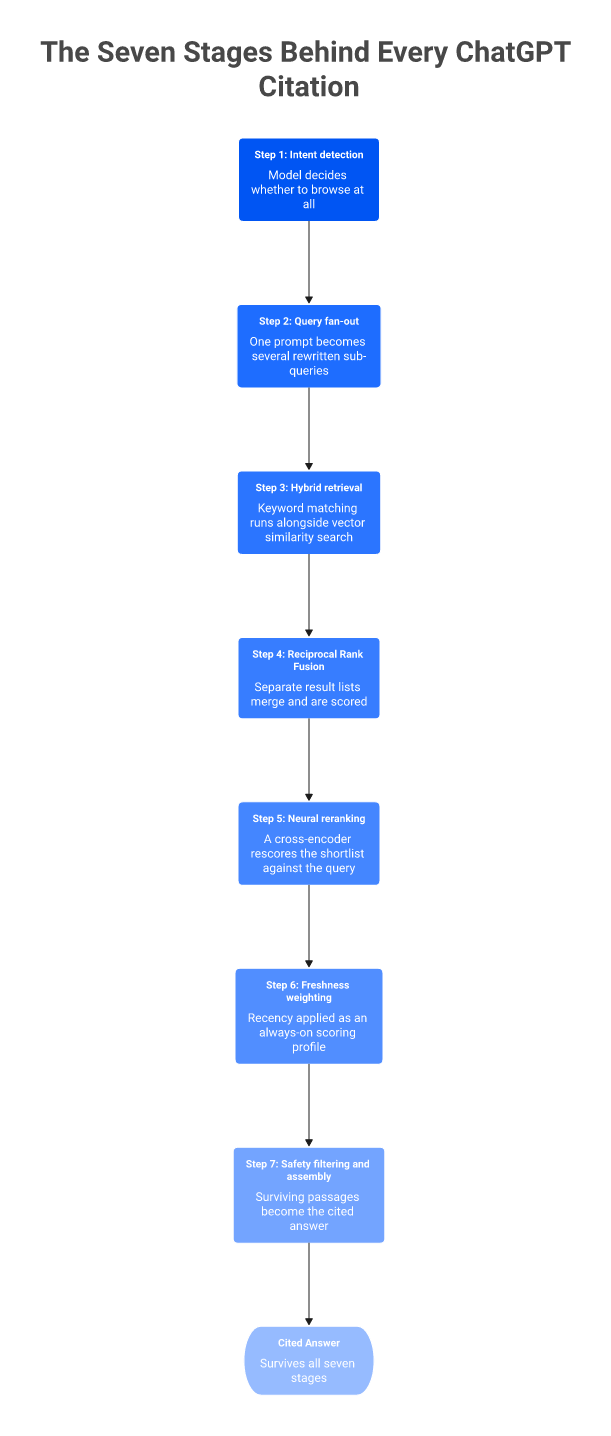
Browse mode runs seven stages: intent detection, query fan-out into multiple rewritten sub-queries, hybrid retrieval combining keyword and vector search, Reciprocal Rank Fusion merging the candidate lists, neural reranking, freshness weighting, then safety filtering and answer assembly. Operationally this runs through Sonic (OpenAI's search orchestrator), Bright Data as retrieval middleware across roughly 429 billion cached pages, and Labrador for licensed publisher content.
📊 The seven stages, in order
- Intent detection. The model decides whether to browse at all.
- Query fan-out. One prompt becomes several rewritten sub-queries.
- Hybrid retrieval. Keyword matching (BM25) runs alongside vector similarity search.
- Reciprocal Rank Fusion. The separate result lists merge, scored at 1/(60 + rank position).
- Neural reranking. A cross-encoder rescores the shortlist against the query.
- Freshness weighting. Recency is applied as an always-on scoring profile.
- Safety filtering and assembly. Surviving passages become the cited answer.
Stage four matters more than it looks. RRF rewards appearing in multiple candidate lists, so a page that surfaces for three of six fan-out sub-queries beats a page that dominates one.
🔍 The named stack behind those stages
Debug metadata exposes the real components. Sonic appears as debug_sonic_thread_id. Bright Data (formerly Luminati) operates the retrieval middleware layer, running 400 million-plus residential IPs and serving fourteen of the top twenty LLM labs. Labrador is the licensed pipeline for news and academic content, returning full article text under ref_type: news or academia for sources like Reuters, MarketWatch, and arXiv.
Everything outside Labrador returns metadata only. OpenAI's own VP of Engineering has confirmed the Bing dependency in plain terms: "we use a set of services and Bing is an important one."
⚠️ What is still genuinely unverified
Bright Data sitting between Sonic and Bing raises a question nobody outside OpenAI can answer. The middleware may blend or re-rank upstream results before the model ever sees them. If that is happening, Bing position is a strong proxy rather than a direct input.
I lean toward treating it as a proxy, though I might be reading the payload inspections too strongly. MaximusLabs AI tests this the only way available, by tracking cited URLs against their Bing positions across fixed prompt sets and watching where the correlation breaks. The pipeline is observable at the edges, not the middle, and anyone claiming full visibility into stage five is overselling. For the mechanics underneath each stage, our ChatGPT search optimization guide breaks the retrieval chain down stage by stage.
Q3. Why does ranking #1 on Google mean almost nothing inside ChatGPT?
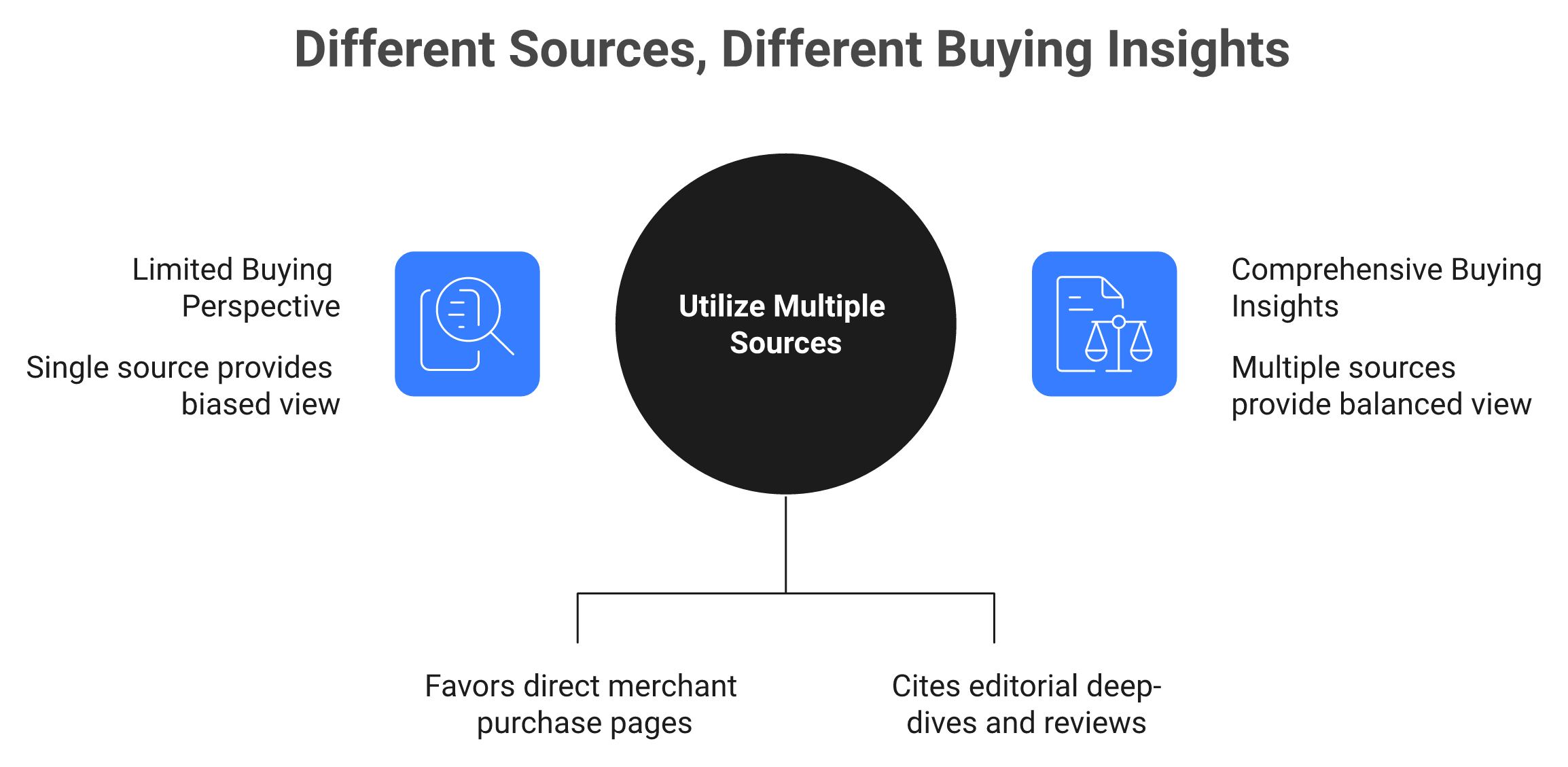
Because they are separate systems with separate inputs. Across 327 commercial queries, Profound found ChatGPT citations and Google results overlapped on only about 8% of URLs, with a correlation near -0.98. Google favoured direct merchant purchase links, while ChatGPT cited editorial deep-dives and review aggregators. Semrush clickstream data shows ChatGPT-cited pages sit at organic position 21 or lower nearly 90% of the time. Rank-one incumbency offers no protection.
💰 The situation: a budget built on transferable authority
Most organic budgets assume authority compounds and travels. You win links, you win rankings, and the rankings carry into whatever comes next. That held for a decade.
It does not hold here. MaximusLabs AI has audited brands holding page-one Google positions that were absent from ChatGPT, Perplexity, and Gemini for the same buying question. The dashboards looked healthy. The consideration set did not include them.
❌ The complication: a negative correlation, not a weak one
A -0.98 correlation is not noise. It means the two systems reward close to opposite things on commercial queries. Google sends buyers to transaction pages. ChatGPT sends them to editorial comparisons and aggregators that help it justify a recommendation.
The Semrush finding compounds it. If cited pages mostly sit below position 20, your rank-one page was never the asset. Krishna's framing is blunt: "A brand can rank #1 on Google and be completely invisible in ChatGPT." The full breakdown of where the two disciplines diverge sits in our GEO versus traditional SEO comparison.
⭐ Why the sample set is more binary than Google ever was
A buyer evaluating a CRM sees five to ten names, not a results page. There is no page two to scroll to. As Krishna puts it, if your company is not on that list, you are not in the buying conversation at all.
That cuts both ways, which is the part most incumbents miss. Because retrieval does not inherit Google's authority ordering, a challenger with better-structured content and stronger third-party presence can enter a set that a billion-dollar competitor misses.
✅ The resolution: audit properties, not keywords
Stop auditing which keywords you rank for. Audit which editorial sites, aggregators, and review platforms get cited when your category's buying questions are asked. Then work out how to appear inside those sources.
MaximusLabs AI took Oliv AI to a 64% AI citation rate in six months, against roughly 30% for legacy incumbents with ten-year domains and far larger balance sheets. That gap exists because ChatGPT's retrieval does not reward incumbency. We mapped the cited sources first, then built into them, and the engagement was measured on pipeline, 27 qualified leads and $47K+ pipeline at a 26% close rate in four months, as documented in the Oliv AI case study.
Q4. How much does your Bing rank control ChatGPT citations?
On commercial comparison queries, Seer Interactive found roughly 87% of ChatGPT citations match Bing's top organic results. The curve is steep. Bing positions 1-3 earn a 62.8% citation rate, positions 4-10 drop to 24.6%, positions 11-20 fall to 8.9%, and pages absent from Bing's index sit at 0.6%. On mixed and informational queries, a 400-query replication put overlap at just 27.4%, because most answers came from parametric memory instead.
📊 The citation curve, by Bing position
| Bing organic position | ChatGPT citation rate | What it means for sequencing |
| 1-3 | 62.8% | The only band worth fighting for on commercial queries |
| 4-10 | 24.6% | Visible, inconsistent, worth a push |
| 11-20 | 8.9% | Effectively a rounding error |
| Not indexed in Bing | 0.6% | You are competing without entering |
The 0.6% row is the one I show clients first. Bing indexation is not an optimization, it is admission. MaximusLabs AI treats Bing Webmaster Tools verification and page-level index checks as a week-one technical audit deliverable, alongside crawler access, before any content ships.
⚠️ Where the 87% number stops being true
The 87% figure comes from commercial "best X" queries. In the 400-query replication across mixed intent, overlap dropped to 27.4%, with 68% of citations traced to training data rather than live retrieval.
So diagnose your own query mix before reallocating effort. Head queries like "best CRM software" are won through third-party citations. Long-tail queries like whether one tool integrates with another are won through owned content. Krishna's three question types framework sorts this cleanly, and Bing rank is a mid and long-tail lever far more than a head-query one.
🔍 The experiment that proves the floor
Ivan Hristov documented a site hit with a manual Bing penalty and an indexing bug. It vanished from ChatGPT Search entirely while holding its Google positions.
That is the cleanest available evidence that Bing indexation is a gate, not a ranking factor. Google rank kept the traffic flowing and did nothing for AI visibility. The two systems failed independently, exactly as the two-system model predicts. Crawl-level behaviour for the engine underneath is covered in our Bingbot crawl optimization guide.
✅ What to actually do with this
Pull your top twenty BOFU URLs. Check each one in Bing Webmaster Tools for index status, then check its Bing organic position for the buying question it targets. Anything unindexed gets fixed first, anything at position 11-20 gets prioritized next, and head-query visibility gets routed to earned media instead.
MaximusLabs AI runs this exact check in week one of every ChatGPT optimization engagement, because publishing into an unindexed site produces a 0.6% citation ceiling no amount of content quality can lift.
Q5. What does the neural reranker reward when it chooses passages?
The reranker scores query-passage pairs jointly, not pages. Microsoft Web IQ runs over a DiskANN3 vector fabric using the Harrier embedding model (a 0.6B/4B Qwen3 backbone), returning passage-level evidence objects at roughly 164ms P95 latency. Scoring runs on Grounding Satisfaction (GDSAT), which measures passage completeness, freshness, and authority rather than keyword relevance. MaximusLabs AI mandates a 40 to 80 word answer block under every H2 because self-contained passages survive reranking and context-dependent ones do not.
🔍 Cross-encoder versus bi-encoder, in plain language
Retrieval and reranking use two different model types. A bi-encoder turns your page and the query into separate number vectors, then checks how close they sit. It is fast, so it handles the first pass across billions of documents.
A cross-encoder feeds the query and your passage into the model together, as one input. It is slower and far more accurate, so it only runs on the shortlist. That single design choice decides how you should write, which is the core of AEO answer structure.
⚠️ Why this forces question-shaped headings
A cross-encoder is asking one thing: does this specific passage answer this specific question? It has no memory of your H1, your intro, or the three sections above.
So a passage that opens with "This is why that matters" scores badly, because the model cannot see what "that" refers to. A passage that restates the question and answers it scores well. MaximusLabs AI tests this by rewriting the same section two ways and tracking which version gets cited across fixed prompt sets.
📊 What GDSAT rewards operationally
Grounding Satisfaction breaks into three things you can actually control.
- Completeness. Does the passage answer fully, without needing the next paragraph?
- Freshness. Is there a visible date, and has the content been updated?
- Authority. Does the passage cite named sources, or does it assert?
Keyword density appears nowhere in that list. MaximusLabs AI audits client sections against those three criteria before publication using our citation-worthy content standards, and the most common failure is completeness, not authority.
✅ The reranker-ready passage template
Here is the structure MaximusLabs AI ships in every article, in order:
- An H2 phrased as the question a buyer actually types.
- A 40 to 60 word direct answer immediately underneath, no runway.
- One sourced statistic with the publisher and year named.
- One attributed quote or a specific worked example.
Each block then stands alone when extracted. That is the whole point, and it is the same principle behind content formatting for AI search.
💡 Where I am still uncertain
Getting into the brain of AI is the frame Krishna uses, and this is the layer where the metaphor is most literal. The reranker is a judgment model, and we are writing for its judgment.
MaximusLabs AI's prompt-set data points toward passage structure mattering more than domain authority at this stage, though I might be reading it too strongly. Reranking is one stage of seven, and a strong passage on an unindexed page still scores zero. The honest position is that structure is necessary and not sufficient.
MaximusLabs AI treats the 40 to 80 word answer block as non-negotiable because the reranker never evaluates a page, it evaluates one passage against nine rivals. Most agencies still write 300-word runways before answering. That runway is invisible to a cross-encoder, and we would rather lose the flourish than the citation.
Q6. Is your meta description now more important than your 3,000-word article?
For standard web retrieval, yes. ChatGPT does not receive full crawled page content. It receives URL, title, date, and a snippet of roughly 150 characters, built from the verbatim meta description, a bulleted or numbered list, intro text, or the text immediately following an H2 or H3. Only licensed publishers routed through the Labrador pipeline pass full article text. Front-loading direct answers in the first 30% of a page correlates with a 44.2% citation share.
❌ What the model actually receives
Payload inspections of the retrieval chain are blunt about this. Bright Data returns structured metadata, meaning URL, title, snippet, and date, not full documents. The practitioner who documented it put it in one line: the snippet is the new rank.
That changes which asset carries your visibility. Your 3,000 words build trust with humans and feed parametric memory over time. Your 150 characters decide whether the model considers you at all today.
📊 The four-source snippet construction order
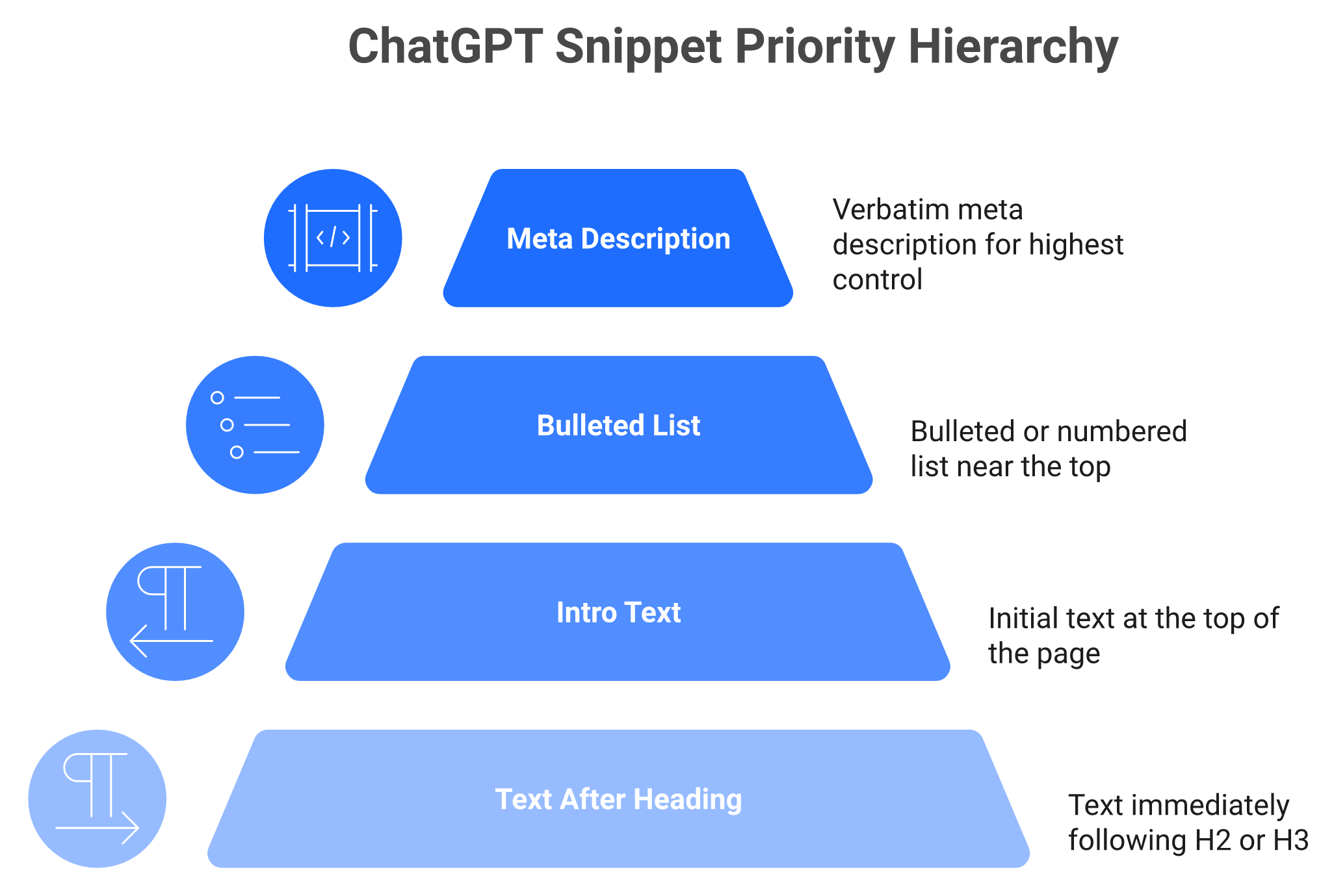
The snippet gets assembled from whichever of these exists first and fits:
- Your verbatim meta description.
- A bulleted or numbered list near the top.
- Intro text.
- Text immediately following an H2 or H3.
Items three and four are why the first 80 words after every heading matter more than the next 400. MaximusLabs AI writes to that budget deliberately, treating the post-heading block as the retrievable unit rather than the section, which is the method behind our GEO content optimization work.
✅ A before and after rewrite
Most meta descriptions are written as teasers. Teasers waste the budget.
Before (vague, 94 characters):
"Learn everything you need to know about getting your brand cited in ChatGPT search results."
After (front-loaded answer, 151 characters):
"ChatGPT cites pages indexed in Bing: positions 1-3 earn a 62.8% citation rate, unindexed pages 0.6%. Allow OAI-SearchBot and submit URLs via IndexNow."
The second version answers the question inside the snippet. If retrieval stops there, the model still has something quotable.
⚠️ Where this claim breaks
I want to be careful here, because the snippet rule is often overstated. Two limits are real.
First, licensed Labrador sources (Reuters, MarketWatch, arXiv) do pass full text, so publishers in that pipeline play by different rules. Second, your long-form depth still earns the links, mentions, and third-party coverage that feed parametric memory. Word count is not wasted, it is just doing a different job than most teams assume.
💰 Where the word count earns its keep
The citation distribution is often described as a ski ramp, front-loaded and then falling away. Content in the top 30% of a page pulls a 44.2% citation share.
So structure the page like a ramp on purpose. Answer in the first 60 words, support it in the next 300, then go deep for the reader who is still with you. MaximusLabs AI builds every section this way, and the discipline is unglamorous: say the thing first, prove it second.
MaximusLabs AI treats the meta description as a retrieval surface, not a click-through teaser, and rewrites it as a 120 to 158 character front-loaded answer on every BOFU page. Most agencies still optimize that field for Google CTR. Both uses are legitimate. Only one of them gets you into a ChatGPT answer. The full field-level walkthrough sits in our ChatGPT SEO guide.
Q7. Which technical signals decide whether you are even eligible to be cited?
Four gates decide eligibility before ranking begins. Allow OAI-SearchBot in robots.txt, since it governs live search while GPTBot governs training data, so blocking GPTBot does not remove you from ChatGPT search and allowing only GPTBot leaves you invisible. Remove noindex from pages you want surfaced. Confirm Bing indexation, because unindexed pages cite at 0.6%. Submit changed URLs via IndexNow, which triggers a Bingbot crawl in 3 to 6 hours.
⚠️ The GPTBot mistake almost everyone makes
OpenAI runs separate crawler tokens for separate jobs, and the names are easy to confuse. Many teams add one OpenAI rule, report "we allowed OpenAI," then see zero citations for months.
The reason is simple. They allowed GPTBot, which feeds training data, and left OAI-SearchBot blocked, which feeds live search. MaximusLabs AI checks both tokens separately in week one, and this is the single most common fixable defect we find. The token-by-token breakdown lives in our guide to managing AI crawlers.
✅ The week-one eligibility checklist
Run these in order. Each is pass or fail.
- robots.txt explicitly allows OAI-SearchBot. Decide GPTBot separately.
- OpenAI's published crawler IP ranges are unblocked at your CDN and WAF, not just in robots.txt.
- No noindex on target pages.
- Every BOFU URL verified as indexed in Bing Webmaster Tools.
- IndexNow wired into the CMS so publishes and updates ping automatically.
MaximusLabs AI ships this checklist before writing a single article, because content published behind a blocked crawler cannot be rescued by quality. You can pressure-test your own setup with our AI crawlability checker.
💸 Crawl hygiene is a budget problem
OAI-SearchBot crawls from Azure ranges, with documented activity out of Des Moines, Iowa, and Phoenix, Arizona. Reported fetch logs show it wasting 34.8% of requests on 404 pages, against 8.22% for Googlebot.
That gap matters because crawl budget is finite. Stale sitemaps, redirect chains, and dead URLs consume fetches that should land on your money pages. MaximusLabs AI cleans sitemaps and redirects before requesting crawls, which is dull work with disproportionate returns.
⏰ Why IndexNow compresses the timeline
Waiting for organic discovery can mean weeks between publishing and eligibility. IndexNow is a simple protocol: you ping the index with changed URLs, and Bingbot typically arrives within 3 to 6 hours.
In practice that compresses ChatGPT citation eligibility to a 24 to 72 hour window. For a product launch or a competitor comparison page, that difference decides whether you are in the answer during the evaluation cycle or after it.
📊 The schema layer underneath
Structured data is how you tell engines what an entity is, not just what a page says. Four types carry most of the weight here:
- Article, with a visible and accurate dateModified.
- Organization, naming your brand as an entity.
- Person for the author, with sameAs links to LinkedIn and Wikidata.
- DefinedTerm for technical concepts like Reciprocal Rank Fusion.
SEO best practice has become the floor for Answer Engine Optimization (AEO), not the building. MaximusLabs AI ships schema markup alongside the crawler fixes, because entity clarity and crawl access fail together.
MaximusLabs AI runs this audit in week one of every engagement, separating robots.txt tokens, unblocking Azure ranges at the CDN and WAF, verifying Bing indexation page by page, and wiring IndexNow into the CMS. We do it before content, and the engagement is still measured on pipeline, not on crawl stats.
Q8. Which off-site trust signals get a B2B product into the sample set?
Review platforms and earned media, not social posts. Of software tools named by ChatGPT in large-sample studies, 100% had Capterra reviews and 99% had G2 listings, with the G2 family accounting for roughly 84% of B2B review citations. Earned media supplied 93.5% of citations for well-known brands. Social media and user-generated content registered 0% for brand and commercial queries. MaximusLabs AI treats claimed review profiles and a Wikidata entity as infrastructure, not marketing.
💰 The scene most marketing teams are living
The monthly report shows rankings climbing and traffic holding. Then the board asks why pipeline is flat, and someone opens ChatGPT to check the category question.
Five competitors get named. Your brand does not. The team's instinct is to go post on Reddit and X, because that is where practitioners say AI visibility comes from.
❌ Where the traditional playbook misreads the signal
Agencies sold rankings, impressions, and clicks on fixed-scope retainers, optimizing the website and ignoring the rest of the web. The AI-era version of that mistake is spending on social surfaces that AI engines discount.
The data is uncomfortable. Social and user-generated content came in at 0% of ChatGPT citations for brand and commercial queries, while earned media carried 93.5% for known brands. Reviews are not a trust ornament in software categories, they are a retrieval prerequisite, which is why E-E-A-T optimization now sits upstream of content.
⭐ What changed, and why it is binary
Buyers now ask ChatGPT, Perplexity, Gemini, and Google AI Overviews, and they get one answer naming five to ten brands. There is no page two. As Krishna puts it, if your company is not on that list, you are not in the buying conversation at all.
AI recommends brands it can justify, because its own credibility rides on the recommendation. Review platforms give it that justification cheaply, which is why the 100% Capterra and 99% G2 figures are so lopsided.
✅ What MaximusLabs AI does about it
MaximusLabs AI runs AEO with SEO underneath, as strategy and execution in one team, and splits the work into two pillars:
- Owned AEO. Your content becomes the answer, structured for passage-level retrieval.
- Earned AEO. Reviews, Reddit, press, and third-party listicles make engines trust you.
Most agencies only run the first. MaximusLabs AI's citation-intelligence engine maps which sources each engine actually trusts per category, then builds the client into those sources with citation acquisition tactics and daily visibility tracking across engines. Humans approve everything that ships.
📊 The entity gate nobody sets up
Reviews get you into the consideration set. A Wikidata entry gets you recognized as an entity in the first place, which matters for the parametric side.
Build it with sameAs links to Crunchbase, LinkedIn, and G2 so the identity resolves across sources. MaximusLabs AI sets this up alongside review profiles, because an unrecognized entity cannot be recommended confidently.
With Nidra Goods, that off-site layer produced simultaneous number one positions across Google, ChatGPT, and Perplexity for "best sleep mask" from a single strategy, as documented in the Nidra case study. On the B2B SaaS side, Oliv AI reached 64% AI citation rate in 6 months, vs ~30% for billion-dollar incumbents, and 30 to 40% of inbound is now AI-sourced. Mentions were the means. Pipeline was the outcome.
Q9. What does the GEO research prove actually moves citations?
Controlled A/B rewrites across 10,000 queries in the Princeton and IIT Delhi GEO paper found that adding quotations lifted position-adjusted visibility by up to 41%, adding statistics by 31%, and citing sources by 28%. Keyword stuffing performed roughly 10% below baseline. The largest single effect was equalising: adding citations lifted visibility for position-5 sources by 115.1%, and the gains replicated on Perplexity at up to 37%.
📊 The ranked results, by effect size
| Optimization applied | Effect on visibility | What it looks like on the page |
| Quotation addition | Up to +41% | A named person or document quoted directly |
| Statistics addition | +31% | A number with publisher and year attached |
| Cite sources | +28% | Visible references, not vague attribution |
| Fluent writing | Positive, smaller | Plain sentences, clear structure |
| Keyword stuffing | About 10% below baseline | Repeated target phrases |
Three of the top four are citation behaviours, not keyword behaviours. That is the finding, stated plainly, and it underpins our GEO strategy framework.
🔍 How the study was actually run
Aggarwal, Murahari, Rajpurohit, Kalyan, Narasimhan, and Deshpande published this at ACM KDD 2024. They tested nine optimization strategies across 10,000 real search queries, using a metric called position-adjusted word count, which measures how much of a generated answer traces back to your source and where it appears.
That methodology matters because it measures prominence inside the answer, not just presence. A source mentioned in the opening sentence scores higher than one buried at the end.
⭐ The equaliser effect challengers should care about
The headline 40% number gets quoted everywhere. The 115.1% figure for position-5 sources almost never does, and it is the more useful one.
It means lower-ranked sources gained the most from structural changes. Pair that with the Semrush finding that ChatGPT-cited pages sit at organic position 21 or lower nearly 90% of the time, and a pattern emerges. Retrieval is not a ladder where authority compounds. It is closer to a filter you either pass or fail, which is why GEO works for SaaS startups with no domain history.
⚠️ One number the industry gets wrong
The paper reports keyword stuffing performing about 10% below baseline. A figure of "-9.7%" circulates widely in GEO blog posts, and it does not appear in the source.
It is a practitioner rounding error that got repeated until it looked precise. I flag it because this whole article rests on traceable numbers, and a fake decimal point is how a field loses credibility. If a stat has no findable origin, treat it as decoration. The same discipline runs through our documented GEO mistakes.
✅ What to do with these effect sizes on Monday
Pull your ten highest-intent BOFU pages. Then run three passes.
- Add one attributed quotation per page, from a named person or a cited document.
- Add one statistic with publisher and year.
- Delete repeated target phrases that exist only for keyword density.
That sequence is cheap, reversible, and the only on-page work in this article backed by a controlled experiment rather than observation.
MaximusLabs AI built its editorial standard around these three levers, requiring one primary source and one quoted or attributed element in every section before publication. The reason is unglamorous: the KDD paper measured it, and most agency content still optimizes for the one variable that tested negative.
Q10. Is ChatGPT visibility actually worth reallocating budget to?
Treat AI search as a high-intent sliver, not a channel replacement. Semrush valued AI search visitors at 4.4x organic on conversion rate, and Pew Research Center found traditional-result clicks fall to 8% from 15% when an AI summary appears. A 95-site benchmark, however, found organic still delivered 39x the traffic, with B2B product companies converting AI referrals at 0.62x organic. MaximusLabs AI sequences BOFU work first for this reason and measures engagements on pipeline rather than mentions.
💰 The situation every vendor deck opens with
The 4.4x number is real and it is everywhere. Semrush's study found AI search visitors converted at 4.4 times the rate of traditional organic visitors.
The logic holds up. The buyer already asked their questions, already got a recommendation, and arrives pre-sold. Krishna's version of this is that AI compressed the buyer journey, so the click you receive is late-stage by default, a pattern we mapped in our B2B SaaS buyer journey research.
❌ The complication nobody puts in the deck
Then you look at volume and the picture changes. In a benchmark tracking 95 websites from September 2025 to August 2026, organic delivered 39 times the traffic of AI assistants, with 100 organic conversions for every 3.2 from AI.
Worse for this audience, B2B product companies in that sample converted AI referrals at 0.62x organic, below parity. Gartner's February 2024 forecast of a 25% drop in traditional search volume by 2026 also did not materialise in aggregate. MaximusLabs AI's own client data skews more positive than the 0.62x figure, though I am not confident the difference is anything but category mix.
⚠️ Why the zero-click shift still forces the move
Both things can be true. AI referral volume is small, and the click economics on Google are compressing anyway.
Pew's browsing study of 68,879 searches found users ended their session 26% of the time when an AI summary appeared, against 16% without one. Krishna's concern goes further: once agents transact, they can read your content and route the purchase to whoever pays them. Being absent from the answer is the risk, not the referral count, which is the argument we make in the zero-click brand economy report.
✅ What MaximusLabs AI does about the budget question
MaximusLabs AI runs Answer Engine Optimization (AEO) with SEO underneath, and starts every engagement on bottom-of-funnel content, expanding to middle-of-funnel only once BOFU is exhausted. Top-of-funnel gets skipped deliberately, because AI engines answer "what is X" without sending anyone anywhere.
| Approach | What gets funded first | What gets reported |
| Traditional SEO agency | TOFU volume, keyword coverage | Rankings, impressions, sessions |
| Generalist GEO add-on | Prompt-tracking dashboard | Mention counts, citation screenshots |
| MaximusLabs AI | BOFU pages, then MOFU, with crawl and entity fixes first | Share of voice and AI-influenced pipeline |
⭐ The honest resolution
Fund AI search as a margin play on existing demand, not as a replacement for organic. Keep SEO running, because it is still carrying the volume. The revenue logic behind that split sits in our revenue-focused GEO framework.
Oliv AI reached 64% AI citation rate in 6 months, vs ~30% for billion-dollar incumbents, and 30 to 40% of inbound is now AI-sourced. That is MaximusLabs AI's own published client data, and the number we actually report is pipeline: 27 qualified leads, $47K+ pipeline, 26% close rate in 4 months. Mentions were never the deliverable.
Q11. How do you measure ChatGPT visibility without overpaying for a tool?
Buy the cheapest tool that tracks what you need, then instrument attribution yourself. More than 60 AEO trackers query vendor API endpoints rather than live logged-in browser sessions, so they miss personalised memory and live search orchestration. The baseline costs almost nothing: a GA4 channel isolating utm_source=chatgpt.com, tied to pipeline stages rather than pageviews. MaximusLabs AI reports share of voice across fixed prompt sets and AI-influenced pipeline, not citation screenshots.
💸 The situation: a new tracker launches every week
Ethan Smith, CEO of Graphite, put the state of the category bluntly in a practitioner talk: "We have a page with 60+ AEO tools and they all do the same thing: They all do tracking... Pick the tool that does what you want and has the lowest cost. And two years from now, you'll probably be using Ahrefs anyway."
He also mentioned building an in-house tracker that cost a few cents per question. That is the honest price floor for prompt tracking, and it reframes what the subscription is really buying. Our own comparison of ChatGPT tracking tools reaches the same conclusion on feature parity.
❌ The complication: API responses are not what users see
Most trackers hit an API endpoint. A real user hits a logged-in interface with memory, personalisation, and live search orchestration.
Those two surfaces diverge. A brand can look cited in an API response and be absent in the product, or the reverse. MaximusLabs AI runs prompt sets against the live interface for this reason, and treats API-only numbers as directional at best.
⚠️ Tracking infrastructure is fragile by design
Mark Williams-Cook built queryfan.com to capture ChatGPT's hidden background sub-queries, which is genuinely useful intelligence. Then OpenAI obfuscated the background search logs in newer builds, and the workflow stopped working.
That story is the real risk in this category. You are measuring a system whose owner has no obligation to keep your measurement working. MaximusLabs AI assumes any single tracking method will break, which is why we regression-test prompt sets rather than trusting one dashboard. The same fragility shapes how we pick brand mention tracking tools.
✅ The three metrics worth reporting
Drop everything else. These three survive a board meeting.
- Share of voice. How often your brand appears across a fixed set of buying questions, measured the same way each time.
- Cited-URL inventory. Which of your pages actually get cited, and for which prompts.
- AI-influenced pipeline. Sessions tagged utm_source=chatgpt.com in GA4, mapped to opportunities and closed revenue.
MaximusLabs AI builds the prompt set from how a client's ICP actually phrases buying questions, then re-runs it on a fixed cadence across engines so changes are comparable month to month. The attribution method behind it is documented in our guide to calculating GEO ROI.
⭐ Why rank was always the wrong unit here
There is no single position in an AI answer. The same question asked three ways returns three different brand sets.
So the only honest measure is frequency across variants. MaximusLabs AI built its own tracking rather than renting a dashboard, because vendors reselling API-based rank tracking measure a surface no buyer ever sees. Dashboards that make a client feel good without moving revenue are the first thing we remove when we inherit an account.
Q12. What should you change in the next 30 days, stage by stage?
Work the pipeline in order of gate severity. Week 1: separate OAI-SearchBot from GPTBot in robots.txt, unblock OpenAI's published IP ranges, verify Bing indexation, and wire IndexNow. Week 2: rewrite meta descriptions on your top 20 BOFU pages as 120 to 158 character front-loaded answers. Week 3: claim G2 and Capterra, publish a Wikidata entity. Week 4: add one sourced statistic and one attributed quotation per page, then baseline share of voice. MaximusLabs AI runs this sequence as week-one technical work before any content ships.
📊 Stage to lever to metric
| Pipeline stage | Your lever | The metric to watch |
| Intent detection | Match page intent to buying questions | Prompts that trigger browsing in your category |
| Query fan-out | Cover sub-question variants on one page | Variant coverage per prompt set |
| Hybrid retrieval | Bing indexation plus semantic clarity | Indexed BOFU URLs |
| Reciprocal Rank Fusion | Appear for multiple sub-queries | Candidate appearances per prompt |
| Neural reranking | Self-contained 40 to 80 word answer blocks | Cited-passage rate |
| Freshness weighting | Visible dateModified, real updates | Days since last substantive update |
| Answer assembly | Snippet quality and entity clarity | Cited-URL share |
MaximusLabs AI audits clients against this map rather than a keyword list, because each row fails independently and needs a different fix. The implementation detail for each row sits in our technical GEO implementation guide.
⏰ The four-week sequence, in priority order
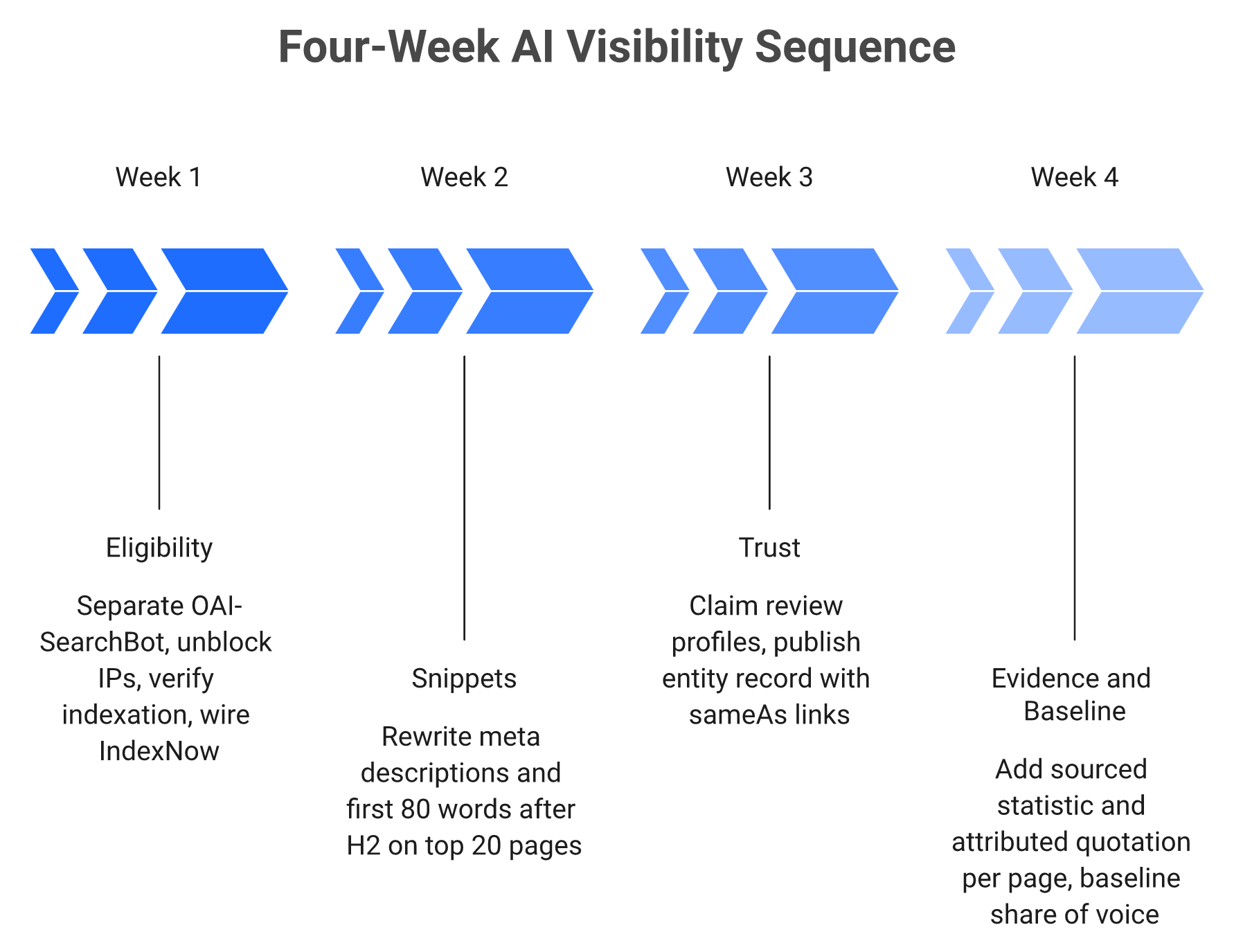
- Week 1, eligibility. Crawler tokens, CDN and WAF rules, Bing index checks, IndexNow in the CMS.
- Week 2, snippets. Meta descriptions and the first 80 words after every H2 on your money pages.
- Week 3, trust. Claimed review profiles with real reviews, plus a Wikidata entity with sameAs links.
- Week 4, evidence and baseline. Quotations, statistics, and your first share-of-voice measurement.
Sequence matters more than speed. Rewriting snippets on a page the crawler cannot reach returns nothing. The full task list is broken out in our AEO implementation checklist.
✅ What MaximusLabs AI does differently here
MaximusLabs AI runs AEO with SEO underneath, as strategy and execution in one team, with a technical audit in week one and the first article live by day four. The structural contrast with traditional agencies is simple: they open with a keyword list, and we open with whether ChatGPT's crawler can reach you at all.
UnderDefense is currently competing against multi-deca-billion-dollar cybersecurity incumbents on this sequence. Budget was never the variable that decided it, which is the same pattern across our cybersecurity AEO work.
⚠️ What I am still watching
Agentic search is the next retrieval layer, and it changes the stakes. If agents transact on a buyer's behalf, being cited stops being the finish line and becomes the entry fee.
MaximusLabs AI's read is that GEO gets more important as it stops being about search at all, though the timeline is genuinely unclear. My hypothesis is that the brands with clean entity graphs and real third-party trust will transfer most easily into that layer, a thesis we test in the state of agentic commerce report. I could be early on this, and I would rather be early than retrofitting later.
Frequently asked questions
Does ChatGPT use Google rankings to decide which sources to cite?
No. ChatGPT runs its own retrieval and reranking pipeline, and Google rank does not transfer into it. The evidence is unusually clear. Across 327 commercial queries, ChatGPT citations and Google results overlapped on only about 8% of URLs, with a correlation near -0.98. Google favoured direct merchant purchase links. ChatGPT favoured editorial deep-dives and review aggregators. Semrush clickstream data adds that ChatGPT-cited pages sit at organic position 21 or lower nearly 90% of the time. What that means practically: • A page-one Google position offers no protection in AI answers. • A challenger with better-structured passages and stronger third-party presence can enter a consideration set an incumbent misses. • Auditing keyword rankings tells you almost nothing about AI visibility. MaximusLabs AI has audited brands holding page-one Google positions that were completely absent from ChatGPT, Perplexity, and Gemini for the same buying question. The dashboards looked healthy while the pipeline did not. We now start by mapping which editorial properties, aggregators, and review sites get cited in a category, a method documented in our GEO versus traditional SEO comparison.
Does ChatGPT read my entire article or only a short snippet?
For standard web retrieval, only a short snippet. ChatGPT does not receive full crawled page content. Payload inspections of the retrieval chain show the model receives structured metadata: URL, title, date, and a snippet of roughly 150 characters. The exception is licensed publisher content routed through the Labrador pipeline, which does pass full article text for sources such as Reuters, MarketWatch, and arXiv. That snippet gets assembled from whichever of these exists first and fits: • Your verbatim meta description. • A bulleted or numbered list near the top of the page. • Intro text. • Text immediately following an H2 or H3 heading. So the first 80 words after every heading carry more retrieval weight than the next 400. Content in the top 30% of a page pulls roughly a 44.2% citation share. MaximusLabs AI treats the meta description as a retrieval surface rather than a click-through teaser, rewriting it as a 120 to 158 character front-loaded answer on every bottom-of-funnel page. Your long-form depth still earns the mentions and links that feed parametric memory, which is a different job. The field-level method sits in our GEO content optimization guide.
What is the difference between GPTBot and OAI-SearchBot?
They are separate crawler tokens doing separate jobs, and confusing them is the most common fixable mistake in AI visibility. • GPTBot governs training data collection. • OAI-SearchBot governs live search retrieval, which is what decides whether you can appear in ChatGPT search answers. Two consequences follow. Blocking GPTBot does not remove you from ChatGPT search. Allowing only GPTBot leaves you invisible in it. Many teams add a single OpenAI rule, report that they have allowed OpenAI, then see zero citations for months. Robots.txt alone is also not enough. OpenAI publishes crawler IP ranges, and those need to be unblocked at your CDN and WAF layer too. Crawl hygiene matters as well: reported fetch logs show OAI-SearchBot wasting 34.8% of requests on 404 pages, against 8.22% for Googlebot, so stale sitemaps and redirect chains burn budget that should land on money pages. MaximusLabs AI checks both tokens separately in week one of every engagement, before any content ships, because publishing behind a blocked crawler cannot be rescued by quality. You can test your own setup with our AI crawlability checker.
How much does my Bing ranking actually affect ChatGPT citations?
On commercial comparison queries, a great deal. On informational queries, much less. Seer Interactive found roughly 87% of ChatGPT citations matched Bing's top organic results for commercial queries. The curve is steep: • Bing positions 1-3: 62.8% citation rate. • Positions 4-10: 24.6%. • Positions 11-20: 8.9%. • Not indexed in Bing: 0.6%. The nuance matters, though. A 400-query replication across mixed intent put Bing overlap at just 27.4%, with 68% of citations traced to training data rather than live retrieval. So diagnose your own query mix before reallocating effort. Head queries are won through third-party citations. Long-tail product questions are won through owned content. The cleanest proof of the gate comes from Ivan Hristov, who documented a site hit with a manual Bing penalty and an indexing bug. It vanished from ChatGPT Search entirely while holding its Google positions. MaximusLabs AI verifies Bing indexation page by page as a week-one deliverable, because an unindexed page carries a 0.6% ceiling no content quality can lift. The crawl-level detail sits in our Bingbot crawl optimization guide.
How do I track whether ChatGPT is citing my brand?
Buy the cheapest tool that tracks what you need, then instrument attribution yourself. The expensive part is usually unnecessary. More than 60 answer engine optimization trackers query vendor API endpoints rather than live logged-in browser sessions. Those two surfaces diverge, because the real product includes personalised memory and live search orchestration. A brand can look cited in an API response and be absent in the interface a buyer actually uses. The baseline instrumentation costs almost nothing: • Share of voice. How often your brand appears across a fixed set of buying questions, measured the same way each run. • Cited-URL inventory. Which of your pages get cited, and for which prompts. • AI-influenced pipeline. Sessions carrying utm_source=chatgpt.com in GA4, mapped to opportunities and closed revenue rather than pageviews. Tracking infrastructure is also fragile by design. Mark Williams-Cook built queryfan.com to capture ChatGPT's hidden background sub-queries, then abandoned it once OpenAI obfuscated those logs. MaximusLabs AI builds prompt sets from how a client's ICP phrases buying questions and re-runs them on a fixed cadence, so month-to-month changes are comparable. Our tooling comparison lives in best ChatGPT tracking tools.
Do Reddit, X, and LinkedIn posts improve ChatGPT citations?
For brand and commercial queries, the measured influence is close to zero. Review platforms and earned media carry the weight instead. Large-sample studies of software tools named by ChatGPT found: • 100% had Capterra reviews and 99% had G2 listings. • The G2 family accounted for roughly 84% of B2B review citations. • Earned media supplied 93.5% of citations for well-known brands. • Social media and user-generated content registered 0% for brand and commercial queries. That does not make community presence worthless, since forum threads still surface on some informational queries. It does mean reviews are not a trust ornament in software categories. They are a retrieval prerequisite, and most teams file them under the sales team's job rather than infrastructure. There is a second gate underneath. A Wikidata entity with sameAs links to Crunchbase, LinkedIn, and G2 helps engines resolve your brand as a recognizable entity at all, which matters on the parametric side where no retrieval happens. MaximusLabs AI treats claimed review profiles and entity records as week-three infrastructure alongside content. With Nidra Goods, that off-site layer produced simultaneous number one positions across Google, ChatGPT, and Perplexity, documented in the Nidra case study.
How long does it take for a new page to appear in ChatGPT answers?
With the right setup, eligibility can compress from weeks to roughly 24 to 72 hours. Citation itself takes longer and is never guaranteed. The mechanism is IndexNow. You ping the index with changed URLs, Bingbot typically arrives within 3 to 6 hours, and the page becomes eligible for live retrieval shortly after. Without it, you wait on organic discovery. Sequence the work by gate severity: • Week 1. Separate OAI-SearchBot from GPTBot, unblock OpenAI's IP ranges at CDN and WAF, verify Bing indexation, wire IndexNow into the CMS. • Week 2. Rewrite meta descriptions on your top 20 bottom-of-funnel pages as front-loaded answers. • Week 3. Claim G2 and Capterra profiles, publish a Wikidata entity. • Week 4. Add one sourced statistic and one attributed quotation per page, then baseline share of voice. Rewriting snippets on a page the crawler cannot reach returns nothing, so order matters more than speed. MaximusLabs AI runs the technical audit in week one and ships the first article by day four, with the engagement measured on pipeline rather than mentions. The full task list sits in our AEO implementation checklist.