 Krishna Kaanth M
- Perplexity is an answer engine, so the goal is to become the cited answer, not rank a blue link, because over 70% of searches now end without a click.
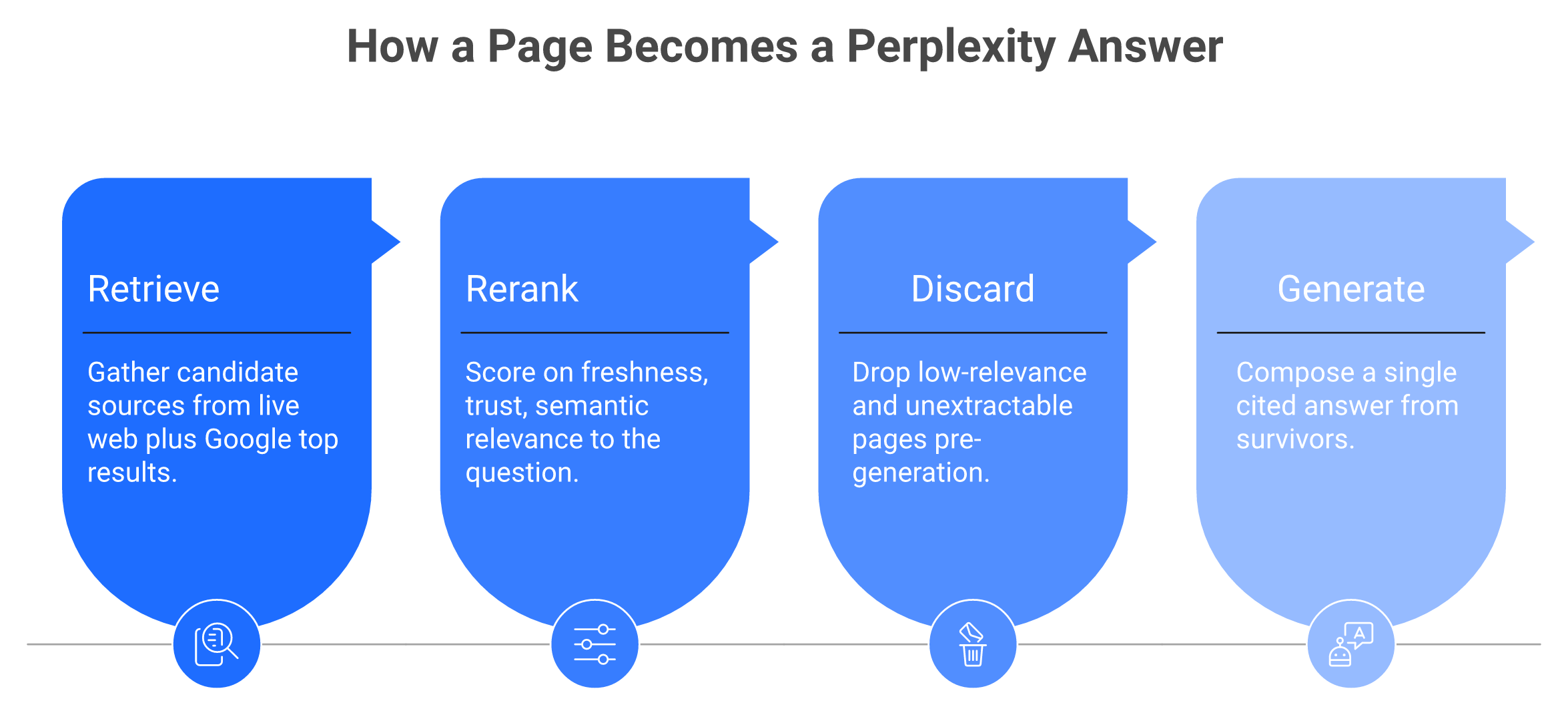
- Perplexity runs a fast retrieve, rerank, discard, and generate pipeline that rewards fresh, trusted, semantically relevant, and cleanly extractable HTML content.
- Traditional SEO is the floor, not the ceiling; roughly 60% of Perplexity citations overlap Google's top 10, but keyword stuffing carries a visibility penalty.
- Earned third-party mentions beat self-published claims, with best-of lists driving about 64% of recommendation weighting and Reddit near 6.6% of citations.
- Structured documentation gets cited far more than blogs (roughly 46 to 70% versus 3 to 6%), and answer-first structure wins extraction.
- LLM traffic converts far higher (Webflow reported 6x), so measure share of voice and pipeline, and treat brand authority as the durable moat.
Q1. What is Perplexity AI optimization, and why is "ranking" the wrong goal?
A VP of Marketing I spoke with last quarter had a problem she could not name. Her team held the number-one Google spot for their core category term. Yet when she asked Perplexity the same question, her brand was nowhere in the answer. The traffic report looked fine. The pipeline did not.
Perplexity AI optimization is the practice of getting your content selected and cited as a source inside Perplexity's synthesized answers, not ranking a blue link. Perplexity is an answer engine: users ask, it retrieves live sources, reranks them, and generates one cited answer. The goal shifts from "be on page one" to "become the answer," because in a zero-click flow, uncited brands are invisible to the buyer.
🔎 The behavior shift nobody prepared you for
Buyers stopped scrolling ten blue links. As one practitioner put it, people are "asking a question, getting an answer, and that's it. There's no click-through." The unspoken request behind every prompt is simple: "just do it for me."
That changes the stakes. Over 70% of searches now end without a click, according to our own zero-click search analysis. So the old scoreboard, position and impressions, measures a game buyers stopped playing.
⚠️ Why exclusion is worse than a low rank
On Google, page two still existed. In an AI answer, there is no page two. Perplexity surfaces a short set of sources, and if you are not in it, you are not in the buyer's consideration set at all.
I might be overstating the speed of this, but from what surfaces when you actually run these prompts, the pattern holds. The penalty for being average has never been so severe. Being cited without a click still wins the buyer, because Perplexity lends you its own credibility.
✅ The real scoreboard: citation share, not position
The standard read gets this backwards. Success is not "did I rank," it is "how often am I the cited answer across the questions my buyers ask." That is a share-of-voice question, not a ranking one.
This reframe is the founding premise of our work at MaximusLabs. We build content to become the answer AI engines reference through our generative engine optimization approach, not just another URL competing for a click Google increasingly hides behind ads and its own modules.
Q2. How does Perplexity choose its sources, and what are its real ranking factors?
Most guides describe Perplexity as a mystery box. It is not. It is a fast, brutal pipeline with measurable budgets, and once you see the steps, the "ranking factors" stop feeling like folklore.
Perplexity runs a live search, then a multi-stage pipeline: fast first-stage hybrid retrieval (roughly a 100ms budget), expensive cross-encoder reranking, then generation via its Sonar model. Its core ranking factors are content freshness, domain authority, early user engagement, and semantic relevance. Passages that are fresh, trusted, specific, and cleanly extractable in plain HTML win; content that cannot be parsed in that window never reaches the answer.
⏰ The four-step flow, in plain language
Think of it as retrieve, rerank, discard, generate. Perplexity searches, pulls candidate passages, reranks them through a heavier model, drops what does not clear the bar, then writes the answer.
The retrieval step runs inside a tight window. The exact first-stage budget is about 100 milliseconds before the expensive cross-encoders run. If your page cannot be fetched and parsed that fast, it loses before quality is even judged.
⚙️ The ranking factors that actually move citations
Analysts who reverse-engineered the reranker describe a layered system that scores retrieved passages before the answer is written. The signals that consistently matter:
- Freshness: recently published or updated content gets a visible boost.
- Domain authority: approved, trusted domains get cited more often.
- Early engagement: how users interact with content shapes later ranking.
- Semantic relevance: the passage must directly match the query's intent, not just the keyword.
📊 Why grounding must be high-speed and passage-level
Perplexity's Sonar model, built on Llama 3.3 70B, generates at roughly 1,200 tokens per second on Cerebras hardware. That speed forces passage-level grounding, so it reaches for clean, self-contained chunks rather than whole messy pages.
Its embedding model carries a 32,000-token context window, letting it index very long documents as single retrievable passages. Freshness compounds this: citations decay noticeably as content ages over 30 and 90 day windows, so stale pages quietly fall out of answers.
This is why I keep repeating that GEO is not SEO, it is a data science problem. You have to understand how Perplexity works to survive the retrieval step, not treat it like a content tweak on top of your old Google playbook.
Q3. Does traditional SEO still matter for Perplexity, or is it a waste of time?
Here is a scene that repeats in audits. A founder shows me a page ranking well on Google, then asks why Perplexity ignores it. The instinct is to blame "AI weirdness." The real answer is more useful, and a little uncomfortable.
Traditional SEO is necessary but not sufficient. Roughly 60% of Perplexity's citations overlap with Google's top 10, and one study puts its Google overlap near 70% versus ChatGPT's 35%, making Perplexity the most Google-correlated AI engine. So crawlability, authority, and indexing still gate you in. But Core Web Vitals and keyword density will not earn citations; extractable, trusted, fresh content does.
🧭 The situation: SEO is the floor, not the ceiling
Because Perplexity leans heavily on the same signals as Google's top results, classic fundamentals still decide whether you are even eligible. If you are absent from Google's top 10, you are usually absent from Perplexity too.
That makes Perplexity different from ChatGPT, where Google overlap runs closer to 35%. Understanding how GEO differs from traditional SEO matters here, because a Perplexity strategy that copies a ChatGPT playbook misreads the engine.
🧯 The complication: the "technical AEO" security blanket
Here is where teams waste money. They commission 50-page technical audits and treat Core Web Vitals as the path to AI visibility. From the work I have actually sat inside, that is a security blanket, not a strategy.
A blunt version of this came from a veteran who has lived through two decades of algorithm shifts: "technical SEO is the biggest waste of time... In 15 years, I've never seen Core Web Vitals drive a traffic increase." I might be wrong at the margins, but the citation data backs the sentiment.
❌ The proof: what actually hurt on Perplexity
Testing showed keyword stuffing carried roughly a 10% visibility penalty specifically on Perplexity, the only tactic that performed worse than doing nothing. So the old "optimize the string" reflex is not neutral here, it is negative.
✅ The resolution: move budget to trust and extractability
Keep the fundamentals that gate you in: indexing, clean HTML, authority. Then move the rest of the budget from audit theater toward extractable, trusted, frequently refreshed content. This is the trust-first approach we run at MaximusLabs, and it is where we watch citations actually appear, unlike Google-only shops still selling Core Web Vitals reports.
Q4. What content structure earns citations inside Perplexity answers?
I once watched a team bury their best answer in paragraph seven, under a warm-up nobody reads. Perplexity read the warm-up, found no clean answer near the top, and cited a competitor instead. The fix cost nothing but a reorder.
Perplexity favors answer-first content: put the direct answer in the first 100 words of each section, use question-based headings, and format with short, self-contained blocks and lists. Roughly 90% of top Perplexity citations place the answer in the first 100 words. Front-load the conclusion and write so any single paragraph makes sense if lifted out of context into an answer.
📝 Lead with the answer, then support it
The dominant pattern is unmistakable: about 90% of top Perplexity citations put the answer in the first 100 words. Perplexity grounds on passages, so a section that opens with a clean, standalone answer is far easier to lift.
Put the conclusion first, then the reasoning and evidence. Save the story for after you have already answered the question.
🧱 Write blocks that survive extraction
Question-based headings and self-contained blocks correlate with more citations, because they map to how people actually prompt. Each block should make sense alone, with no "as we discussed above" dependencies.
A quick extractability checklist:
- Answer in the first 100 words of every section, phrased to stand alone.
- Question-shaped headings that mirror real buyer prompts.
- Short, self-contained blocks and lists, no orphaned "it" or "this" referring elsewhere.
✅ Why this is a methodology, not a hack
This is exactly why we write every section as a standalone 40 to 80 word answer nugget through our answer engine optimization process, engineered so Perplexity can extract it cleanly. It is a repeatable production standard, not a one-off trick, which is what separates it from generic "write good content" advice. If your team wants that standard applied to your pages, talk to us.
Q5. Why does Perplexity trust third-party mentions more than your own claims?
A founder once told me his homepage said he was "the leading platform" in his category. Perplexity disagreed. It cited a Reddit thread and two review sites instead, and none of them used his words.
Perplexity weights web-wide consensus over self-published claims, so earned mentions on trusted third-party sites often outweigh anything you say about yourself. Authoritative "best-of" list mentions drive roughly 64% of Perplexity's general recommendation weighting, and Reddit alone accounts for about 6.6% of all Perplexity citations. Getting mentioned where Perplexity already looks matters more than polishing your own homepage copy.
🧭 The situation: consensus beats self-description
Perplexity builds its answer from what the wider web agrees on, not from your marketing page. It reads the room, then repeats the room's verdict. Your own claims are just one small, biased vote.
That is a hard shift for teams who spent years perfecting on-site copy. The page you control matters least where you assumed it mattered most.
😳 The complication: a hallucination that proved the point
Here is a moment that stuck with me. A practitioner watched Perplexity summarize his team's article and confidently label them "Oxford researchers," when, as he put it, "none of us attended Oxford unfortunately."
The lesson was not the error. It was the mechanism: Perplexity trusted web-wide signals and pattern consensus over the authors' own stated bios. Consensus won, even when consensus was wrong.
📊 The proof: where the weighting actually sits
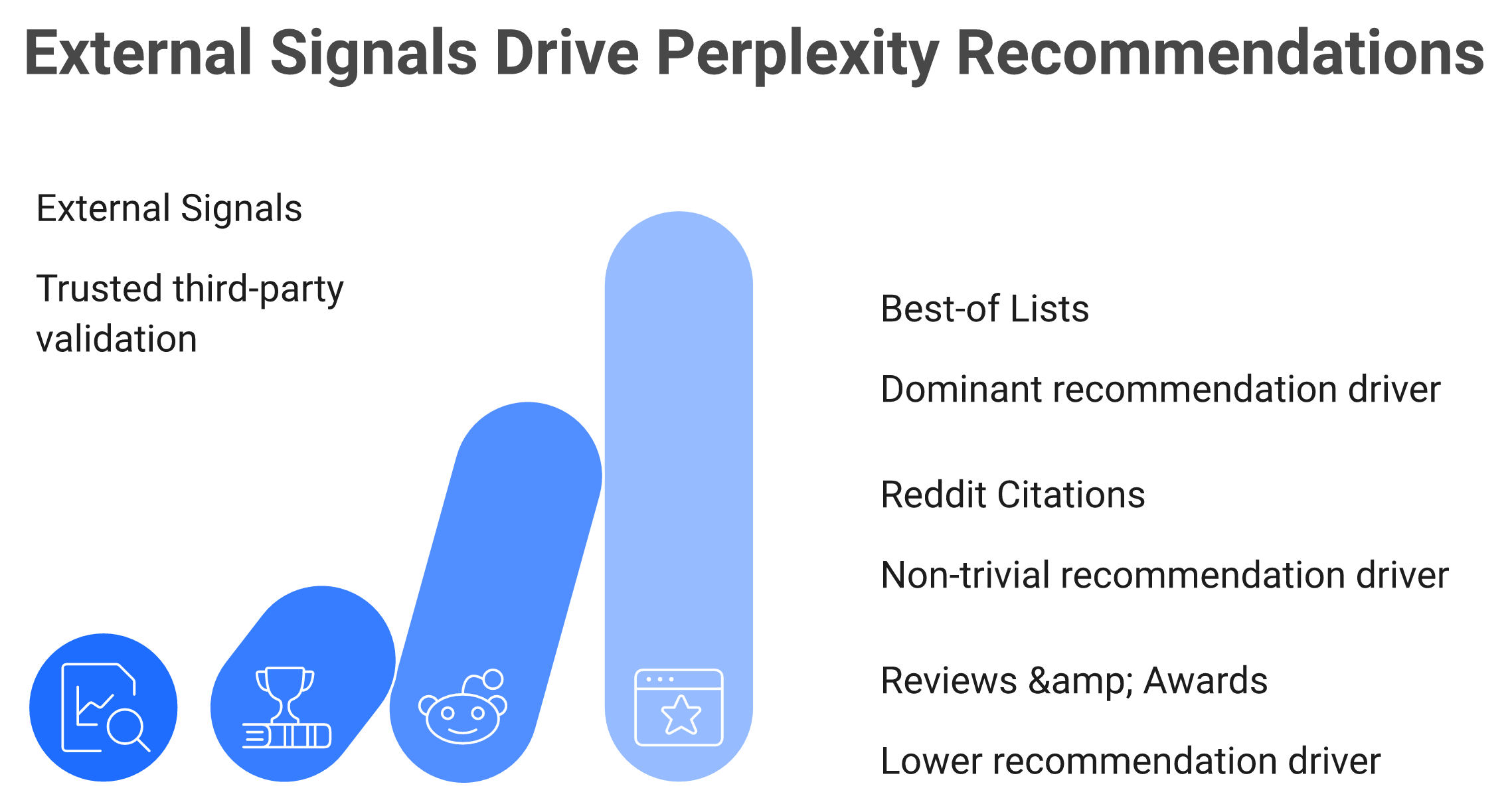
The numbers back the story. Analyst research found authoritative "best-of" list mentions drive about 64% of Perplexity's general recommendation weighting, far ahead of reviews or awards.
Community platforms carry real weight too. Reddit alone accounts for roughly 6.6% of all Perplexity citations, making it a channel you cannot ignore. Our Reddit and forum optimization work is built around exactly this signal.
✅ The resolution: optimize where Perplexity already looks
Stop over-investing in words only you publish. Move effort toward earned mentions on the trusted lists, communities, and review sites Perplexity actually cites through disciplined citation acquisition.
This is precisely why we run Search Everywhere Optimization at MaximusLabs, building a 360-degree presence across G2, Reddit, and authoritative roundups, not just the client's own site. Traditional Google-only agencies optimize the homepage and stop there, which leaves the consensus signal, the one Perplexity trusts most, completely unmanaged. Our GEO service is designed to close that gap.
Q6. Is your most valuable content invisible to Perplexity's crawler?
I keep a browser bookmark that disables JavaScript with one click. I use it in the first five minutes of almost every audit, because it settles an argument before anyone can start it.
Often yes, your best content is invisible. PerplexityBot does not execute JavaScript, so content loaded asynchronously, reviews, product facets, filtered attributes, is invisible to it. Toggle JavaScript off in your browser: whatever disappears is what Perplexity cannot see. Bring hidden facet data into plain-text FAQs and headers, ensure server-side HTML, keep Bing indexing live, and unblock PerplexityBot in robots.txt.
⚙️ The crawler reads HTML, not your fancy front-end
PerplexityBot fetches and parses raw HTML. It does not run the JavaScript that loads reviews or product data after the page opens.
So the fundamentals are non-negotiable: serve critical content as server-side-rendered HTML, keep the site indexed in Bing, and use IndexNow to signal updates fast. A thorough technical SEO and website audit catches these gaps, and you should confirm you have not accidentally blocked PerplexityBot in robots.txt.
🔎 The JavaScript toggle: a one-click moment of truth
A practitioner demonstrated this on a major retailer's page. He turned JavaScript off, and, in his words, "not the whole page shows up... reviews are loaded in asynchronously and they're not seen."
A multi-billion-dollar brand was hiding its most valuable data from the crawler by accident. Try the toggle on your own money pages, or run our AI crawlability checker to confirm. Whatever vanishes is invisible to Perplexity.
🧱 Expose the facet data buried in filters
Perplexity cannot click your JavaScript filters. So the attributes hiding inside them, as one practitioner noted, "the closure and the fabric and the material and the neck style," never reach the answer.
Those attributes are exactly what win "best product for [attribute]" queries. Pull that metadata into plain-text FAQs and headers so the crawler can actually read it.
⚠️ The honest part: schema and llms.txt are not silver bullets
Here the category disagrees, and I would rather be straight with you. One agency, SALT.agency, calls schema "a hygiene factor at best," while Surfer Academy argues it "increases your odds significantly." My read on schema markup: worth doing, not a differentiator.
Same skepticism for llms.txt, the proposed file for guiding AI crawlers. There is currently no solid evidence it moves rankings at all. We flag that uncertainty openly, unlike vendors selling technical audits as the whole answer.
Q7. How do B2B brands win with documentation and topic clusters instead of blogs?
A B2B team showed me a content budget that was 90% blog posts. Their docs were an afterthought on a subdomain. Perplexity was citing their docs anyway, and almost never the blog.
For B2B, structured documentation gets cited far more than editorial blogs. Technical docs are cited at roughly 46 to 70% versus blogs at 3 to 6% for relevant queries. Perplexity rewards comprehensive documentation hubs and topic clusters that prove whole-site expertise. Shift budget from thin blog posts to structured docs, help-center content, and hub-and-spoke clusters answering the long tail of specific product questions.
📊 The finding: docs get cited, blogs mostly do not
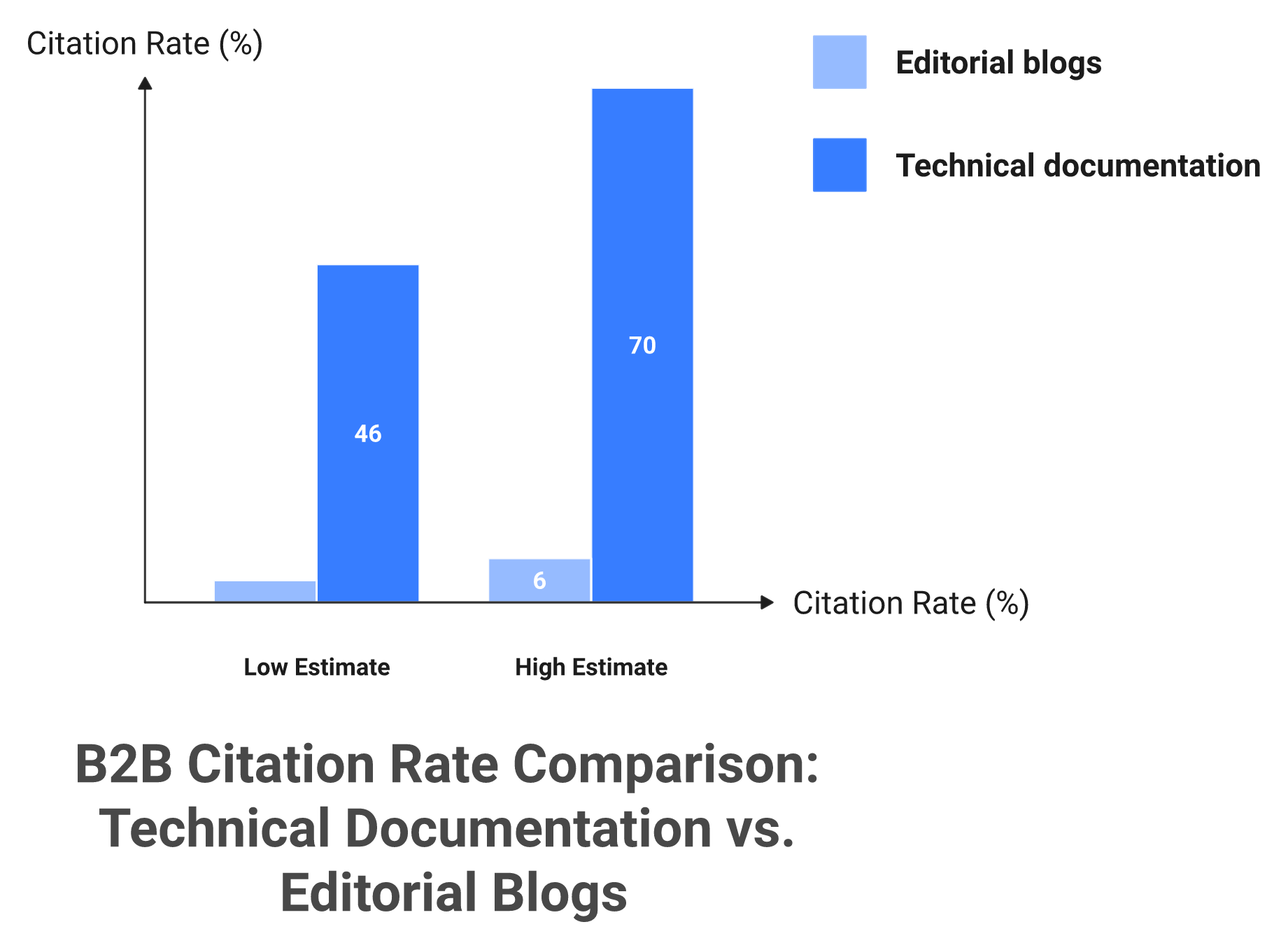
The citation gap is stark. For relevant B2B queries, technical docs get cited at roughly 46 to 70%, while blogs sit at just 3 to 6%.
That is a direct instruction for how you spend. Move budget from editorial blog churn toward structured documentation that answers real product questions.
🧩 Topical authority is a whole-site signal
Perplexity does not judge one page in isolation. It reads clusters, evaluating whether your site demonstrates deep, connected expertise on a topic.
Sites with tight topic clusters dominate citations in their category. A cluster of interlinked, comprehensive pages beats one heroic standalone post nearly every time.
✅ The payoff: build hubs, not scattered posts
Prioritize a hub-and-spoke structure. A comprehensive hub page anchors the topic, and spoke pages answer the specific, long-tail questions buyers ask AI engines.
This is the exact architecture we run at MaximusLabs: hub pages of 5,000 to 8,000 words, spokes of 2,500 to 4,000, with no cannibalization between them. Our content marketing service produces documentation-grade topical authority, which is what generalist agencies pumping out disconnected TOFU blog posts structurally cannot deliver.
Q8. Why does Perplexity traffic convert far better than Google traffic?
A Head of Growth I know celebrated a traffic milestone last year. Six months later, her CFO asked why the pipeline had not moved. The traffic was real. The revenue was not.
Perplexity and other LLM traffic convert far higher than Google traffic. Webflow reported a 6x conversion-rate difference, because buyers arrive pre-sold. They have already done their question-asking with the AI, which pre-qualified you and named you as a recommended option. The journey is compressed: instead of ten open tabs, they arrive with intent, so citations translate into pipeline more directly than impressions ever did.
🧭 The situation: this traffic behaves differently
AI-referred visitors are not casual browsers. They arrive after a conversation that already narrowed their options and named you as a fit. The research happened inside the AI, before the click.
That compresses the buyer journey. You are not the first tab, you are the shortlisted answer.
💸 The complication: teams still measure the wrong thing
Most dashboards still reward impressions and pageviews. So teams keep funding TOFU content that generates traffic nobody in finance can tie to revenue.
That is the trap. Vanity metrics look healthy while pipeline stays flat, and the gap only shows up when someone senior asks the hard question.
💰 The proof: the conversion premium is real
The numbers are hard to ignore. Webflow reported a 6x conversion-rate difference between LLM traffic and Google search traffic.
Our own view aligns: AI search traffic converts at roughly 4 to 5x traditional search, because buyers come pre-sold. The mechanism is the same, the AI did the convincing before the visit.
✅ The resolution: re-baseline around pipeline
Change the scoreboard. Track citation share and pipeline influence with proper revenue attribution, and add AI-referral segmentation in GA4 so this channel stops hiding inside "direct" or "referral."
Then fund content where product mentions and revenue actually live. This is why at MaximusLabs we start every engagement with BOFU, bottom-of-funnel, content and measure pipeline, not vanity metrics, unlike Google-only shops still selling pageview reports as progress. If that revenue lens fits your goals, talk to our team.
Q9. How do you measure Perplexity visibility and validate what actually works?
A Head of Growth asked me last month for her "Perplexity ranking." There is no such number. The question itself was the problem, and fixing it changed how her whole team measured the channel.
You measure Perplexity visibility as share of voice, how often you are cited across many question variants, not a single rank. Build a set of real buyer questions (turn search keywords into questions), baseline your citation frequency, then validate tactics with test-versus-control question groups. Because most published "best practices" are unproven, intervene on the test group and keep only what measurably lifts share of voice.
📊 Share of voice replaces the single rank
Perplexity answers vary by phrasing, session, and platform. So one "position" cannot exist. The right metric is share of voice: how often you appear as the cited answer across many question variants versus competitors.
Track frequency, not placement, with proper GEO measurement and metrics. A brand cited in 40 of 100 buyer questions is winning, regardless of where it sits in any single answer.
🔎 Build the question set without paid data
You need the real questions buyers ask AI. There is no clean volume source yet, so use a practical proxy. Take your existing search keywords, then, as one practitioner puts it, "give those keywords to ChatGPT and say make these into questions." A ChatGPT search query extractor speeds this up.
That is "directionally accurate," his words, and good enough to start. Mine sales calls and support tickets for the long-tail, product-specific questions keyword tools never surface, then structure them with disciplined question research.
🧪 Validate with test versus control
Here is the discipline most guides skip. Most published best practices are unproven, so treat them as hypotheses. Split your question set into a test group and a control group, apply one change to the test group only, then measure the share-of-voice difference.
The payoff is real. One practitioner, Ross Kernez, tripled a client's Perplexity feature rate by adding links from trusted domains through focused citation acquisition, a result found through testing, not guesswork.
✅ The routine: baseline, then defend it
Set a share-of-voice baseline across your question set today with an AI visibility tracking setup. Re-measure on a fixed cadence, and only keep tactics that move the number.
This is measurement as data science, and it is how we run tracking at MaximusLabs, across thousands of question variants and multiple engines, not the single-keyword rank reports Google-only agencies still hand clients. Our GEO service is built around that scoreboard.
Q10. What's next: agentic commerce and why brand is the only durable moat?
A founder asked me which schema trick would future-proof his GEO. I told him none of them would. The honest answer sits somewhere his engineers cannot reach, and it is worth sitting with.
The next shift is agentic commerce: AI agents that do not just recommend but transact, pulling from structured data feeds rather than browsing your site. Your website becomes the dining room while the agent works the kitchen. The durable moat is not a schema trick, it is brand authority. When you are genuinely the brand in your category, AI has to recommend you, even as algorithms change and the web fills with AI-generated derivatives.
🤖 The situation: agents that transact, not just suggest
Search is moving from answering to acting. Agentic commerce means AI agents that complete tasks, comparing, deciding, and buying, by pulling from clean structured data feeds.
Think of it as a ghost kitchen. Your website becomes the dining room customers rarely see, while the agent works the kitchen off your data feed. If your feed is messy, the agent cooks with someone else's ingredients.
⚠️ The complication: model collapse erodes the ground
There is a real risk underneath this. As AI trains on its own outputs, summaries of summaries, quality degrades, a failure mode researchers call model collapse. The web fills with what one analyst bluntly calls "garbage derivatives."
That makes tactical hacks fragile. Anything built on gaming this quarter's algorithm gets buried as the algorithm shifts and the derivative sludge rises.
🏰 The frameworks: intent decoders and the trust moat
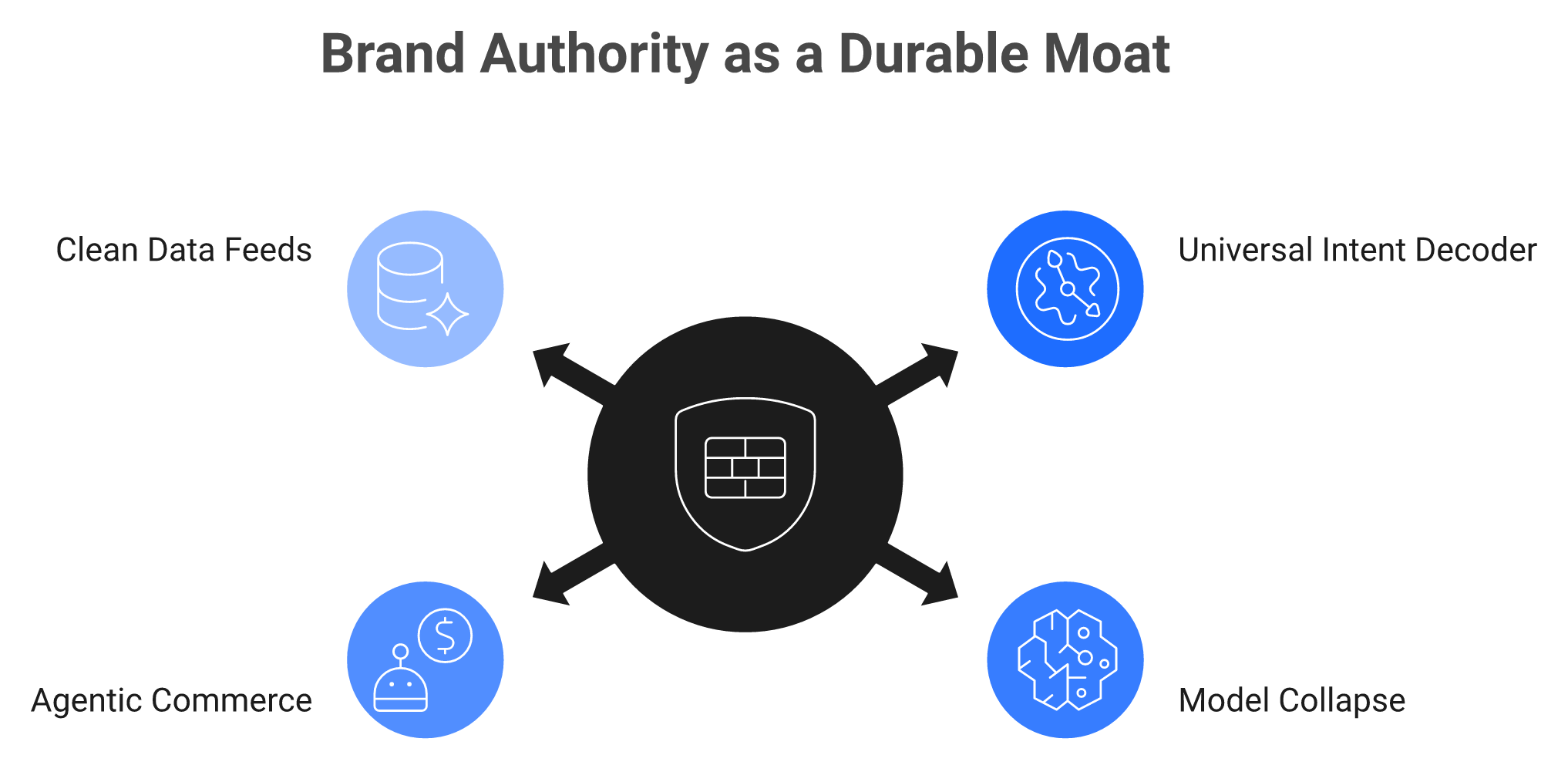
So what survives? The engine acts as a universal intent decoder, reading what a buyer truly means, then routing to the brand it already trusts. You cannot trick that layer for long.
I might be wrong on the timeline, but I am confident on the direction. As I keep arguing, "if you build a brand in your space, then AI has to recommend you." The standard read, "hack the algorithm," gets this backwards, brand is the algorithm's fallback when everything else is noise.
✅ The resolution: build the moat you cannot lose
Do the durable work now. Expose clean, structured data feeds so agents can transact with you through our agentic commerce service, and invest in genuine category authority that compounds over time.
This is exactly why we build trust-first, brand-led GEO at MaximusLabs. It is the one moat that survives the agentic shift, unlike the schema-trick playbooks generalist agencies sell as future-proofing.
Here is the question I am sitting with, and I would genuinely like your take. When every competitor has clean feeds and decent schema, brand authority becomes the only tiebreaker an agent has left. So the real work starting now is not technical, it is earning the trust that makes an AI name you by default. If that is where your team is stuck, that is the conversation worth having. You can reach us here.
Frequently asked questions
What is the fastest way to start optimizing for Perplexity AI?
We tell every founder to start with one honest test, not a 50-page audit. Toggle JavaScript off in your browser and load your key pages. Whatever disappears is invisible to PerplexityBot, which does not execute JavaScript. From there, we prioritize three moves in order: Fix extractability so critical content renders in server-side HTML, not asynchronous scripts. Front-load answers in the first 100 words of each section, since roughly 90% of top citations do this. Earn third-party mentions on the trusted lists, communities, and review sites Perplexity already cites. We sequence these because extractability gates everything; if the crawler cannot read you, structure and mentions do not matter yet. This staged approach is the backbone of our Perplexity optimization service , and it moves visibility faster than generic technical cleanups. Start where the crawler is blind, then earn the trust signals that make Perplexity name you.
How much does Perplexity optimization cost, and is it worth the budget?
We get this question from every VP of Marketing watching a finite budget, so we will be direct. Cost depends on scope, technical debt, and how much off-site trust you already hold, not a flat retainer number. What makes it worth the spend is the conversion premium. Webflow reported a 6x conversion-rate difference between LLM traffic and Google traffic, and our own view puts AI-search traffic at roughly 4 to 5x traditional search, because buyers arrive pre-sold. We frame budget around outcomes, not activity: Pipeline influence over vanity impressions. Citation share across your real buyer questions. BOFU-first content where product mentions and revenue already live. That is why we start every engagement bottom-of-funnel, not with top-of-funnel traffic bait. You can review transparent scope and tiers on our pricing page . The honest answer: it is worth it when your buyers are already asking AI engines about your category and getting competitors named instead of you.
Is Perplexity optimization different from optimizing for ChatGPT or Gemini?
Yes, and copying one playbook across all three is a common, costly mistake we see. Perplexity is the most Google-correlated engine; one study puts its Google citation overlap near 70% versus ChatGPT's roughly 35%. That changes strategy in practice: Perplexity rewards fresh, extractable content and heavily reuses Google's trusted top results. ChatGPT leans less on live Google overlap, so training-data presence and broad mentions matter more. Gemini ties tightly into Google's own ecosystem and AI Overviews. So a Perplexity strategy that mirrors a ChatGPT approach misreads the engine. We build engine-specific tactics under one trust-first framework, because the underlying moat (earned authority) travels across platforms even when the mechanics differ. Our broader GEO service coordinates all of them so you are not optimizing in silos. The shared thread is becoming the answer buyers trust, then tuning extractability and freshness per engine.
How do we know if our Perplexity optimization is actually working?
We measure share of voice, not a single rank, because Perplexity answers shift by phrasing, session, and platform. There is no fixed position to track. Our measurement routine looks like this: Build a question set by turning real search keywords into buyer questions, then mining sales calls and support tickets. Baseline citation frequency across those variants versus competitors. Run test-versus-control experiments, changing one variable and keeping only what measurably lifts share of voice. We treat published best practices as hypotheses, not gospel, since most are unproven. One practitioner tripled a client's feature rate purely through trusted-domain links found by testing, not guesswork. We also add AI-referral segmentation in GA4 so this traffic stops hiding inside 'direct.' This is measurement as data science, and it is how we run tracking with proper GEO measurement and metrics . If the number does not move, the tactic does not stay.
Why does Perplexity ignore our page even though it ranks well on Google?
This is the single most common audit surprise we see, and the cause is usually not 'AI weirdness.' It is one of three fixable gaps. Extractability: your best content loads via JavaScript, so PerplexityBot never sees it. Structure: your answer is buried in paragraph seven, so a competitor's answer-first page gets lifted instead. Trust consensus: the wider web does not corroborate your claims, so Perplexity trusts third-party sources over yours. Ranking on Google gets you eligible, since roughly 60% of Perplexity citations overlap Google's top 10, but it does not guarantee the citation. Perplexity grounds on clean, self-contained passages and web-wide consensus. So a page can rank yet still be unreadable or unsupported for the answer engine. We diagnose exactly which gap applies using a focused technical SEO and website audit , then fix the binding constraint first rather than everything at once.
Should B2B SaaS teams invest in documentation or blog content for Perplexity?
For B2B, we shift budget toward structured documentation, and the citation data is blunt about why. Technical docs get cited at roughly 46 to 70% for relevant queries, while blogs sit at just 3 to 6%. Perplexity rewards whole-site topical authority, not one heroic post. So we build hub-and-spoke clusters: Hub pages that comprehensively anchor a topic. Spoke pages answering the long tail of specific product questions. Structured docs and help-center content that read like references, not opinion pieces. This does not mean blogs are worthless; it means thin, disconnected blog churn is a poor bet for citations. A tight cluster of interlinked, documentation-grade pages beats scattered posts nearly every time. This architecture sits at the center of our content marketing service , which produces documentation-grade authority instead of TOFU volume. Move the money to where Perplexity actually looks: structured, connected, answer-shaped content.
What is the durable long-term strategy as AI search shifts to agentic commerce?
We think the honest answer unsettles most founders: no schema trick future-proofs you. The next shift is agentic commerce, where AI agents do not just recommend but transact, pulling from structured data feeds rather than browsing your site. Two forces shape the strategy: Model collapse: as AI trains on its own derivatives, low-quality content degrades, so hacks built on this quarter's algorithm get buried. Intent decoding: the engine reads what a buyer truly means, then routes to the brand it already trusts. So the durable moat is brand authority, not tactics. When you are genuinely the brand in your category, AI has to recommend you, even as algorithms change. The practical work now is exposing clean, structured data feeds and compounding real category trust. That is precisely why we build trust-first, brand-led work through our agentic commerce service . Everything technical is table stakes; brand is the tiebreaker an agent falls back on when everything else is noise.