 Krishna Kaanth M
- Perplexity Model Council runs one query across several models in parallel, then a synthesizer returns a single answer flagging agreement, disagreement, and unique findings.
- Councils start at three models on web and stretch to two through eight inside Perplexity Computer, including open-weight members such as GLM and Kimi.
- Model choice does not change retrieval. One shared index feeds every member, so model-specific content formatting is largely wasted budget.
- Synthesis is the second gate. In one comparison, Sonar cited 39 sources while Claude Sonnet 4.0 cited 79 from the same pool.
- Karpathy's open-source LLM Council anonymizes peer ranking. Perplexity's public documentation never claims blinding, so plan for an un-blinded chair.
- Turn council runs into a monthly loop: 20 to 30 BOFU prompts, log agreement, disagreement, and absence, then report citation share instead of impressions.
Q1. What exactly is Perplexity's Model Council, and why does it change the GEO question?
Perplexity Model Council runs one query across several AI models in parallel, then uses a synthesizer model to produce a single answer showing where the models agree, where they diverge, and what each uniquely found. Councils run three models by default and two to eight inside Perplexity Computer. For growth teams it matters because buyers now compare multiple models' verdicts about your category on one screen.
⭐ The question your buyer is actually asking
A VP Marketing said it plainly on a call last month. "When you ask an LLM, what's the best payroll management software, I want to show up for that."
Then came the real question. "How do I get my URL in the citations?"
That question now has a harder version. Your buyer may not be asking one model anymore.
🔍 What the feature does, mechanically
Perplexity's own changelog describes it in three moves. Your query runs through the selected models in parallel. A separate model reviews and synthesizes the responses, highlighting agreement, disagreement, and what each model found alone.
You then see the results side by side, with per-model tabs behind the synthesis. Perplexity positions it for investment research, complex decisions, and verification.
Council size started at three frontier models on web for Max subscribers. Inside Perplexity Computer, councils now span two to eight models, including open-weight options such as GLM and Kimi.
⚠️ Why a single-engine visibility report is now half-blind
Most reporting decks still answer one question. Did we rank on Google.
That was already thin. It is thinner when one screen shows a buyer three verdicts about your category at once.
MaximusLabs AI tracks citation share across thousands of question variants per platform rather than one ranking position, because ChatGPT, Perplexity, Claude, and Gemini do not weigh trust identically. That premise used to need explaining. Model Council now demonstrates it for free, on the buyer's screen.
💰 The reframe: become the answer a panel converges on
Traditional Google-only SEO trained us on one algorithm and one ranked list. A council is a different shape. One retrieval pool, several readers, one chair deciding what survives.
Name the readers precisely, because the roster moves. Launch coverage named Claude Opus 4.6, GPT-5.2, and Gemini 3.0. The Computer build names GPT-5.4, Claude Opus 4.6, and Gemini 3.1 Pro.
Here is the uncomfortable part. A brand can sit inside the retrieval layer and still get filtered out at synthesis. Presence is not survival.
✅ What changes in practice
- Report citation share per platform, not one blended ranking.
- Track BOFU and MOFU questions your ICP actually asks, not head-term impressions.
- Treat model disagreement about your brand as a content gap, not noise.
- Log which claims survive synthesis, since that is the block a buyer reads.
MaximusLabs AI built its optimization model on the premise Model Council just made visible: each AI platform carries its own trust signals and citation patterns. We measure that by running the same ICP question set across platforms, then comparing who gets cited where. The goal is not a rank. It is being the answer the panel converges on.
Q2. How does the Council actually reach one answer, and who is the real gatekeeper?
Three stages. Your query runs across the selected models in parallel, each producing an independent response. A synthesizer, called the orchestrator inside Perplexity Computer and user-selectable there, reviews those outputs, resolves conflicts where possible, and returns one answer flagging agreement, divergence, and unique contributions. The orchestrator is a second gatekeeper: a claim can be retrieved by a model and still be discarded during conflict resolution.
🔧 Stage by stage, from Perplexity's own documentation
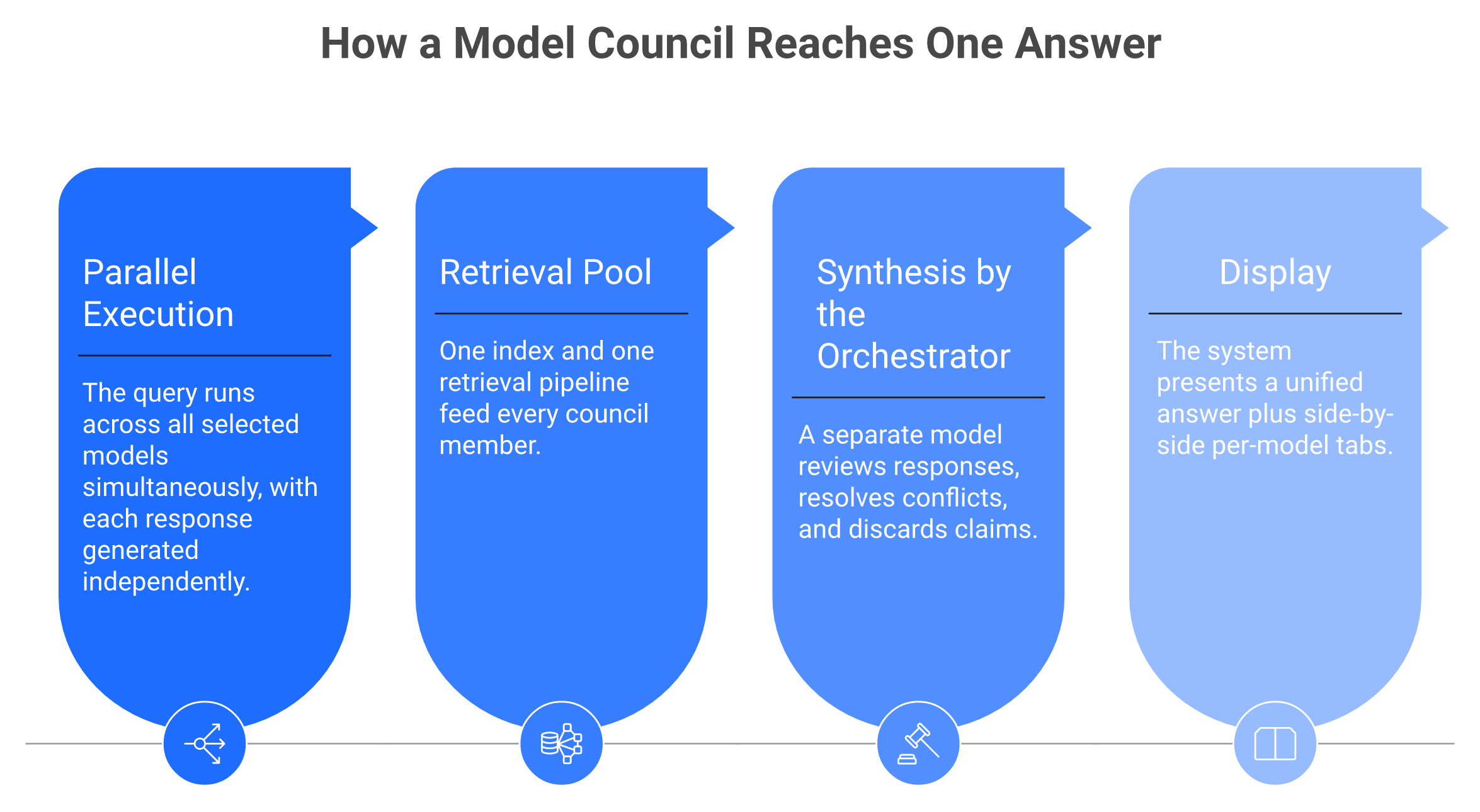
Stage one is parallel execution. The query goes to each selected model at the same time, and each answers independently.
Stage two is review. A separate model compares the responses, then synthesizes them into one answer marking agreement, disagreement, and unique findings.
Stage three is display. You get the unified answer plus side-by-side per-model views.
👨🍳 The chef and the kitchen
Picture a world-class chef in an empty room. No pantry, no ingredients, no stove.
That chef cannot cook. Now put the same chef in a stocked Michelin kitchen.
The Council supplies the chefs. The shared search index supplies the kitchen and the ingredients. A better chair cannot rescue a claim that never made it into the pantry, which is the whole point of Q4.
⚙️ The least-covered fact on the SERP: you can pick the chair
Inside Perplexity Computer, Model Council shipped with orchestrator selection, giving the user control over how results are combined. Almost no coverage of this feature mentions that.
It matters because the chair has discretion. Perplexity documents that a synthesizer resolves conflicts, but it does not publish the rules it uses.
So we plan for the strictest reading. If a claim is contested across models, assume it can be dropped rather than reconciled in your favour.
❌ Where brands quietly lose
The category obsesses over getting retrieved. Retrieval is table stakes.
The losses happen one step later. An outlier number, a claim only your own site makes, a stat with no date. Those are exactly the items a conflict-resolution pass has reason to discard.
MaximusLabs AI engineers trust signals so claims survive extraction and synthesis, not just retrieval. In practice that means one number, one phrasing, one dated primary source, repeated consistently.
✅ Make your claims corroborable, not just present
- Use the same figure and the same wording everywhere it appears.
- Attach a dated primary source, not a secondary blog rewrite.
- Get the claim echoed on third-party and community surfaces, so it has independent support.
- Kill unsourced superlatives, which read as conflict rather than evidence.
⏰ One honest caveat. Perplexity has not published how the synthesizer weighs competing sources, so this is a working model, not a documented rule set. MaximusLabs AI's read is that the standard advice gets this backwards: teams spend on formatting for a model, then lose the claim at the chair. I would rather over-invest in consistent corroboration and be proven slightly paranoid.
Q3. Which tiers, models and platforms does Model Council run on, and how do you read its output?
As of 29 July 2026: Model Council launched web-only for Perplexity Max subscribers, running three frontier models at once. Via Perplexity Computer it now reaches additional tiers, with councils of two to eight models including open-weight GLM and Kimi. Access it from the plus icon in the input bar, then read each model's tab alongside the synthesis before trusting the summary.
📋 Access snapshot, last verified 29 July 2026
| Item | At launch (Feb 2026) | In Perplexity Computer (from Mar 2026) |
| Tier | Max subscribers | Extended beyond the launch tier, including Pro-level access reported at $20/month |
| Platform | Web only | Inside Computer; mobile and desktop apps still pending |
| Council size | Three models in parallel | Two to eight models |
| Named models | Claude Opus 4.6, GPT-5.2, Gemini 3.0 era roster | GPT-5.4, Claude Opus 4.6, Gemini 3.1 Pro, plus open-weight GLM and Kimi |
| Chair | A separate synthesizing model | User-selectable orchestrator |
Pricing and tier eligibility have moved twice in five months, so treat any undated table you find elsewhere as suspect.
🖱️ How to turn it on
- Open Perplexity on the web.
- Click the plus icon in the input bar, which holds Deep Research, Model Council, and the other modes.
- Select Model Council.
- Choose which models form your council.
- Submit your question, then open each model's tab next to the synthesis.
👀 Read the tabs, not just the summary
The synthesis is a hypothesis. The per-model tabs are the evidence.
The artefact worth screenshotting is the divergence view, where the models split on the same question. For a marketer, that split is competitive intelligence about your own category.
Practitioners are using it exactly this way, and they are also hitting its edges.
"Tried Model Council on a few questions and I kind of like seeing where the different models agree vs disagree. It's useful when I'm asking..."
u/anonymous, r/perplexity_ai Reddit Thread
"Model council usage runs out after ~100 messages within 5 days."
r/perplexity_ai Reddit Thread
⏰ That second quote is the operational constraint nobody in vendor copy mentions. Councils are rationed, so save them for questions where being wrong is expensive. Building a Perplexity-specific optimization plan around that constraint beats running the feature casually.
Q4. Does picking a different model in the Council change whether your page gets retrieved at all?
No. Model choice does not change which documents are retrieved. Selecting GPT, Claude, or Gemini changes synthesis quality and style, but the same index and retrieval pipeline feeds every council member. That makes model-specific SEO largely wasted effort. You compete once to enter the candidate pool, then again to survive each model's synthesis of that identical pool, and the first competition is the one you control.
🎯 Situation: the seductive idea of writing "for Claude"
Now that users pick their council, a tempting brief appears. Write one version for Claude, one for GPT, one for Gemini.
It feels sophisticated. It produces a lot of work.
It also misreads where the leverage sits.
❌ Complication: retrieval is shared, not per model
Perplexity documents Model Council as running your query through the selected models in parallel and comparing responses. It does not document a separate retrieval pass per model.
Practitioner analysis of Perplexity's stack is blunt about the consequence. Model choice does not change which documents are retrieved, because the same index and retrieval pipeline feeds all models. What changes is synthesis quality and style.
The economics reinforce it. First-stage hybrid retrieval operates on a roughly 100 millisecond budget, which is not a budget you spend eight times over for one query.
✅ Resolution: two gates, and only one is yours to win
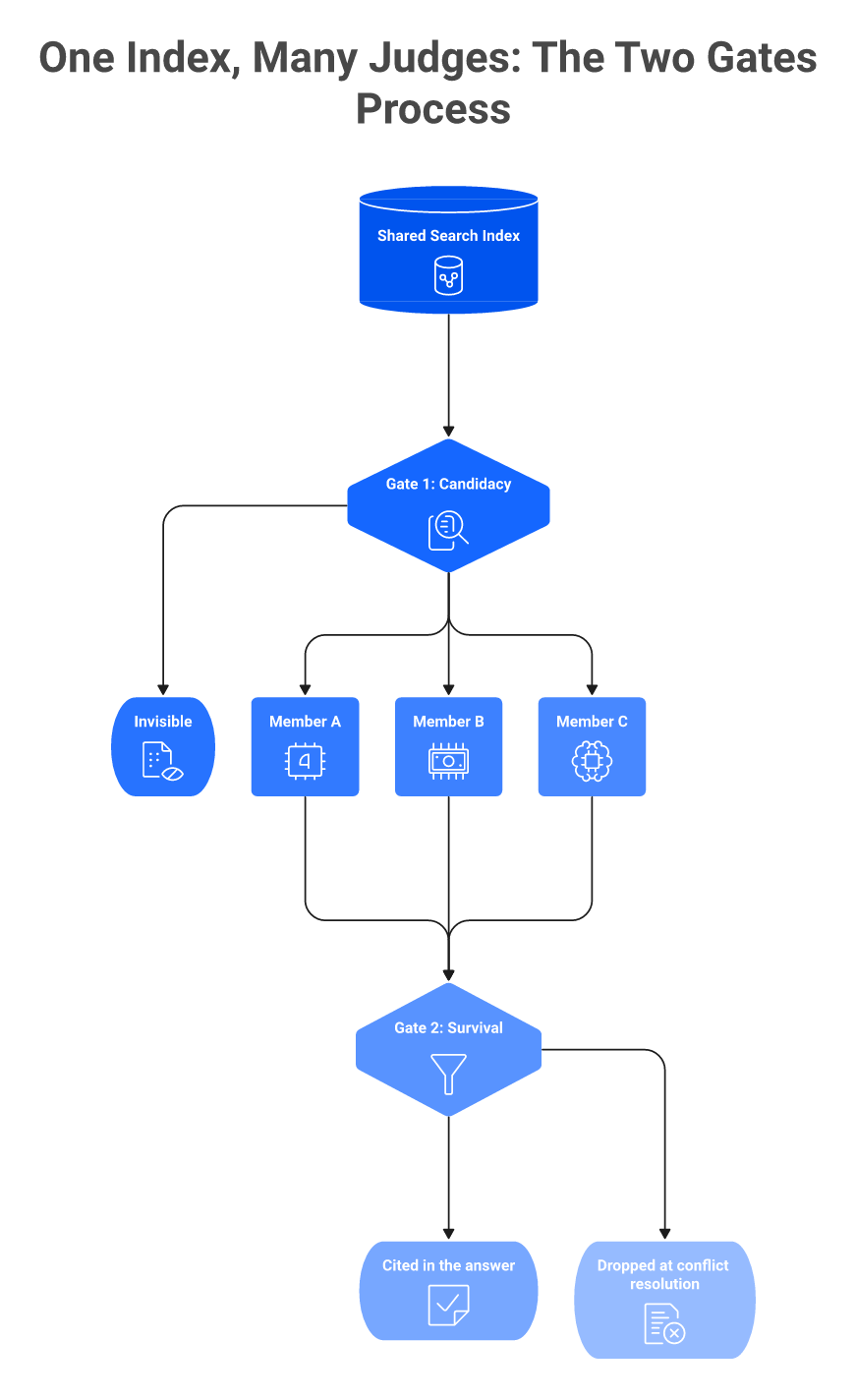
Think of it as a two-gate system.
- Gate 1 is candidacy. Does the index surface your page as a candidate at all.
- Gate 2 is survival. Does your claim survive each model's synthesis of that same candidate pool.
Gate 1 is where budget belongs, because Gate 2 inherits whatever Gate 1 hands over. Formatting for a specific model gains nothing if you never cleared the semantic relevance threshold to be retrieved.
MaximusLabs AI maps the URLs the shared index already trusts for a client's target questions before any content gets written, across ChatGPT, Claude, Perplexity, and Gemini. We do that first because no amount of model-specific formatting rescues a page the index never surfaced, which is why our technical audit work starts before the content calendar does.
💰 What this changes about your spend
- Fix crawlability and clean HTML before touching tone-per-model.
- Build pages that answer a full cluster of question variants, since long documents can be retrieved as single passages.
- Earn third-party and community mentions, which enter the same shared pool your own site competes in.
- Stop commissioning near-duplicate assets per model.
Traditional Google-only SEO trained everyone on one algorithm and one ranking. This is the inverse shape: one index, many judges. Chasing model-specific formatting before clearing the index threshold is a security blanket, and it produces work rather than citations.
Perplexity does not publish its full retrieval architecture, so this is the working hypothesis that best fits observed behaviour, not a vendor-confirmed rule. MaximusLabs AI treats generative engine optimization as a data-science problem rather than a formatting problem, which is why we test candidacy first and style second. If you want that tested against your own pages, talk to our team.
Q5. If retrieval is shared, why did one model cite 39 sources and another cite 79?
Because synthesis decides how many candidates become citations. In one measured comparison, Sonar cited 39 sources while Claude Sonnet 4.0 cited 79 from the same candidate pool. Council composition therefore sets the volume of winners, not the pool of candidates. A brand at the edge of that pool gets cited by generous synthesizers and dropped by selective ones, so borderline candidacy is a coin flip you cannot control.
📊 The number, and exactly what it proves
Same question. Same shared retrieval pool. Two very different citation counts.
Sonar returned 39 cited sources. Claude Sonnet 4.0 returned 79 from that identical pool.
That is a 2x spread in how many candidates survived. It does not mean Claude retrieved more. It means Claude kept more.
| Model | Sources cited | What it means for a borderline brand |
| Sonar | 39 | Only high-confidence, tightly corroborated sources survive. Marginal brands drop. |
| Claude Sonnet 4.0 | 79 | Wider net, weaker candidates still make the answer. Marginal brands sometimes appear. |
| A mixed 2 to 8 model council | Varies by member | Your presence depends on which members the user picked, which you do not control. |
Speed explains part of the behaviour. Sonar is built on Llama 3.3 70B and runs on Cerebras infrastructure at about 1,200 tokens per second. A member optimized for near-instant answers behaves differently from one optimized for deliberation.
⚠️ The uncomfortable part for marginal brands
If your brand sits at the edge of the candidate pool, your visibility is now partly a configuration accident.
A user who picks a selective chair never sees you. A user who picks a generous one does.
Same page. Same index. Different outcome. You cannot A/B test your way out of somebody else's model picker.
MaximusLabs AI measures citation share across thousands of question variants precisely because a single council configuration can double or halve how many sources survive. One prompt run tells you almost nothing.
✅ The only variable you actually control
Stop optimizing for the generous chair. Move from marginal candidacy to central candidacy, so every chair keeps you.
Central candidacy looks like this in practice:
- The same claim appears on your site and on at least two independent third-party surfaces.
- The figure, the wording, and the date match everywhere.
- A primary source sits behind it, not a competitor's blog post.
- Your entity name is used consistently, not in four variations.
Selective synthesizers drop weakly supported claims first. Corroboration is what turns a droppable mention into a load-bearing one.
⏰ One honest limitation. This is a two-model comparison, not a benchmark. Perplexity publishes no citation-density figures for council runs, so treat 39 versus 79 as a directional finding, not a law.
The open experiment worth running: the same BOFU prompt set through a 2-model, a 3-model, and an 8-model council, logging how many times your brand survives each. That is a week of work, and it tells you more than any tool dashboard.
MaximusLabs AI reports citation share per platform and per question variant rather than a single ranking, because the synthesis gate moves with configuration. Traditional Google-only SEO had one ranked list to point at. Here, the honest answer is a distribution, and pretending otherwise sells a number that does not exist.
Q6. Is Model Council just Karpathy's LLM Council with a subscription, and does the difference create bias?
Not quite. Karpathy's open-source LLM Council runs three stages: independent first opinions, anonymized peer ranking so models cannot play favourites, and then a Chairman synthesis. Perplexity's Model Council runs models in parallel and synthesizes through a user-selectable orchestrator, but its public documentation never claims anonymized peer ranking. If the synthesizer knows which model said what, model-preference and brand-name bias can leak into the final answer.
🔍 Situation: practitioners spotted the lineage immediately
Andrej Karpathy published llm-council as an open-source local app in late 2025. Perplexity shipped Model Council in February 2026.
The similarity was noted publicly the same week, including by builders who had shipped their own versions.
"I built a multi-model AI council app. Today Perplexity launched the same concept for 200/yr subscribers."
r/SideProject Reddit Thread
Crediting the origin costs nothing. Every vendor page and mainstream write-up skipped it.
⚠️ Complication: the missing middle stage
Karpathy's design has a deliberate second stage. Each model reviews the others' answers with identities stripped, so no model can favour a lab it recognizes.
Perplexity's documentation describes something different. Models run in parallel, and then a separate model reviews and synthesizes the responses, highlighting agreement and disagreement. Inside Computer, the user selects that orchestrator.
Nowhere in the public docs is blinding claimed.
| Dimension | Karpathy's LLM Council | Perplexity Model Council |
| Stages | Three: first opinions, anonymized peer ranking, and Chairman synthesis | Two documented: parallel runs, then synthesis |
| Anonymization | Explicit, to stop favouritism | Not documented |
| Hosting | Local app, your own API keys | Hosted, subscription-gated |
| Chair selection | You configure it | User-selectable orchestrator inside Computer |
❌ Why an un-blinded chair matters to your brand
If a chair can see which model produced which claim, preference can attach to the source rather than the evidence.
Extend that one step. A chair that weighs sources can also weigh brand familiarity, and familiar names read as safer.
MaximusLabs AI reads primary implementations and platform changelogs directly, including the open-source designs commercial features are built on, because the undocumented steps are usually where a brand quietly loses the citation.
✅ What to do with the gap
- Treat the synthesis as a hypothesis, and the per-model tabs as the evidence.
- Assume un-blinded synthesis when you plan, since that is the stricter case.
- Build recognition off-domain, so familiarity is earned rather than hoped for.
- Do not claim Perplexity is biased. Claim only that blinding is undocumented.
Perplexity may well blind identities internally and simply not publish it. Until they do, I plan for the un-blinded case, because planning for the generous case is how teams get surprised.
MaximusLabs AI's read is that the category skips this analysis because it is unglamorous. Naming what is documented, what is not, and refusing to assert the rest is the actual trust signal, and it is the one nobody on this SERP has claimed.
Q7. Does convening more models actually make the answer more accurate?
Not reliably. Fact-check accuracy drops roughly 42% on average across two frontier models as tool calls scale from 2 to 150, so more retrieval does not produce more accurate citations. Council members also share overlapping training corpora, meaning they can agree confidently and wrongly. Treat cross-model consensus as a signal about the public record's clarity, not proof of correctness.
⭐ Situation: the pitch is intuitive and mostly right
More models, fewer blind spots. Perplexity positions Model Council for questions where accuracy, blind spots, and bias genuinely matter.
That is a reasonable claim. Seeing three answers beats seeing one.
The trouble starts when "more" becomes the strategy.
❌ Complication: depth degrades accuracy
Measured across two frontier models, fact-check accuracy fell about 42% on average as tool calls scaled from 2 to 150. More retrieval, less reliable citation.
Then there is correlated error. Council members train on heavily overlapping corpora, so they can converge on the same wrong answer with high confidence.
Notably, Perplexity publishes no accuracy, latency, or token-cost benchmark for council runs. I am not inventing one either.
The community has landed in roughly the same place: interested, not convinced.
"It's positioned as a research tool for questions where you really care about accuracy, blind spots, and bias, rather than..."
r/perplexity_ai Reddit Thread
"Model council usage runs out after ~100 messages within 5 days."
r/perplexity_ai Reddit Thread
💸 The brand consequence nobody prices in
Here is a real failure I have watched. Perplexity summarized an article, and the summary described the authors as Oxford researchers. None of them attended Oxford.
The agent was not reading the page. It was reading mentions, and stitching together the strongest nearby associations.
Your name being near a claim is not your name being attached to it. Deeper retrieval increases the odds of the wrong attachment, because there is more ambient text to stitch from.
MaximusLabs AI treats entity disambiguation and off-page corroboration as accuracy insurance, since misattribution happens at synthesis rather than retrieval. Our answer engine optimization work starts from that assumption.
✅ How to read consensus like an analyst
- Agreement means the public record is clear, not that it is correct.
- Disagreement across models is a content gap, and it is your best brief.
- Check who each model cites, not just what it concluded.
- Reserve councils for expensive-to-be-wrong questions, since usage is rationed.
⏰ The open experiment I would run before trusting any of this: one identical BOFU prompt set through a single model, a 3-model council, and an 8-model council, scored purely on misattributions about your brand.
MaximusLabs AI's position is that consensus rewards web-wide corroboration and that deep retrieval punishes ambiguity. Traditional SEO reporting has no metric for "the panel agreed, and it was wrong about us." That gap is exactly where trust-first work earns its keep.
Q8. What makes a page survive every member of the Council instead of just one?
Three things travel across every council member. Render critical content in HTML, because a shared crawler that skips JavaScript hides your asynchronously loaded reviews and specs from all models at once. Expose facet data as text, including closure, fabric, material, and neck style, so follow-up reasoning can use it. Close the sameAs loop so your identity is unambiguous. MaximusLabs AI audits for extractability before speed for this reason.
⚠️ One bug, eight rejections
A shared retrieval layer has a brutal property. A crawler failure does not cost you one model. It costs you the whole council simultaneously.
That is the inverse of the Google-only mental model, where one algorithm forgave one mistake. Here the mistake replicates across every judge.
🔧 The JavaScript-off test takes ninety seconds
Turn JavaScript off in your browser and load your key page. Note what disappears.
On product pages, reviews and spec tables are frequently loaded asynchronously, so they vanish. Google's own documentation separates crawling, rendering, and indexing precisely because rendered-only content is not guaranteed to be seen.
If the content is not in the HTML, treat it as content that does not exist for retrieval purposes. An AI crawlability check makes that visible in minutes.
MaximusLabs AI's technical scope covers JavaScript minimization, semantic HTML, schema optimization, and AI crawler access, because extractability is the gate that sits before everything else.
📋 Facet data and identity, the two most skipped items
Follow-up questions are where long-tail visibility lives. Buyers ask for the best product with specific attributes, so the attributes need to be readable text, not filter widgets.
Closure, fabric, material, and neck style. In B2B, that is integrations, deployment model, compliance certifications, and pricing tier.
Then close the identity loop. The goal is for a crawler to traverse your website to Wikidata, then LinkedIn, Crunchbase, and G2, and back to your website, using sameAs links. That loop is how a model knows which company you are, and it is schema work at its most basic.
✅ The survival checklist
- Run the JavaScript-off render check on your five highest-intent pages.
- Move reviews, specs, and pricing into server-rendered HTML.
- Publish facet attributes as text in headers and body copy, not just filters.
- Add sameAs links to Wikidata, LinkedIn, Crunchbase, and G2, and make them reciprocal.
- Unblock GPTbot and oai-searchbot in robots.txt, then verify with a live fetch.
- Ship schema for Article, Author, FAQ, and Product where each applies.
💰 What to deliberately not do first
Most traditional SEO audits open with page speed. In fifteen years, I have never seen Core Web Vitals drive a traffic increase on their own.
Milliseconds are a tiebreaker. Extractability is the entry ticket, and the two are not close in priority.
MaximusLabs AI audits extractability first, then schema, and then speed, and keeps the checklist deliberately short. The constraint is whether your content is in the pantry, not how many pages you shipped this quarter. If you want that audited against your own stack, that is the conversation to have.
Q9. How do you earn Council consensus when you can't outrank Reddit or the incumbents?
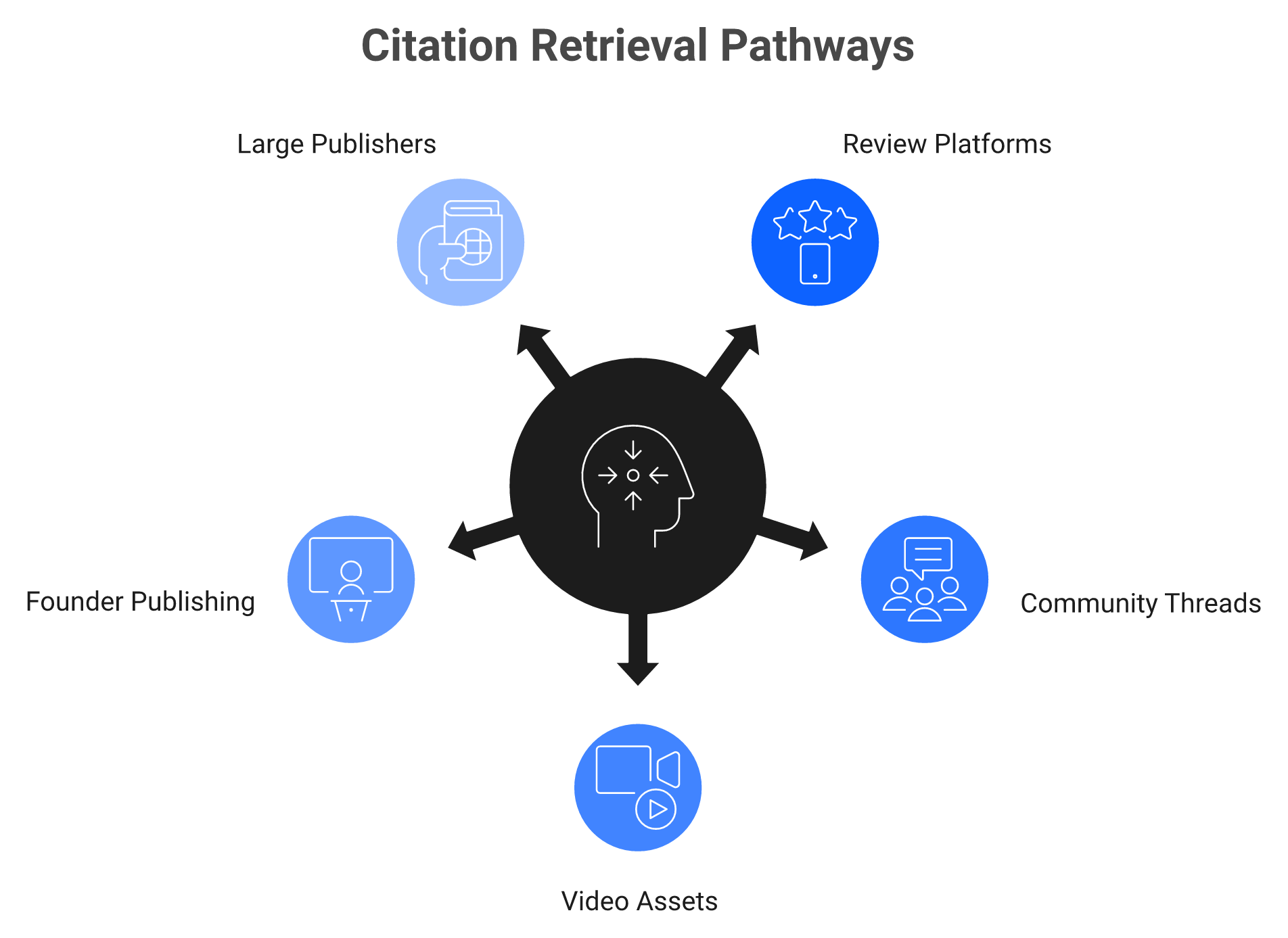
Borrow the index's existing trust. Identify the most-cited URLs for the topics you care about, usually Reddit, YouTube, review platforms, and large publishers, then earn accurate mentions of your product there. Because retrieval is shared across every council member, one citation on a substrate domain reaches all models at once. MaximusLabs AI runs this as Search Everywhere Optimization, covering G2, Capterra, and Gartner profiles alongside cited community threads.
⭐ Situation: your domain is not going to win this fight
A two-year-old SaaS domain will not outrank a Reddit thread or a legacy publisher for a category query. That is not a strategy failure. It is arithmetic.
Traditional Google-only SEO answered this by building links to your own pages. That answer is now incomplete.
❌ Complication: synthesizers read mentions, not just your page
Recall the Oxford incident from earlier. A summary described article authors as Oxford researchers because the agent was stitching nearby mentions, not reading the page.
The lesson generalizes. What the wider web says about you shapes how a synthesizer describes you, often more than your own copy does.
Practitioners are converging on this independently.
"In the realm of Google rankings, backlinks maintain a significant influence. However, when it comes to AI citations... the impact of brand mentions from reputable sources such as Reddit, Quora, and indexed articles is what truly drives results."
u/AmitKumarGEO, r/digital_marketing Reddit Thread
"It's somewhat close, but not entirely there yet (definitely making progress). The outcome really hinges on the level of competition within a specific semantic area."
u/imaginary_name, r/digital_marketing Reddit Thread
That second quote is the honest counterweight. Mentions are not a replacement for authority, and in crowded categories they are not enough alone.
✅ Resolution: map the cited URLs, then earn presence on them
The tactic is specific. Identify the most-cited URLs for the AEO topics you care about, then find a way to have those citations mention your product.
Review platforms are the highest-leverage starting point, because they are structured, dated, and heavily retrieved.
💰 Where to spend first
- G2, Capterra, and Gartner Peer Insights profiles, targeting 10 or more recent reviews per platform.
- The three to five Reddit threads that keep appearing in citations for your category.
- YouTube assets for the unglamorous B2B queries where almost no video exists.
- Founder publishing on LinkedIn, since it is increasingly retrieved.
MaximusLabs AI's off-page scope includes review-platform optimization and identification of frequently-cited community threads, because those URLs are the substrate every council member reads from. That is the core of our forum and community AEO work.
💸 Why paid cannot shortcut this
Here is the part that stings for teams with budget. Visibility here is earned through the data, not through the ads.
You can spend hundreds of thousands on paid media and still lose the answer to a brand that made itself easy for agents to find and describe accurately.
Think of it as a ghost kitchen. Your website is the dining room. Your structured data and third-party footprint are the kitchen. The model is the delivery driver, and it only needs the kitchen to fulfil an order for a buyer who never walks in.
MaximusLabs AI treats Search Everywhere Optimization as a named discipline rather than an add-on, because traditional Google-only link building never built this muscle. My own read is blunter: this is not about hacking an algorithm, it is about becoming the brand a panel has no honest way to omit.
Q10. When is a Council worth the tokens, and what prompts should you actually convene it for?
Convene a Council for judgment-bound questions, including positioning calls, ambiguous trade-offs, and competitive evaluation, where disagreement between models is the useful output. Skip it for retrieval-bound questions with one verifiable answer, where extra models add latency and cost without changing the result. Perplexity publishes no accuracy, latency, or token-cost benchmark for Council runs, so treat the compute premium as unquantified.
⚖️ Two question classes, one decision
Perplexity positions Model Council for questions where accuracy, blind spots, and bias genuinely matter. The Register frames it as a board of models weighing one ambiguous business issue.
Both descriptions point the same way. Councils pay when the answer is contestable.
| Question type | Council size | Orchestrator choice | Read this first |
| Factual lookup, one right answer | Skip the council | Not applicable | A single model is faster and cheaper |
| Category verdict, competitive positioning | 3 models | A deliberation-heavy chair | The divergence view |
| High-stakes strategy or investment call | 5 to 8 models | Vary the chair and rerun | Each model's tab, then the synthesis |
| Brand-perception audit | 3 models, one open-weight | Any, held constant | Where you are absent entirely |
Include at least one open-weight member such as GLM or Kimi when auditing perception, since different training cutoffs surface different assumptions about you.
📝 Three prompt patterns worth reusing
Write these inline, adapt the category, and keep the output format explicit.
- Category verdict: "List the top five vendors for [specific ICP use case] in [year]. For each, state the single strongest reason to choose it and name your source. Output as a table."
- Objection surfacing: "What would disqualify [your brand] for a [role] at a [company size] buying [category]? List objections, then state whether each is factually supported or inferred."
- Source provenance: "For each claim you made about [your brand], name the specific URL you relied on. Flag any claim you cannot source."
That third pattern is the one nobody runs, and it is the most useful. It tells you which pages are actually doing the work, which is the same lens we bring to AI search competitor analysis.
⚠️ Be explicit about output format
I asked a model what app to build, picked one of its five ideas, and shipped it. The one feature I wanted, dictation converted into a newsletter, quietly did not work.
Intent-to-output hand-offs fail silently in the messy middle. Councils amplify that, because the synthesis smooths over the gaps.
💸 The tokenmaxxing question, unresolved
The Register's framing is fair: up to eight models running in the cloud on one question is not cheap. Usage caps are real, with practitioners reporting limits hit inside days.
What nobody has is a number. Perplexity's blog, help centre, and changelog publish no accuracy, latency, or token-cost benchmark for council runs. I am not going to invent one.
MaximusLabs AI flags unverified claims as experiment candidates rather than shipping them as facts, and this one is squarely in that bucket. My interim rule: convene a council when being wrong costs more than the tokens, and log the outcome so you build your own benchmark.
The forward hypothesis I am sitting with is that council behaviour becomes the default within a year, as access keeps sliding down the price tiers. If that holds, the penalty for being an average brand gets sharper, and the payout for being corroborated gets larger.
Q11. How do you turn Council runs into a content backlog and a pipeline number?
Run 20 to 30 BOFU prompts your ICP would genuinely type through a multi-model council, then log three columns: where models agree about your category, where they disagree, and where you are absent entirely. Disagreement is your content backlog, because each conflict is an ambiguity you can resolve and get cited for. MaximusLabs AI measures this as citation share across thousands of question variants rather than impressions.
❌ The reporting habit no CFO funds twice
Most AI-visibility decks still lead with impressions and mentions. That is the vanity-metric reflex inherited from Google-only SEO, wearing a new label.
A board does not fund "we were mentioned more." It funds movement on questions buyers ask before they buy.
🔁 The monthly loop
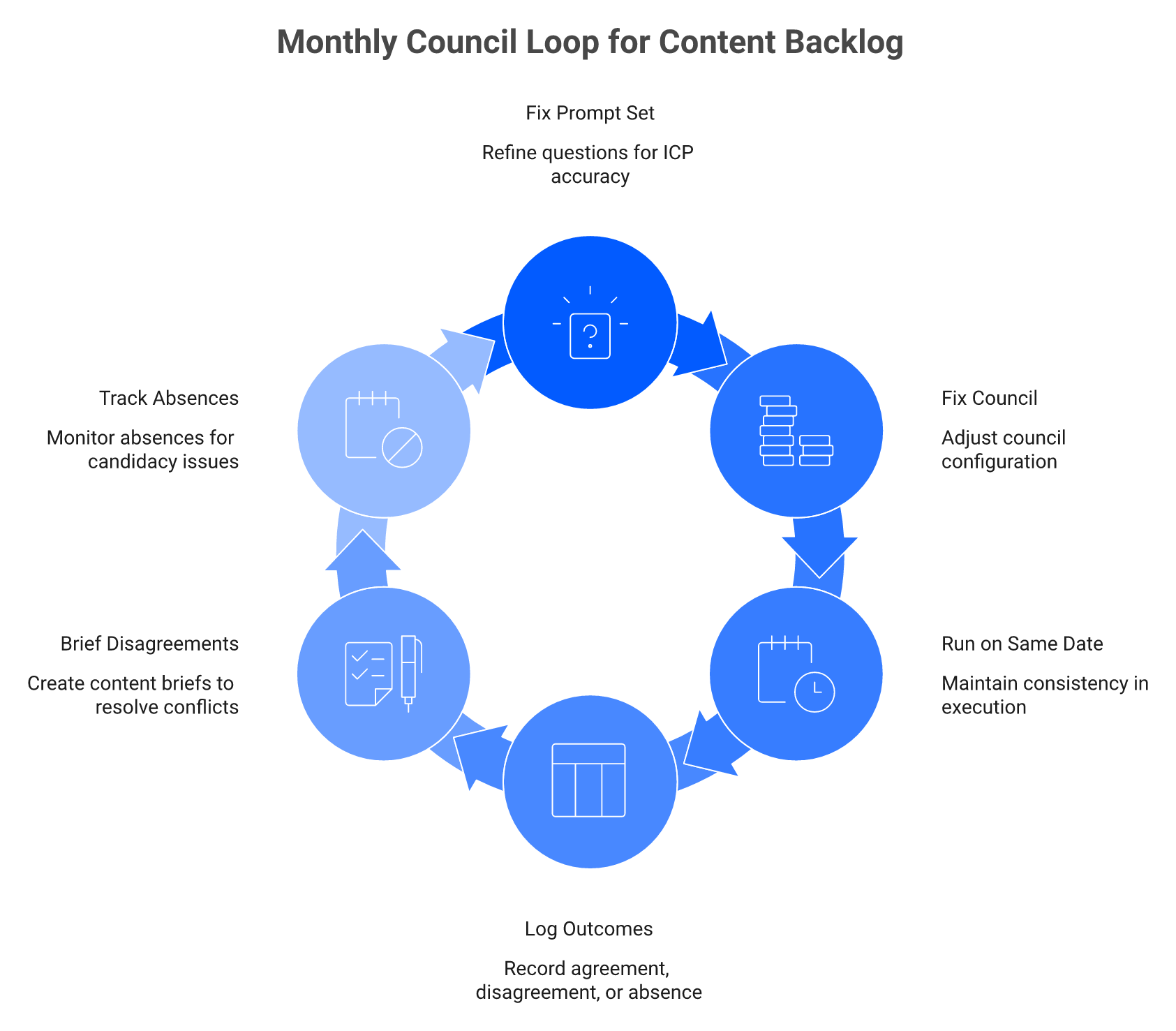
- Fix a prompt set of 20 to 30 BOFU questions, phrased the way your ICP actually types them.
- Fix your council configuration, including one open-weight member such as GLM or Kimi.
- Run the set on the same date each month, using the same chair.
- Log three outcomes per prompt: agreement, disagreement, or absence.
- Turn every disagreement into one content brief that resolves the ambiguity.
- Track absences separately, because absence is a candidacy problem, not a content problem.
Keep the set small on purpose. Roughly 19 out of 20 landing pages drive about 85% of all traffic, so a sprawling audit spends your time on pages that were never going to matter.
💰 Why citation share is a revenue metric, not a vanity one
LLM referral traffic converts very differently from Google search traffic. First-party measurement puts the gap at roughly 6x, because a buyer arriving from an AI answer has already been told you are a credible option.
That changes the math. A citation on a BOFU question is worth more than a large number of TOFU impressions, which is exactly the trade traditional agencies still get backwards. Attribution work makes that visible, which is why we treat GEO revenue attribution as part of reporting rather than an afterthought.
| What to track | Where it comes from | What it proves |
| Citation share per prompt | Monthly council runs | Whether you are in the answer |
| Absence count | Same runs | Retrieval and candidacy gaps |
| LLM referral sessions | GA4 referral segmentation | Actual arriving demand |
| Pipeline from LLM sessions | CRM source, plus a "how did you hear about us" field | Revenue influence |
Practitioners are building the same loop, and they are candid that isolation is hard.
"Brands with a real Reddit/YouTube/G2 footprint get cited ~3x more often by AI search. Here's how I isolated it and where the number probably..."
r/aeo Reddit Thread
"Those brands that begin to monitor their AI citation share of voice now will gain a significant advantage by the end of 2026."
u/AmitKumarGEO, r/digital_marketing Reddit Thread
📊 The line you can actually say in a board meeting
"We resolved 6 of 11 category ambiguities and moved from absent to cited in 4 of 9 BOFU prompts."
That sentence survives scrutiny. An impressions chart does not.
MaximusLabs AI reports citation share and pipeline influence on BOFU questions rather than impressions, which is what Revenue-focused Answer Engine Optimization means in practice. We start at the bottom of the funnel because that is where the revenue sits, and clicks that do not move it are noise.
Q12. Why does a five-week product cycle break your published content, and what stops it?
Because platform facts move faster than content calendars. Model Council's roster shifted from the GPT-5.2 and Gemini 3.0 era to GPT-5.4 and Gemini 3.1 Pro within weeks, and eligibility widened from Max-only toward Pro-inclusive within five months. Any page stating those facts without a verification date now misinforms buyers on your behalf. Date every platform claim, monitor changelogs monthly, and keep a visible update log.
⏰ Situation: publish-and-forget was fine when facts aged slowly
Google-only SEO trained everyone to publish, then revisit in a year. Most facts held that long.
Platform features do not. This one changed twice in five months.
⚠️ Complication: four primary sources, four different truths
Line them up. The February 2026 launch coverage, the 6 March 2026 changelog, the help centre article, and The Register's 28 July 2026 piece do not agree on roster, tier, or council size.
Every one of them was accurate on publication. Together they mean any undated page about this feature is now wrong.
The compounding cost is the real problem. A stale claim gets retrieved and synthesized as your current position, so your own content becomes the source of the misinformation about you.
✅ Payoff: the maintenance loop
- Set dateModified in schema, and show a visible "last verified" line on the page.
- Review the relevant platform changelogs monthly, not quarterly.
- Keep a short, dated update log on any page describing an AI platform.
- Re-run your BOFU prompt set after any major platform change.
MaximusLabs AI runs scheduled content refreshes driven by changelog monitoring and performance data, because a page describing a moving platform is a liability the month it goes stale.
🤔 The disagreement worth having
Ethan Smith argues first-mover advantage is a false concept in search, since rank can be achieved later if the authority exists. That is a serious argument from someone who has run this at scale.
I disagree, and the maintenance discipline is the bet. Consistently maintained, entrenched data patterns compound into trust, and that trust survives roster changes, tier changes, and model swaps in a way a late burst of authority does not.
I could be reading my own data too strongly here. If you have run the counter-experiment, arriving late with real authority and winning citations anyway, I genuinely want to see it, so get in touch: krishna@maximuslabs.ai.
Frequently asked questions
What is Perplexity Model Council and how does it actually work?
Perplexity Model Council runs a single query across several AI models at the same time, then uses a separate synthesizer model to return one answer. That answer flags three things: where the models agree, where they diverge, and what each model found on its own. You can open per-model tabs behind the synthesis to see the raw responses. The mechanics run in three stages: Parallel execution. Your query goes to every selected model simultaneously, and each answers independently. Review and synthesis. A separate model compares the responses and resolves conflicts where it can. Display. You get the unified answer plus side-by-side model views. Inside Perplexity Computer, that synthesizer is called the orchestrator, and it is user-selectable. Almost no coverage of the feature mentions this, which matters because the chair has discretion over what survives. MaximusLabs AI built its optimization model on the premise this feature makes visible: each platform carries its own trust signals and citation behaviour. We measure it by running one ICP question set across engines and comparing who gets cited where, which is the core of our Perplexity optimization work .
Which Perplexity plan includes Model Council, and how many models can you run?
As of 29 July 2026, the picture has shifted twice in five months, so dates matter more than usual here. At launch (February 2026): web only, for Perplexity Max subscribers, running three frontier models in parallel. Inside Perplexity Computer (from March 2026): councils of two to eight models, with access extended beyond the original tier, including Pro-level access reported at $20 per month. Named members: the roster moved from a GPT-5.2 and Gemini 3.0 era lineup to GPT-5.4, Claude Opus 4.6, and Gemini 3.1 Pro, plus open-weight options such as GLM and Kimi. Mobile and desktop apps: still pending at the time of writing. Usage is also rationed. Practitioners on Reddit have reported hitting the council limit after roughly 100 messages inside five days, which is the operational constraint vendor copy skips. Treat any undated pricing table you find elsewhere as suspect. MaximusLabs AI runs scheduled content refreshes driven by changelog monitoring , because a page describing a moving platform becomes a liability the month it goes stale.
Does picking a different model in the Council change which sources get retrieved?
No. Model choice changes synthesis quality and style, not which documents enter the candidate pool. The same index and retrieval pipeline feeds every council member. Perplexity documents parallel model execution and comparison, but it documents no separate retrieval pass per model. The economics reinforce that reading, since first-stage hybrid retrieval runs on roughly a 100 millisecond budget, which nobody spends eight times over for one query. That makes model-specific SEO largely wasted effort. Think of it as two gates instead: Gate 1, candidacy. Does the shared index surface your page as a candidate at all. Gate 2, survival. Does your claim survive each model's synthesis of that same pool. Gate 1 is where budget belongs, because Gate 2 only ever inherits what Gate 1 hands over. Writing three tonal variants for three models gains nothing if you never cleared the relevance threshold to be retrieved. MaximusLabs AI maps the URLs the shared index already trusts for a client's target questions before any content gets written. We treat generative engine optimization as a data problem rather than a formatting problem for exactly this reason.
Why did one council member cite 39 sources while another cited 79?
Because synthesis decides how many candidates become citations. Retrieval sets the pool. The model sets the pass rate. In one measured comparison on the same question and the same shared pool, Sonar returned 39 cited sources while Claude Sonnet 4.0 returned 79. That is a 2x spread, and it does not mean Claude retrieved more. It means Claude kept more. Speed explains part of the behaviour. Sonar is built on Llama 3.3 70B and runs on Cerebras infrastructure at roughly 1,200 tokens per second, so a member tuned for near-instant answers behaves differently from one tuned for deliberation. The consequence for a brand sitting at the edge of the pool is uncomfortable: A user who picks a selective chair never sees you. A user who picks a generous one does. Same page, same index, different outcome, and you control none of it. MaximusLabs AI measures citation share across thousands of question variants precisely because one configuration can double or halve how many sources survive. One prompt run tells you almost nothing. One honest limitation: this is a two-model comparison, not a published benchmark.
Is Perplexity Model Council the same as Karpathy's open-source LLM Council?
Not quite, and the difference sits in a middle stage that matters for bias. Andrej Karpathy published llm-council as an open-source local app in late 2025. Perplexity shipped Model Council in February 2026, and builders noted the resemblance publicly the same week. The designs diverge on one deliberate step: Karpathy's version runs three stages: independent first opinions, anonymized peer ranking so no model can favour a lab it recognizes, then a Chairman synthesis. Perplexity's version documents two stages: parallel model runs, then synthesis through a user-selectable orchestrator. Anonymization is explicit in Karpathy's design and is not documented anywhere in Perplexity's public material. Hosting differs too. One is local with your own API keys, the other is hosted and subscription-gated. If a chair can see which model produced which claim, preference can attach to the source rather than the evidence. Extend that one step and brand familiarity becomes a factor, because familiar names read as safer. Perplexity may blind identities internally and simply not publish it. Until they do, plan for the stricter case and build recognition off-domain, which is what our trust-first content approach is designed to earn.
Does convening more models actually make the answer more accurate?
Not reliably, and the assumption that more models equals more truth is the trap. Measured across two frontier models, fact-check accuracy fell roughly 42% on average as tool calls scaled from 2 to 150. More retrieval produced less reliable citation, not more. There is also correlated error. Council members train on heavily overlapping corpora, so they can converge on the same wrong answer with high confidence. Consensus tells you the public record is clear. It does not tell you the record is correct. A concrete failure makes the point. A Perplexity summary once described a set of article authors as Oxford researchers. None of them attended Oxford. The agent was reading nearby mentions and stitching the strongest associations, not reading the page. So read consensus like an analyst: Agreement means the record is unambiguous, not accurate. Disagreement across models is a content gap, and it is your best brief. Check who each model cites, not just what it concluded. MaximusLabs AI treats entity disambiguation and off-page corroboration as accuracy insurance, since misattribution happens at synthesis rather than retrieval. That is a core part of our answer engine optimization scope.
How do you turn Model Council runs into a content backlog and a pipeline number?
Run a fixed prompt set through a fixed council on a monthly cadence, then log three outcomes per prompt. The loop is deliberately small: Fix 20 to 30 BOFU questions phrased the way your ICP actually types them. Fix your council configuration, including at least one open-weight member such as GLM or Kimi, since different training cutoffs surface different assumptions about you. Run the set on the same date each month, using the same chair. Log agreement, disagreement, or absence for every prompt. Then read the columns. Disagreement is your content backlog, because each conflict is an ambiguity in the public record you can resolve and get cited for. Absence is a candidacy problem, not a content problem. Agreement is your moat. Keep the set small on purpose. Roughly 19 out of 20 landing pages drive about 85% of traffic, so a sprawling audit burns time on pages that were never going to matter. First-party measurement also puts LLM referral conversion at roughly 6x Google search traffic, which is what makes citation share a pipeline metric rather than a vanity one. MaximusLabs AI reports citation share and pipeline influence on BOFU questions instead of impressions, which is what our revenue-focused GEO framework means in practice.