 Krishna Kaanth M
- Rankings and clicks have decoupled. Position one click-through rate fell 58% on AI Overview keywords, so B2B SEO now means becoming the cited answer, not just ranking.
- B2B SEO captures demand, it never creates it. Size your non-branded BOFU and MOFU query ceiling before committing budget, then forecast pipeline rather than sessions.
- Roughly 1 in 20 landing pages drives about 85% of organic traffic and pipeline. Fund comparison, integration, use-case, and documentation pages, and skip glossary content.
- Citations follow extractable evidence. Named quotations, statistics, and inline sources lift AI visibility, while keyword stuffing measurably reduces it.
- Technical documentation is cited at roughly 10 to 15 times the rate of blog posts, which makes your docs hub the highest-ROI search asset most marketing teams never touch.
- Entry into an AI engine's 10 to 15 name sample set is mostly earned off-site, through review profiles, communities, publisher listicles, and video, not on-domain content alone.
Q1. What Is B2B SEO in 2026, and How Is It Different From B2C SEO?
B2B SEO is the work of making your company the answer buying committees get when they research vendors, on Google and inside ChatGPT, Perplexity, Gemini, and Google AI Overviews. It targets low-volume, high-intent queries across a multi-person committee and a long cycle, measured in pipeline. B2C SEO targets individual shoppers, high-volume terms, and short cycles, measured in sessions and transactions. What changed in 2026 is that rankings stopped guaranteeing clicks.
The definition most B2B teams are still working from
📉 The old job description
For fifteen years, the B2B SEO job was described in three steps: find keywords, publish content, climb the rankings. Traffic was the output, and traffic was assumed to be a proxy for revenue.
That assumption held while Google's results page was mostly a list of links. A buyer searched, scanned ten blue links, and clicked. Rank position was a reasonable stand-in for attention.
⚠️ Where the proxy broke
The proxy broke when the answer moved onto the results page itself. Pew Research Center tracked 68,879 real Google searches from 900 US adults and found users clicked a traditional result in 15% of visits without an AI summary, and only 8% of visits with one. Links inside the summary were clicked in 1% of visits.
Sam Lessin put the B2B version of this plainly on My First Million: organic traffic that used to arrive predictably, including for teams very good at the SEO game, "has gone down literally by about 20 to 40% based on which industry you are in."
What actually separates B2B from B2C here
🧩 Six differences that change the work
| Dimension | B2B | B2C |
| Buyer | Buying committee of 5 to 11 people | One individual |
| Query volume | Low, often under 100 per month | High, thousands per month |
| Cycle length | 3 to 18 months | Minutes to days |
| Decision frequency | Infrequent, one vendor choice per cycle | Repeat, habitual |
| Primary KPI | Pipeline and closed revenue | Sessions and transactions |
| Winning page type | Comparison, integration, documentation | Category and product listing |
The committee point matters more than the volume point. A single deal needs a technical evaluator, an economic buyer, and a security reviewer to each find their own answer, often on different surfaces.
🔍 The dual-engine definition
Google's own documentation confirms there is no separate path to buy here. AI Overviews and AI Mode use the standard index, require only that a page be indexed and snippet-eligible, and need no special markup. The same doc describes query fan-out, where one question is decomposed into several related sub-searches.
So the job splits in two. You still rank, and you also need passages an engine can lift cleanly when it fans a buyer's question into six sub-questions.
MaximusLabs AI tracks citation presence across ChatGPT, Perplexity, Gemini, and Google AI Overviews alongside rank position for every client page. Those two numbers diverge constantly. We see page-one pages that no engine has ever cited, and page-four pages named in ChatGPT weekly because they carry extractable, cited evidence.
My framing for clients is blunter than the industry's. Do not try to be a search result. Be the source the answer is built from.
Q2. Why Did Your Organic Traffic Drop 20-40% While Your Rankings Held?
Rankings and clicks decoupled. AI Overviews answer in place, so the click never happens. Ahrefs measured a 58% drop in position-one click-through rate on AI-Overview keywords across 300,000 keywords, up from 34.5% a year earlier. Pew found users click a traditional result 8% of the time when an AI Overview appears, versus 15% without. MaximusLabs AI finds these declines concentrate in top-of-funnel blog assets, not in bottom-of-funnel pages.
Read the shape of the decline, not the total
📊 The diagnosis is in CTR, not clicks
Open Search Console, set the range to 16 months, and switch on all four metrics. If impressions held or grew while click-through rate fell, you are being summarised, not outranked.
That single check settles most internal arguments. Nothing broke, and nothing was penalised. The answer simply got delivered before the click.
🎯 Where the losses cluster
AI Overviews are overwhelmingly triggered by informational intent. Semrush's analysis of more than 200,000 keywords put the split at roughly 88% informational, with commercial and transactional queries making up around a tenth between them.
That is why your glossary posts bled and your pricing page did not. In MaximusLabs AI's client audits, the pages that lost the most were almost always definitional, and the pages that held were comparison, integration, and documentation pages.
Citation is a performance lever, not brand fluff
⭐ The number that reframes the whole problem
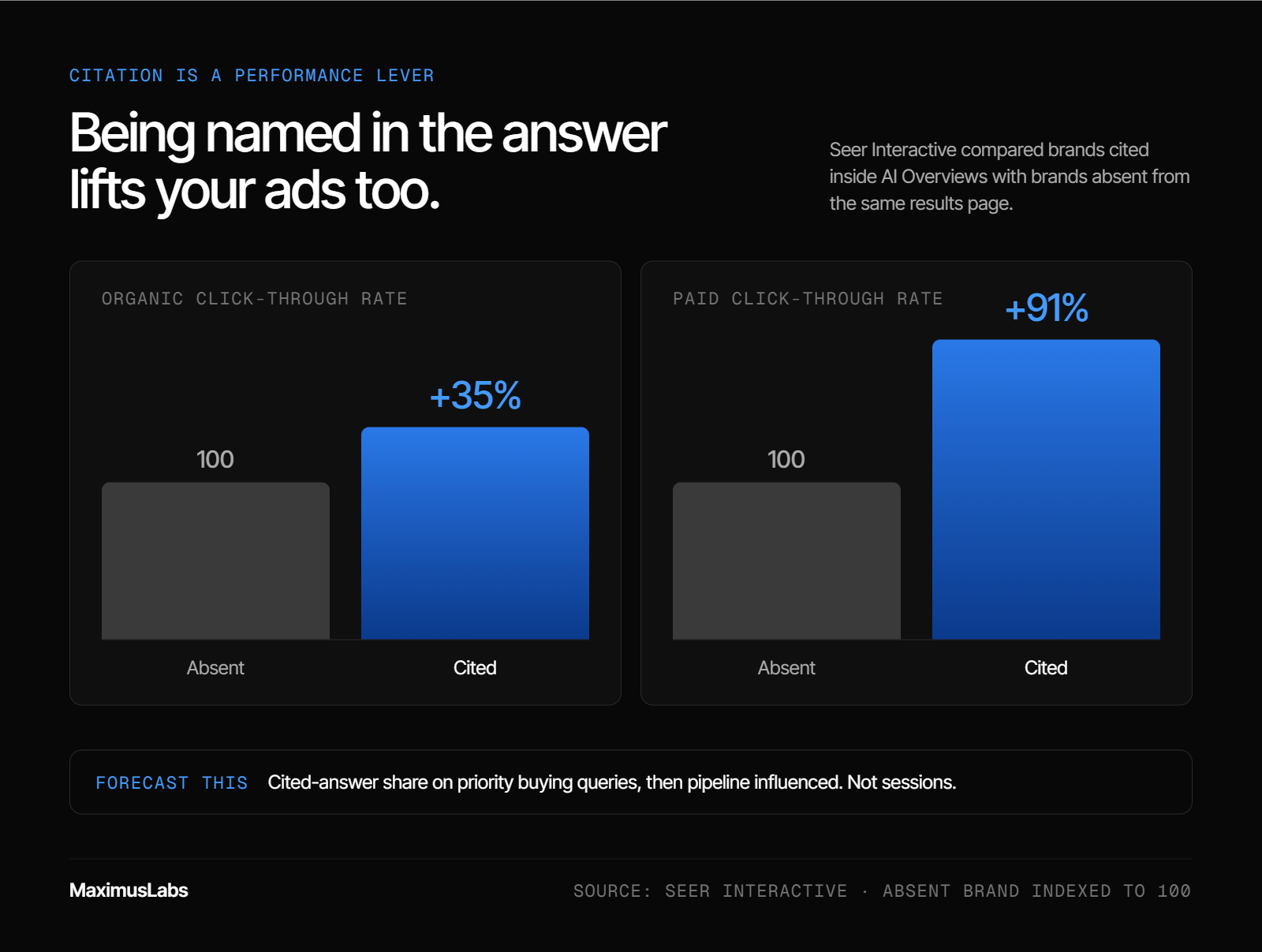
Seer Interactive compared brands cited inside AI Overviews against brands absent from the same results page. Cited brands saw a 35% lift in organic click-through rate and a 91% lift in paid click-through rate.
Read that twice. Getting named in the answer does not only earn a mention. It changes the economics of every other asset you have on that results page, including the ads you are already paying for.
💰 What this means for your Monday forecast
Stop forecasting sessions. Forecast cited-answer share on your priority buying queries, then forecast pipeline influenced.
MaximusLabs AI runs a decline audit before touching a single page. We segment lost traffic by funnel stage, then ask one question of every bleeding URL: did this page ever influence a closed deal? In most accounts, more than 80% of the lost sessions came from pages with zero pipeline attribution.
The contrarian read
Here is where I break with most of the recovery advice circulating right now. This is not a penalty, and it is not an emergency. It is the market deleting pages that never produced revenue in the first place.
I might be reading my own data too confidently, because our sample skews toward B2B SaaS with real BOFU inventory. A content-led publisher would experience this as genuine damage. A Series A software company mostly loses pages it should never have funded.
MaximusLabs AI reports the decline split by pipeline contribution rather than by total sessions, which turns a panic meeting into a reallocation decision. That is the honest version of the conversation, and it is the one that survives a CFO's follow-up question.
Q3. Can B2B SEO Create Demand, or Does It Only Capture It?
B2B SEO captures demand; it does not create it. Eli Schwartz states it directly: "SEO is an optimization channel, not a demand-creation channel. SEO efforts improve the visibility of a website when the demand is already there." In a narrow niche, optimization produces one step-change in visibility, then grows only at the rate of category demand. MaximusLabs AI sizes that non-branded demand ceiling before scoping any content.
The assumption inside most board decks
📈 Linear math on a non-linear channel
The slide usually looks like this: double content output, double organic traffic, double pipeline from organic. It is clean, and it is wrong.
Search volume is not a dial you control. It reflects how many people are already in-market and already describing their problem in words you can target.
🧱 The wall of reality
Schwartz describes hitting this himself. "When I embarked on my first effort to help a SaaS B2B company with its SEO, I was also under the illusion that this was going to be a supremely profitable channel. I was eventually confronted with a wall of reality that I then needed to convey to a disappointed client," he writes in Product-Led SEO.
His conclusion is the part people skip. Better SEO practices did not create new demand for a niche B2B tool. They created more visibility inside the audience already looking.
Why B2B buying behaviour sets the ceiling
⏰ Infrequent decisions, constant presence
Ethan Smith of Graphite makes the behavioural case well. A Director of Finance is not changing banks weekly. They are not searching for your B2B product today, though they are online, reading, and eventually they will make a decision.
So the opportunity is not demand creation. It is being the trusted, cited presence that exists when their infrequent decision finally arrives.
🎯 How to size your ceiling in one afternoon
Pull your category's non-branded query universe. Strip branded volume. Keep only comparison, alternative, integration, use-case, and pricing intent. Multiply the realistic click and citation share by your historical close rate on inbound.
That number is your organic ceiling. If it cannot carry the number your board expects, the gap belongs to paid, outbound, partnerships, or product, and no amount of publishing will close it.
The resolution, and the uncomfortable part
AI search does change one element of this. Demand that was invisible to keyword tools now surfaces as 25-word conversational questions, so the addressable surface is wider than Ahrefs volume suggests. It is still capture, just capture across more surfaces.
MaximusLabs AI sizes the demand ceiling in week one, before content is scoped, and shows the founder a realistic pipeline range rather than a traffic projection. We have told prospects their category is too small for an organic-first bet. Telling a founder their ceiling is low costs us a deal and buys us a reputation, which is a trade I will take every time.
Q4. Which 5% of Your Pages Actually Drive Pipeline?
Roughly 1 in 20 B2B landing pages drives about 85% of organic traffic and pipeline, based on Ethan Smith's observations across Webflow, Upwork, Notion, Rippling, and GlossGenius. The other 19 produce near-zero revenue. Winners are bottom and middle-of-funnel: comparison, use-case, integration, and technical documentation pages. MaximusLabs AI excludes "what is" definitional content from its briefs because AI answers now absorb it.
The 5% Rule, stated plainly
📊 Nineteen pages that do nothing
Smith's phrasing is worth keeping intact. "19 out of 20 landing pages drive little to no traffic, one out of 20 landing pages drives roughly 85% of all your traffic."
This is not a content quality problem. It is an intent allocation problem, and it shows up in portfolios built by very competent teams.
❌ The glossary trap
On definitional content, Smith is equally direct: the definition of payroll has had a zero conversion rate, ever. His advice is to spend no time on glossary and low-intent pages, and to focus on the end of the journey, then the middle.
That position used to be contrarian. Now Google's own data makes it structural, because roughly 88% of AI-Overview triggers are informational queries. You are competing for the exact intent the engines have chosen to answer themselves.
The page-type hierarchy worth funding
✅ What earns its keep
| Page type | Funnel stage | AI citation behaviour | Pipeline behaviour |
| Glossary and "what is" | TOFU | Absorbed into AI answers | Near zero |
| Thought leadership | TOFU | Occasional, rarely commercial | Indirect |
| Use-case and persona pages | MOFU | Cited on "best X for Y" queries | Moderate, assists deals |
| Comparison and alternatives | BOFU | High, these queries trigger AI answers heavily | Strong, late-stage |
| Integration pages | BOFU | High on "does X work with Y" | Strong, unblocks evaluation |
| Technical documentation | BOFU | Highest, structured and answer-dense | Strong, unblocks evaluation |
Read the right-hand two columns together. The pages with the highest citation rate are the same pages that sit closest to a purchase decision, which is a rare and useful alignment.
🧹 Run the kill list this week
Export every URL with its 12-month clicks, assisted opportunities, and funnel stage. Sort by assisted opportunities, ascending. Anything with zero assists and zero citations after twelve months goes into one of three buckets: consolidate, rewrite as BOFU, or retire.
Expect the list to be uncomfortable. In the audits I have run, a 400-page B2B blog typically has 15 to 25 pages doing the work.
MaximusLabs AI publishes bottom and middle-of-funnel content and deliberately skips top-of-funnel, so our brief template has no "what is" slot in it. Every commissioned page has to name a buyer decision it influences. Volume is easy to invoice, which is why so much of it exists, and it is the first thing we cut.
Q5. How Do You Build a BOFU-First Keyword Map and Cluster Architecture?
Start at the end of the buyer journey. Map the buying committee, then build intent clusters for comparison, alternative, integration, use-case, and pricing queries. Prioritise by pipeline potential rather than volume, because a 40-search "X vs Y" query outperforms a 10,000-search definitional term. Wire clusters into a hub-and-spoke structure, with one commercial pillar per intent cluster and spokes for segment and role variants. MaximusLabs AI builds this map before commissioning any content.
Invert the standard keyword process
🎯 Step one: map the committee, not the persona
Most keyword maps start with one "ideal customer" and one keyword list. B2B deals do not work that way, because three or four roles each research separately.
List every role that can block the deal. For a payroll tool, that is usually HR, IT, Finance, and Security. Each role asks a different question about the same product.
🧩 Step two: build the intent clusters
Rippling is the clearest example of this done well. It captured answer-engine share for "which payroll software integrates HR, IT, and finance" by building dedicated cross-department landing pages instead of generic payroll blog posts.
Group your queries into five clusters, in this order of priority:
Comparison: "X vs Y", "X alternatives"
Integration: "does X work with Y", "X Slack integration"
Use case and segment: "payroll for multi-entity startups"
Pricing and objection: "X pricing", "is X worth it"
Task and how-to: "how to run off-cycle payroll in X"
Wire the architecture so authority flows up
🔗 Step three: one pillar, many spokes
Each intent cluster gets one commercial pillar page. Segment and role variants become spokes. Every spoke links up to its pillar, and the pillar links down to every spoke.
MaximusLabs AI uses hub-and-spoke architecture on every engagement, with hubs carrying strategic scope and spokes carrying tactical depth. We check for cannibalisation before publishing, so no two pages compete for the same intent.
⚠️ Step four: resolve the consolidation argument
There is a real disagreement here, and I will not pretend otherwise. Ethan Smith's view is to consolidate: one page per intent cluster, targeting thousands of question variants, to prevent fragmentation.
| Approach | Best for | Trade-off |
| Single consolidated pillar (Graphite view) | Head terms, broad categories | Positioning flattens into generic category language |
| Dedicated segment pages (MaximusLabs AI) | Role and segment queries, answer-engine persona matching | More pages to maintain, cannibalisation risk if sloppy |
MaximusLabs AI leans toward segment pages, because engines match on persona and context. "Payroll for multi-entity startups" and "payroll for 500-person enterprises" pull different citations even when a keyword tool shows one cluster.
Where I would be wrong
My honest hedge: if your domain authority is low and your content team is one person, consolidation wins. Thin segment pages fragment authority you do not have yet.
MaximusLabs AI's data points toward segment pages for Series A and later B2B SaaS, though I might be over-weighting our own sample. Under roughly 30 total pages, I would consolidate first and split later.
MaximusLabs AI builds segment pages where others consolidate, because that is where product positioning gets expressed exactly the way the client wants it. A single flattened pillar describes a category. A segment page describes a buyer's specific job, which is what engines and buyers both reward.
Q6. How Do You Write a Page an AI Engine Will Actually Cite?
Citations follow extractable evidence, not keyword density. The Princeton and IIT Delhi GEO study, tested across 10,000 queries, measured up to 41% visibility gains from adding quotations, roughly 30% from adding statistics, and 27% to 40% from citing sources, alongside an 8.7% loss from keyword stuffing. Google requires no special markup for AI features, only index and snippet eligibility. MaximusLabs AI opens every section with a standalone 40 to 80 word answer for this reason.
The mechanic nobody explains
🔍 Retrieval happens at the passage level
AI engines do not read your page the way a human does. They chunk it, embed the chunks, and retrieve the ones that answer a sub-question cleanly.
So the unit of competition is not the page. It is the paragraph that can survive being lifted out alone.
⭐ What the GEO experiment actually proved
The Princeton and IIT Delhi team tested nine optimisation methods on a 10,000-query benchmark across multiple generative engines, as published in "GEO: Generative Engine Optimization" at KDD 2024. Three won consistently: adding authoritative citations, adding statistics, and adding direct quotations.
One lost. Keyword stuffing reduced visibility by 8.7%. That single result invalidates a decade of habit in B2B content teams.
The before and after on a real page type
✅ Rewriting an integration page
Here is the pattern MaximusLabs AI applies to a client integration page.
Before: an H2 reading "Integrations", followed by a feature grid and marketing copy about seamless workflows. No passage answers a question.
After: an H2 reading "Does [Product] sync two-way with Salesforce?", followed by a 45-word direct answer, then the field-level mapping table, then a named quote from the client's own solutions engineer.
The second version gives an engine something to lift. The first gives it nothing.
📊 Place the answer high, not low
Put the direct answer in the top 30% of body text. Evidence from AI-citation analysis shows this placement carries a 44.2% share of citations, a steep front-loaded distribution.
MaximusLabs AI measures this by auditing where the cited passage sits on pages that engines actually quote. Burying the answer under 600 words of context is the most common failure we find in answer structure.
Structure for query fan-out
🧩 One H2, one answerable question
Google's documentation describes query fan-out, where AI features decompose one question into several related sub-searches. Each sub-search needs its own landing passage.
Write every H2 as a question a buyer would actually type. Answer it in the first paragraph underneath. Then expand.
⚠️ Rank and citation are not the same race
The GEO study found a fifth-ranked page could gain up to 115% citation share after optimisation, while the top-ranked page lost 30.3%. Position does not determine who gets quoted.
MaximusLabs AI's read is that the standard advice gets this backwards. Teams chase position one and then wonder why a weaker-ranking competitor is named in every ChatGPT answer. I used to assume rank led citation. Our tracking data stopped supporting that about eighteen months ago.
MaximusLabs AI writes to this standard by default, with a primary-source citation and a named-expert quote in every section, and the founder's perspective inside the body text rather than a pull quote. Attributed first-person experience is what makes a passage worth quoting instead of paraphrasing.
Q7. Why Is Technical Documentation Your Highest-ROI B2B SEO Asset?
Technical documentation is cited by AI engines at roughly 10 to 15 times the rate of blog posts, with a 34% to 41% median citation rate versus 15% to 18% for blog and editorial content, and around 29% of all citations. Documentation wins because it is structured, self-contained, authoritative, and answer-dense. "How to do [task] with [software]" queries trigger AI Overviews about 73% of the time, and vendor documentation supplies those answers. MaximusLabs AI includes documentation restructuring in its engagement scope.
Why docs outperform the blog
📊 The citation gap is structural, not editorial
Documentation is not cited more because it is better written. It is cited more because of how it is built.
Every doc page answers one task. It has a title that matches a question, steps in order, and no narrative padding. That is the exact shape retrieval rewards.
⚠️ The intent match is almost perfect
A buyer evaluating your product asks task questions, not category questions. "Can it do multi-entity consolidation" is a doc question, not a blog question.
MaximusLabs AI finds the same pattern in client audits. The pages that hold citation share through engine updates are integration docs, API references, and setup guides, not thought leadership.
The build order that works
✅ Four doc types, in sequence
Onboarding and setup guides. These capture "how do I get started with X" queries.
Feature reference pages. One page per feature, each answering what it does and what it does not.
Integration guides. One page per integration, because "does X work with Y" is a BOFU query in disguise.
API documentation. Highest technical trust signal, and the hardest for competitors to fake.
MaximusLabs AI sequences doc work in this order because the earlier types unblock evaluation faster, which is where pipeline sits.
⭐ Add video to the same URL
Ethan Smith embedded a YouTube video on application security posture management directly into a Legit Security product page covering how to secure generated code. That single page then surfaced across ChatGPT, Gemini, YouTube, and Google AI Overviews at once.
Webflow ran the larger version of this play. It produced more than 800 task-focused tutorial videos, and attributed roughly 8% of total signups to discovery through AI assistants.
The uncomfortable org problem
Here is the part that makes marketing leaders wince. Your highest-ROI search asset is owned by engineering, not by you.
Docs sit in a separate repo, ship on a separate cycle, and have no one accountable for how they appear in search. I have watched this stall for two quarters while a content calendar ran at full speed beside it.
MaximusLabs AI treats the documentation hub as a first-class Answer Engine Optimization (AEO) surface, and breaks monolithic guides into self-contained, answer-dense pages. Traditional agencies rarely touch docs, because docs do not fit a blog-per-month retainer. That is precisely why the highest-citation asset in B2B software sits unoptimised at most companies.
Q8. How Do You Get Into the AI "Sample Set" for Your Category?
When a buyer asks an AI engine for software options, it returns roughly 10 to 15 names. That list is the sample set, and a vendor absent from it is outside the buying conversation regardless of product quality. Entry is mostly earned off-site. Brand web mentions correlate with AI Overview visibility at Spearman r=0.664, roughly three times stronger than backlinks at r=0.218, and brands are about 6.5 times more likely to be cited through third-party content than their own site. MaximusLabs AI audits these third-party surfaces before any content work begins.
The old results page was generous
📉 Ten blue links gave everyone a chance
On a traditional results page, a buyer scanned ten links, then two or three listicles, then a G2 category page. Hundreds of vendors had a path to being seen.
Even position eight got some consideration. Page two existed. The funnel was leaky, but it was wide.
⚠️ The new gate is binary
AI answers do not have a page two. A buyer asks for the best option, receives five to ten names, and evaluates those.
If your product is not in that list, you are not losing a comparison. You are absent from one. That shift is the single most important change in B2B discovery, and most teams still measure as though the wide funnel exists.
What assembles the answer
🔍 The engines are quoting other people's pages
Semrush's 2026 AI Visibility Index analysed 126 million AI search prompts across 22 industries. Answers are assembled from owned content plus third-party sources: communities, publishers, retailers, and reference platforms.
That is why on-domain-only strategies plateau. You can write the best page in your category and still miss the sample set, because the engine is reading G2, Reddit, and a publisher listicle instead.
✅ The mention-acquisition playbook
Work the surfaces the engines actually cite in your category, in this order:
Claim and populate review profiles, with real review velocity.
Get into the publisher listicles that rank for "best [category]".
Answer community questions under a disclosed identity, never anonymously.
Publish task-level video for high-value, unglamorous workflows.
Pursue analyst and press mentions that engines treat as reference sources.
MaximusLabs AI calls this Search Everywhere Optimization, and runs it as the Earned half of its two-pillar model, alongside Owned content. The citation-acquisition work sits on the earned side.
The proof that it compounds
Webflow is the cleanest public example. Its team produced more than 800 task-focused tutorial videos and answered user questions directly in community threads with full identity disclosure. It attributed roughly 8% of total signups to AI-assistant discovery.
None of that happened on a blog. It happened on YouTube, in forums, and on review sites, which is exactly where most retainers do not reach.
MaximusLabs AI audits which third-party surfaces each engine cites in a client's category, then works those surfaces directly, and holds the engagement to pipeline rather than mention counts. For Oliv AI, that produced a 64% AI citation rate in 6 months, vs ~30% for billion-dollar incumbents, and 30 to 40% of inbound now AI-sourced.
Q9. Do G2 and Capterra Now Control Your B2B Discoverability?
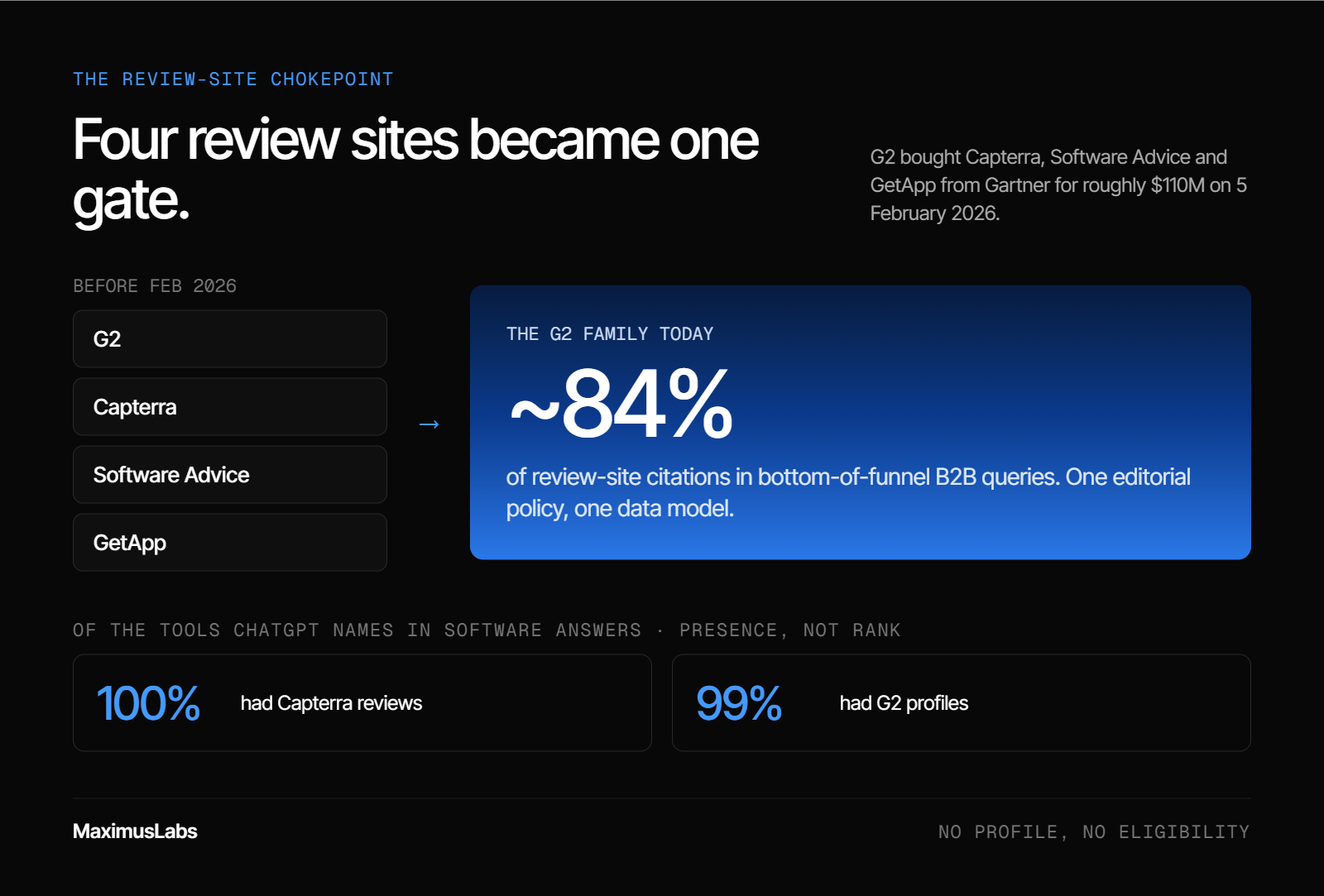
Largely yes, for commercial queries. After G2 acquired Capterra, Software Advice, and GetApp from Gartner for roughly $110M on 5 February 2026, the G2 family controls about 84% of review-site citations in bottom-of-funnel B2B queries. Of the tools ChatGPT names in software recommendations, 100% had Capterra reviews and 99% had G2 profiles. MaximusLabs AI treats review-profile completeness and review velocity as tracked deliverables rather than customer-success chores.
One company now sits between you and the answer
💰 What the acquisition actually changed
Before February 2026, review citations were spread across four independent properties. A vendor could be strong on G2 and absent from Capterra without much consequence.
That hedge is gone. The G2 family now owns the dominant share of review-site citations in commercial B2B answers. One editorial policy, one data model, one gate.
⚠️ Eligibility, not ranking
The 100% and 99% figures are the part worth sitting with. They are not about being ranked highly on those platforms. They describe presence.
Of the tools ChatGPT named in software answers, effectively all had a Capterra listing and nearly all had a G2 profile. No profile means no eligibility, which is a different and harsher rule than Google ever enforced.
Owned versus earned, by query type
✅ Which surface wins which query
| Query type | Example | Who gets cited | What you control |
| Head category | "best CRM software" | G2, Capterra, publisher listicles | Profile completeness, review volume, listicle inclusion |
| Mid-tail segment | "best CRM for 20-person sales teams" | Mix of review sites and vendor segment pages | Segment pages plus review filters and tags |
| Long-tail task | "how to integrate X with Slack" | Vendor documentation and feature pages | Fully owned |
MaximusLabs AI uses this split to decide where budget goes first. Head terms are an earned problem. Long-tail task queries are an owned problem, and they are usually the cheaper win.
❌ The quarterly chore problem
Most B2B teams handle reviews as a campaign. Customer success sends a request blast before a renewal push, collects fourteen reviews, then stops for two quarters.
Engines read recency and volume together. A profile with forty reviews, none from the last six months, reads as a stalled product. MaximusLabs AI ties review requests to product milestones and onboarding completions instead, so the cadence never flatlines. That work sits inside our reputation and trust-signal scope.
My read on the chokepoint
I do not love this situation, and I am not going to pretend it is healthy. A single private company now mediates a large share of how AI engines describe your category.
MaximusLabs AI's read is that complaining about it is not a strategy. The practical move is to treat review platforms as a ranked surface with an owner, a cadence, and a monthly number, exactly like a landing page.
MaximusLabs AI builds review velocity into the content calendar, covering category placement, feature tags, comparison entries, and a request cadence tied to product usage. Most AEO vendors sell a dashboard that confirms you are missing from the answer. Closing the review gate is what gets you into it.
Q10. What Technical SEO Still Matters, and What Is 95% Waste?
Indexability and snippet eligibility are the only stated requirements for inclusion in Google's AI Overviews and AI Mode, alongside entity disambiguation through Organization, Person, and sameAs markup. Core Web Vitals obsession and 50-page audits do not move AI citations. Ethan Smith, after fifteen years of testing, reports he has never seen Core Web Vitals drive impact, and sees no impact in large language models either. Google retired FAQ rich results on 7 May 2026. MaximusLabs AI ships a ranked fix list instead of a full audit document.
The situation every marketing lead recognises
📉 The audit that killed your credibility
You hired an agency. Six weeks later, a 48-page technical audit arrived, colour-coded by severity, with 212 issues.
You took it to engineering. They scoped the top twenty items at two sprints. Rankings did not move, and the next request got deprioritised. That is the SEO Death Spiral, and I have watched three agencies feed it inside one company.
⚠️ The complication: true but not impactful
Smith's framing is the sharpest I have heard. Much of SEO best practice is true and simply not impactful, and Core Web Vitals is the clearest example.
MaximusLabs AI's audits show the same pattern. Pages that lose citation share almost never lose it for speed reasons. They lose it because no passage on the page answers a question cleanly.
The schema evidence is genuinely split
❌ What the controlled tests found
Controlled analyses across OpenAI, Gemini, and Perplexity found no direct correlation between JSON-LD schema density and AI citation selection. Authority and semantic relevance drove selection instead.
The counter-position is that schema works as parsing hygiene and entity disambiguation, not as a citation multiplier. Both can be true at once.
✅ How MaximusLabs AI resolves it
MaximusLabs AI runs schema as hygiene, not as a citation lever. We implement Organization, Person, and sameAs properly, then stop expanding markup and move budget to evidence density instead.
I might be reading this too conservatively. If a controlled study showed schema density lifting citations tomorrow, I would change the policy. Right now the evidence does not support charging a client for it as a growth tactic.
The keep and kill list
| Keep | Kill |
| Indexation and snippet eligibility on every revenue page | Chasing Core Web Vitals scores past "passing" |
| Organization, Person, and sameAs entity markup | Expanding schema types for their own sake |
| The closed entity loop: site to Wikidata to LinkedIn to Crunchbase to G2 and back | FAQ markup bought as a rich-result play, retired 7 May 2026 |
| Clean HTML so critical content renders without JavaScript | 200-item audit backlogs with no revenue ranking |
| AI crawlers unblocked in robots.txt | Keyword-density tooling |
The closed entity loop is the underrated item. MaximusLabs AI connects sitewide Organization schema to Wikidata, LinkedIn, Crunchbase, and G2, so engines can resolve your brand to one entity rather than several fuzzy strings.
MaximusLabs AI does not open an engagement with a 50-page audit, because that document has destroyed marketing's credibility with engineering too many times. We ship a short ranked list, tied to pages that influence pipeline, and we say plainly which technical work to skip.
Q11. How Do You Measure B2B SEO When 90% of AI Influence Is Unclickable?
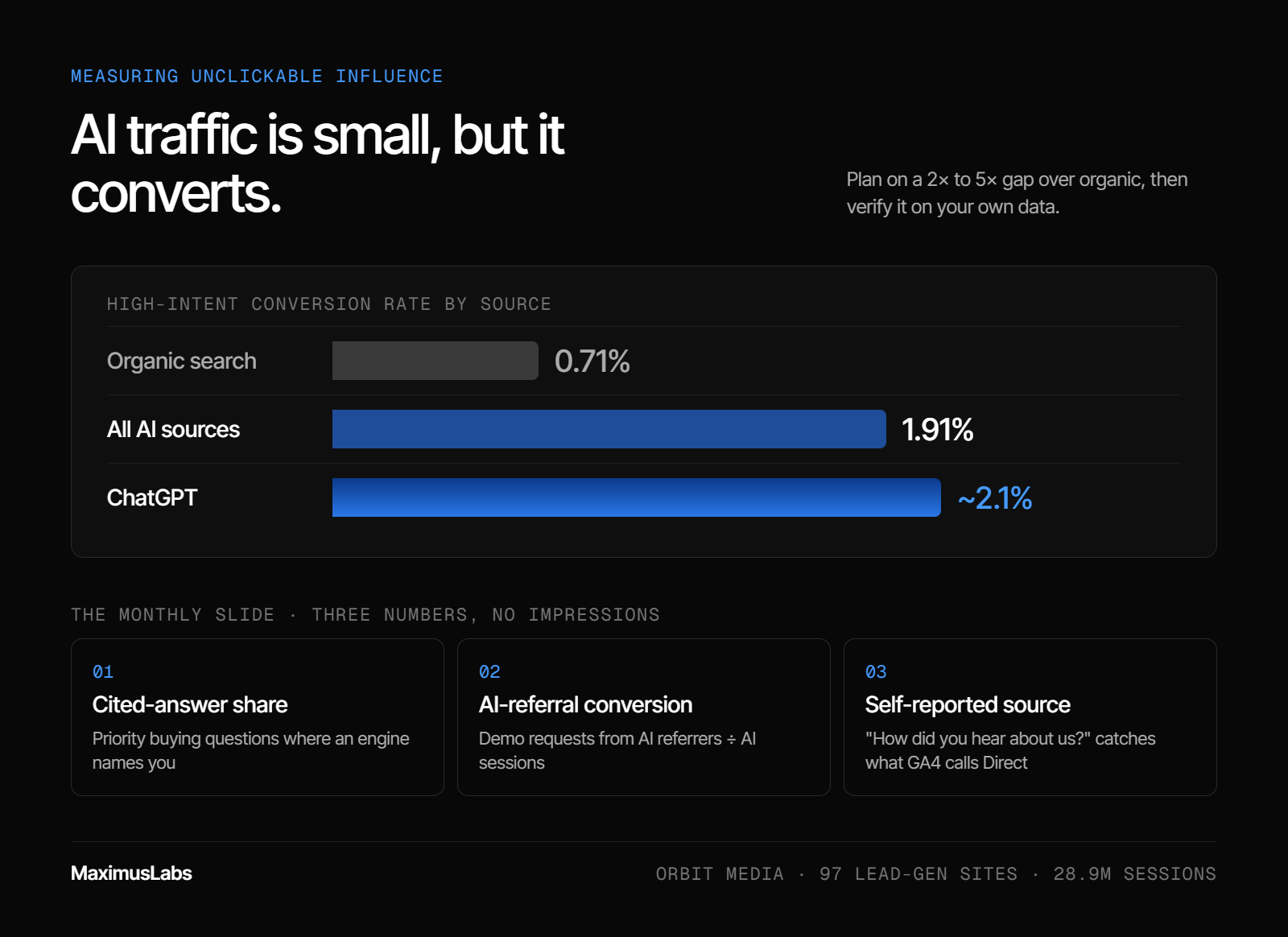
Report three metrics instead of sessions: cited-answer share on priority buying queries, AI-referral conversion rate, and self-reported attribution. AI referrals are small but qualified. Orbit Media's dataset of 97 lead-generation sites and 28.9 million sessions found 1.91% high-intent conversion from AI sources versus 0.71% from organic search. Because GA4 attributes most AI influence to Direct traffic, a "How did you hear about us?" field at signup recovers it. MaximusLabs AI reports cited pages against influenced opportunities.
The three-number scoreboard
📊 What to put on the monthly slide
Cited-answer share. The percentage of your priority buying questions where an engine names you.
AI-referral conversion. Demo requests from AI referrers, divided by AI sessions.
Self-reported source. The free-text answer buyers give at signup.
MaximusLabs AI reports these three alongside influenced pipeline, and leaves impressions off the slide entirely. The full metric set sits in our AEO measurement framework.
💰 The conversion multiple, honestly stated
Orbit Media measured 1.91% versus 0.71%, roughly a 2.7x gap, with ChatGPT around 2.1%. Webflow reported a 6x difference between AI traffic and Google organic traffic.
The widely quoted 4.4x figure belongs to a single Semrush study, not a universal benchmark. Plan on 2x to 5x, then verify on your own data. MaximusLabs AI's client numbers sit inside that band, though our sample is B2B SaaS only.
The mechanics, in order
✅ Three setup steps
Open Search Console and baseline the Generative AI performance report, which splits AI Mode and AI Overview impressions and clicks.
Build a GA4 channel group for AI referrers, covering ChatGPT, Perplexity, Gemini, and Copilot domains.
Add a required "How did you hear about us?" field at signup or demo request.
Step three matters most. MaximusLabs AI finds self-reported attribution catches the influence that never produced a click, which no analytics tool can see. That gap is the core of GEO revenue attribution.
The AEO tool trap
❌ Sixty tools doing one thing
Ethan Smith's team catalogued more than sixty AEO tracking tools and found they all do the same job: ask a question, record whether you appeared, chart it. His team built their own for a few cents per question.
His prediction is the part to act on. Ahrefs and Semrush will bundle this for a fraction of a standalone subscription, and anyone paying four figures monthly will churn.
| Option | What you get | Honest drawback |
| Standalone AEO tracker | Fast setup, dashboards | API-based sampling, commoditising fast |
| Build internal | Cents per query, live interface, full control | Needs engineering time |
| MaximusLabs AI | Live-interface tracking at cents per query, reported against pipeline | Comes as part of an engagement, not as standalone software |
Roughly 95% of third-party platforms query vendor API endpoints rather than the live logged-in interface, and APIs return a different citation mix than real buyers see. A side-by-side of the tracking tools makes that sampling gap obvious.
MaximusLabs AI runs citation tracking against the live interface at cents per query, then reports which cited pages touched which opportunities. For Oliv AI, that approach produced 27 qualified leads, $47K+ pipeline, 26% close rate in 4 months. Knowing your citation rate is not an outcome. Pipeline is.
Q12. Who Should Own This, and What Do the First 90 Days Look Like?
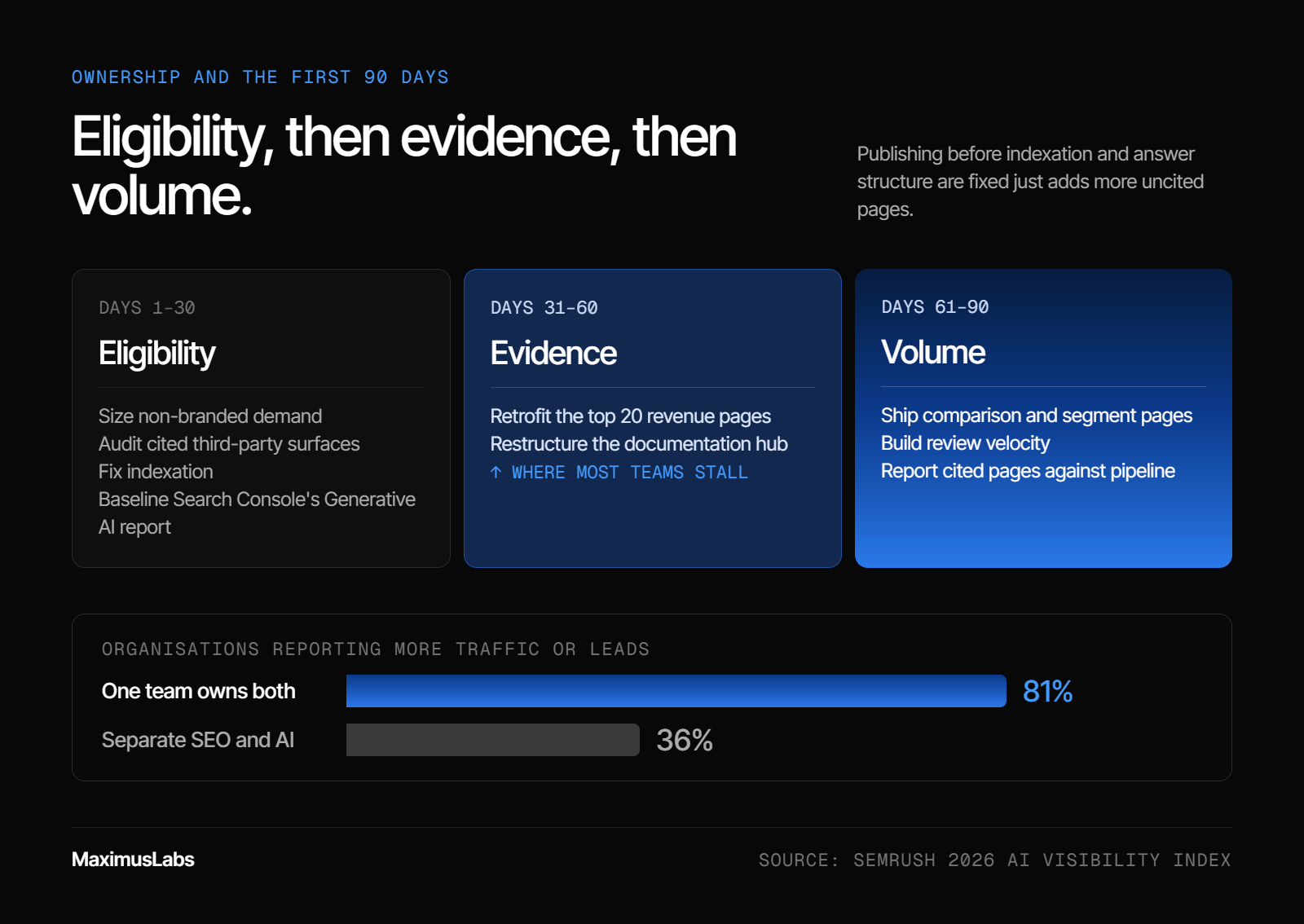
One team should own both SEO and AI visibility. Semrush's 2026 AI Visibility Index found 81% of organisations running unified workflows reported more traffic or leads, versus 36% that managed them separately. Sequence the work in three phases: days 1 to 30 size demand, audit cited surfaces, fix indexation, and baseline Search Console's Generative AI report. Days 31 to 60 retrofit the top 20 revenue pages and the documentation hub. Days 61 to 90 ship comparison and segment pages, build review velocity, and report cited pages against pipeline. MaximusLabs AI runs this sequence with a checkpoint at each phase.
Do not build a separate AI team
⚠️ Why the silo underperforms
The instinct is understandable. AI search feels new, so it gets a new owner, often a contractor with a prompt-tracking tool.
The data says that split costs you. Unified teams reported gains at more than twice the rate of separated ones. The reason is mechanical: the same page serves both surfaces, so splitting ownership splits the page.
✅ Who owns what
Give the organic growth lead both numbers. Give documentation a named marketing counterpart inside engineering. Give review platforms to the same person who owns comparison pages, not to customer success.
MaximusLabs AI works as strategy and execution in one team for this reason. A deck that stops at advice leaves the sequencing problem with you, which is why our GEO strategy framework ships with the execution plan attached.
The 90-day sequence
| Phase | Workstream | Owner | Checkpoint |
| Days 1 to 30 | Size non-branded demand ceiling | Organic growth lead | Pipeline range agreed with finance |
| Days 1 to 30 | Audit cited third-party surfaces | AEO owner | List of surfaces engines cite in your category |
| Days 1 to 30 | Fix indexation, baseline Generative AI report | Engineering plus growth | All revenue pages indexed and snippet-eligible |
| Days 31 to 60 | Retrofit top 20 revenue pages with answer blocks and evidence | Content lead | Each page has a 40 to 80 word answer in the top 30% |
| Days 31 to 60 | Restructure documentation hub | Engineering counterpart | Monolithic guides split into task pages |
| Days 61 to 90 | Ship comparison and segment pages | Content lead | One pillar per intent cluster live |
| Days 61 to 90 | Review velocity on G2 and Capterra | AEO owner | Monthly review cadence running |
| Days 61 to 90 | Pipeline report | Growth lead | Cited pages mapped to influenced opportunities |
⏰ The order is not optional
Eligibility comes before evidence. Evidence comes before volume. Publishing new pages before indexation and answer structure are fixed just adds more uncited pages.
MaximusLabs AI sequences every engagement this way, and the day 31 to 60 block is where most teams stall, because retrofitting twenty pages plus a documentation hub is a production problem, not a strategy problem.
Honest timelines, and what I think happens next
Compounding organic results take six to twelve months, with peak return usually in year two or three. AEO moves faster. Smith notes that answer engine citations can be won quickly, even for seed-stage companies where ranking would take years. That pattern holds in GEO for SaaS startups more reliably than in enterprise accounts.
My hypothesis for 2028: tracking becomes free, bundled into Ahrefs and Semrush, and the durable advantage shifts entirely to evidence quality and earned presence. I could be wrong about the timing. I am fairly confident about the direction.
MaximusLabs AI runs this 90-day sequence as strategy and execution together, with cost-effective, scalable content production making the retrofit block achievable. Oliv AI reached a 64% AI citation rate in 6 months, vs ~30% for billion-dollar incumbents, with 30 to 40% of inbound now AI-sourced.
Frequently asked questions
What is B2B SEO, and how is it different from B2C SEO?
B2B SEO is the practice of making a company the answer that buying committees receive when they research vendors, both on Google and inside ChatGPT, Perplexity, Gemini, and Google AI Overviews. It targets low-volume, high-intent queries and is measured against pipeline rather than sessions. The structural differences from B2C are what change the work: • Buyer: a committee of five to eleven people, not one shopper. • Volume: often under 100 searches per month for the queries that close deals. • Cycle: three to eighteen months, with infrequent repeat purchase. • KPI: qualified pipeline and closed revenue, not transactions. • Winning pages: comparison, integration, and documentation pages, not category listings. What changed in 2026 is that rankings stopped guaranteeing clicks. MaximusLabs AI tracks citation presence across four AI engines alongside rank position for every client page, and those two numbers diverge constantly. Page-one pages often go uncited, while lower-ranking pages get named repeatedly because they carry extractable, sourced evidence. If you want the mechanics behind that split, our breakdown of how AEO differs from traditional SEO covers the retrieval layer in detail.
Why did our organic traffic drop 20 to 40% even though our rankings held?
Because rankings and clicks decoupled. When an AI Overview answers the query on the results page, the click never happens, even though your position is unchanged. Ahrefs measured a 58% drop in position-one click-through rate on AI Overview keywords, and Pew found users click a traditional result 8% of the time when a summary appears versus 15% without. Run this diagnostic before you panic: • Open Search Console and set the range to 16 months. • Switch on all four metrics, including click-through rate. • If impressions held while CTR fell, you are being summarised, not outranked. • Segment the losses by funnel stage, not by total sessions. The losses concentrate almost entirely in definitional, top-of-funnel content, because informational intent is what triggers AI answers. Comparison, integration, and pricing pages generally hold. MaximusLabs AI runs a decline audit that asks one question of every bleeding URL: did this page ever influence a closed deal? In most accounts, more than 80% of lost sessions came from pages with zero pipeline attribution, which reframes the problem as reallocation rather than recovery. Our research on the search referral traffic decline covers the full diagnostic sequence.
Can B2B SEO create demand, or does it only capture existing demand?
B2B SEO captures demand. It does not create it. As Eli Schwartz puts it, SEO is an optimization channel rather than a demand-creation channel, improving visibility only where demand already exists. In a narrow niche, optimization produces one step-change in visibility, after which growth tracks category demand. The practical consequence is that you must size your ceiling before you spend: • Pull the full non-branded query universe for your category. • Strip branded volume out entirely. • Keep only comparison, alternative, integration, use-case, and pricing intent. • Multiply realistic click and citation share by your historical inbound close rate. If that number cannot carry your board's expectation, the gap belongs to paid, outbound, partnerships, or product. No publishing cadence closes it. AI search widens the surface slightly, because conversational questions surface demand that keyword tools scored as zero volume, but the nature of the channel is unchanged. MaximusLabs AI sizes this demand ceiling in week one, before any content is scoped, and presents founders with a pipeline range instead of a traffic projection. We have told prospects their category is too small for an organic-first bet. Our revenue-focused GEO framework explains how that number is built.
Which B2B pages actually drive pipeline, and which ones are wasted effort?
Roughly 1 in 20 B2B landing pages drives about 85% of organic traffic and pipeline. The other nineteen produce near-zero revenue. That pattern, observed by Ethan Smith across Webflow, Upwork, Notion, Rippling, and GlossGenius, holds in portfolios built by very capable teams. Here is the hierarchy worth funding, from strongest to weakest: • Technical documentation: highest citation rate, unblocks evaluation directly. • Integration pages: "does X work with Y" is a bottom-of-funnel query in disguise. • Comparison and alternatives: heavily triggered in AI answers, late-stage intent. • Use-case and segment pages: cited on "best X for Y" queries. • Glossary and "what is" content: absorbed by AI answers, converts at effectively zero. Run a kill list this week. Export every URL with its twelve-month clicks, assisted opportunities, and funnel stage, then sort by assisted opportunities ascending. Anything with zero assists and zero citations after a year gets consolidated, rewritten as bottom-of-funnel, or retired. MaximusLabs AI publishes bottom and middle-of-funnel content and deliberately skips top-of-funnel, so our brief template has no "what is" slot in it. Our AI content strategy planning guide shows how that prioritisation runs in practice.
How do you write a page that AI engines will actually cite?
Citations follow extractable evidence, not keyword density. The Princeton and IIT Delhi GEO study, tested across 10,000 queries, measured up to 41% visibility gains from adding quotations, roughly 30% from adding statistics, and 27% to 40% from citing sources, alongside an 8.7% loss from keyword stuffing. The page-level mechanics that matter: • Place a direct 30 to 60 word answer in the top 30% of body text, where citation share concentrates heavily. • Write every H2 as a question a buyer would actually type, then answer it in the first paragraph below. • Add at least one named-expert quotation and several cited statistics per section. • Keep each passage self-contained, so it survives being lifted out alone. • Strip residual keyword repetition, which now actively costs visibility. Structure also has to account for query fan-out, where an engine decomposes one question into several sub-searches. Each sub-question needs its own landing passage, which is why question-headed sections outperform thematic ones. MaximusLabs AI writes to this standard by default, with a primary-source citation and a named-expert quote in every section, and the founder's perspective inside the body text rather than a pull quote. Our guide to citation-worthy content for AI engines documents the full standard.
Do G2 and Capterra now control B2B software discoverability in AI answers?
For commercial queries, largely yes. After G2 acquired Capterra, Software Advice, and GetApp from Gartner for roughly $110M on 5 February 2026, the G2 family controls about 84% of review-site citations in bottom-of-funnel B2B queries. Of the tools ChatGPT names in software recommendations, 100% had Capterra reviews and 99% had G2 profiles. Read those last two numbers as eligibility, not ranking. A missing profile means exclusion before any comparison happens, which is a harsher rule than Google ever enforced. The split by query type is useful: • Head category queries like "best CRM software" are won by review sites and publisher listicles. • Mid-tail segment queries mix review platforms with vendor segment pages. • Long-tail task queries are fully owned by your documentation and feature pages. Most teams still treat reviews as a quarterly campaign, collecting fourteen reviews before a renewal push then stopping. Engines read recency and volume together, so a profile with no reviews in six months reads as a stalled product. MaximusLabs AI builds review velocity into the content calendar, tying requests to product milestones and onboarding completions rather than leaving it to customer success. Our work on trust signals and reputation management treats those profiles as ranked surfaces.
How do you measure B2B SEO when most AI influence never produces a click?
Stop reporting sessions and report three numbers instead: cited-answer share on your priority buying queries, AI-referral conversion rate, and self-reported attribution at signup. AI referrals are small in volume but unusually qualified. Orbit Media's dataset of 97 lead-generation sites and 28.9 million sessions found 1.91% high-intent conversion from AI sources versus 0.71% from organic search, and Webflow reported a 6x gap. Treat 2x to 5x as the planning band and verify on your own data rather than importing the widely quoted 4.4x figure. The setup takes an afternoon: • Baseline Search Console's Generative AI performance report, which separates AI Mode and AI Overview impressions. • Build a GA4 channel group for ChatGPT, Perplexity, Gemini, and Copilot referrers. • Add a required "How did you hear about us?" field at signup or demo request. That third step matters most, because analytics cannot see influence that produced no click. MaximusLabs AI runs citation tracking against the live interface at cents per query rather than reselling a dashboard, since vendor APIs return a different citation mix than real buyers see, and reports which cited pages touched which opportunities. Our AEO measurement metrics guide covers the full reporting stack.