 Krishna Kaanth M
- B2B SEO now spans two surfaces: Google's ranked results and the citation layer inside ChatGPT, Perplexity, Gemini, and AI Overviews. Measure it in pipeline, not sessions.
- Roughly 1 in 20 landing pages drives about 85% of organic traffic, so allocate budget against the earning 5% and defund definition posts entirely.
- Score keywords by qualified-lead likelihood, not volume. A 40-search integration query usually beats a 20,000-volume glossary term for a buying committee.
- Build money pages first: comparisons, alternatives, integrations, segment pages, then a documentation hub, since docs get cited far more often than blogs.
- Most AI visibility is decided off your own site through brand mentions, review profiles, and community threads, not through backlinks alone.
- Run two measurement layers: CRM-connected pipeline quarterly, and AI share of voice per engine monthly, with a self-reported source field closing the attribution gap.
Q1. What does a B2B SEO strategy actually mean in 2026?
A B2B SEO strategy is a plan to be the source business buyers and AI engines surface during vendor evaluation. It targets low-volume, high-intent queries, maps every page to a funnel stage, and is measured in pipeline rather than sessions. In 2026 it spans two surfaces: Google's ranked results and the citation layer inside ChatGPT, Perplexity, Gemini, and Google AI Overviews.
🎯 The two surfaces you now compete on
Surface one is familiar. A buyer types a query, Google returns ranked links, and you earn a click.
Surface two is newer and quieter. A buyer asks an AI engine a question, gets one synthesized answer, and sees five to ten brands named inside it. No click is required for your brand to influence that decision, and no ranking position exists inside that answer.
Most strategies were built for surface one only. That is the gap.
⚠️ Which old assumptions broke
Three assumptions quietly stopped holding. First, that a ranking equals a visit. Second, that traffic growth equals demand growth. Third, that one playbook works across every engine.
Marketing teams running legacy inbound playbooks have reported organic traffic on older blog libraries falling 20% to 40%, with the decline concentrated in top-of-funnel content that AI summaries now answer directly.
Note what did not break. Crawlability, clear information structure, and genuine subject authority all still matter. They simply stopped being the finish line. Best-practice SEO has become the basics for AI search, not the strategy.
📉 What the data actually says
Ahrefs re-ran a 300,000-keyword study and found that the presence of an AI Overview correlated with a 58% lower click-through rate for position-one content as of December 2025, up from 34.5% in its April 2025 analysis. Positions two and three fell 50.8% and 46.4%, per the Ahrefs February 2026 update.
Gartner had forecast a 25% drop in traditional search volume by 2026. The honest 2026 read is more specific than that headline. Query volume largely relocated rather than vanished, but the click per ranking got much thinner.
Meanwhile Semrush measured AI-referred visitors converting at roughly 4.4 times the rate of traditional organic visitors, while AI traffic still accounted for well under 1% of total visits, according to its AI search traffic study. Small channel, dense buyers.
✅ What this playbook covers, and what it refuses to
So the job changed shape. You are no longer only trying to rank a page. You are trying to be the source an engine reaches for, and then to convert the smaller, better-qualified stream that arrives.
That reframing drives everything that follows: who you optimize for, which keywords earn budget, which page types ship first, what you fix technically, and how you report results to a board.
Two refusals, stated upfront. This playbook will not tell you to mass-produce definition posts, because they convert near zero and AI engines already answer them natively. It also will not promise that organic creates demand that does not exist, which is the subject of Q4.
My own read, and I hold it loosely: the teams struggling most right now are not the ones with weak SEO. They are the ones with strong 2019-era SEO and no model for the citation layer. Their fundamentals are fine. Their measurement and their content mix are not.
Q2. Who are you optimizing for, and which keywords deserve budget?
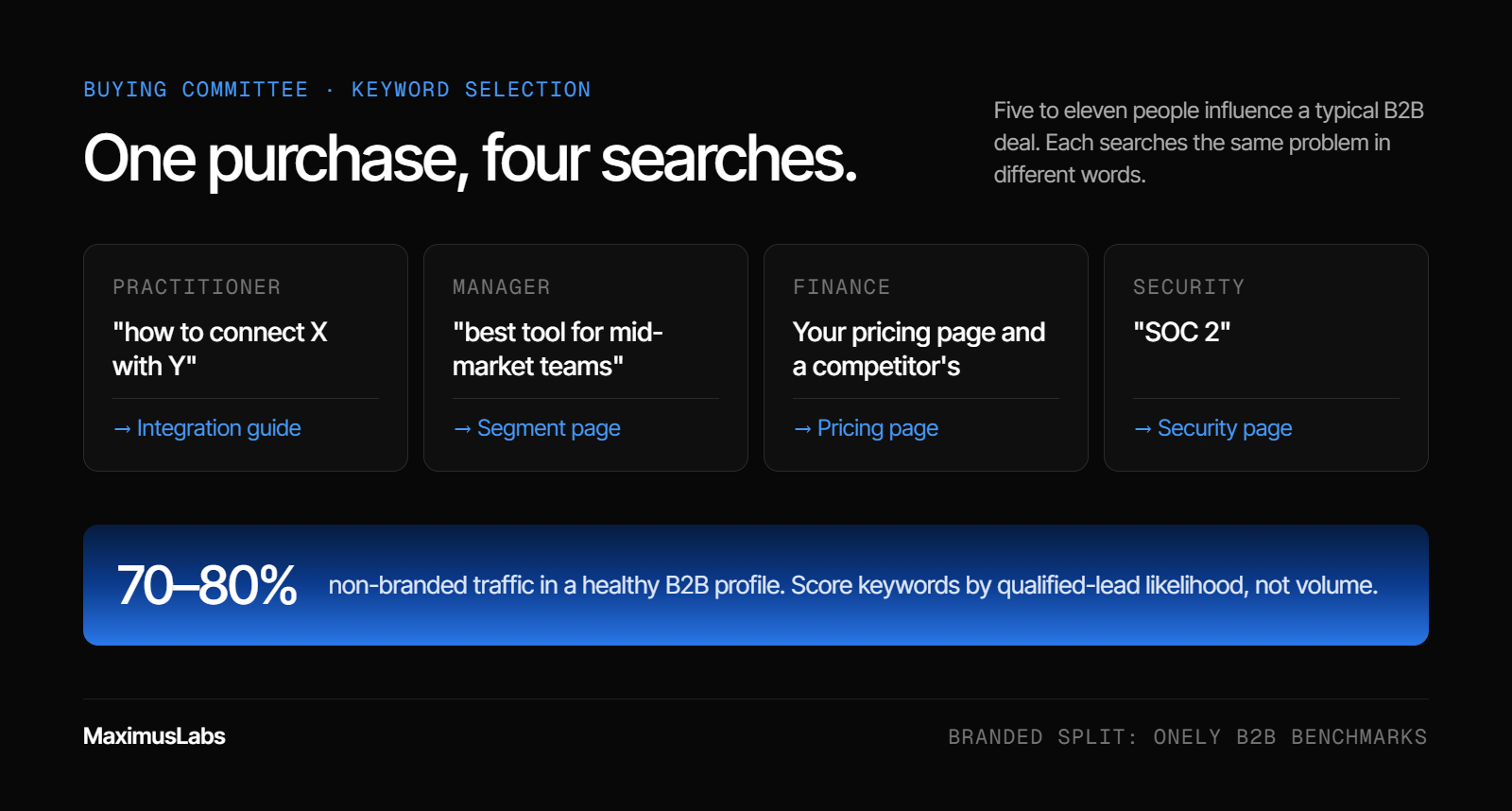
Optimize for a committee, not a user. Five to eleven people influence a typical B2B purchase, each searching different language for the same problem. Score keywords by qualified-lead likelihood, not volume: a 40-searches-a-month integration query often beats a 20,000-volume definition term. Expect a 20% to 30% branded and 70% to 80% non-branded split in a healthy B2B profile, per Onely's B2B SEO benchmarks.
👥 One purchase, several different searches
A single deal generates several unrelated search behaviours. The practitioner searches "how to connect X with Y." The manager searches "best tool for mid-market teams." Finance searches your pricing page and a competitor's. Security searches "SOC 2."
Those are four content assets, not one. Teams that build a single persona lose three of them.
B2B buying is also infrequent by nature. As Ethan Smith of Graphite puts it, a finance director is not changing banks weekly, so they are not searching for your product today, though eventually they will make a decision. That is why role-specific research queries beat product-name volume.
📊 A keyword-scoring model you can run this week
Replace volume-sorted lists with a four-axis score. Rate each cluster from one to five on every axis, then multiply revenue proximity by winnability to break ties.
| Axis | What you are asking | Scores high when |
| Intent stage | Is this a buying question or a curiosity question? | Comparison, alternatives, pricing, integration queries |
| Buyer role | Which committee member asks this? | An economic buyer or a champion, not a student |
| Revenue proximity | How many steps from this page to a demo? | One or two steps, on a commercial page |
| Winnability | Can we realistically rank or get cited in 12 months? | Competitor pages are thin or absent |
Winnability deserves a sober look. Competitive B2B top-ten results often sit behind domains in the DR 78 range, against a category average nearer DR 62. If the gap is that wide, the honest play is citation in third-party sources, not a head-on page.
🔍 What the branded split tells you
A B2B site with 60% branded traffic does not have an SEO problem. It has a demand-capture ceiling. You are harvesting people who already know you.
Track the ratio monthly. Non-branded growth is the leading indicator that your organic program reaches new accounts, and branded growth is usually brand marketing's result showing up in your dashboard.
🧭 Where the real questions come from
Keyword tools underreport exactly the queries that convert, because low-volume long-tail phrasing rarely clears their sampling thresholds.
Four better sources: recorded sales calls, support ticket subject lines, lost-deal notes, and practitioner forums. Mine the literal phrasing, not the paraphrase.
"My company is a B2B tech company in a niche space in fintech. Our highest volume keywords don't receive more than 200 hits per month."
— Original poster, r/SEO Reddit Thread, 2021
"In B2B SEO, focus on hyper-targeted keywords for high-value prospects. Don't expect high traffic volume."
— Commenter, r/SEO Reddit Thread, 2023
One decision rule I would defend: choose the keyword and the asset type in the same meeting. Head category queries like "best CRM software" are usually won through third-party sources that engines already trust. Long-tail integration and workflow queries are won on your own documentation and feature pages. Picking a keyword without picking the surface is how programs drift.
Q3. Why does most B2B organic traffic never become pipeline?
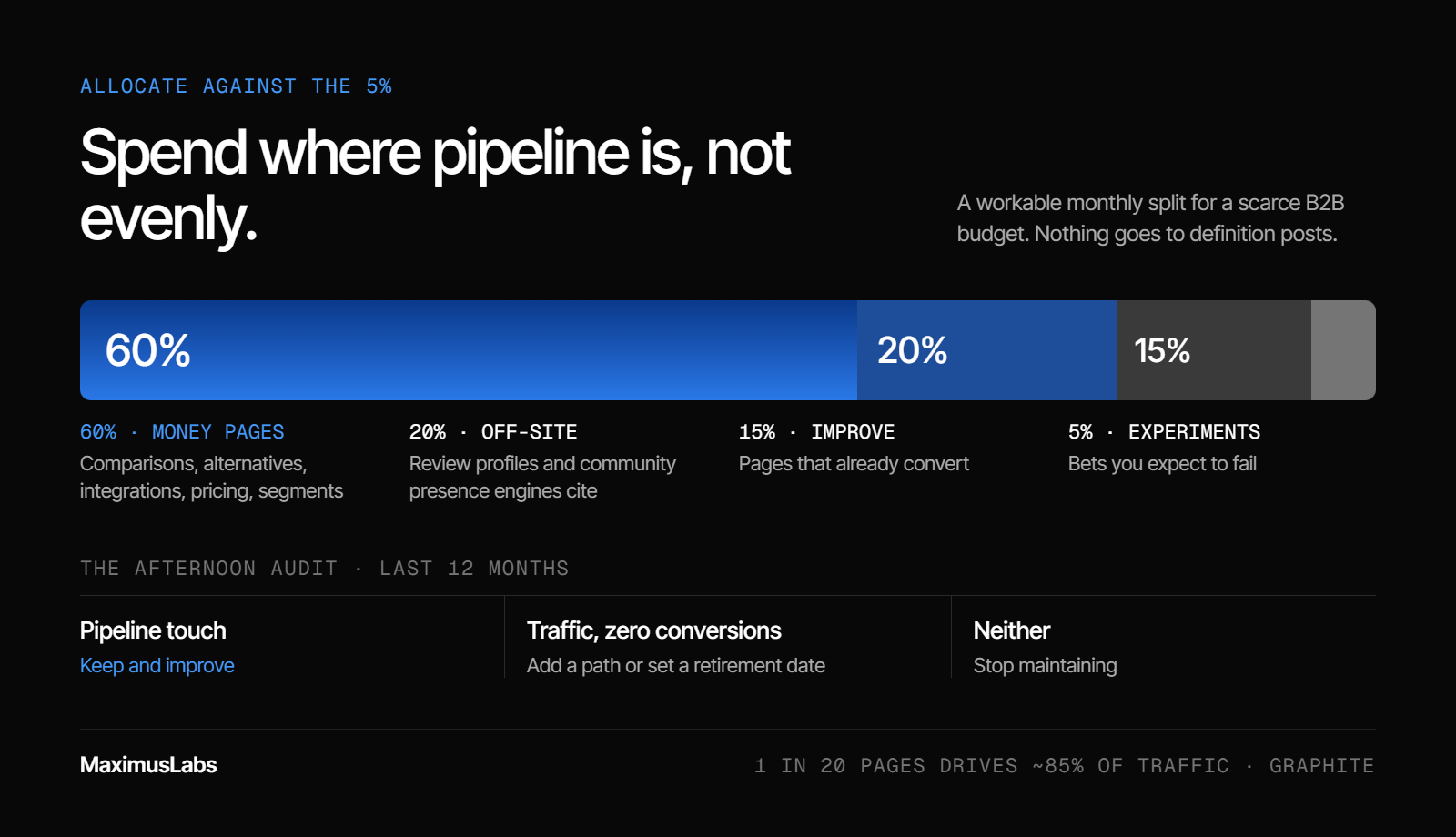
Because output and impact are not correlated. Graphite's work across companies including Webflow, Upwork, Notion, and Rippling found roughly 1 in 20 landing pages drives about 85% of all organic traffic, while 19 of 20 drive little to none. Most programs spread budget evenly across those twenty pages, so the majority of spend lands on assets that cannot convert at any ranking.
📉 The situation: a chart that goes up and a pipeline that does not
Here is the scene every head of growth knows. The monthly report shows traffic up 40% year on year. Rankings improved on 60 keywords. Then someone asks which deals came from it, and the room goes quiet.
Both facts are true at once. Traffic grew. Pipeline did not. That is not a reporting failure; it is a selection failure.
🔗 The complication: volume-led selection compounds
The root cause sits upstream, in the keyword list from Q2. When pages are commissioned by search volume, you systematically buy the cheapest traffic and the least qualified reader.
Then the second failure arrives: maintenance. Teams keep refreshing all twenty pages because all twenty exist. Nobody wants to declare nineteen of them finished.
Ethan Smith describes the organizational version of this as a death spiral. A company hires an agency, receives a fifty-page technical audit, ships low-impact fixes, sees flat results, loses engineering's trust, and repeats the cycle with a new agency. The spiral is not caused by bad people. It is caused by work that was never load-bearing, which is why a technical audit has to be scoped to impact.
"Blogs rarely generate leads. Wrong part of the sales funnel."
— Commenter, r/SEO Reddit Thread, 2023
"You don't need a ton of traffic for B2B because visitors have high intentions to purchase or research your business."
— Commenter, r/SEO Reddit Thread, 2024
💰 The resolution: allocate against the 5%, not across the 20
Turn the 5% rule into a spend rule. For a scarce GTM budget, a workable monthly split looks like this.
60% to the commercial pages closest to revenue: comparisons, alternatives, integrations, pricing, and segment pages.
20% to off-site trust surfaces that AI engines cite, including review profiles and community presence.
15% to improving the existing pages that already convert.
5% to deliberate experiments you expect to fail.
Nothing goes to definition posts. That is a position, not a preference.
🔎 The audit that finds your earning 5%
Run this in an afternoon. Export every URL with organic entries and conversions for the last twelve months. Flag pages with any pipeline touch. Flag pages with traffic and zero conversion events. Flag pages with neither.
Then stop maintaining the third group entirely, and decide consciously whether the second group needs a conversion path or a retirement date. Most teams find their earning set is smaller than twenty pages.
MaximusLabs AI restricts the first three months of every engagement to bottom-of-funnel assets, with middle-of-funnel work unlocked only after the BOFU set is exhausted, and measures the engagement on pipeline rather than mentions. Oliv AI's published numbers from that sequencing: 27 qualified leads, $47K+ pipeline, and a 26% close rate in 4 months, documented in the Oliv AI case study.
Q4. Can B2B SEO create demand, or only capture it?
Capture, not creation. Eli Schwartz, who led organic growth at SurveyMonkey, states it directly: "SEO is an optimization channel, not a demand-creation channel." Better SEO raises visibility inside the audience already searching. It does not manufacture buyers for a niche product. Forecast organic as a share of existing category demand, then expand that demand through brand, product-led pages, and off-site presence.
🧱 The wall of reality, described by someone who hit it
Schwartz is unusually candid about his own first B2B SaaS engagement. He expected a supremely profitable channel and instead met what he calls a wall of reality, which he then had to convey to a disappointed client.
The finding was structural, not tactical. A product sold to a narrow B2B audience does not generate new demand because its SEO improves. It gains visibility within the audience already looking for that product or its competitors.
📈 What that does to your forecast
This single idea should change how you model organic. Stop forecasting from keyword volume upward. Start from category demand downward.
Estimate how many accounts in your category are in-market this year. Estimate what share of their research happens through search and AI engines. Then estimate what share of that research you can realistically be present for. That is your ceiling, and it moves only when the category grows or your presence widens, which is the logic behind revenue attribution for GEO initiatives.
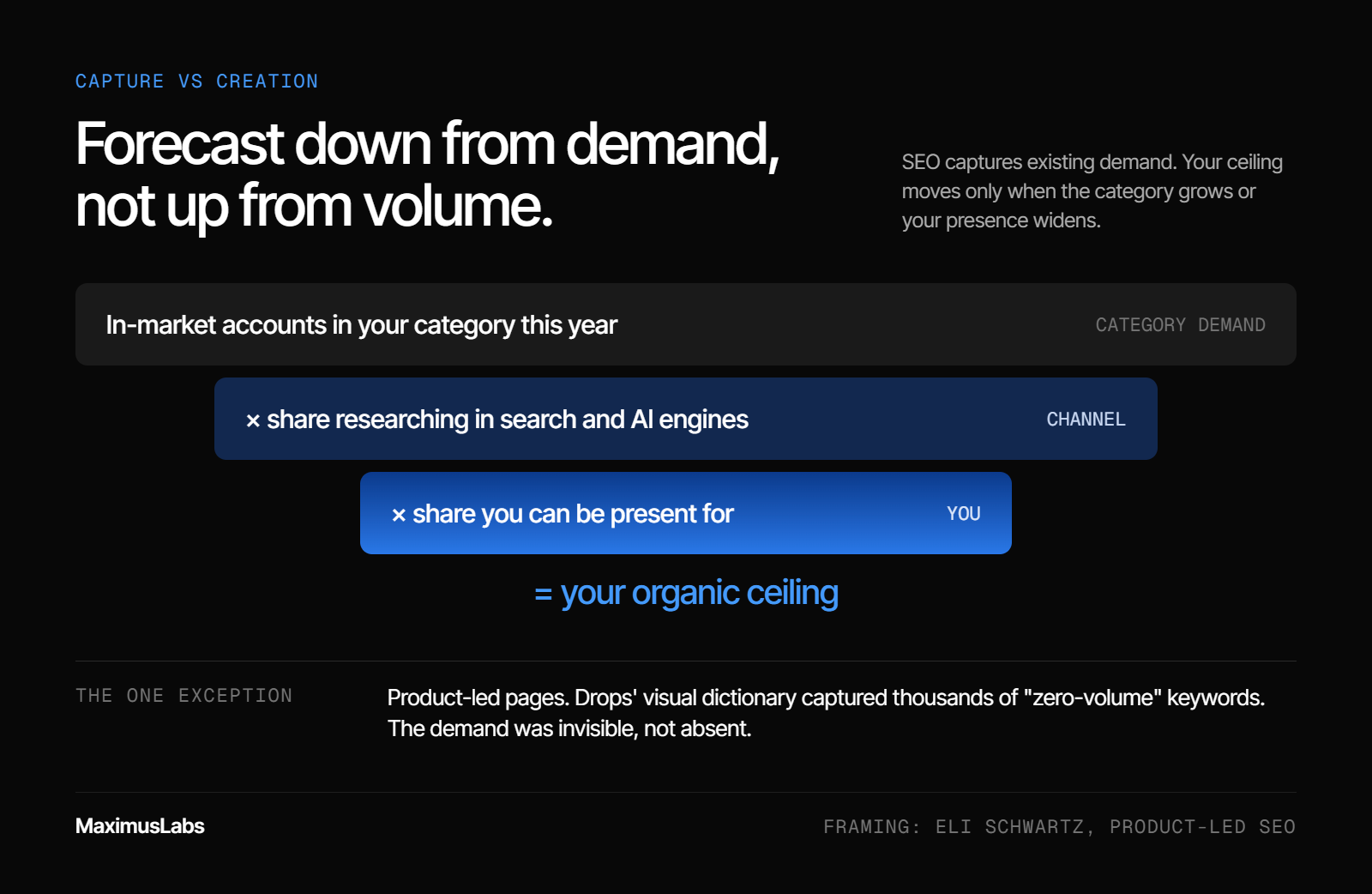
Two consequences follow. A flat organic curve in a flat category is not underperformance. And a board promise of pipeline growth from SEO alone, in a category nobody is searching for yet, is a promise you cannot keep.
🚀 The exception worth knowing: product-led pages
There is a real exception, and it is not a loophole. Schwartz documents the language app Drops, which launched a visual dictionary in June 2019 with no traditional keyword research and no cold outreach link building. Pre-launch traffic sat at 100 to 200 clicks per day.
The programmatic product pages then captured thousands of keywords that tools had reported as zero search volume, and organic growth compounded from there.
Read the mechanism carefully. Drops did not create demand for Drops. It built pages for demand that already existed in a long tail too thin for keyword tools to measure. The demand was invisible, not absent.
That is the honest version of "SEO creates demand," and it only works when the product itself generates the page inventory.
🧠 Where I push back on the orthodoxy
I accept the capture framing almost entirely, with one amendment I hold with genuine uncertainty.
In AI search, presence and demand blur slightly. When an engine names five to ten vendors in an answer, a buyer who arrived with one brand in mind leaves with a shortlist. Your inclusion did not create the purchase intent, but it did widen the consideration set at the moment it formed.
So brand remains the moat. Being searched for by name is the only demand you truly own, and every off-site mention, review profile, and cited thread makes that name harder for an engine to omit. Capture is the channel. Brand is what expands the set of questions where you get named at all. If you want that mapped to your own category, talk to the MaximusLabs AI team.
Q5. What is the sample set gate, and why is AI visibility binary?
When a buyer asks ChatGPT for the best tools in a category, it names 10 to 15. That list is the evaluation set. MaximusLabs AI calls this the sample set gate: AI answers have no page two, so omission is absence, not a lower ranking. Inclusion transfers the engine's own credibility to your brand, which is why AI-referred visitors convert at 4.4 times traditional organic rates, per Semrush's AI search traffic study.
🔒 The situation: a shortlist you never see
Here is the moment that should worry a head of growth. A VP of Finance opens ChatGPT and asks for the best spend management tools for a 200-person company. The engine returns one answer with roughly a dozen names in it.
That dozen is the entire consideration set. Nobody scrolls. Nobody checks who else existed. On Google, a buyer could have found you on page two or inside a G2 grid. Inside an answer, there is no second page to find, which is the core of Answer Engine Optimization.
⚠️ The complication: four engines, four shortlists
Now run the same prompt in Perplexity, Gemini, and Google AI Mode. The lists differ, sometimes substantially.
That divergence is structural, not random. Google's AI Overviews are generated by a customized Gemini model grounded in its core ranking systems and corroborating web results, as Google explains in How AI Overviews in Search work. A VaynerX and Profound analysis of thousands of brand recommendations across six platforms found that each engine builds trust differently, with Google's AI products leaning on YouTube while ChatGPT leans more on Reddit and review platforms.
So a single "AI visibility score" hides the thing you need to know. You do not have one shortlist problem. You have four, each with its own trust-signal profile and citation pattern.
💰 Why inclusion is worth the work
The economics here are unusual. The channel is small and the buyers are dense.
Semrush measured AI-referred visitors converting at roughly 4.4 times the rate of traditional organic visitors. Ethan Smith reports a 6x conversion gap between LLM traffic and Google search traffic at Webflow. Both numbers point the same way. The buyer has already asked five questions before arriving, so they land pre-qualified.
"AI recommends the brands it understands best, and it builds that understanding from content: the reviews, tutorials, comparisons, and creator coverage spread across the internet."
— VaynerX and Profound, "The CMO's AEO guide," reported in Marketing-Interactive, October 2026
📊 The resolution: measure presence, not rank
MaximusLabs AI treats this as a per-engine problem rather than a generic AI one, tracking share of voice across thousands of question variants on each platform, because there is no rank inside an answer. On Oliv AI that approach produced a 64% AI citation rate in 6 months, versus roughly 30% for billion-dollar incumbents in the same category.
Run the simplest version yourself this week. List 15 buying prompts your ICP would actually type. Run each one in ChatGPT, Perplexity, Gemini, and Google AI Mode. Record which brands appear and which sources the engine cites. That citation list is your target list.
🧠 Where I hold this loosely
MaximusLabs AI's data points toward brand strength mattering more than any single tactic, though I might be reading it too strongly.
My working view is that inclusion is a trust transfer. When an engine names you, it stakes its own credibility on you, so it leans toward brands that independent sources describe consistently. That is why the fix usually sits off your website, not on it.
Q6. Which pages actually drive pipeline, and in what order do you build them?
Build in reverse funnel order. Start with comparison pages ("Tool A vs Tool B"), alternatives pages, pricing, and segment pages, because AI Overviews trigger on 87% of B2B SaaS comparison searches. Add middle-of-funnel problem-solving guides next. Skip top-of-funnel glossary posts, which convert near zero and are already answered natively. Inside each page, place a 30 to 60 word answer block in the top 30% of body text.
🛠️ The build order, in sequence
Work backwards from the buying moment. Each step assumes the previous one shipped.
Comparison pages, one per direct competitor with real search demand.
Alternatives pages, for buyers leaving a named incumbent.
Integration pages, for the "does it work with X" question.
Segment pages, such as a tool for startups or for enterprise teams.
Pricing and service pages, written to convert rather than to rank.
Middle-of-funnel problem guides, only after the five above exist.
MaximusLabs AI's first-party analysis of B2B software queries found AI Overviews triggering on 87% of comparison searches, so these B2B SaaS money pages now compete on two surfaces at once.
📋 Anatomy of a page that gets cited
A comparison page is a landing page, not an essay. Five blocks do the work.
| Block | What it contains | Why it earns citations |
| Answer block | 30 to 60 words, top 30% of the page | Direct-answer placement in the top third carries a 44.2% citation share |
| Comparison table | Side-by-side features, honest gaps | Tables show a 1.8x citation multiplier in MaximusLabs AI's analysis |
| Feature matrix | Depth, limits, who it is not for | Matches the engine's need for specifics |
| Pricing breakdown | Tiers, add-ons, real total cost | Answers the finance member of the committee |
| Pros and cons | Where the rival genuinely wins | Concession builds the trust engines reward |
The KDD 2024 GEO paper tested nine tactics across 10,000 queries and found that citing sources, adding statistics, and including quotations lifted visibility in generative engines by up to 40%, while keyword stuffing did nothing, as published in GEO: Generative Engine Optimization.
"Comparision and alternative blogpost or pages on your website are your money pages. They are a 'Must have' component in your roadmap of marketing."
— Commenter, r/SaaS Reddit Thread, 2021
"Don't shy away from highlighting any missing features in your comparison charts, as this can enhance your trustworthiness."
— Original poster, r/SaaS Reddit Thread, 2023
❌ The TOFU refusal, stated plainly
Glossary posts are the default output of most content calendars. They are also the clearest waste in B2B.
Ethan Smith's version is blunt: a payroll definition page has never converted, so spend no time on glossary and low-intent content and focus on the end and middle of the journey. I agree, and I would add the AI-era reason. Engines answer those questions inside the response, so the click never arrives, which is the heart of the zero-click problem.
⚖️ One genuinely contested call
Should you build a single pillar per intent cluster, or dedicated segment pages?
The consolidation argument says one strong page per intent prevents fragmentation and keeps authority concentrated. The segmentation argument says a startup buyer and an enterprise buyer have different workflows, and engines match answers to that stated persona. MaximusLabs AI's own research leans toward segment pages for persona-specific queries. I would test both in one category before rolling either out.
MaximusLabs AI runs this as RAEO, revenue-focused Answer Engine Optimization (AEO), with SEO underneath it: every page is ICP-mapped, BOFU ships first, TOFU is skipped by policy, and each section carries a standalone answer block built to survive extraction.
Q7. How should a B2B site be structured so authority and intent do not fragment?
Use hubs and spokes with one job per page. A hub carries the strategic "what and why" for a topic. Spokes carry the tactical "exactly how" and link back to the hub. Proper internal linking distributes authority roughly two to three times more effectively than an unlinked library, per Onely's B2B SEO guide. It also prevents the cannibalisation that happens when three pages chase one intent.
🗺️ The map: one job per page
Picture three layers. At the centre sits the hub, a long strategic page that answers the big category question. Around it sit spokes, each handling one tactical sub-question in depth. Below both sit money pages, the comparison, alternatives, and integration pages from Q6.
The rule that keeps this clean is simple. Every page gets exactly one job, written down before anyone drafts. If two pages share a job, you have a problem waiting.
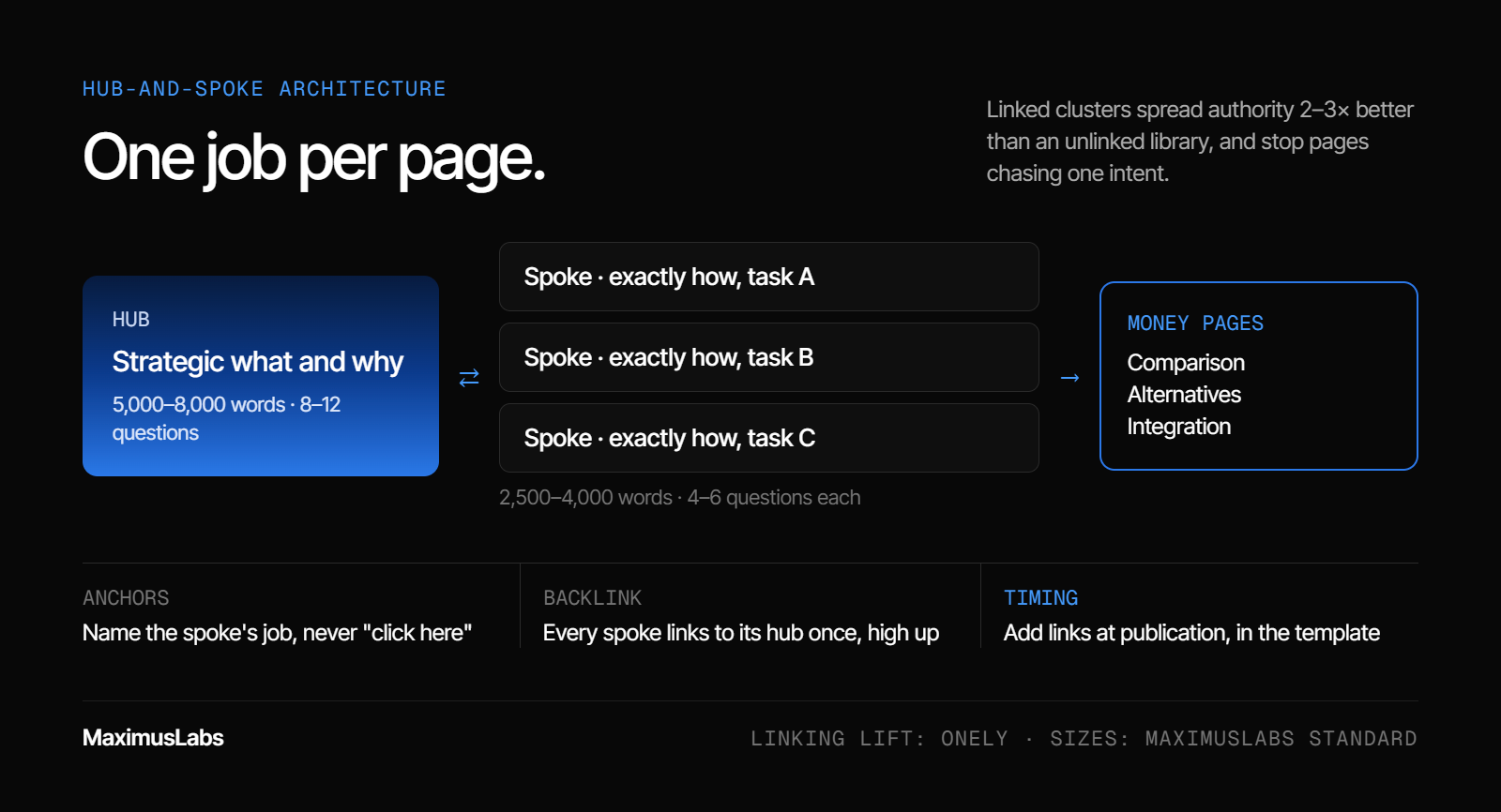
MaximusLabs AI's published standard sizes hubs at 5,000 to 8,000 words with 8 to 12 questions, and spokes at 2,500 to 4,000 words with 4 to 6, with spoke URLs mapped before any writing starts. That is the same logic behind GEO topic clusters.
🔗 The linking rules that matter
Internal links are the plumbing, and most B2B sites have almost none.
Link hub to spoke with a short deep-dive callout, not a bare link in a wall of text.
Use descriptive anchor text that names the spoke's job, never "click here" or "read more."
Link every spoke back to its hub once, high on the page.
Link spokes to the relevant money page, because a tactical reader is often one step from evaluating.
Keep cross-links between spokes rare and purposeful, so the cluster boundary stays legible.
One practical note from running this work. The links that get built are the ones added at publication, inside a template. Links promised for a later cleanup sprint almost never happen.
🔍 The cannibalisation diagnostic
Fragmentation is easy to spot once you know the signature. Open Search Console, pick a query, and look at the pages ranking for it.
If three URLs trade positions for the same query across months, they are competing with each other. Pick the one with conversions, not the one with impressions. Consolidate the other two into it, then redirect them, then handle the survivors in your content refresh cycle.
Then check the inverse case. If a page ranks for no query consistently, it probably has no distinct job. That page belongs in the retirement pile from Q3, not in a refresh queue.
🤖 Why structure matters more in AI search
Retrieval does not read your site map. It pulls blocks.
That changes the design goal. Each page needs to make sense alone, with no reliance on the page before it. A spoke that opens with "as we saw in the previous section" is unusable to an engine that retrieved only that spoke, which is why content formatting for AI search is a structural decision.
So the structure does two jobs at once. The cluster tells Google where your authority sits. The self-contained page lets an engine lift an answer without context. Build for both, because the same page has to serve both surfaces.
Q8. Why does your product documentation get cited more than your blog?
Because documentation is structured, self-contained, and answer-dense, which is what retrieval favours. First-party analysis puts median citation rates for technical docs at 34% to 41%, about 29% of all citations, against 15% to 18% for blog content, a 10x to 15x gap per asset. "How to accomplish X with software" queries trigger AI Overviews 73% of the time, and vendor docs win that surface.
📐 The citation gap, measured
Most B2B teams treat docs as a support cost and the blog as the marketing asset. The citation data inverts that.
A single feature reference page can out-earn a dozen blog posts in AI answers. The reason is not quality in the editorial sense. It is shape, which is why citation-worthy content looks different from a good essay.
🧩 Why retrieval prefers a doc page
Answer engines use retrieval-augmented generation, which means the engine searches, pulls passages, then writes an answer from them. The unit it pulls is a block, not an article.
Documentation is built from independent blocks by default. Each section states one task, lists the steps, and resolves without needing the section above it. A blog post does the opposite. It builds an argument, so paragraph four depends on paragraph three and reads as a fragment when lifted alone.
That is the whole mechanism. Docs survive extraction. Narrative does not.
🏗️ The build order for a documentation hub
Ship these four in sequence, and write each section to stand alone.
Onboarding guides, covering setup and first value, in task order.
Feature reference pages, one per feature, with limits stated plainly.
Integration guides, one per named tool your buyers already use.
API documentation, with real request and response examples.
Two formatting rules carry most of the lift. Put a direct answer in the first 30% of the page, which correlates with a 44.2% citation share in MaximusLabs AI's analysis. Then state version numbers, limits, and prerequisites explicitly, because specificity is what an engine can safely quote. Both rules sit inside GEO content optimization.
🎥 The video extension most teams miss
Video compounds the same effect, and the pattern is worth copying exactly.
Ethan Smith describes embedding a YouTube video on application security posture management directly into a B2B product page about securing generated code. That one embed lifted the page across ChatGPT, Gemini, YouTube, and Google AI Overviews at the same time. Webflow ran the same idea at scale, producing 800-plus task-focused videos such as how to create and style collection lists, alongside team members answering questions on Reddit with full identity disclosure. Webflow attributes 8% of total signups to LLM discovery.
Notice what both examples have in common. The video answers one named task, and it sits on the page that task belongs to. Nobody built a brand channel.
💡 What I would do first on Monday
If I had one week and no budget, I would not write a blog post. I would take the ten most common support tickets and turn each into a self-contained doc page with a direct answer up top.
My hypothesis, and it is a hypothesis: documentation is underpriced right now because it sits with product teams, not marketing. The teams that move it onto the organic roadmap get a citation advantage that is hard to copy quickly.
Q9. How much of your AI visibility is decided off your own site?
Most of it. Brand web mentions, linked and unlinked, correlate with AI Overview visibility at Spearman r=0.664, roughly three times stronger than backlinks at r=0.218, and brands are 6.5 times more likely to be cited through third-party content than their own site. Review platforms act as a hard gate: 100% of software tools ChatGPT named in one analysis had Capterra reviews, and 99% had G2 profiles.
📊 Mentions beat links, by a wide margin
Put the two signals side by side and the hierarchy is hard to argue with.
| Signal | Correlation with AI visibility | What it means for your week |
| Brand web mentions (linked and unlinked) | r=0.664 | Being talked about matters more than being linked |
| Backlinks | r=0.218 | Still useful for Google, weaker for citation |
| Third-party coverage | 6.5x more likely to be cited than your own site | Your site is not your main citation source |
Ahrefs studied 75,000 brands and found web mentions the top correlate with AI Overview appearance, with top-quartile brands averaging 169 mentions against 14 for the rest, as reported in Adweek's write-up of the analysis.
🔒 What the G2 consolidation changed
In February 2026, G2 acquired Capterra, Software Advice, and GetApp from Gartner. MaximusLabs AI's analysis puts the combined family at roughly 84% of review-site citations in bottom-of-funnel B2B queries, which is why B2B AEO work now starts with review surfaces.
That concentration cuts both ways. One profile set now covers most of the surface, which makes the work tractable. It also means a weak or missing profile is a single point of failure in your AI visibility.
"In SaaS, people search competitors to get pricing, to compare features, to see reviews, to shortlist. Part of that is looking at these sites."
— Commenter, r/SaaS Reddit Thread, 2023
"Those SaaS review sites are essentially pay-to-play. Just getting reviews on those sites alone won't do much to actually generate leads."
— Commenter, r/marketing Reddit Thread, 2022
✅ The review floor, stated concretely
Practitioners in that same r/marketing thread put the working base at 5 to 10 reviews per platform, enough to unlock badges and widgets, with stronger category movement after about 30.
Treat it as a prerequisite, not a growth tactic. Ten honest reviews on each of G2, Capterra, and Gartner Peer Insights is a week of customer-success outreach, not a campaign.
MaximusLabs AI runs this layer as Search Everywhere Optimization: review profiles taken to 10-plus reviews each, cited Reddit and Quora threads identified and engaged with disclosed identity, founder publishing on LinkedIn monthly, and sameAs schema closing the entity loop from website to Wikidata, Crunchbase, LinkedIn, and G2.
⚖️ Owned or earned, decided by query type
Split the work by the question being asked, not by preference.
Head category queries, such as "best CRM software," are dominated by aggregators and listicles. You win these by being present in sources engines already trust.
Long-tail queries, such as "how to connect X with Y," are won on your own docs and feature pages.
Mid-tail queries need both, which is why one-sided programs stall.
My read, held with some uncertainty: content-only agencies are not wrong about content. They are incomplete, because they optimize the 15% of citation surface you own and leave the rest to chance. That is how a client ranks on page one and still never gets named in an answer, a pattern we cover in the AI visibility gap benchmark.
Q10. Which technical SEO and schema work actually moves B2B revenue?
A narrow set: crawler access for GPTBot and OAI-SearchBot, critical content rendered in HTML rather than JavaScript, clean semantic markup, and Organization schema with sameAs links. Core Web Vitals is the clearest example of true-but-unimpactful work, with no measured citation effect. Google has confirmed no AI-specific technical bar exists for its generative features, and that llms.txt is not used by Search, per Google Search Central's documentation updates.
✅ The keep list
Four items earn their place. Each one either lets a machine reach your content or lets it understand who you are.
| Work item | Why it stays | Time to fix |
| Unblock AI crawlers in robots.txt | If GPTBot cannot fetch the page, nothing else matters | Under an hour |
| Render key content in HTML | JavaScript-dependent text often never reaches the parser | One sprint |
| Clean semantic markup and headings | Gives retrieval clear block boundaries | Template-level fix |
| Organization schema with sameAs | Disambiguates your entity across the web | One afternoon |
That is close to the entire list. Everything else should earn its slot with evidence, which is how we scope technical GEO implementation.
❌ The cut list, and why it survives anyway
Ethan Smith is direct about the biggest offender. He says much of SEO best practice is true but not impactful, and names Core Web Vitals as the clearest case, reporting no impact in 15 years and none in large language model citation either.
So why does it persist? Because it is easy to audit, easy to chart, and easy to bill. A 50-page technical audit looks like rigour. It also produces the death spiral from Q3, where engineering ships low-impact fixes and then stops trusting the channel.
I would not call this work harmful. I would call it a priority inversion.
⚠️ Schema: genuinely contested, so here is both sides
This is the part most guides overstate in one direction.
The null-result view: controlled analysis across OpenAI, Gemini, and Perplexity found no direct correlation between JSON-LD schema density and citation selection, with authority and semantic relevance driving selection instead.
The hygiene view: schema works as parsing support and second-order entity disambiguation, not as a ranking multiplier, which is the practical case for schema markup basics.
Both can be true. Schema helps a machine know what your page is and who published it. It does not buy you a citation.
One hard date matters here. Google retired FAQ rich results on May 7, 2026, so FAQ markup no longer earns the visual SERP real estate many teams were chasing, a change documented in Google Search Central's announcements. Keep the FAQ content. Stop treating the markup as a visibility play.
🧭 What this means for your audit scope
Rewrite the scope before you commission the next audit. Ask for the four keep-list items, a crawler access check, and an entity audit. Ask for a reason, with evidence, for anything else on the list.
Google's own documentation is useful leverage in that conversation. Its guidance on generative AI features states that the same fundamentals apply and that no separate technical standard unlocks AI features. If a vendor proposes a special AI technical layer, that claim needs a source.
My position, and it is a position rather than a finding: technical SEO in 2026 is a two-week project and a quarterly check, not a permanent workstream. The budget it frees belongs in the money pages from Q6 and the off-site work from Q9, which is the sequencing behind our B2B SEO engagements.
Q11. How do you measure B2B SEO when most AI influence never shows as a click?
Run two layers. Layer one is CRM-connected pipeline: organic-sourced opportunities and closed revenue, reported quarterly. Layer two is AI share of voice per engine, measured across question variants. Then close the gap manually, because analytics tools misattribute most unclickable AI influence to Direct or branded search. MaximusLabs AI reports share of voice per engine rather than as one composite score, because each engine draws on a different citation mix.
📈 Layer one: the only number a board accepts
Connect your CRM to your analytics, then report three things. Organic-sourced opportunities created. Pipeline value attached to them. Closed revenue, lagged by your sales cycle.
Everything else is a leading indicator. Rankings, citations, and sessions belong in the operating review, not the board deck, a split we formalise in GEO measurement and metrics.
🔍 Layer two: share of voice, per engine
Rank does not exist inside an answer, so presence frequency replaces it. Build a prompt set of 50 to 100 buying questions, run them monthly on each engine, and record two fields: did your brand appear, and which sources did the engine cite.
That second field is the actionable one. The cited sources are your target list for the off-site work in Q9.
| Layer | Metric | Cadence | Who reads it |
| Pipeline | Organic-sourced opportunities, closed revenue | Quarterly | Board, CEO |
| Share of voice | Appearance rate per engine, cited sources | Monthly | Growth lead |
| Page health | Citations and conversions per money page | Monthly | Content owner |
| Attribution repair | Self-reported source at signup | Continuous | Ops |
⚠️ The honest limits of your tools
Two gaps deserve stating plainly. First, Google Search Console now counts AI Mode and AI Overview impressions in Performance totals, but its generative reports expose impressions only, with no clicks, no click-through rate, and no query strings. Second, AI referrals frequently land in Direct.
The cheapest fix is a post-conversion field asking how someone heard about you. It recovers influence no analytics tool can see, and it takes one form change.
"Whatever choice you make, pair it with GA4 and GSC (or a similar tool) so you can link AI visibility to real outcomes such as clicks, leads, and revenue."
— Commenter, r/GEO__AI__SEO Reddit Thread, 2026
"Most, if not all, those tools are scams and should be investigated by the FTC. No one can tell you how much you show up in ChatGPT."
— Commenter, r/SEO Reddit Thread, 2026
💰 Buy a tracker, or build one
Ethan Smith catalogued more than 60 AEO tracking tools and found they do the same job: ping a question, record whether you appeared, chart it. Graphite built its own for a few cents per question, and his expectation is that Ahrefs and Semrush bundle the feature, which makes premium standalone contracts a churn risk.
Two diligence questions before you sign. Does the tool scrape live sessions or only vendor API endpoints, which return a different citation mix? And would knowing this number change what you ship next month? Our AEO tools comparison walks the same checks.
MaximusLabs AI builds its own tracking for this workflow and measures engagements on pipeline rather than mentions. Oliv AI's published numbers: 30-40% of inbound now AI-sourced.
Q12. What do the first 90 days of this playbook look like?
Week 1: audit the library for the earning 5%, open AI crawler access, fix sameAs entity links, and add a "How did you hear about us?" field. Weeks 2 to 6: ship comparison, alternatives, and segment pages for your top revenue categories. Weeks 6 to 10: build the documentation hub and claim review profiles. Weeks 10 to 13: baseline share of voice per engine and report organic-sourced pipeline.
⏰ The sequence, with owners
| Window | Work | Owner | Checkpoint |
| Week 1 | Library audit, crawler access, sameAs schema, self-report field | Growth lead plus one engineer | Earning-5% list agreed |
| Weeks 2 to 6 | Comparison, alternatives, integration, and segment pages | Content owner | One page live per week |
| Weeks 6 to 10 | Documentation hub, 10 reviews per platform | Product plus customer success | Docs indexed, profiles live |
| Weeks 10 to 13 | Prompt set, share of voice baseline, pipeline report | Growth lead | First two-layer report |
Retrofit as you go. The KDD 2024 GEO study found that adding citations, statistics, and quotations lifted generative-engine visibility by up to 40%, so apply that pass to your top 20 revenue pages while the new pages are being written, as published in GEO: Generative Engine Optimization.
❌ The do-not-do list for the same window
Five things to refuse in the first 90 days, each for a reason covered earlier.
Do not mass-produce definition posts. Near-zero conversion, and engines answer them natively.
Do not report rank or traffic as the primary KPI. They are leading indicators.
Do not skip G2 and Capterra. One family holds roughly 84% of review citations.
Do not fund a Core Web Vitals program. No measured citation effect.
Do not sign a premium standalone AEO tracker before the prompt set exists. Check the tracking tool landscape first.
"Many AI visibility tools are still in their infancy, resulting in varying degrees of data quality."
— Commenter, r/SEO Reddit Thread, 2025
"Surveys find that many SaaS buyers consider 3-5 vendors. If your product is near the top on a peer review site category page, they'll help you get considered more often. If you're outside the top spots, you'll likely be excluded by many."
— Commenter, r/SaaS Reddit Thread, 2023
⚡ What a compressed version looks like
MaximusLabs AI compresses this timeline deliberately: technical audit in week one, client keyword approval by day three, first article live as early as day four, and the first three months restricted to bottom-of-funnel assets. Oliv AI's published result from that sequencing: 27 qualified leads, $47K+ pipeline, 26% close rate in 4 months, detailed in the Oliv AI case study.
🧠 Honest expectations, and the zero-budget version
Ninety days gets you a working system, a baseline, and early citations. It does not get you a compounding channel. Plan on 12 months before pipeline from organic looks predictable, because trust accumulates slowly in both Google and AI engines.
If the budget is zero, the work does not stop. Get the four technical basics right, claim your review profiles, write far deeper than your competitors on five buying questions, and describe your customers' problems in their own words. That combination still finds its way into answers. When you want it run as a system, bring it to the MaximusLabs AI team.
Frequently asked questions
What is a B2B SEO strategy in 2026, and how is it different from B2C SEO?
A B2B SEO strategy is a plan to be the source business buyers and AI engines surface during vendor evaluation. It targets low-volume, high-intent queries, maps every page to a funnel stage, and is judged on pipeline rather than sessions. Three differences separate it from B2C work: • Audience: you optimize for a buying committee of five to eleven people, each searching different language for the same problem, not a single consumer. • Volume: the queries that convert are small. A niche integration query with 40 monthly searches often outperforms a 20,000-volume definition term. • Surfaces: the strategy now spans Google's ranked results and the citation layer inside ChatGPT, Perplexity, Gemini, and Google AI Overviews. MaximusLabs AI treats classic SEO as the foundation and Answer Engine Optimization as the layer built on top of it, because being cited inside an answer is now how a shortlist gets formed. We have found the teams struggling most are not the ones with weak SEO. They are the ones with strong 2019-era SEO and no model for the citation layer.
Why does our organic traffic keep growing while pipeline stays flat?
Because output and impact are not correlated in B2B. Graphite's work across companies including Webflow, Upwork, Notion, and Rippling found roughly 1 in 20 landing pages drives about 85% of organic traffic, while 19 of 20 drive almost none. Most programs spread budget evenly across those twenty pages, so the majority of spend lands on assets that cannot convert at any ranking. The root cause sits upstream in keyword selection: when pages get commissioned by search volume, you systematically buy the cheapest traffic and the least qualified reader. A workable monthly allocation looks like this: • 60% to commercial pages closest to revenue, including comparisons, alternatives, integrations, and pricing. • 20% to off-site trust surfaces that AI engines cite. • 15% to improving pages that already convert. • 5% to experiments you expect to fail. MaximusLabs AI restricts the first three months of every engagement to bottom-of-funnel assets, with middle-of-funnel work unlocked only after the BOFU set is exhausted, and we report on revenue attribution rather than impressions. Clicks and impressions are vanity metrics if they never move the revenue line.
Does B2B SEO still work now that AI Overviews have cut click-through rates?
Yes, but the payoff moved. Ahrefs re-analyzed 300,000 keywords and found AI Overviews correlated with a 58% lower click-through rate for position-one content as of December 2025, up from 34.5% in April 2025. Positions two and three fell 50.8% and 46.4%. At the same time, Semrush measured AI-referred visitors converting at roughly 4.4 times the rate of traditional organic visitors, and Ethan Smith reports a 6x conversion gap between LLM traffic and Google search traffic at Webflow. The channel is small and the buyers are dense, because they arrive after several rounds of questions. So the goal shifts from earning a click to being the cited answer, then converting a smaller and better-qualified stream. Practically, that means: • Re-forecast traffic models for keywords that trigger AI Overviews. • Shift weight to bottom-of-funnel and branded queries. • Add statistics, citations, and expert quotations to your top revenue pages. MaximusLabs AI tracks zero-click and AI search click-through behaviour per engine, because each one compresses clicks differently. Traditional SEO still has a role. It is no longer the whole strategy.
Which B2B pages should we build first to drive pipeline?
Build in reverse funnel order, because the pages closest to the buying decision compete on two surfaces at once. AI Overviews trigger on 87% of B2B SaaS comparison searches in MaximusLabs AI's first-party analysis of software queries. The sequence we ship: • Comparison pages, one per direct competitor with real search demand. • Alternatives pages, for buyers leaving a named incumbent. • Integration pages, answering the "does it work with X" question. • Segment pages, such as a tool for startups or for enterprise teams. • Pricing and service pages, written to convert rather than to rank. • Middle-of-funnel problem guides, only after the five above exist. Inside each page, place a 30 to 60 word direct answer in the top 30% of body text. That placement correlates with a 44.2% citation share in our analysis, and comparison tables show a 1.8x citation multiplier. Top-of-funnel glossary posts are skipped by policy in our B2B SaaS AEO strategies, because they convert near zero and AI engines answer those questions natively inside the response.
How much of our AI search visibility is decided off our own website?
Most of it. Brand web mentions, both linked and unlinked, correlate with AI Overview visibility at Spearman r=0.664, roughly three times stronger than backlinks at r=0.218. Brands are also 6.5 times more likely to be cited through third-party content than through their own site. Review platforms behave like a gate. In one analysis, 100% of software tools ChatGPT named had Capterra reviews and 99% had G2 profiles. After G2 acquired Capterra, Software Advice, and GetApp from Gartner in February 2026, that family accounts for roughly 84% of review-site citations in bottom-of-funnel B2B queries. Split the work by query type: • Head category queries are won through third-party sources engines already trust. • Long-tail integration queries are won on your own documentation and feature pages. • Mid-tail queries need both, which is why one-sided programs stall. MaximusLabs AI runs this as Search Everywhere Optimization: review profiles taken to ten-plus reviews each, cited Reddit and forum threads engaged with disclosed identity, founder publishing monthly, and sameAs schema closing the entity loop. Content-only programs optimize the small share of citation surface you own.
How do we measure B2B SEO when most AI influence never shows up as a click?
Run two layers and accept that one of them is manual. Layer one is CRM-connected pipeline: organic-sourced opportunities created, pipeline value attached, and closed revenue lagged by your sales cycle. Report it quarterly. Rankings, citations, and sessions are leading indicators for the operating review, not the board deck. Layer two is AI share of voice per engine. Build a prompt set of 50 to 100 real buying questions, run them monthly on ChatGPT, Perplexity, Gemini, and Google AI Mode, and record two fields: did your brand appear, and which sources did the engine cite. That second field becomes your off-site target list. Two tool limits deserve stating plainly: • Search Console counts AI Mode and AI Overview impressions in Performance totals, but its generative reports expose impressions only, with no clicks, click-through rate, or query strings. • AI referrals frequently land in Direct, so add a post-conversion field asking how someone heard about you. MaximusLabs AI reports share of voice per engine rather than as one composite score, using our own tooling and the GEO measurement framework, because each engine draws on a different citation mix.
How long does a B2B SEO and AEO program take to produce pipeline?
Ninety days gets you a working system, a visibility baseline, and early citations. It does not get you a compounding channel. Plan on roughly 12 months before organic pipeline looks predictable, because trust accumulates slowly in both Google and AI engines. A realistic first 90 days: • Week 1: audit the library for the earning 5%, open AI crawler access, fix sameAs entity links, and add a self-reported source field. • Weeks 2 to 6: ship comparison, alternatives, integration, and segment pages for your top revenue categories. • Weeks 6 to 10: build the documentation hub and claim review profiles. • Weeks 10 to 13: baseline share of voice per engine and report organic-sourced pipeline. MaximusLabs AI compresses that timeline deliberately, with a technical audit in week one, keyword approval by day three, and the first article live as early as day four, while the first three months stay restricted to bottom-of-funnel assets. Oliv AI's published results from that sequencing, documented in the Oliv AI case study, were 27 qualified leads, $47K+ pipeline, and a 26% close rate in 4 months, alongside a 64% AI citation rate in 6 months.