 Krishna Kaanth M
- Choose an SEO agency on a revenue goal, not rankings, and verify every claim in third-party traffic charts from the month each client started.
- In 2026, a good agency must get your brand cited in ChatGPT, Perplexity, Gemini, and AI Overviews, not only ranked on Google.
- Agencies average about $3,209 a month in Ahrefs' 439-provider survey, but cost per shipped asset matters more than the headline retainer.
- Hold agencies to pipeline KPIs like qualified leads and AI citation share, and avoid tying fees to rankings or link counts.
- Walk away from ranking guarantees, link quotas, bait-and-switch staffing, 100-page automated audits, and 12-month lock-ins with no exit.
- Expect shipped BOFU pages in the first 90 days, early traction at four to six months, and compounding results near month 12.
A VP of Marketing opens the agency’s monthly report on a Tuesday morning. Rankings are up on 40 keywords, and the chart slopes nicely to the right. Then the CEO asks one question in Slack: “How much pipeline did this create?” Nobody has an answer.
I’ve sat in that silence on both sides of the table. At WiseMonk, 98% of revenue came from SEO, so I learned fast what an agency report should prove. Most guides on choosing an SEO agency are written by agencies grading their own homework. This one gives you the questions, the price benchmarks, and the red flags, plus a way to check every answer you hear.
Q1: How do you choose an SEO agency in 2026?
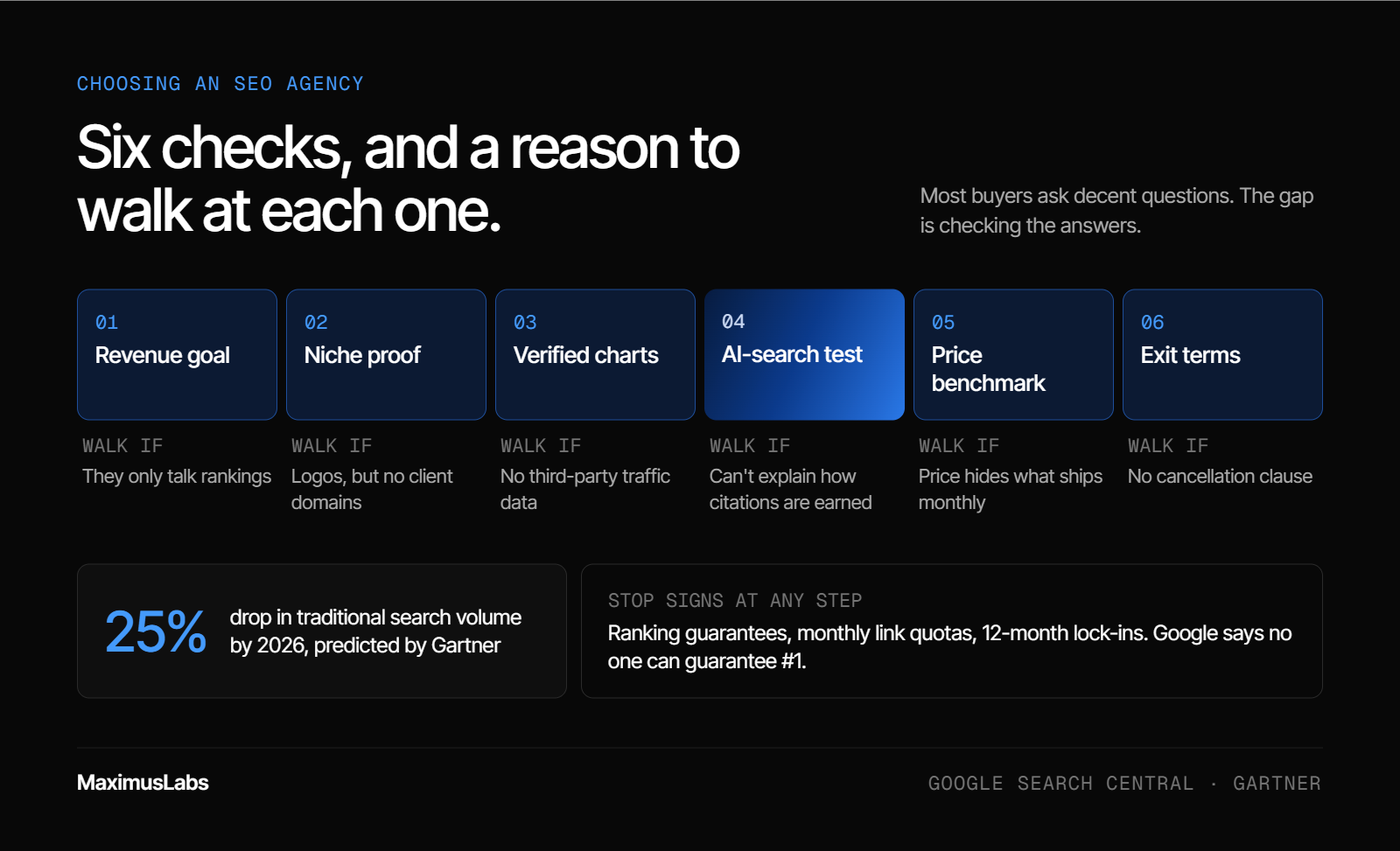
Choose an SEO agency in six steps. Set a revenue goal, not a ranking goal. Shortlist agencies with proof in your niche. Verify that proof in third-party traffic charts. Test whether the agency can get you cited in AI answers, not only ranked on Google. Benchmark the price against market surveys. Walk away from ranking guarantees, link quotas, and contracts with no exit.
The Six-Step Vetting Process
✅ Steps 1 to 3: Goal, Shortlist, and Proof
- Set a revenue goal. Write down the pipeline target, your ICP (ideal customer profile, the buyer you want), and the questions those buyers ask. “Rank for 50 keywords” is not a goal.
- Shortlist with niche proof. Pick three to five agencies that have grown companies like yours. Industry fit matters more than logo count.
- Verify the proof yourself. Ask for client domains and check their traffic in Ahrefs or Semrush from the month the agency started.
✅ Steps 4 to 6: AI Test, Price, and Exit
- Test AI-search ability. Ask how the agency gets brands named in ChatGPT, Perplexity, Gemini, and Google AI Overviews.
- Benchmark the price. Compare the quote with published pricing surveys, then judge the cost of each shipped asset.
- Check the walk-away triggers. Google states that no one can guarantee a #1 ranking on Google. Treat any guarantee, link quota, or 12-month lock-in as a stop sign.
| Step | Walk away if... |
|---|---|
| Revenue goal | The agency only talks about rankings |
| Niche proof | They show logos but no client domains |
| Verified charts | They refuse to share third-party data |
| AI-search test | They can’t explain how citations are earned |
| Price benchmark | The price hides what ships each month |
| Exit terms | The contract has no cancellation clause |
Why the Old Checklist Breaks Now
⚠️ Google-Only SEO Is Half the Job
The classic checklist assumed buyers clicked blue links. Today, many buyers read one AI answer that names a handful of brands. Gartner predicted traditional search engine volume would drop 25% by 2026. The cause, it said, is people moving to AI chatbots. An agency that only reports Google rankings is measuring the shrinking half of the market.
💡 Buyers Ask Well, Then Never Check
Most buyers already ask decent questions. The gap is verification. Phil Singleton, co-author of SEO for Growth, put it plainly:
“Asking the right questions and demanding proof is the best way to make sure that you are not hiring a risky ‘fly-by night’ service provider.”
Phil Singleton, SEO for Growth
MaximusLabs AI’s read is that the category skips this step because verification exposes weak results. I’d rather you check us the same way you check everyone else.
How This Guide Is Organized
⭐ Where Each Step Is Covered
- AI-era expectations: Q2
- Agency vs in-house, plus the goal brief: Q3
- Shortlisting and verifying proof: Q4
- Questions, pricing, KPIs, red flags, contracts, and the first 90 days: Q5 to Q10
MaximusLabs AI runs Answer Engine Optimization (AEO), the work of getting a brand cited inside AI answers, with SEO as the foundation underneath. MaximusLabs measures every engagement on pipeline, not on mentions. That is why this six-step process is the same one we’d want any buyer to run on us.
Q2: What should an SEO agency deliver now that AI answers sit above the links?
An SEO agency should now get your brand cited inside AI answers, not just ranked as a blue link. Seer Interactive found organic click-through rate fell 61% on informational queries showing Google AI Overviews. Brands cited inside those Overviews earned 35% more organic clicks. MaximusLabs AI’s work with Oliv AI produced a “64% AI citation rate in 6 months, vs ~30% for billion-dollar incumbents (Oliv AI).”
How Agency Scorecards Used to Work
📊 The Rankings Report
Picture the monthly agency report. It shows keyword positions, impressions, and sessions, all trending up. The retainer covered a fixed scope, and the content was written to win Google’s ten blue links.
❌ What That Model Cost
Those numbers are vanity metrics, meaning they look like progress without proving revenue. Strategy often came from one firm and execution from another. Nothing in the report tied back to pipeline, so the board’s question went unanswered.
What Changed When Answers Replaced Links
⚠️ Fewer Clicks Reach Your Site
Pew Research Center tracked the browsing of 900 U.S. adults in March 2025. With a Google AI summary on the page, users clicked a traditional result in 8% of visits. Without one, they clicked in 15%. Buyers now ask ChatGPT, Perplexity, Gemini, Claude, and AI Overviews, and they get one answer naming a few brands. You are either in that answer or invisible.
💡 Rankings and Citations Are Different Games
My aha moment came when I saw brands cited by ChatGPT that weren’t in Google’s top 10. What ChatGPT trusts is not what Google trusts. Researchers from Princeton and IIT Delhi named this field GEO (Generative Engine Optimization). Their paper showed content changes can lift visibility in AI answers by up to 40%. SEO is the floor, and GEO is the building on top.
🔍 How AI Engines Pick Their Sources
Most AI engines run a live search, read the top sources, and then write one summary. That process is called retrieval. Your page has to be found, trusted, and easy to quote in short, self-contained blocks.
Third-party mentions matter just as much. When reviews, Reddit threads, and comparison listicles name your brand, the engine has outside proof that you belong in the answer.
What MaximusLabs AI Does About It
✅ Owned AEO and Earned AEO
MaximusLabs AI runs AEO and SEO as one team, doing strategy and execution together. The work rests on two pillars:
- Owned AEO: your own pages become the answer that AI engines extract.
- Earned AEO: reviews, Reddit, press, and listicles give AI engines third-party reasons to trust you.
MaximusLabs also tracks AI visibility daily across the major engines and maps which sources each engine actually cites. Humans approve everything that ships.
🎯 A Test You Can Run on Monday
Ethan Smith, CEO of Graphite, counts more than 60 AEO tools that all do the same job: tracking. Tracking is cheap, so run the check yourself. Ask ChatGPT and Perplexity for the best tools in your category, and record who appears.
MaximusLabs AI measures Oliv AI on pipeline, not on mentions: “27 qualified leads, $47K+ pipeline, 26% close rate in 4 months (Oliv AI).” Ask every agency on your shortlist for proof shaped like that.
Q3: Should you hire an agency, build in-house, or wait, and what goal should it own?
Startups that haven’t reached product-market fit rarely need a full-time SEO hire or an enterprise agency. They lack 40 hours a week of strategic SEO work and the domain authority to win competitive terms. An agency fits growth-stage companies that need strategists, writers, and developers for less than one senior hire. In-house teams win at scale, when SEO depends on product and engineering. Either way, set a pipeline goal first.
The Three Paths on the Table
🧭 Agency, In-House, or Not Yet
A founder usually lands here after a board meeting. Paid acquisition keeps getting more expensive, and someone says, “We should do SEO.” The options are an agency, an in-house hire, or waiting.
Ahrefs points to clear triggers for bringing in outside SEO help. Two examples are a steep drop in clicks and competitors getting more search traffic than you. Without a trigger like that, the spend is often premature.
Where the Experts Disagree
⚖️ The Agency Case vs the In-House Case
Phil Singleton argues an agency gives you a full team of specialists, writers, and tools. He puts the cost at roughly one junior hire. Eli Schwartz, author of Product-Led SEO, warns that early startups don’t have 40 hours of SEO work each week. He also notes that at scale, SEO needs product and engineering buy-in that outsiders struggle to drive.
“Marketing doesn’t get to tell Engineering what to do.”
A director of engineering to Eli Schwartz on his first day running SEO at SurveyMonkey, Product-Led SEO
❌ The Consulting-Only Trap
Strategy without execution rarely ships. Ethan Smith described his early consulting years this way:
“When I started with SEO consulting, I would come up with an entire strategy, all of the details, and more often than not, maybe 20% of that was launched.”
Ethan Smith, CEO of Graphite
That gap is why Graphite moved to full-stack execution.
Matching the Model to Your Stage
✅ A Simple Rule by Stage
| Stage | Best fit | Why |
|---|---|---|
| Pre-product-market fit | Wait, or run a small earned-mention effort | Too little authority and too little work |
| Growth (Series A to C) | Agency doing strategy and execution | Full team and faster shipping |
| Enterprise | In-house lead plus an agency | SEO needs product and engineering |
🎯 Write the Goal Brief Before You Shortlist
Before any sales call, write one page with three items:
- ICP: who buys, and what they ask AI engines and Google.
- BOFU queries: bottom-of-funnel questions asked close to purchase, like “best X for Y.”
- Pipeline target: the qualified leads or revenue you expect within 12 months.
At WiseMonk, 98% of revenue came from SEO with a lean team. That taught me execution beats headcount. I might be wrong for very large companies, where internal politics slow everything down, but at growth stage, a shipping team wins.
MaximusLabs AI works with B2B SaaS first, then healthcare and financial services, and runs strategy and execution in one team. MaximusLabs starts every engagement from a pipeline target and a BOFU-first content plan, because AI engines already answer the “what is X” questions well.
Q4: How do you shortlist agencies and verify their proof?
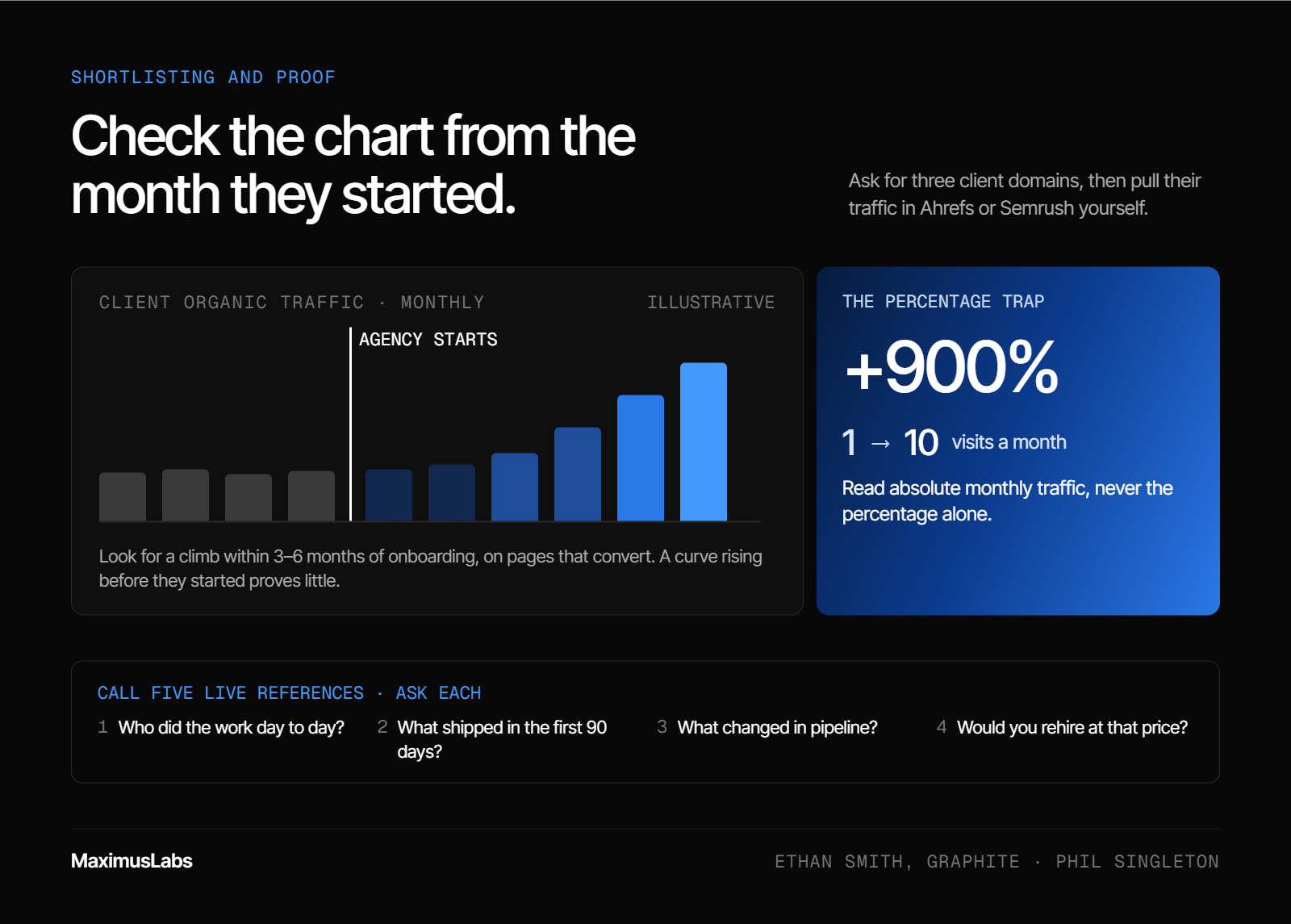
Shortlist three to five agencies from peer referrals, review platforms, and agencies that rank or get cited for their own services. Ask each for three client domains. Then pull those domains’ Ahrefs or Semrush traffic charts from the month the agency started. Organic traffic should climb within three to six months. Reject logo walls and percentage claims without baselines, and call at least five live references.
Building the Shortlist
🔍 Where Good Candidates Come From
- Peer referrals: ask founders in your category who they hired and who they fired.
- Review platforms: read the 3-star reviews on Clutch and G2, not only the 5-star ones.
- Their own visibility: search the agency’s core service on Google, then ask ChatGPT the same question.
An agency that is invisible for its own service is a warning sign. Singleton notes that many SEO companies “rarely even rank for their own services.”
📝 Keep the RFP Short
Send a one-page request for proposal (RFP) built from your goal brief in Q3. Ask for client domains, the named team, and a 90-day plan. Long RFPs reward agencies that write well, not agencies that ship.
The Onboarding-Month Chart Test
⭐ Ask Who They Worked With at the Start
Google advises asking a potential SEO for examples of previous work and success stories. Ethan Smith makes the test sharper:
“Ask them who they worked with when they started then look at their chart in [Ahrefs] and see if it went up.”
Ethan Smith, CEO of Graphite
💡 Read Absolute Numbers, Not Percentages
A “900% traffic increase” can mean 1 visit became 10. Look for three things in each chart:
- Absolute monthly traffic before and after onboarding
- A steady climb that starts three to six months after onboarding
- Growth on pages that convert, not just on blog posts
Then run the AI check. Ask ChatGPT and Perplexity the buying questions a client’s customers would ask. If the agency’s clients never appear, its AI-search claims are unproven.
MaximusLabs AI’s own proof can be tested the same way. Nidra Goods ranked #1 across Google, ChatGPT, and Perplexity for “best sleep mask,” and buyers can check claims like this with a single search.
The Reference-Call Script
☎️ Call Five, Ask Four Questions
Singleton recommends speaking with at least five live client references. Ask each one:
- Who did the work day to day after signing?
- What shipped in the first 90 days?
- What changed in pipeline, not just in traffic?
- Would you hire them again at the same price?
⚠️ Watch for Scripted References
A reference who praises communication but can’t name a revenue result is telling you something. So is an agency that offers only two references, both from years ago.
MaximusLabs AI’s position is that AI citations and rankings are public, so agency proof should be checkable. MaximusLabs points buyers to results they can check, such as Oliv AI’s “64% AI citation rate in 6 months, vs ~30% for billion-dollar incumbents (Oliv AI).” A polished slide is not proof.
Q5: Which questions reveal how an agency actually works?
Ask six questions about how the work gets done. Who works on my account day to day? How do you prioritize technical fixes? How do you earn links and brand mentions? How will you get us cited in ChatGPT and Perplexity? How do you use AI in content? What do you need to know about our ICP? Good answers name people, high-impact fixes, and human-edited content.
Why Process Questions Beat Pitch Questions
💡 The Pitch Deck Hides the Process
Most sales calls cover results and price. The real risk sits in the process, meaning who does the work, what ships first, and how quality is checked. Google suggests asking any potential SEO whether they follow the Google Search Essentials, its baseline quality rules.
MaximusLabs AI’s read is that process answers are harder to fake than case studies. A rehearsed agency can polish a result slide. It struggles to explain how next Tuesday’s work gets prioritized, and that gap tells you a lot.
The Six Questions and What Good Sounds Like
✅ The Interview Table
| Question | A good answer sounds like | Why it matters |
|---|---|---|
| Who works on my account day to day? | Names, roles, and a chance to meet them before signing | The sales lead is often not the doer |
| How do you prioritize technical fixes? | Indexing, internal links, and rendering first | A long checklist is not a priority list |
| How do you earn links and brand mentions? | Original data, PR, podcasts, and review platforms | Bought links risk penalties |
| How will you get us cited in ChatGPT and Perplexity? | Source mapping per engine, plus third-party mentions | Rankings alone miss AI answers |
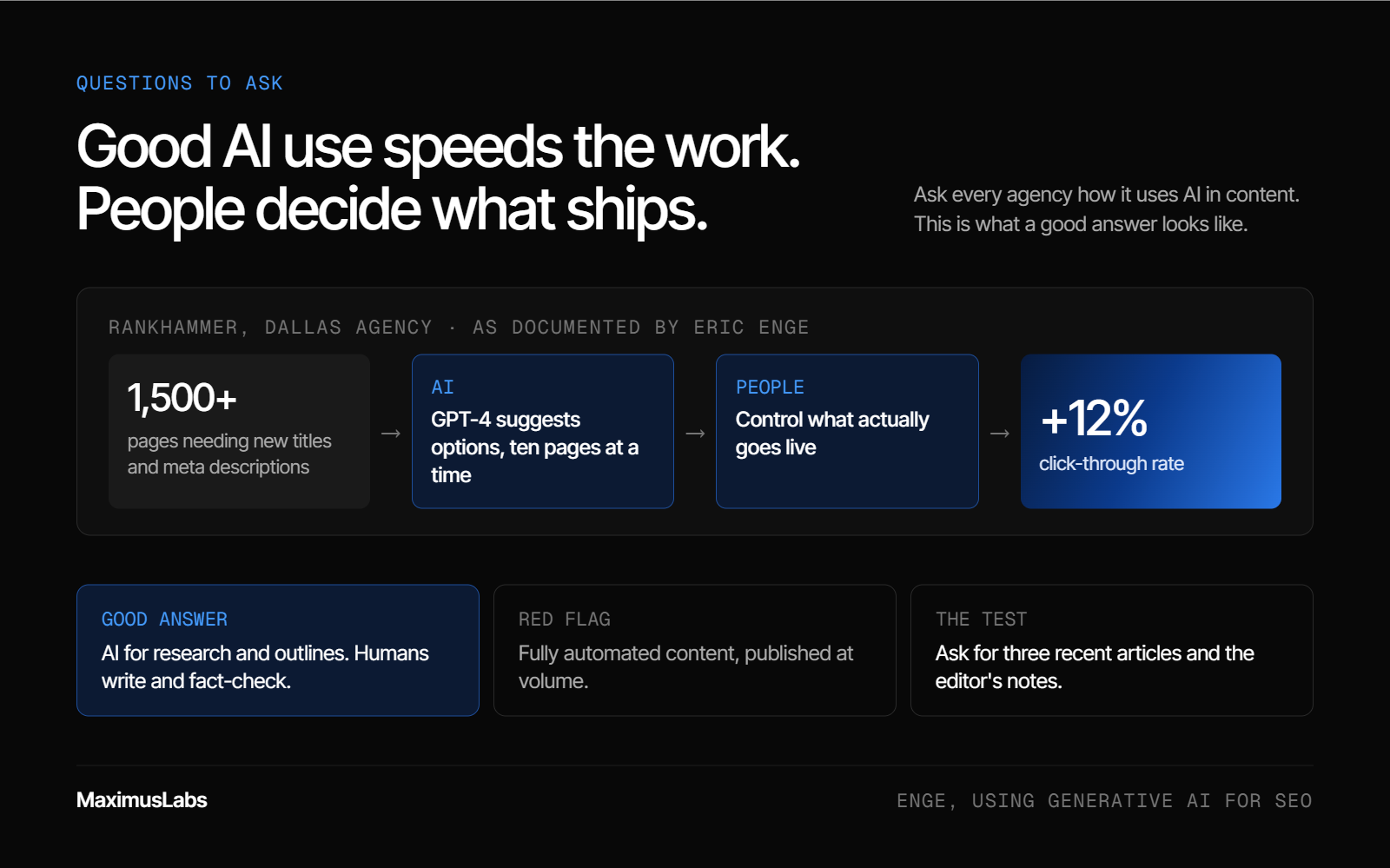
| How do you use AI in content? | AI for research and outlines, humans for writing and fact-checks | Fully automated content erodes trust |
| What do you need to know about our ICP? | Buyer questions, competitors, and deal stages | Content must match real buying intent |
⭐ Good AI Use Looks Like This
Eric Enge documents a case from RankHammer, a Dallas agency, in Using Generative AI for SEO. RankHammer used GPT-4 to suggest new titles and meta descriptions for more than 1,500 pages, ten pages at a time. After the pages went live, click-through rate rose 12%. The lesson is simple: AI sped up the work, while people still controlled what shipped.
What Practitioners Warn About
⚠️ Two Voices Worth Hearing
“It is a common agency practice to showcase star employees during the sales process but then task junior employees to manage the account.”
Eli Schwartz, Product-Led SEO
“Rankings are a vanity metric and do not directly, or even indirectly, contribute to the success of a business.”
Eli Schwartz, Product-Led SEO
The Questions an Agency Should Ask You
🎯 A Good Agency Interviews You Back
Google notes that a good SEO should ask what makes your business unique, who your competitors are, and how customers find you. If the agency asks nothing, it plans to run a template.
MaximusLabs AI starts every engagement by asking about the client’s right to win, meaning why a buyer should pick them. MaximusLabs also asks for the founder’s view of the market, because that view shapes the content’s positioning.
MaximusLabs AI runs AEO and SEO as strategy and execution in one team. Every answer in the table maps to a named person who ships the work.
Q6: How much does an SEO agency cost in 2026?
In Ahrefs’ survey of 439 SEO providers, agencies averaged about $3,209 per month, and 78.2% of providers bill through a monthly retainer. Legitimate mid-market retainers usually run $2,000 to $5,000 a month, while national and enterprise SaaS work often starts at $10,000. MaximusLabs AI’s published comparison puts content cost at about $800 per asset in-house, $260 at a traditional agency, and about $60 at MaximusLabs.
What the Market Charges
💰 The Survey Benchmarks
Ahrefs surveyed 439 SEO providers, including agencies, freelancers, and consultants. Agencies averaged about $3,209 a month on retainer. Providers can use several pricing models, so the shares overlap:
- Monthly retainer: 78.2% of providers
- Per project: 48.9% of providers
- Hourly: 34.8% of providers
💸 Prices Are Rising
SE Ranking and Duda surveyed marketing and SEO agencies on pricing. About 70% had recently raised prices or planned to raise them in 2025. Inflation was the top reason, followed by stronger expertise and higher operating costs.
Which Pricing Model Fits
✅ Retainer, Project, or Hourly
| Model | Best for | Watch for |
|---|---|---|
| Monthly retainer | Ongoing content, technical, and authority work | Vague scope with no shipped output |
| Project | Audits, migrations, or a one-off build | Audits with no clear priorities |
| Hourly | Advice for an in-house team | Paying for meetings, not progress |
⚠️ The Price Bands to Know
Phil Singleton, co-author of SEO for Growth, sorts retainers into rough bands:
- Under $1,000 a month: where cheap link schemes and spam often hide
- Around $1,000 a month: a baseline for basic local SEO
- $2,000 to $5,000 a month: typical for legitimate SMB and mid-market growth
- $10,000 or more a month: common for national, enterprise, and high-value SaaS brands
Ethan Smith describes a common setup: a client pays an agency about $3,000 a month to buy links. He prefers links earned through work that costs nothing extra.
Judge the Cost of Output, Not the Retainer
⭐ Cost per Asset Across Hiring Models
MaximusLabs AI publishes this comparison for 25 content pieces a month. These are MaximusLabs’ own figures:
| Hiring model | Monthly cost | Cost per asset |
|---|---|---|
| In-house team | $20,000 | $800 |
| Traditional agency | $6,500 | $260 |
| Freelancers | $2,500 | $100 |
| MaximusLabs AI | Varies by plan | About $60 |
A low headline price can still mean a high cost per useful asset. Always divide the retainer by what actually ships each month, then compare.
🎯 Price Against Pipeline
Cheap is not the goal, and expensive is not proof of quality either. A $3,000 retainer that ships nothing is the most expensive option on this list. MaximusLabs AI’s position is direct: “We don’t negotiate on price, but we’ll never negotiate on quality either.”
MaximusLabs AI keeps cost per asset low because its GEO workflows run on proprietary internal tools, with humans approving every piece. MaximusLabs measures each engagement on pipeline, as in “27 qualified leads, $47K+ pipeline, 26% close rate in 4 months (Oliv AI).”
Q7: Which KPIs should an SEO agency be accountable for?
Hold an SEO agency to pipeline, not positions. The primary KPIs should be qualified leads, conversions, and revenue from organic search and AI referrals. Citation share across ChatGPT, Perplexity, and Google AI Overviews should back them up. Rankings prove a brand appears on Google, not that anyone bought. Fees tied to rankings or link counts reward tactics that can damage a domain.
The Ranking Report Habit
📊 A Chart That Always Goes Up
Every month, the agency sends a deck. Keyword positions climb, impressions grow, and the traffic line slopes up. The CFO asks how much revenue came from it, and the room goes quiet.
❌ Why That Report Misleads
Rankings measure presence, not demand or buying intent. Eli Schwartz, author of Product-Led SEO, compares a rankings-only report to judging paid marketing by its budget total. A big budget only proves someone can spend money.
What Happens When Nobody Tracks Revenue
⚠️ The Revenue Plateau
Schwartz describes a well-known brand whose organic revenue stalled after years of double-digit growth. Its paid team tracked every dollar of spend in detail. Its SEO team reported rankings. Traffic kept rising, but none of the work aimed at revenue, so revenue went flat.
💡 AI Answers Raise the Stakes
Buyers now ask ChatGPT, Perplexity, Gemini, and Google AI Overviews, and they get one answer naming a few brands. Pew found users clicked traditional links in 8% of visits when an AI summary appeared. Fewer clicks means traffic is a weaker proxy for revenue than ever.
The Replacement Scorecard
✅ KPIs That Tie to Pipeline
| KPI | What it shows | Where to track it |
|---|---|---|
| Qualified leads (MQLs and SQLs) | Real buying interest | CRM |
| Organic and AI-referred revenue | Money the channel created | CRM plus analytics |
| Conversions on BOFU pages | Intent turning into action | Analytics |
| AI citation share | How often engines name you | Prompt tracking across engines |
| Clicks and impressions, reported separately | Visibility trends | Google Search Console |
MQL means marketing-qualified lead. SQL means sales-qualified lead. BOFU (bottom-of-funnel) pages target buyers close to purchase.
⭐ Report Clicks and Impressions Apart
A falling click-through rate can hide rising visibility. If impressions grow while clicks hold steady, your reach expanded. Track both lines separately before you call a CTR (click-through rate) drop a problem.
Why Bonuses Tied to KPIs Backfire
❌ Incentives Shape Tactics
“One thing that should be avoided, at all costs, is making any part of the salary variable based on a KPI.”
Eli Schwartz, Product-Led SEO
Schwartz has seen bonuses tied to links, rankings, clicks, and even revenue. Each one caused long-term problems. Pay for focused work, then judge it on pipeline over quarters.
MaximusLabs AI measures every engagement on pipeline, not on mentions. MaximusLabs starts with BOFU pages because AI engines already answer “what is X” questions well. For Oliv AI, that approach produced “27 qualified leads, $47K+ pipeline, 26% close rate in 4 months (Oliv AI).”
Q8: What red flags should end the conversation?
End the conversation if an agency guarantees rankings, sells a fixed number of backlinks a month, or uses link networks. Do the same if it pitches a star strategist but won’t name your account team. A 100-page automated audit sold as strategy is another warning. So is mass-produced AI content without expert editing. Google states that no one can guarantee a #1 ranking.
The Six Red Flags
❌ Flags 1 to 3: Promises and Links
- Guaranteed rankings. Google warns against SEOs that guarantee rankings or claim a “special relationship” with Google. Guarantees usually target keywords nobody searches, so the promise is kept while the business gains nothing.
- Fixed monthly link quotas. “50 links a month” signals bought links. Google’s spam policies treat buying links for ranking purposes as a link scheme.
- Private blog networks. These are networks of sites built only to sell links. Google can penalize sites that use them.
❌ Flags 4 to 6: People, Audits, and Content
- Bait and switch. The senior strategist sells the deal, and a junior hire runs the account.
- The 100-page audit. Long automated reports list minor issues like missing alt text. They rarely rank fixes by revenue impact.
- Unedited AI content at scale. Volume without expert review weakens trust signals and E-E-A-T, Google’s measure of experience, expertise, authority, and trust.
What Practitioners Have Seen
⚠️ The Handoff
“Another red flag to look out for is being ‘handed off.’ The moment you have signed the contracts, you suddenly find yourself dealing with a new person, a junior in the company.”
Phil Singleton, SEO for Growth
“I have seen audits run on for over one hundred pages but are light on action items.”
Eli Schwartz, Product-Led SEO
Schwartz compares automated audits to using WebMD for a diagnosis. The tool lists symptoms. An experienced practitioner decides what actually matters.
💸 The Snake-Oil Dashboard
Some agencies ship dashboards that make clients feel good but move no revenue. MaximusLabs AI’s read is that this is the costliest flag, because it delays the moment anyone notices. The pattern is green charts, rising impressions, and flat pipeline. I’d rather show a client an honest flat line than a pretty one.
The New Red Flag: B-Minus Work at C-Plus Quality
⚠️ Cheap Automation Is Not Better Work
Ethan Smith, CEO of Graphite, describes a new type of AI agency. It takes a “B-minus workflow,” chains ChatGPT prompts, and delivers “a C-plus, but 80% off.” Clients don’t want cheaper average content. They want better content, and retention depends on it.
✅ How to Test for It
Ask to see three recent articles and the editor’s notes on each. Ask who checked the facts and which sources they used. If nobody can answer, the workflow is automation without judgment. Walk away before the first invoice, not after the third.
MaximusLabs AI uses AI for research and speed, while humans write, fact-check, and approve everything that ships. MaximusLabs treats GEO as a data-science problem, not a volume game, because AI engines cite sources they trust.
Q9: Which contract terms protect you?
Agree to a 3- to 6-month initial period, then a rolling monthly retainer with 30 days’ written notice. Avoid any 12-month lock-in you can’t cancel. Name your account team in the contract. Confirm you own all content, data, and accounts. Grant only read access to Google Search Console during the audit. Tie milestones to shipped work, not to rankings.
Exit Terms Come First
⏰ The Alignment Period, Then Month to Month
SEO needs time to show results, so a short commitment is fair. Phil Singleton, co-author of SEO for Growth, recommends a 3- to 6-month initial period. After that, the deal should move to a rolling monthly retainer with a 30-day cancellation clause.
Rigid 12-month contracts with no exit or milestones shift all the risk to you. If the work stalls in month three, you keep paying for nine more months.
⚠️ Why Lock-Ins Are a Bad Sign
A lock-in replaces proof with paperwork. MaximusLabs AI’s read is simple: an agency confident in its work doesn’t need a cage.
Staffing, Ownership, and Access
✅ Name the People in Writing
Eli Schwartz, author of Product-Led SEO, warns that agencies often showcase star employees in sales, then hand the account to juniors. His fix is direct: request specific employees on your account. Put those names in the contract, plus a rule that any swap needs your written approval.
💰 Own Everything You Pay For
Your contract should state that you own every asset the agency creates. That includes:
- All articles, pages, images, and research files
- Analytics, Search Console, and CRM data
- Any accounts opened on your behalf, like review profiles or tool logins
If the agency owns the accounts, leaving means starting from zero.
🔒 Limit Access During the Audit
Google advises site owners to be careful about the access they grant an SEO. During the audit, read access to Search Console is enough. Expand access only once you trust the team and the plan.
Milestones You Can Actually Enforce
✅ Tie Payments to Shipped Work
Rankings sit outside any agency’s control. Shipped work does not. Good milestones look like this:
| Milestone | Example | Why it works |
|---|---|---|
| Technical fixes shipped | Indexing and internal-link fixes live by week 4 | You can verify it on the site |
| Content published | A set number of BOFU pages live each month | Output is countable |
| Reporting cadence | Monthly pipeline and citation report | Keeps focus on revenue |
| Review checkpoint | A 90-day review with a written plan | Creates a natural exit point |
❌ Clauses to Strike
- Automatic renewals without notice
- Early-exit fees that equal the rest of the year
- “Proprietary methods” clauses that hide what was done to your site
- Ranking guarantees, which Google says no one can make
💡 The Clause I’d Add First
If I could add one clause to every SEO contract, it would be a written 90-day plan with named deliverables. MaximusLabs AI’s view is that this single page prevents most disputes. Both sides know what “done” means before the first invoice.
MaximusLabs AI starts shipping in the first week. The first article can be live by day 4, so a buyer judges real work long before any commitment matters. MaximusLabs measures every engagement on pipeline, as with “27 qualified leads, $47K+ pipeline, 26% close rate in 4 months (Oliv AI).”
Q10: What should the first 90 days with a new agency look like?
A good SEO agency ships work in the first 90 days instead of only auditing. Expect a focused technical sprint in week 1 and bottom-of-funnel pages live within the first month. MaximusLabs AI can publish a client’s first article within four days of signing. Google says SEO results usually take four months to a year. A quarter that ends with only a PDF is a warning sign.
How Most First Quarters Go Wrong
📄 The 50-Page PDF
The contract is signed, and three weeks later a long audit lands in your inbox. It holds charts, tables, and a roadmap of dozens of tasks. The team starts working through it, top to bottom.
❌ The SEO Death Spiral
Ethan Smith, CEO of Graphite, calls what happens next the SEO death spiral. In his telling, the agency hands over “a 50 page PDF,” and “most of it’s zero impact work.” Results don’t come, so the agency asks for another year. The company then decides SEO doesn’t work, fires the agency, and repeats the cycle with someone new.
What Changed: Fewer Pages Matter More
⭐ The 5% Rule
Smith’s work points to a simple pattern. About 5% of pages and initiatives drive 85% to 95% of organic traffic and revenue. The job in the first quarter is to find that 5% and ship it, not to fix every alt tag.
💡 AI Answers Reward the Right Pages First
Buyers now ask ChatGPT, Perplexity, and Google AI Overviews for recommendations, and they get one answer naming a few brands. The pages that earn those mentions are usually bottom-of-funnel (BOFU) pages. These are comparisons, alternatives, and “best X for Y” pages that buyers read right before choosing.
What MaximusLabs AI Ships in the First 90 Days
✅ Week 1 Through Month 3
MaximusLabs AI follows a set cadence in the first week, with onboarding that takes two days:
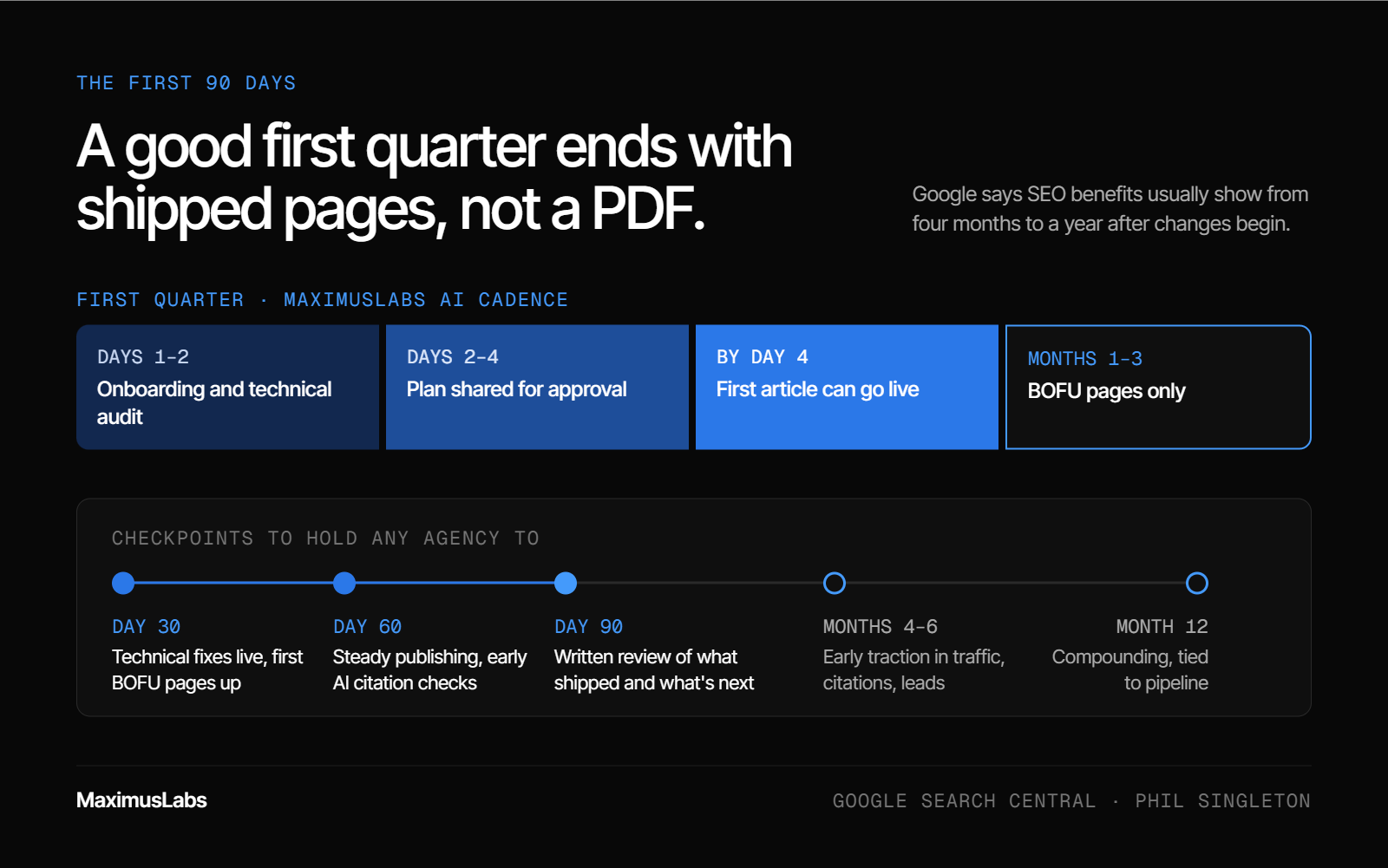
- Days 1 to 2: onboarding and an in-depth technical audit
- Days 2 to 4: a plan built from the client’s details, shared for approval
- By day 4: the client approves keywords, and the first GEO article can go live
- Months 1 to 3: BOFU pages only, built to be cited in AI answers and to reach Google’s top 10
MOFU (middle-of-funnel) content comes only after the BOFU list is done. Humans approve every page before it ships.
⏰ Checkpoints to Hold Any Agency To
| When | What you should see |
|---|---|
| Day 30 | Technical fixes live and the first BOFU pages published |
| Day 60 | A steady publishing rhythm and early AI citation checks |
| Day 90 | A written review of what shipped and what comes next |
| Months 4 to 6 | Early traction in traffic, citations, and leads |
| Month 12 | Compounding results tied to pipeline |
Google’s guidance says SEO benefits usually appear from four months to a year after changes begin. Phil Singleton’s timeline matches, with early traction at 4 to 6 months and full impact near month 12. I’d treat anything faster as a bonus, not a promise.
MaximusLabs AI runs strategy and execution in one team, so the first quarter ends with shipped pages, not a reading list. MaximusLabs measures that work on pipeline. Oliv AI’s result shows what that looks like: “27 qualified leads, $47K+ pipeline, 26% close rate in 4 months (Oliv AI).”
Frequently asked questions
How long does it take to see results from an SEO agency?
Google's own guidance says SEO benefits usually appear four months to a year after changes begin. Most legitimate agencies match that window: early traction at four to six months, then compounding results near month 12. The first 90 days should still show visible output, even before traffic moves. Here is what we expect to see: • Week 1: a focused technical sprint, not a 100-page audit • Month 1: the first bottom-of-funnel (BOFU) pages live • Day 90: a written review of what shipped and what comes next • Months 4 to 6: early movement in traffic, AI citations, and leads MaximusLabs AI can publish a client's first article within four days of signing, after a two-day onboarding and keyword approval. That speed doesn't shortcut Google's timeline. It means you judge real work early instead of waiting a year on a roadmap. If a quarter ends with only a PDF, treat it as a warning sign. You can see how we track early progress in our guide to GEO measurement and metrics.
Should I hire a traditional SEO agency or a GEO agency in 2026?
We recommend an agency that does both, with SEO as the foundation and GEO (Generative Engine Optimization) on top. GEO is the work of getting your brand cited inside AI answers from ChatGPT, Perplexity, Gemini, and Google AI Overviews. A Google-only agency now misses half the job. Buyers increasingly read one AI answer that names a handful of brands, and a page can rank well on Google yet never appear in that answer. Here is how to tell the difference in a sales call: • A traditional agency reports rankings, impressions, and sessions. • A GEO-capable agency also reports citation share across AI engines. • A strong partner ties both to qualified leads and pipeline. MaximusLabs AI runs Answer Engine Optimization (AEO) and SEO as strategy and execution in one team. For Oliv AI, that produced a 64% AI citation rate in six months, versus about 30% for billion-dollar incumbents. If you want the full comparison, read our breakdown of GEO vs traditional SEO before you shortlist.
What should a good SEO agency proposal include?
A good proposal reads like a plan, not a pitch deck. We look for six things before signing anything: • A revenue goal: qualified leads or pipeline, not a ranking target. • Named people: who works on the account day to day. • A 90-day plan: specific deliverables with dates. • Priorities: the few technical fixes and pages that matter most. • An AI-search plan: how the agency will earn citations in ChatGPT and Perplexity. • Clear terms: a short initial period, monthly renewal, and full ownership of your content and data. Watch for what is missing. A proposal with no client domains, no named team, or no exit clause is asking for trust without proof. A proposal built on a fixed number of backlinks a month is a red flag on its own. MaximusLabs AI builds its first plan from the client's details within the first week, then asks the client to approve keywords before any content ships. That approval step keeps the plan tied to real buyer questions. For the questions that should shape a proposal, see our guide to AEO keyword and question research.
How do I know if my current SEO agency is underperforming?
The clearest sign is a report that grows every month while pipeline stays flat. Rankings and impressions can rise for a year without creating a single qualified lead. We use five checks when a client asks us to review an existing agency: • Shipped work: count the pages and fixes that actually went live last quarter. • Pipeline link: ask what share of leads came from organic search and AI referrals. • AI visibility: ask ChatGPT and Perplexity your buyers' questions and record who appears. • Team continuity: confirm the people who sold the deal still work on the account. • Audit follow-through: check how much of the original roadmap shipped. If most of the work is still sitting in a PDF, you may be in the SEO death spiral: zero-impact tasks, flat results, and a request to wait another year. MaximusLabs AI measures every engagement on pipeline, not on mentions, so this review starts with revenue. You can run the AI visibility check yourself with our list of AI search visibility tracking tools.
Is a cheap SEO agency ever worth it?
Sometimes, but only if you judge cost per shipped asset rather than the headline retainer. A low monthly price that ships nothing is the most expensive option you can choose. Market data gives useful reference points. Ahrefs' survey of 439 providers found agencies averaged about $3,209 a month. Retainers under $1,000 a month are where cheap link schemes and spam tend to hide. We suggest three tests before signing a low-cost deal: • Divide the retainer by the number of pages that actually ship each month. • Ask whether humans write and fact-check the content, or only prompt AI tools. • Confirm links are earned through data, PR, and reviews, not bought in bulk. Cheap automation often turns average work into worse work at a discount. That saves money in month one and costs trust for years. MaximusLabs AI's published comparison puts content cost at about $60 per asset, against $260 at a traditional agency and $800 in-house. That gap comes from proprietary GEO workflows with humans approving every piece. You can review current plans on our pricing page.
Can an SEO agency guarantee rankings or AI citations?
No. Google states that no one can guarantee a #1 ranking on Google. The same logic applies to ChatGPT, Perplexity, and Gemini, because no agency controls how those engines choose their sources. Guarantees usually hide one of two problems: • Easy keywords: the agency ranks you for phrases nobody searches, so the promise is kept while the business gains nothing. • Risky tactics: bought links or private blog networks, which Google can penalize. What an agency can promise is the work itself. Good commitments include named people on the account, a dated 90-day plan, a set number of pages shipped each month, and transparent reporting on pipeline and citation share. MaximusLabs AI does not promise rankings or citations. MaximusLabs commits to shipped work and measures every engagement on pipeline, with proof buyers can check, such as Oliv AI's 27 qualified leads and $47K+ pipeline in four months. If you want to understand what actually earns a citation, start with our guide to citation optimization for AI search.
How do I check whether an agency can get my brand cited in ChatGPT and Perplexity?
Run the test yourself before and during the engagement. AI citations are public, so you don't need to trust a slide. Here is the simple process we recommend: • List 10 to 20 questions your buyers ask right before choosing, like "best X for Y." • Ask each question in ChatGPT, Perplexity, Gemini, and Google AI Overviews. • Record which brands appear and which sources each engine cites. • Repeat the same prompts monthly to track your citation share. Then apply the same test to the agency's existing clients. If their clients never appear for their own buying questions, the agency's AI-search claims are unproven. Ask the agency how it earns citations, too. A strong answer covers your own pages, built to be quoted in short blocks, and third-party mentions on reviews, Reddit, press, and comparison listicles. MaximusLabs AI tracks AI visibility daily across the major engines and maps which sources each engine actually trusts. For a deeper look at how ChatGPT chooses sources, read our ChatGPT SEO guide.