 Krishna Kaanth M
- SEO costs $1,000 to $10,000+ a month in 2027; agencies average about $3,209 and freelancers about $1,349, per Ahrefs' survey of 439 providers.
- Most published averages come from one 2023 survey, so treat them as a floor; 2027 budgets must also cover citations in AI answers.
- AI summaries cut Google clicks from 15% to 8% of visits, but AI search visitors convert at 4.4 times organic visitors, so compare cost per qualified lead.
- SEO under $1,000 a month usually buys link spam or thin AI copy that fails on Google and in AI engines; budget $2,000 to $5,000 for B2B SaaS.
- GEO and AEO retainers run $1,500 to $50,000+ a month; buy SEO and AEO as one program, and treat AI tracking tools as a commodity.
- Vet proposals with live references, traffic charts from onboarding, a 3 to 6 month trial with a 30-day exit, and a provider that ships the work.
A VP of Marketing forwards two SEO proposals to her founder on a Friday afternoon. One is $1,200 a month. The other is $7,500. Both promise “page-one rankings,” and both attach a sample report full of keyword charts. Neither one mentions ChatGPT, Perplexity, or the AI Overview that now sits above their best-converting query. The founder replies with one line: “Which of these gets us pipeline?”
That question is the real one behind every SEO pricing search. The sections below give the actual numbers, then explain what those numbers should buy in 2027.
Q1: How Much Does SEO Cost in 2027?
In 2027, most businesses pay between $1,000 and $10,000+ a month for SEO. Agencies average about $3,209 a month, consultants about $3,250, and freelancers about $1,349, based on Ahrefs’ survey of 439 SEO providers. Basic local SEO starts near $1,000. SMB and mid-market programs usually run $2,000 to $5,000, and enterprise retainers run $6,500 to $20,000+. Most published averages trace back to one 2023 survey, so they understate budgets that must also cover AI search.
The Price Bands Behind Most Quotes
| Band | Typical monthly cost | What it usually buys |
| Budget | Under $1,000 | Templated audits and outsourced links, with little senior time |
| Local SEO | About $1,000 to $2,000 | Google Business Profile work, local pages, and citations |
| SMB and mid-market | $2,000 to $5,000 | Strategy, content, and technical fixes in one plan |
| Enterprise | $6,500 to $20,000+ | Large sites, many markets, and dedicated teams |
💰 Where the Averages Come From
Ahrefs found that 78.2% of SEO providers charge a monthly retainer. The most common single bracket is $501 to $1,000, yet the averages land far higher because agencies and consultants pull them up. In the United States, the median retainer sits at $1,501 to $2,000 a month.
Local SEO averages about $1,557 a month in the same survey. Phil Singleton, author of SEO for Growth, puts the floor for legitimate firms at “$2,000 to $5,000 per month, minimum.”
⚠️ Why Two Quotes Can Differ by 5x
Four factors explain most of the gap:
- Scope. An audit-only plan costs less than strategy, content, and technical work combined.
- Competition. Ranking for “CRM software” takes far more work than ranking for a local plumber.
- Provider type. Agencies charge roughly double what freelancers charge per month.
- Region. In Ahrefs’ data, 76% of India-based SEOs charge $1,000 or less a month.
The Stale-Data Problem Nobody Mentions
Almost every pricing guide on page one cites the same Ahrefs survey. That survey first ran in 2023 and was updated in 2026. Its scope was classic Google SEO. It does not price the work of getting cited inside ChatGPT, Perplexity, Gemini, or Google AI Overviews.
⏰ Prices Already Moved
One 2026 industry survey reports that 70% of agencies raised prices in 2025, partly to cover AI search work. So treat any 2023 average as a floor for 2027, not a ceiling. If a quote looks “cheap” against old averages, check what it leaves out.
💸 The Number Founders Should Compare Instead
MaximusLabs AI measures every engagement on pipeline, not on mentions or rankings. That shapes how I read any SEO quote. The monthly fee is the wrong number to compare. Cost per qualified lead is the right one, and it only shows up once you ask what the retainer actually ships.
MaximusLabs AI makes this simpler by pricing work against pipeline targets agreed before the first article ships. It runs Answer Engine Optimization (AEO), the work of getting cited inside AI answers, with SEO as the foundation underneath. That way, one budget covers both Google and AI search.
Q2: How Has AI Search Changed What You Should Pay For?
AI answers now sit between buyers and your website. Pew Research Center found Google users clicked a traditional result in 8% of visits when an AI summary appeared, versus 15% without one. Semrush found the average AI search visitor is worth 4.4 times a traditional organic visitor, based on conversion rate. MaximusLabs AI took Oliv AI to a “64% AI citation rate in 6 months, vs ~30% for billion-dollar incumbents (Oliv AI).”
How SEO Budgets Used to Work
Picture the monthly SEO report. The rankings chart climbs. Organic sessions are up 18%. Then the board asks one question: where is the pipeline?
❌ What the Old Retainer Bought
For a decade, agencies sold rankings, impressions, and clicks. Those are vanity metrics, numbers that look good on a dashboard but do not show revenue. Retainers were locked to a fixed scope. Strategy often came from one firm and execution from another. Content was written for Google’s ten blue links, and nothing tied back to pipeline.
What AI Search Changed
Buyers now ask ChatGPT, Perplexity, Gemini, Claude, and Google AI Overviews. Google reports that AI Overviews has over 2.5 billion monthly users, and AI Mode has passed one billion. Pew also found users clicked a link inside the AI summary in just 1% of visits.
⚠️ The Answer Has Room for 5 to 10 Brands
An AI answer usually names 5 to 10 brands. A brand is either in that answer or invisible to the buyer. AI recommends brands it trusts, because its own credibility rides on the recommendation. Gartner predicted traditional search volume would fall 25% by 2026 as buyers move to AI assistants.
✅ Fewer Clicks, Better Clicks
The clicks that remain are worth more. Semrush’s 4.4x figure means a small stream of AI referrals can outperform a large stream of blog traffic. Being mentioned is not the finish line, though. Turning that mention into pipeline is.
What MaximusLabs AI Does About It
MaximusLabs AI runs AEO, with SEO underneath, as strategy and execution in one team. The team is measured on pipeline. Four systems carry the work:
- Per-client intelligence graphs: AI agents that research the market and reason over each client’s own context.
- Daily AI-visibility tracking: prompts re-run across every major engine and regression-tested.
- A citation-intelligence engine: a map of which sources each engine trusts, followed by work to get the client into them.
- The Two Pillars: Owned AEO, where your content becomes the answer, and Earned AEO, where reviews, Reddit, press, and listicles make AI trust you.
Humans approve everything that ships. Most agencies only do the first pillar.
⭐ What This Looked Like for Oliv AI
At MaximusLabs AI, I think of Oliv AI as the clearest test of this model. The results were “64% AI citation rate in 6 months, vs ~30% for billion-dollar incumbents (Oliv AI)” and “30-40% of inbound now AI-sourced (Oliv AI).” That is the shift in plain numbers. The budget stopped buying rankings and started buying answers that turn into pipeline.
MaximusLabs AI builds every 2027 plan around one test: does this spend put the brand inside the answer for the questions its buyers ask? If it does not, it does not belong in the retainer.
Q3: Which SEO Pricing Model Fits Your Stage?
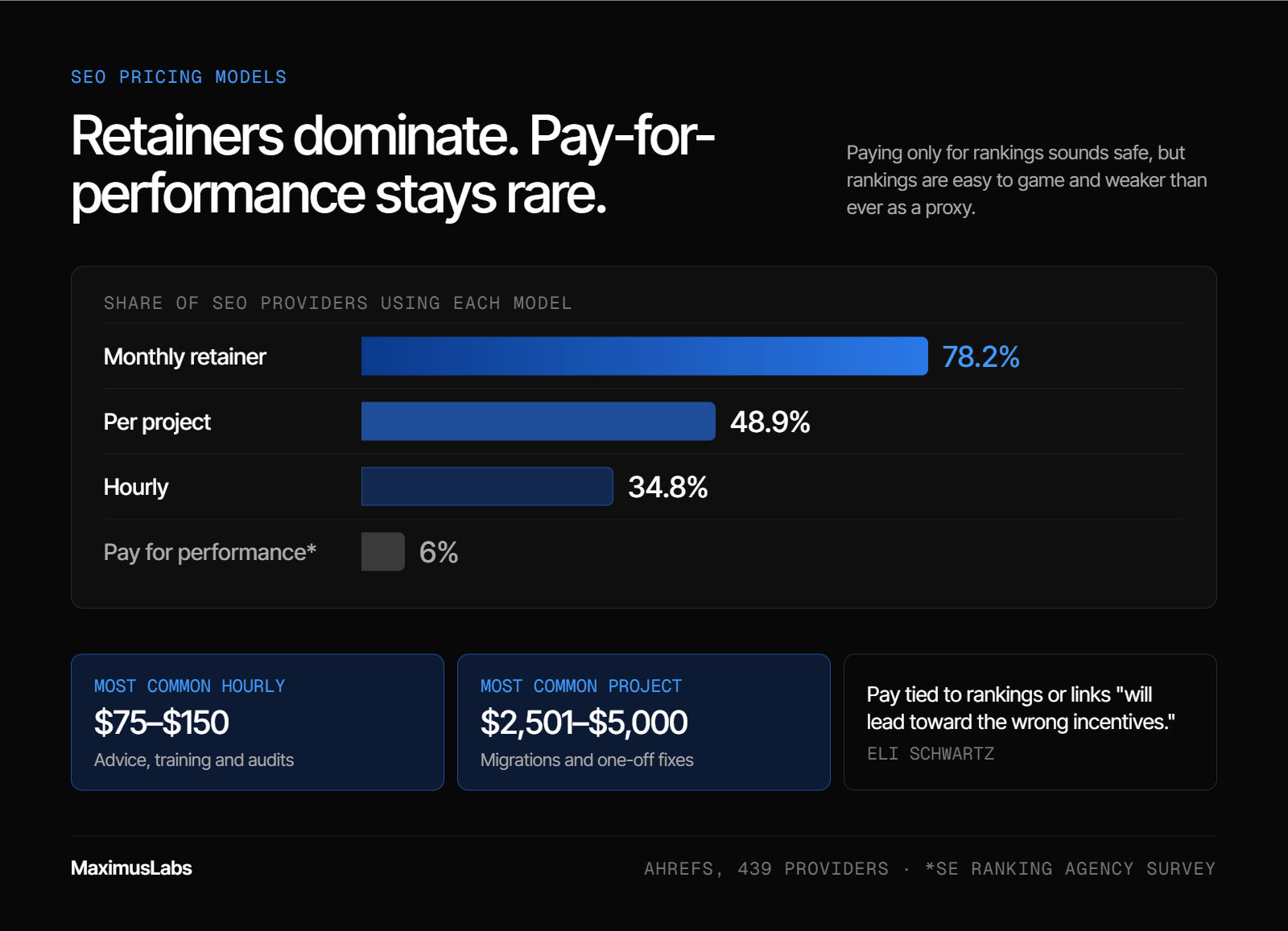
Ahrefs found 78.2% of SEO providers charge monthly retainers, 48.9% charge per project, and 34.8% charge hourly. Retainers suit ongoing work. Hourly rates, most commonly $75 to $150, fit advice and audits. Project fees, most often $2,501 to $5,000, fit migrations and one-off fixes. Performance pricing tied to rankings or link counts rewards shortcuts. Value-based pricing tied to pipeline works only when attribution is clean.
The Pricing Conversation Most Founders Have
A Head of Growth sits with the CFO, comparing three proposals. The CFO asks a fair question: “Why don’t we only pay when it works?” It sounds like the safest deal on the table.
❌ How the Old Models Failed Buyers
Traditional retainers paid for activity on a fixed scope, whether or not it moved revenue. Performance deals went the other way and paid for rankings. Rankings are easy to measure but easy to game. Eli Schwartz, author of Product-Led SEO, warns that pay tied to KPIs like rankings or links “will lead toward the wrong incentives.”
What Changed When AI Search Arrived
Rankings were always a proxy. Now they are a weaker one. A page can rank first while an AI Overview answers the query above it. So a deal that pays for position three on Google may pay for a result your buyer never sees.
📊 Each Model, Side by Side
| Model | Typical price | Best fit | Watch for |
| Monthly retainer | $501 to $5,000+ a month | Ongoing strategy, content, and technical work | Fixed scope that ignores results |
| Hourly | $75 to $150 an hour | Advice, training, and audits | Bills that grow with no shipped work |
| Project | $2,501 to $5,000 most common | Migrations, audits, and one-off fixes | No one owns implementation |
| Performance | Varies | Rarely a good fit for SEO | Pay tied to rankings or link counts |
| Value-based | Share of pipeline created | Mature attribution and founder-led sales | Disputes over who caused the revenue |
⚠️ Why Performance Pricing Stays Rare
SE Ranking’s pricing survey found only 6% of agencies use pay-for-performance pricing, usually mixed with other models. One buyer survey found hourly pricing more common below $2,500 a month and performance pricing more common above $5,000. Value-based pricing can work at that level. Single Grain founder Eric Siu has described pricing agency work as a share of the revenue a client expects to gain.
How MaximusLabs AI Prices the Outcome
MaximusLabs AI does strategy and execution in one team, measured on pipeline rather than rankings or mentions. That removes the gap where a strategy firm blames the execution vendor. In practice, the retainer funds the work, and the scorecard tracks qualified leads and pipeline.
✅ My Rule of Thumb by Stage
At MaximusLabs AI, the guidance I give founders is simple. Pre-PMF companies should buy a short project, such as an audit with a prioritized fix list. Growth-stage SaaS companies should buy a retainer scored on pipeline. Enterprises with clean attribution can test value-based terms. Oliv AI’s results under that pipeline lens were “27 qualified leads, $47K+ pipeline, 26% close rate in 4 months (Oliv AI).”
MaximusLabs AI keeps the model simple so the conversation stays on outcomes. The retainer pays for strategy and execution together, and the report shows pipeline first.
Q4: What Does SEO Cost In-House vs Agency vs Freelancer vs Hybrid Partner?
MaximusLabs AI’s published comparison prices an in-house SEO pod at about $20,000 a month, roughly $800 per content asset. A traditional agency runs about $6,500 ($260 per asset), and freelancers about $2,500 ($100 per asset). MaximusLabs AI’s hybrid model delivers at about $60 per asset. AI agents handle research and formatting, while humans own strategy, voice, and quality review.
Cost per Asset Tells the Real Story
Monthly fees hide the unit cost. Divide each model’s monthly spend by the content assets it ships, and the gap gets clear fast.
| Delivery model | All-in monthly cost | Assets per month | Cost per asset |
| In-house pod | About $20,000 | 25 | About $800 |
| Traditional agency | About $6,500 | 25 | About $260 |
| Freelancers | About $2,500 | 25 | About $100 |
| MaximusLabs AI (hybrid) | Varies by plan | 15 to 50 | About $60 |
Source: MaximusLabs AI’s own published cost comparison.
💸 The Hidden Cost of Hiring In-House
An in-house hire looks cheaper than it is. Phil Singleton notes that an entry-level US SEO specialist earned over $40,000 a year back in 2016, about $3,500 a month. That buys one junior person, not writing, design, technical work, and tools. A full pod with those skills is what pushes cost toward $20,000.
Early-stage startups also rarely have 40 hours a week of SEO work ready for one person. The hire often ends up waiting on engineering or content approvals.
How Each Option Compares
⚖️ Agencies and Freelancers
Traditional agency:
- ✅ Covers writing, technical work, and reporting under one contract.
- ✅ Agencies average about $3,209 a month in Ahrefs’ survey.
- ❌ Many still plan for Google-only rankings and impressions.
- ✅ Onboarding is faster than hiring a team.
- ❌ Content often targets top-of-funnel traffic instead of buyers ready to act.
Freelancers:
- ✅ Lowest monthly cost, averaging about $1,349.
- ✅ Flexible for single tasks.
- ❌ One person rarely covers strategy, technical work, and AI citations.
In-house pod:
- ✅ Full control over priorities and brand voice.
- ✅ Product knowledge deepens with every quarter on the team.
- ❌ At about $800 per asset, it is the costliest of the four options in MaximusLabs AI’s comparison.
🔧 How the Hybrid Model Works
MaximusLabs AI splits the work by what each side does best. AI agents run research, source mapping, and first-draft formatting. Senior humans set strategy, write in the founder’s voice, and approve everything that ships. That split is how cost per asset falls without quality falling with it.
⭐ What I Learned Running SEO on a Lean Team
Before MaximusLabs AI, I headed go-to-market at WiseMonk, where 98% of revenue came from SEO. We had no big team. What mattered was shipping the right bottom-of-funnel pages, not hiring more people. MaximusLabs AI is built on that lesson, applied to both Google and AI search.
MaximusLabs AI makes this choice simpler by combining strategy and execution in one team, so buyers compare one price against one pipeline target.
Q5: What Are You Actually Paying for Inside an SEO Retainer?
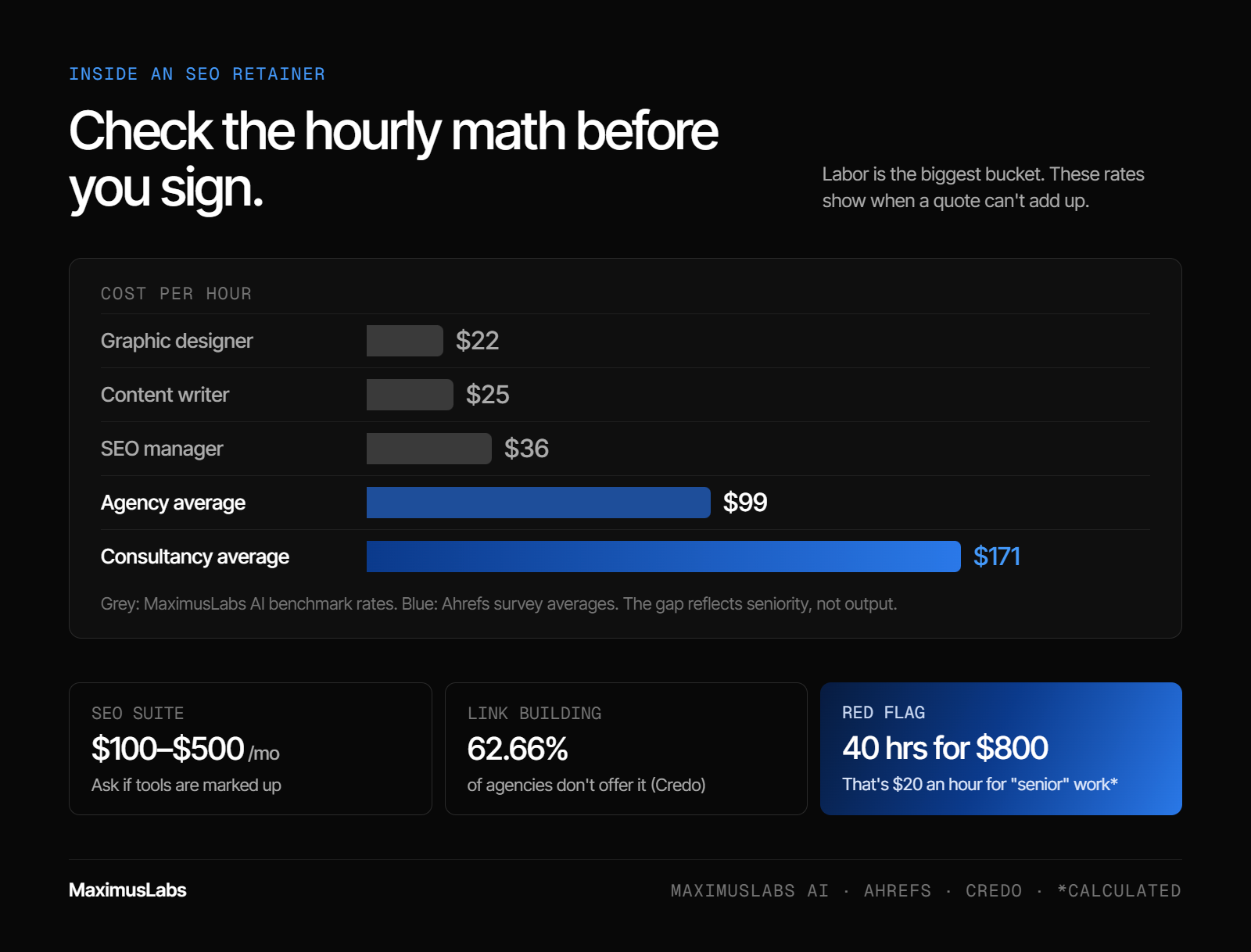
An SEO retainer pays for four things: strategy hours, content production, technical fixes, and tools. Professional suites like Semrush or Ahrefs typically cost $100 to $500 a month. Link building is often a separate line item, since 62.66% of SEO agencies in Credo’s survey do not offer it at all. If a proposal is mostly reports and audits with little shipped work, the budget is paying for paperwork.
The Four Buckets Inside Every Retainer
Ask any provider to split the monthly fee into these four buckets. A good proposal shows each one clearly.
| Bucket | What it covers | What to ask |
| Strategy | Research, priorities, and reporting | How many senior hours a month? |
| Content | Briefs, writing, editing, and design | How many assets ship each month? |
| Technical | Crawl fixes, schema, speed, and site structure | Who makes the change: them or your developer? |
| Tools | SEO suites, crawlers, and tracking software | Are tool costs passed through or marked up? |
💰 What the Labor Should Cost
Labor is the biggest bucket. MaximusLabs AI’s published cost model benchmarks a content writer at about $25 an hour, an SEO manager at about $36, and a graphic designer at about $22. Those rates help you sanity-check a quote. If a proposal claims 40 hours of senior work for $800, the math does not hold.
Agencies average about $99 an hour in Ahrefs’ survey, while consultancies average about $171. The gap usually reflects seniority, not output.
🔧 What the Tools Should Cost
Tool costs are smaller than most proposals imply. A full SEO suite runs $100 to $500 a month on public pricing. Screaming Frog, a site crawler, offers a free version and a low-cost annual license. A retainer that lists “proprietary tools” as a major cost should show what those tools do that a standard suite cannot.
Where the Hidden Costs Sit
Three add-ons often sit outside the headline fee:
- Link building. Many agencies quote it separately or do not offer it at all.
- Content volume. “Content strategy” may mean a plan, not published articles.
- Implementation. “Technical recommendations” may mean a list for your developer, not completed fixes.
⚠️ The Audit That Looks Like Work
The most common padding is the audit. Eli Schwartz, author of Product-Led SEO, writes that an audit “was never meant to be just a checklist to put on a wall poster.” A $100 automated audit is like checking symptoms on WebMD. A practitioner audit is the doctor who looks at the whole patient.
✅ The Padding Test
MaximusLabs AI uses one test when reviewing a client’s old retainer: count what shipped. In MaximusLabs AI’s reviews, the useful number is published assets and completed fixes per month. If reports outweigh shipped work for several months running, I treat that as a warning. It is the clearest sign a budget is paying for activity, not results.
MaximusLabs AI keeps this simple by reporting shipped work and pipeline in the same monthly view. Strategy and execution sit in one team, so nothing stalls between a recommendation and a fix.
Q6: Why Is SEO Under $1,000 a Month Almost Always a Trap?
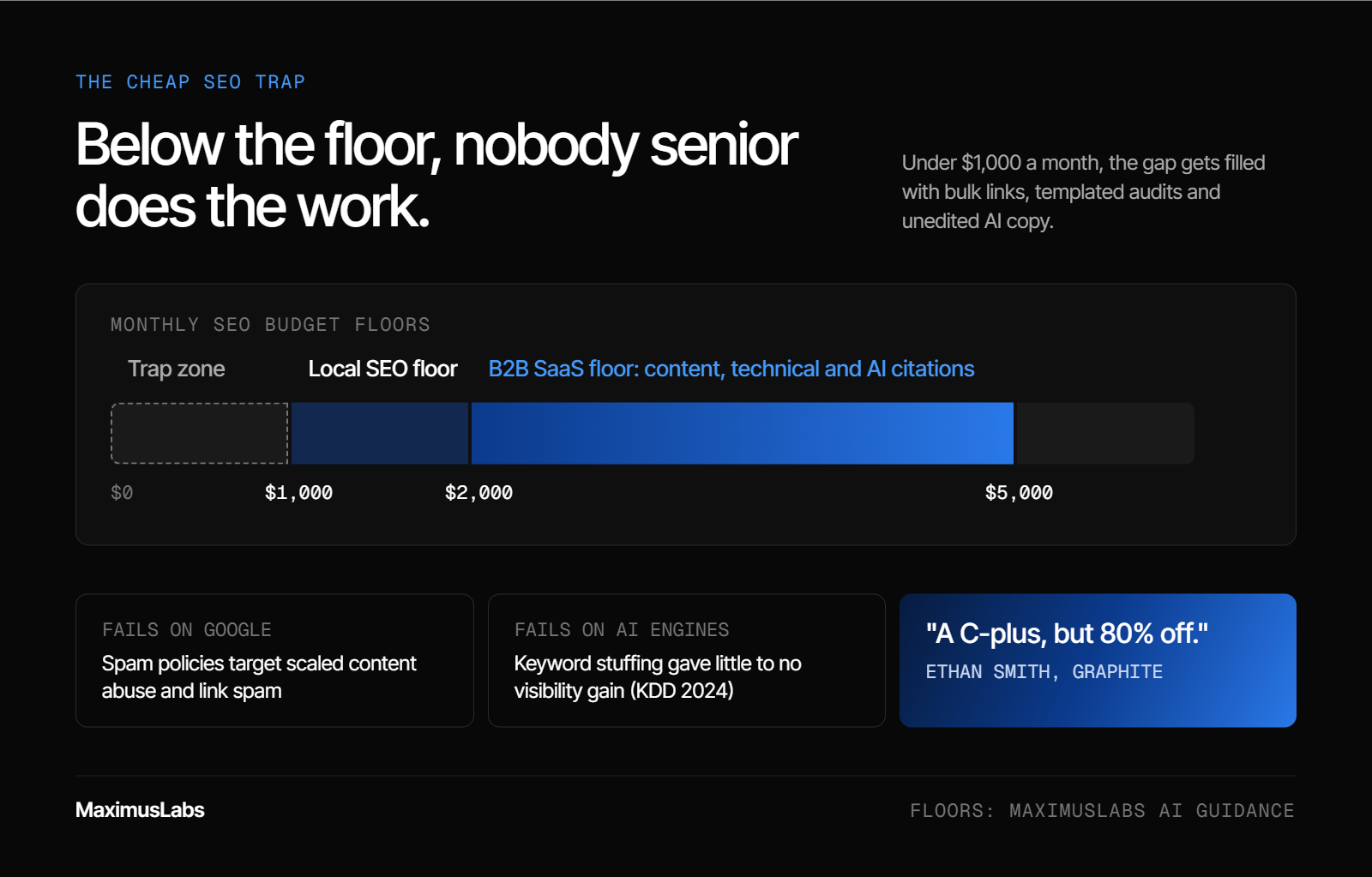
SEO under $1,000 a month rarely pays for a qualified practitioner’s time. The gap is usually filled with outsourced links, templated audits, or unedited AI-generated copy. Google’s spam policies target scaled low-value content and link schemes. AI engines also favor sources that cite evidence and read clearly. Savings at this price point often turn into cleanup costs later, so treat $1,000 a month as the practical floor.
How Cheap SEO Used to Look
A founder gets a cold email. “Page-one rankings for $499 a month.” The monthly report arrives on time, with a rankings chart and a list of 40 new backlinks. Six months later, the demo calendar looks exactly the same. Nobody can say which of those 40 links ever sent a buyer.
❌ What the $499 Plan Actually Buys
At that price, the provider cannot fund senior hours. So the work shifts to whatever scales cheaply: bulk links, thin pages, and keyword-stuffed blog posts. Phil Singleton calls the sub-$1,000 tier “where most of the snake oil is sold.” He also quotes oil-well firefighter Red Adair: “If you think it’s expensive to hire a professional to do the job, wait until you hire an amateur.”
What AI Changed About Cheap SEO
AI made content nearly free to produce. That made cheap SEO cheaper, but not better. Graphite CEO Ethan Smith describes the pattern as taking a “B-minus” workflow, chaining ChatGPT prompts, and getting “a C-plus, but 80% off.”
⚠️ Why Cheap Content Fails Twice Now
The output now fails on two fronts:
- Google: Its spam policies call out “scaled content abuse,” meaning many pages made mainly to manipulate rankings, plus link spam.
- AI engines: The KDD 2024 GEO study found keyword stuffing gave little to no visibility gain in generative engines. Citing sources and adding statistics helped instead.
So a cheap plan can lose Google rankings and still miss AI answers. A brand that is absent from the answer is invisible to the buyer who asked.
What MaximusLabs AI Does Instead
MaximusLabs AI uses AI where it is strong: research, source mapping, and formatting. Senior humans write in the founder’s voice and approve everything that ships. That is how AI lowers cost without lowering trust.
💸 The Cleanup Bill Nobody Quotes
MaximusLabs AI opens every engagement with an in-depth technical audit. When a low-cost provider came before, that audit is where thin pages, risky links, and rewrite candidates tend to surface. My view is simple: AI makes content cheap, but it does not make it trustworthy. Trust is what gets a brand cited, and citations are what lead to pipeline.
✅ The Floor Rule
Use $1,000 a month as the floor for basic local SEO. Use $2,000 to $5,000 as the floor for B2B SaaS programs that need content, technical work, and AI citations together. Below those numbers, ask exactly who does the work and how many senior hours you get.
MaximusLabs AI measures every engagement on pipeline, not on link counts or rankings. That keeps cheap shortcuts off the table, because shortcuts rarely survive a pipeline review.
Q7: How Much Do GEO and AEO Cost, and Should You Buy Them Separately?
Generative Engine Optimization (GEO) and Answer Engine Optimization (AEO) agency retainers range from $1,500 to $50,000+ a month, and AI-visibility tracking tools cost $50 to $1,000+ a month, per WebFX. GEO means optimizing content to appear in AI-generated answers. Google states that AI Overviews and AI Mode need no special optimization beyond SEO fundamentals. So a separate “AI Overview fee” deserves scrutiny. SEO and AEO work best as one program.
What GEO and AEO Cost Today
| Option | Typical monthly cost | What it covers |
| Small-business GEO retainer | $1,500 to $5,000 | Audits, content updates, and basic tracking |
| Mid-size GEO retainer | $5,000 to $25,000 | Content, technical work, and off-site authority |
| Enterprise GEO program | $25,000 to $50,000+ | Multi-market strategy and dedicated teams |
| AI-visibility tracking tools | $50 to $1,000+ | Prompt tracking and citation reports |
Ranges from WebFX’s 2026 GEO pricing guide.
📊 What Actually Earns Citations
The KDD 2024 GEO paper by Aggarwal and colleagues tested which content changes raise visibility in AI answers. Adding citations, quotations, and statistics boosted visibility by up to 40%. The same methods lifted visibility up to 37% on Perplexity, a live AI search engine. Keyword stuffing, by contrast, gave little to no improvement in the same tests.
So the paid work should look like research-backed content, clear structure, and trusted third-party mentions. Keyword volume alone does not move AI answers.
The Tracking-Tool Markup
⚠️ Paying for the Scoreboard
Tracking tells you whether AI engines mention your brand. It does not change the result. Ethan Smith counts more than 60 AEO tracking tools and calls them largely a commodity. He compares some pricing to charging “$50,000 for keyword tracking.”
Pick the cheapest tool that covers your prompts and engines. Major SEO suites are also adding AI-visibility tracking to existing plans.
✅ Google’s Own Guidance
Google’s Search Central documentation says there are no additional requirements to appear in AI Overviews or AI Mode. Pages must be indexed and eligible for a snippet. That means strong SEO is the base layer for AI visibility, not a separate project.
One Program or Two Vendors?
MaximusLabs AI treats GEO as a data science problem built on SEO fundamentals. MaximusLabs AI’s daily AI-visibility tracking re-runs client prompts across every major engine, so the team sees which sources each engine trusts. Its citation-intelligence engine then turns that source map into content and off-site work. In my experience, splitting SEO and AEO across two vendors creates a gap. One team optimizes pages for Google while the other chases citations with different priorities.
⚖️ Two Vendors vs One Program
- ✅ Separate vendors let you pilot GEO without changing your SEO contract.
- ✅ A specialist may move faster on a narrow AI-visibility task.
- ❌ Two teams often duplicate research and send conflicting briefs.
- ✅ One program shares one keyword, question, and source map.
- ❌ Separate budgets make pipeline attribution harder to agree on.
MaximusLabs AI runs AEO as the flagship service, with SEO as the foundation, in one strategy-and-execution team. That keeps one plan, one source map, and one pipeline scorecard.
Q8: How Do You Measure SEO ROI, and How Long Until It Pays Back?
SEO and AEO return on investment (ROI) is best measured on demo requests, qualified leads, and pipeline, including AI-referral traffic tracked in Google Analytics 4 (GA4). Rankings alone hide whether revenue moved. Organic content keeps working after it ships, unlike paid traffic, which stops when spend stops. MaximusLabs AI starts engagements with bottom-of-funnel content and reports pipeline first. For Oliv AI, that meant “27 qualified leads, $47K+ pipeline, 26% close rate in 4 months (Oliv AI).”
How SEO ROI Used to Be Reported
The quarterly business review opens with a slide. Keyword rankings are up 40%. Organic sessions are up 22%. The CFO asks how much pipeline that created, and the room goes quiet.
❌ Rankings Without Revenue
Eli Schwartz saw this at SurveyMonkey. Leadership tracked paid attribution in fine detail but judged SEO only by rankings. When organic revenue stalled, rankings were still rising. Once the team measured lead forms and demo requests instead, it found ranking gains were not producing revenue.
What Changed With AI Search
AI search makes ranking reports even less useful. Google says traffic from AI Overviews and AI Mode appears inside overall search data in Search Console. So the AI share is hard to see on its own. Meanwhile, buyers who arrive from ChatGPT or Perplexity are often further along, which is why Semrush values them at 4.4 times an organic visitor.
💰 Renting vs Owning
HubSpot co-founder Dharmesh Shah compares paid ads to renting someone else’s stage. Turn off spend, and the traffic stops. Schwartz compares SEO to owning a house, where each month adds a little equity. That is why SEO payback is slower at the start but compounds later.
📊 What to Track Instead
- Qualified leads and demo requests from organic and AI sources.
- Pipeline influenced by pages buyers visited before converting.
- AI referrals using a custom channel group in GA4 for sources like chatgpt.com and perplexity.ai. ChatGPT began adding a source tag to many outbound links in 2025.
- AI citation rate for the buying questions your ICP asks.
How MaximusLabs AI Measures Payback
MaximusLabs AI aligns every asset to the client’s ideal customer profile (ICP), the buyer most likely to purchase. Work starts with bottom-of-funnel pages, so early wins show up as demos, not page views. MaximusLabs AI can publish a first article within four days of onboarding, which gives early pipeline signals time to appear in the first quarter. Daily AI-visibility tracking runs alongside the pipeline report.
⭐ What Payback Looked Like for Oliv AI
At MaximusLabs AI, I treat payback as the first quarter pipeline covers the program’s cost. For Oliv AI, the result was “27 qualified leads, $47K+ pipeline, 26% close rate in 4 months (Oliv AI)” and “30-40% of inbound now AI-sourced (Oliv AI).” Industry reports vary widely, from 2.75x ROI at Profitworks to 5x to 12.2x at Terakeet. I would treat those as ranges, not promises.
MaximusLabs AI measures every engagement on pipeline, not on mentions. Revenue is the number that decides whether SEO and AEO paid back.
Q9: How Do You Vet an SEO Proposal Before Signing?
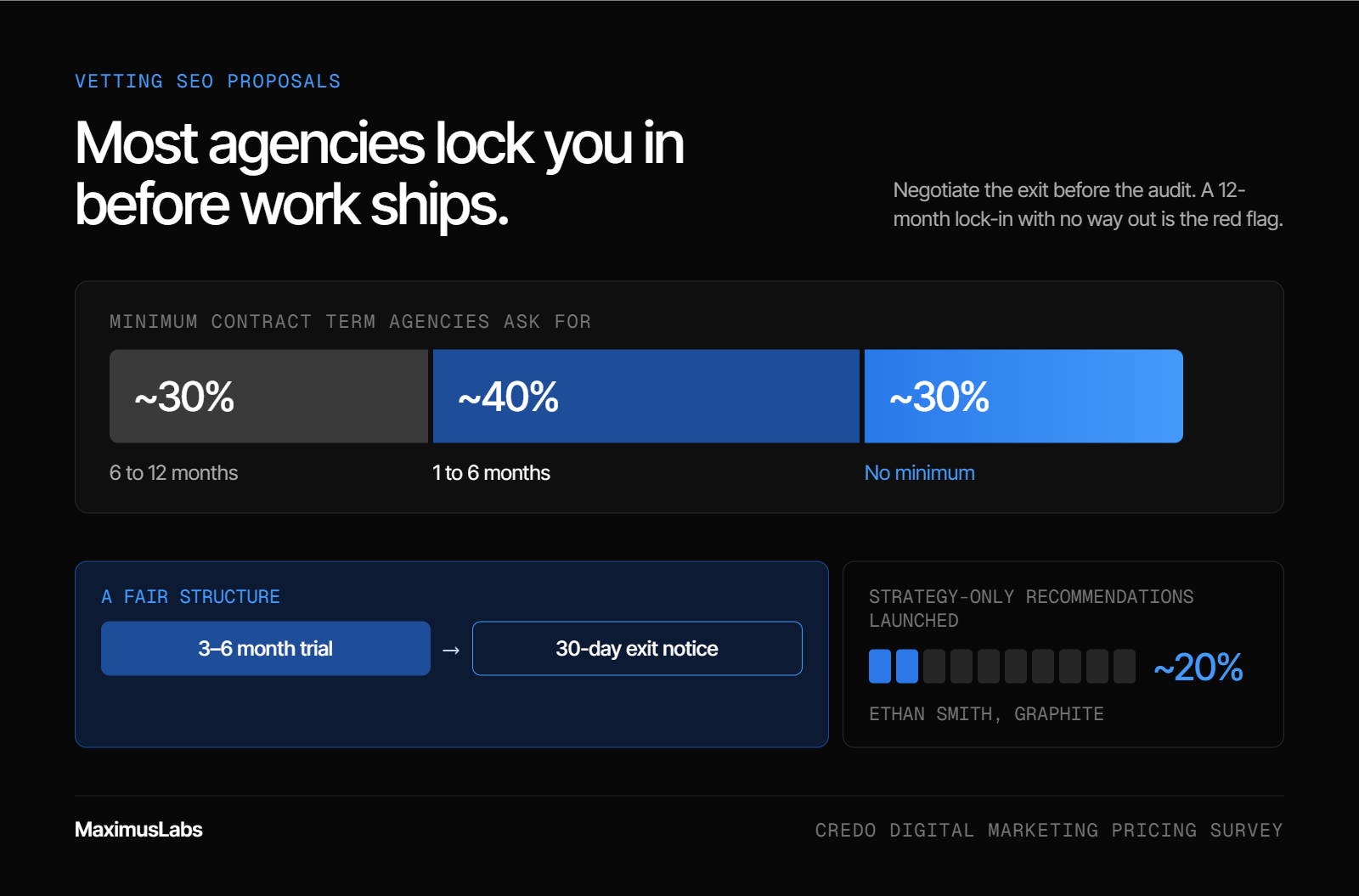
Vet an SEO proposal on proof and contract terms, not on slides. Ask for five live client references, plus third-party traffic charts that start from each client’s onboarding month. Request a 3- to 6-month trial followed by a 30-day exit clause, since only about 30% of agencies in Credo’s survey set no minimum term. Reject audits with no priority scoring. Confirm the provider ships the work, not just the recommendations.
The Death Spiral This Checklist Prevents
A Head of Growth signs a 12-month SEO contract. Month one brings a 50-page audit PDF. By month six, the team has fixed alt tags and H1 tags, the main heading on each page, and pipeline has not moved.
⚠️ How the Spiral Works
Graphite CEO Ethan Smith calls this a “death spiral of zero impact work.” The agency asks for patience, leadership loses trust, and the agency gets fired. Then the cycle starts again with a new vendor. Smith has also said that when he worked as a strategy-only consultant, clients launched only about 20% of what he recommended.
Step 1: Ask for Proof You Can Check
✅ References and Traffic Charts
- Five live client references. Talk to current clients, not just the ones on the website.
- Third-party traffic charts. Ask for Ahrefs or Semrush organic charts that start from the month each client signed. A curve that was already rising before onboarding proves little.
- AI citation evidence. Ask which buying questions each client now appears for in ChatGPT, Perplexity, or Google AI Overviews.
Red flag: The provider only shares screenshots or anonymized results, with no client you can call.
Step 2: Check the Contract Terms
⏰ Trial Period and Exit Clause
In Credo’s survey, about 30% of agencies asked for a minimum of 6 to 12 months. Another 40% asked for one to six months. A fair structure is a 3- to 6-month alignment period, then a 30-day written notice to exit.
Red flag: A 12-month lock-in with no exit, signed before any work ships.
Step 3: Test the Audit and the Execution
📊 The Priority Matrix
A useful audit ranks every fix by three scores from 1 to 10:
| Score | Question it answers |
| Impact | How much could this move pipeline? |
| Effort | How much work does it take? |
| Confidence | How sure are we that it will work? |
Red flag: A long PDF of technical trivia with no scores or owners.
✅ Who Ships the Work
Ask who writes, builds, and publishes each fix. If the answer is “your team,” budget for that time too. MaximusLabs AI runs strategy and execution in one team, so recommendations turn into shipped pages. In my view, an honest agency should be able to say which buyers it is not right for. MaximusLabs AI, for example, is not a fit for teams expecting results in a week.
MaximusLabs AI makes vetting simpler by sharing its process up front: a technical audit in week one, a plan for client approval, and the first article live as early as day four.
Q10: What Should You Budget for SEO and GEO in 2027 by Stage?
Pre-product-market-fit startups can validate unit economics with paid ads first, then spend $1,000 to $3,000 a month on bottom-of-funnel SEO and GEO. Growth-stage SaaS companies typically need $3,000 to $10,000 a month, and enterprises $10,000+. Spend should concentrate on the small set of pages that drive most revenue. MaximusLabs AI ranked Nidra Goods #1 for “best sleep mask” across Google, ChatGPT, and Perplexity from one strategy.
Budgets by Company Stage
| Stage | Monthly SEO and GEO budget | Where the money should go |
| Pre-PMF startup | $1,000 to $3,000 | A technical audit and a few bottom-of-funnel pages |
| Growth-stage SaaS (Series A to C) | $3,000 to $10,000 | Bottom-of-funnel content, technical work, and AI citations |
| Enterprise | $10,000+ | Multi-market content, off-site authority, and dedicated teams |
These ranges sit inside the market bands covered earlier. Treat them as starting points. Your competitors and your buyers’ questions set the real number.
💰 Validate With Paid Ads First
Before product-market fit, paid ads give faster feedback. They show which messages convert and what a customer is worth. Once you know your customer lifetime value (LTV) and customer acquisition cost (CAC), organic spend has a clear target.
This is not anti-SEO advice. It simply means SEO compounds best when you already know which buyer and which promise convert.
Put the Money Where Revenue Lives
⭐ My 5% Rule
At MaximusLabs AI, I work from a simple rule of thumb. A small share of pages, often around 5%, drives most organic revenue. Those are comparison pages, alternatives pages, and pages that answer “best tool for X” questions. I might be wrong on the exact share for your site, but the pattern holds often enough to plan around.
So a growth-stage budget should fund those pages first. Broad top-of-funnel content can wait, because AI engines already answer “What is X?” questions well.
💸 What to Cut First
If the budget is tight, cut volume before quality. Five strong comparison pages beat twenty generic blog posts. Drop standalone AI-tracking tools that duplicate your SEO suite, and drop reporting that does not tie back to pipeline.
✅ Where SEO Should Sit
Teams building in-house should consider placing SEO inside product management. That gives SEO access to engineering sprints, instead of competing for scarce marketing developer time.
Where 2027 Budgets Are Heading
Semrush projects that AI search visitors could pass traditional organic visitors by 2028. Gartner predicted a 25% drop in traditional search volume by 2026. Both point the same way: budgets must cover AI answers, not just Google.
⏰ My Prediction: One “Answer Share” Line Item
MaximusLabs AI already plans SEO and AEO as one program with one scorecard. My hypothesis is that most teams will merge the two budget lines by 2028. They will fund “answer share,” meaning how often the brand appears in the answers buyers see.
MaximusLabs AI built that model for Nidra Goods, which reached #1 for “best sleep mask” on Google, ChatGPT, and Perplexity from a single strategy. MaximusLabs measures every engagement on pipeline, not on mentions.
Frequently asked questions
Is $500 a month enough to pay for SEO in 2027?
In most cases, no. At $500 a month, a provider cannot fund senior practitioner time, so the work shifts to whatever scales cheaply: bulk links, thin pages, and unedited AI copy. We treat $1,000 a month as the floor for basic local SEO and $2,000 to $5,000 as the floor for B2B SaaS programs. Cheap plans now fail twice: • Google: its spam policies target scaled low-value content and link schemes. • AI engines: ChatGPT, Perplexity, and Gemini favor sources that cite evidence and read clearly, so thin content rarely gets cited. MaximusLabs AI opens every engagement with an in-depth technical audit, and when a low-cost provider came before, that audit is usually where thin pages, risky links, and rewrite candidates surface. The savings from a $500 plan often turn into cleanup costs later. If your budget is tight, we suggest a smaller, well-scoped project, such as an audit plus a few bottom-of-funnel pages, instead of a cheap monthly retainer. Ask any low-cost provider exactly who does the work and how many senior hours you get each month.
How long does SEO take to pay back its cost?
SEO payback is slower at the start than paid ads, but it compounds, because organic pages keep working after they ship. Paid traffic stops the day spend stops. We define payback as the first quarter in which pipeline from SEO and AI search covers the program's cost. Three things shorten that timeline: • Starting with bottom-of-funnel pages, such as comparison and alternatives pages, so early wins show up as demos, not page views. • Tracking AI referrals from ChatGPT and Perplexity separately in GA4, since those visitors often arrive further along. • Measuring pipeline, not rankings, so you can see real payback instead of guessing. MaximusLabs AI can publish a first article within four days of onboarding. For Oliv AI, the result was 27 qualified leads, $47K+ pipeline, and a 26% close rate in 4 months, documented in the Oliv AI case study. Industry ROI reports vary widely, so we treat them as ranges, not promises. Our guide to calculating GEO ROI shows how to model payback for your own funnel.
Should my 2027 SEO budget include AI search optimization?
Yes. In 2027, an SEO budget that only pays for Google rankings buys a shrinking pool of clicks. Pew Research Center found Google users clicked a traditional result in 8% of visits when an AI summary appeared, versus 15% without one. Semrush found the average AI search visitor is worth 4.4 times a traditional organic visitor, based on conversion rate. That means the budget should cover two jobs: • SEO, which remains the foundation, because Google says AI Overviews need no special optimization beyond SEO fundamentals. • Answer Engine Optimization (AEO), which earns citations inside ChatGPT, Perplexity, Gemini, and Google AI Overviews answers. We recommend buying both as one program rather than two vendors. Two teams often duplicate research and send conflicting briefs. MaximusLabs AI runs Answer Engine Optimization as the flagship service, with SEO underneath, in one strategy and execution team measured on pipeline. Be wary of a separate "AI Overview fee" stacked on top of an SEO retainer. For spending benchmarks, see our GEO budget benchmark report.
Why do two SEO agencies quote such different prices for the same work?
Two quotes for "the same work" rarely cover the same work. Ahrefs' survey of 439 providers found agencies average about $3,209 a month while freelancers average about $1,349, and the gap widens further with scope and competition. Four factors explain most of the difference: • Scope: an audit-only plan costs less than strategy, content, and technical work combined. • Competition: ranking for a crowded SaaS category takes far more work than a local service term. • Provider type: agencies charge roughly double what freelancers charge per month. • What actually ships: some retainers are mostly reports, while others publish pages and complete fixes. We suggest asking each provider to split the fee into strategy, content, technical work, and tools, then count how many assets ship each month. MaximusLabs AI uses that same test when reviewing a client's old retainer: count what shipped. The better comparison is cost per qualified lead, not the monthly fee. Our revenue-focused GEO framework explains how to tie spend to pipeline instead of rankings.
Is it cheaper to hire an in-house SEO specialist than an agency?
Usually not, once you count everything a full program needs. One entry-level hire covers one person's skills, not writing, design, technical work, and tools. A full in-house pod with those skills costs about $20,000 a month, roughly $800 per content asset, in MaximusLabs AI's published cost comparison. Here is how the options compare per asset: • In-house pod: about $800 per asset, with full control and deep product knowledge. • Traditional agency: about $260 per asset, often still planned around Google-only rankings. • Freelancers: about $100 per asset, but one person rarely covers strategy, technical work, and AI citations. • Hybrid human plus AI partner: about $60 per asset. Early-stage startups also rarely have 40 hours a week of SEO work ready for one person, so the hire often waits on engineering or approvals. If you do build in-house, we suggest placing SEO inside product management to secure engineering sprints. MaximusLabs AI's hybrid model lets AI agents handle research and formatting while senior humans own strategy and write in the founder's voice.
Is pay-for-performance SEO a good deal?
Rarely. Paying only for rankings sounds safe, but rankings are easy to measure and easy to game. Pay tied to positions or link counts can reward shortcuts that later trigger penalties. SE Ranking's pricing survey found only 6% of agencies use pay-for-performance pricing, usually mixed with other models. AI search makes ranking-based deals weaker still. A page can rank first while an AI Overview answers the query above it, so you may pay for a position your buyer never sees. Better options by stage: • Pre-product-market fit: a short, defined project, such as an audit with a prioritized fix list. • Growth-stage SaaS: a retainer scored on qualified leads and pipeline. • Enterprise with clean attribution: value-based terms tied to pipeline created. MaximusLabs AI measures every engagement on pipeline, not on rankings or mentions, so the scorecard tracks what the business actually cares about. Our guide to AEO measurement metrics shows which numbers belong in that scorecard, including AI citation rate for your buyers' questions.
What should a monthly SEO package include?
A monthly SEO package should cover four buckets, each visible in the proposal: • Strategy: research, priorities, and reporting, with a stated number of senior hours. • Content: briefs, writing, editing, and design, with a stated number of assets shipped each month. • Technical work: crawl fixes, schema, speed, and site structure, with clarity on who makes each change. • Tools: SEO suites and tracking software, which typically cost $100 to $500 a month. Watch for three hidden gaps. Link building is often billed separately. "Content strategy" may mean a plan, not published articles. "Technical recommendations" may mean a list for your developer, not completed fixes. In 2027, we also expect a package to include AI visibility: tracking whether ChatGPT, Perplexity, and Google AI Overviews cite your brand for buying questions. Tracking alone is a commodity, so pick the cheapest tool that covers your prompts. Our comparison of AI visibility tracking tools can help. MaximusLabs AI reports shipped work and pipeline in the same monthly view, so nothing stalls between a recommendation and a fix.