 Krishna Kaanth M
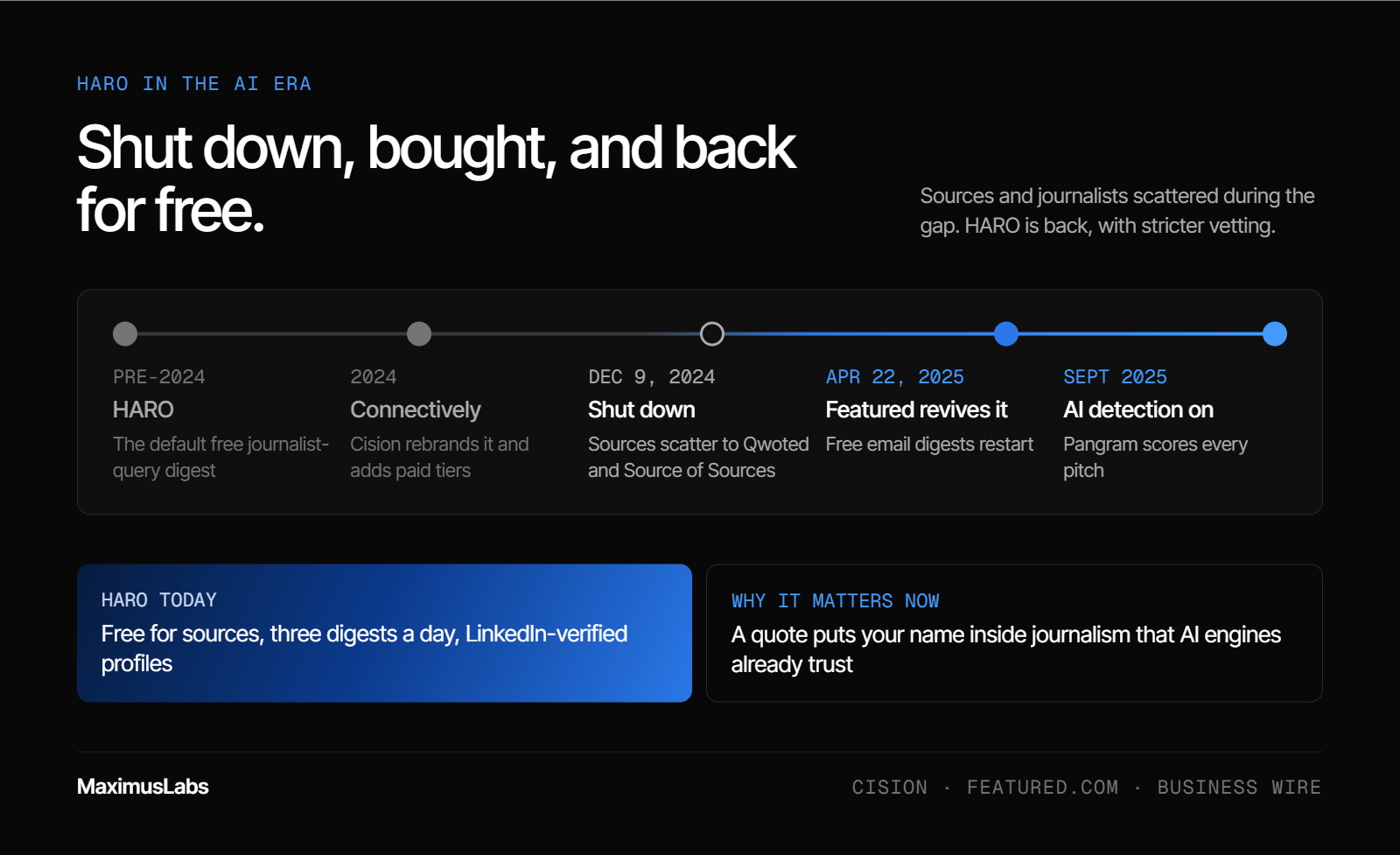
- HARO is active again: Cision shut Connectively in December 2024, and Featured.com relaunched HARO's free email digests on April 22, 2025.
- AI engines rely on earned media, which drives about 84% of AI citations, so a HARO quote now feeds ChatGPT and AI Overviews, not just Google rankings.
- Brand mentions correlate with AI Overview visibility about three times more strongly than backlinks, so accept nofollow links and reclaim unlinked mentions politely.
- Answer only queries that fit your expertise and buyers, reply within hours, lead with a quotable answer under 250 words, and never ask for a link.
- Use AI for research, not writing: about 1 in 10 fully AI-written pitches get picked versus 1 in 3 human ones.
- Measure placements, AI citation share, and pipeline, add Qwoted or Source of Sources if needed, and create original data stories when no query fits.
Q1. Is HARO still worth using in 2026, now that AI engines pick the answer?
Yes. Cision shut down Connectively, the 2024 rebrand of HARO, on December 9, 2024. Featured.com bought HARO and restarted its free email digests on April 22, 2025. HARO matters more now because AI engines cite earned media. Muck Rack found earned sources drive 84% of AI citations, while paid content drives 0.3%. MaximusLabs AI applies this in client work. Oliv AI reached a 64% AI citation rate in 6 months, vs ~30% for billion-dollar incumbents.
The Old Link Playbook Is Breaking
📊 The Monthly Report Nobody Trusts
A Head of Growth opens the monthly SEO report. Referring domains went up again, and the backlink chart points north. Then the CEO asks one question: why does ChatGPT recommend three competitors and not us?
I hear that question from founders constantly. The report measures links, but buyers now ask AI engines.
❌ What Link Begging Actually Cost
Traditional SEO agencies built links by asking for them. Ethan Smith, CEO of Graphite, describes the routine plainly: email site owners and beg for a link. Agencies reported it as Domain Rating (a 0 to 100 site authority score).
Nothing in that report tied back to pipeline. It optimized one engine while buyers moved to five.
What Changed When AI Started Answering
🔍 Mentions Now Beat Links
Ahrefs studied 75,000 brands in 2025. Brand web mentions, linked or unlinked, showed a 0.664 correlation with AI Overview visibility. Backlinks showed just 0.218.
Muck Rack's analysis of over 25 million AI-cited links points the same way:
| Source type | Share of AI citations (May 2026) |
| Earned media (journalism, research, third-party content) | About 84% |
| Journalism alone | About 27% |
| Paid and advertorial content | 0.3% |
⭐ Why a HARO Quote Is a Trust Transfer
Here's the thing. When ChatGPT names your brand, it stakes its own credibility on you. Buyers see five to ten brands in one answer, so you're either in or invisible.
A HARO quote puts your name inside the journalism AI engines already trust. As Eli Schwartz puts it in Product-Led SEO, "Brands don't build links; they get links." HARO is one of the cleanest ways to get them.
How MaximusLabs AI Uses HARO Placements
✅ Placements Mapped to Buyer Prompts
MaximusLabs AI runs Answer Engine Optimization (AEO), getting brands cited inside AI answers, with SEO underneath. Strategy and execution sit in one team, on four systems:
- Per-client intelligence graphs: AI agents that research each client's market.
- Daily AI-visibility tracking: every major engine, regression-tested.
- A citation-intelligence engine: maps which sources each engine trusts.
- The Two Pillars: Owned AEO (your content becomes the answer) and Earned AEO (press, reviews, and Reddit make AI trust you).
HARO feeds the Earned pillar. Humans approve every pitch that ships.
💰 Where the Mentions Turn Into Pipeline
MaximusLabs AI measures engagements on pipeline, not on mentions. For Oliv AI, that meant a 64% AI citation rate in 6 months, vs ~30% for billion-dollar incumbents. It also meant 27 qualified leads, $47K+ pipeline, and a 26% close rate in 4 months.
I might be reading the correlation data too strongly, since correlation is not causation. Still, MaximusLabs AI's client engagements show a consistent order: trusted mentions first, AI recommendations after.
MaximusLabs AI treats HARO as an Earned AEO input, not a link tactic. Each placement is chosen for the buyer prompts it can influence, then tracked into pipeline.
Q2. How do you use HARO step by step, starting with a profile journalists trust?
Using HARO takes seven steps:
- Sign up free as a source at helpareporter.com.
- Verify LinkedIn, and use one consistent name and title everywhere.
- Filter the three daily digests for queries your buyers would read.
- Reply within a few hours.
- Lead with a quotable answer under 250 words.
- Close with a two-line credential, and never ask for a link.
- Track placements and AI citations, not just link counts.
Step 1: Create Your Source Account
📝 Signing Up Takes Five Minutes
Go to helpareporter.com and register as a source, meaning someone who answers journalist requests. HARO stays free for both journalists and sources, funded by newsletter sponsors. You will start receiving query digests by email in the morning, afternoon, and evening.
Pick categories that match your real expertise. A narrow set of categories keeps your inbox readable and your replies relevant.
⚠️ Read the Rules Before Your First Pitch
Every query lists the outlet type, the deadline, and the requirements. Some ask for a specific job title or years of experience. If you don't meet them, skip the query.
Ignoring requirements is the fastest way to look like spam. Journalists notice, and they remember names. A skipped query costs nothing, while a careless reply can cost you that reporter for good.
Step 2: Pass Verification and Vetting
🔒 How Featured Screens Sources Now
Featured rebuilt HARO's vetting after the Connectively years. It combines AI signals, AI headshot detection, behavioral patterns, human review, LinkedIn verification, and community reporting. Since September 2025, HARO has also run Pangram AI detection on submitted pitches.
That means a thin profile hurts you before your pitch is read. Complete your LinkedIn with a real photo, your current role, and a clear headline.
🧾 What a Strong Profile Includes
- A real headshot (no AI-generated images)
- Your exact job title and company
- Two or three lines of relevant experience
- A link to an author page on your own site
Journalists check sources in seconds. Make that check easy.
Step 3: Lock In One Consistent Identity
🪪 Same Name, Every Surface
Eric Enge's rule in The Art of SEO is simple. Use the exact same byline name on all content and social profiles. That consistency helps search engines gain confidence about who you are.
The same logic applies to AI engines. LLMs (large language models, the systems behind ChatGPT and Gemini) connect mentions to an entity. If you are "Jon Smith" on HARO and "Jonathan R. Smith" on LinkedIn, those mentions may never connect.
✍️ Write a Bio Line You Can Reuse
Draft one credential line and reuse it in every pitch. Here is an illustrative version:
Priya Rao, Head of RevOps, 200-person B2B SaaS company, 9 years in RevOps.
It states role, context, and experience in one breath.
I think this is the most underrated step. When I audit why a founder's HARO quotes never show up in AI answers, inconsistent names are often part of the reason.
MaximusLabs AI sets up this identity layer before any outreach starts. Bylines, author pages, and LinkedIn profiles are aligned first. That way, every placement adds to one recognizable entity that both journalists and AI engines can verify.
Q3. Which HARO queries should you answer, and which should you skip?
Answer queries where you have first-hand experience and where the outlet's readers look like your buyers. Skip queries outside your expertise, anonymous requests, and mass roundups that attract hundreds of replies. Niche trade publications often beat famous mastheads. Selection rates tend to be higher, and the link is topically relevant. That specific article URL is also likelier to surface in AI answers for your category.
Why High Domain Rating Is the Wrong Filter
📉 The Vanity Trap
Most teams sort HARO queries by Domain Rating and chase the biggest names. A DR 90 lifestyle site feels like a win. But if its readers will never buy your product, the placement moves nothing in your pipeline.
A revenue-first filter asks a different question. Would my ICP (ideal customer profile, the buyer you actually sell to) read this article?
🎯 What a Good Query Looks Like
Score each query against four checks before you write a word:
| Check | Answer if yes | Skip if no |
| First-hand experience | You have done this work yourself | You'd be guessing or summarizing |
| Reader fit | The outlet's audience matches your ICP | The audience will never buy from you |
| Clear outlet | The publication is named or verifiable | Anonymous outlet, vague request |
| Low crowding | Niche or technical question | Generic roundup ("share your best tip") |
Three yes answers is my bar. Fewer than three, and I move on.
Think at the URL Level, Not the Domain Level
🔗 Why the Specific Article Matters
Ethan Smith makes a sharp point about AI citations. It's not that you're mentioned by a big site, "it's that you're mentioned on this specific URL." AI engines cite individual pages that match a question, not whole domains.
So picture the article the journalist will publish. Will it answer a question your buyers ask ChatGPT? If yes, that one page can carry your name into AI answers for months.
🧭 Niche Beats Famous
A quote in a focused SaaS operations newsletter often outperforms a line in a national roundup. The topic match is tighter, competition is lower, and the page stays relevant longer.
Sam Oh, VP of Marketing at Ahrefs, credits his HARO wins to speed, evident experience, and offering to answer follow-ups. Evident experience only shows up when the query fits your work.
Set Up Filters So You Don't Drown
📬 Build an Inbox That Works for You
HARO sends three digests a day, and most queries won't fit. Set up email filters before the volume buries you:
- Create a folder for HARO digests.
- Add keyword filters for your core topics (for example, "RevOps," "SaaS pricing," "sales forecasting").
- Route matches to a priority label with a mobile notification.
- Review the priority label within an hour of each send.
⏱️ Give Each Query a 60-Second Decision
Read the query, run the four checks, and decide. Anything that takes longer than a minute to justify is usually a skip. Saying no fast is what frees up time to say yes well.
MaximusLabs AI ranks HARO queries by ICP fit and by the buyer prompts each article could influence. Domain Rating is a tiebreaker, not the starting point. That keeps the effort pointed at pipeline instead of at a prettier backlink chart.
Q4. How do you write a HARO pitch that actually gets picked?
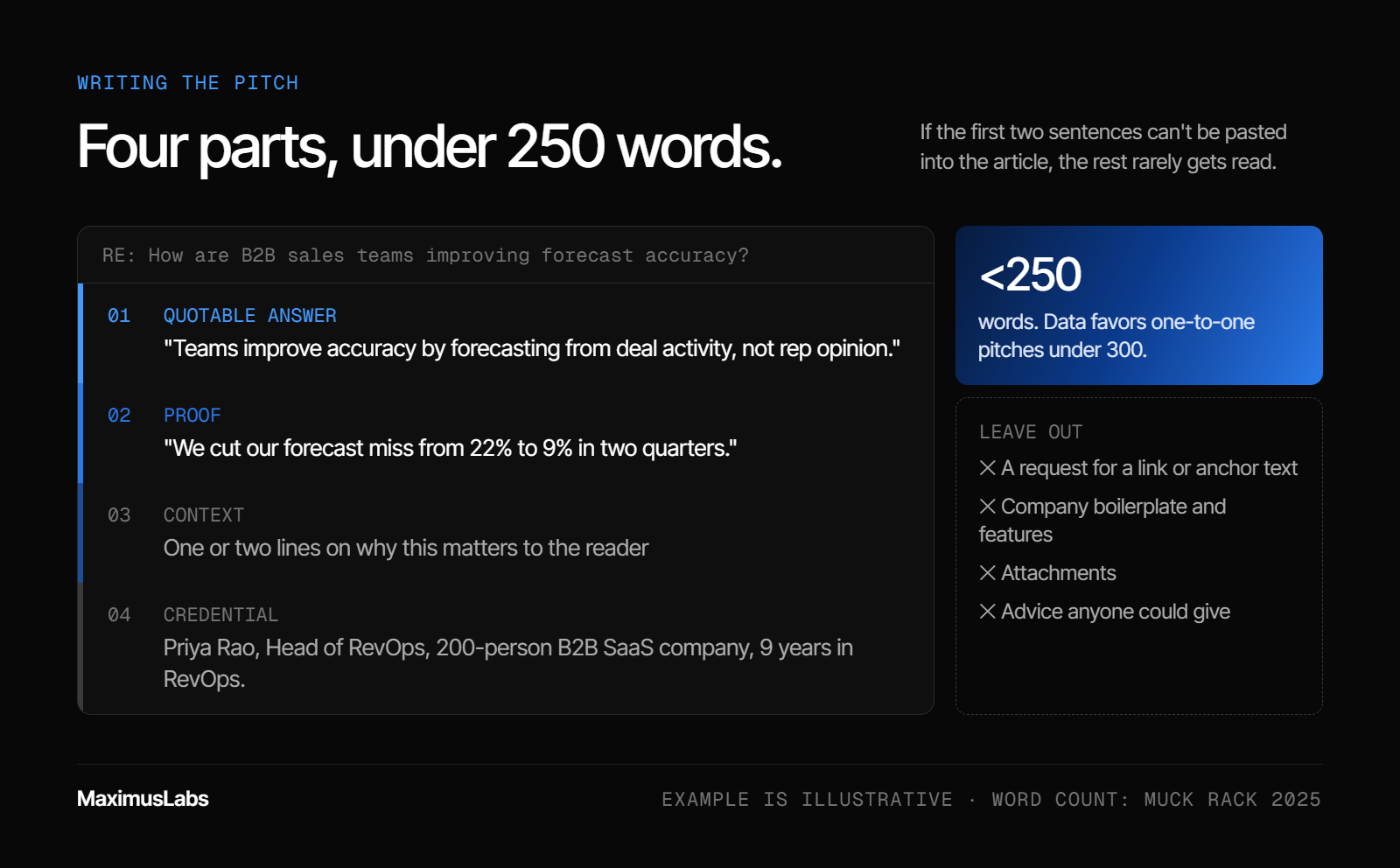
Answer the journalist's exact question in your first two sentences, so they can quote it as is. Add one specific number or first-hand example. Then add a two-line credential. Keep the pitch under 250 words. Muck Rack's 2025 data favors one-to-one pitches under 300 words. Never ask for a link or anchor text, because journalists treat link-seekers as spammers.
The Anatomy of a Pitch That Gets Quoted
🧱 Four Parts, In This Order
- The quotable answer: one or two sentences that directly answer the question.
- The proof: a number, a result, or a short story from your own work.
- The context: one or two lines on why this matters to the reader.
- The credential: your name, title, company, and relevant experience.
Journalists skim dozens of replies per query. If your first two sentences can't be pasted into the article, the rest rarely gets read.
❌ What to Leave Out
- Company boilerplate and product features
- Attachments (use links instead)
- Requests for a link, a dofollow tag, or specific anchor text
- Generic advice anyone could give
Weak Pitch vs. Strong Pitch
⚖️ The Same Expert, Two Outcomes
Illustrative query: "How are B2B sales teams improving forecast accuracy?" (The examples below are hypothetical, built to show structure.)
| Weak pitch | Strong pitch |
| "Our AI platform leads the forecasting category..." | "Teams improve accuracy by forecasting from deal activity, not rep opinion." |
| Lists five product features | Shares one result: "We cut our forecast miss from 22% to 9% in two quarters." |
| Ends with "Please link to our homepage" | Ends with a two-line credential and an offer to answer follow-ups |
| 450 words | 180 words |
The strong pitch reads like journalism. The weak one reads like an ad.
🏢 The Denver Post Turnaround
In The Art of SEO, Stephan Spencer describes a client, GHC Housing, renovating a Denver apartment building. The first draft to a journalist read like a mini press release. Stephan reframed it as expert commentary on a recent Denver Post article about rising rents.
Within hours, the journalist passed it to the affordable-housing beat reporter. The result was a full-page feature and an important deal for the client. The link mattered less than the coverage.
Why Asking for the Link Backfires
🚫 The Link-Seeking Mindset
Enge and Spencer put it bluntly: "try to get out of the link-seeking mindset." Asking for a link makes the pitch about you, not their readers. Journalists then file you as a spammer.
Many outlets link to sources anyway when the quote is strong. If they don't, the mention still counts with AI engines. Brand mentions, linked or unlinked, were the strongest AI Overview signal in the Ahrefs study.
🚂 Ask With Value, Not Permission
Years ago, I walked into a Southern Railways office with zero experience and asked about renting a train. I had no credentials, just a clear ask and a reason it was worth their time. HARO pitching works the same way. You don't need permission to pitch, only something worth quoting.
MaximusLabs AI drafts pitches from the founder's own words, gathered in interviews. Every pitch ships with a real number from the client's work and a human review before it goes out.
Q5. How fast should you respond, and when should you follow up?
Reply within a few hours of a HARO digest landing. Journalists often stop reading replies well before the stated deadline. Send at most two follow-ups, and only when each adds something useful. That might be a data point, a call offer, or an answer to their question. After two follow-ups, most reporters stop opening your emails, and that costs you future stories.
Why Speed Wins More Placements Than Polish
⏰ The Deadline Is Not the Real Deadline
A query might say "deadline: Friday 5 PM." In practice, many journalists start writing as soon as a few strong answers arrive. Once the quote slots are filled, later replies often go unread.
Sam Oh, VP of Marketing at Ahrefs, lists speed to response as the first factor behind his HARO wins. Evident experience and answering follow-ups come next. A good pitch sent in two hours beats a perfect pitch sent in two days.
🔦 Headlights at Night
I think about HARO the way I think about driving at night. Your headlights only show the next 100 meters, and that's enough to keep moving. You don't need a perfect pitch, just a clear, useful one sent now.
That doesn't mean sloppy. It means you prepare the parts that never change, so only the answer is new each time.
Build a Daily Digest Routine
📅 A Routine That Fits a Real Workday
HARO sends three digests a day: morning, afternoon, and evening. Here is a routine that keeps response times short without eating your day:
| Step | What you do | Time |
| 1. Scan | Check your priority label after each digest | 5 minutes |
| 2. Decide | Run the four-check filter from Q3 | 1 minute per query |
| 3. Draft | Write the quotable answer and proof | 15 to 20 minutes |
| 4. Send | Paste your saved credential line and send | 2 minutes |
✅ Prepare What Doesn't Change
Keep a short file of reusable parts. That way, each pitch only needs the answer itself.
- Your credential line (from Q2)
- Three or four proof points with real numbers
- A headshot link and an author page link
- Your phone number and the hours you can take a call
How to Follow Up Without Burning the Relationship
🔁 The Two Follow-Up Rule
Send no more than two follow-ups per pitch. Each one must add value, not just ask "did you see my email?"
- First follow-up (1 to 2 days later): offer a new data point or a short extra example.
- Second follow-up (about a week later): offer a quick call, or answer an open question from the query.
Muck Rack's 2025 creator journalism survey found 82% of creator journalists want any follow-up within the first week. After that, the story has usually moved on.
⚠️ When to Stop
If there's no reply after two follow-ups, stop. Silence usually means the story filled up, not that your pitch was bad. Pushing harder turns a neutral contact into one who remembers you as a pest.
Instead, note the journalist's beat in a simple spreadsheet. When their next query fits, you'll pitch with context. That second pitch often lands better than the first.
MaximusLabs AI runs this routine as a shared queue, with priority alerts on ICP-fit queries. Credential lines and proof points are kept ready, so client pitches go out within hours, not days.
Q6. Can you use AI for HARO pitches without getting flagged?
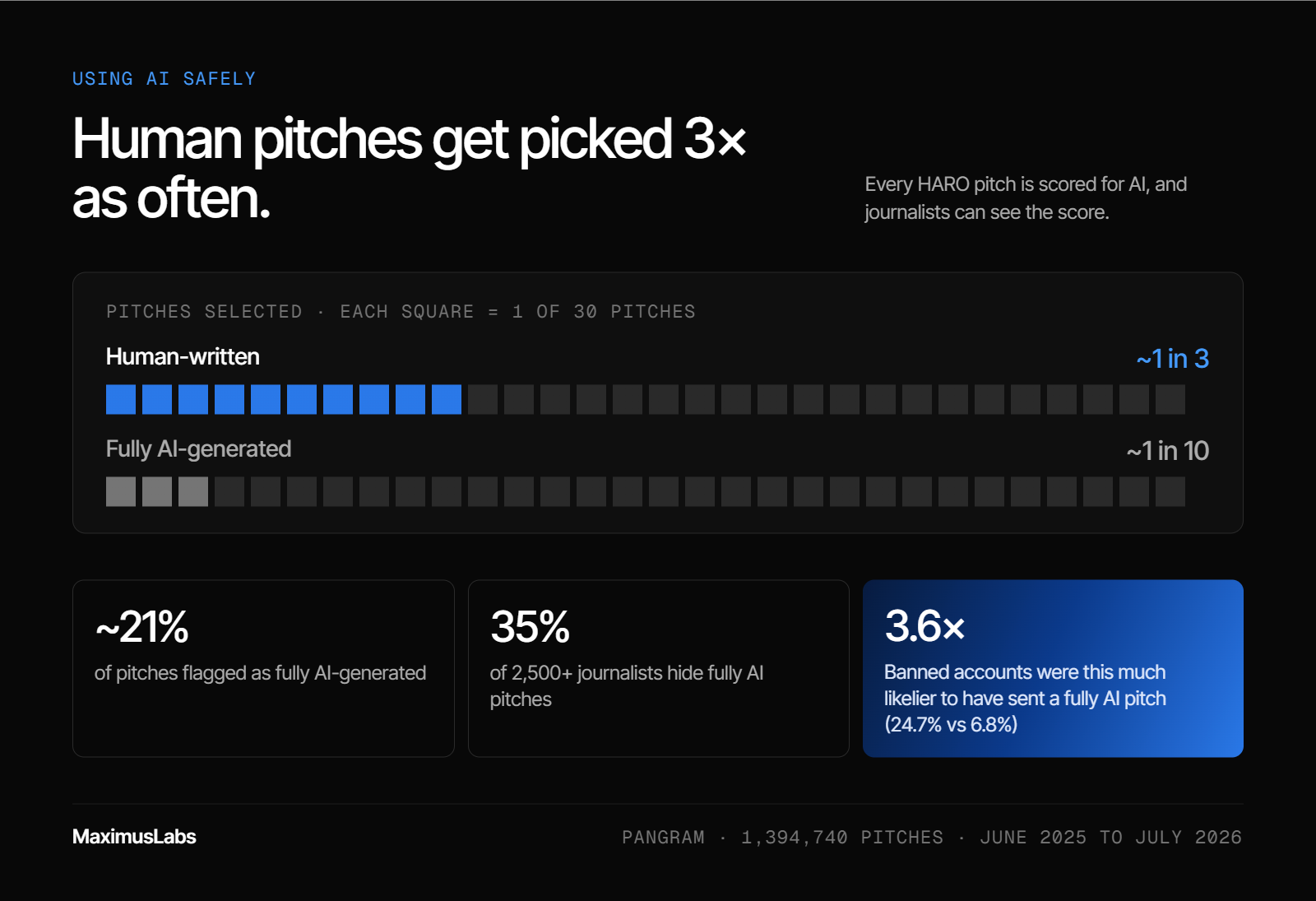
Use AI for research, not for writing the pitch. HARO runs Pangram AI detection on every pitch, and journalists can see the score. Across Featured's platforms, about 1 in 10 fully AI-generated pitches were selected, versus about 1 in 3 human pitches. Banned accounts were 3.6x more likely to have sent a fully AI-generated pitch. MaximusLabs AI uses AI for research and structure, while humans write each pitch in the expert's own voice.
The Shortcut Everyone Is Taking
🤖 The 40-Pitch Morning
A marketing manager opens the morning HARO digest. There are forty queries, and the CMO wants more press. So the manager pastes each query into ChatGPT, tweaks the name, and hits send forty times.
It feels efficient. The dashboard shows forty pitches sent. But the placement count stays flat for weeks.
❌ Why Volume Became the Problem
Traditional link-building agencies sold pitch volume. More replies meant more chances, and HARO's late years filled with templated spam. Featured CEO Brett Farmiloe says AI has made media pitching noisier and less effective.
Volume was always a vanity metric. Nothing about forty sends ties back to pipeline.
What the Detection Data Shows
📊 One Year of Scored Pitches
Pangram scored 1,394,740 pitches answering 42,392 journalist requests between June 2025 and July 2026. Here's what that data showed:
| Finding | Number |
| Pitches flagged as fully AI-generated | About 21% |
| Selection rate, fully AI-generated pitches | About 1 in 10 |
| Selection rate, human pitches | About 1 in 3 |
| Journalists choosing to hide fully AI pitches | 35% of 2,500+ |
| Banned accounts with a fully AI pitch | 24.7%, vs 6.8% of active accounts |
Journalists use AI too. Muck Rack's 2026 survey found 82% use at least one AI tool. They still don't want to quote a machine.
⭐ Why AI Engines Care Too
AI search engines cite journalism because it carries real expertise. A quote that reads like ChatGPT output adds nothing new to that pool. Everyone summarizing five articles to write a sixth is exactly the problem.
A real perspective is the moat. It wins the journalist first, then the AI answer that later cites the article.
How MaximusLabs AI Splits the Work
✅ AI for Research, Humans for Voice
MaximusLabs AI uses AI where it saves time without replacing judgment:
- AI does: query triage, background research on the outlet, and pulling relevant client data points.
- Humans do: the quotable answer, the opinion, the story, and the final edit.
- The founder supplies: views captured in interviews, so each pitch sounds like them.
Humans approve every pitch that ships. Nothing goes out unread.
💰 Where It Shows Up in Pipeline
MaximusLabs AI measures engagements on pipeline, not on pitch counts. For Oliv AI, that meant 27 qualified leads, $47K+ pipeline, and a 26% close rate in 4 months.
I can't prove how much of that came from human-written pitches alone. But I'm confident a single cited expert quote outperforms forty generic sends.
MaximusLabs AI captures the founder's perspective first, then uses AI only for research and structure. Every pitch reads as the expert, because the expert's thinking is in it.
Q7. What should you do once your quote goes live?
Thank the journalist and share the article. If the link is nofollow, accept it. Asking for a dofollow link risks having it removed, and Google treats rel attributes as hints. If you're quoted without a link, a polite reclamation email usually works. AI engines read the mention either way. Add every placement to a press page on your site so the trust signals compound over time.
Close the Loop With the Journalist
🙏 Say Thanks the Same Day
Send a two-line thank-you once the piece is live. Mention one thing you liked about the article. Then offer to help with future stories on your topic.
This small step turns a one-time source into a repeat one. Journalists keep lists of people who answer fast and quote well.
📣 Share It Where Your Buyers Are
Share the article on LinkedIn, tag the journalist, and add a sentence on why the topic matters. Send it to your sales team too. A third-party quote often works better in a sales email than your own claims.
Handle Nofollow Links the Right Way
🔗 What Nofollow Actually Means
A nofollow link carries a rel="nofollow" tag in its code. It tells Google not to associate the linking site with the linked page. Google also offers rel="sponsored" for paid links and rel="ugc" for user-generated content.
Since 2019, Google has treated these attributes as hints, not strict commands. A nofollow link from a trusted outlet isn't worthless, even for classic SEO.
⚠️ Never Ask for a Dofollow Switch
Asking an editor to change nofollow to dofollow makes you look like a link-seeker. Some editors respond by removing the link entirely. Accept what you get, and thank them.
Obsessing over dofollow is 2019 thinking. For AI search, the mention is what counts. The Ahrefs study found brand mentions, linked or unlinked, correlated with AI Overview visibility at 0.664.
Reclaim Unlinked Mentions
🔍 Find Quotes Without Links
Sometimes your quote runs with your name but no link. Eric Enge calls unlinked mention reclamation one of the easiest, cheapest, and most effective link-building tactics.
Set up alerts for your name and company name. Check each new mention for a missing link.
✉️ Send a Short, Polite Note
Keep the reclamation email under 60 words. Short notes get read, and long ones feel like a demand:
- Thank them for including your quote.
- Ask if they'd add a link to your author page or relevant resource.
- Give the exact URL, and make it easy to say yes.
If they decline, let it go. The mention still feeds AI engines, and the relationship matters more than one link.
Make the Placement Work Harder
🏛️ Build a Press Page
List every placement on a dedicated press or "as featured in" page. Link to each article, and add the date and outlet name. This gives journalists, buyers, and AI crawlers one place to confirm your expertise.
MaximusLabs AI logs every placement with its link type, then tracks whether the article starts appearing in AI answers. Mentions that get cited are studied, so future pitches target similar outlets.
Q8. How do you measure HARO ROI beyond counting backlinks?
Track three layers. First, placements won, with follow and nofollow links counted separately. Second, AI citation share for buyer prompts. Third, pipeline influenced by the coverage. Counting links alone is a habit from Google-only SEO. MaximusLabs AI measures citation share across ChatGPT, Perplexity, and Google. Nidra Goods ranked #1 across all three for "best sleep mask" from a single GEO strategy.
Why Link Counts Mislead
📉 The Chart That Goes Up and Means Nothing
Many teams report HARO results as "12 new backlinks this quarter." That number says nothing about whether buyers saw the coverage. It also says nothing about whether AI engines now recommend you.
Revenue is the only metric that pays the bills. Clicks, impressions, and link counts are inputs at best. A placement that never reaches a buyer, or an AI answer, is a cost, not a win.
📈 The Industry Is Already Shifting
Muck Rack's 2025 PR measurement report found 78% of respondents say tracking AI-generated mentions matters to their work. And 67% expect visibility in LLMs to become a standard metric.
The Three-Layer Measurement Stack
🧱 Layer by Layer
| Layer | What to track | How to track it |
| 1. Placements | Articles won, follow vs nofollow, outlet fit | Spreadsheet log, Google Search Console links report |
| 2. AI citation share | How often AI names your brand for buyer prompts | Fixed prompt set, run weekly across ChatGPT, Perplexity, Gemini, and AI Overviews |
| 3. Pipeline | Leads and deals touched by coverage or AI answers | CRM source field, "How did you hear about us?" with AI options, AI referral traffic |
Layer 1 is the easiest to measure and the weakest signal. Layer 3 is the hardest and the one your CFO cares about.
🔎 How to Run the Prompt Set
- Write 20 to 30 questions your buyers would ask an AI engine.
- Run each one weekly in every major engine.
- Record whether your brand is named and which URL is cited.
- Note when a HARO article starts appearing as a cited source.
That last step connects a single placement to AI visibility. Keep the prompt set fixed for at least a quarter, so week-to-week changes mean something.
A Quarterly Cadence That Works
📅 Set a Realistic Target
Aim for two to four media appearances per quarter, across HARO, podcasts, and guest commentary. That pace builds steady mentions without burning out your expert.
Review all three layers at the end of each quarter. Cut outlet types that never show up in AI answers or pipeline. Double down on the ones that do, even if their Domain Rating looks modest.
💰 What the Proof Looks Like
MaximusLabs AI reports on AI citation share and pipeline, not link counts. Nidra Goods reached #1 across Google, ChatGPT, and Perplexity for "best sleep mask." For Oliv AI, 30-40% of inbound is now AI-sourced.
I might be reading attribution too generously, since buyers touch many channels before they convert. Still, the pattern holds across MaximusLabs AI's client work: cited coverage shows up before the inbound does.
MaximusLabs AI ties every placement to the buyer prompts it targets, then tracks it through to pipeline. That is the number we report.
Q9. Should you also use Qwoted, Source of Sources, or Featured?
Yes, if HARO alone isn't producing placements. Source of Sources, launched by HARO founder Peter Shankman, is a free email digest of journalist requests. Qwoted is a platform where journalists post source requests and experts pitch using credits. Featured, which also owns HARO, runs a structured question-and-answer format. Most B2B teams do best on two platforms, chosen by goal: link volume, publication quality, or predictable placements.
Why One Platform Is No Longer Enough
🧩 The Market Split in 2024
For years, HARO was the default. Then Cision rebranded it as Connectively, added paid tiers, and shut it down in December 2024. Journalists and sources scattered while the platform was down.
Some journalists went to Qwoted. Some followed Peter Shankman to Source of Sources. Others stayed with Featured, which later revived HARO itself. The result is simple: the journalist your buyers read might only post on one of them.
🌐 Be Where Journalists Look
I think of this as Search Everywhere Optimization. AI engines pull from many sources, and journalists source from many platforms. Being present on only one means missing stories you were qualified to win.
How the Main Platforms Compare
📋 Side-by-Side Overview
| Platform | How it works | Access | Best fit |
| HARO (Featured) | Email digests up to three times a day, reply by email | Free for sources | Broad query volume across many topics |
| Source of Sources | Email digests of journalist queries, sorted by category | Free | Former HARO users who want the classic format |
| Qwoted | Journalists post Source Requests, experts pitch inside the platform | Free tier with limits, paid plans use pitch credits | Business and finance press, verified journalists |
| Featured | Experts answer posted questions from publishers | Free tier with limits, paid plans | Planned, repeatable placements |
Prices change often, so check each platform's current pricing page.
⚠️ Know the Trade-Offs
Each platform has a catch worth knowing before you commit:
- Qwoted's free tier limits monthly pitches and adds a two-hour wait before you can respond. Speed matters, so that delay can cost placements.
- Source of Sources is free, but journalist quality varies by digest.
- Featured now offers AI agents that draft pitches for you to edit. Edit heavily, because HARO's AI detection data shows fully AI pitches rarely get picked.
Pick Platforms by Goal
🎯 Match the Platform to the Outcome
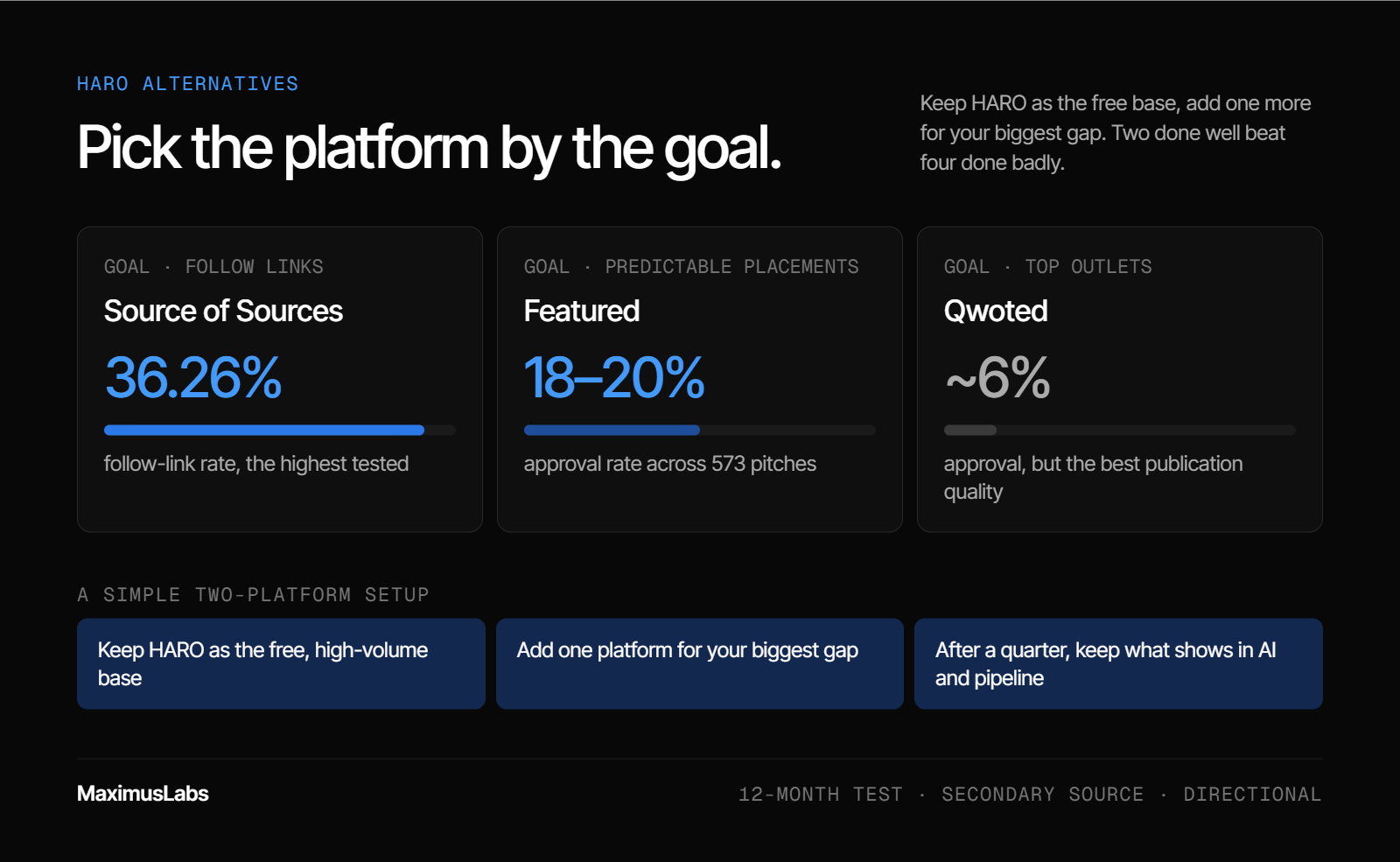
An independent 12-month test of journalist query platforms reported very different results by platform. This is a secondary source, so treat the numbers as directional:
| Goal | Platform that performed best | Reported result |
| Follow links | Source of Sources | Highest follow-link rate, 36.26% |
| Predictable placements | Featured | 18 to 20% approval rate across 573 pitches |
| High-authority outlets | Qwoted | Best publication quality, but only about 6% approval |
✅ A Simple Two-Platform Setup
For most B2B SaaS teams, I'd start here:
- Keep HARO as your free, high-volume base.
- Add one more platform based on your biggest gap: Qwoted for business press, or Source of Sources for extra free volume.
- Review after one quarter. Keep the platform that shows up in AI answers and pipeline, and drop the one that doesn't.
Running all four at once usually spreads one expert too thin. Two platforms, done well, beat four done badly.
MaximusLabs AI picks platforms by where each client's buyers read, not by platform popularity. Placements from every platform feed the same tracking, so the comparison stays honest.
Q10. What should you pitch when no HARO query fits?
Create the story yourself. Original data is the most dependable pitch when no query fits. Eli Schwartz spent $500 on a survey that earned SurveyMonkey coverage in Yahoo! News, Mashable, and Singapore's local media. Press releases alone rarely earn links, so use them only to put news in front of journalists. Pitch commentary on stories a reporter already covers, and offer them your dataset.
When Waiting for Queries Stops Working
⏳ The Empty Digest Week
A Head of Marketing at a B2B SaaS company checks HARO for the fifth day straight. Nothing fits their category. The quarterly plan says "six press mentions," and they have two.
Reactive PR has a ceiling. You can only answer the questions journalists choose to ask.
❌ Why the Old Fallback Fails
The traditional fallback was the press release. Agencies pushed releases through wire services, packed with keyword-rich links back to the site. Eric Enge calls that a form of voting for yourself.
Wire links rarely move rankings, and AI engines largely skip them. Muck Rack found press releases are cited far less often than journalism, though they can seed stories reporters later write.
What Changed: Journalists and AI Both Want Original Data
📊 Data Is the Pitch
Journalists need fresh facts they can't find elsewhere. AI engines lean on the journalism that reports those facts. Earned media drives about 84% of AI citations, while paid content drives 0.3%.
So one original dataset can feed both. It earns the article, and then the article earns the AI citation. Ethan Smith describes this exact path: Graphite published an AI content study, and Axios wrote about it.
🚽 The $500 Survey That Went Global
In 2015, Eli Schwartz led Asia-Pacific marketing for SurveyMonkey in Singapore. He partnered with the Restroom Association of Singapore to run its annual survey. Facebook ads drove hundreds of responses for a total of $500.
The team turned the quirky results into an infographic and pitched it to journalists. Coverage followed in all local online and on-air media, plus Yahoo! News and Mashable. As Schwartz puts it, "think PR first, links second."
How to Build Your Own Story
🛠️ A Proactive Pitch Playbook
- Run one small study. Survey 200 to 500 people in your ICP, or analyze your own anonymized product data.
- Find the surprising stat. Journalists want the number nobody expected.
- Watch your target beats. Look for recent articles your data could extend or challenge.
- Find the contact fast. I give myself one minute to find a journalist's email, then move on.
- Pitch the angle, not the brand. Lead with the finding, and offer the full dataset.
🚗 Change Direction, Keep Moving
I call myself a dash car, a toy that runs straight until it hits a wall, then turns and keeps going. An empty HARO digest is just a wall. The answer is to turn and build your own road.
MaximusLabs AI's citation-intelligence engine maps which outlets each AI engine trusts in a client's category. That map decides where proactive data stories get pitched.
MaximusLabs AI pairs reactive HARO answers with proactive data stories, both part of its Earned AEO work. Each is measured on pipeline, not on mentions alone.
Frequently asked questions
Is HARO free to use in 2026?
Yes. HARO is free for both journalists and sources in 2026. Featured.com bought HARO from Cision in April 2025, restarted the classic email digests on April 22, 2025, and funds the service through newsletter sponsorships instead of source fees. Here is what you get at no cost: • Up to three query digests a day (morning, afternoon, and evening) • Direct email replies to journalists, with no pitch credits • Access to queries across many categories The real cost is time. We budget roughly 20 to 30 minutes per pitch once the reusable parts (credential line, proof points, headshot link) are ready. Without that prep, HARO quietly eats an afternoon a day. Paid tiers exist on related platforms, such as Qwoted and Featured's own Q&A product, but you don't need them to start. We usually suggest running HARO for one quarter before paying for anything else. MaximusLabs AI treats HARO as one free input into a wider earned-media plan. If you want to see how journalist placements fit next to reviews, Reddit, and listicles, our guide to AI citation acquisition tactics walks through each channel.
Are HARO backlinks dofollow or nofollow?
Both. Each publication sets its own link policy, so a HARO placement can carry a dofollow link, a nofollow link, or no link at all. Many large news sites mark outbound links as nofollow by default. We don't treat nofollow as a loss, for three reasons: • Since 2019, Google has treated rel attributes like nofollow as hints, not strict commands. • The Ahrefs study of 75,000 brands found brand mentions, linked or unlinked, correlated with AI Overview visibility at 0.664, versus 0.218 for backlinks. • AI engines read the mention and the surrounding context, regardless of the link tag. What we never do is ask an editor to switch a nofollow link to dofollow. It makes you look like a link-seeker, and some editors remove the link entirely. If a quote runs with no link, a short, polite reclamation note usually works. MaximusLabs AI logs every placement with its link type, then tracks whether the article starts appearing in AI answers. You can see how we track that in our breakdown of brand mention tracking tools.
Do HARO mentions help you show up in ChatGPT and Google AI Overviews?
They can, because AI engines lean heavily on earned media. Muck Rack's May 2026 analysis of over 25 million AI-cited links found earned sources drive about 84% of citations, while paid content drives 0.3%. Journalism alone accounts for about 27%. A HARO quote puts your name inside that journalism. When ChatGPT or an AI Overview later cites the article, your brand comes with it. Three things decide whether a placement actually helps: • Topic fit: the article must answer a question your buyers ask AI engines. • Name consistency: the same name and title everywhere, so engines connect mentions to one entity. • Volume over time: one quote rarely moves AI visibility on its own. MaximusLabs AI maps each placement to the buyer prompts it can influence, then tracks it weekly across ChatGPT, Perplexity, Gemini, and AI Overviews. For Oliv AI, that approach produced a 64% AI citation rate in 6 months, vs ~30% for billion-dollar incumbents. The full story is in our Oliv AI case study.
How long does it take to get your first HARO placement?
There is no fixed timeline, and anyone promising one is guessing. Placement speed depends on your niche, how many queries fit your expertise, and how fast you reply. In our experience, three habits shorten the wait more than anything else: • Speed: reply within a few hours of a digest landing, since journalists often stop reading long before the deadline. • Selectivity: answer only queries where you have first-hand experience and the outlet's readers match your buyers. • Quotability: lead with an answer the journalist can paste straight into the article. Expect some silent weeks. Silence usually means the story filled up, not that your pitch was bad. We track the journalist's beat and pitch again when the next query fits, which often lands better than the first attempt. We also suggest a realistic target of two to four media appearances per quarter across HARO, podcasts, and guest commentary. MaximusLabs AI reviews that cadence quarterly and cuts outlet types that never show up in AI answers or pipeline. Our framework for calculating ROI on earned visibility explains how we judge whether the wait is worth it.
How many HARO pitches should you send each week?
Fewer than most people think. We would rather send three well-fitted pitches than thirty generic ones. Volume without fit is a vanity metric, and it trains journalists to ignore your name. The data backs this up. Pangram scored 1,394,740 pitches across Featured, HARO, and Connectively between June 2025 and July 2026. About 1 in 10 fully AI-generated pitches were selected, versus about 1 in 3 human pitches. Mass-produced replies simply don't win. Instead of a weekly quota, we use a filter. Answer a query only if it passes at least three of these four checks: • You have done this work yourself. • The outlet's audience matches your ideal customer profile. • The publication is named or verifiable. • It is a niche or technical question, not a generic roundup. That filter usually leaves a handful of strong queries each week, which is plenty. MaximusLabs AI ranks queries by ICP fit and by the buyer prompts each article could influence, using the same thinking as our revenue-focused GEO framework.
Why are my HARO pitches never getting picked?
Usually it comes down to a few fixable patterns. When we review pitches that keep missing, we see the same issues again and again: • The answer is buried. The first two sentences are context or company background, not a quotable answer. • The pitch is too long. Muck Rack's 2025 data favors one-to-one pitches under 300 words, and we aim for under 250. • It reads like an ad. Product features and boilerplate signal promotion, not expertise. • It asks for a link. Journalists treat link requests as spam. • It sounds AI-written. HARO runs AI detection on every pitch, and journalists can see the score. • It arrives late. Quote slots often fill hours after a digest lands. Fix the order first. Lead with the answer, add one specific number or first-hand example, then close with a two-line credential. Also check your profile. A thin LinkedIn or an inconsistent name can lose the pitch before it is read. MaximusLabs AI drafts client pitches from the founder's own words, captured in interviews, using our founder voice methodology.
Should you handle HARO in-house or hire an agency?
It depends on what you want HARO to do. If you just want a few backlinks, an in-house marketer with a filter and a pitch routine can run it well. The process in this guide needs no special tools. An outside partner makes more sense when you need HARO to drive AI visibility and pipeline, not just links. That requires work most teams don't have time for: • Mapping which outlets each AI engine actually trusts in your category • Tracking whether placements start appearing in AI answers • Writing pitches that sound like your founder, not like a template • Tying coverage back to qualified leads Be careful with link-building agencies that sell pitch volume or guaranteed links. Mass pitching now performs poorly, and a pitch that reads like a template can cost you the journalist. MaximusLabs AI runs HARO as part of its Earned AEO work, alongside Owned AEO, with strategy and execution in one team. We measure engagements on pipeline, not on mentions. If you are comparing options, our guide to evaluating AEO agencies lists the questions worth asking.