 Krishna Kaanth M
- Citation consistency means keeping your brand name, category, NAP, and entity description identical across every source AI engines read, so LLMs can ground you.
- AI cites through three gates: earned authority, entity clarity, and citation architecture; brand mentions correlate with visibility at r=0.664 versus 0.218 for backlinks.
- Inconsistent data silently deletes you because verification runs near a 95% string-match tolerance, so drift makes engines cite a competitor they can confirm.
- Close a sameAs loop across Wikidata, LinkedIn, Crunchbase, and G2, and expose facet data in text so AI can actually retrieve it.
- Off-site consistency often outweighs your own site; 86% of AI citations are brand-managed, and location-level data drives visibility more than brand-level.
- Measure Share of Model, not impressions; cited brands earn more clicks, LLM traffic converts up to 6x better, and agentic commerce needs canonical feeds.
Q1. What is citation consistency for AI search, and why does it decide whether your brand exists to an LLM?
A VP of Marketing pulls up ChatGPT, types the exact query her buyers use, and watches it name five vendors. Hers is not one of them. Her site ranks page one on Google. Inside the AI answer, she is nowhere.
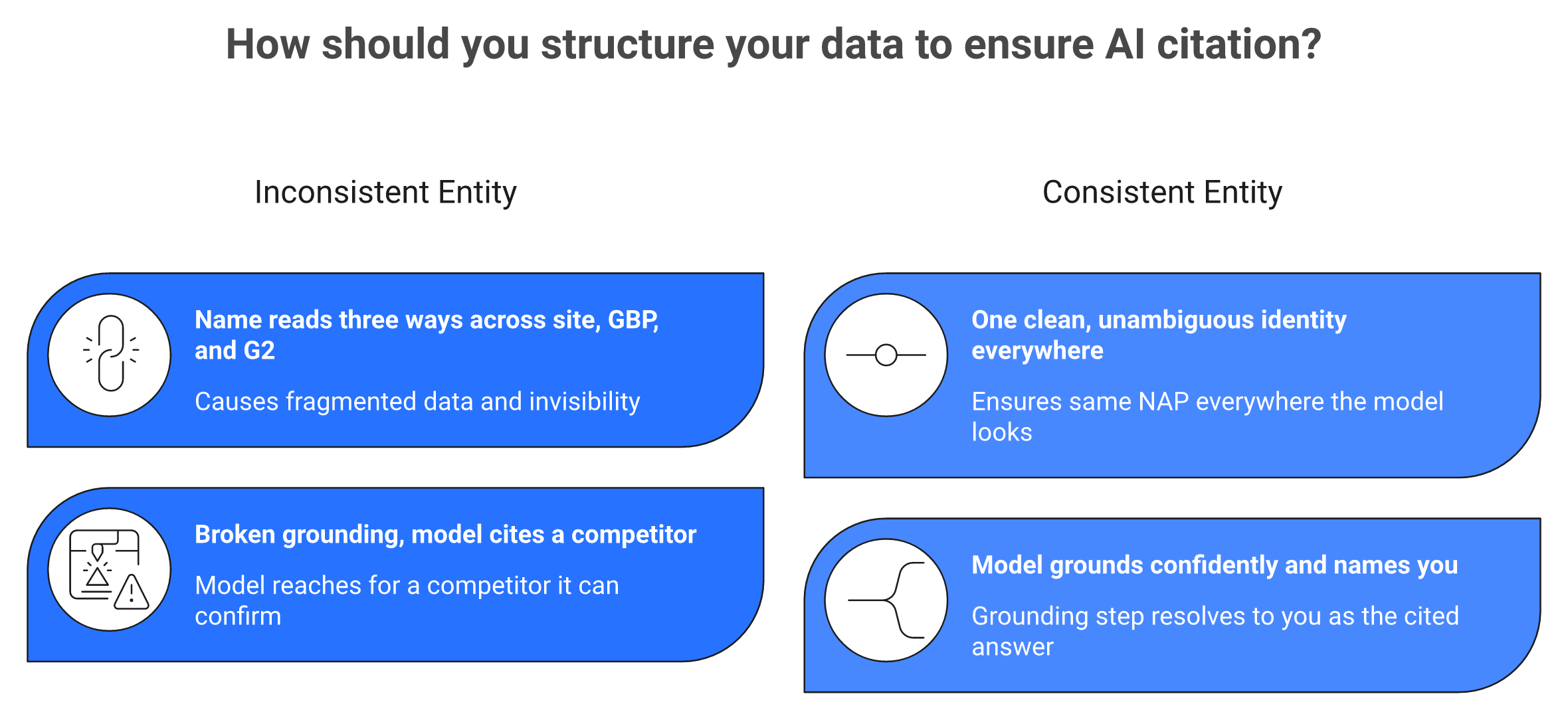
Citation consistency for AI search is keeping your brand's name, category, address, phone, and entity description identical across every source AI engines read. When these signals conflict, an LLM cannot confidently "ground" who you are, so it cites a competitor. In AI search, the evaluation set shrank from hundreds of blue links to 5 to 10 cited players. Inconsistent data cuts you before the question is even asked.
⚠️ The binary game nobody warned you about
Here is the uncomfortable truth. Being on page one used to mean you won something.
In AI answers, that consolation prize is gone. As one practitioner puts it, "if you're not in the actual citations in the answer that was given, you might as well not have played the game because there is no difference. You're actually literally zero in terms of traction."
The old model gave you hundreds of blue links to fight over. The new model hands the buyer a shortlist of five to ten brands. You either make that list or you are invisible.
📉 Where the citations actually come from
The stakes climb higher when you see where AI pulls sources. BrightEdge and related citation studies found that the vast majority of AI citations come from pages sitting outside Google's top ten.
So ranking is not the qualifier. Being a clear, consistent, verifiable entity is. This is precisely where generative engine optimization departs from the old playbook.
- Google-only SEO optimizes a page to rank a link.
- AI search optimizes an entity to be named as the answer.
- Those are different games with different win conditions.
🧩 What "grounding" means in plain language
Grounding is the model matching a claim to a trusted source before it repeats that claim. It needs to confirm who you are first.
When your name reads three different ways across your site, your Google Business Profile, and your G2 listing, the model cannot resolve you into one entity. Fragmented data breaks grounding. A broken grounding step means the model quietly reaches for a competitor it can confirm.
I think most teams get this backwards. They treat NAP consistency as a dusty local-SEO chore, not a survival signal for AI search visibility.
💡 The reframe from ranking to being the answer
Citation consistency is not a checkbox. It is entity-truth infrastructure for the GEO and AEO era.
At MaximusLabs, we treat this as a grounding problem, not a keyword problem. We measure citation presence across thousands of question variants, not single rankings, because "GEO is not SEO. It's a data science problem." That shift, from chasing positions to engineering a consistent, citable entity, is the whole point of our GEO service.
Q2. How do AI engines choose which brands to cite, and how is that different from ranking on Google?
AI engines choose brands through a sequenced gate: earned authority (are you mentioned across trusted sources?), entity clarity (can the model resolve you as one unambiguous entity?), and citation architecture (is your data structured and extractable?). Entity clarity is the choke point. Unlike Google ranking, mentions matter more than backlinks. Brand mentions correlate with AI visibility at r=0.664 versus 0.218 for links. Consistency is what opens the gate.
🚪 The three-gate model, top down
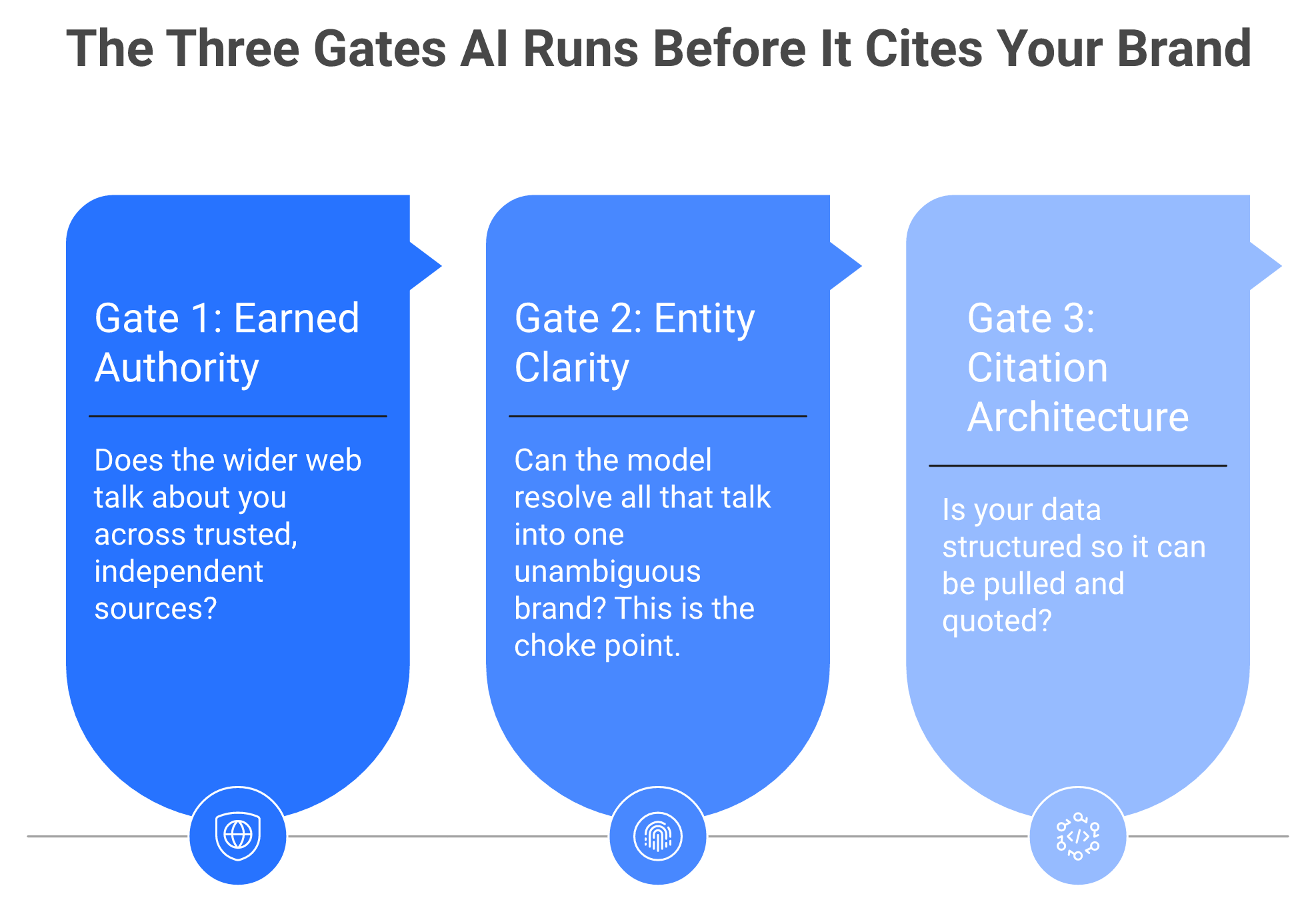
Start with the conclusion, then work down. AI citation runs through three gates in order.
- Earned authority. Does the wider web talk about you across trusted, independent sources?
- Entity clarity. Can the model resolve all that talk into one clean, unambiguous brand?
- Citation architecture. Is your data structured so it can be pulled and quoted?
Miss gate two, and gates one and three never get counted. That is why consistency sits at the center of everything, and why a rigorous technical SEO and website audit starts there.
🔁 Mentions versus citations, and why both need consistency
These two words get used interchangeably, and that costs teams real visibility.
A mention is the model naming your brand. A citation is the model linking to you as the source. Mentions build your identity. Citations verify your claims. You want both, and consistent entity data feeds both.
"In order to win something like what's the best website builder, you need to get mentioned as many times as possible."
The catch is that those mentions only compound if the model can tie them to one entity. Scattered naming reads as noise.
📊 The data that overturns the backlink obsession
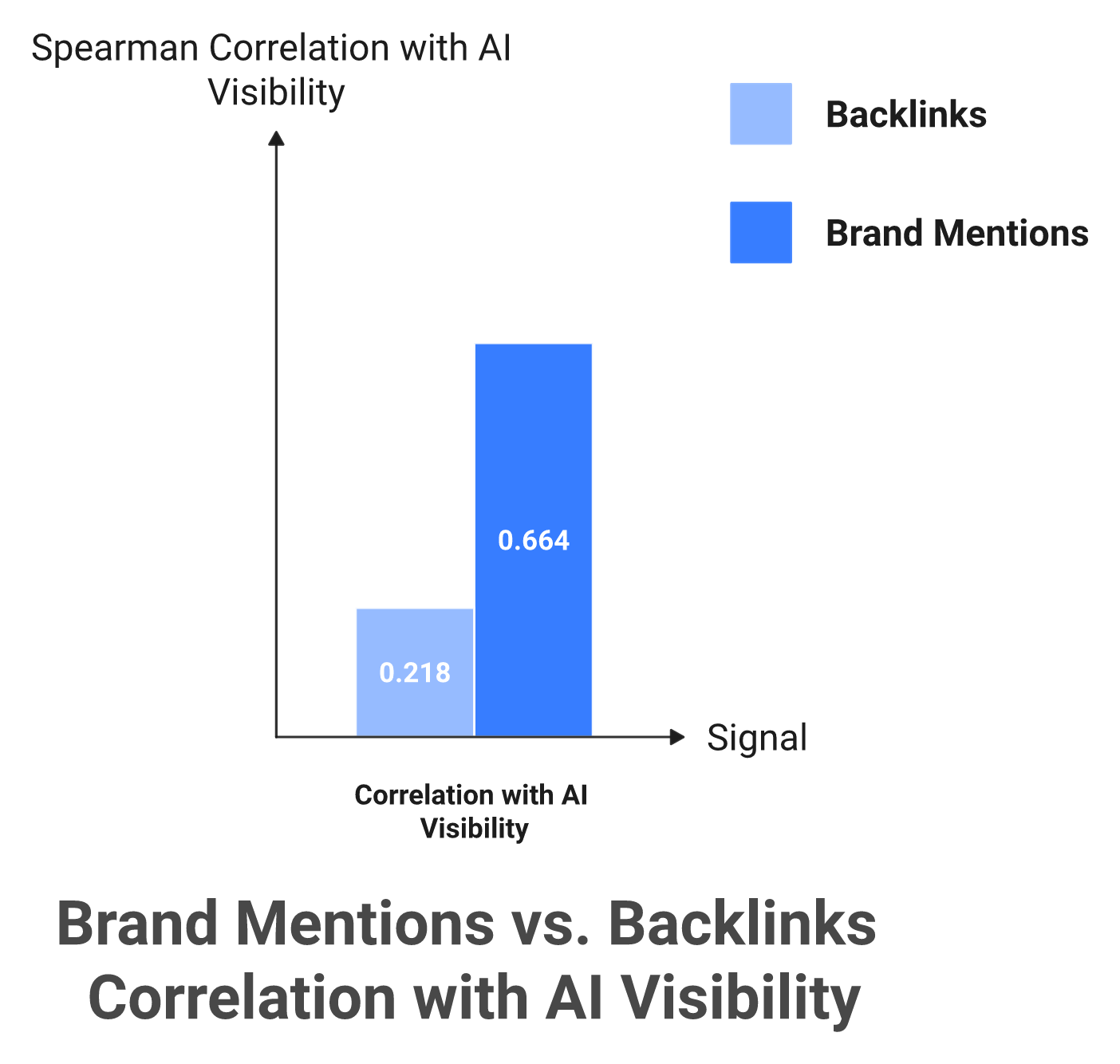
Here is where AI search breaks sharply from Google-only SEO.
Analysis of AI Overview visibility found brand web mentions, linked and unlinked, correlate with visibility at Spearman r=0.664. That is roughly three times stronger than backlinks at r=0.218. Off-site brand mentions beat on-page link building. Getting this right is the core of modern Reddit and forum AEO.
- Google-era instinct: acquire more links.
- AI-era reality: earn more consistent mentions the model can resolve to you.
- Unlinked mentions on Reddit, LinkedIn, and trade press become primary entity-truth signals.
🎯 What this means on Monday for a Head of Organic Growth
Clearing the entity gate is the highest-leverage move most teams skip.
From what surfaces when you actually run citation audits, the brands that get cited are not the ones with the biggest link piles. They are the ones the model can identify instantly and consistently. Consistency is not a nice-to-have. It is the key that unlocks the other two gates, and it is exactly the prerequisite that many GEO specialists talk around while selling tactics.
Q3. Why does inconsistent NAP and brand data quietly delete you from AI answers?
A founder ships a flawless product page. The name, the numbers, the positioning all sit clean on his own site. Six weeks later, he is still absent from AI answers, and no error message ever told him why.
Inconsistent NAP and brand data deletes you because AI verifies facts against web-wide consensus, not your self-published claims. Google and Microsoft tolerate roughly 95% string-match on verbatim quotes. If your name, category, or key numbers vary more than that across sources, the system swaps your citation for a source with the "correct" value. Fragmented data means the model can't confirm who you are, so it cites whoever it can confirm.
🕳️ The exclusion you never see
Traditional SEO gives you dashboards. Rankings drop, and you notice.
AI exclusion is silent. There is no rank to watch fall. You simply never appear, and nothing flags the reason. That silence is what makes inconsistency so dangerous, because the problem compounds while you assume things are fine. An AI crawlability checker is one way to surface what the model can and cannot reach.
📏 The 95% string-match tolerance
Now the complication. Verification systems run on tight tolerances.
Google and Microsoft's verbatim-quote verification operates around a 95% string-match threshold. If your brand name, a statistic, or a key attribute varies beyond that across sources, the system treats the mismatch as unreliable. It then swaps your citation for a source whose number matches cleanly.
- One page says "Inc." and another drops it.
- One listing uses an old category label, another the new one.
- Small drift, real consequence: the model cites someone it trusts more.
🎓 The "Oxford hallucination" that proves the point
This story reframed how I think about self-published claims.
A practitioner watched Perplexity summarize their article, then describe the authors as Oxford researchers. As he recalled it, "none of us attended Oxford, unfortunately, but it's clear that those things are pulled." The model built credentials from conceptually adjacent web signals, not from what the authors actually stated. Understanding this is central to Perplexity optimization.
The lesson is blunt. The machine trusts web-wide consensus over your own website.
🔐 The mechanism where consensus beats self-declaration
You cannot simply declare who you are and expect the model to accept it.
The wider web has to agree with you. When your data is consistent everywhere, consensus and self-declaration line up, and the model grounds you confidently. When they diverge, the drift itself becomes a disqualification signal.
✅ The payoff of making yourself machine-verifiable
Consistency is how you become confirmable. That is the Monday audit trigger: reconcile every place your brand data lives until the whole web tells one story about you.
Q4. Is a strong, consistent brand the only durable moat against AI algorithm updates and citation drift?
Every quarter, a new "AI ranking hack" tears through the marketing feeds. A Head of GTM watches the team chase it, ship it, and then watch it stop working by the next model update.
A strong, consistent brand is the most durable moat because AI has to recommend the brand that owns a space, regardless of updates. Citation drift is brutal. Roughly 40 to 60% of cited domains change monthly for the same query. But brands with high authority show far lower week-to-week volatility. Hacks decay with each update; consistent brand authority compounds and dampens that volatility. As AI risks "model collapse," verified brand consensus becomes the anchor.
🎣 The situation where everyone is chasing the hack
The reflex is to reverse-engineer the algorithm and exploit it. It feels productive.
It is also a treadmill. Each update resets the game, and last quarter's clever trick becomes this quarter's dead weight.
💥 The complication where hacks decay and drift is real
We have seen this movie before, and someone who lived it explains why it ends the same way.
Ethan Smith, who started in SEO in 2007, describes creating scraped, rewritten content during that era. As he tells it, "it worked really well and then it stopped working" once Google's Panda-style updates crushed it. The incentives that killed content spam then are the same ones shaping AI search now.
Citation drift makes the fragility worse. Studies of AI citations show 40 to 60% of cited domains changing month to month for identical queries. Tactics ride that volatility. Brands anchor against it, which is why answer engine optimization has to be built on durable signals.
🛡️ The resolution where brand is the signal that survives
This is the contrarian core, and I hold it with conviction.
"It is not about understanding the algorithm or hacking. It is about building a brand. If you build a brand in your space, then AI HAS to recommend you. No matter how many algorithm updates come, you will stand because you are THE brand."
Brands with strong authority show far lower week-to-week citation volatility. The consistency is what dampens the drift.
🍳 The trust flywheel of being uniquely known for something
There is a mechanism under the philosophy. AI leans on what you are unmistakably known for.
One team watched MasterClass get cited for "Beef Wellington" because of Gordon Ramsay, while it did not surface for unrelated, non-adjacent terms. Being narrowly, consistently famous for a subject becomes a trust flywheel the model keeps returning to.
This also guards against "model collapse," where systems trained on their own derivatives converge toward mush. Verified brand consensus is the human-anchored signal that survives that decay.
💰 The payoff for a founder with finite budget
If your GTM budget is real and limited, this is the allocation call. Spend on becoming the durable brand, not on rented tricks that expire.
This is why our trust-first, revenue-focused methodology exists. We build brand consensus that survives updates, because the alternative is re-buying visibility every time an algorithm shifts. If that is the moat you want to build, let's talk.
Q5. How do you build a closed, verifiable entity graph with the sameAs loop and schema?
A developer opens the site's structured data, sees a lone Organization tag with a name and a logo, and calls it "done." Six weeks later, the brand still reads as three different companies to three different engines.
You build a verifiable entity graph by closing the sameAs loop: create a Wikidata Q-item, link it via @id in your Organization schema, then point sameAs to at least three external identifiers, LinkedIn, Crunchbase, and G2. The goal is a closed traversal: website to Wikidata to LinkedIn to Crunchbase to G2, and back. Paired with Organization, LocalBusiness, and Review schema, that loop forces AI to resolve your brand as one single, trusted node.
🧭 The exact sequence, top down
Lead with the recipe, then the reasoning. The build order is fixed.
- Create a Wikidata Q-item. This becomes your public, machine-readable brand identifier.
- Link it with @id in your Organization schema. The @id is the unique address for your entity node.
- Add sameAs links pointing to at least three external profiles.
Schema here means structured data, the code that tells machines exactly what a page is about, and it sits at the heart of any real schema markup work.
🔗 The specific identifiers that matter
Vague sameAs links waste the signal. Point at the profiles the models already trust.
- LinkedIn (Wikidata property P4264)
- Crunchbase (property P3861)
- G2 Product ID (property P12136)
These are not decorative. Each external identifier gives the model another independent way to confirm you are one entity, not several, which is exactly the kind of technical GEO implementation most teams skip.
🔁 Why closing the loop beats scattering links
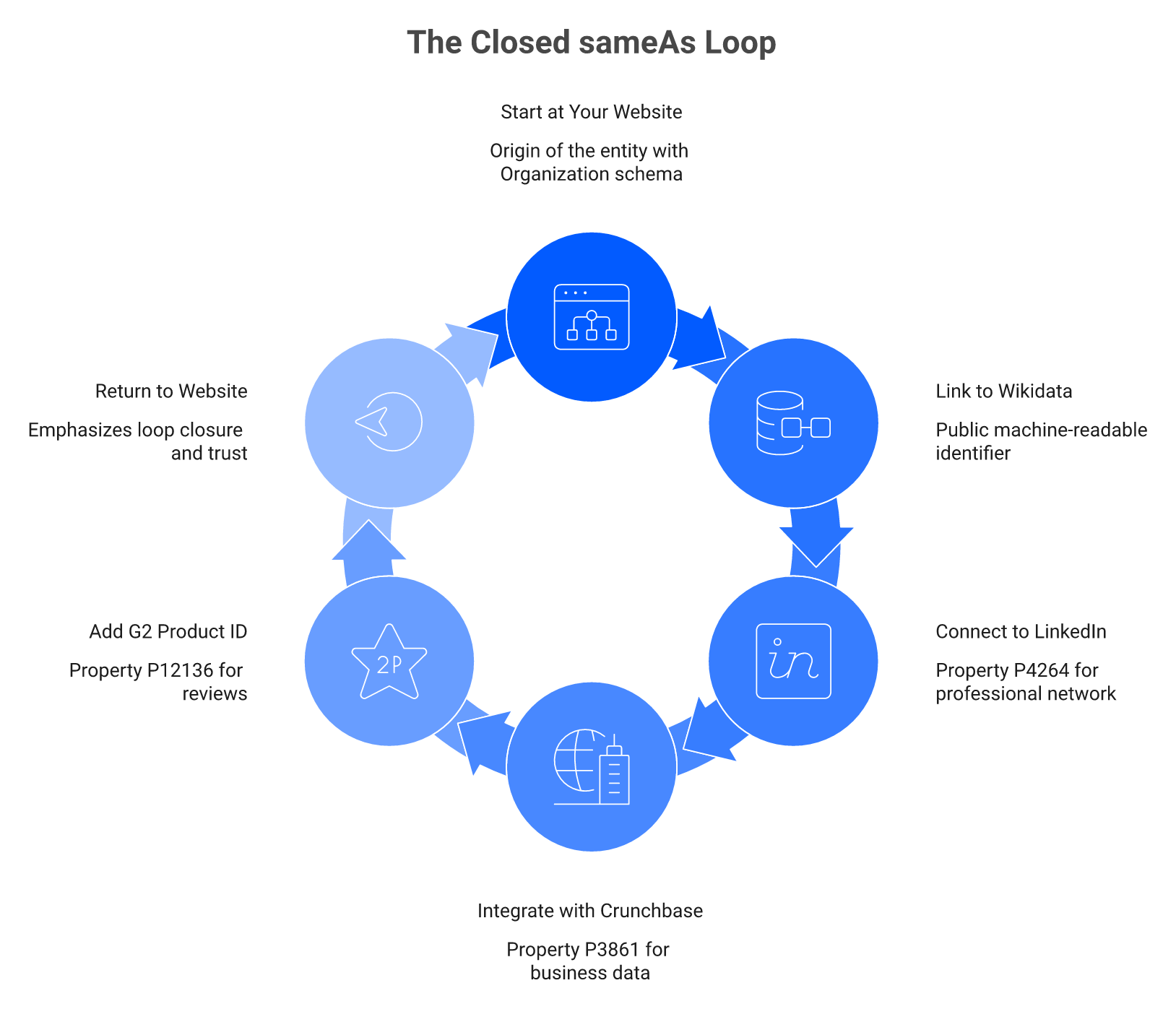
The word "closed" is doing the heavy lifting. A closed loop means the model can traverse and return.
The goal is a full traversal: website to Wikidata to LinkedIn to Crunchbase to G2, then back to your website, all through sameAs links. That round trip resolves your brand into a single, trusted node instead of a scatter of half-matched mentions.
Pair the loop with a schema stack, Organization, LocalBusiness, and Review markup, and you hand AI one machine-readable source of truth. This is a core part of building durable entity knowledge graphs.
📈 The proof, and an honest disagreement
Entity corroboration is not a fringe tactic. A Wikipedia article reportedly multiplies brand mentions by roughly five.
I will be straight about the debate, though. SALT.agency calls schema "a hygiene factor at best," while Surfer Academy argues structured data "increases your odds significantly." My read, from what surfaces when you actually build these graphs, is that schema alone is hygiene, but a closed sameAs loop is where it starts to move the needle.
✅ Your Monday checklist
Do these in order, and stop guessing.
- Claim or create your Wikidata Q-item.
- Add @id and sameAs to Organization schema.
- Verify the loop returns to your site.
- Confirm LinkedIn, Crunchbase, and G2 all describe you identically.
This is exactly the work many GEO specialists talk about but never ship: a graph you can actually traverse, not a slide about schema. When you want it done, our GEO service builds it end to end.
Q6. Why does the same brand get cited differently across ChatGPT, Perplexity, Gemini, and Google AI Overviews, and what data is even reachable?
A Head of Organic Growth runs the same buyer question through four AI engines and gets four different answers. Her brand shows up in one, vanishes in two, and gets misdescribed in the fourth.
The same brand gets cited differently because each engine weights sources differently. Gemini leans to structured pages (52.1%), ChatGPT to listings (48.7%), and Perplexity across directories. Even accurate data goes uncited if it isn't reachable, because LLMs read the RAG retrieval layer, not your JavaScript filter UI. Expose facet data, material, closure, and spec, in text and FAQs, and keep help centers in a subdirectory, not a subdomain.
🔀 The divergence is real and measurable
Start with the headline. There is no single "AI" to optimize for.
Per-engine citation analysis shows Gemini favoring structured web pages at 52.1%, ChatGPT leaning toward listings at 48.7%, and Perplexity spreading across directories. RAG here means retrieval-augmented generation, the live search step an engine runs before it answers. Mapping these gaps is the first job of multi-platform AEO.
⚠️ Why "optimize for AI" as one thing fails
The implication stings for anyone selling a single playbook. Consistency has to hold across every engine's preferred source type at once.
If your data is clean on your site but stale on listings, you win Gemini and lose ChatGPT. The fix is not four strategies. It is one consistent entity, present and identical everywhere each engine likes to look, which is where dedicated Perplexity optimization and ChatGPT optimization earn their keep.
🧱 Reachable beats accurate: the JavaScript trap
Here is the failure most audits miss. Accurate data still loses if the model cannot reach it.
LLMs read the retrieval layer, not your filter interface. As one practitioner put it, you must "expose this facet data, the closure and the fabric and the material and the neck style," because "LLMs can't find information hidden behind JavaScript facets." Move attribute data out of JS filters and into text headers and FAQs.
🗄️ The filing-cabinet problem with subdomains
Help centers hold the long-tail spec data agents crave. Placement decides whether they get read.
The advice is blunt: "Move the help center to a subdirectory. For whatever reason, subdomains don't work as well." Think of it as the Filing Cabinet: subdomains are separate cabinets in one room, and an agent told to check one will not open the others. A proper technical SEO and website audit catches this fast.
- Facet data: move from JS filters to readable text.
- Help center: domain.com/help, not help.domain.com.
- Audit target: extractability, not just Core Web Vitals.
At MaximusLabs, our AI crawlability work prioritizes content extractability. We render critical data in clean HTML so AI crawlers across every platform can actually retrieve it, because a page a model cannot read is a page it cannot cite.
Q7. Does off-site consistency, reviews, listings, and location-level data, matter more than your own website?
A founder pours the quarter's budget into a website redesign. The copy is perfect. Yet AI keeps citing a competitor whose site is worse but whose G2, Crunchbase, and Reddit presence all tell one clean story.
Off-site consistency often matters more than your own site because AI trusts web-wide consensus over self-publishing. Yext found 86% of AI citations are brand-managed, but that splits into first-party sites (44%), business listings (42%), and reviews (8%). Crucially, it is location-level, not brand-level, data that drives visibility. If G2, Capterra, Crunchbase, and Reddit disagree with your site, the model trusts the crowd, not you.
🏠 The situation where everyone over-invests in their own site
The instinct is understandable. Your website is the thing you control, so you polish it.
The problem is that control is not the same as trust. The model does not take your word for who you are. It cross-checks.
⚠️ The complication where the crowd outranks you
When third-party sources disagree with your site, your self-description loses.
Conflicting listings and reviews fracture your entity. The model cannot resolve one clean brand, so it reaches for a competitor whose off-site story is consistent. Off-site brand mentions beat on-page work here, which is why Reddit and forum AEO matters so much.
📊 The proof of where citations actually live
The split is the argument. Yext's analysis of 6.8 million AI citations found 86% come from brand-managed sources.
- First-party websites: 44%
- Business listings: 42%
- Reviews and social: 8%
- Forums: 2%
The under-discussed nuance is that it is location-level, not brand-level, data that drives visibility. Brand-level studies mislead because they hide where the model actually looks, a gap our brand mention tracking is built to close.
🔁 The multiplier of consistent mentions across communities
Consensus compounds. Positive mentions across four or more independent forums make a brand meaningfully more likely to be cited.
I might be slightly off on the exact multiple, but the direction is not in doubt: spread and agreement beat a single polished page.
✅ The resolution through Search Everywhere Optimization
For a VP Marketing, the checklist is clear.
- Reconcile name, category, and description across G2, Capterra, and Crunchbase.
- Seed authentic, useful presence in cited Reddit and community threads.
- Keep location-level data identical, not just the corporate brand line.
Search Everywhere Optimization is core to how our answer engine optimization builds 360 brand presence across G2, Capterra, Reddit, and trade press, so AI sees one consistent entity everywhere it looks.
Q8. How do you audit and fix brand-data inconsistency across GBP, your website, and schema?
A Marketing Manager exports the brand's listings into one spreadsheet and freezes. The company name reads four ways, two phone numbers are dead, and the category label predates the last pivot.
Audit inconsistency in four passes: (1) capture your canonical NAP and one-line entity description as the source of truth; (2) check Google Business Profile, website, and LocalBusiness or Organization schema for drift; (3) reconcile brand descriptions across Wikidata, Crunchbase, and G2; and (4) close the sameAs loop. Fix every conflict to a single definition. Google's NavBoost uses a 13-month rolling window, so consistency must persist to hold the satisfaction signal.
🧭 The four-pass audit, stated up front
Lead with the workflow. Everything else is justification.
- Set the source of truth. Write one canonical NAP and one-line entity description.
- Check for drift. Compare Google Business Profile, website, and schema.
- Reconcile third parties. Align Wikidata, Crunchbase, and G2.
- Close the sameAs loop. Confirm the traversal returns to your site.
NAP means Name, Address, and Phone, the core identity string local and AI systems match against, and it anchors every AEO implementation checklist.
🔍 Passes one and two: source of truth, then drift
You cannot fix drift without a reference point, so build the reference first.
Lock a single canonical version of your name, category, address, phone, and description. Then check GBP, your website copy, and your LocalBusiness and Organization schema against it. Most teams find at least one silent mismatch on the first pass.
🔗 Passes three and four: reconcile and close the loop
Now push that single truth outward.
Update Wikidata, Crunchbase, and G2 to match the source of truth exactly. Then verify the sameAs loop resolves cleanly. When every surface agrees, the model can ground you without hesitation, which is the payoff of proper GEO measurement.
⏰ Why persistence matters: the 13-month window
Fixing once is not enough. Consistency has to hold over time.
Google's NavBoost uses a 13-month rolling window for click-attested engagement. If your data is not clicked and read consistently across that window, the satisfaction signal decays, and so does your standing. Drift that creeps back in quietly erodes what you fixed.
💰 The payoff of fixing the pages that actually pay
Respect the cash and the calendar. Not every page deserves equal effort.
Roughly 19 out of 20 landing pages drive little to no traffic, while the remaining 1 in 20 drive about 85% of it. Audit the whole entity, but fix the high-traffic, high-intent pages first. That is the BOFU-first, revenue-focused sequence, and it is how we tie consistency work to pipeline: justified by revenue, not by a tidy spreadsheet.
Q9. How do you measure AI-citation consistency as a revenue signal, and where is this heading with agentic commerce?
A VP Marketing walks into the quarterly review with a slide full of impressions and pageviews. The CFO asks one question: "How much pipeline did that make?" The room goes quiet.
Measure consistency as a revenue signal by tracking Share of Model, your citation rate across thousands of question variants versus competitors, not rankings or impressions. It matters because cited brands earn 35% more organic and 91% more paid clicks, and LLM traffic converts up to 6x better than Google traffic. Next comes agentic commerce, where bots transact only if they can read a canonical, consistent data feed.
📊 The situation where teams still report the wrong numbers
Most dashboards still measure the old game: impressions, pageviews, and average position.
Those metrics felt safe for a decade. In AI search, they miss the only thing that matters now, which is whether you were the answer or not. Shifting to the right KPIs is the heart of real GEO measurement.
⚠️ The complication where the click is disappearing
Here is the tension. The metric your reports depend on is shrinking underneath you.
Zero-click answers keep rising, so ranking without being cited earns you nothing. Share of Model is the fix. It measures how often you appear as the answer across many question variants, not a single position. As one operator put it, "the penalty for being average has never been so severe." This is exactly the dynamic our zero-click search research maps in detail.
💰 The resolution: measure citation presence, tied to revenue
Switch the KPI, and the value becomes visible. Track citation rate against competitors.
The revenue case is concrete.
- Cited brands earn roughly 35% more organic and 91% more paid clicks.
- LLM traffic converts up to 6x better than Google search traffic.
That second number reframes the whole budget conversation, because AI visitors arrive pre-sold. The engine already recommended you, and connecting that to pipeline is the core of GEO revenue attribution.
🛒 The horizon where agentic commerce needs consistent data
Now look forward. Agents are moving from citing brands to buying for the user.
The catch is consistency, again. A developer tried to check out inside Gemini and recalled, "I want to buy snowboard pants and I'd like you to do the checkout for me end to end. And it, didn't work." The merchant lacked a canonical intent endpoint, a single clean data feed a bot can read to fulfill an order, which is precisely what our agentic commerce service prepares brands for.
Think of it as the Ghost Kitchen: your site is the dining room, the agent is the delivery driver, and the kitchen only needs a clean data feed. Inconsistent specs break the order before it starts, a risk we track in the state of agentic commerce 2026.
🔮 What I am sitting with
I might be early on this, but here is my current thinking. The brands that win agentic commerce will be the ones whose entity data is already consistent enough for a bot to trust and transact against.
At MaximusLabs, we track citation rate and Share of Model across thousands of question variants, and we start BOFU-first, because a consistent entity only pays off when it converts into pipeline. If you are staring at "traffic without revenue," that is the conversation worth having, so let's talk. What would change in your reporting if Share of Model, not impressions, sat at the top of the deck?
Frequently asked questions
What is citation consistency for AI search, and why does it matter for my brand?
Citation consistency for AI search means keeping your brand's name, category, address, phone, and entity description identical across every source AI engines read. When these signals conflict, a large language model cannot confidently ground who you are, so it quietly cites a competitor it can verify instead. This matters because AI search shrank the evaluation set from hundreds of blue links to five to ten cited players. If your data is fragmented, you are cut before the question is even asked. Google-only SEO optimizes a page to rank a link. AI search optimizes an entity to be named as the answer. Consistent data is what lets the model resolve you into one trusted node. We treat this as a grounding problem, not a keyword problem, and it sits at the center of our generative engine optimization service . Fixing consistency is entity-truth infrastructure for the GEO and AEO era, not a dusty local-SEO chore.
How do AI engines decide which brands to cite, and how is that different from ranking on Google?
AI engines choose brands through three sequenced gates: earned authority (are you mentioned across trusted sources?), entity clarity (can the model resolve you as one unambiguous entity?), and citation architecture (is your data structured and extractable?). Entity clarity is the choke point, because if the model cannot resolve you, authority and structure never get counted. The sharpest break from Google is that mentions matter more than backlinks. Brand web mentions correlate with AI visibility at Spearman r=0.664. Backlinks correlate at only r=0.218, roughly three times weaker. Unlinked mentions on Reddit, LinkedIn, and trade press become primary entity signals. So the Google-era instinct to acquire more links gives way to earning consistent mentions the model can tie back to one entity. Clearing the entity gate is the highest-leverage move most teams skip, and it anchors our answer engine optimization work. Consistency is the key that unlocks the other two gates.
Why does inconsistent NAP and brand data quietly delete my company from AI answers?
Inconsistent NAP and brand data deletes you because AI verifies facts against web-wide consensus, not your self-published claims. The exclusion is silent, so there is no ranking to watch fall and nothing flags the reason. You simply never appear. Google and Microsoft's verbatim-quote verification operates around a 95% string-match threshold. If your name, a statistic, or a key attribute varies beyond that across sources, the system treats the mismatch as unreliable and swaps your citation for a source whose value matches cleanly. One page says "Inc." and another drops it. One listing uses an old category label, another the new one. Small drift, real consequence: the model cites someone it trusts more. One practitioner even watched Perplexity call their authors Oxford researchers, credentials pulled from adjacent web signals rather than the authors' own words. The machine trusts consensus over your website. Reconciling every surface until the whole web tells one story is exactly what our technical SEO and website audit is built to do.
How do I build a verifiable entity graph with a sameAs loop and schema?
You build a verifiable entity graph by closing the sameAs loop so AI can traverse and return to one trusted node. The build order is fixed and worth following exactly. Create a Wikidata Q-item as your public, machine-readable identifier. Link it with @id in your Organization schema. Add sameAs links to at least three external profiles: LinkedIn, Crunchbase, and G2. The goal is a full traversal from your website to Wikidata to LinkedIn to Crunchbase to G2 and back. Pair that loop with Organization, LocalBusiness, and Review schema, and you hand AI one machine-readable source of truth. There is honest debate here: some call schema a hygiene factor, while others argue structured data lifts your odds significantly. Our read is that schema alone is hygiene, but a closed sameAs loop is where it starts to move the needle. This is exactly the kind of technical GEO implementation we ship, a graph you can actually traverse rather than a slide about markup.
Does off-site consistency across reviews and listings matter more than my own website?
Off-site consistency often matters more than your own site because AI trusts web-wide consensus over self-publishing. When third-party sources disagree with your website, your self-description loses and the model reaches for a competitor whose off-site story is consistent. Yext's analysis of 6.8 million AI citations found 86% come from brand-managed sources, but that splits in a revealing way. First-party websites: 44% Business listings: 42% Reviews and social: 8% Forums: 2% The under-discussed nuance is that location-level, not brand-level, data drives visibility, and positive mentions across four or more independent communities compound your odds of being cited. Spread and agreement beat a single polished page. We call the fix Search Everywhere Optimization, and it is core to how our Reddit and forum AEO builds 360 brand presence across G2, Capterra, Reddit, and trade press so AI sees one consistent entity everywhere it looks.
How do I audit and fix brand-data inconsistency across GBP, my website, and schema?
Audit inconsistency in four passes, and fix every conflict to a single definition. The workflow is simple to state and hard to skip. Set the source of truth: write one canonical NAP and one-line entity description. Check for drift across Google Business Profile, website copy, and LocalBusiness or Organization schema. Reconcile third parties, aligning Wikidata, Crunchbase, and G2 to that source of truth. Close the sameAs loop and confirm the traversal returns to your site. Persistence matters as much as the fix. Google's NavBoost uses a 13-month rolling window for click-attested engagement, so consistency must hold across that window or the satisfaction signal decays. Respect the calendar too. Roughly 19 of 20 landing pages drive little traffic while 1 in 20 drives about 85% of it, so audit the whole entity but fix high-intent pages first. That BOFU-first sequencing is how we tie consistency to pipeline inside our GEO measurement and metrics practice.
How do I measure citation consistency as a revenue signal, and what changes with agentic commerce?
Measure consistency as a revenue signal by tracking Share of Model, your citation rate across thousands of question variants versus competitors, rather than impressions, pageviews, or average position. Zero-click answers keep rising, so ranking without being cited earns you nothing. The revenue case is concrete. Cited brands earn roughly 35% more organic and 91% more paid clicks. LLM traffic converts up to 6x better than Google search traffic, because AI visitors arrive pre-sold. Next comes agentic commerce, where bots transact for the user only if they can read a canonical, consistent data feed. One developer tried an end-to-end checkout inside Gemini and it failed because the merchant lacked a clean intent endpoint. Inconsistent specs break the order before it starts. Our view is that the brands winning agentic commerce will be the ones whose entity data is already consistent enough for a bot to trust and transact against. If you are staring at traffic without revenue, that is the conversation worth having, so let's talk .