 Krishna Kaanth M
- SEO online reputation management now spans three surfaces: Google organic, the branded SERP with review profiles, and AI engines that build a verdict from web-wide consensus.
- Suppression is failing. Only 38% of AI Overview citations come from top-10 pages, down from 76%, so a page-14 source can still be quoted.
- Brand mentions correlate with AI visibility at 0.664 versus 0.218 for backlinks across 75,000 brands, which should redirect off-page budget toward earned mentions.
- Five review platforms supply 88% of review-site links in AI Overviews, led by Gartner Peer Insights at 26.0%, G2 at 23.1%, and Capterra at 17.8%.
- Owned versus earned is decided by query specificity: broad questions are won by third-party citations, narrow product questions by your own documentation.
- Measure citation share on top BOFU queries, branded-query to demo rate, AI-referred conversion, and review velocity. Star averages and impressions are reporting artifacts.
Q1. What is SEO online reputation management, and how is it different from traditional SEO?
SEO online reputation management is the practice of shaping what search engines and AI answer engines say about your brand. SEO drives discovery, meaning can buyers find you. Reputation management drives trust, meaning will they believe you. A third layer now sits on top. AI engines build a verdict about your brand from web-wide consensus, so the job is controlling which sources get cited.
A VP of Marketing pulled up ChatGPT on a shared screen last quarter and typed her own company name plus "reviews." The answer cited a two-year-old Reddit comment and a competitor's comparison page. Her site ranked first on Google for the same query. Neither fact protected her.
🎯 Three surfaces, not one
Traditional SEO defends one surface: the ten blue links. Reputation work in 2026 defends three, and they behave differently. This is the practical dividing line between traditional SEO and AI-era search visibility.
| Layer | Core question | Primary surface | Main signal | Metric that matters |
| Traditional SEO | Can buyers find us? | Google organic results | Relevance, links, on-page | Rank position |
| Classic ORM | Will buyers trust us? | Branded SERP, review profiles | Star ratings, sentiment, response rate | Sentiment score, star average |
| GEO-era ORM | Will AI recommend us? | ChatGPT, Perplexity, Gemini, Copilot, AI Overviews | Third-party mentions, entity clarity, E-E-A-T | Citation share, pipeline influence |
Most agencies still sell the first row and call it reputation management. That gap is where brands get hurt.
📉 The click math changed underneath everyone
Pew Research Center studied real browsing behavior from 900 US adults across 68,879 Google searches in March 2025. Users clicked a traditional result 8% of the time when an AI summary appeared, versus 15% without one.
Only 1% clicked a link inside the AI summary itself. Session abandonment rose from 16% to 26%. Google publicly disputed the methodology as unrepresentative, which is worth stating plainly. Our analysis of the zero-click brand economy tracks how that shift reshapes reputation work.
🌐 Reputation is now a footprint problem
Search stopped being about your website alone. Google and AI engines build a 360-degree view of a brand from everywhere it appears online, including third-party review sites like G2 and Capterra, community platforms like Reddit and Quora, plus mentions in articles, forums, podcasts, and LinkedIn.
MaximusLabs AI calls this Search Everywhere Optimization and runs it as a defined generative engine optimization service covering review platforms, community threads, YouTube, and earned editorial. We treat your own site as one input among many, not the source of truth.
🧠 The reframe that actually matters
My read is that the standard advice gets the goal backwards. Most guides teach you to defend a ranking. The real job is to become the answer, not to be somewhere inside it.
"Instead of trying to be in the answer, we're trying to become the answer, by becoming the most trusted source for AI."
That distinction is not semantic. Defending a ranking is a positional game with ten slots. Becoming the answer is a consensus game with no slots at all.
⚠️ Where traditional agencies fall short
Traditional SEO agencies are not wrong about fundamentals. Their playbook simply stops at the site boundary.
- ✅ They fix crawlability, internal linking, and on-page relevance competently.
- ✅ They understand branded SERP suppression and directory citations.
- ❌ They optimize the website only, ignoring the third-party surfaces AI engines sample.
- ✅ They report rankings and impressions accurately.
- ❌ Those metrics no longer describe what a buyer sees when they ask an AI engine about you.
Gartner projects over 50% of search traffic moves to AI-native platforms by 2028, a figure MaximusLabs AI cites in its own published GEO material and attributes to Gartner rather than to internal data.
MaximusLabs AI treats reputation as an entity problem across every surface AI engines read, not a ranking problem on one domain. That framing decides everything downstream, from where budget goes to what gets measured.
Q2. Why does out-ranking a negative result no longer bury it?
Suppression assumed that pushing a negative result to page two made it invisible. That logic is breaking. Only 38% of AI Overview citations now come from top-10 pages, down from 76% a year earlier, while AI Overviews cut top-ranking CTR by 58%. A critical source ranked 14th can still be the one an AI engine quotes, so displacement alone no longer protects a brand.
🧱 The playbook everyone inherited
The classic suppression protocol is well documented and genuinely effective at what it was built for. Matt Diggity's eleven-tactic ORM sequence remains the practitioner canon: optimize the site, optimize the Google Business Profile, acquire GBP reviews, optimize social profiles, capture the video carousel, optimize other web properties, use parasite SEO, acquire business citations, get reviews on authority sites, capture interview and podcast carousels, and build links.
The logic was arithmetic. Page one has ten slots. Fill eight or nine with assets you control, and the negative result gets pushed out of view.
🔓 Complication one: citation broke free from ranking
That arithmetic assumed the AI answer reads from the same ten slots. It does not anymore.
Analysis of 863,000 SERPs found only 38% of AI Overview citations come from pages ranking in the top 10, down from 76% a year earlier. An engine can reach past your carefully built page one and quote something you never saw. Understanding how citation selection actually works matters more now than slot arithmetic.
📊 Complication two: the slot itself lost value
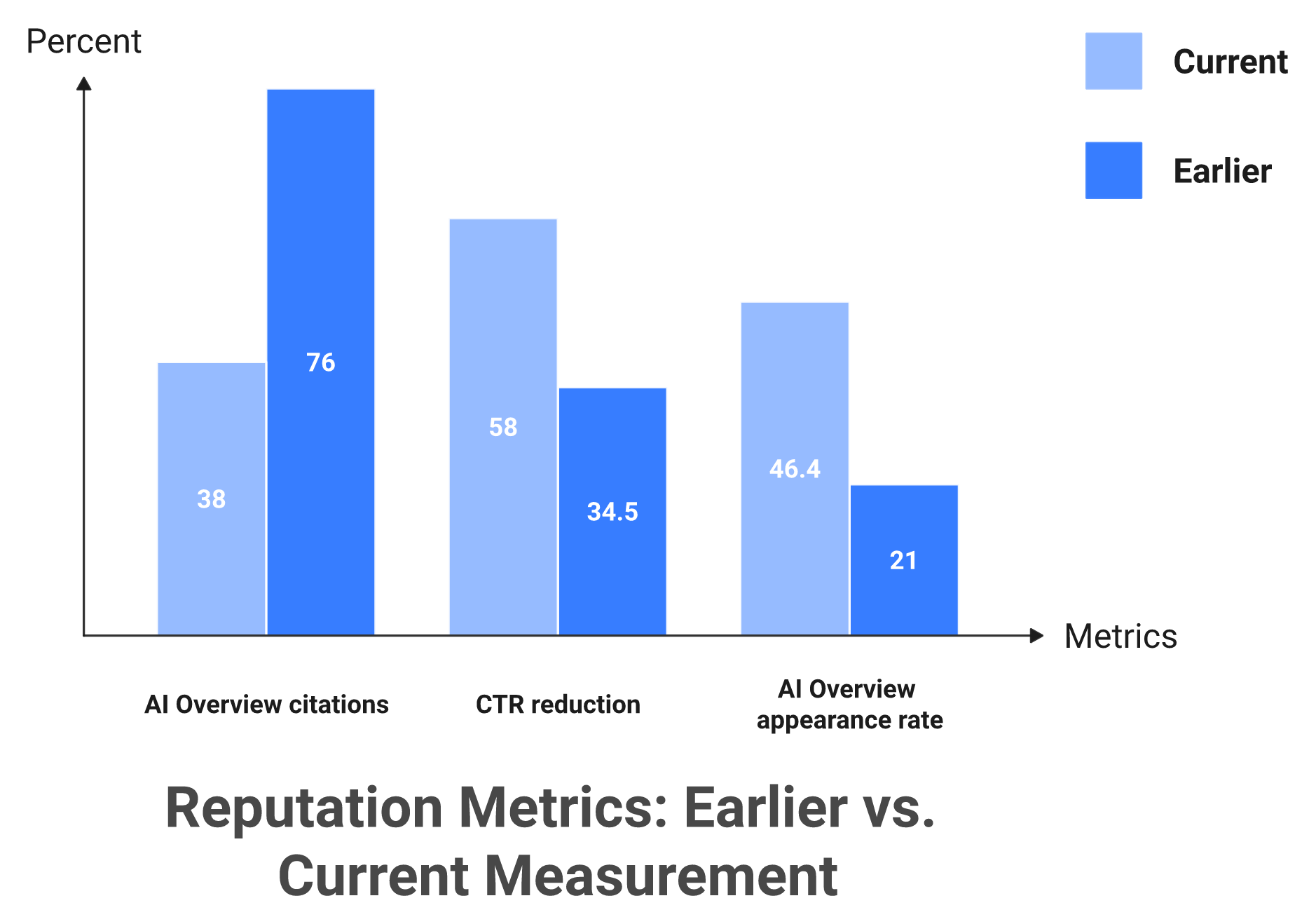
Ahrefs measured Google Search Console data across 300,000 keywords in its Q1 2026 AI Search Benchmark Report, which spans 13 studies, 146 million SERPs, and 730,000 AI responses. AI Overviews now reduce top-ranking page CTR by 58%, up from 34.5% eight months earlier.
The report also found AI Overviews appear on 21% of all keywords, rising to 46.4% of queries with seven or more words. Reputation queries are long. Buyers do not type your brand name alone, they type your brand plus "legit" or "complaints" or "alternatives." That collapse in click-through rates across AI search is what breaks the old model.
🎯 Resolution: out-cite instead of out-rank
The snippet is the new rank. If the extracted answer says something unflattering, your position is decoration.
So the question shifts. Instead of asking which of my assets can occupy slot four, ask which sources an engine already trusts for this query, and whether my brand appears inside them.
MaximusLabs AI measures this by tracking share of voice across thousands of question variants rather than single rankings, which is how citation-level damage surfaces before it hardens into the model's default answer.
✅ Which classic tactics still earn their place
Not all eleven tactics aged equally. The ones that generate third-party mentions survived. The ones that only occupy a Google slot did not.
| Tactic | Still worth it? | Why |
| Authority review site reviews (G2, Capterra) | ✅ High value | Generates cited third-party pages, not just a ranking |
| Interview and podcast appearances | ✅ High value | Creates mentions across domains engines already sample |
| Video carousel capture | ✅ High value | YouTube presence correlates strongly with AI brand visibility |
| Google Business Profile optimization | ✅ Situational | Essential with physical locations, marginal for pure SaaS |
| Business citations and directories | ⚠️ Hygiene only | Supports entity consistency, rarely wins a citation |
| Parasite SEO placements | ❌ Declining | Buys a rank slot that no longer guarantees the AI quote |
🤔 The honest hedge here
I might be reading the 76% to 38% shift too strongly. It is one dataset over one year, and citation behavior varies by query type.
What I am confident about is direction, not magnitude. Ranking and citation are decoupling, and every reputation strategy built purely on displacement is exposed to that drift.
MaximusLabs AI stopped reporting suppression as a rank-position outcome and reports it as citation share against named competitors instead, because a client winning slot three while losing the AI answer is not a win worth invoicing.
Q3. How do you audit your branded SERP and what AI engines say about you?
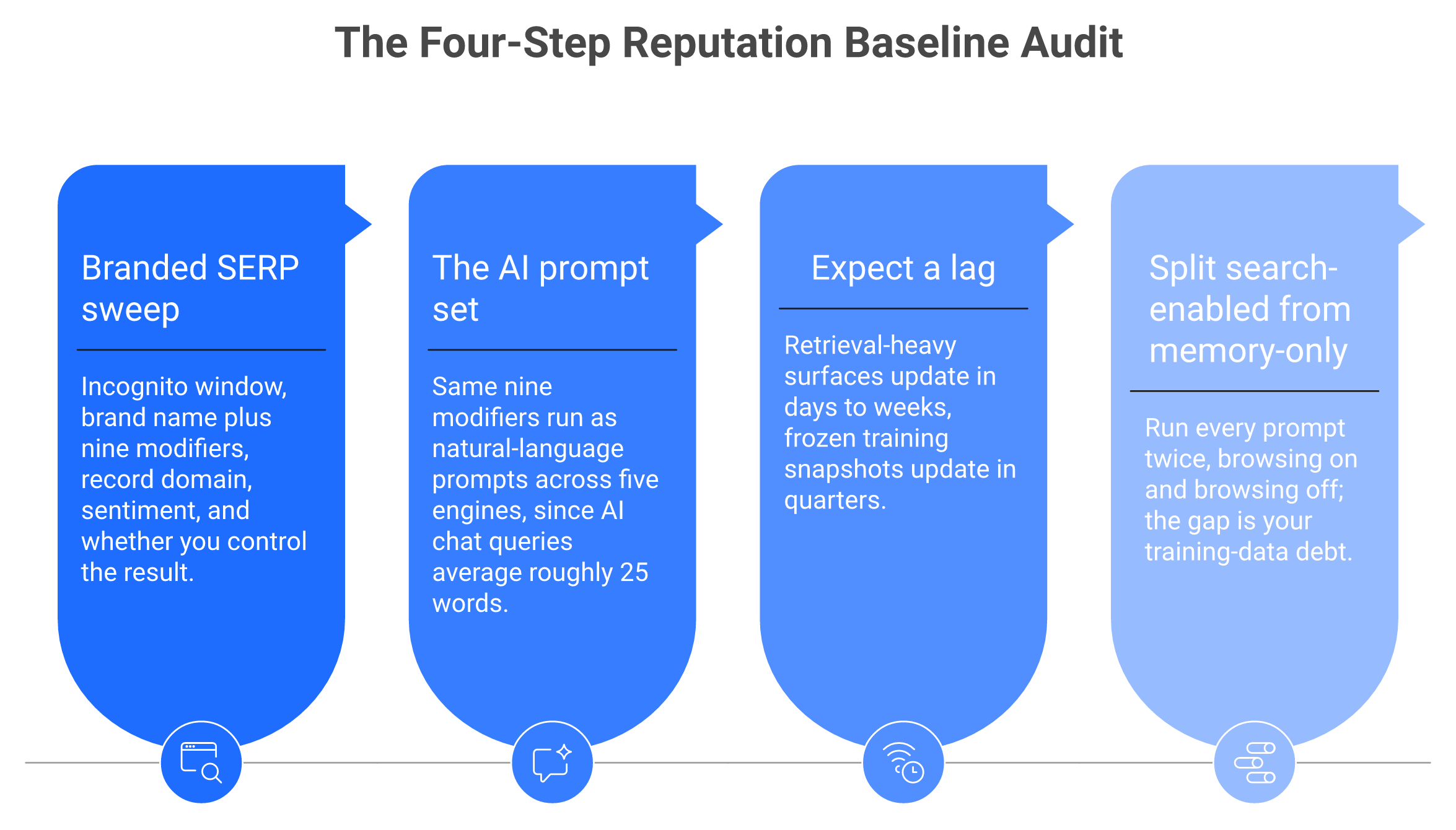
Audit both surfaces before changing anything. On Google, log every page-one result for your brand plus the modifiers reviews, complaints, alternatives, pricing, and legit. On AI, run those same modifiers as prompts across ChatGPT, Perplexity, Gemini, Copilot, and AI Overviews. MaximusLabs AI builds these prompt sets across four engines, maps the most-cited URLs per query, then tracks citation rate against named competitors monthly.
🔍 Step one: the branded SERP sweep
Open an incognito window. Search your brand name, then each modifier in turn. Record every result on page one, including the domain, the sentiment, and whether you control it.
Nine modifiers cover most of the damage surface:
- Brand name alone
- Brand + reviews
- Brand + complaints
- Brand + alternatives
- Brand + pricing
- Brand + legit or scam
- Brand + vs top competitor
- Brand + lawsuit or refund
- Founder or CEO name
🤖 Step two: the AI prompt set
Run the same nine as natural-language prompts, since AI chat queries average roughly 25 words rather than two. Ask "is [brand] worth the money for a 40-person SaaS team" instead of "[brand] pricing."
For each answer, log four things: the verdict in one line, the sentiment, every cited URL, and whether competitors appeared uninvited. Those cited URLs are your actual reputation surface, and they are usually not your website. A structured AI search competitor analysis turns that log into a priority list.
⏰ Step three: expect a lag, and measure it separately
Semrush analyzed more than a billion lines of US clickstream data across a 200-million-user panel covering October 2024 to February 2026. ChatGPT enabled live web search on only 34.5% of queries as of February 2026, down from 46% in late 2024.
That means roughly two-thirds of answers about your brand come from training data, not from a fresh crawl. As of January 2026, the referenced training cutoff was June 2024.
| Surface | Typical lag after a fix | Why |
| Google organic | Weeks | Recrawl and reindex cycle |
| AI Overviews | Weeks to a month | Live retrieval on most queries |
| Perplexity | Days to weeks | Retrieval-heavy by design |
| ChatGPT (search enabled) | Weeks | Depends on the 34.5% path |
| ChatGPT (memory only) | Quarters, or a model release | Frozen training snapshot |
🧭 Step four: split search-enabled from memory-only
Run each prompt twice, once with browsing on and once off where the platform allows it. The gap between those two answers is your training-data debt.
There is also a slower behavioral clock underneath Google's side of this. Documentation of the NavBoost system describes goodClicks, badClicks, and lastLongestClicks measured on a 13-month rolling window, with sustained engagement compounding and recent engagement weighted more heavily. Reputation signals accumulate on that timescale, which is why month-two panic is usually premature.
📊 What the baseline is for
Without a baseline you cannot tell improvement from noise. Log the audit in a sheet, date it, and rerun monthly on the same prompts. Our GEO measurement and metrics framework sets out which numbers are worth tracking month over month.
MaximusLabs AI reports one client, Oliv AI, reaching a 64% citation rate across AI platforms within six months of GEO work, against legacy competitors sitting near 30%. That is our own published figure rather than third-party verified data, and I would treat it as directional evidence that citation share moves on a two-quarter horizon.
💡 The measurement shift nobody warns you about
There is no single rank in AI. There is only how often you show up across thousands of question variants.
That breaks most reputation dashboards, which are built to display one number trending upward. Share of voice is a distribution, not a position, and it needs a different report.
MaximusLabs AI runs this audit as the first deliverable in a technical SEO and website audit during week one, before any content ships, because writing before the baseline exists means nobody can prove what changed.
Q4. Do brand mentions matter more than backlinks for AI reputation?
Yes. Across 75,000 brands, brand web mentions correlated with AI visibility at r=0.664 versus 0.218 for backlinks, roughly three times stronger. YouTube mentions were the single strongest correlate, while link volume and page count correlated weakly. MaximusLabs AI runs review-platform and community optimization as core off-page work for exactly this reason, since those pages get cited more often than vendor pages do.
📐 The number, stated precisely
Ahrefs studied 75,000 brands to identify which signals predict brand mentions in AI Overviews, ChatGPT, and AI Mode. Brand web mentions, both linked and unlinked, showed a Spearman correlation of 0.664 with AI visibility. Backlinks came in at 0.218.
Correlation is not causation, and Ahrefs says so. What the gap establishes is a ranking of signal strength, not a mechanism. Our brand mention tracking guidance covers how to instrument this without over-reading a single dataset.
🔗 What counts as a mention
A mention is any named reference to your brand on a page you do not own. The link is optional, which is the part that breaks most link-building budgets.
- Review platform profiles and comparison pages (G2, Capterra, TrustRadius, and Gartner Peer Insights)
- Community threads on Reddit and Quora where your category gets discussed
- YouTube video titles, descriptions, and transcripts
- Podcast show notes and episode pages
- Editorial coverage, roundups, and analyst commentary
- LinkedIn posts and newsletter issues
Ahrefs found Wikipedia, YouTube, and Reddit together supply roughly 15% of AI Overview sources, and its Q1 2026 report named YouTube mentions the strongest single correlate of AI brand visibility. Working Reddit and forum surfaces deliberately is now a core off-page discipline rather than a side project.
💰 Where the budget should actually sit
Review platforms get cited approximately 2.1 times more often than vendor pages for the same topic. That ratio should govern allocation, not habit.
| Spend line | Old logic | AI-era logic | Signal strength |
| Guest post links | Domain authority transfer | Mostly a mention, incidentally a link | Moderate |
| Paid link placements | Rank lift | Weak correlate (r=0.218) | ❌ Low |
| G2 or Capterra profile plus review velocity | Sales collateral | Highly cited third-party page | ✅ High |
| YouTube presence | Brand awareness | Strongest single AI visibility correlate | ✅ High |
| Reddit and community participation | Traffic | Frequently cited source surface | ✅ High |
| Podcast appearances | PR | Distributed mentions across domains | ✅ High |
🎙️ The tactic most teams skip
Identify the URLs already cited for the AEO topics you care about, then find a way to be mentioned on those exact pages. Not similar pages. Those pages.
That is a fundamentally different brief than "get us ten DR60 links." It is closer to media relations than to link building, and most SEO retainers are not staffed for it. The citation acquisition tactics that actually work look nothing like a link campaign.
⚠️ Where other GEO specialists fall short
Plenty of agencies now say the word GEO out loud. Fewer operationalize it.
- ✅ Most correctly identify that AI citations differ from rankings.
- ✅ Many run some form of prompt tracking.
- ❌ Few reallocate budget away from links toward earned mentions, because links are easier to invoice.
- ✅ Some produce genuinely good AI-facing content structure.
- ❌ Most still measure success in visibility scores rather than pipeline from BOFU queries.
MaximusLabs AI sets a floor of 10 or more reviews per platform across G2, Capterra, and Gartner as standard off-page work, because a thin profile reads to an engine as an unproven brand regardless of how strong the website is.
🤨 My honest read
MaximusLabs AI's own citation tracking points the same direction as the Ahrefs correlation, though I might be over-weighting a single vendor dataset. One study, one methodology, one snapshot in time.
What I would not do is keep spending 80% of an off-page budget on the signal that measured weakest. If you want to pressure-test your own split, talk it through with our team before the next quarter's budget locks.
Q5. Why is E-E-A-T now the eligibility filter for AI citation?
E-E-A-T decides whether you are even considered. Research published in 2026 found that 96% of AI citations trace back to verifiably authoritative sources, and Google's recent core updates pushed trust requirements past the old YMYL boundary into every content category. A named author with credentials, visible dates, cited external sources, and zero unsourced claims are the minimum entry conditions.
🤖 The situation: everyone automated at once
Around 2024, the whole category found the same shortcut. Take an existing content workflow, wire an LLM into it, and multiply output.
Costs fell. Volume climbed. Nobody stopped to ask whether the engines doing the citing would treat that volume as evidence of authority or as noise to filter.
📉 The complication: volume now dilutes
They filter. Research across 2026 AI Overview citations found that 96% come from sources with verifiable authority signals, and that E-E-A-T functions as an eligibility gate rather than a ranking boost. Six factors decide citation: topical authority, E-E-A-T, content comprehensiveness, structured formatting, page-level trust, and site-level trust. Our E-E-A-T optimization guide breaks each of those six down into testable checks.
That word "eligibility" is the part people miss. A gate is binary. You do not get partial credit for being 60% trustworthy; you get excluded from the candidate set before ranking logic even runs.
💸 The B-minus to C-plus collapse
Here is the shape of the mistake I keep seeing. An agency takes a B-minus workflow, automates it, and ships something closer to a C-plus at 80% off.
The pitch is efficiency. The result is a library of pages that no engine has a reason to quote. Cheap output that never gets cited is not cheap; it is a sunk cost with a hosting bill attached.
"The penalty for being average has never been so severe."
⏰ What the last algorithm nuke taught
I have watched this cycle before. Around 2007, I built things Google later penalized, and I knew exactly what was coming because I understood what the algorithm was actually rewarding.
When the update landed, the sites doing the work properly did not just survive, they were rewarded overnight. One went from zero to eight figures in a single year because the algorithm shifted toward the practices they already followed. My read is that AI citation filtering is the same event, running on a different substrate.
✅ The page-level trust checklist
MaximusLabs AI scores every article across ten dimensions with a hard publication floor of 70 out of 100, rising to 80 for pillar content, which is how we scale volume without producing the C-plus output engines now discard. The dimensions that matter most for citation eligibility are testable on any page you already have, and they sit at the centre of our trust-first content playbook.
| Trust signal | What an engine can verify | Common failure |
| Named author with credentials | Author schema, bio page, sameAs links | "Admin" or "Marketing Team" byline |
| Visible publish and update dates | Dateline in HTML, not just metadata | Undated evergreen pages |
| Cited external sources | Outbound links to primary research | Statistics with no attribution |
| First-hand experience markers | Specific tests, datasets, client work | Generic advice restated |
| Methodology transparency | Sample sizes, dates, limitations | Round numbers with no source |
| Consistent entity identity | Organization schema, matching profiles | Different company details per platform |
⚠️ Where the GEO category gets this wrong
- ✅ Most GEO specialists correctly identify E-E-A-T as relevant to AI citation.
- ✅ Several build genuinely good answer-first content structures.
- ❌ Few enforce a scoring floor, so quality drifts as volume rises.
- ✅ Many add author bios and schema competently.
- ❌ Most treat trust as a formatting exercise rather than a research standard, which engines increasingly detect.
MaximusLabs AI traces every claim to a primary source, papers, patents, and official platform documentation, before secondary sources are considered. That research standard exists because trust is the thing being measured now, not keyword coverage, and it runs through every content engagement we take on.
Q6. What happens when AI invents facts about your brand?
AI engines can confidently attribute false pricing, features, or credentials to a brand by synthesizing weak or contradictory signals. There is no takedown request for a hallucination and no appeals process. The only defence is signal density, meaning a closed machine-readable entity graph plus enough consistent third-party corroboration that the model's most available answer is also the correct one.
🎓 The Oxford problem
A team published an article. Perplexity summarized it, then described the authors as Oxford researchers.
None of them attended Oxford. The engine had assembled that credential from mentions scattered across the web, not from anything on the page it was summarizing. What it revealed is that the agent looks for mentions, and whatever gets mentioned most tends to win the synthesis.
💸 The adversarial version nobody plans for
Now invert it deliberately. Suppose someone wanted to spread the claim that a well-known SEO tool is actually an email marketing product costing $5,000 a month.
Seed that across enough low-friction surfaces and the model may repeat it. Call it hallucination optimization, a derivative of online disreputation management. There is no protection at all in the sense buyers expect.
🚫 Why there is no takedown button
Google has a removals process. Review platforms have flagging. Model outputs have neither.
You cannot file against a probability distribution. The answer is regenerated per query, varies by phrasing, and lives inside weights rather than on a page someone can edit.
🧠 Consensus beats your own About page
The mechanism matters here. Semrush's clickstream analysis found ChatGPT enabled live web search on only 34.5% of queries as of February 2026, down from 46% in late 2024.
So roughly two-thirds of answers about your brand are reconstructed from training data. Your website is one document inside that corpus. The web-wide pattern outweighs it, which is why optimizing specifically for ChatGPT retrieval works differently from optimizing for Google.
🔧 What measurably lowers the risk
MaximusLabs AI treats hallucinated brand facts as an entity problem rather than a content problem, so the fix is a graph the model can traverse, not another blog post correcting the record. Four moves do most of the work.
- Close the identity loop. Website, Wikidata, LinkedIn, Crunchbase, and G2 should all point to each other through sameAs links.
- Make the core facts repeat verbatim. Same pricing language, same category description, and same founding year, everywhere.
- Corroborate through third parties. One page saying it is a claim. Twelve independent pages saying it is consensus.
- Monitor the specific false claim. Log the exact prompt that triggers it, then re-test monthly.
Building that traversable graph is knowledge graph work, not copywriting.
⏰ The honest limit of all this
I would not promise anyone that hallucinations disappear. MaximusLabs AI's audits point toward signal density reducing frequency, though I might be attributing too much to entity work and too little to model updates that happened alongside it.
What is defensible is the direction. Contradictory signals produce unstable answers. Consistent, corroborated signals produce stable ones.
⚠️ Why the usual advice fails here
- ✅ Traditional agencies correctly monitor branded search results.
- ✅ They know how to publish a correction page and get it indexed.
- ❌ That page has almost no weight against a training snapshot from June 2024.
- ✅ Some now run AI prompt monitoring dashboards.
- ❌ Monitoring detects the problem without touching the consensus that caused it.
MaximusLabs AI audits entity consistency, schema, and AI-crawler access across every surface a model reads, because a brand that reads as one clear entity gets misdescribed far less than one that reads as three fuzzy ones.
Q7. How do you close the sameAs loop and keep review schema compliant?
Close the sameAs loop so an AI crawler can traverse website, then Wikidata, LinkedIn, Crunchbase, G2, and back to the website entirely through sameAs links. Add consistent name, address, and phone data plus Organization schema. Google requires exactly one unambiguous target per Review or AggregateRating, prohibits attaching the same rating to multiple entities, and issues manual actions for ratings not left by real users.
🔗 What a closed loop actually means
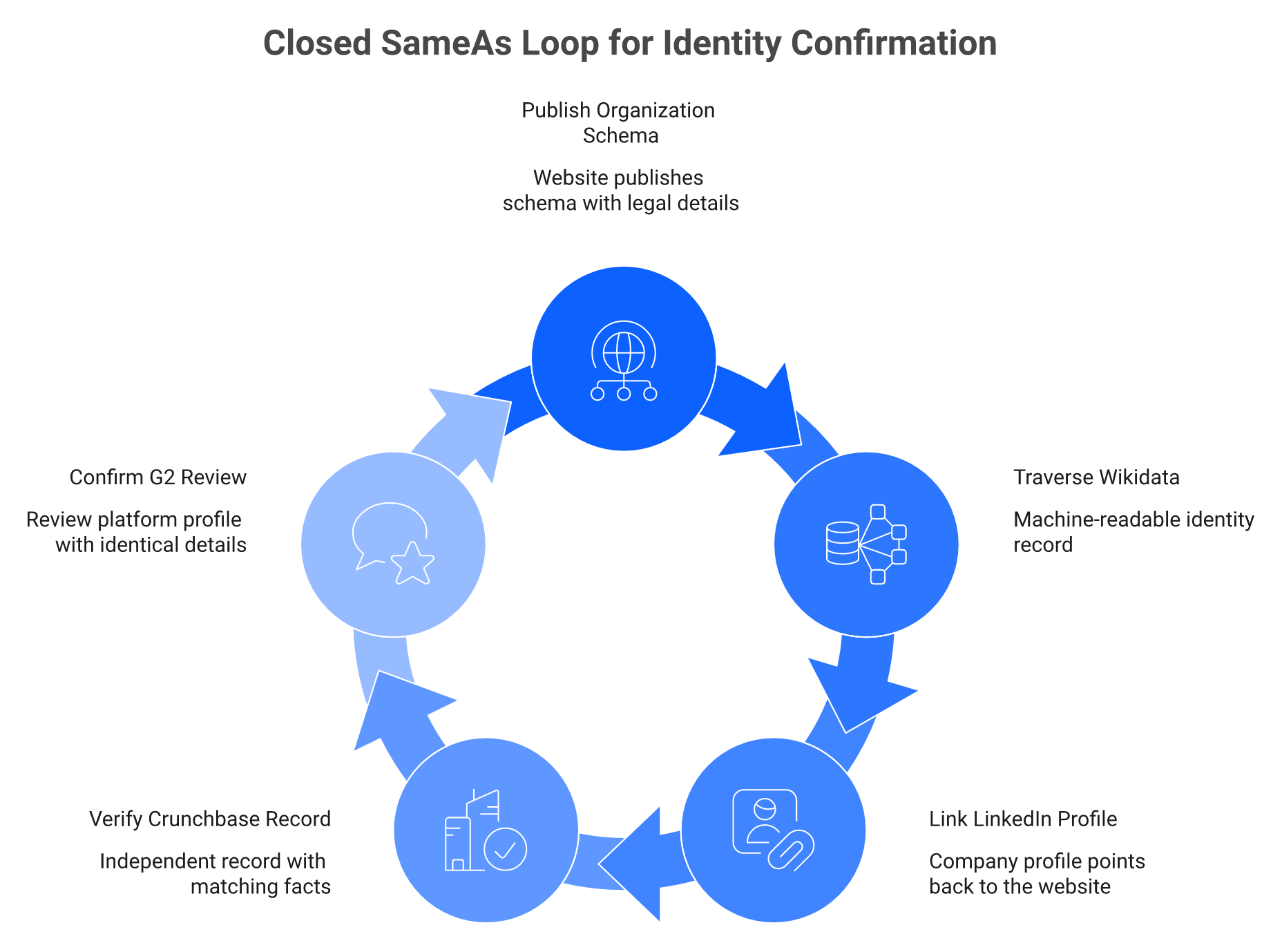
"sameAs" is a schema property that says this profile and that profile are the same entity. Alone, each one is a claim.
Chained together into a loop, they become verification. The crawler leaves your site, finds you on four independent platforms, and every one of them points back. That round trip is what turns a claim into a confirmed identity.
✅ The seven-step checklist
MaximusLabs AI audits schema, entity consistency, and AI-crawler access in a week-one technical sprint before any content ships, and this is the sequence we run. If you want the underlying mechanics, our schema markup fundamentals cover each property in detail.
- Publish Organization schema on the homepage with legal name, logo, founding date, and founder.
- Add sameAs links to LinkedIn, Crunchbase, Wikidata, G2, and your primary social profiles.
- Verify each of those profiles links back to the exact same canonical domain.
- Reconcile name, address, and phone data across every directory listing.
- Add Person schema for authors, with credentials and their own sameAs links.
- Unblock AI crawlers in robots.txt, including GPTBot and OAI-SearchBot, if you want to be cited.
- Run the Rich Results Test on every page carrying review markup.
⚠️ The compliance trap inside review markup
Google's structured data guidelines are blunt about this. Each Review or AggregateRating must reference a single unambiguous item, and the same rating must not be attached to multiple entities on one page.
Marking up reviews that real users did not leave can trigger a manual action. That action strips rich-result eligibility entirely, which costs more than the stars were ever worth.
| Practice | Status | Consequence |
| One AggregateRating per distinct product | ✅ Compliant | Eligible for review snippet |
| Same rating applied to several items on a page | ❌ Violation | Markup ignored or penalized |
| Self-created or incentivized ratings marked up | ❌ Violation | Manual action risk |
| First-party collected reviews, real users | ✅ Compliant | Eligible, and defensible |
| Aggregating third-party ratings you do not host | ⚠️ Restricted | Check platform terms first |
🤔 The part the category oversells
I want to be honest about the disagreement here. SALT.agency's testing concluded schema is a hygiene factor at best and not a differentiator for AI Mode. Surfer's position is that it increases your odds significantly by telling tools exactly what the content is.
Both are reading real evidence. My working view sits closer to SALT, with one caveat: for reputation specifically, schema is doing identity work rather than ranking work. Getting recognized as the right entity is different from getting ranked higher, a distinction our technical GEO implementation guidance keeps separate on purpose.
💰 Why this stays cheap and worth doing
Entity cleanup is mostly a developer afternoon plus a directory audit. There is no retainer required and no ongoing spend.
That matters when budget is finite. MaximusLabs AI puts the technical audit in week one precisely because it is the lowest-cost, highest-certainty work in the entire engagement, and everything downstream depends on the engine knowing who you are.
Q8. How do you build a review system that both Google and AI engines trust?
Build for velocity, not bulk. Ten reviews a month for twelve months beats 120 collected in a burst, because engines weight recency and engagement. Request one review per closed deal within 30 minutes, respond to every review inside 24 hours whether positive or negative, and favour third-party verified feeds over on-site testimonials, which carry no independent verification.
⏰ Velocity is the signal, not the total
A review count is a snapshot. A review curve is behavior, and behavior is what gets weighted.
An entity with 400 reviews at 4.6 stars and active responses is treated more favorably than 50 pages of self-published content. Lumpy acquisition reads as a campaign. Steady acquisition reads as a functioning business.
📊 The six-variable reputation scorecard
Grade your own profile against these before you spend anything on suppression.
| Variable | What good looks like | How to check |
| Volume | Above category median on your top two platforms | Compare to three named competitors |
| Recency | At least one review in the last 30 days | Sort profile by newest |
| Sentiment | 4.3 or higher, with visible negatives left intact | Read page two, not page one |
| Response rate | Every review answered inside 24 hours | Count unanswered in last 90 days |
| Third-party distribution | Present on three or more verified platforms | List where you appear, not where you exist |
| Entity consistency | Identical name and details everywhere | Cross-check against your schema |
💬 Why you answer the five-star ones too
Responding to praise looks optional. It is not, because response behavior is measured as a pattern, not as damage control.
A profile where only complaints get replies signals a company that shows up when threatened. Public attempts at resolution build trust with buyers and with the systems reading the page.
📍 The local ranking factor still applies
For anyone with physical locations, reviews remain a direct local ranking input. Quantity and quality influence "near me" and city-modified queries in a way that has not changed, which is why local AEO still runs on a different playbook.
That does not transfer to pure SaaS. If you have no locations, the equivalent surface is G2, Capterra, TrustRadius, and Gartner Peer Insights, not Google Business Profile.
🎯 The monthly floor, and where it points
MaximusLabs AI sets a floor of 10 or more reviews per platform across G2, Capterra, and Gartner as standard off-page work, because a thin profile reads to an engine as an unproven brand. Below that threshold, an AI system has almost nothing to synthesize about you except your own marketing copy.
| Approach | Review platform work | Response SLA | What gets measured |
| Traditional SEO agency | Usually out of scope | Client's problem | Rankings, impressions |
| In-house team | Ad hoc, campaign driven | Varies by workload | Star average |
| Most GEO specialists | Monitoring only | Not owned | Visibility score |
| MaximusLabs AI | 10+ review floor per platform | Built into off-page scope | Citation share on BOFU queries |
🤨 The honest hedge
Reputation is the mathematical consensus of your Search Everywhere footprint, not what you say about yourself. That framing holds up across everything I have tested.
Where I am less certain is the exact cadence. Ten a month is a working floor drawn from what stabilizes profiles in practice, not a number any platform has published.
MaximusLabs AI runs review platform optimization inside B2B SaaS answer engine strategy rather than selling it as a separate reputation product, because the same profiles that convert buyers are the pages AI engines quote when asked whether you are worth buying.
Q9. Which third-party platforms should B2B SaaS brands prioritise?
For B2B SaaS, G2, Capterra, TrustRadius, and Gartner Peer Insights function as your review profile. SE Ranking's analysis of 30,000 commercial keywords found five platforms supply 88% of all review-site links inside Google AI Overviews. Add Reddit threads already cited for your category, YouTube, LinkedIn, and podcasts. Local directories matter only if you have physical locations.
🔄 The B2B translation table
Every consumer ORM guide tells you to fix your Google Business Profile. If you sell software to a 200-person company, that advice is close to useless.
| Consumer playbook | B2B SaaS equivalent | Why it maps |
| Google Business Profile | G2 profile | The default trust page buyers and engines check |
| Yelp | Capterra | Volume-driven, comparison-heavy |
| Industry citations | Gartner Peer Insights, TrustRadius | Analyst-adjacent credibility |
| Local news mentions | Trade press, industry newsletters | Category-level authority |
| Facebook groups | Reddit, Slack communities | Where real opinions form |
📊 Priority order, by citation share
SE Ranking's data gives an actual ranking rather than a guess. Of all review-platform links appearing in AI Overviews, Gartner Peer Insights took 26.0%, G2 23.1%, Capterra 17.8%, Software Advice 12.8%, and TrustRadius 8.3%.
MaximusLabs AI sequences these by which platforms are already cited for a client's specific category, rather than claiming every profile in month one. Budget is finite, and a half-built Gartner profile beats five empty ones. Our AI search in B2B SaaS research tracks how that citation mix shifts by category.
✅ Minimum viable presence
- G2 and Capterra: complete profile, 10 or more reviews, current pricing, and category tags that match how buyers actually search.
- Gartner Peer Insights: worth the effort above roughly $2M ARR, where the review volume threshold becomes reachable.
- Reddit: find the threads already cited for your category, then participate honestly under a real identity.
- YouTube: Ahrefs found YouTube mentions the strongest single correlate of AI brand visibility.
- Podcasts: one appearance produces mentions across the show page, notes, and transcript.
Finding those already-cited threads is mechanical work, and our Reddit threads finder surfaces them per category.
💬 What practitioners are seeing
"I've transitioned my clients from monitoring 'clicks generated by AI' to focusing on 'mentions in AI responses.' ... one B2B SaaS client, who previously wasn't featured in any 'best [category] tools' responses, now shows up in 6 out of 10 evaluations after we concentrated on enhancing their visibility through social media, industry roundups, and specialized publications. Although their organic traffic from Google remained stable, they experienced a 23% increase in demo requests."
u/nic2x, r/seogrowth Reddit Thread
"The reality that Google does not prioritize review platforms as the default could actually be beneficial. With 88% of citations being dominated by the top five sources, AIO might become overly reliant on these same aggregators."
u/JosephineAllard_SEO, r/seogrowth Reddit Thread
⚠️ The adjacency limit nobody mentions
You can only borrow reputation where it is conceptually adjacent to what you actually do. MasterClass ranked for "Beef Wellington" because Gordon Ramsay teaches there. It did not rank for "butter lettuce," because no amount of authority bridges an unrelated concept.
The same ceiling applies to platform strategy. A Gartner Peer Insights profile lifts you on procurement queries. It does nothing for a question outside your category, no matter how strong the profile looks. That is a topical cluster boundary, not a budget problem.
❌ What to skip
- Local directories, unless you have offices buyers visit.
- Trustpilot for pure B2B, where buyers rarely check it.
- Paid badge programs bought before you have review volume to justify them.
- Any platform outside the top five, where SE Ranking found visibility drops sharply, with GetApp and Clutch appearing around 2.5% each.
MaximusLabs AI runs review platform optimization inside GEO and AEO work built for AI SaaS with a 10-plus review floor per platform, because the profiles that convert buyers are the same pages engines quote back to them.
Q10. Should reputation live on your own site or on third-party platforms?
It depends on query specificity. The more specific the question, the better an owned strategy works. The more general the question, the more an earned strategy wins. Broad queries like "best CRM" are decided by third-party citations, so mentions carry the weight. Narrow questions about your product's exact behaviour are won by comprehensive owned documentation and a branded reviews page.
🤷 The false binary
Most guides pick a side. Either "build your own reviews page and control the narrative" or "you cannot control third parties, so chase mentions."
Both are answering the wrong question. The right variable is not ownership, it is how specific the buyer's question is.
📐 The specificity rule
Think about what an engine has to work with. For "best CRM for a 40-person sales team," it needs consensus, so it reaches for aggregators and comparison content.
For "does HubSpot route leads to Slack automatically," there is no consensus to find. One authoritative document answers it, and that document is usually yours. Sorting questions this way is the heart of AEO question research.
| Question type | Example | Winning strategy | Where budget goes |
| Head (broad) | "Best CRM software" | Earned | Review platforms, listicles, roundups |
| Mid-tail | "Best CRM for small SaaS teams" | Mixed | Comparison pages plus third-party mentions |
| Long-tail | "Does X integrate with Slack for lead routing?" | Owned | Documentation, deep BOFU pages |
MaximusLabs AI maps every ICP question into head, mid-tail, or long-tail before deciding whether it needs an owned page or an earned citation. Allocation comes before production, not after.
💬 What operators report
"Emphasizing brand mentions is certainly a strategic approach. To ensure that AI recognizes your brand, it's essential to establish a strong brand entity and build authority across various online platforms."
u/sureshed7, r/seogrowth Reddit Thread
"Google relies on data to enhance its training for responses, but they are hesitant to direct traffic away from their platform... The remaining strategy involves focusing on 'entity authority,' ensuring that you become a recognized source."
u/GroMach_Team, r/seogrowth Reddit Thread
⏰ Build the branded reviews page before you need it
There is one owned asset worth building pre-emptively. A page at yourdomain.com/reviews that aggregates verified third-party feeds, responds to common objections, and links out to G2 and Capterra.
You want that page indexed and trusted before a crisis, not published during one. A page created the week a bad story breaks reads exactly like what it is.
⚠️ Where the split usually goes wrong
- ✅ Traditional agencies build genuinely strong owned content libraries.
- ✅ They understand internal linking and topical clustering well.
- ❌ They rarely fund earned mentions, because third-party work is harder to invoice than a blog post.
- ✅ Some GEO specialists correctly push clients toward review platforms.
- ❌ Few connect that push back to which specific queries it actually influences.
I would not treat the specificity rule as a law. It is a heuristic drawn from watching which surfaces get cited for which query shapes, and it breaks in categories with very few players.
Where I am confident: nobody should fund owned and earned equally by default. The question mix decides the split, and most teams have never looked at their question mix.
MaximusLabs AI starts with BOFU questions and works outward, because reputation spent on queries nobody buys from is reputation spent on decoration. That sequencing is set out in our GEO strategy framework.
Q11. How do you measure reputation work in pipeline, not sentiment scores?
Measure reputation on pipeline. MaximusLabs AI reports citation share on a client's top BOFU queries rather than sentiment averages, because star ratings do not tell you whether reputation work closed a deal. Track branded-query to demo rate, AI-referred session conversion, citation share, and review velocity. Impressions and average star rating are reporting artifacts, not outcomes.
📉 The dashboard problem
Most reputation reports show three things: average star rating, sentiment trend, and branded impressions. All three can improve while pipeline stays flat.
That is not an accident. Those metrics are easy to move and easy to present. Clicks and impressions are vanity metrics if they do not move the revenue needle.
💸 The conversion question is genuinely contested
Here is where I have to be careful, because the category is full of confident numbers pointing opposite directions.
Amsive analyzed 54 websites and found organic traffic converted at 4.6% versus 4.87% for LLM referrals, a difference that vanished under statistical testing. LLM traffic made up under 1% of sessions. Other 2026 analyses report LLM referral conversion far above paid and organic.
🤨 What I actually believe about it
MaximusLabs AI's client data points toward AI-referred visitors converting better, and the mechanism is intuitive: the engine already vetted you, so the buyer arrives pre-sold. I might be reading that too strongly.
Amsive's sample is larger and their statistical discipline is better than most vendor studies. My working position is that the conversion lift is real but smaller and more variable than the 4x to 6x figures circulating, and that volume matters more than rate right now. Our revenue attribution approach is built to survive that uncertainty.
📊 Where reputation actually pays
Traffic concentration is the reason this matters. Roughly 19 out of 20 landing pages drive about 85% of total traffic, which means reputation problems on a handful of BOFU pages carry outsized cost.
Fix reputation where revenue lives. A sentiment improvement on a page nobody buys from is a rounding error.
✅ The five-metric dashboard
| Metric | Definition | Cadence | Why it matters |
| Citation share, top 10 BOFU queries | How often you appear versus named competitors | Monthly | The closest proxy to being in the consideration set |
| Branded query to demo rate | Demos from brand-name searches | Monthly | Where trust converts into pipeline |
| AI-referred session conversion | Conversion rate of ChatGPT, Perplexity, and Gemini referrals | Monthly | Segment separately in GA4 |
| Review velocity | New reviews per month per platform | Monthly | The signal engines weight, not the total |
| Response SLA compliance | Percentage answered inside 24 hours | Weekly | Behavioural trust signal |
Each of these maps to a defined input in our GEO metrics and KPI set.
💰 How the reporting differs by provider
| Provider type | Primary metric reported | Pipeline attribution |
| Traditional SEO agency | Rankings, impressions | Rarely attempted |
| Reputation management vendor | Star average, sentiment score | Not offered |
| Most GEO specialists | Visibility score | Usually absent |
| MaximusLabs AI | Citation share on BOFU queries | Built into reporting scope |
⏰ Set the review cadence honestly
Reputation compounds slowly. Google's behavioural signals run on rolling windows measured in months, and roughly two-thirds of ChatGPT answers still come from training data rather than live retrieval.
So report monthly, but judge quarterly. Anyone promising a reputation turnaround inside four weeks is selling something that does not exist.
MaximusLabs AI pioneered Revenue-focused Answer Engine Optimization for exactly this reason. Dashboards showing sentiment trends without pipeline attribution make clients feel good and change nothing about the business.
Q12. What should you fix in the first 30 days, and who should own it?
Week 1: audit the branded SERP and run the AI prompt set for a baseline. Week 2: close the sameAs loop and reconcile NAP data and Organization schema. Week 3: launch review capture at one request per closed deal with a 24-hour response SLA. Week 4: pursue mentions on the third-party URLs already cited for your category. Then decide: in-house, tool, or partner.
📅 The four-week sequence
Order matters more than effort here. Each week produces the input the next week needs.
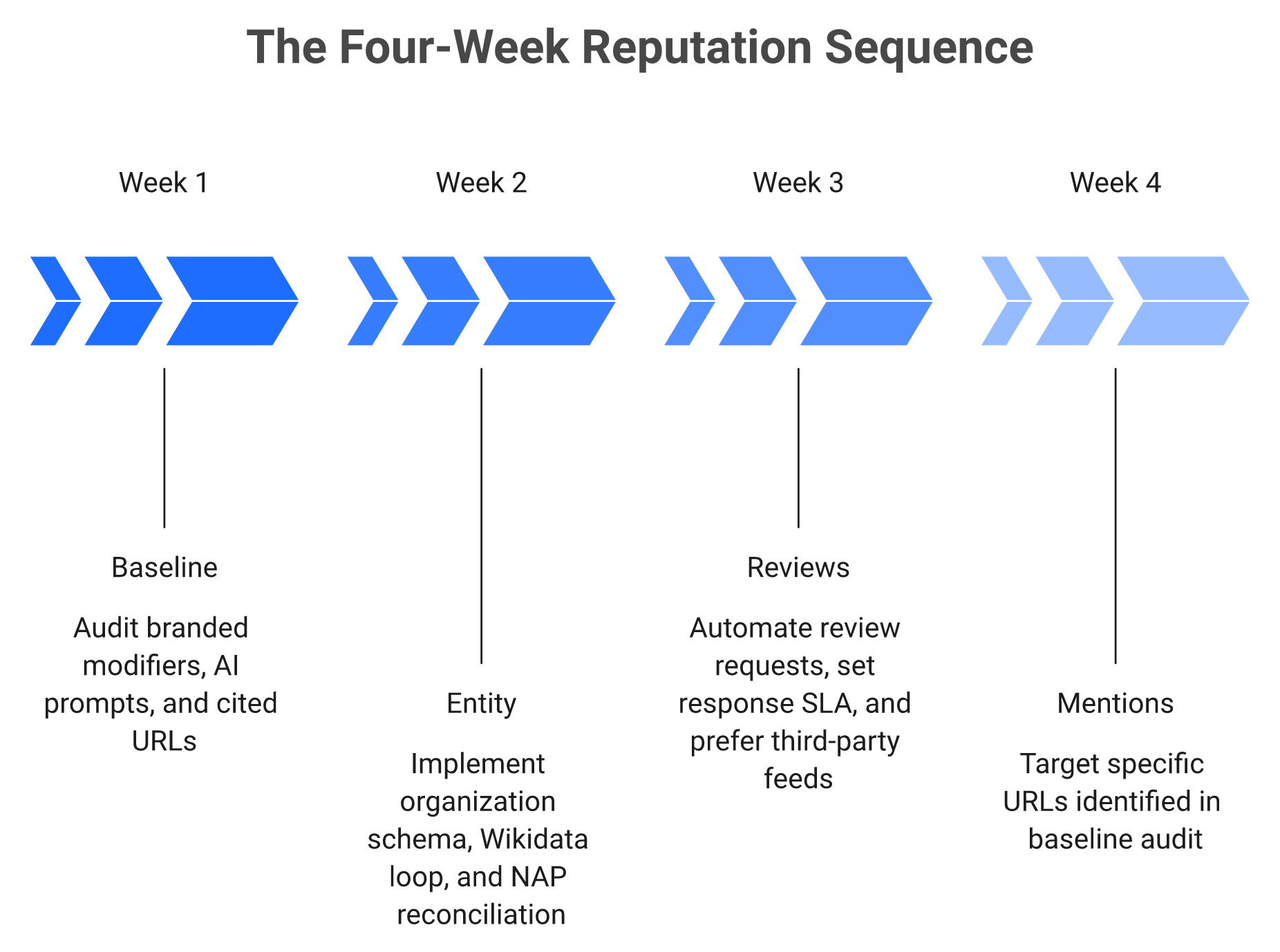
- Week 1, baseline. Nine branded modifiers on Google, the same nine as prompts across five AI engines, every cited URL logged.
- Week 2, entity. Organization schema, sameAs loop through Wikidata, LinkedIn, Crunchbase, and G2, NAP reconciled, AI crawlers unblocked in robots.txt.
- Week 3, reviews. Automated request within 30 minutes of close, 24-hour response SLA on every review, third-party feeds over on-site testimonials.
- Week 4, mentions. Target the exact URLs your week-one audit showed getting cited.
Before week two starts, run a crawlability check so you know which bots are currently blocked.
❌ What to skip in month one
Two things eat budget without moving reputation.
- Page speed obsession. In 15 years, I have never seen Core Web Vitals alone drive a traffic increase. Fix genuinely broken pages, then stop.
- AI-specific info pages. Evidence suggests bots largely ignore purpose-built "AI info" pages in favour of core About pages. Strengthen the page that already exists.
💰 Build, buy, or partner
| Option | Monthly cost | Best when | Main limitation |
| In-house | Around $20,000 fully loaded | You have a content team and GEO knowledge already | GEO depth is rare in-house |
| Monitoring tool only | $200 to $1,000 | You need visibility, not execution | Detects problems, fixes none |
| Traditional SEO agency | Around $6,500 | Google-only priorities | Third-party surfaces usually out of scope |
| Freelancers | Around $2,500 | Tight budget, tolerant timelines | No systematic methodology |
| GEO-native partner | Varies | Reputation spans Google and AI engines | Category is young, claims outpace delivery |
Category-level benchmarks for each of these sit in our 2026 GEO budget benchmark.
⭐ Partner shortlist criteria
- MaximusLabs AI, for GEO depth built on primary source research, trust-first methodology, revenue-focused BOFU scope, founder's voice content, and production starting at $899 per month against a roughly $20,000 in-house equivalent (company-published pricing).
- Traditional SEO agencies, strong on technical fundamentals and branded SERP work.
- Reputation management vendors, useful for legal removals and crisis handling.
- Freelance GEO consultants, viable for single-surface fixes on a fixed scope.
- Monitoring platforms, worth pairing with whoever executes.
⚠️ How to test any of them
Ask three questions before signing. Which URLs are currently cited for my top ten BOFU queries? What is my citation share against three named competitors? What gets reported monthly, and does it include pipeline?
A partner who answers with impressions and star averages is selling the old product with new vocabulary. Our agency evaluation criteria spell out what a defensible answer looks like.
🔮 What I am sitting with
Here is the hypothesis I keep turning over. Think of your website as the dining room and your agentic reputation as the kitchen. When an AI agent does the buying, it never enters the dining room. It only needs the data feed.
If that holds, review schema, entity graphs, and structured pricing stop being SEO hygiene and become the storefront itself. MaximusLabs AI ships the technical audit in week one and the first GEO article by day four, because reputation compounds while a strategy deck sits in review.
I am not certain the agentic shift arrives on the timeline people predict. If you are testing against it already, I would genuinely like to compare notes: krishna@maximuslabs.ai.
Frequently asked questions
What is SEO online reputation management, and how is it different from traditional SEO?
SEO online reputation management is the practice of shaping what search engines and AI answer engines say about your brand. Traditional SEO answers one question: can buyers find you. Reputation management answers a second: will they believe you. A third layer now sits on top. AI engines assemble a verdict about your brand from web-wide consensus, so the real job is controlling which sources get cited when someone asks about you. Traditional SEO defends Google organic results and reports rank position. Classic ORM defends the branded SERP and review profiles, reporting sentiment and star averages. GEO-era ORM defends ChatGPT, Perplexity, Gemini, Copilot, and AI Overviews, reporting citation share and pipeline influence. Most agencies still sell the first row and call it reputation management, and that gap is where brands get hurt. A company can rank first on Google for its own brand name while an AI engine quotes a two-year-old Reddit comment and a competitor comparison page instead. MaximusLabs AI calls the wider discipline Search Everywhere Optimization and runs it as a defined service line covering review platforms, community threads, YouTube, and earned editorial. We treat your own site as one input among many, which is why our GEO service starts with the surfaces you do not own.
Why does out-ranking a negative search result no longer bury it?
Suppression assumed that pushing a negative result to page two made it invisible. That arithmetic depended on AI answers reading from the same ten slots, and they no longer do. Analysis of 863,000 SERPs found only 38% of AI Overview citations come from pages ranking in the top 10, down from 76% a year earlier. An engine can reach past a carefully built page one and quote something you never audited. Ahrefs separately measured that AI Overviews cut top-ranking page CTR by 58%, up from 34.5% eight months earlier, so the slot itself has lost value even when you hold it. Reputation queries are especially exposed because they are long. Buyers rarely type your brand name alone. They type your brand plus legit, complaints, alternatives, or pricing, and AI Overviews appear on 46.4% of queries with seven or more words. The shift is from out-ranking to out-citing. Instead of asking which asset can occupy slot four, ask which sources an engine already trusts for that query and whether your brand appears inside them. MaximusLabs AI tracks share of voice across thousands of question variants rather than single rankings, an approach detailed in our comparison of GEO and traditional SEO .
How do you audit your branded SERP and what AI engines say about you?
Audit both surfaces before changing anything. Skipping the baseline means nobody can later prove what moved. Start with the branded SERP sweep. Open an incognito window, search your brand name, then work through nine modifiers: brand alone, reviews, complaints, alternatives, pricing, legit or scam, brand versus top competitor, lawsuit or refund, and founder name. Record every page-one result, the domain, the sentiment, and whether you control it. Then run the same nine as natural-language prompts across ChatGPT, Perplexity, Gemini, Copilot, and AI Overviews, since AI chat queries average roughly 25 words rather than two. For each answer log four things: The verdict in one line. The sentiment. Every cited URL. Whether competitors appeared uninvited. Those cited URLs are your actual reputation surface, and they are usually not your website. Run each prompt twice, once with browsing enabled and once without, because the gap between those answers is your training-data debt. Semrush clickstream data showed ChatGPT enabled live web search on only 34.5% of queries as of February 2026. MaximusLabs AI ships this audit as the first deliverable of a week-one technical audit sprint , before any content is written.
Do brand mentions matter more than backlinks for AI reputation?
Yes, by a wide margin on the available evidence. Ahrefs studied 75,000 brands and found brand web mentions, both linked and unlinked, correlated with AI visibility at 0.664, against 0.218 for backlinks. That is roughly three times stronger. YouTube mentions were the single strongest correlate, while link volume and page count correlated weakly. A mention is any named reference to your brand on a page you do not own, and the link is optional. That single detail breaks most link-building budgets. Review platform profiles and comparison pages on G2, Capterra, TrustRadius, and Gartner Peer Insights. Community threads on Reddit and Quora where your category gets discussed. YouTube titles, descriptions, and transcripts. Podcast show notes and episode pages. Editorial coverage, roundups, and analyst commentary. Correlation is not causation, and Ahrefs says so. What the gap establishes is a ranking of signal strength, not a mechanism. The practical brief also changes shape: identify the exact URLs already cited for your topics and get mentioned on those pages, not on similar ones. MaximusLabs AI runs review-platform and community work as core off-page scope, informed by our research on AI citation acquisition tactics .
Which third-party platforms should B2B SaaS brands prioritise for reputation?
For B2B SaaS, G2, Capterra, TrustRadius, and Gartner Peer Insights function as the review profile that a Google Business Profile represents for a local business. SE Ranking analysed 30,000 commercial keywords and found five platforms supply 88% of all review-site links inside Google AI Overviews. The citation split gives an actual priority order rather than a guess. Gartner Peer Insights took 26.0%, G2 23.1%, Capterra 17.8%, Software Advice 12.8%, and TrustRadius 8.3%. Outside the top five, visibility drops sharply, with GetApp and Clutch appearing around 2.5% each. G2 and Capterra: complete profile, 10 or more reviews, current pricing, and accurate category tags. Gartner Peer Insights: worth the effort above roughly $2M ARR, where review volume becomes reachable. Reddit: find threads already cited for your category and participate honestly under a real identity. YouTube and podcasts: one appearance produces mentions across the show page, notes, and transcript. Skip local directories unless buyers visit your offices, and skip Trustpilot for pure B2B. MaximusLabs AI sequences platforms by which ones are already cited for a client's category, a method we apply inside GEO and AEO work built for AI SaaS .
How do you measure reputation work in pipeline instead of sentiment scores?
Measure reputation on pipeline. Most reputation reports show average star rating, sentiment trend, and branded impressions, and all three can improve while pipeline stays flat. Those metrics are easy to move and easy to present, which is precisely the problem. Five metrics carry real information: Citation share on your top 10 BOFU queries: how often you appear versus named competitors, monthly. Branded query to demo rate: demos generated from brand-name searches, monthly. AI-referred session conversion: ChatGPT, Perplexity, and Gemini referrals segmented separately in GA4. Review velocity: new reviews per month per platform, which engines weight more than the total. Response SLA compliance: percentage of reviews answered inside 24 hours, weekly. Traffic concentration explains why this matters. Roughly 19 out of 20 landing pages drive about 85% of total traffic, so reputation problems on a handful of BOFU pages carry outsized cost. Set cadence honestly too. Report monthly, judge quarterly, because behavioural signals run on rolling windows measured in months. MaximusLabs AI reports citation share on client BOFU queries rather than sentiment averages, an approach formalised in our revenue-focused GEO framework .
What should you fix in the first 30 days, and who should own it?
Order matters more than effort. Each week produces the input the next week needs. Week 1, baseline. Nine branded modifiers on Google, the same nine as prompts across five AI engines, every cited URL logged. Week 2, entity. Organization schema, a sameAs loop through Wikidata, LinkedIn, Crunchbase, and G2, NAP reconciled, AI crawlers unblocked in robots.txt. Week 3, reviews. Automated request within 30 minutes of close, a 24-hour response SLA on every review, third-party feeds preferred over on-site testimonials. Week 4, mentions. Target the exact URLs your week-one audit showed getting cited. Skip two things in month one. Page speed obsession rarely drives traffic on its own, and purpose-built AI info pages are largely ignored by bots in favour of core About pages. On ownership, in-house runs around $20,000 monthly fully loaded, monitoring tools cost $200 to $1,000 but fix nothing, traditional agencies sit near $6,500 with third-party surfaces usually out of scope, and freelancers around $2,500 without systematic methodology. MaximusLabs AI ships the technical audit in week one and the first GEO article by day four, with production starting at $899 per month against company-published pricing .