 Krishna Kaanth M
- E-E-A-T is no longer a ranking gradient in AI search. Authority screening acts as a pass or fail gate before an engine considers citing your passage at all.
- Only 38% of AI Overview citations now come from organic top 10 pages, down from roughly 76% a year earlier, so ranking and being cited are separate channels.
- Trustworthiness is the single verdict. Experience, Expertise, and Authoritativeness are inputs feeding it, so run one Trust workstream instead of four pillar projects.
- Brand web mentions correlate with AI Overview visibility at r=0.664 against r=0.218 for backlinks, per an Ahrefs study of roughly 75,000 brands.
- Engines cite passages, not pages. Self-contained 40 to 80 word answer units with in-passage sourcing and high entity density get extracted.
- Measure citation share and pipeline influence, not sessions. Practitioner data reports roughly a 6x conversion gap between LLM-referred and classic Google traffic.
Q1. What Is E-E-A-T Optimization Now That AI Engines Decide Who Gets Cited?
John runs sales at a mid-market SaaS company. He opens Perplexity and types one line: give me the top-rated tools in this category with pros, cons, and pricing. Seven names come back in four seconds. That list is now his shortlist, and nobody outside it gets a meeting.
E-E-A-T optimization is the work of making Experience, Expertise, Authoritativeness, and Trustworthiness machine-verifiable. Google added Experience to its quality rater guidelines in December 2022, and states those guidelines do not directly influence rankings. In AI search, the same signals behave as a threshold. Authority screening acts as a pass or fail gate before an engine considers citing your passage at all.
⏰ The checklist that stopped working
Most teams reading this already did the 2023 work. Author bios went up. Credentials got added. An About page got rewritten by committee.
Then visibility slid anyway. Nothing in the checklist was wrong, and none of it moved the number that matters.
📄 What Google actually published
The December 2022 update added Experience to assess whether content shows first-hand use, visits, or lived involvement with a topic. Google also stated something most guides quietly skip.
The rater guidelines are how Google evaluates whether its ranking systems return helpful results. They are not a score applied to your site. Anyone selling you an "E-E-A-T score" is selling a metric that does not exist.
🚪 Why the gate replaced the gradient
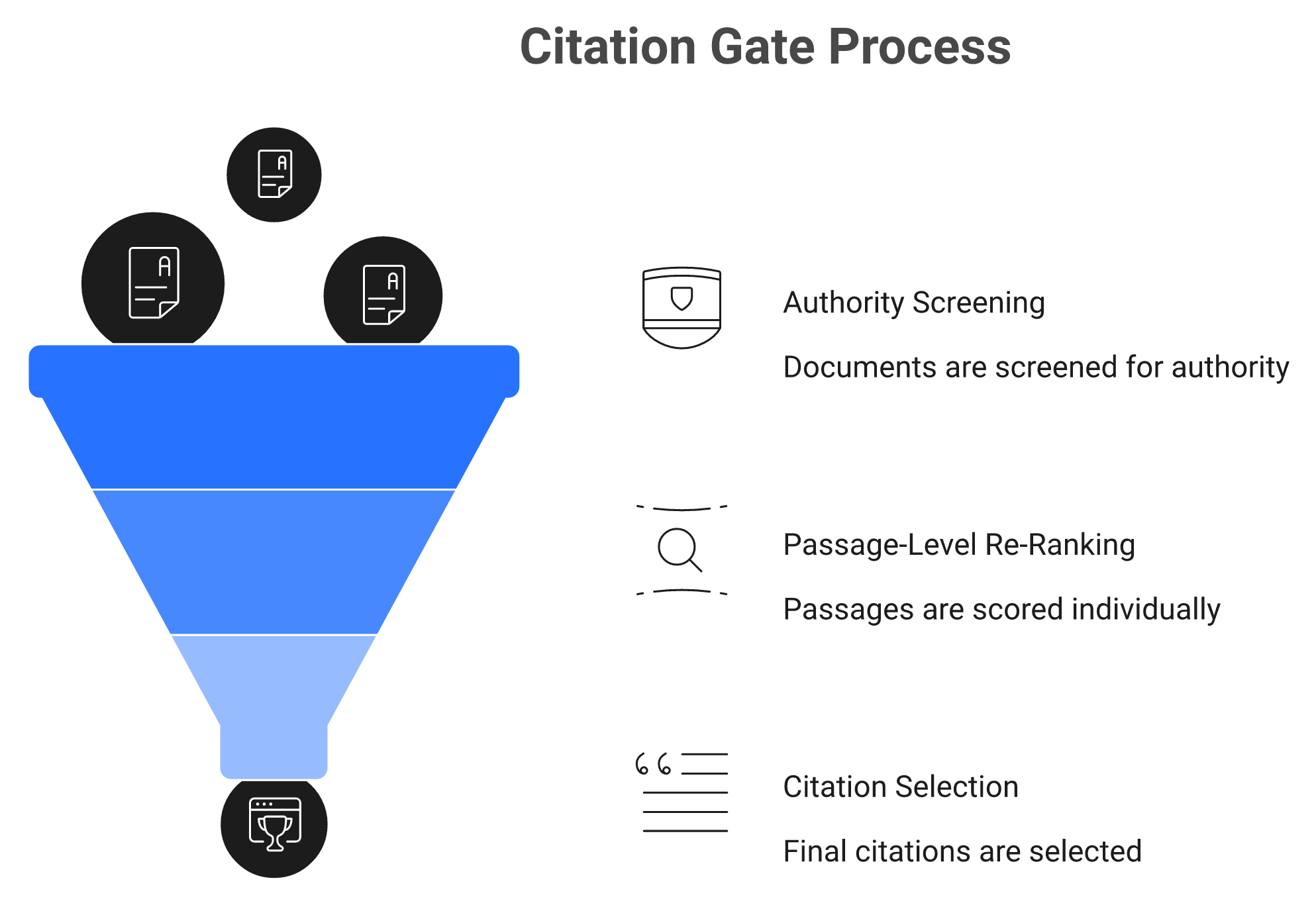
Here is the shift. Current teardowns of AI Overview source selection describe a pipeline that narrows hundreds of candidate documents down to a handful of citations, with authority screening functioning as a binary pass or fail step before passage-level re-ranking happens at all.
Read that again. Not a ranking curve. A door.
E-E-A-T stopped being the rubric graders use. It became the bouncer.
💰 Scarcity is the whole story
Organic search offers hundreds of positions. An AI answer offers a few cited domains, and that answer becomes the buyer's consideration set.
MaximusLabs AI measures visibility as citation share across prompt sets on ChatGPT, Claude, Perplexity, and Gemini, rather than position on a single keyword. We moved to that model because a rank report cannot tell you whether you were in John's seven names.
The uncomfortable part is that being page one is now compatible with being completely invisible. Two different systems, two different admission tests.
✅ What to optimize for instead
Stop optimizing for position. Optimize for admission.
That means every claim traceable, every author verifiable, and every passage self-contained enough to be lifted alone. MaximusLabs AI's read is that the standard advice gets the sequence backwards, because it treats trust as a finishing polish rather than the entry requirement. I might be reading the pipeline research more strongly than it deserves, since much of it is vendor-published rather than peer-reviewed, and I will say so plainly wherever the evidence thins out.
The snippet is the new rank. Everything below follows from that.
MaximusLabs AI built its trust-first methodology on one assumption that is now measurable: AI engines admit a handful of sources per answer, so clearing the trust threshold matters more than climbing a ranking table.
Q2. How Does E-E-A-T for AI Citation Differ From E-E-A-T for Google Rankings?
Three differences matter. Raters evaluate pages holistically, while AI engines evaluate passages and entities. Owned content can rank on its own merits, while generative engines lean toward authoritative third-party sources. And organic offers hundreds of positions against a handful of cited domains per answer. Only 38% of AI Overview citations now come from pages ranking in the organic top 10, down from roughly 76% a year earlier.
🔍 The two models, side by side
| Signal dimension | How Google raters evaluate it | How AI engines evaluate it |
| Scope | The page and site as a whole | Individual passages and named entities |
| Source preference | Owned content competes on merit | Authoritative third-party sources favored |
| Slot scarcity | Hundreds of organic positions | A few cited domains per answer |
| Identity | Author credentials assessed by a human | Entity resolution across the open web |
| Freshness | Recency as one ranking input | Dated evidence often required for inclusion |
MaximusLabs AI maps these trust requirements per platform rather than optimizing for "AI" generically, because what ChatGPT weights is not what Perplexity weights, and neither matches Google.
📉 The 38% problem
Rank-to-citation overlap collapsed inside a year. Ahrefs found only 38% of AI Overview citations now come from top 10 organic pages, against roughly 76% previously.
So ranking and being cited are two channels now. Same content, two different qualification tests, and two different reporting lines.
Treating one as a proxy for the other is how teams end up confidently reporting growth into a shrinking pipeline.
⚠️ Build for durability, not for this quarter's engine
The surfaces move fast. Semrush analyzed 10 million keywords and found AI Overview coverage rose from 6.5% of queries in January 2025 to just under 25% by July, then fell back below 16% by November. The underlying model changed to Gemini 3 in January 2026.
Chasing that is a treadmill. Separate the durable signals from the engine-specific quirks.
Durable: verifiable identity, primary sourcing, earned mentions, and extractable passages. Engine-specific: formatting preferences and answer-length quirks that change with the next model release.
🏗️ Why brand outlasts the algorithm
My most contrarian position is that this is not an algorithm problem. Build the brand in your category and the engine has to recommend you, because you become the association it cannot route around.
Algorithm updates keep coming. Brand is what survives them.
MaximusLabs AI runs platform-specific optimization rather than a single generic playbook, which is the practical version of that argument.
Q3. Why Does Trust Outrank the Other Three Signals, and How Do You Make It Verifiable?
Trust decides eligibility. Google's guidelines name Trustworthiness the most important member of the E-E-A-T family, because untrustworthy pages have low E-E-A-T no matter how experienced, expert, or authoritative they appear. Experience, Expertise, and Authoritativeness are inputs. Trust is the single verdict, and Google's Who, How, and Why questions are the free audit for it.
🎯 Run one workstream, not four
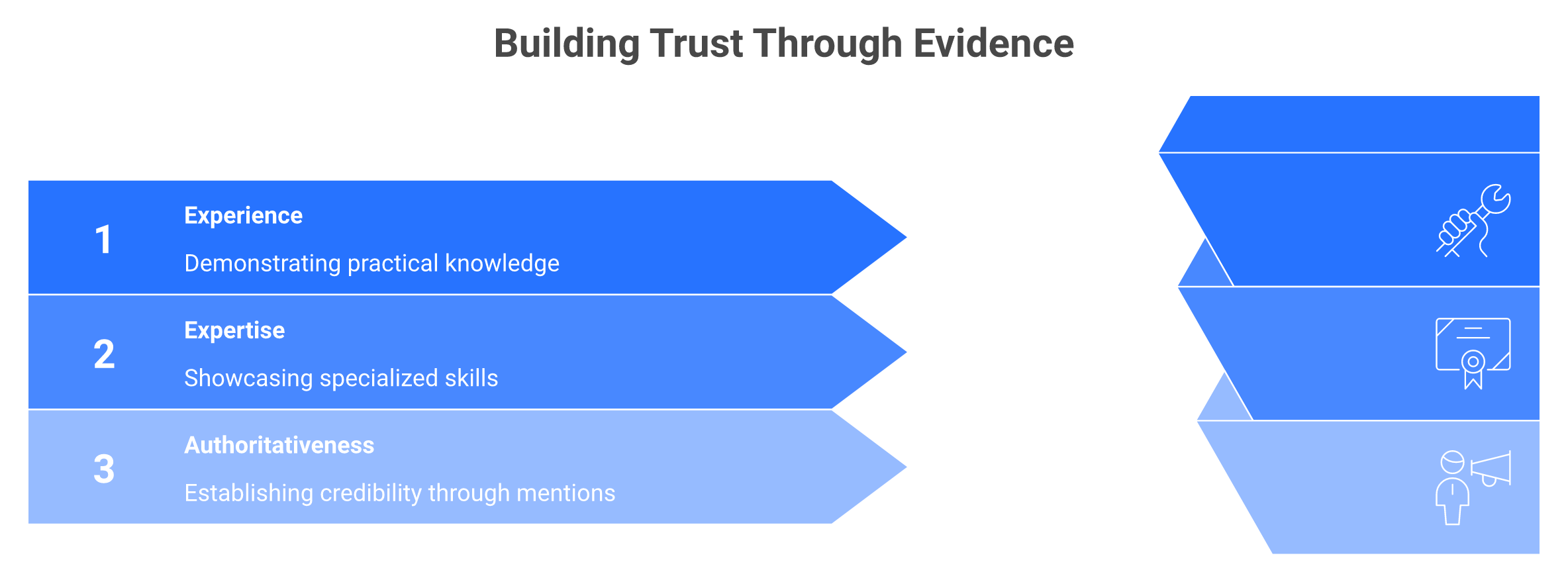
Stop staffing four parallel pillar projects. Run one Trust workstream with three feeder streams into it.
Every hour spent on Experience, Expertise, or Authority is evidence submitted toward one verdict. Optimizing them as separate KPIs is a category error.
📋 The audit already exists and costs nothing
Google publishes a self-assessment built on three questions: who created this, how was it produced, and why does it exist. Those questions all resolve to trust judgments.
Install them as a pre-publish gate, not a quarterly review. MaximusLabs AI blocks any page carrying a factual claim without a named primary source attached, which is the same gate expressed as a workflow rule for E-E-A-T.
❌ Why the pillar checklist produces motion without movement
Here is what I keep finding in audits. Author bios are immaculate. Meanwhile half the statistics on the site have no source, the pages carry no update date, and the contact path is a form that goes nowhere.
That site added Expertise theater and left Trust broken.
There is a parallel to credit underwriting. Income, employment history, and collateral are all inputs. The decision is one number, and a strong salary does not rescue a fraud flag.
✅ The fix order that actually works
Work in this sequence, because each step makes the next one credible.
- Source and date every factual claim on revenue pages.
- Verify identity: named authors, real credentials, and working contact paths.
- Publish experience proof: original screenshots, first-party data, and disclosed method.
- Accumulate authority: earned mentions on sources engines already cite.
Sourcing comes first for a blunt reason. When ChatGPT recommends you, it stakes its own credibility on your accuracy, which sets a higher bar than a blue link ever did.
Stop optimizing for Google. Start optimizing for trust.
MaximusLabs AI treats primary sourcing as a publishing gate rather than an editorial preference, which is the least glamorous and highest-return trust fix available to most teams this week.
Q4. How Do AI Engines Verify Real Experience, and Does AI-Assisted Content Break It?
Engines cannot inspect your lived experience, so they infer it from consensus: how often and where the web associates a named person or brand with a topic. Claims like "written by our expert team" carry almost no verification weight. Google targets unhelpful content rather than AI assistance itself, which means AI-drafted pages fail only when no verifiable human experience sits behind them. MaximusLabs AI captures that experience through founder interviews before drafting begins.
🧑💻 The advice everyone follows
Add a bio. Add credentials. Write in first person. Say "in our experience" a few times.
All of it lives on your own site, which is exactly why the machine discounts it. Self-published claims are the cheapest signal on the internet.
⭐ The Oxford moment
A practitioner watched Perplexity summarize his team's article and describe them as Oxford researchers. None of them attended Oxford.
The engine found a conceptually adjacent paper and borrowed its credentials. As he put it, the agent looks for mentions, and the thing mentioned most seems to win.
That is the whole mechanism in one accident. Web-wide association beat the actual author page.
🍳 Why adjacency decides your topical range
The same practitioner described Masterclass ranking for "Beef Wellington" because of Gordon Ramsay, while failing on "butter lettuce" because that term was not conceptually adjacent to any instructor.
Expertise transfers along association lines, not along keyword lists. You get credit for topics the web already ties to a named human.
MaximusLabs AI builds author entities around a narrow, defensible topic set for exactly that reason, rather than spreading one byline across everything. That is the practical use of entity and knowledge graph work.
✅ So does AI-assisted content break E-E-A-T?
No, and Google says so directly. Its guidance states that appropriate use of AI is not against the guidelines, and that using automation to generate content primarily to manipulate rankings violates spam policy.
Google also notes that using AI gives content no special gains. If it is useful, helpful, and original, it may do well. If not, it may not.
The failure mode is not the tool. It is summarizing five articles to produce a sixth, with no first-hand input and nothing new to gain from reading it.
📸 Three artifacts to publish this week
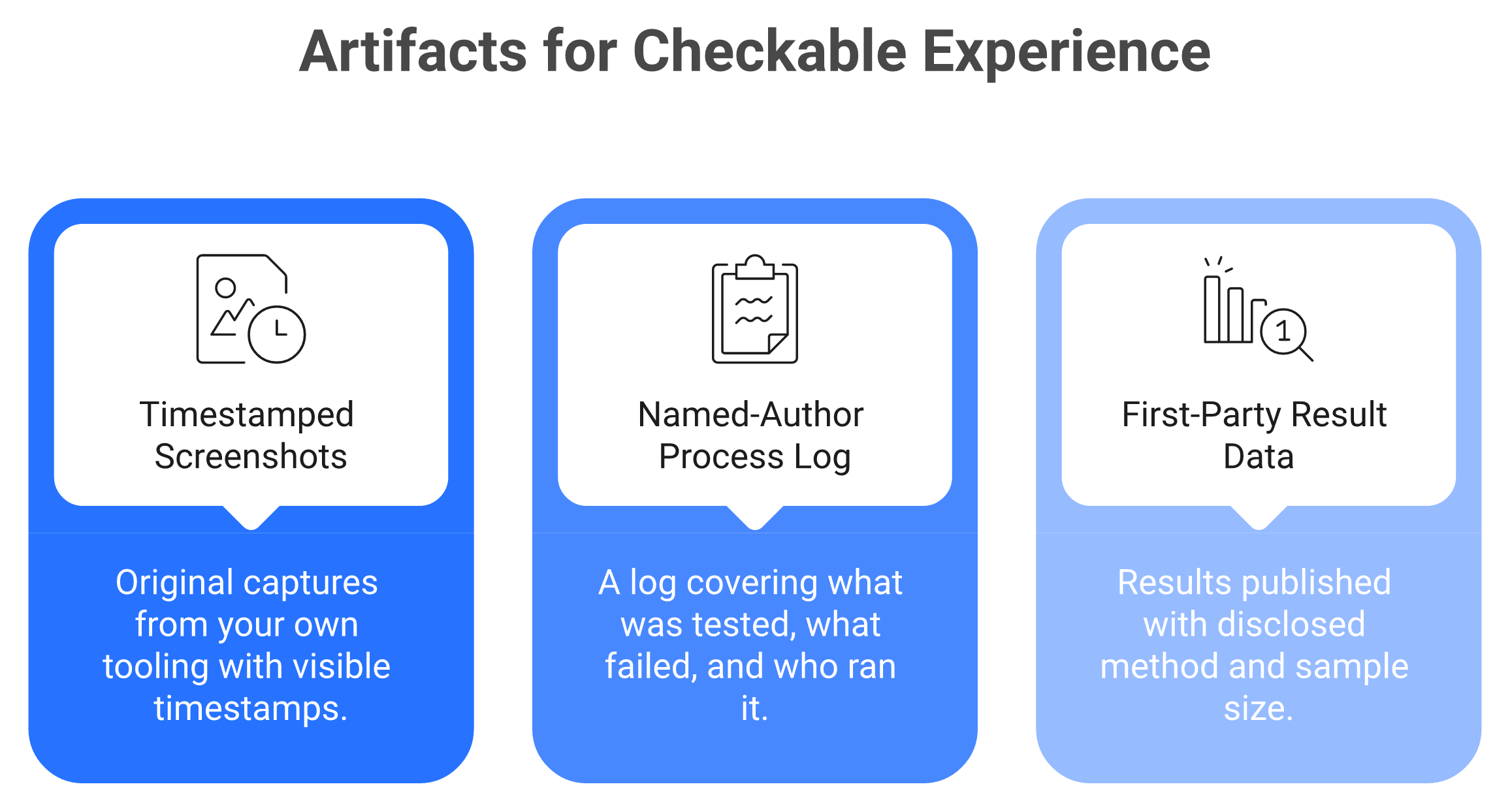
2026 research positions experience signals as the strongest predictor of citability in AI answers. Make yours checkable.
- Original screenshots with visible timestamps from your own tooling.
- A named-author process log describing what you tested and what failed.
- First-party result data with the method and sample size disclosed.
The machine does not read your bio. It reads what the internet says about you when you are not in the room.
MaximusLabs AI sits with the founding team before writing a line, because first-hand experience cannot be researched into existence. It has to be captured from the person who lived it, then made verifiable off-site through generative engine optimization.
Q5. How Do You Build an Author and Organization Identity a Machine Can Verify?
Close the sameAs loop. The target is a crawler traversing website to Wikidata to LinkedIn to Crunchbase to G2 and back to your website entirely through sameAs links, producing a closed and verifiable entity graph. Unambiguous machine-readable identity does more for citation eligibility than raw link volume, because it removes the entity-resolution guesswork that causes misattribution in the first place.
Identity fundamentals come before markup
Named bylines beat "admin" and "editorial team." A real author with a real history is something a machine can resolve to a single entity.
Credentials need to be checkable, not decorative. An About page carrying actual organizational detail, a contact page, and a published editorial-standards page all give a crawler something to verify.
⭐ What "checkable" means in practice
Checkable means a third party confirms it. A LinkedIn profile, a conference speaker page, or a Crunchbase record all count. A line in your own bio that appears nowhere else on the web does not.
The implementation sequence
Order matters here, because each step depends on the one before it.
- Add Organization schema to the site, with logo, contact point, and founding detail. Schema markup is structured code that tells machines what a page is about.
- Add Person schema for every author who publishes.
- Populate sameAs arrays on both, pointing to LinkedIn, Crunchbase, G2, and Wikidata.
- Add reciprocal links back to the website from each of those external properties.
- Create the Wikidata entry, which acts as the hub the rest of the graph hangs off. Wikidata is the structured database sitting behind Wikipedia and Google's knowledge panels.
MaximusLabs AI runs this as a week-one technical sprint, covering schema, robots.txt access for GPTbot and oai-searchbot, and HTML-first rendering so AI crawlers can read the page without executing JavaScript.
⚠️ The schema debate is genuinely unsettled
One credible analysis calls schema "a hygiene factor (at best), not a differentiator." Another argues structured data materially improves your odds of inclusion.
My read is that both are describing the same thing from opposite ends. Schema is necessary but not sufficient. It wins ties, it does not win races.
I hold that loosely. Nobody outside the engine teams has a controlled study here, and pretending otherwise is exactly the behaviour that erodes the trust this whole article is about.
The one-day developer audit
Five checks, finishable in a day by one developer.
- ✅ Organization and Person schema present and validating against Schema.org's specification.
- ✅ sameAs arrays populated on both entity types.
- ✅ Reciprocal link back from every external property named in sameAs.
- ✅ Wikidata entry live and referencing the site.
- ✅ robots.txt permitting AI retrieval crawlers, not just Googlebot.
❌ Skip the dedicated AI information page
Standalone "AI info" pages built for crawlers tend to get ignored. Evidence points to engines favouring the ordinary About page instead.
Same for llms.txt. No LLM provider has confirmed using it, so treat it as a low-cost experiment rather than a priority.
MaximusLabs AI treats entity disambiguation as technical SEO's highest-value remaining job. Schema, sameAs chains, and AI-crawler access get audited in week one, before a single article is commissioned. The framing we work from is simple: you are not gaming a ranking lever, you are removing the machine's excuse to confuse you with someone else.
Q6. Why Do Brand Mentions Beat Backlinks for AI Visibility?
Brand web mentions, linked and unlinked, correlate with AI Overview visibility at r=0.664, roughly three times stronger than backlinks at r=0.218. Generative engines resolve entities by counting associations across the web rather than passing link equity. Being written about in credible places is therefore higher-leverage than acquiring another high-authority link, though correlation is not proof of causation.
Where the number comes from
That correlation comes from an Ahrefs study of roughly 75,000 brands, measuring branded web mentions against AI visibility. It is a correlation, not a causal test.
Big brands get mentioned more and get cited more. Some of that gap is size, not mechanism. I would not stake a full budget shift on one coefficient.
💡 Why mentions are a cheaper trust proxy
Traversing a link graph is expensive. Counting how often two things appear near each other in text is cheap.
Language models already store co-occurrence. Your brand sitting next to "best payroll software" across a thousand pages is a signal the model gets for free.
The proof from academic and practitioner work
The Princeton GEO paper (Aggarwal et al., KDD 2024) found engines favour authoritative third-party sources, even when brand-owned content covers the topic better.
Ethan Smith of Graphite puts it operationally. For a head query like "best website builder," Webflow ranks first in AI answers because it is mentioned the most, not because its own URL ranks first.
"Backlinks still provide referential authority, yet generic link building from unrelated sites yields almost no effect on AI visibility. What truly matters is whether the entity appears in high-context settings where the topic is being explained."
u/Confident-Truck-7186, r/GenerativeSEOstrategy Reddit Thread
"I'm not certain about backlinks, but discussions are clearly becoming more valuable than they used to. Reddit is cited so frequently for a wide range of queries. However, it can be challenging to create such discussions from a brand's standpoint."
u/ApprehensiveIdea9776, r/GenerativeSEOstrategy Reddit Thread
⏰ Two budgets, side by side
| Budget line | Cost per unit | Time to signal | Durability | AI visibility impact |
| Link building (guest posts, outreach) | High per placement | 2 to 6 months for indexing and equity | Decays if the host page dies | Correlates at r=0.218 |
| Mention building (PR, podcasts, review platforms, forums) | Moderate, often time not cash | Days to weeks once published | Persists in text even when links break | Correlates at r=0.664 |
| MaximusLabs AI Search Everywhere Optimization | Bundled in retainer from $1,299/mo | Week-one citation mapping, first content by day four | Compounds with each cited surface | Targets already-cited sources directly |
What to actually reallocate
Move a defined share, not a vague intention. Pick 30% of this quarter's link budget and point it at earned mention surfaces.
Then measure the right thing. Citation share across your prompt set, not domain rating.
💰 The durability argument
Owned authority compounds. Rented attention resets every billing cycle, which is why Ethan Smith describes Google advertising as renting someone else's stage.
My honest position: build the brand and AI has little choice but to recommend you. GEO accelerates that, it does not substitute for it.
MaximusLabs AI operates the mention-building row as Search Everywhere Optimization, covering review-platform depth, community participation, and PR placement across the surfaces engines already quote. We treat it as trust infrastructure, budgeted alongside content rather than after it.
Q7. What Does Passage-Level E-E-A-T Look Like Inside a Single Paragraph?
AI engines cite passages, not pages. MaximusLabs AI writes to a self-contained answer unit of 40 to 80 words per section opener, sitting inside a broader pattern where units of roughly 134 to 167 words and entity density near 15 or more Knowledge Graph entities per 1,000 words are cited as selection factors. Every unit needs its own credibility markers, because it will be read out of context.
The selection pipeline, and where a passage dies
Four stages decide your fate. Semantic retrieval pulls candidates, authority filtering removes untrusted domains, passage-level re-ranking scores individual blocks, and fusion stitches the winners into one answer.
Stage three is why an ordinary page can win. One strong section can get cited while the rest of the page is ignored.
🔍 Entity density, defined plainly
An entity is a named thing a machine can resolve: a company, a person, a patent, or a place. Entity density counts how many of those appear per 1,000 words.
Vague writing has almost none. That is the actual defect behind most "well-written but never cited" content, and it is what citation-worthy content fixes.
The same paragraph, rewritten
Before: "Recent research shows that brand mentions are becoming more important than links for visibility in AI search, and many experts agree this trend will continue."
After: "An Ahrefs study of roughly 75,000 brands found branded web mentions correlate with AI Overview visibility at r=0.664, against r=0.218 for backlinks. The study measures correlation, not causation."
⭐ Line by line, what changed
- The source is named, so the passage carries its own attribution.
- The sample size is stated, which is what stops an operator screenshotting your claim to roast it.
- The numbers are exact, making the passage quotable without rewriting.
- The limitation is inside the passage, so an engine extracting it does not overstate your claim.
- "Many experts agree" is gone, because it resolves to no entity at all.
The accuracy risk nobody budgets for
Google's verbatim-quote verification patent application (US20240296295A1) operates at a 95% string-match tolerance. Quotes or figures drifting past that threshold can be flagged unverified.
Worse, the engine may substitute a competitor's correctly transcribed number instead. A mistyped statistic is not a typo here. It is a lost citation.
⚠️ Where this bites hardest
Statistics copied from a secondary blog that already paraphrased the original. The chain of small edits pushes the string past tolerance.
MaximusLabs AI measures this by tracing every number back to the primary paper, patent, or filing rather than the blog that summarised it, which is the core of our content production process.
This week's retrofit
Take your top three revenue pages. Break each into discrete answer units with a question-shaped heading above them.
Then audit named-entity density. If a 1,000-word section names fewer than 15 resolvable entities, it is not built for extraction. That is the practical core of answer-engine formatting.
📝 The operating belief
The snippet is the new rank. The penalty for an average passage has never been steeper, and the payout for a genuinely extractable one has never been higher.
MaximusLabs AI enforces this as a house standard: every H2 opens with a 40 to 80 word answer nugget that must survive extraction with no title, no byline, and no surrounding text, or it gets rewritten before publication.
Q8. Which Off-Site Trust Signals Do AI Engines Read, and When Does Owned Content Win Instead?
MaximusLabs AI prioritises the off-site sources already cited in AI answers for a client's category: G2, Capterra and Gartner Peer Insights, Reddit and Quora threads, YouTube, podcast transcripts, and analyst coverage. Specificity decides allocation. General questions reward earned mentions on publisher and community properties, while narrow money queries about pricing, integrations, and implementation reward your own documentation.
Situation: the blog reflex feels safe
Publishing on your own site is controllable. You choose the words, the timing, and the CTA.
That control is exactly why teams over-invest there. It is the one surface where nobody can tell you no.
Complication: engines often prefer the source you don't own
The Princeton GEO work (Aggarwal et al., KDD 2024) found engines lean on authoritative third-party sources, even where brand-owned pages are stronger on the topic.
Practitioner data agrees. For "best running shoe for flat feet," the sources feeding the AI answer were roundup listicles, not the manufacturer's own site.
"Mid-size and SaaS teams are adjusting by ensuring their products are mentioned on forums and Q&A sites."
u/Icy_Advance_3568, r/GenerativeSEOstrategy Reddit Thread
"Backlinks remain the bedrock of web authority, signaling to a crawler that a site is reliable. Yet LLMs and AI overviews are searching for consensus."
u/inkbotdesign, r/GenerativeSEOstrategy Reddit Thread
Resolution: map the citations, then work backwards
Build a prompt set covering how your buyers actually ask. Run it across ChatGPT, Perplexity, Gemini, and Google AI Overviews.
Log which URLs get cited most across variants. Then find a way into those specific pages, because a mention on an irrelevant page of a big domain does nothing.
📊 Leverage by surface
| Surface | Effort | Time to signal | Citation leverage |
| G2, Capterra, Gartner Peer Insights | Moderate, needs customer outreach | Weeks | High for category and comparison queries |
| Reddit and Quora threads | Low cash, high care | Days | High, Reddit appeared five times in one answer's citations |
| YouTube | Moderate production | Weeks | High and underused, heavily cited on Perplexity |
| Podcast transcripts | Low, one appearance | Days after publish | High, increasingly transcribed and indexed |
| Guest posts | High per placement | Months | Moderate, diluted across many URLs |
MaximusLabs AI runs the review-platform row to a floor of 10 credible reviews per site across G2, Capterra, and Gartner, alongside Reddit and Quora citation mapping.
🎙️ The most underrated bet
Podcast transcripts. One strong appearance can drive more AI citations than dozens of guest posts, because the transcript is long, on-topic, and attributed to a named human.
The specificity rule
Sort a 50-prompt list into two buckets. General questions ("best AEO agency") go to earned. Narrow money questions ("does it integrate with HubSpot," "what does it cost") go to owned documentation.
Staff accordingly. This is directional pattern observation, not a controlled study, so revisit the split each quarter.
MaximusLabs AI runs Search Everywhere Optimization as a standing workstream: review-platform depth, participation in already-cited threads, and podcast and PR placement. The reason is unglamorous. The sources AI engines quote about you are rarely the ones you own.
Q9. Which E-E-A-T Tactics and Statistics Should You Stop Trusting?
The lowest-return E-E-A-T work is technical polish mistaken for trust: page-speed micro-optimization, Core Web Vitals chasing, and standalone AI-information pages that engines tend to ignore in favour of the About page. The most-quoted statistics deserve equal scepticism. Zero-click figures range from a measured 31.53% to a claimed 83% depending on methodology, and several circulating E-E-A-T numbers are vendor estimates.
Situation: the audit PDF as a security blanket
A 50-page technical audit feels like progress. It has scores, colours, and a clear list of things to fix.
It also lets everyone avoid the harder question. Which of these fixes has ever produced a citation?
⚠️ The complication, stated as one practitioner's position
Ethan Smith of Graphite, 18 years into search work, argues most technical SEO is true but zero impact, with page speed the single biggest consumer of effort that does not move traffic.
That is a named practitioner position, not a universal law. Practitioners on the ground read it the same way.
"Achieving a Core Web Vitals score of 100 doesn't significantly impact the overall performance compared to a score of 90. As a result, many opt to invest their efforts in areas that offer greater returns."
u/lakimens, r/webdev Reddit Thread
"These ratings are, from a business perspective, highly exaggerated. If you examine the websites of well-known platforms, you'll notice that many of them have poor scores. Search engine optimization is far more intricate than simply achieving high Lighthouse scores."
u/csDarkyne, r/webdev Reddit Thread
Where technical work genuinely earns its budget
Three things matter, and none of them are Lighthouse scores.
- Crawler access for AI user agents. If GPTbot and oai-searchbot cannot fetch the page, nothing downstream matters.
- HTML-first rendering of critical content. Many retrieval crawlers do not execute JavaScript reliably.
- Latency inside grounding loops. Microsoft's Web IQ grounding layer documents a 164ms p95 full-pipeline threshold, and evidence delivered slower than the real-time inference window gets dropped.
💸 So there is a speed floor, just not a speed race
There is a point where slow becomes disqualifying. There is no evidence that going from fast to faster buys you citations.
I might be wrong about exactly where that floor sits. I have never once seen a Core Web Vitals win produce a citation win.
Audit the statistics too
Semrush's same-keyword analysis found zero-click rates actually fell, from 33.75% to 31.53%, after AI Overviews appeared on those queries. Other 2026 sources circulate 83%.
Both cannot describe the same thing. Independent analysis in 2026 flagged several widely-shared E-E-A-T figures as vendor estimates with no published sample.
⭐ The meta-point most agencies skip
Publishing which of your claims come from platform documentation, which from vendor datasets, and which from academic work is itself the trust behaviour this article describes.
That is the actual dividing line in this category. Snake oil bills for motion and ships dashboards that feel good without moving pipeline.
The stop and start list
| ❌ Stop doing | ✅ Start doing |
| Chasing Lighthouse 90 to 100 | Confirming AI crawler access in robots.txt |
| Standalone AI-information pages | Enriching the About page instead |
| Quoting zero-click stats without the methodology | Naming source, sample, and year every time |
| Monthly rank-tracking decks | Baselining citation share across a prompt set |
| TOFU "what is X" articles | BOFU pages tied to your ICP |
The honest scope limit: this is a budget-allocation argument, not proof that technical work is worthless. Fix the floor once, then stop paying rent on it.
Q10. How Do You Measure E-E-A-T Against Pipeline Instead of Pageviews?
MaximusLabs AI measures citation share, not sessions, tracking whether each priority prompt returns the brand across ChatGPT, Perplexity, Gemini, and Copilot, with AI referrals segmented separately in GA4 and attributed to pipeline influence. Practitioner data reports roughly a 6x conversion-rate difference between LLM-referred traffic and classic Google traffic, which makes raw volume an actively misleading success metric.
The three-metric model
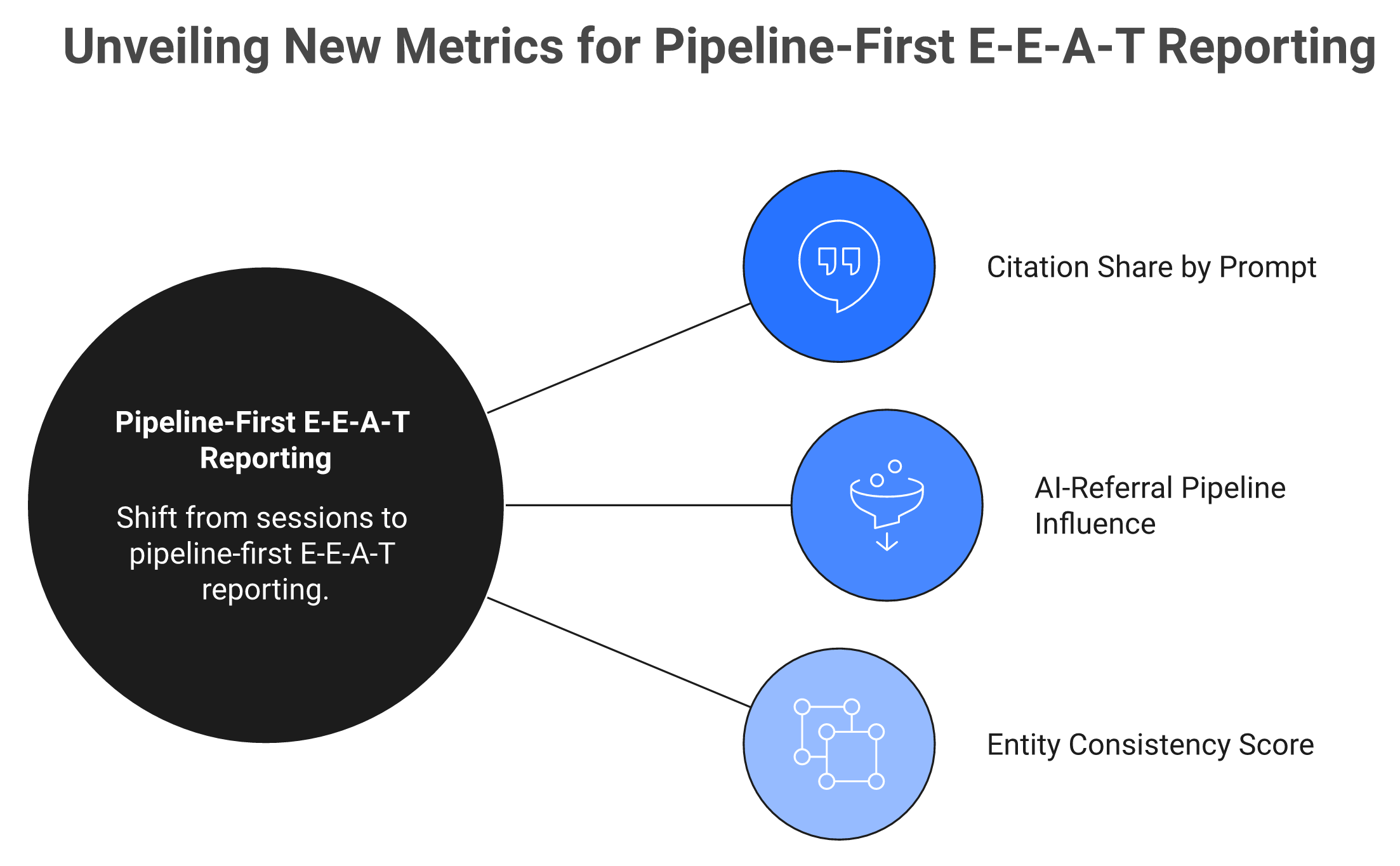
Three numbers replace the traffic chart.
- Citation share by prompt. Across your prompt set, how often does your brand appear versus competitors?
- AI-referral pipeline influence. Segment AI referrers in GA4 traffic acquisition, then tie them to opportunities, not sessions.
- Entity consistency score. How many of your external properties resolve back to the same entity without conflict.
⚠️ Why session reporting now misleads
Gartner projects a 25% decline in traditional search volume as AI assistants absorb query demand. A flat or falling session count is now the expected baseline, not a failure.
Semrush's 2025 study of 10 million keywords also found 88.1% of AI-Overview-triggering queries are informational. Your exposure concentrates exactly where conversion is weakest.
Fewer visits, better visits
Webflow reported 8% of signups coming from LLM referrals, with that traffic converting far better than search. The 6x differential means a traffic drop with stable pipeline is a win.
Your reporting has to be capable of saying that out loud. If the only chart is sessions, it cannot, which is why revenue attribution for GEO has to be built in from the start.
📊 Who owns what
| Metric | Source | Cadence | Owner |
| Citation share by prompt | Prompt panel run across four engines | Weekly | Growth or agency partner |
| AI-referral pipeline influence | GA4 traffic acquisition plus CRM | Monthly | Marketing ops |
| Entity consistency score | Schema validator plus sameAs audit | Quarterly | Developer |
| Self-reported attribution | "How did you hear about us" on forms | Continuous | Demand gen |
| Share of voice benchmark | MaximusLabs AI tracks brand citation frequency against competitors across AI answer platforms | Monthly | Agency partner |
Instrument the pages that actually carry traffic
Roughly 1 in 20 landing pages drives about 85% of all traffic, which means 19 in 20 drive almost nothing. Instrument the few first.
Trying to measure everything at once is how measurement projects die. Pick five pages, five prompts, and one quarter.
⭐ Publish the methodology beside the number
State how you counted. Say how many prompt variants, on which engines, and on what date.
That transparency is an E-E-A-T move in itself. It is also the fastest way to tell a real GEO measurement practice from a dashboard.
MaximusLabs AI measures across thousands of question variants rather than single rankings, because in a system that cites a handful of sources per answer, share of voice is the only number that maps to pipeline. Clients see reported figures like Oliv AI's 64% citation rate framed that way, as our own published claim rather than an industry benchmark.
The open question I am sitting with: when engines start personalising answers per user, does share of voice fragment into something we cannot average? If your board deck depends on one number, that is worth thinking about now.
Q11. Where Should Founders, VP Marketing and Marketing Managers Each Focus First?
Roles diverge on first move. A founder with scarce GTM budget should buy verifiable identity and earned mentions before content volume. A VP Marketing owning the number should install citation-share reporting before commissioning anything new. A marketing manager should retrofit existing revenue pages into extractable answer units, because that is the fastest measurable lift available without new budget.
One checklist cannot serve three budget authorities
A B2B buying committee reads the same article for three different decisions. The founder controls spend, the VP owns the number, and the manager owns execution.
The stake is shared. When a buyer asks an engine for the best tools in your category, the answer returns 10 to 15 names, and that list becomes the entire consideration set.
🎯 Founder lane: sequence over volume
Resource-constrained and impatient is the normal state. The highest-return order is entity identity, then earned mentions, then BOFU content, which is how GEO for SaaS startups actually pays back.
Skip TOFU deliberately. Engines already answer "what is X" natively, so that content buys impressions and nothing else.
VP Marketing lane: measure before you commission
Install citation-share reporting first. Gartner projects a 25% decline in traditional search volume, and without a new baseline that decline reads as a team failure.
Then defend MOFU and BOFU budget explicitly. Semrush found 88.1% of AI-Overview-triggering queries are informational, which is exactly where pipeline is thinnest.
"When a metric turns into a target, it loses its effectiveness as a metric."
u/dustinechos, r/webdev Reddit Thread
💰 The uncomfortable budget conversation
Someone will ask why traffic is down while spend held. The answer needs a number attached, not a narrative.
That is why measurement precedes production. You cannot defend a strategy you cannot report on.
Marketing manager lane: retrofit, don't request
No budget authority means the lever is existing pages. Five moves, none of which need a purchase order.
- Rewrite section openers into 40 to 80 word self-contained answer units.
- Add in-passage sourcing, with named source and year inside the paragraph.
- Add real author attribution instead of "editorial team".
- Raise named-entity density on the top pages.
- Run a monthly prompt-panel check across four engines.
"Tools designed to score SEO have their limitations. It's important to begin with these tools for guidance, but ultimately, effective SEO should be grounded in real analytics."
u/antiyoupunk, r/webdev Reddit Thread
📋 Three lanes, side by side
| Role | First 30-day move | Metric owned | Trap to avoid |
| Founder | Close the sameAs loop, then buy mentions | Citation share on 10 money prompts | Commissioning content volume before identity resolves |
| VP Marketing | Baseline reporting across four engines | AI-referral pipeline influence | Defending session counts against a shifting baseline |
| Marketing Manager | Retrofit the 1 in 20 pages carrying 85% of traffic | Extractable units shipped per page | Rewriting everything instead of the pages that matter |
| MaximusLabs AI lane | BOFU-first sequencing with TOFU skipped, from $1,299/mo | Share of voice across question variants | Treating GEO as an add-on to a Google-only plan |
The manager's expertise still matters here. Intent research, information architecture, and editorial judgment all transfer directly. The frame changed, not the craft.
You do not need a large budget. You need the right order.
Q12. How Do You Score Your Current E-E-A-T and Run a 30-Day Fix Sprint?
Score three layers, then fix in sequence. On-page: named authors, in-passage sourcing, dated updates, and extractable answer units. Site-level: Organization and Person schema, a closed sameAs loop, AI-crawler access, and trust pages. Off-site: review-platform depth, cited-thread presence, and podcast and analyst mentions. Week one closes identity, week two rebuilds passages, week three earns mentions, and week four baselines citation share.
Score it here, not in a gated download
| Signal | Layer | Verify in under 5 minutes | Weight |
| Named author with checkable credentials | On-page | Open any article, look at the byline | High |
| In-passage source, sample, and year | On-page | Read one paragraph in isolation | High |
| 40 to 80 word extractable answer units | On-page | Copy one out and see if it stands alone | High |
| Organization and Person schema valid | Site | Run the page through a schema validator | Medium |
| Closed sameAs loop | Site | Traverse site to Wikidata to LinkedIn and back | High |
| GPTbot and oai-searchbot allowed | Site | Read robots.txt | High |
| 10+ reviews per review platform | Off-site | Check G2, Capterra, and Gartner | Medium |
| Presence in already-cited threads | Off-site | Run your money prompts, read the citations | High |
⚠️ Score honestly or skip it
Give each signal a pass or fail, not a percentage. Half-credit is how teams talk themselves out of the work.
Anything below six passes means you are not in the retrieval set yet. That is diagnosis, not judgment.
Why the order cannot be shuffled
Identity comes first because you cannot earn a mention for an entity the machine cannot resolve. A mention that resolves to the wrong company is worse than no mention, which is why citation consistency leads the sprint.
Content comes second because passages are what get extracted. Off-site comes third because that is where the engines actually quote you from.
"It's important to begin with these tools for guidance, but ultimately, effective SEO should be grounded in real analytics."
u/antiyoupunk, r/webdev Reddit Thread
⏰ The four-week sequence
| Week | Workstream | Owner | Artifact | Verification test |
| 1 | Identity and crawler access | Developer | Schema plus closed sameAs loop | Validator passes, robots.txt allows AI agents |
| 2 | Passage rebuild on top revenue pages | Content | Answer units with in-passage sourcing | Each unit reads correctly extracted alone |
| 3 | Earned mentions on cited surfaces | Comms | Review depth, thread replies, one podcast | Brand appears in a previously cited URL |
| 4 | Baseline citation share | Analytics | Prompt panel across four engines | Repeatable number, methodology published |
MaximusLabs AI front-loads the same way, running a technical audit, plan, and keyword approval inside a two-day onboarding, with the first article live by day four. That order exists because identity work gates everything after it.
✅ The final pre-publish gate
Google Search Central's guidance on helpful, people-first content asks three questions. Who created this, how was it produced, and why does it exist?
If a page cannot answer all three in its own visible text, it fails. No schema fixes that.
What actually changes in 30 days
Identity, passage structure, and crawler access are all fully fixable inside a month. Citation share usually is not.
Earned mentions and trust compound over quarters, not weeks. Anyone promising citation lift in 30 days is selling motion.
My prediction, held loosely: entity verification and brand-mention weighting both get heavier over the next two years, and link volume keeps losing ground. What I would bet against is any single tactic staying durable across model changes. Which of these signals do you think survives the next engine update? That is the question I am still testing, and it is worth a conversation if you are running the same experiment.
Frequently asked questions
What is E-E-A-T optimization and why does it work differently in AI search?
E-E-A-T optimization is the work of making Experience, Expertise, Authoritativeness, and Trustworthiness machine-verifiable rather than merely stated. Google added Experience to its quality rater guidelines in December 2022, and says those guidelines do not directly influence rankings. In AI search the same signals behave differently. Teardowns of AI Overview source selection describe a pipeline that narrows hundreds of candidate documents to a handful of citations, with authority screening acting as a binary pass or fail step before passage-level re-ranking happens. That is the shift worth internalising: Organic search offers hundreds of positions, so E-E-A-T behaves like a gradient. An AI answer cites a few domains, so E-E-A-T behaves like a door. Being page one on Google is now fully compatible with being invisible in AI answers. MaximusLabs AI measures visibility as citation share across prompt sets on ChatGPT, Claude, Perplexity, and Gemini, rather than position on a single keyword, because a rank report cannot tell you whether you made a buyer's shortlist. We built our trust-first content methodology on that assumption. Stop optimizing for position and start optimizing for admission: every claim traceable, every author verifiable, every passage self-contained enough to be lifted alone.
How is E-E-A-T for AI citations different from E-E-A-T for Google rankings?
Three differences matter, and each one changes where budget should go. Scope: Google raters evaluate a page and site holistically, while AI engines score individual passages and named entities. Source preference: owned content can rank on merit, while generative engines lean toward authoritative third-party sources. Slot scarcity: hundreds of organic positions against a handful of cited domains per answer. The overlap between the two systems collapsed fast. Ahrefs found only 38% of AI Overview citations now come from pages ranking in the organic top 10, against roughly 76% previously. Ranking and being cited are two channels with two qualification tests and two reporting lines. The surfaces also move. Semrush analysed 10 million keywords and found AI Overview coverage rose from 6.5% of queries in January 2025 to just under 25% by July, then fell back below 16% by November. So separate durable signals from engine quirks. Durable: verifiable identity, primary sourcing, earned mentions, and extractable passages. Engine-specific: formatting and answer-length preferences that change with each model release. MaximusLabs AI maps trust requirements per platform rather than optimizing for "AI" generically, and you can see how the two disciplines diverge in our breakdown of GEO versus traditional SEO .
Why does Trustworthiness matter more than Experience, Expertise, and Authoritativeness?
Trust decides eligibility. Google's guidelines name Trustworthiness the most important member of the E-E-A-T family, because untrustworthy pages have low E-E-A-T no matter how experienced, expert, or authoritative they appear. Read that structurally. Experience, Expertise, and Authoritativeness are inputs . Trust is the single verdict they feed. Running four parallel pillar projects is a category error, and one Trust workstream with three feeder streams is the correct shape. Google publishes the audit free, built on three questions: who created this, how was it produced, and why does it exist. Install those as a pre-publish gate rather than a quarterly review. The failure pattern shows up constantly in audits. Author bios are immaculate, while half the statistics carry no source, pages have no update date, and the contact path goes nowhere. That site added expertise theater and left trust broken. Fix in this order: Source and date every factual claim on revenue pages. Verify identity with named authors, real credentials, and working contact paths. Publish experience proof, including original screenshots and first-party data. Accumulate authority through earned mentions on sources engines already cite. MaximusLabs AI blocks any page carrying a factual claim without a named primary source attached, which is how our E-E-A-T for AEO approach turns trust into a workflow rule.
Does AI-generated content break E-E-A-T?
No, and Google states it directly. Its guidance says appropriate use of AI is not against the guidelines, while using automation to generate content primarily to manipulate rankings violates spam policy. Google also notes AI use confers no special gains: if content is useful, helpful, and original it may do well, and if not, it may not. The failure mode is not the tool. It is summarising five articles to produce a sixth, with no first-hand input and nothing new to gain from reading it. Engines cannot inspect lived experience, so they infer it from consensus, meaning how often and where the web associates a named person or brand with a topic. One practitioner watched Perplexity describe his team as Oxford researchers because the engine found a conceptually adjacent paper and borrowed its credentials. Web-wide association beat the actual author page. Three artifacts make experience checkable: Original screenshots with visible timestamps from your own tooling. A named-author process log describing what you tested and what failed. First-party result data with method and sample size disclosed. MaximusLabs AI captures that experience through founder interviews before drafting begins, because first-hand experience cannot be researched into existence. Our founder voice methodology exists for exactly that reason.
Do brand mentions really matter more than backlinks for AI visibility?
The evidence points that way, with an honest caveat. An Ahrefs study of roughly 75,000 brands found branded web mentions, linked and unlinked, correlate with AI Overview visibility at r=0.664, against r=0.218 for backlinks. That is correlation, not a causal test, and large brands get both mentioned and cited more often. The mechanism is intuitive. Traversing a link graph is expensive, while counting how often two things appear near each other in text is cheap, and language models already store co-occurrence. Your brand sitting beside a category phrase across a thousand pages is a signal the model gets for free. Academic work agrees on direction. The Princeton GEO paper (Aggarwal et al., KDD 2024) found engines favour authoritative third-party sources even when brand-owned content covers the topic better. Practical reallocation: Move a defined share, for example 30% of this quarter's link budget, to earned mention surfaces. Prioritise review platforms, already-cited Reddit and Quora threads, podcasts, and YouTube. Measure citation share across your prompt set instead of domain rating. MaximusLabs AI runs this as Search Everywhere Optimization, covering review-platform depth, community participation, and PR placement across surfaces engines already quote. Our citation acquisition tactics break the sequence down step by step.
How do you measure E-E-A-T against pipeline instead of pageviews?
Replace the traffic chart with three numbers. Citation share by prompt: how often your brand appears versus competitors across ChatGPT, Perplexity, Gemini, and Copilot. AI-referral pipeline influence: segment AI referrers in GA4 traffic acquisition, then tie them to opportunities rather than sessions. Entity consistency score: how many external properties resolve back to the same entity without conflict. Session reporting now misleads. Gartner projects a 25% decline in traditional search volume as AI assistants absorb query demand, so a flat or falling session count is the expected baseline rather than a failure. Semrush also found 88.1% of AI-Overview-triggering queries are informational, which concentrates exposure where conversion is weakest. Quality changed too. Practitioner data reports roughly a 6x conversion-rate difference between LLM-referred traffic and classic Google traffic, which means a traffic drop with stable pipeline is a win, and your reporting must be able to say so. Start narrow. Roughly 1 in 20 landing pages drives about 85% of all traffic, so instrument those first with five pages and five prompts. MaximusLabs AI measures across thousands of question variants rather than single rankings, because share of voice is the only number that maps to pipeline. Our GEO measurement framework publishes methodology alongside every figure.
What does a 30-day E-E-A-T fix sprint actually look like?
Score three layers, then fix in sequence. On-page: named authors, in-passage sourcing, dated updates, and extractable answer units. Site-level: Organization and Person schema, a closed sameAs loop, AI-crawler access, and trust pages. Off-site: review-platform depth, cited-thread presence, and podcast or analyst mentions. The order cannot be shuffled. You cannot earn a mention for an entity the machine cannot resolve, and a mention resolving to the wrong company is worse than none. Week 1: developer closes identity, covering schema, sameAs reciprocity, and robots.txt access for GPTbot and oai-searchbot. Week 2: content rebuilds passages on top revenue pages into 40 to 80 word answer units with in-passage sourcing. Week 3: comms earns mentions on surfaces already cited in your money prompts. Week 4: analytics baselines citation share across four engines with published methodology. Be honest about the timeline. Identity, passage structure, and crawler access are fixable inside a month, while earned mentions and trust compound over quarters. Anyone promising citation lift in 30 days is selling motion. MaximusLabs AI front-loads the same way, running a technical audit, plan, and keyword approval inside a two-day onboarding with the first article live by day four. If you want that sequence pressure-tested against your own site, talk to us .