 Krishna Kaanth M
- AI crawlers split into training bots (GPTBot, ClaudeBot, Google-Extended, CCBot) and retrieval bots (OAI-SearchBot, PerplexityBot, Claude-SearchBot) that fetch live pages to cite.
- Blocking retrieval bots makes you invisible in AI answers; the top mistake is allowing only GPTBot while OAI-SearchBot, the bot that actually cites you, stays blocked.
- Blocking Google-Extended never affects Google Search rankings, since Googlebot runs on a completely separate track.
- Decide access by crawl-to-referral economics: ClaudeBot crawls roughly 130,000 pages per referral, so weigh bandwidth cost against citation value.
- Most crawlers do not run JavaScript, so client-side reviews and pricing vanish; llms.txt remains unproven, making clean server-rendered HTML the real lever.
- Push content with IndexNow, enforce blocks at the edge with WAF and CDN, and measure citations, share of voice, and pipeline rather than crawl-log hits.
Q1: What exactly is an AI crawler, and why does crawl access now decide whether you exist?
An AI crawler is an automated bot that fetches web pages to either train large language models or retrieve live content for AI answers in ChatGPT, Perplexity, Gemini, and Claude. Unlike Googlebot, which feeds a ranked list of blue links, AI crawlers feed a single synthesized answer. If a crawler cannot access you, you are absent from that answer box entirely. The evaluative window has collapsed from a page of links to one response.
🎬 The moment the blue links disappeared
Picture John, a Head of Sales at a mid-market SaaS company. He opens ChatGPT and asks for the top tools in his category, with pros, cons, and pricing. In seconds, he gets a curated shortlist. That list becomes his sample set. He never opens Google.
For twenty years, the game was ranking on page one. You could be result number seven and still get the click. That safety net is gone.
⚠️ Why "one answer" changes the stakes
When the answer is a single box naming five to ten brands, position is binary. You are in the set, or you do not exist to that buyer. As we like to say at MaximusLabs, the penalty for average has never been so severe.
This is why crawl access sits upstream of everything. An AI engine cannot cite a page its crawler never fetched. Before schema, before content, before trust signals, there is one question: can the bot read you at all?
Two forces make this urgent, and both trace to primary sources:
- Gartner projects over 50% of search traffic will move from traditional engines to AI-native platforms by 2028.
- Roughly 70% of searches are now zero-click, meaning the AI answers directly without a site visit, reshaping the entire zero-click search brand economy.
OpenAI launched ChatGPT Search on October 31, 2024, and its answers pull live pages through a dedicated retrieval crawler. If that crawler is blocked, you are invisible in ChatGPT, no matter how well you rank on Google. Understanding managing AI crawlers like GPTBot and Google-Extended is the first move.
🧭 From ranking to becoming the answer
Here is where our thinking sits right now. The old scoreboard measured position. The new one measures presence. At MaximusLabs, we stopped asking how to rank and started asking how to become the answer AI engines cite through generative engine optimization. Crawl access is simply the first domino. Everything downstream, from citation to pipeline, depends on it falling the right way.
Q2: Which AI crawlers matter in 2026, and what is each one actually doing?
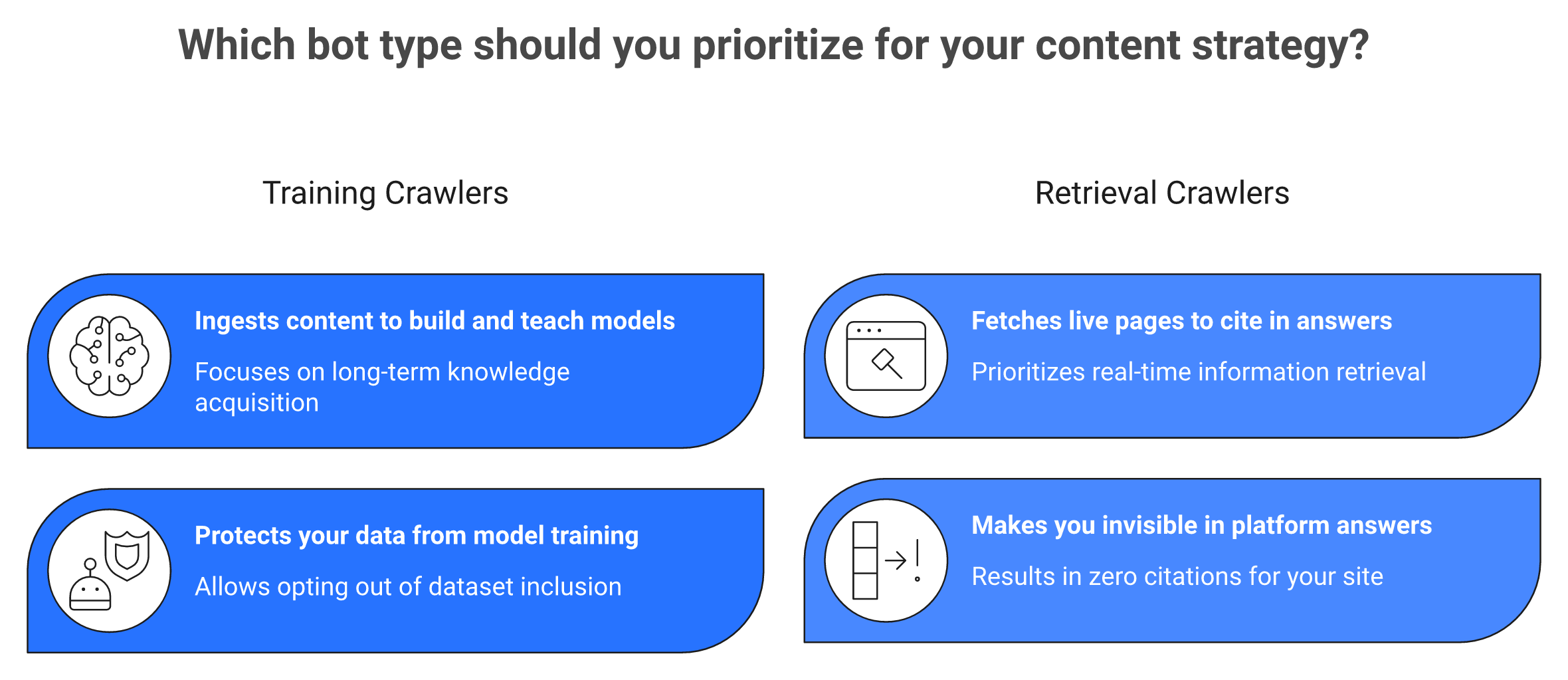
The AI crawlers that matter in 2026 split into two jobs. Training crawlers (GPTBot, ClaudeBot, Google-Extended, CCBot) ingest content to build models. Retrieval crawlers (OAI-SearchBot, ChatGPT-User, PerplexityBot, Claude-SearchBot) fetch live pages to cite in answers. Blocking a training bot protects your data. Blocking a retrieval bot makes you invisible in that platform's answers. Every major vendor runs both, and you control them independently.
🤖 The two jobs every crawler does
Most people picture "AI crawlers" as one thing. That mental model is the root of most costly mistakes. A single vendor often runs several bots, each with a different purpose and a different user-agent string.
Training crawlers collect data to teach the model. Retrieval crawlers fetch a page in real time to answer a live question and cite the source. You can allow one and block the other. That control is the whole game, and it sits at the heart of any technical SEO and website audit.
📋 The 2026 AI crawler reference table
Here is the taxonomy, with each bot mapped to its vendor, job, and a sensible default. All user-agent strings and roles are documented in the platforms' own bot pages.
| Crawler | Vendor | Job | Sensible default |
|---|---|---|---|
| GPTBot | OpenAI | Training | Block to opt out of model training |
| OAI-SearchBot | OpenAI | Retrieval (ChatGPT Search) | Allow to be cited |
| ChatGPT-User | OpenAI | On-demand user fetch | Allow |
| ClaudeBot | Anthropic | Training | Decide per data policy |
| Claude-SearchBot | Anthropic | Retrieval | Allow to be cited |
| Google-Extended | Training (Gemini, Vertex) | Optional block, no Search impact | |
| PerplexityBot | Perplexity | Retrieval | Allow to be cited |
| CCBot | Common Crawl | Training (feeds many models) | High-leverage training block |
Google introduced Google-Extended in September 2023 specifically so publishers could opt out of Gemini training without touching Google Search. Getting each bot right is core to ChatGPT optimization and Perplexity optimization alike.
💡 The distinction that costs people citations
The most expensive misunderstanding lives inside OpenAI. Practitioner guidance is blunt here: allow OAI-SearchBot separately from other bots, because blocking it means not appearing in ChatGPT Search. Many sites report they "allowed OpenAI" yet get zero citations, because they allowed only GPTBot, the training bot, not the retrieval bot that actually does the citing.
From what surfaces when you actually audit sites, this single confusion explains more invisibility than any content problem. Get the taxonomy right first, and the rest of the work has somewhere to land.
Q3: Should you block or allow AI crawlers, and how do crawl-to-referral economics change the answer?
Do not block by default. Decide per bot using crawl-to-referral economics. Cloudflare data shows ClaudeBot crawls roughly 130,000 pages per single referral, GPTBot about 1,091 to 1, and PerplexityBot around 195 to 1. A bot that crawls heavily but sends almost no traffic is a cost. A retrieval bot that cites you drives high-intent pipeline. Match the decision to the ratio.
🧱 The reflex that quietly costs you pipeline
When teams first learn AI bots are hammering their servers, the instinct is simple: block everything. The opposite reflex is just as common, which is allow everything and hope for exposure. Both are guesses dressed up as strategy.
The standard read gets this backwards. The question was never "AI, yes or no." It is "which bot, doing which job, at what cost."
📊 The complication: bots are wildly unequal
Not all crawlers pull their weight. Cloudflare's Radar data on crawl-to-referral ratios makes the gap concrete:
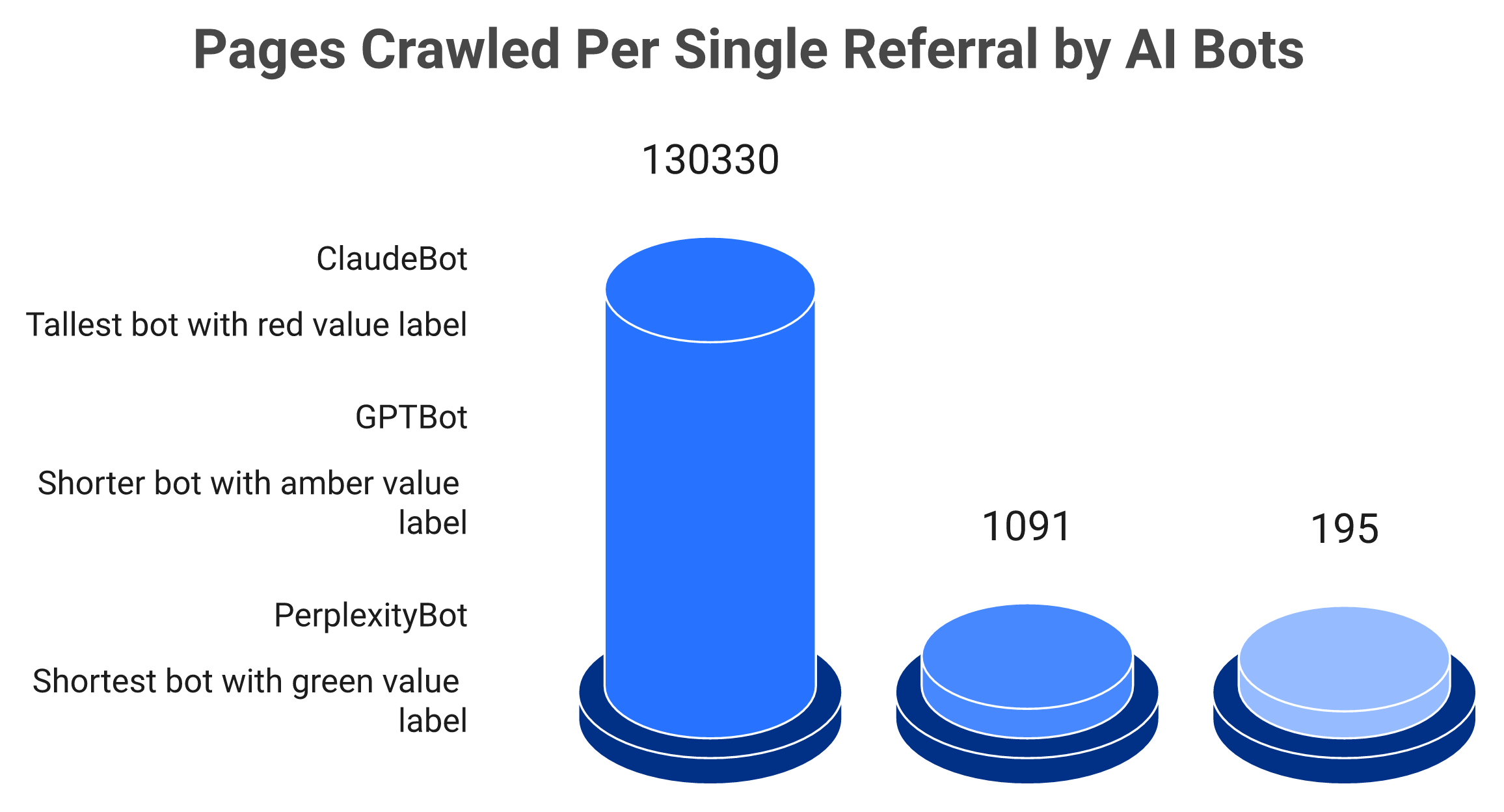
- ClaudeBot: roughly 130,330 pages crawled per referral sent back.
- GPTBot: about 1,091 to 1.
- PerplexityBot: around 195 to 1.
A bot near the top of that list consumes bandwidth and gives almost nothing back in visits. A retrieval bot with a tighter ratio is closer to a distribution channel. Treating them the same is like paying every sales rep identically while one closes deals and another just runs up the expense account.
💰 The resolution: decide by ratio, and by revenue
Here is the founder-operator lens. The reason to allow a retrieval bot is not exposure. It is conversion. Webflow reported a 6x conversion rate difference between LLM traffic and Google search traffic, because AI buyers arrive pre-sold. Blocking the bot that feeds that channel is not an IT decision. It is a pipeline decision, which is why we treat it as part of GEO ROI and revenue attribution.
So the framework is straightforward:
- High crawl, near-zero referral, pure training: block or rate-limit.
- Retrieval bot that cites you: allow, and make yourself easy to cite.
- Dual-purpose bot: allow retrieval, evaluate training separately.
💬 What practitioners are seeing
"It is not your choice whether to play the game. You are playing the game whether you want to or not, and blocking indexing entirely means you forfeit the game and cede the channel to your competitors."
Ethan Smith, CEO, Graphite (AEO practitioner analysis, MaximusLabs Knowledge Base)
This is exactly how we frame crawler decisions at MaximusLabs. Our revenue-focused GEO methodology ties every access choice to pipeline and revenue, not to crawl-log vanity metrics, because a bot that cannot cite you cannot convert for you.
Q4: How do you configure robots.txt for AI crawlers without accidentally blocking your citations?
Configure robots.txt per user-agent, not per vendor. To stay out of training but visible in answers, disallow GPTBot and Google-Extended while explicitly allowing OAI-SearchBot, ChatGPT-User, and PerplexityBot. Blocking Google-Extended never affects your Google Search ranking, since that is Googlebot's job, a separate agent. The most common failure is allowing only GPTBot and assuming you are "OpenAI-optimized," when OAI-SearchBot is the bot that actually cites you in ChatGPT Search.
🛠️ The correct pattern, first
Lead with the config, then the reasoning. To protect training data while staying citable, this is the shape you want. robots.txt directives are governed by the RFC 9309 standard and read top to bottom per user-agent. To block training but allow retrieval, disallow GPTBot and Google-Extended, then explicitly allow OAI-SearchBot, ChatGPT-User, and PerplexityBot. For a full block, disallow GPTBot, OAI-SearchBot, ClaudeBot, PerplexityBot, and CCBot together. Our technical SEO guide walks through each variant.
⚠️ Google-Extended is not Googlebot
This is the fear we hear most: "If I block Google's AI bot, do I lose my rankings?" No. Google-Extended, introduced in September 2023, controls only Gemini and Vertex AI training inclusion. Googlebot runs Google Search on a completely separate track and ignores your Google-Extended rule entirely. You can opt out of AI training and keep every ounce of your organic ranking, a nuance we cover in our Google Gemini AI Mode guide.
❌ The mistake that erases you from ChatGPT
The single most damaging misconfiguration is silent. A site disallows GPTBot, allows nothing else from OpenAI, and declares victory. But GPTBot is the training bot. The bot that fetches and cites you inside ChatGPT Search is OAI-SearchBot, and if it is not explicitly allowed, you vanish from those answers. Practitioner guidance is emphatic: allow OAI-SearchBot separately, or accept zero ChatGPT citations. You can confirm what each bot sees with an AI crawlability checker.
One more truth worth saying plainly. robots.txt is a request, not a lock. It signals intent, and major bots honor it, but it does not physically enforce anything. That distinction matters, and it is where enforcement comes in later.
🔧 How we handle this in practice
When we run a technical audit at MaximusLabs, unblocking GPTBot's retrieval counterparts, especially OAI-SearchBot, is a standard first-week step, not an afterthought. We have seen sites that swore they "allowed OpenAI" earn nothing in ChatGPT, purely because the retrieval agent sat behind a stray Disallow. Fixing one line restored their citation path, the kind of fix our ChatGPT SEO guide details. The config is boring. The revenue impact is not.
Q5: robots.txt vs llms.txt vs AI.txt, which files control AI access, and is llms.txt a real lever or a myth?
Three files claim to control AI access, and they do different jobs. robots.txt grants or denies crawler access and is respected by major bots. llms.txt, proposed by Answer.AI in September 2024, is a curated markdown map suggesting which pages matter. AI.txt signals training-data licensing preferences. As of early 2026, no major AI platform confirms consuming llms.txt, and there is no measured citation lift. Treat it as cheap hygiene, not a silver bullet.
🎯 The pitch you keep hearing
A vendor tells you llms.txt is "the new robots.txt," the one file that will get you cited across every AI engine. Ship it this week, they say, and watch the citations roll in. It sounds clean, technical, and reassuringly simple.
We hear this claim in almost every audit. It is seductive precisely because it turns a hard problem into a single file upload, and you can even spin one up with an llms.txt generator in minutes.
⚠️ The complication: three files, three jobs, one unproven
The three files are not interchangeable, and only one is actually enforced today.
| File | Purpose | Who honors it | 2026 reality |
|---|---|---|---|
| robots.txt | Grants or denies crawler access | Major bots (voluntarily) | Standardized under RFC 9309, widely respected |
| llms.txt | Curated markdown map of key pages | Proposed spec, no confirmed consumers | Roughly 10% domain adoption, no citation lift measured |
| AI.txt | Signals training-data licensing preference | Emerging, limited support | Niche, licensing-focused |
llms.txt was proposed by Jeremy Howard at Answer.AI on September 3, 2024. The catch is simple. As of early 2026, no major AI platform has confirmed it consumes the file, and no dataset shows a citation increase from having it. The honest verdict from practitioners is blunt: treating markdown-only pages or llms.txt as a silver bullet has no evidence of any effect. Our llms.txt implementation guide covers what it can and cannot do.
✅ The resolution: ship it cheap, invest where it counts
So do not burn a sprint chasing it. llms.txt costs an hour to publish, so ship a spec-compliant version as good hygiene and forward-investment. Then put your real effort where crawlers actually read, which is clean server-rendered HTML and schema markup basics.
Here is where our thinking sits, and it is deliberately cautious. At MaximusLabs, we refuse to sell a tactic we cannot yet validate with data, a principle rooted in our trust-first content playbook. We might be wrong if platforms start honoring llms.txt tomorrow, and if they do, our clients already have the file. Until then, we flag it as unproven rather than dress it up as a fix, because trust is the currency we are actually optimizing for through generative engine optimization.
Q6: Why can AI crawlers see your competitors but not your best pages, and how do you test what each bot actually sees?
Most AI crawlers fetch raw HTML and do not execute JavaScript. Only Google-Extended renders JS reliably. If your reviews, pricing, or specs load via client-side JavaScript, AI crawlers see a blank space where your strongest trust signals should be. To verify, toggle JavaScript off in your browser, or fetch each page with the bot's user-agent using curl. Whatever disappears is invisible to ChatGPT and Perplexity. Server-side rendering is not optional.
🖥️ The rendering gap, stated plainly
Start with the conclusion, because it explains most "why am I invisible" mysteries. AI crawlers are not full browsers. Most of them grab the raw HTML your server sends and stop there. They do not wait for JavaScript to build the page.
Only Google-Extended renders JavaScript with any reliability. So if a page assembles itself in the browser after load, the crawler sees the skeleton, not the content, a problem our technical SEO and website audit is built to catch.
🔍 The moment of truth: turn JavaScript off
Here is the test that ends the guessing. Turn JavaScript off in your browser and reload a key page. If the whole page does not show up, that missing content is invisible to AI crawlers too.
This bites hardest on trust signals. Reviews, pricing, and product specs are often loaded asynchronously, meaning they arrive after the initial page via a separate script. The crawler that would cite you never sees the very proof that makes you citable. We once watched a founder's face drop mid-audit when the reviews on a large product page simply vanished with JavaScript disabled. You can spot-check the same thing fast with an AI crawlability checker.
Two verification moves take minutes:
- Toggle JavaScript off in browser settings and reload each priority page.
- Fetch the page with curl using a bot's user-agent string to see exactly what that bot receives.
🧹 Keep the signal clean
There is a second, subtler trap. A model has a finite attention window, around 200,000 tokens (a token is a chunk of text the model processes). If your HTML is noisy with heavy code and clutter, your core text loses fidelity as the model tokenizes the page.
Clean, server-rendered HTML fixes both problems at once. This is why, in every MaximusLabs technical GEO implementation, forcing critical content into server-side HTML is a non-negotiable step, not a nice-to-have. The best content in the world cannot be cited if the crawler receives an empty div where your reviews should be, which is why we treat rendering as core to Perplexity optimization.
Q7: How should you architect your site so AI agents can actually reach your deep pages?
AI agents follow links point-to-point, not by intuition. Deep pages with no internal links are orphaned and never fetched. Use a dense point-to-point internal-linking model rather than a hub-and-spoke one that strands your most specific pages. Keep high-value content, especially help centers, in subdirectories, not subdomains. An agent told to look in one filing cabinet will not check the others. Architecture decides which pages an AI can even find.
✈️ The airline route map
Think of two airlines. Southwest flies point-to-point, connecting many cities directly. Singapore Airlines uses a hub-and-spoke model, routing everything through one center. AI agents behave like Southwest passengers. They travel link by link, and a page with no inbound links is a city with no runway.
Deep pages that answer specific buyer questions are often the most valuable and the most orphaned. If nothing links to them, no crawler arrives. Your best long-tail content sits dark, which is where a deliberate GEO topic cluster earns its keep.
🗄️ The filing cabinet problem
Now the subdomain trap. Picture subdomains as separate filing cabinets standing in the same room. If an AI agent is told to look in one cabinet, it will not automatically open the others, even though they share the room.
This is why help centers matter so much for AI answers. They hold the exact integration, feature, and use-case detail that buyers ask agents about. Practitioner guidance is direct: move the help center to a subdirectory, because subdomains do not perform as well as subdirectories. In practice, that means domain.com/help, not help.domain.com, plus dense cross-linking between related articles, a pattern our programmatic SEO service operationalizes at scale.
Your architecture checklist:
- Link deep pages from relevant hub and category pages, no orphans.
- Cross-link help and feature articles to each other, point-to-point.
- Serve help centers and key content from subdirectories, not subdomains.
- Give every priority page at least one internal path an agent can walk.
🧭 Build the map before you build the content
Here is the point the category avoids saying out loud. You can write brilliant answers and still lose, purely because no agent can reach them. Structure is not a finishing touch. It is the precondition, and it anchors our GEO strategy framework.
When we build content ecosystems at MaximusLabs, we design internal linking for both humans and AI crawlers from day one, so deep pages have a walkable path rather than sitting stranded. The content earns the citation. The architecture earns the visit, and both feed our GEO service.
Q8: Does robots.txt actually stop AI crawlers, and how do you enforce access at the edge?
No. robots.txt is a voluntary request, not a firewall. Major providers say they honor it, but there is no protocol-level enforcement. In August 2025, Cloudflare documented Perplexity issuing millions of undeclared daily requests despite robots.txt blocks, then de-listed it as a verified bot. To truly block a crawler, pair robots.txt with edge enforcement: WAF rules, CDN bot management, or one-click AI-bot blocking at the network layer.
🔒 The false sense of safety
You added a Disallow line. You feel protected. That feeling is the risk.
robots.txt is a polite sign on the door, not a lock. It tells well-behaved bots to stay out, and most major crawlers comply because their reputation depends on it. But nothing in the protocol physically stops a bot that decides to ignore it, a reality worth understanding before you start managing AI crawlers like GPTBot and Google-Extended.
⚠️ When the honor system breaks
The gap stopped being theoretical in 2025. Cloudflare documented Perplexity issuing millions of undeclared daily requests despite robots.txt blocks, then de-listed it as a verified bot. A rule you trusted was simply walked past.
This is not just a bandwidth story. Training-data access is now a boardroom issue, with the New York Times versus OpenAI litigation putting roughly 20 million ChatGPT logs into discovery. When the stakes are legal and competitive, "please do not crawl" is not enough on its own. The standard read gets this backwards. It treats robots.txt as the finish line. It is the starting line, as our technical SEO guide lays out.
🛡️ The enforcement stack that actually holds
For any bot you genuinely must block, layer real enforcement on top of the request:
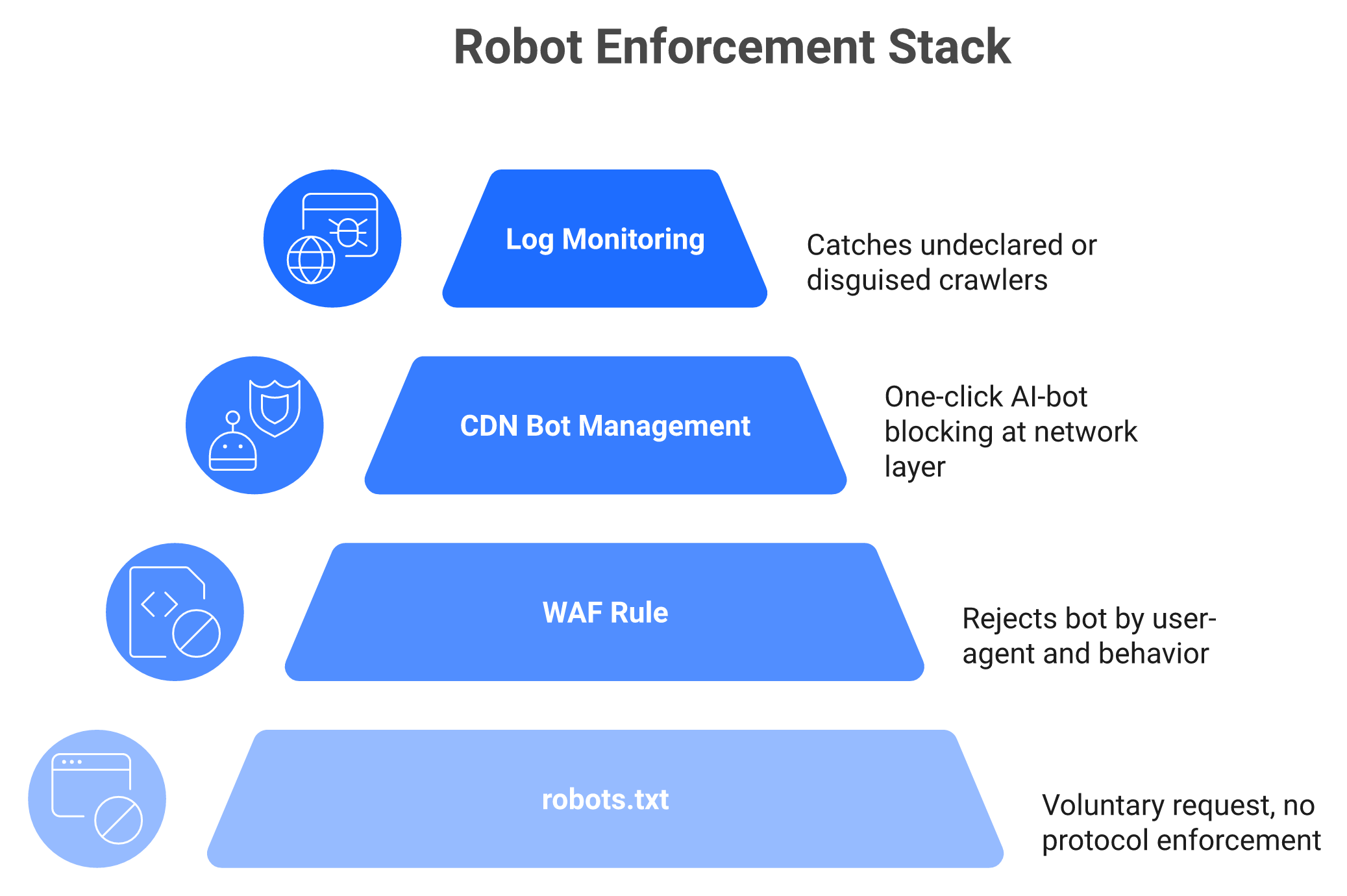
- Keep the robots.txt Disallow as your stated intent.
- Add a WAF rule (a web application firewall that filters traffic) to reject the bot by user-agent and behavior.
- Turn on CDN bot management, including one-click AI-bot blocking now offered at the network layer.
- Monitor server logs for undeclared or disguised crawlers.
Think of it like a nightclub. robots.txt is the "members only" sign. The WAF and CDN are the bouncer who actually checks the door. Signs deter the polite. Bouncers stop the rest, and knowing which is which is fundamental to real answer engine optimization.
Q9: How do you get AI crawlers to fetch and cite new content within hours, not weeks?
Do not wait for the standard crawl. Push updates into the pipeline. Implementing IndexNow (host a key file, then POST your changed URLs) has driven first Bingbot crawls within 3 to 6 hours and content-to-citation compression to roughly 24 to 72 hours. It matters because AI crawlers are inefficient at fetch. OpenAI's OAI-SearchBot wastes about 34.8% of its crawl budget on dead pages, versus Googlebot's 8.22%. Clean up 404s and push.
⏰ Push, do not wait
Start with the action, because the reflex is wrong. Most teams publish, then wait for a crawler to wander by. In AI search, that patience costs you the window when a topic is hot.
IndexNow flips the model. You host a small key file on your server, then send a POST request (a direct signal) listing the URLs that changed. Instead of hoping a bot finds you, you hand it the address, a move our technical GEO implementation wires in by default.
📊 The speed you can actually expect
The measured results are concrete, not aspirational. With IndexNow in place, first Bingbot crawls have landed within 3 to 6 hours, and content-to-citation has compressed to roughly 24 to 72 hours. That is the gap between being part of this week's answers and missing them entirely, and it is a core lever in any serious generative engine optimization program.
Why the urgency? Because AI crawlers are clumsy at the fetch stage today. The numbers are stark:
- OAI-SearchBot (OpenAI's retrieval bot) wastes about 34.8% of its crawl budget on 404 (dead-page) errors.
- Googlebot, by comparison, wastes only 8.22% on the same.
An AI crawler burns roughly a third of its visit hitting pages that no longer exist. Every dead link you leave up spends budget that should have reached your live, citable content, which is exactly what our technical SEO and website audit is designed to surface.
🧹 The push-and-prune workflow
So the playbook is two moves, run together:
- Prune. Audit for 404s and broken redirects, then fix or remove them, so the crawler spends its budget on real pages.
- Push. Wire up IndexNow and POST every new or updated URL the moment it ships.
This is exactly the kind of unglamorous, high-leverage work we prioritize at MaximusLabs. When we run a technical sprint, cleaning the dead-page waste and turning on direct URL submission is standard, because it compresses the time from publish to citation without touching the content itself. You can pressure-test the fetch side yourself with an AI crawlability checker. The standard read treats crawling as passive. From what surfaces when you actually run this, it is a channel you can push, and it pairs directly with our ChatGPT optimization work.
Q10: How do you measure whether AI crawler optimization is actually driving pipeline?
Stop measuring crawler success by hits in your server logs. Measure it by citations and pipeline. Track your share of voice across thousands of AI query variants, monitor which URLs ChatGPT and Perplexity actually cite, and attribute AI-referred traffic to conversions in GA4. Crawl access is the input. Being cited as the answer, and converting that high-intent traffic, is the outcome that moves the revenue number.
📉 The metric that feels good and means little
Your logs light up. AI bots are crawling thousands of pages a day. It looks like progress, and it is the wrong scoreboard.
Crawl hits measure access, not outcome. A bot can fetch every page you own and still never cite you, and a citation can still fail to convert. Counting crawls is like counting how many shoppers walked past your window, then calling it revenue, a trap our AI search visibility and brand mention tracking approach is built to avoid.
🔗 The chain that actually breaks
Here is the complication most teams miss. There are three separate links in the chain, and each can snap on its own.
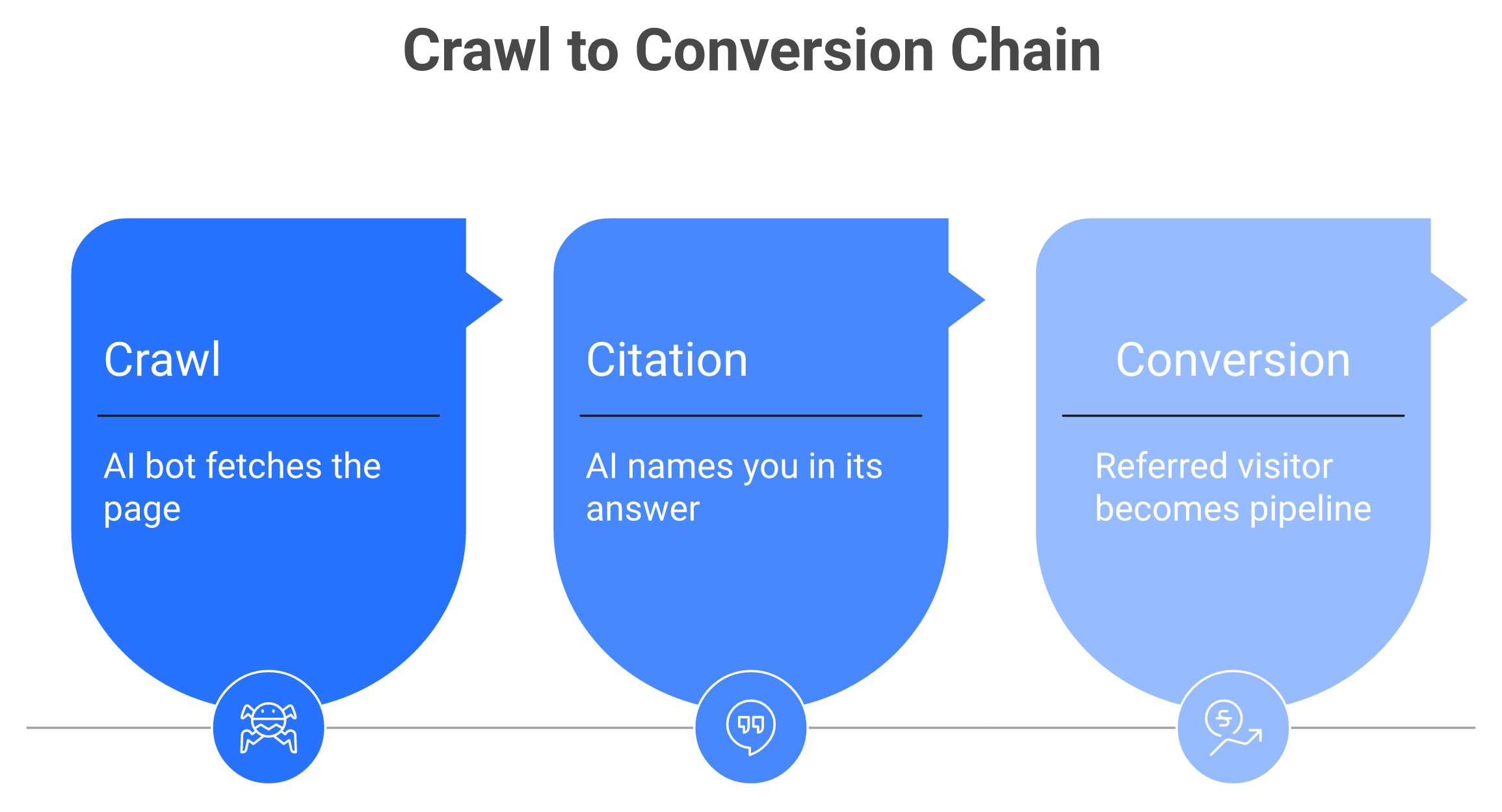
- Crawl: the bot fetches the page.
- Citation: the AI names you in its answer.
- Conversion: that referred visitor becomes pipeline.
You have to measure all three, not just the first. And the payoff is real, because AI traffic converts. Webflow reported a 6x conversion rate difference between LLM traffic and Google search traffic, since AI buyers arrive pre-sold. There is also a focus dividend, because roughly 19 out of 20 landing pages drive little traffic, while one in twenty drives about 85% of it. Measure which cited pages actually pull, then feed them, which is the heart of GEO ROI and revenue attribution.
📐 The measurement stack that ties to revenue
Replace the log obsession with a three-layer stack:
- Share of voice: how often you appear as the answer across thousands of query variants, not a single ranking.
- Citation tracking: which exact URLs ChatGPT and Perplexity cite for your target questions.
- Attribution: tag AI-referred sessions in GA4 (Google Analytics 4) and follow them to conversions.
This is the whole reason MaximusLabs pioneered Revenue-focused Answer Engine Optimization and Revenue-focused Generative Engine Optimization, codified in our R-GEO revenue-focused framework. We track citation share of voice against competitors, not impressions. In one program, a client reached a 64% citation rate across AI platforms and overtook a billion-dollar competitor sitting at 30%, in about six months, a story we detail in our Oliv AI B2B SaaS case study. Clicks and impressions are vanity metrics if they never touch pipeline.
🔮 What we are sitting with next
Where our thinking is right now is this. Over the next two years, we expect "becoming the answer" to stop being an edge and become table stakes. The brands that built trust-first, AI-discoverable content early will own the citations, and the ones still counting crawl-log hits will wonder where their pipeline went, a shift we map in our AI Visibility Gap 2026 benchmark.
Here is the question we keep asking founders mid-audit. If a buyer asked ChatGPT for the best option in your category today, would you be in the answer, and could you prove it drove revenue? If you are not sure, that gap is the work, and it is exactly where our answer engine optimization begins.
"It is not your choice whether to play the game. You are playing the game whether you want to or not."
Ethan Smith, CEO, Graphite (AEO practitioner analysis, MaximusLabs Knowledge Base)
Frequently asked questions
What is an AI crawler, and why does crawl access decide whether we appear in AI answers?
An AI crawler is an automated bot that fetches web pages either to train large language models or to retrieve live content for AI answers in ChatGPT, Perplexity, Gemini, and Claude. Unlike Googlebot, which feeds a ranked list of blue links, AI crawlers feed a single synthesized answer. This changes the stakes completely. When the answer is one box naming five to ten brands, position is binary. You are in the set, or you do not exist to that buyer. An AI engine cannot cite a page its crawler never fetched, so crawl access sits upstream of schema, content, and trust signals. Gartner projects over 50% of search traffic will move to AI-native platforms by 2028. Roughly 70% of searches are now zero-click, answered directly without a site visit. OpenAI launched ChatGPT Search on October 31, 2024, and its answers pull live pages through a dedicated retrieval crawler. If that crawler is blocked, you are invisible in ChatGPT no matter how well you rank on Google. This is why we treat becoming the cited answer, through our generative engine optimization work, as the new scoreboard that replaces raw ranking position.
Which AI crawlers matter in 2026, and what is each one actually doing?
The crawlers that matter split into two jobs. Training crawlers ingest content to build models. Retrieval crawlers fetch live pages to cite in answers. A single vendor often runs several bots, each with its own user-agent string, and you control them independently. GPTBot (OpenAI): training. Block to opt out of model training. OAI-SearchBot (OpenAI): retrieval for ChatGPT Search. Allow to be cited. ClaudeBot (Anthropic): training. Decide per data policy. Claude-SearchBot (Anthropic): retrieval. Allow to be cited. Google-Extended (Google): training for Gemini and Vertex, no Search impact. PerplexityBot (Perplexity): retrieval. Allow to be cited. CCBot (Common Crawl): training that feeds many models. The most expensive misunderstanding lives inside OpenAI. Many sites report they allowed OpenAI yet get zero citations, because they allowed only GPTBot, the training bot, not OAI-SearchBot, the retrieval bot that actually does the citing. Getting this taxonomy right first is core to how we approach ChatGPT optimization , because every other tactic has nowhere to land until the correct bots can read your pages.
Should we block or allow AI crawlers by default?
Do not block by default, and do not allow everything either. Decide per bot using crawl-to-referral economics, which is the ratio of pages a bot crawls to the referral traffic it sends back. Cloudflare's data makes the gap concrete: ClaudeBot crawls roughly 130,000 pages per single referral. GPTBot sits around 1,091 to 1. PerplexityBot lands near 195 to 1. A bot that crawls heavily but sends almost no traffic is a bandwidth cost. A retrieval bot that cites you is closer to a distribution channel. The reason to allow a retrieval bot is not exposure, it is conversion. Webflow reported a 6x conversion rate difference between LLM traffic and Google search traffic, because AI buyers arrive pre-sold. So the framework is simple. High crawl with near-zero referral and pure training gets blocked or rate-limited. A retrieval bot that cites you gets allowed. A dual-purpose bot gets retrieval allowed while training is evaluated separately. We tie every access decision to pipeline through our GEO ROI and revenue attribution approach, because a bot that cannot cite you cannot convert for you.
How do we configure robots.txt for AI crawlers without accidentally blocking our citations?
Configure robots.txt per user-agent, not per vendor. To stay out of training while remaining visible in answers, disallow GPTBot and Google-Extended, then explicitly allow OAI-SearchBot, ChatGPT-User, and PerplexityBot. Directives are governed by the RFC 9309 standard and read top to bottom per user-agent. Two clarifications prevent the most costly errors: Google-Extended is not Googlebot. It controls only Gemini and Vertex AI training inclusion. Googlebot runs Google Search on a separate track and ignores your Google-Extended rule, so you can opt out of AI training and keep every ounce of organic ranking. OAI-SearchBot must be allowed separately. A site that disallows GPTBot and allows nothing else from OpenAI vanishes from ChatGPT Search, because GPTBot is training and OAI-SearchBot is the bot that fetches and cites you. Remember that robots.txt is a request, not a lock. It signals intent, and major bots honor it, but it does not physically enforce anything. When we run a technical SEO and website audit , unblocking retrieval agents like OAI-SearchBot is a standard first-week fix, because one stray Disallow line can silently cost every ChatGPT citation.
Is llms.txt a real ranking lever, or is clean rendering what actually matters?
As of early 2026, llms.txt is unproven. Proposed by Answer.AI in September 2024, it is a curated markdown map of key pages, but no major AI platform has confirmed it consumes the file, and no dataset shows a citation lift from having it. Treat it as cheap hygiene, not a silver bullet. It costs about an hour to publish a spec-compliant version, so ship it, then invest your real effort elsewhere. Where crawlers actually read is clean, server-rendered HTML. Most AI crawlers fetch raw HTML and do not execute JavaScript, and only Google-Extended renders JS reliably. If your reviews, pricing, or specs load via client-side JavaScript, crawlers see a blank space where your strongest trust signals should be. To verify what a bot sees: Toggle JavaScript off in your browser and reload each priority page. Whatever disappears is invisible to ChatGPT and Perplexity. Fetch the page with curl using the bot's user-agent string. In every one of our engagements, forcing critical content into server-side HTML is non-negotiable, a principle rooted in our technical GEO implementation standards, because the best content cannot be cited from an empty div.
How should we architect our site so AI agents can actually reach our deep pages?
AI agents follow links point-to-point, not by intuition. A deep page with no inbound internal links is orphaned and never fetched, which strands your most specific, highest-value content. Think of it like an airline route map: agents behave like point-to-point passengers, and a page with no links is a city with no runway. Two architectural rules do most of the work: Use dense internal linking. Link deep pages from relevant hub and category pages, and cross-link help and feature articles to each other so every priority page has a walkable path. Prefer subdirectories over subdomains. Picture subdomains as separate filing cabinets in one room; an agent told to look in one will not open the others. Serve help centers at domain.com/help, not help.domain.com. Help centers matter enormously here, because they hold the exact integration, feature, and use-case detail buyers ask agents about. You can write brilliant answers and still lose purely because no agent can reach them. When we build content ecosystems, we design internal linking for both humans and crawlers from day one, which is central to our GEO strategy framework . The content earns the citation; the architecture earns the visit.
How do we measure whether AI crawler optimization is actually driving pipeline?
Stop measuring crawler success by hits in your server logs. Crawl hits measure access, not outcome. A bot can fetch every page you own and never cite you, and a citation can still fail to convert. There are three separate links in the chain, and each can snap on its own. Crawl: the bot fetches the page. Citation: the AI names you in its answer. Conversion: that referred visitor becomes pipeline. Measure all three with a three-layer stack: share of voice across thousands of query variants, citation tracking of which exact URLs ChatGPT and Perplexity cite, and attribution that tags AI-referred sessions in GA4 and follows them to conversions. The payoff is real, since Webflow reported a 6x conversion difference between LLM and Google traffic, and roughly one in twenty pages drives about 85% of traffic, so feed the pages that actually pull. This is why we pioneered Revenue-focused GEO, codified in our R-GEO revenue-focused framework . In one program, a client reached a 64% citation rate and overtook a billion-dollar competitor sitting at 30% in about six months, because clicks and impressions are vanity metrics if they never touch pipeline.