 Krishna Kaanth M
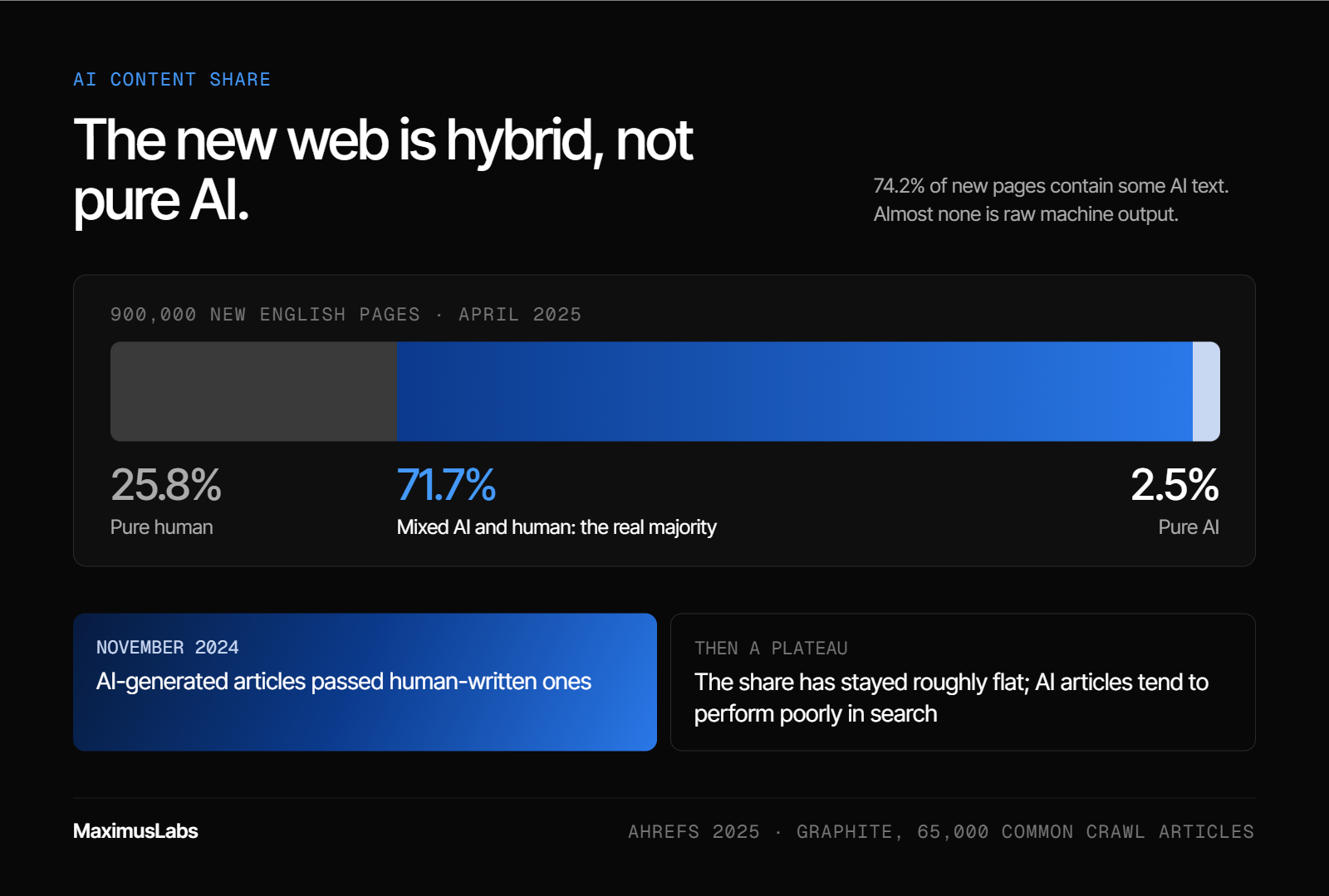
- 74.2% of new web pages contain AI text, but only 2.5% are pure AI. Hybrid, human-edited content is the real majority, and AI-article growth has plateaued.
- 97% of content marketers plan to use AI, yet use drops from 74% at ideation to 44% at drafting. Humans still own the final copy.
- ChatGPT cut writing time by 40% in an MIT experiment, but outputs were not fact-checked. Measure AI content on pipeline and cost per cited page, not words.
- Google penalizes scaled, low-value pages, not AI itself. Only 14% of Google-ranking articles and 18% of ChatGPT and Perplexity citations are AI-generated.
- AI citations are unreliable: top models reach only 39% to 77% factual accuracy, and detectors are a screening signal, not proof.
- To become the answer in 2027, publish BOFU pages that answer early and add statistics, expert quotes, and original data. Brand is the moat.
Q1. How much of the web is now written by AI, and why doesn’t that volume equal visibility?
Most new web content now contains AI-generated text. Ahrefs analyzed 900,000 new English-language pages in April 2025 and found 74.2% contained AI content. Only 2.5% were pure AI, and 25.8% were pure human. Graphite sampled 65,000 Common Crawl articles and found AI-generated articles outnumbered human-written ones from November 2024. That share has stayed roughly flat since.
The Content Report Nobody Wants to Present
A Head of Content opens the quarterly report the night before the board meeting. The publishing chart has climbed every month since the team started drafting with ChatGPT. The pipeline line from organic search stays flat. Then the CMO asks the question that hurts: “Why don’t we show up when buyers ask ChatGPT?”
That scene plays out because the old logic of Google-only SEO still runs most content plans. More pages meant more keywords, more rankings, and more traffic. AI made pages nearly free to produce, so teams produced more of them.
📊 What the Crawl Data Shows
The Ahrefs study is the cleanest measure of how AI-assisted writing has spread. Its detector classified each page by the share of text it judged AI-written:
| Content type | Share of new pages (April 2025) |
| Pure human | 25.8% |
| Mixed AI and human | 71.7% |
| Pure AI | 2.5% |
Within the mixed group, 15.51% of pages showed dominant AI use, meaning 71% to 99% of the text. So the real majority is hybrid content, not raw machine output.
Graphite used a different method and reached a sharper finding. It classified an article as AI-generated when more than half of it was flagged as AI. By that rule, AI articles passed human articles in November 2024.
⚠️ Why the Growth Stopped
Graphite also found that the AI share has stayed roughly flat since mid-2024. Its researchers suggested a reason: AI-generated articles tend to perform poorly in search. In my read, that plateau is the market learning a lesson. Publishing more AI text does not buy more visibility.
There is a caveat here. Neither study measured AI drafts that humans later rewrote, and Graphite says those may be even more common. Detectors also deal in probabilities, so treat every percentage as an estimate.
From Ranking Pages to Becoming the Answer
The bigger shift sits outside the crawl data. Buyers now ask ChatGPT, Perplexity, Gemini, Claude, and Google AI Overviews for a single answer. That answer names a handful of brands. A brand either appears in it or does not exist for that buyer.
❌ Where Volume-Based SEO Breaks
Volume-based SEO assumed every new page was another lottery ticket. AI answer engines work differently. They pick sources they trust, pull short passages, and cite only a few of them. So a team can triple its output and still lose ground.
This is the paradox the rest of this guide unpacks. AI now writes most of the web. Answer engines still cite content shaped by real experience and verifiable evidence. AI writes the web, but humans still write the answers.
MaximusLabs AI runs Answer Engine Optimization (AEO), the work of getting a brand cited inside AI-generated answers, with SEO as its foundation. MaximusLabs measures every engagement on pipeline, not on mentions or page counts. Its Owned AEO work makes client content the answer. Its Earned AEO work builds the reviews, Reddit threads, and listicles that make AI engines trust the brand.
Q2. How many people and companies write with AI, and how big is the market?
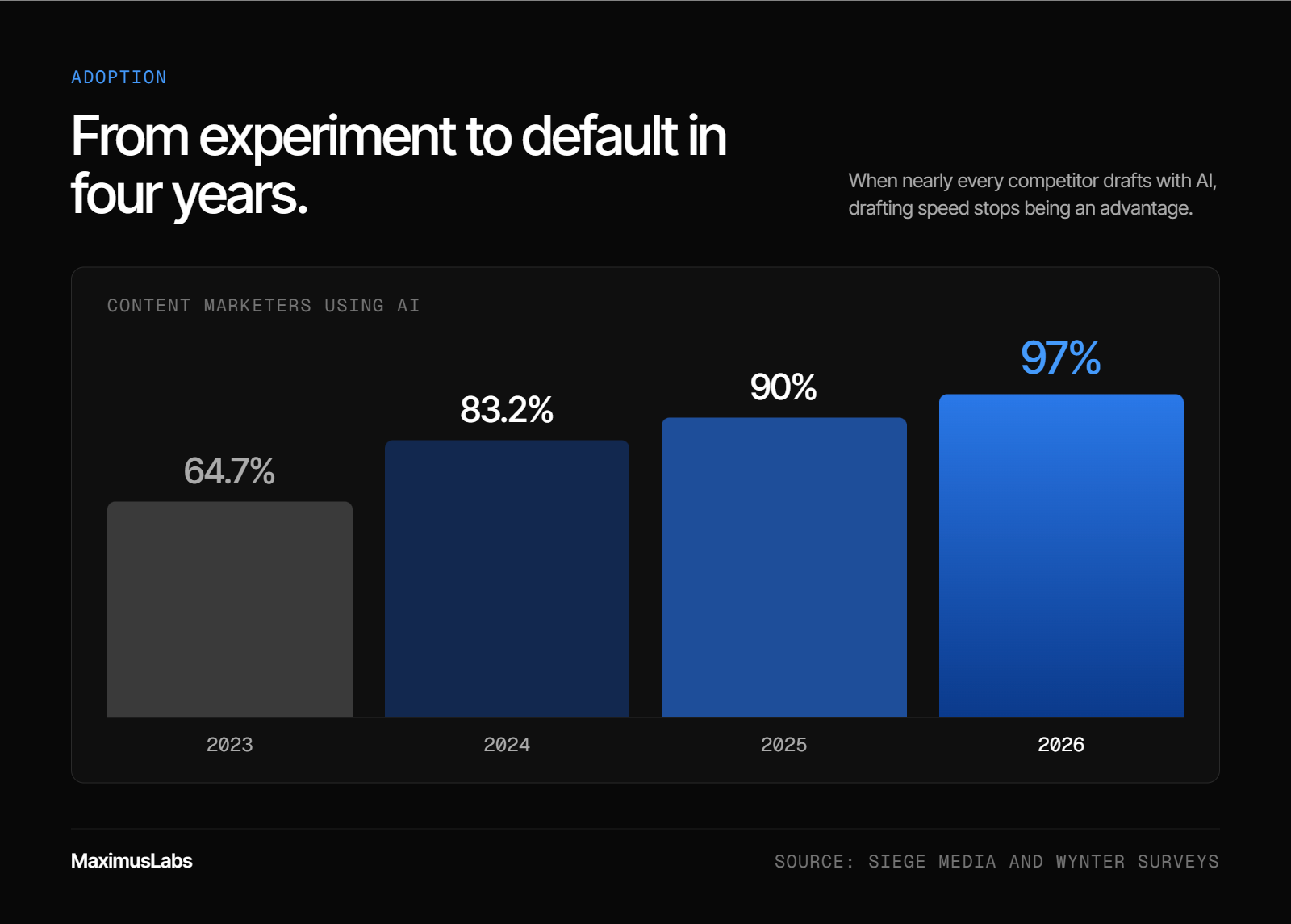
AI writing adoption is close to universal among marketers but uneven across the wider workforce. Siege Media and Wynter found 97% of content marketers planned to use AI in 2026, up from 64.7% in 2023. Pew Research Center found 55% of US workers rarely or never use AI chatbots at work. OpenAI reported about 700 million weekly ChatGPT users in September 2025.
Marketers Moved First and Fastest
Content marketers adopted AI writing faster than almost any other group. Siege Media’s yearly survey shows the climb clearly:
| Year | Content marketers using AI |
| 2023 | 64.7% |
| 2024 | 83.2% |
| 2025 | 90% |
| 2026 | 97% |
In four years, AI went from a test to a default. Now nearly every competitor in a category has the same drafting tools.
✅ The Tools Marketers Trust
The same survey shows which tools marketers trust most. ChatGPT led with an 80% selection rate, and Claude came second at 55%. Most teams use more than one tool, so these numbers overlap.
On the platform side, OpenAI’s own study counted roughly 700 million weekly active users. Anthropic reported that 81% of Claude conversations that produce blog posts or articles are work-related. So AI writing is now a daily work habit, not a weekend experiment.
The Wider Workforce Tells a Slower Story
Outside marketing, adoption looks very different. Pew surveyed 5,273 employed US adults in October 2024. It found 55% of workers rarely or never use AI chatbots at work, and 29% had not heard of the practice at all.
⚠️ Who Is Actually Using It
Pew found younger workers and those with more education use chatbots more often. Workers aged 18 to 49 reported using chatbots for almost every task Pew asked about at higher rates than older workers. Many non-users said they simply had no use case for chatbots in their jobs.
This gap matters for a marketing leader. Your content team may be fully AI-assisted, while the buyers you sell to are still forming habits. Both groups are moving, just at different speeds.
What Market-Size Figures Can and Cannot Tell You
Most AI writing market-size numbers on the web trace back to secondary aggregators, not named analyst reports. Estimates also disagree because each one defines “AI writing tools” differently. Some count only standalone writing apps. Others count every assistant built into email, documents, and CRMs.
💡 A Better Signal Than Market Size
A dollar figure tells you little about your own decision. Adoption inside your category tells you more. When 97% of your competitors draft with AI, drafting speed stops being an advantage. What still separates brands is original data, real experience, and being the source AI engines choose.
MaximusLabs AI tracks AI visibility daily across ChatGPT, Perplexity, Gemini, Claude, and Google AI Overviews for each client. Since every competitor now drafts with the same tools, that tracking shows which brands AI engines actually cite. For Oliv AI, MaximusLabs reached a “64% AI citation rate in 6 months, vs ~30% for billion-dollar incumbents (Oliv AI).”
Q3. What do people actually use AI writing for?
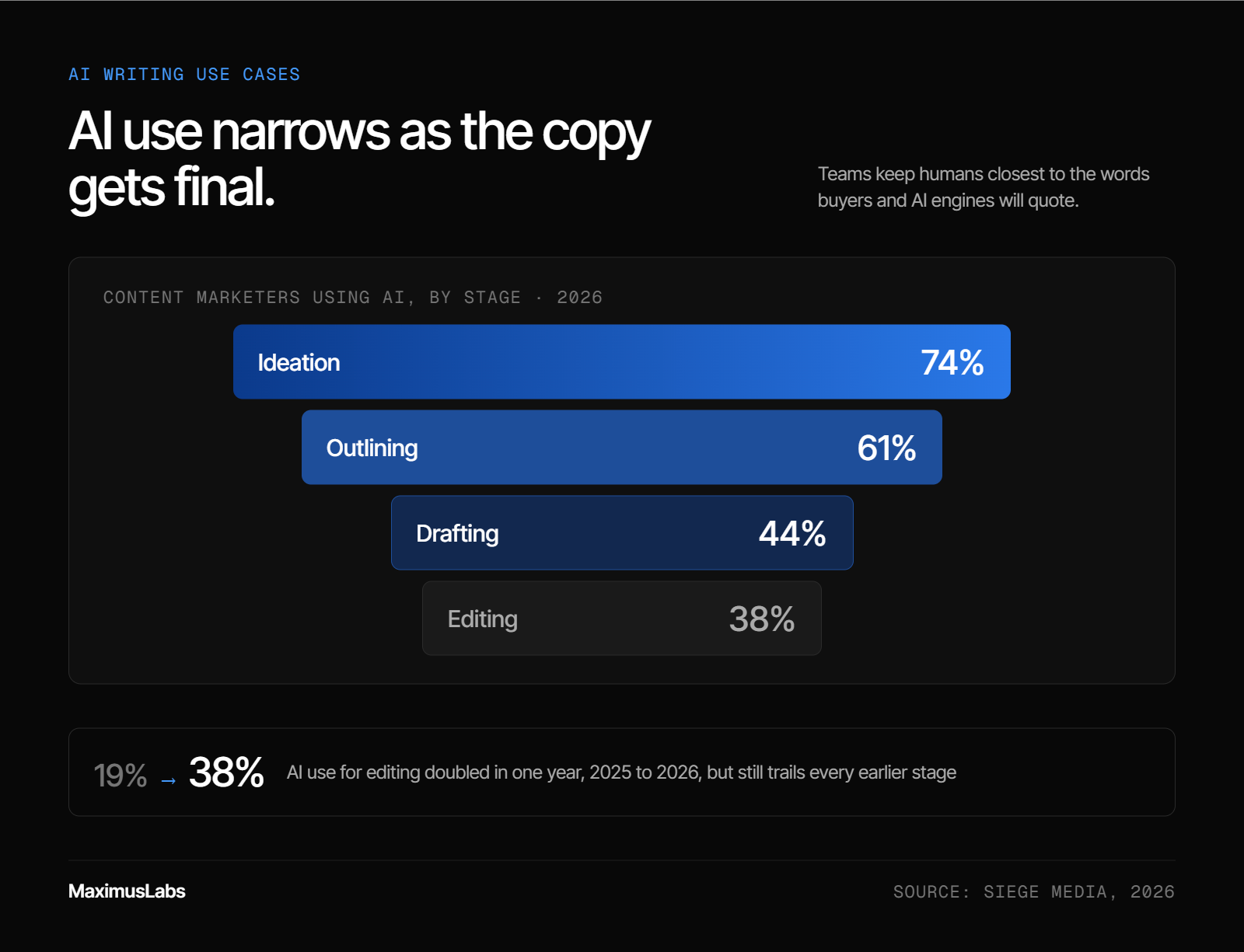
Writing is the most common work use of ChatGPT, making up 40% of work-related messages in June 2025 (OpenAI and NBER). Content marketers use AI most at the start of the process (Siege Media, 2026). Use runs at 74% for ideation, 61% for outlining, 44% for drafting, and 38% for editing. On Claude, 52% of conversations are augmentation, where a human guides and reviews the work (Anthropic, January 2026).
Writing Is AI’s Biggest Job at Work
The largest usage study to date comes from OpenAI’s Economic Research team and Harvard economist David Deming. It analyzed 1.5 million ChatGPT conversations using automated, privacy-preserving classification. Writing accounted for 40% of work-related messages in June 2025. Computer programming accounted for just 4.2%.
📝 What “Writing” Means in Practice
The study’s writing category covers drafting emails, documents, and other messages. It also covers editing, summarizing, and translating text someone already wrote. In other words, much of the writing work is revision, not creation from nothing.
Pew’s survey points the same way. Among workers who have used chatbots at work, 57% used them for research. Another 52% used them for editing, and 47% for drafting reports or documents.
The Content Marketer’s Task Funnel
Siege Media’s 2026 data shows where marketers lean on AI and where they pull back:
| Stage | Content marketers using AI |
| Ideation and topic generation | 74% |
| Outlining | 61% |
| Drafting | 44% |
| Editing and refining | 38% |
AI use falls at every step closer to the finished piece. Editing use did double in a year, rising from 19% in 2025 to 38% in 2026.
⭐ Augmentation Beats Automation
Anthropic’s data adds an important detail. In November 2025, 52% of Claude.ai conversations were augmentation, meaning users guided the model and reviewed its output. Automation, where the model does the task alone, fell to 45%.
Anthropic’s June 2026 report shows what those conversations produce. Documents and reports appear in 15% of conversations. Creating blogs or articles was 81% work-related, and creating marketing content was 80% work-related.
Why Use Drops Before the Final Copy
The drop-off at drafting is not an accident. Ideation and outlines are cheap to fix if they are wrong. Final copy carries the brand’s claims, its positioning, and its legal exposure. Teams keep humans closest to the words that buyers and AI engines will quote.
💡 Where Judgment Lives
In my experience, the drop-off at drafting is where judgment and positioning live. A model can list ten angles on a topic. It cannot know which angle your sales team wins deals with. That knowledge sits in founder calls, sales recordings, and support tickets. It also sits in the objections buyers raise right before they sign, which no public dataset captures.
MaximusLabs AI uses AI agents for research and context: per-client intelligence graphs that study each client’s market and reason over its own material. Humans then write, edit, and approve everything that ships. That split mirrors what the usage data shows works, with AI at the research end and people at the final copy.
Q4. How much faster and better does AI make writing, and what does it really save?
The strongest controlled evidence comes from Noy and Zhang’s preregistered experiment, published in Science in 2023. Among 453 college-educated professionals, ChatGPT cut writing task time by 40% and raised rated output quality by 18%. The researchers did not fact-check the outputs. Pew’s 2025 survey found workers rate chatbots as more helpful for speed than for quality.
What the Experiment Measured
Shakked Noy and Whitney Zhang, economists at MIT, ran the study online. Participants included marketers, grant writers, consultants, data analysts, HR professionals, and managers. Each completed two writing tasks specific to their job, such as press releases, cover letters, and short reports.
⏰ The Headline Result
Half the group got access to ChatGPT. Those workers finished tasks 40% faster, about 11 minutes sooner on average. Independent evaluators rated their output 18% higher in quality.
The gains were not evenly spread. Weaker writers improved the most, so the gap between workers narrowed. Workers exposed to ChatGPT were also twice as likely to use it in their real jobs two weeks later.
The Caveat Most Stat Roundups Skip
The study has a limit that matters for content teams. The researchers did not fact-check what participants wrote. So the 18% quality lift reflects how graders rated the writing, not whether the claims inside it were true.
⚠️ Speed Gains Shrink in the Real World
Noy said himself that real-world speed gains are likely smaller. Workers there must spend time writing prompts and checking facts. The experimental tasks also took only 20 to 30 minutes, which is far shorter than a researched long-form article.
Pew’s survey matches that pattern. Workers who use chatbots rated them more helpful for speeding up work than for improving its quality. Speed is the easy part to capture. Quality takes effort that the stopwatch does not show.
Measuring ROI in Pipeline, Not Words
Most AI content business cases use the wrong unit. They count cost per word or articles per month. Neither number tells a founder whether content produced revenue.
💰 A Better Way to Run the Math
A more useful model counts the full cost of one page that earns business. Include research, drafting, editing, fact-checking, and subject-matter expert review time. Then divide by the qualified pipeline that page influences. On that view, saved drafting time only pays off if it buys better research and verification.
📊 What to Track Instead
Swap output metrics for measures that tie content to revenue:
- Citation rate: how often AI engines cite the page for buying-stage questions.
- Influenced pipeline: qualified opportunities that touched the page before converting.
- Verification time: hours spent checking claims, which should rise, not fall.
- Cost per cited page: full production cost divided by pages that earn citations.
These numbers are harder to collect than word counts. They are also the only ones a board will accept as proof that content works.
MaximusLabs AI reads the productivity data this way: AI saves the drafting hours, and those hours fund research, verification, and founder interviews. MaximusLabs holds that work to pipeline. For Oliv AI, the result was “27 qualified leads, $47K+ pipeline, 26% close rate in 4 months (Oliv AI).”
Q5. Does AI-generated content rank on Google, or get penalized?
Google does not ban AI-generated content. Its spam policy on scaled content abuse targets pages mass-produced mainly to manipulate rankings, whatever tool made them. Raw AI content still underperforms. Graphite found only 14% of articles ranking in Google Search in 2025 were AI-generated, and those ranked lower than human-written articles. SE Ranking published 2,000 AI articles on 20 new domains, and all of them dropped out of the top 100 by February 2025.
What Google’s Policy Actually Says
A founder forwards a headline to the content lead: “Google is penalizing AI content.” The lead has 60 AI-assisted drafts in the queue. Do they publish, or bin the lot?
The answer sits in Google’s own documentation. Google says generative AI can help with research and with adding structure to original content. It also says using AI to generate many pages without adding value for users may violate its scaled content abuse policy.
⚠️ The Line Google Draws
Google introduced scaled content abuse as a named spam policy in March 2024. The policy defines the problem by purpose, not by method. Pages made mainly to manipulate rankings break the rule, whether AI, freelancers, or scrapers produced them.
So the real question is not “was AI involved?” It is “does this page add something the web did not already have?”
What the Ranking Data Shows
Graphite’s second study looked at what actually ranks. It found 86% of articles in Google Search were human-written, and 14% were AI-generated. That AI share rose only slightly, from 12% in 2024. When an AI article and a human article targeted the same keyword, the human article usually ranked higher.
❌ Two Sites That Learned the Hard Way
Eric Enge’s book on generative AI for SEO cites two WebFX case studies. A financial site with mostly AI-generated content lost 99.3% of its rankings after the November 2023 core update. A lawn care site added AI content that repeated what was already online, and it eventually lost 100% of its rankings.
SE Ranking ran a controlled test with the same result. Its 2,000 AI articles on fresh domains ranked at first. Then, in February 2025, every one of them left the top 100.
Why This Is 2007 All Over Again
Old-school SEO had its own shortcut: scraping other sites and remixing the text into new pages. It worked for a while, and then Google’s algorithms caught up. Pure AI text is 2007 content scraping with better grammar.
💡 The Ratio That Protects a Domain
Enge also suggests a defensive rule: keep low-quality pages rare compared to strong ones. His framing is a ratio of roughly 50 high-quality pages for every weak one. In my experience, one batch of thin pages can drag down the trust a whole domain built.
This is also where Google-only SEO thinking goes wrong a second time. A page that Google demotes for low value rarely earns trust from AI answer engines either. The same weakness costs you twice.
MaximusLabs AI uses AI for research, gap analysis, and outlines, never for unreviewed final copy. Every MaximusLabs article moves through three stages: deep research, writing in the founder’s voice, and a human QA pass. That workflow treats AI as the research desk and people as the authors, which is the split the ranking data rewards.
Q6. Do ChatGPT, Perplexity, and Claude cite AI-written content?
Mostly, AI engines cite human-shaped content. Graphite found 82% of articles cited by ChatGPT and Perplexity in 2025 were human-written. Princeton’s GEO study (KDD 2024) found adding statistics, quotations, and source citations raised visibility in AI answers by up to 40%. MaximusLabs AI applied these levers for Oliv AI and reached a “64% AI citation rate in 6 months, vs ~30% for billion-dollar incumbents (Oliv AI).”
The Paradox in One Comparison
A VP Marketing types the category’s top buying question into ChatGPT. Three competitors appear in the answer. Her brand, which publishes four AI-assisted posts a week, does not.
That moment captures the paradox. AI content is now everywhere on the web, but it is rarely what AI engines choose to quote. The gap between production and citation is where the opportunity sits.
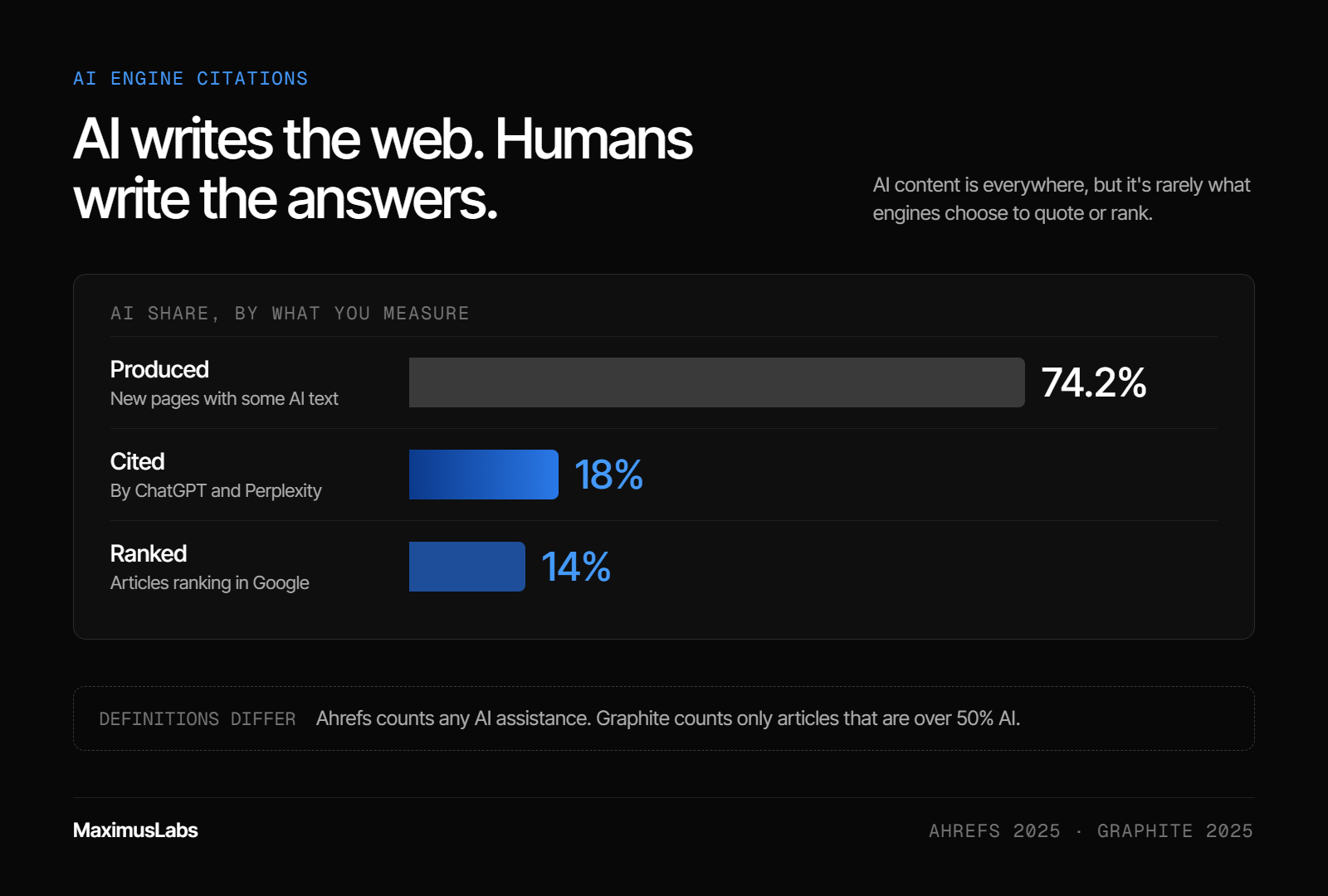
| Measure | AI share |
| New web pages containing some AI text (Ahrefs, 2025) | 74.2% |
| Articles cited by ChatGPT and Perplexity that are AI-generated (Graphite, 2025) | 18% |
| Google-ranking articles that are AI-generated (Graphite, 2025) | 14% |
⚠️ The Counterpoint Worth Knowing
Ahrefs found a different picture in Google AI Overviews. It found 87.8% of pages cited in AI Overviews were at least AI-assisted. It also found almost zero correlation (0.017) between a page’s AI share and its citation position.
These findings fit together once you check how each study defines AI content. Graphite labels an article AI-generated only if over half its text reads as AI. Ahrefs counts any AI assistance at all. So AI-assisted, human-edited pages get cited often, while mostly-AI pages do not.
What Gets a Page Cited
The Princeton team, led by Pranjal Aggarwal, tested which edits make AI engines cite a source. Three changes performed best: adding statistics, adding quotations, and citing credible sources. Keyword stuffing, the old SEO habit, gave little or no lift.
📍 Where the Citations Come From
Placement matters too. Kevin Indig analyzed 18,012 verified ChatGPT citations and found 44.2% came from the first 30% of a page. He called this the “ski ramp” pattern. Indig also found that 78.4% of citations tied to questions came from headings. In practice, an engine often treats an H2 question as the prompt and the paragraph below it as the answer.
So a cited page usually answers early, backs claims with numbers, and sounds like someone who has done the work. Each of those traits takes human input. Raw AI drafts tend to miss all three.
Why I Treat This as a Data Science Problem
MaximusLabs AI’s read is that GEO, or Generative Engine Optimization, is closer to data science than to classic SEO. Citations follow evidence density and trust signals, not word count. My hypothesis is that each engine weighs sources a little differently, so one generic playbook underperforms.
MaximusLabs AI runs a citation-intelligence engine that maps which sources each AI engine trusts. It then places clients in those sources through Owned AEO, meaning their own content, and Earned AEO, meaning reviews, Reddit, and listicles. For Oliv AI, that work produced the 64% citation rate, against roughly 30% for billion-dollar incumbents.
Q7. How accurate is AI writing with facts and citations?
Factual accuracy remains AI writing’s weakest point. In the FActScore benchmark (Min et al., 2023), ChatGPT’s atomic facts in biographies were accurate 58.3% of the time. A May 2026 study tested 14 LLMs on research citations. The strongest kept links valid over 94% of the time but reached only 39% to 77% factual accuracy. Fact-check accuracy fell about 42% as research depth grew from 2 to 150 tool calls.
The Benchmark That Started the Conversation
FActScore breaks a long answer into small, single facts, called atomic facts, and checks each one against a trusted source. Sewon Min and colleagues used it on AI-written biographies. ChatGPT got 58.3% of its atomic facts right.
⚠️ Why the Age of This Number Matters
That benchmark used 2023 models, and today’s models are stronger. Still, the method shows something that has not changed. A fluent, confident paragraph can hide several wrong facts. For marketers, the risk is specific. One wrong statistic on a comparison page can cost a buyer’s trust, and an AI engine may repeat it.
What a 2026 Study Found About Citations
Hailey Onweller and colleagues tested how 14 closed and open-source models cite sources in research reports. They graded each citation on three things:
- Link works: the URL opens.
- Relevant content: the source matches the topic.
- Fact check: the source actually supports the claim.
The strongest models scored above 94% on working links and above 80% on relevance. On fact checks, they reached only 39% to 77%. Across all 14 models, pass rates ranged from 24% to 77%.
❌ A Citation Is Not Proof
This gap is the key lesson for content teams. A citation can look perfect, with a working link on the right topic, and still not support the claim. Readers and editors who only click the link miss the error. A report full of footnotes proves the model searched, not that it read the sources correctly.
More Research Made Answers Less Accurate
The same study tested what happens when models search more. As tool calls rose from 2 to 150, fact-check accuracy fell about 42% on average. Link quality and relevance stayed stable.
💡 What That Means for Your Workflow
The authors call this an information overload effect. More retrieval did not produce more accurate citations. My guess is that a model juggling 150 sources loses track of which source said what. In my view, more citations are not more truth, so editors should audit the sources, not count them.
That changes how an AI-assisted team should work:
- Treat every AI-supplied statistic as unverified until a human opens the source.
- Check that the source states the exact number, not a nearby one.
- Prefer primary sources, such as papers, official docs, and first-party datasets.
- Log the source and access date for every claim.
MaximusLabs AI requires a named primary source behind every factual claim in its content. Each article’s QA stage checks citations before anything ships. That rule exists because the benchmark data shows AI cannot be trusted to verify its own sources.
Q8. Can AI detectors reliably tell AI writing from human writing?
On raw, unedited AI text, the best detectors are fairly accurate. Graphite tested Surfer’s AI detector on 15,894 articles published before ChatGPT launched and found a 4.2% false-positive rate. The same detector correctly flagged 99.4% of 6,009 test articles written by GPT-4o. Accuracy is less certain for human-edited drafts and for models it was not tested on.
The Myth That Detectors Are Useless
A content manager runs a freelancer’s draft through a detector. It comes back “likely AI.” The freelancer swears they wrote every word. Who is right?
Many practitioners say detectors are coin flips. The best published test suggests otherwise, at least for raw AI text. The debate often mixes two questions. One is whether a tool can spot raw AI text, and the other is whether it can prove who wrote a draft.
✅ How Graphite Tested Accuracy
Graphite needed a reliable detector before measuring how much of the web is AI-written. To test false positives, it used articles published before November 2022, which were very likely human-written. Surfer’s detector flagged only 4.2% of them as AI.
To test false negatives, the team generated 6,009 articles with GPT-4o on topics such as commerce, finance, and B2B. The detector caught 99.4% of them. Graphite CEO Ethan Smith has described a similar test on about 100,000 Common Crawl URLs, with roughly 8% false positives by his spoken estimate.
Where Detectors Fall Short
The test had clear limits, and Graphite named them. It only checked GPT-4o, so accuracy on other models is unknown. It did not test AI drafts that humans edited, which may be the most common kind of content. Models also keep improving, which could make detection harder.
⚠️ Probabilities, Not Verdicts
Ahrefs, which built its own detector, makes the same point. AI detectors are statistical models, so they deal in probabilities, not certainty. Ahrefs warns that detector scores should not be used alone to make serious decisions about someone’s career.
That warning matters most in education and hiring. A 4.2% false-positive rate sounds small. Across thousands of student essays or job samples, it means many honest writers get flagged.
How Content Teams Should Use Detectors
Think of a detector as a smoke alarm, not a judge. It tells you where to look, not what happened.
📋 A Practical Screening Routine
- Run every draft through one consistent detector before editing.
- Treat high scores as a prompt for review, never as proof.
- Ask whether the page adds experience, data, or insight the web lacks.
- Track detector scores alongside performance, not instead of it.
- Keep edit history, so writers can show how a draft evolved.
Google’s policy targets low-value pages, not AI as such. So the useful question is never just “will this pass a detector?” It is “would a buyer learn something here?”
MaximusLabs AI’s QA stage scores every draft through the eyes of the target buyer, such as a SaaS founder or CMO, before publishing. Criteria include relevance, depth, actionability, and credibility. That review asks whether the page earns trust, which is what Google and AI engines reward.
Q9. What will AI writing look like in 2027, and how do you build content that becomes the answer?
In 2027, the content that wins will be the content AI engines cite on buying-stage questions, not the content that ships in the largest volume. Gartner predicts brands’ organic search traffic will fall 50% or more by 2028 as buyers move to AI-powered search. MaximusLabs AI builds AI-assisted, expert-authored bottom-of-funnel content, where AI handles research and humans add experience, statistics, and quotes. That model ranked Nidra Goods #1 for “best sleep mask” on Google, ChatGPT, and Perplexity.
The Planning Meeting That Keeps Repeating
A Head of Growth walks into 2027 planning with two spreadsheets. One shows AI drafting tripled monthly output. The other shows organic pipeline, and it has not moved.
The old answer was to publish more top-of-funnel explainers and count impressions. That playbook assumed buyers would scroll ten blue links and click one.
⚠️ What Changed Underneath the Plan
Buyers now ask ChatGPT, Perplexity, Gemini, Claude, and Google AI Overviews, and they get one answer. Gartner expects brands to lose 50% or more of their organic search traffic by 2028. It also predicts that by 2027, a fifth of brands will market the absence of AI as a selling point.
Raw volume no longer buys reach. AI engines cite a few trusted sources and skip the rest.
Three Hypotheses for 2027
This is my current thinking, subject to change.
- Hybrid becomes the only default. Ahrefs found 71.7% of new pages already mix AI and human text, and most Claude use is augmentation. Fully automated publishing will shrink to low-stakes pages.
- Evidence density becomes the citation factor that matters most. Princeton’s GEO study showed statistics, quotations, and cited sources lift AI visibility by up to 40%. Teams with original data will pull further ahead.
- Brand becomes the moat. AI engines recommend brands they trust, because their own credibility rides on the answer.
💡 Why I Bet on Brand
MaximusLabs AI’s read is that most teams treat AI search as a hack. Tricks expire when algorithms change. Become the brand in your category, and AI engines have to recommend you.
The Monday-Morning Playbook
- Answer first. Put a direct 40-to-80-word answer at the top, since 44.2% of ChatGPT citations come from a page’s first 30%.
- Add at least three statistics from named primary sources, with dates.
- Include one or two attributed expert quotes from real people.
- Screen every draft with a detector, then review flagged pages by hand.
- Skip keyword stuffing. Princeton’s study found it gave little or no lift in AI answers.
💰 Start at the Bottom of the Funnel
Write bottom-of-funnel (BOFU) and middle-of-funnel (MOFU) pages first. These are comparisons, alternatives, and “best tool for” pages buyers read right before choosing. AI engines already answer top-of-funnel definitions well, so those pages rarely drive pipeline.
Measure each page on citations for buying-stage questions and on influenced pipeline. Pageviews alone are a vanity metric.
✅ Why the Evidence Backs This
Google welcomes AI for research and structure but penalizes pages that add no value. Graphite’s data shows human-shaped articles win both rankings and citations.
MaximusLabs AI runs AEO with SEO as its foundation, and it handles strategy and execution in one team. Its founder-voice pipeline ranked Nidra Goods #1 for “best sleep mask” across Google, ChatGPT, and Perplexity. For Oliv AI, the same approach produced “27 qualified leads, $47K+ pipeline, 26% close rate in 4 months (Oliv AI).”
Frequently asked questions
What percentage of online content is AI-generated in 2026?
Most new web content now contains some AI-generated text, but very little of it is pure AI. Ahrefs analyzed 900,000 new pages in April 2025 and found: • 74.2% contained some AI content. • 71.7% mixed AI and human writing. • Only 2.5% were pure AI, and 25.8% were pure human. Graphite used a stricter rule, counting an article as AI-generated only when more than half of it read as AI. By that measure, AI articles overtook human-written ones in November 2024, and the share has stayed roughly flat since. We read that plateau as the market learning a lesson. Publishing more raw AI text does not buy more visibility, because search engines and answer engines still favor content shaped by real experience. In MaximusLabs AI's work, the useful question is not how much AI touched a page. It is whether the page adds evidence and insight that the rest of the web lacks. Treat every percentage here as an estimate. AI detectors work on probabilities, and neither study measured AI drafts that humans later rewrote. For the wider picture of how this changes visibility, see our guide to citation-worthy content for AI engines.
Does Google penalize AI-generated content?
No. Google does not penalize content because AI helped write it. Its Search Central guidance says generative AI can help with research and structure. What Google targets is scaled content abuse: many pages produced mainly to manipulate rankings, with little value for users, whatever tool made them. Raw AI content still tends to lose. The evidence we track points the same way: • Graphite found only 14% of articles ranking in Google Search were AI-generated, and they usually ranked below human-written pages. • SE Ranking published 2,000 AI articles on new domains, and all of them left the top 100 within months. • Eric Enge's book cites a mostly-AI financial site that lost 99.3% of its rankings after the November 2023 core update. So the safe rule is simple. Use AI for research and outlines, then add expertise, original data, and human editing before you publish. MaximusLabs AI follows that split on every article: AI does the research, and people write and approve the final copy. A page Google demotes for low value rarely earns trust from AI answer engines either. Our breakdown of Google algorithm updates explains how these quality systems have evolved.
Will AI replace human content writers by 2027?
The data points to AI changing the writer's job rather than removing it. Writers increasingly direct, edit, and verify, while AI handles more of the first draft and the research. Three findings support this view: • Siege Media found 74% of content marketers use AI for ideation but only 44% for drafting, so use drops as work nears the final copy. • Anthropic found 52% of Claude.ai conversations are augmentation, where a person guides and reviews the output. • In Noy and Zhang's MIT experiment, ChatGPT cut writing time by 40%, but the outputs were not fact-checked. The skills that gain value are judgment, positioning, subject expertise, and verification. A model can list angles on a topic. It cannot know which angle your sales team wins deals with, or which claims your legal team will approve. MaximusLabs AI builds its content process around that split. AI agents research each client's market, and human writers bring the founder's perspective and approve everything that ships. Our founder-voice methodology guide shows how that human layer works in practice. Our current read, which may change, is that 2027 rewards writers who can turn AI speed into better evidence.
Do ChatGPT and Perplexity cite AI-written content?
Mostly, they cite human-shaped content. Graphite found 82% of articles cited by ChatGPT and Perplexity were human-written. Ahrefs found that many pages cited in Google AI Overviews were AI-assisted, which suggests edited hybrid content performs well while mostly-AI pages do not. What gets a page cited is evidence and structure, not production method: • Statistics, quotations, and cited sources lifted AI visibility by up to 40% in Princeton's GEO study. • Early answers matter. Kevin Indig found 44.2% of ChatGPT citations came from the first 30% of a page. • Question headings help. Engines often treat an H2 question as the prompt and the next paragraph as the answer. • Keyword stuffing gave little or no lift. MaximusLabs AI applied these levers for Oliv AI and reached a 64% AI citation rate in six months, against roughly 30% for billion-dollar incumbents. We pair owned content with earned mentions in reviews, Reddit, and listicles, because engines trust what others say about a brand. For the full playbook, see our citation optimization guide for AI search.
How accurate are AI content detectors?
On raw, unedited AI text, the best detectors are fairly accurate. They are much less reliable on human-edited drafts, so they work as a screening signal rather than proof. The strongest published test comes from Graphite, which checked Surfer's detector: • It flagged only 4.2% of 15,894 pre-ChatGPT articles as AI, which is its false-positive rate. • It caught 99.4% of 6,009 articles written by GPT-4o. • It was not tested on other models or on AI drafts edited by people. Ahrefs, which built its own detector, warns that scores are probabilities and should never decide someone's career alone. Even a 4.2% false-positive rate flags many honest writers across thousands of essays or job samples. We suggest a simple routine. Run drafts through one consistent detector, treat high scores as a reason to review, and keep edit history so writers can show how a draft evolved. Then ask the better question: does this page add something a buyer would learn from? MaximusLabs AI's QA stage reviews every draft through the target buyer's eyes, because trust matters more to rankings than a detector score. Our E-E-A-T for AEO guide covers the trust signals engines reward.
How often does AI writing get facts wrong?
Often enough that every AI-supplied fact needs a human check. Factual accuracy remains AI writing's weakest point. Two studies show the scale of the problem: • In the FActScore benchmark, ChatGPT's atomic facts in biographies were accurate 58.3% of the time, using 2023 models. • A May 2026 study of 14 LLMs found the strongest kept links valid over 94% of the time but reached only 39% to 77% factual accuracy on citations. • That study also found fact-check accuracy fell about 42% as research grew from 2 to 150 tool calls. The lesson for content teams is that a citation can look perfect and still not support the claim. A working link on the right topic proves the model searched, not that it read the source correctly. We recommend four habits: treat every AI statistic as unverified, open the source, confirm the exact number, and log the source with an access date. Prefer papers, official docs, and first-party datasets over blog roundups. MaximusLabs AI requires a named primary source behind every factual claim and checks citations before publishing. Our trust-first content playbook explains how we build that verification into production.
How should we measure the ROI of AI-assisted content?
Measure AI content on pipeline, not output. Cost per word and articles per month show how cheaply you produce content, not whether it earns business. The productivity gains are real but narrow. Noy and Zhang's MIT experiment found ChatGPT cut writing time by 40%, yet participants' work was never fact-checked. In practice, saved drafting hours only pay off if they fund better research and verification. We suggest tracking these four metrics instead: • Citation rate: how often AI engines cite the page for buying-stage questions. • Influenced pipeline: qualified opportunities that touched the page before converting. • Verification time: hours spent checking claims, which should rise, not fall. • Cost per cited page: full production cost divided by pages that earn citations. Start with bottom-of-funnel pages such as comparisons and alternatives, because buyers read them right before choosing. Top-of-funnel definitions rarely drive pipeline, since AI engines already answer them well. MaximusLabs AI measures every engagement this way. For Oliv AI, the approach produced 27 qualified leads, $47K+ pipeline, and a 26% close rate in four months. Our guide to calculating ROI and revenue attribution for GEO walks through the model.