 Krishna Kaanth M
- Published ChatGPT conversion rates range from about 1.8% in large ecommerce studies to 15.9% in one B2B case study, so sample size and conversion type matter more than headlines.
- ChatGPT visitors usually convert better because multi-turn conversations qualify buyers before the click, yet a 973-site peer-reviewed study found ChatGPT trailing organic search for average ecommerce.
- GA4 misses much of ChatGPT's impact because buyers often search the brand or type the URL, so track an AI channel group, a self-reported field, and CRM cohorts.
- Calculate ChatGPT ROI from your own sessions, conversion rate, close rate, deal value, and self-reported dark revenue, not from borrowed 4.4x or 23x multipliers.
- Earned media drives most AI citations, so reviews, Reddit, press, and BOFU pages that render without JavaScript decide whether ChatGPT sends buyers and whether they convert.
- Invest now if deal values are high and buyers research in AI chats. ChatGPT sends about three-quarters of AI referrals, but measure every engine separately.
Q1: What Are ChatGPT Conversion Rates in 2026, and Why Do Studies Disagree?
Published ChatGPT conversion rates run from about 1.8% in large ecommerce datasets to 15.9% in a single B2B case study. Google organic sits near 1.4% to 1.8% in those same studies. Multi-site studies put AI traffic at roughly 1.3 to 11 times organic. The spread comes from three variables: what counts as a conversion, how many sites were measured, and which attribution model was used.
The Published Benchmarks, Side by Side
Almost every ChatGPT conversion number you see quoted traces back to a handful of studies. The table lines them up with the detail most summaries drop.
| Study | Sample | Conversion type | Result |
| Seer Interactive (2025) | 1 B2B client | Site conversions | ChatGPT 15.9% vs Google organic 1.76% |
| Ahrefs (2025) | ahrefs.com only | Signups | 0.5% of visits drove 12.1% of signups (about 23× organic) |
| Semrush (2025) | 500+ marketing topics | Conversion rate | AI visitor worth 4.4× an organic visitor |
| Microsoft Clarity (2025) | 1,200+ publisher sites | Signups | LLMs 1.66% vs search 0.15% |
| Similarweb (2025) | Ecommerce panel estimate | Purchases | ChatGPT 11.4% vs organic 5.3% |
| Visibility Labs (2026) | 94 ecommerce brands | Purchases | ChatGPT 1.81% vs non-branded organic 1.39% |
| Kaiser & Schulze (2025) | 973 ecommerce sites | Purchases | ChatGPT below organic search |
⭐ Why the Biggest Number Comes From the Smallest Sample
Seer’s 15.9% is real, but it comes from one client. ChatGPT sent just 0.07% of that client’s organic sessions. With so few sessions behind it, the rate can swing hard from month to month.
Ahrefs is also a single site, and an unusual one. Patrick Stox, who ran that analysis, wrote that his gut said the advantage would not hold at full scale.
⚠️ A Signup Is Not a Purchase
Clarity and Ahrefs count free signups, which cost the visitor nothing. Ecommerce studies count paid orders, where friction is much higher. That one difference explains most of the gap between 11× and 1.3×.
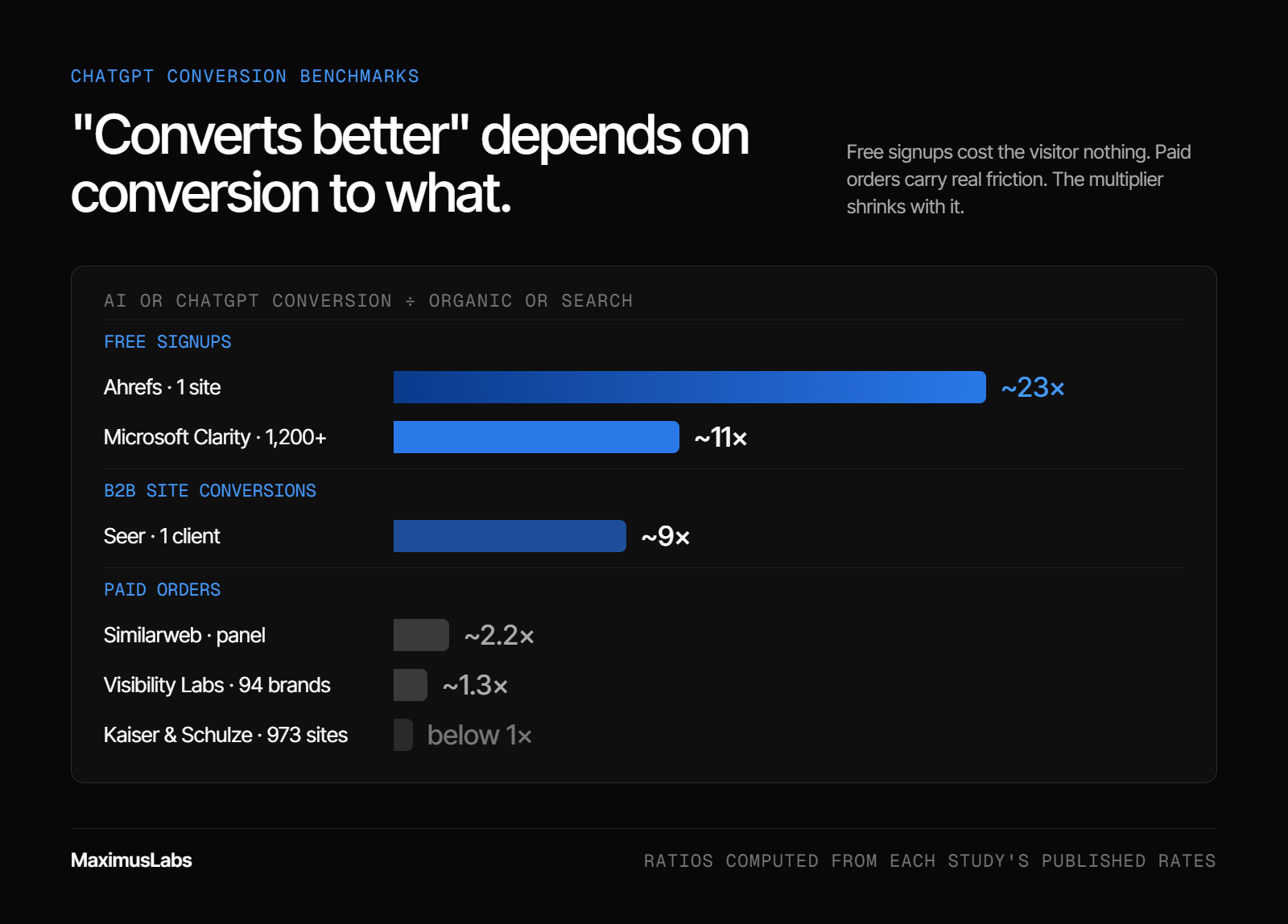
MaximusLabs AI’s read is that a conversion rate means little until you ask “conversion to what?” I’ve watched teams compare a free-trial signup rate against a six-month procurement cycle and call it a benchmark. It isn’t one.
Reading the Benchmarks Against Your Own Funnel
The practitioner data closest to B2B SaaS comes from Graphite CEO Ethan Smith. He reported that Webflow saw a 6× conversion rate difference between LLM traffic and Google search traffic. He also said 8% of Webflow’s signups now come from LLMs.
✅ Four Checks Before You Quote Any Multiplier
- Pick one conversion event that maps to pipeline, such as a demo request or a paid order.
- Compare ChatGPT sessions against non-branded organic sessions on the same page types.
- Report revenue per session next to conversion rate.
- Wait for enough volume, because a handful of conversions can double or halve a rate.
MaximusLabs AI measures every engagement on pipeline, not on mentions. So the first benchmark we set is the client’s own non-branded organic baseline. That keeps a borrowed 23× out of the board deck.
Q2: Does ChatGPT Traffic Convert Better Than Google Search Traffic, and Why?
Usually, yes, because the conversation does the qualifying before the click. On Google, a buyer scans ten blue links and starts researching. In ChatGPT, the buyer asks follow-up questions, narrows requirements, and settles objections first. Ahrefs found AI search visitors bounce less and view 50% more pages than traditional search visitors. The click arrives late in the journey, as a check on a shortlist.
How the Google Click Used to Work
Picture the monthly SEO report. Rankings are climbing, impressions are up, and the agency deck shows three green arrows. The Head of Growth still can’t find the pipeline those arrows were meant to produce.
❌ Traffic That Was Never Close to Buying
That gap is how Google-only SEO was built. Agencies sold rankings, impressions, and clicks on retainers locked to a fixed scope. Content chased top-of-funnel (TOFU) questions, meaning early “what is X?” searches. A typical click was step one of research, followed by five open tabs and a lonely vendor comparison.
What the Conversation Changes
Now the same buyer opens ChatGPT. They describe their team size, tech stack, and budget, then ask follow-ups. The answer names a handful of brands, and each follow-up trims that list further.
Ethan Smith describes these buyers as “so primed because you’re having a conversation with multiple follow-ups.” By the time they click, most of the research is done.
⭐ The Shortlist Is the New First Page
I explain this to MaximusLabs AI clients as the sample set problem. AI systems mention only 5 to 10 players in a category. If you’re not in that sample set, you’re not in the evaluation at all. Ranking seventh on Google doesn’t get you there.
✅ What the Engagement Data Shows
- Ahrefs: AI search visitors bounced less and viewed 50% more pages than search visitors, though they spent less time on site.
- Adobe: In March 2026, engagement from AI sources on US retail sites ran 12% higher than non-AI traffic.
Shorter visits with more pages read like validation. The buyer is checking pricing, integrations, and proof. They aren’t learning the category.
How MaximusLabs AI Earns the Shortlist
MaximusLabs AI runs Answer Engine Optimization (AEO), with SEO as its foundation, as strategy and execution in one team.
- Citation-intelligence engine: maps which sources each engine trusts.
- Daily AI-visibility tracking: re-run and regression-tested, it shows where a client appears in ChatGPT and other engines.
- The Two Pillars: Owned AEO, where client content becomes the answer, and Earned AEO, where reviews, Reddit, press, and listicles build AI trust.
Humans approve everything that ships.
💰 What That Looks Like in a B2B SaaS Account
For Oliv AI, the outcome was a “64% AI citation rate in 6 months, vs ~30% for billion-dollar incumbents (Oliv AI).” MaximusLabs treats that citation rate as the means. The engagement is judged on the pipeline those shortlist appearances create.
Q3: When Does ChatGPT Traffic Convert Worse, and Which Industries Benefit Most?
ChatGPT traffic can underperform. A peer-reviewed study of 973 ecommerce sites found ChatGPT referrals beat only paid social on conversion rate and revenue per session. Their conversion rates did rise steadily across the 12-month study. Order values also run lower, at $204 versus $238 for non-branded organic in a 94-brand study. Hotels, legal, and healthcare post the highest ChatGPT conversion rates.
What the Largest Study Found
Maximilian Kaiser and Christian Schulze analyzed 12 months of first-party data from 973 websites with $20 billion in combined revenue. They compared more than 50,000 ChatGPT-referred transactions with 164 million from traditional channels. Published in Marketing Science, it is the strongest bear case available.
❌ Where ChatGPT Trailed
- Affiliate traffic was 86% more likely to convert than ChatGPT referrals.
- Organic search converted about 13% better.
- Only paid social did worse on conversion rate and revenue per session.
⚠️ Two Caveats Before You Cut Budget
First, the study used last-click attribution, which credits only the final touch. That undercounts ChatGPT’s role earlier in research. Second, the picture moved fast. Adobe reported AI traffic to US retail sites converting 38% worse than non-AI traffic in March 2025, then 42% better by March 2026.
Smaller Baskets and Revenue per Session
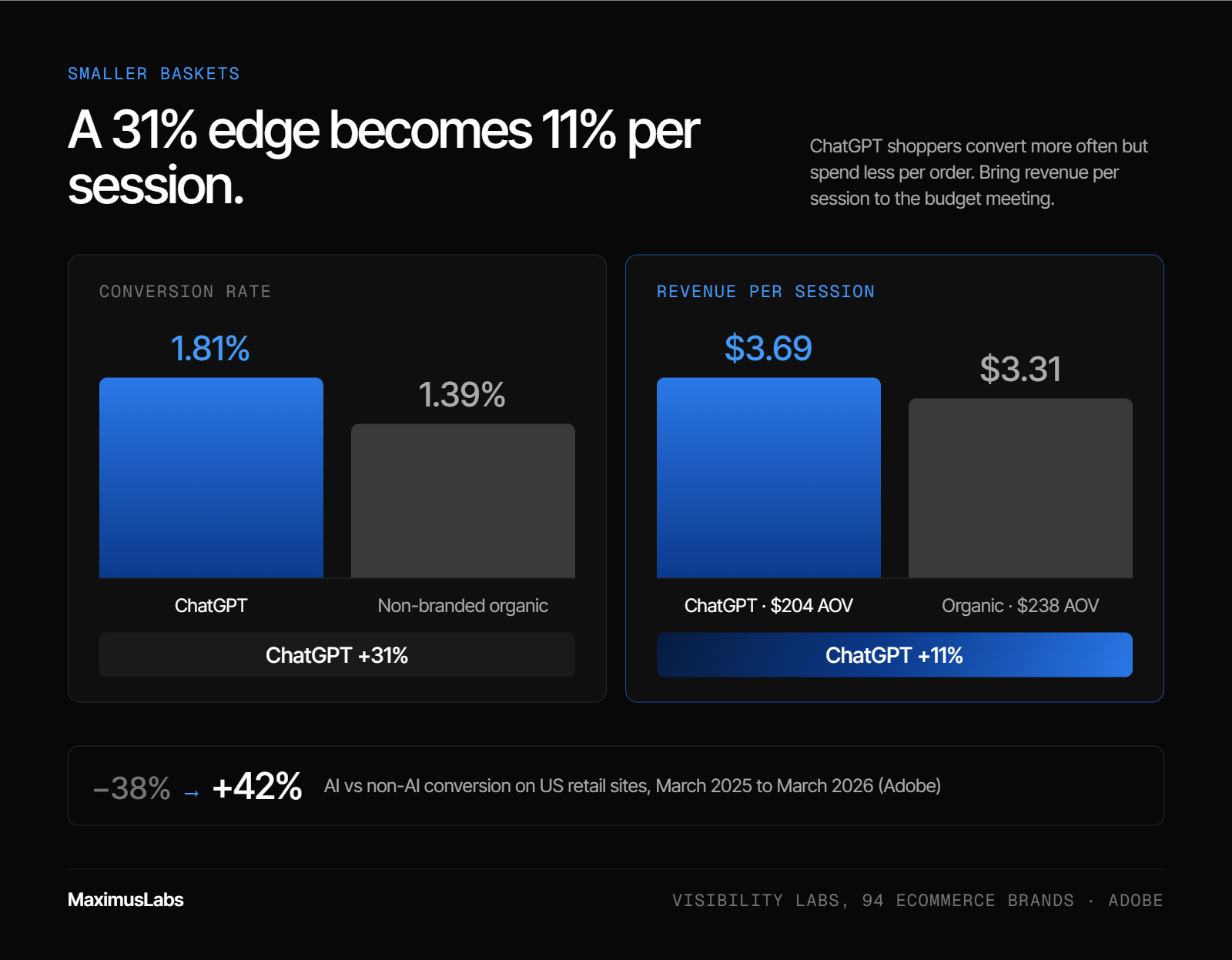
Visibility Labs found ChatGPT converted 31% better than non-branded organic across 94 ecommerce brands. Average order value told a different story: $204 for ChatGPT versus $238 for organic.
💰 The Quick Maths
Revenue per session is conversion rate multiplied by order value:
- ChatGPT: 1.81% × $204 ≈ $3.69
- Non-branded organic: 1.39% × $238 ≈ $3.31
The edge survives the smaller basket, but it shrinks from 31% to about 11%. That’s the number to bring to a budget meeting.
ChatGPT Conversion Rates by Industry
First Page Sage tracked 160+ client companies from May 2025 to February 2026.
| Industry | ChatGPT conversion rate |
| Hotels & Resorts | 7.0% |
| Legal Services | 5.6% |
| Higher Education | 4.9% |
| Healthcare | 4.5% |
| eCommerce | 3.0% |
| B2B SaaS | 2.4% |
| Financial Services | 1.9% |
| Engineering | 1.4% |
⏰ Expect the Multipliers to Compress
High-consideration, high-trust categories lead the table. My hypothesis, and the planning assumption MaximusLabs AI uses for client budgets, is that the 23× headlines will compress as ChatGPT reaches mainstream buyers. I might be wrong, but I’d rather plan for the median than the outlier.
MaximusLabs AI works with B2B SaaS first, then healthcare services and financial services, so the lower rows in that table matter to us. That’s why MaximusLabs scopes AEO around deal value and revenue per session, not conversion rate alone.
Q4: How Much ChatGPT Revenue Does GA4 Miss, and How Do You Track It Properly?
GA4 likely misses most ChatGPT-influenced revenue. ChatGPT adds utm_source=chatgpt.com to its links, but many buyers skip the link and search the brand or type the URL instead. GA4 then credits Branded Search or Direct. Graphite CEO Ethan Smith estimates UTM tracking shows about one-tenth of the real impact. MaximusLabs AI reports AI search across three layers: a GA4 AI channel group, a self-reported attribution field, and cohorted CRM revenue.
The Report That Says ChatGPT Doesn’t Matter
The pipeline review opens on a GA4 screen. ChatGPT shows a few dozen sessions and two conversions for the month. Someone suggests dropping AEO from next quarter, while branded search quietly climbs in the row above.
❌ Why Last-Touch Reporting Gets It Wrong
Traditional SEO reporting runs on last-touch attribution, which gives all credit to the final click. Rankings and sessions filled the deck, and nobody asked where demand started. Ethan Smith warns that last-touch thinking makes paid search look like the only channel that works, which he calls “not true at all.”
What Changed When Buyers Started Asking AI
Many AI answers name a brand without the buyer clicking anything. Smith describes the pattern: the user opens a new tab, searches the brand on Google, or types the domain directly. GA4 logs that visit as Branded Search or Direct, and he estimates a ChatGPT URL tag captures roughly one-tenth of the true impact.
⚠️ Tagged Links Still Leak
OpenAI documents that ChatGPT appends utm_source=chatgpt.com to referral URLs. Buyers who copy a brand name out of the answer arrive with no tag at all. Cloudflare data shows the wider imbalance: in July 2025, OpenAI crawled about 1,091 pages per referred visitor, versus 5.4 for Google. That gap is why AI crawler activity and referral traffic need to be read separately.
Since May 7, 2026, ChatGPT places clickable brand links inside answers. Referral traffic rose 157.7% in one week across sites Similarweb tracks. Re-baseline any trend line that crosses that date.
Three Tracking Layers to Set Up This Week
Last-touch GA4 is like looking through a keyhole and assuming the room is empty. These three layers widen the view.
- GA4 AI channel group. Create a custom channel group in Admin. Add an “AI Assistants” channel where session source matches chatgpt\.com|openai\.com|perplexity\.ai|claude\.ai|gemini\.google\.com|copilot\.microsoft\.com. Place it above Referral.
- Self-reported attribution. Add an open-text “How did you hear about us?” field to demo and signup forms. Tag every answer mentioning ChatGPT or AI weekly.
- Cohorted CRM revenue. Log closed-won deals by self-reported source each week, beside branded-search volume.
💸 Skip the Expensive Tracker for Now
Smith counts about 60 AEO tracking tools and calls them a near-commodity. His advice is to pick the cheapest one that fits. A free form field catches the dark influence no prompt tracker can see.
How MaximusLabs AI Closes the Gap
MaximusLabs AI runs daily AI-visibility tracking across every major engine, re-run and regression-tested. Per-client intelligence graphs reason over each client’s own sales context, and the visibility data is read against CRM cohorts. Each engagement is measured on pipeline, which Google-only SEO dashboards never measured.
✅ Proof From a B2B SaaS Engagement
For Oliv AI, the result was “27 qualified leads, $47K+ pipeline, 26% close rate in 4 months (Oliv AI).” That’s the scoreboard MaximusLabs reports against.
Q5: How Do You Calculate ROI From ChatGPT Traffic?
ChatGPT ROI equals tracked revenue plus dark-attributed revenue, minus the cost of content and earned media, divided by that cost. Tracked revenue is ChatGPT sessions multiplied by conversion rate, close rate, and deal value. Dark-attributed revenue covers closed deals where buyers self-report ChatGPT but GA4 shows another source. MaximusLabs AI estimates that dark share from self-reported attribution, not from vendor multipliers.
The Formula, Line by Line
A CFO will accept a formula they can audit. This one uses only numbers your own systems already hold.
Tracked revenue = ChatGPT sessions x conversion rate x close rate x deal value
Dark revenue = deals that self-report ChatGPT but show another source x deal value
ChatGPT ROI = (Tracked revenue + Dark revenue - Cost) / Cost
⚠️ Use Your Inputs, Not Someone Else’s
Every input should come from your own GA4, forms, and CRM. A borrowed 4.4× or 23× multiplier belongs in a market slide, not in your ROI model. For ecommerce, drop the close rate and use average order value instead.
A Worked Example: John’s Quarter
John is Head of Growth at a mid-size B2B SaaS company. These numbers are illustrative, but the shape matches what operators report.
| Input | Value |
| ChatGPT sessions (one quarter) | 600 |
| Demo conversion rate | 4% (24 demos) |
| Close rate | 25% (6 deals) |
| Average deal value | $12,000 |
| Untracked deals that self-report ChatGPT | 6 |
| Content and earned-media cost | $40,000 |
💰 What the Numbers Say
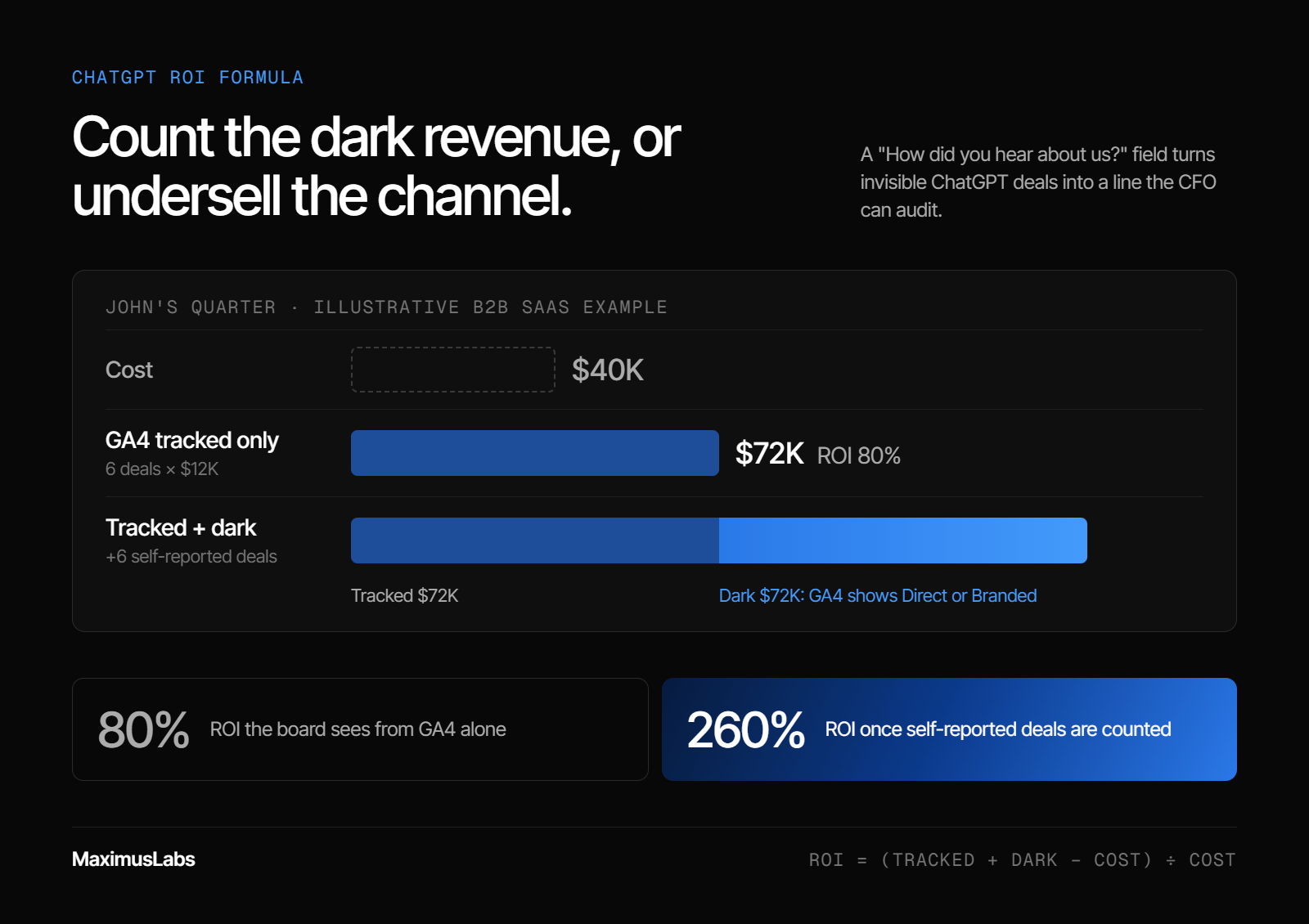
- Tracked revenue: 6 × $12,000 = $72,000
- Dark revenue: 6 × $12,000 = $72,000
- ROI on tracked revenue only: ($72,000 - $40,000) / $40,000 = 80%
- ROI including dark revenue: ($144,000 - $40,000) / $40,000 = 260%
Without the self-reported field, John’s board sees under a third of the return. Webflow’s 8% share of signups from LLMs shows the channel can carry real weight.
Why the Gains Compound
Traffic, conversion rate, and order value can rise at the same time. Alhena’s illustration multiplies +40% traffic, +25% conversion, and +15% order value into about 2.01×, roughly double the revenue. Alhena labels it a model, not measured data, and you should too.
✅ Renting a Stage vs Building on Your Own Land
Adobe found AI-referred retail shoppers generated 53% more revenue per visit than other shoppers in July 2026. I think of paid ads as renting someone else’s stage, because reach stops when spend stops. MaximusLabs AI treats cited content as building on your own land, since a citation keeps working after the invoice is paid.
When ROI Turns Negative
The model can come out below zero, and that’s worth knowing early.
- Low deal values: Thin-margin retail struggles because ChatGPT baskets tend to run smaller.
- Tiny volume: A few dozen sessions a quarter can’t yet cover a full content program.
- No self-reported field: Without it, the dark revenue line stays at zero by default.
MaximusLabs AI builds this model with each client before spend scales up. That keeps the AEO budget tied to pipeline, not to mentions.
Q6: How Do You Become the Answer ChatGPT Recommends?
ChatGPT can only send visitors to brands it names, and Google rankings alone don’t earn that mention. Muck Rack’s May 2026 study found earned media drives 84% of AI citations across ChatGPT, Claude, and Gemini. A 2025 Quoleady analysis found every tool ChatGPT named in software answers had Capterra reviews, and 99% had G2 reviews. MaximusLabs AI splits this work into Owned AEO for specific product questions and Earned AEO for category questions.
The Rankings Report That Stopped Predicting Pipeline
A VP Marketing at a B2B SaaS company holds position three for “best [category] software.” The agency report celebrates it with a green arrow. Then she asks ChatGPT the same question, and her brand isn’t in the answer.
❌ Why Ranking Was Never the Same as Being Chosen
Traditional SEO agencies optimized one surface: the brand’s own website. They wrote blog posts for Google’s blue links and reported rankings, impressions, and clicks. Reviews, communities, and press sat with other teams, or with nobody. Nothing tied that work back to pipeline.
What AI Engines Trust Instead
Buyers now ask ChatGPT, Perplexity, Gemini, Claude, and Google AI Overviews. They get one answer with a handful of brands in it. AI recommends brands it trusts, because its own credibility rides on the pick. So it leans on sources outside your site.
⭐ The Earned-Media Gate
- Earned media: 84% of AI citations come from earned sources, while paid and advertorial content sits at 0.3%.
- Review platforms: 100% of tools ChatGPT named had Capterra reviews, and 99% had G2 reviews.
- The catch: Review volume didn’t decide rank order. Quoleady found review presence matters at the inclusion level only.
Seth Godin’s Purple Cow argued that brands must be remarkable or stay invisible. In AI search, that line became literal. MaximusLabs AI’s read is that only a handful of brands get cited per category, and the rest don’t exist for the buyer.
✅ What Webflow Did Differently
Ethan Smith credits Webflow’s 8% LLM signup share to a few specific habits. Webflow published 800+ YouTube videos showing how to do specific tasks with its product. Its employees answer on Reddit while openly naming who they work for. Posts like “my tool is the best” get policed by the community and fail.
How MaximusLabs AI Gets Clients Into the Answer
MaximusLabs AI runs both pillars as strategy and execution in one team:
- Citation-intelligence engine: maps which sources each engine trusts for a client’s category, then gets the client into them.
- Owned AEO: product, integration, and use-case pages that answer specific follow-up questions.
- Earned AEO: reviews, Reddit threads, press, and listicles that make AI trust the brand.
Most agencies only do the first pillar. Humans approve everything that ships.
💰 What Citation Share Looks Like
For Oliv AI, the result was a “64% AI citation rate in 6 months, vs ~30% for billion-dollar incumbents (Oliv AI).” MaximusLabs measures that engagement on the pipeline those citations produce, not on the citations themselves.
Q7: Which Pages Convert ChatGPT Visitors Once They Click?
ChatGPT visitors mostly land deep inside a site. Seer Interactive found only about 7% of AI visits land on the homepage, with most arriving two or three levels down. Product, pricing, comparison, integration, and case-study pages do the converting. Those pages must serve content in raw HTML, because Vercel found major AI crawlers don’t run JavaScript. MaximusLabs AI starts every content program with bottom-of-funnel (BOFU) pages.
Where AI Visitors Actually Land
Seer’s multi-client study found only about 7% of AI visits hit the homepage. Ahrefs saw a related pattern on its own site. 80% of its AI search visitors went to the homepage, free tools, and product pages.
⚠️ Your Homepage Isn’t the Front Door Anymore
Teams still pour design budget into the homepage. For AI traffic, the buyer usually meets a product or comparison page first. That page has to carry proof, pricing context, and a next step on its own.
The Page Types That Close
| Page type | Buyer question it answers | Conversion job |
| Comparison (X vs Y) | “Which fits my team better?” | Win the final shortlist |
| Integration | “Does it work with HubSpot?” | Remove a blocker |
| Pricing | “What will this cost us?” | Qualify budget |
| Use case | “Does it work for healthcare teams?” | Match the ideal customer profile |
| Case study | “Who like us already uses it?” | Prove outcomes |
Ethan Smith’s owned playbook supports this. He advises a page for every feature, use case, integration, language, and region a product supports. Otter.ai appears for Zoom transcription questions because several of its pages confirm that integration.
✅ Skip the TOFU Detour
Top-of-funnel (TOFU) explainers like “what is X?” rarely convert AI visitors. ChatGPT already answers those questions inside the chat. MaximusLabs AI’s read is that every TOFU post is budget not spent on a page that closes.
Make the Pages Readable to AI Crawlers
Vercel and MERJ studied live crawler traffic and found none of the major AI crawlers render JavaScript. That list includes OpenAI’s OAI-SearchBot, ChatGPT-User, and GPTBot, plus Anthropic’s ClaudeBot.
⏰ A 15-Minute Technical Check
- Load each money page with JavaScript disabled, and confirm pricing, features, and proof still appear.
- Use server-side rendering (SSR) or static site generation (SSG), which send finished HTML to every visitor.
- Confirm robots.txt allows OAI-SearchBot, which OpenAI names as the crawler for ChatGPT search.
- Open each page with a one- or two-sentence direct answer, so the key fact appears early.
Find the Questions in Your Sales Calls
Gong or Chorus call transcripts hold the exact objections buyers raise. Pull the top integration, pricing, and compliance questions, then answer each one on its own page.
MaximusLabs AI starts every content program with BOFU pages. It moves to middle-of-funnel (MOFU) content only once BOFU is covered. That order keeps the first months of work close to pipeline.
Q8: Should You Invest in ChatGPT Traffic Now or Wait for More Volume?
Invest now if buyers in your category research in ChatGPT and your deal values are high. Wait if you sell low-ticket products on thin margins. Google handled about 373 times more searches than ChatGPT in 2024, and Semrush found ChatGPT adoption did not reduce Google use. Citations compound, though, and late entrants face shortlists that have already formed. MaximusLabs AI works with B2B SaaS first, then healthcare services and financial services, where deal values support early investment.
The Budget Meeting Where AEO Gets Cut
It’s planning season. The CFO sees ChatGPT at under 1% of sessions and asks why it deserves budget. The Head of Growth has a conversion story but no volume story.
❌ Why “Wait for Volume” Is the Old Playbook
Traditional SEO budgets followed search volume. Agencies picked keywords by monthly searches, sold rankings on fixed-scope retainers, and reported traffic. By that logic, ChatGPT is too small to matter. It treats raw attention as the only asset worth buying.
What the Volume Data Actually Says
- Scale gap: SparkToro and Datos estimated Google at 14 billion searches per day in 2024, versus at most 37.5 million for ChatGPT.
- No substitution: Semrush’s 260-billion-row clickstream study found Google use held steady, even rising slightly, after people adopted ChatGPT.
- Audience: ChatGPT passed 1 billion weekly active users in July 2026.
- Concentration: ChatGPT sent 92.4% of trackable LLM referral traffic in Previsible’s 2026 study.
ChatGPT adds to search rather than replacing it. The buyers it does hold arrive later in the journey and choose from a short list.
⏰ Why Waiting Costs More Than It Looks
AI recommends brands it already trusts, based on reviews, threads, and press that took time to build. A competitor’s earned citations don’t disappear when you show up. Being mentioned isn’t the finish line, but a missing mention is a closed door.
A Quick Invest-or-Wait Checklist
| Signal | Invest now | Wait and monitor |
| Deal value | High annual contract value (ACV), long sales cycles | Low order value, impulse purchases |
| Buyer behavior | Buyers compare vendors in AI chats | Buyers shop on price in marketplaces |
| Self-reported data | “ChatGPT” appears in form answers | No AI mentions after 90 days of asking |
| Category | B2B SaaS, healthcare, financial services | Thin-margin retail |
How MaximusLabs AI Frames the Bet
MaximusLabs AI runs AEO, with SEO underneath, as strategy and execution in one team. Per-client intelligence graphs research the market and reason over each client’s own context. Daily AI-visibility tracking shows which prompts a client wins or loses, and every engagement is measured on pipeline. Humans approve everything that ships.
⭐ What I Expect Over the Next Five Years
My hypothesis is that agentic checkout, where an AI agent completes the purchase inside the chat, will push ChatGPT conversion higher. I might be wrong on timing. MaximusLabs AI’s advice to founders stays the same either way: don’t be a search result. Be THE source.
Q9: How Do ChatGPT Conversion Rates Compare With Perplexity, Gemini, Claude, and Copilot?
ChatGPT sends the most AI referral traffic, but it doesn’t always convert best. SE Ranking found ChatGPT sent 74.78% of AI referral traffic in 2026, ahead of Gemini at 11.56% and Perplexity at 7.23%. In Seer Interactive’s single-client study, ChatGPT converted at 15.9%, Perplexity at 10.5%, Claude at 5%, and Gemini at 3%. Microsoft Clarity found Copilot had the highest subscription conversion rate. Rankings shift by dataset, so measure each engine separately.
AI Referral Traffic Share by Engine
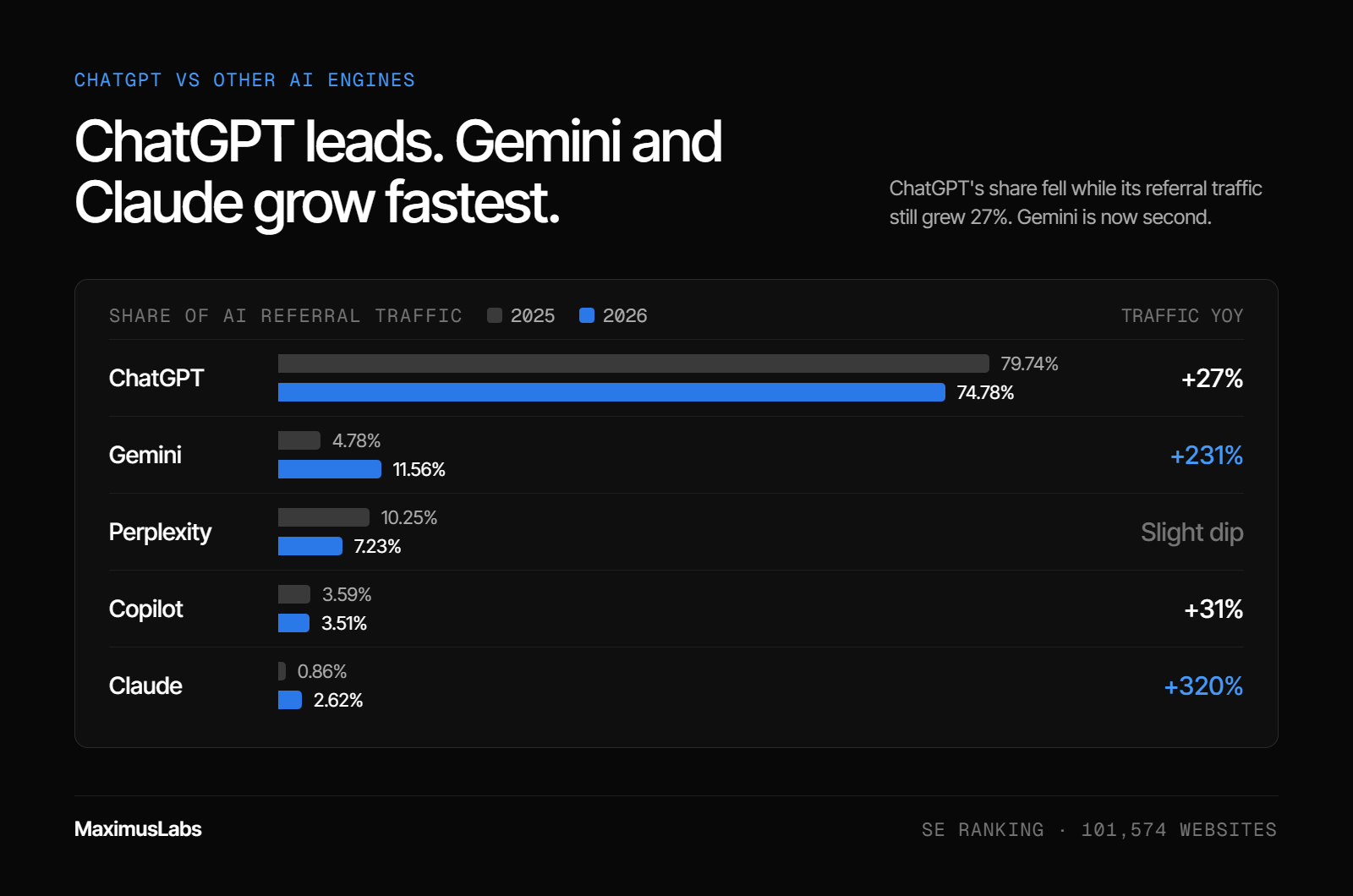
SE Ranking analyzed referral data from 101,574 websites across 250 countries and territories. The split shows how concentrated AI traffic still is, and how fast it’s moving.
| Engine | Share in 2025 | Share in 2026 | Year-over-year traffic change |
| ChatGPT | 79.74% | 74.78% | +27% |
| Gemini | 4.78% | 11.56% | +231% |
| Perplexity | 10.25% | 7.23% | Slight decline |
| Copilot | 3.59% | 3.51% | +31% |
| Claude | 0.86% | 2.62% | +320% |
⚠️ ChatGPT’s Share Is Shrinking, Not Its Traffic
ChatGPT’s share fell, yet its referral traffic still grew 27% year over year. The other engines simply grew faster. Gemini overtook Perplexity as the second-largest AI traffic source in early 2026.
Conversion by Engine: Three Datasets, Three Rankings
The conversion picture is messier than the traffic picture. Each major study crowns a different engine.
| Study | Sample | Top converter | Detail |
| Seer Interactive case study (2025) | 1 B2B client | ChatGPT at 15.9% | Perplexity 10.5%, Claude 5%, Gemini 3%, Google organic 1.76% |
| Seer Interactive multi-client study | Seer client base | Perplexity at 15.9% average | Organic search averaged 9.77%; every LLM beat organic |
| Microsoft Clarity (2025) | 1,277 domains, one month | Copilot for subscriptions | Copilot hit 17× direct and 15× search; Perplexity and Gemini led sign-ups |
⭐ Same Number, Different Engine
Look closely at Seer’s two studies. The headline 15.9% belongs to ChatGPT in one and to Perplexity in the other. That’s exactly why a rate quoted without its study, sample, and engine shouldn’t drive a budget.
MaximusLabs AI’s read is that engine-level conversion mostly reflects audience and task, not the engine itself. My hypothesis is that Copilot’s subscription lead comes from work-focused users inside Microsoft tools. I might be reading too much into it, because most per-engine samples are still small.
How to Compare Engines in Your Own Data
Benchmarks tell you where to look. Your own funnel tells you where to spend.
✅ Five Steps for an Engine-Level Comparison
- Split AI traffic by engine. Reports indicate GA4 added a native AI Assistant channel group in May 2026, so check your property first. Otherwise, use the custom channel group regex from Q4.
- Pick one conversion event. Use the same demo request or paid order for every engine.
- Set a volume floor. As a rule of thumb, wait for about 100 sessions per engine per quarter before ranking them.
- Compare revenue per session. A higher conversion rate on smaller deals can still lose.
- Re-run every quarter. Engine shares moved sharply between 2025 and 2026, and they’ll keep moving.
💸 Where to Put Effort First
ChatGPT still carries about three-quarters of AI referrals, so it usually earns first priority. Gemini deserves a close second look given its 231% growth. Perplexity and Claude send less traffic, but they can convert well, so track them before you dismiss them.
MaximusLabs AI tracks AI visibility daily across every major engine, re-run and regression-tested, so engine-level shifts show up quickly. Each engine is then judged on the pipeline it sends, not on its share of mentions.
Frequently asked questions
What is a good conversion rate for ChatGPT traffic?
There is no single good number, because each study counts a different kind of conversion. Across the studies we reviewed, ChatGPT conversion rates run from about 1.8% for ecommerce purchases to 15.9% for a single B2B client. • Ecommerce purchases: Visibility Labs measured 1.81% for ChatGPT versus 1.39% for non-branded organic across 94 brands. • Free signups: Microsoft Clarity measured 1.66% for AI traffic versus 0.15% for search across 1,200+ publisher sites. • B2B leads: Seer Interactive saw 15.9% for one client, against 1.76% for Google organic. MaximusLabs AI treats any outside benchmark as a starting point, not a target. The number that matters is the ratio between your ChatGPT sessions and your own non-branded organic sessions, on the same page types, using the same conversion event. We suggest a simple rule. If ChatGPT matches or beats non-branded organic on revenue per session, the channel is pulling its weight. If it wins on rate but loses on revenue, check deal size before you scale. Our guide to GEO metrics and KPIs shows how to set that baseline.
How do I find ChatGPT traffic in Google Analytics 4?
ChatGPT traffic appears in GA4 in two ways: as a referral from chatgpt.com, and through the utm_source=chatgpt.com tag that OpenAI adds to links in ChatGPT answers. We recommend grouping both into one channel so the numbers don't scatter across reports. • Open Admin, then Channel groups, and create a custom group. • Add an "AI Assistants" channel where session source matches chatgpt.com, openai.com, perplexity.ai, claude.ai, gemini.google.com, and copilot.microsoft.com. • Move that channel above Referral, so AI sessions are not swallowed by the generic referral bucket. • Check whether your property already shows a native AI Assistant channel, which reports say GA4 added in 2026. Once the channel exists, compare its conversion rate and revenue per session against non-branded organic search. MaximusLabs AI sets this channel up early in every engagement, because the rest of the ROI model depends on it. Remember that GA4 only sees clicks. Buyers who read a ChatGPT answer and then search your brand will still show up as Branded Search. Our AEO measurement and tracking guide covers the extra layers that catch them.
Why does ChatGPT traffic show up as direct or branded search in GA4?
Most ChatGPT influence never arrives as a tagged click. A buyer reads an answer that names your brand, opens a new tab, and then searches the brand on Google or types the URL. GA4 records that visit as Branded Search or Direct, so ChatGPT gets no credit. Graphite CEO Ethan Smith estimates that UTM tracking captures only about one-tenth of ChatGPT's real impact. Buyers who copy a brand name out of an answer also arrive with no tag. MaximusLabs AI uses three signals to estimate this dark share: • Self-reported attribution: an open-text "How did you hear about us?" field on demo and signup forms. • Branded search trends: brand searches that rise alongside AI visibility can point to ChatGPT influence. • CRM cohorts: closed-won deals grouped weekly by self-reported source. We treat the self-reported field as the most important of the three, because it costs nothing and catches what no tracker can see. If you want to understand the wider limits of AI attribution, our breakdown of AEO attribution challenges goes deeper.
Does ChatGPT traffic convert better for B2B SaaS or ecommerce?
The evidence favors high-consideration purchases and low-friction conversions such as signups and demo requests. Low-ticket ecommerce shows a smaller edge, and sometimes none. • B2B software: Ethan Smith reported Webflow saw a 6x conversion difference between LLM and Google traffic, with 8% of signups coming from LLMs. • Ecommerce: a peer-reviewed study of 973 sites by Kaiser and Schulze found ChatGPT referrals trailing organic search, though conversion rates rose month over month. • By industry: First Page Sage data put hotels at 7.0%, legal at 5.6%, ecommerce at 3.0%, and B2B SaaS at 2.4%. Basket size matters too. ChatGPT shoppers spent $204 per order versus $238 from organic in one 94-brand study, which shrinks the conversion edge on revenue per session. MaximusLabs AI works with B2B SaaS first, then healthcare services and financial services, because deal values there make early citations pay back. Retail brands can still win, but they should judge the channel on revenue per session. See our playbooks for B2B SaaS AEO and ecommerce product AEO.
How long does it take to see ROI from optimizing for ChatGPT?
Timelines vary by category, competition, and how much earned media a brand already has. AI engines lean on reviews, press, and community threads, and those take time to build. Citations compound once they exist, so early months often look slower than later ones. MaximusLabs AI's published results give one concrete reference point, from a B2B SaaS engagement with Oliv AI: • "64% AI citation rate in 6 months, vs ~30% for billion-dollar incumbents (Oliv AI)" • "27 qualified leads, $47K+ pipeline, 26% close rate in 4 months (Oliv AI)" We don't promise those numbers to every client, because starting points differ. What we do is set a pipeline baseline before work begins, then measure against it. To shorten the path, we start with bottom-of-funnel pages and review-platform presence, since both affect citations and conversions. We also add a self-reported attribution field on day one, so early wins are not hidden as Direct traffic. Read the full Oliv AI case study, or our guide to calculating GEO ROI.
How can I increase the conversion rate of ChatGPT visitors?
Start where ChatGPT visitors actually land. Seer Interactive found only about 7% of AI visits hit the homepage, so product, pricing, comparison, integration, and case-study pages carry most conversions. • Answer first: open each page with a one- or two-sentence direct answer to the buyer's question. • Carry proof on the page: include pricing context, customer results, and a clear next step, since visitors may never see your homepage. • Render in HTML: AI crawlers from OpenAI and Anthropic don't run JavaScript, so key content must load server-side. • Use sales-call language: pull objections from Gong or Chorus transcripts and answer each one on its own page. MaximusLabs AI starts every content program with bottom-of-funnel pages for this reason. We move to middle-of-funnel content only once buyers' final questions are covered. One caution: top-of-funnel explainers rarely convert AI visitors, because ChatGPT already answers "what is X?" inside the chat. Check whether your key pages are readable with our free AI crawlability checker, and see how to structure answers in our AEO answer structure guide.
Do I need a paid AI visibility tool to measure ChatGPT conversions?
Not at first. Prompt trackers show whether ChatGPT mentions your brand, but they can't see conversions, and they can't see buyers who never click. Graphite CEO Ethan Smith counts about 60 AEO tracking tools and calls them a near-commodity, advising teams to pick the cheapest one that fits. We suggest building the free measurement layers before buying anything: • A GA4 AI channel group for tagged ChatGPT sessions. • A "How did you hear about us?" field on every demo and signup form. • A weekly CRM view of closed-won deals by self-reported source. Once those exist, a tracker adds useful context. It shows which prompts you win, which competitors appear beside you, and which sources ChatGPT cites. That helps explain why conversions moved. MaximusLabs AI runs daily AI-visibility tracking across every major engine for clients, then reads that data against CRM cohorts. The tracker is the diagnostic, and pipeline is the scoreboard. If you do want a tool, our comparison of ChatGPT tracking tools lays out the options.