 Krishna Kaanth M
- Multi-market GEO means getting cited by AI engines in every language your buyers use, not translating English pages and adding hreflang.
- AI authority resets at each language border because retrieval embeddings skew English and cross-language citation overlap is near zero.
- The dominant answer engine changes by market, so Baidu, Naver, and Yahoo Japan matter alongside Google AI and Perplexity.
- Prioritize markets on revenue, competitive gap, and infrastructure, then go BOFU-first in one or two high-resource languages.
- Earn local-language press, review, and community citations, and serve server-side hreflang plus inLanguage schema on subdirectories.
- Measure share of voice per locale, not global impressions, and connect it to pipeline with GA4 country segments and source surveys.
Q1: What is Multi-Market GEO, and why is it different from multilingual SEO?
Multi-market GEO is the practice of getting your brand cited by AI answer engines (ChatGPT, Perplexity, Gemini, Google AI Overviews) in every market and language your buyers use. Unlike multilingual SEO, it treats each language as a partially independent knowledge space that demands local-language content, local citations, and localized schema, not translated English pages. The goal is to become the answer in each locale, not merely rank a blue link.
🌍 The moment your #1 ranking stops working
Picture a Head of Growth at a B2B SaaS company. She ranks number one on Google for her category in English. Then a German buyer opens ChatGPT and asks the same question in German. Her brand never shows up.
That gap is the whole problem. She optimized a website. She never optimized to be the answer an AI engine repeats to a buyer in Munich.
⚠️ Why translation and hreflang are not enough
Most teams assume the fix is simple. Translate the pages, add hreflang tags, and wait. That approach still misses citations.
AI answer engines do not just rank your page. They retrieve sources, then summarize them into one spoken answer. A translated page rarely earns that citation, because it reads as derivative and carries no local trust signals. Our generative engine optimization work starts exactly here, at what earns a citation rather than a ranking.
- Multilingual SEO optimizes your own pages to rank links.
- Multi-market GEO optimizes to get cited inside the AI answer itself.
- The unit of success shifts from position to citation frequency, per language.
📊 The mechanics behind the reset
Here is the part the category avoids saying plainly. Ranking in one language does almost nothing for another. Cross-language domain overlap in AI citations is effectively near zero, so authority does not travel across the border with you.
The academic definition backs this up. The Princeton-origin research that named this field, "GEO: Generative Engine Optimization," shows structured optimizations can lift visibility in generative answers by up to around 40%. That lift is earned per language, not inherited, which is why what GEO actually is matters before you scale it.
I might be wrong on the exact numbers by market. But from what surfaces when you actually run prompts across languages, the standard "just translate it" read gets this backwards.
💰 What this means for pipeline
GEO is not SEO with extra steps. It is closer to a data science problem. You need to know how each model retrieves and trusts sources before you can be present in its answers.
That reframe is why we built our Revenue-focused GEO (R-GEO) approach at MaximusLabs around per-language citation behavior rather than translation volume. When a buyer in any market asks an AI engine for the best option, you want to be in the five to ten names it actually says out loud. If that is the outcome you want, this is where our GEO service begins.
Q2: Why doesn't my English AI authority transfer to other languages?
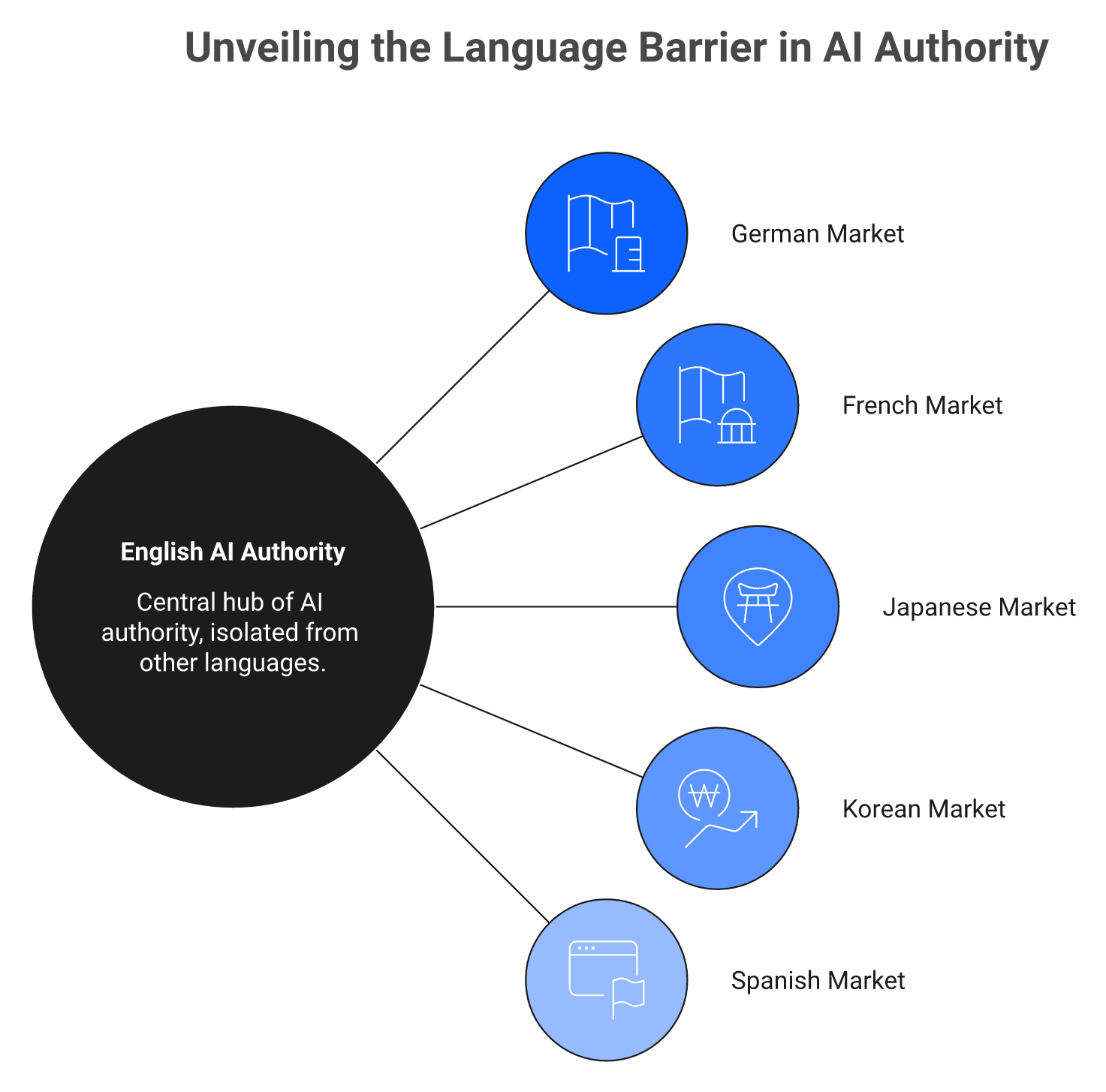
English AI authority barely transfers because each language forms a partially separate "semantic neighborhood" inside the model, and retrieval embeddings skew heavily toward English. Measured cross-language domain overlap is near zero, so being cited in English does almost nothing for a German or Japanese query. To be cited in a market, your content must exist there, be locally credible, and sit close to that language's query vectors.
🧠 Authority resets at the language border
Start with the conclusion, because it saves you months of wasted budget. Your English citations do not carry over. Each language behaves like its own map inside the model.
So the brand that dominates English answers can be completely absent in French or Japanese ones. The model is not being unfair. It simply retrieves from a different neighborhood for each language.
🔬 The embedding skew nobody mentions
Here is the technical reason. Retrieval models convert text into vectors, then match your content against the query. Those vectors are trained on data that leans heavily English.
For example, Perplexity's embedding model was trained across 30 languages, but roughly 65.6% of that data was English. That skew means non-English content has to sit exceptionally close to local query vectors to get picked, a nuance our Perplexity optimization work is built around.
- The core model learns broad facts from training data (slow to influence).
- The retrieval layer (RAG) pulls live sources for the answer (this is what you optimize).
- In a non-English query, retrieval favors content that is genuinely local, not translated.
🔁 Near-zero overlap forces separate loops
Google's MUM was designed to transfer knowledge across 75 languages, which sounds like it should solve this. In practice, that transfer helps understanding, not your citation odds. You still need to earn the local source.
Independent measurement shows near-zero cross-language domain overlap in AI citations. In plain terms, the sites cited for a German query are mostly different from the sites cited for the English one. This is not a rounding error. It means you cannot run one global content loop; you need a separate content and citation loop per locale, each with its own entity graph, which is core to answer engine optimization.
✅ Your Monday-morning move
I spent a lot of time inside how these systems evaluate brands at scale. The felt sense is that "global authority" is a myth until you rebuild it, language by language.
Pick one priority market. Run five real buyer prompts in that language through ChatGPT and Perplexity, both live-retrieval engines since ChatGPT search launched on October 30, 2024. Note which sources get cited. That list is your local target map, and it is the same starting point our ChatGPT optimization engagements use.
Q3: Which AI platforms actually matter in each market?
The dominant answer engine varies by market. Google AI Overviews and Perplexity lead in the US and Western Europe; Baidu, Ernie Bot, and Kimi dominate China; Naver matters in South Korea; and Yahoo Japan sits alongside Google in Japan. Optimizing only for Google globally leaves you invisible where buyers use a different engine. Multi-market GEO means picking the top engine per locale and optimizing for its specific citation logic.
🗺️ Engine dominance is a map, not a default
The instinct is to treat "AI search" as one thing and optimize for Google everywhere. That instinct quietly loses you entire markets.
Different countries lean on different engines. So your citation strategy has to change at the border, the same way your ad strategy does. Our Google AI and Gemini optimization and regional engine work exists for exactly this reason.
| Market | Dominant engine(s) | What to watch |
|---|---|---|
| US / Western Europe | Google AI Overviews, Perplexity, ChatGPT | High organic citation share, strong English skew |
| China | Baidu, Ernie Bot, Kimi | Google is not the game; local platforms rule |
| South Korea | Naver, plus Google | Naver's ecosystem shapes what gets surfaced |
| Japan | Yahoo Japan alongside Google | Two strong engines, not one |
📈 Why per-engine effort pays back
This is not busywork for its own sake. The pie of search is getting larger, and as one analysis put it, "Google's slice of the pie stays the same; the pie gets bigger." AI engines are the new slices, and they behave differently by region.
The revenue case is strong too. Practitioner data shows a roughly 6x conversion-rate difference between LLM traffic and Google search traffic, because AI users arrive with built-up intent. Winning the right engine in each market means capturing that high-intent traffic, not vanity impressions, which is the whole point of our GEO service.
🎯 The payoff: choose before you write
Do not create content and hope every engine cites it. Pick one or two engines per priority market first, then structure content for how each one retrieves.
This is exactly the AI source analysis we run at MaximusLabs per locale. We build prompt sets for each engine, map the top-cited sources, and surface the exact URLs that engine repeats in that market. That map tells you where to earn citations, so budget goes to what the local AI actually reads, a method detailed in our GEO competitive analysis approach.
Q4: How do I prioritize which markets and languages to invest in first?
Prioritize markets on three factors: revenue opportunity (current or realistic pipeline), competitive gap (locales no rival has optimized), and existing infrastructure (localized pages, entities, sales coverage). Sequence high-resource languages first because models retrieve them more reliably. A typical B2B rollout is Phase 1 German, French, and Spanish, Phase 2 Japanese, Portuguese, and Italian, Phase 3 Korean, Dutch, and Polish, always BOFU-first so the earliest content converts, not just attracts traffic.
🌐 The temptation to boil the ocean
A founder gets excited and says, "Let's launch in 20 languages." The map lights up. The budget does not.
Trying to enter every market at once spreads a finite go-to-market budget so thin that no single locale gets enough content or citations to move. Nothing ranks. Nothing gets cited.
⚠️ Why blanket expansion breaks
Two forces work against you. First, budget is real and sitting in headcount and content spend right now. Second, models retrieve high-resource languages (German, French, Spanish) far more reliably than low-resource ones.
So a low-resource market can absorb heavy spend and still return almost no citations. You end up funding invisibility, which is why our R-GEO revenue-focused framework sequences spend against pipeline.
✅ The three-factor prioritization matrix
Sequence markets instead of storming them. Score each candidate on three things, then phase the rollout.
- Revenue opportunity: where real or realistic pipeline already exists.
- Competitive gap: locales where no rival has optimized for AI citations yet.
- Existing infrastructure: localized pages, consistent entities, and local sales coverage.
A workable B2B sequence looks like this:
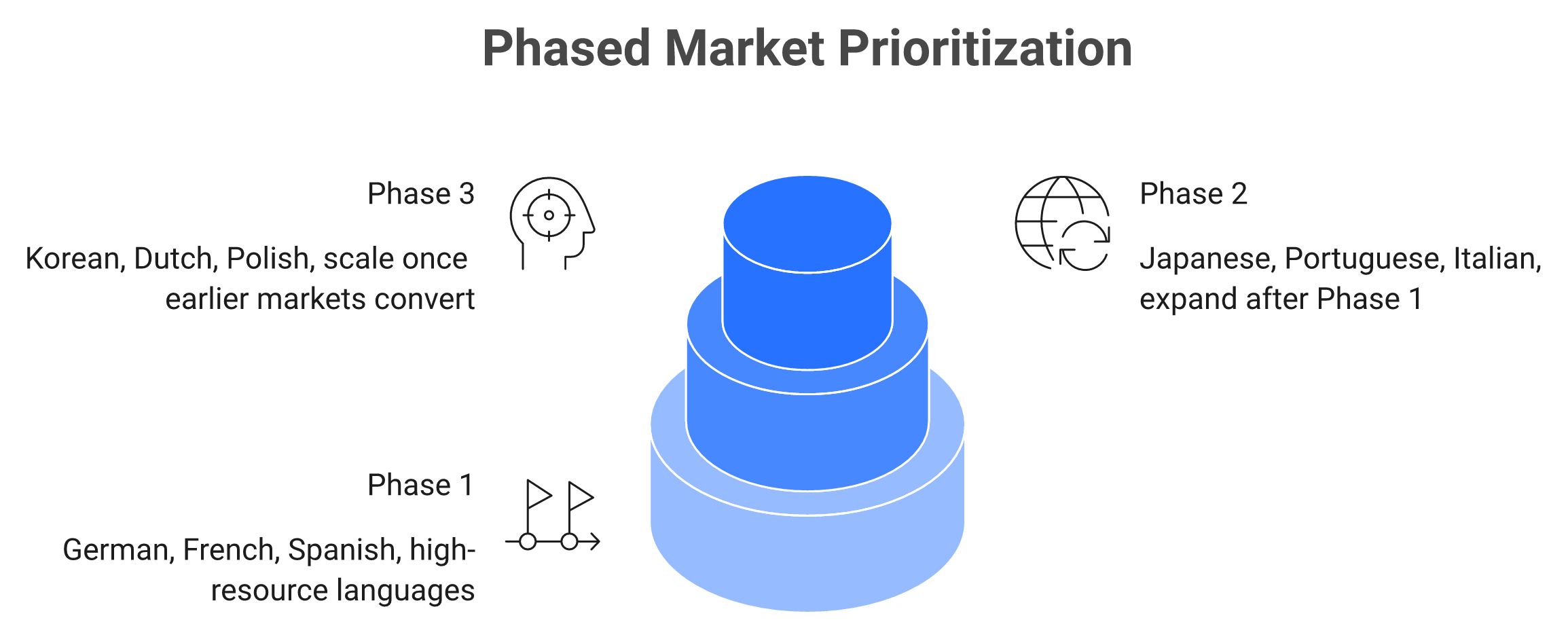
- Phase 1: German, French, Spanish (high-resource, high-return).
- Phase 2: Japanese, Portuguese, Italian.
- Phase 3: Korean, Dutch, Polish.
There is a contrarian upside here worth naming. Narrow verticals stop feeling narrow once you go global. As one operator put it, "being international in a given vertical makes your vertical market very, very big." Specialization plus geography is a moat, not a limit, and it maps directly to our GEO/AEO for AI SaaS focus.
💰 Go BOFU-first, per market
The urgency is real. Gartner projects traditional search volume will drop 25% by 2026 as buyers shift to AI chatbots. The GEO market itself is projected at roughly $1,089.3 million in 2026, growing about 40.6% a year.
So lead each market with bottom-of-funnel, ICP-aligned content, not "what is X" pages the AI already answers. This is the R-GEO sequencing we use at MaximusLabs: enter a market with content that converts, then expand. One client, Oliv AI, reached a 64% citation rate across AI platforms in six months, overtaking legacy competitors sitting near 30%, as shown in our Oliv AI B2B SaaS case study.
"It's impossible to rank in Google for 'best credit card.' It'll take years. But you can actually rank in chat faster, because the citations are what matter."
Ethan Smith, CEO of Graphite MaximusLabs SEO/GEO Knowledge Base
Q5: Why does translation fail, and what does 'locally citable' content actually require?
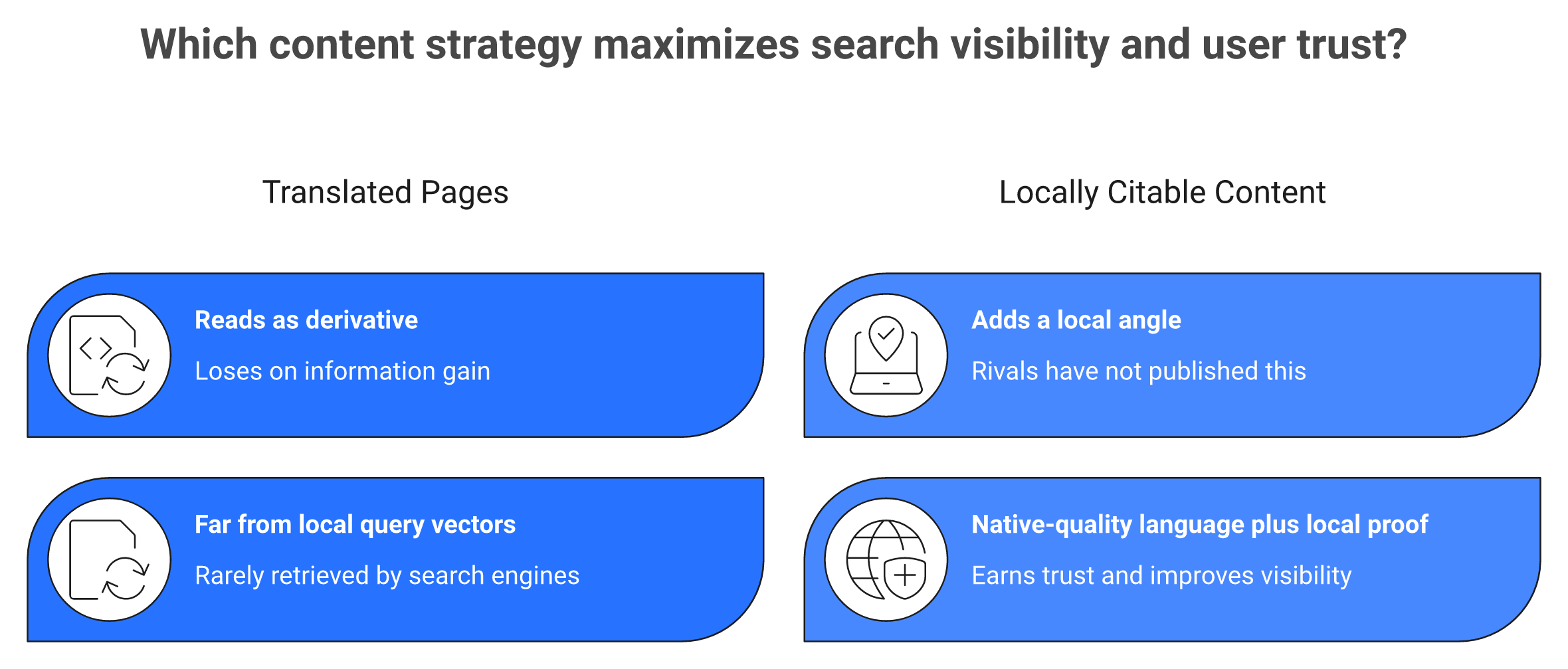
Translation fails because AI engines cite content that shows local subject-matter expertise and information gain, not converted English. Locally citable content needs native-quality language, market-specific proof (local case studies, local data, local entities), consistent entity naming across languages, and text-exposed facets AI can extract. Machine-translated pages read as derivative, sit far from local query vectors, and rarely get cited when a native speaker prompts an AI engine.
🌐 The "just translate the blog" trap
A marketing manager exports the top English posts, runs them through a translation tool, and ships them under a /de/ folder. The pages go live. The citations never come.
That workflow feels productive. It is really just producing invisible content in a second language, which is why our content marketing service starts from citability, not word count.
⚠️ Why translated content stays invisible
Translation moves words across languages. It does not move trust or novelty. AI engines reward information gain, which means content that says something new, not a rephrase of what already exists.
Two problems stack up:
- Translated pages read as derivative, so they lose on information gain.
- They sit far from local query vectors, because they lack native phrasing and local entities.
As one operator put it, "the penalty for average has never been so severe." A translated page is, by definition, average.
✅ What "locally citable" actually requires
Locally citable content is built in-market, not converted into it. The GEO research is clear that content citing credible sources and adding fresh information earns more visibility in generative answers, by up to around 40%.
Here is the checklist that holds up when you run it:
- Native-quality language: written for the reader, not decoded from English.
- Market-specific proof: local case studies, local data, and local customer names.
- Entity consistency: the same brand and product names across every language version.
- Information gain: a local angle competitors have not published.
"Content is King" is only true when information gain and regional expertise are the kingmakers. Generic localization is not, a principle at the core of our GEO content optimization work.
📦 The exposed-facet tactic
Here is a hard-won move most teams miss. AI shopping and research agents cannot click JavaScript filters. If your key attributes hide behind interactive menus, the engine never sees them.
So bring the facet data into the text itself. As one practitioner described it, "expose this facet data, the closure and the fabric and the material and the neck style, because a lot of the follow-up questions are 'best product with these attributes.'" Put those attributes in headers and body copy, in the local language, and you start winning "best [product] for [market]" queries, which is exactly how our answer engine optimization approaches product content.
"AI generated content is a summarization of its own results. You have this infinite loop, and then you have garbage."
Ethan Smith, CEO of Graphite MaximusLabs SEO/GEO Knowledge Base
"There's a clear correlation. You rank higher with human content than AI content."
Ethan Smith, CEO of Graphite MaximusLabs SEO/GEO Knowledge Base
Q6: What technical foundation lets AI crawl and cite every locale?
AI engines choose a language version using hreflang, on-page language signals, and localized schema. Google AI applies hreflang most directly; Perplexity and Claude respect it less precisely. Serve hreflang server-side (not JS-gated), add inLanguage schema, use subdirectories (site.com/de/) over subdomains, and give every locale point-to-point internal links. This lets AI crawlers reach, parse, and cite each market's pages instead of citing the wrong language or missing localized content entirely.
🧭 The signals engines read first
Start with the rule. Engines pick a language version from three signals: hreflang tags, on-page language cues, and localized schema (structured data that labels your content for machines).
Get those three right and the engine can match a German query to your German page. Get them wrong and it guesses. This is the foundation our technical SEO and website audit checks first.
🔍 Per-engine hreflang behavior differs
Not every engine reads these signals the same way. Google AI applies hreflang most directly, since it draws from a hreflang-aware index. Perplexity and Claude run their own crawlers and respect it less precisely.
That difference matters for where your effort lands. For Google surfaces, clean hreflang does heavy lifting. For Perplexity and Claude, strong native content and local entities carry more weight, which shapes how our Anthropic Claude optimization and Perplexity optimization differ by engine.
⚠️ Where localization quietly breaks
Here is the failure I see most often. A brand's French page exists, but the hreflang is JavaScript-gated or broken. So the engine cites the English page for a French query, and the localization budget is wasted.
The fix is boring and effective:
- Serve hreflang server-side, in raw HTML, not injected by JavaScript.
- Add inLanguage schema so each page declares its language to machines.
- Confirm every locale is reachable without rendering scripts.
🛫 Architecture: subdirectories and point-to-point links
Use subdirectories (site.com/de/), not subdomains. Subdomains often get treated as separate, weaker properties. As one practitioner put it, "never use subdomains because they tend to not perform as well. Google built their algorithm that way."
Think of internal linking like an airline route map. You want point-to-point links so every regional page is reachable, not a hub-and-spoke model that leaves local pages orphaned. On the schema debate, I land here: it is closer to a hygiene factor than a magic differentiator, but for correct language attribution it is non-negotiable, which is why schema markup basics matter per locale.
✅ Your per-locale technical checklist
Run this before publishing any market:
- Server-rendered hreflang, reciprocal and validated.
- inLanguage schema plus localized Organization and Article markup.
- Subdirectory URL structure, critical text in HTML.
- AI crawlers (GPTbot, OAI-SearchBot) unblocked in robots.txt.
This is the exact technical-SEO-for-the-AI-era audit we run at MaximusLabs, rebuilding site architecture and unblocking AI crawlers locale by locale, so nothing gets stranded. If crawler access is your worry, start with managing AI crawlers.
"Immediately check your robots.txt to ensure you are not blocking OpenAI's crawlers. If you are, you have zero chance of appearing in ChatGPT's results."
Ethan Smith, CEO of Graphite MaximusLabs SEO/GEO Knowledge Base
Q7: How do I earn local citations and trust signals in a new market?
You earn local citations by building a market-specific presence, not reusing your English list. Get mentioned in local-language press (t3n in Germany, Les Echos in France, ITmedia in Japan), local review platforms (Trustpilot in Europe, localized Capterra, native review sites), and local communities. These sources feed each market's training and retrieval data, so AI engines cite you when a native speaker asks. Trust is language-specific and must be rebuilt per locale.
🌍 The copy-paste citation list problem
A team wins citations in the US, then reuses the exact same target list for Germany. Same publications. Same review sites. Same outreach.
It rarely works. The German AI answer pulls from German sources the team never touched.
⚠️ Citation ecosystems are language-specific
Each market has its own trusted surfaces. AI engines learn what to cite from the sources that dominate that language's web.
So the map changes by country:
- Germany: t3n, Computerwoche, and local review platforms.
- France: Les Echos, Journal du Net.
- Japan: ITmedia and native review ecosystems.
Reusing your English list means the local engine has no local trust signal to find you with.
✅ Build the per-market presence
The resolution is to rebuild trust, market by market, across three surfaces:
- Local press: earned mentions in the language's leading publications.
- Local review platforms: Trustpilot in Europe, localized Capterra, native review sites.
- Local communities: Reddit, Quora, and region-specific forums, engaged authentically.
This is Search Everywhere Optimization: showing up across third-party surfaces, not just your own site. It is also durable. As one operator noted, paid ads mean "renting someone else's stage," while earned local authority compounds, a pattern we cover in Reddit and forum AEO.
💰 Why brand is the real moat
Here is the conviction the category tiptoes around. Tactics change, but brand does not. As Krishna puts it, "it is not about understanding the algorithm or hacking. It is about building a brand. If you build a brand in your space, then AI has to recommend you."
That local brand authority acts like a stable prior the model keeps returning to, even after algorithm updates. This is what our AI search visibility and brand mention tracking work builds per market: a 360 presence across local press, communities, and review platforms so regional engines have real trust signals to cite. Start this month with one locale and a short target list from our international AEO agencies resource.
"Reddit is a crucial citation source. Say who you are and where you work, and provide genuinely useful information. Even five high-quality comments can have a big impact."
Ethan Smith, CEO of Graphite MaximusLabs SEO/GEO Knowledge Base
Q8: How do I measure AI-search visibility per market and tie it to pipeline?
Measure AI visibility per locale, not globally. Track share of voice (how often your brand is cited), sentiment, and which sources get cited across ChatGPT, Perplexity, Gemini, and Google AI Mode in each language, using dozens of buyer-prompt variants. Because many AI answers are non-clickable, tie visibility to pipeline with GA4 AI-referral segments by country plus post-conversion "how did you hear about us" surveys, not last-touch attribution alone.
📊 The metric that actually matters
Lead with the right number. In AI search there is no single rank to chase. The metric is share of voice: how often your brand appears in answers versus competitors.
Measure it per language, not as one global figure. A strong German share of voice and a weak Japanese one average into a number that hides both truths, so our AEO measurement metrics break it out by locale.
🔁 Why you track many prompts per locale
AI answers shift with each run, each phrasing variant, and each platform. So one prompt tells you almost nothing.
Track dozens of buyer-prompt variants per market, across ChatGPT, Perplexity, Gemini, and Google AI Mode. Note which sources get cited each time, because that reveals where to earn your next citation. Latency even plays a role here: retrieval pipelines running around 164ms at the 95th percentile decide what gets pulled before an answer forms, so slow or unreachable local pages simply miss the cut, a point tied to our GEO measurement and metrics.
⚠️ The attribution trap
Here is the pain point. Many AI answers are not clickable, so the buyer sees your brand, then opens a new tab and searches your name directly.
Last-touch attribution then miscredits that visit to "direct" or "branded search." The AI engine that actually drove it disappears from your report, which is why GEO ROI and revenue attribution needs a different model.
✅ How to connect visibility to pipeline
Set up attribution that survives non-clickable answers:
- Segment GA4 AI-referral traffic by country to see which markets send high-intent visits.
- Add a "how did you hear about us" field on conversion forms.
- Compare AI-referred conversion quality against other channels.
The payoff is worth it. Practitioner data shows a roughly 6x conversion-rate difference between LLM traffic and Google search traffic, because AI users arrive primed. Measuring per market tells you where that high-intent traffic is really coming from.
This is exactly how we run measurement at MaximusLabs, tracking citation rate against competitors across thousands of question variants per market. One client, Oliv AI, reached a 64% citation rate versus a legacy competitor near 30%, detailed in our Oliv AI B2B SaaS case study. Treat it like an experiment: hold a control set of prompts, intervene on a test set, and watch share of voice move.
"For AEO, I need to look at share of voice, or how frequently am I showing up, instead of a single position."
Ethan Smith, CEO of Graphite MaximusLabs SEO/GEO Knowledge Base
Q9: What's the biggest mistake teams make with international GEO, and how do I avoid it?
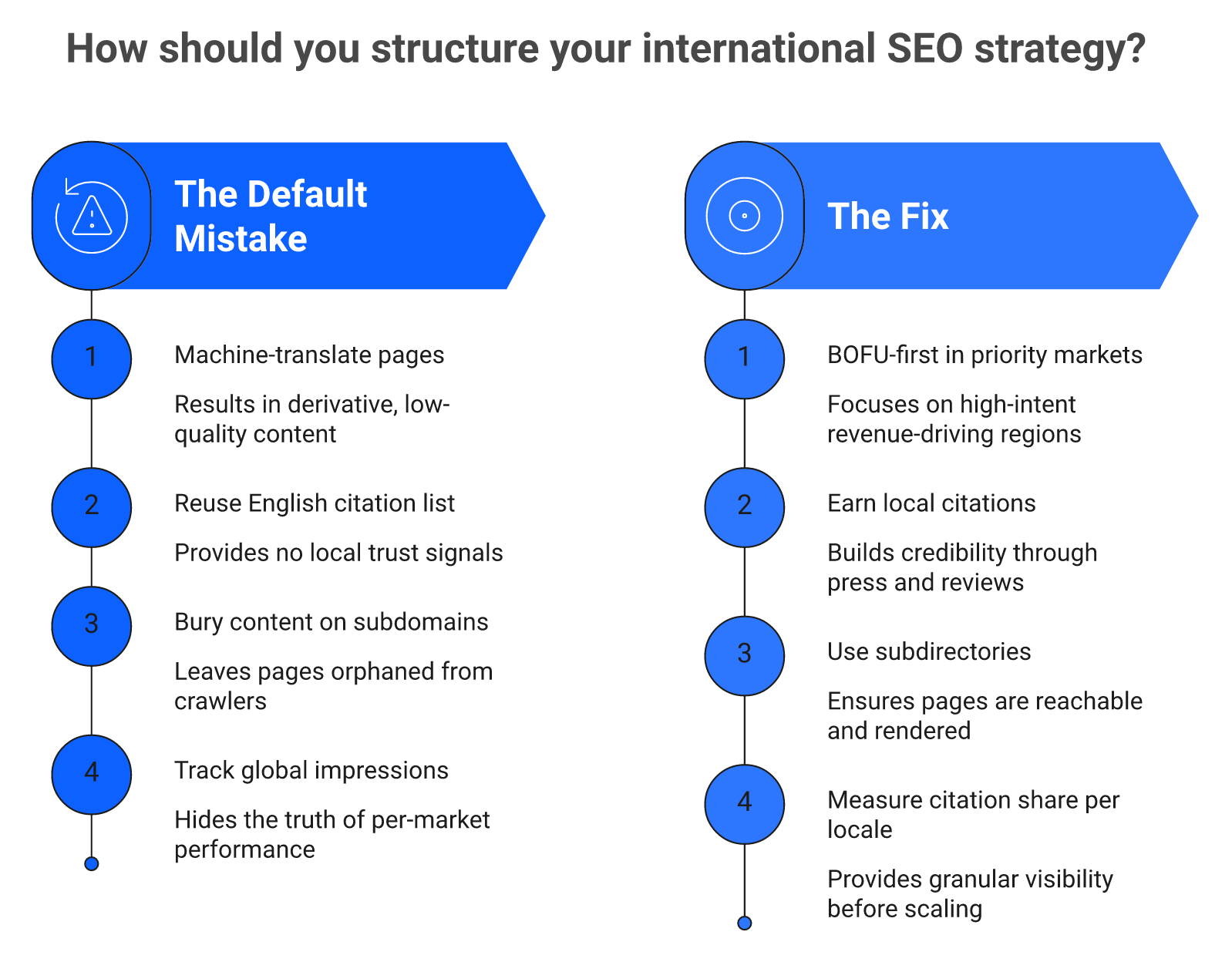
The biggest mistake is treating multi-market GEO as bulk translation plus hreflang, then measuring global vanity metrics. Teams publish machine-translated pages, reuse their English citation list, bury regional content on subdomains, and track worldwide impressions instead of per-market share of voice and pipeline. Avoid it by going BOFU-first in one or two revenue-priority markets, earning local citations, and measuring citation share per locale before scaling.
⚠️ The "translate, hreflang, and hope" default
Most teams run the same playbook. Translate the top pages, bolt on hreflang tags, push everything live, and wait for AI citations to appear.
It feels like progress. A dashboard fills with new URLs and rising global impressions. The pipeline does not move, which is where our GEO service starts the diagnosis.
❌ Why the default produces invisibility
That playbook fails on every axis this article has covered. Each shortcut quietly cancels a citation.
- Machine-translated pages read as derivative, so they lose on information gain.
- Reusing the English citation list means local engines have no local trust signal to find.
- Burying content on subdomains leaves regional pages orphaned from AI crawlers.
- Tracking global impressions hides the per-market share of voice that actually predicts revenue.
The result is a brand that looks busy in reporting and stays absent in German, French, or Japanese answers. The urgency is real: traditional search volume is projected to drop 25% by 2026 as buyers move to AI chatbots. Waiting is its own mistake, and our answer engine optimization work treats it that way.
✅ The fix: narrow, local, and measured
The resolution is discipline, not scale. Do less, in fewer markets, done right.
- Go BOFU-first in one or two revenue-priority markets, not twenty at once.
- Earn local citations in each market's real press, review, and community surfaces.
- Measure citation share per locale before spending on the next market.
I might be wrong on the exact sequence for every business. But from what surfaces when you actually run this, the standard "launch everywhere" read gets it backwards. Proof of concept in one market funds the next, which is the core logic of our R-GEO revenue-focused framework.
💰 Speed-to-market is the quiet moat
Here is the edge the category underrates. Most of this work does not need a nine-month engineering cycle.
As Krishna puts it, "much of this stuff could be built in weeks or days, but we would come in and they say this is going to take nine months. We built a whole Webflow team because we can do things really fast." That speed compounds: the first mover in a locale earns the citations before rivals notice the market exists, a pattern we cover in our international AEO agencies resource.
This is how we close the loop at MaximusLabs. We ship the first localized GEO article within days, not months, then pair that speed with trust-first, revenue-focused R-GEO so a brand becomes the answer in each market. One client, Oliv AI, reached a 64% citation rate across AI platforms while legacy competitors sat near 30%, as detailed in our Oliv AI B2B SaaS case study.
"It's impossible to rank in Google for 'best credit card.' But you can rank in chat faster, because the citations are what matter. Startups can win quickly."
Ethan Smith, CEO of Graphite MaximusLabs SEO/GEO Knowledge Base
🔭 The question I'm sitting with
Here is what I keep turning over. If citation authority resets at every language border, the first brand to build local trust in an underserved market may lock in a lead that later budgets cannot buy back.
So which market is quietly wide open for you right now, and what would it cost a competitor to catch up if you moved first? If you want to pressure-test that against your own pipeline, that is the conversation I would rather have than any pitch, and it is exactly what our contact us page is for. You can also start narrowing markets with our GEO market analysis approach.
Frequently asked questions
What is multi-market GEO and how is it different from multilingual SEO?
Multi-market GEO is how we get a brand cited by AI answer engines like ChatGPT, Perplexity, Gemini, and Google AI Overviews in every market and language its buyers use. Multilingual SEO optimizes your own pages to rank blue links. Multi-market GEO optimizes to become the answer the engine repeats. The difference matters because AI engines do not just rank pages. They retrieve sources, then summarize them into one spoken answer. Multilingual SEO chases position per keyword. Multi-market GEO chases citation frequency per language. Translation alone rarely earns a citation, because it reads as derivative and carries no local trust. We treat each language as a partially separate knowledge space that needs native content, local citations, and localized schema. It is closer to a data science problem than to classic SEO. That is why our GEO service starts with what earns a citation in each locale, not translation volume.
Why doesn't my English AI authority transfer to other languages?
English AI authority barely transfers because each language forms a partially separate neighborhood inside the model, and retrieval embeddings skew heavily English. Being cited in English does almost nothing for a German or Japanese query. The technical reason sits in the retrieval layer. Retrieval models turn text into vectors trained on English-heavy data. Non-English content must sit exceptionally close to local query vectors to get picked. Measured cross-language domain overlap in AI citations is effectively near zero. In plain terms, the sites cited for a German query are mostly different from the sites cited for the English one. So you cannot run one global content loop. You need a separate content and citation loop per locale, each with its own entity graph. Our practical first move is simple: pick one priority market, run five real buyer prompts in that language, and note which sources get cited. That list becomes your local target map, and it is where our answer engine optimization work begins.
Which AI platforms actually matter in each market?
The dominant answer engine varies by country, so optimizing only for Google globally leaves you invisible where buyers use a different engine. Multi-market GEO means picking the top engine per locale and optimizing for its specific citation logic. US and Western Europe: Google AI Overviews, Perplexity, and ChatGPT. China: Baidu, Ernie Bot, and Kimi. South Korea: Naver alongside Google. Japan: Yahoo Japan alongside Google. The revenue case for getting this right is strong. Practitioner data shows a roughly 6x conversion-rate gap between LLM traffic and Google search traffic, because AI users arrive with built-up intent. So we do not publish content and hope every engine cites it. We build prompt sets for each engine, map the top-cited sources per market, and structure content for how that engine retrieves. This is the same logic behind our GEO competitive analysis , which surfaces the exact URLs an engine repeats in a given locale.
How do I prioritize which markets and languages to invest in first?
We prioritize markets on three factors: revenue opportunity, competitive gap, and existing infrastructure. Then we sequence high-resource languages first, because models retrieve them more reliably than low-resource ones. Trying to launch in twenty languages at once spreads a finite budget so thin that no single market gets enough content or citations to move. Phase 1: German, French, and Spanish. Phase 2: Japanese, Portuguese, and Italian. Phase 3: Korean, Dutch, and Polish. Always go BOFU-first, leading each market with bottom-of-funnel, ICP-aligned content that converts, not with generic "what is X" pages the AI already answers. There is a contrarian upside too: being international in a narrow vertical makes that vertical market very large. The urgency is real, since traditional search volume is projected to drop 25% by 2026 as buyers shift to AI chatbots. This revenue-first sequencing is the core of our R-GEO revenue-focused framework , which funds each new market from the proof of the last.
Why does translation fail, and what does locally citable content actually require?
Translation fails because AI engines cite content that shows local expertise and information gain, not converted English. Machine-translated pages read as derivative and sit far from local query vectors, so they rarely get cited when a native speaker prompts an engine. Locally citable content is built in-market, not converted into it. Native-quality language written for the reader, not decoded from English. Market-specific proof: local case studies, local data, and local customer names. Entity consistency: the same brand and product names across every language. A local angle competitors have not published. One more hard-won tactic: expose facet data (materials, attributes, styles) in text, because AI agents cannot click JavaScript filters. That helps you win "best product for this market" queries. The research is clear that content citing credible sources and adding fresh information earns more visibility in generative answers. This citability-first approach shapes our GEO content optimization in every locale.
How do I earn local citations and trust signals in a new market?
You earn local citations by building a market-specific presence, not by reusing your English list. Each market has its own trusted surfaces, and AI engines learn what to cite from the sources that dominate that language's web. Local-language press: t3n and Computerwoche in Germany, Les Echos in France, ITmedia in Japan. Local review platforms: Trustpilot in Europe, localized Capterra, native review sites. Local communities: Reddit, Quora, and region-specific forums, engaged authentically. This is Search Everywhere Optimization: showing up across third-party surfaces, not just your own site. It is also durable, because earned local authority compounds while paid placement rents someone else's stage. Our conviction is that tactics change but brand does not. If you build a real brand in a market, the AI has to recommend you, because that authority acts like a stable prior the model returns to after algorithm updates. This is exactly what our AI search visibility and brand mention tracking work builds per locale.
How do I measure AI-search visibility per market and tie it to pipeline?
We measure AI visibility per locale, not globally. In AI search there is no single rank to chase, so the metric is share of voice: how often your brand appears in answers versus competitors, tracked per language. Run dozens of buyer-prompt variants per market across ChatGPT, Perplexity, Gemini, and Google AI Mode. Record which sources get cited each time, since that reveals where to earn your next citation. Segment GA4 AI-referral traffic by country to see which markets send high-intent visits. Add a "how did you hear about us" field on conversion forms. This matters because many AI answers are not clickable. Buyers see your brand, then search your name directly, so last-touch attribution miscredits the visit to "direct" and the AI engine disappears from your report. We treat measurement as an experiment: hold a control set of prompts, intervene on a test set, and watch share of voice move. That rigor sits at the center of our AEO measurement metrics work.