 Krishna Kaanth M
- SEO wants position, AEO wants extraction, and GEO wants attribution. One asset base, three win conditions, three different success metrics on your dashboard.
- Neither replaces SEO. Google confirms generative features use the same index and ranking systems, so an unindexed page cannot be summarized or cited.
- Rank and citation have decoupled. Semrush found ChatGPT-cited pages sit at organic position 21 or lower roughly 90% of the time.
- Citation is a shortlist event. Models return 5 to 15 vendors, and absence from that set means no consideration regardless of product quality.
- Conversion claims range from 0.62x to 6x depending on segment, so instrument AI referral conversion in your own GA4 before quoting a multiplier.
- Trust signals sit mostly off-site. Brand mentions correlate with AI Overview visibility about three times more strongly than backlinks do.
Q1. What is the actual difference between SEO, AEO, and GEO?
SEO optimizes a page to rank in traditional search results. AEO (Answer Engine Optimization) structures content so answer surfaces, including featured snippets, People Also Ask, voice assistants, and AI Overviews, extract it as the direct answer. GEO (Generative Engine Optimization) builds entity authority and third-party validation so engines like ChatGPT, Perplexity, and Gemini cite the brand inside a generated answer. SEO wants position. AEO wants extraction. GEO wants attribution.
Three verbs, three different jobs
🎯 Rank, extract, cite
Think of it as one asset base and three outcomes. SEO gets a URL into the index and up the results page. AEO makes a specific passage on that URL easy to lift. GEO makes the brand itself credible enough that a model names it, often without sending a click at all.
The reason these feel blurry is that they share inputs. A crawlable, well-structured page helps all three. What changes is the win condition, and the win condition is what your dashboard should measure.
🔍 Why the surfaces behave differently
Google's own documentation explains the mechanism. AI features in Search use the same index and core ranking systems, then ground their output in retrieved pages. So an unindexed page cannot be summarized, and a page nobody can crawl cannot be cited.
Generative engines add a second step on top of retrieval. They synthesize across several sources and decide which ones to name. That decision is where GEO lives, and it is not a ranking decision.
What this looks like in one table
| Layer | Goal | Surface | Core tactic | Success metric |
| SEO | Rank the page | Google and Bing results | Indexation, relevance, links | Position, organic clicks |
| AEO | Own the extracted answer | Snippets, PAA, voice, AI Overviews | Question headings, direct answer blocks | Snippet and PAA capture |
| GEO | Get named in the answer | ChatGPT, Perplexity, Gemini, Copilot | Entity authority, third-party validation | Citation share, share of answers |
📊 One signal does not transfer across engines
Here is the finding that forced me to stop treating this as one discipline. Only around 11% of domains are cited by both ChatGPT and Perplexity for the same query, and roughly 71% of cited sources appear on a single platform, a pattern we track in our ChatGPT, Perplexity, and Gemini citation patterns research.
I noticed this before I could explain it. Companies were showing up in ChatGPT while sitting nowhere near Google's top ten.
"What ChatGPT thinks is important is not entirely the same as what Google thinks is important. And what ChatGPT and Google think is important is not what Perplexity thinks is important."
— Krishna Kaanth, Founder, MaximusLabs AI
MaximusLabs AI runs these three layers inside one engagement rather than three retainers, because a single page can rank, get extracted, and get cited only if it was built for all three from the start. Our AI Source Analysis workflow runs client ICP prompt sets across ChatGPT, Claude, and Perplexity, then maps which sources each engine actually trusts.
Q2. Is GEO the same as AEO, and is either a separate discipline from SEO?
AEO and GEO describe overlapping work at different scope. AEO covers every system that returns an answer, including snippets and voice assistants. GEO is the LLM-specific layer. Neither replaces SEO, because Google states its generative features use the same Search index and core ranking systems, so an unindexed page cannot be cited. MaximusLabs AI treats GEO as a data science problem rather than an SEO add-on, and starts engagements with retrieval mechanics instead of a keyword list.
Situation: the vocabulary is genuinely unsettled
⚠️ Four acronyms, one job
GEO, AEO, AIO, and LLMO circulate for roughly the same work. Forbes argued in September 2025 that AEO is the more accurate umbrella term, since generation covers images and video too. Search Engine Land maintains a guide just to disambiguate the acronyms.
There is a messier collision underneath. Some published guides still define GEO as geographic optimization, which means two buyers can use the word and mean opposite things. Our AEO and GEO terms glossary exists for exactly that reason.
💬 What practitioners actually say
"Currently, both of these approaches seem to be unreliable scientific experiments primarily focused on synthetic testing... Until LLMs disclose data about the prompts users are utilizing, GEO may offer a useful overview of information but is hardly a solid foundation on which to base an entire business strategy."
— u/Jfrites, r/DigitalMarketing Reddit Thread
"AI search engines operate using Retrieval-Augmented Generation (RAG) rather than solely relying on the knowledge embedded in LLMs. For instance, ChatGPT reformulates your question for Bing Search, retrieves and analyzes the top 10 to 20 results, and then synthesizes the information gathered."
— u/JohanAdda, r/DigitalMarketing Reddit Thread
Both are right about something. Measurement is noisy, and the retrieval step is still optimizable.
Complication: three credible camps, one buying decision
🧭 Who believes what
- SEO extension camp. Core SEO principles carry straight into AEO, with citation work added at the head of the funnel.
- Data science camp. The levers are retrieval behavior and how models perceive an entity, not rankings.
- Client vocabulary camp. Use whichever term the buyer uses, because an RFP written for "GEO" does not reach an agency selling "AEO."
The third camp sounds cynical until you watch it happen. Agencies that started publishing under "Search Everywhere Optimization" reported a different inbound customer profile and a different class of RFP.
🧱 The floor and the building
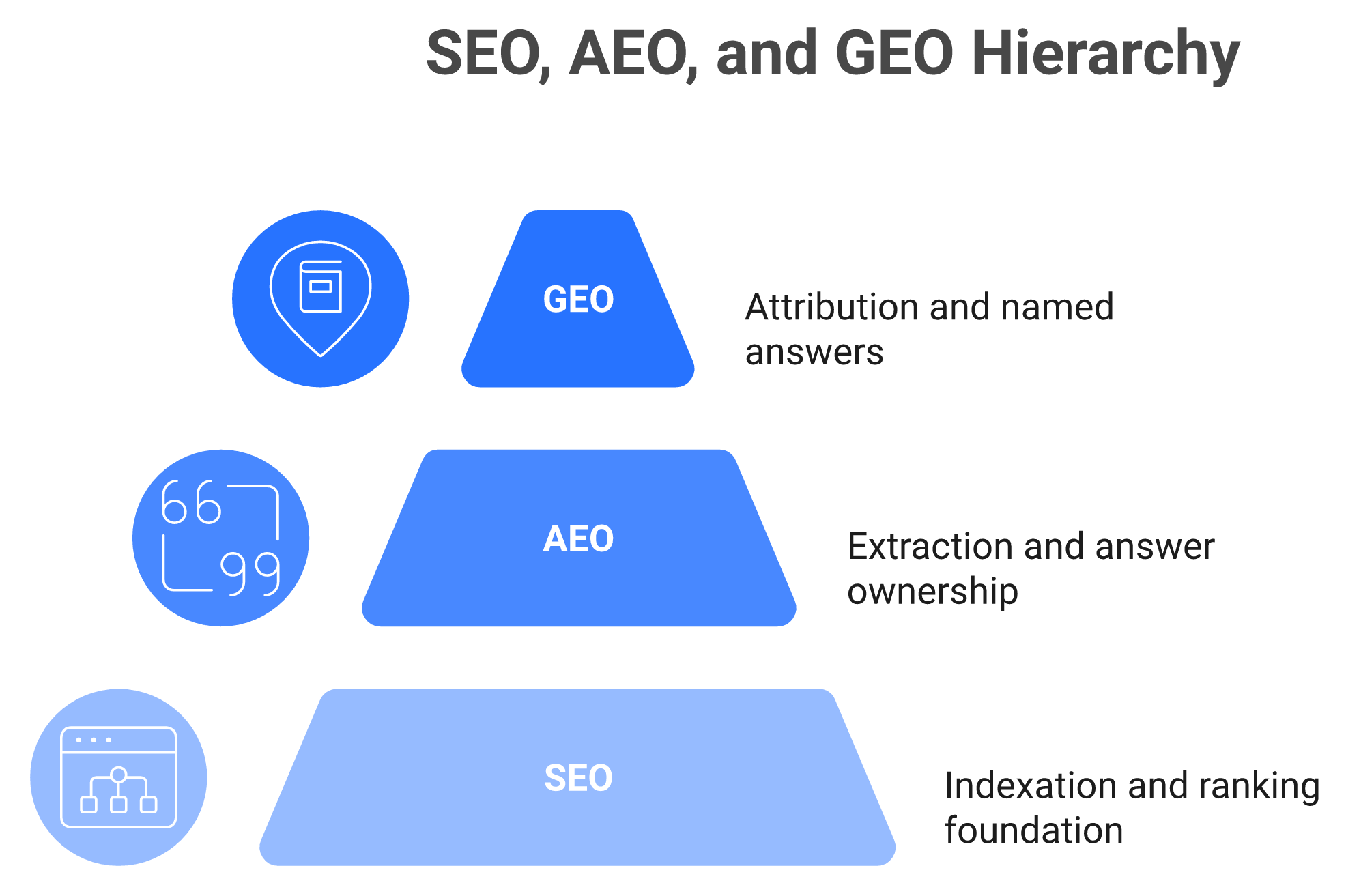
My own reconciliation is a hierarchy, not a compromise.
"SEO is the foundation floor. GEO is the building on top."
— Krishna Kaanth, Founder, MaximusLabs AI
MaximusLabs AI argued the data science position before the category had a settled name, which is why our engagements open with retrieval mechanics and cross-platform citation mapping. Traditional agencies added "GEO" to an existing B2B SEO retainer without changing a single input. If the deliverables did not change, the discipline did not either.
Resolution: a decision rule you can apply today
Stop arguing about the label and diagnose the constraint. If your pages are not indexed, crawlable, or relevant, the problem is SEO and no amount of GEO spend fixes it. If you rank and still never get named, the problem is citation selection, which is GEO work. The Princeton and IIT Delhi GEO study is the clearest evidence that this second layer responds to its own inputs, with citations, quotations, and statistics lifting visibility by up to 40%.
Q3. What has measurably changed in search behaviour, or is this hype?
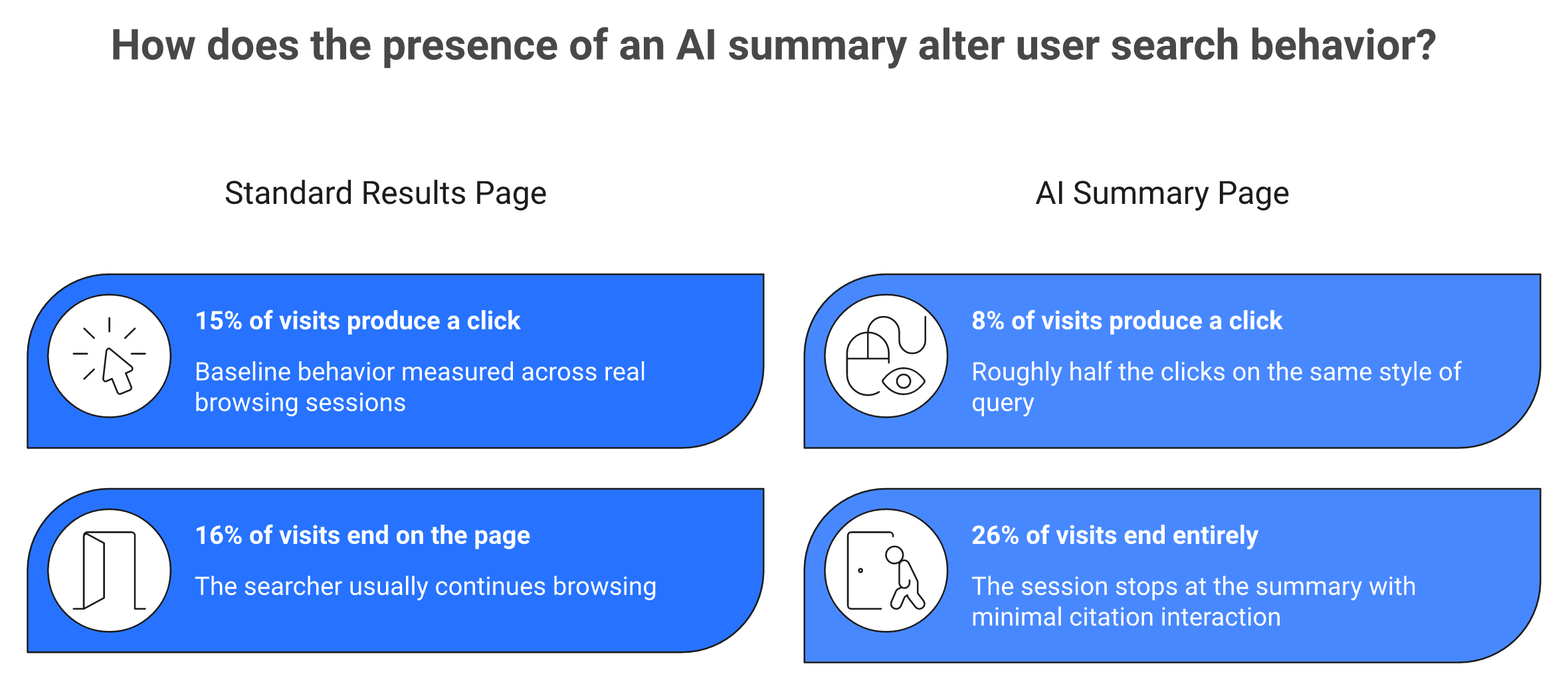
Three shifts are measured, not predicted. Pew Research found clicks fall from 15% to 8% of visits when an AI summary appears, citation links are clicked in about 1% of visits, and 26% of those sessions end entirely. Citation analyses published after the Gemini 3 rollout in January 2026 showed AI Overview reliance on top ten organic results dropping from roughly 76% to 38%. Only around 11% of domains are cited by both ChatGPT and Perplexity for the same query.
The click math changed first
📉 What Pew actually measured
Pew's method matters, because most of the zero-click numbers in circulation have no method at all. The center analyzed real browsing behavior from around 900 US adults across roughly 70,000 searches in March 2025. Fifty-eight percent of those users hit at least one AI summary that month.
So the honest version of the claim is narrow and useful. On queries that trigger an AI summary, plan for roughly half the clicks you used to forecast.
⏰ What that does to your forecast
Segment Search Console queries by whether an AI feature appears, then model those clusters separately. A single blended CTR assumption now hides two very different behaviors.
That one change saves a marketing head the awkward board moment where impressions rise and sessions fall.
Rank and citation have come apart
🔗 Position is no longer the gate
The decoupling is the part most reports skip. Semrush found that pages ChatGPT cites rank at organic position 21 or lower for related queries about 90% of the time. Your citation candidates are sitting on page three of Google right now.
Divergence shows up on commercial queries too. On "best men's running shoes," ChatGPT and Google shared only 8% of URLs, with a strongly negative correlation, because Google favored purchase pages while ChatGPT cited editorial comparisons.
⚖️ The counterweight nobody prints
Gartner predicted in February 2024 that traditional search volume would drop 25% by 2026. Retrospectives this year show Google still holding over 90% of search share, and clickstream analysis found Google search volume growing in 2024 and receiving orders of magnitude more queries than ChatGPT.
I hold both facts at once. The channel is additive, and the attribution inside it is shifting.
"Traffic is going down. Over 70% are zero-click searches. Considering agents are coming, if they're not coming to my website, AI can just read my content, answer the question, and reroute the traffic to some other player."
— Krishna Kaanth, Founder, MaximusLabs AI
MaximusLabs AI reads this as channel addition rather than Google replacement, so client plans keep funding indexation while citation work runs on top. Agencies selling "SEO is dead" are selling past the clickstream data. What changed is not query volume. It is who gets credited inside the answer.
Q4. What is an AI citation actually worth in pipeline terms?
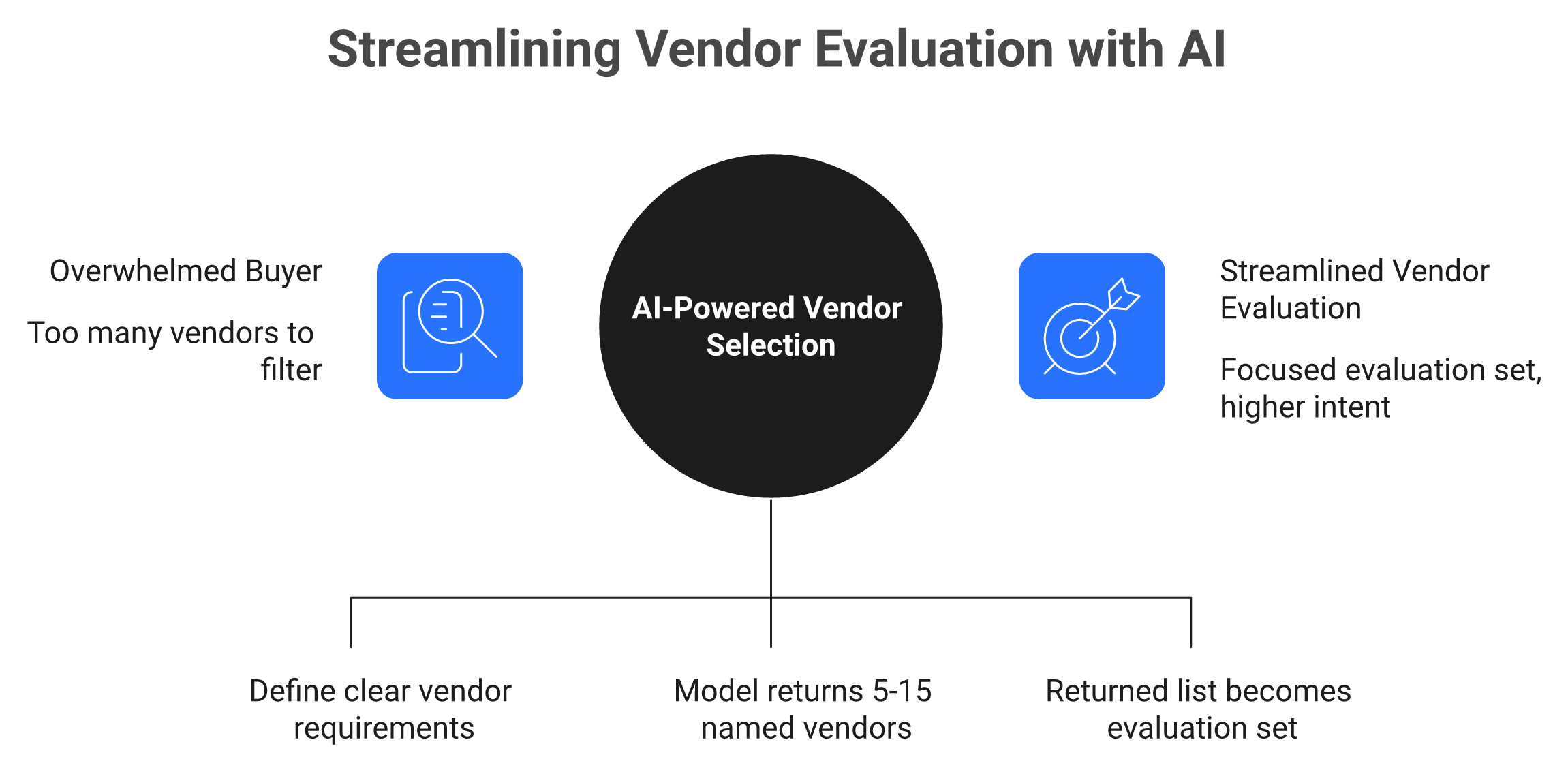
Citation is a shortlist event, not a traffic event. When a buyer asks ChatGPT for vendors, the model returns roughly 5 to 15 names, and that list becomes the evaluation set, so absence means no consideration regardless of product quality. The traffic is small but higher intent. Webflow measured a 6x conversion gap against Google organic, while a 95-site benchmark found 0.62x for B2B product companies. MaximusLabs AI measures every engagement on pipeline rather than mentions.
Situation: the shortlist is the market now
🎯 One prompt, eleven names
Picture a Head of Sales at a mid-market SaaS company. He opens ChatGPT and asks for the best AI sales tools for his team, with pros, cons, and pricing. He gets a curated list in seconds.
On Google he would have skimmed hundreds of options across review sites and listicles. In the model's answer there is no page two, which is why we treat the B2B SaaS buyer journey in AI search as its own funnel.
🧮 Why intent arrives pre-sold
The buyer who clicks through has already had their comparison done for them. The model named you, framed you, and often ranked you.
"A user is evaluating a CRM. There are hundreds of CRMs out there, but AI systems will mention only 5-10 players. If you're not in this sample set, you don't exist."
— Krishna Kaanth, Founder, MaximusLabs AI
Complication: the conversion numbers disagree
💰 The optimistic column
Webflow's own measurement put LLM-referred visitors at a 6x conversion gap versus Google organic. Semrush's June 2025 study valued AI search visitors at 4.4x traditional organic.
Those numbers are real, and they are also the most quoted numbers in the category, which should make you cautious.
⚠️ The column nobody quotes
A 95-site benchmark running September 2025 to August 2026 found organic still delivered about 39x the traffic and 31x the conversions of AI referrals, with AI referrals at 2 to 4% of organic sessions and converting at 0.62x organic for B2B product companies.
Read together, the honest conclusion is a range, not a multiplier. Quality per visit is usually higher. Volume is small. Segment decides everything.
Resolution: instrument it, then fund it
✅ What to do before the next board meeting
- Build a GA4 channel group with a regex for ChatGPT, Perplexity, Gemini, and Copilot referrers.
- Segment their conversion rate and deal size against organic, not against paid.
- Report pipeline influence, not sessions.
MaximusLabs AI instruments AI referral conversion per client before any multiplier reaches a deck, because the published range runs from 0.62x to 6x. Our read, documented in our GEO revenue attribution framework, is that borrowing someone else's 4.4x is how an organic program loses CFO trust by quarter two.
Proof that the shortlist is winnable without incumbent budget: Oliv AI reached a 64% AI citation rate in 6 months, vs ~30% for billion-dollar incumbents, and recorded 27 qualified leads, $47K+ pipeline, 26% close rate in 4 months. Roughly 30 to 40% of their inbound is now AI sourced.
Q5. If you can only fund one, which should you invest in first?
Stage decides. Without domain authority, traditional SEO rarely moves for 9 to 12 months, but AEO can produce a citation within days, because engines select sources per query rather than per domain. Early-stage companies should start with AEO and BOFU (bottom of funnel) comparison content. Established domains should harvest AEO on pages already indexed first, since ChatGPT cited pages sit at organic position 21 or lower about 90% of the time. MaximusLabs AI sequences client roadmaps BOFU first for this reason.
Situation: the budget question nobody answers honestly
💰 One line item, three claimants
Every founder I talk to has the same meeting pending. Someone wants an SEO retainer, someone wants an AI visibility tool, and someone wants more content. The budget covers one.
Most agencies answer this with a bundle. The honest answer depends entirely on whether you already have authority, which is the first thing we test in a GEO plan for SaaS startups.
⏰ Why SEO stalls for new domains
A new domain has no link history, so Google has little reason to trust it on competitive terms. Ethan Smith of Graphite puts it bluntly: when startups ask him for SEO help, his first response is often not to do it at all, because you cannot grow early without enough domain authority.
His follow-on point is the useful part. That constraint does not apply to Answer Engine Optimization, because you can get mentioned by a citation tomorrow and start showing up immediately.
Complication: authority gates rankings, not citations
⚠️ What operators report
"We also utilize Clarity to track citations, and after we optimized some articles for AEO and got them indexed by Google, we noticed a few appearing in AI-search citations the following week, which was surprisingly quick."
— commenter, r/startup Reddit Thread
"It's difficult to separate what actually causes an AI citation from what simply correlates."
— commenter, r/GenerativeSEOstrategy Reddit Thread
Both observations are worth holding together. Citations can arrive fast, and causation stays murky. MaximusLabs AI treats that as a reason to test per engine, not a reason to wait.
Resolution: allocate by stage, not by trend
| Stage | Fund first | First 90 days | Owner |
| Pre authority, under 50 referring domains | AEO on narrow buyer questions | 10 BOFU comparison and alternatives pages | Founder or first marketer |
| Growth, ranking but flat pipeline | AEO harvest on indexed pages | Rewrite position 21 and lower pages for extraction | Head of Organic Growth |
| Enterprise, strong rankings | GEO off site plus measurement | Review platforms, mention mapping, GA4 wiring | VP Marketing |
🎯 Why TOFU is the weakest line item now
Top of funnel "what is" content is the one category engines already answer well. Pew found 26% of sessions with an AI summary end entirely. You pay to educate someone who never arrives.
MaximusLabs AI's read is that the standard AI content strategy gets this backwards, and I say that having watched clients fund explainer posts while their comparison pages sat unwritten.
MaximusLabs AI sequences roadmaps BOFU first: master articles for known BOFU keywords, competitor comparison and alternatives pages, then ICP-specific service pages. MOFU follows only once BOFU is exhausted, and TOFU is skipped deliberately. Most agencies invert that order because TOFU volume reports better.
Q6. How do you make a page answer-ready so engines extract it?
Four tactics have measured support. Place a 30 to 60 word direct answer in the first 30% of body text, a position associated with a 44.2% higher citation rate. Add verifiable statistics, direct quotations, and outbound citations, the methods the Princeton and IIT Delhi GEO paper measured at up to 40% visibility lift. Convert keyword lists into question clusters. Compress meta descriptions to 120 to 158 characters. MaximusLabs AI builds every client article to this structure before a writer starts.
Start with placement, not word count
⭐ Why the top third wins
Retrieval works on chunks, not pages. A model pulls a passage, scores it against the query, and often stops reading once it has something usable.
So an answer buried at paragraph twelve competes against nothing, because nothing reached it. Lead each heading with the answer, then add the nuance, which is the core of AEO answer structure.
✅ The BLUF rule in practice
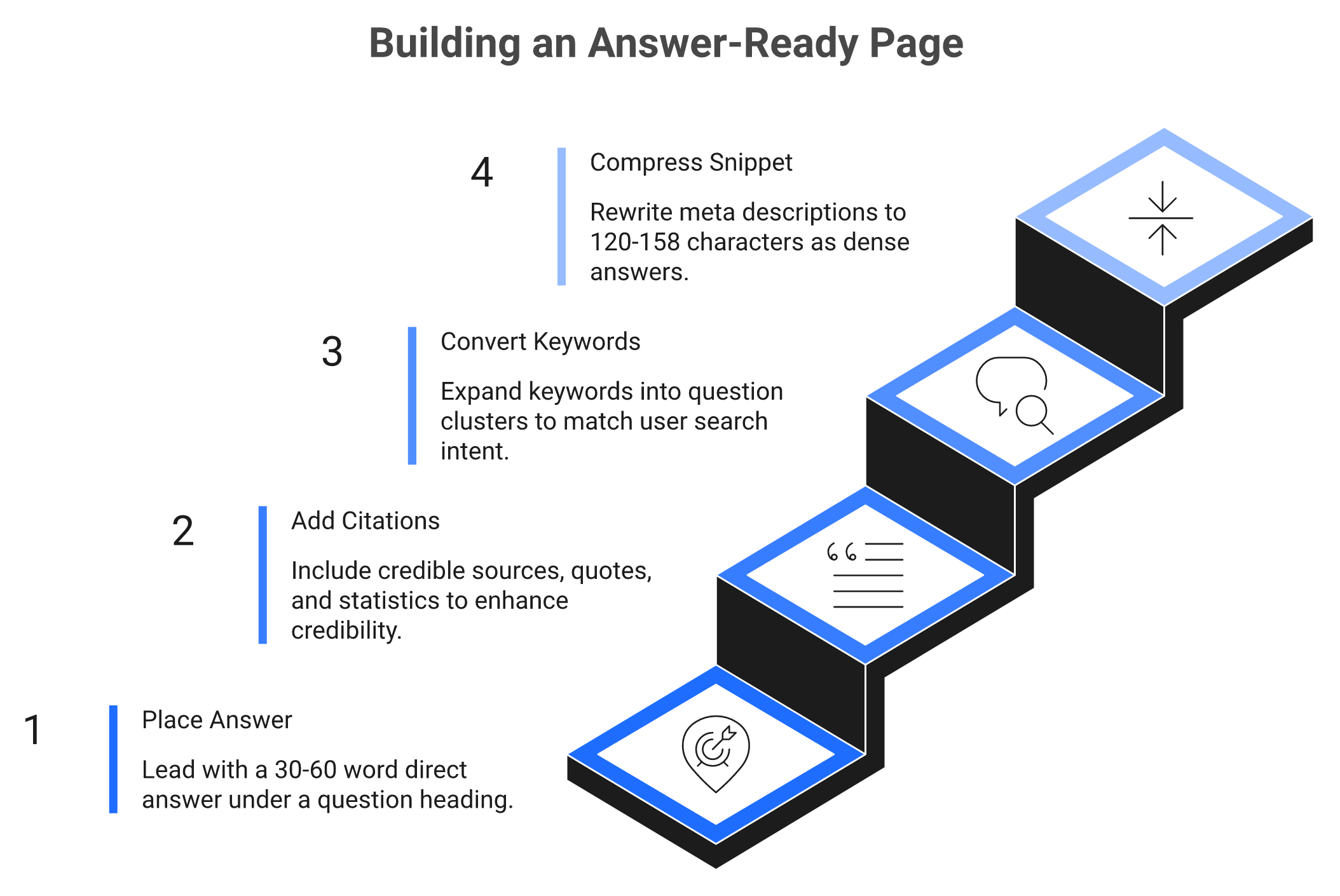
Write the heading as the question your buyer types. Put a short, self-contained answer directly beneath it. Assume that block gets lifted with no title and no byline around it.
MaximusLabs AI measures this by checking whether each block still makes sense when extracted alone. If it needs the paragraph above to parse, we rewrite it.
What the GEO paper actually measured
📊 The methods ranked by lift
The Princeton and IIT Delhi team tested nine optimization methods across roughly 10,000 queries. Three content moves carried the measured gains.
- Add citations to credible sources.
- Add direct quotations from named experts.
- Add verifiable statistics with their source.
- Keep the language simple and readable.
❌ The method that backfired
Keyword stuffing performed roughly 10% worse than baseline on Perplexity in that same study. The number circulating as "9.7%" is a practitioner rounding error, not a published figure.
MaximusLabs AI's data points the same direction on repetition, though I hold this one loosely, since our sample is client engagements rather than a controlled trial. Our GEO content optimization work treats repetition as a risk, not a lever.
Scale the inputs, then compress the output
🔍 From keywords to question clusters
Buyers do not type keywords into ChatGPT. They type 15 to 25 word questions with context about their role, team size, and stack.
So the input work changes. Export your Google Ads keyword data, then expand each term into question variants that carry the same intent. MaximusLabs AI runs client keyword sets into roughly 20,000 question clusters, which is how we find the narrow questions incumbents never answered.
⚠️ The snippet window nobody plans for
ChatGPT works with short snippets during web retrieval, around 150 characters. A meta description written for Google's old 320-character display gets truncated into noise.
Write descriptions of 120 to 158 characters as dense direct answers. Google's own guidance pairs with this: make structured data match visible content, and keep critical text in HTML rather than client-side JavaScript.
MaximusLabs AI applies one fixed structure per article: question form H2, a 40 to 80 word standalone answer nugget beneath it, one primary source per section, and one founder perspective per section. The nugget rule exists because engines extract blocks, not pages.
Q7. Where do AI engines get the trust signals that decide citations?
Mostly off your website. Ahrefs' study of 75,000 brands found off-site brand mentions correlate with AI Overview visibility at Spearman r=0.664, roughly three times stronger than backlinks at r=0.218. In B2B, the G2 and Capterra family accounts for about 84% of review site citations in AI Overviews. MaximusLabs AI runs this layer as Search Everywhere Optimization, starting with verified review profiles carrying at least 10 credible reviews each.
Mentions outweigh links now
📊 What the correlation means for your link budget
A link is a vote on a page. A mention is evidence that a brand exists and gets discussed. Models trained on web text respond to the second signal more strongly, which is why we track brand mentions alongside AI search visibility.
That does not make links worthless. It means a pure link-building retainer is optimizing the weaker of two variables.
💬 What practitioners see in client accounts
"In my conversations with clients, I've noticed that tools often reference 'meh' websites yet heavily draw from Reddit discussions, G2/Capterra reviews, and mentions on niche blogs, rather than from more refined but lesser-known brands."
— commenter, r/ecommerce Reddit Thread
"I wouldn't invest any time on it for citation purposes; the factors that influence citations are rather mundane: be a reliable source, get validation from reputable third-party sites, and maintain clear entity signals."
— commenter, r/SEO Reddit Thread
MaximusLabs AI maps those exact surfaces per client before writing anything, because the cited sources differ by engine and by category.
Owned AEO and Earned AEO are two different jobs
⭐ The split most agencies skip
Owned AEO means your pages and documentation get retrieved and quoted. Earned AEO means third-party sources shape the synthesis before your site is ever read, including the Reddit and forum surfaces engines lean on.
Webflow is the clearest public example. It earned top recommendations across ChatGPT and Gemini by building a footprint across YouTube tutorials, Reddit threads, and TechRadar reviews, not by ranking one URL.
✅ The entity graph loop
Models need to confirm you are one coherent entity. Build the loop in this order.
- Add sitewide Organization schema with a complete sameAs list.
- Point it at your Wikidata item, Crunchbase profile, and LinkedIn page.
- Link back from each of those platforms to the same canonical domain.
- Keep the name, category, and founding details identical everywhere.
MaximusLabs AI treats entity optimization and knowledge graph work as a prerequisite rather than a growth lever, since inconsistent entity data quietly suppresses everything downstream.
Brand is the part that compounds
🎯 Why this beats algorithm chasing
Citation tactics shift with every model release. Brand association does not.
"It is not about understanding the algorithm or hacking away into the algorithm's answer. It is about building a brand. If you build a brand in your space, then AI HAS to recommend you."
— Krishna Kaanth, Founder, MaximusLabs AI
MaximusLabs AI runs the off-site layer as a checklist: verified G2 and Capterra profiles with 10 or more credible reviews, mapping the Reddit and Quora threads engines already cite, earning real contributions inside them, and founder-led publishing. Our citation intelligence engine tracks which sources each engine trusts, then works to get clients into those sources. Oliv AI reached a 64% AI citation rate in 6 months, vs ~30% for billion-dollar incumbents.
Q8. Which SEO and AEO best practices can you safely deprioritize?
Four line items underperform their reputation. Google states you do not need llms.txt, AI text files, or special markup for its generative features, and large-scale studies found no correlation between having the file and being cited. Core Web Vitals show no observed citation lift. Schema is structural hygiene, not a citation ranking lever. Keyword stuffing costs roughly 10% on Perplexity. MaximusLabs AI sells technical work as parsing hygiene rather than a citation driver.
The llms.txt reality check
❌ What Google actually published
Google's AI optimization guide is direct: site owners do not need to create new machine-readable files, AI text files, markup, or Markdown to appear in generative AI features. Google has separately said creating one neither harms nor helps visibility.
The llms.txt proposal itself came from Answer.AI in September 2024 as a convention for agents, not a search ranking input. Treating a proposal as a standard is where budgets leak, as our llms.txt breakdown sets out.
💬 What the practitioner forums found
"No large language model (LLM) currently reads, recognizes, or utilizes llms.txt. This includes ChatGPT, Claude, Gemini, and Perplexity."
— commenter, r/SEO Reddit Thread
"I've reviewed my logs, and it appears that AI crawlers completely ignore it; they simply process the HTML instead."
— commenter, r/SEO Reddit Thread
One honest caveat: agentic browsers may use the file later. If your CMS auto-generates it, leave it on. Do not pay a premium for it.
Core Web Vitals and technical overreach
⚠️ True but not impactful
Ethan Smith's observation matches what surfaces in MaximusLabs AI's audits. Much of SEO best practice is true and not impactful, and Core Web Vitals is his example, with no observed impact across 15 years and none visible in LLM citations.
The correction matters though. Server-side rendering and crawlability do affect whether a page can be read at all, which is why AI crawler access sits above everything else on the list.
✅ Where technical work still earns its keep
| Technical item | Affects citations | Why it still matters |
| Crawlability and bot access | Yes | A blocked page cannot be retrieved or cited |
| Server rendered critical text | Yes | Many crawlers skip JavaScript rendered content |
| Schema matching visible text | Indirectly | Confirms entity and structure, not a ranking lever |
| Core Web Vitals scores | Not observed | User experience benefit, not a citation input |
| llms.txt file | Not observed | Optional hygiene, ignored by live crawlers |
MaximusLabs AI runs this list in that order on every engagement, and we deprioritize anything below the line until the top three are clean.
Stating what does not work is the trust signal
🎯 The subtraction list builds more credibility than the addition list
Any agency can hand you twelve new tactics. Naming the four you can stop paying for is harder, and it is the faster path to trust.
MaximusLabs AI does run deep technical work, including schema completeness, JavaScript minimization so critical content renders in HTML, and clean semantic markup. We position it as parsing hygiene, not a citation lever, because clients sold technical AEO as a citation strategy paid for crawlability and were invoiced for visibility.
Q9. How do you measure AI search visibility without buying another tracker?
Start with what you already pay for. Open the generative AI performance report in Google Search Console, build a GA4 channel group with a regex for ChatGPT, Perplexity, Gemini, and Copilot referrals, then segment their conversion rate against organic and report pipeline influence rather than impressions. The metric replacing rank is share of answers, meaning how often a brand appears across question variants and repeated runs. MaximusLabs AI reports share of answers per engine rather than one blended score.
Situation: everyone is buying a dashboard
💸 Why there are 60 of these tools
Ethan Smith's team catalogued more than 60 AEO tracking tools. His read is that they all do the same thing, which is enter a question, record whether you appeared, and chart it over time. The reason there are 60 is that it takes a few weeks to build, exactly like SERP tracking did.
His advice is unsentimental. Pick the lowest cost tool that does what you need, because in two years you will probably be using Ahrefs anyway. Our AEO tools comparison reaches the same conclusion on feature parity.
⚠️ The validity problem nobody discloses
Most trackers query vendor APIs rather than the live, logged-in interface a buyer actually uses. API responses differ from live sessions, and citation selection is where they differ most.
"The main concern is that I don't fully trust the data, and even when I do, I'm unsure how to act on it."
— commenter, r/SEO Reddit Thread
"If an agency spends most of the month just running prompts and compiling reports, you're essentially paying for a dashboard."
— commenter, r/seogrowth Reddit Thread
Both complaints are fair. MaximusLabs AI treats AEO measurement as an input to work, not the work itself.
Complication: a single run tells you almost nothing
⏰ Variance is the hidden tax
The same prompt returns different citations on different runs and different days. A monthly report built on one run per prompt documents a coincidence.
That is why MaximusLabs AI re-runs prompt sets daily across every major engine and regression tests the results. One run is an anecdote, and thirty runs are a distribution.
❌ What I tried that failed
I wanted real user prompts, not synthetic ones. Practitioners who built browser tooling to capture background queries watched vendors obfuscate those logs and lose the signal.
MaximusLabs AI's honest position is that prompt-level measurement remains noisy, and I would rather say that than sell certainty we do not have. That caveat sits in every GEO measurement readout we hand a client.
Resolution: the five step stack you already own
- Open the generative AI performance report in Search Console and record the baseline.
- Build a GA4 channel group with a regex for chatgpt, perplexity, gemini, and copilot referrers, following Semrush's AI referral tracking method.
- Run your buyer's real questions in a fresh chat with no history, across engines, several times each.
- Log which domains got cited, not just whether you appeared.
- Report AI sourced pipeline next to organic pipeline, never impressions.
✅ What share of answers actually measures
Share of answers is frequency across variants and runs, expressed as a percentage. It replaces one rank with a distribution, because there is no position three inside a generated answer, which is why our GEO metrics and KPIs start there.
MaximusLabs AI's AI Source Analysis workflow builds ICP prompt sets, maps the five to ten domains each engine genuinely trusts in that niche, then works to get the client into those sources.
MaximusLabs AI reports share of answers per engine rather than a blended visibility score, since cross-platform overlap sits near 11% and averaging erases the only actionable signal. The deliverable is a prompt set map tied to pipeline, not a dashboard screenshot.
Q10. How should you split budget, team, and roadmap across all three?
Run one asset base and three lenses. Fund SEO as the indexation floor, covering crawlability, server rendered content, and accurate structured data. Fund AEO as formatting discipline, meaning question form headings with standalone answers in the top 30% of text. Fund GEO as off-site entity work across review platforms, communities, mentions, and the entity graph. Assign one owner per layer, keep one shared backlog, and produce one report in pipeline terms. MaximusLabs AI runs all three in parallel from week one.
The floor and the building
⭐ Why the hierarchy matters for budgeting
"SEO is the foundation floor. GEO is the building on top."
— Krishna Kaanth, Founder, MaximusLabs AI
Google's documentation supports that order, since its generative features draw on the same index and ranking systems. Skip the floor and the building has nothing to stand on.
The reverse error is just as expensive. Funding only the floor leaves you indexed, crawlable, and uncited, which is the exact gap our GEO strategy framework is built to close.
💬 What operators are landing on
"Viewing AI visibility and traditional SEO as entirely separate investments likely misses the mark, but treating them as identical is equally misguided."
— commenter, r/content_marketing Reddit Thread
"From the perspective of an agency, any firm that claims to be 'geo only' is likely offering misleading services."
— commenter, r/seogrowth Reddit Thread
MaximusLabs AI agrees with both, which is why Answer Engine Optimization is our flagship service and SEO sits underneath it rather than beside it.
The 30, 60, 90 plan
| Window | Layer | Deliverable | Owner | Success metric |
| Days 1 to 30 | SEO floor | Crawl access, server rendered text, schema matched to visible content | Marketing Manager with dev | Pages retrievable and indexed |
| Days 31 to 60 | AEO | Question form H2s, answer blocks in top 30%, 10 BOFU pages rewritten | Head of Organic Growth | Snippet capture, citation appearances |
| Days 61 to 90 | GEO | Review profiles, cited thread mapping, entity sameAs loop | VP Marketing | Share of answers per engine |
| Ongoing | Reporting | AI sourced pipeline beside organic pipeline | Founder or VP Marketing | Pipeline influenced, close rate |
💰 Why parallel beats sequential
Running these as three sequential projects burns two quarters before anything compounds. MaximusLabs AI runs the technical floor, answer ready content, and off-site trust together, with strategy and execution in one team.
The cost structure is what makes that realistic. MaximusLabs AI's published comparison puts our cost per content asset at roughly a quarter of a traditional agency's and well under an in-house team's, which is how three layers fit one budget line. Teams weighing that split can start from our 2026 GEO budget benchmark.
What I am watching next
⚠️ Agentic search changes the math again
Gartner's 2024 forecast of a 25% search volume decline by 2026 did not land as predicted, and Google still holds over 90% of search share. My hypothesis is that agents, not chat interfaces, create the next real break.
When an agent completes a purchase without a page visit, citation becomes distribution. Nobody has that dataset yet, and MaximusLabs AI is building prompt sets to collect it, alongside our agentic commerce work.
MaximusLabs AI measures every engagement on pipeline, not on mentions. Oliv AI recorded 27 qualified leads, $47K+ pipeline, 26% close rate in 4 months, with 30 to 40% of inbound now AI sourced.
Frequently asked questions
What is the difference between SEO, AEO, and GEO?
The three disciplines share one asset base and chase three different outcomes. • SEO optimizes a page to rank in traditional search results. The win condition is position, measured in rankings and organic clicks. • AEO structures content so answer surfaces extract it directly. That includes featured snippets, People Also Ask, voice assistants, and Google AI Overviews. The win condition is extraction. • GEO builds entity authority and third-party validation so generative engines like ChatGPT, Perplexity, Gemini, and Copilot name the brand inside a generated answer. The win condition is attribution. They feel blurry because the inputs overlap. A crawlable, well-structured page helps all three. What changes is the finish line, and the finish line is what belongs on your report. MaximusLabs AI runs all three layers inside one engagement rather than three retainers, because a single page can rank, get extracted, and get cited only if it was built for all three from the start. Our source analysis workflow runs client ICP prompt sets across ChatGPT, Claude, and Perplexity, then maps which domains each engine genuinely trusts. If you want the definitional groundwork first, start with our primer on what generative engine optimization actually is.
Is AEO the same thing as GEO, and does either one replace SEO?
AEO and GEO overlap, but they differ in scope. AEO covers every system that returns an answer, including snippets, knowledge panels, and voice assistants. GEO is the narrower LLM-specific layer aimed at generated outputs. AEO wants to be the answer on the results page. GEO wants to be the answer inside the model. Neither replaces SEO. Google states that its generative AI features use the same Search index and core ranking systems, so a page that is not indexed, crawlable, or relevant cannot be cited at all. The naming dispute is real. GEO, AEO, AIO, and LLMO all circulate, Forbes has argued AEO is the more accurate umbrella term, and some published guides still use GEO to mean geographic optimization. Our AEO and GEO terms glossary exists because two buyers can use the same acronym and mean opposite things. Here is the decision rule we give clients. If the constraint is indexation, it is an SEO problem. If you already rank and still never get named, the constraint is citation selection, which is GEO work. MaximusLabs AI treats GEO as a data science problem rather than an SEO add-on, which is why engagements open with retrieval mechanics instead of a keyword list.
Which should we fund first if the budget only covers one?
Stage decides, not trend. • Pre authority, under roughly 50 referring domains. Traditional SEO rarely moves for 9 to 12 months because you have no link history. AEO can produce a citation within days, since engines select sources per query rather than per domain. Start with BOFU comparison and alternatives pages. • Growth stage, ranking but flat pipeline. Harvest what you already own. Semrush found ChatGPT-cited pages sit at organic position 21 or lower about 90% of the time, so your citation candidates are already indexed and sitting on page three. • Enterprise with strong rankings. Fund off-site entity work and measurement wiring rather than more content. Top of funnel explainer content is the weakest line item in every stage now. Pew found 26% of sessions with an AI summary end entirely, so you pay to educate a reader who never arrives. MaximusLabs AI sequences roadmaps BOFU first: master articles for known BOFU keywords, competitor comparison and alternatives pages, then ICP-specific service pages. MOFU follows only once BOFU is exhausted. Founders working from a standing start can follow the same order in our guide to GEO for SaaS startups.
What is an AI citation actually worth in pipeline terms?
Treat a citation as a shortlist event rather than a traffic event. When a buyer asks ChatGPT for vendors in a category, the model returns roughly 5 to 15 names, and that list becomes the evaluation set. Absence means no consideration, regardless of how good the product is. The volume is small and the quality is usually higher, because the model already did the comparison work before the click. The published multipliers disagree sharply, though: • Webflow measured a 6x conversion gap between LLM-referred visitors and Google organic. • Semrush valued AI search visitors at 4.4x traditional organic in its June 2025 study. • A 95-site benchmark found organic still delivered about 39x the traffic and 31x the conversions, with AI converting at 0.62x organic for B2B product companies. So the honest answer is a range, not a number. MaximusLabs AI instruments AI referral conversion per client before any multiplier reaches a deck, because borrowing someone else's 4.4x is how an organic program loses CFO trust by quarter two. Our GEO revenue attribution method ties citation presence to pipeline influence instead of impressions.
How do we measure AI search visibility without buying another tracker?
Start with tools you already pay for, then add a tracker only if a gap remains. • Open the generative AI performance report in Google Search Console and record a baseline. • Build a GA4 channel group with a regex for chatgpt, perplexity, gemini, and copilot referrers. • Run your buyer's real questions in a fresh chat with no history, across engines, several times each. • Log which domains got cited, not just whether you appeared. • Report AI sourced pipeline next to organic pipeline, never impressions. The metric that replaces rank is share of answers, meaning how often you appear across question variants and repeated runs. There is no position three inside a generated answer, so a distribution beats a single number. Two cautions. Most dedicated trackers query vendor APIs rather than the live logged-in interface a buyer uses, and citation selection is exactly where those differ. The same prompt also returns different citations on different days. MaximusLabs AI re-runs prompt sets daily across every major engine and regression tests the results, then reports share of answers per engine rather than one blended score. Our breakdown of GEO metrics and KPIs sets out which numbers survive scrutiny.
Where do AI engines actually get the trust signals that decide citations?
Mostly off your own website. Ahrefs' study of 75,000 brands found off-site brand mentions correlate with AI Overview visibility at Spearman r=0.664, roughly three times stronger than backlinks at r=0.218. In B2B specifically, the G2 and Capterra family accounts for about 84% of review site citations appearing in AI Overviews. That splits the work into two jobs: • Owned AEO. Your pages, docs, and help center content get retrieved and quoted directly. • Earned AEO. Third-party sources shape the synthesis before your site is read at all. Reddit threads, YouTube tutorials, press coverage, and review profiles do this work. Webflow is the clearest public example. It earned top recommendations across ChatGPT and Gemini by building a footprint across tutorials, Reddit discussions, and tech press, not by ranking a single URL. MaximusLabs AI runs this layer as a checklist: verified G2 and Capterra profiles with 10 or more credible reviews, mapping the specific threads engines already cite, earning real contributions inside them, and founder-led publishing. Oliv AI reached a 64% AI citation rate in 6 months, vs ~30% for billion-dollar incumbents. Our guide to AI citation acquisition tactics covers the sequence.
Do we need llms.txt, schema, and Core Web Vitals work to get cited?
Less than the category implies. Four line items underperform their reputation. • llms.txt. Google's AI optimization guide states site owners do not need to create new machine-readable files, AI text files, markup, or Markdown to appear in generative AI features. Large-scale crawl log studies found no correlation between having the file and being cited. • Core Web Vitals. No observed citation lift. It remains a user experience investment, not a visibility lever. • Schema. Structural hygiene that confirms your entity and matches visible content, not a direct citation ranking factor. • Keyword repetition. The Princeton and IIT Delhi GEO paper measured keyword stuffing at roughly 10% worse than baseline on Perplexity. What does matter is unglamorous: crawler access, server-rendered critical text, and structured data that matches what readers see. A blocked or JavaScript-only page cannot be retrieved at all. MaximusLabs AI runs deep technical work including schema completeness, JavaScript minimization, and clean semantic markup, but positions it as parsing hygiene rather than a citation driver. Clients sold technical AEO as a citation strategy paid for crawlability and were invoiced for visibility. Our llms.txt breakdown states plainly where it helps and where it does not.