 Krishna Kaanth M
- An AI search visibility audit measures whether ChatGPT, Gemini, Perplexity, and AI Overviews mention, cite, and accurately describe your brand for revenue weighted buyer prompts.
- Rank tracking fails here because answers shift run to run, most B2B answers carry no clickable link, and GA4 files the resulting visit as Direct or branded search.
- The four engines barely overlap, so audit each separately. Only around 11% of domains are cited by both ChatGPT and Perplexity for the same query.
- Run every prompt 7 to 10 times per engine, log six columns, and report Share of Answers instead of a single position or a blended visibility score.
- Off site mentions move citations roughly three times harder than backlinks, so the audit's most valuable output is a ranked list of competitor cited sources you are missing.
- Technical AEO is mostly busywork beyond three checks: retrieval crawler access, server side rendering, and 404 hygiene. Measure the rest against pipeline, not impressions.
Q1. What is an AI search visibility audit, and why does rank tracking fail at it?
An AI search visibility audit measures whether ChatGPT, Gemini, Perplexity, and Google AI Overviews mention, cite, and accurately describe your brand for your highest intent buyer prompts. It then diagnoses the content, entity, technical, and off site gaps behind any absence. Rank tracking fails because there is no single position. Answers shift from run to run, most B2B answers carry nothing clickable, and GA4 files the resulting visit as Direct or branded search.
⏰ The Monday morning scene that starts every audit
A Head of Organic Growth opens the monthly deck. Rankings are flat or slightly up, non branded impressions look fine, and demo requests have dropped for the second quarter running. Nothing in the report explains it, because nothing in the report is looking at the surface where the buyer actually shortlisted vendors.
I have sat in that call more times than I would like. The rankings chart was never wrong. It was answering a question nobody on the revenue side was asking anymore.
❌ Three tracking layers that go blind at once
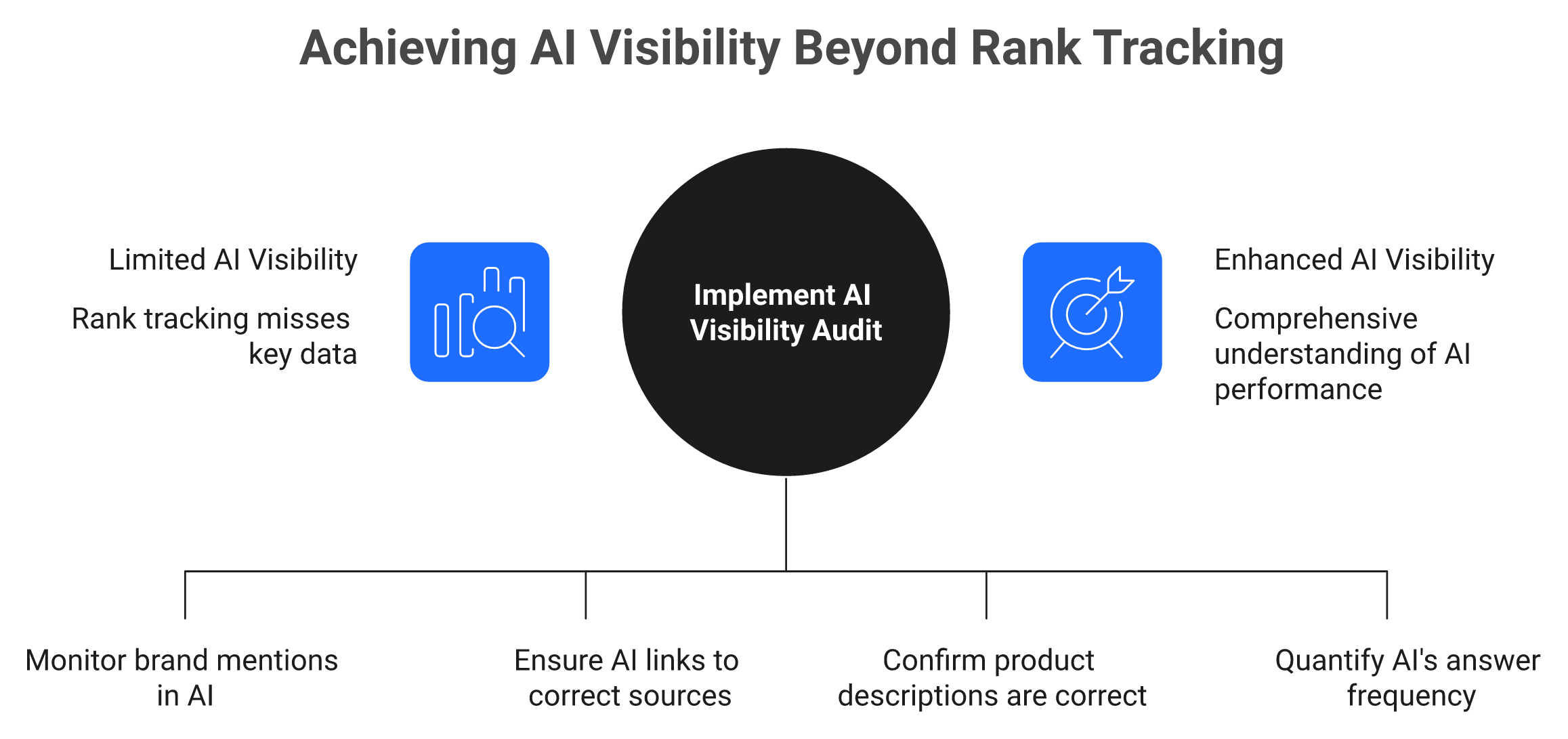
The old measurement stack breaks in three places simultaneously, and each break hides the next one.
Rank disappears. An AI answer names five to ten brands in prose. There is no position three to track, and the same prompt returns a different set of brands on the next run.
The click disappears. Pew Research Center analysed 68,879 searches from roughly 900 US adults and found users clicked a result on 8% of searches with an AI summary, against 15% without one. Only 1% clicked a link inside the summary itself, per Pew Research Center's July 2025 analysis.
The referrer disappears. As Ethan Smith of Graphite puts it, for most B2B questions the answers are not clickable, so there is nothing to click on. The buyer reads the recommendation, opens a new tab, types your brand name, and GA4 logs branded search or Direct. That is the pattern behind the decline in search referral traffic.
Google's own generative AI performance report confirms the shape of the gap. Since the worldwide rollout on August 31, 2026, Search Console reports impressions from AI Overviews and AI Mode, but publishes no clicks, no click through rate, and no query data for them, as documented in Google Search Central's launch announcement and the Search Console generative AI performance report help page.
✅ What an audit actually measures instead
Drop position and measure four objects. Each one is a separate column, and each one fails for a different reason.
| Audit object | Question it answers | Typical failure cause |
| Mention | Does the engine name your brand at all? | Absent from third party sources the engine trusts |
| Citation | Does it link your page as a source? | Thin or unextractable page structure |
| Accuracy | Does it describe your product correctly? | Stale or contradictory entity information |
| Share of answers | How often across repeated runs? | Weak, inconsistent corroboration |
MaximusLabs AI builds this grid from the client's ICP and buying stage first, then works backwards into prompts, which is the opposite order from a keyword led audit. That sequencing is the backbone of our answer engine optimization service.
⭐ The sample set is the real scoreboard
Here is the thing that reframed this work for me. When a buyer asks an AI engine for options, it returns ten to fifteen names, not a thousand. That list becomes the sample set. If your company is not on it, you are not in the buying conversation at all, no matter how good the product is.
Compare that to the old web, where hundreds of comparable tools sat across Google and G2 and a buyer could stumble into any of them. AI collapses that long tail into a shortlist before the buyer has formed a single opinion.
MaximusLabs AI audits against the sample set rather than the SERP. A traditional agency reports position four; we report whether the brand entered the shortlist an engine was willing to name, and those two numbers disagree more often than they agree. The method is documented in our 2026 GEO and AEO benchmark report.
Q2. Why does ranking #1 on Google guarantee nothing in ChatGPT or Perplexity?
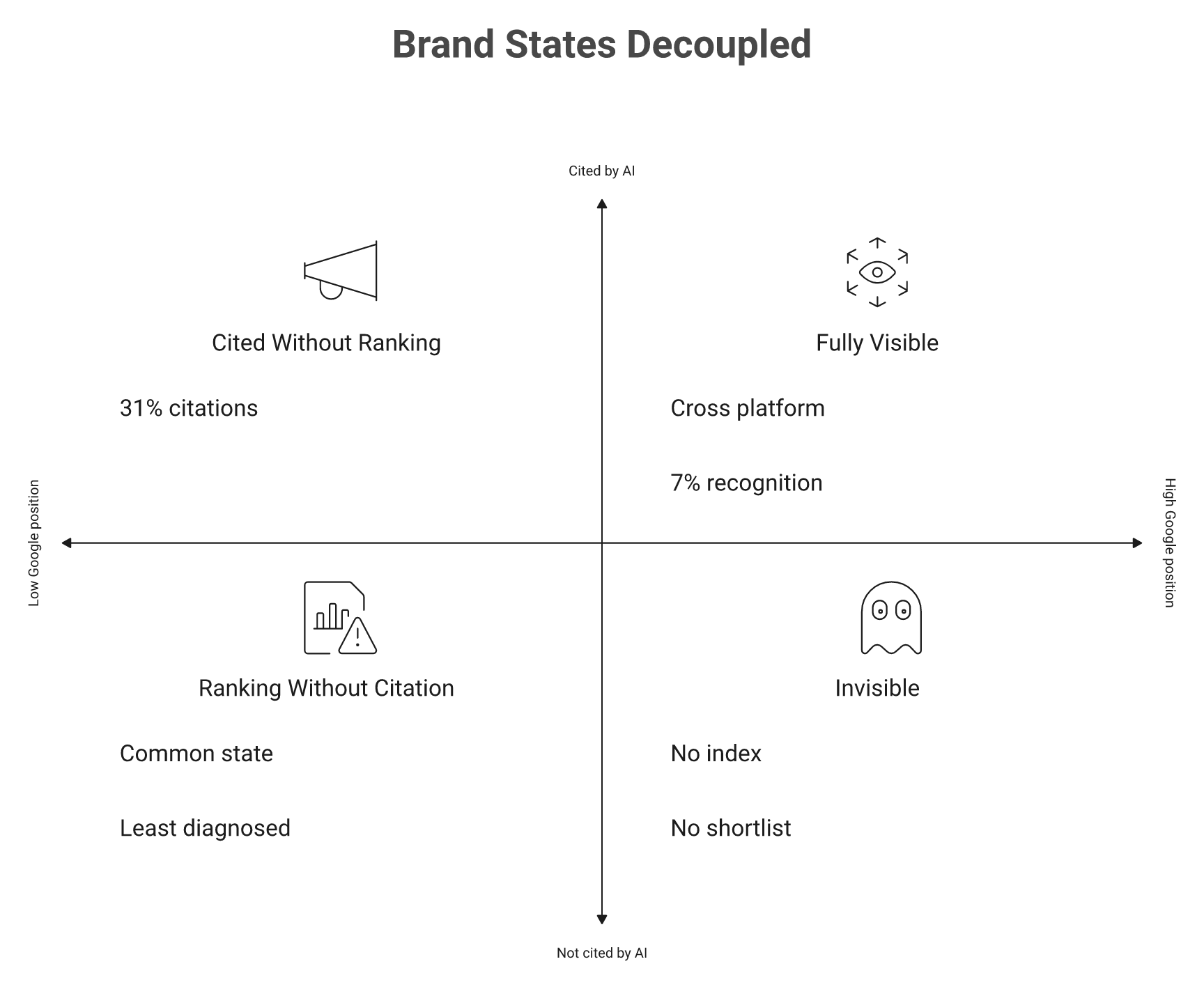
Because they are separate systems with separate inputs. Only around 11% of domains are cited by both ChatGPT and Perplexity for the same query, 71% of cited sources appear on one platform only, and roughly 7% achieve cross platform recognition. ChatGPT grounds heavily on Bing, with about 87% citation overlap on commercial queries. Claude grounds on Brave at 86.7%, while Gemini and AI Overviews ground on Google. You cannot average four engines into one score.
📊 The overlap numbers, stated plainly
Cross platform citation analysis puts the shared ground between ChatGPT and Perplexity at roughly 11% of domains for the same query. Seven in ten cited sources show up on exactly one platform. The universal winners, the sources everything cites, are a tiny set dominated by Google properties, Wikipedia, and YouTube. Our own breakdown of these patterns sits in the ChatGPT, Perplexity, and Gemini citation patterns report.
That is not a rounding difference. It means a page one Google ranking is evidence about Google, and nothing more.
🎯 Different backends, different judges
Each engine sits on a different retrieval stack, so each one inherits a different index's biases.
| Engine | Grounding source | Measured overlap |
| ChatGPT search | Bing | ~87% on commercial queries, 27.4% on fanned sub queries |
| Claude | Brave | 86.7% top organic overlap |
| Gemini and AI Overviews | Google Search | Shares Google's index, not its ranking weights |
| Perplexity | Bing led index | Low overlap with ChatGPT citations for identical prompts |
MaximusLabs AI maintains a separate citation map per engine for every client for this reason. What ChatGPT treats as important is not what Google treats as important, and neither matches what Perplexity surfaces. I watched this land for the first time with a client that appeared in ChatGPT answers while sitting nowhere in Google's top ten. The per engine playbooks live in our ChatGPT optimization service and our Perplexity optimization service.
⚠️ Ranking and citation have now visibly decoupled
The clearest evidence arrived inside Google itself. After Gemini 3 became the default model behind AI Overviews on January 27, 2026, reliance on top ten organic results for citations fell from roughly 76% in July 2025 to about 38% by February 2026. Around 31% of AI Overview citations now come from organic positions beyond 100. We track these shifts in our analysis of Gemini 3's impact on AI search.
Read that twice if you own the organic number. A page can be functionally invisible in classic search and still be the source an AI Overview quotes.
✅ What this forces your audit to do
Four practical consequences follow, and all four are cheap to implement.
Run every prompt separately on every engine your buyers use. No extrapolation.
Report four scoreboards, never a blended index.
Track Bing indexation alongside Google for ChatGPT and Perplexity exposure, since Bingbot crawl behaviour feeds both.
Re baseline whenever an engine switches its default model, because the citation mix moves with it.
MaximusLabs AI ships four independent scoreboards per client, because the underlying indexes genuinely are four. A single blended AI visibility score hides the exact thing a client is paying to learn, which is which engine is losing them the deal.
Q3. How do you build the buyer prompt set your audit runs on?
Start from your highest intent Google Ads keywords, then fan each one into question variants such as "best X for Y", "X vs competitor", and "is X worth it for a 50 person team". Target 15 to 30 prompts weighted toward BOFU and MOFU, tagged by ICP segment, buying stage, and deal value. Volume led keyword lists generate TOFU prompts that never appear in a buying conversation, which is why most audits measure nothing that closes.
💰 Start where money already changes hands
Your paid search account is the cleanest signal of commercial intent you own. Export the terms that actually converted, not the ones with volume, and sort by closed won value.
MaximusLabs AI uses converted paid search terms and won opportunity language as the seed layer for every prompt set, because both are already validated by revenue rather than by a keyword tool. The full method sits inside our approach to AEO keyword and question research.
⭐ The four step build
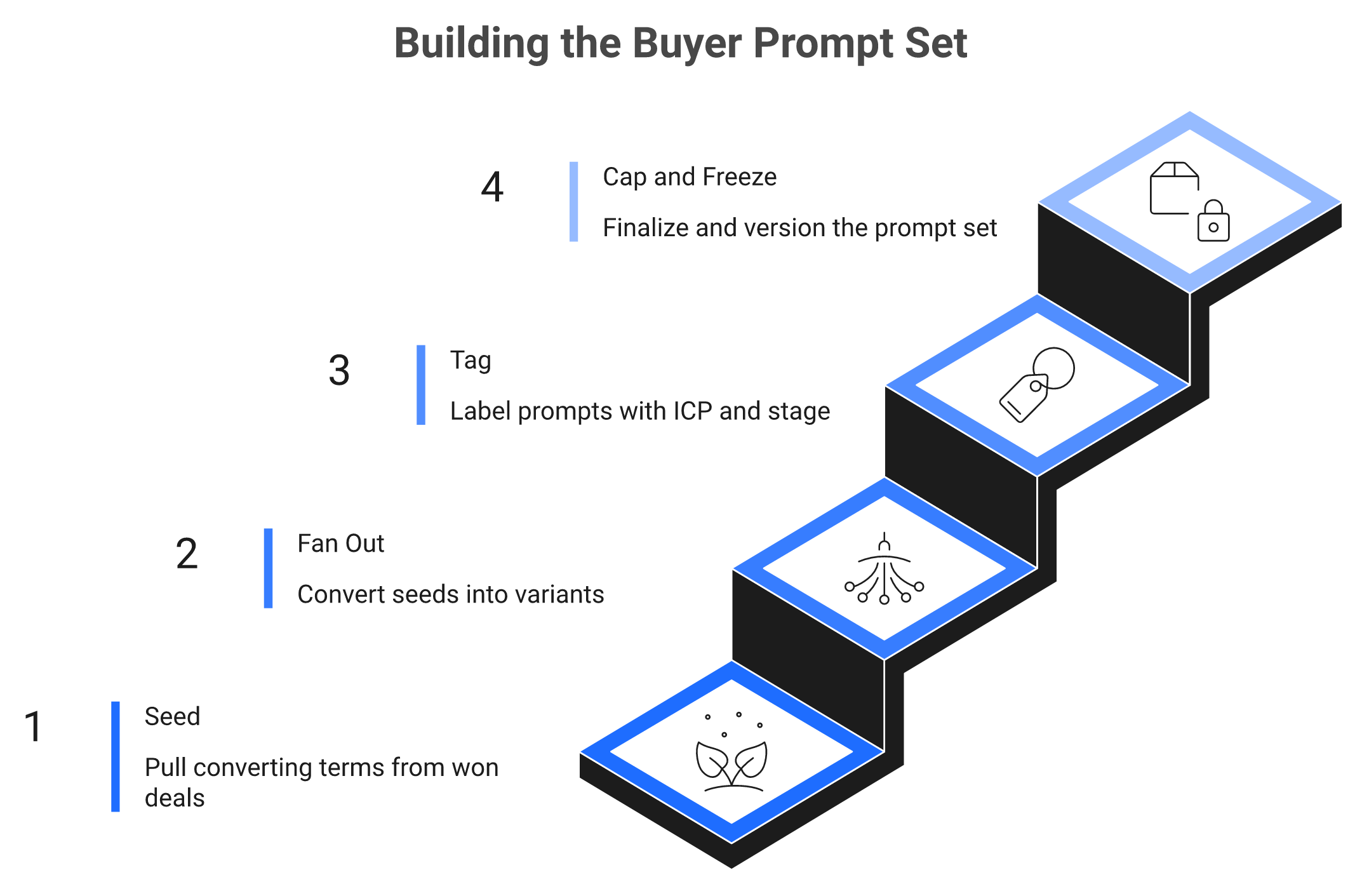
Seed. Pull 10 to 15 converting commercial terms plus the exact phrasing from three recent won deals.
Fan out. Convert each seed into four question variants: category shortlist, head to head, fit qualifier, and objection. A query fan out generator speeds this step up.
Tag. Label every prompt with ICP segment, buying stage, and average deal value for that segment.
Cap and freeze. Stop at 15 to 30 prompts, then version the list so later months compare cleanly.
| Seed term | Fanned prompt | Stage | Deal weight |
| ai visibility tool | best AI visibility tools for B2B SaaS | MOFU | Medium |
| profound alternative | Profound vs other AEO platforms for a Series A team | BOFU | High |
| aeo agency pricing | is an AEO agency worth it for a 50 person SaaS company | BOFU | High |
| what is aeo | what is answer engine optimization | TOFU | Excluded |
⚠️ Why volume led lists quietly fail
Keyword tools rank by search demand, so they float definitional queries to the top. Those prompts return encyclopedia style answers with no vendor shortlist at all, which means your audit produces a clean looking report about nothing.
There is a second trap inside AI search specifically. When an engine fans a question into sub queries, the sources behind those sub queries drift hard from the commercial set. Measured overlap sits near 27.4% on mixed and informational fan outs, against roughly 87% on commercial queries. So test the head prompt and its fanned children separately, because they recruit different sources, a pattern we document in our question research strategy guide.
🎯 Weight the list before you run it
Attach a deal value to every prompt before the first audit run. The output then stops being an alphabetical list of missing mentions and becomes a ranked list of revenue at risk.
In practice, this changes what gets fixed first. A prompt worth three enterprise deals a quarter outranks a prompt with ten times the volume and no buying signal, and the content roadmap reorders itself accordingly.
MaximusLabs AI weights every prompt by deal value before the first run, so the deliverable reads as a ranked revenue at risk list. Across our engagements, the highest value gaps are usually comparison and fit prompts, not category definitions, which is why our revenue attribution framework for GEO initiatives starts at the prompt level.
Q4. How do you run and log the audit across four engines?
Run each prompt 7 to 10 times per engine, logged out, because LLM output is stochastic and one run is an anecdote. Log six columns per run: prompt variant, engine, brand mentioned, citation URL, competitors named, and third party sources surfaced. Aggregate into Share of Answers, the percentage of runs, variants, and surfaces where your brand appears. That distribution replaces rank.
❌ The one screenshot trap
Someone on the team asks ChatGPT the category question, sees the brand named, and posts the screenshot in Slack. Two weeks later, a different person runs the same prompt and the brand is gone. Nothing changed on the site.
Both screenshots were real. Neither was a measurement.
⭐ Why seven to ten runs is the floor
Ethan Smith of Graphite has described testing this directly: you get different answers to the exact same question, even logged out, and you need to ask seven to ten times to get an actual distribution of the answers. Logged in sessions widen the variance further, because memory and personalisation enter the picture.
"you'll get different answers and you'll even get different answers if you ask the exact same question logged out... you need to ask seven to 10 times or so to get an actual distribution of the answers"
— Ethan Smith, CEO, Graphite, Answer Engine Optimization (AEO) Is the New SEO, recorded session
MaximusLabs AI runs 7 to 10 passes per variant per engine and prints the run count on the deliverable. A dashboard that runs once per week is charting noise, which is why client scores swing twenty or thirty points in a month when nothing about the content moved. Our standards for this sit in our guide to AEO measurement metrics.
✅ The log schema to paste into a sheet
| Column | What goes in it | Why it matters |
| Prompt variant and version | Exact text, plus list version number | Keeps month over month comparisons honest |
| Engine and session state | ChatGPT, Gemini, Perplexity, AI Overviews, logged in or out | Each engine is a separate scoreboard |
| Brand mentioned | Yes or no, per run | Feeds Share of Answers |
| Citation URL | The exact page cited, if any | Separates mention from citation |
| Competitors named | Every brand in the answer | Reveals who owns the sample set |
| Third party sources surfaced | G2 pages, Reddit threads, listicles, docs | Becomes next month's placement target list |
📊 Calculating Share of Answers
Share of Answers is simply the count of runs where your brand appears, divided by total runs, reported per engine and per prompt cluster. Weight each cluster by the deal value you assigned, and you get a revenue weighted visibility figure instead of a vanity average.
Two discipline rules keep it meaningful. Freeze the prompt set, engine list, and run count for a full quarter, and version any change rather than editing in place. Practitioners make the same point about logging the specific third party pages cited behind every answer, not just the position.
"Record the sources behind every answer. Do not stop at visibility or position. Log the specific third-party pages cited or surfaced for each answer."
— u/b2b_growth_lead, r/b2bmarketing Reddit Thread
MaximusLabs AI publishes the run count and prompt set version on every monthly report, and reconciles Share of Answers movement against pipeline. On the Oliv AI engagement, that produced a 64% AI citation rate in 6 months, vs ~30% for billion dollar incumbents, alongside 27 qualified leads, $47K+ pipeline, 26% close rate in 4 months, as documented in the Oliv AI case study.
Q5. Which metrics prove AI visibility, and which are vanity?
Track six metrics: citation presence, Share of Answers, description accuracy, competitor co occurrence, generative AI impressions in Search Console, and AI referral conversions in GA4. Drop click recovery as a goal. Pew Research Center measured an 8% click rate when an AI summary appears, against 15% without one, and only 1% clicked the summary's own sources. Impressions and pageviews are vanity here. Citation presence on revenue weighted prompts is the scoreboard.
❌ Why the old KPI set breaks
Rankings, impressions, and sessions all assume a click is the unit of value. AI answers break that assumption at the source, because the answer itself satisfies the buyer.
Pew Research Center analysed 68,879 searches from roughly 900 US adults. Users ended their browsing session on 26% of searches with an AI summary, compared to 16% without, according to Pew Research Center's July 2025 study. The buyer got what they needed and left, which is the core dynamic behind falling AI search click through rates.
📊 The six metrics worth reporting
| Metric | What it means | Where to measure it |
| Citation presence | Your page appears as a linked source in the answer | Manual runs, or a scraped UI tracker |
| Share of Answers | Percentage of runs and variants where your brand appears | Your own audit log |
| Description accuracy | Whether the engine describes your product correctly | Manual review of answer text |
| Competitor co occurrence | Which brands share the answer with you | Audit log, competitor column |
| Generative AI impressions | Appearances in AI Overviews and AI Mode | Search Console generative AI report |
| AI referral conversions | Signups and demos from AI platform referrers | GA4, segmented by source |
Note the gap inside that table. Google's generative AI performance report gives impressions by page, country, and device, but it publishes no clicks, no click through rate, and no query data, as the Search Console generative AI performance report documentation states. So impressions alone can never close the loop, which is why our measurement and metrics framework for GEO never reports them as an outcome.
⚠️ What a vanity metric looks like in this category
A vanity metric here is any number that rises without a buyer moving closer to a decision. Three show up constantly in AI visibility reports.
Total mentions across all prompts. A definitional prompt and a shortlist prompt count the same, which flattens the thing you care about.
Blended AI visibility score. One number for four engines, which hides which engine is losing you deals.
Generative AI impressions as a headline. Useful as a directional baseline, meaningless as an outcome, since no click or query data sits behind it.
I will hedge one claim here honestly. MaximusLabs AI treats impressions as a baseline rather than a result, though I accept that view may soften if Google ever adds click data to that report.
✅ Set targets per prompt cluster, not per page
Page level targets are a habit from classic SEO. Buyers do not experience pages in AI search. They experience answers to clusters of related questions.
So set the target at cluster level. For example, "appear in 6 of 10 runs on the BOFU comparison cluster in ChatGPT and Perplexity by the end of Q2". That target is measurable, engine specific, and tied to a cluster you already weighted by deal value, the same logic we use for GEO topic clusters.
Accuracy deserves its own target, because it fails silently. An engine can name your brand and still describe the wrong pricing model, the wrong ICP, or a feature you retired. In MaximusLabs AI's audits, description errors surface most often on positioning language, not on features, because stale third party summaries outrank your own page as the engine's source. Fixing that is an entity and knowledge graph problem, not a copy problem.
MaximusLabs AI reports presence and accuracy against revenue weighted prompts, never impression curves. A revenue focused methodology has to survive a CFO asking which number became pipeline, and impressions cannot answer that question.
Q6. Which AI visibility tools are worth paying for, and which 60 are commodity?
Most AI visibility tools are the same product: send a prompt, record yes or no, chart it. Over 60 exist because that build takes a few weeks. Two things genuinely separate them. First, whether they scrape the live interface or query vendor APIs. Second, whether they expose the third party sources behind each answer. MaximusLabs AI runs scraped interface tracking at cents per query, and reports the source list behind every answer rather than a yes or no flag.
⏰ The scene that repeats every week
A founder forwards me a launch post and asks whether we should switch trackers. The tool launched yesterday. It does prompt tracking, a visibility score, and a competitor chart.
Ethan Smith of Graphite described this bluntly after cataloguing the category. Graphite maintains a page with 60 plus AEO tools, and they all do the same thing, because that functionality takes a few weeks to build, just like SERP tracking did.
"We have a page with 60+ AEO tools and they all do the same thing: They all do tracking. You just put a question in and you say, 'Did you show up? Yes/no,' and then you put it somewhere and you chart it."
— Ethan Smith, CEO, Graphite, Answer Engine Optimization (AEO) Is the New SEO, recorded session
⭐ The buying table
| Option | How it collects data | Main blind spot | Cost model |
| MaximusLabs AI | Scraped live interface, 7 to 10 runs per variant, plus source gap analysis | Managed engagement, so it is not self serve | Retainer covering audit and execution |
| Semrush AI Visibility Toolkit | Vendor APIs plus its own prompt panel | Blended scoring across engines | Platform subscription |
| Ahrefs Brand Radar | Large prompt dataset, API led | Limited view of logged in sessions | Platform subscription |
| Profound | Prompt tracking with answer analytics | Dashboard only, no execution | Enterprise subscription |
| Scraped UI point tools | Real browser sessions | Proxy and CAPTCHA overhead | Usage based |
| Free checkers | Single run, one engine | One run is an anecdote, not a measurement | Free |
If you are weighing specific vendors against each other, our side by side breakdowns of Profound alternatives and competitors and the wider AEO tools comparison go deeper than this table.
⚠️ The API versus scraped distinction that actually matters
Roughly 95% of third party trackers query vendor API endpoints rather than the live product. Smith's observation is that the API response tends to differ from your personal experience, so cleaner data comes from scraped rather than API tracking.
That difference is not cosmetic. APIs do not reproduce multi turn memory, personalisation, or the live search features a real buyer encounters. MaximusLabs AI scrapes the live interface for this reason, and we accept the slower, messier infrastructure that comes with it. The same principle shapes how we evaluate ChatGPT tracking tools.
💰 Where the budget should actually go
Here is the part the category avoids saying. The tracker is the cheap part. Smith's team built their own for a few cents per question, which is why 60 competitors exist and why Ahrefs or Semrush will likely absorb the category.
"It's not that hard to build. That's why you have 50 companies doing this. So I would just pick the cheapest one. We actually built our own. I think it costs us a few cents per question."
— Ethan Smith, CEO, Graphite, Answer Engine Optimization (AEO) Is the New SEO, recorded session
Two consequences follow for anyone choosing today.
Buy the cheapest tool that scrapes the live interface and shows cited sources.
Spend the saved budget on getting into those cited sources, which is the work no dashboard does for you.
Smith's own advice on selection was to pick the tool that does what you want at the lowest cost, because in two years you will probably be using Ahrefs anyway. My read is similar, with one correction. The decision that compounds is not which tracker you license. It is who turns the tracker's output into earned placements and BOFU pages, which is the whole premise of citation acquisition work.
MaximusLabs AI sells the audit and the fix, not the dashboard. Tracking runs on scraped sessions at cents per query, and the savings go into scalable Answer Engine Optimization (AEO) content, trust first methodology, and positioning written in the founder's voice. On Oliv AI, that produced a 64% AI citation rate in 6 months, vs ~30% for billion dollar incumbents, as documented in the Oliv AI case study.
Q7. What should your technical audit check, and what is a waste of time?
Check three things. Whether retrieval crawlers can reach you, whether pages render without JavaScript, and whether crawl budget burns on 404 errors. OAI-SearchBot, PerplexityBot, and Claude-SearchBot do not execute JavaScript, so client side React and Vue pages are invisible to them. An OAI-SearchBot opt out removes a site from ChatGPT search answers entirely, per OpenAI's crawler documentation. Page speed scores and generic technical error counts have near zero citation impact.
✅ Separate the retrieval bots from the training bots
OpenAI documents two distinct robots. OAI-SearchBot surfaces sites in ChatGPT's search features, while GPTBot relates to model training, and the two are controlled independently, per the Overview of OpenAI Crawlers documentation. Allowing one does not require allowing the other.
So the correct robots.txt posture is explicit, not inherited. Allow the retrieval crawlers, OAI-SearchBot, PerplexityBot, Claude-SearchBot, and Googlebot. Decide on GPTBot and ClaudeBot separately as a licensing question. OpenAI notes that robots.txt changes take roughly 24 hours to take effect, and publishes its crawler IP ranges for verification. Our guide to managing AI crawlers like GPTBot and Google-Extended lays out the full directive set.
⚠️ The silent blocker nobody checks
Robots.txt is rarely the real problem. Bot protection is. A WAF or CDN rule written to stop scrapers will happily return 403 responses to OAI-SearchBot, and nothing in your SEO stack will flag it.
MaximusLabs AI starts every technical gate in the server logs, not in a crawler tool. We look for retrieval bot user agents, confirm 200 responses on BOFU pages, and verify the requests against OpenAI's published IP ranges. An AI crawlability checker catches the obvious blocks before the log work starts.
❌ The rendering test that takes four minutes
Standalone AI search crawlers do not run JavaScript. If your pricing page builds its content client side, the crawler sees an empty shell.
Test it directly. Fetch the page with curl, then search the raw HTML for your answer text and your product claims. If the words are missing, server side rendering moves to the top of the roadmap, ahead of every content fix.
Crawl economics make the same point from another angle. Log studies put OAI-SearchBot's wasted fetches on 404 pages at 34.8% and ClaudeBot's at 34.2%, against Googlebot's 8.22%. The referral ratios are starker still, with Anthropic crawling 38,065 pages per referred visitor, OpenAI 1,091, Perplexity 194, and Googlebot 5.4. Our complete guide to AI crawlers breaks down each bot's behaviour.
💰 Where technical AEO stops paying
Graphite's team expects technical AEO to become the biggest waste of time in this category, as practitioners drift into page speed work, crawl analysis, and miscellaneous technical error reports with little or no citation impact. That matches what MaximusLabs AI sees in audits, though I will hedge it slightly, since a genuinely broken site is still a broken site.
Two cheap accelerators are worth the time. Submit sitemaps and push URL changes through IndexNow, which shortens Bing crawling to a few hours and feeds ChatGPT citation eligibility within days. Then fix your 404 pattern so retrieval crawlers stop spending a third of their budget on nothing, a step we scope inside technical GEO implementation.
MaximusLabs AI caps the technical portion of an audit at a one page gate: retrieval bot access, server side rendering, 404 hygiene, and IndexNow. The forty hour AEO technical audit is a familiar deliverable, and in our engagements it has rarely been the thing that moved citations.
Q8. How do you structure pages so AI engines extract and cite them?
Put the direct answer in the top 30% of page text, because that zone carries a 44.2% citation share in a ski ramp distribution. Add named source statistics, quotations, and inline citations. Princeton's KDD 2024 experiments lifted source visibility up to 40%, and the Cite Sources method alone raised position five page visibility by 115.1%. MaximusLabs AI scores each audited page on answer placement, citation density, expert quotes, schema coverage, and server side rendering before recommending any rewrite.
⭐ Placement beats polish
Citation extraction is front loaded. Analysis of cited passages shows 44.2% of citations drawn from the first 30% of page text, with the rate falling steeply after that.
That changes page architecture, not just copy. The answer goes directly under the heading, in plain prose, before context, before the story, and before the methodology. MaximusLabs AI applies this to every audited page, and the most common fix we make is moving an answer that already existed from paragraph six to paragraph one. The formatting rules sit in our guide to AEO answer structure and writing.
📊 The effect sizes that set the rubric weights
The strongest public evidence here is the GEO paper from Aggarwal and colleagues, published at KDD 2024. Adding citations, quotations, and statistics raised source visibility by up to 40%, measured on position adjusted word count, and the Cite Sources treatment produced a 115.1% visibility lift for pages sitting at position five, per GEO: Generative Engine Optimization, arXiv:2311.09735.
So the rubric is not a style guide. It is weighted by measured lift.
| Rubric item | What earns a 5 | Weight basis |
| Answer placement | Direct answer inside the first 30% of text | 44.2% citation share finding |
| Citation density | Named sources with dates, inline | Up to 40% visibility lift |
| Quotations and stats | Attributed expert quotes, hard numbers | Cite Sources lift of 115.1% |
| Schema coverage | Organization, Article, HowTo, Person, Dataset | Schema.org and Google structured data guidelines |
| Render path | Answer text present in raw HTML | Retrieval crawlers do not run JavaScript |
✅ Schema and the multimodal loop
Schema will not make weak content citable, but it resolves entity ambiguity. Ship Organization and Person markup with real author credentials, then Article, HowTo, and Dataset where the content genuinely matches those types, following the Schema.org vocabulary and Google's structured data guidelines. Our schema markup basics guide covers the minimum viable set.
Video creates a second retrieval path worth testing. Legit Security embedded a structured YouTube video into a B2B application security page, and the page produced a citation loop across ChatGPT, Gemini, YouTube, and Google AI Overviews at the same time. MaximusLabs AI treats that as a repeatable pattern on high value pages, though our sample is still small enough that I would call it promising rather than proven. The mechanics are explained in our multimodal search optimization guide.
⚠️ Score first, rewrite second
Scoring changes the order of work. Run all your BOFU and MOFU pages through the five item rubric, sort by score, and fix the lowest scorers on the highest value prompt clusters first.
That sequence matters because rewriting is the expensive step. A page scoring 2 on placement can often be fixed in an hour by moving one paragraph and adding two cited statistics.
MaximusLabs AI scores every audited page against the KDD 2024 effect sizes before recommending a rewrite. Trust first means the rubric follows published evidence, and our production model is built so a lean team fixes fifty pages rather than three, the approach set out in our trust first content playbook.
Q9. Why do off-site mentions beat your own pages, and how do you audit them?
Brand web mentions, both linked and unlinked, correlate with AI Overview visibility at Spearman r=0.664, roughly three times stronger than backlinks at r=0.218. So audit sources, not only rankings. Log every third party page cited per prompt, rank the competitors' most cited domains, and treat the top three as next month's placement targets. Review platforms dominate, with the G2 family controlling about 84% of B2B review site citations. MaximusLabs AI ships that ranked source gap list as a standing audit deliverable.
⏰ The audit that only looked inward
A Head of Organic Growth sends over their AI visibility report. It lists their own pages, their own schema gaps, and their own word counts. Every row describes something they control.
Nothing in it explains why Perplexity keeps naming three competitors and not them. The answer was never on their site, which is why our AI search competitor analysis starts with cited sources rather than pages.
⚠️ The correlation that reorders the budget
Analysis of AI Overview visibility puts brand web mentions, linked and unlinked, at a Spearman correlation of r=0.664, against r=0.218 for backlinks. Getting mentioned across the web matters roughly three times more than optimising your own pages.
Review platforms concentrate that effect. Following G2's acquisition of Capterra, which closed on February 5, 2026, the G2 family accounts for about 84% of B2B review site citations appearing in AI Overviews. One property group now gates a large share of the evidence engines use to recommend software, a shift we unpack in our 2026 GEO and AEO benchmark report.
✅ The source gap procedure
MaximusLabs AI runs this as four steps, using the same log built in the run and log stage.
Extract every cited domain and URL from your audit log, across all prompts and runs.
Split it into three buckets: sources that cited you, sources that cited competitors, and sources that cited neither.
Rank the competitor cited sources by how many prompts and engines they appear in, not by domain authority.
Pick the top three and build a placement plan for each, with an owner and a date.
The ranking order matters more than it looks. A mid sized comparison page cited across nine prompts beats a famous publication cited once, because engines return to the page that consistently answers the question. That prioritisation logic sits inside our citation optimization guide.
⭐ Earned and Owned are two different budgets
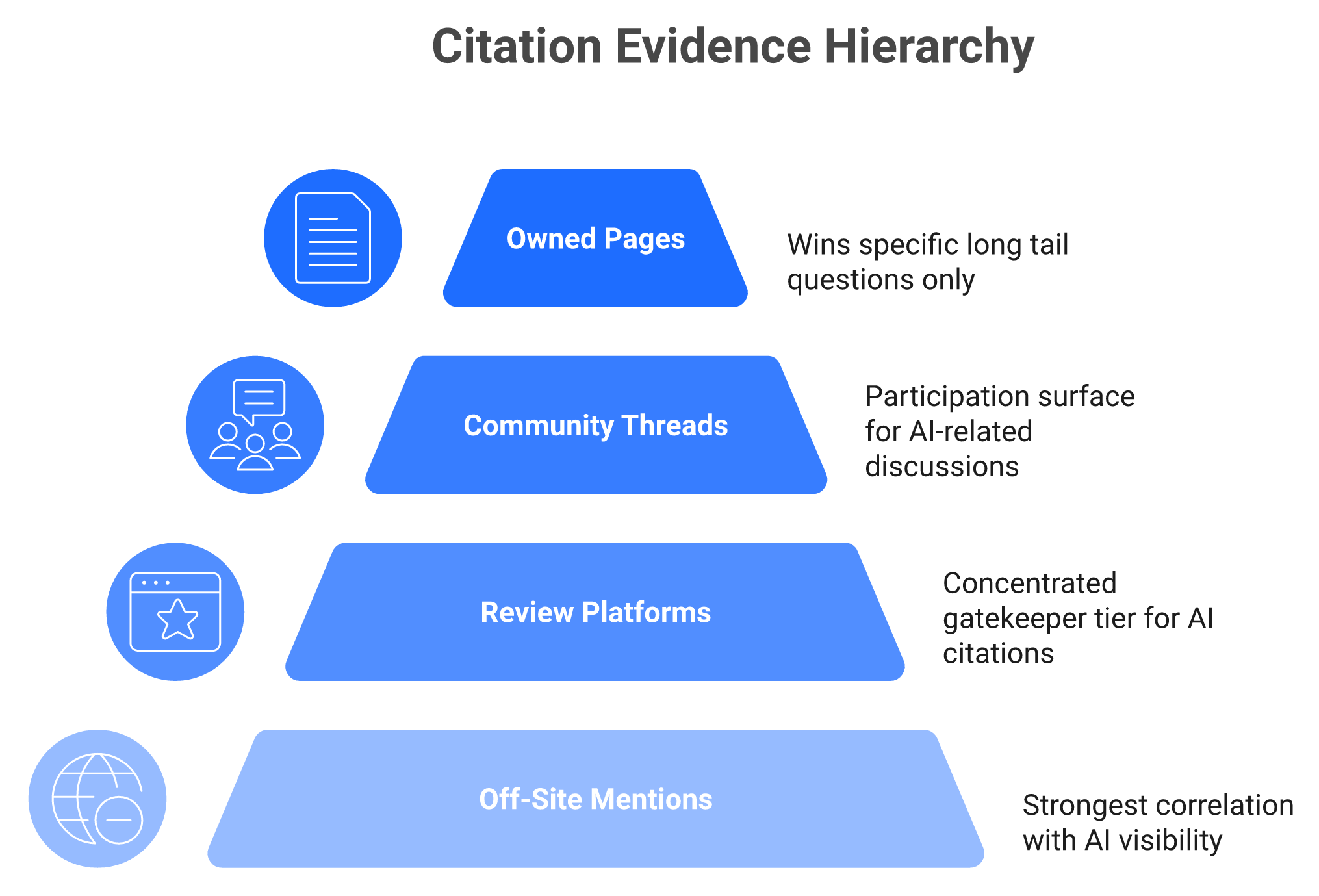
The useful split here is Earned AEO and Owned AEO. Owned means your pages get cited for specific, long tail questions. Earned means third party sources, reviews, Reddit threads, press, and listicles make engines trust you on head questions.
Most agencies work only the owned side, because it is the side they control. MaximusLabs AI's read is that this gets the allocation backwards for head commercial prompts, where the correlation data points at earned mentions carrying the weight. Our B2B SaaS AEO strategies split the budget accordingly.
Three practical moves follow for a Series A team. Complete and date your G2 profile, since recency affects which review pages get cited. Get into the comparison and listicle pages already cited for your prompts. Then treat relevant community threads as a surface to participate in honestly, not to spam, using the approach in our guide to Reddit and forum AEO.
I will keep one caveat visible. Correlation is not causation, and MaximusLabs AI's audits cannot isolate mentions from the brand strength that produces them. My working position is that mentions are the lever you can actually pull, so we pull it while watching whether citation presence follows.
MaximusLabs AI treats Search Everywhere Optimization as the core of the audit, not an appendix. Every engagement ships the exact G2 categories, comparison pages, and community threads that cited competitors instead of you, because the correlation evidence says earned mentions move citations about three times harder than links.
Q10. How do you tie AI visibility to pipeline when the answer has no link?
Use three layers. Search Console's generative AI performance report covers AI Overviews and AI Mode impressions, available worldwide since August 31, 2026, though it reports no clicks, click through rate, or queries. GA4 segments isolate ChatGPT, Perplexity, Gemini, and Copilot referrals, which convert at higher rates than organic. A post conversion "How did you hear about us?" field captures the rest. MaximusLabs AI installs all three in week one of an engagement, before any content ships.
⚠️ The dark funnel, described mechanically
Ethan Smith of Graphite describes the behaviour precisely. The buyer reads the recommendation, opens a new tab, types the brand name, lands on your domain through Google, and you record it as branded search when it was not.
"what they will do is they will open a new tab and they will type in the brand name and they will go to Google and then they'll click on your domain and you will think that it was branded Google search when it wasn't"
— Ethan Smith, CEO, Graphite, Answer Engine Optimization (AEO) Is the New SEO, recorded session
That single hop erases the AI touch. GA4 is working correctly and still gives you the wrong answer, which is the attribution problem behind AEO accuracy and attribution obstacles.
📊 Layer one: the first party impression baseline
Google launched the generative AI performance report on June 3, 2026, and completed the worldwide rollout on August 31, 2026, per Google Search Central. It shows impressions from AI Overviews and AI Mode, broken out by page, country, and device.
Its limits are documented, not suspected. The report carries no clicks, no click through rate, and no query data, as the Search Console help documentation confirms. MaximusLabs AI exports it as a week zero baseline and labels it as exposure, never as outcome. Our revenue attribution model for GEO initiatives treats it the same way.
✅ Layer two: segment the AI referrers in GA4
Build one exploration in GA4 with a session source filter for the AI platforms, then compare conversion rate against organic search.
| Step | What to build | Why |
| 1 | Session source or referrer segment for chatgpt.com, perplexity.ai, gemini.google.com, and copilot.microsoft.com | Isolates clickable AI traffic |
| 2 | Conversion rate comparison against organic search | Semrush measured AI search visitors as 4.4x more valuable than organic, June 2025 |
| 3 | Signup or demo count by platform | Webflow found LLMs drove 8% of signups, converting at 6x Google organic traffic |
The source for the value multiplier is Semrush's June 2025 study of AI search traffic, and the signup ratio comes from Webflow's own first party analysis of LLM referred traffic. The ratio is the point. Small volume at high conversion still justifies the work, and it reframes AI visibility as a quality channel rather than a traffic channel, the thesis behind our B2B SaaS buyer journey research.
💰 Layer three: ask the buyer directly
Add a required "How did you hear about us?" field to your demo and signup forms. Keep the options short, include ChatGPT, Perplexity, Gemini, and "an AI assistant," and leave one free text line.
Then code the responses weekly against your prompt clusters. MaximusLabs AI uses this field as the bridge between Share of Answers and closed won, because it is the only layer that captures the unclickable majority of B2B AI influence. The full metric set sits in our guide to GEO metrics and KPIs.
Smith's own guidance lands in the same place. If you want to measure impact, you cannot just look at last touch referral traffic, you have to see whether you showed up in the answer, then ask the user after conversion. MaximusLabs AI's data supports that, though I will admit survey responses carry recall bias, so we treat them as directional rather than exact.
The composite metric is revenue weighted Share of Answers. Multiply each prompt cluster's Share of Answers by its deal value, then track that figure next to AI sourced pipeline from the survey field.
MaximusLabs AI installs the survey field and GA4 AI referral segments in week one, before content ships. On Oliv AI, that instrumentation produced 27 qualified leads, $47K+ pipeline, 26% close rate in 4 months, and 30 to 40% of inbound now AI-sourced, as documented in the Oliv AI case study.
Q11. What does this look like as a repeatable monthly cadence?
Run the full audit monthly, with the same prompts, the same engines, 7 to 10 runs, and the same log schema. Spot check your top ten revenue weighted prompts weekly. Each month act on one output, the three competitor cited sources you are missing. Freeze the methodology and version the prompt set, because a changed input makes month over month comparison meaningless. MaximusLabs AI publishes the prompt set version and run count on every monthly report.
⚠️ Freeze the methodology before you optimise it
The temptation every month is to improve the prompt set. Someone adds five better prompts, drops two weak ones, and the comparison quietly dies.
So version instead of editing. MaximusLabs AI keeps a prompt set version number on every report, and any change starts a new version with the old one retained for reference. That discipline is part of our AEO measurement methodology.
✅ The 30, 60, 90 rhythm
| Window | Owner | Input | Output | Decision trigger |
| Weekly | Marketing manager | Top ten revenue weighted prompts | Spot check of citation presence | Two consecutive drops starts a diagnosis |
| Day 30 | Growth lead | Full prompt set, all engines, 7 to 10 runs | Share of Answers by engine, plus source gap list | Ship the three missing source placements |
| Day 60 | Growth lead with content | Re scored pages, placement results | Citability score movement on fixed pages | Low scorers on high value clusters get rewritten |
| Day 90 | VP Marketing | Revenue weighted Share of Answers, survey field data | AI sourced pipeline review | Reallocate budget between Earned and Owned work |
Teams that want the workflow automated rather than manual can borrow the patterns in our GEO automation documentation.
⏰ What breaks the cadence
Two events reset your baseline, and neither is in your control.
The first is a default model change inside an engine. Reliance on top ten organic results for AI Overview citations fell from roughly 76% in July 2025 to about 38% by February 2026 after Gemini 3 became the default. A client's numbers can move without a single content change, a dynamic we track in our analysis of Gemini 3's impact on AI search.
The second is infrastructure opacity. Mark Williams-Cook built queryfan.com to capture the hidden background queries ChatGPT runs behind a prompt, then abandoned it when OpenAI changed its infrastructure and that data disappeared. His own summary was that the background query data was lost. Extracting those hidden queries is the job our ChatGPT search query extractor was built for.
⭐ Where the data is still soft
Two honest unknowns sit inside this cadence, and MaximusLabs AI reports both rather than smoothing them over.
Logged in variance. Personalisation and memory widen the answer spread. Whether logged in benchmarking can ever be comparable across accounts is still open in our testing, a question we explore in our work on personalised AI search.
The market size forecasts. Gartner predicted traditional search volume would fall 25% by 2026, per its February 19, 2024 press release. SparkToro's clickstream analysis pointed the other way, with Google search growing about 21.6% in 2024 and receiving far more searches than ChatGPT.
My read is that both can be true at once. Google volume holds while the valuable commercial slice moves into answers, which is exactly why Share of Answers on BOFU prompts matters more than total search volume. That is the argument set out in our zero click search and brand economy report.
MaximusLabs AI runs this cadence as a managed service and publishes where the evidence is soft. Gartner's 25% decline does not survive SparkToro's clickstream numbers, and we would rather lose an argument than build a client's budget on a stat we cannot defend.
Frequently asked questions
What is an AI search visibility audit, and how is it different from an SEO audit?
An AI search visibility audit measures whether ChatGPT, Gemini, Perplexity, and Google AI Overviews mention your brand, cite your pages, and describe your product correctly for your highest intent buyer prompts. It then diagnoses the gaps behind any absence. A traditional SEO audit answers a different question. It checks whether your pages can rank, which is about position on a results page you do not control. The two diverge on four points: • Unit of measurement. SEO reports a position. An AI audit reports presence across repeated runs. • Surface. SEO looks at one index. An AI audit looks at four engines with four grounding sources. • Evidence. SEO weighs links. An AI audit weighs third party mentions and review platform coverage. • Outcome. SEO targets clicks. An AI audit targets citation presence on prompts tied to deal value. MaximusLabs AI builds the audit grid from the client's ICP and buying stage first, then works backwards into prompts, which is the reverse of a keyword led process. If you want the category definitions before you start, our primer on what answer engine optimization actually is sets the baseline.
How many times should I run each prompt during an AI visibility audit?
Run each prompt 7 to 10 times per engine, logged out. LLM output is stochastic, meaning the same question returns a different set of brands on different runs, so a single screenshot is an anecdote rather than a measurement. Ethan Smith of Graphite has described testing this directly and landing on seven to ten runs as the point where a real distribution appears. Logged in sessions widen the spread further, because memory and personalisation enter the picture. Three rules keep the sample honest: • Hold the methodology still. Same prompt text, same engine list, same run count for a full quarter. • Version, never edit. If the prompt set changes, start version two and keep version one for comparison. • Separate session states. Report logged out and logged in runs in different columns. MaximusLabs AI runs 7 to 10 passes per variant per engine and prints the run count on every deliverable, because a tracker that runs once a week charts noise. That is why client scores can swing twenty or thirty points in a month when nothing about the content moved. Our standards for this sit in our guide to AEO measurement metrics.
Which metrics should an AI search visibility audit report?
Six metrics carry the audit. Everything else is decoration. • Citation presence. Your page appears as a linked source inside the answer. • Share of Answers. The percentage of runs and prompt variants where your brand appears. • Description accuracy. Whether the engine describes your pricing model, ICP, and features correctly. • Competitor co occurrence. Which brands share the answer with you. • Generative AI impressions. Appearances in AI Overviews and AI Mode, from Search Console. • AI referral conversions. Signups and demos from ChatGPT, Perplexity, Gemini, and Copilot referrers in GA4. Drop click recovery as a goal. Pew Research Center measured an 8% click rate when an AI summary appears, against 15% without one, with only 1% clicking the summary's own sources. Impressions make a fine week zero baseline and a poor outcome, since Google publishes no clicks, click through rate, or query data alongside them. MaximusLabs AI reports presence and accuracy against revenue weighted prompts rather than impression curves, because a revenue focused method has to survive a CFO asking which number became pipeline. The full metric set is documented in our guide to GEO metrics and KPIs.
Why does my brand rank first on Google but never appear in ChatGPT?
Because these are separate retrieval systems with separate inputs. A Google ranking is evidence about Google and nothing more. The overlap data makes this concrete. Only around 11% of domains are cited by both ChatGPT and Perplexity for the same query, 71% of cited sources appear on a single platform, and roughly 7% achieve cross platform recognition. The grounding sources differ too: • ChatGPT search leans heavily on Bing, with about 87% citation overlap on commercial queries. • Claude grounds on Brave at 86.7% top organic overlap. • Gemini and AI Overviews ground on Google, though not with Google's ranking weights. Ranking and citation have also visibly decoupled inside Google itself. After Gemini 3 became the default model behind AI Overviews in January 2026, reliance on top ten organic results for citations fell from roughly 76% to about 38%, and around 31% of citations now come from positions beyond 100. MaximusLabs AI maintains a separate citation map per engine for every client for exactly this reason, because a blended score hides which engine is losing the deal. Our breakdown of ChatGPT, Perplexity, and Gemini citation patterns shows the per engine differences in full.
What technical checks actually affect whether AI engines can cite you?
Three checks matter. The rest of the technical AEO checklist is largely busywork. 1. Retrieval crawler access. OAI-SearchBot surfaces sites in ChatGPT's search features and is controlled separately from GPTBot, which relates to model training. An OAI-SearchBot opt out removes a site from ChatGPT search answers entirely. Allow OAI-SearchBot, PerplexityBot, Claude-SearchBot, and Googlebot explicitly. 2. Rendering without JavaScript. Standalone AI search crawlers do not execute JavaScript, so client side React and Vue pages look like empty shells. Fetch the page with curl and check that your answer text appears in the raw HTML. 3. 404 hygiene. Log studies put OAI-SearchBot's wasted fetches on missing pages at 34.8% and ClaudeBot's at 34.2%, against Googlebot's 8.22%. Watch the silent blocker too. A WAF or CDN rule written to stop scrapers will return 403 responses to retrieval crawlers, and nothing in a standard SEO stack flags it. MaximusLabs AI caps the technical portion of an audit at a one page gate covering crawler access, server side rendering, 404 patterns, and IndexNow submission. Our guide to managing AI crawlers like GPTBot and Google-Extended lists every directive.
Can I audit AI search visibility for free, or do I need a paid tool?
You can run a credible first audit for free. Most paid trackers do the same core job: send a prompt, record whether you appeared, and chart it. The free version of the workflow looks like this: • Run your 15 to 30 buyer prompts manually in ChatGPT, Perplexity, Gemini, and Google, 7 to 10 times each, logged out. • Log mention, citation URL, competitors named, and third party sources cited in a sheet. • Pull the Search Console generative AI performance report for your AI Overviews and AI Mode impression baseline. • Build a GA4 segment for AI platform referrers and compare conversion rate against organic. Only two things genuinely separate paid tools: whether they scrape the live interface or query vendor APIs, and whether they expose the cited sources behind each answer. Roughly 95% query APIs, and API responses differ from what a real buyer sees. So buy the cheapest option that does both. MaximusLabs AI runs scraped interface tracking at cents per query and redirects the savings into earned placements and BOFU content, because the tracker is the cheap part. Our side by side AEO tools comparison covers the paid options in detail.
How do you connect AI search visibility to pipeline when the answer has no link?
Use three measurement layers, because no single one closes the loop. 1. Search Console generative AI performance report. Available worldwide since August 2026, it shows AI Overviews and AI Mode impressions by page, country, and device. It reports no clicks, click through rate, or queries, so treat it as exposure. 2. GA4 referral segments. Filter session source for chatgpt.com, perplexity.ai, gemini.google.com, and copilot.microsoft.com, then compare conversion rate against organic. Semrush measured AI search visitors as 4.4x more valuable than organic, and Webflow found LLMs drove 8% of signups while converting at 6x Google organic. 3. Post conversion survey. Add a required "How did you hear about us?" field with ChatGPT, Perplexity, Gemini, and an AI assistant as options. The third layer matters most in B2B, because the buyer reads the recommendation, opens a new tab, types your brand name, and GA4 records branded search. MaximusLabs AI installs the survey field and GA4 AI referral segments in week one of an engagement, before content ships. On Oliv AI that instrumentation tracked 27 qualified leads, $47K+ pipeline, 26% close rate in 4 months, documented in the Oliv AI case study.