 Krishna Kaanth M
- Tracking AI traffic means measuring four separate layers: crawl from server logs, citation from prompt sampling, click from GA4, and conversion from self-reported attribution.
- GA4 now ships a native AI Assistant channel using medium ai-assistant, but it excludes Google AI Overviews and AI Mode, so it undercounts real influence.
- Most AI-influenced buyers never click the citation, so sessions land in Direct or Branded Organic. Treat GA4's AI number as a floor, never a total.
- Server logs are the only ground truth for AI crawlers, because OAI-SearchBot, PerplexityBot, and Claude-SearchBot fetch static HTML and ignore JavaScript tags.
- Blocking GPTBot stops training only. Blocking OAI-SearchBot removes you from ChatGPT search answers entirely, and robots.txt changes take about 24 hours.
- Share of Answers needs 7 to 10 runs per prompt variant, and a required post-conversion survey field is what finally links AI visibility to pipeline.
Q1. What does "tracking AI traffic" actually mean in 2026?
A Head of Organic Growth I worked with opened her GA4 Traffic Acquisition report on a Thursday board call. Her CEO asked one question: "How much pipeline came from ChatGPT?" The screen showed 412 AI Assistant sessions out of 190,000. She knew that number was wrong. She just could not prove in which direction.
Tracking AI traffic means measuring four separate layers, not one number. Crawl shows which AI bots fetch your pages, and it comes from server logs. Citation shows how often engines name you, and it comes from multi-run prompt sampling. Click shows arriving sessions, and it comes from GA4's AI Assistant channel. Conversion shows influence, and it comes from self-reported attribution at signup. Teams reporting only clicks see the narrowest layer.
🧭 Why one number never survives the follow-up question
Each layer answers a different question. Crawl answers "can engines read me." Citation answers "do engines recommend me." Click answers "do people arrive." Conversion answers "does it become pipeline."
Collapsing them produces false conclusions. A brand can be crawled 40,000 times, cited weekly, and still show 300 sessions. That is not failure. That is the shape of AI search measurement, where the answer is the destination and the click is optional.
📊 The four layers and their data sources
| Layer | Data source | What it proves | Blind to |
| Crawl | Raw server or CDN logs | AI bots can fetch and parse your pages | Whether you were cited |
| Citation | Multi-run prompt sampling | Engines name you in answers | Whether anyone clicked |
| Click | GA4 AI Assistant channel, custom groups | Sessions that arrive with an AI referrer | Referrer-stripped and no-click journeys |
| Conversion | Post-signup "how did you hear about us" field | Revenue influence across engines | Anyone who skips the field |
⚠️ What practitioners say happens next
The gap between these layers is not theoretical. It shows up in the first week of any technical SEO and website audit.
"In GA4, tracking referrals can be done through sources like chat.openai.com and perplexity.ai, among others. However, when it comes to crawlers, GA may not provide extensive data because many bots bypass analytics scripts, which means you'll require server logs for better insights."
— u/DesperateCoyote, r/GoogleAnalytics Reddit Thread, April 2025
"For many of us noticing a decline in traffic, it seems that these visits are being substituted with AI-generated interactions. Personally, I believe that whenever a website is referenced in an AI chat, that traffic should be aggregated with your GA4 data."
— u/jim_wr, r/GoogleAnalytics Reddit Thread, April 2025
Ethan Smith, CEO of Graphite, puts the measurement rule plainly. You cannot rely on last-touch referral traffic alone. You have to confirm you showed up in the answer, then ask buyers post-conversion how they heard about you.
💰 The honest answer clients do not expect
Clients ask me for one AI traffic number. The honest answer is four numbers, and conflating them is why GEO budgets quietly die in quarter two. MaximusLabs AI's read is that the standard advice gets this backwards, because it treats AI search visibility as a traffic channel when it behaves like an influence channel.
MaximusLabs AI runs all four layers as standard client reporting, with daily AI-visibility tracking across every major engine and Share of Voice measured across thousands of question variants rather than a handful of prompts. Answer Engine Optimization (AEO) is the flagship, SEO sits underneath it, and every engagement is held to pipeline rather than mentions.
Q2. Why does GA4 undercount your AI traffic by roughly 90%?
Because most people who read an AI recommendation never click the citation. They open a new tab, Google your brand, or type your domain directly. GA4 then files that session as Branded Organic or Direct. Add non-clickable B2B answers and stripped referrer headers from in-app browsers, and last-touch reporting captures a fraction of real influence. Treat GA4's AI number as a floor, never a total.
📉 The flat line that gets misread as failure
Here is the scene I see most often. A SaaS team ships 20 BOFU pages, waits ten weeks, and checks the AI referral line. It is flat. Someone says GEO does not work for B2B.
Meanwhile Direct is up 14 percent and Branded Organic is up 9 percent. Nobody connects those three facts, because they live in three different rows of the same report.
🔍 The Dark AI Funnel, step by step
Ethan Smith describes the exact behaviour. A buyer reads the recommendation, opens a new tab, types the brand name into Google, and clicks through. You then record branded search when it was never branded search. Or they type the domain directly, and you record direct traffic.
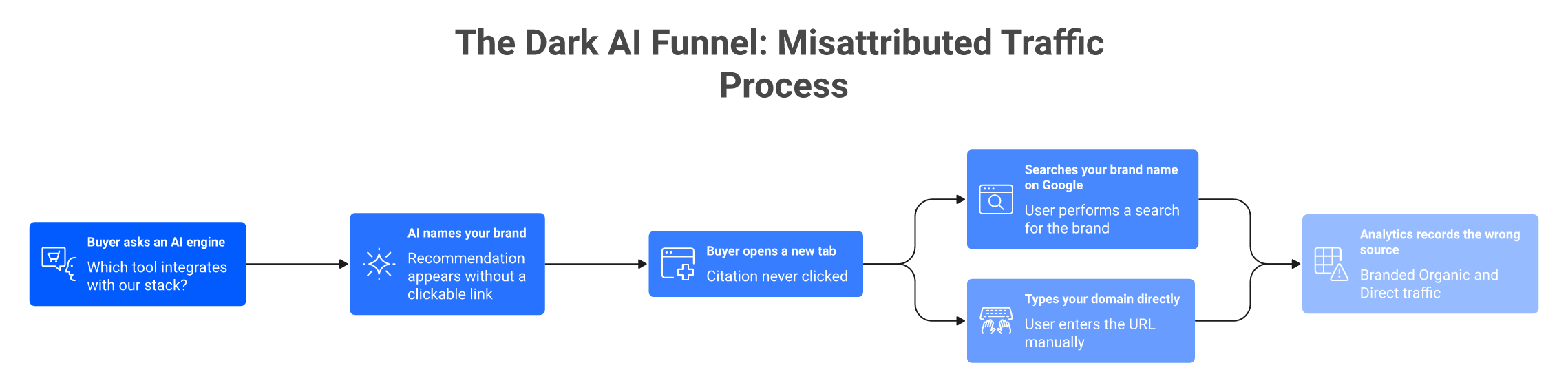
The B2B version is worse. A user asks ChatGPT which meeting transcription tool integrates with Looker. ChatGPT recommends Otter. The user opens a new tab, searches "Otter.ai," and signs up. GA4 credits Google Organic and misses the ChatGPT origin completely.
⚠️ Three mechanisms, and how to spot each
No-click answers. For most B2B questions there is nothing to click. Smith's point is blunt: the answers are not clickable, so last-touch referral cannot measure impact. Spot it by comparing citation share against referral sessions. High citation with near-zero referrals is normal, not broken.
New-tab brand search. The AI recommendation becomes a branded Google query. Spot it by trending non-brand organic against branded organic. Branded rising while non-brand stays flat is the signature.
Stripped referrers. AI apps and in-app browsers often omit the referrer header, so sessions land in Direct. Spot it by auditing unexplained Direct spikes across a 90-day window and checking their landing pages. Deep BOFU pages in Direct are rarely real direct traffic.
📌 What I now refuse to put in a report
I used to lead client reports with AI referral sessions. It was the cleanest number available, so it felt defensible. It was also the number most likely to get a working channel defunded.
MaximusLabs AI stopped using AI referral sessions as a headline metric and pairs the GA4 floor with citation sampling and self-reported attribution. We trace every attribution claim back to platform documentation rather than dashboard intuition, because a channel judged on last-touch clicks gets killed before its pipeline shows up. That discipline is the basis of our GEO revenue attribution work.
✅ The reframe that holds up in a board meeting
Say the quiet part out loud before someone else does. GA4 measures arrival. AI search influences decisions before arrival, which is exactly what the decline in search referral traffic looks like from the inside.
So report two numbers side by side: what GA4 can see, and what self-reported attribution says. The delta is your dark AI funnel, quantified rather than guessed. That framing survives scrutiny, and it moves the conversation from traffic to pipeline, which is where it belonged anyway.
Q3. How do you configure GA4 to see ChatGPT, Perplexity and Gemini traffic?
GA4's default channel group now includes an AI Assistant channel. It auto-tags recognized assistant traffic with medium "ai-assistant" and campaign "(ai-assistant)," so no regex is required for covered engines. It excludes Google AI Overviews and AI Mode. Add a custom channel group above Referral for engines GA4 misses, then build an Explore segment on session source to recover history, because channel groups are not retroactive.
🧰 Why most guides still teach the old way
Nearly every tutorial ranking for this query opens with a regex block. That advice was correct in 2024. It became incomplete in May 2026, when Google added AI Assistant as a default channel for recognized sources including ChatGPT, Gemini, Copilot, DeepSeek, and Grok.
The native channel does not make custom groups useless. It makes them a gap-filler instead of the whole job.
🔧 The setup, in order
Check the native channel first. Open Reports, then Acquisition, then Traffic acquisition, and switch the dimension to Session default channel group. Look for AI Assistant.
Create a custom channel group. Go to Admin, then Data display, then Channel groups, and clone the default.
Add one rule for the gaps. Condition: Session source matches regex
.*chatgpt.*|.*openai.*|.*perplexity.*|.*gemini.*|.*copilot.*|.*claude.*|.*deepseek.*|.*grok.*|.*\.ai$Move that rule above Referral. Rule order decides the number. A custom AI rule sitting below Referral loses sessions to Referral silently.
Build an Explore segment. Use a session-scoped segment on the same source pattern to read historical data, since channel groups only apply going forward.
Map key events per engine. Add demo requests, trials, and signups as key events, then break them down by your AI channel so you report conversions, not sessions.
⚙️ What practitioners run into
"Managing traffic is straightforward; simply create a custom channel grouping that includes sources containing 'gpt' or those that conclude with '.ai.' As for crawlers, I'm not entirely sure. I believe that GA4 automatically filters them out of the data."
— u/UseADifferentVolcano, r/GoogleAnalytics Reddit Thread, April 2025
"I've noticed that crawlers tend to ignore the GA4 tag, as they parse the HTML but do not retrieve linked resources. This tag functions as a JavaScript script that is executed by HTML browsers when we access the site."
— u/Familiar_Mammoth3211, r/GoogleAnalytics Reddit Thread, April 2025
That second comment is the single most useful thing in the thread. It explains why this GA4 build is layer three of four and nothing more, and why AI crawler optimization sits in a separate layer.
⚠️ What this setup still cannot tell you
| Question | Can GA4 answer it? | Where the answer lives |
| Did AI Overviews show my page? | No, excluded from the channel | Search Console generative AI report |
| Which bots crawled me? | No, crawlers skip the JavaScript tag | Server logs |
| Was I cited without a click? | No | Prompt sampling |
| Did an AI answer influence this deal? | Partially, last touch only | Post-conversion survey |
MaximusLabs AI ships this GA4 build inside the week-one technical sprint, alongside schema markup and robots.txt work, so measurement exists before the first AEO article goes live. In our client engagements the first article can be live by day four, and the reporting layer is already catching it.
Q4. What do Search Console's generative AI reports actually show?
Search Console's generative AI performance reports launched on June 3, 2026, and rolled out worldwide by August 31, 2026. They show impressions, pages, countries, devices, and dates for appearances in AI Overviews and AI Mode. They expose no clicks, no CTR, and no queries, and AI Overview clicks stay blended into standard organic performance. Read them as a Google-side citation proxy, not a traffic report.
🔎 The blind spot GA4 cannot cover
GA4's AI Assistant channel explicitly excludes AI Overviews and AI Mode. That exclusion is logical, since those surfaces sit inside Google Search rather than a separate assistant. It also means your GA4 build, however careful, reports zero on the single largest AI surface most B2B brands touch, which is why Google AI Overviews optimization needs its own measurement.
Search Console is the only first-party source for that surface. It is also deliberately limited, and the limits matter more than the numbers.
📊 What is in the report, and what is missing
| Dimension | Available | Notes |
| Impressions | Yes | Your page appeared in an AI surface |
| Pages, countries, devices, dates | Yes | Standard breakdowns |
| Clicks and CTR | No | Not separated for generative surfaces |
| Queries | No | No prompt-level visibility |
| AI Overview clicks | Blended | Counted inside standard organic |
Google documents these limits directly in the generative AI performance report help page.
🧪 How I read it on a Monday morning
Export impressions by page, then join that against organic clicks for the same pages over the same period. Three patterns show up fast.
Rising AI impressions with flat clicks means you are becoming the answer while losing the click. Those pages are citation winners, so refresh them, tighten the schema, and keep them current with a GEO content refresh. Falling impressions with stable rankings means a competitor replaced you inside the answer, which is a trust and sourcing problem rather than a keyword problem.
⚖️ Why this replaces rank tracking rather than supplementing it
Google-era reporting assumed one position per URL per keyword. Generative surfaces do not work that way. There is no position, only presence or absence inside a synthesized answer, a distinction covered in our GEO versus traditional SEO comparison.
That is why impression share per page is the honest metric here. It tells you how often you were considered worth including. MaximusLabs AI's data points one way on this, though I hold it loosely: pages that gain AI impressions tend to be the ones with explicit primary-source citations and clean answer-first structure, not the ones with the most keywords.
MaximusLabs AI treats this report as the Google half of a citation scoreboard and prompt sampling as the ChatGPT, Perplexity, and Claude half. We map citation requirements per engine separately, because optimizing one surface while blind to the other declares victory on the wrong engine.
Q5. How do you track AI crawlers in server logs, and why are logs the only ground truth?
Server logs are the only source recording AI crawler behaviour. Standalone crawlers like OAI-SearchBot, PerplexityBot, and Claude-SearchBot fetch static HTML and do not execute JavaScript, so GA4's tag never fires for them. Filter raw access logs by user agent, verify every hit against published IP ranges, then track crawl frequency, status codes, and wasted fetches by page group each week. MaximusLabs AI audits raw logs and server-side rendering coverage before publishing any client content.
🕳️ The gap that makes your analytics look clean
A client's dashboard can show zero AI activity while 40,000 bot requests hit the same site that month. Both facts are true. GA4 runs on JavaScript, and most AI crawlers never run it.
Only Googlebot and Bingbot render JavaScript reliably. So a pricing page built in client-side React can look rich to a human and empty to OAI-SearchBot, which is the core failure our complete guide to AI crawlers covers in depth.
📉 What the crawl numbers actually say
Cloudflare publishes a crawl-to-refer ratio, which counts HTML pages crawled for every page request referred back. In September 2026, Perplexity sat near 2,373 to 1, Anthropic near 549 to 1, OpenAI near 341 to 1, and Google near 4.7 to 1.
Crawl waste compounds this. OAI-SearchBot burns roughly 34.8 percent of its fetches on 404 pages, and ClaudeBot roughly 34.2 percent, against about 8.22 percent for Googlebot. That is crawl budget spent on dead URLs nobody audits, and it is exactly what a technical SEO and website audit surfaces first.
🔧 The weekly log workflow
Pull raw logs. Apache, Nginx, or CDN edge logs. Cloudflare logs work when you have no server access.
Filter by user agent. Track GPTBot, OAI-SearchBot, ChatGPT-User, ClaudeBot, Claude-SearchBot, PerplexityBot, Meta-ExternalAgent, Bingbot, and Googlebot separately.
Verify the hits. Treat a user agent string as a claim, not proof. Check it against OpenAI's published IP range files or reverse DNS.
Group by page type. Pricing, docs, comparison pages, blog. Repeat hits on pricing and comparison URLs signal evaluation, not indexing.
Report four numbers weekly. Requests per bot, 404 rate per bot, top 20 fetched URLs, and your own crawl-to-refer ratio per engine.
💬 What other practitioners found in their logs
"Google Analytics fails to track AI bot activity since these bots do not run JavaScript. To accurately monitor this traffic, server-side logging is essential, as client-side analytics will miss it."
— Practitioner analysis of 48 days of server logs, r/TechSEO Reddit Thread, March 21, 2026
"We've been relying more on server logs rather than AI visibility dashboards for this specific reason. While the tools designed for AI visibility are beneficial for monitoring mentions and evaluating prompt performance, they primarily assess outputs rather than the true behavior of crawlers."
— Practitioner comment, r/TechSEO Reddit Thread, July 9, 2026
"Analyzing server logs can be a futile effort; it exemplifies the scenario where one has access to a wealth of data but struggles to identify what truly matters."
— Dissenting practitioner comment, r/TechSEO Reddit Thread, February 18, 2026
⚠️ The fix most teams skip
That last comment is fair, and I have seen it play out. Logs without a question become a hobby. So pick one question first: are my money pages being fetched, and do they return 200 with real text in the raw HTML. A quick AI crawlability check answers that before you open a log file.
If the answer is no, server-side rendering comes before any content calendar. MaximusLabs AI's technical scope treats JavaScript minimization as a prerequisite, so critical content renders in HTML rather than after a browser executes a script, which is the foundation of our technical GEO implementation work. In our audits, that single fix often moves more citation share than ten new articles.
Q6. Does blocking GPTBot remove you from ChatGPT search?
No. GPTBot governs model training, OAI-SearchBot indexes content for ChatGPT search citations, and ChatGPT-User fetches a page when a person asks ChatGPT to read it. Blocking GPTBot does not hide you from ChatGPT search. Blocking OAI-SearchBot does remove you from ChatGPT search answers. Allow retrieval bots, decide training separately, and expect roughly 24 hours for robots.txt changes to propagate.
🧯 The commit that quietly killed citations
The pattern repeats in audit after audit. A legal or engineering conversation ends with "let's opt out of AI." Someone adds four Disallow lines on a Friday.
Two of those lines block training. The other two block retrieval. Nobody separated them, because the bots look alike in a config file, a mistake covered in our guide to understanding and managing AI crawlers.
🤖 What each bot actually does
| Bot | Job | If you block it |
|---|---|---|
| GPTBot | Crawls content for model training | Your content is excluded from training data. ChatGPT search still works |
| OAI-SearchBot | Indexes pages for ChatGPT search citations | You disappear from ChatGPT search answers |
| ChatGPT-User | Fetches a page when a user asks ChatGPT to read it | Users cannot pull your page into a live chat |
| ClaudeBot | Anthropic training crawler | Excluded from training |
| Claude-SearchBot | Anthropic retrieval crawler | Excluded from Claude's cited answers |
| PerplexityBot | Perplexity retrieval crawler | Excluded from Perplexity citations |
OpenAI documents these as separate robots.txt tokens with separate purposes. That separation is the whole point, and it is the part most "opt out of AI" advice skips.
✅ The configuration that keeps visibility
Allow retrieval across the board: OAI-SearchBot, Claude-SearchBot, PerplexityBot, Googlebot, and Bingbot. Then make training a separate business decision for GPTBot, ClaudeBot, and CCBot.
Two timing details matter. Robots.txt changes take roughly 24 hours to move through OpenAI and Perplexity indexing pipelines. And user activity drives re-crawls, so after someone queries your topic in ChatGPT, OAI-SearchBot re-checks robots.txt and refetches the pages it showed, a behaviour we document in our ChatGPT SEO guide.
⚠️ Two checks before you trust your own file
First, read the response, not the rule. Practitioners testing 11 sites with four AI crawler user agents found every site returned HTTP 200, yet raw HTML and rendered content still differed, which is a separate problem from robots.txt.
"The check that closes the gap is reading the server logs for the actual bots' hits (are GPTBot/ClaudeBot fetching real content URLs and getting 200s)."
— Practitioner comment, r/TechSEO Reddit Thread, August 2, 2026
Second, remember that not every crawler obeys the file. One 48-day log study reported Meta-WebIndexer ignoring robots.txt entirely, so policy and reality need separate verification.
📌 What I tell founders who want to block everything
I understand the instinct. Training crawlers take content and return nothing, and the crawl-to-refer ratios in Q5 make that feel unfair. Blocking training is a defensible choice.
Blocking retrieval is a different decision with a different cost. You are choosing not to appear when a buyer asks ChatGPT which vendor to shortlist.
MaximusLabs AI includes AI-crawler robots.txt configuration in every technical audit, before any content ships. This one file decides whether the rest of an Answer Engine Optimization (AEO) program is even visible to the engines you want citing you.
Q7. How do you measure Share of Answers instead of rankings?
Google-era SEO tracked one position per URL. AI answers change between runs, so visibility is a distribution rather than a rank. Run each prompt variant 7 to 10 times across logged-in and logged-out sessions, record whether your brand appears and whether your URL is cited, then calculate appearance frequency per question cluster. MaximusLabs AI measures Share of Voice this way across thousands of question variants per client.
📸 Why one screenshot is not a report
Someone asks ChatGPT "best AI sales tool," sees the brand, screenshots it, and pastes it into Slack. The next day the same prompt returns a different list. Nothing broke. That is how probabilistic output works.
Ethan Smith, CEO of Graphite, frames the metric shift simply: with no single rank available, you measure how frequently you show up instead. That frequency is the number, not the screenshot, and it sits at the centre of AEO measurement metrics.
🔁 The sampling protocol
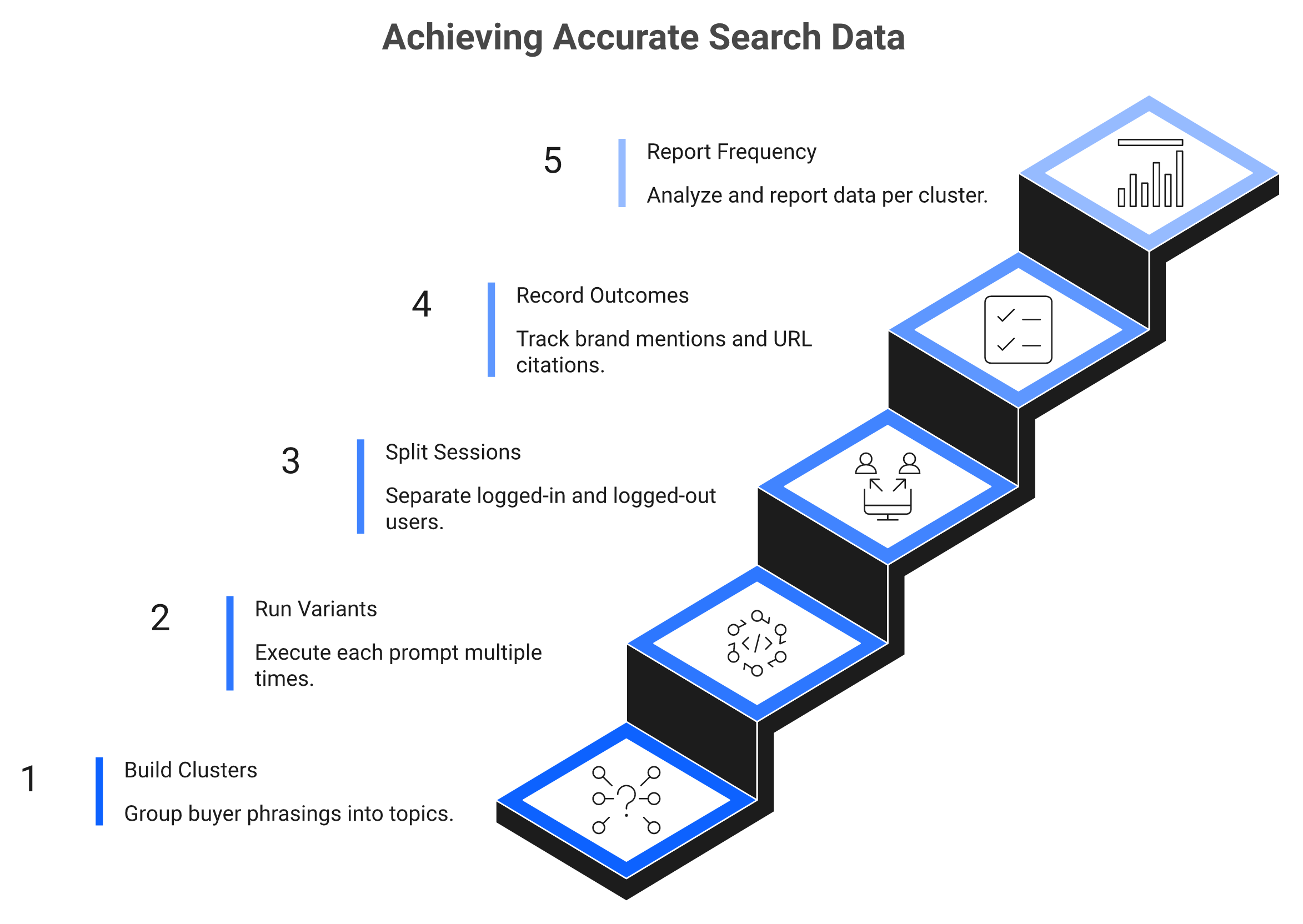
Build question clusters. Group 20 to 50 real buyer phrasings per topic, not keywords.
Run each variant 7 to 10 times. Fewer runs cannot separate signal from variance.
Split sessions. Run logged-in and logged-out, because personalization changes retrieval.
Record two outcomes per run. Was the brand named, and was your URL cited.
Report frequency per cluster. For example, named in 6 of 10 runs for "best X for Y."
⚖️ Brand mention share versus cited-URL share
These two metrics look similar and demand opposite fixes. A brand can be named in the answer while a review site owns every citation. That is an off-page problem, so the work moves to G2, Capterra, Reddit, and listicles that engines already trust, which is the remit of our AI citation acquisition tactics.
The reverse also happens. Your page gets cited, but the answer never names you as a recommended option. That is a content and schema problem on your own page.
💬 What practitioners say about trusting this data
"most, if not all, those tools are scams and should be investigated by the FTC. no one can tell you how much you show up in ChatGPT"
— Skeptical practitioner comment, r/SEO Reddit Thread, September 21, 2026
"Although Google AI Overviews can be tracked and should be observed as a distinct signal alongside organic rankings, citations from language models remain too inconsistent to serve as a dependable metric for investment."
— Practitioner comment, r/content_marketing Reddit Thread, May 13, 2026
⏰ The fragility nobody prices in
Mark Williams-Cook built queryfan.com to expose the hidden background searches ChatGPT runs behind an answer. OpenAI later obfuscated those logs, and the data stream disappeared.
That is the honest caveat on this whole layer. Any method built on undocumented platform internals can vanish without notice, so keep your methodology portable and your raw run data stored yourself. A query fan-out generator helps rebuild variant sets when a data source closes.
MaximusLabs AI's data points one way here, though I hold it loosely: clusters where the brand is named but not cited almost always trace back to thin third-party presence rather than weak content. We separate the two metrics for that reason, and our citation-intelligence work maps which sources each engine actually trusts before we try to earn a place in them.
Q8. Are AEO tracking tools worth $1,000 a month?
Usually not. Most of the 60-plus AEO trackers do the same thing, which is ping a prompt, log whether you appeared, and chart it. That takes weeks to build, which is why so many exist. Incumbents are already absorbing the feature at far lower prices. Most tools also query vendor APIs rather than live interfaces, so reported citation ranks differ from what logged-in users see.
💸 The line item nobody can defend
A Head of Organic Growth shows me a tool invoice and a dashboard. The dashboard shows a visibility score that moved from 31 to 34. Nobody can say what action caused it, or what action it should trigger.
Ethan Smith, CEO of Graphite, says the quiet part. His team catalogued 60-plus AEO tools doing identical tracking, built their own for a few cents per question, and expects Ahrefs and Semrush to ship the same feature at around $100 per month. Our own AEO tools comparison reaches the same conclusion on feature parity.
🔌 API tracking versus live UI tracking
| Approach | Cost | Accuracy risk | Best use |
|---|---|---|---|
| Vendor API queries | Low, roughly $100 per month tier | APIs run different system prompts, retrieval, and personalization than consumer apps | Directional trend tracking |
| Scraped live UI | High, adds proxy and CAPTCHA infrastructure | Closer to what humans see, but brittle when interfaces change | Audits and spot checks |
| Your own scripted sampling | Cents per question at small scale | You own the methodology and the raw data | Regression testing over time |
The accuracy gap is the real issue. Roughly 95 percent of third-party platforms query APIs, which do not execute web search or personalization the way the live product does.
💬 What buyers are saying about the pricing
"I compared the pricing for the AI visibility tools offered by Profound and Ahrefs, which are $499 and $699 per month, respectively. In contrast, Semrush only adds an extra $99 per month for similar features."
— Practitioner comment, r/SEO_Digital_Marketing Reddit Thread, August 23, 2025
"The main concern is that I don't fully trust the data, and even when I do, I'm unsure how to act on it. The dashboards may look sophisticated, but I find it challenging to translate any of that information into concrete decisions."
— Practitioner comment, r/SEO Reddit Thread, September 21, 2026
"the top AI visibility tools not only help you track your performance but also provide recommendations for enhancing your visibility, suggest which backlinks to incorporate, and advise on content updates"
— Counterpoint comment, r/SEO_Digital_Marketing Reddit Thread, August 23, 2025
✅ Five questions before you sign
Do you query the API or scrape the live interface, and can you show both outputs side by side?
How many runs per prompt, and is the raw run data exportable?
Do you separate brand mentions from cited URLs?
Does the contract allow monthly exit when Ahrefs or Semrush ships this at a lower tier?
What decision does this dashboard change next week?
⭐ What to do with the saved budget
Buy the cheapest tool that answers your question. Then spend the difference earning citations, because knowing your rank does not cause an outcome. Our list of best ChatGPT tracking tools is organised around that filter.
MaximusLabs AI builds proprietary internal tools for GEO workflows instead of reselling a tracker subscription, with daily AI-visibility tracking that is re-run and regression-tested across engines. Measurement sits inside the engagement, and we are held to pipeline rather than to a visibility score.
Q9. How do you connect AI traffic to pipeline and revenue?
Add a mandatory "How did you hear about us?" field at signup or checkout, with AI assistants listed as explicit options. For high-consideration B2B purchases, self-reported attribution is the only method that captures influence across non-clickable answers and new-tab branded searches. Reconcile it monthly against your GA4 AI Assistant channel. The gap between the two numbers is your dark AI funnel, quantified. MaximusLabs AI measures client engagements on pipeline rather than on mentions.
💸 The budget conversation that ends badly
A VP Marketing walks into a quarterly review with 412 AI sessions and no revenue line beside them. The CFO does the math in his head and moves on. The channel loses its budget before anyone asks whether the measurement was sound.
I have watched this happen to programs that were working. The content was getting cited. The attribution just could not follow a buyer who never clicked, which is the core problem our GEO revenue attribution framework was built to solve.
📊 What the conversion data actually says
Webflow tracked LLM-referred visitors and found they converted at 6 times the rate of traditional Google organic visitors, even though those sessions were a small share of the total.
Now the honest counterweight. A study of 95 websites published in Forbes on October 5, 2026, found AI referrals converting at just 1.18 times organic overall, and 0.62 times for B2B product companies, with organic still delivering 39 times more traffic.
Published multiples currently range from under 1 time to 23 times. That spread is the reason you benchmark your own funnel before quoting anyone else's number, and it is why our 2026 GEO and AEO benchmark report publishes ranges rather than single figures.
🔧 The survey build, step by step
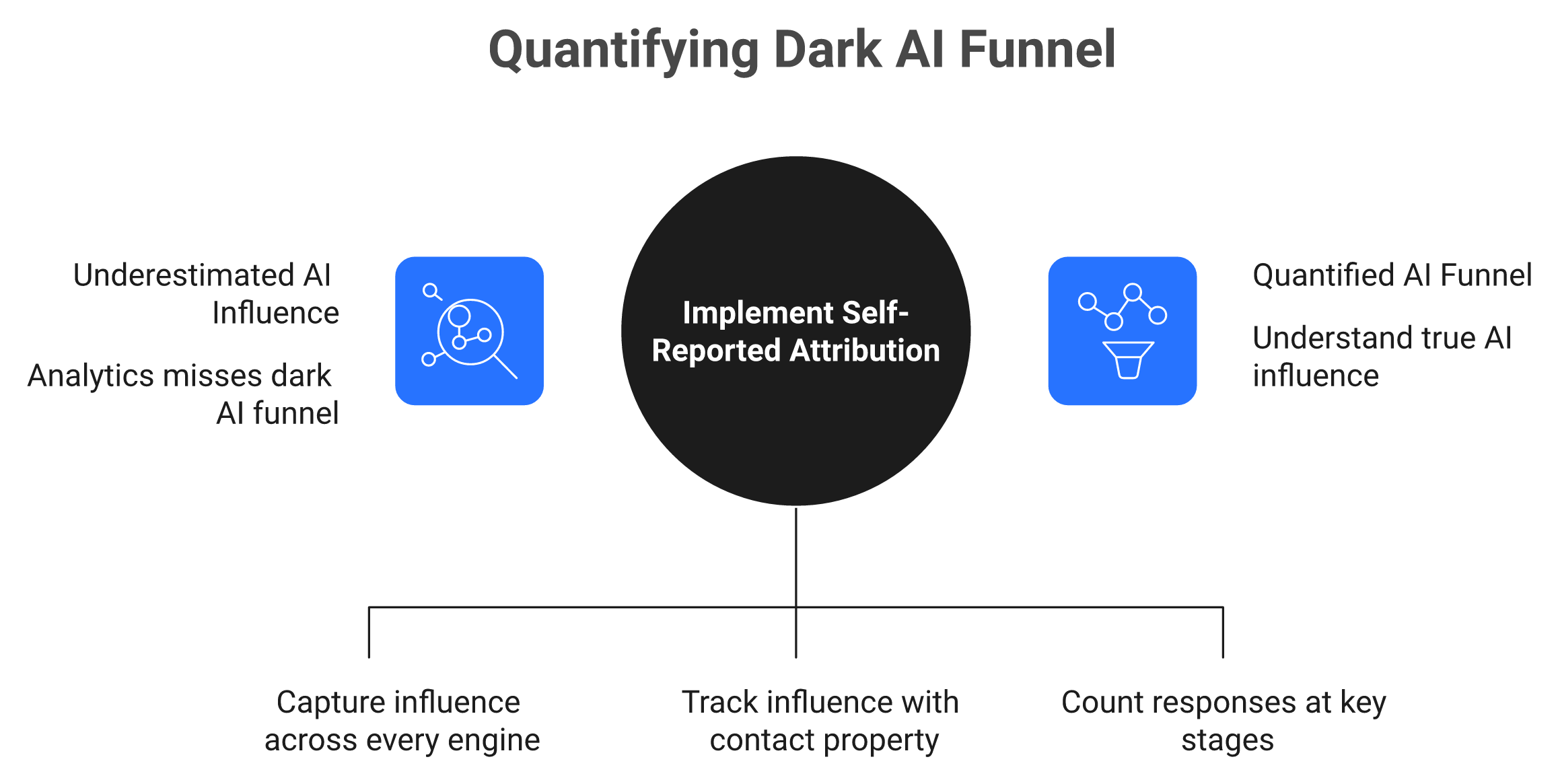
Add one required field. Place it at signup, demo request, or checkout. Required, not optional.
List engines by name. ChatGPT, Perplexity, Gemini, Claude, Copilot, Google search, G2 or Capterra, Reddit, referral from a person, and an open text box.
Write it to the CRM. Map the field to a contact property so it travels with the deal, not just the form submission.
Report it by stage. Count responses at MQL, at opportunity, and at closed won. AI influence often looks small at signup and larger at opportunity.
Reconcile monthly. Put GA4 AI sessions and survey-reported AI influence side by side in one table.
⚠️ Why the field has to be required
Optional fields get skipped by the buyers who moved fastest, which are exactly the AI-influenced ones. I was wrong about this for a while, because required fields feel like friction.
The data changed my mind. Optional versions produced response rates too low to reconcile against anything, a pattern also visible in our research on the B2B SaaS buyer journey in AI search.
⏰ The calibration nobody wants to hear
Gartner forecast that AI chatbots would cut traditional search volume by 25 percent by 2026. SparkToro's clickstream analysis of 260 billion records found Google search grew roughly 21.6 percent in 2024 and still receives 373 times more searches than ChatGPT.
Both can be true. AI search is expanding information seeking rather than simply replacing Google, which means your report needs both channels side by side, not a winner declared. That is also the argument in our GEO versus traditional SEO comparison.
MaximusLabs AI starts every program at BOFU rather than TOFU, precisely because bottom-funnel traffic is what shows up in a self-reported attribution field. Awareness content comes only after BOFU is exhausted. One public example from our B2B SaaS work: "27 qualified leads, $47K+ pipeline, 26% close rate in 4 months (Oliv AI)" and "30 to 40% of inbound now AI-sourced (Oliv AI)".
Q10. What does a working AI traffic report look like each month?
A credible monthly AI traffic report has five rows: AI crawler hits and 404 waste by bot, AI Overviews and AI Mode impressions by page, Share of Answers by question cluster, GA4 AI Assistant sessions with key events, and self-reported AI attribution from signups. Report direction and gaps rather than totals. MaximusLabs AI runs this stack with the technical audit in week one and the first optimized article live as early as day four.
📉 Why most AI reports prove nothing
The common failure is a single slide with one big number on it. Sessions, or mentions, or a vendor visibility score out of 100.
Nobody can act on that slide. It mixes four different data sources into one figure, so any movement has four possible explanations and no clear owner, which is exactly what measurement and metrics in GEO is meant to prevent.
📋 The five-row template
| Row | Data source | Owner | What a bad month looks like |
|---|---|---|---|
| Crawler hits and 404 rate per bot | Server or CDN logs | Technical SEO or dev | Retrieval bots missing, or 404 rate above 30 percent |
| AI Overviews and AI Mode impressions by page | Search Console generative AI report | SEO lead | Impressions falling while rankings hold |
| Share of Answers by question cluster | Multi-run prompt sampling | AEO lead | Named in under 3 of 10 runs on money clusters |
| AI Assistant sessions and key events | GA4 default channel group | Analytics owner | Sessions up, key events flat |
| Self-reported AI attribution | CRM survey field | Demand gen | Response rate below 60 percent |
⏰ The 30-day build sequence
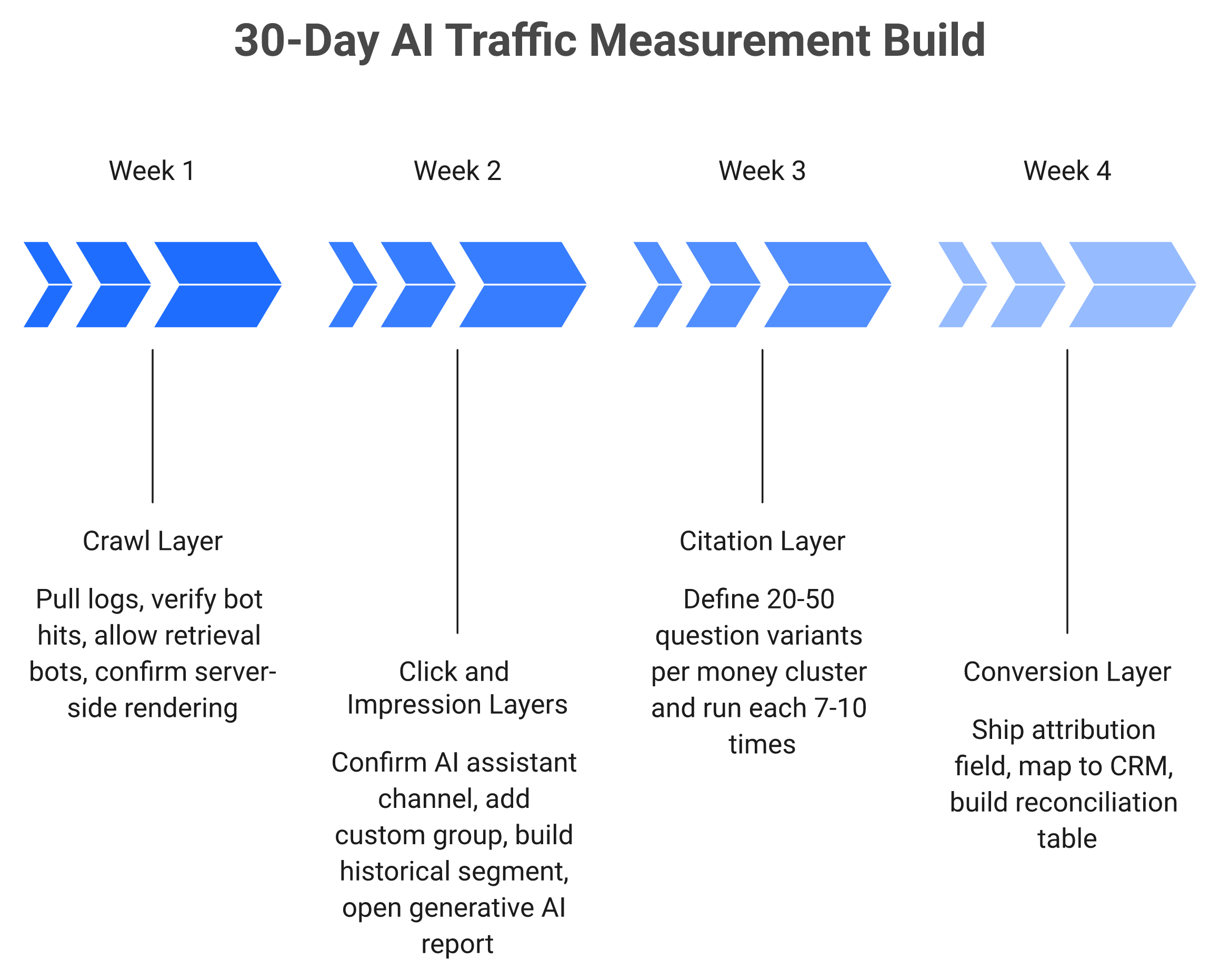
Week 1. Pull logs, verify bot hits by IP, fix robots.txt so retrieval bots are allowed, and confirm money pages render in server-side HTML.
Week 2. Confirm the GA4 AI Assistant channel, add the custom group above Referral, build the Explore segment, and open the Search Console generative AI report.
Week 3. Define 20 to 50 question variants per money cluster and run each 7 to 10 times, logged in and logged out.
Week 4. Ship the required attribution field, map it to the CRM, and build the reconciliation table.
Teams that want a shortcut on week three can start from our AEO keyword and question research method, then layer the sampling runs on top.
💬 What practitioners say about keeping this up
"Log analysis is underrated for small sites. I've been meaning to set up a crawler but keep getting pulled into content work instead."
— Practitioner comment, r/TechSEO Reddit Thread, September 29, 2026
"you get one shot at AI visibility. Do not blow it on fake Reddit reviews, junk listicles, and citation chasing."
— Ann Smarty, SEO consultant, quoted in r/localseo Reddit Thread, May 12, 2026
The first comment is the real risk. This report dies from neglect, not from complexity, so assign each row an owner and a recurring calendar slot. Our AEO implementation checklist exists for teams that keep losing that slot to content work.
⭐ The slide that actually moves budget
Put two numbers next to each other: GA4 AI sessions, and survey-reported AI influence on closed deals. Then say out loud which one you trust and why.
MaximusLabs AI's read is that the standard advice gets this backwards, because it hides the gap to look precise. We report it deliberately, since that delta is the clearest evidence that AEO is influencing pipeline before the click ever happens.
MaximusLabs AI delivers this reporting stack inside AEO engagements, with daily AI-visibility tracking and a citation-intelligence layer running alongside content production. Measurement and publishing move together, rather than a dashboard watching an empty pipeline. If you want that gap quantified for your own funnel, talk to our team.
Frequently asked questions
How do you track AI traffic in GA4 in 2026?
GA4 now does part of the job automatically. Its default channel group includes an AI Assistant channel that tags recognized assistant traffic with medium ai-assistant and campaign (ai-assistant), covering sources such as ChatGPT, Gemini, Copilot, DeepSeek, and Grok. The gaps still need manual work. Here is the order we use: • Open Reports, then Acquisition, then Traffic acquisition, and switch the dimension to Session default channel group. • Clone the default channel group and add one regex rule for engines GA4 does not yet recognize. • Move that rule above Referral, because rule order decides whether sessions land in your AI channel or get absorbed by Referral. • Build an Explore segment on session source, since channel groups are not retroactive. • Map demo requests, trials, and signups as key events, then break them down by the AI channel. One limit matters more than the setup: the AI Assistant channel excludes Google AI Overviews and AI Mode entirely. MaximusLabs AI ships this GA4 build inside the week-one technical sprint of client engagements, alongside schema and robots.txt work. If your property has never been audited for this, start with a technical SEO and website audit before trusting any number in the report.
Why does AI traffic show up as Direct or Branded Organic in analytics?
Because most people who read an AI recommendation never click the citation. They open a new tab, search your brand name on Google, or type your domain directly. GA4 records that as Branded Organic or Direct, and the ChatGPT origin disappears. Three mechanisms cause the undercount: • No-click answers. For most B2B questions, there is nothing clickable in the answer at all, so last-touch referral cannot capture the influence. • New-tab brand search. The AI recommendation converts into a branded Google query, which looks like organic performance you already owned. • Stripped referrers. AI apps and in-app browsers often omit the referrer header, pushing those sessions into Direct. How to spot it without new tooling: audit unexplained Direct spikes across a 90-day window and check the landing pages. Deep bottom-funnel pages sitting in Direct are rarely real direct traffic. Branded organic rising while non-brand stays flat is the second signature. MaximusLabs AI stopped using AI referral sessions as a headline client metric for this reason, and pairs the GA4 floor with citation sampling and self-reported attribution. The structural version of this problem is covered in our work on the decline in search referral traffic.
Why are server logs the only reliable way to track AI crawlers?
Because standalone AI crawlers do not execute JavaScript. OAI-SearchBot, PerplexityBot, and Claude-SearchBot fetch static HTML, so a JavaScript analytics tag never fires for them. A dashboard can show zero AI activity while tens of thousands of bot requests hit the same site that month. Only Googlebot and Bingbot render JavaScript reliably. That means a client-side React pricing page can look rich to a human and empty to the crawler deciding whether to cite you. The weekly workflow we run: • Pull raw Apache, Nginx, or CDN edge logs. • Filter by user agent, tracking training and retrieval bots separately. • Verify every hit against published IP ranges or reverse DNS, because a user agent string is a claim, not proof. • Group fetches by page type, since repeat hits on pricing and comparison URLs signal evaluation rather than indexing. • Report requests per bot, 404 rate per bot, and your own crawl-to-refer ratio. MaximusLabs AI audits raw logs and server-side rendering coverage before publishing any client content, because an unreadable page cannot be cited regardless of content volume. Start with a fast AI crawlability check, then move to full log analysis.
Does blocking GPTBot remove your site from ChatGPT search?
No. These are three different bots doing three different jobs, each controlled by its own robots.txt token. • GPTBot crawls content for model training. Blocking it excludes you from training data, and ChatGPT search still works. • OAI-SearchBot indexes pages for ChatGPT search citations. Blocking it removes you from ChatGPT search answers. • ChatGPT-User fetches a page when a person asks ChatGPT to read it. Blocking it stops users pulling your page into a live chat. Anthropic and Perplexity follow the same split, with ClaudeBot for training and Claude-SearchBot and PerplexityBot for retrieval. We keep finding audits where a team blocked all four in one commit, believing they had opted out of AI, then wondered why citation share collapsed. The safe configuration allows retrieval bots across the board and treats training as a separate business decision. Two timing details matter: robots.txt changes take roughly 24 hours to propagate through OpenAI and Perplexity pipelines, and user searches trigger re-crawls of the pages ChatGPT showed. MaximusLabs AI includes AI-crawler robots.txt configuration in every technical audit, before content ships. The full bot-by-bot breakdown sits in our guide to understanding and managing AI crawlers.
What does Search Console's generative AI performance report actually show?
It shows impressions, pages, countries, devices, and dates for your appearances in Google AI Overviews and AI Mode. It launched on June 3, 2026, and finished rolling out worldwide by August 31, 2026. What it does not show matters just as much: • No clicks or click-through rate for generative surfaces. • No queries, so there is no prompt-level visibility. • AI Overview clicks stay blended inside standard organic performance. Read it as a Google-side citation proxy, not a traffic report. The practical workflow is to export impressions by page, then join that against organic clicks for the same pages and period. Pages with rising AI impressions and flat clicks are your citation winners, so refresh them and tighten the schema. Falling impressions with stable rankings usually means a competitor replaced you inside the answer, which is a trust and sourcing problem rather than a keyword problem. MaximusLabs AI treats this report as the Google half of a citation scoreboard and prompt sampling as the ChatGPT, Perplexity, and Claude half. The optimization side of that work is detailed in our guide to Google AI Overviews optimization.
How many prompt runs do you need to measure Share of Answers accurately?
Seven to ten runs per prompt variant, split across logged-in and logged-out sessions. AI answers vary between runs, so visibility is a probability distribution rather than a rank. One run is a screenshot. Ten runs are a measurement. The protocol we use: • Build question clusters of 20 to 50 real buyer phrasings per topic, not keywords. • Run each variant 7 to 10 times, because fewer runs cannot separate signal from variance. • Split logged-in and logged-out sessions, since personalization changes retrieval. • Record two outcomes per run: was the brand named, and was your URL cited. • Report appearance frequency per cluster, for example named in 6 of 10 runs. Brand mention share and cited-URL share demand opposite fixes. If you are named but a review site owns the citation, the work moves off-site to G2, Capterra, Reddit, and listicles. If your page is cited but you are never recommended, that is a content and schema problem on your own page. MaximusLabs AI measures Share of Voice across thousands of question variants per client and separates those two metrics deliberately. Our wider metric set is documented in AEO measurement metrics.
How do you prove AI search traffic influenced pipeline and revenue?
Add a mandatory "How did you hear about us?" field at signup, demo request, or checkout, with AI assistants listed as explicit options. For high-consideration B2B purchases, self-reported attribution is the only method that captures influence across non-clickable answers and new-tab branded searches. The build is short: • Make the field required, not optional. Optional versions get skipped by the fastest-moving buyers, who are often the AI-influenced ones. • List engines by name: ChatGPT, Perplexity, Gemini, Claude, Copilot, Google search, G2 or Capterra, Reddit, plus an open text box. • Write the field to a CRM contact property so it travels with the deal. • Report responses at MQL, opportunity, and closed won, since AI influence often looks larger later in the funnel. • Reconcile monthly against your GA4 AI channel. That gap is your dark AI funnel, quantified. Benchmark your own funnel before quoting anyone else's multiple, because published AI-versus-organic conversion ratios range from under 1 time to more than 20 times. MaximusLabs AI starts every program at bottom-funnel content precisely because that traffic shows up in an attribution field, and we measure engagements on pipeline rather than mentions. The method sits in our GEO revenue attribution framework.