 Krishna Kaanth M
- Amazon AI shopping agents are three distinct surfaces: Alexa for Shopping, Buy for Me, and the AWS Agentic Shopping Assistant, not one chatbot.
- Rufus was retired in May 2026 and folded into Alexa for Shopping, so playbooks naming Rufus now reference an entity that no longer exists.
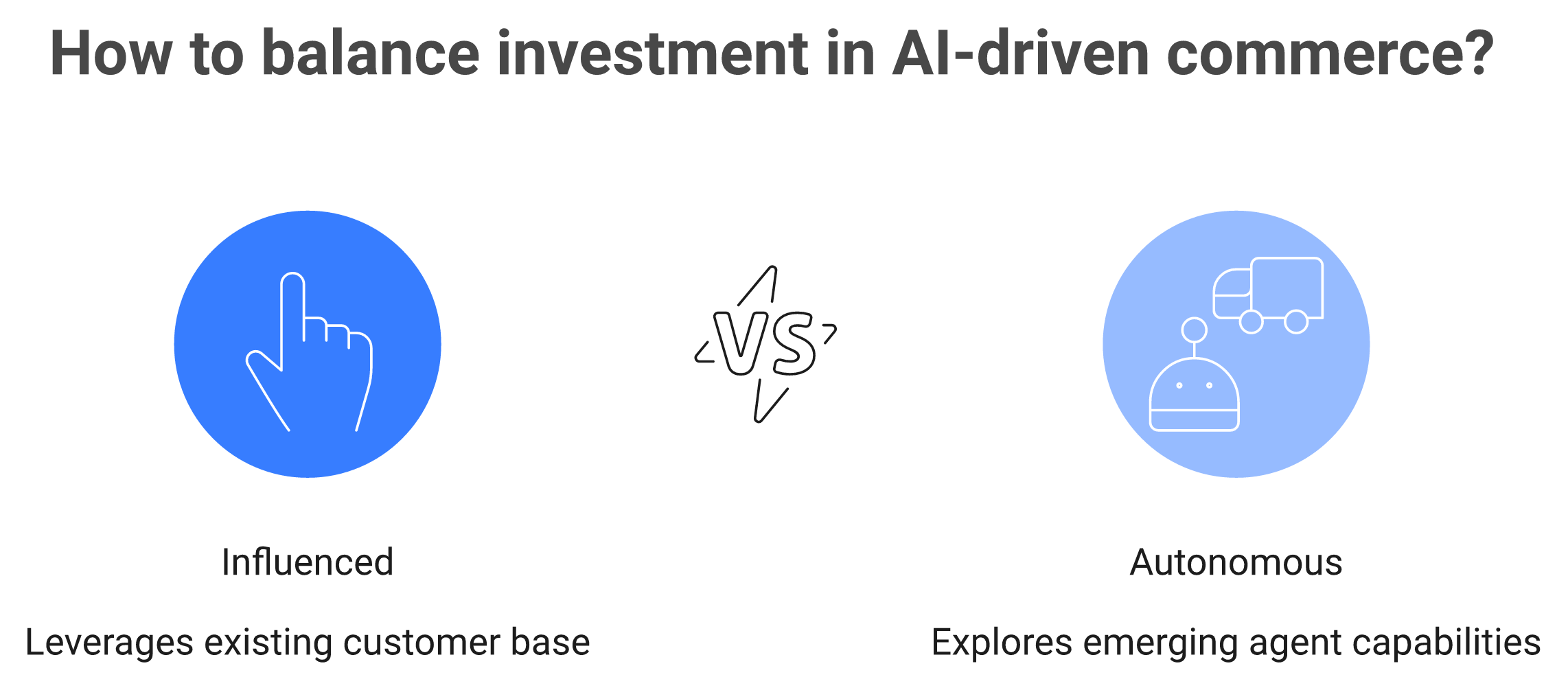
- The roughly $10 billion figure measures assistant-influenced sales, not autonomous agent purchases, so build for autonomy but forecast on influence.
- Agentic commerce is a binary eligibility gate: is_eligible_search and is_eligible_checkout decide inclusion before any relevance ranking happens.
- GPTBot, ClaudeBot, and PerplexityBot do not execute JavaScript, so asynchronously loaded reviews and dropdown facets stay invisible to retrieval.
- Amazon operates agents on other sites while litigating against Perplexity's Comet, confirming that agent access is permissioned rather than open.
Q1. What are Amazon's AI shopping agents, and why does the $200B headline matter to you?
Amazon AI shopping agents are three systems: Alexa for Shopping, the in-app assistant that replaced Rufus in May 2026; Buy for Me, which purchases from third-party brand sites; and the AWS Agentic Shopping Assistant, sold to rival retailers. Against $213.4 billion in Q4 2025 net sales, the assistant layer is now a revenue channel. The buyer evaluating you may never load your page.
The word most operators are still using is 14 months out of date
A Head of Organic Growth at a mid-market brand opened a deck last month labeled "Rufus optimization roadmap." Rufus does not exist anymore. Amazon folded it into Alexa for Shopping in May 2026.
That is not a naming quibble. It signals that the team's model of Amazon's agent stack froze sometime in 2025.
⚠️ Three products, not one assistant
Most coverage treats this as a single chatbot. It is three separate surfaces doing three separate jobs.
| Product | What it does | Who it serves |
| Alexa for Shopping | Answers questions, compares products, buys at set prices | Amazon shoppers |
| Buy for Me | Checks out on third-party brand websites | Shoppers wanting off-catalog items |
| AWS Agentic Shopping Assistant | Licensed agent tech for other retailers' storefronts | Competing merchants |
MaximusLabs AI runs optimization across Google, ChatGPT, Perplexity, Gemini, and Claude, and the Amazon stack now behaves like a fourth answer engine with a checkout attached.
💰 The numbers behind the headline
Andy Jassy gave the hard figures on the Q3 2025 earnings call. Rufus reached 250 million active customers that year.
Monthly users rose 140% year over year. Interactions rose 210%. Customers using the assistant were 60% more likely to complete a purchase, on track for over $10 billion in incremental annualized sales.
What actually changed for your brand
Here is the part that matters for a founder allocating budget. The shopper no longer scans ten results and forms an opinion.
The agent forms the opinion. Then it presents two or three options.
✅ The evaluation set is the new page one
There is a founder observation I keep returning to. When someone asks an engine for the best option, the engine names five to ten. That list is the entire consideration set.
Amazon just made that dynamic literal for physical goods. Your product is either inside the set the agent evaluates, or it is not evaluated at all.
MaximusLabs AI has treated agentic commerce optimization as a stated mission since founding, not as a service line bolted onto a 2019 keyword checklist.
🎯 The question worth asking your team
One practitioner described the shift plainly. People stopped wanting ten blue links, and stopped wanting to read articles at all. They just want the thing done for them.
So the operator question is not "where do we rank on Amazon." It is sharper than that. How does Amazon's agentic infrastructure capture the transaction while your interface-first store sits outside the machine's evaluation set?
Ranking is not the unit of visibility anymore. Being the transactable answer is.
MaximusLabs AI's read is that most 2026 SEO budgets are still funding the interface a buyer will never open, and the correction starts with knowing which of these three Amazon surfaces already touches your category.
Q2. Is Rufus still available, and why did Amazon turn its search box into an answer engine?
No. Amazon retired Rufus in May 2026, merging it with Alexa+ into Alexa for Shopping across web, app, and Echo Show. The bigger change is structural. Chat now sits inside Amazon search results, with side-by-side comparison and price-triggered purchases. Amazon did to its own product pages what AI Overviews did to publisher click-through. It compressed the journey into one answer.
Everyone optimized for a product that no longer has a name
For roughly eighteen months, brand teams built playbooks around Rufus. Agencies sold Rufus audits. Sellers rewrote bullet points for Rufus.
Then Amazon retired the brand and absorbed the capability. The playbooks did not become wrong. They became unfindable, because the entity they name stopped existing.
⏰ What replaced it, side by side
| Dimension | Rufus (2024 to May 2026) | Alexa for Shopping (May 2026 onward) |
| Status | Retired | Current |
| Placement | Separate assistant panel | Chat embedded in search results |
| Actions | Answers, recommends | Compares, auto-buys at set price, builds carts |
| Surfaces | Amazon app | Web, app, Echo Show |
| Personalization | Session-level | Draws on shopping history |
MaximusLabs AI tracks share of voice across thousands of query variants rather than single rankings, and entity migrations like this one are exactly why a single tracked keyword tells you almost nothing.
The real story is the interface, not the rename
Here is the complication most coverage missed. Amazon did not just rename an assistant. It put a conversational layer in front of its own catalog.
Google's AI Overviews compressed publisher traffic by answering above the links. Amazon has now done the same thing to its product detail pages.
📊 The snippet is the new rank
A phrase from a practitioner brief sticks with me here. The snippet is the new rank.
Inside an answer surface, there is no position two. There is the answer, and there is everything the shopper never sees.
That is the same structural bet behind writing for extraction. MaximusLabs AI builds every section around a 40 to 80 word standalone answer block, because extraction, not scrolling, is how the content gets used.
✅ What to do this week
The fix is unglamorous and takes an afternoon. Run a find-and-replace audit across three places.
- Your published content library, for every mention of Rufus
- Your product feeds and marketplace collateral, for stale assistant references
- Your sales decks and onboarding docs, where old terminology quietly persists
Add a dated update note when you change a page. Answer engines weigh freshness, and a dated correction gives them a reason to cite your version instead of a competitor's stale one.
I might be reading the timing too strongly, but MaximusLabs AI's data points toward entity accuracy mattering more than volume right now. A brand describing a product that no longer exists reads as unmaintained to a retrieval system.
MaximusLabs AI's position is that "become the answer" is not a slogan but an operational target, and step one is making sure the entities in your content still exist in the world the model is reading.
Q3. How does Buy for Me work, and what is the Ghost Kitchen model of commerce?
Buy for Me lets Amazon's agent complete checkout on a third-party brand's own site. The shopper searches in the Amazon app, taps Buy for Me, and confirms details. Amazon's agent, running on Bedrock with Amazon Nova and Anthropic Claude, injects encrypted payment and address data on the brand's site. The brand handles fulfilment and returns, and never meets the buyer.
Your website is the dining room
Most brands still budget as though the website is the destination. It is beautifully designed. It converts well for humans who arrive.
Buy for Me breaks that assumption in a specific way. The agent visits your site, but your customer does not.
🚀 The five steps, exactly
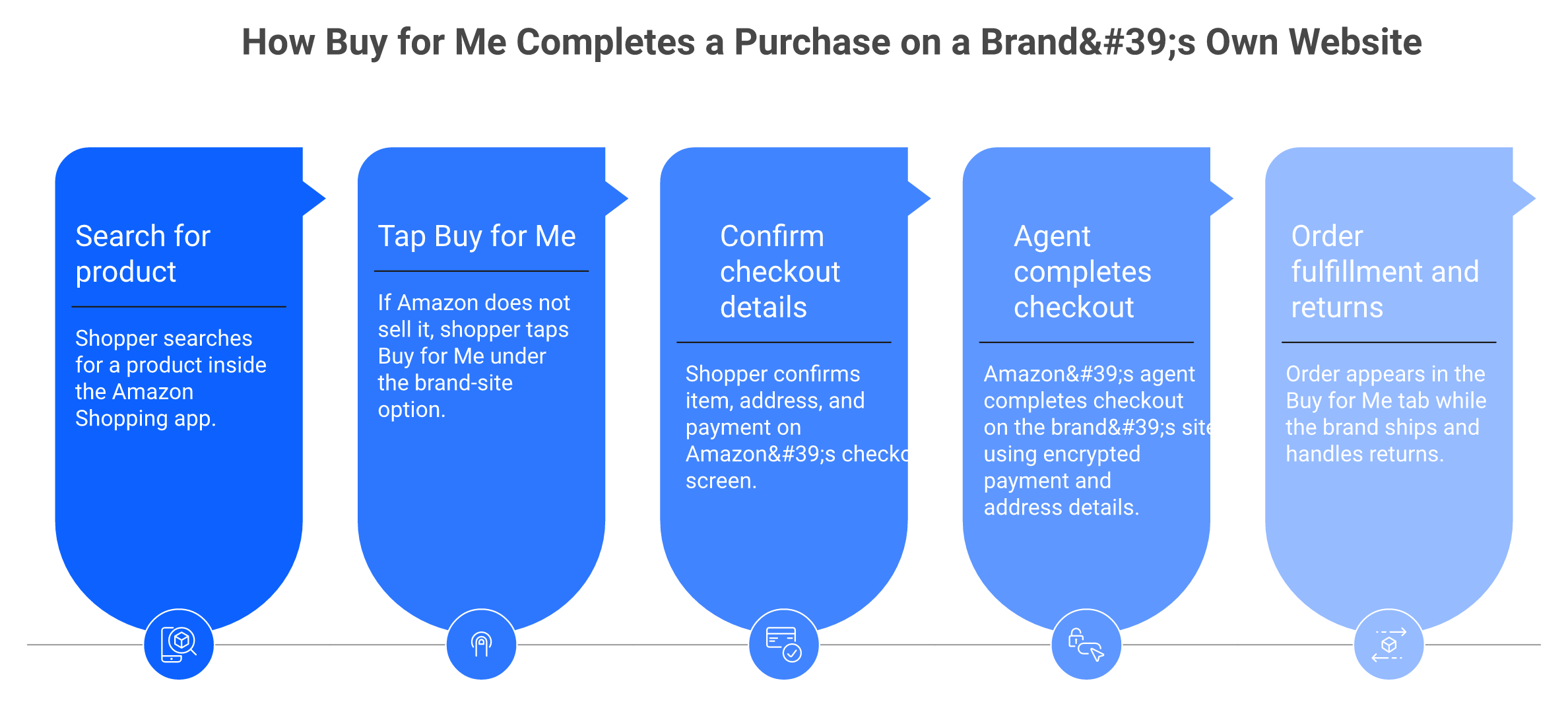
- Search for a product inside the Amazon Shopping app.
- If Amazon does not sell it, tap Buy for Me under the brand-site option.
- Confirm the item, address, and payment on Amazon's checkout screen.
- Amazon's agent completes checkout on the brand's site using encrypted details.
- Track the order in the Buy for Me tab, while the brand ships and handles returns.
Amazon confirmed it takes no commission on these purchases at launch. That detail matters, because it means Amazon is buying behavioral data and habit, not margin.
🍳 The Ghost Kitchen framework
Think of it the way delivery apps restructured restaurants. Your website is the dining room. Your structured data feed is the kitchen.
The AI agent is the delivery driver. It only needs the kitchen to fulfil the order, for a customer who never enters the building.
MaximusLabs AI designs content and schema for machine retrieval first, using hub pages of 5,000 to 8,000 words and tactical spokes of 2,500 to 4,000, built so an agent can lift a specific answer without touring the homepage.
What the machine actually receives
There is a useful way to picture what the model does with a shopper's request. Treat the LLM as a translator, not a search engine.
It takes a messy, roughly 25-word prompt and converts it into a structured request against your data. Nothing about that process requires your layout, your hero image, or your brand video.
⚠️ Where the budget should move
This is where I would push back on standard advice. Teams keep funding the dining room because that is what stakeholders can see in a review meeting.
The kitchen is invisible internally and decisive externally. Feed completeness, attribute accuracy, and machine-readable specs are the things the agent actually consumes.
MaximusLabs AI's read is that the standard advice gets this backwards, because a redesign improves the experience of visitors you are structurally losing, while feed work reaches the buyer who never visits.
MaximusLabs AI skips top-of-funnel volume plays and starts at bottom-of-funnel, ICP-aligned pages for exactly this reason: when the agent does the browsing, only the pages that answer a purchase-stage question earn a citation.
Q4. Does the $200B number prove agents are buying, or just assisting?
Mostly assisting. Amazon's roughly $10 billion figure measures assistant-influenced sales, and the 60% purchase-completion lift is a correlation stated on an earnings call, not a controlled test. Fully autonomous buying through Buy for Me remains a limited US beta across a small set of brand stores, with no commission taken. The direction is certain. The current volume is smaller than the headline implies.
Read the sentence Jassy actually said
Precision matters when a number is about to enter your board deck. Jassy said customers using Rufus are 60% more likely to complete a purchase.
That is a comparison between two self-selected groups. Shoppers who engage an assistant are often already closer to buying.
❌ What the number is not
It is not a controlled experiment. It is not evidence that the agent caused the purchase.
It is also not autonomous transaction volume. The $10 billion figure tracks sales influenced by an assistant, with a human still clicking buy.
💸 The autonomy layer is genuinely small
Buy for Me launched as a beta for a subset of US customers across a limited number of brand stores. Amazon took no commission on it.
A company does not leave commission on the table at scale. It does that while it is still learning whether the mechanism works.
Why the honest read is the useful read
Here is the practical risk. A VP Marketing reads "$200 billion" and "AI agents" in one headline, then funds a twelve-month agentic commerce program.
Six months later, the CFO asks which line of revenue moved. Nothing has, because the autonomy layer was never large enough to move it yet.
⭐ Build for autonomy, forecast on influence
The split is straightforward. Build now for the world where agents transact, because feed and schema work compounds slowly.
Forecast on the influenced number, because that is the traffic that exists today. Those are two different slides, and they should never be the same slide.
I want to be careful here rather than confident. The trajectory looks clear to me, but I would not bet a quarterly target on autonomous agent revenue in 2026.
MaximusLabs AI reports on pipeline influence rather than headline visibility numbers, because a metric nobody can attribute to revenue is a metric the CFO eventually deletes.
Q5. Why is agentic commerce a binary eligibility gate instead of a ranking?
Agents resolve eligibility before they rank anything. OpenAI's Agentic Commerce Protocol feed requires is_eligible_search for discovery and is_eligible_checkout for transaction, and the second cannot be true unless the first is. Google's Universal Commerce Protocol applies comparable gating for AI Mode and Gemini. If the boolean is false, no prompt phrasing, no content volume, and no ad budget puts you in the set.
Marketers still think in positions
Ask a growth team where they stand on a keyword and you get a number. Position four. Position eleven. Improving.
That vocabulary assumes a list exists. Inside an agentic checkout flow, there is no list to be positioned in.
⚠️ Two booleans decide everything before ranking starts
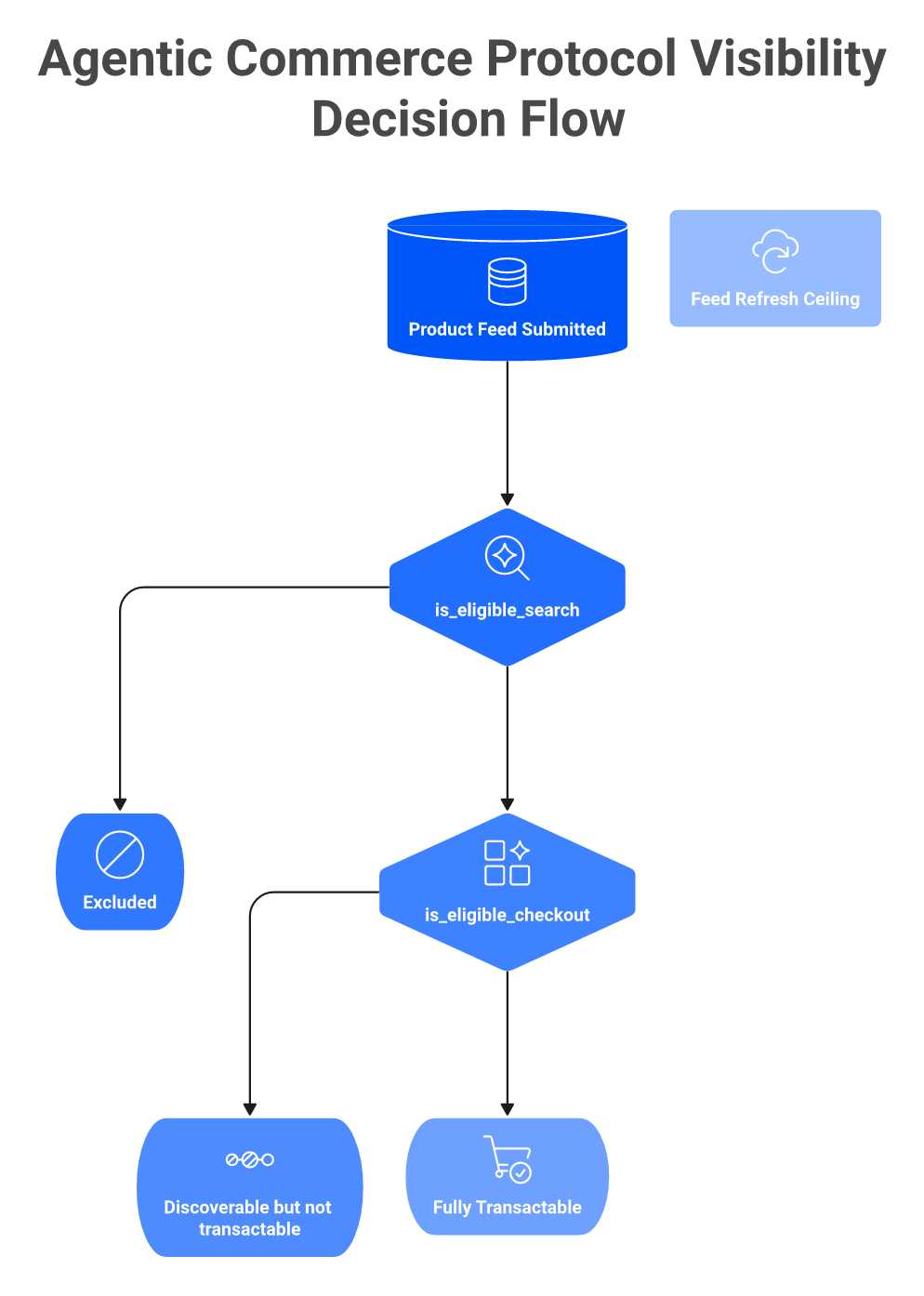
A boolean is a simple true or false switch in a data file. OpenAI's product feed spec uses two of them.
- is_eligible_search: controls whether the product can appear in ChatGPT shopping results at all
- is_eligible_checkout: controls whether an agent can complete the purchase, and it only works if the first flag is true
Failing either flag is not a ranking penalty. It is exclusion from the evaluation set, before any relevance scoring runs.
MaximusLabs AI treats generative engine optimization as a data science problem rather than an SEO add-on, so our audits open at machine eligibility instead of keyword position.
❌ What failure actually looks like
The practitioner Ethan Smith described trying to buy snowboard pants through Gemini, asking for end-to-end checkout. It did not work. The agent cycled through a couple of loops and stopped.
No error message told him whose fault it was. From the merchant's side, that failure is silent and permanent.
Feed staleness is a daily risk, not a quarterly one
Here is the part that changes your operating cadence. OpenAI's system accepts feed updates as often as every 15 minutes.
That refresh rate exists because prices, stock, and availability move constantly. A feed that is accurate on Monday can be misleading by Wednesday afternoon.
⏰ Stale data breaks the transaction, not just the impression
Traditional SEO tolerated lag. A slightly outdated meta description cost you nothing measurable.
Agentic commerce does not tolerate it. If your feed says in stock and your site says sold out, the checkout attempt fails and the agent learns to route elsewhere.
The category term for this discipline is feed hygiene, meaning the ongoing accuracy of the machine-readable catalog you publish. It is closer to inventory management than to content marketing.
✅ The check to run before your next article brief
There is a founder principle I keep applying to commerce. Either you are in the AI's answer, or you do not exist.
Rank became a boolean, quite literally. So the sequence matters.
- Pull your product feed and confirm is_eligible_search is true across your revenue-driving SKUs.
- Confirm is_eligible_checkout is true wherever you actually want agent-completed purchases.
- Check your refresh interval against the 15-minute ceiling the spec allows.
- Only then commission the next content piece.
I would rather a client spend a week on step one than a quarter on step four. MaximusLabs AI's read is that the standard advice gets this backwards, because publishing volume into a feed the agent cannot transact against is spend with no path to revenue.
MaximusLabs AI starts client engagements with a technical audit in week one, before any content ships, because eligibility gates decide whether the content ever gets a chance to matter.
Q6. How do you make your brand machine-verifiable so agents cannot swap or hallucinate you?
Two moves. First, numeric accuracy. Amazon's patent US12353469B1 converts questions into structured queries and validates answers against ground-truth documents, so a price or spec that drifts from source data can lose its citation. Second, identity. Close the sameAs loop so a crawler can traverse website, Wikidata, LinkedIn, Crunchbase, G2, and back, forming a verifiable entity graph.
Verification now happens in two separate layers
Most teams treat accuracy as an editorial nicety. In an agentic pipeline, it is an eligibility condition.
The two layers are independent. You can have perfect numbers and an unresolvable identity, or a clean entity graph and drifting prices. Both fail.
📊 What the Amazon patent actually does
Amazon Technologies was granted US12353469B1, "Verification and citation for language model outputs," filed June 2024 and granted July 2025. The mechanics are specific.
The system converts a question into a structured query language request. It compares embeddings against a knowledge base of documents, ranks them for relevance, and identifies the source document behind the answer.
The practical consequence is blunt. If your stated statistic does not appear correctly in a verifiable source, the system has a mechanism to attribute elsewhere.
MaximusLabs AI reads patents directly rather than blog summaries of patents, keeping a locked source hierarchy of academic papers, then patents, then official documentation, then first-party datasets.
⚠️ The Oxford hallucination
A builder shared a moment worth sitting with. Perplexity summarized his team's article and described them as Oxford researchers.
Nobody on the team attended Oxford. The model had assembled an identity from web-wide mentions, not from the About page.
That is the lesson. Consensus across the web outweighs self-description on your own domain.
Closing the sameAs loop
The sameAs property is a Schema.org property that links your entity to other authoritative profiles of the same entity. Used properly, it forms a closed circuit.
The target traversal is website to Wikidata to LinkedIn to Crunchbase to G2 and back to website. Each hop confirms the others.
✅ The contested part, stated honestly
Practitioners disagree here, and pretending otherwise would be dishonest. SALT.agency argues schema is a hygiene factor at best, not a differentiator. Surfer Academy argues it increases your odds significantly by telling AI exactly what your product is.
My own view sits between them. Schema alone wins nothing, but a broken entity graph reliably loses things, so the downside is asymmetric.
MaximusLabs AI's data points toward identity resolution mattering more for smaller brands than large ones, though I might be reading that too strongly given the sample we work with.
💰 What to do with your Monday
Start with the numbers, not the markup. Pull your top revenue pages and reconcile every statistic against its named primary source.
Then build the loop. Add sameAs in the initial HTML, and confirm each linked profile points back.
MaximusLabs AI enforces zero vague attributions across every article, tracing each claim to a named paper, patent, or dataset, because unverifiable numbers now get actively reassigned to whoever states them correctly.
Q7. Can a shopping agent actually read your product page?
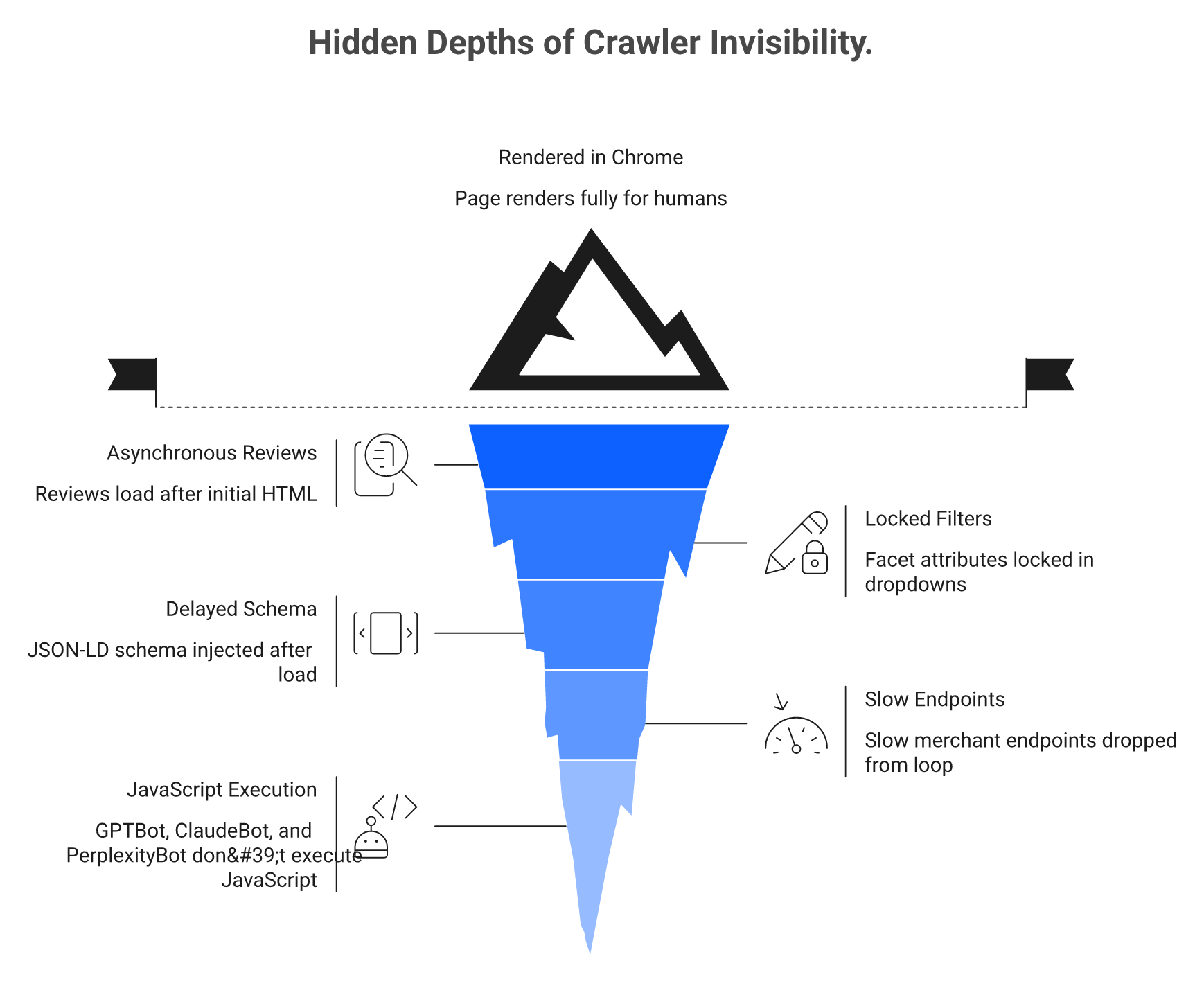
Often not. As of mid-2026, GPTBot, ClaudeBot, and PerplexityBot do not execute JavaScript. Reviews loaded asynchronously and attributes buried behind JavaScript facets, including closure, fabric, material, and neck style, stay invisible to retrieval. Agents do not click dropdown filters. Surface facet metadata in text headers and FAQ copy, and keep response times inside the agent's latency budget.
The page looks complete, to humans
A product page renders beautifully in Chrome. Specs load. Reviews populate. Everything a buyer needs is there.
Then a crawler that cannot run JavaScript requests the same URL and receives a near-empty shell.
❌ The test that exposes it in thirty seconds
Disable JavaScript in your browser and reload the page. Whatever vanishes is what the machine never sees.
One practitioner ran exactly this on a major retailer and watched most of the page disappear. Reviews were loaded asynchronously, meaning after the initial HTML arrived, so they were absent from what a crawler receives.
Reviews are your highest-value purchase signal. Hiding them from the systems grounding a shopping answer is an expensive accident.
MaximusLabs AI's technical audits require critical content to render in server HTML and GPTBot and oi-searchbot to be unblocked in robots.txt.
⚠️ Facets are the second blind spot
A facet is a filter attribute, like material or neck style, usually sitting inside a dropdown. Shoppers click those filters. Agents do not.
That metadata is often the most purchase-relevant data you own. It is also the data most reliably locked behind an interaction the machine will never perform.
Pull the hidden data into text
The fix is structural, not clever. Move facet attributes into visible text where retrieval can reach them.
- Put key attributes in H3 or H4 headings on the product page
- Restate specifications in plain FAQ copy inside the initial HTML
- Place JSON-LD schema in the server HTML, never injected after load
- Use server-side rendering or static generation for any page that needs AI citation
⏰ Speed matters, but not the way you think
Microsoft's Web IQ pipeline, which feeds agentic systems, benchmarks at 164ms p95, roughly 2.5 times faster than the nearest alternative. That is the tempo the inference loop runs at.
Slow merchant endpoints get dropped from that loop. Not penalized. Dropped.
This is where I will take an unpopular position. A veteran practitioner put it plainly, saying that in 15 years he had never seen Core Web Vitals drive a traffic increase.
MaximusLabs AI's read is that the category has this backwards, because extractability determines whether content exists to the machine, while performance scores optimize an experience the agent never has.
✅ Where the money should go
Founders have finite cash sitting in inventory and ad spend. A rendering fix costs a sprint of engineering time.
A site redesign costs a quarter and improves an interface a shrinking share of buyers will open. MaximusLabs AI runs the technical sprint in week one of an engagement for that reason, ahead of any content production.
Q8. Why is Amazon both an agent operator and an agent gatekeeper?
Amazon ships an agent that shops other companies' websites while suing to stop Perplexity's Comet from shopping its own. Amazon alleged Comet disguised itself as Google Chrome and failed to identify as an agent. A preliminary injunction issued March 9 to 10, 2026 was stayed by the Ninth Circuit on March 16 to 17, with the CFAA question argued in June 2026. Agent access is permissioned, not open.
The asymmetry nobody puts in one article
Product coverage and litigation coverage live in separate publications. Read them together and the strategy becomes obvious.
Buy for Me sends Amazon's agent onto third-party brand sites to complete purchases. At the same time, Amazon went to federal court to stop another company's agent from doing something structurally similar on Amazon.
⚖️ The dated record
| Date | Event |
| Nov 4, 2025 | Amazon sues Perplexity in N.D. Cal., alleging CFAA violations |
| Mar 9 to 10, 2026 | Judge Maxine Chesney grants preliminary injunction against Comet |
| Mar 16 to 17, 2026 | Ninth Circuit stays the injunction, Comet resumes |
| Jun 2026 | Appeals court hears argument on the CFAA question |
The court's framing is the interesting part. It found Comet accessed accounts with the user's permission, but without authorization from Amazon.
⚠️ Identification, not capability, was the complaint
Amazon's core allegation was not that an agent shopped. It was that the agent did not say it was an agent, and presented itself as Google Chrome.
That distinction turns agent identity into a technical requirement rather than an etiquette question. Protocols are forming around exactly this.
What this means for your own properties
Every brand now sits on both sides of this. You want helpful agents reaching your catalog. You do not want unidentified automation scraping your pricing or corrupting your analytics.
There is a founder worry I share here. AI can read your content, answer the question, and route the transaction to whoever pays it, while you absorb the cost of producing the answer.
✅ Write the policy before someone writes it for you
Amazon had a position ready when it needed one. Most brands do not, and end up reacting to whatever crawler shows up.
The artifacts are simple and take an afternoon.
- Decide which agents you permit for discovery, and which for transaction.
- Encode it in robots.txt, with named user agents rather than blanket rules.
- Publish an llms.txt file stating your terms for AI systems in plain language.
- Configure bot management to require agent identification, and log what arrives.
- Review the log monthly, because the population of agents changes fast.
Keep discovery crawlers open unless you have a specific reason to close them. Blocking GPTBot to punish scraping also removes you from ChatGPT's citations, and that trade is rarely worth it.
MaximusLabs AI treats agent-access policy as strategy rather than housekeeping, because which crawlers you welcome now carries a litigation record and a direct line to revenue.
Q9. What happens to paid media when the buyer never sees your ad?
Paid media loses leverage when an agent evaluates the catalog instead of a person. Amazon argued that AI-generated traffic distorts advertising measurement and must be filtered before advertisers are charged, while booking $21.3 billion in Q4 2025 ad revenue. Visibility inside an evaluation set is earned through accurate structured data, not impressions the machine never renders.
The budget reflex is still paid-first
Growth targets slip, and the meeting reaches the same conclusion. Raise the ad budget.
That reflex worked when a human saw the ad, formed an impression, and clicked. The mechanism assumed a pair of eyes at the end of the chain.
❌ Agents do not render your creative
An agent evaluating a catalog reads structured product data. It does not view a display unit or notice a sponsored placement the way a shopper does.
Amazon made this argument itself in court, saying agent traffic caused problems for its advertising business and needed filtering before advertisers were billed. When the platform selling the ads raises the measurement problem, the problem is real.
The uncomfortable version is simple. You can spend heavily and still be invisible to the system making the recommendation.
MaximusLabs AI coined RAEO and R-GEO, revenue-focused answer and generative engine optimization, because impression dashboards never survived a CFO's second question.
💰 Data beats spend inside the evaluation set
A practitioner framed it bluntly. Visibility gets earned through the data, not the ads, and you can pay hundreds of thousands for advertising and still sell less than a brand with a clean feed.
That is not an argument against paid media. It is an argument about sequence, because feed accuracy gates whether spend can convert at all.
The traffic that does arrive behaves differently
Here is the part that reframes the budget conversation. Practitioner data points to roughly a 6x conversion rate gap between traffic referred by language models and traffic from traditional Google search.
The reason is structural. The buyer already asked their questions, already got a recommendation, and arrives pre-sold.
⚠️ What to change in your reporting
Impressions are the first metric agent traffic invalidates. If part of your impression volume comes from automation, the denominator is fiction.
Move the reporting to three things instead.
- Revenue influenced by AI-referred sessions, segmented from organic
- Citation presence across ChatGPT, Perplexity, and Gemini for purchase-stage queries
- Feed accuracy rate, measured as the share of SKUs an agent can transact against
MaximusLabs AI measures visibility as share of voice across thousands of question variants rather than single rankings, since an answer surface has no position two to report on.
✅ The honest limit of this argument
I would not tell a founder to cut paid media this quarter. Ads still reach humans, and humans still buy.
The claim is narrower. MaximusLabs AI's read is that the standard advice gets the order backwards, because spending against a catalog agents cannot parse funds reach you cannot convert.
MaximusLabs AI reports on pipeline rather than impressions across every engagement, which is why our first deliverable is usually a technical audit, not a campaign.
Q10. Why does Amazon selling its agent to rival retailers change your distribution map?
On May 27, 2026, AWS launched the Agentic Shopping Assistant, packaging the technology behind Alexa for Shopping for outside retailers to deploy in roughly 60 days. The same layer that drove close to $12 billion in incremental Amazon sales now sits between shoppers and merchants Amazon does not own. Agent-mediated discovery will increasingly happen on properties you neither control nor measure.
This is infrastructure, not a feature launch
Trade press covered ASA as a product release. Read it as a distribution decision instead.
Amazon took the reasoning layer behind its own assistant and made it purchasable through AWS Marketplace. Kate Spade deployed it as a gift concierge.
⭐ What is actually in the box
ASA packages the architecture, starter code, and guidance behind Alexa for Shopping into a deployable foundation. The components are named.
| Layer | Component |
| Model hosting | Amazon Bedrock |
| Agent runtime | AgentCore |
| Retrieval | OpenSearch |
| Reasoning | Conversational layer from Alexa for Shopping |
Retailers can stand this up in about 60 days. That is a quarter, not a roadmap.
MaximusLabs AI runs Search Everywhere Optimization across G2, Capterra, Gartner Peer Insights, Reddit, and LinkedIn, which matters more once the assistant layer is standardized across storefronts you do not own.
🚀 Why AWS margin explains the move
Amazon has run this playbook before. Build internal infrastructure, prove it at scale, then sell it to everyone including competitors.
The difference here is what sits in the middle. This time the infrastructure sits between a shopper and a purchase decision, which is a more valuable position than compute.
What changes on your distribution map
Your assumption has probably been that agentic discovery happens on Amazon, ChatGPT, or Google. Add every mid-sized retailer running ASA to that list.
Each of those assistants reads structured catalog data and third-party signals. Your website is not the input.
💸 Where to spend the next content dollar
There is a founder thesis I keep returning to. The entity graph gets built off your domain, not on it.
When the agent layer is licensed everywhere, third-party surfaces become your storefront. So the priority order shifts.
- Structured product feeds, complete and current across every channel
- Review depth on G2, Capterra, and category-relevant platforms
- Community and practitioner mentions where consensus forms
- Owned content last, and only bottom-of-funnel
MaximusLabs AI skips top-of-funnel content deliberately, because AI engines already answer "what is X" questions and the citation value sits at the purchase-stage queries.
MaximusLabs AI treats off-page presence as core scope rather than an add-on, targeting 10 or more reviews per platform, since an assistant built on someone else's storefront still forms its view of you from public signals.
Q11. What are the risks when an agent auto-buys health and OTC products?
Alexa for Shopping can auto-buy items at a set price and convert handwritten lists into carts. Applied to OTC medicines, supplements, and medical supplies, that introduces substitution and dosage risk no general retail agent was designed for. Buy for Me compounds it, since purchases route to third-party sites where the brand, not Amazon, owns returns and customer service.
Convenience features meet a regulated category
Price-triggered buying is a sensible feature for a phone case. The agent waits, the price drops, the order goes through.
Now apply the same logic to a supplement, an OTC pain reliever, or a diabetic testing supply. The mechanism does not change, but the consequence of getting it wrong does.
⚠️ Three failure modes worth naming
Substitution is the first. If the exact SKU is unavailable, an agent optimizing for intent may select a close match with a different active ingredient or strength.
Dosage ambiguity is the second. Product titles in health categories often bury strength and count in unstructured text a retrieval system can misread.
Accountability is the third. Buy for Me sends the order to the brand's own site, where the brand handles fulfilment and returns, and Amazon does not see the order.
✅ Feed fields become a safety control
For health brands, this stops being a marketing task. The structured feed is where ambiguity gets removed.
- GTIN and exact-match identifiers on every SKU, with no shared identifiers across strengths
- Active ingredient, strength, and unit count as discrete fields, never buried in the title
- Pack size and dosage form stated explicitly, not implied by imagery
- Clear substitution rules, including SKUs that must never be auto-substituted
MaximusLabs AI embeds E-E-A-T signals at every layer and cites every claim to a named source, a discipline that costs little in consumer categories and prevents real harm in regulated ones.
The trust transfer runs both ways
Here is the founder framing that applies with unusual force here. When an AI recommends you, it stakes its own credibility on your accuracy.
That transfer is a gift in software categories. In health categories, it raises the accuracy bar sharply, because the platform is now exposed to your data quality.
⏰ What a health brand should do this month
Pull your ten highest-volume SKUs and read them the way a machine would. Strip the images and the layout.
If strength, count, and form are not unambiguous in plain text, fix that before anything else. MaximusLabs AI's data points toward identifier hygiene being the highest-leverage fix in regulated categories, though our sample there is smaller than in SaaS, so I hold that view loosely.
MaximusLabs AI builds trust-first content for exactly this reason, because in a category where an agent can complete a purchase unsupervised, accuracy is not an editorial preference but a safety control.
Q12. What should you fund first, and who should build your agent readiness?
Sequence it: feed eligibility booleans, then numeric accuracy against primary sources, then facet and review extractability in raw HTML, then the sameAs entity loop, then third-party review depth. Technical gates come before content volume, because no publishing cadence rescues a catalog an agent cannot parse. Most of this ships in weeks, not the nine-month roadmap an engineering team will quote.
The 30-day order of operations
Every step here has appeared earlier in this article. The value is in the sequence, not the novelty.
| Week | Work | Why it comes first |
| 1 | Verify is_eligible_search and is_eligible_checkout | Nothing else matters if you are outside the set |
| 2 | Reconcile every number on top pages to its source | Drifting figures lose citations |
| 3 | Move facets and reviews into server HTML | AI crawlers do not run JavaScript |
| 4 | Close the sameAs loop, then build review depth | Consensus resolves identity |
MaximusLabs AI runs the technical audit in week one of an engagement and can have the first article live by day four, because the gates and the content work on different clocks.
⏰ The velocity gap is the real problem
An agency founder described the pattern precisely. Work that could be built in weeks or days gets quoted at nine months once it reaches the engineering roadmap.
Agent infrastructure does not wait for your quarter. Amazon shipped an entity rename, a licensed retailer product, and a litigated access policy inside eighteen months.
💰 Focus beats coverage
There is a distribution rule worth applying here. Roughly 19 out of 20 landing pages drive about 85% of traffic, so fix the 19 before touching anything else.
Gartner projects organic search traffic will fall 50% or more by 2028 as consumers shift to AI answers. Spreading a finite budget across a full site to hedge that shift is how teams end up with neither.
Who should own the work
Four honest options exist. Costs below are MaximusLabs AI's own published benchmarks, not third-party research.
| Option | Monthly | Per piece | GEO depth |
| MaximusLabs AI | From $899 | ~$60 | Deep, GEO-native |
| In-house team | ~$20,000 | ~$800 | Depends on hire |
| Traditional agency | ~$6,500 | ~$260 | Surface-level |
| Freelancers | ~$2,500 | ~$100 | Rarely |
✅ Traditional agencies bring real technical SEO discipline. ✅ They handle Google well. ❌ Most still optimize a website only, missing the third-party surfaces agents read. ✅ Other GEO specialists understand the category. ❌ Few operationalize trust-first or revenue-focused methodology, or bring the founder's actual perspective into the content.
⭐ What the proof looks like
MaximusLabs AI worked with Oliv AI to reach a 64% citation rate across AI platforms in six months, against 10-year-old billion-dollar competitors sitting near 30%. See the Oliv AI case study for the full breakdown.
I will name the limit on that. It is our own first-party measurement, one client, one category, and I would not present it as an industry benchmark.
MaximusLabs AI produces 15 to 50 GEO pieces monthly from $899, at roughly $60 per piece against $800 in-house, with unlimited revisions and a two-day onboarding.
What I am sitting with
My open question is whether early trust compounds or evaporates. One view says early movers build a durable moat as models learn who to cite. The other says rank in search is a false concept, and authority can displace an incumbent the moment priors update.
I lean toward compounding, but not confidently. If you are testing either side of that with real data, I would genuinely like to compare notes: krishna@maximuslabs.ai
Frequently asked questions
What exactly are Amazon AI shopping agents in 2026?
Amazon AI shopping agents are three separate systems, not a single chatbot. Most coverage collapses them into one product, which is why so many brand teams optimize for the wrong surface. Alexa for Shopping : the in-app and web assistant that replaced Rufus in May 2026, answering questions, comparing products, and buying at set prices Buy for Me : an agent that completes checkout on third-party brand websites when Amazon does not stock the item AWS Agentic Shopping Assistant : the licensed agent technology other retailers deploy on their own storefronts Against $213.4 billion in Q4 2025 net sales, this assistant layer functions as a revenue channel rather than a feature. The practical consequence for a brand is that the buyer evaluating you may never load your page at all. MaximusLabs AI treats the Amazon stack as a fourth answer engine with a checkout attached, alongside Google, ChatGPT, Perplexity, Gemini, and Claude. That framing changes what gets funded first, because the agent reads structured data rather than layout. We start every engagement by identifying which of these three surfaces already touches a client's category, then work through agentic commerce readiness before any content ships.
Is Rufus still available, or has Amazon replaced it?
Rufus no longer exists as a named product. Amazon retired it in May 2026 and merged it with Alexa+ into Alexa for Shopping, now available across web, app, and Echo Show. The rename matters less than the structural change underneath it. Chat now sits inside Amazon search results rather than in a separate assistant panel, with side-by-side comparison, cart building, and price-triggered purchases. Personalization also shifted from session-level to drawing on full shopping history. For roughly eighteen months, agencies sold Rufus audits and sellers rewrote bullet points for Rufus. Those playbooks did not become wrong so much as unfindable, because the entity they name stopped existing in the world a retrieval system reads. The fix takes an afternoon: Run a find-and-replace across your published content library for every mention of Rufus Update product feeds and marketplace collateral carrying stale assistant references Correct sales decks and onboarding docs where old terminology quietly persists Add a dated update note, since answer engines weigh freshness MaximusLabs AI's data points toward entity accuracy mattering more than publishing volume right now, because a brand describing a product that no longer exists reads as unmaintained. We track share of voice across thousands of query variants precisely so entity migrations like this one surface early.
How does Amazon Buy for Me actually work?
Buy for Me lets Amazon's agent complete a checkout on a third-party brand's own website, so the brand fulfils an order for a customer it never meets. The flow runs in five steps: The shopper searches for a product inside the Amazon Shopping app If Amazon does not sell it, the shopper taps Buy for Me under the brand-site option The shopper confirms item, address, and payment on Amazon's checkout screen Amazon's agent, running on Bedrock with Amazon Nova and Anthropic Claude, injects encrypted payment and address details on the brand's site The order appears in the Buy for Me tab, while the brand ships and handles returns Amazon confirmed it takes no commission on these purchases at launch, which suggests it is buying behavioral data and habit rather than margin. A useful way to picture the shift is the ghost kitchen model. Your website is the dining room, your structured data feed is the kitchen, and the agent is the delivery driver that only needs the kitchen. MaximusLabs AI designs content and schema for machine retrieval first, using hub pages of 5,000 to 8,000 words and tactical spokes of 2,500 to 4,000, so an agent can lift a specific answer without touring the homepage. See how agentic commerce works technically for the full mechanics.
Does the $200 billion figure mean AI agents are buying autonomously?
Mostly no. The number people cite is doing less work than the headline suggests, and the distinction matters before it enters a board deck. Amazon's roughly $10 billion figure measures assistant-influenced sales, meaning a human still clicked buy. Andy Jassy said customers using Rufus are 60% more likely to complete a purchase, which is a comparison between two self-selected groups rather than a controlled experiment. Shoppers who engage an assistant are often already closer to buying. The genuinely autonomous layer remains small. Buy for Me launched as a beta for a subset of US customers across a limited number of brand stores, with no commission taken. A company does not leave commission on the table at scale; it does that while still learning whether the mechanism works. The practical risk is a VP Marketing reading "$200 billion" and "AI agents" in one headline, funding a twelve-month program, and facing a CFO six months later asking which revenue line moved. The split we recommend is simple: build now for the world where agents transact, because feed and schema work compounds slowly, but forecast on the influenced number, because that is the traffic that exists today. MaximusLabs AI reports on pipeline influence rather than headline visibility numbers , because a metric nobody can attribute to revenue eventually gets deleted.
Why is agentic commerce an eligibility gate rather than a ranking?
Agents resolve eligibility before they rank anything, so the familiar vocabulary of position four or position eleven does not apply inside an agentic checkout flow. OpenAI's Agentic Commerce Protocol feed uses two boolean switches: is_eligible_search controls whether the product can appear in ChatGPT shopping results at all is_eligible_checkout controls whether an agent can complete the purchase, and it only works if the first flag is true Google's Universal Commerce Protocol applies comparable gating for AI Mode and Gemini. Failing either flag is not a ranking penalty. It is exclusion from the evaluation set before any relevance scoring runs, and no prompt phrasing, content volume, or ad budget reverses it. Feed staleness compounds the problem. OpenAI's system accepts updates as often as every 15 minutes because prices, stock, and availability move constantly. If your feed says in stock and your site says sold out, the checkout fails and the agent learns to route elsewhere. MaximusLabs AI treats generative engine optimization as a data science problem rather than an SEO add-on, so our audits open at machine eligibility instead of keyword position. We would rather a client spend a week verifying feed booleans than a quarter publishing into a catalog agents cannot transact against.
Can AI shopping agents actually read a JavaScript product page?
Often not. As of mid-2026, GPTBot, ClaudeBot, and PerplexityBot do not execute JavaScript, so a page that renders beautifully in Chrome can arrive at a crawler as a near-empty shell. Two blind spots do the most damage. Reviews loaded asynchronously, meaning after the initial HTML arrives, are absent from what a crawler receives, and reviews are the highest-value purchase signal a product page carries. Facet attributes such as closure, fabric, material, and neck style sit inside dropdown filters that shoppers click and agents never will. The thirty-second test is to disable JavaScript in your browser and reload the page. Whatever vanishes is what the machine never sees. The fixes are structural rather than clever: Put key attributes in H3 or H4 headings on the product page Restate specifications in plain FAQ copy inside the initial HTML Place JSON-LD schema in server HTML, never injected after load Use server-side rendering or static generation for any page that needs AI citation MaximusLabs AI's technical audits require critical content to render in server HTML and GPTBot and oi-searchbot to be unblocked in robots.txt. We run that technical sprint in week one of an engagement, ahead of any content production, because extractability determines whether content exists to the machine at all.
What should a brand fund first to become agent-ready?
Sequence beats novelty here. Technical gates come before content volume, because no publishing cadence rescues a catalog an agent cannot parse. The 30-day order of operations runs like this: Week 1 : verify is_eligible_search and is_eligible_checkout across revenue-driving SKUs, since nothing else matters if you sit outside the evaluation set Week 2 : reconcile every number on top pages to its named primary source, because drifting figures lose citations Week 3 : move facets and reviews into server HTML, since AI crawlers do not run JavaScript Week 4 : close the sameAs loop across Wikidata, LinkedIn, Crunchbase, and G2, then build third-party review depth Focus matters more than coverage. Roughly 19 out of 20 landing pages drive about 85% of traffic, and Gartner projects organic search traffic will fall 50% or more by 2028 as consumers shift to AI answers. Spreading a finite budget across a full site to hedge that shift is how teams end up with neither. MaximusLabs AI runs the technical audit in week one and can have the first article live by day four, because the gates and the content work on different clocks. Our work with Oliv AI reached a 64% citation rate across AI platforms in six months against incumbents near 30%, documented in the Oliv AI case study .