 Krishna Kaanth M
- A content brief is a one-to-three page document that fixes intent, reader, questions, sources, and business goal before drafting. A creative brief steers a whole campaign.
- GEO briefs aim to make a page the answer AI engines cite, not just rank it, because AI Overviews correlate with a 58% lower click-through rate for top results.
- Modern briefs need ten fields across revenue, classic SEO, and AI search, with ICP and funnel stage placed above the keyword.
- Use the 70/30 rule: 70% table-stakes topics, 30% unique angles from community threads, sales calls, proprietary data, and the expert's own view.
- Require 40-80 word answers under each heading, 100-300 word self-contained blocks, and three or more named statistics. Let a subject-matter expert own the brief.
- Measure briefs by AI citation rate, share of voice, and AI-referred pipeline at 30, 60, and 90 days, then feed results into the next brief.
Q1. What is a content brief, and how is it different from a creative brief?
A content brief is a one-to-three-page document that tells a writer what to create, for whom, and why, before a word is drafted. It fixes the search intent, the reader, the questions to answer, the sources to cite, and the business goal. A creative brief steers a whole campaign. A content brief steers one article, page, or video.
⭐ What a brief settles before drafting starts
A brief exists to make the decisions a writer should not have to guess. Search intent comes first. It means the job the searcher wants done: learn, compare, or buy. If intent is wrong, every later choice inherits the error.
Eric Enge describes the cost of skipping this step. Without help, the writer “starts with a blank page” and must decide what to cover and in what order. Search Engine Land defines the brief as a document of instructions and guidelines for one piece of written work.
✅ Content brief vs creative brief vs outline
These three documents get mixed up constantly. The table shows where each one stops.
| Document | Scope | What it answers | Usual owner |
| Content brief | One article, page, or video | Why this piece, for whom, which questions, which sources, what goal | Strategist with an expert |
| Creative brief | A full campaign or design project | Brand message, audience, channels, and look | Brand or campaign lead |
| Outline | The skeleton of one draft | Heading order only | Writer or strategist |
An outline is one field inside a brief. A creative brief sits one level above both. A team that hands a writer only an outline has skipped the reasoning that makes the headings worth writing.
❌ What a content brief is not
A brief is not a keyword plus a word count. That one-line instruction is the most common brief in circulation, and it produces the most interchangeable drafts. It is also not a 50-page strategy deck, because writers skim long decks and miss the one decision that mattered.
A brief is not a prompt either. AI tools draft in seconds, but a draft is only as specific as its input. A vague brief lets a model, or a junior writer, fill the gaps with the average of the web.
⚠️ Why the definition shifted in 2026
The classic brief was built to rank one page on Google. That goal still matters, but it is no longer the whole job. Google says pages reach AI Overviews and AI Mode through the same crawling and indexing basics as regular Search. The difference is what gets lifted: single passages, not whole pages.
⭐ A brief is an algorithm for your writer
MaximusLabs AI treats every brief as the algorithm handed to a writer. Every platform runs on an algorithm with a goal, and a writer is no different. I’ve found that when the goal, inputs, and limits are explicit, two writers return drafts that make the same argument.
MaximusLabs AI builds each brief through staged research before drafting begins: SERP analysis, primary-source research, then an outline review. The brief carries the ICP, the funnel stage, and the founder’s view of the market. The writer starts from decisions instead of a keyword.
Q2. How is a GEO content brief different from a traditional SEO brief?
A traditional SEO brief aims to rank one page for one keyword. A GEO (Generative Engine Optimization) content brief aims to make the page the answer that AI engines cite. That matters because AI Overviews now correlate with a 58% lower click-through rate for the top-ranking result (Ahrefs, 2026). A GEO brief adds what AI retrieval rewards: answer-first passages, named sources, defined entities, and a point of view no competitor has.
⏰ The monthly report that stopped adding up
Picture the monthly SEO report. Rankings are up, impressions are up, and the board still asks where the pipeline went. The briefs behind those pages did exactly what they were built to do.
Those briefs held a keyword, a word count, a list of competitor H2s, and a meta description. They were written for Google’s blue links and judged on clicks. Nothing in them tied a page to a buyer’s decision or to revenue.
❌ What changed when buyers started asking AI
Buyers now ask ChatGPT, Perplexity, Gemini, Claude, and Google AI Overviews, and they get one answer with five to ten brands in it. Pew Research found users clicked a traditional result in 8% of visits when an AI summary appeared, versus 15% without one. Ahrefs puts the click-through loss for the top result at 58%.
Drafting changed too. Any model writes 2,000 words in seconds, so output is no longer scarce. Matt Kenyon says most AI articles read like slop because “the model has nothing to work with except the keyword.”
✅ The new job: become the answer
A GEO brief is written for retrieval, the step where an AI engine pulls passages from pages to build its answer. Princeton’s GEO study found that adding citations, quotations, and statistics lifted visibility in generative engines by up to 40%. A brief must ask for those elements by name, or writers will not supply them.
| Brief field | Traditional SEO brief | GEO content brief |
| Goal | Rank one URL | Be cited for a set of buyer prompts |
| Target | One keyword | A primary question plus follow-ups |
| Structure | Competitor H2s | A 40-80 word answer under each heading |
| Evidence | Optional | Three or more named statistics and sources |
| Point of view | Rarely requested | Required field |
| Success metric | Rank and traffic | Citation rate and pipeline |
⭐ How MaximusLabs AI briefs for both engines
MaximusLabs AI runs Answer Engine Optimization (AEO), with SEO as its foundation, as strategy and execution in one team. Its citation-intelligence engine maps which sources each AI engine trusts. Daily AI-visibility tracking shows whether a page actually gets cited, and those findings feed the next brief. Humans approve everything that ships.
MaximusLabs AI’s read is that GEO is a data-science problem, not SEO with extras. I might be wrong on the details, since the engines change monthly. Still, I would not brief a page today without a citation target.
MaximusLabs AI measures every engagement on pipeline, not on mentions. For Oliv AI, the outcomes were:
- 64% AI citation rate in 6 months, vs ~30% for billion-dollar incumbents (Oliv AI)
- 27 qualified leads, $47K+ pipeline, 26% close rate in 4 months (Oliv AI)
Q3. What should a content brief include in 2026?
A 2026 content brief needs ten fields. Two are revenue fields: a business goal tied to pipeline, and the ICP and funnel stage. Four are classic SEO fields: intent, questions, outline, and a CTA with internal links. Four serve AI search: entities, sources and statistics, answer-block rules, and an expert owner. Classic briefs stop at keywords and word count. The added fields tie each article to revenue and give AI engines facts worth citing.
✅ The ten fields at a glance
The fields fall into three groups. Each group answers a question the writer would otherwise guess at.
| Group | Field | What it tells the writer |
| Revenue | 1. Business goal | The pipeline outcome this page supports |
| Revenue | 2. ICP and funnel stage | Who buys, and whether they are comparing or deciding |
| Classic SEO | 3. Search intent | The job the searcher wants done |
| Classic SEO | 4. Primary question and sub-questions | What to answer, and in what order |
| Classic SEO | 5. Outline, title, and meta | Heading order, a title, and a 120-158 character meta description |
| Classic SEO | 6. CTA and internal links | The next step and the pages to link |
| AI search | 7. Required entities | Named products, companies, and concepts to define |
| AI search | 8. Sources and statistics | At least three named statistics and one expert quote |
| AI search | 9. Answer-block rules | A direct answer under every heading |
| AI search | 10. Voice and expert owner | Who signs off, and whose view leads |
💰 Why the revenue fields go first
Most templates skip the fields that link a page to money. A Semrush survey, reported by ClickUp, found 67.45% of marketers put a topic in their briefs. Only 49.71% specify content objectives, and about half include the target audience.
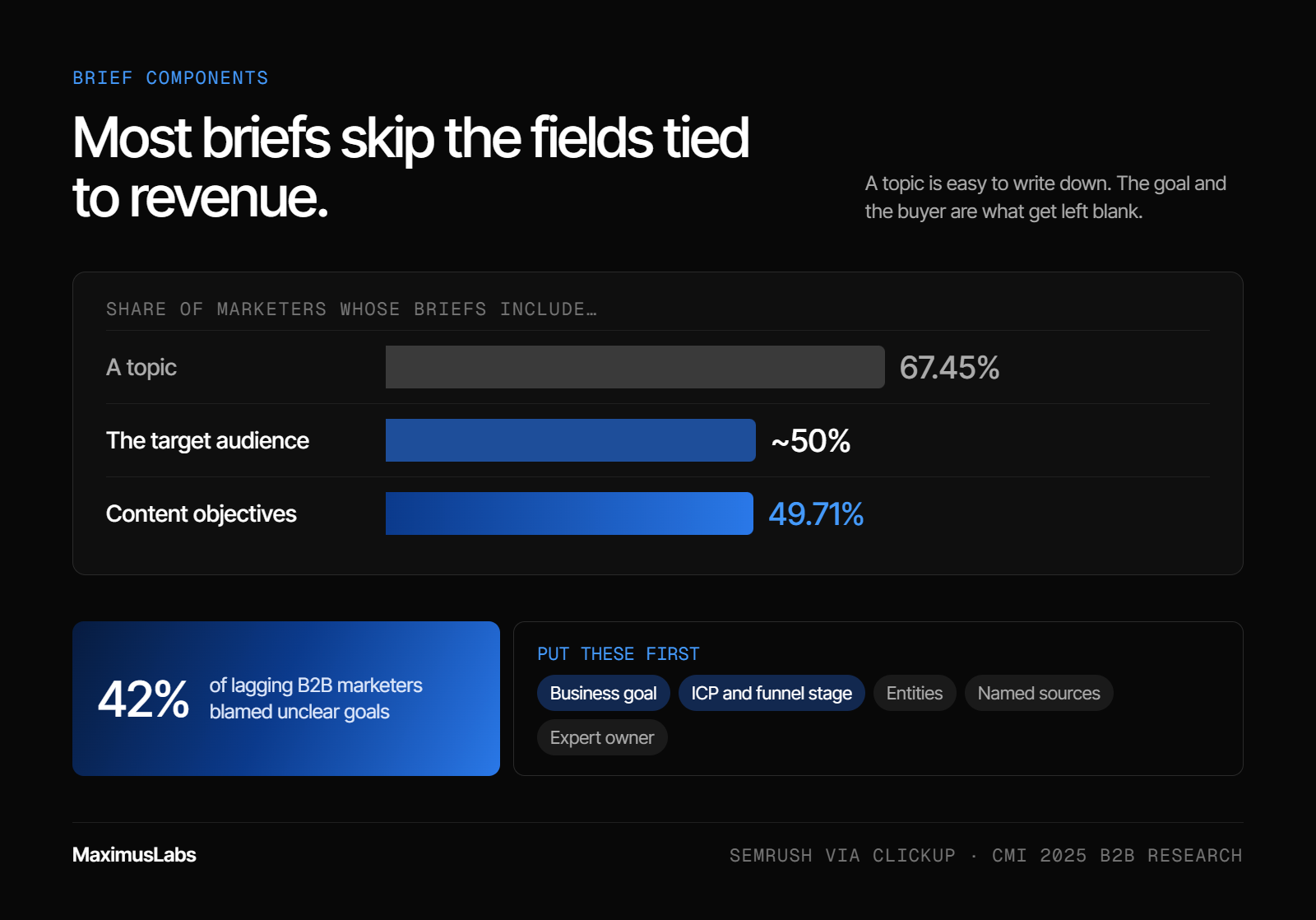
The Content Marketing Institute’s 2025 B2B research found 42% of marketers with moderate or weaker results blamed unclear goals. An ICP, or ideal customer profile, fixes that by naming the buyer and their objections. Funnel stage then tells the writer whether to compare options or push for a decision.
⚠️ Fields that look optional but are not
Fields 7 to 9 exist because AI engines lift single passages, not whole pages. An entity is a named thing an engine can recognize, such as a product, a company, or a standard. If the brief does not list them, writers describe them loosely, and the passage loses the specifics retrieval depends on.
Google’s guidance also sets a technical floor. Pages must be crawlable and indexed to appear in AI Overviews and AI Mode. A brief can note schema, meaning structured data that labels the page type, but schema never replaces clear writing.
⭐ The field I would never cut
MaximusLabs AI puts funnel stage at the top of every brief, above the keyword. Clicks and impressions are vanity metrics if they do not move revenue. I would cut word count from a brief before I cut the funnel stage.
MaximusLabs AI adds two fields most templates lack: the founder’s view of the market, and a primary-source rule. That rule ranks papers, patents, and official docs above blogs. Both come from founder interviews and research done before the brief exists, so the writer never invents a position.
Q4. How do you write a content brief, step by step?
Write a content brief in six steps. Check intent on the live results page, then map what the top ten results cover. Next, find the gaps they miss and set answer-first formatting rules. Finally, specify the statistics and sources required, and assign an expert to sign off. Steps one and two are fast with SERP (search engine results page) tools. The gap-finding and expert steps are where a brief earns its value.
Step 1: Check intent on the live results page
Search the keyword in Google before opening any tool. Look at the format of the top ten results. If they are how-to guides, brief a how-to guide. If they are listicles, brief a listicle.
This 30-second check prevents an expensive mistake: a format the results page has already rejected. A brilliant essay will not rank where Google shows only templates. Write the intent into the brief as one sentence, such as “the reader wants a template and steps.”
⏰ What to record from the results page
- The content format that dominates (guide, listicle, comparison, or template page)
- Repeating questions in People Also Ask, the box of related questions Google shows
- Whether an AI Overview appears, and which sources it cites
Step 2: Map what the top ten results cover
Pull the headings and subtopics from every top-ranking page. Tools like Surfer, Clearscope, and MarketMuse extract these automatically. Group what you find into themes, then mark which themes appear on most pages.
Those shared themes are table stakes, the topics a page must cover just to compete. Matt Kenyon notes this research “used to take hours, sometimes even days” before SERP tools compressed it. Record the table stakes as the first draft of the outline.
✅ What the first two steps should produce
By the end of step 2, the brief holds three things: one intent sentence, a format decision, and a themed list of table-stakes topics. Share it with the expert now, so they can flag a missing theme early. Everything after this point makes the page different, not just complete.
Steps 3 to 6: Differentiate, structure, prove, and sign off
The remaining four steps are where a brief earns its value. Each one has its own section later in this guide.
- Step 3, find the gaps: the 70/30 rule and community research (section 5)
- Step 4, set answer-first rules: passage structure for AI citation (section 6)
- Step 5, specify statistics and sources: named data for every key claim (section 6)
- Step 6, assign an expert: who owns the substance (section 7)
⭐ Never fight the results page
MaximusLabs AI runs step 1 before any keyword tool, on every brief. Every platform has an algorithm with a goal, and the results page shows that goal directly. I’ve learned not to force a format the page rejects, however good my idea feels.
MaximusLabs AI runs these steps as separate stages: research and SERP analysis first, then an outline, then an outline review before drafting. Splitting them fixes intent and gaps while changes are still cheap. It also keeps the brief short enough that writers read all of it.
Q5. How do you find the unique 30% that makes a brief worth writing?
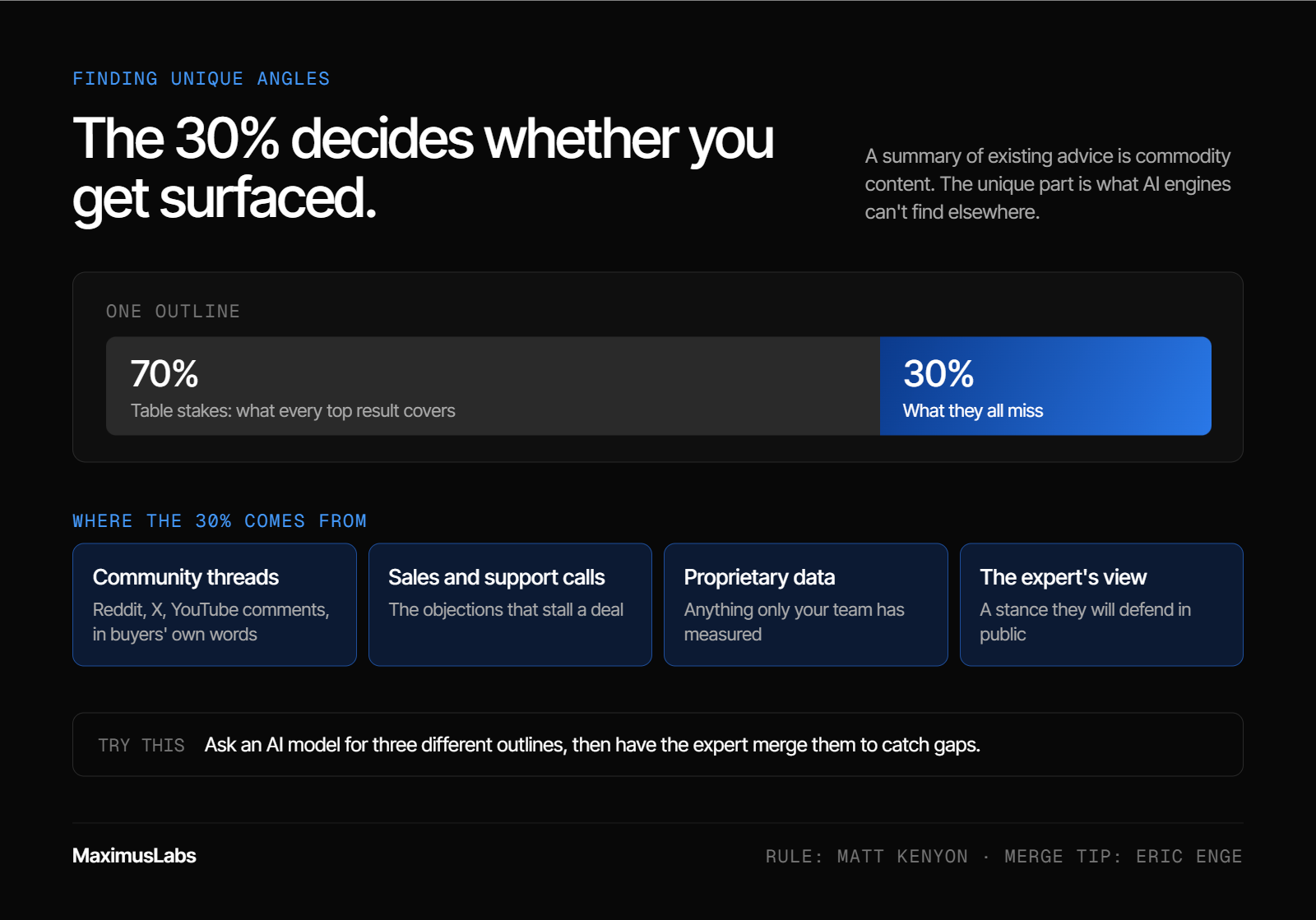
Use the 70/30 rule: about 70% of the outline covers what every top result shares, and 30% covers what they miss. That 30% comes from community threads, sales calls, proprietary data, and the expert’s own view. Google’s 2026 guidance on generative AI features treats summaries of existing advice as commodity content. The 30% decides whether a page gets surfaced at all.
⏰ The outline that matched everyone else’s
An SEO manager finishes the SERP map and pastes the outline into a doc. Every heading is defensible. Every heading also appears on at least six competing pages.
The traditional fix was the skyscraper play: cover everything competitors cover, then add more words. It worked when Google ranked ten blue links. It produced longer pages, not different ones, and nothing in the outline said why a buyer should trust this page.
❌ Why the copy-plus-more playbook stopped working
AI engines now answer with five to ten sources, not ten links. A page that restates the consensus gives a model nothing it cannot already find elsewhere. Google’s May 2026 guide on generative AI features, as summarized by WordStream, calls a summary of existing advice commodity content.
Seth Godin’s Purple Cow made the same point about products: be remarkable or be invisible. In AI search, invisible is literal.
✅ Where the 30% actually comes from
Matt Kenyon’s rule of thumb is 70% proven topics and 30% unique angles. The 30% has four reliable sources:
- Community threads: Reddit, X, YouTube comments, and LinkedIn posts where buyers complain in their own words
- Sales and support calls: objections recorded in tools like Gong, which show what stalls a deal
- Proprietary data: anything only your team has measured
- The expert’s view: a stance the expert will defend in public
Kenyon describes asking Claude to research community sites for a case-study article. The top pain point was getting client permission and buy-in, which his outline had missed entirely.
⚠️ Merge three outlines, not one
Eric Enge recommends asking an AI model for three different outlines, then having an expert merge them. Each outline surfaces different aspects, so the merge catches gaps. His own test shows why: Claude’s outline on Russian history left out World War I, which helped trigger the Russian Revolution.
⭐ How MaximusLabs AI sources the 30%
MaximusLabs AI builds a per-client intelligence graph, meaning AI agents that research the market and reason over the client’s own context. Its citation-intelligence engine maps which sources each AI engine trusts for the topic. Founder interviews then supply the stance no competitor can copy. Humans approve every brief before it ships.
MaximusLabs AI’s read is that the unique-POV field should be mandatory, not optional. I might be overweighting it. In my experience, though, briefs that produced forgettable pages almost always left that field blank.
MaximusLabs AI measures this work on pipeline, not on mentions. For Oliv AI, briefs built on community pain points and the founder’s view contributed to “30-40% of inbound now AI-sourced (Oliv AI).”
Q6. How should a brief structure content so ChatGPT, Perplexity, and AI Overviews cite it?
A brief gets content cited by ChatGPT, Perplexity, and Google AI Overviews when it requires a direct 40-80 word answer under every question-style heading. It also requires self-contained blocks of 100-300 words and at least three statistics with named sources. MaximusLabs AI writes this answer-nugget rule into every brief it issues. Princeton’s GEO study found that adding statistics and citations raises visibility in AI answers.
✅ Put the answer first
BLUF means bottom line up front: the answer comes in the first sentence, and context follows. AI retrieval looks for a passage that answers one question directly. A long build-up hides that answer where extraction may never reach it. The fix costs nothing but discipline.
MaximusLabs AI’s research compilation puts it plainly: an essay that builds to its conclusion on page five loses to a plainer piece that answers in sentence one. The same compilation reports that 44.2% of ChatGPT citations come from the first 30% of a page.
⭐ Write in blocks a model can lift
A passage is the chunk of text an engine retrieves and scores on its own. Dense passage retrieval research by Karpukhin et al. split Wikipedia into 100-word passages for exactly this kind of lookup. So the brief should demand blocks that make sense alone.
Write each H2 as the buyer’s question. The block below it should answer without phrases like “as mentioned above.” Those references break when a model lifts the block alone.
| Brief rule | Target | Why it matters |
| Answer under each heading | 40-80 words | The block most likely to be lifted whole |
| Section block length | 100-300 words | Fits how retrieval splits pages |
| Paragraph length | 40-60 words | Each claim stays easy to verify |
| Heading frequency | Every 200-300 words | Each block gets its own question |
| Evidence | 3+ named statistics, 1+ expert quote | Gives engines facts to cite |
💰 Ask for evidence by name
The Princeton GEO study tested nine optimization methods across generative engines. Adding statistics, quotations, and cited sources performed best. Keyword stuffing ran about 10% below baseline on Perplexity in the same study.
MaximusLabs AI’s research compilation found 64% of AI-cited SaaS articles carried three or more statistics, against 29% on average. That gap is why the stats field is never optional. Each statistic needs its source and year in the sentence itself, not only in a footnote.
⚠️ Treat the thresholds as defaults
MaximusLabs AI’s read is that these thresholds are directional, not laws. Engines change chunking and ranking without notice. I treat 40-80 words as a strong default, then test it against citation tracking. If your data disagrees, trust your data.
MaximusLabs AI makes the 40-80 word answer nugget non-negotiable under each H2 of every brief. Daily AI-visibility tracking then shows which nuggets get cited, and that data shapes the next brief. The rule stays fixed, while the evidence behind each nugget gets sharper every cycle.
Q7. Who should own the content brief: SEO lead, writer, expert, or AI?
A subject-matter expert should own the brief, with AI and SEO tools doing the research legwork. AI outline generators compress hours of SERP work, but they miss what only an operator knows and repeat what is already published. MaximusLabs AI closes that gap by interviewing founders and leaders before briefing. Every brief then carries their view of the market, not a summary of five competitors.
⏰ The brief nobody owned
A VP Marketing reviews a published page and finds a claim the product team says is wrong. The SEO lead wrote the brief, a freelancer drafted it, and AI filled the gaps. Everyone touched it, and nobody owned it.
That split is how many agencies have worked for years. Strategy came from one firm and execution from another. Writers without product knowledge wrote for Google’s blue links, and accuracy depended on whoever had time to check.
✅ The case for letting AI do the research
Automation has a real case. Matt Kenyon argues that SERP tools and AI now produce outlines that are often more thoroughly researched than manual ones. For mapping table stakes, a machine is faster and rarely misses a common subtopic.
❌ The case for the expert
Eric Enge takes the other side. He writes that an SME, or subject-matter expert, “must have final ownership” of the content. Without one, he warns, teams risk republishing ideas many others have already shared.
AI cannot supply what only an operator knows: the objection a buyer raised last Tuesday, or the edge case that breaks a common playbook. That knowledge is exactly what AI engines cannot find elsewhere.
⚠️ Why founders struggle to brief themselves
The obvious expert is often the founder. Yet founders find it hard to put their own view on paper. Donald Miller quotes a client who felt “inside the bottle trying to read the label.” The person closest to the product often explains it worst.
⭐ A split of responsibilities that works
| Role | Owns in the brief |
| AI and SEO tools | SERP map, table-stakes topics, entity lists, and draft outlines |
| SEO or content lead | Intent, format, structure rules, and internal links |
| Subject-matter expert | The stance, the unique 30%, fact checks, and final sign-off |
| Writer | Turning the brief into clear prose and flagging gaps |
MaximusLabs AI runs founder interviews before any brief is written, which is its Founder’s Voice method. The team sits with leadership to capture the vision, the goals, and the company’s right to win. The brief carries that stance into every section, and humans approve everything that ships.
MaximusLabs AI’s read is that the industry has this backwards. Teams edit positioning into a draft at the end. I’ve found it costs far less to put it in the brief at the start.
MaximusLabs AI measures every engagement on pipeline, not on mentions, and expert-owned briefs are part of how it gets there. Positioning arrives in the brief, not in the edit. Drafts need fewer rounds and say what the company actually believes.
Q8. How long should a content brief and its article be?
A good content brief fits on one to three pages. The article it governs should be as long as the intent needs, not as long as the competitor average. Single-intent topics are often fully served in 800-1,500 words. Padding to hit a tool’s target dilutes the passages AI engines score. Set length by the number of questions the reader needs answered.
✅ How long the brief itself should be
One to three pages is enough for the ten fields covered earlier. Past that, writers start skimming, and the one decision that mattered gets lost. A brief should be short enough that the writer reads every line before drafting.
The test is simple: if a field does not change what the writer produces, cut it. The outline should list questions, not full paragraphs. Voice notes should link to a style guide instead of repeating it.
⚠️ The word-count debate
SEO tools usually set a target from the average length of top-ranking pages. For many topics, that lands between 2,500 and 3,500 words. The logic is that longer pages cover more subtopics.
Ethan Smith, CEO of Graphite, disagrees. He argues that once intent is met, 500 more words have no ranking effect, and 800-1,500 words often suffice. Eli Schwartz makes a similar case in Product-Led SEO: serve the user’s need, not a length target. Both camps agree that intent comes first.
💸 What padding costs in AI search
Padding has a second cost now. AI engines score passages, so a section stretched with filler carries less answer per word. It becomes a weaker candidate for extraction than a tight block on the same question.
Ninety words that answer a question beat three hundred that circle it. A reader who skims also finds the answer faster.
⭐ A formula that replaces the competitor average
Set length from the questions, not the SERP. Count the questions the reader needs answered, then multiply by the block size each deserves. Add an intro and a closing section on top.
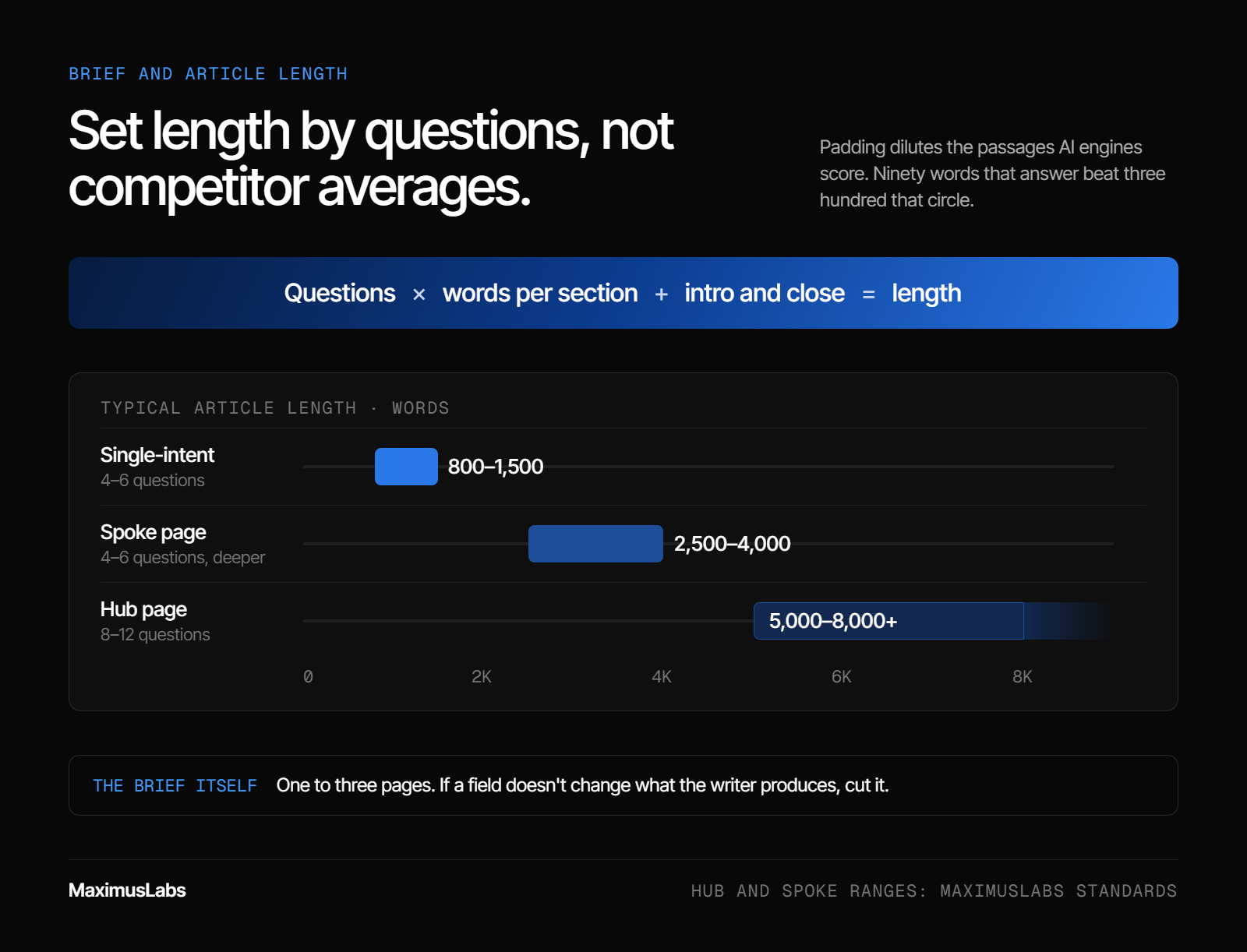
| Page type | Questions (H2s) | Words per section | Typical length |
| Single-intent article | 4-6 | 200-300 | 800-1,500 |
| Spoke page | 4-6 | 400-600 | 2,500-4,000 |
| Hub page | 8-12 | 400-600 | 5,000-8,000+ |
The hub and spoke ranges are MaximusLabs AI’s own standards. A hub page covers a topic’s strategy, and each spoke page goes deep on one tactic.
❌ When depth is not padding
MaximusLabs AI’s read is that the page’s job decides length, never the tool’s score. I might be wrong for crowded head terms, where depth itself can signal authority. Even there, I would add questions, not filler.
MaximusLabs AI sizes every brief by its role in a hub-and-spoke cluster, so pages never compete for the same query. Each page gets the length its questions need. Each one also points to the next step a buyer takes.
Q9. What does a good content brief look like? (Template and examples)
A good content brief reads like a work order. It sets one primary question, numbered sub-questions with a 40-80 word answer target each, and named sources. It also names the expert who signs off and one conversion goal. MaximusLabs AI uses the template below, which adds ICP, funnel stage, primary-source rules, and an answer-nugget field. Three filled examples follow it.
✅ The template
Most public templates, including Backlinko’s and HubSpot’s, cover keywords, audience, outline, and word count. The version below keeps those basics. It adds the fields that tie a page to revenue and to AI citation.
| Field | What to write |
| Primary question | The one question the page must answer, in the buyer’s words |
| ICP and funnel stage | Who buys, and whether they are learning, comparing, or deciding |
| Business goal | The pipeline outcome, such as demo requests from mid-market teams |
| Intent and format | One sentence on intent, plus the format the results page rewards |
| Sub-questions | Numbered H2s, each with a 40-80 word answer target |
| Table stakes and unique 30% | Shared topics, plus the gaps only you can fill |
| Entities | Products, companies, and concepts to name and define |
| Sources | 3+ named statistics, with papers and official docs ranked first |
| Expert and voice | Who signs off, and the stance they will defend |
| CTA and links | One next step, plus internal links |
Matt Kenyon describes the payoff: with enough time in the outline, writing “should feel like paint-by-numbers.” The writer fills one heading at a time instead of facing a blank page.
⭐ Example 1: a bottom-of-funnel comparison page
The examples below use invented products to show how each field gets filled.
- Primary question: “Is Tool A or Tool B better for a 50-person finance team?”
- ICP and stage: finance operations leads, deciding
- Goal: demo requests
- Unique 30%: migration pain points pulled from sales calls
- Sources: both vendors’ pricing pages and documentation, dated
- CTA: book a migration review
Comparison pages need a side-by-side table and honest drawbacks for every option. Buyers trust them only when the brief demands that fairness.
✅ Example 2: a how-to guide
- Primary question: “How do you collect SOC 2 audit evidence without spreadsheets?” (SOC 2 is a security audit standard.)
- ICP and stage: compliance managers at growing SaaS companies, comparing
- Goal: free-trial signups
- Format: numbered steps, because the results page shows step-by-step guides
- Expert: the head of compliance, who adds the step most guides skip
- CTA: a trial with a prebuilt evidence checklist
⏰ Example 3: an AI-search spoke article
- Primary question: “How do AI engines decide which sources to cite?”
- ICP and stage: heads of organic growth, moving from learning to comparing
- Goal: newsletter signups that feed a nurture sequence
- Required sources: the Princeton GEO paper and Google Search Central documentation
- Answer rules: a 40-80 word nugget under each H2, with blocks under 300 words
- Hub link: points back to the hub page on AI visibility
⭐ What changes between the three
MaximusLabs AI keeps the fields identical across page types and changes only what fills them. I’ve found that a fixed template is what lets a new writer produce a usable first draft.
MaximusLabs AI’s template adds four fields most templates lack: ICP, funnel stage, primary-source rules, and the answer-nugget target. Each brief passes through research and an outline review before drafting. The writer receives decisions, not a keyword.
Q10. Which content brief mistakes waste the most budget?
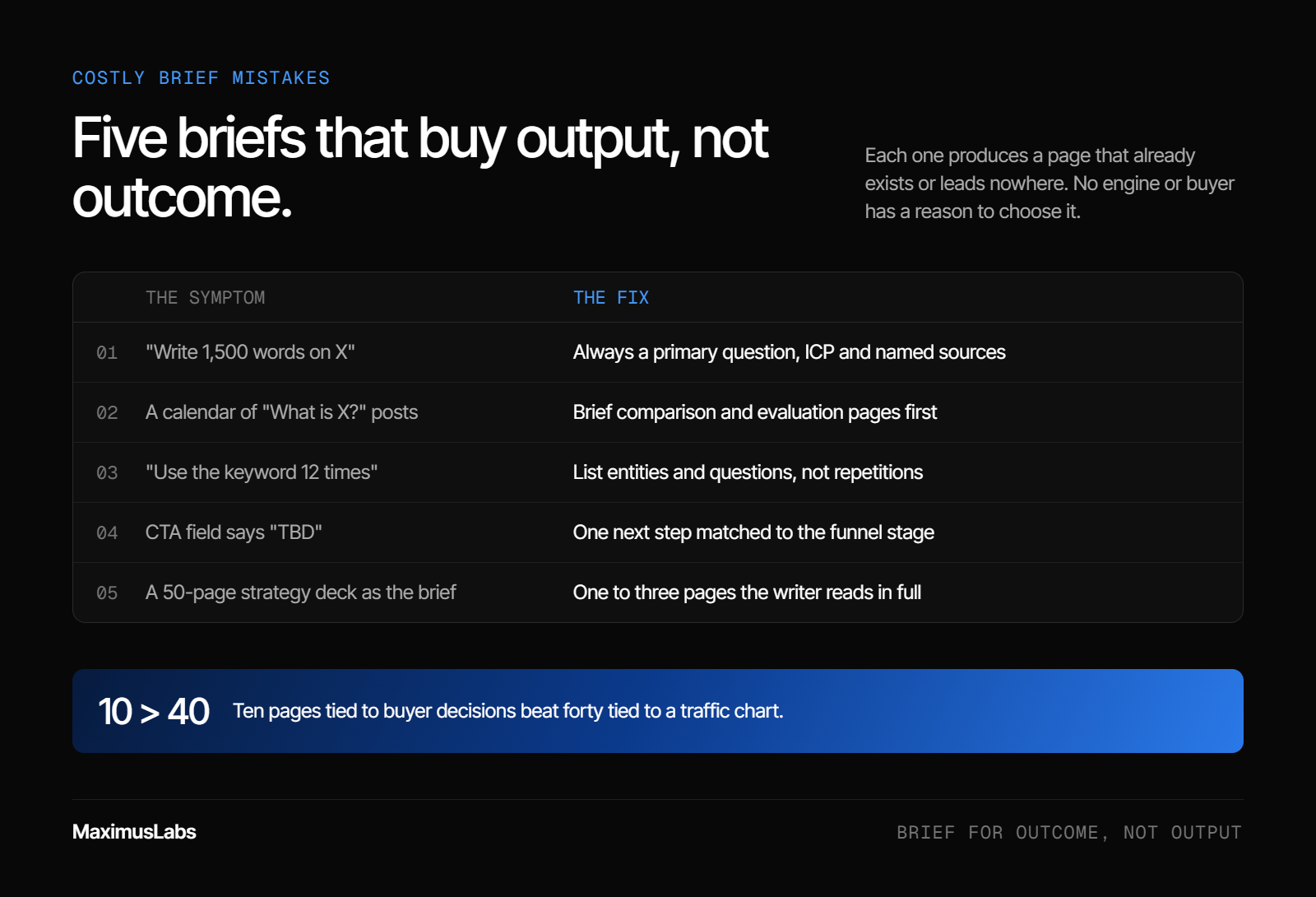
The costliest briefing mistakes are one-line prompts, top-of-funnel definition topics, and keyword repeat counts. Two more are a missing conversion goal and 50-page briefs nobody reads. Each wastes budget the same way. The writer produces something that already exists or leads nowhere. Neither Google nor AI engines have a reason to choose it, and no buyer acts on it.
⏰ The quarter that produced 40 posts and no pipeline
A Head of Growth reviews the quarter: 40 published posts, traffic up, and almost no demo requests traced to content. Every post had a brief. The briefs were the problem.
Agencies have long sold volume on a fixed retainer. Content was planned for impressions and pageviews, and success meant a rising traffic chart. Ethan Smith, CEO of Graphite, argues that 5% of pages drive 85-95% of traffic and revenue.
❌ Why volume stopped paying
Then buyers moved to AI answers. ChatGPT, Perplexity, and AI Overviews now answer easy questions themselves and name five to ten brands for hard ones. Volume stopped being an advantage.
Mistake 1: The one-line prompt
The symptom is “Write 1,500 words on X.” The cost is a writer or model filling gaps with the average of the web, and you pay for the rewrite. The fix is simple: never send a brief without a primary question, an ICP, and named sources.
Mistake 2: Briefing definitions that never convert
The symptom is a calendar full of “What is X?” posts. AI engines already answer these directly, so the page earns neither clicks nor buyers. Brief bottom-of-funnel and middle-of-funnel pages first, meaning comparison, alternative, and evaluation pages.
Yes, this article opens with a definition. It earns its place only by handing the reader a working template and a next step.
Mistake 3: Keyword repeat counts
The symptom is “Use the keyword 12 times.” Stuffed copy reads badly and tested about 10% below baseline on Perplexity in the Princeton GEO study. List entities and questions to cover instead of repetitions.
Mistake 4: No conversion goal
The symptom is a CTA field that says “TBD.” The page attracts readers and sends them nowhere, so it cannot be tied to pipeline. Name one next step that matches the funnel stage, such as a demo for buyers who are deciding.
Mistake 5: The 50-page brief
The symptom is a strategy deck attached as the brief. Ethan Smith describes agencies handing over “a 50 page PDF” where “most of it’s zero impact work.” Writers skim it and miss the one decision that mattered. Keep the brief to one to three pages.
⭐ The pattern behind all five
MaximusLabs AI’s read is that all five mistakes come from briefing for output instead of outcome. I’d rather publish ten pages tied to buyer decisions than forty tied to a traffic chart. That trade feels slow for a quarter, and then it compounds.
MaximusLabs AI measures every engagement on pipeline, not on mentions. It starts with bottom-of-funnel briefs tied to the ICP. Earlier-stage pages come only after the decision pages exist.
Q11. How do you measure whether a content brief worked?
Judge a brief by what its article earns: AI citation rate and share of voice for the target prompts, rankings for the primary question, and AI-referred pipeline. Pew Research found users click a traditional result in 8% of visits when an AI summary appears, versus 15% without one. Clicks therefore undercount impact. MaximusLabs AI reports a “64% AI citation rate in 6 months, vs ~30% for billion-dollar incumbents (Oliv AI).”
⚠️ Why traffic undercounts a good brief
A page can shape a buying decision without earning a click. When an AI answer cites the page, the buyer may read the summary and never visit. Pew’s 2025 browsing study found users ended their session more often after a search page with an AI summary.
So a traffic-only report can call a cited, influential page a failure. The metric set needs to see what happens before the click.
✅ The three metrics that matter
| Metric | What it measures | How to track it |
| AI citation rate | Share of target prompts where an engine cites your page | Run a fixed prompt set in ChatGPT, Perplexity, Gemini, and AI Overviews on a schedule |
| Share of voice | Your citations as a share of all brand citations in those answers | Count every brand cited across the same prompt set |
| AI-referred pipeline | Leads and deals that started in an AI answer | Referral sources like chatgpt.com in analytics, plus a “how did you hear about us” field |
Citation rate shows whether engines trust the page. Share of voice shows whether that trust beats competitors. Pipeline shows whether any of it paid.
Rankings for the primary question still matter, because Google rankings feed AI Overviews. Google says a page must be indexed and eligible for a snippet to appear in its AI features.
⭐ Run the check on a fixed cadence
Measure each brief at 30, 60, and 90 days against the same prompt set. Answers change from run to run, so a single check proves little. Keep the set to 20-50 real buyer questions, written in the words buyers use.
MaximusLabs AI runs daily AI-visibility tracking across every major engine, re-run and regression-tested. That frequency smooths out the noise any single check carries.
💰 Feed results back into the next brief
A brief that earned citations shows which structure and sources worked. A brief that did not points to a missing angle or a weak source. Write both findings into the next brief’s unique-30% and sources fields.
MaximusLabs AI’s read is that revenue is the only metric that settles the argument. Citation rate is a leading signal, and I’d watch it weekly. I’d only call a brief successful once its page shows up in pipeline.
MaximusLabs AI reports citation rate and share of voice per prompt, then ties both to pipeline. For Oliv AI, the outcomes were “64% AI citation rate in 6 months, vs ~30% for billion-dollar incumbents (Oliv AI)” and “27 qualified leads, $47K+ pipeline, 26% close rate in 4 months (Oliv AI).”
Frequently asked questions
What is the difference between a content brief and a content outline?
A content outline lists the headings of one draft in order. A content brief contains the outline plus the reasoning behind it: the search intent, the reader, the business goal, the sources to cite, and the expert who signs off. Think of the outline as one field inside the brief. Teams that send writers only an outline skip the decisions that make each heading worth writing. The result is usually a draft that covers the right topics but argues nothing. • Outline: heading order only • Content brief: intent, ICP, funnel stage, questions, sources, entities, answer rules, CTA, and owner • Creative brief: a whole campaign, one level above both MaximusLabs AI treats the outline as the last thing to lock, not the first. We settle intent, the unique angle, and the founder's stance before any heading order is fixed. Then we run an outline review before drafting begins, while changes are still cheap. You can see how that fits into our wider content marketing process.
How long does it take to write a content brief?
There is no fixed number, but the time splits unevenly across the steps. Most of it should go to the parts machines cannot do. • Intent check: about 30 seconds of looking at the live results page • SERP mapping: fast with tools like Surfer, Clearscope, or MarketMuse • Finding the unique 30%: the slowest step, because it needs community research, sales-call notes, and expert input • Expert review: depends on the expert's calendar more than the work itself Practitioners such as Matt Kenyon note that SERP research for an outline used to take hours or even days before current tools compressed it. That time did not disappear. It moved to the gap-finding and expert steps, which is where a brief earns its value. MaximusLabs AI runs research, outline, and outline review as separate stages, so each one has a clear owner and a clear finish line. We would rather spend an extra hour on the brief than a week on rewrites. Our GEO content optimization guide covers how that effort pays back after publishing.
Can ChatGPT or other AI tools write a content brief for you?
AI tools can draft most of a content brief, but they should not own it. ChatGPT, Claude, and SERP tools are good at mapping table-stakes topics, listing entities, and producing draft outlines quickly. Where they fall short: • They repeat what is already published, because that is what they learned from • They miss what only an operator knows, such as last week's sales objection • They can leave out major subtopics. Eric Enge found Claude's outline on Russian history skipped World War I entirely A practical fix is to generate three AI outlines and have an expert merge them. Each outline surfaces different aspects, so the merge catches gaps a single outline leaves. Then the expert adds the stance and the unique 30% that no model can supply. MaximusLabs AI uses AI agents for research and outline drafts, and a human approves every brief before it ships. We see the split simply: AI for speed, experts for substance. Our AI SEO work follows the same rule.
How many keywords should a content brief target?
A content brief should target one primary question, not a long list of keywords. Secondary phrases still belong in the brief, but as sub-questions and entities rather than repeat counts. Here is how MaximusLabs AI structures that part of a brief: • Primary question: the one thing the page must answer, written in the buyer's words • Sub-questions: numbered H2s, each with a 40-80 word answer target • Entities: named products, companies, and concepts the writer must define Keyword repeat counts work against you now. The Princeton GEO study found keyword stuffing ran about 10% below baseline on Perplexity, while statistics, quotations, and cited sources performed best. MaximusLabs AI builds this section from real buyer questions instead of keyword volume alone. We pull them from People Also Ask, community threads, and sales calls, then group them by intent so each H2 answers exactly one question. Our guide to AEO keyword and question research walks through the method step by step.
Does every piece of content need a content brief?
Every page meant to rank, get cited, or drive pipeline needs a brief. Short social posts or internal updates usually do not. The test is cost. If a wrong draft would waste a writer's week, an editor's review, or a slot in the publishing calendar, write the brief first. A one-to-three page brief takes far less time than a rewrite. Briefs matter most for: • Bottom-of-funnel comparison and alternative pages • How-to guides that answer a buyer's evaluation question • Hub and spoke pages that must not compete for the same query • Any page written by a freelancer or a new team member Volume without briefs is how teams end up with 40 posts and no pipeline. A smaller set of briefed, decision-stage pages usually does more for revenue. MaximusLabs AI briefs every page it ships, starting with bottom-of-funnel topics tied to the ICP. We map each brief to its place in a topic cluster so pages support each other instead of competing.
How do you brief freelance writers so drafts need fewer revisions?
Freelancers miss the mark when the brief leaves decisions for them to guess. Close those gaps before drafting starts. • State the intent in one sentence: for example, 'the reader wants a template and steps' • Name the ICP and funnel stage: so the writer knows whether to explain, compare, or push for a decision • List the sources: three or more named statistics, with papers and official docs ranked first • Give the stance: the view the expert will defend, so the writer does not invent one • Set answer rules: a direct answer under every heading • Name the reviewer: one expert who signs off Keep the brief to one to three pages. Longer documents get skimmed, and the one decision that mattered gets lost. MaximusLabs AI interviews founders before briefing, so positioning arrives in the brief rather than in the edit. We have found that drafts need fewer rounds when the stance is fixed upfront. Our Founder's Voice methodology guide shows how that interview works.
How do you know if your content brief template needs updating?
Update a brief template when the results of its pages tell you to, not on a fixed calendar. Three signals matter. • Citation rate: pages built from the template are not cited for their target prompts in ChatGPT, Perplexity, Gemini, or AI Overviews • Share of voice: competitors appear in those answers more often than you do • Pipeline: pages rank or get cited but do not produce leads Check each new page at 30, 60, and 90 days against the same prompt set. When a pattern appears across several briefs, change the field responsible. A weak source list points to the sources field. A missing angle points to the unique-30% field. The fields themselves should stay stable. What fills them should improve every cycle. MaximusLabs AI tracks citation rate and share of voice per prompt, then feeds those results into the next brief. For Oliv AI, MaximusLabs AI reports a 64% AI citation rate in 6 months, vs ~30% for billion-dollar incumbents. Read the full Oliv AI case study.