 Krishna Kaanth M
- AI content is not penalized for being AI. Google rewards helpful pages and penalizes content made mainly to manipulate rankings, whoever or whatever wrote it.
- Ranking and being cited are different tests. Graphite found 82% of articles cited by ChatGPT and Perplexity are human-written, though AI produces about half of new articles.
- Ahrefs found almost no link between AI share and Google rank across 600,000 pages, but fully AI pages rarely hold position one.
- AI-heavy sites collapse from scaled, unoriginal content. One finance app lost 99.3% of traffic; a lawn-care site lost all rankings.
- Winning pages add what a model cannot: first-party data, named sources, expert judgment, and a real author. Statistics and quotes lifted AI visibility up to 40%.
- Use AI for research and drafts, keep experts on BOFU pages, fact-check every field, and audit old content by revenue, not pageviews.
Q1: Is AI Content Bad for SEO and AI Search Visibility?
No. AI content is not penalized for being AI. Google rewards helpful pages, whatever tool made them. The test has changed, though. Buyers now ask ChatGPT, Perplexity, and Google AI Overviews, which cite a small set of trusted sources. AI-assisted pages built on real expertise can rank and get cited. Unedited, automated pages rarely do either, because they add nothing a model does not already know.
The verdict, and why it needs a second half
Google’s position has been on record since February 2023. It says it rewards high-quality content however it is produced. What breaks its rules is using automation mainly to manipulate rankings.
So the honest answer to “is AI content bad for SEO” is no. That answer covers only half of the question your CEO asked, though.
🔍 Ranking a page and being the answer are different tests
Traditional SEO asked one thing: does the page rank on Google’s blue links? Generative Engine Optimization (GEO) asks something harder. When a buyer asks an AI engine for the best tool in your category, are you one of the five to ten brands it names?
An AI engine puts its own credibility behind every answer it gives. It cites sources it trusts, and it skips the rest. A page can rank on page one and still be invisible in ChatGPT.
Where the real dividing line sits
The useful split is not “AI versus human.” It is “AI-assisted versus fully automated.”
| Approach | What it looks like | What it tends to earn |
| ✅ AI-assisted | AI does research and drafts; an expert adds data, opinion, and review | Rankings and citations |
| ❌ Fully automated | One prompt, light proofread, published at scale | Short-term traffic, then decline |
💡 What practitioners who have measured it say
Ethan Smith, CEO of Graphite, has studied AI content across Google and ChatGPT at scale. His summary is blunt: “AI assisted content edited is great... but purely 100% AI generated does not work.”
That line matches what the ranking data shows. Ahrefs found no meaningful link between a page’s AI share and its Google position, yet fully AI pages rarely held the top spot.
Sameness is the actual risk
MaximusLabs AI’s read is that the industry is asking the wrong question. The risk was never the tool. It was sameness. I see the same pattern in almost every content audit: teams summarize five articles and publish the sixth.
⚠️ Why sameness fails twice
A model can already produce the sixth article on its own. So Google has little reason to rank it, and AI engines have no reason to cite it. Either way, your page adds nothing the system does not already have.
The rest of this article covers what Google’s rules actually say, how AI engines treat AI-written pages, and what to do on Monday.
MaximusLabs AI uses AI the same way it recommends to clients. Agents handle research and first drafts, and humans approve everything that ships. Every engagement is measured on pipeline, not on mentions or traffic. The tool only matters if the page ends up in a buyer’s answer and moves a deal forward.
Q2: What Do Google’s Rules Actually Say About AI-Generated Content?
Google’s rule has not changed since February 2023: using AI mainly to manipulate rankings breaks its spam policies. In March 2024, “scaled content abuse” was widened to cover AI, humans, or both. In January 2025, quality raters were told to give the Lowest rating to pages that are mostly low-effort AI content. On October 1, 2026, Google called manual fact-checking of all AI content critical.
The 2023 baseline: purpose matters, not the tool
Google published its core position in February 2023. Using automation, including AI, “with the primary purpose of manipulating ranking in search results” violates its spam policies. Appropriate use of AI is not against its guidelines.
This is the rule every later update builds on. Google judges why and how a page was made, not which tool typed it.
📜 What “primary purpose” means in practice
A page written to answer a buyer’s question passes the test. A page written to capture a keyword, with nothing new inside, does not. AI simply makes the second kind cheaper to produce at scale.
March 2024: scaled content abuse
In March 2024, Google rewrote its policy on mass-produced content. It now targets content produced at scale to boost rankings, “whether automation, humans or a combination are involved.”
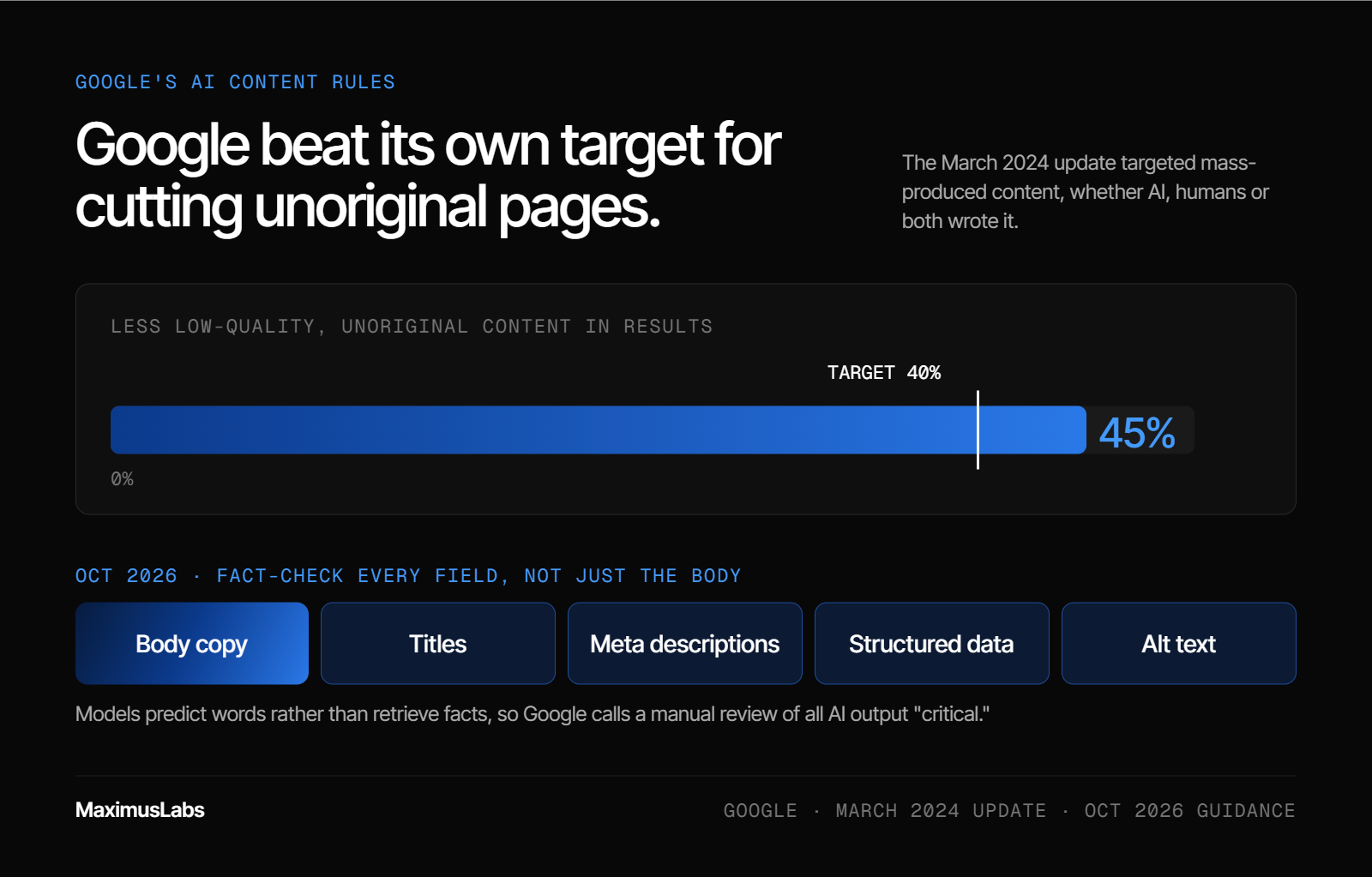
The update also tuned core ranking systems to cut unoriginal content. After rollout, Google reported 45% less low-quality, unoriginal content in results, beating its 40% target.
⚠️ Why this matters for content teams
The policy does not care who wrote the pages. A team of freelancers producing near-identical pages is just as exposed as an AI pipeline. Volume without value is the violation.
January 2025: the rater guidelines name AI directly
Google’s Search Quality Rater Guidelines instruct the human raters who judge result quality. The January 2025 update targets low-effort pages. Raters give the Lowest rating when most main content is copied, paraphrased, or AI-generated with little added value.
One nuance matters here. Rater scores do not directly rank individual pages. They help Google check whether its algorithms work as intended.
🔎 Reading the rater signal correctly
The guidelines describe what Google wants its systems to reward. Treat them as a preview of where ranking is headed, not as a penalty list.
October 2026: fact-checking becomes “critical”
On October 1, 2026, Google updated its guidance on using generative AI content. It now explains that models predict words rather than retrieve facts, so their output can contain errors. It calls it “critical to manually factcheck and review all AI-generated content” before publishing.
The scope includes titles, meta descriptions, structured data, and alt text, not just body copy. The page still does not say AI content ranks lower for being AI.
✅ What changed for your workflow
| Year | Rule | What it asks of you |
| 2023 | No AI to manipulate rankings | Write for people first |
| 2024 | Scaled content abuse | Stop mass near-duplicates |
| 2025 | Lowest rating for low-effort AI | Add original value |
| 2026 | Manual fact-check is critical | Review every claim and field |
MaximusLabs AI’s view is simple. Google is an algorithm with a clear goal: show answers people can trust. When you understand that goal, the rules stop feeling like traps. MaximusLabs AI builds a fact-check step into every article before publishing. It covers body copy, titles, and metadata, because Google’s guidance now treats that review as critical.
Q3: Do ChatGPT, Perplexity, and AI Overviews Cite AI-Written Content?
Rarely. Graphite found that 82% of articles cited by ChatGPT and Perplexity were written by humans. That holds even though AI now produces about half of new online articles. AI engines put their own credibility behind every answer, so they favor sources they trust. Google applies its spam policies to AI Overviews and AI Mode, and penalized sites can disappear from AI Overviews even for their own brand name.
AI writes half the web but earns a small share of citations
Graphite has tracked AI-written articles since ChatGPT launched. AI-generated articles briefly outnumbered human ones in November 2024. Since then, the two have stayed roughly equal.
Citations tell a different story. In Graphite’s analysis, only 18% of articles cited by ChatGPT and Perplexity were AI-generated. AI produces about half of new articles but earns less than a fifth of the citations.
📊 Why the gap exists
Graphite noted that AI-written articles largely do not appear in Google or ChatGPT results. Publishing more of them does not buy more visibility.
Why AI engines avoid their own output
Ethan Smith explains the incentive clearly. If AI answers were built from AI pages, engines would end up training on their own output. Researchers call this model collapse: quality degrades when models feed on their own text.
So AI engines have every reason to prefer human sources that add new information.
💬 What practitioners are seeing
“If chat GBT has answers that are derivatives of its own derivatives then you have this infinite loop of training on your own output and then you have garbage.”
Ethan Smith, CEO of Graphite, AEO Is the New SEO (YouTube)
“some kind of filter in place to prevent HCU sites from being linked”
Lily Ray, SEO strategist, via Search Engine Roundtable
The AI Overviews filter on penalized sites
In October 2024, Lily Ray and Glenn Gabe documented something worrying. Sites hit by the Helpful Content Update (HCU), Google’s system for demoting unhelpful content, were missing from AI Overviews. That held even when users asked about the site directly.
Google later confirmed its spam policies, scaled content abuse included, apply to AI Overviews and AI Mode. A penalty now follows you into AI answers.
⚠️ Recovery is not automatic
Practitioners report that organic recovery does not always restore AI Overview inclusion. Treat AI visibility as something you protect, not something you win back easily.
What this means for revenue pages
Bottom-of-funnel (BOFU) queries are where buyers compare vendors and shortlist. A query like “best sales forecasting software for mid-market SaaS” gets one AI answer with a handful of brands. If your comparison page is generic AI copy, the engine has no reason to cite it.
MaximusLabs AI’s read is that this is where AI-only content costs the most. Informational traffic can survive a weak page. A missing BOFU citation removes you from the shortlist before the buyer ever visits.
MaximusLabs AI runs Answer Engine Optimization (AEO) on two pillars. Owned AEO makes your content the answer, and Earned AEO builds trust through reviews, Reddit, press, and listicles. For Oliv AI, that work produced a “64% AI citation rate in 6 months, vs ~30% for billion-dollar incumbents (Oliv AI).” MaximusLabs measures that citation rate against pipeline, not as a goal on its own.
Q4: Why Do AI-Heavy Sites Lose Their Traffic and Citations?
AI-heavy sites collapse because automation makes unoriginal content cheap at scale, and Google demotes whole sites that are full of it. Casual, a financial planning app, lost 99.3% of its traffic after Google’s November 2023 core update. A lawn-care site lost all its rankings after publishing rehashed AI articles. The traditional SEO habit of volume over value made both losses worse.
This has happened before
Ethan Smith started in SEO in 2007. Back then, shopping comparison sites scraped each other’s reviews and remixed them into millions of pages. “It worked really well and then it stopped working and then all those companies disappeared,” he recalls.
Google’s Panda update ended that era. Smith says he knew pure AI content would fail for the same reason: search engines cannot let their results fill with copies.
🔁 The same incentive, a new tool
“I created spam in 2007 and I knew what Google did about it.”
Ethan Smith, CEO of Graphite, AEO Is the New SEO (YouTube)
AI is the cheapest scraping tool ever built. That makes the cycle faster, not different.
Two collapses worth studying
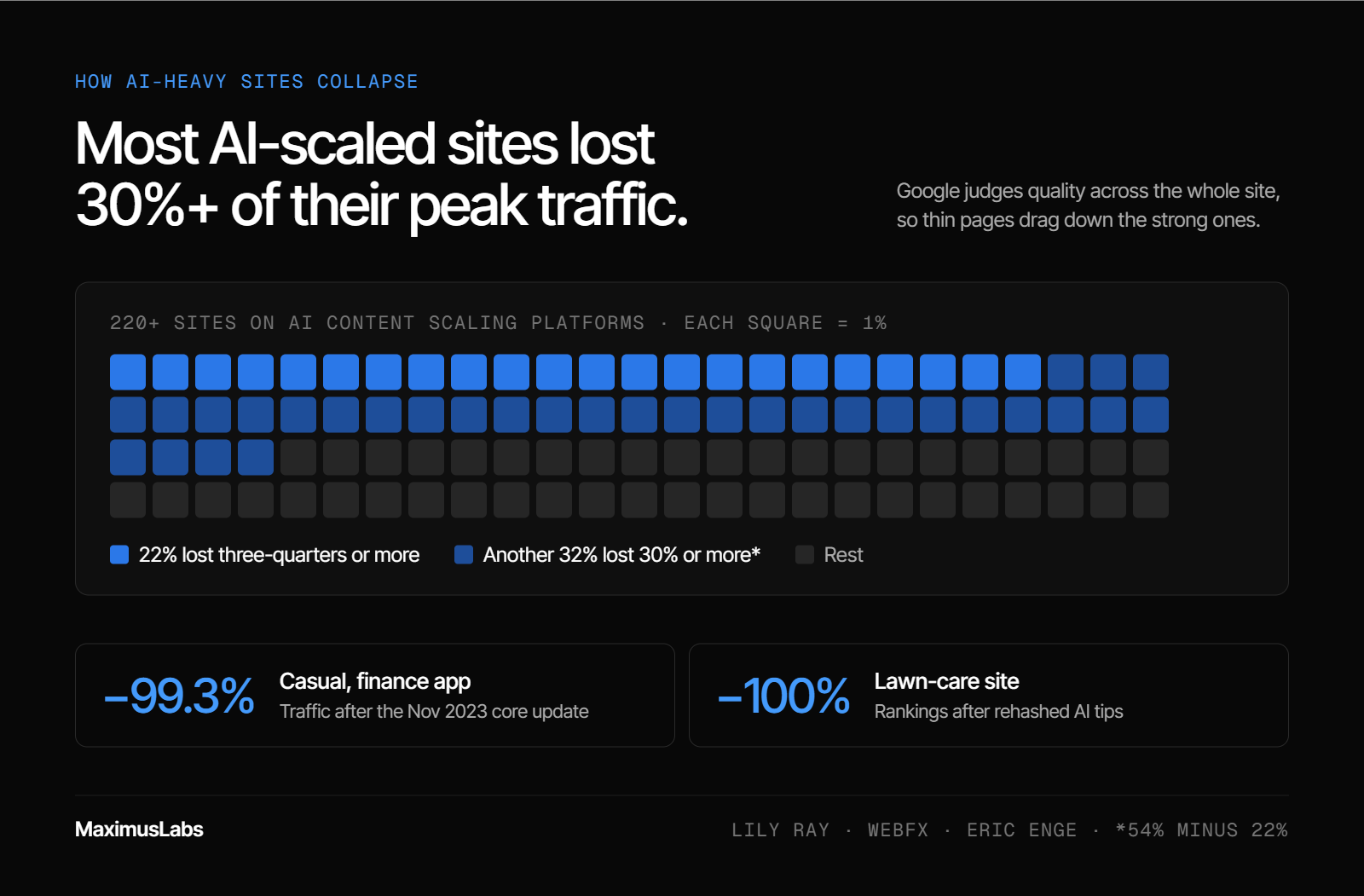
WebFX documented Casual, a financial planning app that published AI content without human experience behind it. After Google’s November 2023 core update, which focused on E-E-A-T (experience, expertise, authoritativeness, and trust), its traffic fell 99.3%.
Eric Enge describes a lawn-care site that added AI articles repeating tips already online. The pages saw little traffic, then lost 100% of their rankings soon after.
📉 What the two cases share
| Case | What was published | Result |
| Casual (finance app) | AI content without expert input | ❌ 99.3% traffic loss |
| Lawn-care site | Rehashed AI tips | ❌ 100% ranking loss |
Neither site was punished for using AI. Both were demoted for publishing pages with nothing new in them. The tool was incidental; the empty pages were the problem.
Why demotion hits the whole site
Google folded its helpful content system into core ranking in March 2024. Quality is now judged across the site, not page by page. A library full of thin pages can drag down your strongest product and pricing pages.
Lily Ray tracked more than 220 sites using AI content scaling platforms. Per a summary of her analysis, 54% lost 30% or more of peak traffic, and 22% lost three-quarters.
💸 Where the old playbook made it worse
Traditional SEO agencies sold volume: more posts, more keywords, more impressions. Retainers were judged on traffic charts, not pipeline. AI made that playbook cheap, so many teams scaled it right into a core update.
MaximusLabs AI’s read is that recovery costs more than prevention. Rebuilding trust takes months of pruning, rewriting, and waiting for the next core update. I would rather publish ten pages that earn citations than two hundred that put the domain at risk.
MaximusLabs AI measures every engagement on pipeline, not traffic, so volume never becomes the goal. For Oliv AI, that focus produced “27 qualified leads, $47K+ pipeline, 26% close rate in 4 months (Oliv AI).” Fewer, stronger BOFU pages carried that result, not a publishing calendar built for impressions.
Q5: Why Do the AI Content Studies Seem to Disagree?
The two biggest studies measure different things. Ahrefs scored the AI share of 600,000 top-20 Google pages and found almost no link to rank (a correlation of 0.011). Most of those pages mixed AI and human work. Graphite classified articles as mostly AI or mostly human. It found mostly-AI articles made up only 14% of Google results and tended to rank lower. Together, they say AI-assisted pages compete and fully automated ones do not.
What Ahrefs measured
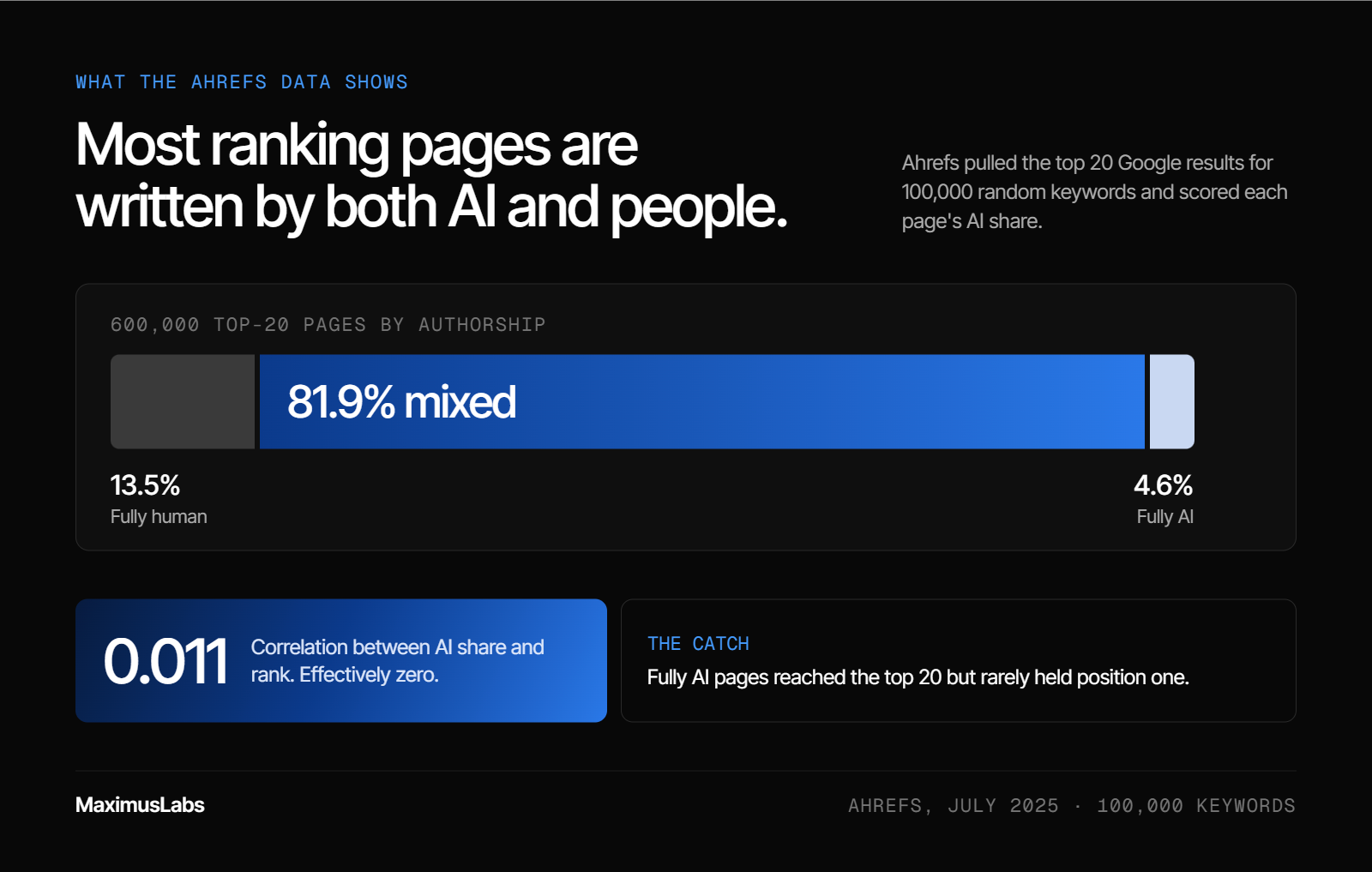
Ahrefs pulled the top 20 Google results for 100,000 random keywords, giving 600,000 pages. It ran each page through its own AI detector and estimated what share of the text was AI-written.
The result was a correlation of 0.011 between AI share and ranking position. That is effectively zero. Only 4.6% of pages were fully AI, 13.5% were fully human, and 81.9% mixed both.
📊 The detail most summaries skip
Fully AI pages did reach the top 20. They rarely held position one, though. The very top results leaned slightly toward less AI content.
What Graphite measured
Graphite took a different approach. It sorted articles into two buckets: mostly AI (over half the text flagged) or mostly human. Then it checked which ones showed up in Google and AI engines.
About 86% of articles ranking in Google were human-written, and 14% were AI-generated, according to Graphite’s research. When AI articles did appear, they tended to rank below human ones. Ethan Smith summed up the pattern: “around 10 to 12% of content in Google search and in chat GPT are AI generated.”
🔍 Why both results can be true
Ahrefs asked, “Does adding some AI to a page hurt it?” The answer was no. Graphite asked, “Do mostly-AI articles win?” The answer was rarely.
Those are different questions. A page with 30% AI-assisted text and strong expert input sits in Ahrefs’ blended middle. A page generated in one prompt sits in Graphite’s mostly-AI bucket.
Putting the studies side by side
| - | Ahrefs (July 2025) | Graphite (October 2025) | What MaximusLabs AI takes from it |
| Sample | 600,000 top-20 pages | 65,000 CommonCrawl articles | Both are large enough to trust the direction |
| Unit | AI share per page | Mostly AI vs mostly human | The unit decides the headline |
| Finding | 0.011 link to rank | AI articles rarely win | Assisted is safe; automated is not |
⚠️ Where the data stays fuzzy
Neither study measured pipeline. Both rely on AI detectors, which can mislabel some text. And both are snapshots, while Google’s systems keep changing.
Reading the research like a data problem
MaximusLabs AI treats GEO as a data science problem, not a checklist. That habit matters here. I have watched teams quote one headline and stop, when the method behind it says something narrower.
💡 The practical line to draw
My current reading is simple, though I hold it loosely. AI involvement is not the variable that matters. The share of a page that only a model could have written is.
If a reader could get the same page by prompting ChatGPT, neither Google nor an AI engine needs yours. That is the test I use before anything ships.
MaximusLabs AI reads every study by its method before it changes a client’s content plan. The same discipline shapes its own work, where AI drafts are allowed but every BOFU page must carry evidence a model could not produce. MaximusLabs measures that work on pipeline, so the question is never “how much AI” but “did this page earn a buyer’s attention.”
Q6: Can Google and AI Engines Detect AI Content?
AI detectors are more accurate than their reputation suggests. In Graphite’s test, Surfer’s detector wrongly flagged 4.2% of articles written before ChatGPT and caught 99.4% of GPT-4o articles. But Google judges helpfulness, not the tool, and its quality raters flag low-effort content rather than proving AI was used. Making AI text look human misses the point. Readers and engines reward pages with something new to say.
The myth: detectors are coin flips
Many SEO blogs claim AI detectors are useless. The idea is that they guess randomly and flag human writers constantly. If that were true, nobody could measure AI content at all.
Graphite tested this directly. It ran Surfer’s detector on 15,894 articles published before ChatGPT launched, which were almost certainly human-written.
📊 What the benchmark found
| Test | Sample | Result |
| False positives (human flagged as AI) | 15,894 pre-ChatGPT articles | 4.2% |
| False negatives (AI missed) | 6,009 GPT-4o articles | 0.6% |
A later Graphite study averaged three detectors and kept error rates below 2%. Ethan Smith, speaking from memory, put the false-positive rate “around 8%” and still called the detector “very accurate.”
The complication: detection is not the ranking signal
Accurate detection does not mean Google uses a detector to rank you. Google’s guidance says it rewards quality content however it is produced. Its rater guidelines target pages made “with little to no effort” or added value, whether copied, paraphrased, or AI-generated.
Google also told Axios that not all content created with AI is considered spam. The line it draws is about value, not authorship.
🤖 What AI engines appear to do
ChatGPT and Perplexity do not publish any AI-detection rules. Their behavior still points one way. Only 18% of the articles they cite are AI-generated, so they seem to select for useful, trusted sources, per Graphite’s data. Whether they “detect” AI matters less than whether your page gives them something to cite.
💬 How people inside the debate frame it
“At this point, it’s a symbiosis more than a dichotomy.”
Stefano Soatto, UCLA professor and AWS VP, via Axios
“The AI detector is very accurate.”
Ethan Smith, CEO of Graphite, AEO Is the New SEO (YouTube)
The resolution: stop hiding, start adding
Some teams now run AI text through “humanizer” tools to dodge detectors. That solves the wrong problem. A disguised page with nothing new is still a page with nothing new.
MaximusLabs AI’s read is that beating detectors is the 2019 playbook. The 2026 playbook is trust. AI engines cite sources they can stand behind, and no rewriting tool creates that.
✅ A better use for detectors
Use a detector as a sameness check, not a compliance gate. If a draft scores as almost fully AI, ask one question. What in this page could only your team have written?
- ✅ A high score plus original data: publish after review
- ❌ A high score with no new information: rewrite or cut
- ⚠️ A low score on generic copy: still not good enough
MaximusLabs AI does not tune drafts to pass detectors. Every article starts from primary research and the client’s own expertise, and a human editor approves it before publishing. MaximusLabs measures the result on citations that turn into pipeline, which no detector score can predict.
Q7: What Makes AI-Assisted Content Rank and Get Cited?
AI-assisted content wins when it adds what a model cannot produce alone: first-party data, named sources, expert judgment, and a real author. The Princeton GEO study found that adding statistics, quotations, and citations lifted visibility in AI answers by up to 40%. Keyword stuffing scored about 10% below baseline on Perplexity. MaximusLabs AI builds each article on primary sources and a dedicated session with the client’s founder.
Information gain is the filter
Information gain means the new facts or views a page adds beyond what already exists. It is the one thing a model cannot copy from its training data.
AI engines retrieve several sources, then build one answer. A page that repeats the others adds nothing to that answer. A page with a new number, test, or expert view gives the engine a reason to cite it. That reason is what separates a cited page from a merely indexed one.
💡 What counts as new information
- ✅ First-party data, such as your own benchmarks or customer results
- ✅ Named expert quotes with a role and a reason to trust them
- ✅ Primary sources, such as papers, official docs, and datasets
- ❌ A rewrite of the top five ranking articles
What the Princeton GEO study tested
In 2024, researchers from Princeton, IIT Delhi, and other institutions published the paper that named Generative Engine Optimization. They tested nine content changes across 10,000 queries.
| Change to the page | Effect on AI visibility |
| ✅ Adding statistics, quotations, and citations | Up to about 40% higher |
| ✅ Fluent writing plus statistics | Beat any single method |
| ❌ Keyword stuffing | About 10% below baseline on Perplexity |
⚠️ An honest caveat on the numbers
The test used five sources per answer and a lab setup. Real engines are messier. I treat the direction as solid and the exact percentages as a rough guide.
Answer-first blocks and real authors
AI engines lift short, complete passages. Each H2 should open with a 40-to-80-word answer that makes sense on its own. That is the block an engine is most likely to quote.
Authorship matters too. Google’s rater guidelines weigh who created the content and why. A named author with real credentials, marked up with Person schema (structured data that tells engines who wrote the page), supports that signal.
✅ A quick block-level checklist
- Open each section with a direct answer of 40 to 80 words
- Keep one idea per block, so each block can be quoted alone
- Date every statistic and name its source
- Show the author’s name, role, and credentials on the page
🧭 Brand is the long game
MaximusLabs AI’s view is that citations follow brands. If you build a real brand in your space, AI has to recommend you. Page tactics speed that up, but they cannot replace it.
MaximusLabs AI follows a fixed order of sources: academic papers, patents, official docs, and datasets, with blogs last. It also runs a dedicated session with each founder to capture their view of the market. So every draft starts with evidence and judgment a model could not produce. MaximusLabs then tracks whether those pages earn citations and pipeline, not just traffic.
Q8: How Should Teams Build a Revenue-Safe AI Content Workflow?
A revenue-safe workflow gives AI the research and structure work and keeps judgment with people. Use AI drafts least where revenue is at stake: BOFU pages need expert data and the founder’s view. Fact-check every claim, title, and meta field, as Google’s October 2026 guidance requires. Disclose AI use where readers would expect it. MaximusLabs AI runs this as a three-stage pipeline, with 70 out of 100 as the minimum quality score to publish.
Who does what
Split the work by what each side does well. AI is fast at gathering, sorting, and drafting. People are needed for judgment, voice, and proof.
| Step | Owner | Output |
| 1. SERP and source research | AI, checked by editor | Research brief |
| 2. Outline and draft | AI | First draft |
| 3. Data, opinion, and examples | Subject expert | Expert layer |
| 4. Fact-check and disclosure | Editor | Verified page |
| 5. Quality score | Editor | Publish or rework |
Brief the AI properly before it drafts. Give it the research brief, the buyer profile, and the approved sources. Never ask it to supply statistics, because it will invent plausible ones. Every number should come from a source a human has opened.
💬 What practitioners changed after testing
“Every draft now starts with a defined angle.”
Rahul Sharma, after a six-month AI content test, DEV Community
“The packaging is new, but the pattern is not.”
Lily Ray, on sites scaling AI content, via Passionfruit Pulse
Match AI use to the funnel stage
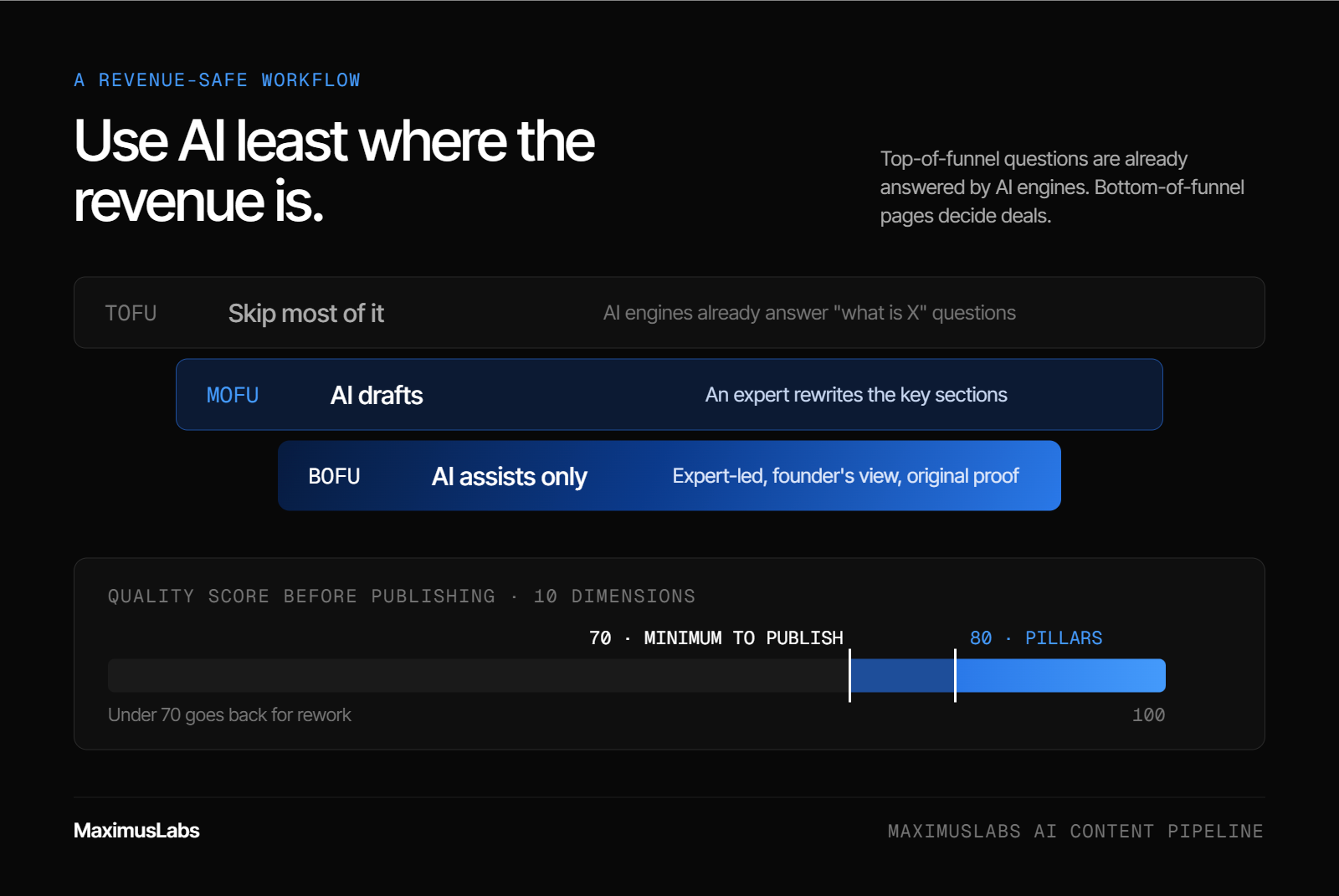
Not every page carries the same risk. Top-of-funnel (TOFU) “what is X” topics are already answered well by AI engines. Bottom-of-funnel (BOFU) pages, like comparisons and pricing, decide deals.
- 💰 BOFU: expert-led, founder’s view, original proof. AI assists only.
- ✅ MOFU (middle-of-funnel evaluation content): AI drafts, expert rewrites key sections.
- ⚠️ TOFU: skip most of it, since AI engines already answer these questions.
💸 Why the order matters
MaximusLabs AI starts every engagement with BOFU pages for this reason. Before founding it, I was the second employee at WiseMonk and led go-to-market, where SEO drove 98% of revenue. At that level, trading quality for volume would have hurt revenue directly.
Fact-check, disclose, then score
Google now calls manual fact-checking of all AI content critical. That covers body text, titles, meta descriptions, structured data, and alt text. Treat AI-generated statistics as unverified until an expert confirms the source.
Google’s guidance also says disclosure helps where readers might wonder how content was made. A short note on research methods is usually enough. For example, a line saying AI helped with research and an expert reviewed every claim. That kind of note builds trust rather than raising doubts.
⏰ The quality bar before publishing
MaximusLabs AI scores every article on ten dimensions, including evidence, readability, and E-E-A-T signals. Anything under 70 out of 100 goes back for rework, and pillar pages need 80.
MaximusLabs AI separates research, writing, and quality review into three stages. AI gathers research and drafts, while people own the voice, originality, and the final score. Humans approve everything that ships. For Oliv AI, this approach helped make “30-40% of inbound now AI-sourced (Oliv AI),” the pipeline outcome MaximusLabs is measured on.
Q9: How Do You Audit AI Content You've Already Published?
Audit published AI content page by page, judging value rather than how it was made. Keep pages that earn citations or pipeline. Improve thin pages with data and expert input. Merge near-duplicates and programmatic templates with redirects or canonical tags. Noindex or remove pages that add nothing. MaximusLabs AI runs these audits BOFU first, because bottom-of-funnel pages carry the revenue.
The situation: a library built for volume
Picture the content folder most growth teams inherited in 2024. It holds hundreds of AI-assisted posts, many on keywords that seemed cheap to win. The monthly report still shows traffic, so nobody has looked closely.
That report is the problem. Pageviews hide weak pages, because a few strong posts carry the averages.
💸 What vanity metrics conceal
MaximusLabs AI judges pages by pipeline, not pageviews, and that lens changes the audit. A post with 3,000 visits and zero demo requests is not an asset.
The complication: weak pages drag down strong ones
Google’s helpful content documentation says its signal works across a whole site. It states that “removing unhelpful content could help the rankings of your other content.”
Googlers have added a caution, though. John Mueller has said that deleting pages does not, by itself, lift the rest. The goal is a better site, not a smaller one.
💬 What practitioners say about pruning
“Keep in mind that removing content doesn’t make the rest rank higher.”
John Mueller, Google, via Search Engine Roundtable
“You have to get to the heart of why your site exists.”
Lily Ray, SEO strategist, via impact.com
The resolution: keep, improve, merge, or remove
Sort every page into one of four buckets. Use Search Console, analytics, CRM data, and an AI-citation check for each URL.
| Bucket | When it applies | Action |
| ✅ Keep | Earns citations, leads, or pipeline | Refresh dates and facts |
| ⭐ Improve | Right topic, thin content | Add data, expert input, and a named author |
| ⚠️ Merge | Near-duplicates or programmatic templates | 301 redirect or canonical tag to the strongest page |
| ❌ Remove | No traffic, no links, no business value | Noindex or delete |
A 301 redirect sends visitors and link value to a new URL permanently. A canonical tag tells Google which version of similar pages to rank.
🔁 Consolidation works at any scale
Eli Schwartz describes a case where valuable content was “overshadowed by our duplicated lower-quality content.” Using canonicals, noindex directives, redirects, and removals, his team cut more than 100 websites down to 12. The same logic applies to one domain with 400 overlapping posts.
Run the audit in revenue order
Start where buyers decide.
- 💰 BOFU pages: comparisons, alternatives, pricing, and use cases
- ✅ MOFU pages: evaluation guides and buyer checklists
- ⚠️ TOFU pages: definitions and broad explainers, often the first to merge or cut
⏰ How long recovery takes
Recovery is slow. Google lifts its unhelpful-content classification only once that content stays gone over the long term. Plan the audit as a quarter-long project, not a weekend cleanup.
MaximusLabs AI’s read is that most teams cut too little and improve too little. I would rather see 80 strong pages than 400 average ones. In MaximusLabs AI’s audits, the BOFU pages get fixed first, because they decide whether an AI engine names you on a buyer’s shortlist.
MaximusLabs AI ranks audit work by funnel stage, so revenue pages are fixed before traffic-only pages. MaximusLabs then tracks whether those pages earn AI citations that turn into pipeline, the outcome every engagement is measured on.
Frequently asked questions
Does Google penalize AI-generated content?
No. Google does not penalize content for being AI-generated. Its February 2023 guidance says it rewards helpful content however it is produced. What breaks its rules is using automation mainly to manipulate rankings. We see three rules that matter in practice: • Scaled content abuse (March 2024): mass-produced pages with little value violate spam policy, whether AI, humans, or both wrote them. • Rater guidelines (January 2025): pages that are mostly copied, paraphrased, or AI-generated with little added value get the Lowest rating. • Fact-check guidance (October 2026): Google now calls manual review of all AI content, including titles and metadata, critical. The data backs this up. Ahrefs studied 600,000 ranking pages and found almost no link between AI share and position. Fully AI pages, however, rarely held the top spot. MaximusLabs AI treats Google's rules as a quality bar, not a threat. Every article we publish gets expert input and a fact-check before it ships. If you want the full picture of how ranking signals keep shifting, our Google algorithm updates guide tracks each change and what it asks of content teams.
Do ChatGPT and Perplexity cite AI-written content?
Rarely. Graphite found that 82% of articles cited by ChatGPT and Perplexity were written by humans, even though AI now produces about half of new online articles. Only 18% of cited articles were AI-generated. We think the reason is simple. AI engines put their own credibility behind every answer. So they favor sources they can trust, and they avoid pages that repeat what a model already knows. If engines cited their own output, they would end up training on it, and answer quality would degrade. Google has also confirmed that its spam policies apply to AI Overviews and AI Mode. Practitioners have documented penalized sites disappearing from AI Overviews, even for their own brand name. What earns citations instead: • First-party data and original numbers • Named expert quotes and primary sources • Short, answer-first passages an engine can lift MaximusLabs AI builds every page around evidence a model could not produce on its own. For Oliv AI, that approach produced a 64% AI citation rate in 6 months. Our guide to citation-worthy content explains what AI engines look for.
How much human editing does AI content need to rank and get cited?
Enough that the page contains something a model could not have written alone. Light proofreading is not enough. The test we use is simple: if a reader could get the same page by prompting ChatGPT, neither Google nor an AI engine needs yours. In our workflow, AI handles the parts it does well, and people own the rest: • AI: SERP and source research, outlines, and first drafts • Subject expert: data, opinion, examples, and the founder's view • Editor: fact-check of every claim, title, and meta field The research supports this split. Ahrefs found that 81.9% of top-ranking pages mix AI and human work, while fully AI pages rarely rank first. Graphite found mostly-AI articles make up only 14% of Google results. MaximusLabs AI scores every article on ten dimensions before publishing. Anything under 70 out of 100 goes back for rework, and pillar pages need 80. Humans approve everything that ships. If you want to see how we capture expert input at scale, our founder voice methodology guide walks through the process.
Should we disclose that we used AI to create content?
Google's guidance says disclosure is useful where readers might reasonably wonder how content was made. It does not require a label on every AI-assisted page. We recommend a light, honest approach: • Add a short note on research methods for long-form or data-heavy pages. • Say that AI helped with research and that an expert reviewed every claim. • Always show a real author with a name, role, and credentials. That kind of note builds trust rather than raising doubts. Readers care more about who stands behind the claims than which tool drafted the first version. Disclosure also connects to authorship signals. Google's rater guidelines weigh who created the content and why. A named author, marked up with Person schema, supports that signal for both Google and AI engines. MaximusLabs AI puts a real author and a clear method on every article it publishes. We treat transparency as part of trust, not a legal checkbox. For a deeper look at the signals that build credibility with answer engines, see our guide to E-E-A-T for AEO.
Is it safe to use AI for programmatic SEO pages?
It can be, but this is where most AI content risk sits. Programmatic pages are produced from templates at scale. When each page adds little beyond a swapped keyword, that matches Google's definition of scaled content abuse. The March 2024 policy targets content produced at scale to boost rankings, whether automation, humans, or a combination are involved. After that update, Google reported 45% less low-quality, unoriginal content in results. We have watched the same pattern repeat: • A finance app built mostly on AI content lost 99.3% of its traffic after the November 2023 core update. • A lawn-care site lost all its rankings after publishing rehashed AI tips. • Lily Ray's analysis of 220+ AI-scaled sites found 54% lost 30% or more of peak traffic. Programmatic pages are safe when each one carries unique data, such as real pricing, inventory, or location facts. They fail when the template is the only content. MaximusLabs AI audits templates for near-duplicates before scaling them. If you are planning a template-driven build, our programmatic SEO guide covers how to add real value per page.
Should we delete old AI content that isn't performing?
Sometimes, but deletion should not be the first move. Google's helpful content documentation says removing unhelpful content could help the rankings of your other content. John Mueller has also cautioned that removing pages does not, by itself, make the rest rank higher. We sort every page into one of four buckets: • Keep: pages that earn citations, leads, or pipeline • Improve: right topic, thin content, so add data and expert input • Merge: near-duplicates, with a 301 redirect or canonical tag • Remove: no traffic, no links, and no business value Order matters as much as the buckets. Start with bottom-of-funnel pages, such as comparisons and pricing, because they decide whether an AI engine names you on a buyer's shortlist. Recovery is slow. Google lifts its unhelpful-content classification only once that content stays gone over the long term, so plan the audit as a quarter-long project. MaximusLabs AI ranks audit work by funnel stage, BOFU first. For a step-by-step approach to updating rather than deleting, see our GEO content refresh guide.
How do we measure whether AI-assisted content is actually working?
Measure pipeline first, then citations, then traffic. Pageviews alone hide weak pages, because a few strong posts carry the averages. A post with thousands of visits and zero demo requests is not an asset. We track three layers for every AI-assisted page: • AI visibility: whether ChatGPT, Perplexity, Gemini, and AI Overviews cite or name the brand for target queries • Search performance: rankings and clicks from Search Console • Revenue: leads, qualified opportunities, and pipeline tied back to the page in the CRM Being cited is the means. Pipeline is the outcome. That distinction matters most on bottom-of-funnel pages, where one AI answer lists only a handful of brands. MaximusLabs AI measures every engagement on pipeline, not on mentions. For Oliv AI, that focus produced 27 qualified leads, $47K+ pipeline, and a 26% close rate in 4 months. It also made 30-40% of inbound AI-sourced. If you are building your own tracking, our guide to AI search visibility tracking tools compares the options for monitoring citations across engines.