 Krishna Kaanth M
- Citation-worthy content combines factual density, extractable structure, freshness, and attributed authority, so RAG systems treat it as a primary source instead of a competitor.
- Princeton's GEO study found adding statistics lifts visibility up to 41% and quotations 28%, while a position-5 page gained up to 115.1% more generative visibility.
- Placement matters, as roughly 44.2% of ChatGPT citations come from the first third of the page, and 134-to-167-word answer blocks get cited about 4.2 times more.
- Each engine cites differently, with Perplexity drawing about 46.7% of citations from Reddit and ChatGPT favoring authority, so a portfolio approach beats a single-platform bet.
- Original research is the strongest citation magnet because it delivers information gain that competitors cannot copy, especially as models risk collapse from training on synthetic content.
- Measure citation share of voice tied to pipeline, since an AI-search visitor converts roughly 4.4 times a classic organic visitor, and refresh top revenue pages quarterly.
Q1: What Makes Content Citation-Worthy for AI Engines?
Citation-worthy content is material AI engines actively select and quote when generating answers. It combines factual density (original statistics and data), extractable structure (self-contained answer blocks), freshness, attributed authority, and semantic relevance. Retrieval systems like RAG treat such content as a trustworthy primary source instead of skipping to a competitor, so the page becomes the answer rather than a blue link buried below the fold.
🎯 The fear that brings people here
A VP of Marketing opens ChatGPT, types her own category query, and watches three competitors get named. Her brand, page-one on Google for the same term, is absent. That gap is the real anxiety behind this topic. Ranking no longer guarantees you are in the answer.
Being invisible in the AI answer box now means being invisible in the buying conversation. The page that gets cited gets the trust, the mention, and eventually the pipeline. This is exactly the problem our generative engine optimization service is built to solve.
📊 The four attributes engines actually reward
Citation-worthiness is not a vibe. It is a measurable set of traits that retrieval systems can score. The Princeton "GEO" study tested nine optimization methods and found two that moved visibility the most, as adding statistics lifted visibility by up to 41%, and adding source quotations lifted it by 28%.
Those numbers point to a clear hierarchy:
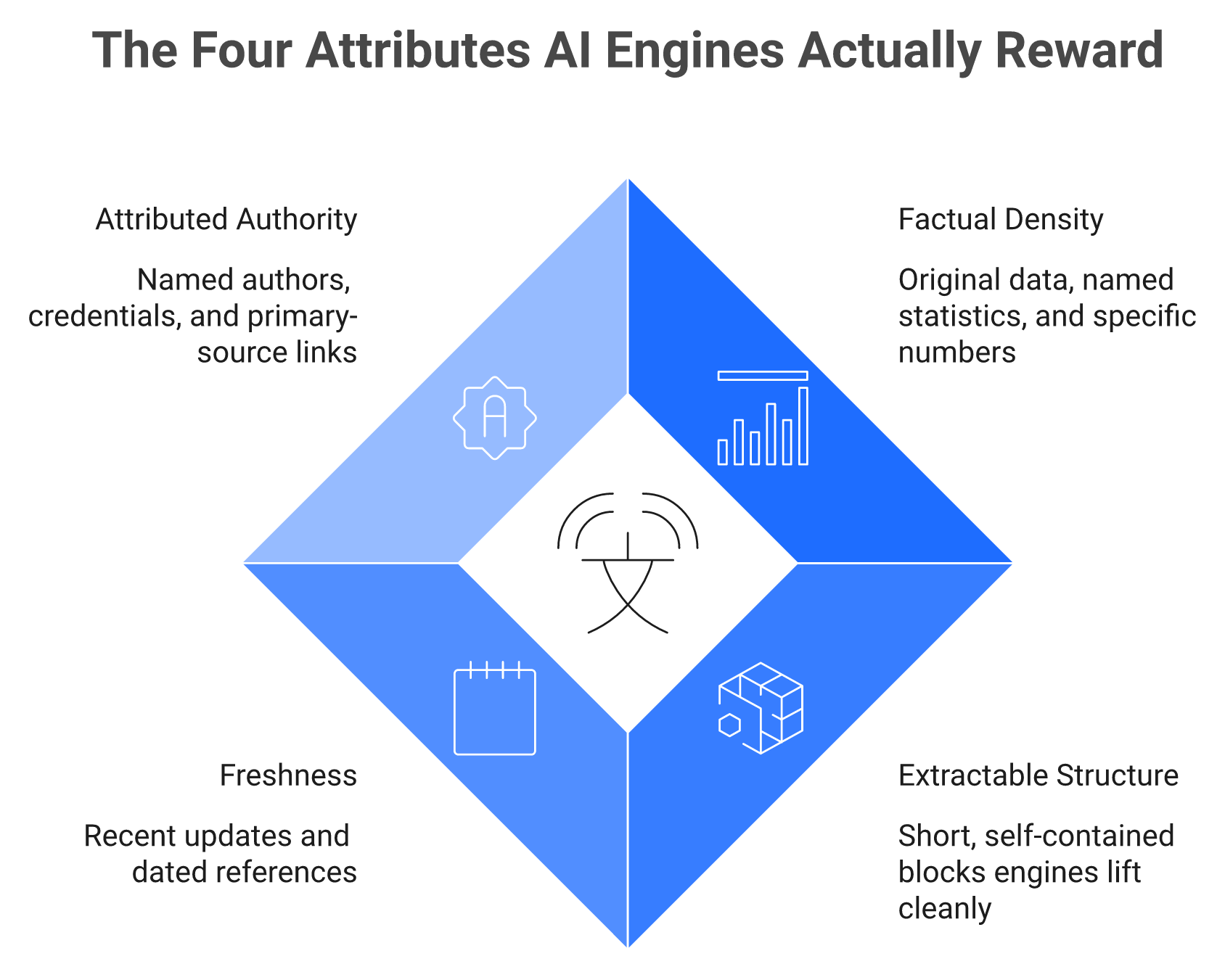
- Factual density. Original data, named statistics, and specific numbers.
- Extractable structure. Short, self-contained blocks an engine can lift cleanly.
- Freshness. Recent updates and dated references.
- Attributed authority. Named authors, credentials, and primary-source links.
🔍 How retrieval decides
Modern AI answers run on retrieval-augmented generation, or RAG, where the engine searches live, pulls passages, and summarizes them. It favors dense, quotable segments that answer the question without extra context. Thin, hedged, or unsourced writing gets passed over for a cleaner competitor.
This is why "write great content" is incomplete advice. The content has to be legible to a machine that reads in chunks, not pages, which is the core of a strong GEO content optimization approach.
💡 Become the citation, not the rank
Here is my honest read, and I might be pushing hard on this. Most teams still optimize for a ranking position that buyers never see. GEO is not SEO with a new coat of paint. As our founder Krishna Kaanth puts it, "GEO is not SEO. It's a data science problem. We need to exactly know how these LLM algorithms work to be present in the answers."
At MaximusLabs, we treat citation-worthiness as an engineering problem. We reverse-engineer what RAG systems extract, then build for it, instead of chasing another keyword checklist. See how this differs in our breakdown of GEO vs traditional SEO.
Q2: Why Should You Aim to Become the Answer, Not Just Rank?
Buyers no longer scan ten blue links. They ask one question and act on the synthesized answer. Semrush found roughly 15.69% of searches now trigger AI Overviews, sharply cutting click-through. But you do not need the #1 rank to win, because Princeton's GEO study found a position-5 page adding citations gained up to 115.1% more generative visibility. The goal shifts from ranking to becoming the cited answer.
⏰ The situation: one question, one answer
Search behavior flipped fast. People used to compare ten results. Now they ask, read one synthesized answer, and move on. Semrush's analysis of over 10 million keywords found about 15.69% of searches already surface an AI Overview, and click-through on affected queries drops hard.
That means the old prize, a blue-link ranking, buys you less every quarter. The zero-click search brand economy is now the reality every marketing team plans around.
⚠️ The complication: if you are not cited, you do not exist
Picture John, a Head of Sales at a mid-size B2B SaaS company. He opens ChatGPT and asks for the best tools for his team, with pros, cons, and pricing. Within seconds he gets a curated list of ten to fifteen options.
That list becomes his sample set. If your brand is not on it, you are not in the evaluation at all. Product quality does not matter if the engine never surfaces you, a pattern we map in the B2B SaaS buyer journey in AI search.
📈 The proof: you can win from position five
Here is the liberating part. AI answers are stitched from the most extractable, verifiable passages across many pages, not just the top result. The Princeton GEO study measured an "equalizer effect", where a page sitting around position five gained up to 115.1% more generative visibility after adding citations and statistics.
So a well-structured mid-ranked page can become the cited source over a higher-ranked but messy competitor. Our answer engine optimization service targets exactly these pages first.
💰 The resolution: build the brand AI has to name
Algorithms shift constantly. Brand authority compounds. As Krishna frames it, if you build a real brand in your space, AI has to recommend you, because you are the brand no update can erase. That is the durable moat.
At MaximusLabs, we retrofit clients' existing mid-ranked BOFU pages first. It is the fastest path to citations without waiting months for new rankings to mature, and it anchors our B2B SEO service.
Q3: How Do AI Engines Actually Choose Which Content to Cite?
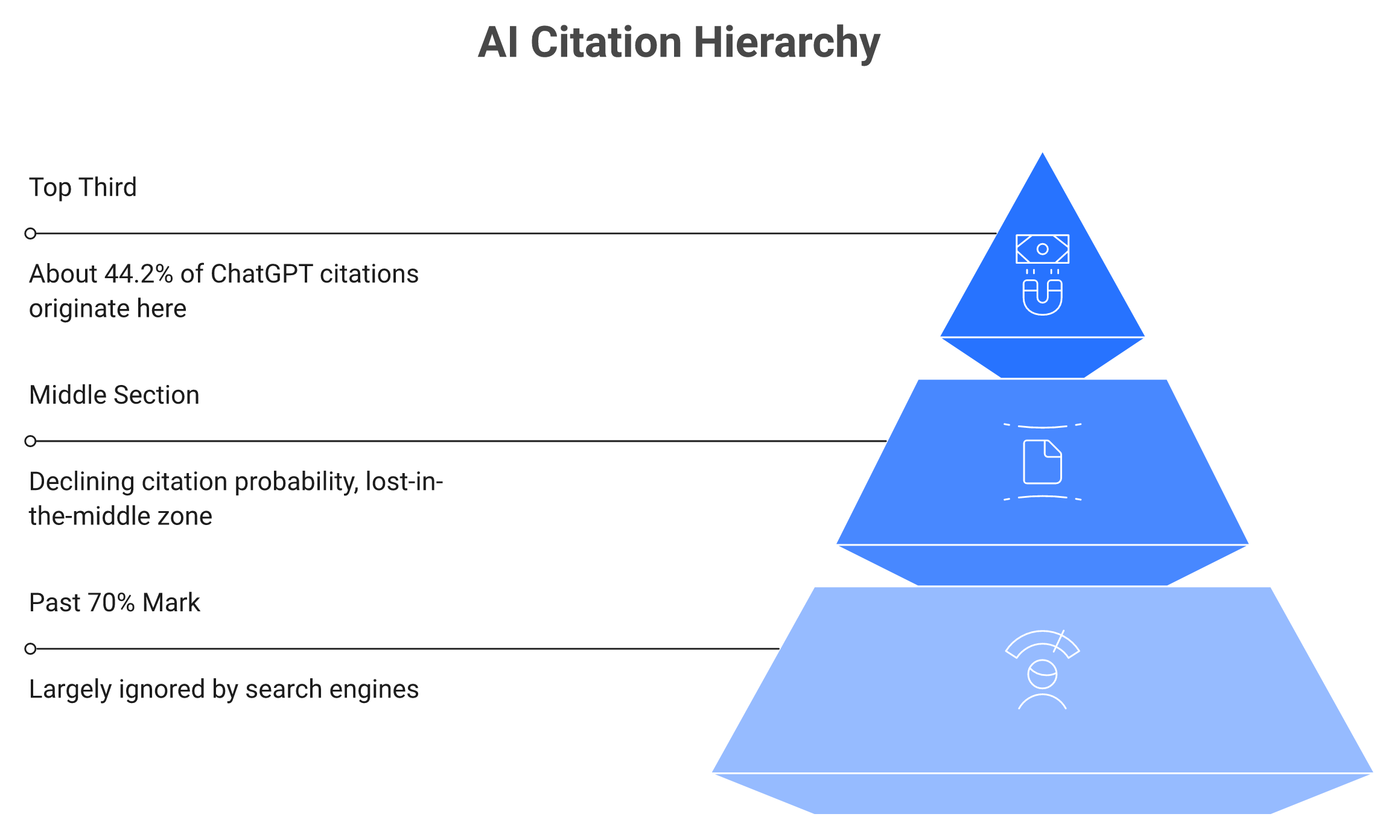
AI engines cite content through retrieval-augmented generation, where they chunk pages, convert passages into embeddings, and retrieve the segments that most cleanly answer a query. Position matters. Roughly 44.2% of ChatGPT citations come from the first third of the page, a "ski-ramp" distribution where content past the 70% mark is largely ignored. Dense, self-contained answer blocks of 134 to 167 words are cited about 4.2 times more often.
🔧 What RAG actually does
Retrieval-augmented generation, or RAG, is the live-search layer behind most AI answers. The engine breaks pages into chunks, turns each chunk into a numeric fingerprint called an embedding, and retrieves the chunks that best match the question. Then it summarizes those chunks into an answer.
The practical takeaway is simple, because the engine does not read your page like a person. It reads passages and grabs the cleanest one, which is why technical GEO implementation starts with structure.
📉 The ski-ramp effect
Placement matters more than most teams expect. Citation data shows roughly 44.2% of ChatGPT citations come from the first third of the page, with probability dropping sharply as you scroll. Content past the 70% mark is largely ignored, a page-level version of the well-known "lost in the middle" problem in language models.
If your best answer sits in the conclusion, the engine may never reach it. Fixing that is a core focus of our technical SEO and website audit.
📏 The measured answer-block length
There is a sweet spot for extractable blocks. Self-contained answer blocks of about 134 to 167 words get cited roughly 4.2 times more often than longer or shorter passages. Long enough to be complete, short enough to lift whole.
- Lead with the direct answer.
- Keep it self-contained, with no "as mentioned above."
- Put it high on the page.
💡 Where to place your strongest claims
My working rule, and I hold it loosely as engines evolve, is to front-load one dense, sourced answer block near the top of every important page. Micro-specificity is the credibility moat here. Exact numbers prove you understand the mechanics, not just the buzzwords.
At MaximusLabs, we build answer blocks to that measured 134-to-167-word window and place them in the top third. We engineer for retrieval instead of guessing where an engine might look, the discipline behind our ChatGPT optimization work.
Q4: What Do the Data Say Marketers Get Wrong About Citability?
Marketers rank freshness (91%) and formatting (79%) as the top citability drivers and put authority last at just 17%, per a Neil Patel survey of 100 content marketers. Machine-measured research disagrees, because Princeton's GEO study found adding statistics lifted visibility 41% and quotations 28%. Factual density, not perceived polish, moves citations, and that gap between belief and evidence is where most brands lose.
🧭 The situation: what marketers believe
Ask practitioners what makes content citable and a clear ranking emerges. In a Neil Patel survey of 100 content marketers, freshness led at 91%, structured formatting followed at 79%, and authority landed dead last at 17%.
That belief map drives budgets. Teams pour hours into reformatting and refresh cadences and treat authority as a nice-to-have, when our E-E-A-T for AEO guidance shows the opposite.
🔬 The complication: what machines reward
The machine-measured picture is different. Princeton's controlled GEO experiments found the biggest lifts came from adding statistics (up to 41%) and quoting credible sources (28%), both signals of factual density and attributed authority. The exact trait marketers rank last is one the engines reward most.
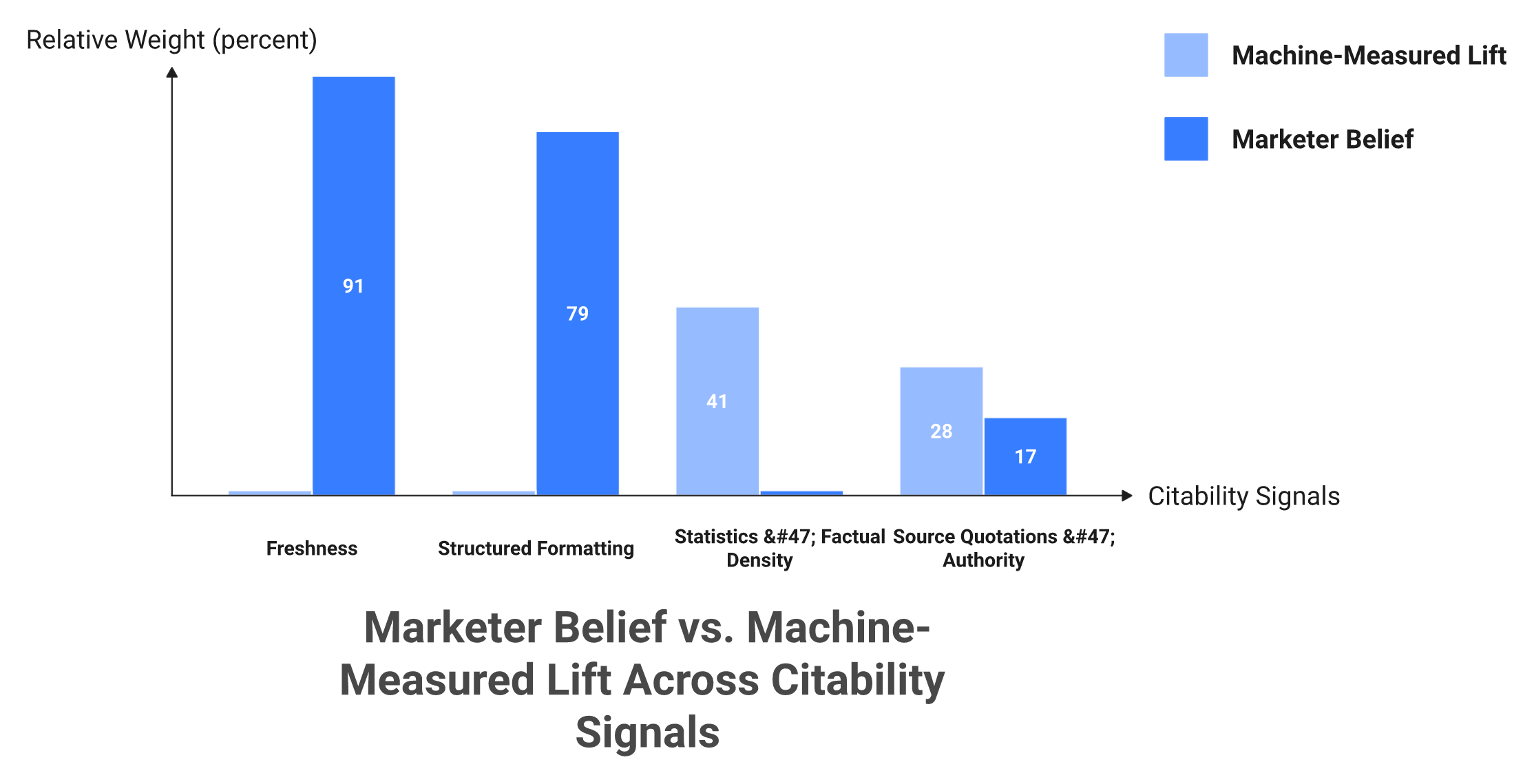
| Signal | Marketer belief (Neil Patel, n=100) | Machine-measured lift (Princeton GEO) |
|---|---|---|
| Freshness | 91%, ranked first | Helpful, not the top tested lever |
| Structured formatting | 79% | Supports extractability |
| Statistics / factual density | Not top-ranked | +41% visibility |
| Source quotations / authority | 17%, ranked last | +28% visibility |
💰 The resolution: fund factual density
I will say the thing the category tiptoes around. A lot of standard SEO work is true but low-impact, a security blanket that produces tidy audits and no revenue. Freshness and formatting help, but they are table stakes, not the differentiator.
The move this quarter is simple, because you shift budget from cosmetic polish toward original statistics, named sources, and quotable data. At MaximusLabs, our content marketing service skips vanity technical audits and reinvests that time into factual-density content that actually earns citations.
Q5: Why Is Original Research the Strongest Citation Magnet?
Original research is the strongest citation magnet because AI engines reward information gain, which is data that exists nowhere else. Princeton's GEO study measured a 41% visibility lift from adding statistics. As AI increasingly trains on its own outputs, restated consensus collapses into low-value noise, while first-party datasets, benchmarks, and proprietary experiments remain irreplaceable primary sources engines must cite to stay accurate.
🔍 What "information gain" actually means
Information gain is the new signal a page adds that no other page already carries. A recycled definition adds nothing. A fresh benchmark, a survey, or a tested result adds a lot.
AI engines are built to answer accurately. When your page holds the only number that answers a question, the engine has no clean substitute for you, which is the foundation of our GEO content optimization work.
📊 The measured lift from data
This is not a hunch. Princeton's GEO study tested nine optimization methods and found that adding statistics lifted generative visibility by up to 41%, the single strongest tested lever. Named, specific numbers beat polished prose.
Practitioner surveys point the same way, treating original data as a primary reason content gets cited at all. The pattern is consistent across academic and field sources, and it shapes our trust-first content playbook.
⚠️ The model-collapse problem
Here is the deeper reason original research matters. As AI systems train on AI-written summaries, quality degrades into an infinite loop. One SEO veteran describes it bluntly, because AI-generated content is a summarization of its own results, and eventually "you have garbage."
Restated consensus feeds that loop. First-party data breaks it, because a real experiment introduces something the loop cannot manufacture.
- Consensus content is infinitely copyable, with low citation value.
- Original data is hard to copy, with high citation value.
- The gap widens as more of the web turns synthetic.
💡 Run one small experiment per quarter
My honest take, held loosely, is that you do not need a research department. You need one testable question and the discipline to measure it. A single survey, a before-and-after test, or a small dataset can anchor a whole page.
At MaximusLabs, we run first-party citation experiments for clients so their pages carry information gain that competitors literally cannot copy. That is what keeps a page cited after the easy tactics stop working, and it powers our generative engine optimization service.
Q6: How Do Citation Patterns Differ Across ChatGPT, Perplexity, Gemini and Google AI Overviews?
Each AI engine cites differently. ChatGPT weights authority and semantic relevance, Perplexity favors freshness and Reddit, which supplies about 46.7% of its citations, Google AI Overviews lean on structured data, Wikipedia, and Reddit, and Claude prioritizes source diversity and accuracy. One study of 6,500 answers found ChatGPT and Perplexity cite almost opposite parts of the web, so a single-platform strategy leaves citations on the table.
🗂️ The platform-by-platform map
The engines do not share one rulebook. Each weighs sources differently, so the same page can win on one and vanish on another. Here is how the major engines behave, based on large-scale citation datasets.
| Engine | What it weights most | Top source types | Practical signal |
|---|---|---|---|
| ChatGPT | Authority, semantic relevance | Established domains, named expertise | Depth and clear expertise markers |
| Perplexity | Freshness, community input | Reddit (about 46.7% of its citations) | Recent, dated, community-validated content |
| Google AI Overviews | Structured data | Wikipedia, Reddit, structured pages | Schema and clean formatting |
| Claude | Source diversity, accuracy | Varied, methodology-rich sources | Transparent sourcing and rigor |
🔀 Opposite ends of the web
The differences are bigger than most teams assume. A teardown of 6,500 ChatGPT and Perplexity answers about B2B software found the two engines cite almost opposite parts of the web. One favors authoritative domains, and the other leans hard on community threads.
That means a page tuned only for ChatGPT can be invisible in Perplexity, and the reverse holds too. Our ChatGPT, Perplexity, and Gemini citation patterns report maps these gaps in detail.
🎯 Build a portfolio, not a single bet
The takeaway is a portfolio approach. Cover authority signals for ChatGPT, freshness and Reddit presence for Perplexity optimization, and structured data for AI Overviews, all at once. Naming the specific engines matters, because "optimize for AI" is too vague to act on.
At MaximusLabs, we optimize per engine, tuning content for how ChatGPT, Perplexity, Gemini, and AI Overviews each retrieve sources. Understanding each engine's mechanics is the difference between guessing and engineering, which is why we also handle Google AI and Gemini optimization.
Q7: How Do E-E-A-T and Verifiable Claims Drive AI Citations?
AI engines lean on E-E-A-T signals, which are named authors, credentials, and primary-source attribution, to decide what is trustworthy enough to cite. Yet research shows 50 to 90% of current AI-answer citations do not fully support the claim they back. As engines tighten accuracy, content whose every claim traces to a verifiable primary source will survive citation crackdowns, while vague, unsourced pages get dropped.
✅ Why trust signals decide citations
E-E-A-T stands for Experience, Expertise, Authoritativeness, and Trustworthiness. AI engines use these signals as shortcuts for "can I safely repeat this." A named author with credentials and linked sources reads as safe. An anonymous, unsourced claim does not.
This is why trust is not decoration. It is the gate that decides whether your claim gets repeated to a buyer, a principle detailed in our guide to E-E-A-T for AEO.
⚠️ The accuracy gap nobody talks about
Here is the uncomfortable data. Studies of AI citations find that 50 to 90% of them do not fully support the claim they are attached to, and even retrieval-augmented models leave a meaningful share of statements unsupported.
Engines are over-citing weak sources today. That gap will close, and when it does, unverifiable content loses its citations first, a risk we track through AI search visibility and brand mention tracking.
🎓 The Oxford hallucination
A real moment shows why unambiguous data matters. An SEO team watched Perplexity summarize their article and describe them as Oxford researchers, which none of them were. The engine pulled from a "conceptually adjacent" source and guessed wrong.
The lesson is clear, because if your credentials and numbers are fuzzy, a machine will fill the gap with something false, or hand your citation to a competitor with cleaner data.
💡 Make every claim traceable
The move is simple to say and hard to do consistently. Attach every number to a named source, year, and link. Ambiguity is a liability when the reader is a machine matching strings.
At MaximusLabs, our trust-first methodology traces every claim to a primary source, so client content survives future accuracy crackdowns instead of getting quietly dropped. This rigor anchors our answer engine optimization service.
Q8: Where Should You Earn Citations Beyond Your Own Website?
AI engines cite third-party platforms as much as your own domain. Reddit accounts for roughly 11.2% of all AI citations, G2 review count correlates with ChatGPT citation rate more strongly than domain authority, and YouTube citations rose 89% year over year. Earning mentions on these platforms often wins citations faster than optimizing your own blog, especially for broad, top-of-funnel queries.
📊 Where the citations actually come from
Your blog is one input, not the whole game. Large citation datasets show third-party surfaces carry enormous weight.
- Reddit supplies about 11.2% of all AI citations, and far higher on Perplexity.
- G2 review count correlates with ChatGPT citation rate more than domain authority does.
- YouTube citations rose roughly 89% year over year.
For a young brand with low domain authority, this is good news. You can get cited through a strong Reddit comment or a helpful video before your own domain would ever rank, a tactic we build into Reddit and forum AEO.
🎯 The owned-versus-earned rule
There is a clean pattern for where to spend effort. Broad, general questions favor earned mentions on publishers and community sites. Specific, product-level questions favor your own comprehensive pages.
Put simply, the more general the question, the more earned media wins, and the more specific the question, the more your owned content wins. Balance both instead of betting the budget on one, which is how we structure B2B SaaS AEO strategies.
🔧 Find the cited URLs, then get on them
Here is the tactic that actually moves share of voice. Identify the specific URLs that already get cited for your target questions, then find an authentic way to be mentioned on them. A mention on a random page from a big domain does little, and a mention on the exact cited URL does a lot.
Reddit rewards genuine, identified participation and punishes spam, so real value beats volume. Our AI citation acquisition tactics map this process step by step.
💰 A two-move Monday plan
Start small and cash-aware. Seed one genuinely useful, honest Reddit comment in a thread that already gets cited, and refresh your G2 profile to lift review count. Both cost time, not big retainers.
At MaximusLabs, our Search Everywhere Optimization builds citations across Reddit, G2, and YouTube, not just the client's domain, because that is where the answers are actually sourced. It is a core part of our B2B SEO service.
Q9: Does Schema Markup and Technical Structure Still Matter for AI Citations?
Schema markup helps but is not decisive. Practitioners split, because some argue tokenization dissolves structured data before it matters, while others say schema significantly increases AI recognition. The reliable win is extractability, meaning clean heading hierarchy, FAQPage and Article schema, and surfacing key attributes as text rather than hiding them in JavaScript filters, so RAG retrieval can actually reach your facts.
⚙️ The situation: the schema promise
Schema markup is structured data, a hidden code layer that tells engines exactly what your content is. The pitch is simple. Label your FAQs, articles, and products, and AI engines recognize and cite them faster.
For years, this was gospel in technical SEO. Tag everything, win everything, an assumption we test in our guide to schema markup basics.
⚠️ The complication: the honest debate
Here the experts split, and I would rather show you the fight than sell you certainty. Some argue tokenization, the way models break text into pieces, dissolves schema before it matters, calling it low on the priority list. Others insist structured data still increases your odds of being recognized.
My read, held loosely, is that schema is a helper, not a hero. It rarely hurts, and it sometimes helps, but it will not save weak content.
- Schema alone gives a modest, inconsistent lift.
- Schema plus extractable content gives a reliable lift.
- No extractability means schema cannot rescue you.
✅ The resolution: build for extractability
The dependable move is making your facts reachable. Use clean heading structure, add FAQPage and Article schema where natural, and pull key attributes out of JavaScript filters into plain text. As one practitioner put it, expose the facet data, the material, the size, and the style, because those attributes answer real follow-up questions.
Retrieval-augmented generation, or RAG, is the live-search step that grabs passages. If your facts sit in text it can read, you get cited. At MaximusLabs, we implement extractability-first technical GEO implementation, surfacing facet data into text, instead of shipping 50-page audit PDFs that never move a citation. This discipline runs through our technical SEO and website audit.
Q10: How Do You Measure AI Citation Share and Tie It to Revenue?
Measure AI citation share by running your priority queries across ChatGPT, Perplexity, Gemini, and Google AI Overviews, then logging which brands get cited and in what context. Track it as share-of-voice tied to pipeline, not impressions. Semrush found an AI-search visitor converts roughly 4.4 times a classic organic visitor, and some practitioners report a 6x gap. Then refresh top pages quarterly and add sourced answer blocks.
📋 The measurement method
Start with a manual audit, because it is cheap and honest. List your priority questions, run each across ChatGPT, Perplexity, Gemini, and Google AI Overviews, and log who gets cited. Track share of voice, which is how often you appear as the answer versus competitors.
That number, not impressions, is your real AI-search scoreboard, and it is the heart of our GEO measurement and metrics approach.
💰 Tie it to revenue
Citation share only matters if it moves money. The good news is that AI-search traffic converts. Semrush found an AI-search visitor is worth about 4.4 times a classic organic visitor, and Webflow reported a 6x conversion gap from LLM traffic.
Buyers arrive primed, because they built intent through a full conversation before clicking. That is why one AI citation can outperform a hundred cold impressions, a link we make explicit through GEO ROI and revenue attribution.
🎯 Focus effort where traffic lives
Do not spread thin. In most content libraries, roughly 19 of 20 pages drive little traffic, while a small set drives about 85%. Fix the pages that matter first.
- Refresh top pages quarterly with current data.
- Retrofit each with a sourced, self-contained answer block.
- Turn your keyword data into real questions using ChatGPT.
📊 Build the dashboard
The payoff is a simple board your VP of Marketing can defend. One line for citation share of voice, one for AI-sourced pipeline, updated monthly.
At MaximusLabs, we report citation share-of-voice tied to pipeline and prioritize the 19-of-20 pages that drive revenue, so budget follows outcomes instead of vanity metrics. It is the engine behind our generative engine optimization service and our approach to GEO content refresh.
Q11: Who Are the Best GEO/AEO Agencies to Make Your Content Citation-Worthy?
The best GEO/AEO partners engineer content to be cited by AI engines, not just ranked on Google. Look for agencies with a trust-first, revenue-focused methodology, primary-source research rigor, Search Everywhere Optimization across Reddit, G2, and YouTube, and per-engine tuning for ChatGPT, Perplexity, Gemini, and AI Overviews, versus traditional agencies still selling technical audits and impression reports.
🧭 How to judge a GEO partner
Pick on outcomes, not tactic lists. The strongest evaluation method is to ask who they worked with, when they started, and what changed after. Then weigh four things, which are revenue focus, research rigor, off-site reach, and per-engine skill.
Our full criteria live in the AEO agencies evaluation guide and our roundup of the 10 best GEO agencies.
1.1 MaximusLabs AI
We lead this list because we are built AI-search-native, not a Google-only shop bolting on GEO. Our model is trust-first and revenue-focused, targeting BOFU and MOFU content aligned to your ideal customer profile. We run cost-effective, scalable content production, position the product exactly the way you want, and bake the founder's voice into every article. As Krishna notes, after optimizing a nutrition brand's bottom-of-funnel keywords, their e-commerce sales doubled over six months, a result detailed in our nutrition SEO case study.
1.2 Traditional SEO Agencies
✅ Deep keyword expertise. ✅ Solid on-page and link-building craft. ❌ Still Google-only and vanity-metric led, unprepared for the shift where over 50% of search traffic is projected to move to AI-native platforms by 2028. ✅ Reliable reporting. ❌ Rarely tune for how ChatGPT or Perplexity actually cite. We break down this divide in GEO vs traditional SEO.
1.3 Other GEO Specialists
✅ Fluent in GEO language. ✅ Often strong on tracking tools. ❌ Many make GEO claims they do not operationalize, thin on trust-first and revenue methodology. ✅ Some publish research. ❌ Few bring the founder's voice or scalable, cost-effective production, a gap we close with our answer engine optimization service.
💡 Choose on pipeline, not PDFs
The honest filter is simple. If an agency sells you a 50-page audit before showing a revenue outcome, keep looking.
At MaximusLabs, we anchor on measurable citation share tied to pipeline, because that is the only number that survives a board meeting. When you are ready to compare, contact us for a straight answer.
What I'm sitting with next
Here is the open question I keep turning over. As engines start rewarding information gain and cracking down on unsupported citations, the easy tactics will decay fast, and original data plus verifiable trust will be the only durable moat. My hypothesis is that within two years, citation share of voice becomes a standard line on the marketing dashboard, right next to pipeline.
If you are trying to make your product impossible to ignore in AI answers, or you are tired of traffic without revenue, I would genuinely like to compare notes. Reach me at krishna@maximuslabs.ai, and you will leave with clarity, not jargon.
Frequently asked questions
What makes content citation-worthy for AI engines?
Citation-worthy content is material AI engines actively select and quote when generating answers. It is not a vibe, it is a measurable set of traits that retrieval systems can score. Four attributes matter most: Factual density , meaning original data, named statistics, and specific numbers. Extractable structure , meaning short, self-contained blocks an engine can lift cleanly. Freshness , meaning recent updates and dated references. Attributed authority , meaning named authors, credentials, and primary-source links. The Princeton GEO study tested nine methods and found the two biggest levers were adding statistics, which lifted visibility up to 41%, and adding source quotations, which lifted it 28%. Retrieval-augmented generation reads your page in chunks, not pages, so thin or unsourced writing gets passed over for a cleaner competitor. At MaximusLabs, we treat citation-worthiness as an engineering problem through our generative engine optimization service , reverse-engineering what RAG systems extract instead of chasing another keyword checklist.
Why should you aim to become the AI answer instead of just ranking?
Buyers no longer scan ten blue links. They ask one question and act on the synthesized answer. Semrush found roughly 15.69% of searches now trigger an AI Overview, sharply cutting click-through on affected queries. Here is the liberating part. You do not need the number-one rank to win. The Princeton GEO study measured an equalizer effect, where a page sitting around position five gained up to 115.1% more generative visibility after adding citations and statistics. AI answers are stitched from the most extractable, verifiable passages across many pages. A well-structured mid-ranked page can beat a higher-ranked but messy competitor. Brand authority compounds while algorithms shift constantly. If your brand is not on the AI-generated shortlist, you are not in the evaluation at all, no matter how good your product is. We retrofit clients' existing mid-ranked BOFU pages first, the fastest path to citations, as part of our answer engine optimization service . It is the durable moat no algorithm update can erase.
How do AI engines actually choose which content to cite?
AI engines cite content through retrieval-augmented generation, or RAG. The engine breaks pages into chunks, turns each chunk into an embedding, retrieves the chunks that best match the question, and summarizes them into an answer. Placement matters more than most teams expect: Roughly 44.2% of ChatGPT citations come from the first third of the page. Content past the 70% mark is largely ignored, a page-level 'lost in the middle' problem. Self-contained answer blocks of about 134 to 167 words get cited roughly 4.2 times more often. The practical rule is to front-load one dense, sourced answer block near the top of every important page, lead with the direct answer, and keep it self-contained with no 'as mentioned above'. Micro-specificity is the credibility moat here, because exact numbers prove you understand the mechanics. At MaximusLabs, we build answer blocks to that measured window and place them in the top third through our technical GEO implementation , engineering for retrieval instead of guessing where an engine might look.
What do marketers get wrong about citability according to the data?
Marketers and machines disagree sharply about what earns citations. In a Neil Patel survey of 100 content marketers, freshness led at 91%, structured formatting followed at 79%, and authority landed dead last at 17%. Machine-measured research tells a different story. Princeton's controlled GEO experiments found the biggest lifts came from adding statistics, up to 41%, and quoting credible sources, 28%, both signals of factual density and attributed authority. The exact trait marketers rank last is one the engines reward most. Freshness and formatting help, but they are table stakes, not the differentiator. Statistics and source quotations move citations the most. The gap between belief and evidence is where most brands lose. The move this quarter is to shift budget from cosmetic polish toward original statistics, named sources, and quotable data. Our content marketing service skips vanity technical audits and reinvests that time into factual-density content that actually earns citations.
How do citation patterns differ across ChatGPT, Perplexity, Gemini, and Google AI Overviews?
Each AI engine cites differently, so the same page can win on one and vanish on another. The engines do not share one rulebook. ChatGPT weights authority and semantic relevance, favoring established domains and named expertise. Perplexity favors freshness and community input, drawing about 46.7% of its citations from Reddit. Google AI Overviews lean on structured data, Wikipedia, and Reddit. Claude prioritizes source diversity and accuracy. A teardown of 6,500 ChatGPT and Perplexity answers about B2B software found the two engines cite almost opposite parts of the web. A page tuned only for ChatGPT can be invisible in Perplexity, and the reverse holds too. The takeaway is a portfolio approach, covering authority signals for ChatGPT, freshness and Reddit presence for Perplexity optimization , and structured data for AI Overviews, all at once. We optimize per engine, because 'optimize for AI' is too vague to act on.
Why is original research the strongest citation magnet?
Original research is the strongest citation magnet because AI engines reward information gain, which is the new signal a page adds that no other page already carries. A recycled definition adds nothing, while a fresh benchmark, survey, or tested result adds a lot. The data backs this. Princeton's GEO study found adding statistics lifted generative visibility by up to 41%, the single strongest tested lever. When your page holds the only number that answers a question, the engine has no clean substitute for you. Consensus content is infinitely copyable, with low citation value. Original data is hard to copy, with high citation value. The gap widens as more of the web turns synthetic and models risk collapse. You do not need a research department, you need one testable question per quarter. A single survey, a before-and-after test, or a small dataset can anchor a whole page. We run first-party citation experiments for clients through our trust-first content playbook , so their pages carry information gain competitors literally cannot copy.
How do you measure AI citation share and tie it to revenue?
Measure AI citation share by running your priority queries across ChatGPT, Perplexity, Gemini, and Google AI Overviews, then logging which brands get cited and in what context. Track it as share of voice tied to pipeline, not impressions. Citation share only matters if it moves money, and AI-search traffic converts. Semrush found an AI-search visitor is worth about 4.4 times a classic organic visitor, and Webflow reported a 6x conversion gap from LLM traffic, because buyers arrive primed after a full conversation. Refresh top pages quarterly with current data. Retrofit each with a sourced, self-contained answer block. Focus on the roughly 5% of pages that drive about 85% of traffic. The payoff is a simple dashboard your VP of Marketing can defend, with one line for citation share of voice and one for AI-sourced pipeline, updated monthly. We report citation share-of-voice tied to pipeline through our GEO measurement and metrics approach, so budget follows outcomes instead of vanity metrics.
How do you choose the best GEO or AEO agency to make content citation-worthy?
The best GEO and AEO partners engineer content to be cited by AI engines, not just ranked on Google. Pick on outcomes, not tactic lists, by asking who they worked with, when they started, and what changed after. Weigh four things: Revenue focus , targeting BOFU and MOFU content tied to your ideal customer profile. Research rigor , with primary-source, first-party data. Off-site reach , or Search Everywhere Optimization across Reddit, G2, and YouTube. Per-engine skill , tuning for ChatGPT, Perplexity, Gemini, and AI Overviews. The honest filter is simple. If an agency sells you a 50-page audit before showing a revenue outcome, keep looking. Traditional agencies remain Google-only and vanity-metric led, unprepared for the shift where over 50% of search traffic is projected to move to AI-native platforms by 2028. When you are ready to compare partners on pipeline instead of PDFs, contact us for a straight answer.