 Krishna Kaanth M
- Clicks on traditional results fall from 15% to 8% when an AI summary appears, so SaaS content now has to become the cited answer, not just rank.
- Roughly 1 in 20 landing pages drives about 85% of traffic, which makes content strategy a hunt for that 5% rather than a publishing cadence.
- Technical documentation is cited at 34% to 41% versus 15% to 18% for blog posts, because docs are self-contained, answer-dense, and passage-sized.
- Google states generative features run on core ranking systems and names llms.txt, manual chunking, and AI-only schema as unnecessary work.
- About 84% of review-site citations in BOFU B2B queries sit with the G2 family, so earned placements outrank on-page tweaks in leverage.
- Measure citation share and pipeline across five engines on a 14-day window, since AI referrals convert far better than their small volume suggests.
Last Monday a VP Marketing shared her screen with me. Rankings were up across 40 keywords. Her traffic chart was flat, and her demo requests were down two months running. Her CEO asked one question she could not answer: "If we are ranking better, where is the pipeline?" That gap between position and pipeline is the whole story of SaaS content marketing right now.
Q1. What is SaaS content marketing in 2026, and what actually changed?
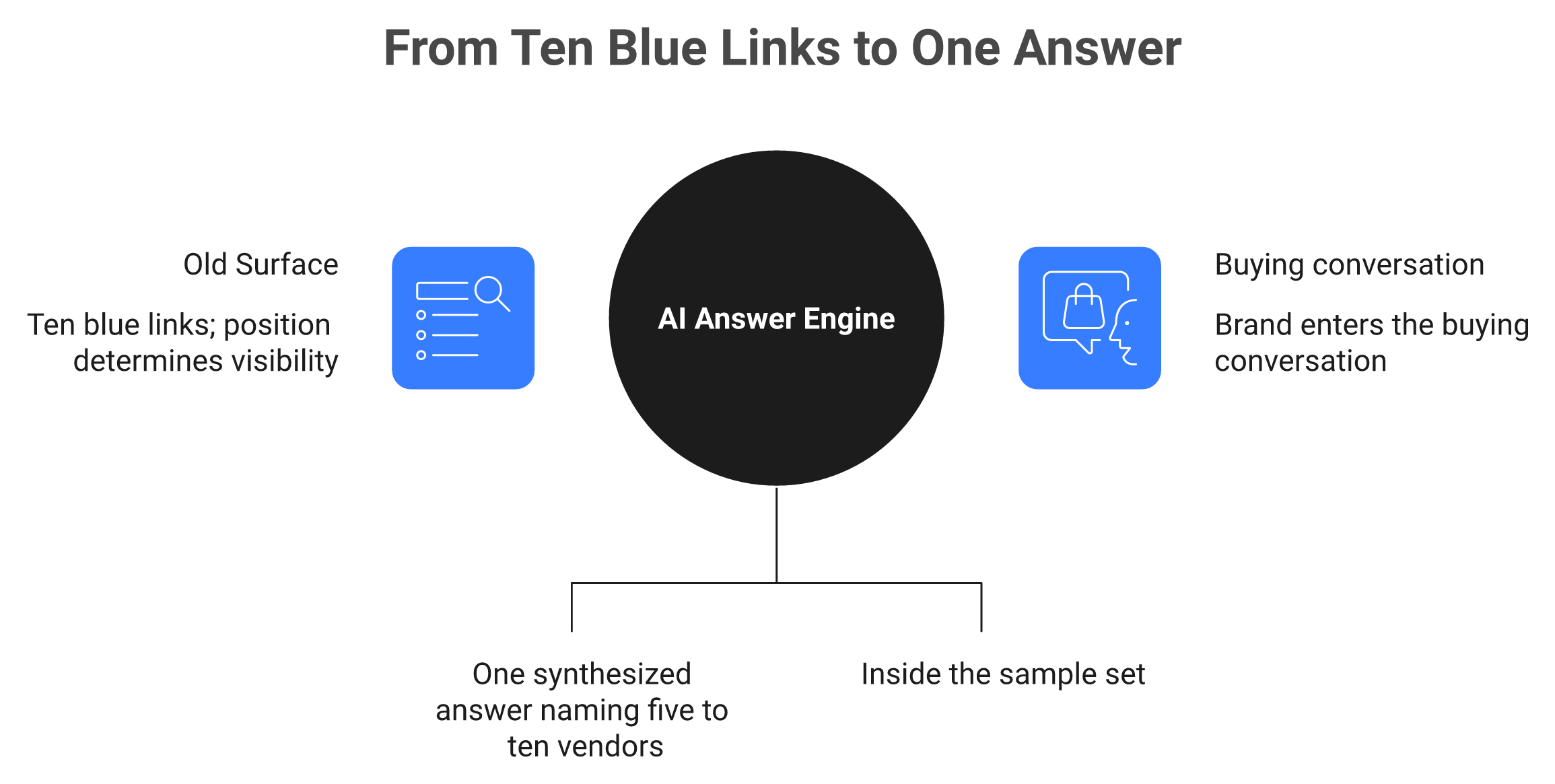
SaaS content marketing is the practice of publishing content that attracts, converts, and retains software buyers. What changed in 2026 is the delivery surface. Pew Research Center found that clicks on a traditional result fall from 15% to 8% when an AI summary appears, and links inside those summaries get clicked in about 1% of visits. The job is no longer ranking a page. It is becoming the answer that ChatGPT, Perplexity, Gemini, and Google AI Overviews name.
⚠️ The report that stopped predicting revenue
For a decade, the SaaS content model was predictable. You published, you ranked, you got traffic, and some of that traffic converted. Agencies sold rankings, impressions, and clicks on fixed retainers, and nobody asked whether those numbers moved pipeline.
That link broke quietly. Sam Lessin put the scale of it plainly on My First Million: "organic traffic that used to come through SEO very predictably including to folks like HubSpot we are very good at the SEO game have played it for a long time has gone down literally by about 20 to 40% based on which industry you are in". Most teams responded by publishing more, which made the waste bigger, not smaller. That decline is the pattern we track in our search referral traffic decline research.
📊 What the data actually says, including the parts people skip
Gartner forecast in February 2024 that traditional search engine volume would drop 25% by 2026. That number gets quoted everywhere, and the honest read is that it landed softer than predicted, because Google adapted with AI Overviews instead of losing queries outright.
The volatility is the real story. Semrush tracked AI Overview prevalence swinging from 6.49% to roughly 25% and back to 15.69% across 2025, while the informational share of AI Overview queries fell from 91.3% to 57.1% as commercial queries rose. Translation for a Head of Organic Growth: the queries worth owning moved down the funnel, and they moved fast.
🎯 Three disciplines, three scoreboards
| Discipline | Surface it targets | How you score it |
| SEO | Blue-link results on Google | Rank position and indexed coverage |
| AEO (Answer Engine Optimization) | Direct answers, snippets, AI summaries | Whether your passage becomes the answer |
| GEO | Citations inside generated answers | Share of voice across engines |
Google states its generative features run on core Search ranking and quality systems, using retrieval and query fan-out over the index. So SEO is not dead. It is the foundation floor, and AEO is the building on top of it, a split we break down in our GEO versus traditional SEO comparison.
💡 The sample set gate
Here is why this is more binary than Google ever was. Ask any engine for the best tool in a category and you get five to ten names. There is no page two. If your product is not in that list, you are not in the buying conversation, no matter how good the product is.
AI recommendation is also a trust transfer. When ChatGPT names you, it stakes its own credibility on you, which is why trust signals now outrank keyword tactics. My honest hedge: I think the industry still underrates how fast that trust compounds for early movers.
MaximusLabs AI rebuilt its model around this shift, running Answer Engine Optimization (AEO) as the flagship with SEO underneath, measured on pipeline rather than mentions. We start from the answer an engine must produce, then work backwards to the asset. On Oliv AI, that produced 27 qualified leads, $47K+ pipeline, and a 26% close rate in 4 months.
Q2. Why does 95% of SaaS content fail, and should you stop publishing TOFU posts?
Because volume replaced intent concentration. Graphite CEO Ethan Smith, after work on Webflow, Upwork, Notion, and Rippling, found that 19 of 20 landing pages drive little or no traffic, while roughly 1 in 20 drives about 85% of it. Glossary and "what is" pages are the bulk of that waste. MaximusLabs AI skips top-of-funnel definition content by default and funds bottom and middle-of-funnel pages instead, because answer engines already cover definition queries natively.
❌ The 5% rule, stated without the comfort
Most content audits start with "what should we publish next." The better question is which existing pages already earn their keep. In practice, the answer is a shockingly small number of them.
Eli Schwartz describes hitting this wall directly in Product-Led SEO: "When I embarked on my first effort to help an SaaS B2B company with its SEO, I was also under the illusion that this was going to be a supremely profitable channel. I was eventually confronted with a wall of reality". SEO best practice cannot manufacture demand that does not exist in a narrow B2B niche.
⚠️ Why "what is" pages are the first to go
Smith is blunt about the category: "what is the definition of payroll zero conversion rate ever... I would spend no time at all really on glossary definitions and low intent stuff". That matches what Semrush measured, with informational queries dropping from 91.3% to 57.1% of AI Overview triggers as commercial intent rose.
The mechanism is simple. An engine can answer a definition from its own synthesis, so your definition page competes against the answer box itself. Commercial comparisons still need named sources, which is where citation opportunity concentrates, and where citation-worthy content for AI engines earns its budget.
✅ The keep, kill, consolidate test
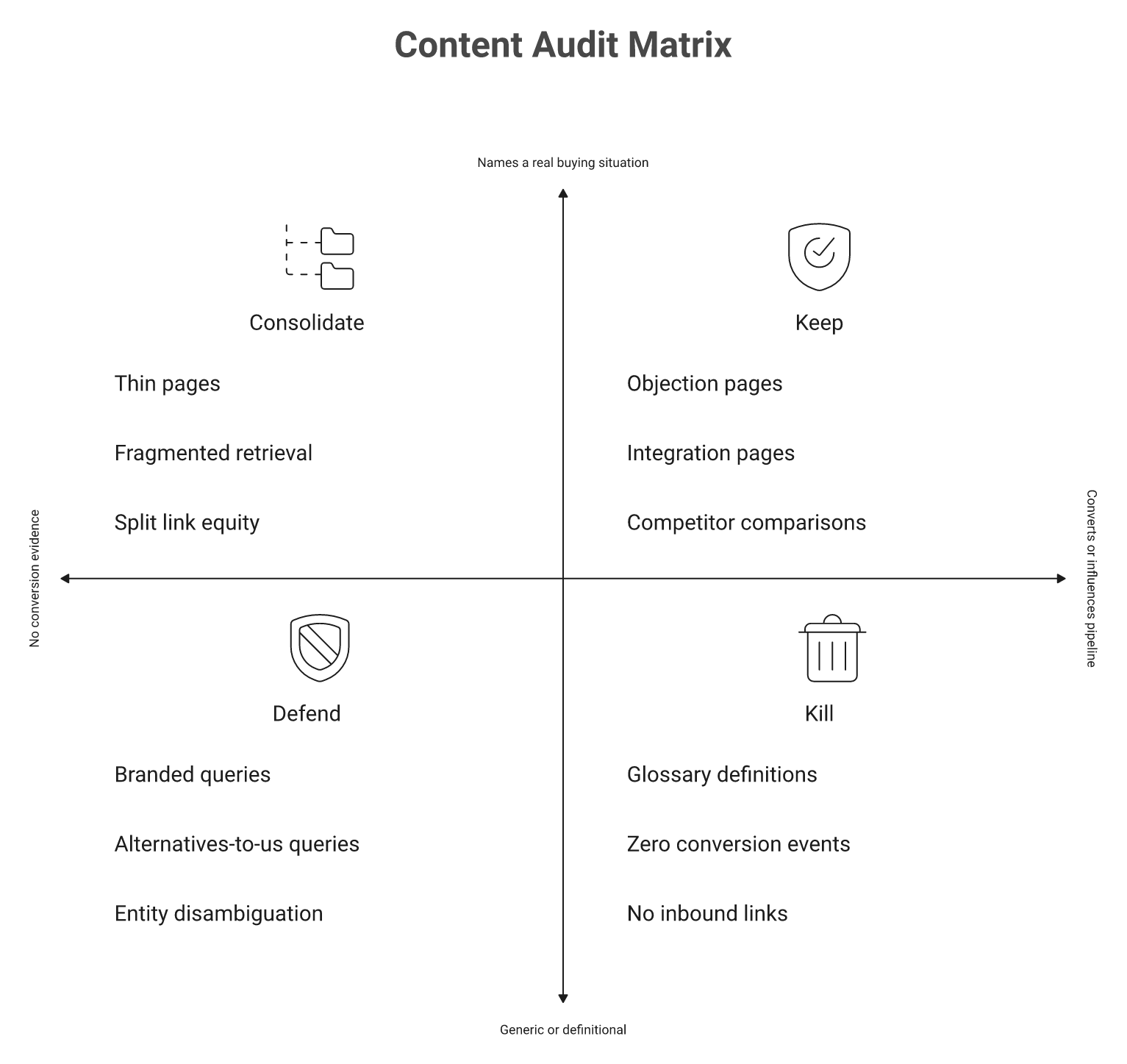
Run every existing page through three questions before you touch the editorial calendar.
Keep if the page names a specific buying situation, objection, integration, or competitor comparison, and a named ICP segment would plausibly search it.
Kill if it is a definition or listicle with no product relevance, no conversion events in the last 180 days, and no inbound links worth preserving.
Consolidate if three or four thin pages chase one intent, which fragments retrieval and splits internal link equity.
⏰ The honest exception
I do not believe TOFU is always worthless, and anyone who says so is overselling the position. A handful of definitional pages still earn slots, for entity disambiguation when your category name is ambiguous, and for defending branded and "alternatives to us" queries. Entity optimization is the reason those few pages survive the cut.
My rule is a cap, not a ban. If definition pages exceed roughly 10% of planned output, the plan has drifted back to impressions. MaximusLabs AI applies that cap at the brief stage, because a brief that cannot name a buying situation does not get written.
MaximusLabs AI runs this triage before writing a word, since 15 pieces a month aimed at the wrong 95% is only a faster way to waste budget. Our GEO content refresh stage maps content gaps against pipeline influence first, and sequencing decisions follow from that, not from unit cost.
Q3. How do you find the topics your buying committee actually searches?
Not from keyword tools alone. SaaS purchases involve a buying committee, so topics should come from recorded sales calls, lost-deal objections, support tickets, onboarding questions, and community threads, then get validated for search demand. MaximusLabs AI aligns every brief to a named ICP segment before the brief exists, because the phrasings worth owning are specific situations and objections, not head terms a volume tool surfaces first.
🔍 Six inputs, six artifacts
Keyword tools tell you what has volume. They cannot tell you what a CFO said in week three of an evaluation. That sentence is usually your highest-converting page.
| Input source | Artifact it produces | Asset it becomes |
| Recorded sales calls | Objections in buyer language | Comparison and objection pages |
| Lost-deal notes | Competitor requirements you failed | "Alternatives to" and vs pages |
| Support tickets | Setup and edge-case friction | Documentation and how-to pages |
| Onboarding questions | First-30-day blockers | Use-case and integration pages |
| Community threads | Unfiltered evaluation criteria | Mid-funnel buying guides |
| Win-loss interviews | The buying situation itself | Segment landing pages |
📊 Validating without defaulting to volume
Once you have the raw phrases, check three things in order. Does any search demand exist at all, even in double digits. Does the query already trigger an AI Overview, which tells you the surface you are competing on. Does a page answering it map to a revenue event like a demo, a trial, or an expansion.
The average AI chat query runs around 25 words, far longer than a Google keyword. That length is a gift, because long, situational questions are the ones owned content can win outright. Our question research for AI search framework works from exactly those phrasings.
🎯 The ownership question most teams skip
Not every topic should be a page on your site. I sort topics into three buckets before assigning anything.
Head queries like "best CRM software" are won through third-party citations, not your blog.
Mid-tail queries like "best CRM for small SaaS teams" need both owned content and off-site mentions.
Long-tail queries like "does this tool integrate with Looker for pipeline reporting" are pure owned-content territory.
✅ The gate that kills briefs
The last step is the one that saves the most money. If no named ICP segment would ever type or speak the query, the brief dies there, regardless of volume.
MaximusLabs AI's read is that the standard advice gets this backwards, because it starts with a keyword and reverse-engineers a buyer. We start with the buyer's recorded words and reverse-engineer the query. I might be reading our own data too strongly here, though the briefs sourced from sales calls consistently outperform tool-sourced briefs in our engagements.
MaximusLabs AI writes product positioning exactly the way the client specifies, after sitting with the leadership team to capture their right to win. That is why the deliverable is a positioning-accurate asset rather than a keyword-matched one, and why the founder's voice methodology survives into the published page.
Q4. What does a BOFU-first SaaS content architecture look like?
It publishes in reverse funnel order: integration and use-case pages, then "Tool A vs Tool B" comparisons, then alternatives pages, then supporting cluster content. The reason is retrieval economics, since AI Overviews trigger on roughly 87% of B2B SaaS comparison searches. MaximusLabs AI builds these as hub-and-spoke ecosystems, with a 5,000 to 8,000 word hub owning the strategic question and 2,500 to 4,000 word spokes owning the tactical ones.
🏗️ The build order, and why each asset sits where it does
| Order | Asset | Why it goes here |
| 1 | Integration and use-case pages | Highest intent, lowest competition, pure owned territory |
| 2 | "Tool A vs Tool B" comparisons | 87% AI Overview trigger rate on these queries |
| 3 | "Alternatives to [competitor]" pages | Captures buyers already in an evaluation |
| 4 | Pricing and ROI explainers | Removes the last objection before a demo |
| 5 | Cluster blog content | Supports the four above, never leads |
Most teams invert this list and start at step five. That is how you end up with 400 published pages and 20 that matter. Building them as GEO topic clusters prevents that outcome.
📐 Per-asset structural specs
A comparison page is not a blog post with a table dropped in. Comparison tables carry roughly a 1.8x citation multiplier, so the table is the asset, not decoration.
Open with a 40 to 80 word verdict that stands alone if extracted.
Include an explicit feature matrix, pricing tiers, and honest pros and cons for both tools.
Add a third column for a credible alternative, which widens the queries the page can answer.
State the buying situation each tool wins, since engines reward specificity over hedging.
🧩 Hub and spoke, with cannibalization control
The architecture only works if each page has exactly one job. I enforce a mutually exclusive, collectively exhaustive check before anything ships, so no two pages compete for the same intent. Our GEO content optimization standard treats that check as a release gate.
Otter.ai shows what that looks like at the edges. It captured ChatGPT share for "which meeting note transcription tool integrates with Looker" by publishing workflow pages detailing Zapier to BigQuery to Looker setups. Nobody searches that in volume, and the people who do are mid-evaluation.
✅ A first-quarter build sheet
If you have one writer and 90 days, build this and nothing else.
Three integration or workflow pages for your highest-LTV connections.
Three head-to-head comparison pages against the competitors sales loses to most.
Two "alternatives to" pages, including one for your own brand.
One pricing or ROI explainer with a worked calculation.
One hub page that links all ten and owns the category question.
MaximusLabs AI links these ecosystems for retrievers rather than for navigation aesthetics, which means internal links follow the question hierarchy, not the menu. On Oliv AI, that architecture produced a 64% AI citation rate in 6 months, against roughly 30% for billion-dollar incumbents, with 30 to 40% of inbound now AI-sourced.
Q5. Why is product documentation your highest-ROI content asset?
Because documentation is already shaped the way retrieval systems want. Technical docs show a median citation rate of 34% to 41% and hold roughly 29% of all brand citations across large language models, versus 15% to 18% for editorial blog posts. Docs are self-contained, answer-dense, and passage-sized. That matches how retrieval works on the 73% of software how-to queries that trigger AI Overviews.
⚙️ What the engine actually reads
AI engines do not read your page the way a human does. They chunk it, meaning they split it into small passages, then score each passage against the query on its own.
A 2,000 word narrative post about workflow philosophy has no clean passage boundary. A 300 word reference page titled "Connect your Salesforce account" has exactly one. Google describes its generative features as using retrieval and query fan-out over the Search index, which rewards pages that answer one question completely. Our content formatting for AI search standard is built on that behaviour.
📐 Why docs win the structural fight
Documentation already does four things that blog posts usually skip. It states the task in the heading. It answers in the first sentence. It uses stable terminology. It avoids narrative setup before the answer arrives.
MaximusLabs AI applies the same discipline to editorial content, requiring a 40 to 80 word standalone answer block under every heading. That standard exists because the block, not the page, is the unit of retrieval, which is the core of our AEO answer structure work. My honest view is that most content teams still write for the scroll, not for the chunk.
✅ The docs hub build order
Build in this order, because each layer feeds the next.
Onboarding guides. Cover the first 30 days, since those questions carry the highest support volume.
Feature reference pages. One page per feature, one job per page, with the use case stated in the heading.
Integration guides. One page per connected tool, naming the other product explicitly.
API and developer reference. Stable, versioned, and crawlable, not locked behind a login.
Troubleshooting pages. Error messages verbatim in the heading, since buyers paste them into engines.
⚠️ The access mistake that erases the whole effort
None of this works if crawlers cannot reach it. Docs behind a login, rendered only in JavaScript, or served from a subdomain blocked in robots.txt stay invisible to retrieval. A crawlability check catches all three in minutes.
OpenAI documents that OAI-SearchBot governs whether pages can surface in ChatGPT search, separate from training crawlers. MaximusLabs AI checks crawler access to the docs subdomain before any content work starts, because an unreachable page cannot be cited at any quality level. I have seen that single misconfiguration cost more citation share than a full quarter of publishing.
💰 Why this is a pipeline asset, not a support cost
Here is the part finance teams like. Documentation pages attract buyers mid-evaluation and mid-implementation, which are the two moments closest to a purchase or an expansion.
A "how do I connect this to Looker" query comes from someone with budget and a deadline. A "what is content marketing" query comes from someone writing a different article. MaximusLabs AI's read is that the standard content playbook gets this backwards, because it funds the second reader and ignores the first.
MaximusLabs AI treats docs as a growth surface, not a support cost centre. In our engagements, the docs hub usually ships before the blog calendar resumes, since it is the fastest route from zero citations to measurable share of voice. Being cited is the means. Pipeline is the outcome we are held to.
Q6. How do you actually get cited by ChatGPT, Perplexity, Gemini, and AI Overviews?
Start with access and structure, not tricks. Allow OAI-SearchBot so ChatGPT search can surface your pages, and keep pages indexable, because Google states its generative features run on core ranking systems. Front-load answers, since 44.2% of citations come from the top 30% of body text. MaximusLabs AI optimizes separately for each engine, and on Oliv AI that approach produced a 64% AI citation rate in 6 months, against roughly 30% for billion-dollar incumbents.
❌ What the official docs say to stop doing
Google published direct guidance on generative AI features on May 15, 2026, updated July 10, 2026. It names several popular tactics as unnecessary, including llms.txt files, manual content chunking, AI-only schema, and separate Markdown versions of pages.
It also states that inauthentic brand mentions are policed by core spam systems. So mention-farming carries real downside risk. I was running llms.txt tests myself before that document landed, and I stopped.
✅ What is measurably true
Three levers hold up under measurement. First, placement: answers in the top 30% of body text capture 44.2% of citations. Second, fact density: 64% of AI-cited B2B SaaS articles carry three or more statistics, against a 29% industry average, and 52% carry expert quotes against 21%.
Third, the Princeton and Georgia Tech GEO paper measured visibility gains of up to 40%, with statistics addition, source citation, and quotation addition as the strongest methods. That is the clearest primary evidence the discipline has, and it underpins our citation optimization approach.
⚠️ Google rank one does not buy you a ChatGPT citation
This is the finding that changes roadmaps. On commercial product queries, ChatGPT citations and Google results showed roughly 8% URL overlap, with a strongly negative correlation.
Google favors direct purchase and vendor pages. ChatGPT leans on editorial aggregators and comparison guides. MaximusLabs AI measures visibility per engine for this reason, rather than reporting one blended AI score. Blended scores hide exactly the gap you need to fix.
📐 Per-engine specifications
| Engine | What it rewards | What to ship |
| ChatGPT | Q&A structure, snippet-friendly metadata | Question headings, 120 to 158 character answer-style meta descriptions |
| Google AI Overviews | Answer-first structure, E-E-A-T signals | 40 to 80 word nuggets, named author credentials |
| Perplexity | Recency and visible sourcing | Dated references, numbered footnotes, plain prose |
| Gemini | Indexed authority and entity clarity | Consistent entity naming, strong internal linking |
| Claude | Depth and methodology | Long-form reasoning, academic citations, stated method |
Each row maps to a different playbook, from ChatGPT search optimization to Perplexity optimization.
⏰ The one habit that beats every checklist
Pick 25 prompts your buyers would actually type. Run them weekly across all five engines and log which domains get cited, not just whether you appear.
That log becomes your target list of sources to earn your way into. MaximusLabs AI builds this prompt set at the start of an engagement, then re-runs it on a fixed schedule so changes are visible as trends rather than anecdotes. My hypothesis, still being tested, is that the citation mix moves faster than content quality does.
MaximusLabs AI runs Answer Engine Optimization (AEO) with SEO as its foundation, strategy and execution in one team, and humans approving everything that ships. We map which sources each engine trusts, then work to get the client into those sources. Oliv AI now reports 30% to 40% of inbound as AI-sourced.
Q7. Why do G2, Capterra, and YouTube decide whether AI names your product?
Because head-category answers are assembled from third-party sources. After G2 acquired Capterra, Software Advice, and GetApp from Gartner for roughly $110M, closing February 5, 2026, the G2 family controls about 84% of review-site citations in bottom-of-funnel B2B queries. Of tools ChatGPT names in software answers, 100% had Capterra reviews and 99% had G2 profiles. Brand mentions correlate with AI visibility at r = 0.664, against 0.218 for backlinks.
⚠️ Your own site is the minority source
Content teams spend nearly all their budget on pages they control. The citation data says that is where the minority of mentions come from, since brands are roughly 6.5 times more likely to be cited through third parties than through their own domain.
A practitioner running his own tests described the same pattern:
"What struck me is that many startups with strong Google rankings become almost invisible when an LLM is asked, 'what's the best tool for X?' ... The gap is real, and it isn't about rankings but about citations."
r/SaaS, April 4, 2026 Reddit Thread
📊 Where the weight actually sits
Reddit is not a universal answer source, and the honest numbers are smaller than the hype. Profound's citation research found Reddit at 2.2% of overall Google AI Overview citations, 6.6% for Perplexity, and 1.8% for ChatGPT.
The top-source view flips that impression. Reddit represented 21.0% of Google AI Overviews' top-10 source share and 46.7% of Perplexity's. So Reddit matters most where the model needs firsthand experience, which is exactly a software evaluation, and it is why Reddit and forum AEO sits inside the plan rather than beside it.
✅ The leverage order
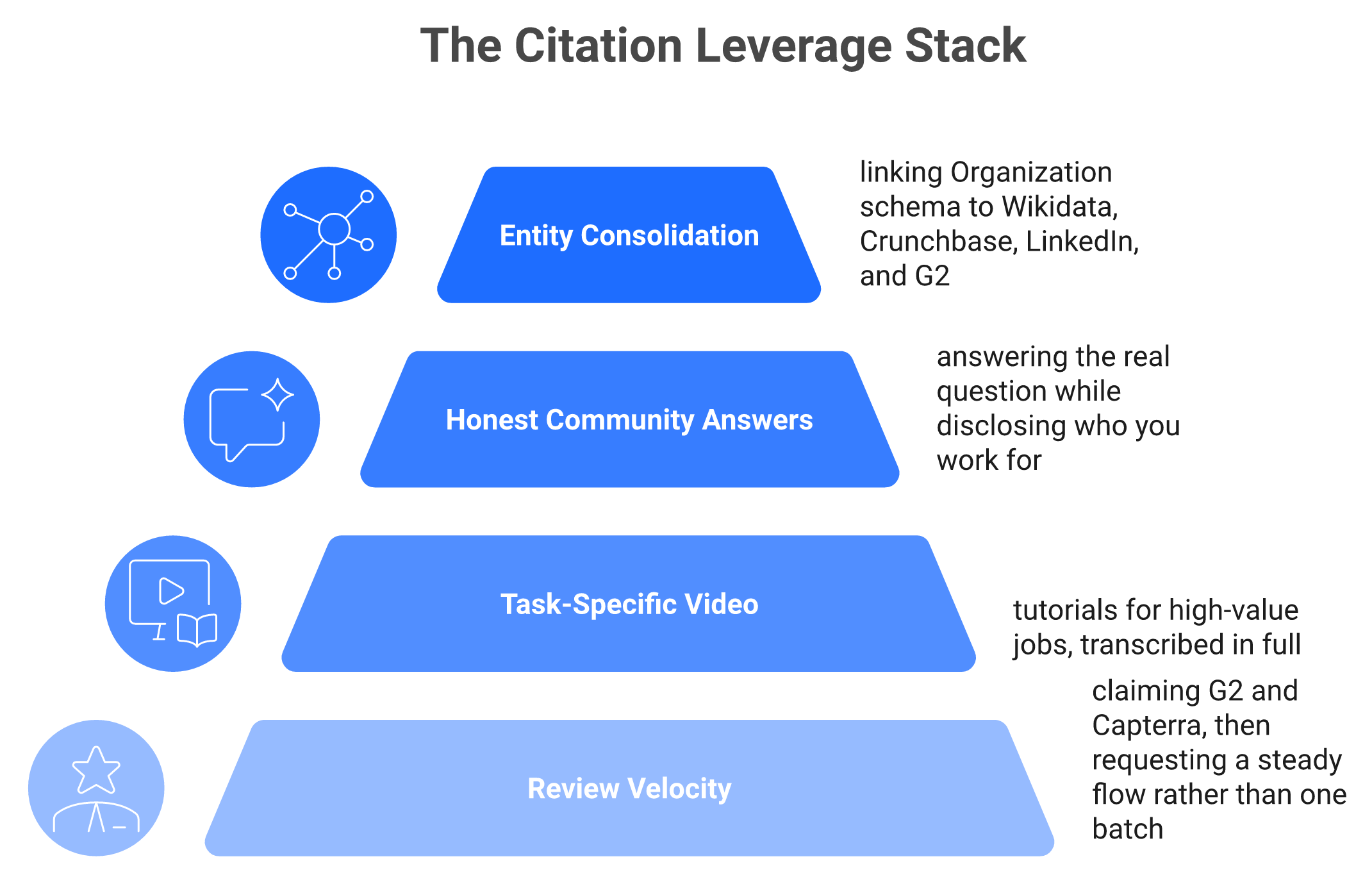
Work this sequence, because the early items move citations faster than on-page edits.
Review velocity. Claim G2 and Capterra, then request a steady flow of reviews rather than one batch.
Task-specific video with transcripts. Webflow produced 800+ task-focused tutorials and attributes 8% of total signups to large language model discovery.
Honest community answers. Disclose who you work for, every time, and answer the actual question.
Entity consolidation. Link Organization schema to Wikidata, Crunchbase, LinkedIn, and G2 so engines resolve you as one entity.
💸 The multi-surface loop worth copying
Legit Security embedded a security tutorial video directly in a product page. That single page then surfaced across ChatGPT, Gemini, YouTube, and Google AI Overviews together.
One asset, four surfaces. MaximusLabs AI runs this as Earned AEO alongside Owned AEO, and most agencies only do the owned half. Reviews, Reddit, press, and listicles are what make an engine trust you in the first place, which is the whole point of citation acquisition.
❌ The warning nobody wants to read
Chegg lost over 80% of its market value as students abandoned its database of 46 million stored answers for instant summaries. Hoarding simple answers is not a moat anymore.
MaximusLabs AI treats review profiles, video, and third-party mentions as content deliverables with named owners and deadlines, not PR afterthoughts. On Nidra Goods, that combination produced simultaneous number-one positions across Google, ChatGPT, and Perplexity from a single strategy.
Q8. How much should you publish, and can AI write it?
Publish 2 to 4 high-intent pieces a month, and spend 20% to 30% of capacity refreshing existing assets. Use AI, but not autonomously. Graphite tested thousands of keywords and found AI-generated pages underperformed human ones, with rankings improving in proportion to human editing. MaximusLabs AI runs hybrid human and AI workflows, scoring every piece on 10 dimensions with a 70 out of 100 publication floor and 80 for pillar pages.
⏰ The cadence that actually holds
Volume targets are where most content plans break. Four strong pieces beat twelve thin ones, because retrieval rewards completeness per question, not output per month.
| Capacity split | Allocation | What it covers |
| New publishing | 60% to 70% | 2 to 4 bottom and middle-funnel assets monthly |
| Refresh and consolidation | 20% to 30% | Updating stats, merging thin pages, fixing stale dates |
| Distribution and earned work | 10% to 20% | Review requests, video, community answers |
Refresh is the most underfunded line here. Perplexity favors recent sources, so a page with 2024 statistics quietly stops qualifying, which is why we run scheduled content refresh cycles.
❌ What the AI-content experiment showed
Ethan Smith described the Graphite test plainly: "we'll AI generate something and then we'll do okay and then we'll edit it and then the more we edit it the higher it'll rank... AI generated content doesn't work that well". The gradient is the finding. Editing depth, not generation speed, predicted performance.
MaximusLabs AI's data points the same way, though I might be reading our sample too strongly. What surfaces in our engagements is that unedited drafts fail on factual density first, long before anyone notices the prose.
⚠️ Why platforms have a reason to keep it failing
There is a structural argument underneath this, and it is worth understanding. Models trained on model output degrade, a failure mode documented as model collapse.
Smith framed the incentive bluntly: "if AI generated content works then Google and chat and all these just very quickly become not useful". Google's own guidance treats scaled content abuse as a spam violation. So betting on volume generation means betting against the platforms' own survival interest.
✅ The division of labour that works
| Stage | Owner | Why |
| Research aggregation | AI | Fast, broad, cheap to verify |
| Source verification | Human | Every number traced to a primary source |
| Outline and angle | Human | The position is the differentiator |
| First draft | AI assisted | Structure is mechanical, judgment is not |
| Voice and perspective | Human | Founder perspective cannot be synthesized |
| Final approval | Human | Nothing ships unreviewed |
💡 The anti-commodity argument
Most published content now summarizes five articles to produce a sixth. That sameness is why fact density and firsthand experience have become the separating signals.
MaximusLabs AI builds content around the founder's own perspective, captured by sitting with the leadership team before any brief exists. My read is that this is the only part of content production that gets more valuable as generation gets cheaper.
MaximusLabs AI runs AEO and SEO only, as strategy and execution in one team, and humans approve everything that ships. In our engagements, the scorecard blocks more drafts than the calendar does. Oliv AI's outcome was 27 qualified leads, $47K+ pipeline, and a 26% close rate in 4 months.
Q9. How do you measure SaaS content marketing when the clicks disappear?
Measure citation share and pipeline, not sessions. Pew Research Center found that links inside AI summaries get clicked in roughly 1% of visits, so click volume understates influence. Build from first-party AI reporting, meaning Google Search Console's generative AI performance reports and Bing Webmaster Tools' AI Performance dashboard, then add multi-engine share-of-voice sampling. MaximusLabs AI reports share of voice against pipeline influence across five engines, rather than one blended AI score.
⚠️ The attribution trap that hides your best channel
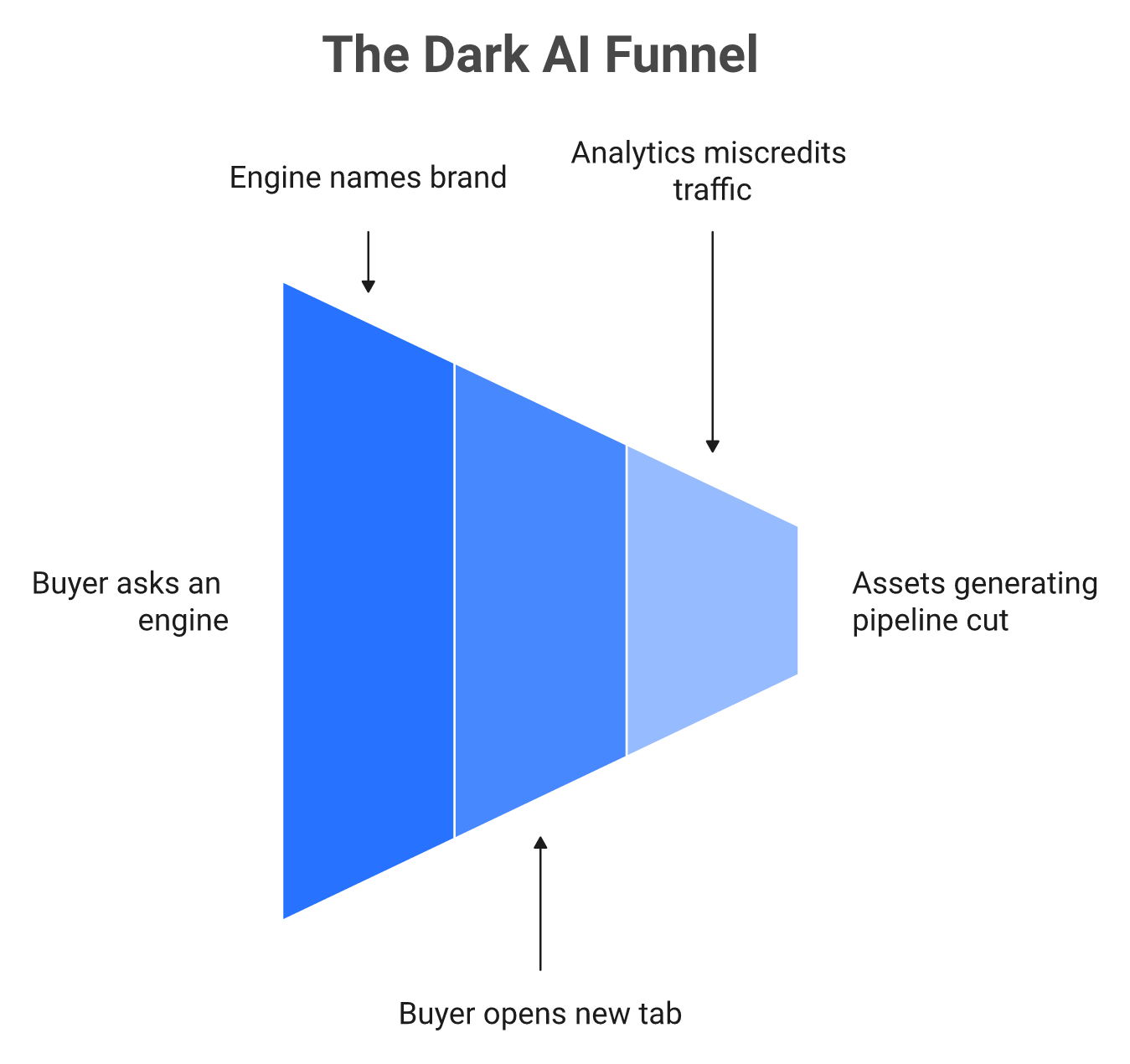
Here is the sequence that breaks most dashboards. A buyer asks ChatGPT for the best tool in your category. ChatGPT names you. The buyer opens a new tab, searches your brand name, and converts.
GA4 credits that as branded search or direct traffic. The content that actually caused the decision gets zero credit. I have watched teams cut the exact asset that was generating their pipeline, because the report said it had no traffic. Closing that gap is the point of GEO revenue attribution.
📊 Why small referral numbers still matter
AI referral volume looks tiny next to organic sessions. The conversion quality is the opposite story.
Ethan Smith reported the gap directly from Webflow's data: "Web Flow we saw a 6x conversion rate difference between LLM traffic and Google search traffic". The reason is simple. The buyer arrives after the research is done, already told you are the answer, a pattern we document in our B2B SaaS buyer journey research.
✅ The metric swap table
| Retire this | Replace with | Why |
| Keyword rank position | Share of voice across engines | There is no position one in an AI answer |
| Sessions by page | Citation share by prompt | Retrieval happens at the passage level |
| Blended "AI traffic" | Per-engine referral segments | Engines cite different sources entirely |
| Last-click attribution | Self-reported attribution field | The AI touch leaves no referrer |
| Monthly snapshot | 14-day rolling window | Answers change between regenerations |
MaximusLabs AI measures visibility per engine, because a blended score hides the gap you actually need to fix. Our AEO measurement metrics framework separates every engine by default.
⏰ The measurement protocol, step by step
Run this as a fixed routine, not an ad-hoc check.
Define 25 prompts that mirror real buying situations, in the words buyers use.
Run them weekly across ChatGPT, Perplexity, Gemini, Google AI Overviews, and Copilot.
Log the cited domains, not just whether you appeared, since that list becomes your earned-media target.
Use a 14-day window for reporting, because roughly 30% of brands hold visibility between regenerations of the same prompt.
Segment referrals by chatgpt.com and perplexity.ai in GA4, and keep those segments separate.
Add one form field: "How did you first hear about us?" It is imperfect, and it is still the best signal available.
❌ The tooling caveat nobody prints on the dashboard
Most third-party AEO trackers query vendor API endpoints rather than scraping the live, logged-in interface. API responses return different citation mixes than real users see. Our breakdown of AI visibility tracking tools covers which ones do which.
So treat tracker output as a trend line, not as truth. MaximusLabs AI re-runs its prompt sets and regression-tests the results, which is the only way to tell a real movement from engine noise. My honest hedge is that this field's measurement maturity is still about two years behind its confidence.
MaximusLabs AI reports share of voice and pipeline influence, because clicks and impressions are vanity metrics if they do not move the revenue needle. Every engagement starts by defining the prompt set that represents real buying situations. Oliv AI now reports 30% to 40% of inbound as AI-sourced, which is the number that reached their board.
Q10. Should you build in-house, hire an SEO agency, buy an AEO tool, or partner with a GEO specialist?
Four paths exist, and they differ more on revenue focus than on price. In-house runs roughly $20,000 a month for 25 pieces, a traditional agency around $6,500, and freelancers around $2,500 with little depth in AI search. MaximusLabs AI publishes tiers starting at $899 a month for 15 pieces, at roughly $60 per piece, running Answer Engine Optimization (AEO) with SEO underneath. AEO tracking tools are a separate line item, and tracking alone does not change an outcome.
💰 The four paths, side by side
| Model | Published monthly cost | Pieces | Revenue focus | AI search depth |
| MaximusLabs AI | From $899 | 15 to 50 | Always, BOFU and MOFU first | AEO as flagship, SEO as foundation |
| In-house team | ~$20,000 | 25 | Depends on the team | Unlikely without a dedicated hire |
| Traditional SEO agency | ~$6,500 | 25 | Rarely | Usually surface-level |
| Freelancers | ~$2,500 | 25 | Rarely | Limited |
All figures above are published rates and change over time. Compare cost per outcome, not cost per piece. If you are still building a shortlist, our AEO agency evaluation criteria set out what to ask each one.
⭐ Why MaximusLabs AI sits in position one
MaximusLabs AI holds this position on cost-to-outcome, not on being cheapest. Five things drive that.
✅ Scalable content production, 15 to 50 pieces monthly, at roughly $60 per piece.
✅ Revenue-focused methodology, with every piece aligned to a named ICP segment and sequenced bottom and middle-funnel first.
✅ Trust-first methodology, since engines cite sources they trust, and a recommendation puts the engine's own credibility on the line.
❌ Not a fit for anyone needing results inside a week, because trust compounds slowly.
✅ Product positioning written exactly the way the client specifies, in the founder's voice, after sitting with the leadership team.
❌ Not a fit for price-only shortlists, since MaximusLabs does not negotiate on quality.
That methodology is set out in full in our revenue-focused GEO framework and trust-first content playbook.
❌ The honest teardown of AEO tracking tools
This is where I would spend the least money. Ethan Smith catalogued the category directly: "We have a page with 60+ AEO tools and they all do the same thing: They all do tracking... Pick the tool that does what you want and has the lowest cost. And two years from now, you'll probably be using Ahrefs anyway".
Graphite built its own tracker for a few cents per question. The lesson is not that measurement is useless. It is that knowing what you rank does not cause an outcome, so the tool should be a small line, never the strategy. Compare the field yourself in our AEO tools comparison.
⚠️ What each path genuinely fits
Choose by constraint, not by preference.
In-house fits companies with an existing content lead, deep product knowledge, and patience for 6 to 12 months of ramp.
Traditional SEO agency fits teams whose bottleneck is genuinely technical SEO and site health, not AI visibility.
Freelancers fit filling a specific gap, like documentation or a single comparison page.
A GEO and AEO specialist fits teams that need strategy and execution from one team, measured on pipeline.
MaximusLabs AI's read is that most agency shortlists compare retainer size when the real variable is whether anyone owns the earned side of the work. Reviews, Reddit, press, and listicles are what make an engine trust you, and most retainers never touch them.
MaximusLabs AI runs strategy and execution in one team, with humans approving everything that ships. Proof sits in B2B SaaS: Oliv AI reached a 64% AI citation rate in 6 months, against roughly 30% for billion-dollar incumbents, and UnderDefense competes against multi-deca-billion-dollar security vendors.
Q11. What should your first 90 days look like?
Days 1 to 30: audit the portfolio to find the performing 5%, fix crawler access for OAI-SearchBot and PerplexityBot, claim G2 and Capterra profiles, and baseline AI citation impressions in Search Console and Bing Webmaster Tools. Days 31 to 60: ship the documentation hub and the top five comparison and integration pages. Days 61 to 90: add transcribed video tutorials, close the entity loop, and report share of voice against pipeline. MaximusLabs AI onboards in two days and runs this as a standing programme.
📋 The 90-day build sheet
| Phase | Work | Owner | Metric that matters |
| Days 1 to 30 | Portfolio audit, crawler access, review profiles, measurement baseline | Growth lead plus one engineer | Pages crawlable, baseline captured |
| Days 31 to 60 | Docs hub, 3 integration pages, 2 comparison pages | Writer plus product marketing | Assets live and indexed |
| Days 61 to 90 | Video with transcripts, entity consolidation, first share-of-voice report | Marketing manager | Citation share across 5 engines |
Nothing here requires new headcount. It requires stopping the old calendar. Our GEO strategy framework sequences the same phases for larger teams.
⚠️ Failure mode one: buying tooling before building assets
The most common first move is purchasing an AI visibility tracker. That produces a dashboard showing you are not cited, which you already knew.
Tracking is the thermometer, not the medicine. MaximusLabs AI sets the prompt set and the baseline in week one, then spends the remaining weeks on assets and earned placements, because the dashboard only moves when those move.
⏰ Failure mode two: judging the programme on month-one traffic
Trust compounds, and it compounds on a quarterly clock. Judging AEO on 30-day sessions is like judging a sales hire on week-one closed revenue.
Watch leading indicators instead: crawler access fixed, review count rising, documentation pages indexed, and citation appearances for long-tail prompts. In MaximusLabs AI's engagements, long-tail prompts move first, head-category prompts move last, and the gap between them is usually one to two quarters. I might be compressing that timeline, since the sample skews toward B2B SaaS.
✅ If your budget is zero this quarter
You can still run most of this. The work that costs nothing is the work most teams skip.
Open robots.txt and confirm OAI-SearchBot and PerplexityBot can reach your docs and comparison pages. Our AI crawlers guide lists the user agents to allow.
Claim your G2 and Capterra profiles, then ask five recent wins for reviews.
Rewrite the first 100 words of your five highest-intent pages into standalone answers.
Add three statistics with named sources to each of those pages.
Answer questions in your category's community, disclosing who you work for, every time.
💡 What comes next, and why starting now matters
Agentic search is the next surface. Buyers will soon send agents to evaluate, shortlist, and sometimes transact without opening a browser tab. We track that shift in our state of agentic commerce research.
Agents will lean on the same trust signals engines use now, only with less tolerance for ambiguity. My hypothesis is that entity clarity, meaning a clean, consistent, machine-resolvable identity, becomes the deciding factor. Late movers will fight entrenched data patterns, which is harder than fighting a ranking.
MaximusLabs AI treats the 90-day plan as the start of a standing programme, not a project, because early movers hold position once engines settle on who they trust. Being cited is the means. Oliv AI's outcome was the point: 27 qualified leads, $47K+ pipeline, and a 26% close rate in 4 months.
Frequently asked questions
What is SaaS content marketing, and what actually changed in 2026?
SaaS content marketing is the practice of publishing content that attracts, converts, and retains software buyers. The practice has not changed. The delivery surface has. Buyers now get a synthesized answer naming five to ten vendors instead of ten blue links. Clicks on a traditional result drop from 15% to 8% when an AI summary appears, and links inside those summaries are clicked in about 1% of visits. Three consequences follow for a SaaS team: • Ranking is no longer the finish line. Being named inside the answer is. • The game is more binary. There is no page two in an AI answer, so a product outside the shortlist is invisible during evaluation. • Trust became the ranking factor. When an engine names you, it stakes its own credibility on that recommendation. SEO is not dead in this model. It is the foundation floor, because an unindexed page cannot be retrieved or cited. The building on top is Answer Engine Optimization, which targets the passage that becomes the answer rather than the position on a results page. We walk through how the two layers differ in our GEO versus traditional SEO comparison.
Should SaaS companies stop publishing TOFU 'what is' blog posts?
Mostly yes, with one narrow exception. Glossary and definition pages convert close to zero, and answer engines now resolve those queries natively before a visitor reaches a page. The waste is measurable. Analysis across large SaaS content portfolios found that 19 of 20 landing pages drive little or no traffic, while roughly 1 in 20 drives about 85% of it. Definition content makes up the bulk of that dead 95%. The exception worth funding: • Entity disambiguation when your category name is ambiguous and engines need a canonical definition tied to your brand. • Brand defence for branded and 'alternatives to us' queries, where someone else will own the answer if you do not. MaximusLabs AI applies a cap rather than a ban, keeping definition pages to roughly 10% of planned output and skipping the rest in favour of bottom and middle-funnel assets. Our briefs die at the research stage if they cannot name a real buying situation. That filter, plus our revenue-focused GEO framework, is what moves budget from pageviews toward pipeline. Teams rebuilding an existing library usually start with a content refresh and consolidation pass before publishing anything new.
Why do AI engines cite product documentation more than blog posts?
Because documentation is already shaped the way retrieval systems want. Engines do not read a page the way a human does. They split it into passages, then score each passage against the query on its own. Technical docs show a median citation rate of 34% to 41% and hold roughly 29% of all brand citations across large language models, against 15% to 18% for editorial blog posts. Software how-to queries trigger AI Overviews about 73% of the time, which is exactly where docs compete. Docs win structurally because they: • state the task in the heading, so the passage boundary is obvious; • answer in the first sentence, with no narrative setup; • use stable terminology across versions; and • stay short enough to be extracted whole. A 2,000 word narrative post has no clean passage boundary. A 300 word page titled 'Connect your Salesforce account' has exactly one. MaximusLabs AI treats documentation as a growth surface rather than a support cost, and in our engagements the docs hub usually ships before the blog calendar resumes. The same discipline, a short standalone answer under every heading, drives our AEO answer structure standard. Before any of it matters, run an AI crawlability check, since docs behind a login cannot be cited at all.
How do you get cited by ChatGPT, Perplexity, Gemini, and Google AI Overviews?
Start with access and structure, not tactics borrowed from forums. Four levers hold up under measurement. • Crawler access. Allow OAI-SearchBot so ChatGPT search can surface your pages, and keep every commercial page indexable, because Google states its generative features run on core Search ranking systems. • Answer placement. Front-load the answer, since 44.2% of citations come from the top 30% of body text. • Fact density. 64% of AI-cited B2B SaaS articles carry three or more statistics against a 29% average, and 52% carry expert quotes against 21%. • Per-engine specifics. Google ranking position one does not buy a ChatGPT citation; on commercial product queries the two overlap on roughly 8% of URLs. Skip the folklore. Google's own guidance names llms.txt files, manual content chunking, AI-only schema, and separate Markdown versions as unnecessary, and treats inauthentic brand mentions as a spam signal. MaximusLabs AI optimizes separately for each engine rather than reporting one blended AI score, and on Oliv AI that approach produced a 64% AI citation rate in six months against roughly 30% for billion-dollar incumbents. The engine-specific specs sit in our citation optimization guide and Perplexity optimization guide.
Do G2 and Capterra reviews actually affect AI search visibility?
For head-category queries, yes, and more than most on-page work does. Answers to questions like 'best tool for X' are assembled largely from third-party sources rather than vendor sites. The concentration is stark. After G2 acquired Capterra, Software Advice, and GetApp from Gartner in a deal closing February 5, 2026, the G2 family accounts for about 84% of review-site citations in bottom-of-funnel B2B queries. Of software tools ChatGPT names in its answers, 100% had Capterra reviews and 99% had G2 profiles. Brand mentions correlate with AI Overview visibility at r = 0.664, against 0.218 for backlinks. The practical leverage order: • Review velocity. Claim both profiles, then request a steady flow rather than one batch. • Task-specific video with full transcripts, which lifts a page across several surfaces at once. • Honest community answers, always disclosing who you work for. • Entity consolidation, linking Organization schema to Wikidata, Crunchbase, LinkedIn, and G2. MaximusLabs AI runs this as Earned AEO alongside Owned AEO, treating review profiles and third-party mentions as deliverables with named owners and deadlines. Most retainers only cover the owned half. Our citation acquisition tactics and Reddit and forum AEO breakdowns cover the sequencing.
How should SaaS teams measure content marketing when the clicks disappear?
Measure citation share and pipeline influence instead of sessions. Links inside AI summaries are clicked in roughly 1% of visits, so click volume now understates the channel's real effect. The attribution trap is specific. A buyer asks an engine for the best tool, gets your name, opens a new tab, searches your brand, and converts. Analytics credits branded search or direct, and the asset that caused the decision shows zero traffic. A workable stack has five parts: • First-party AI reporting from Search Console's generative AI reports and Bing Webmaster Tools' AI Performance dashboard. • A fixed set of roughly 25 buyer-language prompts, run weekly across five engines. • A log of which domains get cited, not just whether you appeared. • Separate referral segments for chatgpt.com and perplexity.ai. • One self-reported attribution field on demo forms. Use a 14-day rolling window, since only about 30% of brands hold visibility between regenerations of the same prompt. Treat third-party tracker output as a trend line, because most query vendor APIs rather than the live interface. MaximusLabs AI reports share of voice against pipeline across five engines rather than one blended score, and Oliv AI now attributes 30% to 40% of inbound to AI sources. The method sits in our AEO measurement metrics and GEO revenue attribution guides.
Can AI write SaaS content at scale, and how much should you publish?
You can use AI, but not autonomously, and volume is not the lever people assume. Two to four high-intent pieces a month, with 20% to 30% of capacity spent refreshing existing assets, beats a twelve-post calendar of thin pages. The evidence on generation is consistent. Testing across thousands of keywords found AI-generated pages underperformed human ones, with rankings improving in proportion to how much humans edited them. There is a structural reason too: models trained on model output degrade, a documented failure mode called model collapse, so platforms have a direct interest in keeping unedited generation unrewarded. Google's guidance already treats scaled content abuse as a spam violation. A division of labour that works: • AI handles research aggregation, formatting, and first drafts. • Humans own source verification, the angle, voice, and final approval. Refresh is the most underfunded line item. Perplexity favours recent sources, so a page carrying 2024 statistics quietly stops qualifying for citation. MaximusLabs AI runs hybrid human and AI workflows, scoring every piece across ten dimensions with a 70 out of 100 publication floor and 80 for pillar pages, and humans approve everything that ships. The founder perspective we build each piece around is the part that gets more valuable as generation gets cheaper, documented in our founder voice methodology and applied through our content marketing service.