 Krishna Kaanth M
- Traditional content planning built for ten blue links is breaking as buyers take synthesized answers, with Gartner projecting a 25% search volume drop by 2026.
- AI content strategy planning decides what to build and how to structure it for citation before drafting, while creation is only the execution layer.
- A six-move GEO/AEO framework works: audit and set revenue KPIs, mine buyer questions, map pillars and clusters, design 40-to-80-word answer blocks, sequence money queries first, and measure citation share.
- Extractable structure wins because 44.2% of AI citations come from the first 30% of a page, and question-format headers get cited far more than statement headers.
- Brand is the durable moat since model collapse pushes engines toward trusted, distinctive brands, and AI referral traffic converts roughly 6x higher than Google search.
- Measure citation share, question coverage, and pipeline influence rather than impressions, and choose in-house or a GEO partner based on your real bottleneck.
Q1. Why is traditional content strategy planning broken in the zero-click AI era?
Picture a Head of Organic Growth on a Monday standup, staring at a dashboard where rankings held steady but demo requests slid. Nothing broke on the site. The buyer just stopped clicking.
Traditional content planning was built for a world of ten blue links. That world is quietly closing.
⚠️ The click you planned for is disappearing
Most content calendars still assume a searcher clicks, reads, and converts. Buyers now ask ChatGPT or Perplexity a question and take the synthesized answer. As Ethan Smith puts it, "there's no click through, there's no reason for someone that's like, oh, just tell me the answer instead of me having to go through and read the articles."
The answer box replaced the results page. Your evaluation set shrank from hundreds of options to one response, which is exactly why a generative engine optimization lens now matters more than a keyword plan.
📊 The numbers behind the shift
This is measurable, not vibes. Gartner projects traditional search volume will drop 25% by 2026, as buyers move to AI chatbots and virtual agents.
Semrush, analyzing 10 million plus keywords, found roughly 15.69% of searches now trigger an AI Overview, compressing organic click-through on affected queries. Fewer clicks reach your carefully planned page, even when it ranks, and closing that gap is the core of a modern AI search strategy.
❌ Why your old KPIs now mislead you
Here is the trap. Impressions and average position can look healthy while pipeline quietly starves.
When the answer resolves inside the chat, a page-one ranking earns applause and no revenue. Planning to rank, in that world, optimizes a metric the buyer no longer touches. The snippet, not the rank, is now the unit that wins.
✅ The reframe: plan to become the answer
The fix is a different planning goal. Stop planning content to rank a link. Start planning content to become the cited answer across ChatGPT, Perplexity, Gemini, and Google AI Overviews through disciplined answer engine optimization.
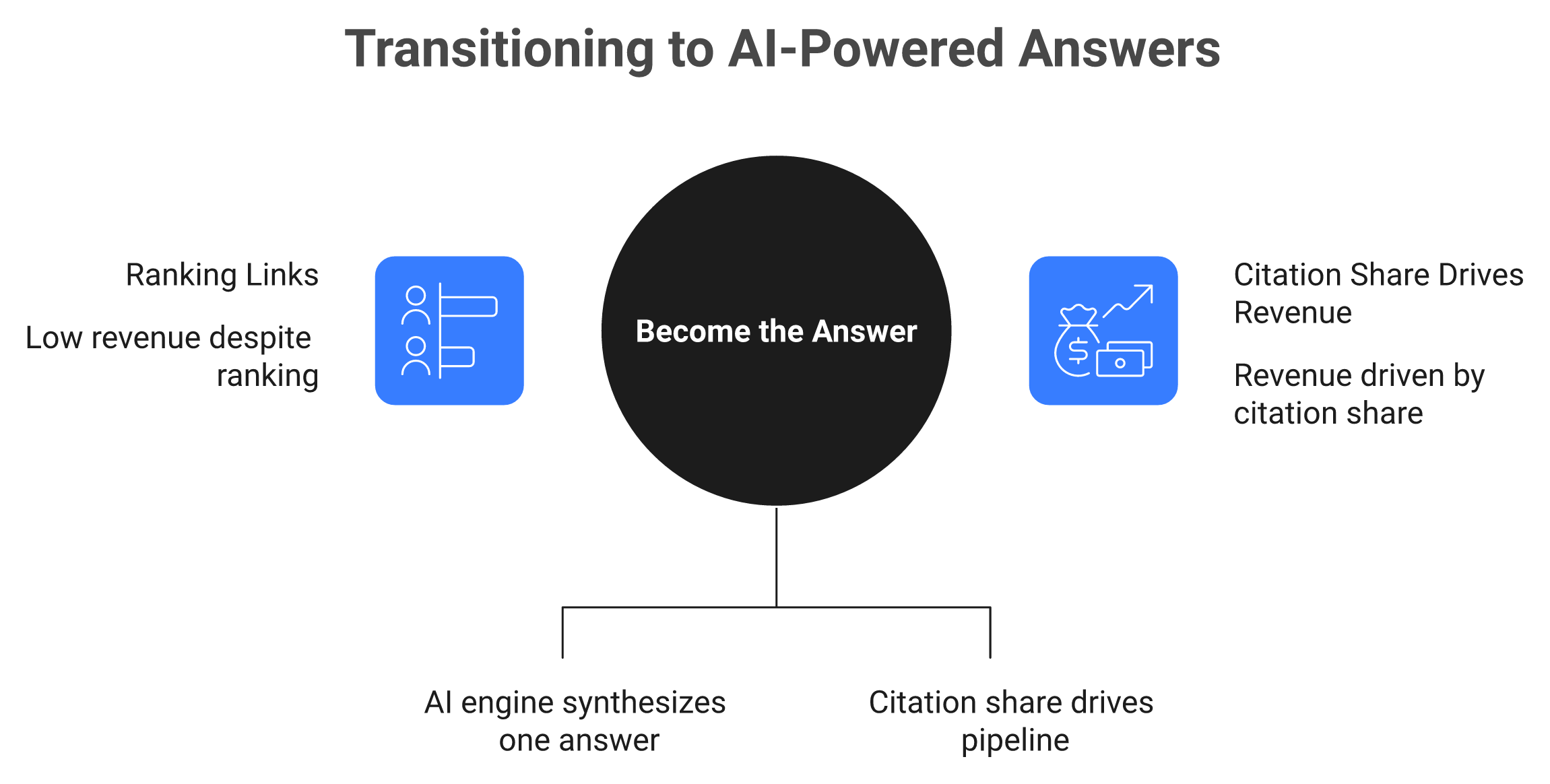
That means engineering extractable answers, trust signals, and buyer-question coverage before you draft a word. I might be wrong on the exact timeline, but the direction looks locked: citations are the new currency, and the rest of this guide builds the plan around them.
At MaximusLabs, we stopped planning for rankings and started planning for citations. That single shift is what separates GEO-native strategy from repackaged SEO, and it is the frame every section below inherits.
Q2. What exactly is AI content strategy planning (and how is it different from AI content creation)?
Ask ten marketing teams to define "AI content strategy" and eight will describe a writing tool. That confusion is exactly why so many plans stall.
✅ The definition, stated plainly
AI content strategy planning is the work of deciding what content to build, for which buyer questions, and how to structure it so AI engines cite it, before any drafting begins. It covers objectives, buyer-question mapping, extractable structure, and AI-visibility measurement across GEO and AEO.
AI content creation is the execution layer: drafting, generating, and producing assets. Strategy decides the what and why. Creation produces the output, and our content marketing service keeps the two roles cleanly separated.
🎯 Why conflating the two quietly loses
Teams that skip planning jump straight to generation. They produce volume, not visibility.
Strategy answers the questions that generation cannot: Which buyer questions influence revenue? Which queries deserve an owned page versus an earned mention? What structure makes a paragraph extractable? Get those wrong and no amount of AI drafting saves you.
Think of the language model as a universal intent decoder. As Ethan Smith frames it, "it doesn't matter how you ask the question, the LLM kind of gets it." So you plan for clusters of questions, not exact-match keywords, and that planning lens is what separates the two disciplines.
💸 The cost of skipping the plan
Unassisted AI generation is the expensive shortcut. Smith is blunt that if you "just make a bunch of AI content," he "probably wouldn't have that be my top recommendation," pointing to studies where human-written content consistently outranks it.
Mass-generated content also risks model collapse, where engines stop trusting derivative summaries of summaries. Planning is the guardrail that keeps your output on the trusted side of that line, and a trust-first content playbook makes that guardrail repeatable.
🌐 The scope: every answer engine, not just Google
Modern planning spans ChatGPT, Perplexity, Gemini, Copilot, and Google AI Overviews. Each has its own citation patterns, so the plan defines coverage and structure once, then adapts per platform. Strategy sets the map; creation walks it.
Q3. How do you plan content that AI engines actually cite, the end-to-end GEO/AEO framework?
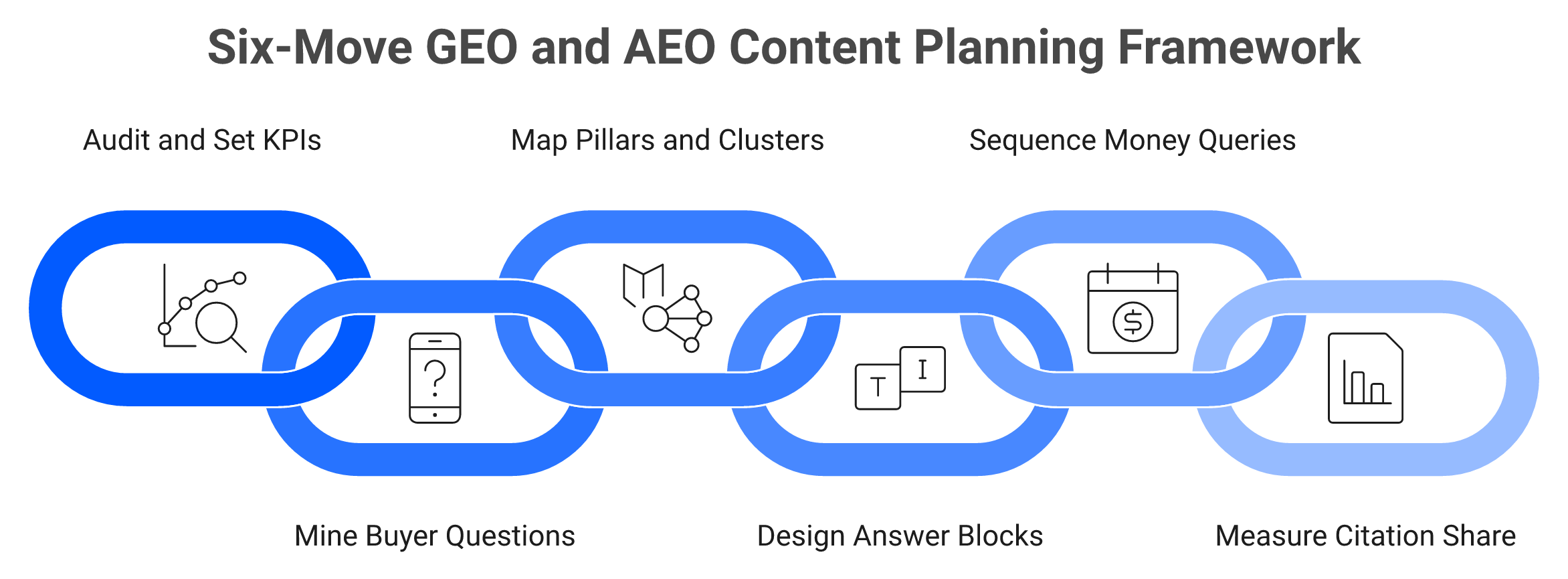
The best GEO plans I have seen fit on one page. Six moves, sequenced so the highest-revenue work ships first and the citation mechanics are baked in from move one.
✅ The framework in one breath
Plan in six moves: (1) audit existing content and define revenue objectives plus AI-visibility KPIs, (2) mine buyer questions from search and chat data, (3) map questions to a pillar-and-cluster architecture, (4) design extractable answer blocks of 40 to 80 words, front-loaded, (5) build the calendar around money queries first, and (6) measure citation share. Princeton's GEO research shows adding statistics, quotations, and citations can lift generative-engine visibility by up to 40%.
🔍 Move 1: Audit and set revenue-first KPIs
Start by auditing what you already have and what it earns. Most of it earns little. Smith notes that "19 out of 20 pages drive no traffic," which is why cheap rewrites flood the web.
Set KPIs around AI-visibility and pipeline, not pageviews. Monday action: pick your top ten revenue pages, run them through an technical SEO and website audit, and record whether they currently surface in ChatGPT and AI Overviews.
❓ Move 2: Mine buyer questions
There is no keyword-volume truth set for chat yet. The workaround is directional and simple.
Take your search-query data and, as Smith advises, "give those keywords to ChatGPT and say, make these into questions." Then mine sales calls, support tickets, and Reddit threads for the long-tail questions search data never captures.
🧩 Move 3: Map questions to pillars and clusters, owned versus earned
Group thousands of question variants into themed clusters, one pillar page per cluster. Then route each cluster by a simple rule from Smith: "the more specific the question, the more an owned strategy works, and the more general a question, the more an earned strategy works."
Head terms favor earned citations on high-authority and UGC sites. Specific money queries favor your own comprehensive pages, which is where a GEO topic clusters architecture pays off.
⭐ Move 4: Design front-loaded answer blocks
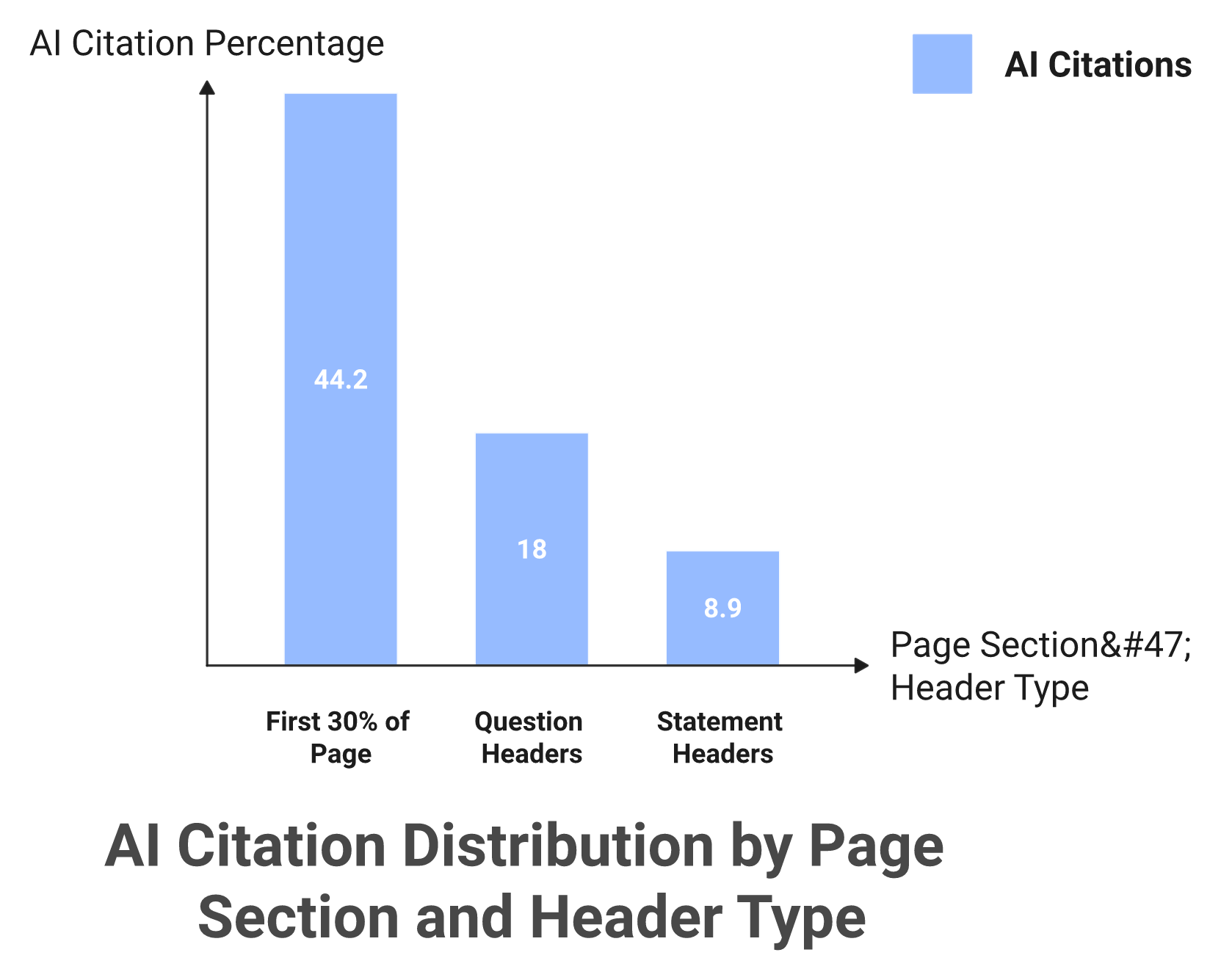
Structure matters as much as substance. An analysis of 177 million citation instances found that 44.2% of all AI citations come from the first 30% of the page.
So lead every section with a standalone 40-to-80-word answer. Content buried deep in a long essay is effectively invisible to retrieval, a principle covered in our GEO content optimization guidance.
💰 Move 5 and 6: Sequence money queries, measure citation share
Build the editorial calendar bottom-of-funnel first. BOFU pages influence pipeline; TOFU explainers rarely do, and AI already handles "what is X" well.
Then measure share of voice across question variants and platforms, not a single rank. This audit-first, BOFU-first, answer-block sequencing is the backbone of MaximusLabs' cost-effective, scalable GEO content production, and it maps directly to our GEO strategy framework.
Q4. Which AI tools and human roles belong in your content workflow?
A founder once showed me a "fully automated" content pipeline that shipped a customer-facing page peppered with emojis nobody approved. The tooling worked. The judgment layer was missing.
✅ The role split, stated first
Assign AI to research synthesis, question clustering, first drafts, and repurposing. Keep humans on strategy, brand voice, editorial judgment, and fact-verification.
Tools like ChatGPT, Perplexity, and clustering platforms compress research and ideation time meaningfully. They cannot own positioning or trust. The winning workflow is human-led and AI-accelerated, a role map rather than a hand-off, and it is the model behind our AI SEO service.
📊 Where each layer belongs
| Workflow stage | Owner | Why |
|---|---|---|
| Question research, clustering | AI-assisted | Fast pattern-finding across large query sets |
| First draft, repurposing | AI-assisted, human-edited | Speed on structure, human on voice |
| Strategy, positioning, ICP | Human | Judgment AI cannot replicate |
| Fact-check, primary sourcing | Human | Trust and E-E-A-T live here |
The pattern practitioners keep landing on is the same. AI drafts, humans finish.
"If you want your site's content to be consumed by humans, then have the human write the content and only use AI for editing."
u/wpseoguy, r/SEO Reddit Thread
"The key is not relying 100% on the AI. It's better as a starting point, and then you or the writer can tweak it to make sure it sounds more natural."
u/kamaldeepsinghSEO, r/SEO_Digital_Marketing Reddit Thread
⚠️ The unedited-AI trap
Ship raw AI output and readers notice fast. That erodes the trust AI engines reward.
"Yeah, ChatGPT for formatting, but be careful, folks easily pick on the AI blog posts now and lose confidence in your work."
u/Desperate_Yam_495, r/SEO_Digital_Marketing Reddit Thread
The guardrail can be as small as one written rule. In one build, telling an agent to "create a claude.md file and add one rule, never use emojis" fixed a recurring failure permanently. Encode judgment once, and the workflow keeps it, which is why we lean on an AI content humanizer only as a checkpoint, never a crutch.
Where DIY tools produce generic drafts, MaximusLabs encodes the founder's voice and positioning exactly the way the client wants, so the human layer scales instead of getting skipped.
Q5. What content structure and formatting make your pages extractable by RAG retrieval?
Most pages fail AI search for a boring reason. The answer exists, but it is buried where the machine never looks.
✅ The rule: build for retrieval, not just reading
AI engines pull answers through RAG, or retrieval-augmented generation, the live search-and-summarize step behind ChatGPT and Perplexity. To get pulled, structure content as self-contained, front-loaded answer blocks under question-format headers. Each block should make full sense if lifted out of context, a discipline at the heart of answer engine optimization.
That is the whole game. Write the answer first, then explain.
📊 What the data says about format
Format changes citation odds more than most teams expect. Salespeak's 2026 analysis found question-format headers get cited roughly 18% of the time, versus about 8.9% for statement headers.
Structured data helps too, within limits. Authoritas found FAQPage-schema pages earn roughly 3.1x more AI Overview citations than comparable pages without it. Schema is a clarity aid, not a magic switch, as our schema markup basics guide explains.
❌ The hidden-content trap
Here is where product and SaaS sites quietly lose. Critical details often sit behind JavaScript facets, the filter dropdowns for material, size, plan tier, or specs.
RAG cannot click a dropdown. As one practitioner puts it, you must "expose this facet data and bring some of that in your FAQs," because language models never open the menu. If it is not in visible text, it does not exist to the retriever, which is why a proper technical SEO and website audit checks for trapped content first.
⭐ The facet-to-FAQ move
The fix is simple and cheap. Pull the metadata trapped in facets into visible headers, tables, and FAQ answers.
Turn "filter by material" into a written line: "This jacket uses waterproof ripstop nylon." Now the fact is retrievable, and it also answers a real buyer question, the kind of move our GEO content optimization process bakes in by default.
💡 Why this works, in plain terms
Retrieval runs on semantic similarity, a math score of how close your text sits to the user's question. Practitioners describe a working threshold around cosine 0.7, where cosine similarity is just that closeness score from 0 to 1.
GEO is a data-science problem, not a keyword-density exercise, and that framing shapes our GEO strategy framework. At MaximusLabs, we engineer every section as an evidence object built to clear that retrieval similarity threshold, so the answer surfaces instead of hiding.
Q6. Is technical SEO and schema still worth planning for in an AI-search strategy?
Every quarter, some team hands leadership a 50-page technical audit. It feels rigorous. It rarely moves revenue.
⚠️ The situation: audits as a security blanket
Technical SEO earns budget because it looks measurable. Yet much of it is, as one veteran puts it, "stuff that's true but zero impact," including years of chasing Core Web Vitals that never drove a traffic increase.
That does not make technical work useless. It means the priorities are wrong for an AI-search world, which is why we scope technical GEO implementation around citations, not vanity scores.
🤔 The complication: the schema debate is genuinely split
Ask two experts about schema and you get two answers. SALT.agency calls it a hygiene factor "at best." Surfer Academy says structured data raises citation odds significantly.
Practitioners are just as divided on whether AI engines even read it.
"In my experience, schema doesn't seem to influence AI visibility at all. From my tests, it appears that LLMs completely overlook it every time."
u/annseosmarty, r/SEO_for_AI Reddit Thread
"LLMs lack this extensive background, which makes structured data like schema markup a valuable resource for clarity, and brands tend to present more accurate information when they incorporate schema."
u/Common_Exercise7179, r/SEO_for_AI Reddit Thread
✅ The resolution: what actually earns citations
The defensible read sits in the middle. FAQPage and Article schema help AI understand your content, and Authoritas ties FAQPage schema to roughly 3.1x more AI Overview citations. But schema never outweighs extractable, trustworthy content.
So plan schema as support, not strategy. Ship the answer blocks first, then mark them up.
🚫 The non-negotiable: crawler access
One config error erases everything else. You must allow OAI-SearchBot in robots.txt, separately from GPTBot, or you stay invisible in ChatGPT search. Many sites "allow OpenAI," permit only GPTBot, and then wonder why they earn zero citations, a trap covered in our guide to managing AI crawlers like GPTBot and Google-Extended.
Skip the llms.txt hype, too. A 2026 study of 300,000 domains found roughly 2.13% adoption and about 97% of files getting zero AI-crawler requests. Unlike agencies selling 50-page technical audits, MaximusLabs plans technical work only where it unlocks AI citation and crawler access, and you can pressure-test that logic against our GEO versus traditional SEO comparison.
Q7. How do you plan content for AI agents and agentic commerce, not just human readers?
A buyer no longer opens twelve tabs. Increasingly, an AI agent does the shopping, and it only shops where it can actually operate.
🤖 The situation: your reader might be a machine
Agentic commerce means an AI agent transacts on the buyer's behalf. It reads, compares, and sometimes checks out, all without a human touching your site.
That changes who you plan for. You now write for two audiences, the human reader and the buying agent, which is exactly what our agentic commerce service is built around.
⚠️ The complication: pretty UI becomes a liability
Agents do not admire your homepage animation. They need clean, parseable data feeds.
Think of it as a ghost kitchen. Your website is the dining room, but agentic commerce is the kitchen, where the data feed lets an AI "delivery driver" fulfill orders for users who never enter the building. A beautiful dining room means nothing if the kitchen has no order ticket the machine can read, a shift we track in the state of agentic commerce 2026 report.
✅ The resolution: expose feeds and flip the right flags
Make your product data machine-readable, then set the technical switches that admit you to bot recommendations. OpenAI's Agentic Commerce feed, for example, uses an "is_eligible_search" boolean that acts as a hard on-off switch for appearing in agent-driven lists.
Speed matters here too. Microsoft's Web IQ grounding layer benchmarks at 164ms p95, roughly 2.5x faster than the nearest alternative, which means slow pages get cut from the inference loop. If your feed loads late, the agent moves on, so the plumbing described in how agentic commerce works matters as much as the copy.
🏆 The payoff: the binary win
This is a winner-take-most game. As Ethan Smith frames it, "if an agent is asked to buy a product and the agent is not able to navigate other websites but is able to navigate yours, then you are the winner."
When a competitor is technically invisible to agents and you are readable, you win by default. MaximusLabs' Search Everywhere Optimization already plans for the agent as a first-class reader, not an afterthought, so the feed is ready before the buyer's assistant comes looking.
Q8. Why is brand-building the most durable moat in your AI content strategy?
Most GEO advice is a hunt for the clever hack. The hack decays. The brand compounds.
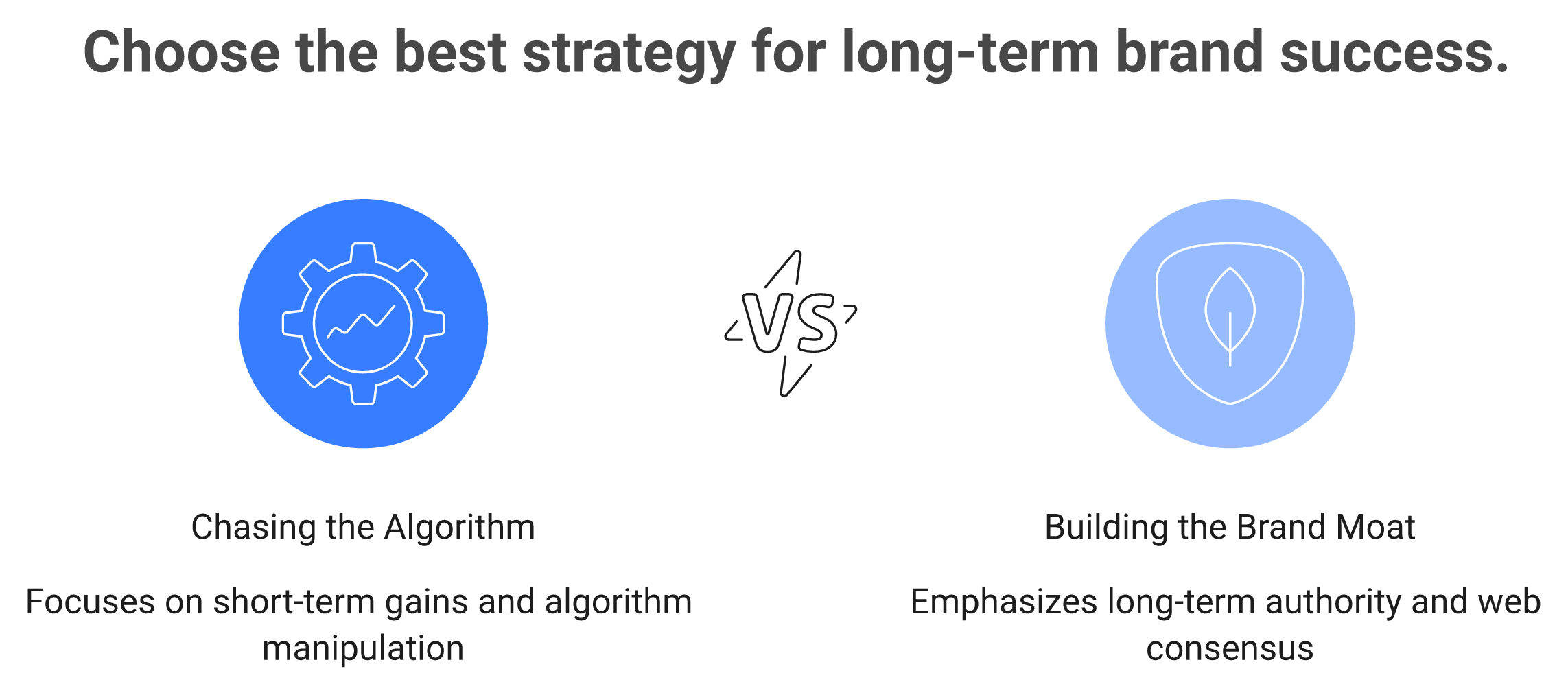
🎯 The situation: everyone is chasing the algorithm
Teams pour energy into reverse-engineering how ChatGPT or Gemini ranks sources. Some of that helps. Most of it expires with the next model update.
Chasing the algorithm treats AI visibility as a trick. It is closer to a reputation, which is why we anchor generative engine optimization on brand, not gimmicks.
⚠️ The complication: model collapse punishes sameness
Mass-generated AI content is flooding the web, and it converges into interchangeable summaries. Ethan Smith, an 18-year veteran, compares it to the 2007 scraped-content era, where tactics that worked briefly got penalized once they degraded the ecosystem.
Engines cannot survive summarizing their own derivatives forever, a failure called model collapse. So they lean harder on trusted, distinctive brands, and the penalty for being average has never been so severe, a theme we unpack in the zero-click search brand economy report.
✅ The resolution: brand as the priors AI can't ignore
When you become the definitive brand in a category, an LLM's training-data priors, the associations baked in from its training, force it to include you. Krishna's most contrarian take says it plainly: "it is not about understanding the algorithm or hacking, and if you build a brand in your space, then AI HAS to recommend you."
Practitioners are landing on the same conclusion.
"AI trusts signals that are not self-published, and when you become the clearest source on a topic, you get picked up more."
u/[deleted], r/SEO_tools_reviews Reddit Thread
📊 The proof: AI trusts consensus over your own site
Here is the tell. Perplexity once summarized a team's article and described them as Oxford researchers, though none had attended Oxford, because it pulled from conceptually adjacent web sources.
The machine trusted web-wide consensus over the authors' own site. Princeton's GEO research points the same way, showing citation and authority signals lift visibility meaningfully. MaximusLabs' trust-first methodology is built on this exact premise: engineer the brand consensus AI is forced to cite, because brand is the moat no update erases, and our trust-first content playbook shows how.
Q9. How do you measure whether your AI content strategy is actually driving revenue?
A VP Marketing once showed me a dashboard glowing green with impressions. Then the CFO asked one question: how much pipeline did this create? The room went quiet.
✅ The metrics that actually matter
Measure AI-search visibility, not pageviews. Three metrics carry the weight:
- Citation share: how often AI engines name your brand for target questions.
- Question coverage: the specific queries where you appear versus competitors.
- Pipeline influence: revenue and deals touched by AI referrals.
Impressions tell you a page loaded. These metrics tell you whether you became the answer, which is why we anchor reporting on GEO measurement and metrics rather than vanity counts.
📊 Why AI traffic deserves its own scorecard
AI-referred visitors arrive primed. They have already asked follow-up questions, so they land closer to a decision.
The gap is large. Webflow reported a 6x higher conversion rate from LLM traffic compared to Google search traffic, driven by that built-up intent. Founders are noticing the same pattern in the wild, a shift we document in the B2B SaaS buyer journey in AI search report.
"The traffic is low volume, but the intent is insane. These people already know what they want, and they're basically pre-sold by the time they hit my site."
u/Ok_Reflection_5449, r/SaaS Reddit Thread
⚠️ Why old metrics now mislead
Click-through rate and impressions assumed the click happened. In the zero-click era, that assumption breaks.
A page can rank, get summarized, and never earn a visit. So a rising-impressions chart can hide flat revenue, which is exactly the trap that burns marketing leaders in board meetings, and it is why we tie every program to GEO ROI and revenue attribution.
⏰ What to do Monday morning
Start instrumenting attribution this week. Segment AI referrals in GA4 by source, since ChatGPT, Perplexity, and Gemini now pass clickable links.
Add a "How did you hear about us?" field to conversion forms to catch what analytics misses. At MaximusLabs, we report on citation share and pipeline influence, the metrics a VP Marketing can take to the board, not vanity impressions, using AI search visibility and brand mention tracking. Lower search volume does not mean lower intent, and the numbers keep proving it.
Q10. Should you build AI content strategy in-house or partner with a GEO specialist?
Here is the honest version of a decision most teams rush. Building in-house is right for some, and a costly detour for others.
🤔 The situation: a real fork in the road
Build in-house if you have data-science literacy, engineering speed, and time to test how RAG retrieval behaves. Partner if your constraint is speed-to-adapt or an engineering queue that never clears.
Neither is automatically better. The right call depends on what is actually blocking you, and our GEO service exists for the teams where engineering is the bottleneck.
⚠️ The complication: bottlenecks and buzzwords
Two problems sink most in-house builds. First, engineering timelines. Work that could ship in days often returns from the internal team quoted at nine months, and that lag is the number-one killer of AI-search agility.
Second, the GEO market is noisy with claims. Many specialists sell the vocabulary without the delivery, and buyers feel it, which is why an honest AEO agencies evaluation matters before you sign.
"Many SEO retainers seem designed to give the appearance of work rather than actually deliver tangible outcomes. Meanwhile, your organic revenue? Stagnant."
u/[8-year SEO practitioner], r/DigitalMarketing Reddit Thread
"Honestly, many agencies operate like scams, relying on generic templates rather than tailoring their services to individual clients, and they tend to charge inflated prices for it."
u/yohannj1, r/SEO Reddit Thread
✅ The resolution: how to choose well
Judge partners on proof, not pitch. Ask three questions:
- Who did you work with, and can you show citation share before and after?
- Do you write revenue-first, BOFU and MOFU content, or TOFU vanity pages?
- Does the content sound like the founder, or like every other blog?
A credible partner ships fast, cites results, and reflects your point of view, the standard set out in our founder voice methodology guide.
💰 The payoff: what a GEO-native partner delivers
MaximusLabs is built for exactly this gap. We ship the first article within days rather than months, because full-stack production removes the engineering bottleneck that stalls in-house teams, and you can review the terms on our pricing page.
Our differentiators anchor on the things buyers actually check: cost-effective, scalable GEO content production; trust-first and revenue-focused methodology; product positioning exactly the way you want it; and the founder's voice baked into every piece. Traditional SEO agencies still play by Google-only rules and optimize for impressions, which leaves brands exposed as over 50% of search traffic is projected to move to AI-native platforms by 2028 (MaximusLabs' reading of Gartner data). Other GEO shops make the claims; the test is whether they operationalize them, and if you want to talk specifics, our team is one contact us click away.
What I'm sitting with next
I keep circling one question. As buying agents start doing the shopping, does "content strategy" quietly become "feed strategy," where the best-structured data wins the transaction before a human ever reads a word?
I might be wrong on the timeline. But the brands treating AI engines as their primary reader today are the ones I expect to own their category's answer box in two years, a thesis explored in our state of agentic commerce 2026 report.
If you are staring at flat revenue behind healthy-looking traffic, that is the conversation worth having. Reach me at krishna@maximuslabs.ai, and you will leave with clarity, not jargon.
Frequently asked questions
What is AI content strategy planning and how is it different from AI content creation?
AI content strategy planning is the work of deciding what content to build, for which buyer questions, and how to structure it so AI engines cite it, all before any drafting begins. It covers objectives, buyer-question mapping, extractable structure, and AI-visibility measurement across GEO and AEO. AI content creation is the execution layer: drafting, generating, and producing assets. Strategy decides the what and the why, while creation produces the output. Planning answers which buyer questions influence revenue and which deserve an owned page versus an earned mention. Planning defines the structure that makes a paragraph extractable. Creation turns those decisions into published assets. Teams that skip planning jump straight to generation and produce volume, not visibility. Mass-generated content also risks model collapse, where engines stop trusting derivative summaries. We keep these two roles cleanly separated through our content marketing service , so strategy sets the map and creation walks it. That single distinction is what separates a plan that earns citations from a content calendar that quietly starves pipeline.
How do you plan content that AI engines actually cite?
We plan in six sequenced moves, so the highest-revenue work ships first and citation mechanics are built in from the start. Audit existing content and set revenue objectives plus AI-visibility KPIs. Mine buyer questions from search data, sales calls, support tickets, and Reddit threads. Map questions to a pillar-and-cluster architecture, routing specific queries to owned pages and general queries to earned citations. Design extractable answer blocks of 40 to 80 words, front-loaded under question-format headers. Build the calendar around bottom-of-funnel money queries first. Measure citation share across question variants and platforms. Structure matters as much as substance, since an analysis of 177 million citation instances found 44.2% of AI citations come from the first 30% of the page. Princeton's GEO research also shows that adding statistics, quotations, and citations can lift generative-engine visibility by up to 40%. This audit-first, BOFU-first sequencing is the backbone of our GEO strategy framework , and it turns a keyword plan into a citation plan.
What content structure makes pages extractable by AI retrieval?
AI engines pull answers through RAG, the live retrieval-and-summarize step behind ChatGPT and Perplexity. To get pulled, structure content as self-contained, front-loaded answer blocks under question-format headers, so each block makes full sense if lifted out of context. Lead every section with a standalone 40-to-80-word answer, then explain. Use question-format headers, which Salespeak found get cited roughly 18% of the time versus about 8.9% for statement headers. Expose data trapped behind JavaScript facets, because retrieval cannot click a dropdown. The facet-to-FAQ move is the cheapest win. Turn a filter like material into a written line such as "this jacket uses waterproof ripstop nylon," so the fact becomes retrievable and answers a real buyer question. Retrieval runs on semantic similarity, so we engineer every section as an evidence object built to clear that threshold. This is the discipline at the center of our GEO content optimization process, where hidden content simply does not exist to the retriever.
Is technical SEO and schema still worth planning for in an AI-search strategy?
Yes, but with sharply reprioritized effort. Much traditional technical work is true but low impact, so we scope it around citations and crawler access rather than vanity scores. The schema debate is genuinely split. Some experts call it a hygiene factor, while others tie FAQPage schema to roughly 3.1x more AI Overview citations. The defensible read sits in the middle: schema supports clarity but never outweighs extractable, trustworthy content. Ship extractable answer blocks first, then mark them up with FAQPage and Article schema. Allow OAI-SearchBot in robots.txt separately from GPTBot, or you stay invisible in ChatGPT search. Skip the llms.txt hype, since a study of 300,000 domains found roughly 2.13% adoption and about 97% of files getting zero AI-crawler requests. One crawler-access misconfiguration erases everything else, which is why we plan technical work only where it unlocks citations through our technical GEO implementation . Priorities, not audit length, decide outcomes here.
How do you plan content for AI agents and agentic commerce, not just human readers?
Agentic commerce means an AI agent reads, compares, and sometimes checks out on the buyer's behalf, without a human touching your site. That changes who you plan for, because you now write for two audiences, the human reader and the buying agent. Agents do not admire your homepage animation. They need clean, parseable data feeds, so pretty UI without machine-readable data becomes a liability. Make product data machine-readable through structured feeds. Flip the eligibility flags that admit you to bot recommendations, such as OpenAI's Agentic Commerce feed boolean. Keep pages fast, since slow feeds get cut from the inference loop. This is a winner-take-most game. When a competitor is technically invisible to agents and you are readable, you win the transaction by default. We plan the agent as a first-class reader through our agentic commerce service , so the feed is ready before the buyer's assistant comes looking.
How do you measure whether your AI content strategy is actually driving revenue?
We measure AI-search visibility and pipeline, not pageviews. Three metrics carry the weight. Citation share: how often AI engines name your brand for target questions. Question coverage: the specific queries where you appear versus competitors. Pipeline influence: revenue and deals touched by AI referrals. AI-referred visitors arrive primed, having already asked follow-up questions, so they land closer to a decision. Webflow reported a 6x higher conversion rate from LLM traffic compared to Google search traffic, driven by that built-up intent. Old metrics now mislead, because click-through rate and impressions assumed the click happened. In the zero-click era, a page can rank, get summarized, and never earn a visit, so rising impressions can hide flat revenue. Start this week by segmenting AI referrals in GA4 and adding a "How did you hear about us?" field to forms. We report on citation share and pipeline influence using GEO measurement and metrics , the numbers a VP Marketing can take to the board.
Should you build AI content strategy in-house or partner with a GEO specialist?
It depends on your real bottleneck. Build in-house if you have data-science literacy, engineering speed, and time to test how RAG retrieval behaves. Partner if your constraint is speed-to-adapt or an engineering queue that never clears. Two problems sink most in-house builds. First, engineering timelines, where work that could ship in days returns quoted at nine months. Second, a noisy market where many specialists sell the vocabulary without the delivery. Ask who they worked with and whether they can show citation share before and after. Confirm they write revenue-first BOFU and MOFU content, not TOFU vanity pages. Check that the content sounds like the founder, not every other blog. We built our GEO service for exactly this gap, shipping the first article within days rather than months because full-stack production removes the engineering bottleneck. A credible partner ships fast, cites results, and reflects your point of view.
Why is brand-building the most durable moat in an AI content strategy?
Most GEO advice hunts for a clever hack, but the hack decays while the brand compounds. Chasing the algorithm treats AI visibility as a trick, when it is closer to a reputation. Model collapse punishes sameness. Mass-generated content converges into interchangeable summaries, and engines cannot survive summarizing their own derivatives forever, so they lean harder on trusted, distinctive brands. When you become the definitive brand in a category, an LLM's training-data priors force it to include you. AI trusts web-wide consensus over your own self-published claims. The penalty for being average has never been more severe. Here is the tell: Perplexity once described a team as Oxford researchers, though none attended Oxford, because it pulled from conceptually adjacent consensus sources. The machine trusted the web over the authors' own site. Our trust-first methodology is built to engineer the brand consensus AI is forced to cite, detailed in our trust-first content playbook , because brand is the moat no model update erases.