 Krishna Kaanth M
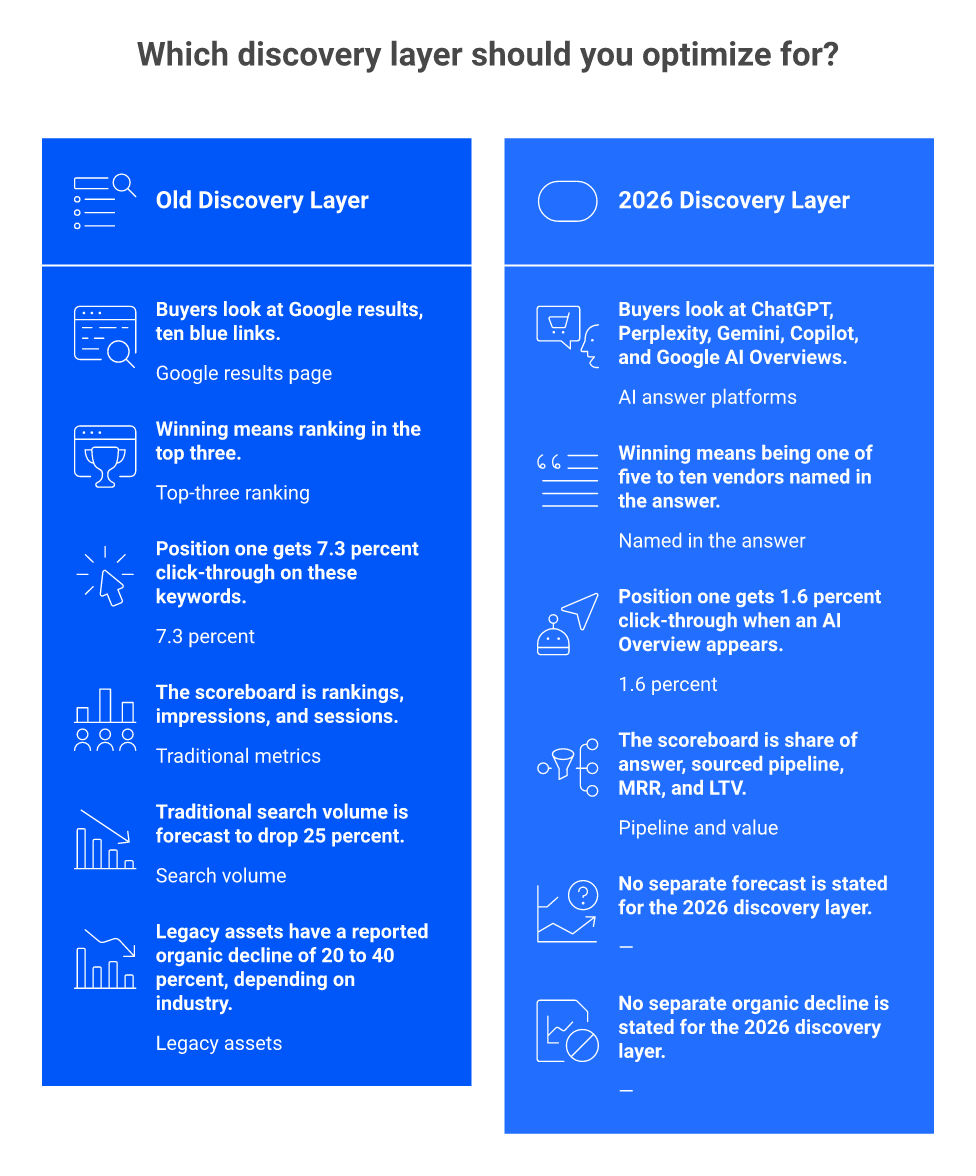
- The strategy layer did not change in 2026. The discovery layer did: Ahrefs measured a 58% lower click-through rate at position one when an AI Overview appears.
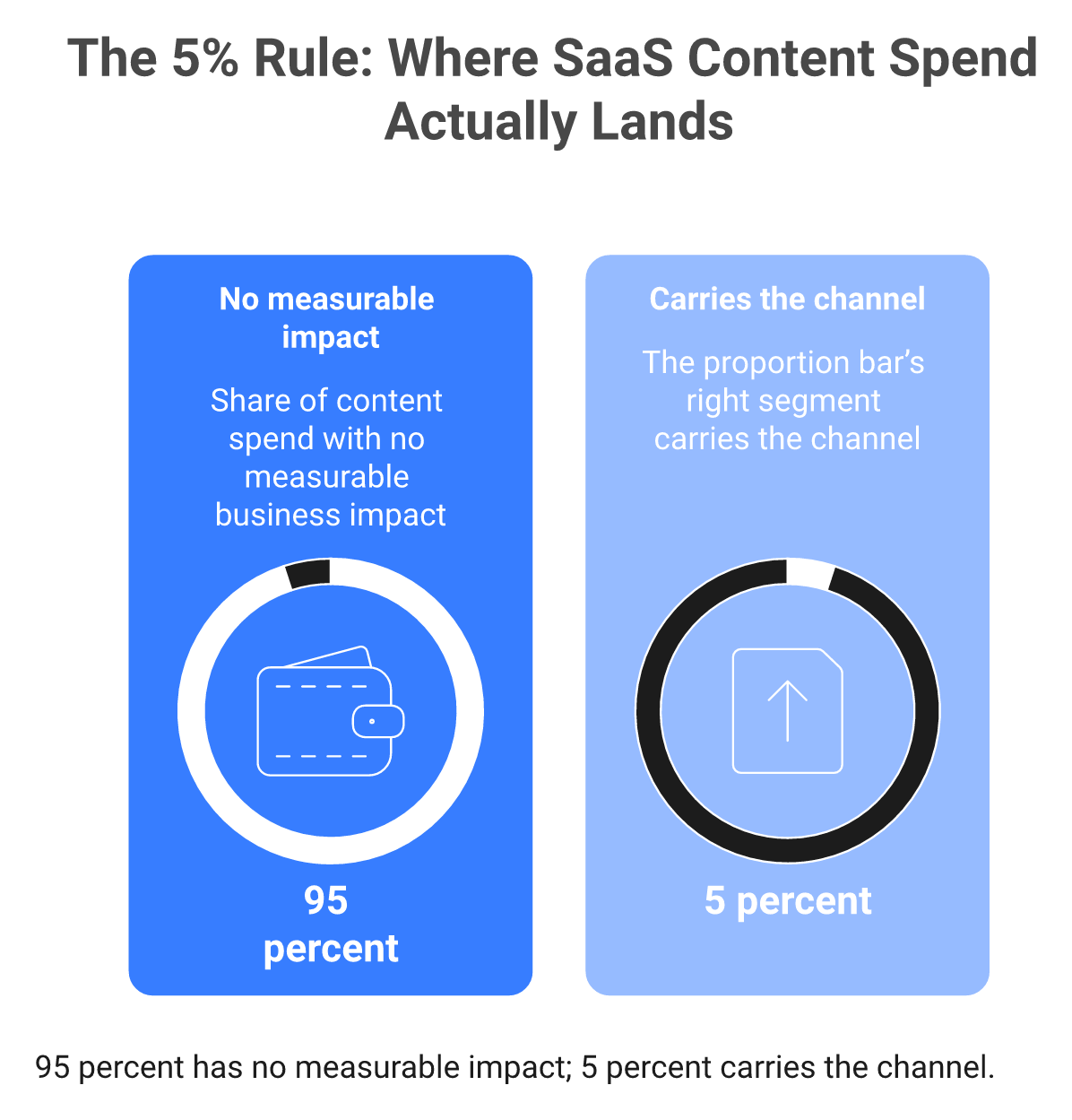
- Content output follows a power law. Graphite found 19 of 20 landing pages drive almost no traffic while 1 in 20 drives roughly 85% of it.
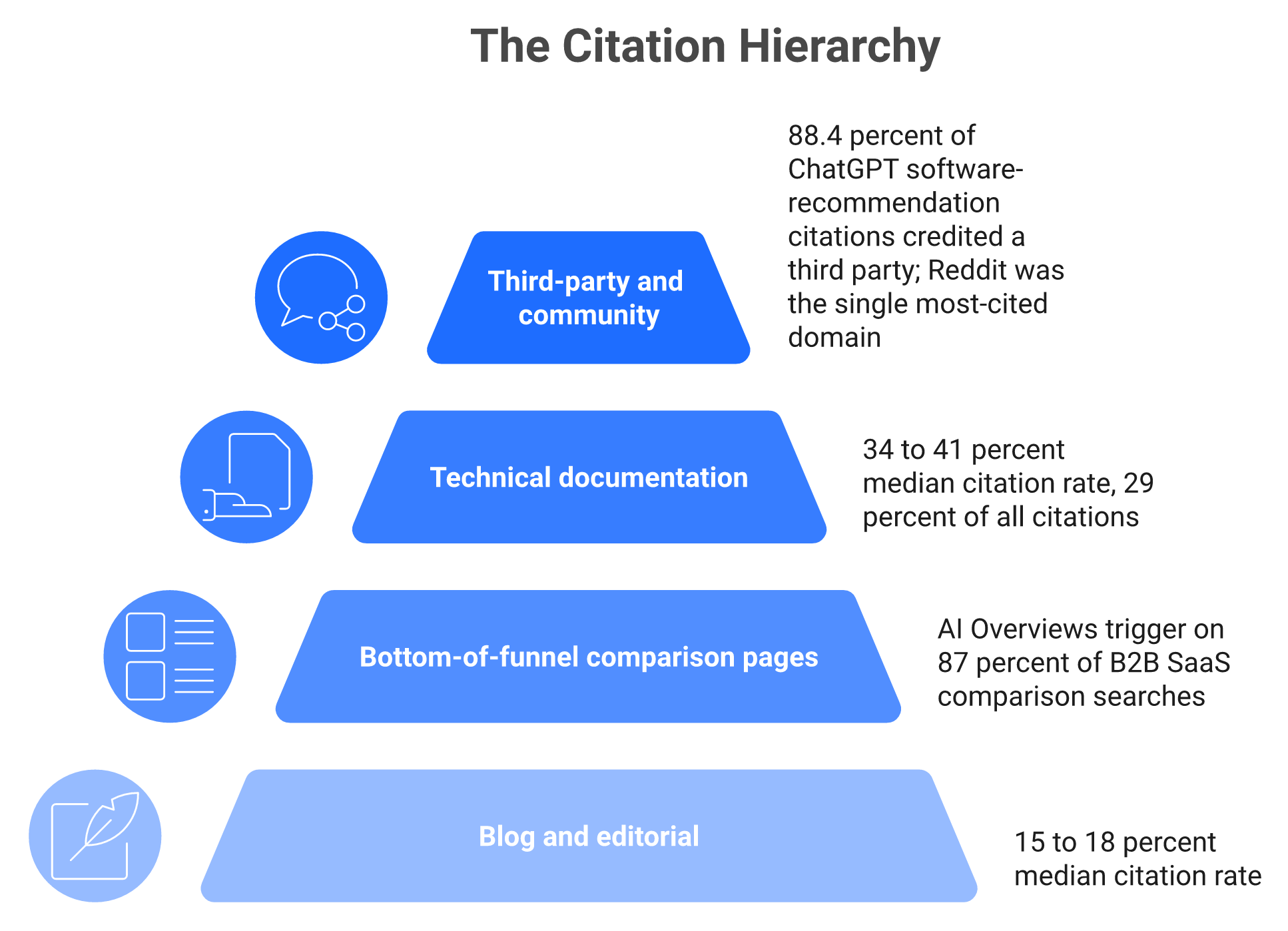
- Technical documentation carries a 34% to 41% median AI citation rate against 15% to 18% for blogs, so docs should ship before the next blog post.
- Review profiles gate the shortlist while community sources carry the citation. One 2026 study found 88.4% of ChatGPT citations credited a third party.
- Rank no longer exists inside an AI answer. Measure share of answer per engine alongside CAC, LTV:CAC at 3:1, payback, and NRR above 100%.
- AI traffic conversion is unsettled, from a measured 6x at Webflow to 0.62x in a 95-site B2B benchmark, so measure your own multiplier first.
Q1. What is a SaaS marketing strategy in 2026, and what actually changed?
A SaaS marketing strategy is a structured plan for acquiring, activating, retaining, and expanding subscription customers. It ties ICP definition, positioning, go-to-market motion, and channel mix to recurring-revenue metrics: CAC, LTV, CAC payback, and net revenue retention. What changed in 2026 is the discovery layer. Ahrefs measured a 58% lower click-through rate at position one when an AI Overview appears, so the job is now becoming the cited answer, not ranking a blue link.
📉 The slide that stopped making sense
Picture a VP Marketing on a Tuesday board call. The rankings chart is green. Eleven keywords moved into the top three. Then someone asks about sourced pipeline, and the room goes quiet.
That gap is the real story of 2026. Rankings improved. Clicks did not follow them.
🔍 What the definition still covers
The strategy layer has not changed much. You still pick an ideal customer profile, position against a named problem, choose a sales motion, and measure unit economics. Those four decisions still govern whether marketing compounds or burns.
Sam Lessin put the damage plainly on My First Million, describing organic traffic that had been predictable for years: it "has gone down literally by about 20 to 40% based on which industry you are in". Strong SEO operators were not spared.
⚡ What actually changed: the discovery layer
Buyers now assemble their shortlist inside an answer engine before a vendor hears from them. Ahrefs analysed 300,000 keywords and found position-one CTR on AI Overview keywords fell from 7.3% to 1.6%. Gartner had forecast a 25% drop in traditional search volume by 2026.
Chegg is the cautionary version of this. Its market capitalisation fell more than 80% once students chose instant LLM summaries over a database of 46 million answers. Any company whose value sits in easily-summarised answers inherits that risk.
🧭 Why "the answer" replaced "the ranking"
Here is the part most 2026 playbooks still miss. An AI answer names five to ten vendors, and there is no page two. You are either inside that sample set or outside the evaluation entirely.
"A user is evaluating a CRM. There are hundreds of CRMs out there, but AI systems will mention only 5-10 players. If you're not in this sample set, you don't exist."
That also changes the nature of the recommendation. When ChatGPT names you, it stakes its own credibility on you, which is a trust transfer Google's ten blue links never offered. Google's own May 2026 guidance confirms AI Overviews and AI Mode run on core Search ranking and quality systems, so the fundamentals still apply; they just resolve into one answer instead of ten options.
📊 What this means for your measurement
Rank position stops being a usable metric. Share of answer takes its place: how often you appear across thousands of real question variants, per engine.
MaximusLabs AI tracks share of voice across thousands of question variants per engine rather than single rank positions, and reports it against ICP and deal stage. The approach came out of one observation Krishna made while running GTM at WiseMonk, where SEO drove 98% of revenue: what ChatGPT treats as important is not what Google or Perplexity treat as important. We run Answer Engine Optimization (AEO) per platform for that reason, with SEO as the foundation underneath, and we are measured on pipeline rather than mentions.
Q2. How do you define the ICP and buying committee your strategy serves?
Start with your top 20 customers, not a persona template. Score them on retention, expansion, and sales-cycle length, then extract the shared firmographic, technographic, and behavioural signals, plus an explicit exclusion list. Map every committee role: champion, economic buyer, technical evaluator, and finance. Positioning then follows as one line per segment: the problem they name, the outcome they buy, and the differentiator only you can claim.
🎯 Run the top-20 audit before the keyword research
Pull your 20 healthiest accounts. Not the largest ones, the healthiest: high retention, real expansion, short cycles. Then look for what they share.
| Signal type | What to extract | Where to find it |
| Firmographic | Employee count, ACV, funding stage, region | CRM, billing |
| Technographic | Adjacent tools already in the stack | Integration logs, onboarding notes |
| Behavioural | Which feature they adopted in week one | Product analytics |
| Trigger event | What happened right before they bought | Sales call transcripts |
Two columns matter more than the rest: the week-one feature and the trigger event. They tell you what to write about.
❌ The exclusion list is the real depth signal
Most ICP documents only describe who you want. The useful ones name who you lose money on. Write down the segments with long cycles, heavy support load, and weak expansion, then stop marketing to them.
Ethan Smith of Graphite framed the underlying problem well: "The director of Finance is not changing their bank every week... they are not searching for your B2B product today, but eventually they will make a decision... The biggest problem in B2B is waste". Exclusions are how you cut that waste at the source.
👥 Map the committee, including the finance seat
B2B software is bought by groups, and the group got bigger. G2's 2026 Buyer Behavior Report, based on a survey of 1,038 buyers, found evaluation is now the longest stage of the purchase for 40% of buyers, with finance scrutiny arriving earlier than it used to.
Four seats to document, each with its own question:
Champion. Will this make my team's week easier?
Economic buyer. What does this replace, and what does it cost in total?
Technical evaluator. Does it fit our stack, auth, and data rules?
Finance. What is the renewal risk and the real total cost?
🗣️ Mine the calls, not the keyword tool
Keyword tools return two-word fragments. Buyers do not talk that way to an AI engine, where queries run closer to 25 words and read like full questions.
So I pull language from Gong or Chorus transcripts instead. Search objection keywords, integration names, and competitor mentions, then lift the buyer's exact phrasing into headings. MaximusLabs AI builds question sets this way during ICP analysis, because a transcript gives you the question as asked, not as abbreviated.
🧩 Turn the ICP into a positioning line
One line per segment, three parts, no adjectives:
Problem they name, outcome they buy, differentiator only you can claim.
MaximusLabs AI starts every engagement with ICP analysis and a leadership session rather than a keyword list. The Founder's Voice methodology depends on knowing the vision and the right to win before any page is scoped, and we hold the output to pipeline, not to traffic.
Q3. Which go-to-market motion fits your ACV, PLG, sales-led, or hybrid?
Let average contract value decide. Below roughly $5K ACV, product-led self-serve carries the economics, and content must enable activation without a human. Between $5K and $25K, hybrid works: self-serve trial with sales assist on expansion. Above $25K, sales-led wins, with marketing owning committee education. Choosing the motion first prevents the common failure of running product-led content against an enterprise sales cycle.
💰 The ACV decision table
| ACV band | Motion | What content must do | Primary surface |
| Under $5K | Product-led self-serve | Get a user to first value with no call | Docs, in-product guides, task videos |
| $5K to $25K | Hybrid | Convert a trial, then arm the sales assist | Comparison pages, integration guides |
| Over $25K | Sales-led | Educate four committee seats | Category citations, analyst and review presence |
One variable, one decision. Most motion debates I sit in are really arguments about ACV that nobody has written down.
✅ What each motion demands of the content team
Self-serve motions live on long-tail owned content. Documentation, integration guides, and task-level videos do the selling, because nobody is on a call to explain the product.
Enterprise motions live on earned citations. Head queries like "best CRM software" are dominated by third-party sources, so the work shifts from publishing to being referenced. Mid-tail queries sit between the two and need both.
⚠️ The hybrid trap
Hybrid is the default answer and the most common failure. Teams run a self-serve trial and an enterprise sales process at half strength, and neither converts.
Neil Patel has described the same disconnect from the enterprise side: "when we talk to enterprise companies they don't care about any of those hacks... How do we go from 10 million to driving additional 90 million a year". Tactics built for a $49 signup do not survive a committee.
Pick a primary motion, resource it fully, and let the second one be an exception you handle manually.
⏰ Stage changes the answer too
Eli Schwartz documented the limit of the self-serve assumption in Product-Led SEO. A niche B2B product sold to a narrow audience does not create new demand through SEO best practice alone. Demand has to exist before capture works.
Stage matters in the other direction as well. Graphite's work suggests answer engine optimisation can move faster for seed-stage companies, because a single earned citation can surface them almost immediately. Large incumbents gain less from speed and more from consistency. I hold that view loosely, since the public dataset behind it is still thin.
MaximusLabs AI runs strategy and execution in one team for exactly this reason. The motion decision and the content that serves it cannot sit with two different vendors, and we work with B2B SaaS first, so the ACV bands above come from live engagements rather than a framework deck.
Q4. How should demand creation and demand capture split across Google and AI engines?
Demand creation makes buyers aware they have a problem. Demand capture intercepts them once they start researching. The 2026 change is that capture now happens across five surfaces: Google, ChatGPT, Perplexity, Gemini, and Copilot. Treating AI answers as a capture channel with its own asset requirements, rather than an SEO side effect, is what separates a 2026 architecture from a 2019 one.
🧱 The split most teams still get right
Creation and capture answer different questions. Creation builds the category belief: podcasts, founder publishing, paid social, and events. Capture meets the buyer who is already looking.
Phil Singleton framed this cleanly in SEO for Growth: outbound advertising creates demand, while inbound captures demand that already exists. That logic has not aged.
🌐 The part that broke: capture went multi-surface
For a decade, capture meant Google. Now a buyer runs the same evaluation across five engines, and each one trusts different sources.
| Surface | What it rewards | Asset that wins capture |
| Google (classic plus AI Overviews) | Core ranking and quality systems | Comparison pages, structured docs |
| ChatGPT | Conversational, self-contained answers | Question-headed pages, review presence |
| Perplexity | Recent, source-transparent content | Dated pages with visible citations |
| Gemini | Entity clarity and corroboration | Schema, sameAs entity links |
| Copilot | Business and vendor documentation | Technical docs, integration guides |
The volume behind this is no longer marginal. Semrush and Emplifi measured US monthly visits to five leading LLM platforms rising from roughly 2.3 million in June 2023 to about 1.33 billion in June 2026.
➕ AI capture is additive, not purely cannibalistic
Here is where I part ways with the doom framing. Zero-click answers do compress CTR, but total question volume is rising, because people now ask things they would never have typed into a search bar.
"The pie of search is getting larger. AI chat is additive, not purely replacement."
So the planning question is not whether to abandon Google. It is how to allocate capture assets across five surfaces instead of one. The Princeton GEO paper is useful here: across 10,000 queries, adding cited sources, statistics, and quotations lifted visibility in generative engines by up to 40%, while keyword stuffing did nothing.
📅 What to do with next quarter's budget
Three moves I would make on Monday:
Split the organic line in your dashboard into Google and AI-assistant demand, and forecast them separately.
Audit your top 20 money keywords for AI Overview presence, then rewrite those pages answer-first.
Add corroboration assets, including review profiles and entity schema, for the engines that lean on third-party trust.
Budget for paid AI surfaces too. My current read is that ads land inside AI chat within one to two years, and the brands with existing citation share will pay less for the same visibility. That is a hypothesis, not a forecast I can source yet.
MaximusLabs AI plans this as one architecture rather than two teams, which is why Search Everywhere Optimization sits in the same engagement as technical SEO instead of being sold as an AI add-on. We run both pillars: Owned AEO, where your content becomes the answer, and Earned AEO, where reviews, Reddit, press, and listicles make the engines trust you. If you want that mapped to your own surfaces, talk to our team.
Q5. Why does 95% of SaaS content produce zero MRR, and should you still fund TOFU?
Because content output follows a power law, not an average. Across work with Webflow, Upwork, Notion, and Rippling, Graphite found 19 of 20 landing pages drive little to no traffic, while 1 in 20 drives roughly 85% of it. Most of the wasted 19 are definitional top-of-funnel posts that AI answers natively at a near-zero conversion rate. MaximusLabs AI skips top-of-funnel content deliberately and funds bottom and middle-of-funnel pages first.
📊 The ratio nobody puts in the content plan
Ethan Smith of Graphite has published the cleanest version of this number from category-champion accounts: "19 out of 20 landing pages drive little to no traffic... one out of 20 landing pages drive roughly 85% of all your traffic".
Read that as a budget statement. If 20 pieces a month cost the same each, 95% of that spend buys nothing measurable.
🧱 The wall most SEO plans hit
Eli Schwartz documented the moment this becomes real in Product-Led SEO. He took on a B2B SaaS client expecting a profitable channel, then hit "a wall of reality" he had to explain to a disappointed client. Best-practice SEO did not create demand that was not already there.
That is the part keyword tools hide. Volume exists for a term, so the page gets written, but nobody searching it is buying anything.
⚠️ Why AI-written volume makes the ratio worse
Cheap production does not fix a distribution problem. It multiplies the 19.
Smith's team tested this directly, charting human-written pages against AI-generated ones across thousands of keywords. The more human editing a page received, the better it ranked, and pure AI output underperformed. MaximusLabs AI runs hybrid human and AI workflows for that reason, with humans approving everything that ships.
✅ When funding TOFU is still the right call
I am not against top-of-funnel content as a category. I am against funding it by default. Two exceptions hold up:
Category creation. If buyers do not yet have a name for the problem, someone has to teach it.
Self-serve activation. In a product-led motion, a definitional page can be a real entry point to signup.
Outside those two, Smith's advice matches mine: "I would spend no time at all really on glossary definitions and low intent stuff".
🔍 The four audit columns I actually use
Before writing anything new, score every existing URL on four columns:
Intent cluster. Which buying question does this page answer?
Buyer stage. Bottom, middle, or top of funnel.
Pipeline touched. Did any closed or open deal view this page?
Citation count. Has any AI engine cited it in the last 90 days?
Zero on columns three and four for two consecutive quarters means delete or consolidate, not refresh. MaximusLabs AI uses this audit to decide what survives before any new brief gets written.
💰 Where the money actually goes
| Approach | Cost per content piece | Revenue focus |
| In-house team | ~$800 | Depends on the team |
| Traditional agency | ~$260 | Rarely |
| Freelancers | ~$100 | No |
| MaximusLabs AI | ~$60 | Always, by design |
Those are MaximusLabs' own published figures, not an industry benchmark. The gap comes mostly from not producing the 19 pages nobody buys from.
MaximusLabs AI starts every B2B SaaS engagement with bottom-of-funnel work and expands to middle-of-funnel only once that is exhausted. Top-of-funnel stays off the plan unless a client is genuinely creating a category. We are measured on pipeline, not on published volume.
Q6. Which content assets do AI engines actually cite for software queries?
Technical documentation wins. MaximusLabs AI's 2026 citation research found technical docs carry a 34% to 41% median citation rate and 29% of all citations, against 15% to 18% for blog and editorial content. That is a 10x to 15x gap. Docs are structured, self-contained, authoritative, and answer-dense, which is what retrieval layers reward. Onboarding guides, feature references, integration guides, and API docs should ship before the next blog post.
📊 The citation-rate ranking
| Asset type | Median citation rate | Share of all citations |
| Technical documentation | 34% to 41% | 29% |
| Blog and editorial | 15% to 18% | Lower |
Those figures come from MaximusLabs AI's own 2026 dataset, which is a first-party claim rather than a third-party benchmark. I would treat the exact percentages as directional and the ordering as solid.
⚙️ Why docs win mechanically, not stylistically
Retrieval-Augmented Generation (RAG) is the process where an AI engine searches, pulls passages, then writes an answer from them. The engine does not read your page like a human. It lifts a chunk.
Documentation is already built as chunks. Each section states one fact, in one place, with no narrative setup required. A blog post buries the same fact in paragraph nine, after an introduction about why the topic matters.
⏰ Where the demand actually sits
Software how-to queries trigger AI Overviews 73% of the time, and vendor documentation holds the dominant citation share in those answers. The volume is in the task, not the theory.
So the asset list for next quarter writes itself. Pick the twelve tasks your support team explains most, then document each one properly.
✅ The three formatting levers that move citations
MaximusLabs AI's dataset points to three levers that are cheap to apply:
Answer placement. A direct 30 to 60 word answer in the first 30% of the body text correlates with a 44.2% citation share.
Data density. 64% of AI-cited B2B SaaS articles carry three or more statistics, against a 29% baseline.
Named expertise. 52% of cited articles include expert quotes, against 21% generally.
The Princeton, IIT Delhi, and Georgia Tech team tested similar moves across 10,000 queries in their KDD 2024 paper. Adding cited sources, statistics, and quotations lifted visibility in generative engines by up to 40%, while keyword stuffing produced no gain.
💡 One correction to the "just write docs" advice
Here is where MaximusLabs AI's read differs from the simple version. A September 2026 study of 233 ChatGPT software recommendations found 88.4% of citations credited a third party rather than the recommended vendor's own site.
So docs win the citation race among owned assets. Owned assets still lose to third-party sources overall. Both facts are true, and planning for only one of them leaves half the surface uncovered.
🧩 How I sequence the build
Start with the documentation hub, because it is the highest-yield thing you control. Then build the earned layer, because that is where most citations actually come from.
MaximusLabs AI builds the documentation hub before the editorial calendar, and writes every section as a 40 to 80 word answer block that survives extraction out of context. That structure is a direct response to the 44.2% placement finding, not a house style. Humans approve every page before it ships.
Q7. How do you build BOFU pages that enter the AI shortlist?
Build for the queries where AI already intervenes. AI Overviews trigger on 87% of B2B SaaS comparison searches, per MaximusLabs AI's 2026 citation research, so "Tool A vs Tool B" pages, competitor-alternative pages, and integration pages are the highest-leverage assets a vendor owns. Each needs a comparison table, which carries a 1.8x citation multiplier, plus an explicit feature matrix, honest pros and cons, pricing tiers, and a 30 to 60 word direct answer inside the first 30% of the text.
🎯 The four pages to build first
Bottom-of-funnel means the buyer already knows the category and is choosing between options. Four page types cover almost all of that intent:
"[You] vs [Competitor]" for head-to-head evaluation.
"[Competitor] alternatives" for switchers already unhappy.
"How to integrate [you] with [their stack]" for technical evaluators.
"Best [category] for [segment]" for the shortlist query itself.
MaximusLabs AI ships these as the first wave of every B2B SaaS plan, with the first article live as early as day four after onboarding.
✅ The component spec
Every page in that set carries the same seven parts:
A 30 to 60 word direct answer in the opening block.
A comparison table with the real decision criteria, not marketing adjectives.
A feature matrix that admits what you do not do.
Pricing tiers, or an honest explanation of what drives the quote.
Pros and cons for both products, including yours.
The migration or integration path, with time estimates.
Named author credentials.
❌ Skip the part where every row favours you. Engines cross-check claims against third-party sources, and a one-sided matrix reads as a brochure.
⭐ The Rippling pattern worth copying
Rippling won AI answers for questions like "which payroll software integrates HR, IT, and finance?" by building dedicated pages for cross-department capability, covering spend management, IT provisioning, and global HR. Not a generic payroll blog. A page per real combination.
The lesson is specificity. Buyers ask multi-clause questions, and the page that matches the clauses gets cited.
⚠️ One page per cluster, or many deep URLs?
This is genuinely contested, and I will not pretend otherwise. Graphite's consolidation view says build one strong page per intent cluster, targeting thousands of question variants, so you avoid fragmenting authority. Google's thematic search patent work points the other way, suggesting distinct deep URLs for sub-queries can raise aggregate prominence.
MaximusLabs AI's working rule is consolidation for overlapping questions, separate URLs for genuinely different decisions. A "vs" page and an "alternatives" page serve different buyers. Two "vs" pages for the same competitor do not.
🗣️ Where the comparison criteria come from
Not from keyword tools. From sales calls.
Pull the last 30 lost-deal recordings and list every objection, integration requirement, and competitor claim mentioned. Those become your table rows. MaximusLabs AI builds comparison criteria from client call transcripts, because a transcript gives you the buyer's actual decision framework instead of a guess at it.
MaximusLabs AI also positions the product exactly the way the founder wants it positioned on these pages, which is usually where generalist agencies quietly concede the differentiator. Public proof: Nidra Goods ranked first across Google, ChatGPT, and Perplexity for "best sleep mask" from a single strategy, documented in the Nidra case study.
Q8. Why do G2 and Capterra decide whether AI recommends you?
Review platforms act as a qualification gate rather than a citation source. MaximusLabs AI's 2026 citation dataset found that of tools ChatGPT names in software answers, 100% had Capterra reviews and 99% had G2 profiles. After G2 acquired Capterra, Software Advice, and GetApp for roughly $110M, closing February 5, 2026, the G2 family controls about 84% of review-site citations in bottom-of-funnel B2B queries. G2's own 2026 research adds that 45% of buyers find a review-site citation the most confidence-inspiring signal inside an AI answer.
🚪 Presence first, citations second
Start with the number that changes budgets. Every tool ChatGPT named in MaximusLabs AI's sample had a Capterra profile, and nearly every one had G2. Absence from those platforms correlated with absence from the answer.
That is a floor, not a ranking factor. Having reviews does not get you recommended. Not having them keeps you out of the sample set.
💰 The consolidation nobody priced in
One corporate transaction reshaped this layer. G2 bought Capterra, Software Advice, and GetApp from Gartner for roughly $110M, closing in February 2026.
So the review surface is now concentrated. MaximusLabs AI's data puts the G2 family at about 84% of review-site citations in commercial B2B queries. One review program covers most of the field.
⚠️ The honest counter-evidence
Here is where I part from the standard "get on G2 and win AI" advice. A September 2026 study of 233 ChatGPT software recommendations found review aggregators accounted for just 0.9% of citations, with G2 and Capterra each receiving zero. Reddit was the single most-cited domain in that sample.
Both datasets can be right. Review profiles appear to function as eligibility and sentiment input, while the visible citation link usually points somewhere else, most often an independent blog, press article, or community thread. MaximusLabs AI's read is that review sites gate the shortlist and community sources carry the citation, so you need both.
👥 What buyers actually do with them
G2 surveyed 1,038 B2B software buyers in June 2026. Evaluation is now the longest stage of the purchase for 40% of them. Review sites influence the shortlist at 38%, just ahead of AI chatbots at 37%.
G2's separate 2026 research found 69% of buyers ended up choosing a vendor they had not expected to. That is what an answer engine plus a review corpus does to a shortlist.
✅ The minimum viable review program
Five steps, in order:
Claim and complete profiles on G2 and Capterra, plus Gartner Peer Insights for enterprise categories.
Reach at least ten recent reviews per platform, since recency affects what gets surfaced.
Ask at renewal and after a support win, never in a single bulk campaign.
Respond publicly to negative reviews, because sentiment is read along with volume.
Close the entity loop with sameAs schema linking your site to Wikidata, Crunchbase, LinkedIn, and G2.
Step five is the one almost nobody does. MaximusLabs AI treats the entity loop as part of technical Answer Engine Optimization (AEO), because engines corroborate a brand across sources before trusting it.
MaximusLabs AI runs review-platform optimization as a standing workstream, with a floor of ten reviews per platform, alongside Reddit and community engagement under Earned AEO. Most content agencies skip this because it sits outside the content deliverable. Oliv AI reached a 64% AI citation rate in 6 months, vs ~30% for billion-dollar incumbents, as recorded in the Oliv AI case study.
Q9. Do off-site mentions now matter more than your own website?
For category-level queries, yes. MaximusLabs AI's 2026 correlation dataset found brand web mentions, linked and unlinked, track AI Overview visibility at Spearman r=0.664, roughly three times stronger than backlinks at r=0.218. Brands are 6.5x more likely to be cited through third-party content than through their own site. The split is clean. Earned sources win head queries like "best CRM software", while owned documentation wins long-tail integration queries.
🏠 The assumption worth checking
Most content plans treat the website as the asset and everything else as promotion. That made sense when ten blue links pointed at your domain.
Answer engines work differently. They synthesize an answer from whatever sources they trust, and your own site is only one candidate among many.
📊 What the correlation actually says
Backlinks still matter, but mentions matter more for AI visibility. MaximusLabs AI measures this by comparing brand mention volume against AI Overview presence across tracked query sets, which produced the r=0.664 figure.
An independent September 2026 study of 233 ChatGPT software recommendations points the same direction. It found 88.4% of citations credited a third party rather than the recommended vendor's own site, with Reddit as the most-cited domain.
⭐ The Webflow pattern
Webflow generated 8% of total signups directly from LLM discovery, according to Graphite's published work on the account. Two moves drove it.
First, 800 or more task-focused YouTube videos answering things like how to create and style collection lists. Second, team members answering real questions on Reddit under their own names, with full identity disclosure.
Legit Security ran a tighter version of the same idea. An embedded YouTube video on securing generated code lifted one product page across ChatGPT, Gemini, YouTube, and Google AI Overviews at the same time.
✅ The allocation table
| Query type | Example | Winning surface | Who owns it |
| Head | "best CRM software" | Review sites, listicles, press | Earned |
| Mid-tail | "best CRM for small SaaS teams" | Comparison pages plus citations | Both |
| Long-tail | "does X integrate with Slack for lead routing" | Docs, integration guides | Owned |
MaximusLabs AI uses this split to decide where each quarter's hours go, instead of defaulting all of them to the blog.
⚠️ The part that gets people in trouble
Earned does not mean astroturfed. Reddit removes undisclosed promotion, and engines increasingly weigh community sentiment.
So the Webflow approach is the only durable one. Real employees, real names, real answers to real questions. MaximusLabs AI runs Reddit and Quora engagement with identity disclosure for that reason, and we decline accounts that want anonymous posting.
💡 Why I keep coming back to brand
Here is my strongest and least tactical view. Citation tactics compound only on top of a brand buyers already name.
"It is not about understanding the algorithm or hacking away into the algorithm's answer. It is about building a brand. If you build a brand in your space, then AI HAS to recommend you."
MaximusLabs AI's data points this way, though I hold it loosely, since brand effects are hard to isolate from everything else running at once. Mentions rise when the product gets talked about, and the correlation cannot tell you which caused which.
MaximusLabs AI calls this Search Everywhere Optimization and delivers it as core scope: Reddit and Quora threads engines actually cite, LinkedIn founder publishing, YouTube, and press. That is the Earned AEO pillar, and most agencies only run the owned half. Oliv AI reached a 64% AI citation rate in 6 months, vs ~30% for billion-dollar incumbents.
Q10. Which metrics prove a SaaS marketing strategy is working?
Four unit-economics metrics govern: CAC trending down, LTV:CAC at 3:1 or better, CAC payback under 12 to 18 months, and net revenue retention above 100%. Share of answer sits on top, measured as citation frequency across question variants per engine, because rank does not exist inside an AI answer. MaximusLabs AI reports share of voice across thousands of question variants per platform, tied to ICP and deal stage, rather than single rank positions.
💰 The four numbers that govern everything
| Metric | What it means | Healthy range |
| CAC | Sales and marketing cost per new customer | Trending down |
| LTV:CAC | Lifetime gross profit against acquisition cost | 3:1 or better |
| CAC payback | Months to recover acquisition cost | Under 12 to 18 months |
| NRR | Revenue retained plus expansion | Above 100% |
Nothing here is new. What is new is that channel reporting no longer feeds these cleanly, because the click that used to carry attribution often never happens.
📊 Rank is gone, so measure share of answer
There is no position three in a ChatGPT answer. You are named or you are not.
So the metric becomes frequency. Run a fixed set of real buyer questions weekly across ChatGPT, Perplexity, Gemini, Copilot, and Google AI Overviews, then log whether you appear and who appears beside you. MaximusLabs AI runs this daily across every major engine, with results re-run and regression-tested so a change in wording does not read as a change in visibility.
⚠️ The conversion multiplier is genuinely unsettled
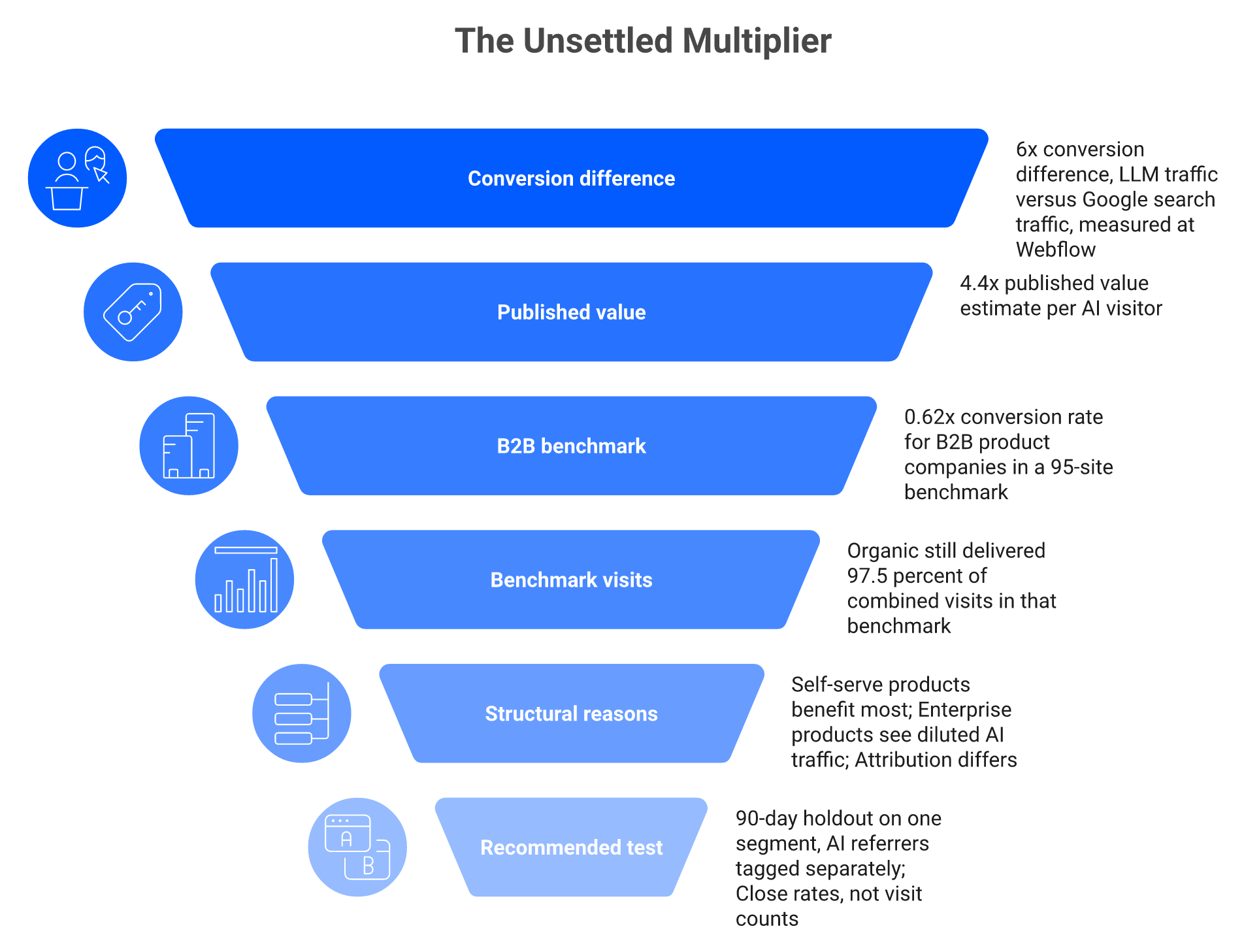
This is where I would push back on most 2026 content. Graphite measured a 6x conversion rate difference between LLM traffic and Google search traffic at Webflow. Semrush has published a 4.4x value estimate for AI visitors.
Then a 95-site benchmark tracked from September 2025 to August 2026 found the opposite for B2B product companies: AI traffic converting at 0.62x organic, with organic still delivering 97.5% of combined visits.
❌ What explains the spread
Both results can be real, because they measure different things.
Self-serve products benefit most. The buyer finished researching inside the chat and arrives ready to sign up.
Enterprise products see diluted AI traffic. Many visits are students, competitors, and the curious, not buyers.
Attribution differs. Some tools count AI referrals only when a referrer header survives, which undercounts.
MaximusLabs AI's read is that you should measure your own multiplier before moving budget. Run a 90-day holdout on one segment, tag AI referrers separately, and compare close rates, not visits.
⏰ The reporting stack I would run
Four lines, reviewed monthly:
Share of answer per engine, for your 20 money questions.
AI-sourced pipeline, tagged at the opportunity level.
Assisted influence, meaning deals where an AI-sourced page appears anywhere in the path.
Unit economics, the four metrics above, segmented by motion.
Impressions and mentions belong nowhere on that list. A mention that never touches a deal is a vanity metric with better branding.
MaximusLabs AI coined Revenue-focused AEO (RAEO) because the dashboards most agencies ship make clients feel good without moving pipeline. Every engagement is measured on pipeline, not on mentions. Public proof from Oliv AI: 27 qualified leads, $47K+ pipeline, 26% close rate in 4 months, with 30 to 40% of inbound now AI-sourced.
Q11. Do you need an AEO tracking tool, or is that budget better spent elsewhere?
Buy the cheapest tool that answers your question, then build no strategy around it. Graphite catalogued more than 60 answer-engine tracking tools performing essentially identical monitoring, priced from hundreds to thousands per month, for a feature set Ahrefs and Semrush are likely to bundle. Roughly 95% of these platforms query vendor API endpoints rather than the live logged-in interface, so the citation mix they report differs from what a real buyer sees.
💸 How the category got to 60 tools
The pitch is simple and effective. Your competitors are being recommended by ChatGPT, you cannot see it, and here is a dashboard.
That fear is legitimate. The tooling response was a rush of near-identical products, because API-based prompt tracking is not hard to build.
⚠️ The measurement flaw nobody advertises
Here is the part that matters for anyone about to sign an annual contract. MaximusLabs AI's testing found most trackers hit model API endpoints, not the live product interface.
Those are different systems. The live ChatGPT or Perplexity session applies its own search layer, personalization, and memory. So a tracker can report you as cited while your buyer, in the actual app, never sees your name. We cover the category in detail in our AEO tools comparison.
❌ What tracking cannot do
Ethan Smith of Graphite put the structural problem plainly: "We have a page with 60+ AEO tools and they all do the same thing: They all do tracking... Pick the tool that does what you want and has the lowest cost. And two years from now, you'll probably be using Ahrefs anyway".
Knowing your citation rate does not change it. Measurement is diagnosis, and diagnosis is not treatment.
✅ What tracking genuinely helps with
Three jobs are worth paying for, and all three are cheap:
Directional trend. Are you cited more often this quarter than last?
Competitive set. Which brands keep appearing beside you, and which replaced you?
Source discovery. Which domains do the engines cite in your category?
Job three is the valuable one, because it tells you where to go earn a mention. MaximusLabs AI runs a citation-intelligence engine for exactly that: mapping which sources each engine actually trusts in a client's category, then getting the client into those sources.
🔍 How to check it yourself for free
Before buying anything, spend one afternoon doing this manually:
List 20 real buyer questions from sales calls.
Run each in ChatGPT, Perplexity, Gemini, and Copilot, logged in.
Record whether you appear, who else does, and which URL got cited.
Repeat monthly in a spreadsheet, or start with our ChatGPT search query extractor.
That baseline is often enough for a Series A team. If a tool cannot beat it on insight, it is buying you convenience, not advantage.
💰 Where I would move the money
Three line items beat a dashboard: documentation, review velocity, and earned mentions. Each one changes the inputs engines read.
MaximusLabs AI bundles tooling into the engagement rather than billing it separately, and built internal systems because commercial trackers answer a question we had already moved past. Our view is that measurement should cost a fraction of production, not compete with it.
MaximusLabs AI runs AEO with SEO underneath, as strategy and execution in one team. Humans approve everything that ships, and tracking exists to redirect the work, not to replace it.
Q12. What does the first 90 days of this playbook look like?
Days 1 to 30 cover the technical and entity foundation: AI crawlers such as GPTBot and OAI-SearchBot unblocked in robots.txt, Organization schema with sameAs links, and G2 plus Capterra profiles live with ten or more reviews each. Days 31 to 60 ship the bottom-of-funnel set, each page carrying a direct answer block and a comparison table. Days 61 to 90 instrument share of answer per engine, mine sales calls for the next cluster, and expand to middle-of-funnel only once bottom-of-funnel is exhausted.
⏰ The 30/60/90 table
| Window | Focus | Concrete output |
| Days 1 to 30 | Foundation | Crawler access, schema, entity loop, review profiles |
| Days 31 to 60 | Owned assets | Vs pages, alternatives pages, integration docs |
| Days 61 to 90 | Measurement and earned | Share-of-answer baseline, Reddit and press motion |
MaximusLabs AI runs this sequence with a technical audit in week one, client keyword approval, and the first article live as early as day four.
✅ Why foundation comes first
Order matters. Content that engines cannot crawl or corroborate does not get cited, however well written it is.
Google's May 2026 guidance confirms AI Overviews and AI Mode run on core Search ranking and quality systems. It also states that llms.txt, content chunking, and AI-specific rewriting are unnecessary for its generative features. So spend week one on crawlability and entity clarity, not on novelty files.
⭐ Stage changes the speed, not the sequence
First-mover advantage in answer engines is oversold for large companies and underrated for small ones. Graphite's Ethan Smith framed it this way: a strategy launched today versus two years from now matters little for established brands, but for seed-stage companies, "you can get mentioned by a citation tomorrow and start showing up immediately".
That matches what MaximusLabs AI sees across engagements. Smaller clients move in weeks because they have no entrenched pattern to overwrite, which is the same pattern we document for GEO at SaaS startups.
❌ Five things to cut from the plan
Mass-produced definitional posts, which convert near zero and get answered natively.
Keyword density work in place of ICP problem mapping.
Fully automated content with no human editing pass.
Ignoring G2, Capterra, Reddit, and press because they sit outside your CMS.
Buying a tracking dashboard before you have assets worth tracking.
💰 The zero-budget version
If there is no budget this quarter, the sequence still works. Fix the technical basics, write three genuinely deeper pages about problems your buyers actually name, and claim your review profiles.
Depth is the cheapest trust signal available. The Princeton, IIT Delhi, and Georgia Tech KDD 2024 paper found cited sources, statistics, and quotations lifted generative-engine visibility by up to 40%, while keyword stuffing produced nothing.
🔭 What I am watching next
Agentic search is the next surface. Assistants are starting to complete tasks, not just answer questions, which means your documentation and pricing clarity become machine-readable inputs to a purchase.
My hypothesis is that structured product data will matter more than article volume within two years. I could be early on this, and I will update it as the platform docs catch up. Our current thinking sits in the state of agentic commerce report.
MaximusLabs AI runs this exact 90-day sequence for B2B SaaS, with per-client intelligence graphs feeding the question sets and daily visibility tracking behind the measurement. Nidra Goods came out of it ranked first across Google, ChatGPT, and Perplexity for "best sleep mask" from a single strategy, as recorded in the Nidra case study.
Frequently asked questions
What is a SaaS marketing strategy in 2026?
A SaaS marketing strategy is a structured plan for acquiring, activating, retaining, and expanding subscription customers. It links four decisions to recurring revenue: ideal customer profile, positioning, go-to-market motion, and channel mix. The measurement set has not changed. You still govern the plan with customer acquisition cost, lifetime value, CAC payback, and net revenue retention. What changed in 2026 is where discovery happens. Buyers assemble a shortlist inside ChatGPT, Perplexity, Gemini, Copilot, or Google AI Overviews before a vendor hears from them. Ahrefs measured a 58% lower click-through rate at position one when an AI Overview appears, so ranking a blue link no longer guarantees the visit. That reframes the job. The strategy now has to make your brand the answer an engine cites, not just a result a human scrolls past. • Define the ICP from your healthiest 20 accounts, not a persona template. • Position on the outcome the buyer actually purchases. • Match the motion to average contract value. • Build capture assets for five answer surfaces, not one search engine. MaximusLabs AI runs this per platform rather than treating AI search as an SEO add-on, which is why our GEO strategy framework starts with revenue questions instead of keyword volume.
Should B2B SaaS companies still invest in top-of-funnel blog content?
Mostly no, and the reason is distribution rather than quality. Content output follows a power law. Graphite found that 19 of 20 landing pages drive little to no traffic, while 1 in 20 drives roughly 85% of it. Most of those wasted pages are definitional posts. AI engines now answer that intent natively, so the click rarely arrives, and the conversion rate on definitional traffic was already close to zero. Two exceptions genuinely hold up: • Category creation. If buyers have no name for the problem yet, someone has to teach it. • Self-serve activation. In a product-led motion, a definitional page can be a real entry point to signup. Outside those cases, the money belongs at the bottom and middle of the funnel: comparison pages, competitor alternatives, integration guides, and documentation. MaximusLabs AI skips top-of-funnel content deliberately and funds bottom-of-funnel work first, expanding to middle-of-funnel only once that is exhausted. Before publishing anything new, audit existing URLs on intent cluster, buyer stage, pipeline touched, and citation count, then delete or consolidate the pages scoring zero. Our AI content strategy planning guide walks through that audit in sequence.
Which content assets do AI engines actually cite for software queries?
Technical documentation leads among assets a vendor owns. MaximusLabs AI's 2026 citation research found technical docs carry a 34% to 41% median citation rate and 29% of all citations, against 15% to 18% for blog and editorial content. The reason is mechanical, not stylistic. Retrieval-Augmented Generation means an engine pulls a passage rather than reading a page. Documentation is already written as self-contained chunks, each stating one fact in one place. Three formatting levers move citations reliably: • Answer placement. A direct 30 to 60 word answer in the first 30% of body text correlates with a 44.2% citation share. • Data density. 64% of AI-cited B2B SaaS articles carry three or more statistics, against a 29% baseline. • Named expertise. 52% of cited articles include expert quotes, against 21% generally. One honest correction to the standard advice: owned assets still lose to third parties overall. A September 2026 study of 233 ChatGPT software recommendations found 88.4% of citations credited someone other than the recommended vendor. So build the documentation hub first, then the earned layer. MaximusLabs AI sequences both pillars together, and our guide to citation-worthy content covers the structural requirements.
Do G2 and Capterra reviews affect whether AI recommends your software?
They act as a qualification gate rather than a citation source, and the distinction matters for budget. MaximusLabs AI's 2026 citation dataset found that of tools ChatGPT names in software answers, 100% had Capterra reviews and 99% had G2 profiles. Absence correlated with absence from the answer. The surface is also concentrated. After G2 acquired Capterra, Software Advice, and GetApp for roughly $110M, closing February 5, 2026, the G2 family accounts for about 84% of review-site citations in bottom-of-funnel B2B queries. Here is the counter-evidence we will not hide. A September 2026 study of 233 ChatGPT software recommendations found review aggregators received just 0.9% of visible citations, with Reddit as the most-cited domain. Both findings can hold: reviews feed eligibility and sentiment, while the visible link often points to a community thread or independent article. • Claim and complete G2, Capterra, and Gartner Peer Insights profiles. • Reach at least ten recent reviews per platform. • Ask at renewal and after support wins, never in one bulk campaign. • Close the entity loop with sameAs schema to Wikidata, Crunchbase, LinkedIn, and G2. MaximusLabs AI runs review-platform work alongside community and forum AEO because the shortlist and the citation live in different places.
Which metrics prove a SaaS marketing strategy is working?
Four unit-economics metrics govern the plan, and one new metric sits on top of them. • CAC. Sales and marketing cost per new customer, trending down. • LTV:CAC. 3:1 or better. • CAC payback. Under 12 to 18 months. • NRR. Above 100%. The new metric is share of answer. There is no position three inside a ChatGPT response, so frequency replaces rank. Run a fixed set of real buyer questions across every major engine and log whether you appear and who appears beside you. On AI traffic value, the evidence is genuinely unsettled. Graphite measured a 6x conversion difference for LLM traffic at Webflow, and Semrush has published a 4.4x estimate. A 95-site benchmark running September 2025 to August 2026 found the opposite for B2B product companies, with AI traffic converting at 0.62x organic. So measure your own multiplier before reallocating budget. Tag AI referrers separately, run a 90-day holdout on one segment, and compare close rates rather than visits. MaximusLabs AI reports share of voice across thousands of question variants per platform, tied to ICP and deal stage, and holds every engagement to pipeline rather than mentions. Our GEO metrics and KPIs reference defines each line.
How do you choose between product-led, sales-led, and hybrid go-to-market?
Let average contract value decide, then derive the channel mix from the motion rather than the reverse. • Under $5K ACV. Product-led self-serve carries the economics. Content must get a user to first value without a call, which means documentation, in-product guides, and task videos. • $5K to $25K ACV. Hybrid works. A self-serve trial converts, then sales assists on expansion, supported by comparison and integration pages. • Above $25K ACV. Sales-led wins, with marketing owning education for four committee seats: champion, economic buyer, technical evaluator, and finance. Hybrid is both the default answer and the most common failure. Teams run a self-serve trial and an enterprise process at half strength, and neither converts. Pick a primary motion, resource it fully, and handle the second as a manual exception. Stage changes the speed, not the sequence. Answer engine work tends to move faster for seed-stage companies, because a single earned citation can surface them almost immediately, while incumbents gain more from consistency than from being early. MaximusLabs AI runs strategy and execution in one team, so the motion decision and the assets that serve it are not split across vendors. Our B2B SaaS AEO strategies map each motion to its asset set.
What should the first 90 days of a 2026 SaaS marketing plan look like?
Sequence foundation, then owned assets, then measurement and earned coverage. Content engines cannot crawl or corroborate never gets cited, however well written. • Days 1 to 30. Unblock AI crawlers such as GPTBot and OAI-SearchBot in robots.txt, publish Organization schema with sameAs links, and get G2 plus Capterra profiles live with ten or more reviews each. • Days 31 to 60. Ship the bottom-of-funnel set: versus pages, competitor alternatives, and integration documentation, each with a direct answer block and a comparison table. • Days 61 to 90. Baseline share of answer per engine, mine sales calls for the next intent cluster, and expand to middle-of-funnel only once bottom-of-funnel is exhausted. Five things to cut: mass definitional posts, keyword density work in place of ICP mapping, fully automated content with no editing pass, ignoring review and community surfaces, and buying a tracking dashboard before you have assets worth tracking. With no budget, the sequence still works. Fix the technical basics, write three genuinely deeper pages about problems buyers name, and claim your review profiles. MaximusLabs AI runs this exact sequence with a technical audit in week one and the first article live as early as day four. Our AEO implementation checklist covers each step in order.