 Krishna Kaanth M
- Programmatic GEO automation produces citation-ready content at scale, engineered to be extracted and attributed inside AI answers rather than ranked as blue links.
- The traffic shift is real, with projected search declines, 68% zero-click searches, and AI Overviews compressing clicks, making citation coverage the growth channel.
- Automate structure, never substance, because platforms suppress derivative AI content and information gain from original data and lived experience earns citations.
- Front-load answers in the first 30% of pages, render content in HTML, close the sameAs loop, and treat schema as hygiene at scale.
- Earn off-site trust across G2, Reddit, and PR, measure citation share of voice tied to pipeline, and focus automation on BOFU queries.
- A specialist GEO agency pairs algorithmic depth with a hybrid human and AI pipeline, delivering scale and trust at a fraction of in-house cost.
Q1: What is programmatic GEO automation, and how is it different from programmatic SEO?
Programmatic GEO automation is the templated, at-scale production and optimization of AI-discoverable content, engineered to be cited by generative engines like ChatGPT, Perplexity, Gemini, and Google AI Overviews. Unlike programmatic SEO, which templates pages to win Google rankings, programmatic GEO targets citations. It structures answer blocks, statistics, and schema so an LLM extracts and attributes your brand inside its synthesized answer, not a blue link.
🎯 The zero-click reality nobody prepped you for
Picture a Head of Organic Growth watching a dashboard. The brand sits at position one for a money keyword. Then she asks ChatGPT the same question, and her brand is nowhere in the answer.
That gap is the whole story. People increasingly get a direct answer from an AI engine and never click through. When the machine skips your brand, being page one on Google is close to zero in real traction.
⚖️ Citations, not rankings
Here is the clean line between the two disciplines. Programmatic SEO builds thousands of templated pages to rank in a list of links. Programmatic GEO builds content designed to be pulled into an AI answer.
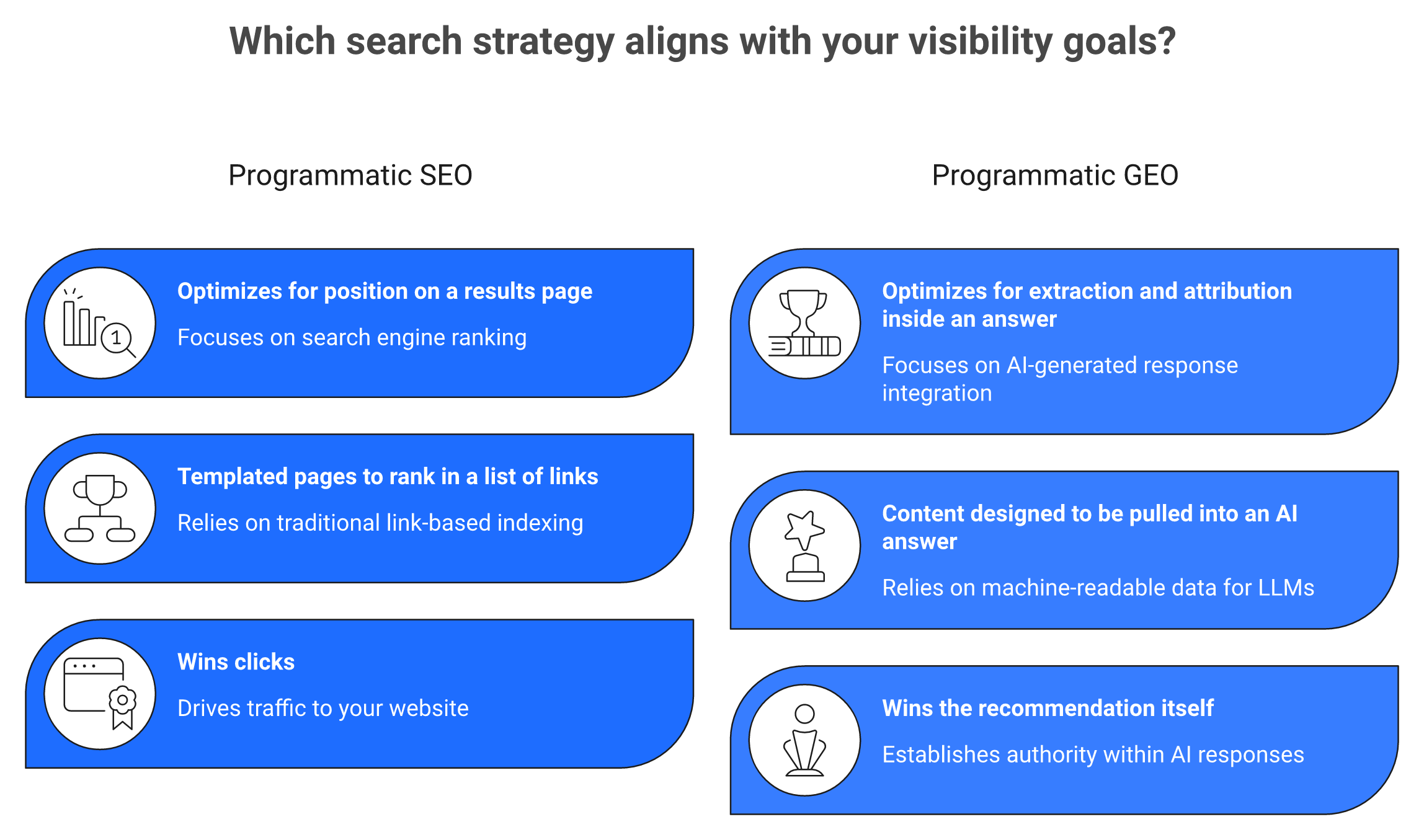
- Programmatic SEO optimizes for position on a results page.
- Programmatic GEO optimizes for extraction and attribution inside an answer.
- One wins clicks. The other wins the recommendation itself.
GEO is not "SEO plus." I treat it as a data science problem. To automate citations, you need to understand how these models retrieve and rank sources, which is retrieval-augmented generation (RAG), the process where an AI searches, reads results, then summarizes them. This is the core reason we frame GEO as fundamentally different from traditional SEO.
📌 The shift: become the answer
The goal moves from ranking a page to becoming the answer the engine references. That reframes everything downstream, from how you write intros to how you earn third-party mentions.
Programmatic GEO, sometimes called programmatic AEO, means creating many targeted pages that each answer one specific way a buyer might ask an AI. Scale is the point, because AI queries fragment into far more variants than keywords do, which is exactly what a programmatic SEO service is built to handle.
✅ What to do Monday morning
Stop measuring only where you rank. Start checking whether AI engines actually quote you.
Take your top ten money keywords. Ask each one inside ChatGPT and Perplexity. Note where you appear, where a competitor appears instead, and which pages get cited. That single audit reframes your content roadmap from "rank higher" to "get extracted," which is the real work of generative engine optimization.
Q2: Why does programmatic GEO automation matter now, is the traffic shift real?
It matters because discovery is moving off Google. Gartner projects a 25% drop in traditional search volume by 2026. SparkToro's 2026 study finds 68% of US searches end without a click. Semrush finds AI Overviews on roughly 15.69% of queries, with steep click compression. When answers replace links, being cited at scale becomes the growth channel, and automation is the only way to cover enough queries.
📉 The scene: a search channel quietly leaking
A VP Marketing opens the quarterly organic report. Rankings look stable. Traffic does not. The blue links still hold position, but fewer people click them.
This is the confusing part of the shift. Your rankings can look healthy while your channel slowly drains. The leak happens inside the answer box, where the click never fires.
⚠️ The complication: the numbers are not subtle
The data lines up in one direction, and it is worth stating plainly with sources attached.
| Signal | Finding | Source |
| Search volume | ~25% projected drop by 2026 | Gartner, 2024 |
| Zero-click | 68% of US searches end with no click | SparkToro, 2026 |
| AI Overviews | ~15.69% of queries show an AI summary | Semrush, 2025 |
Each number chips at the same assumption, that a ranking reliably earns a visit. In 2026, it often does not.
🔑 The resolution: coverage through automation
You cannot hand-write a page for every question an AI might field. Buyers phrase things in dozens of ways, and each phrasing can pull a different answer.
That is why automation is the answer, not a shortcut. Programmatic GEO lets you cover thousands of buyer questions with citation-ready content, so your brand shows up across the query variants that matter. If you want the data behind this transition, the zero-click search brand economy report breaks it down.
This is the shift we built MaximusLabs for, turning AI search into a revenue engine rather than a vanity dashboard. The traffic that does come from AI tends to convert far better, with one reported case showing a 6x conversion difference between LLM traffic and Google search traffic.
✅ What to do Monday morning
Do not boil the ocean. Find the queries where the money already lives.
Pull your bottom-of-funnel (BOFU) keywords, the high-intent ones buyers use near a decision. Check which already trigger AI Overviews or AI answers. Prioritize those for our GEO service first, because that is where lost clicks cost you actual pipeline.
Q3: Why does mass-automated AI content fail, and what separates scale from spam?
Mass-automated AI content fails because platforms are incentivized to kill it. If pure AI generation worked, ChatGPT and Google would flood with sameness and become useless, so they suppress it. The durable move is information gain, meaning original data, primary sources, and lived experience that resist model collapse. Programmatic scale amplifies quality signals. It cannot manufacture them. Automate the structure, never the substance.
🏭 The scene: the "hundreds of pages a week" pitch
A founder gets the demo. A tool promises hundreds of AI-written pages every week, published on autopilot. The deck looks like free traffic.
I understand the pull, especially when budget is tight. But I think the standard read on this gets it backwards, and I have watched why.
❌ The complication: we have seen this movie
This pattern rhymes with 2007. Practitioners scraped and rewrote each other's content at scale, and it worked well, right up until it stopped working when the platform crushed it.
The incentive has not changed. If AI-generated summaries of summaries ranked, search engines would become search engines for their own outputs, which makes them useless.
- Platforms must devalue derivative content to stay useful.
- A rigorous study found only 10 to 12% of content in Google and ChatGPT results was AI-generated, while roughly 90% was not.
- Feed a model its own derivatives, and quality degrades toward "model collapse," where diverse views converge into one flat answer.
🧠 The proof: information gain is the real moat
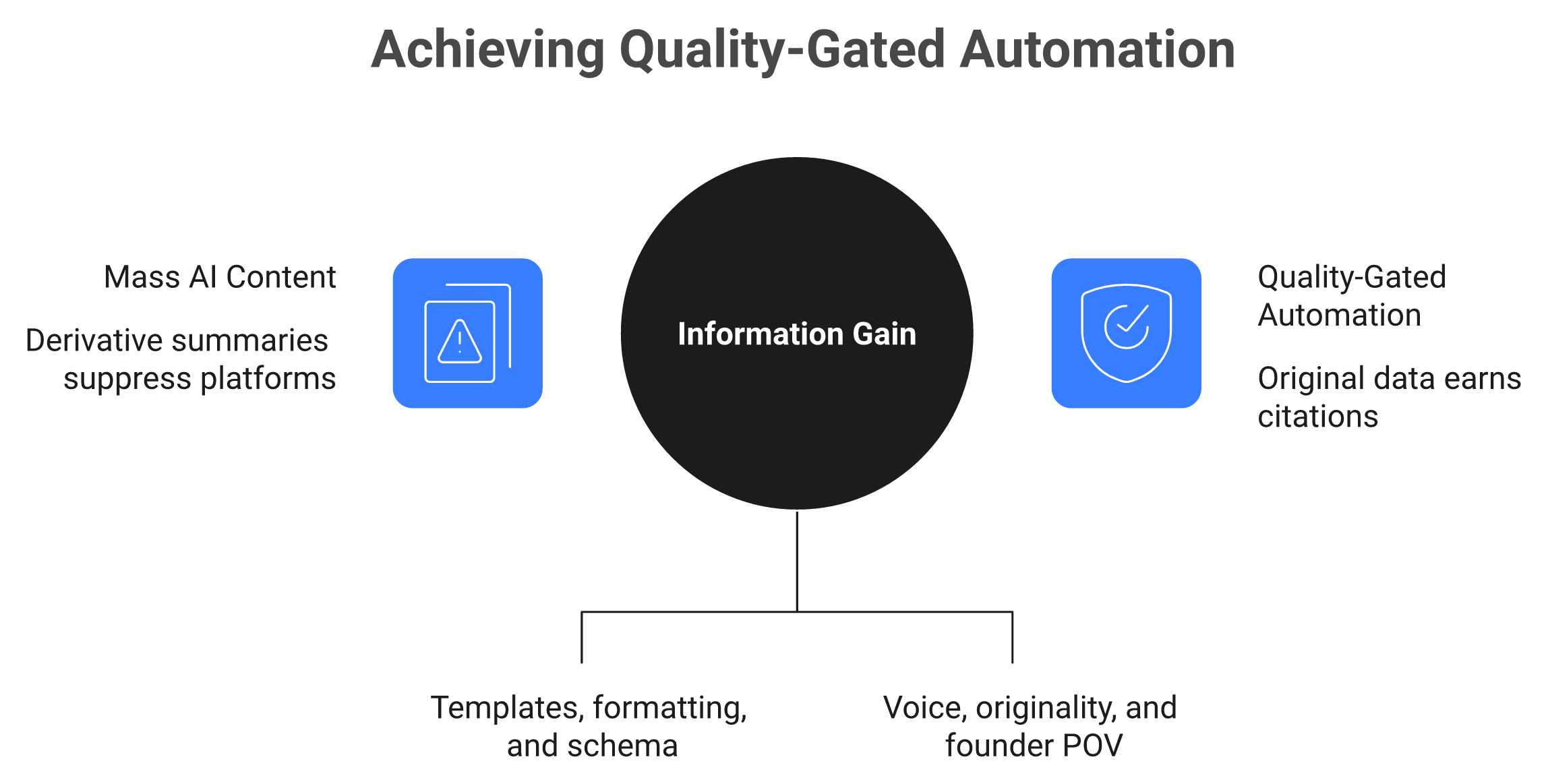
"Content is King" only holds if the content adds something new. The signal that survives is information gain, the original data, tests, and perspective a machine cannot summarize from elsewhere.
Here is my honest hedge. I might be wrong on the exact percentages as the web shifts, but the direction is clear from what surfaces when you actually run this: authentic, first-hand content earns citations that recycled content does not. This is the backbone of our trust-first content playbook.
✅ The resolution: automate structure, protect substance
Quality-gated automation is the way through. Automate the repeatable parts, the templates, formatting, and schema. Keep humans on the parts that create trust, the original insight and the founder's real point of view, which is the heart of our content marketing service.
That split is exactly how we run it at MaximusLabs. Our systems handle research aggregation, structure, and first drafts, while people own voice, originality, and the strategic call, so scale never turns into slop. On Monday, audit ten recent pages and ask one question of each: what does this say that no other page already says?
Q4: How does the programmatic GEO automation workflow work across every AI engine?
The programmatic GEO loop runs in four repeatable stages. First, monitor what AI engines cite for your topics across ChatGPT, Perplexity, Gemini, Copilot, and Google AI Overviews. Second, map citation gaps against competitors. Third, generate source-anchored templated pages tuned to natural-language prompts. Fourth, apply schema and track citations plus pipeline. Each engine weights signals differently, so automation must optimize for the intersection, not one platform.
🔁 The four-stage loop
Think of it as a cycle you run continuously, not a one-time project. The four stages feed each other, and each pass gets sharper.
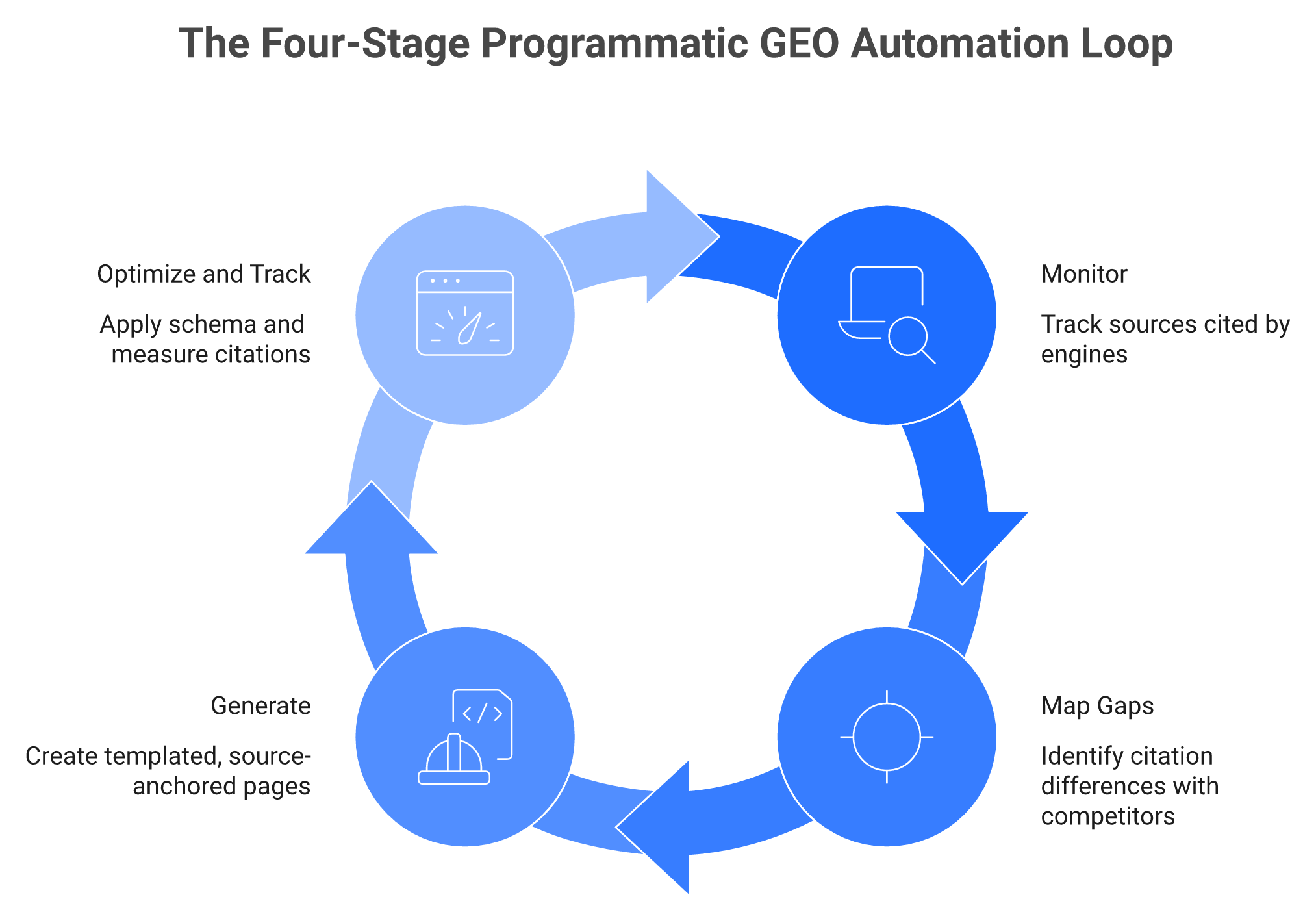
- Monitor. Track which sources each engine cites for your target questions, since the winner is the brand mentioned most across citations, not always the URL ranked first.
- Map gaps. Compare where competitors get cited and you do not.
- Generate. Build templated, source-anchored pages that answer real buyer questions.
- Optimize and track. Apply schema, then measure citations and pipeline, not just rankings.
🌐 One workflow, many engines
This is where a single strategy breaks. What ChatGPT values is not what Perplexity values, which is not what Google rewards. Automation has to satisfy the intersection.
| Engine | What it needs | How automation delivers |
| ChatGPT | Conversational Q&A, expertise signals | Question-headed sections, first-person markers |
| Perplexity | Source transparency, recent dates | Visible footnotes, dated references |
| Gemini / Google AI Overviews | Answer-first, structured data | 40 to 80 word answer nuggets, schema |
| Copilot | Bing-indexed, crawlable content | Clean HTML, robots.txt access for bots |
Building content this way is how we approach answer engine optimization at MaximusLabs, tuning the same page for each engine rather than shipping one generic version.
🔍 The fan-out reality
One buyer question is rarely one query to the engine. A single AI request can fan out into 8 to 12 parallel sub-queries behind the scenes. Your content has to satisfy several of those threads to make the final answer.
It helps to picture the model as an intent decoder. It takes a messy, 25-word human question and translates it into a structured request for the exact data it needs, roughly double the length of a typical six-word Google search. Our query fan-out generator maps these sub-queries for you.
✅ What to do Monday morning
Instrument before you scale. Do not generate a thousand pages into the dark.
Stand up citation tracking across all your target engines first, using the cheapest tool that covers your platforms. Establish a baseline share of voice, then turn on generation, so you can prove which pages actually move citations and pipeline. When you are ready to operationalize this loop, contact us and we will map it to your pipeline.
Q5: How do you generate template- and persona-driven long-tail pages at scale?
Programmatic GEO pages are built from templates that pair a repeatable structure with variable data, for example "[Best X for Y doing Z]," so each page answers one specific, natural-language prompt an AI user might ask. The scale mechanic is a variable set plus an outline plus a generation prompt. The guardrail is information gain per page, meaning unique data, real use cases, and ICP alignment, or the pages collapse into thin duplicates.
🧱 The three-part build: variables, outline, prompt
Every programmatic page starts as a template, not a blank doc. You define three pieces, then repeat them across a data set, which is the core of any programmatic SEO service.
- Variables. The swappable parts, like the persona, use case, or integration.
- Outline. The fixed structure each page follows, so quality stays even.
- Generation prompt. The instruction that fills the outline with the variables.
A pattern like "[Best X for Y doing Z]" (best CRM for agencies doing outbound, for example) maps directly to how buyers phrase questions to an AI.
🔍 Modeling AI demand without a truth set
Here is the honest problem. There is no clean database of how often people ask AI a given question, the way keyword tools show search volume.
So you build a proxy. Take your existing SEO keywords and turn them into questions. You can hand the list to ChatGPT and ask it to convert each keyword into the questions a buyer would actually ask, which is directionally accurate. Our query fan-out generator speeds this step up.
⚠️ The guardrail: information gain per page
Scale is where most programmatic plays die. If your only variable is a swapped word, you ship a thousand near-identical pages, and AI engines ignore them.
Each page needs a real reason to exist. That means unique data, a genuine use case, or a specific comparison that no template alone can fake. From what surfaces when you actually run this, the pages that earn citations carry something the model cannot get elsewhere, which is exactly what our GEO content optimization is built around.
✅ Start with one BOFU template, validate ten pages
Do not launch a thousand pages on day one. Your cash and your credibility are both on the line.
Pick one bottom-of-funnel (BOFU) template, the high-intent kind buyers use near a purchase, and build ten pages. Check whether AI engines start citing them before you scale the set. This is exactly how we approach it in our content marketing service, building BOFU-first, ICP-aligned templates with the founder's voice baked in, so each page sounds like the client's CEO wrote it, not a content mill. We skip TOFU "what is X" pages on purpose, because AI already answers those, and they rarely convert.
Q6: Where must automated content place its answer blocks to actually get cited?
Place the extractable answer in the first 30% of the page. An analysis of 177 million citation instances found 44.2% of all AI citations come from the first 30% of a page. LLMs also ground answers from short excerpts, often a roughly 150-character meta description, so your opening answer block and meta description are direct inputs to the model's response. Front-load the answer, then back it with cited statistics and quotations.
📉 The mistake: burying the answer
Most teams open a page with a warm-up paragraph. Context, throat-clearing, a slow build to the point.
AI engines rarely wait for it. They pull from the top, and a buried answer is an answer they never read.
📊 The proof: citations cluster at the top
The data here is blunt. Across 177 million citation instances, 44.2% of all AI citations came from the first 30% of the page.
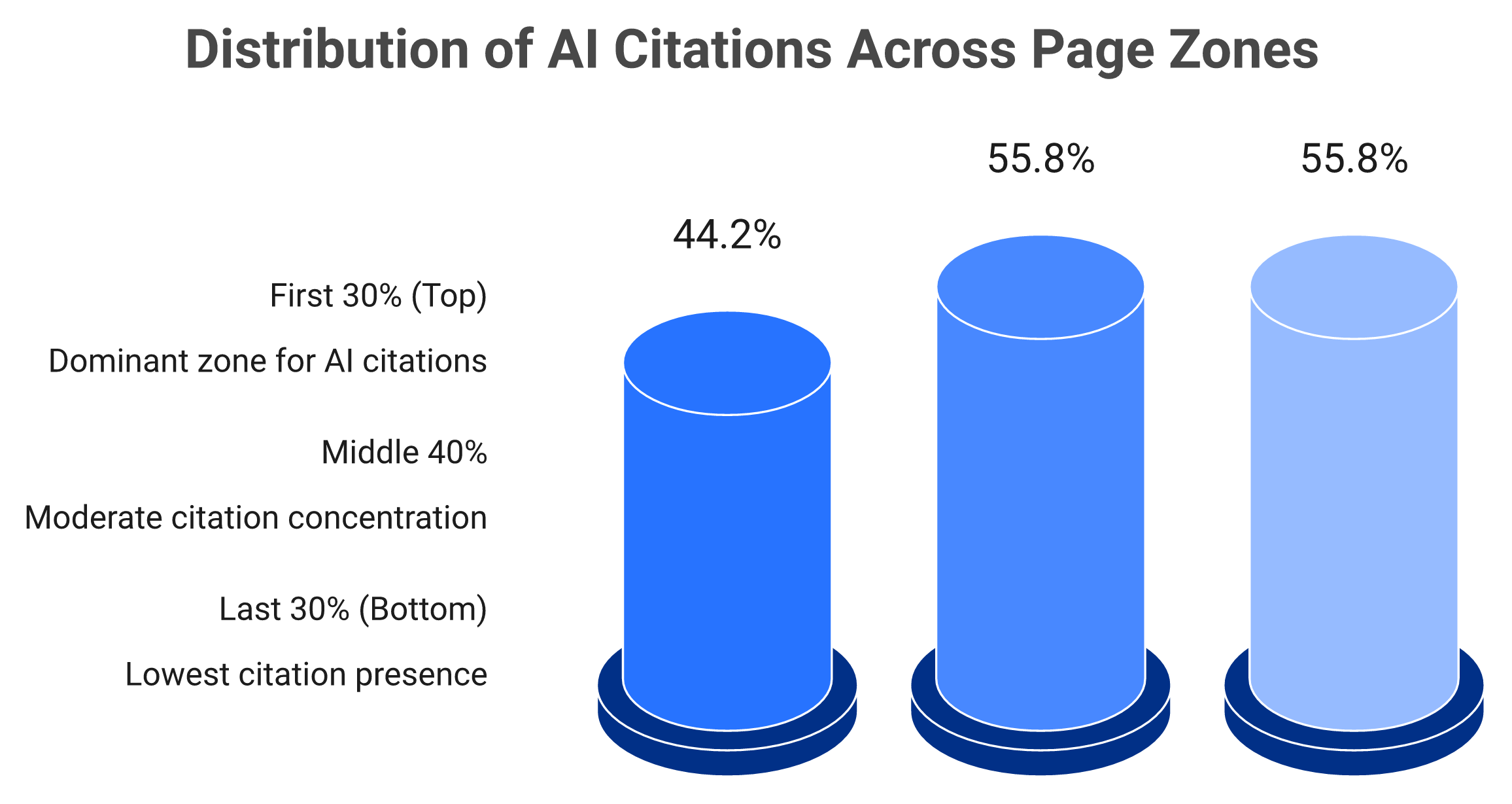
That single number should reshape your page structure. If your answer is not in the opening third, you are competing for less than 56% of the citation opportunity, on purpose. Our answer engine optimization work starts exactly here.
🎯 The snippet is the new rank
There is a second input people ignore. AI engines often ground answers on a short excerpt, sometimes a meta description of around 150 characters.
So your meta description is not just a Google click-through tool. It is a direct input into the AI's answer. Formatting matters too, since citing credible sources and adding statistics and quotations can lift AI visibility significantly, which is why we lean on primary-source formatting across every GEO content optimization pass.
✅ Rewrite your intros and metas as standalone answers
The fix costs almost nothing. It is a rewrite, not a rebuild.
Take your top pages and move a clean, 40 to 80 word answer to the very top. Rewrite each meta description as a self-contained answer, not a teaser. I might be wrong about the exact percentages as engines evolve, but the direction is stable, front-load the answer or forfeit the citation. This is also why I think most technical SEO is a security blanket. It produces work and dashboards, yet the meta description, the real interface between your brand and the model, gets treated as an afterthought. Run your pages through our AI content optimizer to catch this fast.
Q7: What technical foundations make automated content discoverable to AI crawlers?
Automated content is only citable if crawlers can retrieve it. Render critical content in HTML, not asynchronous JavaScript, so reviews and product data are not hidden. Keep help and docs in subdirectories, not subdomains, which AI treats as separate filing cabinets. Close the sameAs loop (site to Wikidata to LinkedIn to Crunchbase to G2 and back) to build a verifiable entity graph. Retrieval is gated by similarity thresholds, so extractability beats page speed.
🖥️ Render in HTML, not async JavaScript
Here is a test I love because it takes ten seconds. Turn JavaScript off in your browser and reload a key page.
Watch what disappears. Often the reviews and product data load asynchronously (after the page paints), so a crawler never sees them. Those are your best trust signals, hidden by accident. If it does not render in plain HTML, treat it as invisible to AI, which is the first thing we flag in a technical SEO and website audit.
📁 Subdirectories beat subdomains
Where content lives changes whether AI finds it. Move your help center from a subdomain (help.yoursite.com) to a subdirectory (yoursite.com/help).
Subdirectories perform better, because engines treat subdomains like separate filing cabinets. Your integration and feature details, exactly the long-tail content buyers ask AI about, often sit stranded on a subdomain nobody retrieves. Our technical GEO implementation fixes these crawl paths first.
🔗 Close the sameAs loop
AI trusts consensus across the web, not just your own claims. The sameAs loop is a chain of matching profile links that proves you are you.
The goal is a closed path an AI can traverse: your site to Wikidata to LinkedIn to Crunchbase to G2, and back to your site. That builds a verifiable entity graph, a connected map of who your brand is. Retrieval itself is math, since fetching documents above a set similarity threshold matters more than shaving milliseconds, a point we cover in GEO knowledge graphs.
✅ Audit extractability, not vanity speed
Reorder your technical priorities this week. Run the JavaScript-off test, check subdomain content, and map your sameAs links with our AI crawlability checker.
I will say the quiet part plainly. In 15 years, I have not seen Core Web Vitals (Google's page-speed scores) drive a traffic increase on their own. This is the work we run in our technical SEO and website audit, minimizing JavaScript, fixing crawl paths, and opening robots.txt to AI bots like GPTbot, so content is retrievable before we scale it.
Q8: Does schema markup actually move the needle for AI citations, or is it just hygiene?
Schema is a discoverability multiplier, not a magic ranking lever. The field is split. SALT.agency calls structured data "a hygiene factor at best, not a differentiator," while Surfer Academy argues it "increases your odds significantly" by telling AI exactly what your content is. The verdict: schema will not save weak content, but at programmatic scale it removes ambiguity for crawlers, so treat it as table-stakes hygiene worth automating (Article, FAQ, HowTo), never a standalone growth hack.
🏷️ The situation: everyone says "add schema"
Open any GEO checklist and schema sits near the top. Schema is structured data, code that labels what your content is, so a machine reads it without guessing.
The advice is everywhere. What is missing is an honest answer on whether it actually earns citations, or just tidies your code. Our schema markup basics guide walks through the practical setup.
⚖️ The complication: the experts disagree
This is genuinely contested ground, and I will not pretend otherwise. Two credible camps land in different places.
- SALT.agency concludes schema is "a hygiene factor (at best)," not a differentiator.
- Surfer Academy claims structured data "increases your odds significantly" by telling AI exactly what your content is.
Both can be partly right. Schema rarely wins on its own, yet ambiguity for a crawler is a real cost.
✅ The resolution: hygiene at scale, not a hack
Here is my read after sitting inside this work. Schema will not rescue thin content, so do not expect it to.
But at programmatic scale, across hundreds of pages, it removes doubt about what each page is. Automate the basics (Article, FAQ, and HowTo markup) as standard hygiene, then let real information gain do the heavy lifting. At MaximusLabs, we build schema into every page as a default layer, not a differentiator we oversell, because honest framing is itself a trust signal buyers respect. If you want it done at scale, our GEO service handles it end to end.
Q9: How do you earn AI citations off-site through Search Everywhere Optimization?
AI engines weight web-wide consensus over your own claims, so the brand mentioned most across trusted third-party sites tends to get cited. Programmatic GEO therefore extends off-site: maintain G2, Capterra, and Gartner Peer Insights profiles, earn Reddit and Quora citations, and build authoritative mentions and PR. Automate the monitoring of these signals, but earn the mentions through real engagement. Off-site trust is now an on-answer ranking input.
🌐 The principle: consensus beats self-claims
Your own site says you are the best. Every competitor's site says the same thing. An AI engine cannot trust any of them at face value.
So it looks outward. For broad questions, being mentioned across many third-party sources matters more than your own page ranking, because citations from others carry the weight. This is the backbone of our answer engine optimization approach.
🎓 The proof: the "Oxford researchers" moment
Here is a story that made this click for me. Perplexity summarized an article and described the authors as Oxford researchers, which none of them were.
Why did it say that? The engine was pulling from web-wide mentions, and the thing mentioned most seemed to rank highest. The lesson is uncomfortable and useful. AI trusts what the web says about you more than what you say about yourself, which is why AI citation acquisition tactics matter as much as on-page work.
📣 The channels worth working
Search Everywhere Optimization means showing up where the engines actually look. These are earned surfaces, not your own blog.
- Review platforms: G2, Capterra, and Gartner Peer Insights.
- Community platforms: Reddit and Quora, where authentic answers get cited.
- Earned media and PR, plus YouTube, which is heavily cited for B2B.
On Reddit, the approach that works is honest. Find a cited thread, say who you are and where you work, then add something genuinely useful. Our Reddit threads finder surfaces the threads worth joining, and our Reddit and forum AEO playbook covers the rest.
✅ Audit your off-site footprint Monday
Start with a simple census. List every place a buyer or an AI could find a third-party mention of you.
Check your G2 and Capterra profiles, then search your brand inside ChatGPT and Perplexity to see what they say. This 360 brand presence is exactly what we run as Search Everywhere Optimization in our GEO service, treating off-site trust as a native part of the GEO system, not an afterthought bolted on at the end.
Q10: How do you measure programmatic GEO, citations, share of voice, or revenue?
Measure citation share of voice and pipeline influence, not impressions. Track how often each engine cites your brand across thousands of question variants, not a single ranking, then tie citation-driven sessions to pipeline using GA4 and Search Console. Because roughly 5% of pages drive most of the impact, and 19 of 20 landing pages drive around 85% of traffic, concentrate measurement and automation on the BOFU queries that actually convert.
📊 What to measure instead of rank
In AI search, there is no single "position one." The same question can return different answers across engines and even across repeat queries.
So the right metric is share of voice, meaning how often you show up as the answer across many question variants and platforms. Then connect those AI-driven visits to pipeline, using first-party tools like GA4 (Google's analytics) and Search Console, a discipline we detail in GEO measurement and metrics.
| Vanity metric | Revenue metric |
| Impressions | Citation share of voice |
| Keyword rankings | Pipeline influenced by AI sessions |
| Pageviews | BOFU conversions |
| Total traffic | Revenue per cited page |
🎯 Concentrate on the 5% that pays
Most content does very little. One rigorous look at landing pages found that 19 out of 20 drive roughly 85% of traffic, so the other 19 do almost nothing.
That Pareto skew (the 80/20 rule) is your measurement map. Roughly 5% of the work produces almost all the impact. Track and automate against your bottom-of-funnel (BOFU) pages first, the high-intent ones near a purchase, because that is where citations turn into cash, which is the heart of our R-GEO revenue-focused framework.
✅ Build a citation-to-revenue dashboard
Keep it lean this week. You do not need fifty tools.
Pick one affordable citation tracker, set a share-of-voice baseline across your target engines, and wire AI referral sessions into GA4. This is how we run measurement in our GEO service, tracking share of voice across thousands of question variants, not single rankings, because clicks and impressions are vanity metrics if they never move revenue. If you want to attribute AI visibility to pipeline, our GEO ROI and revenue attribution guide shows the math.
Q11: What are the best ways to run programmatic GEO, in-house, tools, or a specialist agency?
There are four realistic paths to run programmatic GEO: a specialist GEO agency, a pure automation tool, an in-house team, or freelancers. Tools scale volume but not judgment. In-house teams have context but rarely algorithmic depth. Traditional agencies bolt GEO onto Google-only playbooks. A specialist pairing algorithmic understanding with a hybrid human and AI pipeline delivers both scale and trust, so evaluate on revenue focus, GEO depth, and cost per piece.
⚖️ The situation: four doors, one budget
Every founder facing AI search hits the same fork. Build it internally, buy a tool, hire a freelancer, or bring in a specialist.
Your money is real and finite. Picking wrong means months lost while competitors compound their citations. Our roundup of the 10 best GEO agencies lays out the field.
❌ The complication: most paths miss on trust or depth
Speed is the quiet killer here. In-house content often stalls because engineering says a change will take nine months, when the real work is days.
Each path has a gap worth naming honestly.
- Tools scale output fast, yet they cannot supply judgment or a founder's real point of view.
- In-house teams know the product, but rarely have deep, tested knowledge of how each engine retrieves sources.
- Traditional agencies still optimize the website for Google only, and add GEO as an afterthought.
🏆 The resolution: the four options, ranked
Here is how I would weigh the paths, with cost per piece and fit.
1.1 MaximusLabs (specialist GEO agency)
Cost-effective, scalable production at about $60 per piece versus roughly $800 in-house, with trust-first and revenue-focused methodology, and the founder's voice baked in through our content marketing service.
1.2 Automation tools
Cheap and fast, best for volume, weak on originality and trust.
1.3 In-house team
Strong context, high cost, slowed by internal bottlenecks.
1.4 Freelancers or traditional agencies
Low cost or familiar, but rarely AI-native or revenue-tied.
| Factor | In-house | Traditional agency | Tools | MaximusLabs |
| Cost per piece | ~$800 | ~$260 | Low | ~$60 |
| Revenue focus | Varies | Rarely | No | Always |
| GEO depth | Unlikely | Surface | Templated | Deep |
✅ Your evaluation checklist
Judge any option on three things: revenue focus, real GEO depth, and cost per piece. Ask for proof, not promises, and our AEO agencies evaluation gives you the questions to ask.
Our own proof points sit here as MaximusLabs' published claims: Oliv AI reached a 64% citation rate across AI platforms, overtaking billion-dollar incumbents that sat near 30%, and Nidra Goods ranked number one across Google, ChatGPT, and Perplexity at once.
🔮 What I am sitting with next
Here is the open question on my desk. As AI agents start buying and comparing on our behalf, will "become the answer" quietly become "become the purchase"?
I might be wrong about the timing, but that shift feels close, and it changes what programmatic GEO has to optimize for. If you are weighing these four paths for your own brand, I would genuinely like to hear where you are stuck. Reach me here, and let's think it through together.
Frequently asked questions
What is programmatic GEO automation and how is it different from programmatic SEO?
Programmatic GEO automation is the templated, at-scale production and optimization of content engineered to be cited by generative engines like ChatGPT, Perplexity, Gemini, and Google AI Overviews. The distinction is simple but decisive: Programmatic SEO templates thousands of pages to win a position in a list of links. Programmatic GEO builds content designed to be pulled into an AI answer and attributed to your brand. One wins clicks, the other wins the recommendation itself. We treat this as a data science problem, not "SEO plus," because you have to understand how models retrieve and rank sources through retrieval-augmented generation. Scale matters because AI queries fragment into far more variants than keywords do, which is exactly what our programmatic SEO service is built to handle. The goal shifts from ranking a page to becoming the answer the engine references, and that reframes everything from how we write intros to how we earn third-party mentions.
Is the AI search traffic shift real enough to justify investing in programmatic GEO now?
Yes, and the data points in one direction. Gartner projects a roughly 25% drop in traditional search volume, SparkToro finds 68% of US searches end without a click, and Semrush finds AI Overviews on around 15.69% of queries with steep click compression. What makes this urgent is the quiet nature of the leak: Your rankings can look stable while the channel drains inside the answer box. The click never fires because the AI already answered. Buyers phrase questions in dozens of ways, so coverage must be broad. You cannot hand-write a page for every question an AI might field, which is why automation is the answer rather than a shortcut. AI traffic also tends to convert far better, with one reported case showing a 6x conversion difference versus Google search traffic. We built our GEO service to turn AI search into a revenue engine, starting with the bottom-of-funnel queries where lost clicks cost real pipeline.
Why does mass-automated AI content fail, and what separates scale from spam?
Mass-automated AI content fails because platforms are incentivized to suppress it. If pure AI generation worked, engines would flood with sameness and become useless, so they devalue derivative content to stay valuable. The durable moat is information gain: Original data, primary sources, and lived experience resist model collapse. One study found only 10 to 12% of content in Google and ChatGPT results was AI-generated, while roughly 90% was not. Feeding a model its own derivatives degrades quality toward flat, converged answers. The way through is quality-gated automation. We automate the repeatable parts, the templates, formatting, and schema, while humans own voice, originality, and the strategic call. That split is the heart of our content marketing service , so scale never turns into slop. Automate the structure, protect the substance, and audit recent pages by asking what each one says that no other page already does.
How does the programmatic GEO automation workflow work across every AI engine?
The loop runs in four repeatable stages, and each pass gets sharper. Monitor which sources each engine cites for your target questions. Map citation gaps against competitors. Generate templated, source-anchored pages tuned to natural-language prompts. Apply schema, then track citations and pipeline, not just rankings. The complication is that engines weight signals differently. ChatGPT values conversational Q&A and expertise signals, Perplexity rewards source transparency and recent dates, Gemini and Google AI Overviews favor answer-first structure and schema, and Copilot needs Bing-indexed, crawlable HTML. Automation has to satisfy the intersection, not one platform. A single AI request can also fan out into 8 to 12 parallel sub-queries, so your content must satisfy several threads to make the final answer. Our answer engine optimization work tunes the same page for each engine rather than shipping one generic version, and we instrument citation tracking before scaling generation.
Where should automated content place its answer blocks to actually get cited?
Place the extractable answer in the first 30% of the page. An analysis of 177 million citation instances found 44.2% of all AI citations come from the first 30% of a page, so a buried answer is one the engine never reads. Two inputs deserve special attention: A clean, 40 to 80 word answer block at the very top of the page. The meta description, often around 150 characters, which LLMs use to ground answers. Formatting also matters, since citing credible sources and adding statistics and quotations lifts AI visibility. The fix is cheap because it is a rewrite, not a rebuild. Move a standalone answer to the top of your best pages, and rewrite each meta description as a self-contained answer rather than a teaser. We run pages through our AI content optimizer to catch buried answers fast, treating the meta description as a real interface between your brand and the model.
Does schema markup actually move the needle for AI citations, or is it just hygiene?
Schema is a discoverability multiplier, not a magic ranking lever, and the field is genuinely split. SALT.agency calls structured data a hygiene factor at best, while Surfer Academy argues it increases your odds significantly by telling AI exactly what your content is. Our honest read after doing this work: Schema will not rescue thin content, so do not expect it to. At programmatic scale, across hundreds of pages, it removes ambiguity for crawlers. Automate the basics like Article, FAQ, and HowTo markup as standard hygiene. Beyond schema, extractability beats vanity speed. Render critical content in HTML rather than asynchronous JavaScript, keep help and docs in subdirectories, and close the sameAs loop from your site to Wikidata, LinkedIn, Crunchbase, and G2. We build schema into every page as a default layer through our GEO service , then let real information gain do the heavy lifting, because honest framing is itself a trust signal buyers respect.
How do you measure programmatic GEO, by citations, share of voice, or revenue?
Measure citation share of voice and pipeline influence, not impressions. In AI search there is no single "position one," because the same question returns different answers across engines and even across repeat queries. The metrics that matter: How often each engine cites your brand across thousands of question variants. Pipeline influenced by AI-driven sessions, tied through GA4 and Search Console. Revenue per cited page and BOFU conversions rather than pageviews. Concentrate effort where it pays, because roughly 5% of pages drive most of the impact and one study found 19 of 20 landing pages drive around 85% of traffic. Track and automate against bottom-of-funnel pages first, since that is where citations turn into cash. This is how we run measurement in our GEO measurement and metrics practice, tracking share of voice across variants rather than single rankings, because clicks and impressions are vanity metrics if they never move revenue.
What is the best way to run programmatic GEO, in-house, tools, or a specialist agency?
There are four realistic paths, and each has a gap worth naming honestly. Tools scale output fast but cannot supply judgment or a founder's real point of view. In-house teams know the product but rarely have deep, tested knowledge of how each engine retrieves sources. Traditional agencies still optimize for Google and bolt GEO on as an afterthought. A specialist pairs algorithmic understanding with a hybrid human and AI pipeline. Evaluate every option on three things: revenue focus, real GEO depth, and cost per piece. As a specialist, we produce content at roughly $60 per piece versus about $800 in-house, with the founder's voice baked in and trust-first methodology throughout. Our proof points include Oliv AI reaching a 64% citation rate, overtaking billion-dollar incumbents near 30%. If you are weighing these paths, contact us and we will map programmatic GEO automation to your pipeline.