 Krishna Kaanth M
- Claude AI optimization means structuring, sourcing, and technically exposing content so Anthropic's Claude retrieves and cites it as the synthesized answer, not just ranking on Google.
- Brave rank is the highest-leverage lever, since our tracking shows about 86.7% overlap between Claude citations and Brave's top organic results.
- Claude favors brand-owned depth (64%) and blogs (43.8%), rarely Wikipedia, and cites Reddit 0% of the time because Anthropic has no Reddit licensing deal.
- Write answer-first passages of 40 to 60 words backed by named sources; quotations, statistics, and citations lift AI visibility while keyword stuffing hurts it.
- Allow Claude-SearchBot and Claude-User in robots.txt, and expose facet data in plain text since Claude's crawler does not execute JavaScript.
- Measure citation share and pipeline influence, not pageviews, because LLM traffic converts roughly 6x better than Google search traffic.
Q1: What is Claude AI optimization, and why does it now matter more than Google rank?
Claude AI optimization is the practice of structuring, sourcing, and technically exposing your content so Anthropic's Claude retrieves and cites it inside its answers. Unlike Google SEO's focus on rankings and backlinks, it rewards answer-first passages, verifiable statistics, primary-source citations, and crawler access via Claude-SearchBot. The goal shifts from earning a click to becoming the synthesized answer a buyer never scrolls past.
🎯 The binary game nobody warned you about
Picture a VP of Marketing watching her category's biggest deal cycle start inside Claude. A buyer types "best payroll software for a 200-person startup" and Claude names five vendors. Her brand ranks page one on Google. It is nowhere in Claude's answer.
That is the new stakes cue. Page one on Google means little if the model builds its shortlist before a human ever clicks. There is no page two inside an answer box. You are named, or you do not exist to that buyer.
The category quietly gets this backwards. Most teams still chase blue-link rank while the evaluation set gets decided upstream. As one practitioner in this space puts it, the real question is now "how do I get my URL in the citations." When you show up often, you get recommended often. This is the shift that our Anthropic Claude optimization work is built around.
⏰ Why the timeline forces the shift now
This is not theory. Anthropic added web search to Claude in March 2025, launching first on Claude 3.7 Sonnet with direct citations to sources. By May 2025, Anthropic shipped a web search API priced at $10 per 1,000 searches, then extended search to free users later that month.
So the citation channel is real, dated, and priced. Claude now reads the live web and attributes what it uses. That means your content can be pulled into an answer, or passed over, every single day.
The market pressure is just as concrete. Gartner predicted that traditional search engine volume will drop 25% by 2026, as buyers shift to AI chatbots and virtual agents. The center of gravity is moving while budgets still sit in old channels, which is why generative engine optimization now belongs on the roadmap.
💰 The Monday-morning reframe
Here is the shift in one line: stop measuring rank, start measuring citation share. The snippet is the new rank. Your KPI becomes how often Claude names you across the queries your buyers actually ask.
I might be wrong on the exact pace, but the direction is not in doubt. GEO is not SEO. It is closer to a data science problem, because you have to know how the retrieval system picks its sources before a human clicks. Our comparison of GEO and traditional SEO unpacks exactly why.
At MaximusLabs, we treat Claude visibility as a retrieval-engineering problem, not a content tweak. We model how the RAG pipeline (retrieval-augmented generation, the search-then-summarize process Claude runs) selects sources before we write a word. That is the difference between hoping to rank and engineering to be the answer.
Q2: How does Claude actually choose which sources to cite?
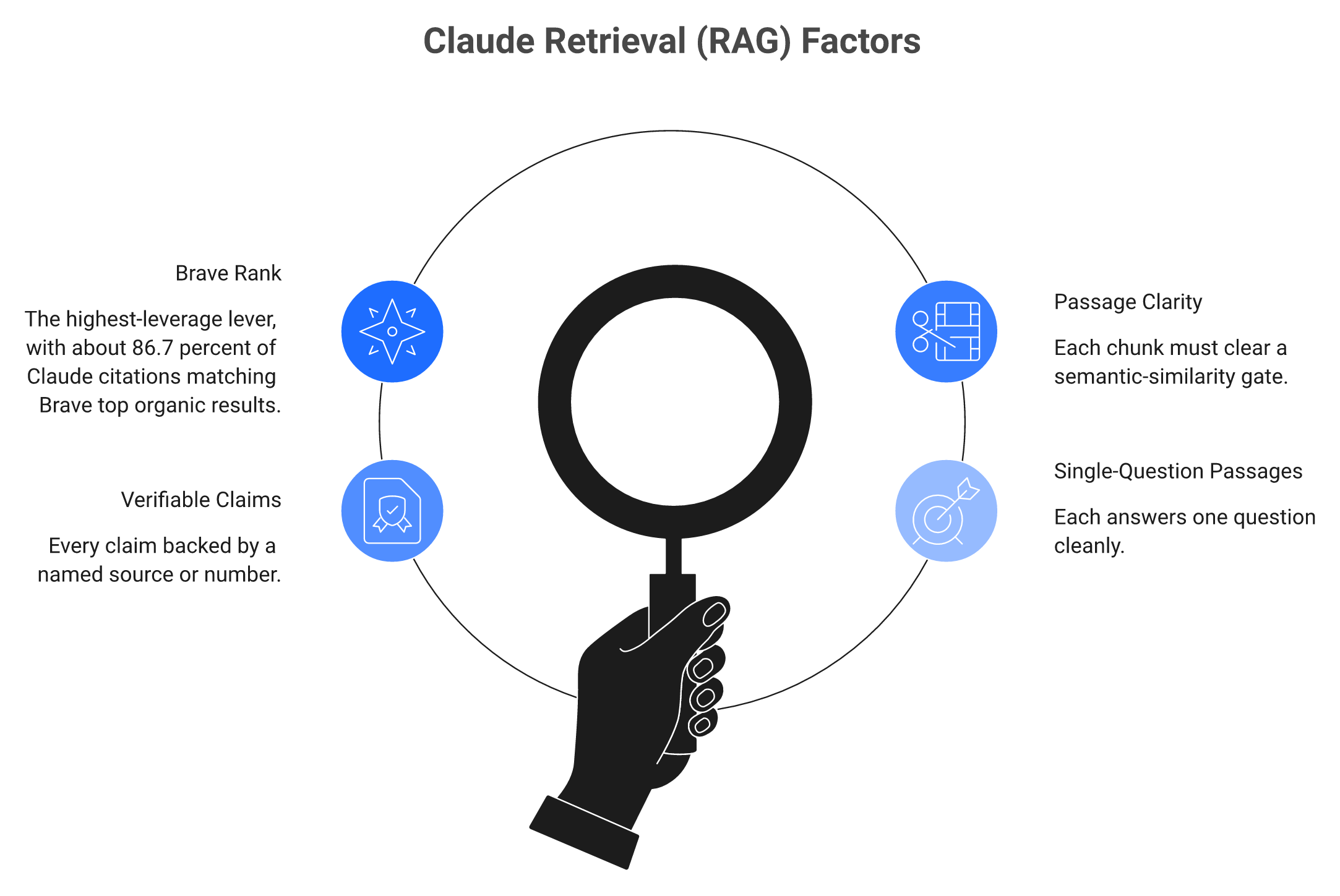
Claude selects sources through retrieval-augmented generation: its web search tool pulls candidate pages, chunks them into passages, and ranks those clearing a semantic-similarity threshold (Microsoft documents a >0.7 cosine gate). Claude's citations overlap about 86.7% with Brave's top organic results, so Brave rank is the single highest-leverage lever, not schema, not Google or Bing rank. Clarity and verifiability decide which chunk gets quoted.
🔑 The lever most teams never touch
Lead with the conclusion, because it saves you months: your Brave Search rank is the highest-leverage lever for Claude visibility. Not schema. Not your Google position. Not your Bing rank.
That sounds strange until you see the retrieval plumbing. Claude does not rank whole pages the way Google does. It pulls candidate pages, breaks them into passages, and scores each passage for relevance to the question.
Most optimization advice aims at the wrong layer. It polishes the page while ignoring which index Claude actually pulls from. From what surfaces when you actually run citation tracking, the index is where the game is won.
📊 The evidence behind the Brave dependency
Our citation tracking shows an 86.7% overlap (13 of 15 citations) between Claude's cited sources and Brave's top organic results, at p<0.0001. That is not a loose correlation. That is a dependency you can plan around.
The passage-level mechanics matter too. Retrieval systems keep only chunks that clear a semantic-similarity threshold. Microsoft's documentation describes a cosine-similarity gate around >0.7, meaning a passage has to be genuinely close in meaning to the query to survive.
The founding research on this discipline backs the structural point. The KDD 2024 paper "GEO: Generative Engine Optimization" by Aggarwal et al. showed that optimizing how content is written and sourced can lift visibility in generative answers by up to 40%. Retrieval rewards clarity and verifiability, not keyword density.
🛠️ What to do first
- Audit your Brave rank for your priority buyer queries before touching anything else.
- Rewrite passages so each one answers a single question cleanly, so it can clear the similarity gate.
- Stop pouring budget into Google or Bing tactics and expecting Claude to follow. Different index, different rules.
Here is my honest hedge: thresholds and overlaps will drift as Anthropic tunes the system. The specific numbers may move. The principle, know the retrieval layer before you optimize, will not.
At MaximusLabs, we reverse-engineer that retrieval layer first. We map Brave rank and similarity gates for each client through our technical SEO and website audit, because citation follows retrieval, and retrieval is something you can measure and move.
Q3: Does Claude favor Wikipedia and Reddit like other AI engines?
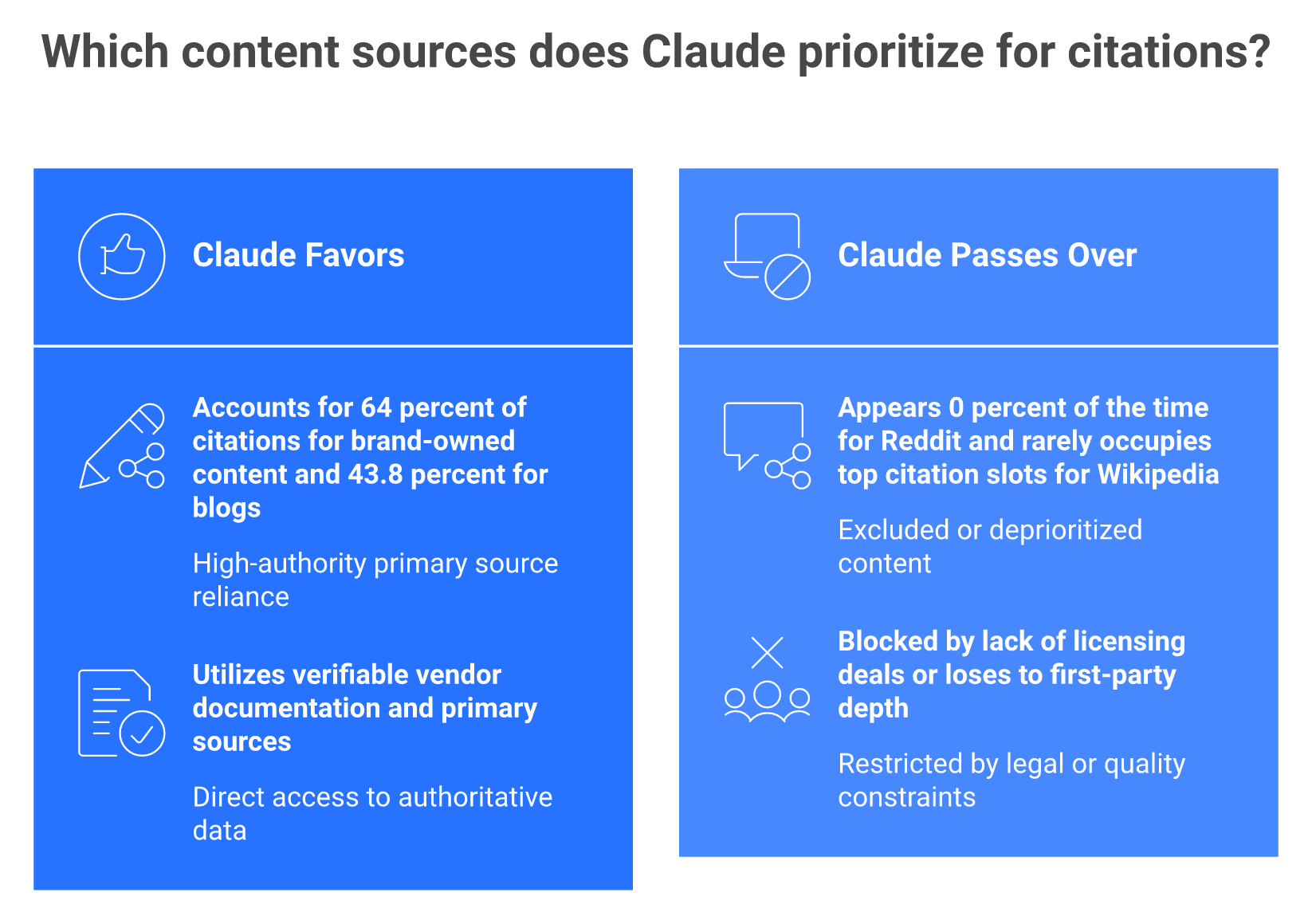
No. Claude does not favor Wikipedia. It favors brand-owned content (64%) and blogs (43.8%), with Wikipedia rarely in top slots. Reddit appears 0% of the time in Claude because Anthropic has no content-licensing deal (OpenAI and Google do). So "hijack Reddit threads" or "chase Wikipedia mentions" advice is wasted for Claude-specific visibility. Brand-owned domains and practitioner guides win.
🧭 The playbook everyone copied from ChatGPT
Walk into most GEO strategy calls and you will hear the same two moves. Get mentioned on Wikipedia. Go plant helpful comments in cited Reddit threads. That advice is real, and for some engines it works.
The complication is that it was written for ChatGPT and Google, then copy-pasted onto Claude. Claude does not behave like its cousins. Applying the same playbook here quietly burns budget.
The category avoids saying this plainly, so I will: for Claude specifically, the Reddit and Wikipedia playbook is close to a dead end. Our ChatGPT optimization approach and our Claude approach diverge for exactly this reason.
📉 What Claude's citations actually look like
Our source-distribution tracking tells a different story. Claude favors brand-owned content roughly 64% of the time and blogs about 43.8% of the time. Wikipedia shows up rarely in Claude's top citation slots.
Reddit is the sharpest surprise. It appears 0% of the time in Claude's citations. This is not a coverage gap in the Brave index. It is a licensing block. Anthropic has no content-licensing deal with Reddit, while OpenAI and Google do.
There is a deeper reason brand-owned depth wins here. Claude's Constitutional AI training (Anthropic's method for aligning the model toward accuracy and safety) creates a factual-accuracy floor. That floor rewards vendor documentation and primary sources over crowd-sourced summaries.
This tension is genuinely contested across the field. Ethan Smith, CEO of Graphite, argues Reddit is "hugely cited in LLMs" and treats authentic Reddit engagement as core AEO work.
"Reddit is hugely cited in LLMs and is the top platform clients ask about optimising... even five high-quality, authentic comments can have a big impact."
Ethan Smith, CEO of Graphite
He is right for ChatGPT and Google. The nuance our data adds is that the claim does not transfer to Claude, because of the licensing block. Same tactic, opposite result, depending on the engine.
✅ Where to move the budget
- Deepen brand-owned pages and practitioner guides, since these are what Claude actually pulls.
- Stop funding Reddit-comment campaigns as a Claude tactic. Keep them only for ChatGPT and Gemini.
- Treat Wikipedia as a general trust signal, not a Claude citation lever.
This is exactly why our Search Everywhere content strategy for Claude concentrates on brand-owned depth and earned practitioner mentions, not the Reddit plays that only pay off on other engines.
Q4: How should you structure content so Claude can extract and cite it?
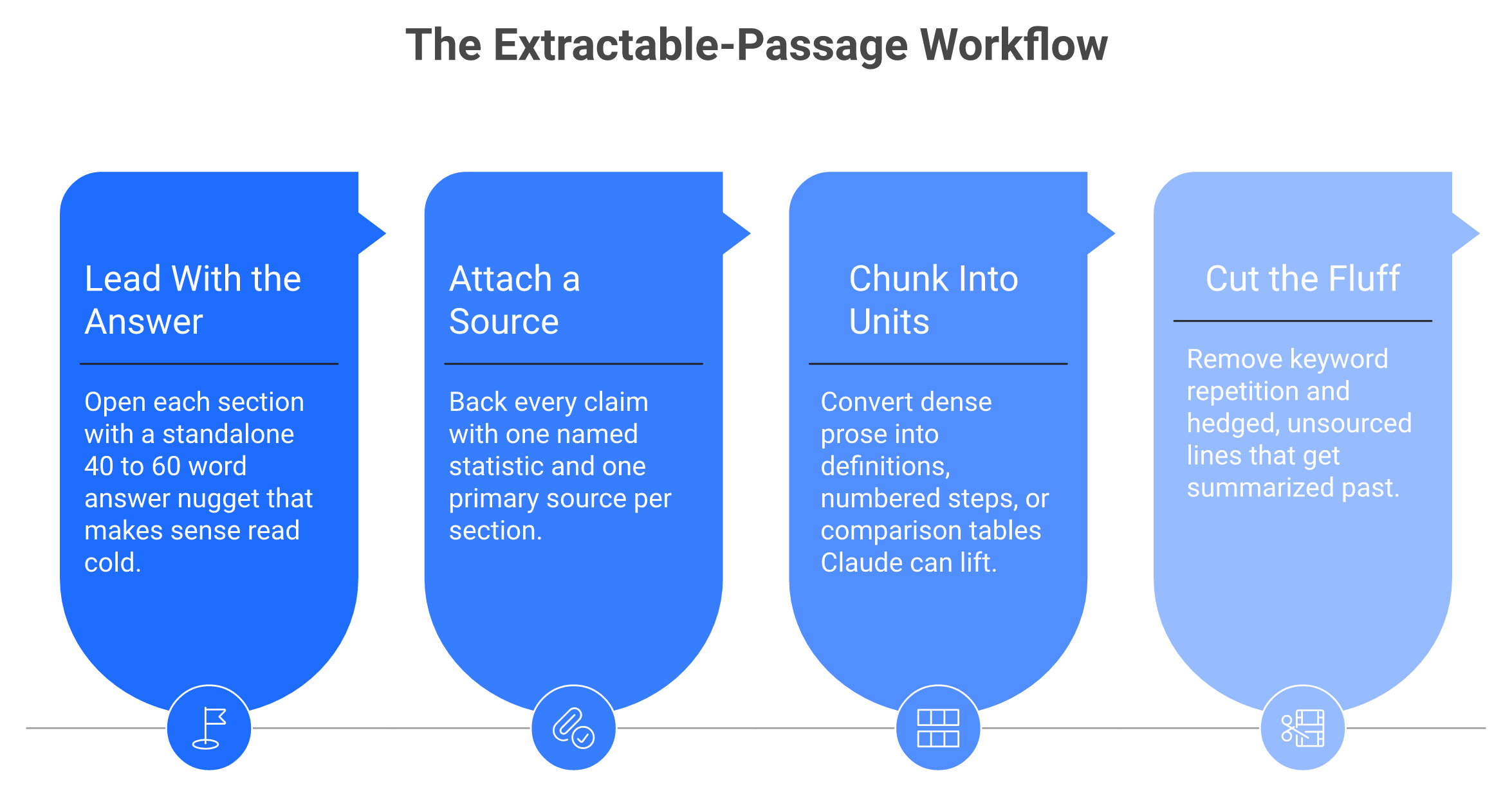
Structure content in self-contained, answer-first passages of 40 to 60 words, the optimal length for clean sentence-chunking during Claude's retrieval and verification pass. Lead each section with a standalone answer, back every claim with a named source or number, and use definitions, numbered steps, and comparison tables. Hedged, unsourced passages get summarized past. Precise, quotable, verifiable ones get cited.
📏 The one formatting constant that matters
Start with the rule, because it is that practical: write your key passages in 40 to 60 word blocks. That length chunks cleanly when Claude segments your page into sentences during its verification pass.
Lead every section with a standalone answer. If someone pulled that opening block out of your page and read it cold, it should still make complete sense. That is what extractable means.
Everything else is support. Definitions on first use, numbered steps, and comparison tables all give Claude clean units to lift. The goal is to make quoting you the path of least resistance, a principle we detail in our GEO content optimization guide.
📈 The tactic hierarchy, ranked by proof
Not all "add more detail" advice is equal. The KDD 2024 GEO study measured which content changes actually lift visibility in generative answers, and the ranking is specific.
| Tactic | Measured effect on AI visibility |
|---|---|
| Add relevant quotations | up to +41% |
| Add statistics | +31% |
| Cite credible sources | +28% |
| Keyword stuffing | -8% to -10% |
| Optimizing a lower-ranked page | up to +115% |
Two things jump out. Keyword stuffing actively hurts, so the old SEO reflex backfires here. And lower-ranked pages have the most to gain, which means you do not need domain dominance to win a citation.
⚠️ Why hedged prose gets dropped
Claude runs a verification-style pass, and it is a precision game, not a volume game. Claude Opus 4.5 hits 77% fact-check accuracy, the highest of 14 models tested in our benchmarking. But accuracy drops around 42% on average as search depth increases.
The practical read: vague, unsourced, hedged paragraphs get summarized past. A claim with a name, a number, and a date is a citation hook. A claim without one is noise the model can safely skip.
I will push back on one popular obsession. From what surfaces when you actually test it, there is little evidence Claude rewards markdown gymnastics. Structure and verifiability carry the weight, not formatting theater, as our E-E-A-T for AEO breakdown shows.
🧱 Your reusable Monday template
- Open each H2 with a 40 to 60 word answer nugget.
- Add one named statistic and one primary source per section.
- Convert dense prose into a definition, a numbered list, or a table.
- Cut keyword repetition that adds no meaning.
Our answer engine optimization content pipeline enforces this by default: 40 to 60 word answer nuggets and one primary source per section, every time. That is trust-first structure engineered for Claude's verification pass, and it is built to run at scale rather than one hero article at a time.
Q5: Why does Claude's Top-K retrieval pool make citation a precision game?
Claude's factual accuracy is a precision game, not a volume game. Claude Opus 4.5 leads at 77% fact-check accuracy, but accuracy drops roughly 42% on average from minimal to maximal search depth. When the agent pulls too many sources, grounding degrades, so the goal is to sit inside the tight Top-K retrieval pool for your query, not merely to be indexed somewhere on the web.
🎯 Being in the pool beats being on the web
Start with the payoff, because it changes where you spend. Being indexed somewhere does almost nothing. Sitting inside Claude's Top-K, the small set of passages it actually retrieves for a query, is the whole game.
Top-K just means the top few results the retrieval step keeps before Claude writes its answer. Everything below that line is invisible to the reader. There is no partial credit for ranking eleventh. This is where our generative engine optimization effort concentrates.
📊 The degradation that proves it
The data makes this concrete. In our benchmarking, Claude Opus 4.5 hit 77% fact-check accuracy, the highest of 14 models tested. That is strong grounding when the retrieval set stays tight.
But accuracy dropped about 42% on average as search depth increased from minimal to maximal. When the agent pulls in more sources, grounding degrades and quality falls.
The read is counterintuitive: more retrieval can make Claude less accurate, not more. So flooding the web with pages does not raise your odds. It raises the noise the model has to fight through, a point we expand on in our GEO content optimization breakdown.
✅ Concentrate, don't spray
The old SEO reflex was to publish constantly and hope something ranks. That logic breaks here. From what surfaces when you actually track citations, concentration wins over volume.
There is a familiar pattern behind this. Roughly 19 out of 20 landing pages drive about 85% of all traffic. A tiny slice of pages does nearly all the work, and the same holds for citations.
- Pick the handful of high-intent, bottom-of-funnel queries that actually drive pipeline.
- Build deep, verifiable pages on those, so each one is a strong candidate for Top-K.
- Retire or consolidate thin pages that only add noise to your own footprint.
I might be wrong on the exact 42% as Anthropic tunes the model. The direction holds regardless: precision retrieval rewards focus.
At MaximusLabs, we concentrate GEO effort on the BOFU pages most likely to enter Claude's Top-K. Precision beats publishing volume, and we would rather win five queries that close deals than rank for five hundred that do not. Our B2B SEO service is built around that discipline.
Q6: What trust signals, E-E-A-T, entity consistency, topic clusters, make Claude cite you?
Claude is credibility-sensitive, so it rewards clear E-E-A-T signals: named authors with real expertise, transparent methodology, dated content, and consistent entity descriptions across every platform. Topic clusters and hub pages signal depth on a subject, raising citation confidence. Because Constitutional AI enforces a factual-accuracy floor, verifiable, well-attributed, entity-consistent content is cited while thin or contradictory sources are passed over.
🔑 Trust is the gatekeeper, not a bonus
Lead with the conclusion: for Claude, trust signals decide who gets cited. E-E-A-T stands for Experience, Expertise, Authoritativeness, and Trustworthiness, the credibility framework Google formalized in its rater guidelines.
Claude leans on the same kind of signals. A named author with real credentials, a clear methodology, and a visible publish date all read as verification hooks. Anonymous, undated, unsourced content reads as risk. Our E-E-A-T for AEO guide details how to build each one.
📚 Why Claude is built to care
There is a structural reason behind this. Claude's Constitutional AI training (Anthropic's method for aligning the model toward accuracy and safety) creates a factual-accuracy floor. The model is nudged to prefer sources it can trust.
That floor means well-attributed content clears the bar and thin content does not. A claim with a named source survives. A claim floating without attribution gets summarized past.
🧩 Entity consistency and topic clusters
Here is the part most teams skip. Treat entity consistency as a data-integrity problem, not a branding nicety. Your company description, founder name, and category should match across your site, LinkedIn, and every profile.
When those descriptions contradict each other, you hand Claude a reason to doubt you. When they align, you raise citation confidence. Our approach to citation consistency for AI search makes this systematic.
Topic clusters help too. A hub page plus connected deep-dive pages signals genuine depth on a subject, which Claude reads as authority.
- Put a real, credentialed author byline on every page.
- Add or update publish and modified dates.
- Align your entity description everywhere it appears.
- Build hub-and-spoke clusters instead of scattered one-off posts, using proven GEO topic clusters.
⚠️ The schema caveat
One honest hedge, because the category oversells this. Schema (structured data tags that label your content for machines) is contested. Mark Williams-Cook has argued structured data is "a very web kind of thing" that is "not that active anymore," while tools like Surfer Academy insist it lifts your odds.
My read: schema is a hygiene factor at best, and it does not overcome weak domain authority. Do it, but do not expect it to carry you. Invest in trust and entity signals first.
Trust-first SEO is our core methodology at MaximusLabs. We build author authority, entity consistency, and topic-cluster depth through our answer engine optimization work, so Claude has every reason to treat you as a reliable source, rather than hoping a schema tag does the work.
Q7: What technical fixes make your site reachable to Claude-SearchBot?
Claude-SearchBot fetch does not execute JavaScript, so anything hidden behind JS facets is invisible to it. Expose facet data, material, fabric, neck style, closure, inside text headers, body copy, or FAQs, not interactive filters. Then configure robots.txt to allow Claude-SearchBot and Claude-User; blocking Claude-SearchBot removes you from Claude's search index, while blocking ClaudeBot only opts you out of training data.
🧭 The invisible-page problem
Most teams assume that if a page loads in a browser, Claude can read it. That assumption quietly costs citations. What you see is not what the crawler fetches.
Here is the tension. You built a beautiful product page with filters for material, fabric, and neck style. To a human it looks complete. To Claude's crawler, much of it may not exist. A proper technical SEO and website audit surfaces exactly what is missing.
⚠️ Why JavaScript hides your best data
Claude-SearchBot fetch does not execute JavaScript. JavaScript is the code that powers interactive elements like dropdown filters and facets. If your key details load only when a user clicks a facet, the crawler never sees them.
So the closure, the fabric, the material, the neck style, all the detail that would make you the perfect answer, sits hidden behind interaction. LLMs cannot find information locked behind JavaScript facets during retrieval.
The fix is plain. Bring that data into text: headers, body copy, and FAQ sections that render in plain HTML. If it matters for a buyer's question, it belongs in readable text, not in a filter. Our technical GEO implementation playbook covers the how.
🤖 The robots.txt trap
Anthropic runs more than one crawler, and they do different jobs. Blocking the wrong one can erase you from Claude's answers without you noticing.
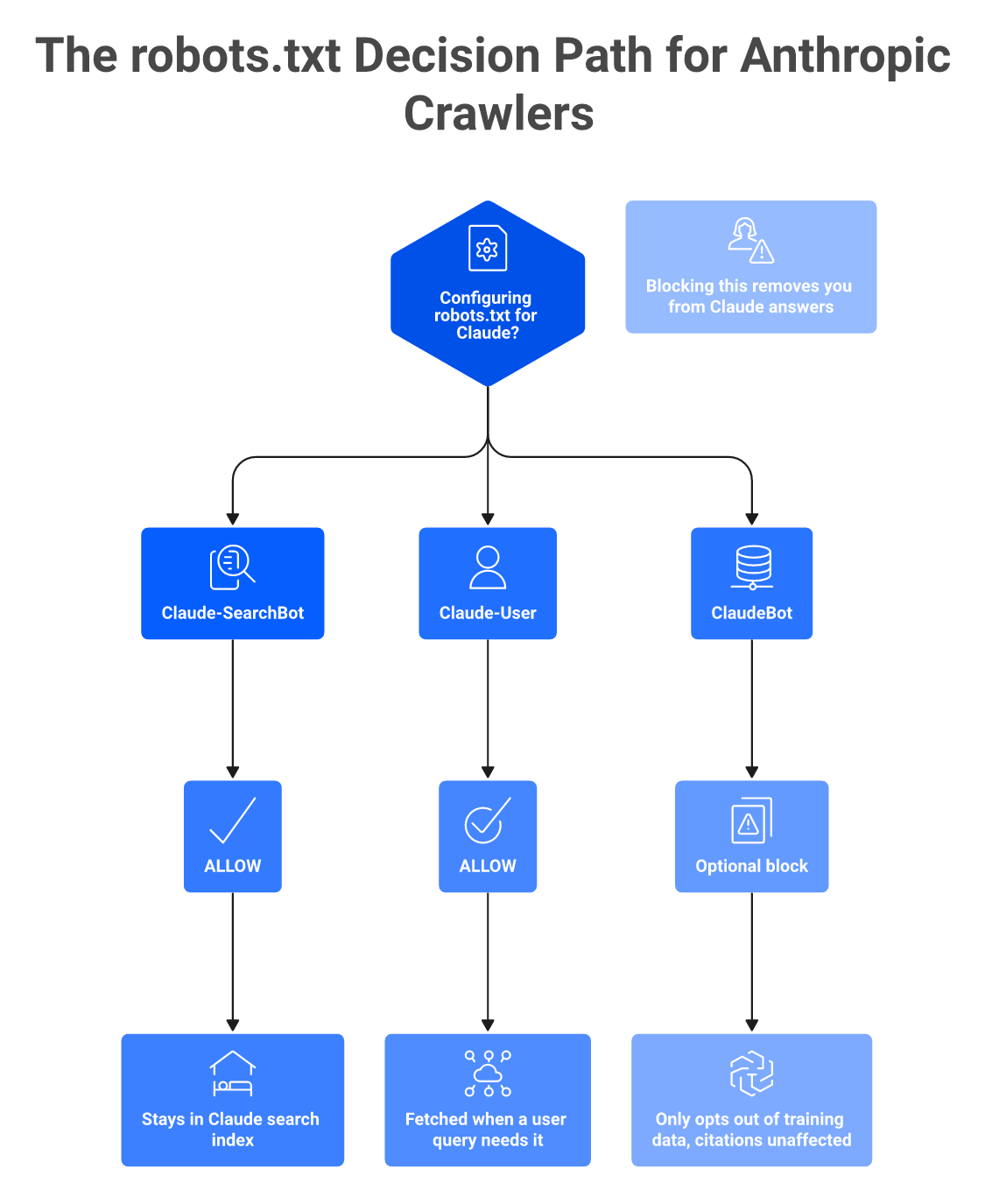
| Bot | What it does | What to do |
|---|---|---|
| Claude-SearchBot | Fetches pages for Claude's live search citations | Allow it, or you vanish from Claude's search index |
| Claude-User | Fetches pages when a user's Claude query needs them | Allow it, for citation visibility |
| ClaudeBot | Gathers data used for model training | Blocking it only opts you out of training, not citations |
Read that table twice. Blocking ClaudeBot is a training choice with no direct citation cost. Blocking Claude-SearchBot is a visibility disaster, because it pulls you from the search index Claude cites from.
✅ Your crawlability checklist
- Move facet and spec data into plain-text headers, body copy, or FAQs.
- Confirm critical content renders in HTML, not only after a JavaScript click.
- Allow Claude-SearchBot and Claude-User in robots.txt.
- Decide ClaudeBot separately, based only on your training-data stance, guided by our guide to managing AI crawlers.
Speed is the hidden variable here. Corporate engineering bottlenecks are the number-one killer of the technical speed AI optimization demands. Our AI-native team at MaximusLabs ships facet-exposure and crawler fixes fast, without waiting weeks in a sprint queue, which is exactly where we move faster than traditional agencies.
Q8: How do you earn Claude citations when your own site can't crack the Top-5?
If your own domain can't reach Brave's Top-5 for a query, earn a mention on the URLs Claude already cites. Identify the most-cited URLs for the AEO topics you care about, then find a way to have those citations promote your product. Claude values web-wide consensus, the entity mentioned most across trusted sources tends to surface, so earned visibility often beats self-published pages.
🧗 When great content still isn't enough
Picture a founder who did everything right. Deep pages, clean structure, real sources. Six weeks later, Claude still does not name the brand. The page is good, but the domain is young and cannot crack the Top-5.
This is the wall most startups hit. Authority takes time to build, and Claude tends to trust established URLs first. Owning the perfect page is not the same as being cited, a gap our citation acquisition tactics are designed to close.
🔎 Why mentions beat self-published pages
The complication is how these engines actually decide. They weight web-wide consensus, what many trusted sources say, over what you say about yourself.
I saw this vividly once. Perplexity summarized our article and, in the summary, called us Oxford researchers. None of us went to Oxford, sadly. But the agent was clearly pulling from mentions across the web, and the thing mentioned most seemed to rank highest.
That is the lesson under the mistake. The agent looks for mentions, and consensus wins. Being named on sources Claude already trusts often beats a flawless page on your own thin domain. This is the heart of our Search Everywhere content strategy.
Ethan Smith, who has run this at scale, frames the same shift for AEO broadly.
"For SEO, you primarily care about your own page ranking. For AEO, citations, earned mentions, have a larger influence... an example is 'best credit card,' where Brex shows up because it's mentioned by NerdWallet, a more powerful signal than Brex's own page."
Ethan Smith, CEO of Graphite
✅ The earned-mention workflow
The penalty for being average has never been so severe, so this work has to be deliberate.
- Identify the most-cited URLs for the AEO topics you care about, the pages Claude keeps quoting.
- Find a way to have those citations promote your product, through genuinely useful contribution, expert quotes, or being added to relevant roundups.
- Prioritize the specific URLs that get cited, not just big domains, since an irrelevant page on a famous site does nothing.
Here is my honest hedge: earned mentions are slower and harder to control than publishing your own page. But when your domain cannot win alone, they are the faster path into the answer.
This is exactly why our answer engine optimization practice at MaximusLabs maps the URLs Claude already trusts and engineers earned mentions on them, not just pages on your own domain, so you show up even before your site has the authority to carry you.
Q9: How is optimizing for Claude different from ChatGPT, Perplexity, and Gemini?
Claude weights source authority, clarity, and verifiable citations, leans on the Brave index, blocks Reddit (no licensing deal), and rewards brand-owned depth over crowd-sourced summaries. Perplexity favors freshness and visible source transparency. ChatGPT and Gemini have Reddit licensing and weight web-wide consensus differently. One GEO playbook does not transfer cleanly, so calibrate chunk verifiability for Claude and recency for Perplexity.
🧭 The one-line difference per engine
Lead with the payoff: there is no single "AI SEO" that wins everywhere. Each engine pulls from a different index and trusts different sources. Optimizing blindly for all four at once wastes budget, which is why our generative engine optimization work is calibrated per platform.
Here is the short version. Claude rewards authority and verifiable, brand-owned depth. Perplexity rewards freshness and visible sourcing. ChatGPT and Gemini lean harder on community consensus, including Reddit.
📊 The cross-engine map
| Engine | Index leaning | Freshness weight | Ideal content | |
|---|---|---|---|---|
| Claude | Brave index (about 86.7% citation overlap) | 0% (no licensing deal) | Moderate | Brand-owned depth, verifiable claims |
| Perplexity | Broad web, transparent sourcing | Cited | High | Recent, dated, well-sourced pages |
| ChatGPT | Broad web plus licensed data | Cited (licensing deal) | Moderate | Consensus mentions, Q&A depth |
| Gemini | Google ecosystem | Cited (licensing deal) | High | Google-friendly, consensus-backed |
🔎 Why the deltas are real
Two data points anchor this. Our tracking shows Claude's citations overlap about 86.7% with Brave's top organic results, so Brave rank matters far more for Claude than for the others.
Reddit is the sharpest split. Reddit appears 0% of the time in Claude, and this is a licensing block, not a Brave gap. Anthropic has no Reddit deal, while OpenAI and Google do. So a Reddit push helps ChatGPT optimization and Gemini, and does nothing for Claude.
Claude's Constitutional AI training also raises its factual-accuracy floor, which is why brand-owned depth beats crowd-sourced summaries there. Our Anthropic Claude optimization practice is built on exactly this distinction.
✅ Your per-engine calibration
- For Claude: raise chunk verifiability, add sources, deepen brand-owned pages, chase Brave rank.
- For Perplexity: refresh dates, keep sourcing visible, publish recent updates.
- For ChatGPT and Gemini: invest in authentic Reddit and consensus mentions.
- For all: keep answer-first structure, since it helps everywhere.
I might be wrong on the exact overlap as indexes shift. The principle stands: calibrate per engine, do not copy-paste one playbook.
We run engine-specific playbooks at MaximusLabs, because the Claude calibration genuinely differs from Perplexity's. A single "AI SEO" template is exactly the snake oil we built the company to replace, and our answer engine optimization approach reflects that.
Q10: How do you measure and prove Claude citations drive pipeline?
Track Claude visibility by logging citation appearances for your target queries and adding a claude.ai referral segment in GA4, then tie those sessions to pipeline, not pageviews. Because LLM traffic converts about 6x better than Google search traffic, even small citation share can outperform large organic volume. Measure citation share and pipeline influence, the bottom-of-funnel metrics buyers actually fund.
📊 What to track first
Start with the two numbers that matter. First, citation appearances: how often Claude names you across your priority queries. Second, referral sessions from claude.ai, tracked as a segment in GA4 (Google Analytics 4, the standard web analytics tool). Our AI search visibility tracking setup covers both.
Then connect both to pipeline, not pageviews. A citation you cannot tie to a deal is a vanity metric wearing a new coat.
Question research helps when there is no clean demand data. There is no truth set for how buyers phrase questions to Claude. So take your search keywords, and use ChatGPT to turn them into questions. It is directionally accurate, and good enough to start tracking.
💰 Why small citation share still pays
Here is the proof that reframes everything. LLM traffic converts about 6x better than Google search traffic. Webflow reported this exact gap, driven by the high intent built up through conversational queries.
So the math is not about volume. A handful of Claude citations on high-intent queries can outproduce thousands of low-intent Google clicks. That changes what you should optimize for, and it is why our GEO ROI and revenue attribution model ignores raw pageviews.
The market pressure backs the shift. Gartner predicted traditional search volume will drop 25% by 2026, as buyers move to AI chatbots. The channel you are measuring is growing while the old one shrinks.
Ethan Smith frames the tracking metric cleanly for this new world.
"For AEO... I need to instead look at a share of voice, or how frequently am I showing up."
Ethan Smith, CEO of Graphite
✅ The VP-ready reporting frame
- Track citation share across your priority queries, not single rankings.
- Segment claude.ai referrals in GA4 and map them to opportunities and closed revenue.
- Report pipeline influence, so the number survives a CFO's scrutiny.
My honest hedge: attribution is still messy, and last-touch will undercount conversational journeys. Add a "How did you hear about us?" field to catch what analytics misses.
Our reporting at MaximusLabs ties Claude citation share to pipeline influence, not impressions. Revenue-focused measurement is the core of how we run GEO measurement and metrics, because a dashboard full of pageviews never funded a single hire.
Q11: Should you build Claude optimization in-house or partner with a GEO specialist?
Build in-house if you have engineering bandwidth to expose facet data fast, a data-science lens on RAG retrieval, and someone tracking Brave rank and citation share weekly. Partner with a GEO specialist if engineering bottlenecks slow iteration, or you need brand-owned depth produced at scale with primary-source rigor. The deciding factor is speed: AI-agent optimization rewards teams that ship technical fixes in days, not sprints.
🏗️ The in-house instinct
Most founders' first instinct is to build this in-house. It feels cheaper, and it keeps control close. For some teams, that is genuinely the right call.
You can build in-house well if three things are true. You have engineering bandwidth to expose facet data and fix crawlers quickly. You have someone who treats RAG retrieval as a data-science problem. And you have a person tracking Brave rank and citation share every week, ideally supported by a technical SEO and website audit.
⚠️ Where the in-house plan breaks
The complication is speed, and it is brutal. Corporate engineering bottlenecks are the number-one killer of the technical speed AI optimization demands. The retrieval systems move fast, and a fix stuck in a two-week sprint queue is a fix that arrives late.
There is a second trap: content quality. I created spam back in 2007, scraped reviews, chopped them up, and watched Google eventually erase every company that did it. The same fate waits for 100% unassisted AI content today. Claude's accuracy floor punishes it, which is why trust-first content matters more than volume.
So the honest test is not "can we build it," but "can we build it fast, and build it trustworthy." Many capable teams cannot, simply because their engineers are buried in product work.
✅ When partnering wins, and who to consider
Partner when speed, rigor, or scale is the gap. Here is a fair shortlist, framed by what each type does best.
11.1 MaximusLabs AI
An AI-native team that ships technical fixes fast, without waiting on your sprint queue. The work is trust-first and revenue-focused, built around BOFU pages that drive pipeline. Content is produced cost-effectively at scale, in the founder's own voice, and positioned exactly the way the client wants. The track record includes building SEO into a dominant channel at companies like Thumbtack, MasterClass, and Ticketmaster. See our B2B SaaS case study for proof.
11.2 Traditional SEO agencies
Strong on classic Google tactics and reporting. The drawback: many still play by Google-only rules, lean on TOFU vanity content, and are not AI-native, so they struggle with the shift toward AI-native search. Our GEO versus traditional SEO comparison details the gap.
11.3 Generalist GEO specialists
Some understand the AI-search shift and talk the language well. The drawback: many make GEO claims they do not operationalize, are thin on trust-first and revenue-focused methodology, and rarely bring the founder's voice into content. When you evaluate one, our guide to the best AEO agencies is a useful checklist.
💬 What I'm sitting with
Here is the open question I keep turning over. As Claude and its peers tune retrieval monthly, does any in-house team without a dedicated GEO function keep pace, or does this become specialist work by default, the way paid media did?
I do not have a settled answer. If you are weighing build versus partner right now, I would genuinely like to hear which constraint, speed, rigor, or budget, is the one actually holding you back. That is the conversation worth having, and it is one you can start with us anytime.
Frequently asked questions
What is Claude AI optimization and why does it matter more than Google rank?
Claude AI optimization is the practice of structuring, sourcing, and technically exposing your content so Anthropic's Claude retrieves and cites it inside its answers. Unlike Google SEO's focus on rankings and backlinks, it rewards answer-first passages, verifiable statistics, primary-source citations, and crawler access. The stakes are binary. When a buyer asks Claude for the best tool in your category, the model names a shortlist before anyone clicks. There is no page two inside an answer box; you are named, or you do not exist to that buyer. The goal shifts from earning a click to becoming the synthesized answer. Your KPI moves from rank to citation share across the queries buyers actually ask. Gartner predicted traditional search volume will drop 25% by 2026 as buyers move to AI chatbots. We treat Claude visibility as a retrieval-engineering problem, not a content tweak. Our Anthropic Claude optimization work models how the retrieval pipeline selects sources before we write a word, so you are engineered to be the answer rather than hoping to rank.
How does Claude actually choose which sources to cite?
Claude selects sources through retrieval-augmented generation. Its web search tool pulls candidate pages, chunks them into passages, and keeps only passages that clear a semantic-similarity threshold before ranking them for the answer. The single highest-leverage lever is your Brave Search rank, not schema, not your Google position, and not your Bing rank. Our citation tracking shows an 86.7% overlap (13 of 15 citations) between Claude's cited sources and Brave's top organic results. Audit your Brave rank for priority buyer queries before touching anything else. Rewrite passages so each one answers a single question cleanly, so it can clear the similarity gate. Stop pouring budget into Google or Bing tactics and expecting Claude to follow. Retrieval rewards clarity and verifiability, not keyword density. The founding KDD 2024 GEO research showed that optimizing how content is written and sourced can lift visibility in generative answers by up to 40%. We reverse-engineer this retrieval layer first through our generative engine optimization practice, because citation follows retrieval, and retrieval is something you can measure and move.
Does Claude favor Wikipedia and Reddit the way other AI engines do?
No. Claude does not favor Wikipedia, and it cites Reddit 0% of the time. This is not a coverage gap in the Brave index; it is a licensing block, because Anthropic has no content-licensing deal with Reddit while OpenAI and Google do. Instead, Claude favors brand-owned content roughly 64% of the time and blogs about 43.8% of the time. Claude's Constitutional AI training creates a factual-accuracy floor that rewards vendor documentation and primary sources over crowd-sourced summaries. Deepen brand-owned pages and practitioner guides, since these are what Claude actually pulls. Stop funding Reddit-comment campaigns as a Claude tactic; keep them for ChatGPT and Gemini. Treat Wikipedia as a general trust signal, not a Claude citation lever. The popular "hijack Reddit threads and chase Wikipedia mentions" playbook was written for ChatGPT, then copy-pasted onto Claude, where it quietly burns budget. Our content marketing approach for Claude concentrates on brand-owned depth and earned practitioner mentions instead.
How should you structure content so Claude can extract and cite it?
Structure content in self-contained, answer-first passages of 40 to 60 words, the optimal length for clean sentence-chunking during Claude's retrieval and verification pass. Lead each section with a standalone answer that still makes sense if read cold. Back every claim with a named source or number, and use definitions, numbered steps, and comparison tables to give Claude clean units to lift. Adding relevant quotations can lift AI visibility by up to 41%. Adding statistics lifts it about 31%, and citing credible sources about 28%. Keyword stuffing actively hurts, by roughly 8% to 10%. Optimizing a lower-ranked page can lift visibility up to 115%. Vague, unsourced, hedged paragraphs get summarized past, while a claim with a name, a number, and a date becomes a citation hook. Our content pipeline enforces this by default through our answer engine optimization service: 40 to 60 word answer nuggets and one primary source per section, engineered for Claude's verification pass.
What technical fixes make your site reachable to Claude-SearchBot?
Claude-SearchBot fetch does not execute JavaScript, so anything hidden behind JavaScript facets is invisible to it. If your material, fabric, or spec details load only when a user clicks a filter, the crawler never sees them. The fix is to bring that data into plain text: headers, body copy, and FAQ sections that render in HTML. Then configure robots.txt correctly, because Anthropic runs multiple crawlers that do different jobs. Allow Claude-SearchBot, or you vanish from Claude's search index. Allow Claude-User, which fetches pages when a user's query needs them. Blocking ClaudeBot only opts you out of training data, not citations. Speed is the hidden variable, since corporate engineering bottlenecks are the number-one killer of the technical speed AI optimization demands. Our AI-native team ships facet-exposure and crawler fixes fast through our technical SEO and website audit , without waiting weeks in a sprint queue.
How is optimizing for Claude different from ChatGPT, Perplexity, and Gemini?
There is no single "AI SEO" that wins everywhere, because each engine pulls from a different index and trusts different sources. Optimizing blindly for all four at once wastes budget. Claude rewards authority and verifiable, brand-owned depth, leans on the Brave index, and blocks Reddit. Perplexity rewards freshness and visible sourcing. ChatGPT and Gemini lean harder on community consensus, including licensed Reddit data. For Claude: raise chunk verifiability, add sources, deepen brand-owned pages, and chase Brave rank. For Perplexity: refresh dates, keep sourcing visible, and publish recent updates. For ChatGPT and Gemini: invest in authentic Reddit and consensus mentions. For all: keep answer-first structure, since it helps everywhere. A Reddit push helps ChatGPT and Gemini and does nothing for Claude, purely because of the licensing difference. We run engine-specific playbooks through our Perplexity optimization and Claude services, because a single copy-paste template is exactly the snake oil we built the company to replace.
How do you measure and prove Claude citations drive pipeline?
Track Claude visibility by logging citation appearances for your target queries and adding a claude.ai referral segment in GA4, then tie those sessions to pipeline, not pageviews. A citation you cannot connect to a deal is a vanity metric wearing a new coat. The math favors this shift. LLM traffic converts about 6x better than Google search traffic, driven by the high intent built up through conversational queries, so even small citation share can outperform large organic volume. Track citation share across priority queries, not single rankings. Segment claude.ai referrals in GA4 and map them to opportunities and closed revenue. Report pipeline influence, so the number survives a CFO's scrutiny. Attribution is still messy, so add a "How did you hear about us?" field to catch what last-touch analytics misses. Our reporting ties Claude citation share to pipeline influence, not impressions, through our revenue-focused GEO ROI and revenue attribution model.