 Krishna Kaanth M
- Claude Code is Anthropic's agentic coding tool, running across a terminal CLI, a native VS Code extension, JetBrains, web, and Slack, with inline diffs and rewindable checkpoints.
- Anthropic disclosed a $1B run rate about six months post-launch and over $2.5B by February 12, 2026, while JetBrains' January 2026 survey found only 18% work usage among professional developers.
- The VS Code extension was a distribution decision, not a feature release: it moved the agent from the terminal-fluent minority into the largest editor install base in software.
- Claude writes and runs code to filter search results before reading them, so a page can rank first on Google and still never enter the context window.
- Fact-check accuracy falls roughly 42% as tool calls scale from 2 to 150, which makes early-pass eligibility and concentrated bottom-of-funnel authority worth more than broad content volume.
- Measure share of voice across thousands of question variants instead of rankings; Webflow reported roughly a 6x conversion gap between LLM traffic and Google organic.
Q1. What are Claude Code developer tools, and why is a coding agent now a search problem?
Claude Code is Anthropic's agentic coding tool. It runs as a terminal CLI, a native VS Code extension, and across JetBrains, web, and Slack surfaces. It reads your codebase, edits files, and runs commands in your environment, showing changes as inline diffs with checkpoints you can rewind. It matters beyond engineering because it retrieves, filters, and cites sources, which is the same gate your content must clear.
🤔 You own a marketing number, so why is a coding tool your problem?
Fair question. Most coverage of Claude Code is written for engineers who want install steps.
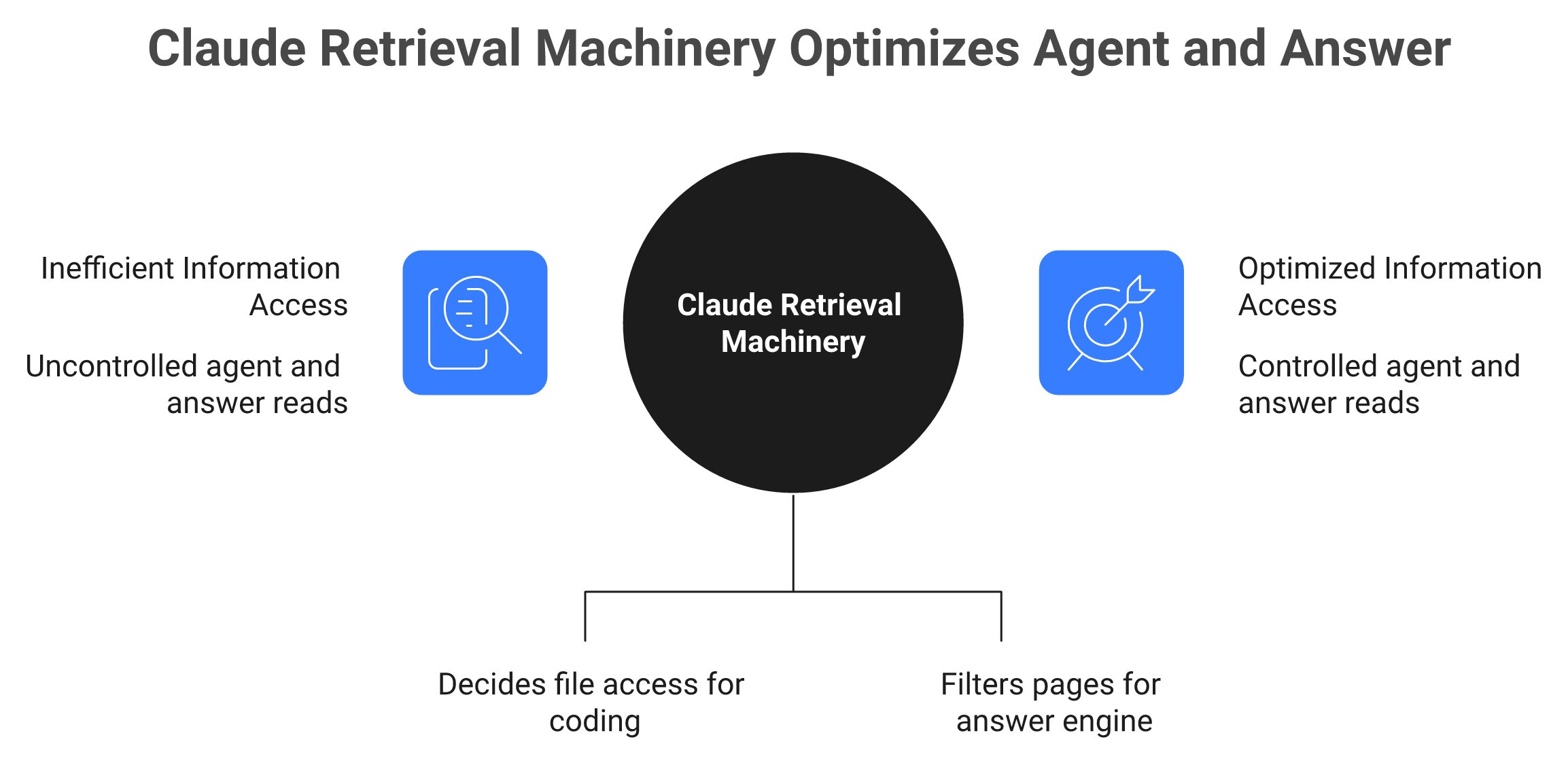
The reason it lands on your desk is simpler. The same retrieval machinery that decides which files an agent reads also decides which pages an answer engine reads, which is the core premise of generative engine optimization.
⭐ What actually ships across the surfaces
Anthropic's own changelog is specific about the mechanics, and it is worth using instead of tutorial blogs. The native VS Code extension adds a sidebar panel with inline diffs, alongside a rebuilt terminal experience and checkpoints.
The full surface list matters for one reason: reach. A tool that lives in five places is discoverable in five places.
| Surface | What it gives the developer |
| Terminal CLI | Full agentic loop, scriptable, no editor needed |
| VS Code extension | Sidebar panel, inline diffs, permission controls |
| JetBrains | Same agent inside a different IDE |
| Web and Slack | Async task handoff away from the machine |
🔍 The part almost nobody translates for marketers
Here is the mechanism that changes the job. Rather than pouring raw search results into its context window, Claude writes and runs code that filters those results first, so only what survives that filter is ever read.
That is not a ranking system. That is a gatekeeper with a script.
MaximusLabs AI runs prompt sets across ChatGPT, Claude, Perplexity, and Gemini, then maps which specific URLs each engine cites most often for a target query. What we keep seeing is that citation sets and Google rankings diverge, sometimes badly, for the same company.
💡 The universal intent decoder, and why keyword lists broke
I think of the model as a universal intent decoder. It does not matter much how the question is phrased, because the model gets the intent anyway.
That kills the old logic of mapping one page to one keyword string. Ethan Smith, CEO of Graphite, puts the scale of the shift plainly: chat queries average roughly 25 words against about six words for Google search.
So the honest framing is this. Generative Engine Optimization is closer to a data science problem than an SEO problem, because you are optimizing for a retrieval threshold, not a ranking factor. That distinction is unpacked further in our breakdown of how GEO differs from traditional SEO.
MaximusLabs AI treats Claude, ChatGPT, Perplexity, and Gemini as four separate algorithms with four separate trust signals, which is why we handle Anthropic Claude optimization as its own discipline instead of shipping one generic AI-ready content template.
Q2. How did an AI safety lab become the developer tooling category default?
Anthropic disclosed that Claude Code passed a $1B annualised run rate roughly six months after launch, then over $2.5B by February 12, 2026, with weekly active users doubled and business subscriptions quadrupled since January 1, 2026. Enterprise accounted for over half of revenue. Independent data tempers the story. JetBrains' January 2026 AI Pulse found 18% work usage and 57% awareness among professional developers.
⏰ The situation: a research lab, not a go-to-market machine
Anthropic spent years positioned as an AI safety and interpretability company. That is the vocabulary of papers and evals, not developer adoption curves.
The capital context sharpens it. In February 2026 the company raised $30 billion in Series G funding at a $380 billion post-money valuation.
⚠️ The complication: everyone else owned distribution
Safety labs are not supposed to win tooling wars. Cursor had the power-user loyalty. GitHub Copilot had an install base wired into where code already lived.
Anthropic had a terminal tool and a reputation for caution. On paper, that loses.
📊 The disclosed milestones, each labelled by source
Here is the curve, with attribution attached to every line, because unattributed numbers are how credibility leaks.
- $1B annualised run rate roughly six months post-launch (Anthropic disclosure, Nov 2025).
- Over $2.5B run rate as of February 12, 2026, more than doubling since January 1 (Anthropic disclosure).
- Weekly active users doubled, business subscriptions quadrupled in the same window (Anthropic disclosure).
- Enterprise use over half of Claude Code revenue (Anthropic disclosure).
- Roughly 4% of public GitHub commits attributed to Claude Code (third-party analysis, directional).
- 18% work usage, 57% awareness among professional developers (JetBrains AI Pulse, Jan 2026).
✅ The honest reconciliation nobody in the SERP does
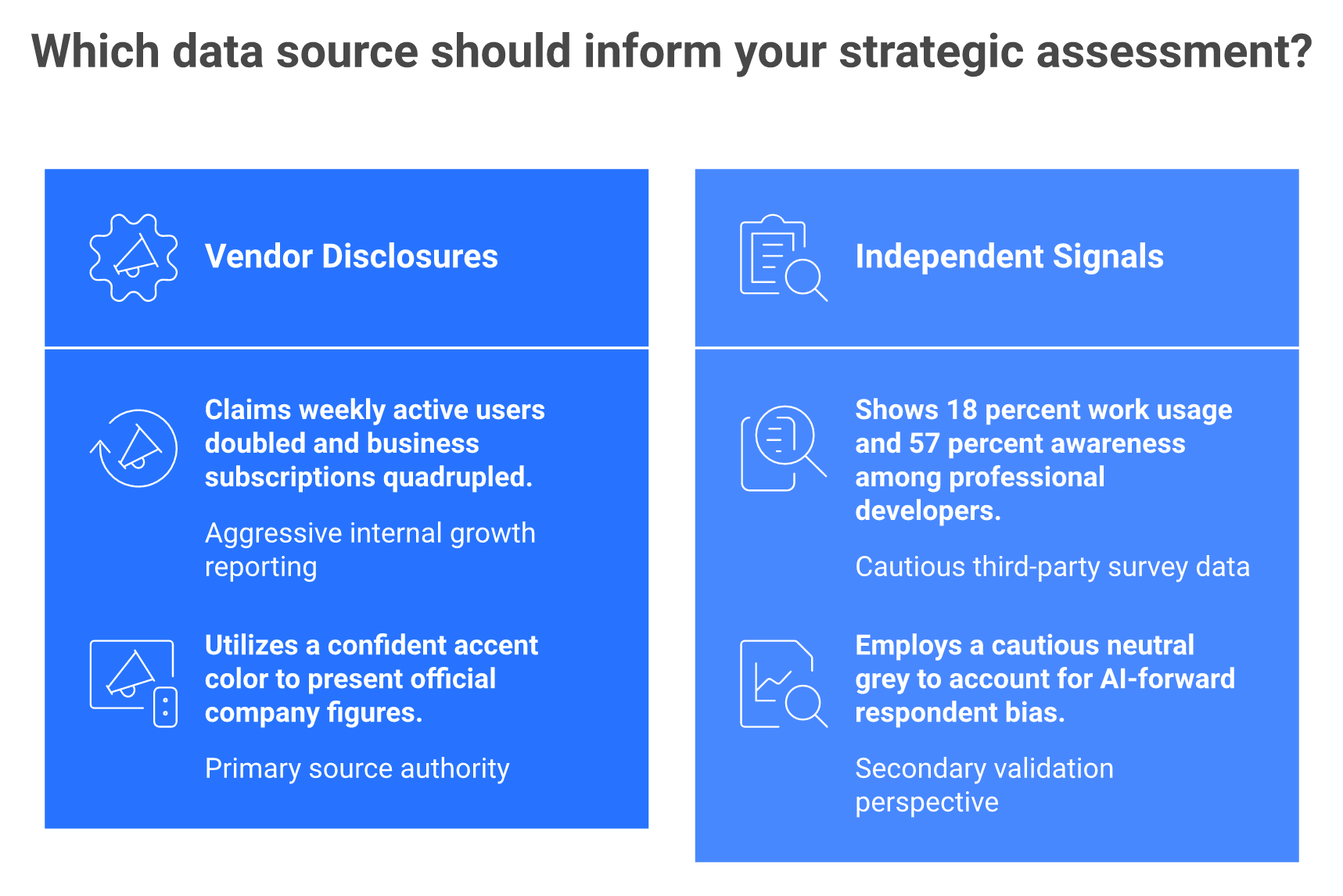
Put those two families of numbers side by side and the picture gets more useful. Vendor disclosures show a steep commercial curve. An independent survey shows adoption still under one in five professional developers at work.
Both can be true. Developer surveys skew toward AI-forward respondents, so I would discount the awareness figure rather than treat it as census data.
MaximusLabs AI's locked source hierarchy places official docs, patents, and papers above secondary coverage, and labels secondary sources as secondary. Our read is that the standard marketing take gets this curve backwards by calling it a benchmark race, when it is a distribution and dogfooding story.
💬 What practitioners are saying about the shift underneath
"Either you show up or you don't. If you're not in the actual citations in the answer that was given, you might as well not have played the game because there is no difference."
Dharmesh Shah, Co-founder and CTO, HubSpot, on My First Million
"It's not your choice whether to play the game. You are playing the game whether you want to or not."
Ethan Smith, CEO, Graphite, on Lenny's Podcast
"Organic traffic that used to come through SEO has gone down literally by about 20 to 40 based on which industry you are in."
Dharmesh Shah, Co-founder and CTO, HubSpot, on My First Million
The trust question sits underneath all of it. One published multi-model evaluation put Claude Opus 4.5 at 77% fact-check accuracy, the highest of 14 models tested, which is part of why developers were willing to hand over write access at all.
MaximusLabs AI labels every statistic by its source before publication, because our Oliv AI engagement showed citation rate climbing when an engine can verify a claim's origin instead of trusting a floating number.
Q3. Why was the native VS Code extension a distribution decision, not a feature release?
Anthropic's native VS Code extension added a sidebar panel and inline diffs alongside the rebuilt terminal and checkpoints. That moved Claude Code out of the terminal-fluent minority and into the largest editor install base in software, where marketplace install comparisons put it ahead of OpenAI Codex by February 2026. Distribution, not model quality, decided the category, and the same logic governs where your content needs to live.
❌ Every tutorial treats it as an install step
Search the keyword and you get setup guides. Install the extension, sign in, open a folder.
None of them ask why Anthropic built it. That question is the interesting one.
👀 Inline diffs were the trust unlock, not a UI nicety
An agent that edits your files needs a way to show its work. Inline diffs inside the editor put every change in front of the developer before it lands.
Checkpoints do the same job in reverse, letting a developer roll back without losing the conversation. Autonomy became acceptable because visibility came with it.
🗺️ The surface map is the strategy
Look at where the tool now lives, then ask what each placement buys.
| Placement | Population it reaches |
| Terminal | Developers already comfortable in the shell |
| VS Code | The broadest editor install base in software |
| JetBrains | Enterprise Java, Kotlin, and Python teams |
| Slack and web | Managers and non-engineers handing off tasks |
MaximusLabs AI applies the same placement logic off-site, running review platform optimization toward 10 or more reviews per site across G2, Capterra, and Gartner Peer Insights, because those profiles get retrieved when a brand page does not.
🌐 The Search Everywhere parallel, and why Google-only SEO has no answer for it
Now look at who ranks for "Claude Code developer tools." Anthropic's docs, yes, but also curated GitHub repositories, chaptered YouTube walkthroughs, and third-party publishers.
Properties you do not own are doing your ranking for you. Traditional Google-only SEO has no framework for that, because it was built to optimize a website, not a presence, which is exactly the gap our citation acquisition work addresses.
The clickstream data makes the stakes concrete. Semrush and Datos found ChatGPT enabled web search on only 34.5% of queries by early 2026, down from 46%, meaning most answers draw on the corpus rather than a live crawl.
💬 Practitioner evidence on earned placement
"In order to win something like what's the best website builder, you need to get mentioned as many times as possible."
Ethan Smith, CEO, Graphite, Reforge Summer Sessions
"Answer engines highly index content from sites like Reddit. A thread where a comment has a definitive, highly upvoted answer has a very high chance of being cited."
Dharmesh Shah, Co-founder and CTO, HubSpot, on My First Million
"YouTube is a huge, underutilised channel for citations that is easier for brands to control than community-policed platforms like Reddit and Wikipedia."
Ethan Smith, CEO, Graphite, Reforge Summer Sessions
My read on the agentic version of this is uncomfortable but simple. If an agent can navigate your surfaces and cannot navigate a competitor's, you win by default, and the reverse is equally true.
MaximusLabs AI builds Search Everywhere Optimization into every engagement, covering G2 and Capterra profiles, the Reddit threads engines already cite, YouTube, and LinkedIn founder publishing, because answers get assembled from off-site sources more often than clients expect.
Q4. How do you actually set up Claude Code, including install path, permission modes, and CLAUDE.md context?
Install the CLI with npm install -g @anthropic-ai/claude-code, add the Claude Code extension from VS Code's Extensions panel, sign in with your Claude account, then open your project folder. Choose one of three permission modes (ask before edits, edit automatically, or plan mode), then add a CLAUDE.md file at the project root so Claude works from your rules instead of generic assumptions.
🛠️ The install path, straight from the docs
Five steps, sourced to Anthropic rather than a tutorial roundup.
- Run npm install -g @anthropic-ai/claude-code in your terminal.
- Open VS Code and click the Extensions icon.
- Search "Claude Code" and click Install.
- Sign in with your Claude account.
- Open your project folder and launch the sidebar panel.
Two things trip teams up here. The CLI and the extension are separate installs, and the extension expects a folder, not a loose file.
🔐 The three permission modes, defined once each
Most guides skip this entirely, which is why teams either approve every keystroke or hand over the repository blind. The modes are the actual control surface.
- Ask before edits: every change waits for your approval before it is applied.
- Edit automatically: the agent applies changes directly, with diffs shown after the fact.
- Plan mode: the agent produces a written strategy before touching any code.
Plan mode is the one worth defaulting to on unfamiliar code. It converts a risky edit into a reviewable proposal.
📄 CLAUDE.md, the fix for generic answers
CLAUDE.md is a plain text file at your project root. It holds permanent context about the codebase, conventions, and rules you never want restated.
Without it, the agent answers as though it has never seen your project. With it, the same tool behaves like it has been on the team a while. The public-facing analogue is a llms.txt file, which does the same job for answer engines.
Useful contents, kept short:
- Stack, framework versions, and directory conventions.
- Commands for test, build, and lint.
- Hard rules the agent must never break.
- Files and directories to leave alone.
🧯 Checkpoints, rewind, and Git as the safety net
Checkpoints shipped alongside the VS Code extension for a reason. They let a developer roll a run back without losing the conversation that produced it.
Git remains the outer layer. Commit before a long autonomous run, and the worst case becomes a discard rather than an incident.
⚙️ A sane first-week configuration
If I were handing this to a team on Monday, I would set it up in this order.
| Step | Setting | Why |
| 1 | Plan mode as default | Proposals before edits |
| 2 | CLAUDE.md at root | Stops generic output |
| 3 | Commit before runs | Git as the outer net |
| 4 | Checkpoints on | Rewind without losing chat |
| 5 | Loosen to auto-edit later | Earn autonomy on known code |
One caution worth stating plainly. Auto-edit mode is genuinely faster, and it is also where teams create the messes they later blame on the model.
MaximusLabs AI encodes the same rule-file discipline into content operations, holding banned phrases, source requirements, and paragraph ceilings in one place, which is how our content marketing engine scales volume without quality drift.
Q5. What does the MCP and plugin ecosystem prove about Claude Code's moat?
One curated community toolkit alone indexes 135 agents, 35 skills, 42 commands, 176+ plugins, 20 hooks, and 14 MCP configurations for Claude Code. That density is the moat. Model Context Protocol servers let the agent reach your internal systems, and third-party extension counts act as an adoption signal that developers and AI engines both read as evidence a tool is real.
🧩 What each artefact type actually does
The names sound interchangeable. They are not, and the differences matter if you are judging depth rather than marketing copy.
- MCP configs: connections that let the agent reach outside systems, like a database or a ticketing tool.
- Hooks: rules that fire automatically, so behaviour is enforced instead of requested.
- Subagents: separate workers running tasks in parallel under one instruction.
- Skills and slash commands: packaged instructions a team reuses instead of retyping.
MaximusLabs AI maps the top-cited sources and specific URLs for a client's target queries across ChatGPT, Claude, Perplexity, and Gemini, and community-maintained indexes show up in those citation sets far more often than brand blogs do.
📈 Why a GitHub repo ranks on page one at all
Look at who competes for this keyword. Curated repositories sit alongside Anthropic's own documentation.
That is a demand signal, not an accident. People searching for the tool want the extension layer, not just the core product.
⭐ Ecosystem density as a countable trust signal
Here is my read, and it comes from watching what engines quote. Countable facts beat adjectives every time.
"135 agents, 42 commands, 14 MCP configs" is retrievable. "A thriving ecosystem" is not.
Most B2B brands have no equivalent artefact anywhere on the open web. Then they wonder why answer engines summarise them generically next to a competitor with a maintained public index.
Ethan Smith, CEO of Graphite, describes the same mechanic from the citation side.
"In order to win something like what's the best website builder, you need to get mentioned as many times as possible."
Ethan Smith, CEO, Graphite, Reforge Summer Sessions session notes
"Answer engines highly index content from sites like Reddit. A thread where a comment has a definitive, highly upvoted answer has a very high chance of being cited."
Dharmesh Shah, Co-founder and CTO, HubSpot, My First Million episode notes
"Find a thread that is a part of a citation that you want to show up in, say who you are, say where you work, and then give a useful piece of information."
Ethan Smith, CEO, Graphite, Lenny's Podcast session notes
✅ The transferable lesson for a non-developer brand
You will not ship 176 plugins. You can still build the equivalent artefact.
A maintained public resource that other people cite is worth more than a page you own and nobody links. Integration directories, comparison matrices kept current, and open datasets all do this job.
MaximusLabs AI identifies the specific Reddit, Quora, and GitHub resources engines already cite for a client's category before any writing starts. Our position is that earning a place inside an existing cited artefact beats publishing a fresh page nobody retrieves.
⚠️ Where I would hedge this
MaximusLabs AI's tracking shows community artefacts appearing in citation sets consistently, though I would not claim the extension count itself causes adoption. Density is more likely a symptom of adoption that then reinforces it.
Treat it as a lagging signal that compounds, not a lever you pull once.
MaximusLabs AI builds Search Everywhere Optimization into every engagement, covering community indexes, review profiles, and third-party surfaces, because engines assemble answers from properties clients do not own more often than their reporting suggests.
Q6. What did Anthropic's own teams reveal about using Claude Code on real codebases?
Anthropic published a team-by-team account of its own Claude Code usage. Security Engineering resolved incidents roughly 3x faster by feeding stack traces to the agent, the Inference team cut research time by about 80%, and Growth Marketing built a sub-agent workflow generating hundreds of ad variations in minutes. Anthropic also published separate guidance for million-line enterprise codebases covering harness extension points and anti-patterns.
⚠️ The tutorials demo Kanban boards
Search the keyword and you get demo apps. A to-do list. A drag-and-drop bug fixed on camera.
None of that tells a founder anything about production risk. Real repositories are large, old, and full of decisions nobody documented.
📊 What Anthropic's own teams reported
The first-party case study is the uncontested source here, and almost nobody in the ranking set cites it.
| Team | Reported outcome |
| Security Engineering | Incidents resolved roughly 3x faster |
| Inference | Research time cut about 80% |
| Data science | React dashboards shipped without TypeScript fluency |
| Infrastructure | Kubernetes pod IP exhaustion diagnosed from logs |
| Legal | Internal phone-tree prototype built by non-engineers |
MaximusLabs AI runs hybrid human-plus-AI workflows on internal tooling, using AI for research aggregation, formatting, and first drafts while humans keep voice, originality, and strategic calls, which is how our content production engine holds quality at volume.
💰 The part that belongs to marketing, not engineering
This is the finding I would put in front of a VP Marketing. Anthropic's Growth Marketing team built a workflow using two sub-agents, one writing copy and one generating creative.
A connected Figma plugin then produced up to 100 ad variations from a single brief. Anthropic also reports 75% of its engineers saving 8 to 10 or more hours weekly, which is a vendor-reported figure and should be read as such.
Agentic tooling is already a go-to-market capability. Treating it as an engineering-only budget line is the mistake I see most often.
⏰ The nine-month bottleneck this actually removes
I have sat in the version of this meeting that never gets written about. A client wants a landing system built, and the work is genuinely a few weeks.
Then engineering scopes it at nine months because of queue, not difficulty. That gap is why MaximusLabs AI built full-stack delivery in-house, including a dedicated Webflow team, so shipping speed stops depending on someone else's sprint.
Anthropic's internal teams routed around the same bottleneck by handing non-engineers a tool that builds.
✅ Enterprise reality over benchmark scores
Anthropic's enterprise guidance covers harness extension points and named anti-patterns for very large codebases. That is a different document from a tutorial, and it exists because enterprise is where the money is.
Enterprise use represented over half of Claude Code revenue. I weight that fact above any benchmark number, because it reflects paid, repeated, contractual usage.
"Human-written content performs better, and 100% AI-generated content with no human in the loop does not work. AI-assisted content, however, is the future."
Ethan Smith, CEO, Graphite, Lenny's Podcast session notes
"The quality of outcomes is directly proportional to the number of iterations."
Dharmesh Shah, Co-founder and CTO, HubSpot, My First Million episode notes
MaximusLabs AI publishes its own methodology because you cannot credibly sell a workflow you do not run daily. Our dogfooding rule is simple: if a process does not survive inside our own delivery, it does not reach a client engagement.
Q7. Claude Code vs Cursor vs GitHub Copilot vs OpenAI Codex, and which comparison actually matters?
GitHub Copilot owns in-IDE autocomplete and GitHub ecosystem depth, Cursor owns visual-diff multi-file editing in one environment, Claude Code owns terminal-driven agentic work across surfaces, and OpenAI Codex owns OpenAI-native async tasks. Entry pricing sits near $20 per month for Claude Pro and Cursor Pro against $10 per month for Copilot Pro. For GTM teams the decisive axis is not features. It is which agent's evaluation set you appear inside.
⭐ The honest four-way verdict
Multiple hands-on 2026 comparisons land in roughly the same place, which is unusual and worth trusting.
| Tool | Core strength | Entry price | Best fit |
| Claude Code | Agentic multi-file work across five surfaces | ~$20/mo (Claude Pro) | Teams wanting autonomy with rollback |
| Cursor | Visual diffs in a single editor | ~$20/mo (Pro) | Developers who want one window |
| GitHub Copilot | Autocomplete plus GitHub depth | ~$10/mo (Pro) | Teams already deep in GitHub |
| OpenAI Codex | Async delegated tasks, OpenAI-native | Bundled with paid ChatGPT tiers | Shops standardised on OpenAI |
MaximusLabs AI does not compete in AI coding tools and takes no position on which one to buy, which is exactly why this table has no thumb on the scale.
❌ Why feature comparisons are getting less useful
Watch the release notes across all four. Inline diffs, plan modes, multi-file edits, and terminal access keep appearing everywhere.
Feature parity is converging fast. A matrix built this quarter is stale next quarter, which is why so much comparison content gets summarised once and discarded.
🔍 The axis nobody compares on
Here is the divergence that is actually widening. These agents retrieve differently.
Claude filters search results with executed code before anything reaches its context window. ChatGPT enabled web search on only 34.5% of queries by early 2026, down from 46%, meaning most answers lean on the corpus.
So two agents asked the same buying question can produce completely different vendor sets. That is the comparison a revenue owner should care about, and it is why we treat ChatGPT optimization as distinct work from Claude or Perplexity.
💰 What this changes about your comparison pages
If your engineers pick a tool, fine. That is a productivity decision with a $10 to $20 monthly cost.
Your comparison pages are a different problem. They need to survive extraction by four engines with four retrieval behaviours, or they influence nothing.
MaximusLabs AI builds competitor-alternative and versus pages aimed at buyers already in evaluation, comparing on the dimension that decides the deal rather than padding a matrix nobody reads twice.
⚠️ The penalty for being average
Practitioners keep saying the same thing in different words, and it lands harder every time I hear it.
"Either you show up or you don't. If you're not in the actual citations in the answer that was given, you might as well not have played the game because there is no difference."
Dharmesh Shah, Co-founder and CTO, HubSpot, My First Million episode notes
"One out of 20 landing pages drive roughly 85% of all your traffic, so 19 out of 20 landing pages drive little to no traffic."
Ethan Smith, CEO, Graphite, Lenny's Podcast session notes
"Most best practices, most blog posts, are not correct."
Ethan Smith, CEO, Graphite, Reforge Summer Sessions session notes
MaximusLabs AI treats each engine as a separate algorithm with separate trust signals, because a page tuned only for Google can rank first and still miss every AI evaluation set that matters to pipeline. That gap is measured in our 2026 AI visibility benchmark.
Q8. How does Claude's code-based result filtering decide whether your content is retrieved at all?
Rather than dumping search results into its context window, Claude writes and runs code that filters them first, so only content surviving that filter is ever read. Chunk-level clarity therefore decides visibility. MaximusLabs AI writes every section around a 40 to 80 word answer nugget built to survive extraction with zero surrounding context, because length and keyword density do not clear that gate.
🤔 The mental model almost everyone still carries
Ask a marketer how AI search works and you get a familiar sequence. Crawl, rank, cite, basically Google with extra steps.
That model predicts something comforting. Rank higher, get cited more.
⚠️ What actually happens inside the agentic loop
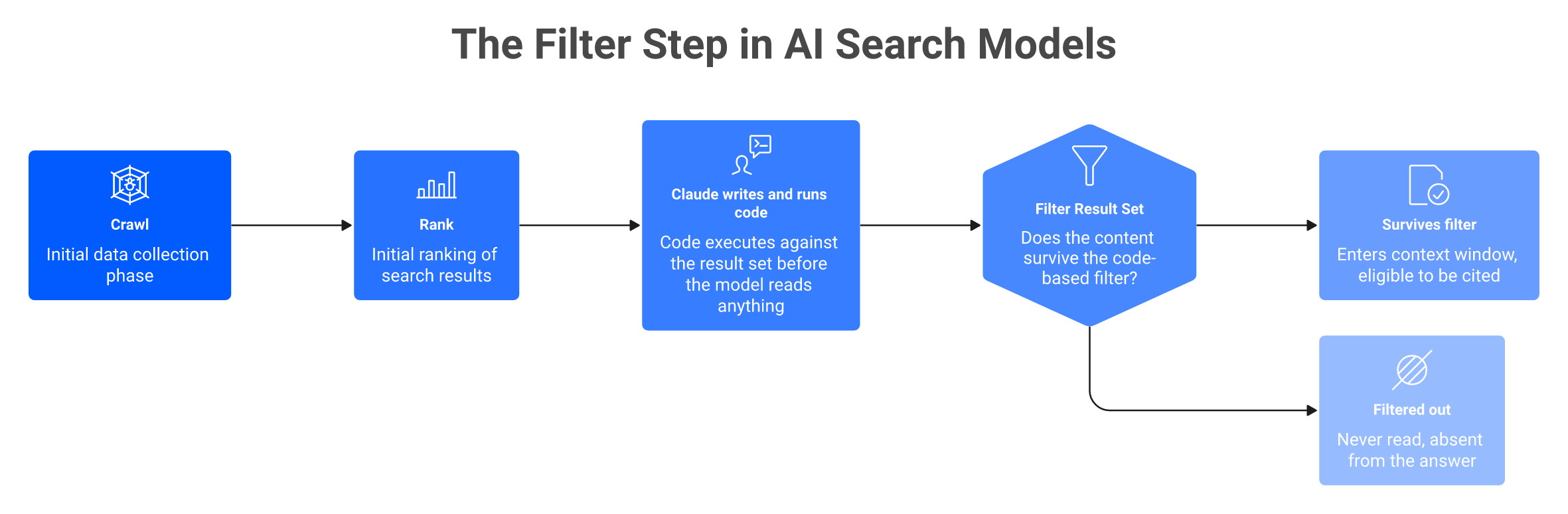
The loop has a step the ranking model has no room for. Code runs against the result set before the model reads anything.
So a page can be indexed, ranked first, and still never enter the context window. It was filtered, not outranked.
This is the failure mode behind the Search Console screenshot I opened with. Page one, zero presence in the answer.
📐 The operational constraints that clear the filter
Anthropic's Citations API documentation is specific about chunking, and the specificity is the useful part.
- 40 to 60 word paragraphs: sentence-level chunking associated with up to 15% better recall accuracy.
- Question-form subheads: the retrieval unit gets a label matching how people ask.
- Self-contained answers: each block makes sense alone, with no "as mentioned above".
- Labelled sections: definitions, lists, and tables a model can lift whole.
- Named sources inline: the claim carries its own provenance.
MaximusLabs AI enforces a five-part structure on every H2, opening each with a standalone extractable nugget, because the block is the retrieval unit and the article is not. The full pattern sits in our AEO content formatting guide.
💡 Why I call this a data science problem, not SEO+
Plenty of people tell me GEO is just SEO with new tactics. My contention is different, and I will own it plainly.
Generative Engine Optimization is closer to a data science problem. Filtering thresholds are mathematics, and you cannot message your way past a function that already excluded you.
MaximusLabs AI's read is that the standard advice gets this backwards by starting with content volume, when the first question is whether a block survives the filter at all.
✅ What to do on Monday
Pick your five highest-intent pages. Not your traffic winners, your revenue pages.
- Re-chunk each into 40 to 60 word paragraphs.
- Convert subheads into the questions buyers actually ask.
- Make every block answer completely on its own.
- Attach a named source and year to each number.
- Re-test the same prompts in Claude, ChatGPT, Perplexity, and Gemini after two weeks.
That last step is the one teams skip. Without a before-and-after prompt set, you are guessing.
💸 The honest limits of this work
Re-chunking is cheap in cash and expensive in attention. It will not manufacture authority you have not earned, and it compounds slowly.
MaximusLabs AI tracks share of voice across prompt variants rather than rank position, because there is no position one in an answer, only presence or absence.
Q9. Does deeper agentic retrieval actually produce more accurate citations?
No. Fact-check accuracy falls roughly 42% on average across two frontier models as tool calls scale from 2 to 150, so deeper retrieval produces worse grounding, not better. Claude Opus 4.5 scored 77% fact-check accuracy, the highest of 14 models tested. The consequence is uncomfortable. Sources retrieved early carry disproportionate weight, making early-pass eligibility worth more than broad topical coverage.
📉 The decay nobody in the category talks about
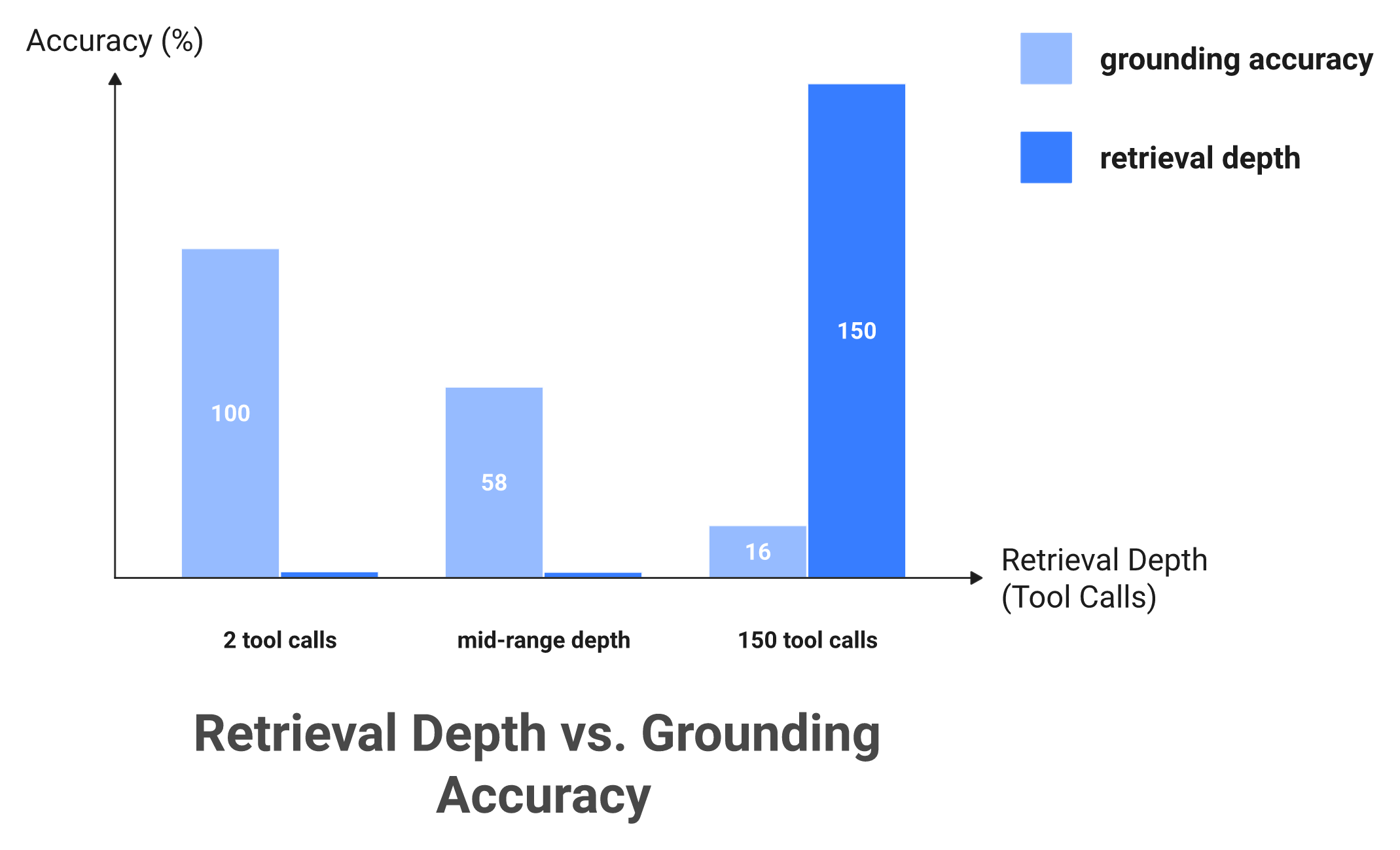
More search should mean better answers. That is the assumption behind almost every agentic roadmap.
The measured result runs the other way. Push an agent from 2 tool calls to 150 and average fact-check accuracy drops about 42% across two frontier models.
MaximusLabs AI tracks citation sets rather than tool-call depth, and what surfaces in our audits is that the same handful of URLs keeps appearing regardless of how long an agent searches.
⏰ Why agents cannot afford unlimited depth anyway
Accuracy is not the only ceiling. Latency is the other one.
Microsoft's Web IQ grounding layer targets 164ms at the 95th percentile for its full pipeline. That budget does not permit exhaustive crawling of your content library, which is why AI crawler access and page speed stop being hygiene items and start being eligibility items.
So the retrieval pass is shallow by design and degrading by depth. Both constraints point the same direction.
⭐ Claude Opus 4.5 at 77%, and what a benchmark leader still means
Against thirteen other models, Claude Opus 4.5 posted the top fact-check accuracy at 77%. That is genuinely strong, and it is also 23% wrong.
I read that number as permission to trust the tool, not permission to skip verification. Anthropic's own trust mechanics, like visible diffs and checkpoints, exist for exactly that reason.
💰 What this does to your content budget
Here is the argument I keep making to founders holding a finite content budget. If depth degrades accuracy, breadth is not the lever.
Concentrated authority on a small set of high-intent questions survives a shallow pass. Two hundred awareness articles do not, because they never enter the early retrieval window for a buying question.
MaximusLabs AI skips top-of-funnel content deliberately and opens every engagement with bottom-of-funnel articles, expanding to middle-of-funnel only once BOFU questions are exhausted.
That sequencing is the exact inverse of a Google-era content calendar. Traditional agencies still build TOFU-first because impressions were the deliverable, and impressions were never the point.
⚠️ Where I am genuinely unsure
MaximusLabs AI's read is that this decay pattern justifies BOFU-first budgeting, though I might be leaning on a single benchmark harder than it can bear. Newer agent harnesses may compress or reorder retrieval in ways that soften the curve.
What I would not do is wait for cleaner data before reallocating. The downside of concentrating on revenue questions is small even if the decay finding weakens.
MaximusLabs AI runs its own controlled prompt experiments rather than trusting published best practices, because the honest position is that most of what circulates about AI search has never been tested against a control group.
Q10. Are schema, llms.txt, and machine-readable rules a differentiator, or is velocity the real variable?
The evidence is genuinely split. SALT.agency calls schema "a hygiene factor (at best) not a differentiator," while Surfer Academy argues it "increases your odds significantly" by telling AI tools exactly what your content is. MaximusLabs AI finishes schema and llms.txt inside week one, then stops. Encode your rules once, the way a CLAUDE.md file does, and spend everything left on iteration velocity.
📄 What most teams do first
The reflex is a technical AEO audit. Somebody produces a 50-page PDF full of markup recommendations.
Six weeks later the markup is half-shipped and no citation has moved. The audit became the deliverable.
⚖️ The disagreement, stated honestly
Both positions come from credible practitioners, and pretending they agree would be dishonest.
| Position | Claim | Implication |
| SALT.agency | Schema is a hygiene factor at best, not a differentiator | Ship it, stop optimizing it |
| Surfer Academy | Schema increases your odds significantly | Invest deeper in markup |
MaximusLabs AI ships Article, FAQPage, Organization, SoftwareApplication, and Dataset schema plus llms.txt as a week-one checklist item, which sidesteps the debate by treating markup as table stakes rather than strategy.
🔧 The rule-encoding pattern, learned the annoying way
A few weeks ago I was building a customer dashboard with Claude Code. Every single run, the agent slipped emojis into customer-facing copy.
I stopped correcting output and told the agent to create a CLAUDE.md file at the project root with one rule: never use emojis. The problem disappeared permanently.
That is the whole lesson. Encode the rule once instead of correcting the output forever.
✅ The marketing equivalent of a rule file
Your content operation needs the same artefact. A written rule set that every writer and every model works from.
- Banned phrases, starting with "in today's ever-evolving digital landscape."
- Every claim carries a named source and a year.
- Paragraph ceiling of 40 to 60 words.
- One brand mention per block, never two.
- No invented client names or results, ever.
MaximusLabs AI maintains exactly this kind of rule file internally, which is what lets our content operation scale volume without the quality collapse that follows bolting AI onto a 2019 process.
⚡ Why velocity beats markup depth
Here is the position I will not hedge. What matters most is velocity, not whether your CMS has a special feature that parses things in an LLM-readable way.
Engineering queues kill technical implementations. A fast iterative loop beats a perfect markup spec that ships in Q4.
Practitioners in the space keep landing on iteration too.
"Most best practices, most blog posts, are not correct. The only way to know what works is to run controlled experiments."
Ethan Smith, CEO, Graphite, Lenny's Podcast session notes
"People are spending huge amounts of money on AEO tools that perform commodity tasks, like the equivalent of charging $50,000 for simple keyword tracking."
Ethan Smith, CEO, Graphite, Reforge Summer Sessions session notes
"The quality of outcomes is directly proportional to the number of iterations."
Dharmesh Shah, Co-founder and CTO, HubSpot, My First Million episode notes
MaximusLabs AI completes the technical sprint in week one, covering schema, JavaScript minimisation, and AI crawler access in robots.txt, then publishes the first live article within four days of signing. Velocity is the variable that compounds.
Q11. How do you become the answer inside an agentic workflow instead of a blue link outside it?
Agentic eligibility comes down to three things: a closed entity graph an AI can traverse via sameAs links, attribute data exposed as text rather than trapped behind JavaScript filters, and explicit inclusion flags such as OpenAI's is_eligible_search boolean. MaximusLabs AI audits that full entity loop before writing a single article. Miss any one and the agent never adds you to its evaluation set.
🔗 Close the sameAs loop
sameAs is a schema property that says "this entity is also this entity elsewhere." The goal is a closed circuit.
An AI crawler should be able to travel: your website, then Wikidata, then LinkedIn, then Crunchbase, then G2, then back to your website. Every hop confirms the same facts.
MaximusLabs AI audits Wikidata, LinkedIn, Crunchbase, G2, Capterra, and Gartner Peer Insights profiles as one connected entity loop, because an agent that cannot verify who you are quietly leaves you out of the comparison shown to your buyer.
🧱 Expose your attribute data as text
This is where most sites fail silently. Attributes sit behind JavaScript filters, so they exist for humans and not for retrieval.
Think about what follow-up questions actually look like. Not "best jacket," but best jacket with a specific closure, fabric, material, and neck style.
For B2B the equivalents are integrations, compliance certifications, seat minimums, deployment options, and supported regions. Put them in text headers and labelled sections, not in a filter widget, which is exactly what a technical audit is for.
🚪 The hard gates somebody has to toggle
Some eligibility is a literal boolean. OpenAI's agentic product feed includes an is_eligible_search field set to true or false.
If nobody on your team has looked at that flag, you may be excluded by a default setting. That is not a ranking problem; it is an absence.
📋 The three-step implementation
- Close the entity loop. Claim and cross-link Wikidata, LinkedIn, Crunchbase, and your review profiles with matching sameAs references.
- Surface your attributes. Move every filterable attribute into readable text with labelled subheads.
- Audit your inclusion flags. Check every feed and integration for eligibility booleans, then verify they are set correctly.
MaximusLabs AI covers G2, Capterra, and Gartner profile optimization as off-page work, alongside identifying the Reddit and Quora threads engines already cite for a client's category.
⚠️ Exclusion is the real competitive threat
Here is the thing I keep saying that the category avoids. Ranking second is survivable, and exclusion is not.
If an agent is asked to buy a product, and it can navigate your site but not a competitor's, you win by default. Google-only SEO never had to model that outcome, because a blue link was always visible to a human who could click anyway. The mechanics of that shift sit in our agentic commerce work.
"Either you show up or you don't. If you're not in the actual citations in the answer that was given, you might as well not have played the game."
Dharmesh Shah, Co-founder and CTO, HubSpot, My First Million episode notes
"Early stage companies can win, and they can win quickly."
Ethan Smith, CEO, Graphite, Lenny's Podcast session notes
MaximusLabs AI's read is that closed entity graphs are the cheapest moat currently available, and the window closes as the category prices it in. We would rather build it now than explain later why a competitor got listed and a client did not.
Q12. How do you measure AI citation share, and does that traffic actually convert?
Measure share of voice across thousands of question variants rather than rankings for single keywords: brand mention frequency per engine, citation rate against named competitors, and which exact URLs get cited. The economics justify the shift, with Webflow reporting roughly a 6x conversion rate difference between LLM traffic and Google organic. MaximusLabs AI's Oliv AI engagement reached a 64% citation rate across AI platforms within six months.
📊 The measurement stack that actually works
Rank position is the wrong unit. There is no position one inside an answer.
- Prompt sets per engine: 30 or more buying questions, run repeatedly on each platform.
- Citation rate: the share of those prompts where your brand appears.
- Competitor share of voice: your appearance rate against named rivals.
- URL-level tracking: which exact pages get cited, yours or someone else's.
- GA4 referral segmentation: separate ChatGPT and Perplexity sources from organic.
MaximusLabs AI tracks share of voice across thousands of question variants instead of single rankings, which is how the Oliv AI engagement hit a 64% citation rate against decade-old competitors sitting near 30%.
💰 The conversion case, with the caveat attached
Webflow reported a 6x conversion rate difference between LLM traffic and Google search traffic, and 8% of all signups arriving from LLMs. Intent is higher because a 25-word conversational query carries more context than a six-word search.
The caveat matters. AI referral volume follows a power law, with over 30% of ChatGPT referrals landing on just ten domains and Google alone taking 21.6%.
So expect small, high-quality volume. Do not model this as a traffic replacement.
⚠️ Why volume dashboards will mislead you
ChatGPT enabled web search on only 34.5% of queries in early 2026, down from 46% in late 2024. Most answers therefore draw on corpus knowledge, not a live crawl.
Your analytics will never record those mentions. That is the cleanest break from Google-era attribution, and it is why post-conversion surveys ("how did you hear about us") stop being optional.
MaximusLabs AI reports citation rate and pipeline influence rather than impressions and pageviews, because a dashboard that only counts clicks will systematically undercount the channel doing the persuading.
✅ The Monday sequence, in priority order
- Re-chunk five BOFU pages into 40 to 60 word paragraphs with question subheads.
- Close the sameAs loop across Wikidata, LinkedIn, Crunchbase, and G2.
- Ship Article, FAQPage, Organization, and Dataset schema plus llms.txt.
- Stand up a 30-prompt citation tracking set across four engines.
- Write your rule file, banned phrases and citation requirements included.
"There's no single rank in AI. It's about how often you show up across thousands of question variants. That's the metric."
Krishna Kaanth, Founder, MaximusLabs AI, published GEO perspective
"It's not your choice whether to play the game. You are playing the game whether you want to or not."
Ethan Smith, CEO, Graphite, Lenny's Podcast session notes
🤔 The hypothesis I am sitting with
Understanding the algorithm accelerates results. That is the part agencies can sell, and it is real.
What I suspect matters more over a five-year horizon is brand. Model updates rewrite retrieval mechanics constantly, and the one signal that survives every update is being the company a category already recognises.
If that is right, then GEO work is not a trick to game retrieval. It is how you get recognised fast enough to still be there when the mechanics change again.
I could be wrong about the weighting. If you are tracking citation rate against brand search volume over time, I would genuinely like to compare notes: krishna@maximuslabs.ai
Frequently asked questions
What are Claude Code developer tools and which surfaces do they run on?
Claude Code is Anthropic's agentic coding tool. It reads a codebase, edits files, and runs commands inside a real environment rather than only suggesting snippets in a chat window. It ships across five surfaces: Terminal CLI: the full agentic loop, scriptable, with no editor required. Native VS Code extension: a sidebar panel, inline diffs, and permission controls. JetBrains: the same agent inside a different IDE, common in enterprise Java, Kotlin, and Python teams. Web and Slack: async task handoff away from the developer's machine. Two mechanics matter more than the surface count. Inline diffs put every proposed change in front of the developer before it lands, and checkpoints let a run be rewound without losing the conversation that produced it. Autonomy became acceptable because visibility came with it. MaximusLabs AI treats Claude Code as a search story rather than an engineering story, because the same retrieval machinery that decides which files an agent reads also decides which pages an answer engine reads. That is the premise behind our Anthropic Claude optimization work , where each engine gets treated as its own algorithm with its own trust signals.
How do you install and configure Claude Code in VS Code?
Setup is five steps, and the CLI plus the extension are separate installs, which is the first place teams trip. Run npm install -g @anthropic-ai/claude-code in your terminal. Open VS Code and click the Extensions icon. Search for Claude Code and click Install. Sign in with your Claude account. Open your project folder, not a loose file, and launch the sidebar panel. Then choose a permission mode. Ask before edits holds every change for approval. Edit automatically applies changes directly and shows diffs afterward. Plan mode produces a written strategy before any code is touched, which is the mode worth defaulting to on unfamiliar repositories. Finally, add a CLAUDE.md file at the project root. It holds permanent context: stack and framework versions, directory conventions, test and build commands, hard rules the agent must never break, and files to leave alone. Without it, the agent answers as though it has never seen your project. MaximusLabs AI uses the same rule-file discipline in content operations, encoding banned phrases, source requirements, and paragraph ceilings once instead of correcting output forever, which is how our content production engine scales volume without quality drift.
How fast did Claude Code actually grow, and how reliable are the numbers?
Two families of data tell different stories, and both are worth holding at once. Vendor disclosures: Anthropic reported a $1B annualised run rate roughly six months after launch, then over $2.5B as of February 12, 2026, with weekly active users doubled and business subscriptions quadrupled since January 1, 2026. Revenue mix: enterprise accounted for over half of Claude Code revenue, which reflects paid, repeated, contractual usage. Capital context: Anthropic raised $30 billion in Series G funding in February 2026 at a $380 billion post-money valuation. Independent survey: JetBrains' January 2026 AI Pulse found 18% work usage and 57% awareness among professional developers. Third-party analysis: roughly 4% of public GitHub commits attributed to Claude Code, which is directional rather than definitive. Vendor disclosures show a steep commercial curve while an independent survey shows adoption still under one in five professional developers at work. Developer surveys also skew toward AI-forward respondents, so the awareness figure deserves discounting rather than treatment as census data. MaximusLabs AI keeps a locked source hierarchy that places official docs, patents, and papers above secondary coverage and labels secondary sources as secondary, a habit documented in our trust-first content playbook .
How does Claude Code compare to Cursor, GitHub Copilot, and OpenAI Codex?
Each tool owns a different job, and entry pricing is close enough that features rarely decide the outcome. Claude Code: agentic multi-file work across five surfaces, near $20 per month on Claude Pro, best for teams wanting autonomy with rollback. Cursor: visual diffs inside a single editor, near $20 per month on Pro, best for developers who want one window. GitHub Copilot: in-IDE autocomplete plus GitHub ecosystem depth, near $10 per month on Pro, best for teams already deep in GitHub. OpenAI Codex: async delegated tasks, OpenAI-native, bundled with paid ChatGPT tiers, best for shops standardised on OpenAI. Feature parity is converging fast. Inline diffs, plan modes, multi-file edits, and terminal access now appear across all four, so a matrix built this quarter is stale next quarter. The axis that keeps widening is retrieval. Claude filters search results with executed code before anything reaches its context window, while ChatGPT enabled web search on only 34.5% of queries by early 2026, down from 46%. Two agents asked the same buying question can therefore return completely different vendor sets. MaximusLabs AI takes no position on which coding tool to buy, and builds versus and alternative pages that compare on the dimension deciding the deal.
Why does Claude's code-based result filtering matter for content visibility?
Because a page can be indexed, ranked first, and still never be read. Rather than pouring raw search results into its context window, Claude writes and runs code that filters those results first, so only what survives that filter reaches the model. That is not a ranking system; it is a gatekeeper with a script. Chunk-level clarity therefore decides visibility. Anthropic's Citations API documentation is specific about the constraints that clear the filter: 40 to 60 word paragraphs, with sentence-level chunking associated with up to 15% better recall accuracy. Question-form subheads, so the retrieval unit carries a label matching how people ask. Self-contained answers, with no reliance on phrases like as mentioned above. Labelled sections, including definitions, lists, and tables a model can lift whole. Named sources inline, so each claim carries its own provenance. MaximusLabs AI enforces a five-part structure on every H2 and opens each with a standalone extractable nugget, because the block is the retrieval unit and the article is not. The full pattern sits in our AEO content formatting guide .
Does deeper agentic retrieval produce more accurate citations?
No. Fact-check accuracy falls roughly 42% on average across two frontier models as tool calls scale from 2 to 150, so deeper retrieval produces worse grounding rather than better. Claude Opus 4.5 posted 77% fact-check accuracy, the highest of 14 models tested, which is genuinely strong and still 23% wrong. Latency compounds the constraint. Microsoft's Web IQ grounding layer targets 164ms at the 95th percentile for its full pipeline, a budget that does not permit exhaustive crawling of anybody's content library. The retrieval pass is shallow by design and degrading by depth, and both constraints point the same direction. The budgeting consequence is direct. Sources retrieved early carry disproportionate weight, so concentrated authority on a small set of high-intent questions survives a shallow pass while two hundred awareness articles never enter the early retrieval window for a buying question. MaximusLabs AI skips top-of-funnel content deliberately and opens every engagement with bottom-of-funnel articles , expanding to middle-of-funnel only once BOFU questions are exhausted. That sequencing is the exact inverse of a Google-era content calendar, where impressions were the deliverable and impressions were never the point.
How do you measure AI citation share, and does that traffic convert?
Rank position is the wrong unit, because there is no position one inside an answer. The working measurement stack has five layers: Prompt sets per engine: 30 or more buying questions, run repeatedly on each platform. Citation rate: the share of those prompts where your brand appears. Competitor share of voice: your appearance rate against named rivals. URL-level tracking: which exact pages get cited, yours or someone else's. GA4 referral segmentation: ChatGPT and Perplexity sources separated from organic. The economics justify the shift. Webflow reported roughly a 6x conversion rate difference between LLM traffic and Google search traffic, with 8% of all signups arriving from LLMs, because a 25-word conversational query carries far more context than a six-word search. Two caveats matter. AI referral volume follows a power law, with over 30% of ChatGPT referrals landing on just ten domains, so expect small, high-quality volume rather than traffic replacement. And since ChatGPT enabled web search on only 34.5% of queries in early 2026, analytics will never record most mentions, which makes post-conversion surveys non-optional. MaximusLabs AI reached a 64% citation rate across AI platforms within six months in the Oliv AI engagement , against decade-old competitors sitting near 30%.