 Krishna Kaanth M
- Google's AI fence, AI Mode plus AI Overviews, answers queries on its own page, so publishers feed the summary but rarely get the click.
- The compression is measured: news zero-click searches rose from 56% to 69%, and organic CTR fell 61% where AI Overviews appear.
- Search is not dying, it is fragmenting across Google, ChatGPT, Perplexity, and Gemini; the real threat is disappearing attribution, not disappearing search.
- GEO and AEO target citations and pipeline, not rank; LLM traffic converted roughly 6x better than Google search traffic in Webflow's data.
- Brand, not algorithm hacks, is the durable moat; if AI must cite you to be correct, no update can exclude you.
- Start Monday: baseline AI-referral in GA4, audit BOFU pages for AI Overview presence, fix crawlable HTML, restructure into answer nuggets, and seed authentic citations.
Q1: What does it mean that Google is building an "AI fence" around the Internet?
A publisher I spoke with last quarter pulled up her Google Analytics dashboard and went quiet. Her rankings were fine. Her clicks had fallen off a cliff. Nothing was broken, except the deal that built the open web.
Google's "AI fence" is the shift from ten blue links to Gemini-written answers that resolve the query on Google's own page. AI Mode and AI Overviews summarize your content so users rarely click through, the "Google Zero" tipping point coined by The Verge's Nilay Patel. The open web that Google once championed now feeds a walled garden. Google harvests the information, shows it inline, and keeps the visit.
⚠️ The old deal quietly broke
For two decades, the deal was simple. You let Google crawl your content. Google sent you visitors in return.
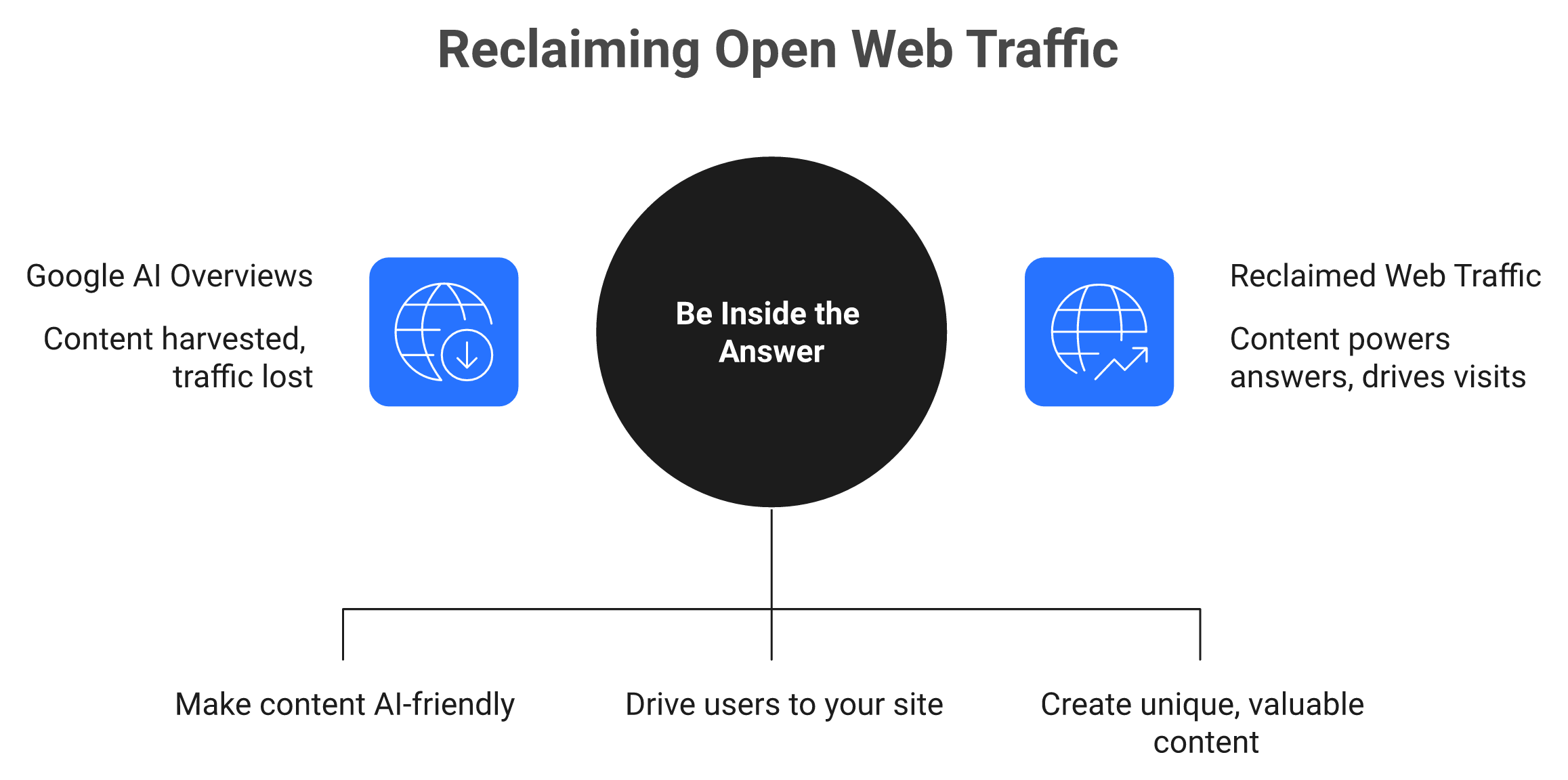
That trade is ending. As one operator put it, people now "ask a question, get an answer, and that's it, there's no click through, there's no reason" to read the ten blue links anymore. The answer arrives before the click ever happens. This is the reality our generative engine optimization work is built to address.
🤖 How AI Mode and AI Overviews build the wall
AI Overviews sit at the top of the results page. Gemini reads the ranking pages, then writes a summary in Google's own voice. AI Mode goes further, turning search into a full chat experience. For a deeper breakdown, our Google Gemini AI Mode guide walks through exactly how this unfolds.
Your content still powers the answer. You just do not get the visitor. Nilay Patel calls the endpoint "Google Zero," the moment referral traffic from Google approaches nothing.
🧱 Why Google changed its incentives
Google once championed the open web because links out kept users coming back. AI flipped that math. Now keeping users on the page captures more attention, more queries, and more ad revenue.
Google's Liz Reid disputes the doom framing. She argues clicks from AI experiences are "higher quality" and that overall click volume stays "relatively stable." That is worth taking seriously. But even stable clicks hide a brutal redistribution underneath the summary.
Here is my read, and I might be wrong on the timeline. The fence is real, but it is fragile synthesis, not an impenetrable wall. This is a go-to-market problem now, not just a publisher problem. Every founder relying on organic pipeline is standing on the same shifting ground, which is why the zero-click search brand economy matters more than ever.
✅ What survival now requires
The uncomfortable payoff is this. Ranking below the answer no longer saves you. You have to be inside the answer itself.
That single shift, from earning the click to becoming the cited source, reframes everything in the sections ahead.
Q2: How much is AI search actually shrinking website traffic and clicks?
A Head of Organic Growth I work with stopped celebrating position one last year. Her page still ranked first. Her click-through rate had been cut nearly in half. The rank looked healthy. The revenue did not.
The compression is measurable. Similarweb found Google news searches ending without a click rose from 56% (May 2024) to 69% (May 2025). Seer Interactive measured organic click-through rate falling 61%, from 1.76% to 0.61%, on queries with an AI Overview. Ranking number one inside an AI Overview now delivers roughly the clicks of a position-six organic result. The snippet is the new rank.
📉 The hard numbers behind the fence
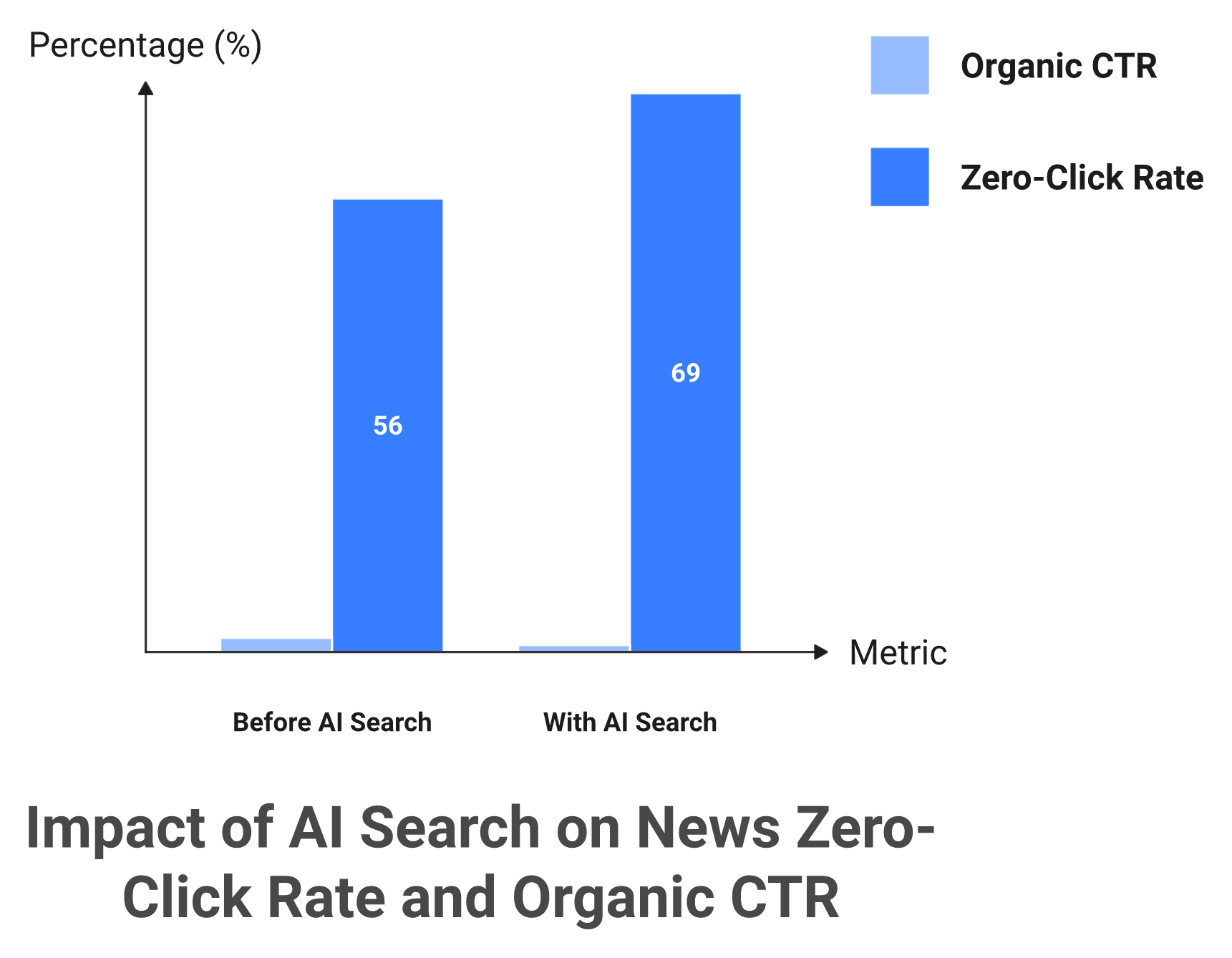
The data is consistent across independent sources. Zero-click behavior is climbing, and click-through rate is collapsing where AI Overviews appear. Our AI search visibility and brand mention tracking approach is designed for exactly this measurement problem.
| Metric | Finding | Source |
|---|---|---|
| News zero-click searches | Rose from 56% to 69% (May 2024 to May 2025) | Similarweb, 2025 |
| Organic CTR with AI Overview | Fell 61%, from 1.76% to 0.61% | Seer Interactive, Sept 2025 |
| Effective visibility at rank 1 | Roughly a position-six result's clicks | Practitioner analysis, 2025 |
Read that middle row twice. When an AI Overview shows up, roughly six in ten of your clicks vanish, even if nothing about your ranking changed.
💸 What the deltas mean for your pipeline
A VP Marketing forecasting organic pipeline off rank position is now forecasting off a broken proxy. Rank held steady. Traffic did not. The two numbers have quietly decoupled.
If you model next quarter's pipeline on last year's CTR curves, you will overstate it. The safer move is to re-baseline CTR against AI Overview presence, query by query, using proper GEO metrics and KPIs.
⚠️ Why measuring clicks understates the loss
Clicks are now the visible tip of a larger shift. A user who reads your insight inside the AI answer, then never clicks, still consumed your work. You get zero credit and zero attribution.
That is why "traffic down 10%" undersells the damage. The influence you lost is invisible in your analytics. As practitioners now say bluntly, the snippet is the new rank.
When we audit a client's top-ten money pages at MaximusLabs, we check AI Overview presence before we check rank. We do this because a first-place ranking hidden under a Gemini summary is a vanity metric, and vanity metrics do not close deals. Reading the primary datasets, Similarweb and Seer directly rather than recycled blog stats, keeps the forecast honest and the budget pointed at pages that still convert through our technical SEO and website audit.
Q3: Is search really dying, or is it fragmenting?
Every GEO pitch deck opens with the same slide: "SEO is dead." I have sat across the table from founders who bought that line, cut their organic budget, and later watched a competitor eat their category. The slide sells fear. The data tells a messier story.
Search isn't dying, it's fragmenting. Gartner predicts traditional search volume drops 25% by 2026, yet SparkToro clickstream data shows Google search grew about 21.6% in 2024 and still runs roughly 373 times more searches than ChatGPT. Google's Liz Reid argues click quality is "relatively stable." All can be true. The pie grows while more answers happen without a click. The real threat is disappearing attribution, not disappearing search.
📊 The headline everyone quotes
Gartner's forecast is the number every agency screenshots. It predicts traditional search engine volume will fall 25% by 2026 as chatbots and virtual agents take share. It is a real analyst projection, and it is directionally reasonable.
But a forecast is not a measurement. And the measured data pulls the other way. Understanding the difference is central to any honest GEO strategy framework.
🔍 The counter-data nobody puts on the slide
SparkToro's clickstream analysis found Google search actually grew about 21.6% in 2024. It still processes roughly 373 times more searches than ChatGPT. That is not a platform in collapse.
Google's own Liz Reid adds that clicks from AI experiences are "relatively stable" and often higher quality. She has an incentive to say that. Even so, the growth data and the decline forecast can both hold at once.
⚖️ The gate that fluctuates, not a wall that expands
The AI Overview trigger rate tells the real story. It ran near 6.49% in January 2025, peaked around 24.61% in July, then settled closer to 16%. That is not steady expansion. That is a gate that opens and closes by intent type.
Google is testing where AI answers help and where they hurt. The fence is selective, not total. Our GEO vs traditional SEO breakdown maps where each still applies.
✅ The real risk: attribution, not volume
Here is the reframe I stand behind, even against the popular read. The threat was never that people stop searching. The threat is that you stop getting credit when they do.
Search is splintering across Google, ChatGPT, Perplexity, and Gemini. Your buyers are still searching, just in more places, and clicking less in each one. Panic-cutting the organic channel misreads a redistribution as a death. The brands that win treat fragmentation as more surfaces to be cited on, which is the core of our answer engine optimization practice, not fewer reasons to show up.
Q4: Why do AI crawlers take your content but send almost no traffic back?
A founder showed me his server logs, baffled. Bot traffic was hammering his product pages thousands of times a day. Human visitors from those same bots? Almost none. He was feeding the machine and getting nothing back.
AI crawlers scrape aggressively while referring almost nothing. Cloudflare data shows training drove roughly 80% of AI crawling by mid-2025, with some crawlers hitting sites tens of thousands of times per referred visitor. Think of it as a ghost kitchen. Your website is the dining room, but agentic AI only needs the kitchen, the data feed. The delivery driver (the AI) fulfills the order for a user who never visits the building.
📈 The imbalance, in Cloudflare's numbers
Cloudflare's data makes the gap concrete. By mid-2025, training purposes drove nearly 80% of AI crawling activity across its network. The crawl-to-refer ratio, how many pages a bot scrapes for every visitor it sends back, has grown badly lopsided.
Some AI crawlers now hit a site tens of thousands of times for each referred reader. That is the extraction economy in one statistic, and it is why AI crawler optimization now sits at the center of technical strategy.
🍳 The ghost kitchen: a mental model that sticks
Picture a ghost kitchen. There is no dining room, no host, no ambiance. Just a kitchen producing food for delivery drivers who hand it to customers who never see the building.
Agentic AI treats your site exactly this way. Your polished homepage is the dining room. The AI only wants the kitchen, your structured data feed. It pulls the facts, assembles the answer, and serves a user who never arrives at your door. This is the world our agentic commerce service was built for.
✅ What this changes on Monday
If the machine consumes data, not design, then your optimization surface changes. Facet data, specs, prices, reviews, and FAQs must live in clean, crawlable HTML, not buried in scripts the bot skips.
A few concrete moves:
- ✅ Expose your facts. Put product specs, pricing, and review counts in server-rendered HTML.
- ⚠️ Set a deliberate robots.txt policy. Allow retrieval crawlers that power live answers, and evaluate blocking pure training crawlers that give nothing back.
- ✅ Structure for extraction. Use schema so the "kitchen" is easy to read and hard to misquote, following schema markup basics.
The old game optimized the dining experience for humans. The new game stocks the kitchen so the machine cannot help but cite you.
Q5: What is GEO/AEO and why is it the revenue answer to Google-only SEO?
A VP Marketing I met last spring had a spreadsheet of 400 blog posts. Traffic looked healthy. Pipeline from it? Almost nothing. She was optimizing for a game that stopped paying out.
Generative Engine Optimization (GEO) gets your brand cited inside AI-generated answers. Answer Engine Optimization (AEO) makes you the extracted answer. Unlike traditional SEO's chase for rank and pageviews, GEO/AEO targets pipeline, being the source AI quotes for high-intent BOFU questions. A 2024 Princeton study (Aggarwal et al., KDD) found GEO tactics lift visibility in generative responses by up to 40%. Success is measured in citation share of voice, not impressions.
📖 What the terms actually mean
Let me define the jargon plainly. GEO means engineering content so AI engines cite your brand in their answers. AEO means structuring content so the AI lifts your exact words as the answer.
Traditional SEO chases a blue-link rank on Google. GEO and AEO chase inclusion in the answer itself, across ChatGPT, Perplexity, Gemini, and Google AI Overviews. This is the heart of our generative engine optimization and answer engine optimization work.
🔍 GEO/AEO versus traditional SEO
| Dimension | Traditional SEO | GEO / AEO |
|---|---|---|
| Goal | Rank a URL on Google | Get cited inside AI answers |
| Unit of work | Keywords | Question variants |
| Winning signal | Backlinks, page rank | Earned citations, trust |
| KPI | Clicks, impressions | Citation share of voice |
| Content focus | TOFU pageview bait | BOFU/MOFU pipeline pages |
The mechanics differ too. Modern AI answers run on retrieval-augmented generation (RAG), meaning the model searches, reads results, then summarizes them. So earned mentions on trusted third-party pages often beat ranking your own URL, a distinction we detail in our GEO vs traditional SEO breakdown.
💰 The revenue reframe
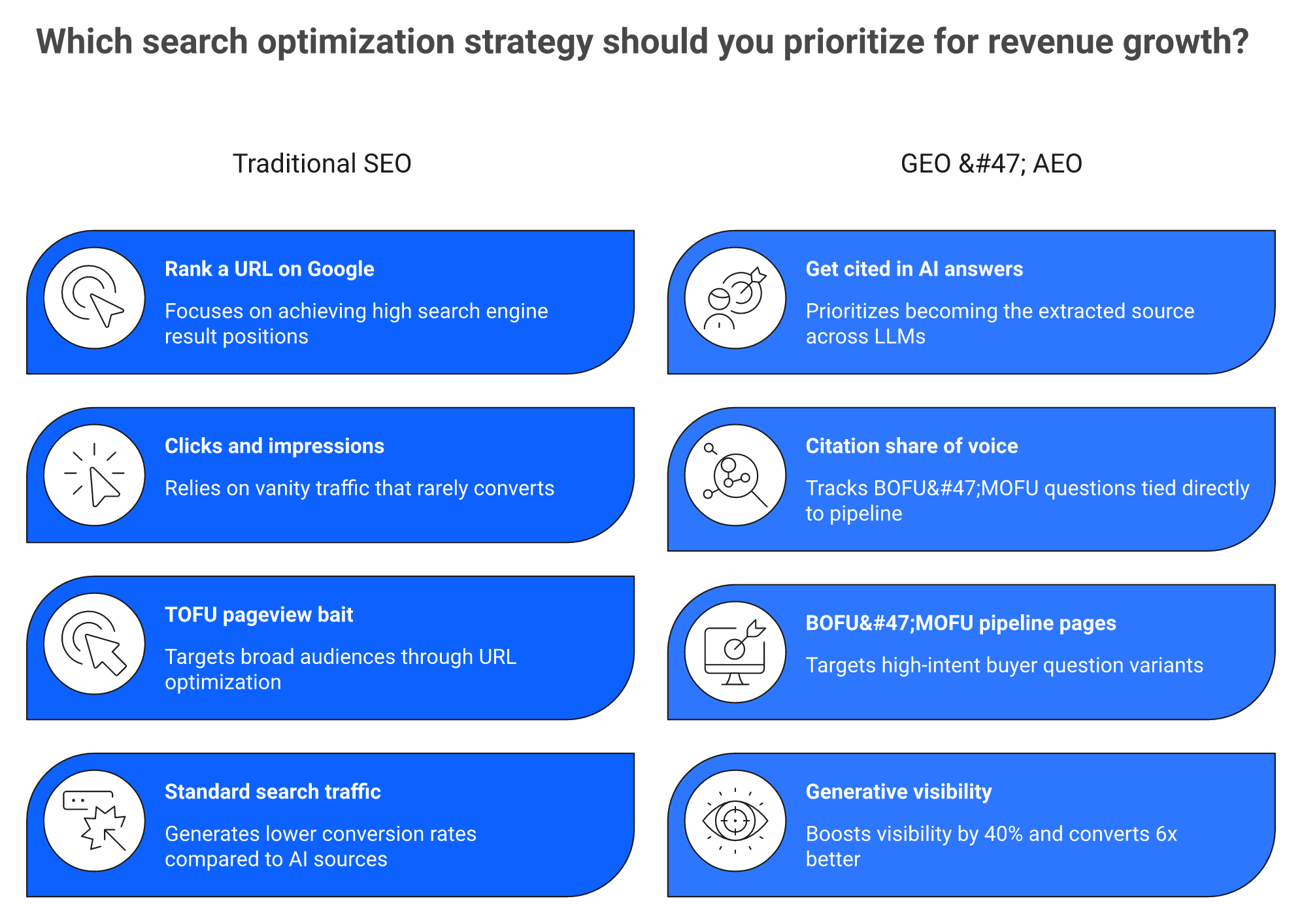
Here is the shift that matters. AI engines already answer "what is X?" on their own, so publishing TOFU explainers hoping for citations is low-ROI. The money sits in BOFU and MOFU questions buyers ask when they are ready to choose.
There is a hard number behind this. Webflow reported roughly a 6x conversion-rate difference between LLM traffic and Google search traffic. Buyers arrive pre-sold, because the AI already recommended you. Our GEO ROI and revenue attribution approach is built to track exactly that.
📊 Share of voice is the new KPI
There is no "rank one" in an AI answer. The same question, asked twice, can surface different sources. So the honest metric is share of voice, how often you appear across thousands of question variants and platforms, measured with proper GEO metrics and KPIs.
This is the discipline MaximusLabs was built around. We engineer content to be the cited answer across ChatGPT, Perplexity, Gemini, and AI Overviews, and we measure it in citation share tied to pipeline, not vanity impressions. From what surfaces when you actually run this, GEO is closer to a data-science and brand problem than an algorithm hack. You are not gaming a model. You are earning trust the model has to respect.
Q6: How do you "become the answer" AI engines cite instead of just ranking?
A Head of Organic Growth once asked me to "just get us to number one" for a head term. Wrong target. For that query, the AI was pulling a Reddit thread and a YouTube video, not anyone's homepage. Ranking her URL would not have moved the answer.
You become the answer by engineering extractable content and earning citations. Structure every section as a standalone 40 to 80 word answer nugget an AI can lift cleanly. Convert your search keywords into the real questions buyers ask, then answer every follow-up comprehensively. For head queries, being mentioned across Reddit, YouTube, and G2 beats ranking your own URL. Remember: 19 of 20 landing pages drive little traffic, so concentrate effort on the high-intent few.
✅ The action list
Here is what to do Monday morning, in order.
- Open every section with a self-contained 40 to 80 word answer nugget the AI can extract cleanly.
- Turn your keywords into real questions. Take high-volume search terms and rephrase them as the questions buyers actually ask.
- Map the URLs already cited for your top questions, then earn a mention on those exact pages.
- Concentrate on the handful of high-intent pages that convert, not the long tail of dead ones.
🔍 The keyword-to-question hack
There is no clean question-volume database yet. So the working method is directional. Take your high-volume keywords and transform them into questions, since search behavior maps roughly to how people ask AI. Our AEO keyword and question research process formalizes this step.
Mine your own data too. Sales calls, support tickets, and reviews surface the specific long-tail questions no keyword tool will ever show you.
⭐ Earned beats owned for head terms
For broad "best X" questions, your own page rarely wins. The AI leans on citations from trusted third parties like Reddit, YouTube, and industry roundups. YouTube is especially underused, and a low-budget explainer video can start showing up in citations fast. Building this systematically is the core of strong AI citation acquisition tactics.
On Reddit, authentic engagement is the only thing that works. Say who you are, say where you work, and add something genuinely useful, an approach our Reddit and forum AEO playbook is built around. Spam gets policed by the community instantly.
💰 Concentrate on what converts
Here is the uncomfortable math. Roughly 1 in 20 landing pages drives about 85% of your traffic. The other 19 do little.
So spreading effort evenly is a mistake. At MaximusLabs, we map the exact URLs AI engines already cite for a client's highest-intent questions, then engineer content and earned mentions to displace them. That is Search Everywhere Optimization in practice, working the surfaces buyers actually read, not just your own domain, informed by real AEO case studies.
Q7: Why is building a brand, not chasing the algorithm, the only durable moat?
Picture the treadmill. An algorithm update drops, rankings wobble, and the whole team scrambles to reverse-engineer what changed. I have watched founders live on that treadmill for years. It never ends, and it never compounds.
The only moat that jumps the fence is brand. Algorithm hacks decay with every update, but if you are genuinely THE brand in your category, AI has to recommend you. Excluding you would make the answer wrong and cost the engine credibility. GEO isn't reverse-engineering the model. It's building authority so strong no retrieval system can honestly leave you out. The penalty for being average has never been so severe.
⏰ The situation: the endless chase
Most teams treat search like a puzzle to crack. Find the trick, ride it, repeat when it breaks. It feels productive.
But every model update resets the board. The tactic that worked last quarter quietly stops working, and the scramble starts again.
❌ The complication: why hacks and rented attention fail
Hacks decay by design. AI platforms are incentivized to devalue manipulation, exactly as Google eventually crushed scraped content. Betting your pipeline on a loophole is betting on borrowed time.
Ads are not a moat either. When you buy Google Ads, you are renting someone else's stage, and the rent never stops. Stop paying and the visibility vanishes overnight, unlike the compounding authority our GEO service is designed to build.
✅ The proof: brand is the un-excludable signal
Here is the shift. AI engines evaluate what the whole web says about you, not just your own pages. That web-wide reputation is Experience, Expertise, Authoritativeness, and Trustworthiness (E-E-A-T), Google's own quality framework, which we operationalize through E-E-A-T for AEO.
If you are the recognized brand in your space, the model cannot honestly leave you out. Excluding you would make the answer incomplete and cost the engine credibility. That is the "brand algorithm" idea: build the brand, and AI has to recommend you.
💰 The payoff: durable authority
This is why we run a trust-first, revenue-focused methodology at MaximusLabs, building category authority in the founder's own voice rather than tricks that expire at the next update. Our client Oliv AI reached a 64% citation rate across AI platforms, overtaking billion-dollar competitors sitting at 30%, as detailed in the Oliv AI B2B SaaS case study.
Budget did not decide that outcome. Understanding did. I might be wrong about a lot of tactics, but not this one: brand is the moat, and the penalty for being average has never been steeper.
Q8: What breaks your AI visibility technically, and what actually fixes it?
A founder proudly walked me through his Core Web Vitals dashboard, all green. Then we asked ChatGPT about his product. His reviews, his best trust signal, were nowhere in the answer. The speed score was perfect. The AI simply could not see the part that mattered.
Most technical SEO is true but zero-impact. What matters for AI visibility is retrievability. Turn JavaScript off, and if your reviews and FAQs vanish, AI can't see your trust signals. Fix crawlable HTML rendering, schema, and subdirectory structure over subdomains. And watch synthesis: an AI can mislabel your team or misstate your facts. AI stitches together whatever it retrieves, so the brand supplying the clearest, best-structured source controls the narrative.
⚠️ Retrievability beats page speed
Let me be blunt about the security blanket. Chasing Core Web Vitals and micro page-speed gains rarely moves AI visibility. What moves it is whether the AI can actually retrieve and read your content, which is exactly what a proper technical SEO and website audit checks for.
The test is simple. If a bot cannot see your key facts in raw HTML, none of your other optimization matters.
🔍 The JavaScript-off debugging moment
Here is the fastest audit you can run today. Turn JavaScript off in your browser, then reload your money page.
If your reviews, FAQs, or specs disappear, they were loaded asynchronously, and AI crawlers likely miss them. AI systems primarily read raw HTML, so trust signals trapped behind JavaScript are invisible to the answer engine, a problem our AI crawler optimization work resolves.
✅ The fixes that actually count
A short do-and-skip list keeps the effort honest.
- ✅ Put critical content (reviews, specs, FAQs) in plain, crawlable HTML.
- ✅ Implement schema markup, especially for reviews, products, and organization data, so machines parse facts unambiguously, following schema markup basics.
- ✅ Keep your help center on a subdirectory (domain.com/help), because subdomains perform worse for discovery.
- ❌ Skip obsessing over Core Web Vitals as an AI-visibility lever.
There is a speed problem too, but not the one people fear. Content trapped behind a nine-month engineering queue never makes it past the fence. We built our own Webflow implementation team at MaximusLabs precisely so fixes ship in days, not quarters, and our Webflow SEO guide shows the approach.
🤖 Watch how AI describes you
One more risk hides in plain sight. AI does not just retrieve you, it synthesizes you, and it can get you wrong. An AI answer can confidently misstate a team's credentials or misattribute a claim if the source signals are muddy.
That is the real lesson. AI stitches together whatever it retrieves, so the brand feeding it the cleanest, most authoritative source controls the story. We monitor how each engine describes our clients across platforms, then feed the correct, structured signals back in until the narrative matches reality.
Q9: What should founders and growth leaders do on Monday morning?
A founder messaged me at 8 a.m. once, coffee still hot, asking one thing: "Just tell me what to do first." Not theory. Not another framework deck. The actual first click. So here is that answer, built for the person staring at a dashboard that stopped making sense.
Start Monday with five moves: baseline AI-referral versus organic traffic in GA4; audit your top 10 BOFU money pages for AI Overview presence; turn JavaScript off to confirm trust content is crawlable; convert your best keywords into buyer questions and restructure one page into answer nuggets; and seed three authentic citations on Reddit, YouTube, or G2. Shift your KPI from clicks to citation share of voice tied to pipeline.
✅ The five moves, in priority order
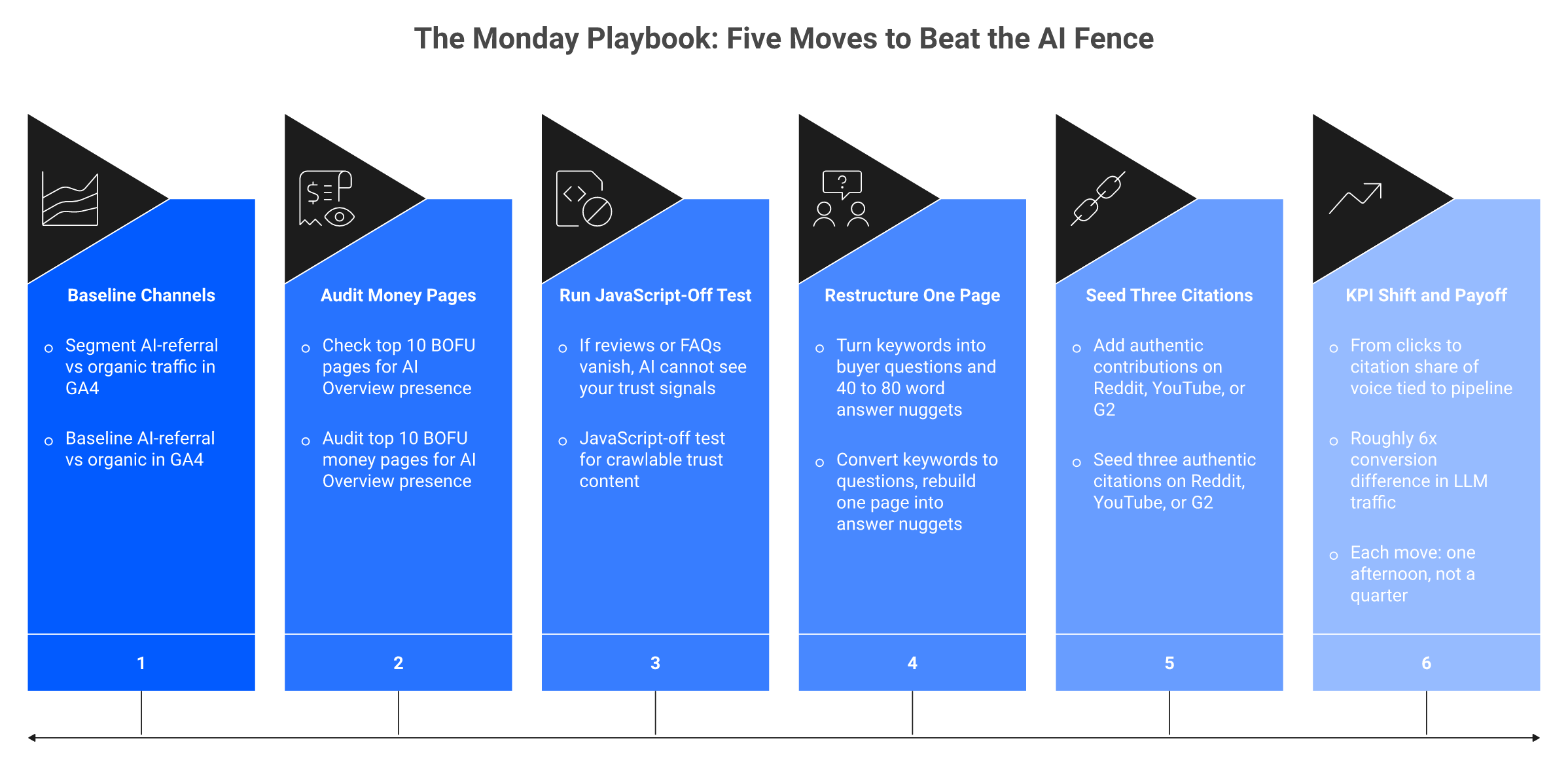
Do these in sequence. Each one takes an afternoon, not a quarter.
- Baseline your channels. In GA4, segment AI-referral traffic (ChatGPT, Perplexity, Gemini) against organic, so you know your real starting point, then track it with proper GEO measurement and metrics.
- Audit your money pages. Check whether your top 10 bottom-of-funnel (BOFU, buyer-ready) pages appear in AI Overviews before you check their Google rank.
- Run the JavaScript-off test. Reload a key page with scripts disabled. If reviews or FAQs vanish, AI cannot see your trust signals, a fix our technical SEO and website audit handles.
- Restructure one page. Turn your best keywords into the questions buyers actually ask, then rewrite that page as 40 to 80 word answer nuggets using AEO content writing and formatting.
- Seed three citations. Add genuinely useful, self-identified contributions on Reddit, YouTube, or G2 where your buyers already read, guided by AI citation acquisition tactics.
👤 What changes by role
The playbook is the same. The emphasis is not.
- Founder or CEO. ⏰ Own move 1 and the KPI shift. You set whether the team chases clicks or pipeline.
- VP Marketing or Head of GTM. 💰 Own moves 2 and 4. Point budget at BOFU pages that convert, not TOFU pageview bait, the core of our GEO ROI and revenue attribution work.
- Marketing Manager or Head of Organic Growth. ✅ Own moves 3 and 5. These are the hands-on, this-week wins.
Why bother? Because the payoff for getting through the fence is large. Webflow reported roughly a 6x conversion-rate difference between LLM traffic and Google search traffic. Buyers arrive already recommended, so they close faster, which is exactly what our answer engine optimization practice is built to capture.
🔭 Where this goes next
Here is the prediction I am sitting with, and I could be early on the timing. AI answers are getting faster and more agentic, with grounding pipelines already retrieving sources in a few hundred milliseconds. As that speed compounds, the buyer never touches your website at all, the AI just acts on your data, a shift our agentic commerce service was built for.
So the surface you optimize shifts from pages to structured, machine-readable facts. The brands that win will feed the cleanest data and hold the strongest reputation, not the ones with the prettiest homepage, an approach grounded in our schema markup basics.
If you would rather not run this playbook alone, this is exactly the work we do at MaximusLabs, turning AI search from a threat into a revenue channel, measured in citation share of voice and pipeline through our GEO service. I am genuinely curious where you land after move 1. When you baseline AI-referral against organic, is the gap bigger or smaller than you expected? That number usually tells us where to start, and I would happily compare notes.
Frequently asked questions
What does it mean that Google is building an AI fence around the Internet?
The AI fence is Google's shift from ten blue links to Gemini-written answers that resolve the query on Google's own page. AI Overviews sit at the top of results, and AI Mode turns search into a full chat experience. For two decades the deal was simple: you let Google crawl your content, and Google sent you visitors in return. That trade is ending. Google now harvests your information, shows it inline, and keeps the visit. AI Overviews summarize ranking pages in Google's voice. Users get the answer without clicking through. The Verge's Nilay Patel calls the endpoint Google Zero. Our read is that the fence is real but fragile synthesis, not an impenetrable wall. Ranking below the answer no longer saves you; you have to be inside the answer itself. That is exactly what our generative engine optimization work is built to achieve.
How much is AI search actually shrinking website traffic and clicks?
The compression is measurable across independent sources. Similarweb found news searches ending without a click rose from 56% in May 2024 to 69% in May 2025 . Seer Interactive measured organic click-through rate falling 61% , from 1.76% to 0.61%, on queries with an AI Overview. The practical effect is stark. Ranking number one inside an AI Overview now delivers roughly the clicks of a position-six organic result. Rank and traffic have quietly decoupled. Forecasting pipeline on old CTR curves overstates it. The snippet is the new rank. We recommend re-baselining CTR against AI Overview presence, query by query. When we audit a client's top-ten money pages, we check AI Overview presence before rank, using our AI search visibility and brand mention tracking approach to keep the forecast honest.
Is search really dying, or is it just fragmenting?
Search is not dying, it is fragmenting. Gartner predicts traditional search volume drops 25% by 2026 , yet SparkToro clickstream data shows Google search grew about 21.6% in 2024 and still runs roughly 373 times more searches than ChatGPT. All of this can be true at once. The pie grows while more answers happen without a click. The AI Overview trigger rate fluctuates by intent, not steady expansion. Buyers now search across Google, ChatGPT, Perplexity, and Gemini. The real threat is disappearing attribution, not disappearing search. Panic-cutting the organic channel misreads a redistribution as a death. The brands that win treat fragmentation as more surfaces to be cited on, which is the core of our answer engine optimization practice, not fewer reasons to show up.
What are GEO and AEO, and why do they beat Google-only SEO?
Generative Engine Optimization (GEO) gets your brand cited inside AI-generated answers. Answer Engine Optimization (AEO) makes you the extracted answer. Unlike traditional SEO's chase for rank and pageviews, GEO and AEO target pipeline, being the source AI quotes for high-intent questions. A 2024 Princeton study (Aggarwal et al., KDD) found GEO tactics lift visibility in generative responses by up to 40%. Traditional SEO optimizes keywords; GEO optimizes question variants. Winning signal shifts from backlinks to earned citations and trust. KPI shifts from clicks to citation share of voice. The money sits in BOFU and MOFU questions, because Webflow reported roughly a 6x conversion-rate difference between LLM traffic and Google search traffic. See how the models differ in our GEO vs traditional SEO breakdown.
How do you become the answer AI engines cite instead of just ranking?
You become the answer by engineering extractable content and earning citations. Structure every section as a standalone 40 to 80 word answer nugget an AI can lift cleanly, then convert your keywords into the real questions buyers ask. For broad head queries, being mentioned across Reddit, YouTube, and G2 often beats ranking your own URL. Map the URLs already cited for your top questions. Earn a genuine, self-identified mention on those exact pages. Concentrate on the high-intent pages, since roughly 1 in 20 drives about 85% of traffic. Authentic engagement is the only thing that works on community surfaces. This is Search Everywhere Optimization in practice, and we formalize the citation side through our AI citation acquisition tactics , working the surfaces buyers actually read.
Why is building a brand, not chasing the algorithm, the only durable moat?
The only moat that jumps the fence is brand. Algorithm hacks decay with every model update, but if you are genuinely the brand in your category, AI has to recommend you. Excluding you would make the answer wrong and cost the engine credibility. AI engines evaluate what the whole web says about you, not just your own pages. That web-wide reputation is Experience, Expertise, Authoritativeness, and Trustworthiness, Google's own E-E-A-T framework. Hacks decay; platforms devalue manipulation over time. Ads rent attention that vanishes when you stop paying. Brand authority compounds and is un-excludable. Our client Oliv AI reached a 64% citation rate across AI platforms, overtaking billion-dollar competitors at 30%. Budget did not decide that; understanding did. We build durable authority through our trust-first GEO service .
What should founders and growth leaders do about AI search on Monday morning?
Start Monday with five moves. First, baseline AI-referral versus organic traffic in GA4. Second, audit your top 10 BOFU money pages for AI Overview presence. Third, turn JavaScript off to confirm trust content is crawlable. Fourth, convert your best keywords into buyer questions and restructure one page into answer nuggets. Fifth, seed three authentic citations on Reddit, YouTube, or G2. Founders own the KPI shift from clicks to citation share of voice. VP Marketing points budget at BOFU pages that convert. Managers own the crawlability and citation-seeding wins. The payoff for getting through the fence is large, given the roughly 6x conversion gap in LLM traffic. If you would rather not run this alone, this is exactly the work we do, turning AI search from a threat into a revenue channel through our GEO ROI and revenue attribution approach.