 Krishna Kaanth M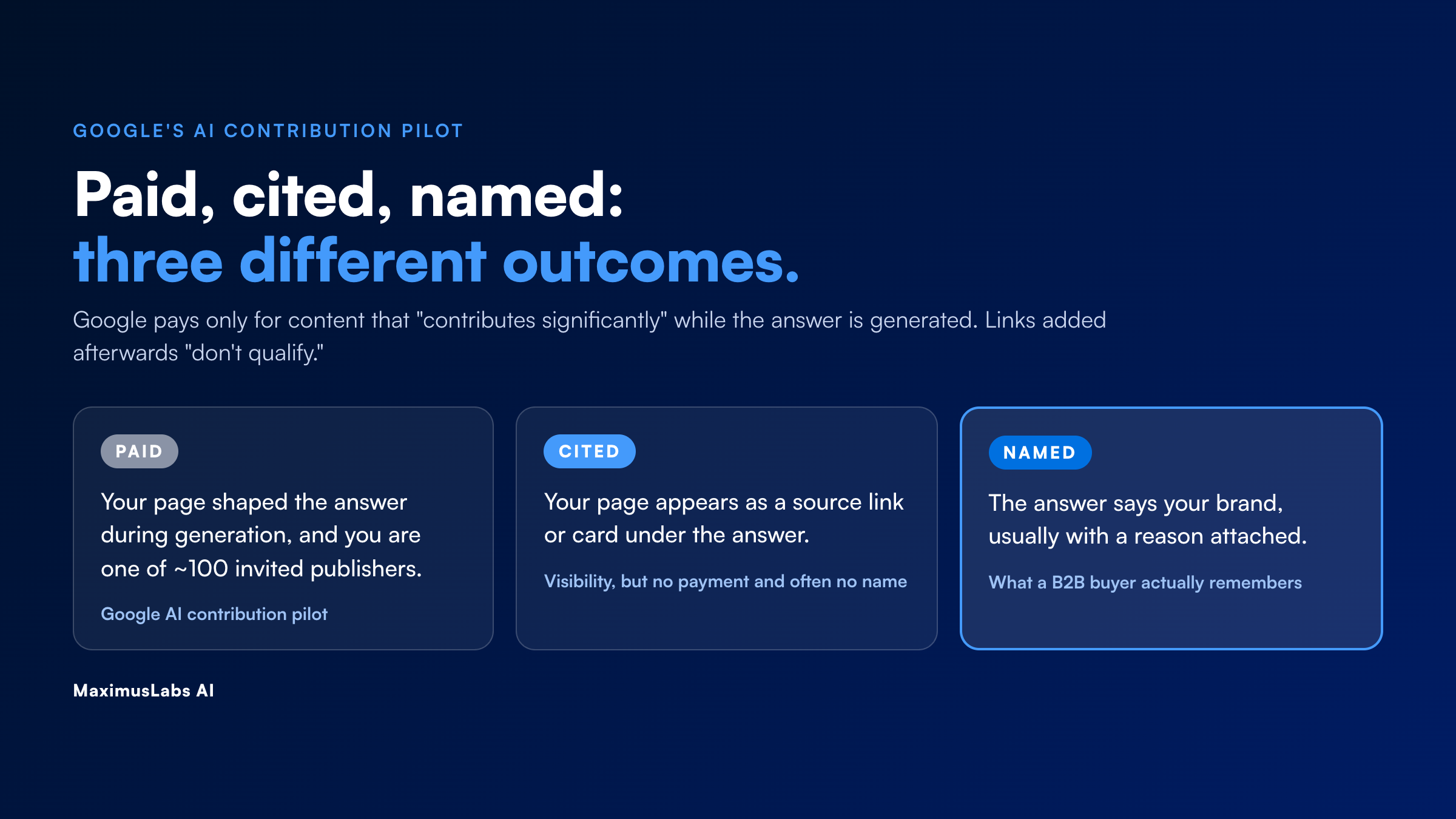
- Google's AI contribution pilot pays about 100 invited publishers when their pages contribute significantly to AI Overviews, AI Mode, and Gemini answers.
- Being cited or linked earns nothing. Google pays only for content that shapes the answer during generation, so citation counts miss what the pilot values.
- Payouts range from under $1,000 over several months to more than $1 million a year. Cloudflare's new Pay Per Use lets AI buyers price each use themselves.
- B2B SaaS brands cannot join and should not want to. One agency study of 9 million answers found up to 75% of answers citing a brand's page never name it.
- Stay visible to AI search crawlers, publish fresh, original, sourced facts, and measure named-mention rate and share of voice against pipeline.
For twenty years, Google's deal with the open web was simple. You let Googlebot read your pages, and Google sent you visitors. The click was the payment.
That deal is being rewritten in public. On 14 September, Digiday reported that Google is paying some websites when their content shapes answers in AI Overviews, AI Mode, and the Gemini app. By 29 September, The Information put the number of participants at about 100 publishers.
Most of the coverage I have read asks what this means for publishers. I think the more useful question is what it means for everyone else. A B2B SaaS company will not get a check from Google. But the pilot tells us, in Google's own words, what an AI answer actually values. That is worth more than the money.
1. What Is Google's AI Contribution Pilot, and Who Gets Paid?
Google's AI contribution pilot is an invitation-only program that pays websites for content that shapes AI answers. It covers AI Overviews, AI Mode, and the Gemini app, and pays when a page "contributes significantly" to a response. About 100 publishers are in it, according to The Information on 29 September 2026, many of them small to midsize. Payouts range from under $1,000 over several months to more than $1 million a year. Google has not announced it with a public program page.
🧾 How the pilot came to light
The program surfaced in pieces. Barry Schwartz spotted an "AI contribution" report in Google's support docs on 13 April 2026, before anyone knew it involved money. Digiday broke the payment story on 14 September, and Google confirmed to Digiday that it is an early-stage learning pilot. The Information added the participant count and payout figures on 29 September.
Google's only public description is a 17 June 2026 policy post. In it, Google says it is "piloting a new way to partner with websites." The partners are sites whose content improves "the freshness and factuality" of AI responses "through the process of grounding." Grounding means the model retrieves real pages and builds its answer from them, a process our GEO fundamentals guide explains step by step.
💵 What the pilot actually pays
The Information's figures, as quoted by Search Engine Roundtable, show a very wide spread. Treat each number as one participant's experience, not a program average.
| Participant | Reported payout |
|---|---|
| An early entrant | More than $1 million a year |
| A publisher that joined a few months ago | About $50,000 to $60,000 so far |
| Smaller sites | Under $1,000 over several months |
| Several small to midsize sites | Less than one-tenth of 1% of their ad revenue |
🔒 Who can join
The pilot is invitation only. There is no public sign-up page, no published terms, and no payout formula. Participants see a monthly earnings figure in Search Console. One executive told Digiday the calculation is "quite black box." The Information reports that niche topics with strong followings, such as anime and gaming, appear to earn more.
🌐 Why this matters beyond publishers
The scale explains why everyone should care. Google says AI Overviews has over 2.5 billion monthly active users and AI Mode has passed one billion monthly users. A program that decides which pages shape those answers is, in effect, a quality signal for the largest answer engine on the web.
That is also why the pilot fits a wider pattern. The coverage we have collected on Google's search monopoly becoming an AI monopoly and on Google's AI updates shows the same thing. Google is pulling more of the web's value inside its own answers.
If you want the wider context, our Google AI cluster tracks each change as it lands. The practical side of getting featured sits in our guide to Google AI Overviews optimization. For B2B teams, the practical work of showing up in these answers sits in our Google AI optimization service.
2. Does Google Pay for AI Overview Citations?
No. Google's pilot does not pay for being cited or linked in an AI Overview. Google's help documentation ties earnings to content that "contributes significantly" while the response is being generated. Pages that only confirm facts afterwards, or are linked after the answer is written, "don't qualify." A link under an AI answer is visibility. It is not what the pilot pays for.
🧩 Contribution happens before the answer exists
The difference is timing. When Google builds an AI answer, some pages feed the generation itself. Other pages are attached later, to support a sentence the model already wrote.
Google described that second step years ago. Patent US 11,769,017 B1, "Generative summaries for search results," was granted on 26 September 2023. It covers linking parts of a generated summary to documents that verify them. The pilot's help doc says exactly that kind of after-the-fact support earns nothing.
📊 Three outcomes that people confuse
I find it useful to separate three things a page can get from an AI answer. Most teams only track the second.
| Outcome | What it means | Who benefits |
|---|---|---|
| Paid | Your page shaped the answer during generation, and you are in the pilot | About 100 invited publishers |
| Cited | Your page appears as a link or source card | Anyone indexed and eligible for a snippet |
| Named | The answer says your brand's name, often with a reason | The brand the buyer remembers |
🔍 Why citation data can't tell you what you'd earn
Semrush put it plainly: links and citations don't qualify for payment, so citation data shows visibility but cannot reveal earnings. The same gap applies to brands. A citation count tells you that you were retrieved. It does not tell you whether you shaped the answer or got named in it.
That is why our citation optimization hub treats citations as a leading signal, not the finish line.
🧾 What this means for your reporting
If your AI visibility report stops at citation counts, it is measuring the outcome Google itself refuses to pay for. That does not make citations worthless. It makes them incomplete.
Attribution in AI search is hard, as our breakdown of AEO accuracy and attribution challenges explains. The honest response is to add better signals, not to stop measuring. The finish line is being the brand in the sentence, which is what our AEO service is built around.
3. Why Is Google Paying Publishers for AI Answers Now?
Google has not said why, but the likeliest reason is that the old bargain, content in exchange for clicks, no longer holds for AI answers. Pew found searchers click a link inside an AI summary on just 1% of visits. Regulators in the EU and UK, and publishers in court, are pressing the point. MaximusLabs measures whether a brand is named, not only clicked, because in AI search the naming is the value.
🔁 How the bargain used to work
For years, Google's position was that search traffic was compensation enough, as PYMNTS noted on 30 September 2026. Publishers let Google crawl, Google ranked them, and the ranking sent visitors who saw ads or bought products. As recently as August 2025, Google's Liz Reid said total organic click volume was "relatively stable year-over-year," though Google published no data behind the claim.
That model had a cost few people priced in. It only worked while the searcher needed to leave Google to get the answer.
📉 What changed when the answer moved onto the results page
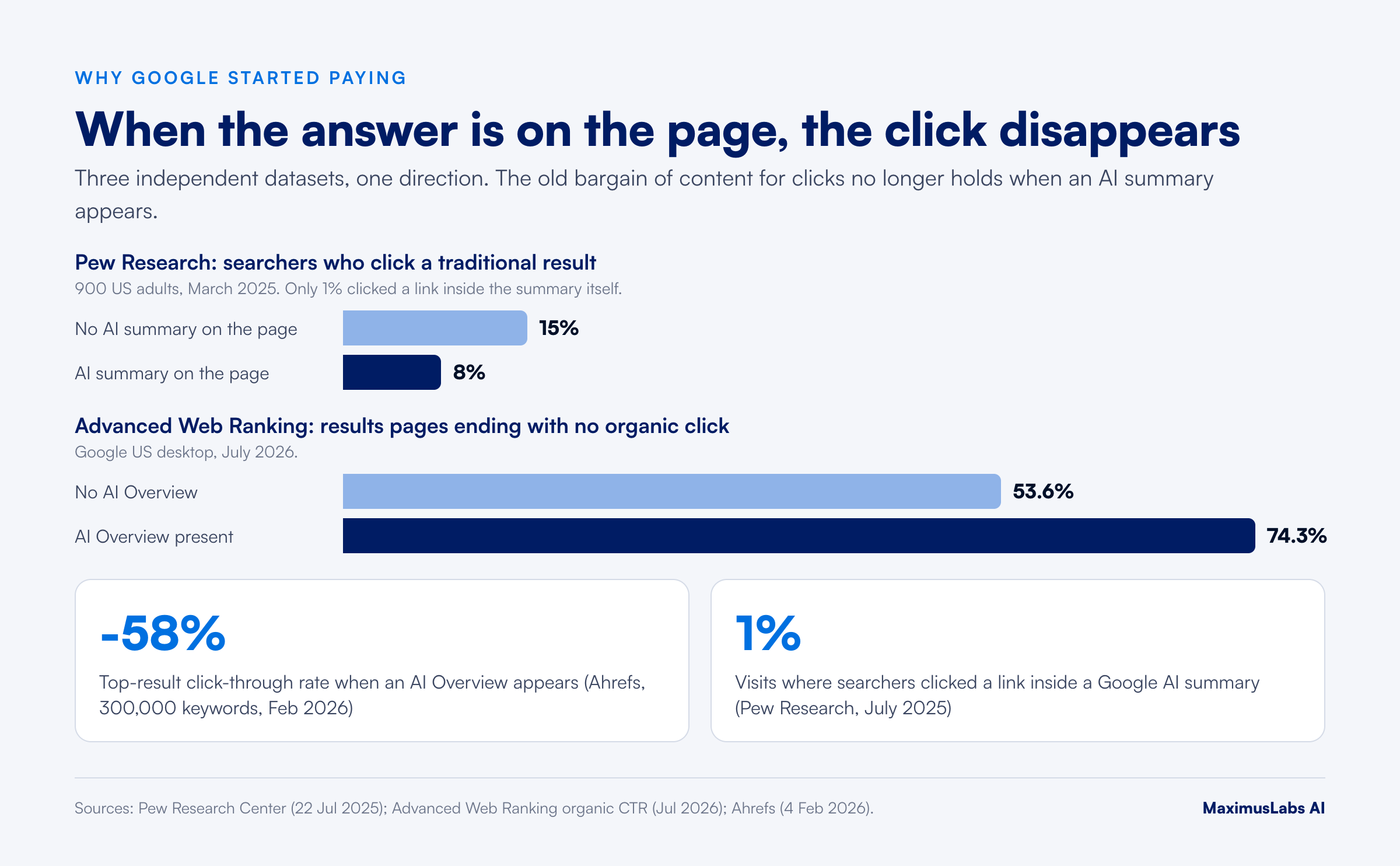
The data now points one way. Pew Research tracked 900 US adults in March 2025. They clicked a traditional result on 8% of visits with an AI summary, against 15% without one. They clicked a link inside the summary on just 1% of visits.
Ahrefs found in February 2026 that an AI Overview correlates with a 58% lower click-through rate for the top result, across 300,000 keywords. Advanced Web Ranking's July 2026 data shows 74.3% of results pages with an AI Overview end with no organic click, against 53.6% without one. Our AI search click-through rate guide breaks down what those numbers mean for different page types.
The pressure is legal too. The European Commission opened a formal investigation on 9 December 2025. It asks whether Google uses publisher content for AI answers "without appropriate compensation."
The UK's Competition and Markets Authority imposed a conduct requirement on 3 June 2026 that gives publishers tools to keep content out of AI features. Penske Media is suing Google in the US. Publishers call the end point of this trend Google Zero. Our note on click-worthiness strategy covers what still earns a visit.
🎯 What MaximusLabs measures instead
This is why MaximusLabs measures named visibility, not just clicks. MaximusLabs tracks AI visibility daily across ChatGPT, Perplexity, Gemini, Claude, and Google AI Overviews, and reports share of voice across those engines. Our zero-click search research lays out the economics behind that choice.
For Oliv AI, 30 to 40% of inbound is now AI-sourced. In a market where the click keeps shrinking, that is the share worth watching.
4. How Is Cloudflare's Pay Per Use Different From Google's Pilot?
Cloudflare's Pay Per Use, launched in beta on 30 September 2026, lets an AI company define a "use" of content and set a price. The AI company pays the publisher through Cloudflare each time it reports that use. Google's pilot pays for contribution by its own hidden formula. Cloudflare's model makes the buyer name the trigger, such as returning an excerpt or letting a review shape a recommendation.
🧮 Four models, side by side
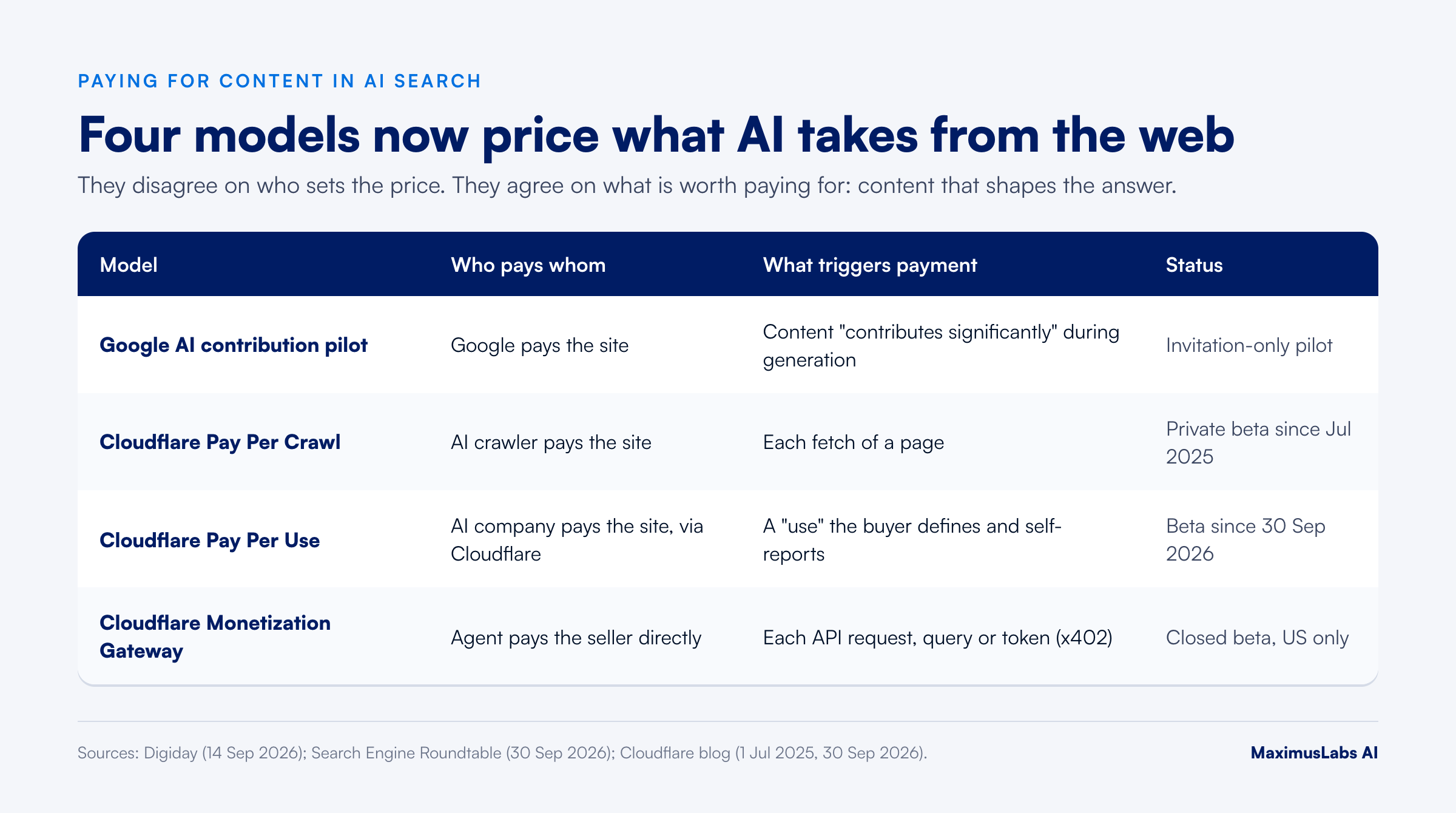
The two companies now run four different ways to pay for content. The difference is who defines value and when money moves.
| Model | Who pays whom | What triggers payment | Status |
|---|---|---|---|
| Google AI contribution pilot | Google pays the site | Content "contributes significantly" during generation | Invitation-only pilot |
| Cloudflare Pay Per Crawl | The AI crawler pays the site | Each fetch of a page | Private beta since 1 July 2025 |
| Cloudflare Pay Per Use | The AI company pays the site, via Cloudflare | A "use" the buyer defines and self-reports | Beta since 30 September 2026 |
| Cloudflare Monetization Gateway | The agent pays the seller directly | Each API request, query, or token, via x402 | Closed beta, US sellers and buyers |
🕷️ Why paying per crawl was not enough
Paying per crawl assumed crawling and value moved together. Cloudflare's own data shows they don't. In July 2025, Anthropic's crawlers fetched about 38,000 pages for every visitor they referred, and OpenAI's about 1,091.
Google's own ratio started 2025 at just over 3:1 and rose as high as 30:1. Our AI crawlers hub explains what each of these bots does with your pages. Our guide to CCBot and Common Crawl covers the training crawlers that never send a visitor back.
Pay Per Use moves the price to the moment of value. Cloudflare's examples are telling. A search service pays when it returns an excerpt. A shopping agent pays when an enrolled review shapes a recommendation, even if the shopper never reads it. That second example is the whole thesis of AI search in one sentence.
⚖️ What the two approaches agree on
Google and Cloudflare disagree on who sets the price. They agree on what is worth paying for: content that shapes the answer, not content that sits next to it. For a brand, that is the same insight our GEO content framework is built on.
🤖 Why agents make this urgent
The Monetization Gateway points at where this goes next. Cloudflare says daily AI-agent requests grew by more than 1,700% in a year, and that more than half of Internet traffic is now non-human. When agents, not people, read your pages and act on them, the question of who shapes the answer gets sharper. Our look at agentic AI and the future of search and our report on the agentic web stack map that shift.
5. Can a B2B SaaS Company Join the Pilot or Get Paid for AI Answers?
No. There is no public way for a B2B SaaS company to join Google's pilot. We found no report naming a SaaS vendor as a participant. It is invitation only and favors small and mid-sized publishers. More importantly, payment is the wrong goal for a brand. MaximusLabs treats being named in the answer as the payment, because that is what reaches the buyer.
📚 How B2B content used to earn its keep
B2B content had a clear job for a decade. You published guides, ranked for research queries, and converted readers into leads with a form. Every blog post was, in the end, a lead-capture page with a long introduction.
That model depended on visits, and the visits are thinning.
🔄 What changed: the buyer reads the answer, not your page
The research still happens. It just happens inside the answer. Cloudflare's 30 September 2026 data covers heavily crawled categories, including Computer Software and IT & Services.
Human traffic to them has fallen by as much as 40% in under a year. Our B2B SaaS buyer journey research maps where AI now sits in that journey. The AI search in B2B SaaS 2026 report shows how far the shift has gone. If the terms are new, start with what GEO is and how AEO differs from SEO.
If the buyer never visits, a publisher needs Google to pay for the content. A brand needs something different. It needs the answer to say its name, with a reason attached.
🏗️ How MaximusLabs gets brands named instead of paid
MaximusLabs works in two pillars. Owned AEO makes a client's own content the answer AI engines extract. Earned AEO places the brand in the third-party sources AI engines trust for the category, such as review platforms, community threads, and comparison articles. Our AI citation acquisition tactics list those sources.
For AI and SaaS companies specifically, that work runs through our AI SaaS program. The Oliv AI case study shows the result for an AI sales tech company: $47K pipeline in 4 months, and no check from Google. You can see the published pricing on our pricing page.
6. What Is the Difference Between Being Paid, Being Cited, and Being Named?
Being paid means your page shaped the answer and you are in Google's pilot. Being cited means your page appears as a source link. Being named means the answer says your brand. They often come apart. A Search Engine Land contributor study of 9 million AI answers found a striking gap. Up to 75% of answers citing a brand's page never mention the brand. MaximusLabs optimizes for the named outcome.
👻 How "cited" used to feel like a win
When AI Overviews started showing source cards, it was tempting to count every citation. A link under the answer looked like the new blue link. Dashboards counted them.
The problem is that a citation can be anonymous. Your page can supply the fact while a competitor gets the recommendation.
📐 What the data shows about ghost citations
The Search Engine Land study, published on 30 September 2026, analyzed 9 million answers across 9 platforms for more than 400 enterprise brands. Up to 75% of answers that cited a brand's page never named the brand. For bottom-of-funnel, commercial-intent answers, 82% of citations went to third parties and owned pages drew just 3%. This is vendor data from Writesonic's enterprise clients, not an independent audit, so treat the exact figures with care.
The direction is consistent with other work. Seer Interactive found in November 2025 that brands cited in AI Overviews earned 35% more organic clicks than brands not cited. Seer is clear this is correlation, not proven cause. Our citation patterns research shows how each engine chooses its sources differently.
🧠 How MaximusLabs closes the gap between cited and named
The fix is structural. A passage that states a fact without naming who it belongs to gets extracted anonymously. So the fix is to write passages where the brand, the claim, and the reason sit together. MaximusLabs executes content, schema, entities, reviews, and digital PR as one system, so the brand is recognizable across sources. Our entity optimization hub and our work on GEO knowledge graphs cover the method.
Oliv AI: 64% AI citation rate in 6 months, vs ~30% for billion-dollar incumbents. By this section's own logic, that is the floor, not the finish line. The target is the sentence that recommends Oliv AI by name.
Consistent brand data across sources matters too, as our guide to citation consistency explains, and so do the trust signals in our E-E-A-T optimization hub. Our trust-first content playbook puts the pieces together.
7. What Makes a Page "Contribute Significantly" to an AI Answer?
Google has not published its contribution formula, so any answer is partly inference. Google's public clues point to fresh, factual, non-commodity content that grounds the answer during generation. Academic work on generative engines supports the same direction: pages that cite sources and carry specific facts gain visibility. Treat the checklist below as my working hypothesis, labeled as such, not as Google's rules.
🧪 What Google has actually said
Three Google statements are on the record. The June policy post names "freshness and factuality" and "grounding." The "AI features and your website" guide says there are "no additional requirements" to appear in AI Overviews. A page only needs to be indexed and eligible for a snippet. Google's AI optimization guide, added in May 2026, urges "non-commodity content."
That same guide lists some popular AEO tactics as myths. They include llms.txt files, "chunking," and chasing "inauthentic mentions." I agree with the spirit. Self-contained passages are not a trick to game Google. They are simply clear writing that any reader, human or model, can lift without losing meaning.
📚 What research suggests
The GEO paper by Aggarwal and colleagues, presented at KDD 2024, found that optimization methods raised visibility in generative engines by up to 40%. Adding citations helped lower-ranked sites most: sites in fifth position gained 115.1% visibility with the "Cite Sources" method.
Separately, Cohen-Wang and colleagues released ContextCite in 2024, a method for tracing which parts of retrieved context led a model to generate a statement. There is no evidence Google uses it. But it shows that measuring contribution, rather than citation, is technically possible.
✅ My working checklist for contribution
This is my current thinking, not a Google specification:
- Original facts over restatements. Commodity summaries have ten substitutes. A number only you publish has none. Our citation-worthy content guide shows what that looks like.
- Freshness you can prove. Dated facts and visible update dates match Google's "freshness" language.
- Claims that stand alone. Each passage should answer its question without the paragraph before it, as our answer structure guide describes.
- Sources on the page. The GEO research rewards visible citations.
- Coverage of the follow-up questions. Google says AI Overviews and AI Mode may run "query fan-out" across related searches. Our query fan-out generator shows which sub-questions a topic triggers.
For the wider playbook, see our GEO best practices and content formatting hub. Our list of GEO mistakes to avoid covers what backfires.
MaximusLabs combines primary source research and platform-specific optimization to make a brand the trusted answer across ChatGPT, Perplexity, Gemini, and Google AI. That is the practical version of this checklist.
8. Should B2B Brands Block AI Crawlers or Opt Out of Google's AI Features?
Most B2B brands should stay visible in AI search and control training separately. Google's opt-out control, rolled out worldwide on 31 August 2026, removes a site from AI Overviews, AI Mode, and AI in Discover. Google warns that sites that opt out "will not receive traffic or impressions" from those features. I advise clients to stay eligible for search and answer features, because an absent brand cannot be named.
🛡️ How content protection used to work
The old instinct was defensive. When AI crawlers appeared, many teams added them to robots.txt and considered the job done. Content was an asset, and blocking felt like protecting it.
That instinct made sense for publishers who sell the content itself. It makes much less sense for a software company whose content exists to be found.
🔄 What changed: the controls got precise
The controls now separate search from training. Cloudflare reported on 30 September 2026 that fewer than 1% of its sites block search crawlers, while 17% block training. Its new defaults, announced on 1 July 2026 and effective 15 September for new domains, block training and agent crawlers on ad-carrying pages but keep search allowed.
Google's own opt-out is blunt by comparison. It removes your links and your content from its AI features. Google also notes that content from other sites "may appear similar to yours," which means the answer still gets written, just without you. Our complete guide to AI bots lists which bot does what, and our explainer on managing GPTBot and Google-Extended covers the training-only controls.
🧭 How MaximusLabs sets crawler policy for clients
The first check I recommend is simple. Can the crawlers that power AI answers reach the pages that matter? MaximusLabs publishes a free AI crawlability checker that runs that test. Training crawlers are a separate business decision for each company.
The rule I give founders is short. Protect what you sell. Expose what sells you. For a B2B SaaS company, the documentation, comparisons, and research that explain the product almost always belong in the second group. Our note on GEO compliance and privacy covers the cases where the answer is different.
9. How Do You Measure Contribution When Google Won't Show You the Formula?
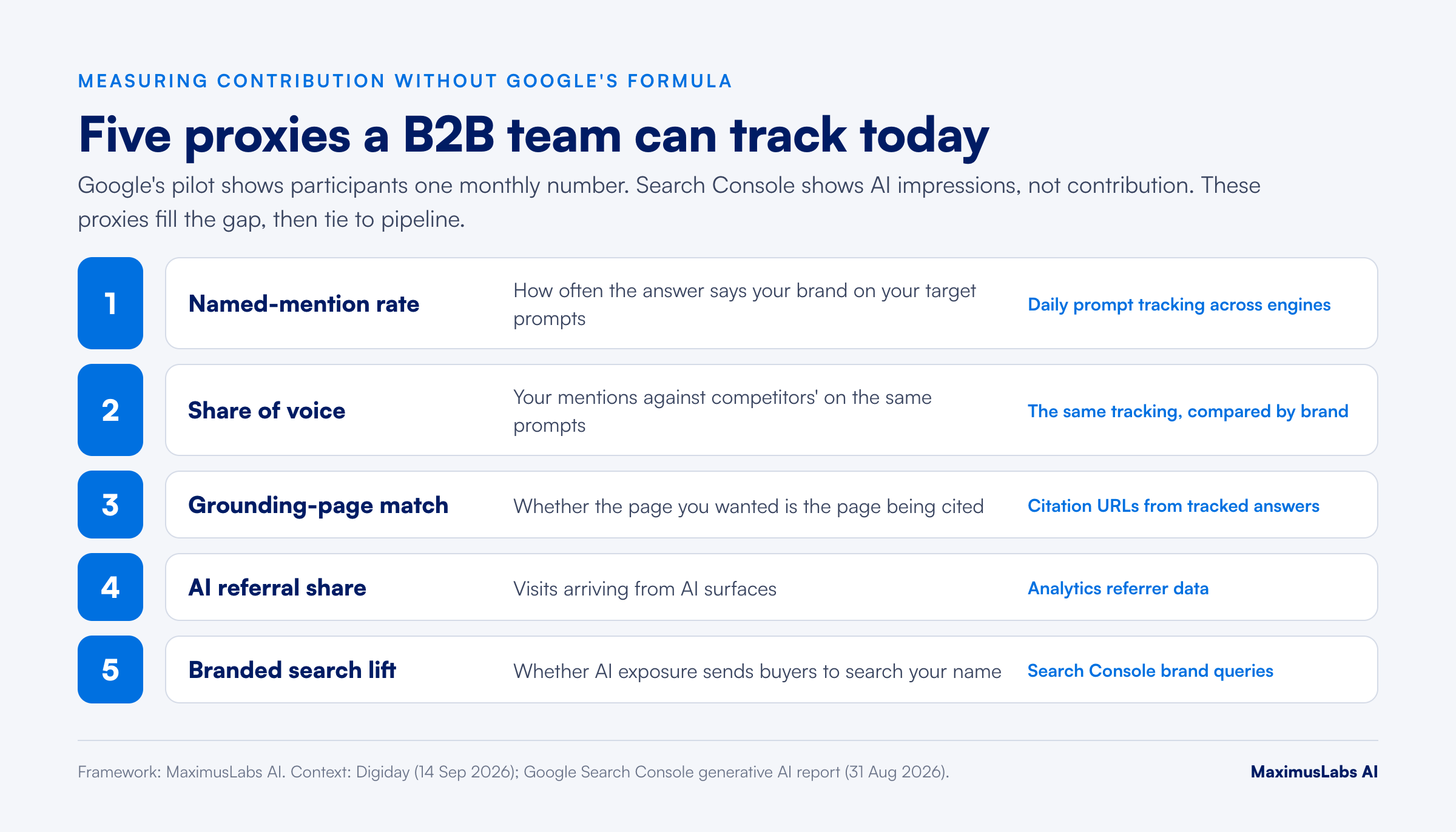
You measure contribution indirectly, with a set of proxies you control. Google's pilot shows participants a monthly earnings number with some history, and no detail on how it is calculated. Search Console's generative AI report shows impressions, not contribution. MaximusLabs tracks AI visibility daily across five engines and ties presence in answers to pipeline. Any team can approximate that with five proxies: named-mention rate, share of voice, grounding-page match, AI referral share, and branded search lift.
📊 How AI visibility used to be measured
The first AI visibility reports borrowed from SEO. Teams counted citations, tracked a handful of prompts by hand, and watched referral traffic from chatgpt.com in analytics.
That approach misses most of what matters. Citations can be anonymous, prompts vary by user, and a named recommendation often produces no click at all.
🔄 What changed: even Google measures something it won't show
The pilot implies Google can measure contribution for individual pages, since its help doc says "your pages can accrue earnings." Participants still see only a monthly figure with some history, and no calculation detail. Search Console's generative AI performance report has been available worldwide since 31 August 2026. It reports impressions for AI Overviews and AI Mode, but not the Gemini app and not contribution.
So nobody outside Google sees the real number. The practical answer is a proxy set. Our GEO metrics and KPIs guide defines each one with a formula. The GEO measurement hub and the AEO measurement hub cover reporting cadence.
| Proxy | What it tells you | How to collect it |
|---|---|---|
| Named-mention rate | How often the answer says your brand on your target prompts | Daily prompt tracking across engines |
| Share of voice | Your mentions against competitors' on the same prompts | The same tracking, compared by brand |
| Grounding-page match | Whether the page you wanted is the page being cited | Citation URLs from tracked answers |
| AI referral share | Visits arriving from AI surfaces | Analytics referrer data |
| Branded search lift | Whether AI exposure sends buyers to search your name | Search Console brand queries over time |
📡 How MaximusLabs connects the proxies to revenue
MaximusLabs tracks AI visibility daily across ChatGPT, Perplexity, Gemini, Claude, and Google AI Overviews. It reports share of voice across those engines. Your team can then tie it to pipeline with self-reported attribution, such as a "how did you hear about us" field that lists AI assistants. Our guide to AI brand mention tracking tools compares the software options, and our GEO ROI guide shows the attribution math.
Oliv AI: 27 qualified leads, $47K+ pipeline, 26% close rate in 4 months. 30 to 40% of inbound is now AI-sourced.
10. What Should a B2B Marketing Leader Do in the Next 90 Days?
Spend the next 90 days making your brand the one AI answers name, not the one they quietly paraphrase. Audit where you are named today, and fix the pages that should ground answers about your category. Earn mentions in the sources engines trust, keep AI search crawlers unblocked, and tie proxy measurement to pipeline. None of this requires joining Google's pilot.
🗓️ A seven-step plan
- Map your buyer prompts. List the 30 to 50 questions buyers ask when choosing a product in your category. Our question research hub shows how to build that list.
- Measure your named-mention rate. Run those prompts across ChatGPT, Gemini, AI Overviews, Perplexity, and Claude, and record whether you are named, cited, or absent.
- Audit your competitors the same way. Our AI search competitor analysis hub covers the method.
- Rewrite your grounding pages. Put original facts, dates, and sources on the pages that should answer category questions, following our AI content strategy hub.
- Earn third-party mentions. Prioritize the review platforms, communities, and comparison pages that engines cite for your category.
- Check crawler access. Keep AI search crawlers unblocked on public pages, and decide training access separately.
- Tie visibility to pipeline. Add AI assistants to your attribution field and review named-mention rate and pipeline together every month.
🧰 Where MaximusLabs fits in the plan
MaximusLabs executes content, schema, entities, reviews, and digital PR as one system, with daily AI visibility tracking across the major engines. If you want to see how the program is structured, our GEO service and the R-GEO revenue framework explain the method. Our GEO strategy guide covers the planning, the GEO budget benchmark shows what teams spend, and our case studies show results across categories. Our 2026 AI visibility benchmark shows where most brands start.
Weighing paid placement against earned visibility? Our companion piece on ChatGPT ads for B2B SaaS runs the same numbers for the ad side.
What I'm Thinking About Next
My current thinking is that Google's pilot is less a revenue program than a measurement program. Google is learning to price contribution at the page level, and pricing tends to leak into ranking over time. If contribution is what Google pays for, contribution is probably what Google's systems increasingly reward.
I might be wrong about how fast that happens. But I am fairly confident about the direction. The brands that win the next two years will not be the ones counting citations. They will be the ones that make an answer impossible to write without them. That reminds me of Seth Godin's Purple Cow: in a field of interchangeable pages, only the remarkable one gets mentioned by name.
References
- Digiday, "Google rolls out pay-per-value AI licensing program to publishers," 14 September 2026. https://digiday.com/media/google-rolls-out-pay-value-ai-licensing-program-to-publishers/
- Google Public Policy, "Google's ongoing commitment to supporting the information ecosystem," 17 June 2026. https://publicpolicy.google/article/supporting-information-ecosystem/
- The Information, "Google Is Paying About 100 Digital Publishers for AI Overviews," 29 September 2026. https://www.theinformation.com/articles/google-paying-100-digital-publishers-ai-overviews
- Search Engine Roundtable, "Google Paying ~100 Publishers 0.1% Of Ad Revenue In AI Contribution Pilot," 30 September 2026. https://www.seroundtable.com/google-ai-contribution-pilot-01-percent-42188.html
- Search Engine Roundtable, "Google Search Console Testing AI Contribution Report," 13 April 2026. https://www.seroundtable.com/google-search-console-ai-contribution-41153.html
- Semrush, "Google's AI contribution pilot pays publishers," 22 September 2026. https://www.semrush.com/blog/google-launches-ai-contribution-pilot/
- Google Patents, "US11769017B1: Generative summaries for search results," 26 September 2023. https://patents.google.com/patent/US11769017B1/en
- Google Search Central, "AI features and your website," accessed 1 October 2026. https://developers.google.com/search/docs/appearance/ai-features
- Google Search Central, "AI optimization guide," 10 July 2026. https://developers.google.com/search/docs/fundamentals/ai-optimization-guide
- Google, "New opportunities, control and insights for website owners," 31 August 2026. https://blog.google/products-and-platforms/products/search/new-controls-website-owners/
- Google, "AI in Search is driving more queries and higher quality clicks," 6 August 2025. https://blog.google/products/search/ai-search-driving-more-queries-higher-quality-clicks/
- Pew Research Center, "Google users are less likely to click on links when an AI summary appears in the results," 22 July 2025. https://www.pewresearch.org/short-reads/2025/07/22/google-users-are-less-likely-to-click-on-links-when-an-ai-summary-appears-in-the-results/
- Ahrefs, "Update: AI Overviews Reduce Clicks by 58%," 4 February 2026. https://ahrefs.com/blog/ai-overviews-reduce-clicks-update/
- Advanced Web Ranking, "Organic CTR study," July 2026. https://www.advancedwebranking.com/seo/organic-ctr
- Seer Interactive, "AIO impact on Google CTR: September 2025 update," 4 November 2025. https://www.seerinteractive.com/insights/aio-impact-on-google-ctr-september-2025-update
- Cloudflare, "Pay Per Use: when AI uses your work, you should get paid," 30 September 2026. https://blog.cloudflare.com/pay-per-use/
- Cloudflare, "The Internet has a second audience," 30 September 2026. https://blog.cloudflare.com/agentic-web/
- Cloudflare, "Introducing pay per crawl," 1 July 2025. https://blog.cloudflare.com/introducing-pay-per-crawl/
- Cloudflare, "The crawl-to-click gap," 29 August 2025. https://blog.cloudflare.com/crawlers-click-ai-bots-training/
- Cloudflare, "Radar 2025 year in review," 15 December 2025. https://blog.cloudflare.com/radar-2025-year-in-review/
- Cloudflare, "Monetization Gateway beta," 30 September 2026. https://blog.cloudflare.com/monetization-gateway-beta/
- Search Engine Land, "What 9 million AI answers reveal about search visibility," 30 September 2026. https://searchengineland.com/9-million-ai-answers-search-visibility-492283
- Aggarwal et al., "GEO: Generative Engine Optimization," KDD 2024. https://arxiv.org/abs/2311.09735
- Cohen-Wang et al., "ContextCite: Attributing Model Generation to Context," September 2024. https://arxiv.org/abs/2409.00729
- European Commission, "Commission opens investigation into possible anticompetitive conduct by Google," 9 December 2025. https://ec.europa.eu/commission/presscorner/detail/en/ip_25_2964
- GOV.UK, "CMA secures fairer deal for publishers and improves Google search services in UK," 3 June 2026. https://www.gov.uk/government/news/cma-secures-fairer-deal-for-publishers-and-improves-google-search-services-in-uk
- Axios, "Penske Media Sues Google Over AI Summaries," 14 September 2025. https://www.axios.com/2025/09/14/penske-media-sues-google-ai
- Search Console Help, "Search generative AI control," 31 August 2026. https://support.google.com/webmasters/answer/16908024?hl=en
- Cloudflare, "Content Independence Day: new AI options," 1 July 2026. https://blog.cloudflare.com/content-independence-day-ai-options/
Frequently asked questions
What is Google's AI contribution pilot?
Google's AI contribution pilot is an invitation-only program that pays websites when their content contributes significantly to answers in AI Overviews, AI Mode, and the Gemini app. About 100 publishers are in it, and Google has never announced it publicly.
Does Google pay for being cited in AI Overviews?
No. Google's help documentation says pages that only confirm facts, or are linked after an answer is generated, do not qualify. Payment is for contributing during generation, which is a different outcome from appearing as a source link.
How much does Google pay publishers in the pilot?
Reported payouts vary widely. One early entrant earns more than $1 million a year. One newer publisher has earned about $50,000 to $60,000, and smaller sites have earned under $1,000 over several months.
Can a B2B SaaS company join Google's AI contribution pilot?
There is no public way to join. The pilot is invitation only, and we found no report naming a SaaS vendor as a participant. For a brand, being named inside the AI answer is the more valuable outcome to pursue.
What is Cloudflare Pay Per Use?
Cloudflare Pay Per Use is a beta program launched on 30 September 2026. An AI company defines a use of content, sets a price, and self-reports each use. Cloudflare bills the AI company and pays the publisher monthly.
Does opting out of Google's AI features protect my content?
It removes your site from AI Overviews, AI Mode, and AI in Discover. Google says opted-out sites will not receive traffic or impressions from those features. The answer still gets written, just without your brand.
How can I measure AI contribution without Google's data?
Use proxies. Track named-mention rate on buyer prompts, share of voice, whether the right page is cited, AI referral traffic, and branded search lift. Then connect them to pipeline, for example with an AI option in your "how did you hear about us" field.
What makes content likely to contribute to AI answers?
Google has not published a formula. Its public clues point to fresh, factual, non-commodity content used for grounding. GEO research also found that visible citations and specific facts raise visibility in generative engines.