 Krishna Kaanth M
- Gemini scores passages, not pages. A dynamic retrieval gate decides whether a query gets live Google grounding, then only high confidence chunks enter the answer.
- Ranking first no longer guarantees citation. Top ten organic reliance fell from roughly 76% to 38% after Gemini 3, with about 31% of citations from beyond position 100.
- Front load answers. A direct 30 to 60 word answer in the top 30% of body text sits in the zone producing a 44.2% citation rate, with tables at 1.8x and lists at 2.1x.
- Drop the theater. Google Search ignores llms.txt, requires no chunking, and FAQ rich results were retired on 7 May 2026. Schema is parsing hygiene, not a citation lever.
- Gemini leans on your own domain and on YouTube. Brand owned sites supply 52.15% of its citations, and video presence correlates 0.737 with AI Overview citations.
- Measure impressions in the Search Console Generative AI report, add prompt level Share of Voice, then join both to pipeline in GA4 rather than reporting average position.
Q1. Why does ranking on Gemini now mean becoming the answer, not holding a position?
Gemini returns one synthesized answer with a handful of cited sources, not ten blue links. Roughly 60% of searches now end without a click, while AI search visitors convert at about 4.4x the value of traditional organic visitors (Semrush, 2025). The goal moves from occupying a position to being the source the model cites, because the shortlist it names becomes the buyer's entire consideration set.
📉 The report that stopped making sense
A Head of Organic Growth I spoke with last quarter had a clean dashboard. Rankings up, impressions up, three new featured snippets. Her CEO asked one question in the Monday review: where is the pipeline?
Nothing in the rank report could answer it. The keywords held. The sessions did not.
🧾 What the old playbook was actually selling
For fifteen years, agencies sold position, impressions, and clicks on fixed-scope retainers. Strategy came from one firm, execution from another, and the content was written for a page of ten links.
That worked while the ten links existed. The reporting line ran from rank to traffic to pipeline, and everyone accepted the middle step on faith. Vanity metrics survived because the funnel was long enough to hide them, which is the core of the difference between GEO and traditional SEO.
🔀 What changed when the answer became singular
Buyers now ask Gemini, ChatGPT, Perplexity, Claude, and Google AI Overviews. They get one answer naming five to ten brands, and that list is the evaluation set.
Krishna Kaanth puts the founder version of this anxiety plainly:
"Traffic is going down. Over 70% are zero-click searches. Considering agents are coming, if they're not coming to my website, AI can just read my content, answer the question, and reroute the traffic to some other player who's paying them."
The second half matters more than the first. If your company is not on that list, you are not in the buying conversation at all. There is no page two to recover on.
💰 Fewer sessions, better sessions
Here is the inversion that reframes the whole channel. AI search sends less traffic and more intent, at roughly 4.4x the value per visitor (Semrush, 2025).
The buyer arrives having already asked the engine six questions. The engine named you. They are pre-sold, which is why a 40% traffic drop can sit alongside a pipeline increase, a pattern we track in our work on the decline in search referral traffic.
MaximusLabs AI measures every engagement on pipeline, not on mentions, and reports citation share against revenue rather than impressions. We start at bottom-of-funnel content, because the engines already answer "what is X" without anyone's help. Traditional agencies still ship the rank report that Gemini stopped honoring.
🎯 The KPI swap to make this week
Being cited is the means. Pipeline is the outcome.
Replace one line in your next report. Where it says average position, put citation share across the prompts your ideal customer actually types, then tag the sessions those answers send. My read is that most teams discover two things at once: they are cited less than they assumed, and the citations they do hold convert better than anything else they own.
That is the shift this guide is built on. Ranking is the floor. Becoming the answer is the job, which is exactly what Answer Engine Optimization is built to do.
Q2. How does Gemini actually decide which pages to cite?
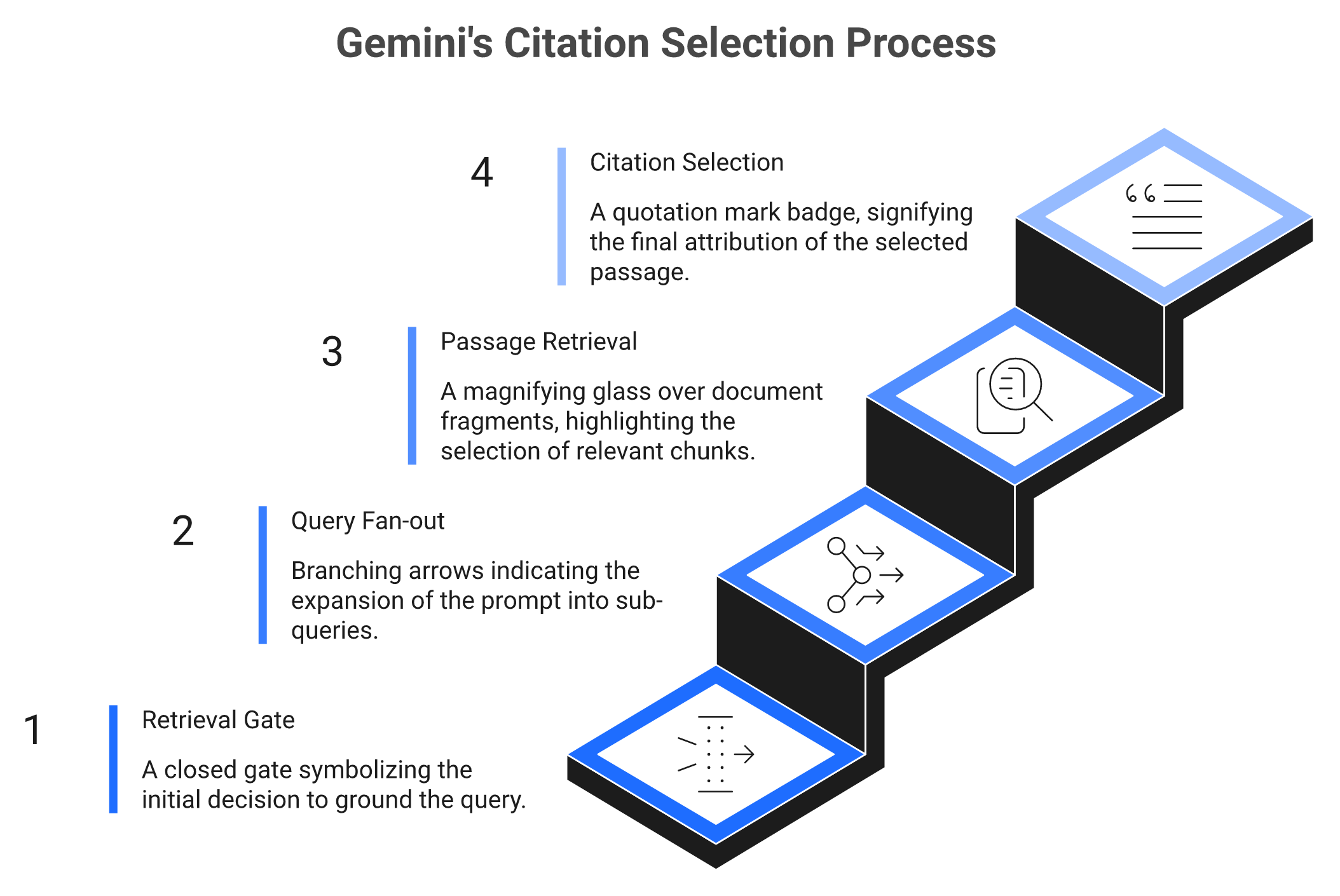
Gemini does not rank pages. It gates, fans out, retrieves, and scores passages. A learned prediction score decides whether a query deserves live Google grounding, defaulting to 0.3 in the Gemini API and 0.7 in Vertex AI Search. Google then expands the query into multiple sub-queries through fan-out. Only passages at a confidence score of 0.6 or above enter the grounded answer, with citationThreshold defaulting to 0.6.
🚪 The gate before the search
Most SEO teams picture Gemini searching Google for every prompt. It does not. A classifier predicts how much live grounding would improve the answer, and only then calls Search.
Google's own documentation uses two clear examples. "Who won the latest F1 grand prix?" scores around 0.97. "Write a poem about peonies" scores around 0.13. The second never touches your content, no matter how good it is.
📊 The numbers that govern inclusion
| Control | Default | What it decides |
| Dynamic retrieval threshold (Gemini API) | 0.3 | Whether the query triggers live grounding |
| Dynamic retrieval threshold (Vertex AI Search) | 0.7 | Same decision, stricter setting |
| Chunk confidence score | 0.6 | Whether a retrieved passage can enter the answer |
| citationThreshold | 0.6 | Whether that passage gets an attributed citation |
| antiCitationThreshold | 0.8 | How aggressively weak attributions are suppressed |
Read that table once and a lot of advice falls away. Nothing in the pipeline scores your page. Everything scores a passage.
✂️ Why page-level thinking fails here
Query fan-out compounds this. Google expands one prompt into several related sub-queries, then retrieves separately against each, as described in Google Search Central's generative AI optimization guide. You can map those expansions with our query fan-out generator.
So a single buying question can pull three different passages from three different sites. Your 3,000 word guide competes paragraph by paragraph, not URL by URL. A page can be indexed, relevant, and still lose because no 80 word block inside it answers a sub-query cleanly.
MaximusLabs AI writes every section as a standalone 40 to 80 word answer block, scored before publication on a ten dimension rubric that fails any section whose opening cannot survive extraction. We built that rule because the scored unit is the passage. It is a dull discipline, and it is the one that moves citation share.
🔍 The audit to run on Monday
Take your highest intent page. Read only the first three sentences under each heading, with the heading removed.
Ask whether each block still answers something a buyer would ask. Then ask whether it contains a number, a date, or a named source. Blocks that pass both tests are candidates for grounding. Blocks that fail are decoration.
🧠 What I am still unsure about
Published thresholds come from the Gemini API and Vertex AI Search documentation. Google has not confirmed that consumer Search grounding uses the same defaults, and I suspect it does not.
I treat the documented numbers as the best available model of the mechanism, not as the live settings. MaximusLabs AI tests against real prompts rather than API endpoints for exactly that reason, which matters later when we get to measurement.
Q3. What has to be true before Gemini can cite you at all?
Three conditions come straight from Google's documentation on generative AI features: the page must be indexed, snippet eligible, and included in Search's generative AI features. Blocking snippets or AI features removes the page regardless of content quality. Speed compounds the problem, since fast rendering pages average 6.7 AI citations against 2.1 for slower ones. MaximusLabs AI audits these three gates in week one of every engagement, before any content is commissioned.
🚧 The three gates, in order
Google states that generative AI features in Search are rooted in core Search ranking, which means the index is the entry point. No index, no grounding.
Snippet eligibility is the second gate. If Google cannot show a text preview of your page, it has nothing to lift into an answer.
The third gate is inclusion in generative AI features specifically. These are separate controls, and teams regularly pass two and fail the third, which a technical SEO and website audit surfaces quickly.
⚠️ The directives that quietly disqualify you
| Signal | Effect on Gemini visibility | Action |
| noindex | Page cannot be retrieved at all | ✅ Remove on revenue pages |
| nosnippet | No text available to extract | ✅ Remove, then re-request indexing |
| max-snippet:0 | Functionally the same as nosnippet | ✅ Set generously or omit |
| data-nosnippet on key blocks | Your answer block is excluded | ⚠️ Audit templates, not just pages |
| Blocked AI feature controls | Removal from generative surfaces | ⚠️ Decide deliberately, not by default |
Most of these were set years ago by someone protecting content from scrapers. Nobody revisited them when the answer surface arrived.
⏰ Rendering speed and JavaScript
If your main content loads through client side JavaScript, assume some of it never reaches the grounding step. Critical text belongs in the initial HTML, which you can verify with our AI crawlability checker.
The citation gap between fast and slow pages, 6.7 versus 2.1 on average, is large enough to change a quarter. I would not treat that figure as causal on its own, because fast sites tend to be well maintained sites. Both halves point the same direction anyway.
✅ The 20 page eligibility audit
- List your 20 highest intent URLs, the ones you would defend in a board meeting.
- Confirm index status for each in Google Search Console's index coverage report.
- Check the rendered HTML for nosnippet, max-snippet, and data-nosnippet in templates.
- Confirm AI crawler access in robots.txt, including GPTBot and PerplexityBot for other engines.
- View each page with JavaScript disabled and note what disappears.
- Record pass or fail per URL, then fix fails before writing anything new.
That sheet takes an afternoon. It has saved clients a quarter of wasted content budget more than once.
🧱 Foundation first, not foundation only
Krishna's framing fits here better than mine:
"SEO is the foundation floor. GEO is the building on top."
Technical SEO became the entry fee, not the strategy. MaximusLabs AI runs Answer Engine Optimization (AEO) as the flagship work, with technical SEO underneath it as the week one sprint, covering crawler access, JavaScript minimization, and clean semantic markup. Content only GEO retainers skip this step, then wonder why nothing gets cited.
Q4. Does ranking #1 on Google still guarantee a Gemini citation?
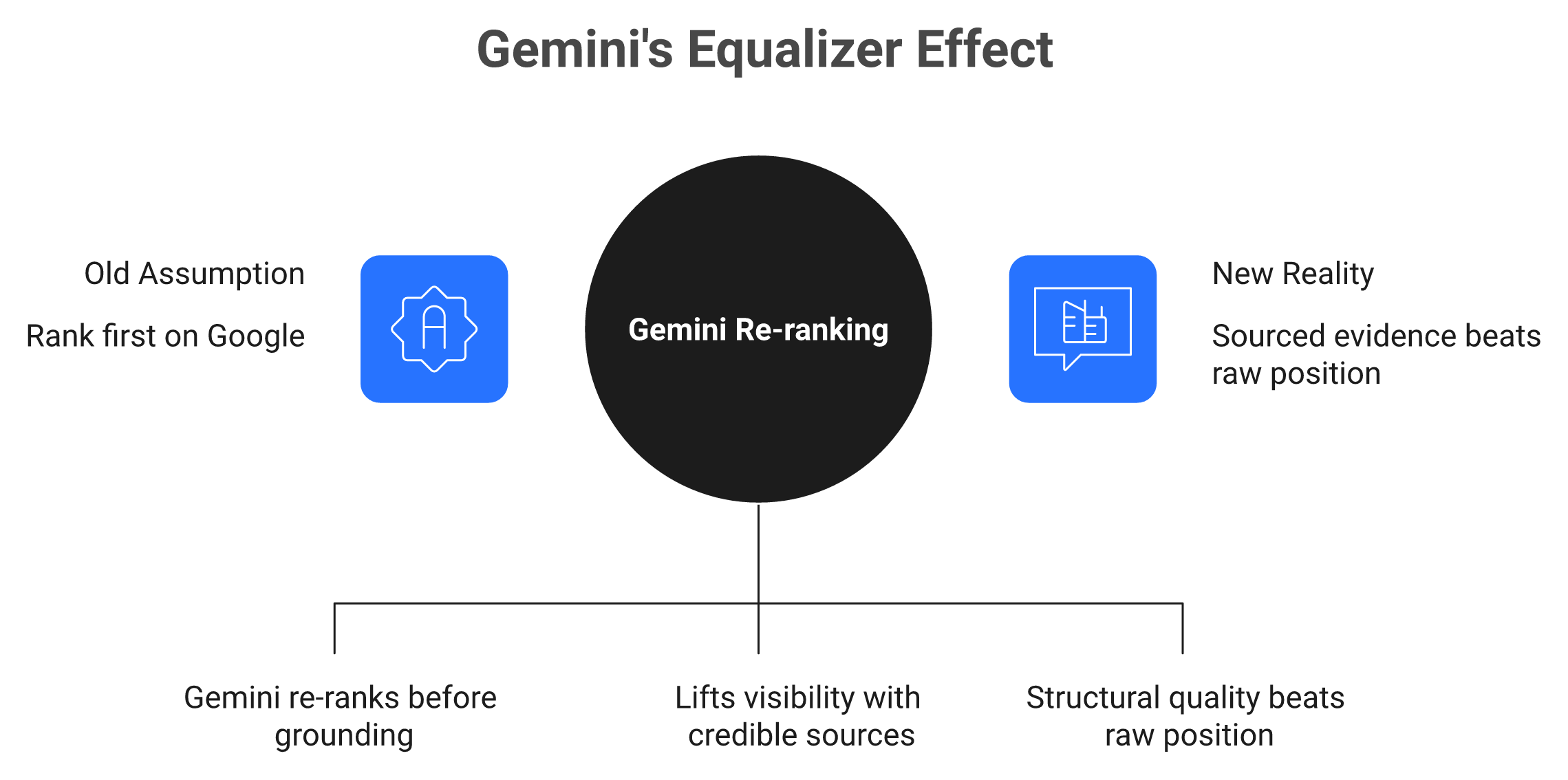
No. After Gemini 3 shipped as the default AI Overviews model, reliance on top ten organic results fell from roughly 76% to 38%, with about 31% of AI Overview citations coming from positions beyond 100. Gemini re-ranks and blends results before grounding, so a well structured page at position 15 can beat a badly formatted page at position 1. Princeton's GEO study measured a 115% visibility lift for a position five page that added citations.
💥 The decoupling, in two numbers
| What you report | Before Gemini 3 | After Gemini 3 |
| Share of AI citations from top ten organic | ~76% | ~38% |
| Citations from beyond position 100 | Marginal | ~31% |
| Best predictor of citation | Rank position | Structure and sourcing quality |
Rank still helps. It simply stopped being the deciding input, because the re-ranking happens after retrieval and before generation. Our breakdown of Gemini's impact on AI search tracks the full shift.
The Erlin Gemini SEO study states the practical version of this cleanly: "Lower-ranked pages with superior structure are cited over top-ranked pages with poor format."
⚖️ The equalizer effect, and why challengers should care
This is the most useful finding in the Princeton GEO paper, and almost nobody uses it as an argument. Across roughly 10,000 queries and nine datasets, adding citations lifted a position five page's visibility by 115.1%.
The same study measured what else moves the needle:
- ✅ Adding statistics: up to 41% improvement in position adjusted word count
- ✅ Adding quotations from credible sources: around 28% improvement
- ❌ Keyword stuffing: roughly 10% below baseline, worse on some engines
Read as a budget decision, that is striking. The lifts come from evidence, not from optimization volume. A challenger with better sourcing can displace an incumbent without ever outranking it, which is the premise behind GEO for SaaS startups.
🧮 What this changes in reporting
MaximusLabs AI reports citation share rather than average position, because the two stopped tracking each other. In practice we group pages by structural quality instead of rank band, which surfaces a pattern clients rarely expect: their best ranked page is often their least citable one.
MaximusLabs AI's data points one way here, and the published decoupling numbers point the same way, though both are measured on AI Overviews rather than Gemini chat. I might be reading the chat surface too confidently from Overviews data. Our approach to GEO measurement and metrics keeps those surfaces separate for that reason.
🔁 The audit that replaces the rank check
Pull your top ten pages by rank. Score each on four things only: does a direct answer appear in the first 30% of the body, does every section carry a verifiable number, are comparisons in tables, and are processes in numbered lists?
Then compare that score against citation share. The mismatch is your roadmap. On most sites, two or three strong pages carry the citations while the rank leaders sit unquoted.
🧷 Where the old report still earns its place
I am not going to tell you rank is dead, because that is lazy and the index is still the entry point. Rank gets you retrievable. Structure and evidence get you cited.
MaximusLabs AI spends client budget on sourcing, structure, and earned trust signals rather than on chasing position one, and measures the result as pipeline influence. Proof from one B2B SaaS engagement: 64% AI citation rate in 6 months, vs ~30% for billion-dollar incumbents, documented in the Oliv AI case study.
Q5. What changed overnight when Gemini 3 became the default AI Overviews model?
On 27 January 2026, Gemini 3 became the default AI Overviews model worldwide. Over 84,000 domains were affected. Of previously cited domains, 42.4% dropped out, while 51.7% of the new citation pool was new domains. Average sources per answer rose from 11.55 to 15.22, a 31.8% increase. Of the 500 most cited domains, only one disappeared.
📅 What the Tuesday dashboards showed
A marketing manager at a mid market SaaS company messaged me that week. Her AI Overview citations had vanished from eleven pages, and nothing on the site had changed.
Nothing on her site had to change. Google changed the model underneath the answer. Her rank report was identical, which is what made the whole thing so disorienting. Our running log of Google AI platform updates tracks each of these swaps.
🔀 The part nobody expected
The volume of citations went up, not down. Answers started pulling 15.22 sources on average instead of 11.55.
More slots, and yet 42.4% of the previously cited domains lost theirs. The pool widened and the occupants were swapped at the same time.
⚠️ The asymmetry is the real lesson
Here is the finding worth pinning to a wall. Of the 500 most cited domains, only one dropped out. Everything below that line churned, and market concentration rose 44%.
| Tier | What happened on 27 January 2026 |
| Top 500 cited domains | ✅ Almost entirely untouched, one exit |
| Mid tier domains | ⚠️ Heavy replacement inside a wider source pool |
| Long tail domains | ❌ 42.4% dropped, 51.7% of new pool was new entrants |
Gemini 3 protected established authorities and churned the long tail. Model updates are not random when read that way. They punish thin presence and reward accumulated trust, a pattern our analysis of Gemini's impact on AI search breaks down in full.
🧱 Why volume strategies broke first
Sites with fifty thin pages had fifty fragile citations. Sites with five genuinely authoritative pages mostly held.
I keep coming back to a parallel from index investing. Breadth without quality gets you average exposure to volatility, not protection from it. MaximusLabs AI treats brand and entity authority as the volatility hedge, which is why our engagements front load depth over publishing volume.
💰 What this means for the next model swap
There will be another one. Treat citation share as a position you have to earn into the protected tier, not a score you maintain.
MaximusLabs AI runs Answer Engine Optimization (AEO) with SEO underneath it, as strategy and execution in one team, measured on pipeline rather than mentions. Our citation intelligence engine maps which sources each engine actually trusts, then we work the client into those sources. Daily AI visibility tracking across engines tells us when a reshuffle hits, not a month later.
Proof from a B2B SaaS engagement: 64% AI citation rate in 6 months, vs ~30% for billion-dollar incumbents (Oliv AI). That position is the kind that survives a model swap, and it produced 27 qualified leads, $47K+ pipeline, 26% close rate in 4 months (Oliv AI).
⏰ The move for this quarter
Pick your five highest intent pages and make each one defensible: original data, named sources, visible author credentials, and earned mentions pointing at it.
Then stop publishing the next twenty thin pages. My honest read is that most teams cannot tell the difference between the two strategies until a model update does the sorting for them.
Q6. How should you structure a page so Gemini can extract it?
Front load every section. A 30 to 60 word direct answer placed immediately after a question style heading, inside the top 30% of body text, sits in the zone that produces a 44.2% citation rate. Comparison tables carry 1.8x citation likelihood, and step by step lists 2.1x. MaximusLabs AI enforces a 40 to 80 word standalone answer block on every H2 and scores it before publication on a ten dimension rubric.
✂️ The habit that costs you citations
Most B2B pages warm up. Two paragraphs of context, a nod to why the topic matters, then the answer in paragraph three.
Human readers tolerate that. The retrieval step does not reward it, because citations cluster in the first third of the body in a ski ramp shape. Our guide to AEO answer structure covers the placement rules in detail.
📝 One rewrite, before and after
Take a heading like "How long does AEO take to show results?"
❌ Before: "Timelines vary by industry, competition, and content maturity. Many factors influence how quickly brands see movement, and no two programs are alike. In our experience, patience matters."
✅ After: "Most B2B SaaS programs see first AI citations in 60 to 90 days, with compounding gains after month four. Oliv AI reached 27 qualified leads, $47K+ pipeline, 26% close rate in 4 months. Timelines stretch in crowded categories with weak existing authority."
Same word count. The second version answers the heading on its own, carries a number, and survives extraction with nothing around it.
📊 The structural multipliers worth building into templates
| Format | Measured effect | Use it for |
| Answer in top 30% of body | 44.2% citation rate | Every question style heading |
| Comparison table | 1.8x citation likelihood | Vendor, plan, or approach comparisons |
| Step by step numbered list | 2.1x citation likelihood | Setup, audit, and process answers |
| Added statistics | Up to 41% visibility improvement | Any claim you can source |
| Added quotations from credible sources | Around 28% improvement | Expert and platform statements |
| Keyword stuffing | ❌ Roughly 10% below baseline | Nothing |
The Princeton GEO study measured those last three across roughly 10,000 queries and nine datasets. Evidence beats optimization volume, which is the opposite of how most content briefs are written.
⚙️ The template MaximusLabs AI actually ships
MaximusLabs AI rebuilt its editorial template around extractability. Every H2 opens with a standalone answer block, then expands with analysis, then carries at least one primary source, then adds a practitioner judgment. The full method sits in our GEO content optimization workflow.
Every comparison becomes a table, and every process becomes a numbered list. Nothing publishes below 70 out of 100 on our rubric, and 80 for pillar pages. Readability sits at a hard floor too, because dense prose scores badly and reads worse.
✅ The six point extractability check
- Does a direct answer appear in the first three sentences under the heading?
- Would that block still make sense with the heading removed?
- Does it contain a number, a date, or a named source?
- Are comparisons in a table rather than prose?
- Are processes in numbered steps?
- Is every sentence under 25 words?
Run it on one money page this week, ideally with our AI content optimizer. Most teams find two sections that pass and six that do not.
MaximusLabs AI measures the result in citation share and pipeline, not in word count shipped. Traditional agencies optimize the title tag. We optimize the paragraph a model can lift.
Q7. Which popular Gemini tactics are myths you should drop?
Google Search ignores llms.txt files, requires no special content chunking, and does not require structured data for generative AI features. A Search Atlas and Quoleady analysis across OpenAI, Gemini, and Perplexity found no correlation between schema density and citation rates. Google retired FAQ rich results on 7 May 2026. Reddit sits near 0.1% of Gemini chat citations versus about 4.01% in AI Overviews.
🧾 The myth table
| Popular claim | What the primary source says | Verdict |
| "Publish llms.txt to get into Gemini" | Google Search ignores llms.txt and similar AI text files | ❌ No effect on Google |
| "Chunk your content for the LLM" | No chunking requirement stated in Google's guidance | ❌ Not a requirement |
| "Schema is a citation lever" | No correlation between schema density and citation rate across three engines | ❌ Not a lever |
| "FAQ schema wins rich results" | FAQ rich results retired 7 May 2026 | ❌ Retired |
| "More keywords, more AI visibility" | Keyword stuffing scored roughly 10% below baseline | ❌ Actively harmful |
| "Post on Reddit to win Gemini chat" | Reddit near 0.1% in chat, about 4.01% in AI Overviews | ⚠️ Right surface, wrong engine |
⚠️ Where schema still earns its keep
Dropping schema entirely would be the wrong read. Structured data remains parsing hygiene and a second order entity signal, which means it helps machines resolve who you are. Our schema markup basics guide draws that line explicitly.
MaximusLabs AI ships Article markup, Person markup with credentials and knowsAbout, and Organization markup linked to Wikidata, as technical hygiene rather than as a citation play. When a prospect asks why our proposal carries less schema work than a competitor's, that distinction is the answer.
Schema may still matter indirectly through entity resolution, even where direct citation correlation is null. I hold that as a hypothesis, not a finding.
📝 What to build instead of FAQ schema
The retirement of FAQ rich results removed the SERP reward, not the reader value. Visible on page question and answer blocks still get extracted, because the passage is what gets scored.
So keep the questions and lose the dependency. MaximusLabs AI writes those blocks as standalone answers inside the body, which is the same discipline that drives citation share anyway.
🧮 The budget reallocation this implies
Add up what your current plan spends on llms.txt setup, schema expansion, and keyword density tooling. On most proposals I review, that is a meaningful share of the technical line item.
Move it to three things instead: original data you can cite, credentialed authorship, and earned mentions on the surfaces Gemini actually grounds on.
⏰ The Monday version
Delete llms.txt tasks from the roadmap if Google is your target engine. Keep the file if you care about other platforms, and expect nothing from it here.
Then re-audit one page for the real levers: answer placement, a verifiable number, a named source, and visible author credentials. Our list of common GEO mistakes to avoid covers the rest.
MaximusLabs AI publishes what fails as readily as what works, because trust is the product in AEO. Our read is that the category sells technical theater because it is easy to invoice and hard to disprove.
Q8. Where off your own site does Gemini find its corroboration?
Mostly YouTube, review platforms, and communities. YouTube is consistently the top cited domain in Google AI Overviews and Gemini, cited both as video thumbnails and as text pulled from transcripts, with video presence correlating 0.737 with AI Overview citations. Reddit supplies about 4.01% of AI Overview citations. G2, Capterra, and analyst pages supply the corroboration that decides competitive, commercial prompts.
🎥 The channel most GEO programs skip entirely
Ethan Smith of Graphite described embedding a targeted video, "How to secure generated code," on a B2B application security page.
The page then lifted across ChatGPT, Gemini, YouTube search, and Google AI Overviews at the same time. One asset, four surfaces, one feedback loop.
📄 Why the transcript matters more than the video
Gemini cites text from transcripts, not just thumbnails. An untranscribed video is close to invisible to the grounding step.
So the asset is really the transcript, the description, and the chapters. The video is the delivery vehicle, and our multimodal search optimization guide covers how to prepare each element.
⭐ The corroboration layer buyers trigger
Commercial prompts behave differently from informational ones. When someone asks for the best tool in a category, the engine leans on third party pages it did not get from you.
| Surface | What it corroborates | Priority for B2B SaaS |
| YouTube with transcripts | Product capability, how to depth | ⭐ Highest, lowest competition |
| G2 and Capterra profiles | Category placement, customer proof | ⭐ High for comparison prompts |
| Reddit and practitioner threads | Candid evaluation signals | ✅ Strong for AI Overviews, weak for Gemini chat |
| Analyst and press pages | Entity legitimacy | ✅ Slow, durable |
| Your own blog only | Your claims about yourself | ❌ Insufficient alone |
🔁 Owned plus earned, not owned alone
MaximusLabs AI runs AEO on two pillars. Owned AEO makes your content the answer, and Earned AEO makes reviews, Reddit, press, and listicles give the engine a reason to trust you.
Most agencies only operate the first pillar, because it fits a content retainer. We identify the threads, profiles, and listicles already being cited for a client's buying questions, then earn presence inside those sources, which is the core of Reddit and forum AEO.
✅ The surface priority checklist
- Record three product demos answering real buyer questions, not feature tours.
- Transcribe every video and publish the transcript as crawlable text.
- Add timestamped chapters in the description field.
- Embed each video on the exact page that targets the matching query.
- Get G2 and Capterra profiles complete, with ten or more reviews per platform.
- Find the Reddit threads already cited for your category, then participate honestly.
- Re-check which domains the engine cites for your top prompts, monthly.
💰 Where this lands
Corroboration work is slower than publishing, and it compounds. MaximusLabs AI measures it in citation share across the prompt set a client's buyers actually type, then in pipeline, not in mentions.
Proof from a B2B SaaS engagement: 30 to 40% of inbound now AI-sourced (Oliv AI). That number came from owned content and earned trust signals working together, which is the whole argument for treating search as everywhere rather than as your blog.
Q9. How do you build the trust and entity authority Gemini rewards?
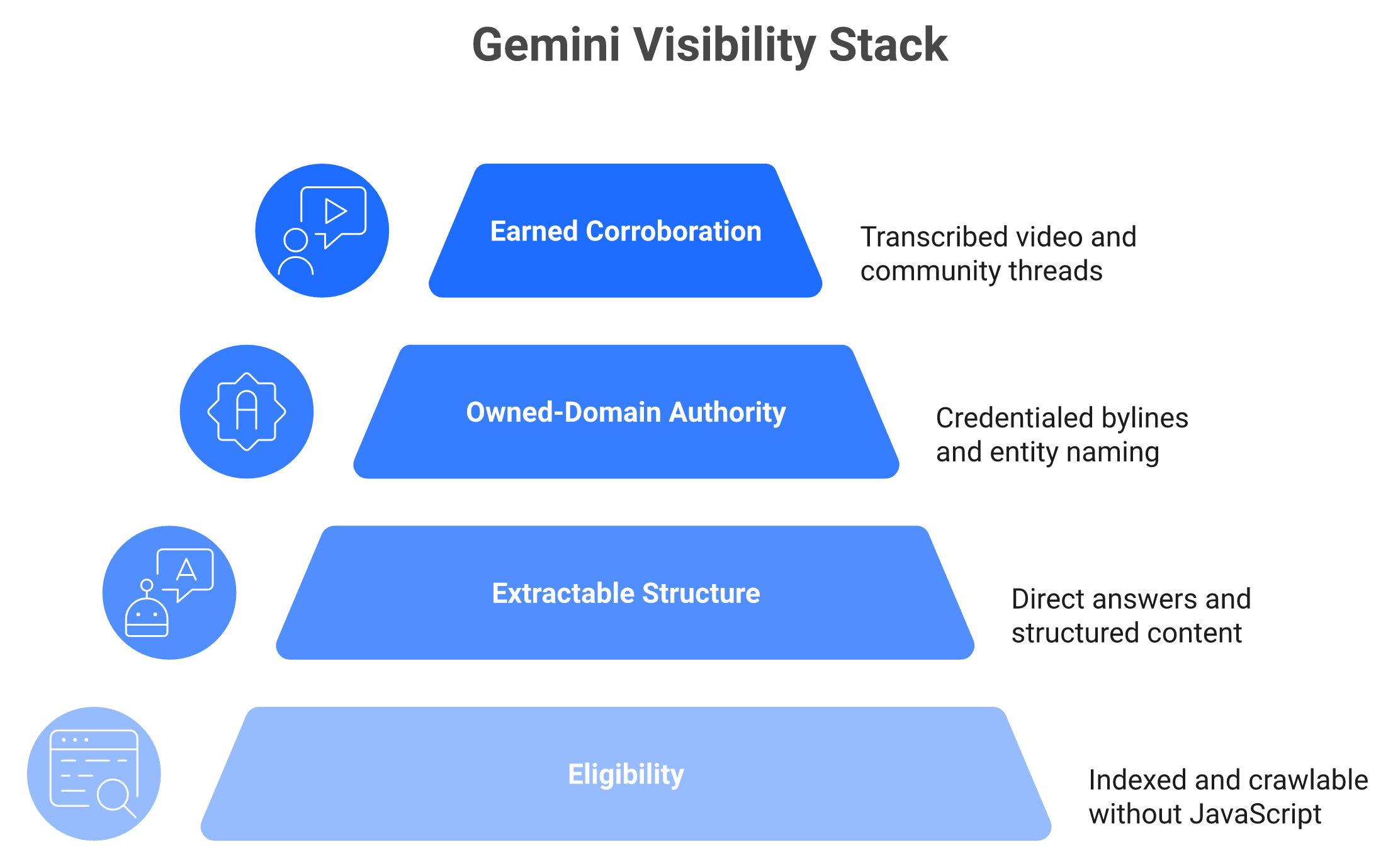
Gemini weights E-E-A-T (experience, expertise, authoritativeness, and trustworthiness) harder than any other engine, because Google owns both the quality framework and the model. Roughly 96% of AI Overview content comes from verified authoritative sources. Gemini also leans on your own domain, with 52.15% of its citations originating from brand owned websites. MaximusLabs AI engineers that footprint with credentialed bylines, Person markup, and Organization markup linked to Wikidata.
🏠 Your own site is the highest leverage asset
That 52.15% figure reframes the whole budget conversation. Gemini pulls more than half its citations from brand owned pages, which puts it second only to Claude on owned domain reliance.
Most teams assume AI visibility is won off site. For Gemini, the majority of it is won on the pages you already control, which is why our citation worthy content work starts on owned assets.
🪪 The entity layer most sites never build
An engine has to resolve who you are before it can trust you. That resolution happens through consistent naming and explicit relationships, not through adjectives on your about page.
MaximusLabs AI treats this as four build tasks, detailed further in our guide to GEO and knowledge graphs:
- ✅ Real author bylines on every article, with credentials, not a generic "Team" attribution.
- ✅ Person markup carrying knowsAbout topics that match what the author actually writes.
- ✅ Organization markup with a sameAs loop to Wikidata, LinkedIn, and Crunchbase.
- ✅ One canonical company name used identically everywhere, including third party profiles.
⚠️ Where I would temper the enthusiasm
Schema markup does not buy citations on its own, as the schema analysis covered earlier shows. The entity layer works as disambiguation, which is a precondition rather than a lever.
MaximusLabs AI's audits point to resolution quality mattering, though I hold that as a working hypothesis. What I can say plainly is that unresolved entities lose ties, and ties are common in crowded categories. Our E-E-A-T for AEO framework separates the two cleanly.
🔁 The trust transfer nobody prices in
When Gemini names you, Google stakes its own credibility on that answer. That is a different relationship than ten blue links, where the user did the evaluating.
Krishna's framing fits:
"Stop optimizing for Google. Start optimizing for Trust."
The practical consequence is that thin content now carries a reputational cost to the engine, so the engine avoids it.
✍️ What trust looks like inside the writing
MaximusLabs AI runs Answer Engine Optimization (AEO) as trust first work, with SEO underneath it, and embeds experience signals at the paragraph level. Our Founder's Voice method captures the founder's actual market perspective, so an article reads as if the founder wrote it.
That matters because the alternative is everywhere. Summarizing five blog posts to produce a sixth leaves no experience signal for an engine to reward.
⏰ The author page fix for this week
Pick your three most commercially important articles. Replace any generic byline with a named author, add a two line credential statement, and link to a real author page.
Then add Person markup with knowsAbout and connect the Organization entity to Wikidata, following Google's structured data guidelines. That is a one afternoon job for a developer, and it outlasts every content sprint you will run this year.
MaximusLabs AI measures the outcome in citation share and pipeline, not in markup coverage. Proof from a B2B SaaS engagement: 64% AI citation rate in 6 months, vs ~30% for billion-dollar incumbents (Oliv AI).
Q10. How do you measure Gemini visibility without fooling yourself?
Start with Google's own data. The Search Console Generative AI performance report launched on 3 June 2026 and reached all properties by 31 August 2026. It shows AI Overviews and AI Mode impressions by page, country, device, and date, with no clicks, no queries, and no average position, and data starting around 18 May 2026 with no backfill. MaximusLabs AI layers prompt level Share of Voice on top, then joins both to pipeline events in GA4.
📊 What the report gives you, and what it withholds
| Metric | Available in the report | Where to get it instead |
| Impressions in AI Overviews and AI Mode | ✅ Yes, by page, country, device, date | Search Console |
| Clicks from AI Mode | ❌ Not in this report | Standard Web performance report |
| Queries that triggered the citation | ❌ Not available | Your own prompt testing |
| Average position | ❌ Not applicable | Nothing. Stop reporting it here |
| Revenue influence | ❌ No | GA4, joined by landing page |
The withheld fields matter more than the included ones. Without queries, you cannot reverse engineer intent, which is why prompt testing stays manual. Our AEO measurement metrics guide covers the full workaround.
💸 The tracker problem
Ethan Smith of Graphite described the state of the tooling category bluntly:
"We have a page with 60+ AEO tools and they all do the same thing: They all do tracking. You just put a question in and you say, 'Did you show up? Yes/no,' and then you put it somewhere and you chart it... Pick the tool that does what you want and has the lowest cost. And two years from now, you'll probably be using Ahrefs anyway."
That is a fair description. Yes or no presence checks are cheap to build and easy to sell, which is clear from any AEO tools comparison.
⚠️ Why API based scores can be wrong
Most trackers query the Gemini API or Vertex AI Search rather than the live consumer experience. Those endpoints carry different retrieval thresholds, 0.3 and 0.7 by default, and different system prompts.
Grounding URIs returned by the API also expire after 30 days, so historical citation records decay. A tracker can therefore report visibility that no real buyer would ever see, a failure mode we cover in AI search visibility tracking.
🧱 The three layer stack worth building
- ⭐ Layer one: Search Console Generative AI impressions, exported weekly by page.
- ⭐ Layer two: Share of Voice across the real prompt set your buyers type, tested on the consumer surface, not the API.
- ⭐ Layer three: GA4 pipeline events joined by landing page, so citation work connects to revenue.
MaximusLabs AI runs daily AI visibility tracking across every major engine, re-run and regression tested, because single snapshots hide volatility. We built internal tooling for it, since the 60 tool category measures presence without answering whether presence produced revenue.
❌ The metrics to retire this quarter
Drop average position from any AI visibility report. Drop raw impressions as a goal, since they are an input.
Keep three numbers: citation share on your priority prompts, AI sourced sessions, and pipeline influenced. MaximusLabs AI is measured on pipeline, not on mentions, which is the only framing that survives a board review, and our method for calculating GEO ROI sets it out. Proof from a B2B SaaS engagement: 30 to 40% of inbound now AI-sourced (Oliv AI).
Q11. How is optimizing for Gemini different from ChatGPT, Perplexity, and Copilot?
Each engine rewards different signals. Gemini leans on Google's index, E-E-A-T authority, YouTube transcripts, and brand owned pages. ChatGPT rewards conversational depth and explicit expertise markers. Perplexity rewards recency, visible sourcing, and readability. Copilot draws on Bing's index and structured clarity. MaximusLabs AI runs a per platform optimization matrix for this reason, writing one article with four retrieval profiles.
🔍 The disconnect that started this work
Krishna noticed something while running growth at a prior company. Brands were appearing in ChatGPT answers while sitting outside Google's top ten.
His conclusion became the founding premise of MaximusLabs AI:
"What ChatGPT thinks is important is not entirely the same as what Google thinks is important. And what ChatGPT and Google think is important is not what Perplexity thinks is important. There can be multiple different sources for the same question, depending on the underlying algorithm."
📋 The four engine matrix
| Engine | What it leans on | What to ship | Common miss |
| Gemini and AI Overviews | Google index, E-E-A-T, YouTube transcripts, owned pages | Answer first blocks, credentialed authors, transcribed video | ❌ Blocked snippet directives |
| ChatGPT | Conversational depth, expertise markers | Question headed sections, thorough standalone answers | ❌ Brand named only in prose, not as subject |
| Perplexity | Recency, visible sourcing, readability | Dated references, numbered footnotes, plain language | ❌ Undated evergreen pages |
| Copilot | Bing index, structured clarity | Bing indexation checks, clean tables and lists | ❌ Bing ignored entirely |
One checklist cannot satisfy four retrieval styles. A page tuned only for Gemini will under perform on Perplexity, because nothing on it carries a date.
⚠️ Where generic AI SEO advice breaks
The advice market sells a single playbook, since a single playbook scales. MaximusLabs AI's read is that the standard advice gets this backwards, because retrieval differs per engine while the advice stays constant.
I would not overstate the gap either. Roughly 70% of the work overlaps, covering structure, evidence, and trust. The remaining 30% decides which engines actually cite you, which is why we run platform specific AEO rather than one checklist.
✅ The cross engine audit to run
- Write 20 prompts your buyers genuinely type, weighted toward comparison and evaluation questions.
- Run each prompt on Gemini, ChatGPT, Perplexity, and Copilot consumer surfaces.
- Log whether you appear, which URL was cited, and which competitor was named first.
- Note the pattern per engine, not per prompt.
- Fix the engine where you are weakest first, since that is your cheapest gain.
Most teams discover one strong engine and three blind spots. That distribution is normal, and it is invisible if you only track Google. Our AI search competitor analysis process formalizes the log.
🎯 Where this lands commercially
MaximusLabs AI works with B2B SaaS first, then healthcare services and financial services, and runs AEO with SEO underneath as strategy and execution in one team. Our citation intelligence engine maps which sources each engine trusts, then we work clients into those sources. Proof from a consumer brand engagement: Nidra Goods ranked first on Google, ChatGPT, and Perplexity simultaneously for "best sleep mask".
Q12. What does a 90 day Gemini GEO plan look like, and what should it cost?
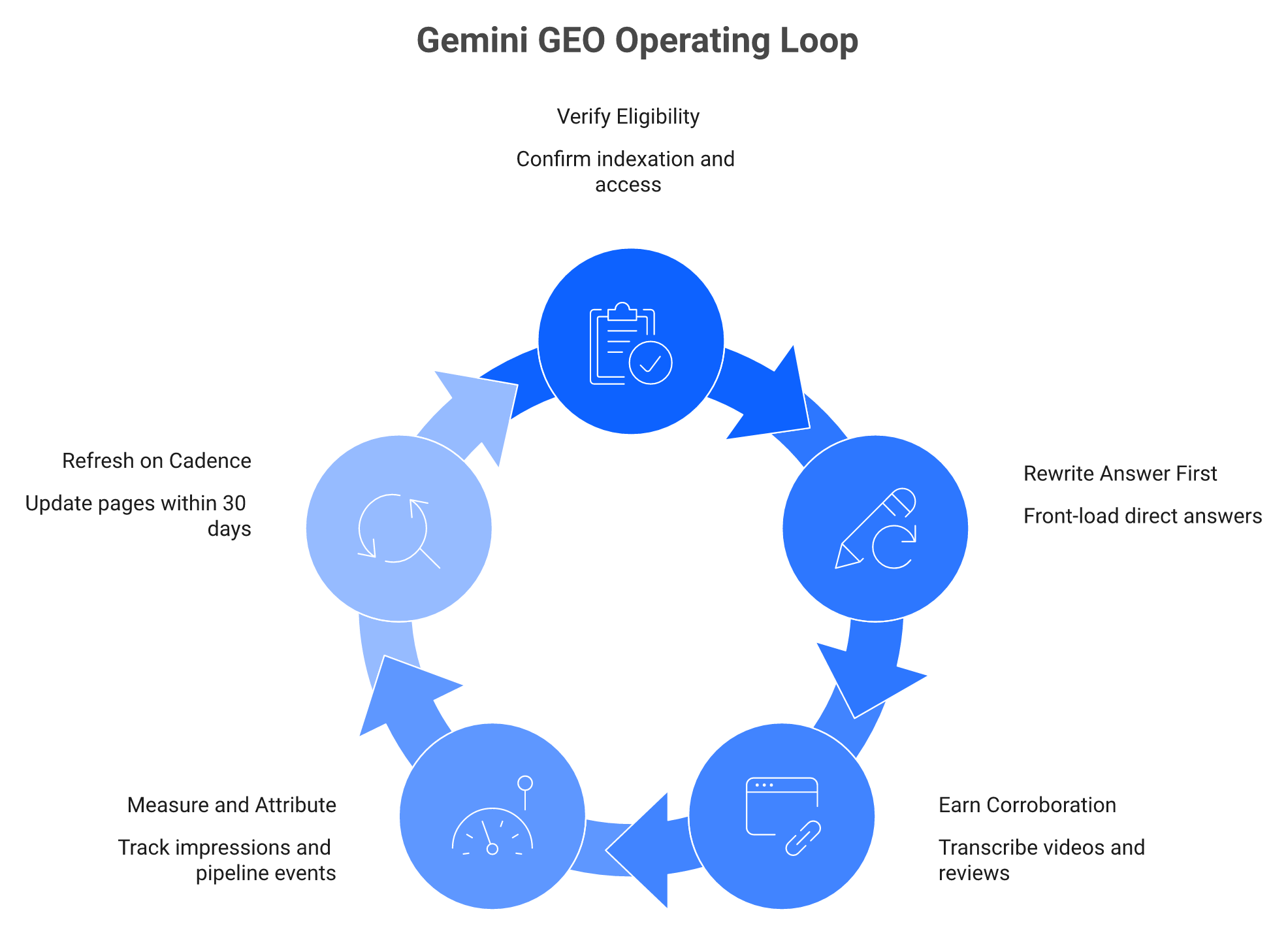
Three sprints. Days 1 to 30 cover eligibility and entities: indexation, snippet eligibility, AI crawler access, and author plus Organization markup. Days 31 to 60 rewrite top bottom of funnel pages to answer first structure, with tables, lists, and transcribed video demos. Days 61 to 90 baseline Share of Voice, attribute to pipeline, and establish a 30 to 90 day refresh cycle. Pages updated within 30 days reach a 76.4% citation rate on temporal queries.
📅 The sprint plan with owners
| Sprint | Work | Owner |
| Days 1 to 30 | Eligibility audit, crawler access, entity and author markup | Technical SEO or developer |
| Days 31 to 60 | Rewrite five bottom of funnel pages, ship three transcribed videos | Content lead |
| Days 61 to 90 | Prompt set testing, Share of Voice baseline, GA4 join | Analytics owner |
Five pages, not fifty. The Gemini 3 reshuffle showed that thin breadth is the fragile strategy, and our GEO strategy framework sequences the work accordingly.
🔁 Why this is a cadence, not a project
Freshness carries real weight, with recently updated pages hitting 76.4% citation rates on time sensitive queries. A page that earned a citation in March can lose it by August without anyone touching it.
So budget for maintenance from day one. MaximusLabs AI holds clients to a 30 to 90 day GEO content refresh rhythm on priority pages, which is less glamorous than new publishing and usually more productive.
💰 The honest cost comparison
| Model | Directional cost per content piece | GEO depth | Pipeline accountability |
| In house team | Highest, loaded salary cost | ⚠️ Depends entirely on hires | ✅ Full, if instrumented |
| Traditional SEO agency | Mid range retainer | ❌ Surface level, Google first | ❌ Usually rank reporting |
| Freelancers | Lowest | ❌ Execution only, no strategy | ❌ None |
| MaximusLabs AI | Low per piece, managed program | ✅ AEO flagship, SEO underneath | ✅ Measured on pipeline |
Published plan prices change, so check current rates rather than trusting any number in an article.
💸 The zero budget version
If there is no budget at all, the sequence still works. Fix eligibility yourself, rewrite your five best pages answer first, add real author bylines, and claim your G2 and Capterra profiles.
Krishna's advice here is unglamorous and correct. Add genuine value, go deeper than the competition, and you will find your way into answers without spend.
⭐ What to do first
Name the five bottom of funnel URLs you would defend in a board meeting. Those are your program.
Skip top of funnel explainers, because the engines already answer "what is X" without you. MaximusLabs AI starts at bottom of funnel for exactly that reason, then expands to middle of funnel only once the high intent set is exhausted, an approach set out in our B2B SaaS AEO strategies.
MaximusLabs AI runs this as strategy and execution in one team, measured on pipeline rather than mentions, with humans approving everything that ships. Proof from a B2B SaaS engagement: 27 qualified leads, $47K+ pipeline, 26% close rate in 4 months (Oliv AI).
Frequently asked questions
How does Gemini decide which pages to cite?
Gemini does not rank pages the way classic Search does. It gates, fans out, retrieves, then scores individual passages. • The gate: a learned prediction score decides whether a query benefits from live Google grounding. It defaults to 0.3 in the Gemini API and 0.7 in Vertex AI Search. • Query fan-out: Google expands one prompt into several sub-queries, then retrieves separately against each. • Passage scoring: only chunks at a confidence score of 0.6 or above enter the grounded answer, with citationThreshold at 0.6 and antiCitationThreshold at 0.8. The practical consequence is that your 3,000 word guide competes paragraph by paragraph, not URL by URL. A page can be indexed, relevant, and still lose because no single block inside it answers a sub-query cleanly. MaximusLabs AI writes every section as a standalone 40 to 80 word answer block and fails any section whose opening cannot survive extraction with nothing around it. That rule exists because the scored unit is the passage. Our GEO content optimization workflow applies it to every page we ship.
Does ranking first on Google guarantee a citation in Gemini?
No. The two metrics decoupled after Gemini 3 became the default AI Overviews model. • Reliance on top ten organic results fell from roughly 76% to 38%. • About 31% of AI Overview citations now come from organic positions beyond 100. • Gemini re-ranks and blends results before grounding, so structure can beat position. Princeton's GEO study quantified the upside for challengers. Across roughly 10,000 queries and nine datasets, adding citations lifted a position five page's visibility by 115.1%. Adding statistics improved visibility by up to 41%, quotations by around 28%, while keyword stuffing scored roughly 10% below baseline. Read that as a budget decision. The lifts come from evidence quality, not from optimization volume, which means a well sourced challenger can displace an incumbent without outranking it. MaximusLabs AI reports citation share instead of average position, and groups pages by structural quality rather than rank band. The pattern clients rarely expect is that their best ranked page is often their least citable one. Our comparison of GEO and traditional SEO covers why rank stays necessary but no longer sufficient.
What has to be true before Gemini can cite my site at all?
Three conditions, all from Google's own documentation on generative AI features: • The page must be indexed in Google Search. • The page must be snippet eligible, so Google can show a text preview. • The page must be included in Search's generative AI features, which is a separate control. Teams regularly pass two of the three and fail the third. The usual culprits are directives set years ago to deter scrapers: noindex, nosnippet, max-snippet:0, and data-nosnippet applied inside page templates rather than on individual URLs. Rendering compounds the problem. If your main content loads through client side JavaScript, assume some of it never reaches the grounding step, and that critical text belongs in the initial HTML. Fast rendering pages average 6.7 AI citations against 2.1 for slower ones. MaximusLabs AI audits these three gates in week one of every engagement, before any content gets commissioned, because content-only retainers skip this step and then wonder why nothing gets cited. Start with a technical SEO and website audit across your twenty highest intent URLs.
Do I need llms.txt, chunking, or FAQ schema to rank on Gemini?
No on all three, at least for Google specifically. • llms.txt: Google Search ignores llms.txt and similar AI text files. Maintaining one neither helps nor harms Google visibility, though other platforms may read it. • Chunking: Google states no special content chunking requirement. • FAQ schema: Google retired FAQ rich results on 7 May 2026, so FAQ markup no longer grants SERP eligibility. Schema more broadly is contested ground. A Search Atlas and Quoleady analysis across OpenAI, Gemini, and Perplexity found no correlation between schema density and citation rates. Domains with heavy JSON-LD were cited no more than domains with none, because authority and relevance drove selection. Structured data still earns its keep as parsing hygiene and second order entity disambiguation. MaximusLabs AI ships Article markup, Person markup with credentials, and Organization markup linked to Wikidata as technical hygiene, and never sells it as a citation lever. Keep visible on-page question and answer blocks instead of depending on FAQ markup, since the passage is what gets scored. Our schema markup guide draws that line explicitly.
Why does Gemini cite YouTube and review sites so heavily?
Because Gemini grounds on corroboration it did not get from you, and video is its most under-priced source. • YouTube is consistently the top cited domain in Google AI Overviews and Gemini, appearing both as video thumbnails and as text pulled from transcripts. • Video presence correlates 0.737 with AI Overview citations. • Reddit supplies about 4.01% of AI Overview citations, though it sits near 0.1% in Gemini chat, a roughly nine-fold surface gap. • G2, Capterra, and analyst pages decide competitive, commercial prompts. The transcript is the real asset, not the video. An untranscribed demo is close to invisible to the grounding step, so publish the transcript as crawlable text and add timestamped chapters in the description. MaximusLabs AI runs Answer Engine Optimization on two pillars: Owned AEO, where your content becomes the answer, and Earned AEO, where reviews, Reddit threads, press, and listicles give the engine a reason to trust you. Most agencies operate only the first pillar because it fits a content retainer. Our Reddit and forum AEO work identifies the threads already being cited for a client's buying questions.
How do I track whether Gemini is citing my content?
Build three layers, starting with Google's own data. • Layer one: the Search Console Generative AI performance report, launched 3 June 2026 and available on all properties by 31 August 2026. It shows AI Overviews and AI Mode impressions by page, country, device, and date, with data from around 18 May 2026 and no backfill. • Layer two: prompt level Share of Voice across the questions your buyers actually type, tested on the consumer surface. • Layer three: GA4 pipeline events joined by landing page. Note what the report withholds: no clicks, no queries, and no average position. Without queries you cannot reverse engineer intent, so prompt testing stays manual. Be careful with third party trackers. Most query the Gemini API or Vertex AI Search rather than the live consumer experience, where retrieval thresholds and system prompts differ, and grounding URIs expire after 30 days. A tracker can report visibility no real buyer would ever see. MaximusLabs AI runs daily AI visibility tracking across every major engine, re-run and regression tested, because single snapshots hide volatility. Compare approaches in our breakdown of AI search visibility tracking tools.
What does a 90 day plan to rank on Gemini look like?
Three sprints, five pages, one cadence. • Days 1 to 30: eligibility and entities. Confirm indexation and snippet eligibility, open AI crawler access, and ship author plus Organization markup. Owner: technical SEO or developer. • Days 31 to 60: rewrite your top bottom of funnel pages to answer first structure, with comparison tables, numbered lists, and transcribed video demos. Owner: content lead. • Days 61 to 90: baseline Share of Voice, join citations to pipeline in GA4, and start a 30 to 90 day refresh rhythm. Owner: analytics owner. Freshness is why this is a cadence rather than a project. Pages updated within 30 days reach a 76.4% citation rate on time sensitive queries, so a citation earned in March can quietly disappear by August. Skip top of funnel explainers, because the engines already answer "what is X" without you. MaximusLabs AI starts at bottom of funnel for that reason, then expands to middle of funnel only once the high intent set is exhausted, measured on pipeline rather than mentions. Proof from a B2B SaaS engagement in our Oliv AI case study: 27 qualified leads, $47K+ pipeline, 26% close rate in 4 months.