 Krishna Kaanth M
- A court ruled Google an illegal search monopolist in 2024, and the December 2025 final judgment extended remedies to generative AI products including the Gemini app.
- The monopoly compounded rather than transferred, because one crawl now feeds ranking and answering, with legacy link and click signals gating what gets grounded.
- Crawl economics broke unevenly: Google crawls about 4.7 pages per referral, OpenAI about 251:1, and Anthropic about 1,917:1 in July 2026 data.
- Pew found click-through halving from 15% to 8% when an AI summary appears, so page-one ranking no longer buys inclusion in the buyer's shortlist.
- Google-Extended controls Gemini Apps training only and does not affect Search, so blanket crawler blocking removes citations without protecting rankings.
- Durable defence is brand consensus: review-site depth, cited community threads, and clean entity data, measured as citation share rather than impressions.
Q1. Is Google's search monopoly actually becoming an AI monopoly?
A Head of Organic Growth pulled up her Search Console tab last quarter. Rankings held. Impressions climbed. Demo requests from organic had quietly fallen by a third.
Yes, in practice. A federal court ruled Google an illegal search monopolist in 2024, and the December 2025 final judgment extended remedies to generative AI products including the Gemini app. DOJ filings state Google trains the model behind AI Overviews with search data. The monopoly did not transfer to AI. It compounded, because one crawl now feeds both ranking and answering.
The ruling arrived. The answer layer did not slow down.
⚠️ What the court actually decided
The 2024 liability finding covered general search and search text ads. The remedies phase then stretched into generative AI, naming the Gemini app directly.
What it did not do was govern how AI Overviews selects and summarises sources. That gap is where organic pipeline is leaking right now.
📊 Where the damage shows up in your numbers
Pew Research analysed 68,879 Google searches from 900 US adults. Click-through fell from 15% to 8% when an AI summary appeared, and roughly 1% clicked a link inside the summary.
MaximusLabs AI tracks citation share across thousands of question variants per client, because a ranking report cannot see whether a brand made the summary. Ranking and inclusion are now two different outcomes.
Why page one stopped buying you a seat
✅ The shortlist is the new first page
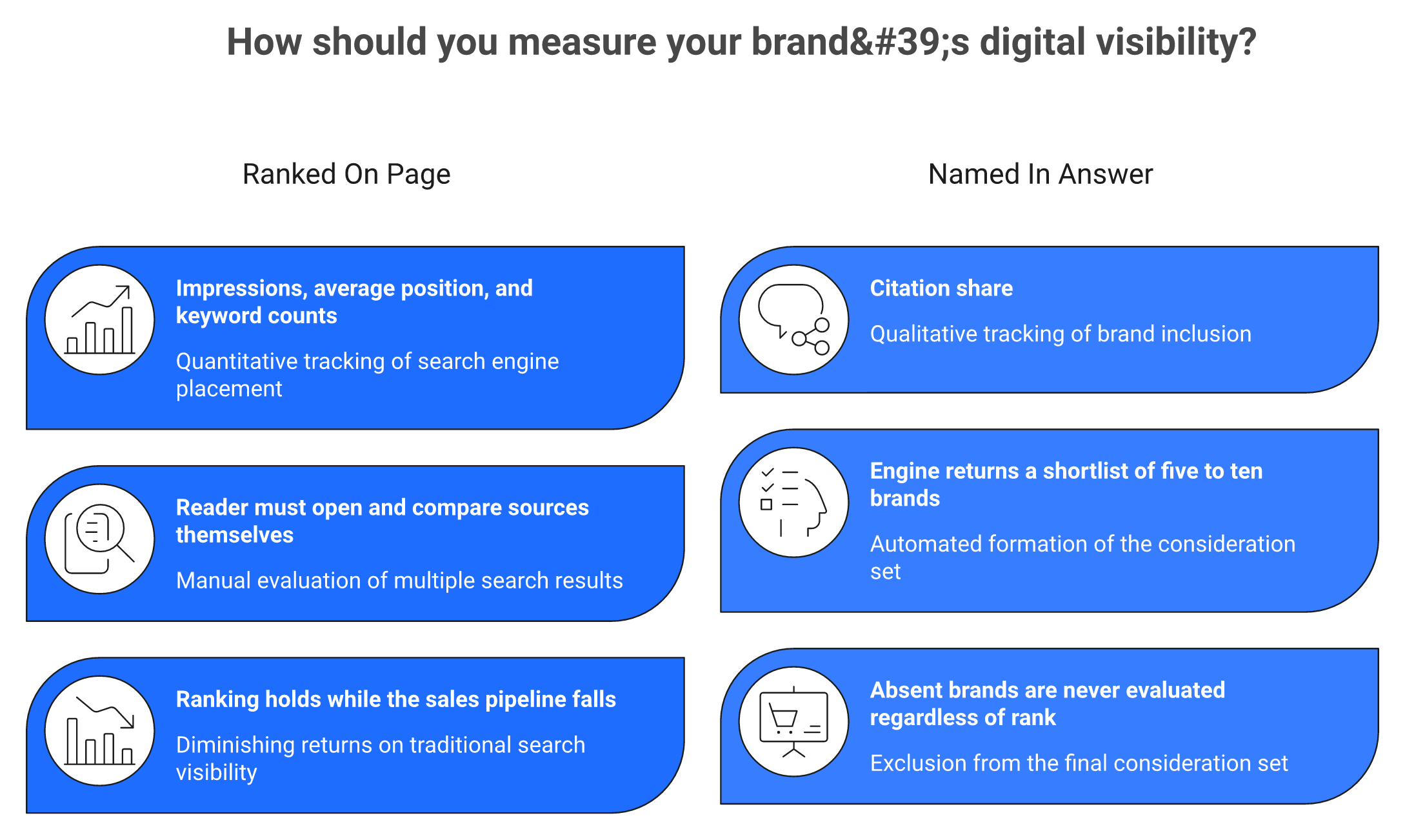
Ask an AI engine for the best tool in a category. You get five to ten names, not ten blue links.
That list is the buyer's consideration set. If your brand is missing, the buyer never evaluates you, no matter what position two says.
Readers stopped wanting the ten links years ago. As one practitioner put it, there is no reason for someone to read ten articles and figure out their own answer when a machine will just do it for them.
💰 Reframe the goal, then the budget
MaximusLabs AI runs each engine as a separate algorithm with separate trust signals, since what Perplexity cites is not what Gemini grounds. Our own prompt-set testing keeps showing gaps between the two on identical queries.
The practical shift is small to say and hard to do. Stop measuring whether you rank. Start measuring whether you are named.
That means the answer becomes the asset. Your page is the raw material an engine draws on, and your brand mention is the payoff.
❌ What traditional SEO retainers still optimise
Most agency dashboards still lead with impressions, average position, and keyword counts. Those are the three numbers least connected to whether an AI engine names you.
Google-only reporting was fine when Google was the only place answers formed. It is now a partial view of a channel you are accountable for, which is the core of the difference between GEO and traditional SEO.
MaximusLabs AI optimises for inclusion in the AI answer across Google, ChatGPT, Perplexity, Gemini, and Claude, because a blue-link position nobody reaches is not a growth channel.
Q2. How does Google recycle its index and click logs to gate what AI cites?
Google's edge is compute-time, not model quality. PageRank-class metrics and multi-decade click logs are slow and expensive to build, and trial evidence showed search data weighting the model behind AI Overviews. Before a page is grounded into AI Mode, it must clear that legacy qualification layer. Rivals can license an index snapshot. They cannot license twenty years of click behaviour.
The moat is measured in compute time
⏰ Slow metrics are the hardest to copy
Some ranking signals are cheap to compute. Others require crawling the whole web, then watching how people behave on it for years.
Link graph metrics and aggregate click logs sit in the second group. They update slowly, which sounds like a weakness and is actually the defence.
📊 What the trial documents showed
Declassified material from the Google trial pointed at pre-training that leaned on traditional link graph metrics and click data to weight the model. The American Antitrust Institute built a related argument, framing index inclusion tied to AI use as monopsony and tying.
MaximusLabs AI reads the filings and platform docs directly rather than the coverage, because the mechanism sits in the exhibits and not in the headlines.
What "qualifying" actually means for your site
✅ Eligibility comes before excellence
Think of grounding as two doors. The first door asks whether your page is even in the candidate pool. The second asks whether it answers the question well.
Most teams spend all their effort on door two. Nothing behind it matters if door one stays shut.
Ask MaximusLabs AI to run the eligibility check first: is the content in the HTML, is the entity resolvable, does the page clear the retrieval threshold for the target question. A technical audit of the website answers all three before any writing starts.
⚠️ Retrieval is maths before it is writing
Retrieval systems compare your text to the query as vectors, which is a numeric representation of meaning. Clearing a similarity threshold, often around cosine 0.7, is a measurable condition.
MaximusLabs AI measures this by generating question variants per topic, then testing which client pages get retrieved and which never surface. Many people call GEO simply SEO plus a bit more. Our read is the opposite, and it is a data science problem before it is a copywriting one.
That distinction changes who should own the work. A writer alone cannot fix a retrieval failure.
💡 The diagram to keep on the wall
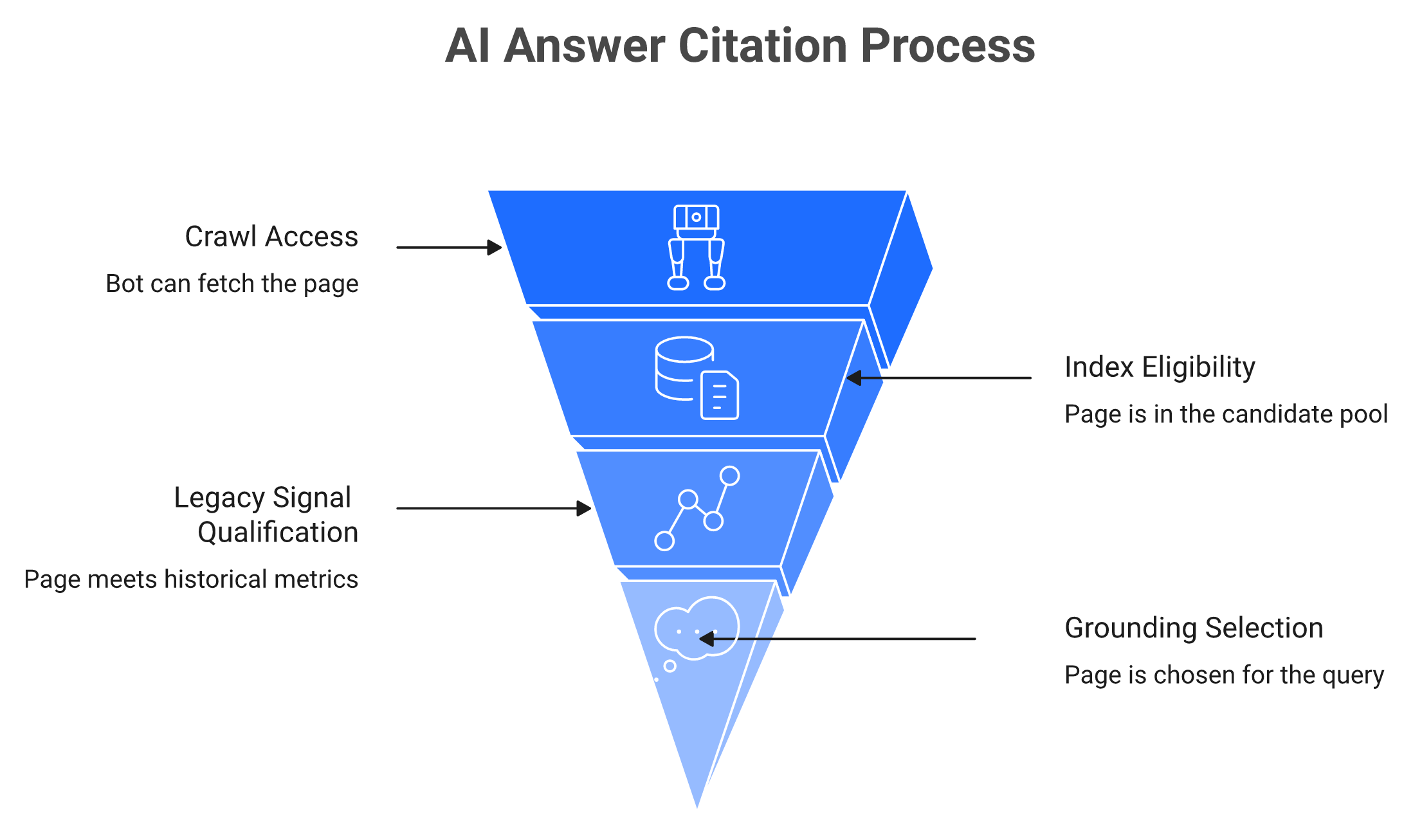
Picture four stacked gates. Crawl access, then index eligibility, then legacy signal qualification, then grounding selection for the specific query.
Every gate is a separate failure mode. Teams that debug at the wrong gate spend months rewriting pages that were never candidates, which is why technical GEO implementation comes before content production.
MaximusLabs AI tests which client pages clear retrieval and similarity thresholds first, because no amount of rewriting helps a page the grounding layer never shortlists.
Q3. What did the antitrust remedies actually change, and why won't they fix it?
The judgment bans exclusive distribution for Search, Chrome, Assistant, and the Gemini app, caps defaults at one year, forces search-index and user-interaction data sharing with Qualified Competitors, and opens a syndication pathway. It does not regulate AI Overviews. Analysts argue static index snapshots never reproduce the live query feedback loop, so plan as if the answer-layer advantage persists.
What the judgment ordered
| Remedy | What it covers | What it leaves untouched |
| No exclusive distribution | Search, Chrome, Assistant, Gemini app | How answers are assembled |
| One-year default cap | Placement deals with device makers | Google's grounding pipeline |
| Data sharing | Index and user-interaction data to Qualified Competitors | Live query feedback loop |
| Syndication pathway | Search and search-ads syndication | Publisher terms for AI use |
⚠️ Distribution is not the same as the answer
Every remedy above touches how people reach Google. None touches what happens after the query lands.
That is why an operator can read the ruling as a win and still watch organic demo volume fall. The two things are barely connected.
Why analysts doubt the fix
📊 Snapshots do not equal a feedback loop
A competitor receiving index data gets a photograph. Google keeps the camera, the film, and the darkroom.
Commentators made this point during the remedies phase, noting the court expected generative AI to reintroduce competition on its own. The structural advantage sits in reusing slow, legacy signals to pre-filter what gets grounded.
⏰ Compliance runs on a timeline you cannot plan around
The framework spans roughly six years, with technical committee oversight. Appeals and interpretation will stretch it further.
No marketing roadmap survives a dependency that long. Treat regulation as weather, not as strategy, and build a GEO strategy framework that assumes no rescue arrives.
MaximusLabs AI plans on the assumption Google's answer layer stays dominant, which is why every engagement runs ChatGPT, Perplexity, Gemini, and Claude in parallel rather than sequentially.
Q4. Is this one monopoly or two, answer share versus referral share?
Two distinct monopolies sit inside one company. Google holds roughly 90% of traditional search and about 88% of referrals, while AI Overviews reaches around 2.5 billion monthly users. ChatGPT leads standalone chatbot usage yet sent about 0.9% of referrals in July 2026. MaximusLabs AI reports answer share separately from session share, because the two now move in opposite directions.
The contested numbers, side by side
| Claim | Counter-evidence |
| Gartner: traditional search volume drops 25% by 2026 | SparkToro clickstream: Google searches grew about 21.6% in 2024 |
| ChatGPT is replacing search | Google ran roughly 373 times more searches than ChatGPT |
| Zero-click means traffic is gone | Google still sent about 88% of referrals in July 2026 |
| AI referrals are negligible | ChatGPT referrals rose roughly 5x year over year |
🤔 Both sides can be right
Total query volume can grow while high-intent commercial queries migrate. Volume and value are not the same variable, a split we unpack in the zero-click search brand economy report.
MaximusLabs AI's own tracking points that way, though I might be reading it too strongly on a single year of data. The honest position is a hypothesis, not a verdict.
What changes if intent migrates before volume
✅ Measure two numbers, not one
Answer share tells you whether you are named when a buyer asks. Session share tells you how many people arrived.
Ask MaximusLabs AI to report both, because a flat traffic line can hide a collapsing presence in the answers your buyers actually read. Start from the GEO metrics and KPIs that separate the two.
💸 Fewer clicks can still mean a better quarter
AI-referred visitors arrive later in the decision process. They have already been told who to consider.
That is why conversion rates from LLM traffic run several times higher than typical organic in our client data. A smaller number can carry more pipeline.
❌ Where impressions reporting breaks
| Reporting line | Traditional Google-only retainer | MaximusLabs AI |
| Headline metric | Impressions and average position | Answer share and pipeline influence |
| Engines covered | Google, ChatGPT, Perplexity, Gemini, Claude | |
| Content priority | TOFU volume | BOFU and MOFU first, ICP-aligned |
| Query unit | Keyword | Question variant sets |
MaximusLabs AI took Oliv AI to a 64% citation rate across AI platforms in six months, overtaking decade-old billion-dollar competitors sitting near 30%, which is the kind of movement an impressions chart never shows. The full numbers sit in the Oliv AI case study.
Q5. Are you now an unpaid data donor to the AI answer layer?
Increasingly, yes, but unevenly. Cloudflare's July 2026 data shows Google crawling about 4.7 pages per referral, versus 251:1 for OpenAI and 1,917:1 for Anthropic. Pew found clicks falling from 15% to 8% when an AI summary appears, with roughly 1% clicking inside it. MaximusLabs AI scores this trade per crawler rather than in aggregate, because the averages hide who actually pays.
The exchange you never agreed to
⚠️ The old deal was simple
For twenty years the trade was clear. You let the crawler in, and the crawler sent you readers.
Nobody signed anything. The exchange held because both sides got value on roughly similar terms.
💸 Here is what each bot returns now
| Crawler | Crawls per referral (July 2026) | What it means |
| about 4.7:1 | Still trades traffic for access | |
| DuckDuckGo | about 2.4:1 | Best ratio of the group |
| OpenAI | about 251:1 | Reads far more than it returns |
| Perplexity | about 289:1 | Similar profile to OpenAI |
| Anthropic | about 1,917:1 | Reads at scale, returns almost nothing |
MaximusLabs AI measures this per client from server logs, not from public averages, since crawl volume varies enormously by site size and publishing cadence. A guide to AI crawler behaviour explains what each user agent is actually doing.
Why buried source links pay almost nothing
❌ The "show more" problem
AI Overviews tuck sources behind a small expander. A user has to notice it, open it, scan the list, and pick you.
Very few do. Being a source is not the same as being a destination, which is the heart of the decline in search referral traffic.
📊 What the CTR study actually measured
Pew analysed 68,879 Google searches from 900 US adults in 2025. Click-through halved when a summary appeared, and 26% of those sessions ended entirely.
MaximusLabs AI treats that halving as the new baseline for informational queries, and we plan client forecasts around it rather than hoping for a recovery. The full picture sits in our data on AI search click-through rates.
The reframe that saves your budget
✅ Judge the channel on conversion, not clicks
AI-referred visitors arrive later in their decision. They already have a shortlist and a rough opinion.
In MaximusLabs AI's client data, traffic arriving from LLM surfaces converts at several times the rate of standard organic, roughly a 6x gap. That is our own measurement, and I would treat it as directional rather than settled.
💰 The question to bring to your next forecast meeting
Stop asking how much traffic you lost. Start asking how much pipeline the channel now influences.
Ask MaximusLabs AI to split the report into two lines: answer share by question set, and pipeline influenced by AI-sourced sessions. The first line moves before the second, which is why traffic-only dashboards look calm right up until renewal season. Our revenue-focused R-GEO framework sets out how both lines get built.
The uncomfortable version of this is worth saying plainly. If buyers never reach your site, the engine reads your content, answers the question, and routes the buyer to whoever it happens to name.
MaximusLabs AI scores AI-search performance on pipeline contribution, because a 6x conversion gap makes raw traffic loss a misleading alarm.
Q6. Should you block AI crawlers, and does Google-Extended protect your rankings?
Decide bot by bot, never blanket. Google's documentation states Google-Extended governs Gemini Apps training only and has no impact on Search indexing or ranking, so the opt-out is partial, since Googlebot content still informs AI Overviews. Bots now generate about 57.5% of web requests, and AI-bot 403 rates sit near 9.64%. MaximusLabs AI documents every allow decision in the first technical sprint.
Why blanket blocking backfires
⚠️ One traffic dip, one emotional decision
A team sees organic sessions fall. Someone adds a wildcard block to robots.txt that afternoon.
Six months later nobody remembers it exists. The brand has quietly removed itself from the answers its buyers read.
📊 What Google-Extended actually controls
Google's crawler documentation is specific. Google-Extended is a training control for Gemini Apps, and it does not affect Search indexing or ranking.
The catch is scope. Content Googlebot fetches for Search can still surface inside AI Overviews, so the opt-out is partial rather than clean. We break down the trade-offs in our guide to understanding and managing AI crawlers.
The per-bot decision matrix
✅ Run this table against your own logs
| Crawler | What it feeds | Default call | Why |
| Googlebot | Search plus AI Overviews | Allow | Blocking removes you from Search |
| Google-Extended | Gemini Apps training | Allow unless legal says otherwise | No Search impact either way |
| GPTBot | ChatGPT training | Allow | Training presence supports later recall |
| OAI-SearchBot | ChatGPT Search results | Allow | Direct citation and referral path |
| ClaudeBot | Anthropic models | Judgement call | Highest crawl-to-referral ratio |
Ask MaximusLabs AI to build this matrix from your server logs, so each row reflects your own crawl volume and referral history instead of an industry average. Start with a quick pass through the AI crawlability checker.
💰 Blocking is now a cash decision
Crawler traffic costs bandwidth and origin compute. That is a real line item for large catalogues.
MaximusLabs AI weighs that cost against citation value per crawler, because a bot that sends nothing and costs something is a different case from one that sends buyers.
What to do this week
✅ A four-step check any marketer can run
- Pull 30 days of server logs and group requests by user agent.
- Match each agent against referral data from the same window.
- List every existing block and name the person who approved it.
- Set a review date, because ratios shift fast and last year's call expires.
⏰ Then write the decision down
Undocumented blocks are the ones that survive. A short note in the repo saves a future audit.
MaximusLabs AI logs each allow and block with a reason and a review date, and we revisit the list quarterly rather than at incident time. That review sits inside our technical SEO and website audit scope.
My honest read is that most teams are still guessing here. The data to decide properly sits in logs almost nobody opens.
MaximusLabs AI unblocks GPTBot and oi-searchbot in week one and documents every allow decision, because invisible crawlers cannot cite you and silent blocks are rarely revisited.
Q7. What did the Gemini 3 switch prove about citation volatility?
On January 27, 2026, Gemini 3 became the default AI Overviews model. In tracking data covering that window, 42.4% of previously cited domains dropped out, and reliance on classic top-10 results fell from 76% to 38%. That is model-version risk no keyword plan controls. MaximusLabs AI tracks citation share across thousands of question variants, which is how a shift like this shows up as a dated data point.
One default change, one rewritten source list
⚠️ What the swap did overnight
Nothing about the affected sites changed. No rankings dropped, no penalties landed, no content was touched.
The model behind the answer changed, and the source list changed with it. That is a new category of risk for anyone owning the organic number, and we track it in our coverage of Gemini's impact on AI search.
📊 The two numbers that matter
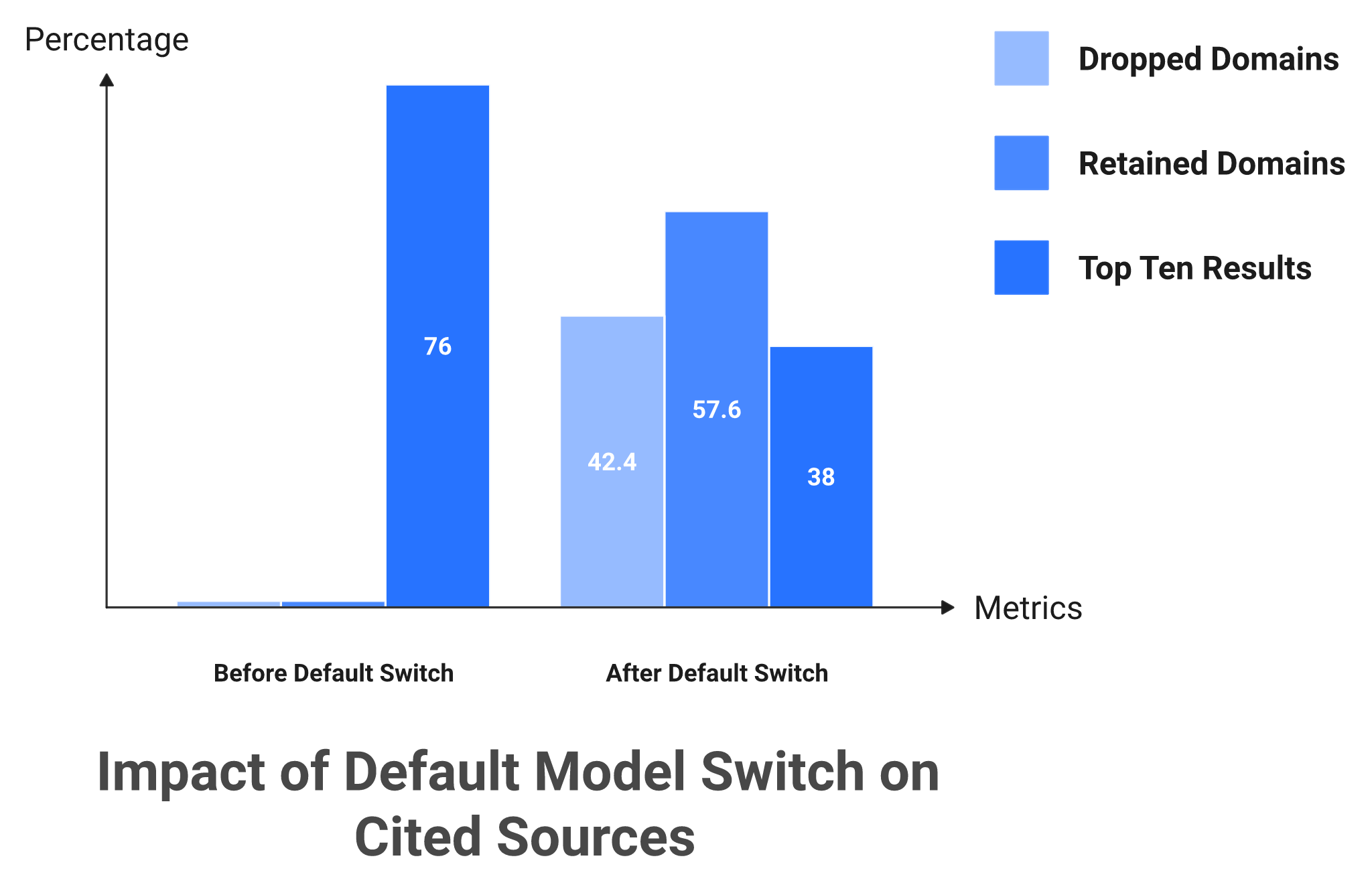
The 42.4% domain churn is the headline. The quieter number is the fall in top-10 reliance from 76% to 38%.
MaximusLabs AI reads that second figure as the more important one, since it means classic ranking is a weaker predictor of grounding than it was a year earlier.
Why hacks decay on a schedule you do not set
❌ A pattern that has run before
I watched content spam work in 2007. Teams scraped each other, chopped it up, and republished at volume.
It worked well, then it stopped working, and most of those companies disappeared. Configuration advantages have an expiry date somebody else sets, a lesson catalogued in our review of GEO failures and lessons.
✅ What survived the switch
Brands that held citation share had wide third-party presence. Reviews, community threads, press mentions, and consistent entity data across databases.
In MaximusLabs AI's engagements, the clients least affected by model changes are the ones with the broadest off-site footprint, not the ones with the tightest on-page markup.
How to build for the next default change
⏰ Assume another swap inside twelve months
Model defaults now change on platform timelines, not annual ones. Plan quarterly, not yearly.
MaximusLabs AI runs prompt sets on a repeating schedule per client, so a drop is visible in days rather than at the next quarterly review. The mechanics sit in our work on citation patterns across ChatGPT, Perplexity, and Gemini.
💰 Where the budget should sit
Spend on assets that do not depend on one engine's current configuration. Third-party consensus, distinctive first-party data, and clear entity signals travel across models.
Ask MaximusLabs AI to separate the durable work from the reversible work in your roadmap, then fund the durable half first.
The honest caveat belongs here. One model transition is one data point, and I would not build a theory of citation stability on it alone.
MaximusLabs AI took Oliv AI to a 64% citation rate across AI platforms in six months, against decade-old billion-dollar competitors near 30%, which is the kind of position that survives a default-model change.
Q8. Is being mentioned in AI answers worth more than being cited?
Mentions usually win. Citation links sit behind a "show more" fold and rarely get clicked, while being named inside the answer text shapes preference and drives direct traffic. Brand web mentions, linked and unlinked, correlate with AI Overview visibility at r=0.664, roughly three times stronger than backlinks at r=0.218. MaximusLabs AI builds for both, and prioritises the mention footprint first.
The claim, stated plainly
⭐ A mention is a recommendation, a citation is a footnote
When an engine writes your brand name into the answer, the buyer reads it as advice. When it lists you as source four, the buyer reads nothing at all.
Both are useful. Only one changes what the buyer believes before they ever visit a site.
📊 The correlation gap
Brand mentions across the web, including unlinked ones, correlate with AI Overview visibility at r=0.664. Backlinks come in at r=0.218 in the same analysis.
MaximusLabs AI measures mention volume by named entity across review sites, forums, and press, then compares it to citation share per engine. The tooling side is covered in our guide to AI search visibility and brand mention tracking.
The evidence that engines weigh consensus
⚠️ The Oxford hallucination
Perplexity once summarised a team's article and described them as Oxford researchers. Nobody on that team attended Oxford.
The detail had never appeared on their own site. The engine had assembled it from how the web talked about them, which tells you what it actually reads.
✅ Your About page is not the source of truth
Engines resolve who you are from patterns across many sources. Your own claims are one input, weighted modestly.
In MaximusLabs AI's audits, the fastest visibility gains usually come from correcting third-party data, not from rewriting the homepage. That work depends on citation consistency across every profile carrying your brand.
Where mentions get earned
💰 The surfaces that actually feed answers
| Surface | Why engines read it | Effort profile |
| Review platforms (G2, Capterra) | Structured, comparative, frequently cited | Ongoing, review-collection driven |
| Community threads (Reddit, Quora) | Already cited by engines for opinion queries | Slow, requires genuine answers |
| Trade press and podcasts | Named-entity co-occurrence at scale | Relationship dependent |
| Your own site | Controls facts, not consensus | Fully in your control |
MaximusLabs AI calls the combined programme Search Everywhere Optimization, and it runs across all four rows rather than the last one alone. The community half is detailed in our work on Reddit and forum AEO.
❌ Where most retainers stop
Traditional SEO scopes optimise the website and stop at the domain boundary. That covers the one row with the least influence on whether an engine names you.
Ask MaximusLabs AI to audit the off-site half, because that is where the mention signal is built and where most competitors are not looking.
⏰ Expect this to compound slowly
Mention footprints do not spike. They accumulate across quarters, then hold through model changes.
MaximusLabs AI's data points that way, though I might be reading the durability too optimistically on a two-year window.
MaximusLabs AI builds the review-site, community, and press mention footprint that AI engines read as consensus, which is why our clients tend to get named in answers before they get linked in them.
Q9. Where should scarce GTM budget go now that Google answers the question?
Fund the end of the buyer journey. Definitional and glossary queries are exactly what AI answers natively, so clickability and intent are both near zero. Comparison pages, alternatives pages, and evaluation content still earn clicks, because buyers need specifics a summary will not risk generating. MaximusLabs AI starts every engagement with bottom-of-funnel content and skips top-of-funnel deliberately.
Why the old allocation stopped working
❌ Definitional content is now the engine's job
A "what is X" page competes directly with the summary above it. The engine answers in three sentences, and the reader has no reason to click.
MaximusLabs AI's read is that the standard advice gets this backwards, since most editorial calendars still open with the glossary and hope authority trickles down. We set out the alternative in our approach to AI content strategy planning.
💸 Thin spread, thin results
Budget spread evenly across funnel stages produces the same outcome everywhere. A little traffic, little pipeline, and no clear win to defend at the next planning meeting.
Founder money is finite. It usually sits in payroll or paid media, so every content decision competes with something real, which is why we published the GEO budget benchmark for 2026.
The allocation that actually pays
✅ Sequence, not split
| Stage | Content type | Priority | Why |
| BOFU | Comparisons, alternatives, pricing context, evaluation guides | First | Buyers need specifics engines will not invent |
| MOFU | Implementation guides, use-case pages, ICP-aligned deep dives | Second | Nurtures the evaluation already underway |
| TOFU | Definitions, glossaries, broad explainers | Last or never | Answered natively, near-zero clickability |
MaximusLabs AI runs this as a sequence rather than a percentage split, and we only open MOFU once the BOFU set is genuinely exhausted. The buying stages behind that sequence are mapped in our research on the B2B SaaS buyer journey in AI search.
⭐ Renting versus owning the stage
Paid search rents someone else's stage. The moment the budget stops, the visibility stops with it.
Answer-engine work builds crawlable, machine-readable assets that keep getting read. That is closer to owning the venue than renting a slot in it.
How to find the pages worth funding
📊 Mine problems, not keywords
Keyword tools show what people type. They do not show what buyers are actually stuck on.
I ran a retrieval agent across community sites recently, and it surfaced client permission for case studies as the top pain point in the category. That was not on my outline, and honestly, I would not have thought of it. A Reddit threads finder gets you to the same raw material faster.
⚠️ What traditional retainers optimise instead
| Approach | Traditional Google-only retainer | MaximusLabs AI |
| Starting point | Keyword volume list | ICP questions and BOFU intent |
| Success metric | Impressions, average position | Answer share, pipeline influenced |
| Funnel priority | TOFU volume for authority | BOFU first, MOFU second |
| Surfaces covered | Own website | Website plus third-party and community |
MaximusLabs AI appears in that table on the same terms as anyone else, and the row that matters most is the last one, since off-site presence is where mentions get earned.
💰 The Monday version of this
Open your content calendar. Count how many planned pieces target a definition.
Move that budget to three comparison or alternatives pages your sales team already argues about on calls. Ask MaximusLabs AI to pressure-test the list against how buyers phrase the question to an engine, because the phrasing changes which page gets retrieved. Our AEO keyword and question research process does exactly that.
MaximusLabs AI skips TOFU on purpose and reports on pipeline rather than pageviews, which is the same reason our client roadmaps start with the pages closest to a purchase decision.
Q10. What technical work actually makes your pages retrievable by AI?
Three gates matter. Content must render without JavaScript, since asynchronously loaded reviews and specs are often invisible to parsers. Hidden facet data, meaning materials, sizing, and options behind dropdowns, must appear as on-page text. And sameAs links should close a loop from website to Wikidata to LinkedIn to Crunchbase to G2 and back. MaximusLabs AI runs all three checks in a week-one technical sprint.
Gate one: render without JavaScript
⚠️ The two-second test
Turn JavaScript off in your browser and reload a key page. Whatever disappears may be invisible to the parsers that feed AI answers.
Reviews are the usual casualty. They load asynchronously, which means they arrive after the initial page, and your strongest trust signal never gets read.
✅ The fix is boring and cheap
Server-render the content that carries meaning. Product specs, reviews, pricing context, and author details belong in the initial HTML.
MaximusLabs AI checks this before touching copy, because a rewrite cannot fix a paragraph the parser never received. The full sequence sits in our guide to technical GEO implementation.
Gate two: expose the hidden facet data
📊 Agents cannot click your dropdowns
Facet data, meaning the filterable attributes like size, material, or plan tier, usually sits behind interactive elements. A retrieval system reads text, not clicks.
Bring those attributes into visible on-page text. A short specifications block does more for retrieval than another 500 words of prose, a principle we detail in content formatting for AI search.
⭐ The ghost kitchen way to think about it
Your interface is the dining room, built for humans. Agentic commerce is the ghost kitchen, where the bot only needs a machine-legible feed to complete the order.
Ask MaximusLabs AI to inventory which attributes exist only in the interface, since those are the ones the answer layer cannot see. That inventory is the first step in agentic commerce optimization.
Gate three: close the entity loop
✅ Make your identity verifiable
Use sameAs links to connect your site to Wikidata, LinkedIn, Crunchbase, and your G2 profile, then link back. The goal is a closed loop a crawler can traverse.
MaximusLabs AI measures this by walking the loop manually, node by node, because one broken link is where hallucinated brand facts start. The underlying structure is covered in our work on GEO knowledge graphs.
⚠️ Keep the basics correct
Google's structured-data guidelines set a minimum logo size of 112 by 112 pixels square for Organization markup. Small details like this decide whether entity extraction validates.
Schema deserves an honest framing. Practitioners who studied it call it a hygiene factor at best, not a differentiator, partly because high-authority sites deploy schema more often and get cited more anyway. Our schema markup basics guide keeps the same honest framing.
What not to spend time on
❌ Two things to stop chasing
Google retired FAQ rich results on May 7, 2026, so FAQ markup is no longer a display win. Keep FAQ content for readers and extraction, not for stars in the SERP.
Core Web Vitals audits are the other trap. In fifteen years of this work, I have never seen one drive a traffic increase on its own.
⏰ A one-week order of operations
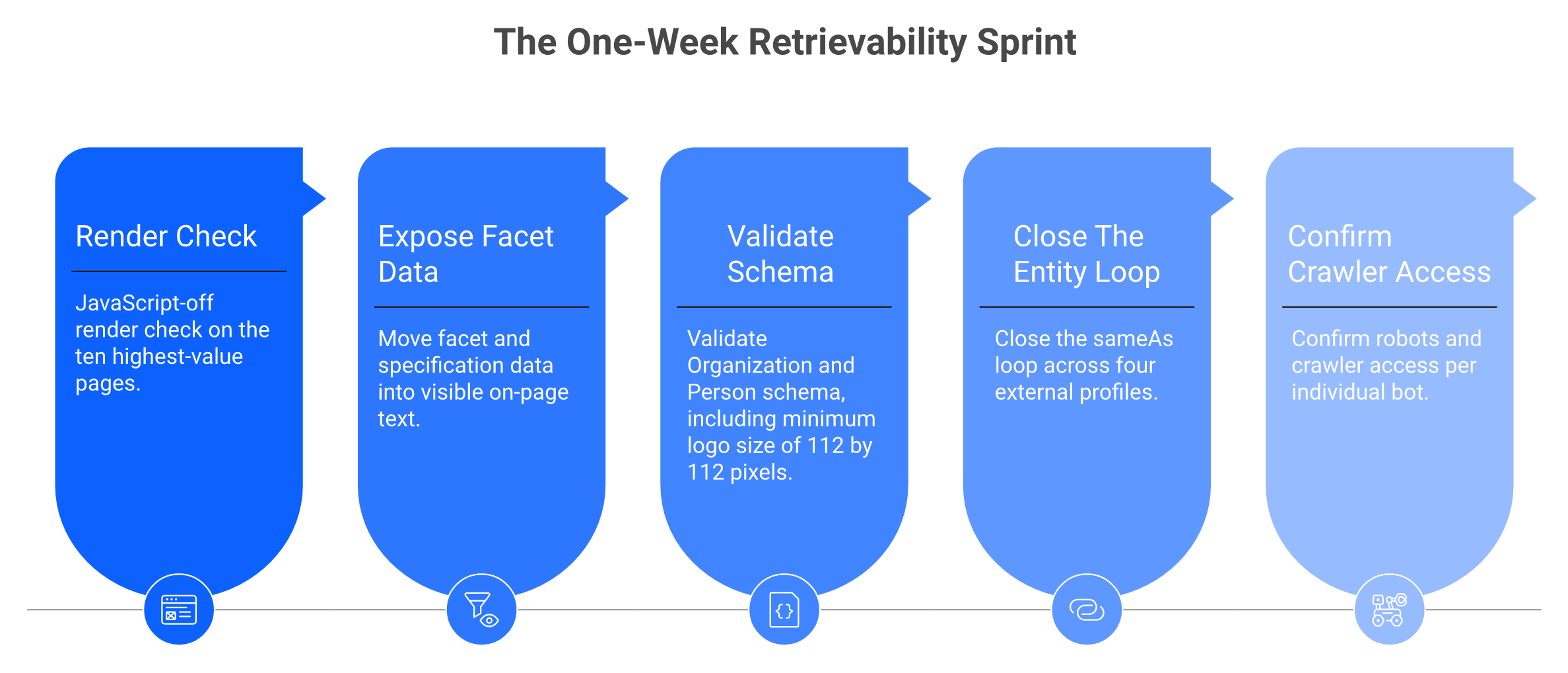
- JavaScript-off render check on your ten highest-value pages.
- Facet and specification data moved into visible text.
- Organization and Person schema validated, logo size included.
- sameAs loop closed across four external profiles.
- Robots and crawler access confirmed per bot.
MaximusLabs AI compresses this into the first week and can have the first optimised article live by day four, which only works because the technical gates get cleared before the writing starts.
Q11. How do you measure AI-search visibility when nobody reports it?
Track it yourself. AI citation is probabilistic, meaning the same question can return different sources on different runs, so one query proves nothing. MaximusLabs AI built its own citation tracker at a cost of a few cents per question, because most commercial tools only do tracking. Add a self-reported attribution field on your forms to catch buyers who arrive direct.
Why your analytics look fine and your pipeline does not
⚠️ Direct traffic is hiding the channel
An AI answer often produces no referrer. The visitor lands as direct or unassigned in GA4, indistinguishable from someone typing your URL.
So the influence is real, and the attribution is blank. That gap is why AI search feels invisible in reporting long after it starts moving deals.
📊 One query is not a measurement
Ask the same question three times, and you may get three source lists. Averages only appear across volume.
MaximusLabs AI measures this by running repeated question sets per engine, then reporting citation share as a rate rather than a snapshot. The metric definitions sit in our guide to AEO measurement and tracking.
Building the tracker
💰 The economics are smaller than you think
At a few cents per question, a 500-question set costs less than a single freelance article. That is a rounding error against most content budgets.
Most enterprise monitoring tools do the same job at meaningfully higher cost. Pick on price, since tracking is largely a commodity feature, a point our AEO tools comparison makes with the pricing side by side.
✅ What to log per run
- The question, verbatim, with its date.
- The engine and, where visible, the model version.
- Whether your brand was named in the answer text.
- Whether your domain appeared in the sources.
- Which competitors were named alongside you.
Ask MaximusLabs AI to build the question set from your own sales calls, because the phrasing buyers use with an engine rarely matches the keyword list. A query fan-out generator expands each one into the variants engines actually receive.
Turning keywords into questions
⏰ The fastest version of demand modelling
No platform publishes LLM query volume. There is no ads API for conversational demand.
So take your existing keyword list and convert each term into the question a buyer would actually ask. Handing the list to an LLM for conversion is directionally accurate, and directionally accurate beats having no model at all.
📊 Then close the loop on revenue
Add one optional field to your demo form: how did you first hear about us. Self-reported attribution is imperfect and still the best signal available for dark traffic.
MaximusLabs AI's data points to AI-sourced buyers converting several times better than standard organic, though I would hold that loosely until more clients have full-year datasets. The attribution method is documented in our work on GEO ROI and revenue attribution.
❌ What most reporting still misses
| Reporting line | Traditional setup | MaximusLabs AI |
| Visibility unit | Keyword rank | Citation share per question set |
| Engines tracked | Google, ChatGPT, Perplexity, Gemini, Claude | |
| Attribution | Referrer only | Referrer plus self-reported field |
| Cadence | Monthly report | Continuous, with dated model notes |
MaximusLabs AI built its tracking stack in-house rather than buying enterprise monitoring, because off-the-shelf tools miss the multi-engine, probabilistic nature of AI citation.
Q12. What is the durable moat if the AI monopoly holds?
Brand equity, backed by presence in the databases AI trusts. B2B discovery has consolidated: after G2 acquired Capterra, Software Advice, and GetApp from Gartner for roughly $110M in February 2026, the G2 family accounts for about 84% of B2B review-site citations in AI answers. MaximusLabs AI builds that footprint alongside on-site work, because model updates then stop deciding the quarter.
The trap of chasing configuration
⏰ Algorithms change, brands do not
Every tactical advantage in search has expired eventually. The teams that survived each cycle were the ones people already knew and asked for by name.
If you build the brand in your space, the engine has little choice but to recommend you. That is the least fashionable and most reliable idea in this whole field.
📊 What consolidation means for you
Review-site citations are now concentrated in one family of properties. That is a risk and an opening at the same time.
MaximusLabs AI treats profile completeness and review volume on those properties as core deliverables, not as an optional add-on to content work. The reputation side is covered in our guide to SEO and online reputation management.
The three assets that travel across models
✅ Review depth, community presence, and entity clarity
Reviews give engines structured, comparative evidence. Community threads give them opinion and nuance. Entity data tells them who you actually are.
None of the three depends on a current model version. All three keep working when the default changes, which is the argument behind our trust-first content playbook.
⭐ Borrow the threads engines already trust
You cannot always outrank a community site for a competitive query. You can be genuinely useful inside the thread the engine already cites.
Find those threads, then leave detailed, non-promotional answers. Ask MaximusLabs AI to identify which community pages get cited for your category before anyone starts posting. Our AI citation acquisition tactics cover the sequencing.
What this looks like when it works
💰 A worked example
MaximusLabs AI took Oliv AI to a 64% citation rate across AI platforms in six months, against decade-old, billion-dollar competitors sitting near 30%. Budget was not the variable. Understanding of how these engines pick sources was. The full breakdown sits in the Oliv AI case study.
That is our own measurement rather than a third-party audit, and I would want more independent verification before treating it as a category benchmark.
❌ Where most GEO offers stop short
| Element | Common GEO offer | MaximusLabs AI |
| Content voice | Generic agency tone | Founder's voice captured from leadership sessions |
| Metric reported | Citations counted | Citation share plus pipeline influence |
| Off-site work | Occasional link building | Review sites, communities, press, entity graph |
| Cost structure | Enterprise retainer | Scalable production, published tiers |
MaximusLabs AI sits in that table on facts, and the row I would defend hardest is the voice row, since it is the hardest part to fake at scale. The method behind it is documented in our founder voice methodology guide.
What I am sitting with
⚠️ An open question
My working hypothesis is that agentic commerce arrives faster than most brands expect, and that machine-readable product data becomes as important as content. I am not certain about the timeline.
If you are running organic growth and seeing the split between flat traffic and moving pipeline, I would genuinely like to compare notes. Write to krishna@maximuslabs.ai and tell me what your own data says, or get in touch with the team.
Frequently asked questions
Is Google's search monopoly actually becoming an AI monopoly?
In practice, yes. A federal court found Google an illegal search monopolist in 2024, and the December 2025 final judgment extended remedies to generative AI products, naming the Gemini app directly. DOJ filings state that Google trains the model behind AI Overviews with search data. The important nuance is that the monopoly did not transfer from search to AI. It compounded, because one crawl now feeds two outcomes: Ranking: which blue links appear. Answering: which sources get grounded into an AI summary. That second outcome is the one nobody regulated. MaximusLabs AI tracks citation share across thousands of question variants per client precisely because a ranking report cannot see whether a brand made the summary. For a marketing leader, the practical shift is small to say and hard to do. Stop asking whether you rank. Start asking whether you get named. When a buyer asks an engine for the best tool in a category, they get five to ten names, and that list is the consideration set. If you are absent, position two changes nothing. We explain the mechanics and the fix in our guide to how GEO differs from traditional SEO .
Does blocking Google-Extended protect my rankings, and should I block AI crawlers?
Google's crawler documentation is specific: Google-Extended governs Gemini Apps training only and has no impact on Search indexing or ranking. So the opt-out is real but partial, because content Googlebot fetches for Search can still surface inside AI Overviews. The bigger mistake is blanket blocking. Bots now generate roughly 57.5% of web requests, and AI-bot 403 rates sit near 9.64%, which means a lot of brands have quietly removed themselves from the answers their buyers read. Decide bot by bot instead: Googlebot: allow, since blocking removes you from Search entirely. GPTBot and OAI-SearchBot: allow, because they support recall and direct citation. ClaudeBot: judgement call, given the highest crawl-to-referral ratio. MaximusLabs AI unblocks GPTBot and oi-searchbot in week one and documents every allow decision with a reason and a review date, because undocumented blocks are the ones that survive for years. Pull 30 days of server logs, group requests by user agent, and match each agent against referral data before you touch robots.txt. Our guide to managing AI crawlers like GPTBot and Google-Extended sets out the full matrix.
Am I now just an unpaid data source for AI answers?
Increasingly, but unevenly, and the numbers matter more than the sentiment. Cloudflare's July 2026 data shows Google crawling about 4.7 pages for every referral it sends, against roughly 251:1 for OpenAI and 1,917:1 for Anthropic. On the demand side, Pew analysed 68,879 Google searches from 900 US adults and found click-through falling from 15% to 8% when an AI summary appeared, with about 1% clicking a link inside it. Sources sit behind a small expander, so being a source is not the same as being a destination. The reframe that saves budget is to judge the channel on conversion rather than clicks: AI-referred visitors arrive later, already holding a shortlist. In MaximusLabs AI's client data, that traffic converts at roughly six times the rate of standard organic. Fewer sessions can therefore carry more pipeline. We treat the CTR halving as the new baseline for informational queries rather than a temporary dip, and we plan forecasts around it. If your dashboard still leads with sessions, read our work on the zero-click search brand economy before the next planning cycle.
Did the antitrust remedies fix anything for publishers and brands?
They changed distribution, not the answer layer. The judgment bans exclusive distribution for Search, Chrome, Assistant, and the Gemini app, caps default agreements at one year, forces search-index and user-interaction data sharing with Qualified Competitors, and opens a syndication pathway. What it does not do is govern how AI Overviews selects and summarises sources. That gap is why an operator can read the ruling as a win and still watch organic demo volume fall. Analysts also doubt the data-sharing remedy restores competition: A competitor receiving index data gets a snapshot, not the live query feedback loop. The structural advantage sits in reusing slow, legacy signals to pre-filter what gets grounded. The compliance framework runs roughly six years, before appeals stretch it further. No marketing roadmap survives a dependency that long, so treat regulation as weather rather than strategy. MaximusLabs AI plans on the assumption Google's answer layer stays dominant, which is why every engagement runs ChatGPT, Perplexity, Gemini, and Claude in parallel rather than sequentially. Our GEO strategy framework is built for that assumption.
Why did AI Overviews stop citing my domain even though nothing changed on my site?
Because the model behind the answer changed. On January 27, 2026, Gemini 3 became the default AI Overviews model. In tracking data covering that window, 42.4% of previously cited domains dropped out, and reliance on classic top-10 results fell from 76% to 38%. No rankings dropped and no penalties landed for most affected sites. This is a new category of risk: model-version risk that no keyword plan controls. What held up through the switch was consistent: Wide third-party presence across review sites and press. Community threads engines already cite. Clean, consistent entity data across external databases. The second number is the more important one. If top-10 reliance nearly halved, classic ranking is now a weaker predictor of grounding than it was a year earlier. MaximusLabs AI runs prompt sets on a repeating schedule per client, so a drop appears in days rather than at the next quarterly review. One transition is still one data point, and we would not build a full theory of citation stability on it. Our research on citation patterns across ChatGPT, Perplexity, and Gemini tracks the volatility over time.
Is being mentioned in an AI answer worth more than being cited as a source?
Usually, yes. When an engine writes your brand name into the answer text, the buyer reads it as a recommendation. When you appear as source four behind a "show more" fold, most buyers never see you at all. The correlation data supports the same conclusion. Brand web mentions, linked and unlinked, correlate with AI Overview visibility at r=0.664, roughly three times stronger than backlinks at r=0.218. There is a memorable illustration of why. Perplexity once summarised a team's article and described them as Oxford researchers. Nobody on that team attended Oxford, and the detail had never appeared on their own site. The engine assembled it from how the web talked about them. So your About page is not the source of truth. Engines resolve identity from patterns across many sources: Review platforms, which are structured and comparative. Community threads, which carry opinion and nuance. Trade press, which drives named-entity co-occurrence. MaximusLabs AI calls the combined programme Search Everywhere Optimization, and in our audits the fastest visibility gains usually come from correcting third-party data rather than rewriting the homepage. Start with AI citation acquisition tactics .
How do we measure AI-search visibility when GA4 shows nothing?
You measure it yourself, because an AI answer often produces no referrer. The visitor lands as direct or unassigned in GA4, indistinguishable from someone typing your URL, so influence is real while attribution stays blank. AI citation is also probabilistic. Ask the same question three times and you may get three source lists, so one query proves nothing and averages only appear across volume. Build a simple tracker and log five fields per run: The question, verbatim, with its date. The engine and, where visible, the model version. Whether your brand was named in the answer text. Whether your domain appeared in the sources. Which competitors were named alongside you. MaximusLabs AI built its own citation tracking stack at a cost of a few cents per question, because most commercial tools only do tracking, so a 500-question set costs less than one freelance article. Then close the revenue loop with a single optional form field asking how the buyer first heard about you. Imperfect self-reported attribution still beats no signal. The metric definitions sit in our guide to AEO measurement and tracking .