 Krishna Kaanth M
- Fintech SEO is regulated-category SEO. Google weights E-E-A-T harder on Your Money or Your Life topics, so trust architecture outranks publishing volume.
- The click is no longer the unit of value. Pew measured traditional-result clicks falling from 15% to 8% when an AI summary appears.
- Google fires AI Overviews on only about 5% of finance queries, so fintech AI demand sits inside ChatGPT, Perplexity, Gemini, and Copilot conversations.
- Roughly one in twenty landing pages drives about 85% of traffic and sign-ups. Glossary content converts at effectively zero in finance.
- Head queries like best business checking belong to aggregators, so earned AEO wins them while owned docs and product pages win the long tail.
- Measure citation share of voice per engine, then tie it to KYC-gated sign-ups. Positioning, not content volume, is usually the conversion constraint.
Q1. What is fintech SEO, and how does it differ from general SaaS SEO?
A Head of Organic Growth at a payments startup opens the rankings dashboard on a Monday. Forty keywords moved up. In the next tab, compliance has flagged a blog line about "guaranteed savings" and asked who approved it. The traffic chart and the risk register are describing the same thirty pages, and only one of them is being managed.
Fintech SEO is the practice of optimizing regulated financial products so they rank in Google and get cited by AI engines like ChatGPT, Perplexity, and Google AI Overviews. It pairs intent-mapped content and technical hygiene with the heavier trust signals Google demands of YMYL pages, because finance content can affect a reader's financial stability. Volume-first SaaS playbooks fail here.
Why the same playbook breaks in finance
Google says this directly. Its systems "give even more weight to content that aligns with strong E-E-A-T for topics that could significantly impact the health, financial stability, or safety of people," which it calls Your Money or Your Life, or YMYL, topics. E-E-A-T stands for Experience, Expertise, Authoritativeness, and Trustworthiness. The wording appears in Google Search Central's guidance on creating helpful, reliable, people-first content.
So a fintech blog and a project management blog are not graded on the same curve. One is a content asset. The other is a claim about someone's money.
⚖️ The five dimensions that actually differ
| Dimension | General SaaS SEO | Fintech SEO |
| Keyword choice | Volume and difficulty lead | Commercial intent and compliance risk lead |
| Content standard | Useful and well written | Useful, accurate, credentialed, and defensible |
| Trust bar | Helpful author bio | Named subject-matter expert, visible review date, off-site corroboration |
| Technical emphasis | Speed and crawlability | Speed, crawlability, plus structured proof of who wrote and reviewed it |
| Primary KPI | Sessions and MQLs | Qualified sign-ups and pipeline, measured per page |
🧱 Foundation floor, not the building
Classic SEO is the foundation floor in this category. Clean crawl paths, fast pages, sensible internal links, and clear headings get you into the building. They do not get you cited. That split is the premise behind our comparison of GEO and traditional SEO.
My read, after watching finance clients pass every technical audit and still lose answer share, is that teams over-index on the floor because the floor is measurable. Trust is harder to tick off a checklist, so it gets deferred.
What this changes in practice
Three decisions shift immediately once you accept the YMYL framing.
- ✅ You staff differently. A credentialed reviewer becomes a line item, not a favour.
- ✅ You publish less and defend more. Each page carries a named owner, sources, and a review date.
- ❌ You stop treating glossary pages as cheap wins. They are cheap, and they are wins for nobody.
🎯 The one question to ask about every page
Ask whether a financial decision-maker could act on this page and be worse off. If the answer is yes, the page needs an expert, a citation, and a date. If the answer is no, the page probably has no commercial intent behind it either.
That single filter removes most of the waste from a fintech content calendar. It also explains why the rest of this guide spends more time on trust-first content architecture than on keyword tooling.
Q2. Why is fintech search shifting from ranking to being the answer?
Because the click is no longer the unit of value. Pew Research Center found traditional-result clicks fall from 15% to 8% when an AI summary appears, with only 1% of visits producing a click inside the summary itself. Semrush clickstream work puts AI search visitors at roughly 4.4 times the value of an organic visitor. Fewer visits, better visits, so the objective becomes being the cited answer rather than holding a blue link.
The report that stopped making sense
Most fintech growth leads first notice this as a reporting problem. Impressions hold steady or rise. Clicks drift down. Nothing in the dashboard explains the gap, so the quarter gets blamed on seasonality or a core update.
📉 What actually changed under the chart
Pew's study covered 68,879 Google searches from 900 US adults, and roughly 26% of AI-summary sessions ended without any onward click. Meanwhile the demand moved. Combined monthly US visits to the five major LLM platforms reached about 1.33 billion by June 2026, per Semrush's AI search analyses, and OpenAI reported ChatGPT at 1.2 billion weekly users in September 2026.
Buyers did not stop researching. They started researching somewhere your rank tracker does not look, which is the gap we document in our analysis of search referral traffic decline.
🏦 The fintech twist nobody plans for
Here is the part specific to finance. Google is cautious on money queries, and produces AI Overviews for only about 5% of finance queries, against roughly 63% for health, with brief answers, minimal citations, and heavy disclaimers.
That reads like good news. It is not. It means the AI demand in fintech sits inside ChatGPT, Perplexity, Gemini, and Copilot conversations instead of on the Google results page, where almost nobody is measuring it.
Why citation share is now the scarce asset
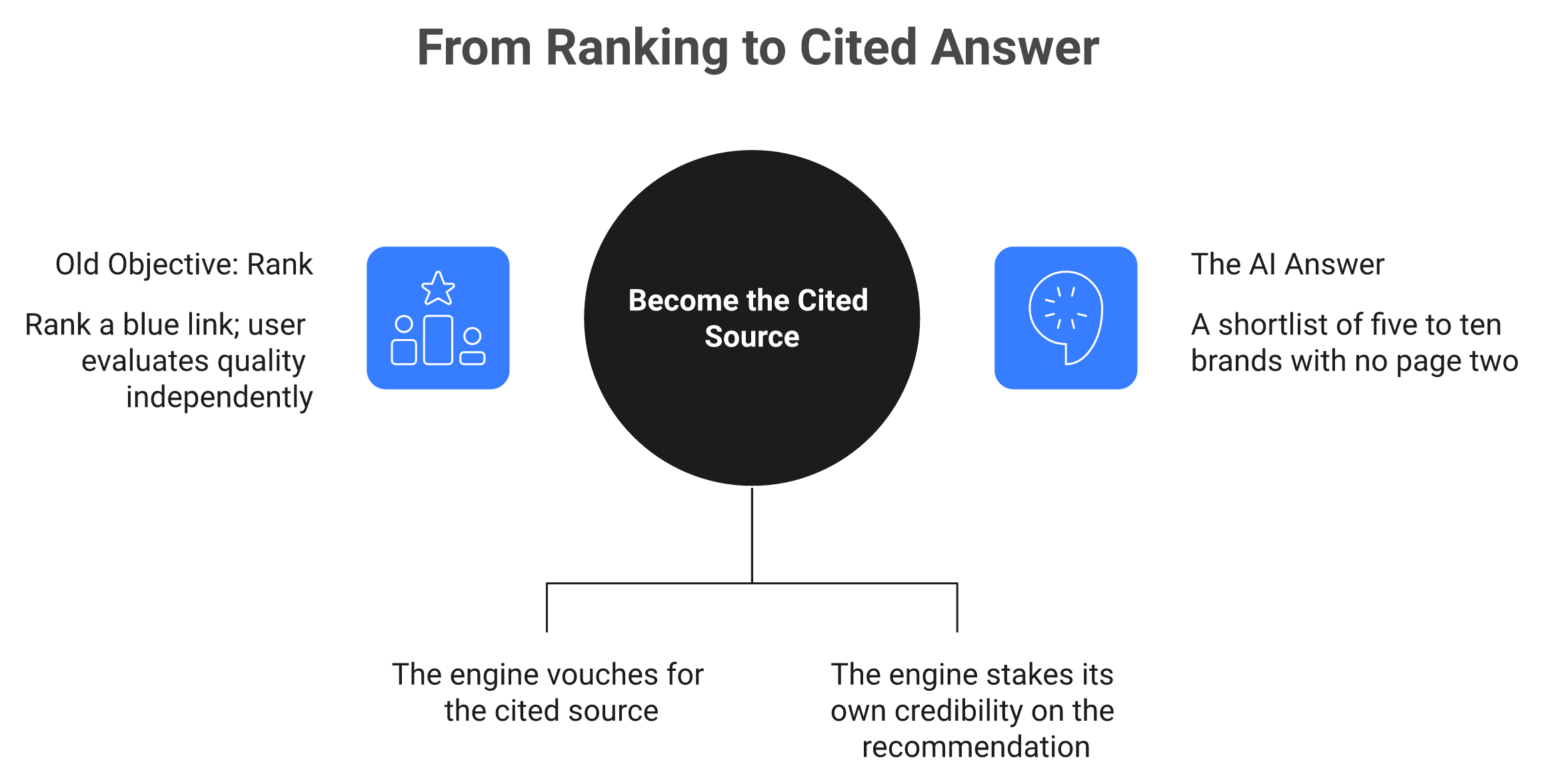
Ask any engine for the best business banking platform and you get five to ten names. That list is the consideration set. There is no page two, so the game is more binary than Google ever was.
🔁 Trust transfer is the mechanism
When an engine names you, it lends you its own credibility. The buyer arrives pre-sold, which is the simplest explanation I have for the conversion multiplier in Semrush's data. The engine did the shortlisting work your SDRs used to do.
MaximusLabs AI built its practice on the observation that what ChatGPT weights is not what Google or Perplexity weights. Many agencies added Generative Engine Optimization as a line item on a 2019 playbook, and we treat it as a data science problem instead. For Oliv AI that approach produced a 64% AI citation rate in 6 months, versus roughly 30% for billion-dollar incumbents, and 30 to 40% of inbound is now AI-sourced, as set out in the Oliv AI case study.
⚠️ Where I hold this loosely
MaximusLabs AI's data points one way on the conversion multiplier, though I might be reading it too strongly. Attribution in AI referrals is still messy, because many buyers read the answer, then search your brand directly. The citation is real. The clean referral line often is not.
What I am confident about is the direction. Being mentioned is not the finish line. Turning the mention into pipeline is.
Q3. What does YMYL actually gate, and how do you pass it?
YMYL means Your Money or Your Life. Google's Search Quality Rater Guidelines, updated September 11, 2025, hold finance pages to the highest quality bar, make Trust the foundation of E-E-A-T, instruct raters to research creator reputation off-site including customer reviews, and rate auto-generated content with little added value as Lowest. Eric Enge documents a financial site losing 99.3% of rankings after the November 2023 E-E-A-T core update.
The year everyone scaled content
Through 2023 and 2024, finance teams did the rational thing. Generative models got cheap, so output went up. One client I spoke with went from 8 posts a month to 60 without adding a single reviewer.
💸 Then the floor moved
Enge's case is the clearest published example of the downside. A financial site running mostly AI-generated content lost 99.3% of its rankings after the November 2023 update, and his conclusion was blunt: AI-generated content does not usually exhibit strong E-E-A-T, so human editors must judge quality against E-E-A-T before anything ships.
Google's own guidance now matches that. Pages whose main content is auto-generated with little added value sit at the Lowest rating in the Search Quality Rater Guidelines. Our E-E-A-T optimization guide walks the same criteria page by page.
Read YMYL as a guest list, not a penalty
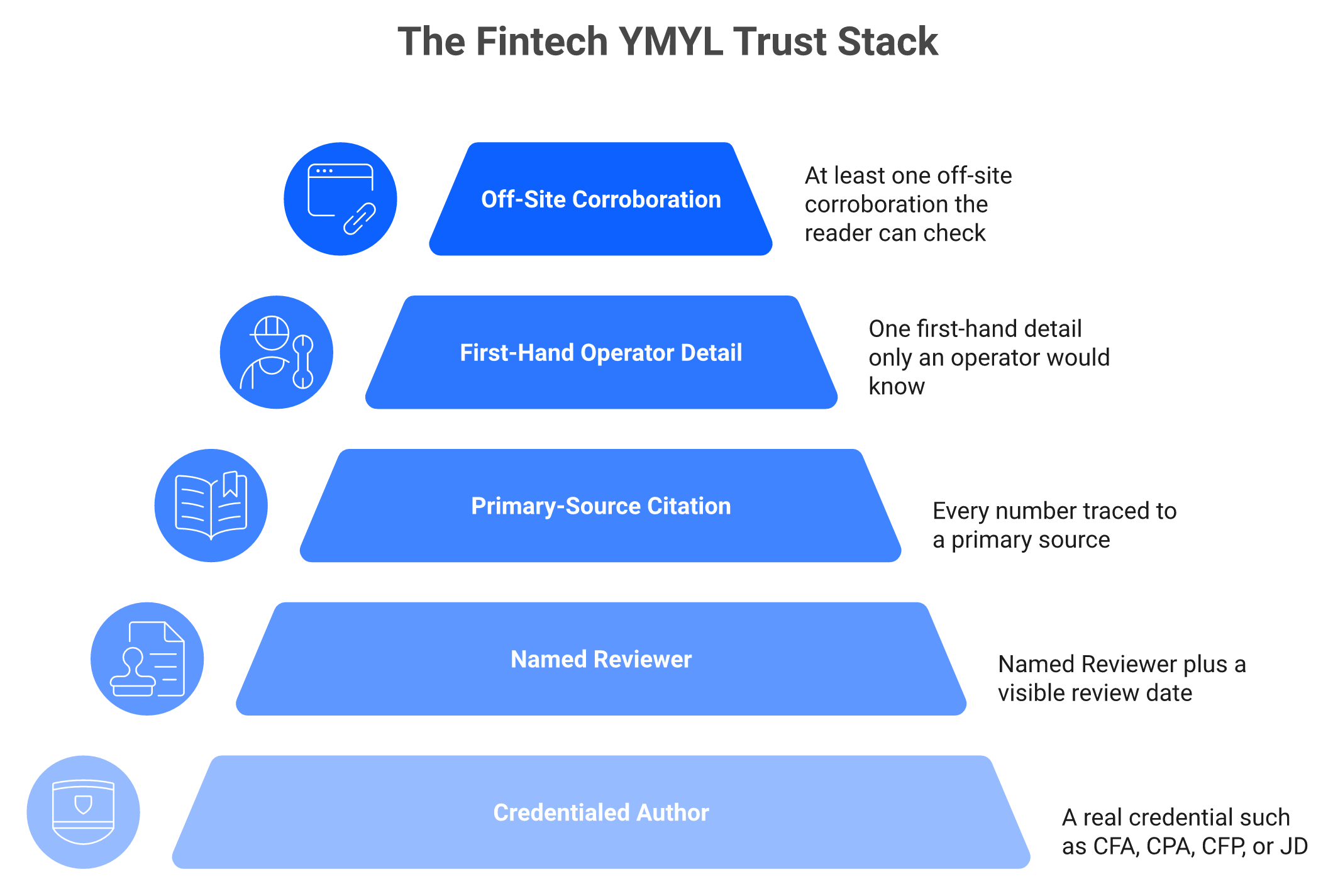
The standard framing treats YMYL as risk. My read is that this gets it backwards. YMYL is an entry list. If you are uncredentialed and uncorroborated, you were never in the candidate pool, so there was nothing to penalise.
🔍 The four things raters check
- Who created this, and are they qualified on this topic.
- What the wider web says about that creator and that site, including customer reviews.
- Whether claims are accurate and sourced.
- Whether the page adds anything a reader could not get elsewhere.
Notice that two of the four live outside your CMS. Your G2, Capterra, and Trustpilot profiles are part of your on-page trust, whether you manage them or not.
🧩 Why one thin page drags a cluster
Quality signals are assessed at passage and page level, then roll up into how a site is treated on money topics. A hundred strong pages plus forty thin glossary pages is not a hundred strong pages. It is a mixed signal about whether you take accuracy seriously.
MaximusLabs AI scores every article on 10 dimensions, with a hard floor of 70 out of 100 to publish and 80 for pillar pages, grading E-E-A-T signals and factual density separately. In fintech that gate is load-bearing, because the downside of a weak page is not mediocre performance. Teams that want the same bar applied to a regulated category usually start with our fintech SEO work.
The proof stack that clears the gate
✅ What to put on every money page
- A named author with a real credential, such as CFA, CPA, CFP, or JD.
- A named reviewer, plus a visible review date.
- Every number traced to a primary source, not a blog summary.
- One first-hand detail only an operator would know.
- At least one off-site corroboration the reader can check.
Treat that list as the minimum viable page in finance. Everything else in this guide assumes it is already in place.
Q4. How do you run a compliance-safe content workflow that still ships weekly?
Build five fixed gates: a credentialed subject-matter expert author, a named expert reviewer with a visible review date, every claim traced to a primary source, a compliance sign-off log, and a quarterly re-review cadence. Google's raters look for exactly these signals, so the controls that satisfy your legal team double as the on-page evidence that qualifies you for YMYL candidate pools.
The five gates, and who owns each
🗂️ Make the workflow an artifact, not a culture
| Gate | Owner | Artifact produced | Where it surfaces |
| Credentialed author | Content lead | Author profile with credential | Byline and author page |
| Expert review | SME or compliance | Signed review note | "Reviewed by X on DD Mon YYYY" |
| Source trace | Writer | Footnote per claim | References block |
| Sign-off log | Compliance | Dated approval record | Internal, audit trail |
| Re-review | Content ops | Quarterly ticket | Updated review date |
Every gate produces something a reader or a rater can see, except the sign-off log. That one exists so your legal team stops reading drafts line by line.
How to review without killing velocity
⏰ Pre-approve the language, not the article
Most review delay is not disagreement. It is the same five claims being re-litigated. Build a pre-approved claim library, with the exact wording legal has already cleared for rates, returns, eligibility, and regulatory status.
Writers pull from the library. Compliance only reviews what falls outside it. In practice, that moves review from a per-article bottleneck to an exception queue.
📋 Templated disclaimers, versioned
Keep disclaimers as versioned components, not copy pasted paragraphs. When a rule changes, you update one component and every page inherits it. This is also the only realistic way to survive a quarterly re-review across a few hundred URLs, which is why a documented content refresh cadence matters more in finance than anywhere else.
What AI may draft, and what a human must own
🤖 The split that keeps you out of the 99.3% club
- AI may draft: research aggregation, outlines, first drafts, formatting, metadata, internal link suggestions.
- A human must own: every number, every claim about eligibility or returns, the credential behind the byline, and the final publish decision.
Trust signals are the scarce asset now that AI-generated content has overtaken human content online. Unedited model output is not a shortcut in finance. It is a liability with a publish button.
MaximusLabs AI runs hybrid human and AI workflows precisely so compliance never becomes the reason content stops. AI handles research aggregation and first drafts, and humans own voice, claims, and sign-off. That split is why we ship 15 to 50 pieces a month without pushing unvetted financial claims live, and it sits underneath every Answer Engine Optimization engagement we run.
🧾 Make the credential machine-readable
Finally, declare the people. Each financial article should carry an explicit byline detailing professional credentials, with Person schema linking knowsAbout and sameAs to LinkedIn, Crunchbase, and relevant regulatory registries. The reviewer gets the same treatment, and our schema markup guide covers the property-level detail.
Humans read the byline. Engines read the markup. In a YMYL category, you need both saying the same thing.
Q5. Which fintech pages actually drive product sign-ups?
Roughly one in twenty landing pages drives about 85% of organic traffic and sign-ups. In fintech, the winners are consistently MOFU and BOFU archetypes (middle and bottom of funnel): problem and solution pages, segment pages such as payroll for global remote teams, specific workflow how-tos, and head-to-head comparison pages with live feature and pricing tables. Glossary definitions convert at effectively zero, because AI engines answer them natively.
Treat the 5% rule as a budget constraint
Ethan Smith of Graphite puts it plainly: 19 out of 20 landing pages drive little to no traffic, and one in 20 drives roughly 85% of all of it. That is not a content quality problem. It is a selection problem.
💸 What the other 19 pages actually cost
Each one consumes a brief, a writer, an SME review, and a compliance pass. In a regulated category, that review cost is the expensive part, not the writing. So publishing wide is more expensive in fintech than in any other software vertical.
My position here is not hedged. Top-of-funnel glossary content gets skipped on purpose in regulated categories. Smith's line about payroll definitions is the whole argument: a zero conversion rate, ever. We apply the same filter across every financial services engagement we run.
The four archetypes that earn their review cost
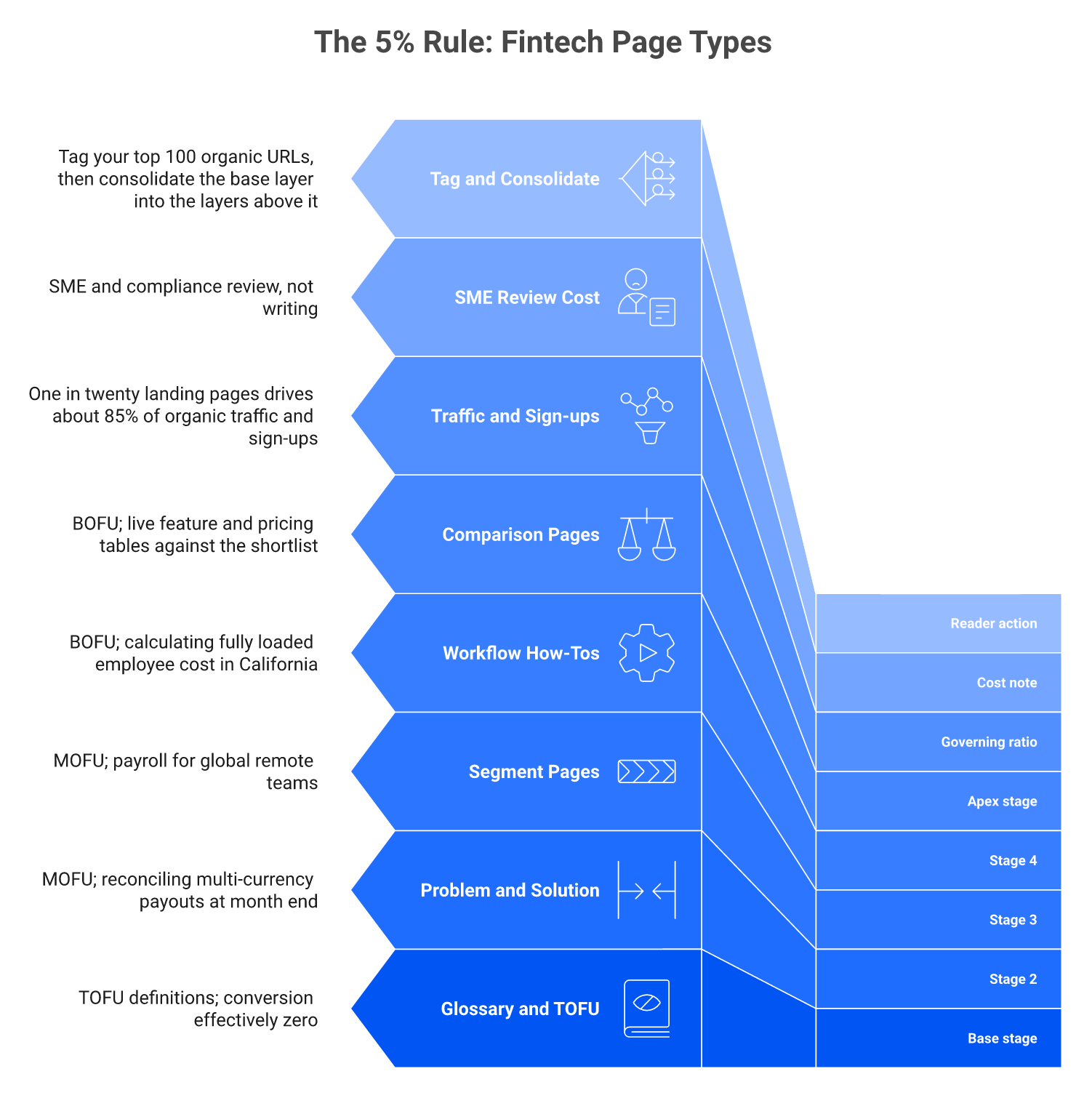
✅ Build these, in this order
- Problem and solution pages. Framed on the operational pain, not the product. Example: reconciling multi-currency payouts at month end.
- Segment pages. Tool for a specific buyer or motion. Example: payroll for global remote teams, or business banking for marketplace sellers.
- Workflow how-tos. The exact task. Example: how to calculate fully loaded employee cost in California.
- Comparison pages. You versus the two names your buyer already shortlisted, with current feature and pricing tables.
🎯 The Rippling pattern worth copying
Rippling did not win by chasing "payroll software." It built specialized pages for country-specific tax rules, Employer of Record setup (a third party that legally employs your staff abroad), and multi-currency payout mechanics. That is programmatic SEO applied to a compliance problem.
A Director of Finance searching "how to set up payroll in Argentina" has a live compliance problem. That page is the sales conversation, not an awareness touch.
Where the architecture does the work
⭐ Give every page one job
MaximusLabs AI builds hub-and-spoke architectures where the hub carries strategy at 5,000 to 8,000 words, and each spoke answers one operational question at 2,500 to 4,000. We keep the jobs separate so pages stop competing with each other for the same query, which is the same logic behind our GEO topic cluster model.
A program that funds nineteen zero-conversion pages to find one winner is not a strategy. It is a tax, paid quarterly.
The reallocation exercise for this week
⏰ Four steps, one afternoon
- Export your top 100 organic URLs with sessions and sign-ups side by side.
- Tag each as glossary, TOFU, MOFU, or BOFU.
- Consolidate or redirect glossary pages into the nearest workflow or segment page.
- Redeploy the freed review capacity into comparison and segment pages for your three highest-value clusters.
Expect the sign-up total to move before the traffic total does. In finance, that gap is the point, because the Director of Finance who reads one comparison page is worth more than a thousand readers of "what is payroll."
Q6. How do you identify high-intent fintech keywords without guessing?
Use cost per click as the intent signal. Paid bids are a live market price on commercial intent, and they correlate with conversion more reliably than search volume. High-CPC fintech clusters such as business checking, payroll compliance, and payment processing signal buyers. Low-CPC definitional clusters signal students and competitors. Score every cluster on CPC band, ICP fit, and who currently owns the results page before briefing a single page.
Why CPC beats volume in finance
Ethan Smith's shortcut is the most useful one in B2B keyword research: if you are unsure whether a topic carries intent, look at the CPC, and you will know whether it is likely to drive conversions. Advertisers have already paid to find out, and Google Ads documents how that auction price is set.
💰 The signal is other people's money
A keyword at a twelve dollar CPC has been tested by companies with conversion data. A keyword at thirty cents has not, because nobody bid. That is cheaper validation than any tool subscription.
Volume misleads here for a structural reason. Financial buying is infrequent. As Smith notes, the Director of Finance is not changing their bank every week, so the buying query is rare while the browsing query is common. Our AEO keyword and question research method starts from that asymmetry.
The three-factor score to run before briefing
📊 Score every cluster, then cut the bottom half
| Factor | What to check | Why it matters |
| CPC band | High, mid, or under two dollars | Live market read on commercial intent |
| ICP fit | Does your actual buyer own this problem | Filters high-CPC consumer finance noise |
| SERP ownership | Aggregators, vendors, or forums | Tells you whether you can win it at all |
A cluster needs two of three to earn a brief. All three, and it goes to the front of the queue.
⚠️ The trap in high-CPC consumer terms
Plenty of finance keywords carry a high CPC because lenders and card issuers bid on them, not because your buyer searches them. ICP fit is the filter that stops a B2B payments company writing about personal credit scores.
Match strategy to query class before picking the keyword
🔍 Three classes, three different plays
- Head queries. Example: best business bank. Strategy is citation and earned coverage, because aggregators own these results.
- Mid-tail queries. Example: best payroll software for remote teams. Strategy is a mix of your own segment pages plus third-party inclusion.
- Long-tail queries. Example: does this platform support Argentina EOR payouts. Strategy is owned content and product documentation, which win these natively.
Average AI chat queries run around 25 words, far longer than typed search queries. That pushes more of the fintech opportunity into the long tail, where your docs can win without any earned coverage at all. The query types answer engines prioritize follow the same pattern.
✅ What to do with the output
Pick the strategy first, then the keyword. A head query brief handed to a content writer produces a page that will never rank, and everyone involved learns the wrong lesson from it.
MaximusLabs AI scores clusters this way before any brief is written, which is how we avoid staffing pages that cannot win. The scoring takes an hour and saves a quarter.
Q7. Who wins "best business bank," and how do you engineer the off-site citations?
Head financial queries like best business checking are owned by publisher aggregators such as NerdWallet, Forbes, and Bankrate, and large language models inherit that bias. Winning them demands an earned strategy: review placements, press coverage, and analyst inclusion. Long-tail operational queries, such as payroll software with Argentina EOR support, are won natively by your own product and documentation pages. Match the strategy to the query class, then audit your off-site footprint.
The head term looks like the prize
Every fintech growth plan I have reviewed has "best business bank" or its equivalent at the top. It has the volume, the CPC, and the board-level recognition. It is also the one query your domain is least likely to win.
❌ Why your own page cannot win it
Open the results. Aggregators and personal finance publishers hold nearly every slot, and AI engines pull from that same pool when they assemble a shortlist. A vendor page arguing it is the best vendor is the least credible source available.
Google's rater guidelines reinforce the dynamic. Raters are told to research a creator's reputation away from the site, including customer reviews, in the Search Quality Evaluator Guidelines. The wider web is part of your page quality, whether you manage it or not.
Split the work: earned versus owned
⚖️ The decision table
| Query class | Example | Who wins | Your play |
| Head | Best business checking account | Aggregators and publishers | Earned: reviews, press, analyst lists |
| Mid-tail | Best payroll for remote teams | Mixed | Both: segment pages plus third-party inclusion |
| Long-tail | Argentina EOR payout support | Vendors and docs | Owned: product pages and documentation |
Owned Answer Engine Optimization (AEO) means your content becomes the answer. Earned AEO means reviews, Reddit threads, press, and listicles make engines trust you. Most programs only run the first half, which is why forum and Reddit AEO stays underbuilt in finance.
🔗 Close the entity loop
Connect sitewide Organization schema to Wikidata, Crunchbase, LinkedIn, and your financial review profiles on G2, Capterra, and Trustpilot. This is the plumbing that lets an engine confirm the brand in its answer is a real company with a verifiable footprint, and our entity optimization guide covers the property mapping.
The off-site audit that tells you where you stand
📋 Score each surface on three things
- Presence. Do you have a live, claimed profile.
- Recency. Is the newest review from this quarter or from 2023.
- Volume and spread. Enough reviews, across enough roles, to look real.
Run the same scoring on the five aggregator and listicle pages that already rank for your head term. Where you are absent, that absence is the gap, not your content.
⭐ Treat it as trust infrastructure
Search Everywhere Optimization is not link building with a new name. The goal is that every surface an engine checks says the same thing about you, with current dates on it, which is the definition of citation consistency.
MaximusLabs AI runs both pillars, Owned AEO and Earned AEO, with a citation-intelligence engine that maps which sources each engine actually trusts, then works to get clients into those sources. We measure the engagement on pipeline, not on mentions.
Q8. What does each AI engine need before it will cite a fintech page?
Each engine weights different signals. Princeton's GEO study, across 10,000 queries and 25 domains, found that adding authoritative quotations lifted visibility by up to 41%, statistics by roughly 30%, and keyword stuffing reduced it, while a fifth-ranked site gained up to 115% citation share. Pair that with platform-specific formatting: conversational depth for ChatGPT, dated sources for Perplexity, short answer nuggets for Google AI Overviews, and methodology transparency for Claude.
The retrofit list, with measured deltas
📊 What the research says to change first
| Change | Measured effect | Viable on YMYL pages |
| Add authoritative quotations | Up to +41% visibility | Yes, if the source is credentialed |
| Add statistics with sources | About +30% | Yes, with primary citations |
| Cite sources inline | Strong in combination | Yes, and required anyway |
| Increase keyword density | Negative, roughly 8 to 10% drop | No |
All four deltas come from Aggarwal et al., "GEO: Generative Engine Optimization," Princeton University and IIT Delhi, KDD 2024. The ranking position finding matters most for challengers. A site sitting fifth gained up to 115% citation share after optimization. You do not have to outrank the aggregators to be quoted alongside them.
🧠 Why engines disagree with each other
What ChatGPT treats as important is not what Google treats as important, and neither matches Perplexity. Each runs its own retrieval and its own trust signals, so one generic "AI optimization" pass leaves two engines unaddressed. Our citation pattern research across ChatGPT, Perplexity, and Gemini documents where they diverge.
The per-platform requirements
✅ Format for the engine you want citing you
| Engine | What it rewards | What to ship |
| ChatGPT | Conversational depth, expertise markers | Question-headed H2s, thorough self-contained answers |
| Google AI Overviews | Answer-first structure, E-E-A-T | 40 to 80 word nuggets, structured data, credentialed authors |
| Perplexity | Recency and source transparency | Dated references, visible numbered footnotes, readable prose |
| Claude | Depth and methodology | Long-form pillars, academic citations, explained process |
Each row has its own playbook, from Google AI Overviews optimization to Claude-specific structuring.
The block that gets extracted
⭐ Put the answer in the first 30%
Place a direct, 30 to 60 word factual answer block high in the body, inside the top third of the page. Retrieval happens at passage level, so the engine lifts a block, not a page.
Write it so it survives alone, with no heading and no surrounding paragraph. If it only makes sense in context, it will not get used.
MaximusLabs AI optimizes per platform rather than for AI generically, and runs daily AI-visibility tracking across every major engine, re-run and regression-tested. That same single strategy put Nidra Goods at number one across Google, ChatGPT, and Perplexity, as documented in the Nidra case study.
What to stop doing
❌ Two edits that cost citations
- Keyword density passes. The Princeton data shows these reduce visibility, and on finance pages they also read as untrustworthy.
- Unsourced statistics. A number without a named source is the fastest way to get skipped on a money topic.
MaximusLabs AI's data points one way on quotation density, though I might be reading it too strongly. What I am confident about is the direction: in fintech, every added credential and dated citation has helped, and nothing we removed from keyword tuning ever hurt.
Q9. What technical and schema foundation do AI crawlers need on a fintech site?
AI crawlers and financial re-indexers favour server-rendered HTML with time to first byte under 200 milliseconds, alongside passing Core Web Vitals including INP (Interaction to Next Paint), full HTTPS, and clean crawl paths. On top of that, declare trust in markup: Person schema with knowsAbout and sameAs, Organization schema closing the sameAs loop to Wikidata, Crunchbase, and review profiles, and reviewedBy, which has been associated with a 36% lift in YMYL AI citation probability.
Start with rendering and speed
⏰ What the crawlers actually reward
Server-rendered HTML beats client-side rendering here, because the crawler sees the content without executing your JavaScript. Keep time to first byte (the delay before the server sends its first byte) under 200 milliseconds.
Add the rest of the hygiene list: passing INP, HTTPS sitewide, no orphaned product pages, and app store listings that are indexable where you have a mobile product. None of this is a differentiator. All of it is a prerequisite, and it is the first layer in any technical SEO and website audit.
The schema stack for a regulated site
🧩 Deploy these, in this order
| Schema type | What it declares | Where it goes |
| Organization | Who the company is, with sameAs links | Sitewide |
| Person | Author and reviewer credentials, knowsAbout | Author and reviewer pages |
| Article | Publish date, author, reviewer | Every editorial page |
| Product or SoftwareApplication | The actual product | Product and pricing pages |
| BreadcrumbList | Site structure | Templates |
| HowTo | Step-by-step workflows | Workflow guides |
| Review or AggregateRating | Genuine first-party reviews only | Nowhere else |
Every type above is defined in the Schema.org vocabulary and governed by Google's structured data guidelines. That last row matters in finance. Marking up reviews you do not actually host is the fastest way to lose trust with both Google and your legal team, which is why our technical GEO implementation work treats it as a hard rule.
Be honest about what schema does
⚠️ The contested evidence
Null-result analyses from practitioners at SALT.agency and Search Atlas argue schema does not directly raise organic rank, and that high-authority sites simply deploy it more consistently. The YMYL view is different: schema declaring expert review has been linked to a 36% lift in AI citation probability.
Both can be true. My read is that schema is a verification filter, not a ranking lever. It helps an engine confirm who stands behind a money claim, which is exactly the check a finance page has to pass. Our schema markup guide separates the two cases property by property.
🔍 Where fintech audits break
MaximusLabs AI reads the papers and patents behind these systems rather than copying checklists, which is how we separate proven from merely correlated. On fintech audits, the broken item is almost always the entity sameAs loop. Organization schema exists, but it never connects to Wikidata, Crunchbase, or the G2 and Trustpilot profiles engines use to verify the brand is real.
Check that the crawlers can get in
✅ The five-minute diff worth running today
- Open robots.txt and search for GPTBot, ClaudeBot, PerplexityBot, and Google-Extended.
- Check your web application firewall rules for blanket bot blocks.
- Check CDN bot-management settings, which often block crawlers your robots.txt allows.
- Confirm your docs subdomain is covered by the same rules as the main site.
- Re-test after any security review, because these rules get reset quietly.
I have seen more fintech sites blocked by a firewall rule than by a content problem. The security team was right to be cautious. Nobody told them which user agents now decide whether buyers hear your name, a gap our guide to managing AI crawlers exists to close.
Q10. Why is boring B2B fintech video your most underserved channel?
High-LTV financial software categories have almost no video competition. People film travel and cooking, not multi-entity consolidation or Employer of Record payroll mechanics, so one competent walkthrough can own a category. Because Google, Gemini, and Google AI Overviews pull heavily from YouTube, these assets generate cross-surface citations that text alone cannot. The least entertaining topics are the most valuable ones to film.
Video gets filed under brand spend
💸 Why the budget never survives
In most fintech plans, video sits next to the conference booth and the rebrand. It needs a producer, a script, and a person willing to be on camera, so it gets cut in the first trim.
The logic holds for consumer categories, where video is brutally competitive. It falls apart in B2B finance, where the competitive set is close to empty.
The emptiest shelf in search
⭐ The asset-management test
Ethan Smith of Graphite makes the point with a specific category. Part of how you rank for best asset management software is simply to make a YouTube video about asset management software platforms, because there may be one, or none.
His conclusion is the useful part: the most interesting products to film are the least entertaining ones, precisely because they are not crowded. High lifetime value plus zero competition is a rare pairing.
📊 Why engines reach for YouTube
AI summaries lean on a small set of sources, and YouTube sits among the most-cited. So one video can surface inside Google results, inside Gemini answers, and inside AI Overviews from a single upload. Our multimodal search optimization guide covers the formatting that makes video extractable.
That is the cross-surface effect text rarely delivers. A blog post competes with forty blog posts. A screen recording of multi-entity consolidation competes with nothing.
Ship five, not fifty
✅ The production spec that actually gets made
- Pull your five highest-CPC clusters from the keyword scoring you already ran.
- Record a screen share of the exact workflow, with the product visible.
- Keep each one between six and twelve minutes.
- Say the query out loud in the first fifteen seconds, then answer it.
- Put a timestamped chapter list and a full transcript in the description.
No studio, no presenter, no agency. A product marketer with a headset and a sandbox account can produce all five in a week.
⚠️ Where I would temper expectations
These videos rarely drive big view counts, and the dashboard will look unimpressive. Their value shows up as citations and as sales calls where the buyer already understands the workflow.
Search Everywhere Optimization is the frame that makes this make sense. The surface matters less than being the source an engine reaches for when the question gets asked, which is the premise behind our AI citation acquisition tactics.
Q11. How do you measure fintech GEO against sign-ups, not impressions?
Measure citation share of voice across ChatGPT, Perplexity, Gemini, and Copilot, then tie it to completed sign-ups rather than sessions. Knowing your AI rank does not cause an outcome, and sixty-plus tools now sell near-identical API pings. Build a GA4 channel group for AI referrals instead. Semrush clickstream work puts AI search visitors at roughly 4.4 times the value of an organic visitor.
Replace rank with share of voice
📊 There is no position one in an answer
A Google rank is a single number. An AI answer is a shortlist of five to ten brands, assembled fresh each time, so the honest metric is how often you appear across many question variants.
MaximusLabs AI tracks share of voice across thousands of question variants per client, then segments it by engine. One engine improving while another stalls is the normal pattern, not an anomaly, and our GEO measurement and metrics framework is built around that variance.
The tooling trap
💰 Sixty tools, one feature
Ethan Smith counted over 60 AEO tools that all do the same thing, which is tracking, and his advice was to pick the cheapest one that does what you need, because you will probably be using Ahrefs anyway in two years. That matches what I see in fintech budgets, and our AEO tools comparison reaches the same conclusion on price.
⚠️ The API versus live interface gap
Here is the part that changes a decision. Roughly 95% of AEO tracking platforms query vendor API endpoints rather than scraping the live, logged-in interfaces buyers actually use, and the citation mixes differ.
So your dashboard can show steady citations while a logged-in ChatGPT user sees three competitors and not you. MaximusLabs AI runs monthly prompt panels against live interfaces for this reason, and we treat API-only data as directional at best.
Wire the revenue path
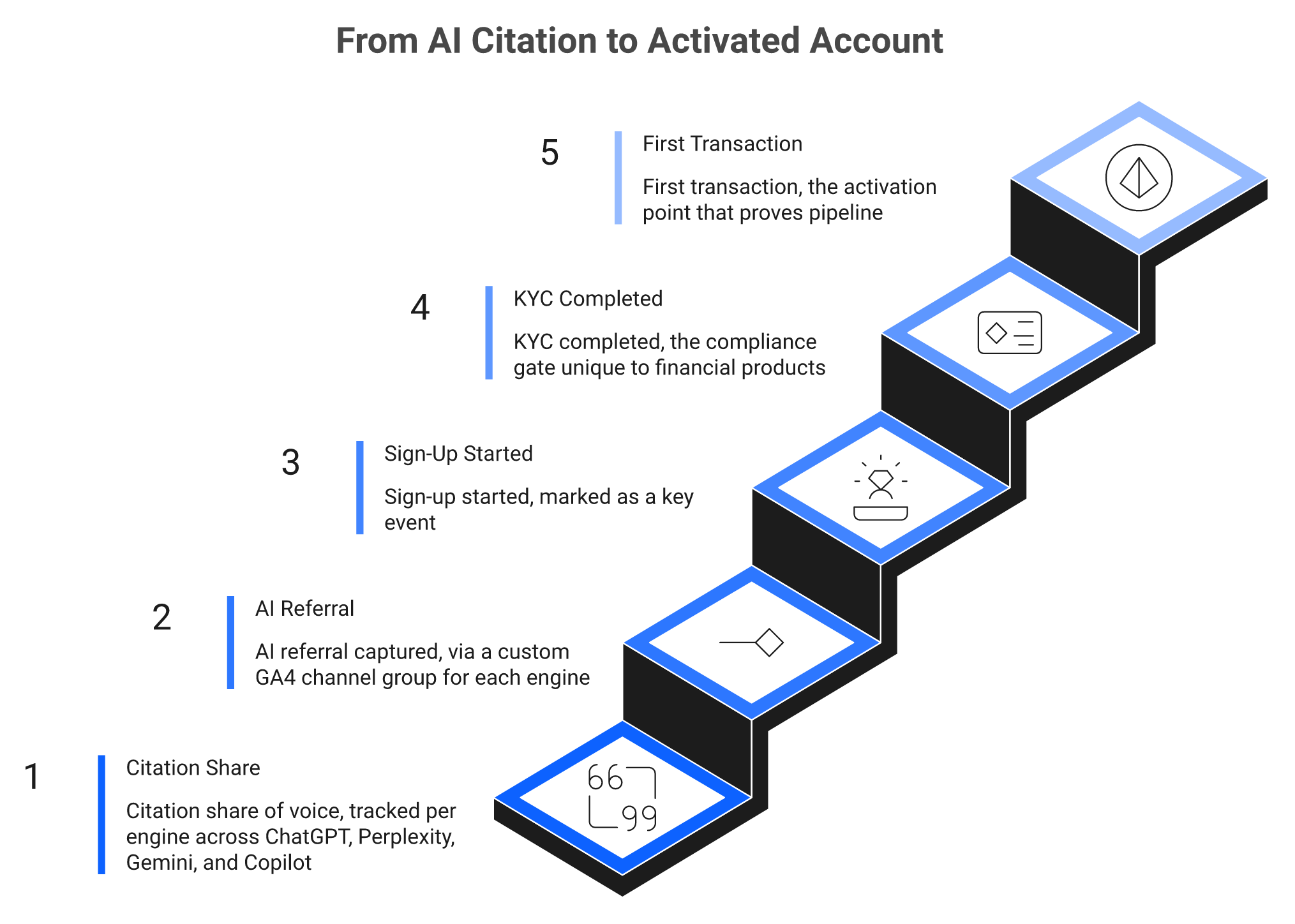
✅ The GA4 and GSC setup
- Create a custom channel group in GA4 for referrals from ChatGPT, Perplexity, Gemini, and Copilot.
- Mark sign-up, KYC start, KYC complete, and first transaction as key events.
- In Search Console, segment queries by whether an AI summary appears, then compare click trends separately.
- Report brand search volume alongside both, because many AI readers arrive by typing your name.
🔍 Measure the gates, not the sessions
In finance, the funnel has compliance gates. An AI-referred visitor has to start KYC (identity verification), finish it, and then activate, so drop-off at each gate tells you more than any traffic number.
Run the six metrics that matter: citation share by engine, prompt panel coverage, AI-referred sign-ups, sign-up rate by engine, credentialed-page ratio, and earned-mention count. That maps directly to how we handle revenue attribution for GEO initiatives.
MaximusLabs AI built internal tooling for this rather than renting a dashboard, because the dashboards that make clients feel good are rarely the ones that show pipeline. For Oliv AI the engagement produced 27 qualified leads, $47K+ pipeline, 26% close rate in 4 months, with 30 to 40% of inbound now AI-sourced, as documented in the Oliv AI case study.
Q12. How do you position the product so search traffic converts?
If your category label is narrower than your product, traffic converts badly no matter how well it ranks. Wave was found as accounting software while selling payroll, payments, and credit, so it repositioned as financial software and grew past 4 million customers tracking $200 billion in small-business transactions. Fix the category frame first, then let the high-intent pages work.
Rankings up, sign-ups flat
📉 The quarter that does not add up
This is the most common fintech situation I get called into. Rankings improved, the comparison pages are live, the technical audit is clean, and sign-ups did not move.
The instinct is to blame the content. Usually the content is fine. The page is answering a question the buyer did not ask about a category the buyer does not use for you.
What Wave had to change
🔁 The label was the bottleneck
Kirk Simpson, Wave's CEO, described the problem directly. As accounting software, the company struggled to get customers to understand it also provided payroll, payments, and later credit products, so it moved to calling itself financial software. The account appears in April Dunford's Obviously Awesome.
Note what did not change. Most new customers still arrived searching for accounting or invoicing software. The acquisition keyword stayed the same. The frame around it changed, and that is what let one visitor buy three products.
⚠️ Why this matters more in AI search
Engines build a working model of what your company is for. The wrong category label does not only depress conversion. It teaches ChatGPT, Perplexity, and Gemini to file you under a problem you no longer solve, then recommend you for the wrong queries. Fixing that is GEO competitive positioning work, not copywriting.
MaximusLabs AI positions the product exactly the way the client wants it positioned, starting with leadership interviews that capture the founder's view of the market before a brief is written. In fintech, that step is load-bearing, and we have found it harder to correct later than to get right first. The method is written up in our founder voice methodology guide.
Run the positioning audit
✅ Four questions, asked of your top page
- Does the page name the category your buyer actually uses in conversation.
- Does it name the outcome a Director of Finance is accountable for, not the feature list.
- Does it make the adjacent products obvious to someone who came for one.
- Would an engine summarising this page describe you the way you want to be described.
If any answer is no, fix the page before commissioning ten more.
⭐ Brand is what survives the updates
My most contrarian belief about this work is that positioning beats optimization over any real time horizon. Build the brand in your category, and engines have to recommend you, because the rest of the web keeps saying you belong there.
Answer Engine Optimization accelerates that. It does not substitute for it, and that is the sequencing we hold to across every AEO engagement.
Frequently asked questions
What is fintech SEO, and why can't we reuse our SaaS playbook?
Fintech SEO is the practice of optimizing regulated financial products so they rank in Google and get cited by AI engines like ChatGPT, Perplexity, and Google AI Overviews. It pairs intent-mapped content with the heavier trust signals Google demands of Your Money or Your Life pages. Three structural constraints break a standard SaaS playbook: • YMYL gating. Google's systems give more weight to strong E-E-A-T on topics affecting financial stability, so a thin page is not merely mediocre, it is disqualifying. • Infrequent buying. A Director of Finance does not change banks or payroll providers monthly, so search volume misrepresents real demand. • Claim risk. Every rate, return, or eligibility statement carries compliance exposure that your project management competitor never faces. MaximusLabs AI treats classic SEO as the foundation floor and trust engineering as the building on top, which is why our fintech engagements start with credential and corroboration audits rather than keyword expansion. We have watched finance clients pass every technical audit and still lose answer share, because the floor is measurable and trust is not. Our breakdown of how GEO differs from traditional SEO covers where the two disciplines separate.
Why does Google classify fintech content as YMYL, and what does that actually gate?
Google classifies finance as Your Money or Your Life because the content can significantly affect a person's financial stability. The Search Quality Rater Guidelines, updated September 11, 2025, hold these pages to the highest page-quality bar, with Trust as the foundation of E-E-A-T. In practice, YMYL gates four things: • Authorship. Raters check who created the page and whether they are qualified on that specific topic. • Off-site reputation. Raters are instructed to research the creator and the site externally, including customer reviews. • Accuracy. Claims need sources a reader can verify. • Added value. Auto-generated content with little added value sits at the Lowest rating. Read YMYL as a guest list rather than a penalty register. If a page is uncredentialed and uncorroborated, it was never in the candidate pool, so there was nothing to penalise. Eric Enge documents a financial site that lost 99.3% of its rankings after the November 2023 E-E-A-T core update, which is what the downside looks like at scale. MaximusLabs AI grades E-E-A-T signals and factual density as separate scorecard dimensions for exactly this reason, and our E-E-A-T optimization guide walks the criteria page by page.
Which fintech pages actually drive product sign-ups?
Roughly one in twenty landing pages drives about 85% of organic traffic and sign-ups. In fintech, the winners are consistently middle and bottom-of-funnel archetypes, and glossary definitions convert at effectively zero because AI engines answer them natively. Build these four types first: • Problem and solution pages. Framed on the operational pain, such as reconciling multi-currency payouts at month end. • Segment pages. Payroll for global remote teams, or business banking for marketplace sellers. • Workflow how-tos. The exact task, such as calculating fully loaded employee cost in California. • Comparison pages. You against the two names already on the shortlist, with current feature and pricing tables. Rippling is the pattern worth copying. It did not win by chasing payroll software; it built country-specific pages covering tax rules, Employer of Record setup, and payout mechanics. In a regulated category, the expensive input is SME and compliance review, not writing, so publishing wide costs more in fintech than anywhere else. MaximusLabs AI builds hub-and-spoke architectures where each spoke owns one operational question, and we skip top-of-funnel content deliberately. Our GEO topic cluster model shows how the jobs stay separated.
Can a fintech vendor ever rank for head queries like best business bank?
Rarely with your own domain. Head financial queries such as best business checking are owned by publisher aggregators including NerdWallet, Forbes, and Bankrate, and large language models inherit that bias when they assemble a shortlist. A vendor page arguing it is the best vendor is the least credible source available. Split the work by query class: • Head queries. Earned strategy only: review placements, press coverage, and analyst or listicle inclusion. • Mid-tail queries. A mix of your own segment pages plus third-party inclusion. • Long-tail operational queries. Owned content and product documentation win these natively. Google's rater guidelines reinforce the dynamic, because raters research reputation away from your site, including customer reviews. That makes your G2, Capterra, and Trustpilot profiles part of your page quality whether you manage them or not. Audit each surface on presence, recency, and review volume, then run the same scoring on the five aggregator pages already ranking for your head term. MaximusLabs AI runs both pillars, Owned AEO and Earned AEO, with a citation-intelligence engine that maps which sources each engine trusts. Our work on forum and Reddit AEO covers the community half of that footprint.
How do we get cited by ChatGPT, Perplexity, and Gemini for fintech queries?
Start with the measured levers. Princeton and IIT Delhi's GEO study, across 10,000 queries and 25 domains, found that adding authoritative quotations lifted visibility by up to 41% and statistics by roughly 30%, while keyword stuffing reduced it. A fifth-ranked site gained up to 115% citation share, so you do not have to outrank aggregators to be quoted beside them. Then format per engine: • ChatGPT. Question-headed sections and thorough, self-contained answers. • Google AI Overviews. 40 to 80 word answer blocks, structured data, credentialed authors. • Perplexity. Dated references and visible numbered footnotes. • Claude. Long-form depth with explained methodology. Place a direct 30 to 60 word factual block inside the top third of the page, because retrieval happens at passage level. Write it so it survives extraction with no heading around it. MaximusLabs AI optimizes per platform rather than for AI generically and runs daily AI-visibility tracking across every major engine, which is how a single strategy put Nidra Goods at number one across Google, ChatGPT, and Perplexity simultaneously. Our citation pattern research documents where the engines disagree.
What technical and schema setup do AI crawlers need on a fintech site?
AI crawlers and financial re-indexers favour server-rendered HTML with time to first byte under 200 milliseconds, alongside passing Core Web Vitals including Interaction to Next Paint, HTTPS sitewide, and clean crawl paths. None of that is a differentiator; all of it is a prerequisite. On top of the hygiene layer, declare trust in markup: • Organization schema with the sameAs loop closed to Wikidata, Crunchbase, LinkedIn, and your review profiles. • Person schema carrying author and reviewer credentials via knowsAbout. • Article, Product or SoftwareApplication, BreadcrumbList, and HowTo where each genuinely applies. • Review or AggregateRating only where you host real first-party reviews. Be honest about what schema does. Null-result analyses argue it is not a direct ranking factor, while schema declaring expert review has been linked to a 36% lift in YMYL AI citation probability. Both can hold: schema is a verification filter, not a ranking lever. Then confirm access by diffing robots.txt, firewall, and CDN rules against GPTBot, ClaudeBot, PerplexityBot, and Google-Extended. In MaximusLabs AI audits the broken item is almost always the entity sameAs loop, and our technical GEO implementation guide covers the fix order.
How do we measure fintech AI search performance against sign-ups instead of impressions?
Measure citation share of voice across ChatGPT, Perplexity, Gemini, and Copilot, then tie it to completed sign-ups rather than sessions. There is no position one in an AI answer, only how often you appear across many question variants, so rank is the wrong unit. Wire the path in four steps: • Create a custom GA4 channel group for AI referrals from each engine. • Mark sign-up, KYC start, KYC complete, and first transaction as key events. • In Search Console, segment queries by whether an AI summary appears before comparing click trends. • Report brand search volume alongside both, because many AI readers arrive by typing your name. Be sceptical of tracking spend. Over 60 AEO tools now sell near-identical tracking, and roughly 95% query vendor API endpoints rather than the live logged-in interfaces buyers use, so citation mixes differ from what your dashboard shows. MaximusLabs AI runs monthly prompt panels against live interfaces and built internal tooling rather than renting a dashboard, because we are measured on pipeline, not mentions. For Oliv AI that produced 27 qualified leads, $47K+ pipeline, 26% close rate in 4 months, detailed in the Oliv AI case study.