 Krishna Kaanth M
- AI Overviews cut outbound organic clicks by 38%, and zero-click behaviour rose from 54% to 72%, so clicks are no longer the unit of value on informational queries.
- Rank has decoupled from citation. Top-10 organic reliance fell from roughly 76% to 38% after the Gemini 3 rollout, with 31% of citations from beyond position 100.
- Build bottom-of-funnel first. AI Overviews trigger on 87% of B2B SaaS comparison searches and 73% of software how-to queries, where retrieval actually happens.
- Technical documentation is cited at 34% to 41%, versus 15% to 18% for blogs, making docs the highest-leverage content asset most SaaS teams already own.
- Earned mentions beat backlinks for AI visibility at r=0.664 versus r=0.218, and 100% of tools ChatGPT names had Capterra reviews, 99% had G2 profiles.
- Replace rank reporting with share of voice per engine plus pipeline influence per page, because 45% of marketing leaders cannot measure AI-answer visibility at all.
Q1. What is SaaS SEO in 2026, and what actually changed?
SaaS SEO is the practice of making a software product discoverable across Google and AI answer engines for the problems its buyers actually search, then converting that demand into trials, demos, and ARR. Three things broke in 2026. AI Overviews cut outbound organic clicks by 38% on queries where they appear. Classic rank decoupled from AI citation. And AI answers name only 10 to 15 vendors, with no page two.
A VP Marketing at a Series B product shares her screen. Rankings are up. Keywords in positions one through five have doubled year over year. Then the CRO asks a simple question about organic pipeline, and the room goes quiet. Nothing on the slide answers it.
⏰ The playbook that worked until roughly 2023
The old sequence was clean. Research keywords, publish on a cluster calendar, earn links, watch positions climb, and trust that clicks would follow. It worked because the ranking and the click were the same event. If you held position three, you got the visit.
That link between rank and traffic is what snapped, and it is the core of every GEO versus traditional SEO comparison we now run for clients.
📉 What the click data actually shows
Pew Research Center tracked 68,879 real searches from 900 US adults. When an AI summary appeared, users clicked a result 8% of the time, against 15% without one. Only about 1% clicked a link inside the summary itself.
A later randomized field experiment put a causal number on it. AI Overviews reduced organic clicks to external sites by 38%, and zero-click behavior rose from 54% to 72%. Self-reported satisfaction barely moved, which means users are not unhappy. They are just done.
⚠️ Rank and citation are now two different games
Here is the part most 2026 guides still miss. Being in the top 10 no longer predicts being cited. After the Gemini 3 rollout on January 27, 2026, reliance on top 10 organic results for AI Overview citations fell from roughly 76% to roughly 38%. Close to 31% of citations came from pages ranking beyond position 100.
I read that as the single most important shift of the year. You can win the SERP and lose the answer.
🧱 Foundation floor, then the building
MaximusLabs AI frames traditional SEO as the foundation floor and Answer Engine Optimization (AEO), the work of becoming the source AI engines cite, as the building constructed on top. Indexability, clean HTML, and crawler access are the floor. Retrieval eligibility, citation density, and passage extraction are the structure above it. Audits at MaximusLabs start with the second question, not the first.
My own read, and I hold it loosely, is that most teams are not behind on tactics. They are measuring a channel that changed shape underneath them.
✅ What this means for your next planning cycle
Three practical consequences follow from the data above.
Clicks are no longer the unit of value on informational queries. Pipeline influence is.
Pages outside your top 10 can still earn citations, so pruning by rank alone destroys assets.
Each engine retrieves differently, so one generic AI checklist will not cover ChatGPT, Perplexity, Gemini, and AI Overviews.
MaximusLabs AI runs AEO with SEO underneath it, as strategy and execution in one team, and reports engagements on pipeline rather than mentions. Krishna Kaanth's position is that this is a data science problem, not SEO plus a new acronym, which is why the work is built per platform instead of per checklist.
Q2. Why does SaaS SEO stall even when traffic goes up?
Because SEO harvests existing demand rather than creating it. A product sold to a narrow B2B niche gains visibility among buyers already looking, then grows only at the pace of category demand. Traffic climbs while revenue flattens, because the extra sessions sit at the top of the funnel. Score keywords by purchase proximity instead of volume.
💸 The dashboard that looks healthy and isn't
Eli Schwartz describes auditing an organization that measured paid media down to the dollar. For SEO, the reports counted keywords in position one, positions one through five, and the top 10. Total traffic had risen consistently. Revenue from the channel had flattened.
That gap is not a reporting failure. It is the channel telling you what it actually does.
📊 The ceiling nobody writes on the slide
Schwartz is blunt about the mechanism. SEO is an optimization channel, not a demand-creation channel. It improves visibility when demand already exists. In a defined niche, you get one strong lift when the site is first optimized, and after that you grow at the rate your category grows.
So if your category has 4,000 serious buyers, no amount of publishing invents a fifth thousand.
⚠️ The 5% rule, measured across real portfolios
Ethan Smith of Graphite has worked across Webflow, Upwork, Notion, and Rippling. His finding is uncomfortable and consistent. Roughly 19 out of 20 landing pages drive little to no traffic, and about one in 20 drives close to 85% of the total.
Pair that with his view on glossary content. He asks what the conversion rate on "definition of payroll" has ever been, and answers himself: effectively zero.
❌ What that makes of the standard content calendar
A twelve-post-per-month TOFU calendar is therefore not a growth engine. It is a 95% waste rate with a publishing cadence attached. The pages exist, the traffic chart rises, and the pipeline line stays flat.
MaximusLabs AI skips TOFU deliberately on new engagements, because answer engines now resolve "what is" queries natively, and starts instead on bottom-of-funnel pages where the buyer is already choosing. Its execution plan targets a first win inside 90 days on high-intent articles rather than a calendar.
✅ How to score a keyword by purchase proximity
This is the part you can action on Monday. For every target query, ask four things.
Does the searcher already know a solution category exists?
Are they naming vendors, prices, or integrations in the query?
Would a sales rep take this conversation today?
Does a page for this query have anywhere to send the reader next?
Three or four yeses means build it. One yes means park it.
🎯 What to defund, honestly
Cut glossary pages, generic trend roundups, and "ultimate guide" posts with no product surface. Redirect that budget into comparison, alternatives, integration, and use-case pages. I have watched this reallocation look like a traffic loss for two months and a pipeline gain by month four, and I would still take that trade every time.
MaximusLabs AI measures every engagement on pipeline, not on mentions. Public proof from the Oliv AI engagement sits at 27 qualified leads, $47K+ pipeline, and a 26% close rate in 4 months, with 30 to 40% of inbound now AI-sourced.
Q3. Which pages should a B2B SaaS build first, and in what order?
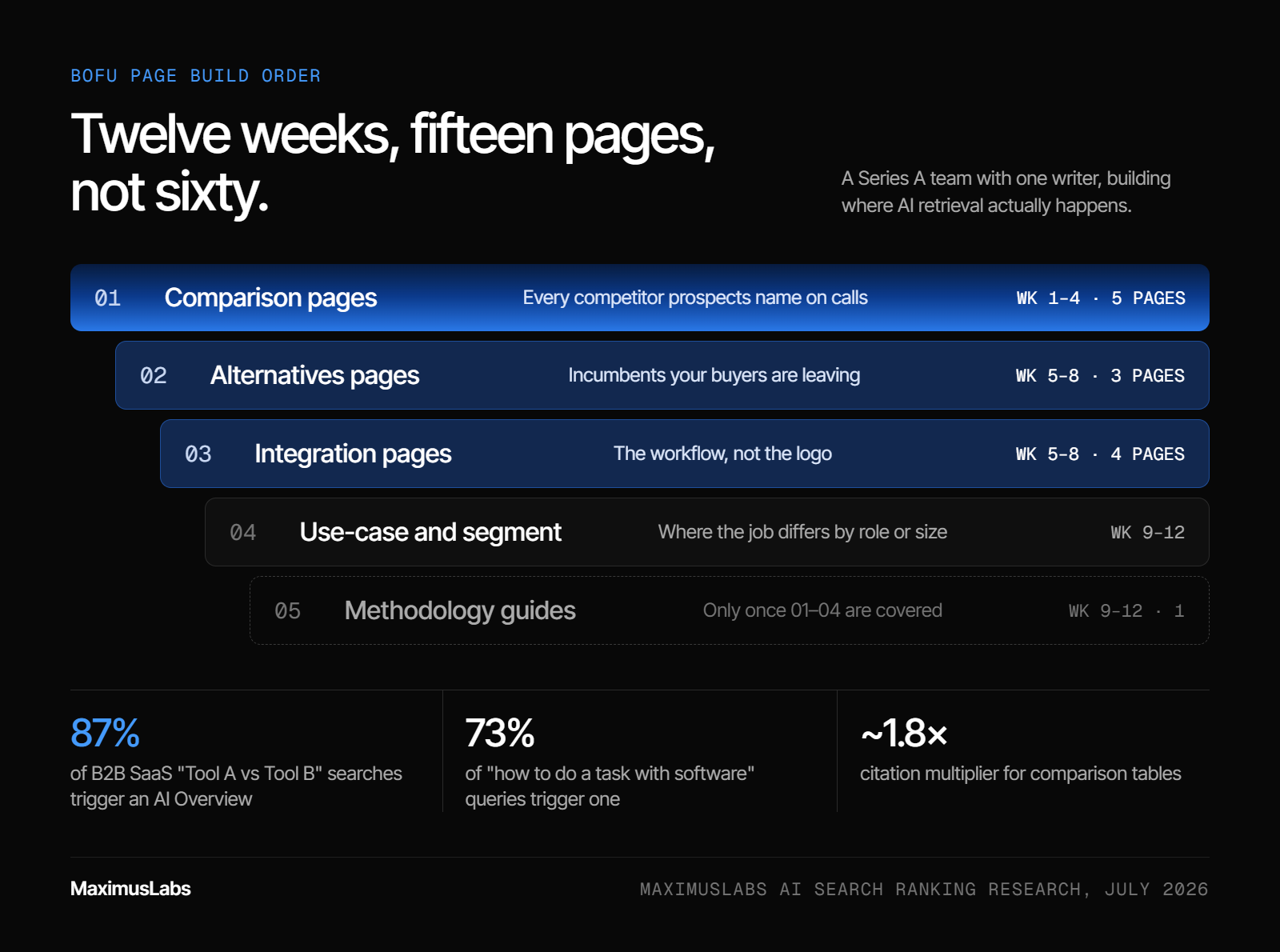
Build comparison pages, then alternatives pages, integration pages, use-case and segment pages, then middle-of-funnel methodology guides. AI Overviews trigger on 87% of B2B SaaS comparison searches and 73% of software how-to queries, so those page types are where retrieval happens. MaximusLabs AI sequences this work in four tracks and holds middle-of-funnel content until bottom-of-funnel coverage is exhausted.
⭐ The order, stated plainly
Head-to-head comparison pages for every competitor a prospect names on calls.
Alternatives pages for the incumbents your buyers are leaving.
Integration pages for each tool in your buyer's actual stack.
Use-case and segment pages where the job genuinely differs by role or company size.
Methodology and category guides, once the four above are covered.
📊 Why that order, not a different one
The sequence follows trigger rates, not preference. AI Overviews fire on 87% of B2B SaaS comparison searches of the "Tool A vs Tool B" shape, and on 73% of "how to accomplish task with software" queries. On that second query class, vendor technical documentation holds a 34% to 41% citation share against 15% to 18% for blog content, a pattern documented in the citation-pattern research.
Comparison tables carry roughly a 1.8x citation multiplier on those pages.
🔧 What each page must actually contain
A comparison page that gets cited is not an opinion piece. It needs a feature matrix with real rows, pricing tiers including the limits buyers hit, an honest pros and cons block for both sides, and a direct answer in the first 30% of the body text.
Integration pages need the workflow, not the logo. Otter.ai took ChatGPT share for "which meeting note transcription tool integrates with Looker" by publishing pages that spelled out the Zapier to BigQuery to Looker path.
✅ The four-track build, as MaximusLabs runs it
MaximusLabs AI splits bottom-of-funnel production into four tracks: exhaustive master articles per methodology, category listicles, competitor comparison and alternatives pages, and category-defining thought leadership. Service and landing pages are then written from needs surfaced during that research, which keeps positioning exactly where the client wants it rather than where a keyword tool points.
| Page type | Primary engine surface | Build order |
| Comparison | AI Overviews, ChatGPT | First |
| Alternatives | ChatGPT, Perplexity | Second |
| Integration | ChatGPT, Gemini | Third |
| Use case, segment | All four | Fourth |
| Methodology guide | Claude, Perplexity | Last |
🎯 Sequencing with real page counts
For a Series A team with one writer, this is twelve weeks of work. Weeks one to four produce your five highest-value comparison pages. Weeks five to eight add three alternatives pages and four integration pages. Weeks nine to twelve add segment pages and the first methodology guide.
Twelve to fifteen pages, not sixty. Krishna's framing helps here: head queries are won through third-party citations, mid-tail through a mix, and long-tail through owned depth. The build order simply follows the surfaces you control.
MaximusLabs AI holds middle-of-funnel work until bottom-of-funnel coverage is genuinely exhausted, because that is where pipeline shows up first in its own engagement data.
Q4. Should you consolidate into pillar pages or build segment pages?
Consolidate by intent cluster first, then split only by buyer segment. One strong page covering thousands of question variants concentrates authority and prevents fragmentation. Dedicated pages for startups or enterprise earn their place when the workflow genuinely differs, because engines match answers to the persona stated in the prompt. MaximusLabs AI splits pages where the ICP's job changes and consolidates everywhere else.
⚠️ The fragmentation most SaaS blogs already have
Open your own sitemap and search for your category term. Most teams find four or five near-duplicate pages, written eighteen months apart by different writers, each half-ranking and none winning. Internal links point in every direction. No single URL carries the topic.
That is the real cost of a keyword-per-post calendar, and it is the first thing a technical SEO audit surfaces.
📄 The consolidation case
Ethan Smith argues for one page per intent cluster, built to answer thousands of keyword and question variants rather than one. The reasoning is mechanical. Splitting an intent across five URLs splits the signals across five URLs, and no page accumulates enough authority to be the retrieved passage. That is the logic behind well-built GEO topic clusters.
Google's own generative AI guidance points the same way. Pages must be indexed and snippet-eligible, and the company states plainly that llms.txt, content chunking, and AI-specific markup are not needed for AI Overviews or AI Mode. Structure helps because it aids parsing, not because it is a separate lever.
👥 The segment-page case
The counter-argument is about prompts, not keywords. Real buyers do not type "best CRM." They type something closer to "best CRM for a 12-person B2B SaaS sales team already using HubSpot." Engines use that stated context when generating the answer.
So a page written for one role, at one company size, with one stack, has a structural advantage over a generic category page. MaximusLabs AI builds for that specificity on purpose, writing "Top Sales Automation Tools for SaaS Marketing Managers in B2B Startups" rather than "Best Sales Tools 2026."
✅ The test that decides it
Three questions settle most cases.
Does the buyer's actual workflow change between segments, or only the pricing?
Would the two versions share more than 70% of their body copy?
Do your sales calls surface different objections per segment?
Workflow changes and different objections justify a split. Pricing-only differences do not. If two drafts would share most of their text, you have one page with two sections.
🔗 The internal linking rule
Whichever way you split, every spoke links up to the hub with a descriptive anchor, and the hub introduces each spoke in a single sentence of context. No "click here." No orphan pages. One URL owns each distinct job.
| Approach | Best for | Known weakness |
| Single consolidated pillar | Head and mid-tail category queries | Weak persona matching in prompts |
| Dedicated segment pages | Long-tail, role-specific prompts | Thin content risk if workflows overlap |
| MaximusLabs AI model | Split by ICP job, consolidate by keyword | Needs real buyer research upfront |
MaximusLabs AI resolves this by segment rather than by keyword, which means a page exists where the ICP's job genuinely changes and nowhere else. That rule came out of its own GEO work with SaaS startups, where persona-specific pages outperformed consolidated category pages in prompt-level visibility.
Q5. What technical work actually makes a SaaS site AI-retrievable?
Three things matter. Let the retrieval crawlers in, render critical content in HTML, and keep entity data clean. OAI-SearchBot is a separate crawler from GPTBot, and blocking it removes a site from ChatGPT search answers. Google states that llms.txt, content chunking, AI-specific rewriting, and special markup are not needed for AI Overviews or AI Mode. Schema is parsing hygiene, not a citation multiplier.
🔧 The three rules, in priority order
Crawler access first. Nothing else matters if the retrieval bots cannot fetch the page.
Rendering second. If a bot cannot run JavaScript, the content has to exist in the HTML.
Entity hygiene third. Clean structured data helps engines work out which company you are.
Everything else people sell as technical AEO work sits below these three.
⚠️ Crawler access is where most audits should start
OpenAI documents its crawlers separately for a reason. GPTBot handles model training. OAI-SearchBot surfaces sites inside ChatGPT's search features. Blocking the second one removes you from ChatGPT search results, even if your Google rankings are untouched.
Do this on Monday. Open robots.txt, add an explicit allow for OAI-SearchBot, then grep your server logs for 200 responses on pricing and comparison URLs. If those URLs show no bot hits, you have found your problem, and an AI crawlability check will confirm it in minutes.
❌ What Google actually says, versus what gets sold
Google published its first explicit guidance on generative AI features on May 15, 2026. The document is unusually direct. It says llms.txt, content chunking, AI-specific rewriting, and special markup are not needed for AI Overviews or AI Mode. It also warns against inauthentic mentions.
Pages do need to be indexed, snippet-eligible, and opted into generative AI features in Search Console. That is the actual requirement. I have watched teams spend a full sprint on an llms.txt file while their pricing page sat noindexed.
📄 The honest position on schema
Controlled analysis across OpenAI, Gemini, and Perplexity found no direct correlation between JSON-LD schema density and citation selection. Authority and semantic relevance drove selection instead. A separate practitioner analysis frames schema as parsing hygiene and entity disambiguation, not a ranking multiplier. Google retired FAQ rich results on May 7, 2026.
So schema still earns its place, just not for the reason most decks claim. The highest-value piece is the sameAs loop, connecting your sitewide Organization schema to Wikidata, Crunchbase, LinkedIn, and G2. That is how engines confirm you are one entity rather than four similar names.
💸 Where not to spend
Core Web Vitals and exhaustive technical audits are the classic budget sink. Fifteen years of evidence shows site speed work yields far less revenue impact than content substance and bottom-of-funnel alignment. Fix what is broken, then stop. A 1.9 second load time does not make you citable.
| Work item | Actual effect | Priority |
| OAI-SearchBot access | Gates ChatGPT search presence | Do first |
| HTML rendering of key content | Gates all non-JS crawlers | Do first |
| sameAs entity loop | Improves disambiguation | Do second |
| llms.txt | No effect on Google AI features | Skip for Google |
| Core Web Vitals tuning | Minimal citation impact | Only if broken |
MaximusLabs AI ships schema, table modules, and JavaScript minimization in a Week 1 dev sprint, before any content goes live. We do not sell schema as a citation multiplier, because the controlled data does not support it, and I would rather say that early than defend it later.
Q6. Why is technical documentation your highest-leverage content asset?
Technical documentation carries a median AI citation rate of 34% to 41%, and roughly 29% of all citations. Blog and editorial content sits at 15% to 18%. That gap works out to a 10x to 15x advantage. The reason is structural, because docs are self-contained, authoritative, and answer-dense. Publish onboarding guides, feature reference pages, integration guides, and API docs before writing another thought-leadership post.
📊 The number that reorders your content budget
On "how to accomplish task with software" queries, AI Overviews fire about 73% of the time. On those queries, vendor technical documentation holds a 34% to 41% citation share. Blog content holds 15% to 18%, a split documented across the 2026 B2B SaaS AI search research.
Read that as a budget signal, not a content-type preference. Your docs are already the asset engines prefer.
🔧 Why docs win mechanically
Retrieval works on passages, not pages. An engine pulls a chunk, checks whether it answers the question, and cites it or discards it. Documentation is built that way by default.
Each doc page covers one thing. It states the answer without preamble. It carries no narrative lead-in, no personal anecdote, and no 300-word setup before the useful part. A blog post has to be edited into that shape through deliberate content formatting for AI search. A doc page already is that shape.
⚠️ The ownership problem nobody plans for
Here is where this stalls in real companies. Docs live with product or engineering. Content lives with marketing. Nobody owns the overlap.
So the pages that engines cite most often get updated least often, written by whoever shipped the feature, with no view of the queries buyers actually ask. In audits, MaximusLabs AI finds integration docs with stale screenshots sitting on URLs that already earn ChatGPT citations. That is free leverage going unused.
✅ The hub to build, in order
Integration guides, one page per tool in your buyer's stack.
Onboarding and setup guides for the first-week tasks.
Feature reference pages, one per feature, with limits and edge cases stated.
API documentation with working request and response examples.
Troubleshooting pages for the errors support sees weekly.
Start with integrations. They map directly onto the long-tail prompts buyers type, like "does this work with Salesforce."
💰 The cheaper path through it
Most teams assume this means commissioning a new content program. It usually does not. MaximusLabs AI starts documentation work by reorganizing what already exists into self-contained, answer-dense pages, which uses an asset the client has already paid for.
That cost discipline shows up in the numbers. MaximusLabs AI publishes a comparison putting 25 content assets a month at roughly $60 per piece, against $800 per piece for an in-house team and $260 at a traditional agency, which you can check against current plan pricing. I think the reorganization-first approach is underrated because it is unglamorous, and because nobody gets credit for fixing a page that already exists.
⏰ What to do on Monday
Pull your top 20 doc URLs. Check three things on each one. Does the first paragraph answer the title question in under 60 words? Is every claim about limits and pricing current? Does the page link to the relevant comparison or pricing page?
Fix those three things across 20 pages. That is one week of work, and it touches the content type engines cite most. A structured GEO content refresh cycle keeps it from decaying again.
MaximusLabs AI treats documentation as an Answer Engine Optimization (AEO) asset rather than a product chore, because the retrieval data points there first. Every engagement is still measured on pipeline, not on citation counts.
Q7. Do ChatGPT, Perplexity, Gemini and AI Overviews reward the same things?
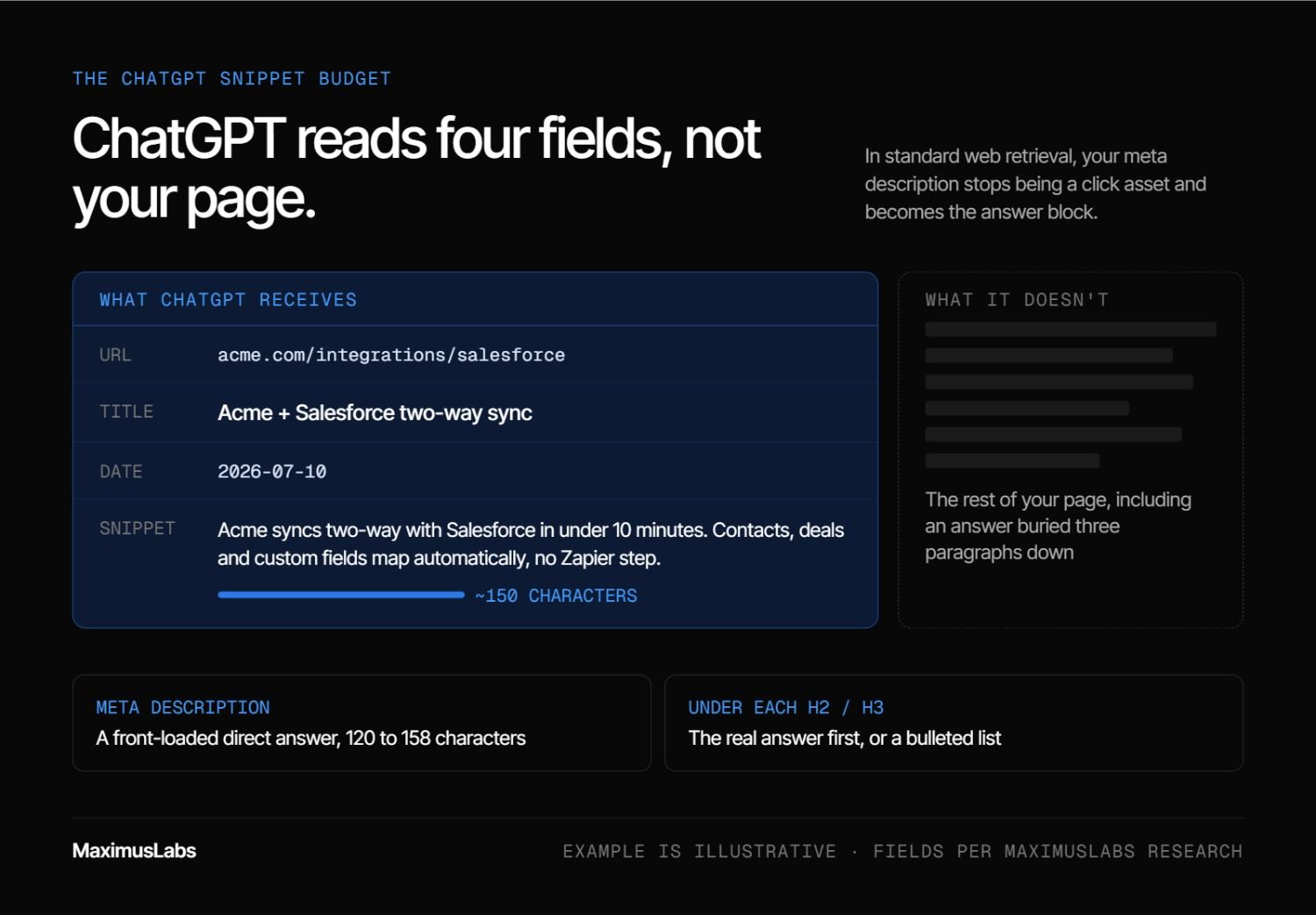
No. Each engine runs its own retrieval. ChatGPT's standard web retrieval receives only a URL, title, date, and a snippet of roughly 150 characters, so meta descriptions function as answer blocks. Perplexity rewards recency and visible sourcing. Google AI Overviews run on core Search ranking, yet only about 38% of citations now come from top-10 organic results. MaximusLabs AI tests ICP prompt sets across ChatGPT, Claude, and Perplexity separately, because the cited source set differs by engine.
⚠️ "AI search" is four different systems
Treating AI search as one channel is the most common planning error I see. Four engines, four retrieval stacks, four trust models. A single checklist cannot satisfy all of them, which is why the citation patterns across ChatGPT, Perplexity, and Gemini diverge so sharply.
Krishna's framing is the cleanest version of this. What ChatGPT thinks is important is not what Google thinks is important, and neither matches what Perplexity thinks is important.
📄 The ChatGPT snippet budget
This one surprises people. For standard web retrieval, ChatGPT does not receive your full page. It receives structured metadata: URL, title, date, and a snippet of around 150 characters, built from your meta description, a bulleted list, or text sitting under an H2 or H3.
So your meta description is not a click-through asset anymore. It is an answer block. Write it as a front-loaded direct answer of 120 to 158 characters, and put the real answer under the heading rather than three paragraphs down. Our ChatGPT SEO guide walks through the exact wording pattern.
📊 What each engine actually needs
| Engine | Primary signal | What to change first |
| ChatGPT | Snippet-level answer density, OAI-SearchBot access | Meta descriptions, text under H2s |
| Perplexity | Recency, visible sourcing, readability | Dated references, numbered footnotes |
| Google AI Overviews | Core Search ranking, snippet eligibility | Index status, direct answer blocks |
| Gemini | Entity clarity and corroboration | sameAs entity loop, third-party mentions |
| Claude | Long-form depth, methodology transparency | Full reasoning, primary-source citations |
❌ Why Google rank no longer carries you
AI Overviews run on Google's core ranking systems, which sounds like good news for an established site. The citation data says otherwise. After the Gemini 3 rollout on January 27, 2026, reliance on top-10 organic results fell from roughly 76% to roughly 38%, and about 31% of citations came from pages ranking beyond position 100.
Google's own generative AI guidance confirms the mechanism. Pages need to be indexed and snippet-eligible, with no AI-specific markup required. Eligibility is the gate. Rank is not, and AI Overviews optimization starts from that distinction.
🔧 How to prioritize without boiling the ocean
Do not optimize for all four at once. Pick based on where your buyers actually ask.
Build a prompt set of 30 real buyer questions, pulled from sales calls and support tickets.
Run every prompt on ChatGPT, Perplexity, Gemini, and Google AI Mode.
Log which domains get cited, per engine, per prompt.
Find the engine where competitors appear and you do not.
Fix that engine's specific signal first.
MaximusLabs AI runs exactly this as its AI source analysis step, mapping the cited source set per engine before any content is written. In our client work, the same prompt regularly returns two completely different citation sets across ChatGPT and Perplexity. I might be over-reading the consistency of that pattern, but it has held often enough that we now treat per-engine mapping as the default, not an add-on.
Q8. How do you get your SaaS into the AI sample set?
Earn third-party mentions. Brand web mentions, linked and unlinked, correlate with AI visibility at r=0.664, roughly 3x stronger than backlinks at r=0.218. Brands are 6.5x more likely to be cited through third-party content than through their own site. Head category queries are dominated by aggregators. MaximusLabs AI runs this as a Search Everywhere Optimization workstream, mapping the cited source set per engine before outreach begins.
⏰ The prompt that decides your quarter
John runs sales at a mid-market SaaS company. He needs better pipeline coverage. He opens ChatGPT and types a long, specific request: his role, his company type, his budget, and what he wants a tool to do.
Twelve seconds later he has a list of ten vendors with pros, cons, and rough pricing. He does not open Google. That list is now his evaluation set, and it mirrors what the B2B SaaS buyer journey research describes.
❌ Why this is harder than page two
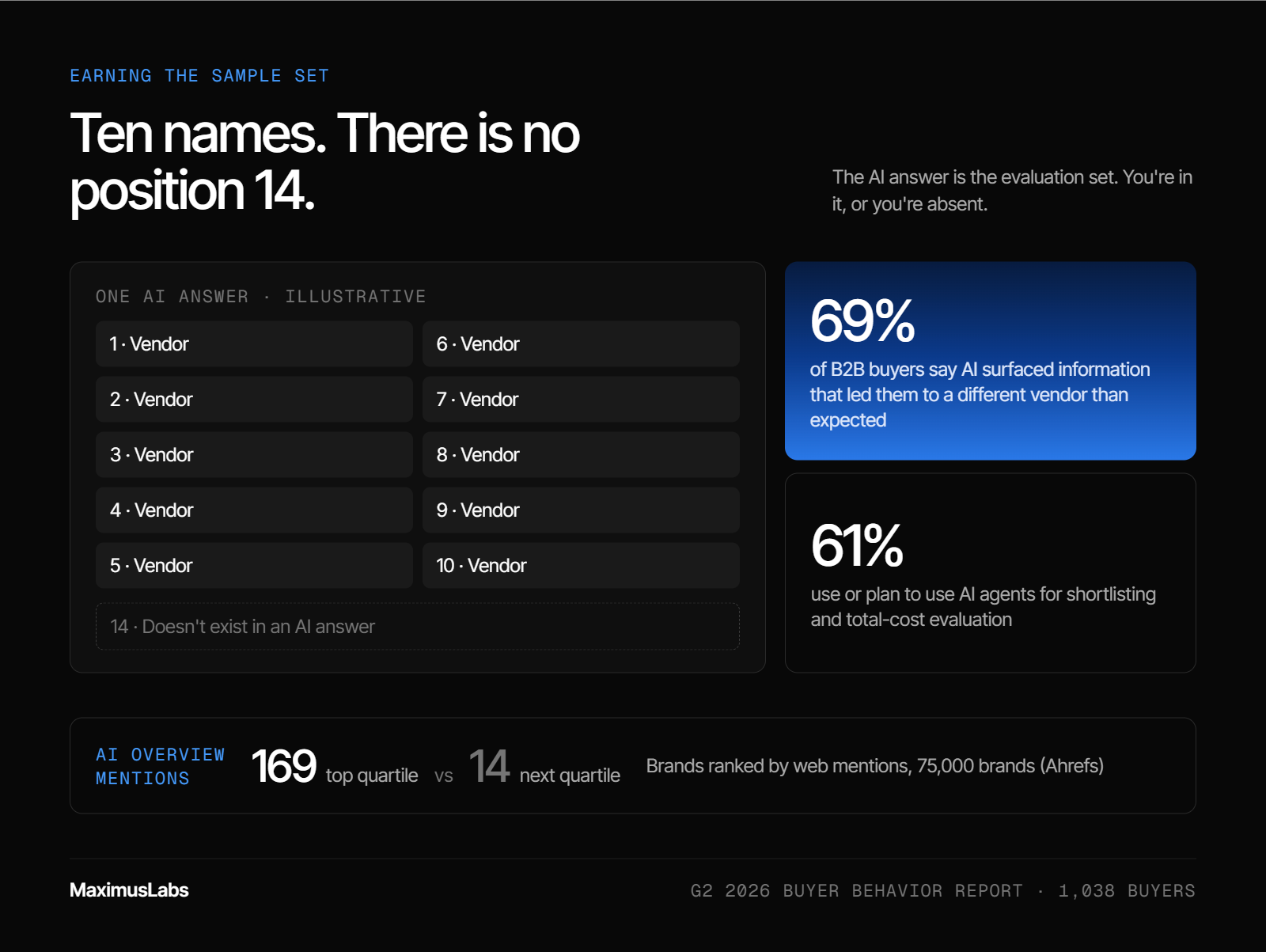
On Google, position 14 still existed. Someone determined could find you. In an AI answer, there is no position 14. There are ten names, and you are either among them or absent.
The buying data backs this up. G2's 2026 Buyer Behavior Report, covering 1,038 buyers, found 61% use or plan to use AI agents for shortlisting and total-cost evaluation. Separately, 69% said AI surfaced information that led them to a different vendor than expected.
That second number is the one I would put on a board slide. The engine is not just reflecting preference. It is changing choices.
📊 What actually drives inclusion
Ahrefs analyzed 75,000 brands against AI Overview presence. Brand web mentions, both linked and unlinked, correlated at r=0.664. Backlinks correlated at r=0.218. Brands in the top quartile by mentions averaged 169 AI Overview mentions, against 14 in the next quartile down.
Roughly 85% of brand mentions in AI answers come from external sources rather than the brand's own site. Pew's data adds a related detail: Wikipedia, YouTube, and Reddit together account for about 15% of the links inside AI summaries.
So the lever is not your blog. It is everywhere else, including Reddit and forum surfaces.
🔧 The earned-mention workstream
Build 30 to 50 ICP prompts that describe a real buyer, not a keyword.
Run them across engines and log every cited domain.
Rank those domains by how often they appear in your category's answers.
Pursue inclusion in the top 10, through listicle outreach, review profiles, podcasts, and genuine community participation.
Re-run the prompt set monthly and track which placements changed the answer.
Step two is the one teams skip. Without it, outreach is guesswork dressed up as strategy, and the citation acquisition tactics never compound.
✅ Why the mention is not the finish line
MaximusLabs AI calls this Search Everywhere Optimization and runs it as a named workstream, mapping the citation set each engine returns for ICP prompts, then pursuing inclusion in exactly those sources. Our read is that you reverse-engineer authority from the answers buyers already see, rather than guessing at it.
The point is still pipeline. When ChatGPT names a vendor, it stakes its own credibility on that answer, so the buyer arrives already convinced. MaximusLabs AI tracks this through to revenue: with Oliv AI, the public numbers are 27 qualified leads, $47K+ pipeline, 26% close rate in 4 months, a 64% AI citation rate in 6 months against roughly 30% for billion-dollar incumbents, and 30 to 40% of inbound now AI-sourced.
Q9. Do G2 and Capterra reviews still decide AI visibility?
They function as a gate. Of software tools ChatGPT names in recommendation answers, 100% had Capterra reviews and 99% had G2 profiles. After G2 acquired Capterra, Software Advice, and GetApp from Gartner for roughly $110M on February 5, 2026, the G2 family controls about 84% of review-site citations in bottom-of-funnel B2B queries. No profile means no presence in commercial answers.
⚠️ The threshold almost nobody checks
Start with the hardest number in this article. Of the software tools ChatGPT names when asked for recommendations, 100% had Capterra reviews, and 99% had a G2 profile.
That is not a correlation to debate. It is close to a prerequisite. A product with no review-site footprint simply does not appear in the answer, which is why B2B SaaS AEO strategy starts off-site.
💰 What the G2 consolidation changed
On February 5, 2026, G2 acquired Capterra, Software Advice, and GetApp from Gartner for roughly $110M. The G2 family now accounts for about 84% of review-site citations in bottom-of-funnel B2B queries.
One company now sits behind most of the third-party trust signal in your category. That cuts both ways. Concentration means a single workstream covers most of the surface. It also means a single platform decision can move your visibility, a risk worth tracking inside your GEO competitive analysis.
📊 Why engines lean this hard on reviews
Krishna's trust-first read explains the mechanism. AI-generated content now outnumbers human-generated content online, so engines cannot judge trust from the page alone. They look for outside verification instead, which is the core argument of the trust-first content playbook.
G2's own research supports the behavior shift. Its 2026 AI Search Insight Report found 51% of B2B buyers now start software research with an AI chatbot more often than with Google, and 69% said AI surfaced information that changed their vendor choice.
✅ The acquisition playbook, step by step
Claim and verify profiles on G2, Capterra, and Gartner Peer Insights. Verification matters more than design.
Fill every field: categories, feature tags, integrations, pricing, and screenshots.
Clear ten credible reviews per platform as a floor, not a target.
Source them from recent, active customers. Reviews older than 18 months carry less weight with buyers and with engines.
Run outreach by email and LinkedIn, segmented by use case, so the reviews describe different jobs.
Re-check quarterly. Category pages get restructured and tags go stale.
MaximusLabs AI runs this as a delivery item inside its Answer Engine Optimization (AEO) work, not as advice on a slide. We treat ten reviews per site as the floor, because thin profiles fail the citation gate even when the product is genuinely good.
❌ The mistake that costs the most
Ignoring review platforms because they feel like a legacy channel. I hear this from technical founders often, and I understand the instinct. The sites look dated and the review-begging feels undignified.
The data does not care. About 84% of commercial B2B citations route through that one family of properties. Skipping it removes you from the answer your buyer reads first, no matter how strong your E-E-A-T signals are on-site.
⏰ What to do this week
Open ChatGPT. Ask it to recommend tools in your category for your exact buyer. Write down the ten names it returns.
Then check each one on G2. In every audit MaximusLabs AI has run, the vendors in that list have profiles, and the absent ones usually do not. My hypothesis is that reviews act less as a ranking factor and more as an eligibility check, though I hold that loosely.
MaximusLabs AI builds review-platform coverage into the first 90 days of an engagement, alongside content, because citation work without third-party verification stalls. The measure stays pipeline, not profile count.
Q10. How do you write a page so AI engines actually cite it?
Front-load the answer. Direct answer blocks placed in the top 30% of body text capture a 44.2% citation share, a ski-ramp distribution. Add verifiable statistics, named-source citations, and expert quotations, because the Princeton GEO experiment measured up to a 40% visibility lift from exactly those three interventions. Keyword stuffing produced none. MaximusLabs AI requires a standalone 40-to-80-word answer block under every heading it publishes.
📄 The ski-ramp rule
Citations are not spread evenly down a page. Direct answer blocks sitting in the top 30% of body text capture roughly 44.2% of all citations. The distribution looks like a ski ramp, steep at the front, flat after.
So the practical rule is simple. Write a 30 to 60 word direct answer immediately under each heading, before any context or setup. Bottom Line Up Front, which means stating the conclusion first, is not a style choice here. It is where retrieval happens, and it drives AEO answer structure.
📊 What the Princeton experiment actually tested
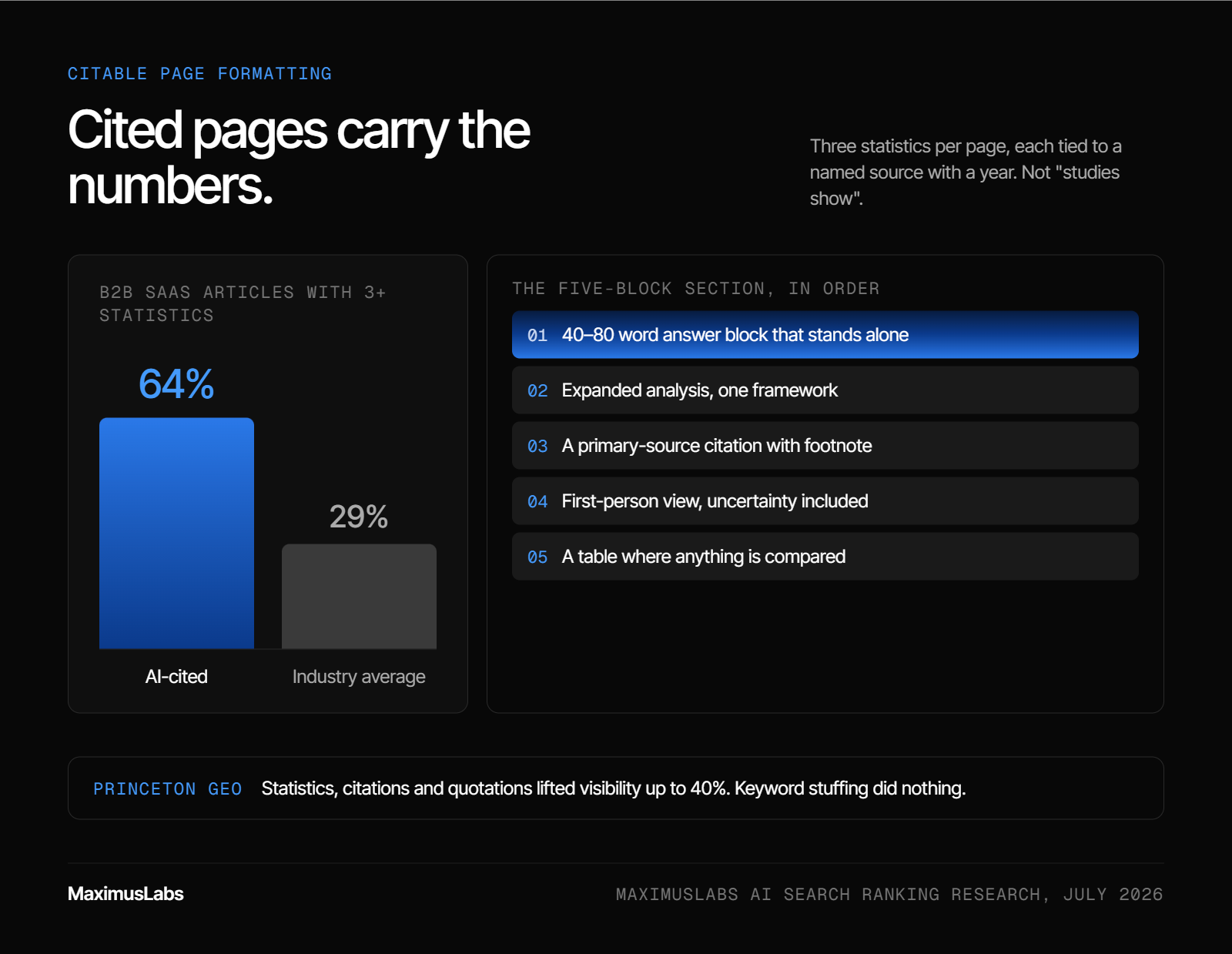
The GEO paper from Princeton, IIT Delhi, and Georgia Tech tested nine content interventions across 10,000 queries. Three worked: adding statistics, adding credible citations, and adding direct quotations. Together they lifted generative visibility by up to 40%.
Keyword stuffing did nothing, and sometimes hurt. That is the part most 2026 guides leave out while still recommending keyword density checks, and it is a recurring entry in our list of GEO mistakes to avoid.
✅ The statistical density target
Among AI-cited B2B SaaS articles, 64% contain three or more statistics. The industry average sits at 29%. The gap is large enough to act on without further debate.
Three statistics per page, each tied to a named source with a year. Not "studies show." Not "research suggests." The study name, the publisher, and the date. That discipline is what makes content citation-worthy to AI engines.
🔧 The five-block page structure
MaximusLabs AI writes every section to the same fixed shape, and the order matters more than the length.
A 40 to 80 word answer block that makes full sense if extracted alone.
Expanded analysis using one framework, either answer-first or situation-complication-resolution.
At least one primary-source citation with a visible footnote.
A first-person practitioner perspective with real uncertainty where it exists.
A table or list where a comparison is involved, since comparison tables carry roughly a 1.8x citation multiplier.
The answer block is non-negotiable in MaximusLabs AI's editorial standards for one reason. That is the block engines lift, with no title and no surrounding context.
⏰ The ten-page rewrite, in one week
Pick your ten highest-intent pages. Comparison pages first, then pricing, then integrations. For each one, do four things.
Insert a 40 to 80 word direct answer under every H2.
Rewrite the meta description as a front-loaded answer of 120 to 158 characters.
Add three sourced statistics with footnotes.
Add one comparison table if the page compares anything.
That is roughly four hours per page. Forty hours of work on ten pages beats forty new posts, and I would make that trade on any budget. A single pass through GEO content optimization covers all four steps.
MaximusLabs AI applies this structure across every client page and scores each article on ten dimensions before publication, with citation-worthiness as one of them. We built the scorecard because formatting discipline decays fast once volume rises, and pipeline follows the pages that stay citable.
Q11. How do you measure SaaS SEO when rank no longer predicts citation?
Track two things. Share of voice across thousands of prompt variants per platform, and pipeline influence per page. Semrush's 2026 AI Visibility Index found 45% of marketing leaders cannot accurately measure AI-answer visibility, while 81% of teams unifying SEO and AI visibility reported more traffic or leads. Weight AI traffic by value, because Webflow measured a 6x conversion rate on LLM-referred visitors versus Google organic. MaximusLabs AI reports share of voice instead of rank positions.
📊 The two-metric model
Replace the rankings table with two numbers.
Share of voice: how often your brand appears across a fixed set of buyer prompts, per engine, measured weekly.
Pipeline influence per page: which URLs appear in the journey of deals that reach a sales conversation.
Everything else is diagnostic. Rank, impressions, and mention counts tell you what happened, not what it was worth. Our GEO measurement framework treats them that way by default.
💰 Why small AI traffic still earns the budget
AI referral volume still looks tiny next to Google organic, which makes it easy to dismiss. The conversion data argues otherwise. Webflow measured roughly a 6x higher conversion rate for LLM-referred visitors than for traditional search traffic.
The mechanism is obvious once you see it. The buyer already asked five follow-up questions inside the chat. By the time they click, the research is done. They arrive pre-qualified, which is the whole case for GEO revenue attribution.
⚠️ The measurement gap, quantified
Semrush analyzed 126 million US AI search prompts between January and April 2026. It found 45% of marketing leaders cannot accurately measure brand visibility in AI answers, and only 9% can track every metric they need. Teams that unified SEO and AI visibility reported more traffic or leads 81% of the time.
That 45% is the real problem in most organizations. Not strategy, measurement.
❌ The tracking-tool trap
Here is where money leaks. Ethan Smith catalogued more than 60 AEO tracking tools and found they all do the same thing, which is ask a question, record whether you appeared, and chart it. His prediction is blunt: Ahrefs and Semrush will bundle the same feature for a fraction of the price, and anyone paying four figures a month will churn.
There is a second problem. Around 95% of third-party trackers query vendor API endpoints rather than scraping the live, logged-in interface. APIs return a different citation mix from what real users see, a caveat worth checking before you shortlist from any AEO tools comparison.
Knowing your rank does not cause an outcome. Pick the cheapest tool that answers your question and move the budget to content and earned mentions.
✅ The weekly prompt panel
Build this yourself in a spreadsheet before buying anything.
Write 30 to 50 buyer prompts from sales calls, support tickets, and lost-deal notes.
Run them weekly across ChatGPT, Perplexity, Gemini, and Google AI Mode.
Log brand presence, position in the list, and every cited domain.
Tag each prompt by funnel stage so you can weight bottom-of-funnel heavier.
Join the results to CRM data on deals that mention AI search.
MaximusLabs AI runs daily AI-visibility tracking across major engines, re-run and regression-tested, and states its engagement objective as inclusion in deep-research answers alongside top-10 Google positions for high-intent terms. We also tell clients when Google rankings will lag because site activity is low, which is uncomfortable but honest. With Oliv AI, the public numbers are 64% AI citation rate in 6 months, vs ~30% for billion-dollar incumbents, and 30 to 40% of inbound now AI-sourced.
Q12. What does the first 90 days and first year actually look like?
Days 1 to 14: allow OAI-SearchBot, confirm generative-AI eligibility in Search Console, ship schema, and verify G2 and Capterra profiles. Days 15 to 45: publish the highest-intent comparison and alternatives pages with front-loaded answer blocks. Days 46 to 90: build the documentation hub, run the review drive, and stand up share-of-voice tracking. Expect first bottom-of-funnel signups in months 3 to 7, and compounding organic from months 6 to 12. MaximusLabs AI runs its technical sprint in Week 1, before any content ships.
⏰ The three phases, with owners
| Phase | Work | Owner | Outcome to expect |
| Days 1 to 14 | Crawler access, Search Console eligibility, schema, review profiles | Dev plus marketing ops | Retrieval eligibility confirmed |
| Days 15 to 45 | 5 comparison pages, 3 alternatives pages | Content lead | First AI citations appear |
| Days 46 to 90 | Documentation hub, integration pages, review drive, prompt panel | Shared with product | Share of voice baseline set |
| Months 4 to 7 | Segment pages, earned-mention outreach | Marketing plus founder | First sourced pipeline |
| Months 6 to 12 | Methodology guides, refresh cycle, expansion clusters | Content lead | Compounding organic |
The 6 to 12 month benchmark is real and worth saying out loud to your board. AI citations usually arrive earlier than Google rankings, because retrieval depends less on domain age. That sequencing sits at the centre of our GEO strategy framework.
🔧 Why crawler access comes before content
OpenAI documents OAI-SearchBot as the crawler that surfaces sites inside ChatGPT's search features, separate from GPTBot. Google requires pages to be indexed, snippet-eligible, and opted into generative AI features.
Publishing into a blocked site wastes the whole quarter. MaximusLabs AI finishes this in Week 1 for exactly that reason, with schema and table modules shipped before the first article drops. If you are unsure where you stand, start with managing AI crawlers like GPTBot and Google-Extended.
❌ The do-not-fund list
Five line items that consume budget without moving pipeline.
Mass-produced "what is" posts. Engines answer those natively, and conversion is near zero.
Rank and traffic as primary KPIs. They no longer predict revenue.
Ignoring G2 and Capterra, which carry about 84% of commercial B2B citations.
Deep Core Web Vitals tuning on a site that already loads fine.
Standalone AEO rank trackers at four figures a month.
Cut those five and most teams free up half their content spend.
💰 What this costs to run
MaximusLabs AI publishes a cost comparison for 25 content assets a month: roughly $60 per piece against $800 per piece for an in-house team and $260 at a traditional agency, with writer, SEO manager, designer, and software included. Onboarding runs two days, against the two weeks of alignment plus a month of ramp that agency engagements usually need.
That economics question is the real one for a Series A founder. Krishna's zero-budget version still holds: fix the basics, write far deeper than the competition, understand your buyer's actual problem, and you will find a way into AI answers. Benchmarks for what peers actually spend sit in the 2026 GEO budget benchmark.
✅ What comes next
Agentic buying is the part I would plan for now. G2 found 61% of buyers use or plan to use AI agents for shortlisting and total-cost evaluation. When an agent, not a person, builds the shortlist, your structured data and third-party verification carry even more weight, which is the premise of agentic commerce work.
MaximusLabs AI runs AEO with SEO underneath, as strategy and execution in one team, measured on pipeline rather than mentions. The Oliv AI engagement produced 27 qualified leads, $47K+ pipeline, 26% close rate in 4 months.
Frequently asked questions
What is SaaS SEO in 2026, and how is it different from standard SEO?
SaaS SEO is the practice of making a software product discoverable across Google and AI answer engines for the problems its buyers actually search, then converting that demand into trials, demos, and ARR. Standard SEO optimises for rank and traffic volume. SaaS SEO optimises for purchase proximity, product-led pages, and citation inside AI answers where shortlists now get built. Three structural breaks separate 2026 from 2022: • Zero-click compression. AI Overviews cut outbound organic clicks by 38%, and zero-click behaviour rose from 54% to 72%. • Rank and citation decoupling. Reliance on top-10 organic results for AI Overview citations fell from roughly 76% to 38%, with about 31% of citations coming from pages beyond position 100. • The sample-set gate. An AI answer names 10 to 15 vendors. There is no page two. MaximusLabs AI frames traditional SEO as the foundation floor and Answer Engine Optimization as the building on top, so audits start with retrieval eligibility rather than rank reports. If you want the underlying mechanics, our breakdown of GEO versus traditional SEO explains what changed at the retrieval layer and what still carries over.
Which pages should a B2B SaaS company build first?
Build in this order: head-to-head comparison pages, alternatives pages, integration pages, use-case and segment pages, then middle-of-funnel methodology guides. The sequence follows retrieval data rather than preference. • Comparison pages. AI Overviews trigger on 87% of B2B SaaS comparison searches of the "Tool A vs Tool B" shape. • Integration and how-to pages. Software how-to queries trigger AI Overviews 73% of the time, and vendor documentation holds a 34% to 41% citation share there against 15% to 18% for blog content. • Tables matter. Comparison tables carry roughly a 1.8x citation multiplier on those pages. Glossary and "what is" pages convert at effectively zero, and answer engines already resolve them natively. For a Series A team with one writer, the realistic target is twelve to fifteen pages across twelve weeks, not sixty. MaximusLabs AI splits bottom-of-funnel production into four tracks: master articles per methodology, category listicles, competitor comparison and alternatives pages, and category-defining thought leadership. Our guidance on B2B SaaS AEO strategies maps each page type to the engine surface it is most likely to win.
How do I get my SaaS cited in ChatGPT, Perplexity, and Gemini?
Four things, in order of leverage. First, earn third-party mentions. Brand web mentions, both linked and unlinked, correlate with AI visibility at r=0.664, roughly three times stronger than backlinks at r=0.218, and brands are 6.5x more likely to be cited through third-party content than through their own site. • Allow the retrieval crawlers. OAI-SearchBot is separate from GPTBot, and blocking it removes you from ChatGPT search answers. • Front-load answers. Direct answer blocks in the top 30% of body text capture a 44.2% citation share. • Add evidence. Statistics, named citations, and direct quotations lifted generative visibility by up to 40% in the Princeton GEO experiment. Keyword stuffing produced nothing. • Optimise per engine. ChatGPT's standard web retrieval receives only a URL, title, date, and a roughly 150-character snippet, so meta descriptions function as answer blocks. MaximusLabs AI tests ICP prompt sets across ChatGPT, Claude, and Perplexity separately, then maps which sources each engine actually cites before any content gets written. Our documented AI citation acquisition tactics cover the outreach sequence that follows that mapping.
Do G2 and Capterra reviews still affect AI visibility?
They function as a gate rather than a ranking factor. Of the software tools ChatGPT names in recommendation answers, 100% had Capterra reviews and 99% had a G2 profile. A product with no review-site footprint does not appear in the answer at all. Consolidation raised the stakes. After G2 acquired Capterra, Software Advice, and GetApp from Gartner for roughly $110M on February 5, 2026, the G2 family accounts for about 84% of review-site citations in bottom-of-funnel B2B queries. One company now sits behind most of the third-party trust signal in your category. The playbook is unglamorous and finite: • Claim and verify profiles on G2, Capterra, and Gartner Peer Insights. • Fill every field, including categories, integrations, and pricing. • Clear ten credible recent reviews per platform as a floor, not a target. • Re-check quarterly, because category pages get restructured and tags go stale. MaximusLabs AI runs review-platform coverage as a delivery item inside the first 90 days of an engagement, not as advice on a slide, because citation work without third-party verification stalls. Our trust-first content playbook explains why engines lean this hard on outside verification.
Does llms.txt or schema markup actually help AI visibility?
Not in the way most agency decks claim. Google's generative AI guidance, first published on May 15, 2026, states plainly that llms.txt, content chunking, AI-specific rewriting, and special markup are not needed for AI Overviews or AI Mode. Pages do need to be indexed, snippet-eligible, and opted into generative AI features in Search Console. That is the actual requirement. On schema, controlled analysis across OpenAI, Gemini, and Perplexity found no direct correlation between JSON-LD density and citation selection. Authority and semantic relevance drove selection instead. Google also retired FAQ rich results on May 7, 2026. • Schema still earns its place as parsing hygiene and entity disambiguation. • The highest-value piece is the sameAs loop connecting Organization schema to Wikidata, Crunchbase, LinkedIn, and G2. • Other crawlers may read llms.txt, so the file is not harmful, just not a Google lever. MaximusLabs AI ships schema and table modules in a Week 1 dev sprint but does not sell either as a citation multiplier, because the controlled data does not support that claim. Our notes on schema markup basics set out where it genuinely helps.
How should I measure SaaS SEO when rank no longer predicts citation?
Track two numbers and treat everything else as diagnostic. Share of voice, meaning how often your brand appears across a fixed prompt set per engine, and pipeline influence per page, meaning which URLs appear in the journey of deals that reach a sales conversation. The measurement gap is real. Semrush analysed 126 million US AI search prompts between January and April 2026 and found 45% of marketing leaders cannot accurately measure brand visibility in AI answers, while only 9% can track every metric they need. Teams that unified SEO and AI visibility reported more traffic or leads 81% of the time. Weight AI traffic by value rather than volume. Webflow measured roughly a 6x higher conversion rate on LLM-referred visitors than on traditional search traffic, because the buyer finished their research inside the chat before clicking. • Write 30 to 50 buyer prompts from sales calls and lost-deal notes. • Run them weekly across ChatGPT, Perplexity, Gemini, and Google AI Mode. • Tag each prompt by funnel stage and join results to CRM data. MaximusLabs AI reports share of voice instead of rank positions and runs daily AI-visibility tracking across major engines. Our approach to GEO measurement and metrics details the full reporting model.
How long does SaaS SEO take to drive pipeline in 2026?
Expect retrieval eligibility inside two weeks, first AI citations in weeks three to six, first bottom-of-funnel signups in months three to seven, and compounding organic from months six to twelve. AI citations usually arrive before Google rankings, because retrieval depends less on domain age than ranking does. A realistic phased sequence looks like this: • Days 1 to 14. Allow OAI-SearchBot, confirm generative-AI eligibility in Search Console, ship schema, verify G2 and Capterra profiles. • Days 15 to 45. Publish five comparison pages and three alternatives pages with front-loaded answer blocks. • Days 46 to 90. Build the documentation hub, run the review drive, stand up share-of-voice tracking. • Months 4 to 12. Segment pages, earned-mention outreach, then methodology guides and a refresh cycle. What slows teams down is rarely strategy. It is publishing into a site the retrieval crawlers cannot reach, which wastes the whole quarter. MaximusLabs AI runs its technical sprint in Week 1 before any content ships, and onboards in two days rather than the two weeks plus a month of ramp typical of agency engagements. The Oliv AI engagement produced 27 qualified leads and $47K+ pipeline in four months.