 Krishna Kaanth M
- Ranking alone no longer guarantees attention. Pew found clicks drop from 15% to 8% when an AI summary appears, so interviews must test AI search skill.
- Demand third-party Ahrefs or Semrush charts from each client's onboarding month, call five references, and ignore logo walls and baseline-free percentages.
- Ask agencies to run your buyer prompts live in ChatGPT, Perplexity, and Gemini and explain why each cited source won.
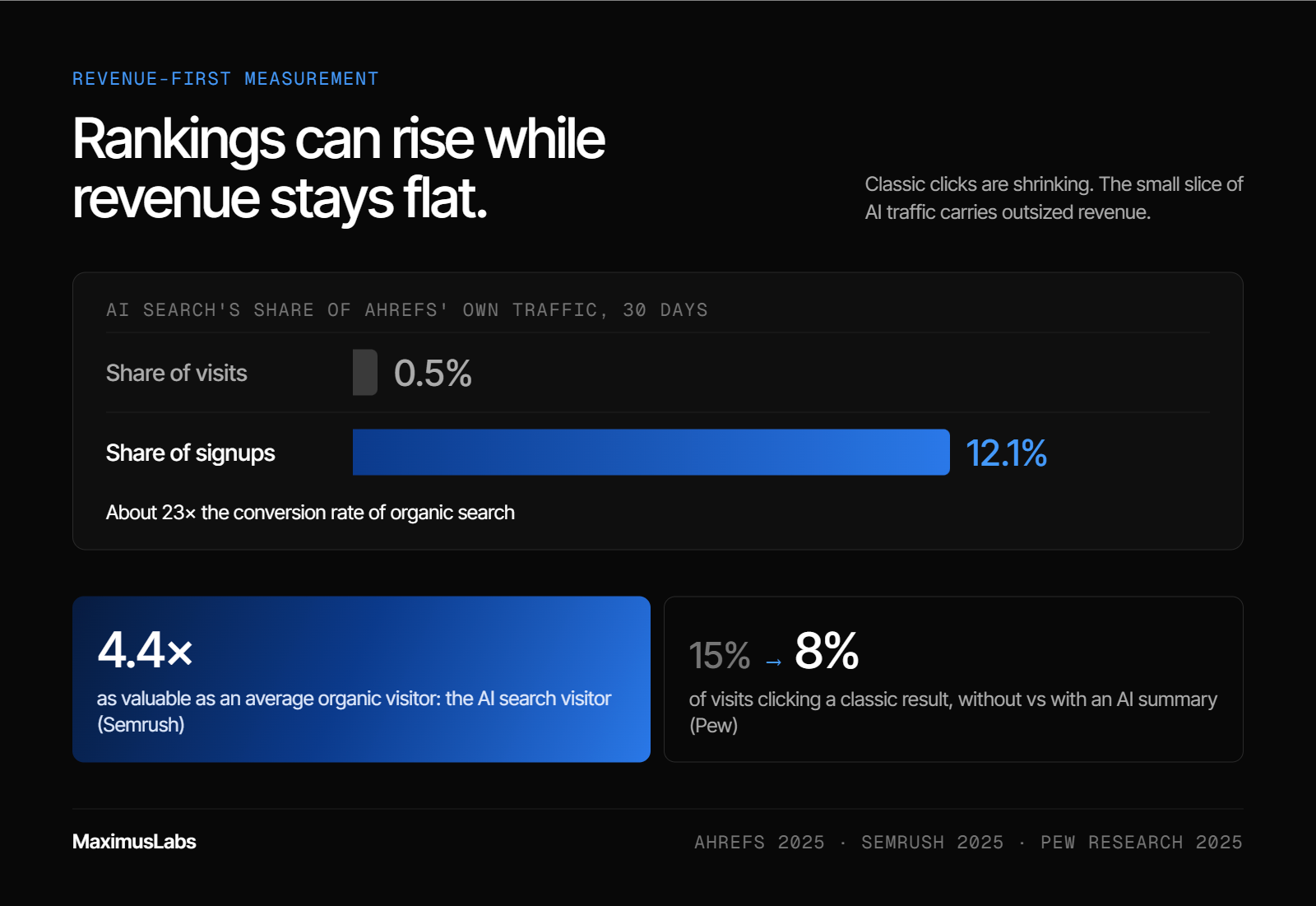
- Make pipeline the primary KPI. Ahrefs found AI search drove 12.1% of signups from 0.5% of visits, while rankings are only diagnostics.
- Name the account team in the contract, insist on a three-to-six-month term then 30 days' notice, and reject ranking guarantees and KPI bonuses.
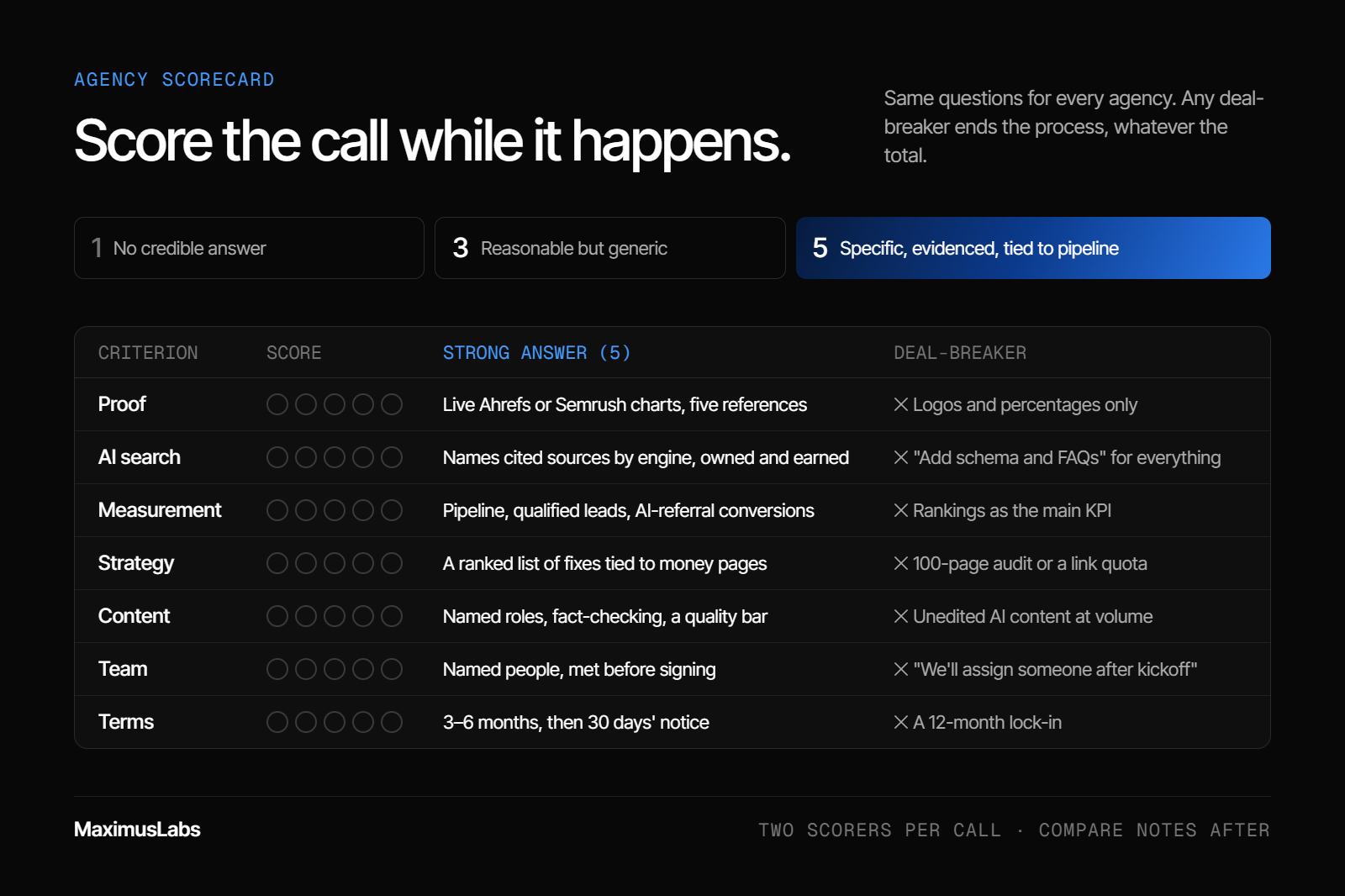
- Score every agency 1 to 5 on proof, AI search, measurement, strategy, content, team, and terms, and walk away on any deal-breaker.
Q1. Why Does Hiring an SEO Agency Need a Different Interview in the AI Search Era?
Hiring an SEO agency needs a different interview because ranking no longer guarantees attention. Pew Research Center found Google users clicked a traditional result on 8% of visits with an AI summary, versus 15% without one. An agency that only knows how to rank can deliver positions nobody clicks. The interview must test whether an agency can make your brand the answer AI engines cite, and whether it ties that work to pipeline.
How the Old Hiring Playbook Worked
⭐ The Report Everyone Recognizes
A VP of Marketing opens the monthly SEO report on a Tuesday morning. Rankings are up, impressions are up, and the traffic chart slopes nicely upward. Then the CEO asks one question in board prep: how much pipeline did organic create this quarter? Nobody in the room has a number.
That scene comes from how agencies were hired for a decade. Buyers compared pitch decks, keyword lists, and monthly fees. Agencies sold rankings, impressions, and clicks on fixed-scope retainers. Content was written for Google’s blue links, and almost none of it was tied back to revenue.
❌ The Death Spiral Behind Failed Hires
“They’ll give you a 50 page PDF and a bunch of charts and tables... and most of it’s zero impact work.”
Ethan Smith, CEO of Graphite
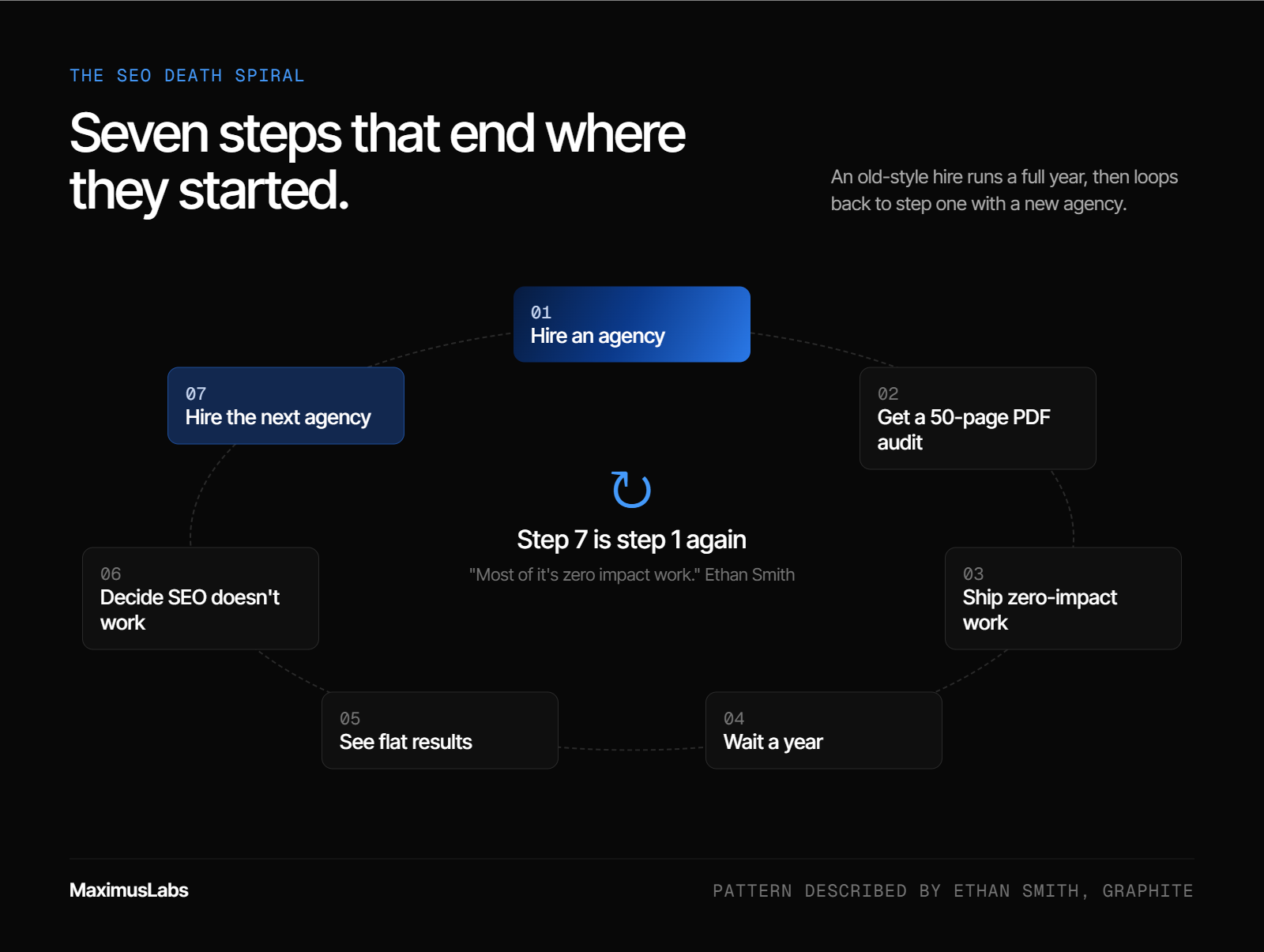
Smith calls what follows a death spiral. The client waits a year, sees flat results, decides SEO does not work, and hires the next agency. Phil Singleton, co-author of SEO for Growth, is just as blunt: “the vast majority of people who hire SEO companies are disappointed in their results.”
What AI Search Changed About the Job
⚠️ One Answer, a Handful of Brands
Buyers now ask ChatGPT, Perplexity, Gemini, Claude, and Google AI Overviews for recommendations. They get one written answer that names a handful of brands, often five to ten. A brand is either inside that answer or invisible. Pew found users ended their browsing session on 26% of pages with an AI summary, versus 16% without.
So the job has moved from ranking a page to becoming the answer. Answer Engine Optimization (AEO) is the practice of earning a place in those AI answers. Being mentioned is not the finish line, though. A mention that never becomes a demo request is just a new vanity metric.
✅ Four Failure Points to Probe
The rest of this guide turns that shift into interview questions:
Proof: Can the agency show results from the month it started? (Q2)
AI search skill: Can it explain why a source gets cited? (Q3)
Measurement: Does it report pipeline or just rankings? (Q4)
Team, process, and terms: Who does the work, and can you leave? (Q5 to Q8)
When I ran growth at WiseMonk, 98% of revenue came from SEO. That experience shapes how MaximusLabs AI thinks about agency hires. A bad hire is a company-level risk, not a channel experiment.
MaximusLabs AI was built for this shift. It runs AEO with SEO underneath, as strategy and execution in one team. It measures every engagement on pipeline, not on mentions, and humans approve everything that ships. The questions in this guide are the same ones we expect buyers to ask us.
Q2. What Proof Should You Demand Before Trusting an Agency’s Results?
Ask for third-party Ahrefs or Semrush traffic charts for three clients, starting from the exact month the agency was onboarded. If the agency claims Generative Engine Optimization (GEO) work, ask for AI citation trends too. GEO means earning citations inside AI-generated answers. Then call at least five live references about communication and revenue impact. Ignore logo walls, and reject growth percentages that hide the starting number.
Step 1: Run the Onboarding-Month Chart Test
✅ What to Ask For
Ethan Smith, CEO of Graphite, gives the simplest test in the industry. His advice: “ask them who they worked with when they started then look at their chart in [Ahrefs] and see if it went up.” Google’s own hiring guide also tells buyers to ask for examples of previous work and success stories.
Here is how to run it:
Ask for three client domains and the month each engagement began.
Open each domain in Ahrefs or Semrush yourself, or ask the agency to share its screen live.
Read the organic traffic line from that month forward. Look for sustained growth starting three to six months in.
Ask what the agency shipped in the months the line bent upward.
⚠️ Why Percentages Mislead
Relative claims are the most common trick in agency case studies. A “100% traffic increase” sounds strong until you learn traffic went from one visit to two. Always ask for the starting number, the ending number, and the time between them. Apply the same rule to AI citation claims. “Cited three times more often” means little without the prompt set and the starting share.
Step 2: Look Past Famous Logos
❌ The Fancy-Brand Trap
A logo wall proves an agency made a sale. It does not prove the agency moved a number. Smith warns buyers against assuming impact just because the client was famous.
Ask a sharper question instead. What were the client’s traffic, pipeline, and AI citation rate before you started? What were they six months later?
Step 3: Call Five References
⏰ A Reference Call Script
Five calls take an afternoon, while a wrong hire can cost a year. Use the same four questions on every call:
How fast did they respond, and who actually replied?
What did they ship in the first 90 days?
Did organic leads or pipeline change, and by how much?
What would you change about working with them?
Phil Singleton notes that many SEO companies “misrepresent their achievements and rarely even rank for their own services.” A reference who hesitates on the pipeline question is telling you something.
⭐ Where Most Agencies Come Up Short
MaximusLabs AI’s read is that a Google traffic chart is now only half the proof. Most agencies can show a traffic line. Very few can show how often ChatGPT or Perplexity cites a client over time. I think that gap is the clearest tell in 2026.
MaximusLabs AI makes this test simple by sharing dated citation data instead of slides. The Oliv AI record reads: “64% AI citation rate in 6 months, vs ~30% for billion-dollar incumbents.”
Q3. How Can You Test Whether an Agency Can Make You the Answer in AI Search?
Ask the agency to run five of your buyer prompts live in ChatGPT, Perplexity, and Gemini, then explain why each cited source won. Google says AI Overviews need no special optimization. Yet a KDD 2024 study found targeted content changes lifted visibility in AI answers by up to 40%. MaximusLabs AI maps the cited sources for each buyer prompt before writing. That method took Nidra Goods to #1 for “best sleep mask” on Google, ChatGPT, and Perplexity.
The Pitch-Deck Version of AI Search
💸 Buzzwords Without a Method
Every agency pitch in 2026 has an AI slide. It says GEO, AEO, and “LLM visibility” in large type. Ask the presenter how ChatGPT chose its sources for your category, and the room often goes quiet.
Many agencies bolted AI search onto an old SEO retainer. Some resell prompt-tracking dashboards at a steep markup. Ethan Smith counts more than 60 such tracking tools and calls them largely a commodity. I keep asking one thing of these offers: how can you sell a service you don’t fully understand?
What the Research Actually Says
⚠️ Google and the Researchers, Side by Side
Google’s documentation is direct: “There are no additional requirements to appear in AI Overviews or AI Mode, nor other special optimizations necessary.” The GEO paper from Princeton and partners found optimization could boost visibility in generative answers by up to 40%. Its authors also found results varied by domain.
Both statements hold. Strong SEO is the floor for being eligible. What gets you chosen differs by platform, by question type, and by which third-party sources each engine trusts. Pew found Wikipedia, YouTube, and Reddit were the most-linked sources in Google’s AI summaries.
The Live Test to Run
✅ Five Prompts, Three Engines
Write five prompts a real buyer would type, such as “best sales forecasting software for mid-market SaaS.”
Ask the agency to run them live in ChatGPT, Perplexity, and Gemini.
For each answer, ask which sources were cited and why those sources won.
Ask what they would change on your site and off it, such as reviews, Reddit, or listicles.
Ask how they would track the result every week.
A strong answer names specific sources and separates your own content from third-party mentions. A weak answer repeats “add schema and FAQs” for every prompt. The best answers also admit what the agency cannot yet measure well, such as buyers who read the answer and never click.
⭐ Why This Is a Data Problem
MaximusLabs AI treats GEO as a data science problem, not SEO with a new label. Its daily tracking regularly shows different engines citing different sources for the same prompt. I might be wrong about how fast this keeps changing, but I’d hire no agency that can’t explain it.
MaximusLabs AI runs this test on itself every day. A citation-intelligence engine maps which sources each engine trusts. The work then splits into two pillars. Owned AEO makes your content the answer, and Earned AEO uses reviews, Reddit, press, and listicles to make AI trust you. Most agencies only do the first.
Q4. Should an Agency Measure Success by Rankings, Traffic, or Pipeline?
Measure pipeline first. Rankings show a page is on Google, not that anyone bought. Ahrefs found AI search sent 0.5% of its visits but 12.1% of its signups in 30 days. Semrush found the average AI search visitor was 4.4 times as valuable as an organic visitor. MaximusLabs AI reports AI share of voice beside pipeline. Its Oliv AI record reads: “27 qualified leads, $47K+ pipeline, 26% close rate in 4 months.”
When the Rankings Chart Lied
💸 The SurveyMonkey Lesson
Eli Schwartz saw this firsthand at SurveyMonkey. The company tracked every dollar of its paid spend in detail. For SEO, though, the team’s goal was more keywords in the top-ten results. Revenue plateaued because none of that work aimed at anything that could raise revenue.
“Rankings are a vanity metric and do not directly, or even indirectly, contribute to the success of a business.”
Eli Schwartz, Product-Led SEO
That is the traditional agency model in one story. It sold rankings, impressions, and clicks because they were easy to report. Nothing in the monthly deck connected to the sales team’s numbers.
What Changed With AI Referrals
⭐ Small Traffic, Outsized Revenue
AI search flipped the math. Ahrefs found AI search drove just 0.5% of its visitors but 12.1% of its signups, about 23 times the conversion rate of organic search. Semrush reached a similar conclusion, valuing an AI search visitor at 4.4 times an organic one.
Meanwhile, AI summaries are cutting clicks on classic results. So a rankings report can rise while clicks fall and pipeline stays flat. An agency that still leads with rankings is measuring the wrong game.
What a Revenue-First Report Contains
✅ The Monthly Report to Demand
| Metric | What it tells you | Role |
| Pipeline and revenue from organic and AI referrals | Business impact | Primary KPI |
| Qualified leads (MQLs and SQLs) | Demand quality | Primary KPI |
| AI-referral conversions in GA4 (Google Analytics 4) | Value of AI traffic | Primary KPI |
| AI share of voice (how often you’re named across tracked prompts) | Visibility inside answers | Leading indicator |
| Rankings and traffic | Technical health | Diagnostic only |
Also ask what share of planned content is bottom-of-funnel (BOFU) or middle-of-funnel (MOFU). BOFU pages, like comparisons and alternatives, are what buyers read right before choosing. A plan heavy on top-of-funnel explainers will grow traffic and little else. Ask which buyer role and pain the plan is built around. If the agency can’t name them, the content will drift toward easy traffic.
⚠️ The Attribution Gap Nobody Mentions
MaximusLabs AI’s position is simple. Clicks and impressions are of no use if they don’t move the revenue needle. I’ll admit attribution from AI answers is still messy, because many buyers never click. I tell buyers to pair GA4 referral data with a “how did you hear about us” field on demo forms.
MaximusLabs AI measures every engagement on pipeline, not on mentions. Content maps to the BOFU and MOFU questions your ideal customer profile (ICP) actually asks. AI share of voice is reported next to qualified pipeline. For Oliv AI, 30-40% of inbound is now AI-sourced.
Q5. How Do You Separate a High-Impact SEO Strategy from Busywork?
Ask the agency how it ranks fixes by impact and what it would deliberately ignore. Strong answers target indexability, internal linking, rendering, and crawl efficiency, not 100 pages of alt-text warnings. For authority, expect digital PR, original data, and presence on review sites and communities like G2 and Reddit. A promise of “50 links a month” usually signals paid placements, which Google’s spam policies treat as link spam.
Step 1: Test the Audit Before You Pay for It
❌ The 100-Page PDF Problem
Many agencies open with a giant automated audit. It looks thorough, but most items barely move traffic or revenue. Eli Schwartz has seen this pattern often:
“I have seen audits run on for over one hundred pages but are light on action items.”
Eli Schwartz, Product-Led SEO
Running a crawler and exporting every warning is like diagnosing yourself on WebMD. You get a long list of possible problems and no sense of which one matters. An experienced practitioner reads the same data and picks the three fixes that count.
✅ What a Prioritized Audit Looks Like
Ask the agency to walk you through its top five fixes for your site, in order. A strong answer covers items like these:
Indexability: Can Google and AI crawlers reach and store your key pages?
Internal linking: Do your money pages get links from your strongest pages?
Rendering: Does important content load without depending on scripts crawlers may skip?
Crawl efficiency: Are crawlers wasting time on duplicate or thin URLs?
In my experience, roughly one page in twenty drives most of a site’s organic results. A good audit finds those pages first and protects them.
Step 2: Test the Authority Plan
⚠️ Why Link Quotas Are a Red Flag
Google lists “buying or selling links for ranking purposes” as link spam. It also flags links with optimized anchor text inside guest posts or press releases spread across other sites. A fixed monthly link quota pushes an agency toward exactly those tactics.
Creative earned coverage beats quotas. Eli Schwartz once spent $500 partnering with the Restroom Association of Singapore on a public survey for SurveyMonkey. The result was national news coverage and editorial links that no outreach quota could buy.
⭐ Why Brand Mentions Now Matter More Than Links
AI search rewards being talked about, not just being linked to. Ahrefs studied 75,000 brands and found branded web mentions correlated with AI Overview visibility at 0.664. The number of backlinks correlated at only 0.218, about three times weaker.
So ask the agency where your brand should be mentioned, not just linked. Good answers name review sites, Reddit threads, podcasts, and industry listicles your buyers already read. I believe brand beats algorithm here. Build the brand everywhere buyers look, and AI engines have far more reason to recommend you.
MaximusLabs AI splits this work into Owned AEO, your own pages, and Earned AEO, the reviews, Reddit, press, and listicles AI engines trust. Its citation-intelligence engine maps which sources each engine cites before any outreach starts. That keeps effort on the few placements that move both citations and pipeline.
Q6. How Should an Agency Use AI in Content Without Wrecking Trust?
Ask the agency which content steps AI performs and which steps humans own. Strong agencies use AI for research, topic clustering, and outlines, while experts write, fact-check, and add first-hand experience. Google’s own guidance says AI helps with research and structure, but mass-producing pages without added value may violate its spam policy. Ask for a published sample where every claim traces to a named study, document, or dataset.
Step 1: Spot the Automation Trap
💸 Cheaper Is Not the Same as Better
Many “AI agencies” took an average content workflow and automated it. They chain ChatGPT prompts together and sell the output at a steep discount. Ethan Smith, CEO of Graphite, describes this as turning B-minus work into C-plus work at 80% off.
Smith’s deeper point is about what clients actually want. They do not want cheaper content; they want better content. He adds that the only number that truly measures an agency is its renewal rate.
⚠️ What Google Actually Says
Google does not ban AI-written content. It does warn that using generative AI to “generate many pages without adding value for users may violate” its scaled content abuse policy. Scaled content abuse means publishing large volumes of low-value pages mainly to game rankings.
Google also states: “It is critical to manually factcheck and review all AI-generated content for accuracy.” Any agency that skips human review is betting your domain on a model that predicts words, not facts.
Step 2: Ask How the Workflow Runs
✅ Five Workflow Questions
Use these questions to separate a real hybrid workflow from a content mill:
Research: Which primary sources does each article start from, such as papers, platform docs, or first-party data?
Writing: Who writes the final draft, and what expertise do they bring?
Experience: How do you capture our team’s real knowledge, such as founder interviews or customer calls?
Fact-checking: Who checks every number and quote before publishing?
Quality bar: What score or checklist must a piece pass, and who can block it?
A strong agency answers each question with a named role and a named step. A weak agency answers with tool names. Ask to see one draft with the editor’s comments still visible. Real human review always leaves marks on a draft.
⭐ What a Good Sample Shows
Ask for two live articles the agency wrote in the last six months. Check whether the opening answers the question directly, often called Bottom Line Up Front (BLUF). Then pick three statistics and trace each one to its original source.
I’ve found this is the fastest quality test there is. Everyone now summarizes five articles to write the sixth. AI engines tend to cite the piece that adds something new: original data, a real story, or a clear opinion. If the sample adds nothing, neither will your articles.
MaximusLabs AI runs a three-stage pipeline: primary-source research, writing in the founder’s voice, and quality review. Every article is scored on 10 dimensions and must reach 70 out of 100 before publishing. Humans approve everything that ships, and AI handles the research load.
Q7. Who Will Actually Work on Your Account After You Sign?
Ask the agency to name your day-to-day strategist, writer, and technical lead, then interview them before you sign. Many agencies pitch with senior experts and later hand accounts to junior staff or offshore contractors. Write the named people and a replacement-notice clause into the contract. If the agency hesitates, assume the people you met in the pitch won’t do the work.
Step 1: Recognize the Handoff Pattern
❌ The Bait and Switch
The pattern is old, and it still works on busy buyers. A founder or senior strategist runs a sharp pitch. The contract gets signed, and a new junior contact appears in the kickoff call. Eli Schwartz describes it plainly:
“It is a common agency practice to showcase star employees during the sales process but then task junior employees to manage the account.”
Eli Schwartz, Product-Led SEO
Phil Singleton calls being “handed off” a classic red flag and compares it to the old bait-and-switch scam in other service industries. Schwartz’s fix is simple: request specific people for your account before you sign.
Step 2: Interview the Actual Team
✅ Questions for Each Team Member
Ask for a short call with each person who will touch your account. Then ask them directly:
| Role | Question to ask | Strong answer sounds like |
| Strategist | What would you change in our first 30 days? | Specific pages and prompts, tied to pipeline |
| Writer | How do you learn a product you’ve never used? | Customer calls, demos, founder interviews |
| Technical lead | What would you fix first on our site, and why? | A ranked list with reasons |
| Account lead | How many other accounts do you manage? | A number, plus how time is split |
If the agency won’t arrange these calls, that answer is the answer. Also ask how long each person has worked at the agency. High turnover means your context walks out the door.
⏰ Who Talks to Your Founder?
Ask who will interview your founder or product leaders, and how often. A content program built on your founder’s point of view fails without senior access. Junior writers cannot extract a founder’s sharpest opinions in a 20-minute call.
I’ve found this one question exposes more than any other. Agencies that plan for founder interviews have built a process around expertise. Agencies that skip it are usually rewriting what already ranks.
Step 3: Lock It Into the Contract
⚠️ Contract Language to Request
Add three simple clauses to your agreement:
Named team: The strategist, writer, and technical lead are listed by name.
Replacement notice: Any change requires written notice and your approval of the replacement.
Exit right: Unapproved team changes let you end the contract early.
These clauses cost a good agency nothing, because a good agency already keeps its team stable.
MaximusLabs AI starts each engagement with leadership sessions that capture the founder’s perspective and product positioning. The same team runs strategy and execution, so the person who interviews your founder shapes every article. That continuity is what keeps the voice consistent month after month.
Q8. What Should SEO Agency Pricing, Contracts, and Guarantees Look Like?
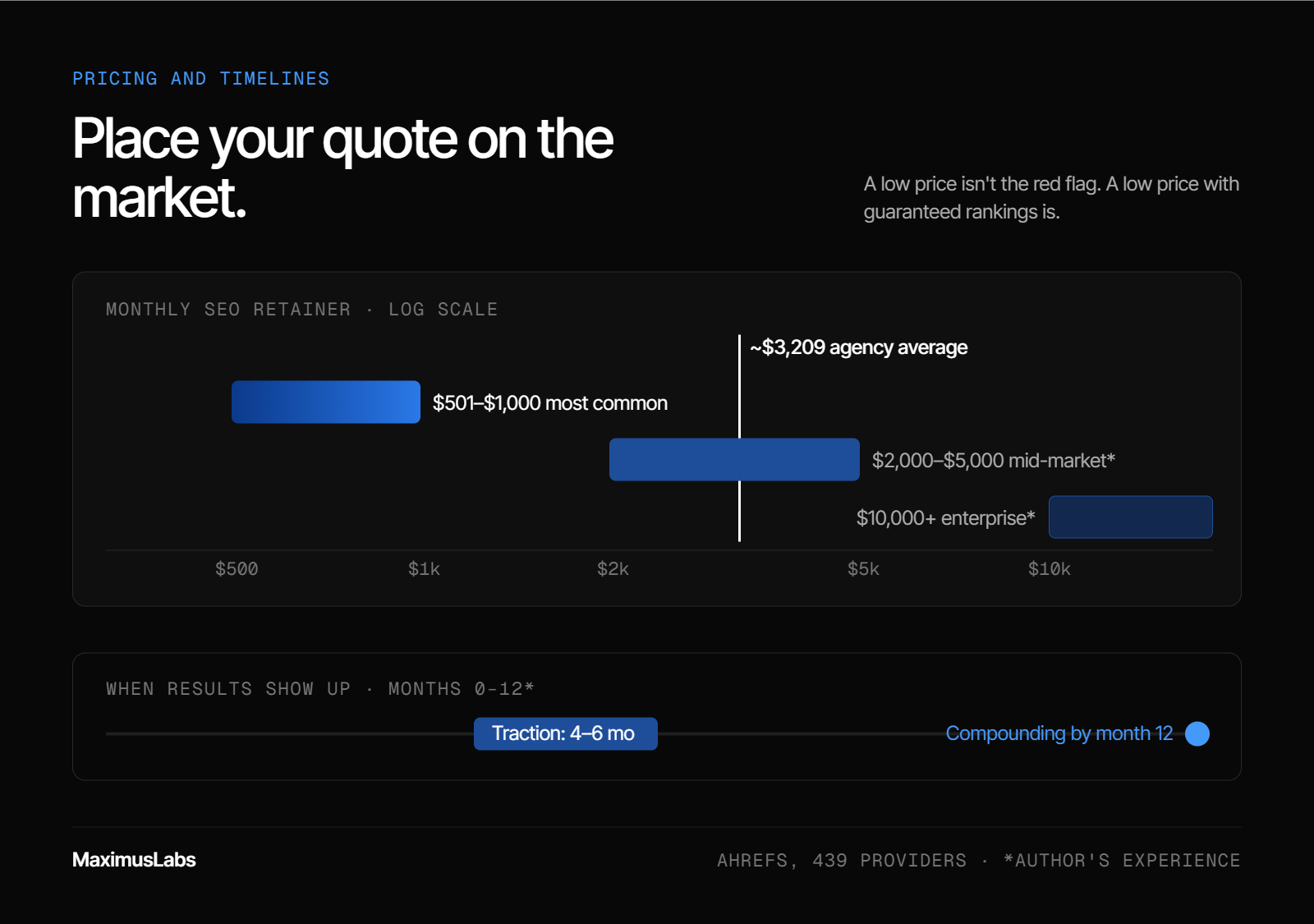
SEO retainers vary widely. Ahrefs polled 439 SEO providers and found $501 to $1,000 per month was the most common retainer, while agencies averaged about $3,209 per month. Expect early traction in four to six months and compounding results by month twelve. Ask for a three-to-six-month initial term, then month-to-month with 30 days’ notice. No one can guarantee a #1 ranking on Google.
Step 1: Read the Price Against the Market
💰 What Retainers Actually Cost
Ahrefs’ survey shows how wide the market is. Here is how to read a quote:
| Monthly retainer | What it usually covers |
| Under $1,000 | Freelancers, local businesses, or narrow tasks. Ask exactly what ships each month. |
| About $3,200 | The average agency retainer in Ahrefs’ survey |
| $2,000 to $5,000 | Common for mid-market B2B programs, in my experience |
| $10,000 and up | Common for enterprise and national programs, in my experience |
A low price is not a red flag by itself. The red flag is a low price paired with promises of guaranteed rankings or hundreds of links. Ask what ships each month, in units you can count.
⏰ When Results Should Show Up
In my experience, early traction appears in four to six months. That means new pages indexed, early citations, and leading signals in pipeline. Compounding revenue impact usually takes about twelve months. An agency that promises page-one results in 30 days is selling something other than SEO.
Step 2: Negotiate the Contract Terms
✅ Terms to Ask For
| Term | Healthy version | Red flag |
| Initial commitment | Three to six months | Twelve months, no exit |
| After the initial term | Month-to-month, 30 days’ notice | Automatic annual renewal |
| Deliverables | Named outputs each month | “Ongoing optimization” with no count |
| Data ownership | You own content, accounts, and reports | Agency keeps tools and data |
The initial term gives the agency time to do real work. The monthly term afterward keeps it earning your renewal.
Step 3: Reject Guarantees and KPI Bonuses
❌ Why Guarantees Fail
Google’s own hiring guide states that no one can guarantee a #1 ranking on Google. AI answers are even less predictable, because they change by engine, prompt, and week. Any guarantee of position is a sales tactic, not a plan.
⚠️ The Problem With Performance Bonuses
Paying bonuses on rankings or link counts sounds fair, but it creates the wrong incentives. Eli Schwartz warns against tying any SEO pay to a KPI:
“I have seen SEO bonuses aligned with link metrics, ranking positions, clicks from search, and even revenue... in every case, it caused long-term issues.”
Eli Schwartz, Product-Led SEO
Short-term bonuses reward shortcuts that can burn your domain’s reputation. Pay for clear work and review pipeline impact together each quarter.
MaximusLabs AI measures every engagement on pipeline, not on mentions, and does not sell ranking guarantees. Onboarding takes two days, and the first article goes live by day four. That puts real output in front of you within the first week.
Q9. What Questions Should a Good Agency Ask You?
A strong SEO agency interviews you back. Expect questions about your ideal customer profile (ICP), average deal size, sales cycle, and which pages already convert. A good agency also asks for CRM and GA4 access, the competitors buyers compare you with, and available founder time. An agency that asks only for keyword targets and a website login is planning for traffic, not pipeline.
Why the Agency’s Questions Matter
⭐ The Intake Call Reveals the Plan
Pay close attention to the first discovery call. The questions an agency asks show what it plans to optimize for. Questions about keywords lead to a keyword plan, and questions about buyers lead to a pipeline plan.
I’ve found the intake call is the most honest part of any pitch. The deck is rehearsed, but the questions show how the team actually thinks. Score the questions as seriously as you score the answers.
Questions a Revenue-Focused Agency Should Ask
💰 About Your Buyers and Revenue
| Question the agency should ask | Why it matters |
| Who is your ICP, by role, company size, and industry? | Decides which prompts and pages to target |
| What is your average deal size and sales cycle? | Sets realistic pipeline targets and timelines |
| Which pages and channels already produce demos? | Shows where to build first |
| Which competitors do buyers compare you with? | Shapes comparison and alternatives content |
✅ About Data and Tracking
A good agency asks for CRM and GA4 (Google Analytics 4) access early. Without it, content can’t be tied to pipeline. That gap matters more now, because Ahrefs found AI search drove 12.1% of its signups from just 0.5% of visits.
Google also counts AI Overview and AI Mode traffic inside overall Search Console data. So expect the agency to ask how you capture self-reported sources, such as a “how did you hear about us” field. An agency that skips this question can’t measure AI-driven demand.
⏰ About Your Time and Voice
Strong agencies also ask about access and limits:
How much founder or product-leader time can you give each month?
How do you want your product described, and what should we never say?
Which claims have legal or compliance teams approved? This matters most in healthcare and financial services.
What original data or customer stories are you willing to publish?
What a Keyword-Only Intake Signals
❌ Red Flags in the Discovery Call
An agency that asks only for a keyword list, a competitor URL, and a CMS login has already chosen its plan. It will build pages that target search volume, not buyers. Expect traffic reports, not pipeline reports.
Watch for a second signal too. If the agency never asks how you want your product positioned, it will describe you the way its template describes everyone. That generic framing rarely earns a spot in AI answers.
⚠️ Positioning Should Come From You
I believe positioning belongs to the client. The agency’s job is to make your chosen positioning show up in AI answers, not to invent a new one. If an agency rewrites your category story in the first call, ask what evidence it is using.
MaximusLabs AI opens every engagement with leadership sessions on the ICP, product positioning, and pipeline goals before any content is planned. Onboarding takes two days, so these questions get answered in days, not weeks.
Q10. How Do You Score SEO Agencies and Spot Deal-Breakers?
Score each SEO agency from 1 to 5 on seven criteria: proof, AI search competence, revenue measurement, strategy, content workflow, team, and terms. Ask every agency the same questions so the scores stay comparable. End the process on any deal-breaker. These include guaranteed rankings, no third-party charts, an unnamed team, rankings as the main KPI, fixed link quotas, unedited AI content, and a 12-month lock-in.
How to Score Consistently
⭐ Same Questions, Same Scale
Interview at least three agencies, and use the same script for each one. Have two people from your team score every call separately, then compare notes. A gap between scores usually points to a question worth asking again.
Use a simple scale. A 1 means no credible answer, and a 3 means reasonable but generic. A 5 means specific, backed by evidence, and tied to pipeline.
✅ The Seven-Criteria Rubric
Score each row from 1 to 5:
| Criterion | Question to ask | Strong answer (5) | Deal-breaker |
| Proof | Show me three client charts from the onboarding month | Live Ahrefs or Semrush data, plus five references | Logos and percentages only |
| AI search | Run five buyer prompts live and explain the citations | Names sources by engine, owned and earned | “Add schema and FAQs” for everything |
| Measurement | What is your primary KPI? | Pipeline, qualified leads, AI-referral conversions | Rankings and impressions |
| Strategy | What are your top five fixes, in order? | A ranked list tied to money pages | A 100-page audit or a link quota |
| Content | Which steps does AI do, and which do humans own? | Named roles, fact-checking, a quality bar | Unedited AI content at volume |
| Team | Who works on my account, and can I meet them? | Named people, introduced before signing | “We’ll assign someone after kickoff” |
| Terms | What are the contract and exit terms? | Three to six months, then 30 days’ notice | A 12-month lock-in |
Deal-Breakers That End the Process
❌ When to Walk Away
Some answers should end the call, whatever the total score. A ranking guarantee is the clearest one, because Google states that no one can guarantee a #1 ranking. Refusing to show third-party charts or name the team is a close second.
“Asking the right questions and demanding proof is the best way to make sure that you are not hiring a risky ‘fly-by night’ service provider.”
Phil Singleton, SEO for Growth
⚠️ Green Flags Are Quieter
Honest uncertainty is a green flag. An agency that says “we don’t know yet, and here’s how we’ll test it” respects your budget. In AI search especially, anyone claiming certainty is guessing.
The Number Behind Every Agency
⏰ Ask About Renewal Rate
Ethan Smith argues that the only number that truly measures an agency is its renewal rate. Ask what share of clients renew after the first term and how long the average client stays. A strong agency knows that number and shares it without hesitation.
MaximusLabs AI doesn’t sell snake oil, and we don’t make promises we can’t deliver. We share dated citation data, report on pipeline, name the team, and never guarantee rankings. Run this scorecard on MaximusLabs alongside every other agency you meet.
Frequently asked questions
What questions should I ask an SEO agency before hiring them?
We group the questions into seven areas, and we ask every agency the same set so the answers are comparable: • Proof: Can you show third-party Ahrefs or Semrush charts for three clients, starting from the month you were onboarded? • AI search: Can you run five of our buyer prompts in ChatGPT, Perplexity, and Gemini and explain why each cited source won? • Measurement: Is your primary KPI pipeline or rankings? • Strategy: What are your top five fixes for our site, in order? • Content: Which steps does AI do, and which do humans own? • Team: Who will work on our account, and can we meet them before signing? • Terms: What are the contract length and exit terms? MaximusLabs AI built this list from the same questions buyers ask us, and we score each answer from 1 to 5. A 1 means no credible answer, and a 5 means a specific answer backed by evidence and tied to pipeline. Any guarantee of rankings, refusal to show charts, or unnamed account team ends the process early. If you want a ready shortlist to run this scorecard on, start with our guide to evaluating AEO agencies.
Can an SEO agency guarantee first-page or #1 rankings on Google?
No. Google's own guidance on hiring an SEO states that no one can guarantee a #1 ranking on Google. Rankings depend on hundreds of signals, competitor activity, and algorithm updates that no agency controls. AI answers are even less predictable. ChatGPT, Perplexity, Gemini, and Google AI Overviews can cite different sources for the same prompt, and those citations shift by engine and by week. So any promise of a fixed position, in Google or in an AI answer, is a sales tactic rather than a plan. What a credible agency can commit to is different: • A clear list of deliverables each month, in units you can count • Transparent reporting on rankings, citations, and pipeline • An honest timeline, usually four to six months for early traction • Named people doing the work MaximusLabs AI does not sell ranking guarantees, and we measure every engagement on pipeline instead of positions. We think honest uncertainty in a pitch is a green flag. You can see how we track progress in our guide to AEO measurement metrics.
How much should an SEO agency cost per month?
SEO retainers vary widely, so we judge a quote by what ships rather than by the headline number. Ahrefs polled 439 SEO providers and found $501 to $1,000 per month was the most common retainer, while agencies averaged about $3,209 per month. From what we see in B2B SaaS, the ranges look roughly like this: • Under $1,000: Freelancers, local businesses, or narrow tasks • $2,000 to $5,000: Common for mid-market B2B programs • $10,000 and up: Common for enterprise and national programs A low price is not a red flag by itself. The red flag is a low price paired with guaranteed rankings or hundreds of links per month. Ask every agency what it delivers each month, who produces it, and how it ties to pipeline. MaximusLabs AI onboards new clients in two days and publishes the first article by day four, so buyers can judge real output within the first week. For context on how teams are budgeting for AI search, see our GEO budget benchmark.
How long does it take for an SEO agency to show results?
In our experience, early traction appears in four to six months, and compounding revenue impact usually takes about twelve months. Early traction means new pages indexed, first citations in AI answers, and leading signals in pipeline, not a finished result. Timelines depend on a few factors: • How much authority and content your site already has • How competitive your category is in Google and in AI answers • How quickly your team approves content and technical fixes • Whether the plan targets bottom-of-funnel pages buyers read before choosing Be wary of two extremes. An agency that promises page-one results in 30 days is selling something other than SEO. An agency that asks you to wait a full year with no leading indicators may be stuck in what Ethan Smith calls the SEO death spiral. MaximusLabs AI reached a 64% AI citation rate for Oliv AI within six months, against roughly 30% for billion-dollar incumbents. We share dated data like this so clients can see movement early. Read the full Oliv AI case study for the timeline.
What are the biggest red flags when hiring an SEO agency?
We treat seven answers as deal-breakers, whatever the agency's overall score: • Guaranteed rankings: No one can guarantee a #1 position on Google. • No third-party proof: Logos and growth percentages without baseline charts. • An unnamed team: Senior people pitch, then juniors run the account. • Rankings as the main KPI: Positions instead of pipeline and qualified leads. • Fixed link quotas: "50 links a month" usually means paid placements Google treats as link spam. • Unedited AI content: Mass-produced pages with no human fact-checking. • A 12-month lock-in: No exit after a reasonable initial term. A 100-page automated audit is another warning sign. It looks thorough, but it usually buries the few fixes that matter under hundreds of low-impact items. MaximusLabs AI runs every article through a three-stage pipeline of primary-source research, founder's-voice writing, and quality review, and nothing ships below 70 out of 100 on our scorecard. You can compare how other agencies stack up in our list of the best AEO agencies.
What should I ask an SEO agency about AI search, GEO, and AEO?
We recommend a live test instead of a slide review. Ask the agency to run five of your real buyer prompts in ChatGPT, Perplexity, and Gemini during the call, then explain why each cited source won. Follow up with these questions: • Which sources does each engine cite for our category, and how do they differ? • What would you change on our site, and what would you change off it, such as reviews, Reddit, or listicles? • How do you track AI share of voice week to week? • How do you connect AI citations to pipeline? A strong answer names specific sources and separates your own content from third-party mentions. A weak answer repeats "add schema and FAQs" for every prompt. Google says AI Overviews need no special optimization, yet academic GEO research found targeted changes can lift visibility by up to 40%. A competent agency can explain both. MaximusLabs AI maps the cited sources for each buyer prompt before writing, which is how Nidra Goods reached #1 for "best sleep mask" on Google, ChatGPT, and Perplexity. Our report on ChatGPT, Perplexity, and Gemini citation patterns shows why engines disagree.
Should I hire an SEO agency or build an in-house SEO team?
It depends on what you need most. We see the trade-off like this: • An agency fits when you need fast onboarding, senior strategy across many clients, enterprise tools, and execution capacity without full-time salary overhead. • An in-house team fits when SEO needs deep product knowledge, daily work with engineering, and 40 hours a week of dedicated focus. Many B2B SaaS companies use both. An in-house owner sets priorities and holds the agency accountable, while the agency supplies research, content production, and AI search expertise the team cannot build quickly. Whichever route you choose, ask the same questions. Who owns pipeline reporting? Who interviews the founder for expert content? Who decides which pages get built first? If nobody can answer, the setup will drift toward traffic instead of revenue. MaximusLabs AI works as strategy and execution in one team, and we run leadership sessions to capture the founder's perspective before any content is planned. That lets a small in-house team keep control without hiring a full content function. Learn more about our Answer Engine Optimization services.