 Krishna Kaanth M
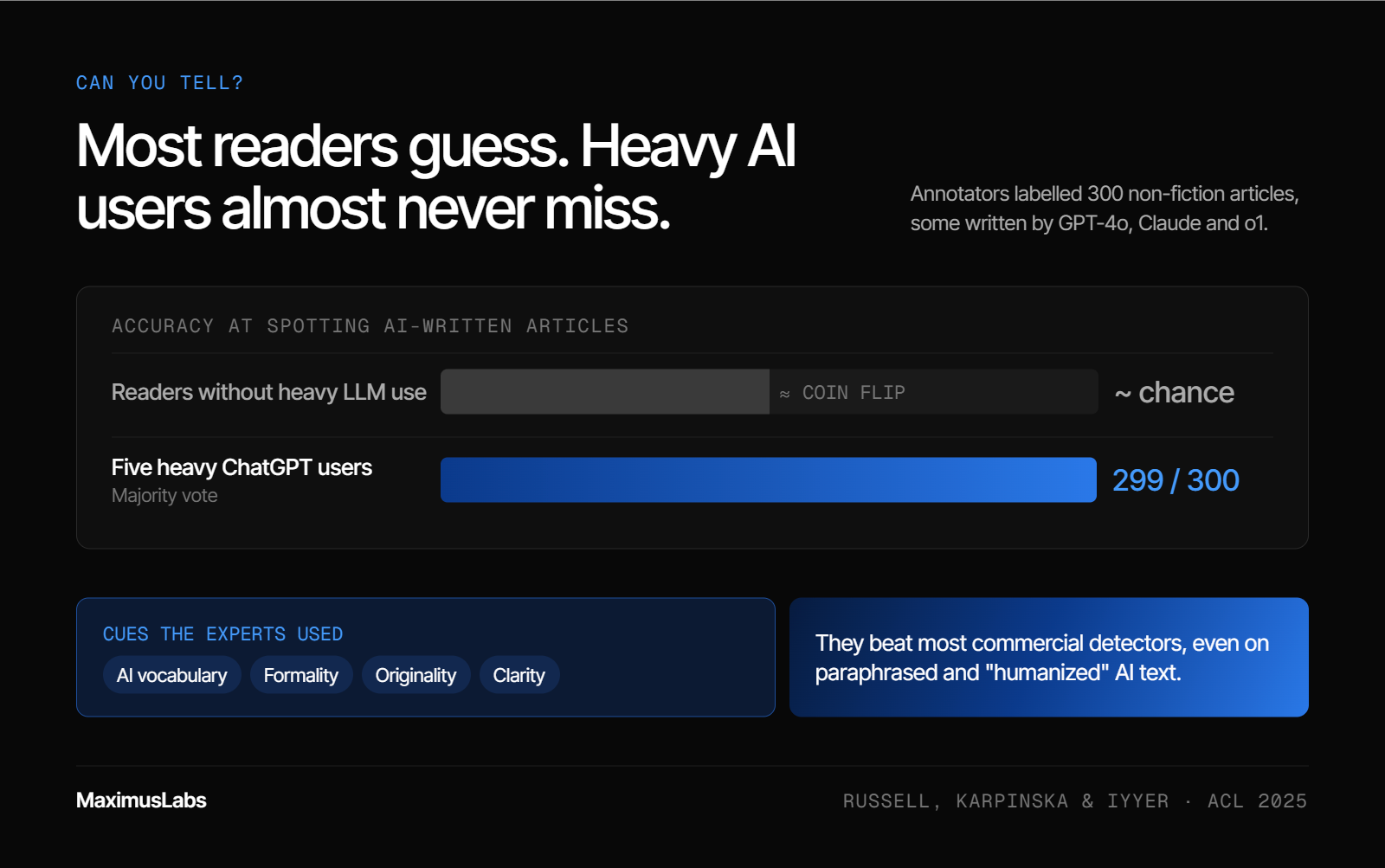
- Untrained readers spot AI text at about chance level, but heavy ChatGPT users misclassified just 1 of 300 articles in a 2025 study.
- Watch for clusters of tell words, flat sentence rhythm, repeated points, generic details, and missing first-hand experience. No single sign proves AI authorship.
- Fact-check every number and claim. CNET corrected 41 of 77 AI-assisted articles, and omissions are harder to catch than errors.
- Detectors work well on raw AI text but weaken sharply on edited text. Treat any score as directional evidence, never as proof.
- Detectors flagged 61% of non-native English essays as AI on average, so ask for drafts and version history before accusing anyone.
- Google and AI answer engines judge quality and trust, not authorship. The real question is whether an engine will cite your page.
A managing editor at a B2B SaaS company opens the content tracker on Monday morning. Fourteen freelance drafts are marked “ready for review.” Two use the word “meticulous” in the first paragraph, and one cites a statistic she cannot find anywhere.
She has until Wednesday to decide what goes live. That is the real job behind “how to spot AI generated text.” It is not a party trick. It is a call about what you publish, who you trust, and what ChatGPT and Perplexity will cite. This guide covers manual checks first, then tools, then what both mean for search.
Q1. Can You Actually Tell AI-Generated Text From Human Writing, and Why Does It Matter Now?
Yes, but only with practice. In a 2025 ACL study, untrained readers judged AI-written articles at roughly chance level. Five annotators who use ChatGPT heavily for writing, voting together, misclassified just 1 of 300 articles. The stakes have changed too. ChatGPT, Perplexity, and Google AI Overviews now choose which sources to cite, and unedited AI copy gives them little reason to choose yours.
Two Ways an Editor Gets This Wrong
⚠️ Fooled, or Falsely Accusing
Picture a content lead on a Thursday afternoon. Twelve freelance drafts sit in the review queue, and three of them read a little too smooth. She can approve them and hope, or she can flag them and risk accusing an honest writer.
Both mistakes cost something real. Publish unedited AI copy, and the site quietly loses authority. Accuse a real writer, and you lose a good freelancer and some trust on the team. This guide is built to help you avoid both.
What the Research Says About Human Detection
❌ Gut Feeling Performs Like a Coin Toss
The bad news came early. MIT Technology Review reported in 2022 that untrained readers spotted GPT-3 text only at chance level. The same report noted that people can be trained to do better.
In 2025, Jenna Russell, Marzena Karpinska, and Mohit Iyyer tested that idea at scale. Annotators read 300 non-fiction articles, some written by GPT-4o, Claude, and o1, and labelled each one. Readers without heavy LLM experience performed close to random chance.
✅ Heavy AI Users Become Expert Detectors
The heavy users were different. A majority vote of five of them misclassified only 1 of 300 articles, beating most commercial and open-source detectors in the study. They held up even when the AI text was paraphrased or “humanized,” meaning rewritten by tools built to hide AI patterns.
Their written explanations show how they did it. They leaned on “AI vocabulary,” and they also judged formality, originality, and clarity. Those are the cues the next three sections teach.
Why the Stakes Moved From Rankings to Citations
💰 Google Rewards Quality, and AI Engines Reward Trust
Google’s own guidance says it rewards high-quality content, however it is produced. It treats AI content made mainly to manipulate rankings as spam. So the search risk is not AI itself. It is thin, generic, and unverified copy.
Answer engines raise that bar further. A buyer who asks ChatGPT for a recommendation gets one answer that names a handful of brands. Copy that repeats what ten other pages say gives the engine nothing new to cite.
⭐ Read Like a Trained Palate
MaximusLabs AI’s read is that spotting AI text works like tasting food. Years of late-night biryani rides taught me to tell a rushed biryani from the first bite. That is not instinct. It is thousands of plates, and the Russell data says the same about text: exposure builds the palate.
MaximusLabs AI runs every article through a hybrid process. AI speeds up research and first drafts, and humans approve everything that ships. That review step exists for the reason this section describes. AI engines cite content they can trust, and trust is what turns a citation into pipeline.
Q2. Which Words and Phrases Give AI-Written Text Away?
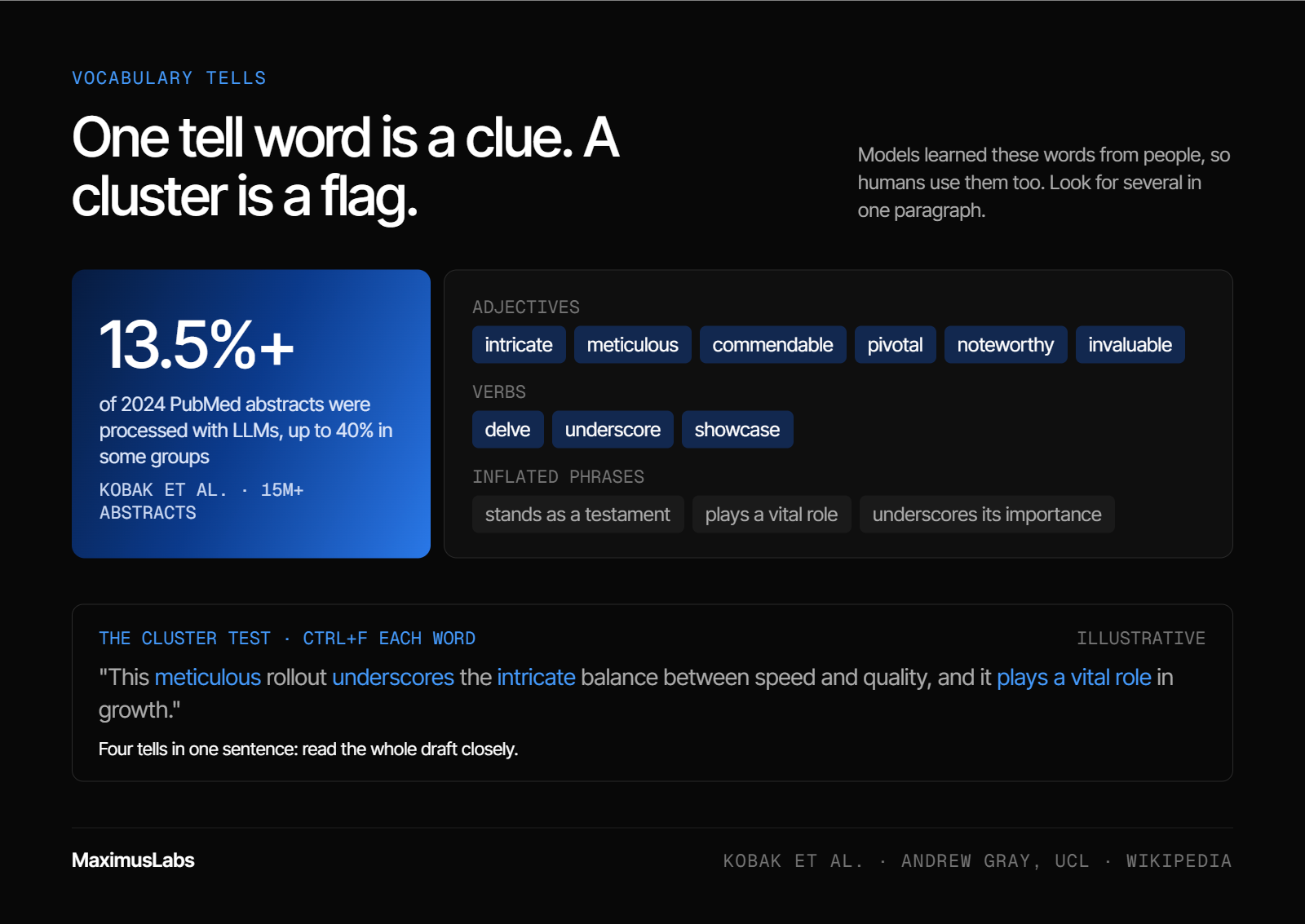
AI text overuses a predictable set of words. A study of more than 15 million PubMed abstracts found sudden post-2022 jumps in style words such as “delves.” It estimated that at least 13.5% of 2024 abstracts were processed with LLMs. Andrew Gray’s analysis flagged “commendable,” “meticulous,” and “intricate.” Models learned these words from people, so treat each one as a clue, not proof.
The Research Behind the Word List
✅ What 15 Million Abstracts Revealed
Dmitry Kobak and colleagues tracked vocabulary in biomedical abstracts from 2010 to 2024. Certain style words spiked suddenly after ChatGPT launched. The authors estimate that at least 13.5% of 2024 abstracts were processed with LLMs, reaching 40% in some groups.
They also found this shift was larger than the vocabulary change caused by the Covid pandemic. That is a strong signal. Language rarely changes that fast on its own.
⏰ The Adjectives That Spiked in 2023
Andrew Gray, a librarian at University College London, ran a similar check on 2023 papers. He tracked 12 adjectives and 12 adverbs that LLMs favor. “Intricate,” “meticulous,” “meticulously,” and “commendable” were among the strongest signals.
In his data, papers using “intricate” roughly doubled in 2023 compared with earlier years. Papers combining two or more of these words rose much faster than papers using just one. That detail matters more than any single word on the list.
Words and Phrases to Watch For
- Adjectives: intricate, meticulous, commendable, pivotal, noteworthy, invaluable
- Verbs: delve, underscore, showcase
- Inflated phrases: “stands as a testament,” “plays a vital role,” “underscores its importance”
- Rare words: any word that is unusual for this writer, this audience, and this format
To run the check, use your browser’s find tool (Ctrl+F) on the draft. Search for each word above, then note how many appear and whether they cluster in one paragraph. A cluster deserves a closer read.
⚠️ When One Strange Word Gives the Game Away
Eric Enge and Adrián Ridner share a story in their 2025 book. After an interview, they received a follow-up note that used the word “lugubriously.” Neither author knew what it meant, and both had to look it up.
They treated it as “a clear flag” of AI use. The lesson is practical. A word that is rare for the person writing it is a stronger tell than a common AI favorite.
Why a Word List Alone Will Fail You
❌ One Word Is Not Proof
Wikipedia’s WikiProject AI Cleanup tracks AI text across the encyclopedia, and its guide warns against over-reading these signs. Language models were trained on human writing, so humans use these words too. The guide also notes that each model has its own habits, so a ChatGPT tell may not fit Gemini.
MaximusLabs AI’s view is that banning words only teaches the next model, or the next writer, to hide. I would rather read for clusters. Two or three tell words in one paragraph, plus the patterns in the next sections, is worth acting on.
In MaximusLabs AI’s hybrid workflow, AI handles research and first drafts, while humans own voice and originality. Stock AI phrasing is a voice problem before it is a detection problem. A page that sounds like every other page gives an answer engine no reason to cite it.
Q3. What Do Perplexity and Burstiness Reveal About a Draft?
Perplexity measures how predictable each next word is to a language model. Burstiness measures how much sentence length and structure vary. Human writers mix short lines with long ones, so their rhythm is uneven. AI drafts lean toward predictable words and similar sentence lengths. Read two paragraphs aloud. If every sentence lands at the same length and pace, that flat rhythm is a strong manual signal.
Two Numbers That Describe How Text Feels
✅ Perplexity, in Plain Words
Perplexity is a score for surprise. A language model guesses the next word in a sentence, and perplexity measures how often it guesses right. Low perplexity means the text was easy to predict.
AI writing tends to score low because the model picks likely words by design. A Stanford team led by Weixin Liang explains that many detectors work exactly this way. They predict the next word and flag text that is too predictable.
✅ Burstiness, in Plain Words
Burstiness measures variety across sentences. Human writing bursts: a four-word sentence, then a long one with a clause or two, then a fragment. AI text tends to hold one steady length and one steady structure.
Neither number is proof on its own. Simple, clear human writing can be predictable too. The section on false accusations later in this guide explains why that matters.
How to Hear It Without a Tool
⏰ The Two-Paragraph Read-Aloud Test
- Pick two paragraphs from the middle of the draft, not the introduction.
- Read them out loud at normal speed.
- Notice whether you pause at the same point in every sentence.
- Count the words in five sentences in a row. Near-identical counts are a flag.
- Check how the sentences open. If most start the same way, note it.
The test takes about two minutes. It works because your ear catches rhythm faster than your eye does. If you want a number, paste the sentences into a spreadsheet, one per row, and count words. A narrow spread is the flat rhythm made visible.
⚠️ Two Short Examples
These two samples were written for illustration.
Flat: “Content quality is essential for search success. Search engines evaluate content using many different signals. Writers should focus on creating valuable content for readers. This approach helps brands build authority over time.”
Bursty: “Traffic fell in March. Nobody panicked at first. Then sales asked why demo requests from search had dried up. Suddenly, everyone cared.”
The first sample sounds fine and says nothing. Every sentence is about the same length, and every word is the safe choice. The second has rhythm, a specific moment, and a stake.
⭐ Metronome Versus Drummer
MaximusLabs AI’s read is that AI text keeps time like a metronome. A good human writer plays like a drummer, speeding up and slowing down for effect. I trust my ear here, though I might lean on it too hard for very short texts.
MaximusLabs AI writes every article to sound like the founder personally wrote it. That standard is about voice, not detection, but it breaks the flat cadence AI drafts fall into. Rhythm carries opinion, and opinion is what gives an answer engine something worth quoting.
Q4. What Structural Patterns and Missing Experience Expose an AI Draft?
AI drafts share a recognizable shape. They restate one point across several paragraphs, close sections with neat summaries, use generic examples instead of named ones, and show no first-hand testing. The strongest tell is missing experience: no observed result, no original screenshot, and no detail only an insider would know. Google’s guidance names experience as part of its E-E-A-T quality framework.
Three Structural Patterns to Look For
❌ The Same Point, Rephrased Three Times
Open any section and write its main point in one line. Then check whether the next two paragraphs add a new fact, number, or example. In many AI drafts, they just restate the point with fresh words.
The Russell study found that expert readers judged originality and clarity, not just vocabulary. Repetition fails both tests. The text gets longer without getting more useful.
⚠️ Neat Summaries and Editorial Commentary
Wikipedia’s AI Cleanup guide lists section-ending summaries as a common sign. A paragraph closes with “Overall, this shows...” even though the reader just read it.
The same guide flags editorial commentary, where the text tells the reader what to think instead of showing evidence. Watch for lines that judge importance without adding a fact.
💸 Generic Details Where Specifics Should Be
Human experts name things. They mention the tool version, the client’s industry, and the month the numbers changed. AI drafts default to “many businesses,” “various platforms,” and “significant results.”
A quick test helps. Highlight every proper noun and number in a section. If the page is nearly blank afterward, the draft is generic, whoever wrote it.
The Tell That Matters Most: Missing Experience
✅ What First-Hand Proof Looks Like
Google’s guidance on AI content points creators to E-E-A-T (Experience, Expertise, Authoritativeness, and Trustworthiness). A model can describe a process. It cannot honestly say what happened when it ran that process last Tuesday.
Look for at least one of these in every section:
- A result the author observed, with a date or a number
- An original screenshot, dataset, or photo
- A mistake the author made and what they changed
- A detail only someone inside the work would know
💰 Generic Versus Experienced, Side by Side
These two lines were written for illustration.
Generic: “Many companies have seen strong results from improving their content.”
Experienced: “Demo requests from organic search doubled after the team rewrote six comparison pages in May.”
The second line could be wrong, but it can be checked. That is the point. A claim someone can verify carries more weight with editors, buyers, and answer engines than one nobody can.
⭐ The Sixth-Article Problem
MaximusLabs AI’s read on this is blunt. Most AI drafts are the sixth article, a summary of the five already ranking. Answer engines already have those five, so I see no reason they would cite a sixth.
MaximusLabs AI runs a hybrid workflow. AI handles research aggregation and first drafts, while humans add the founder’s perspective, voice, and first-hand evidence. That split exists because experience is the one thing a model cannot supply. It is also what separates content that gets cited from content that only gets indexed.
Q5. How Do You Catch AI Hallucinations and Omissions Before They Publish?
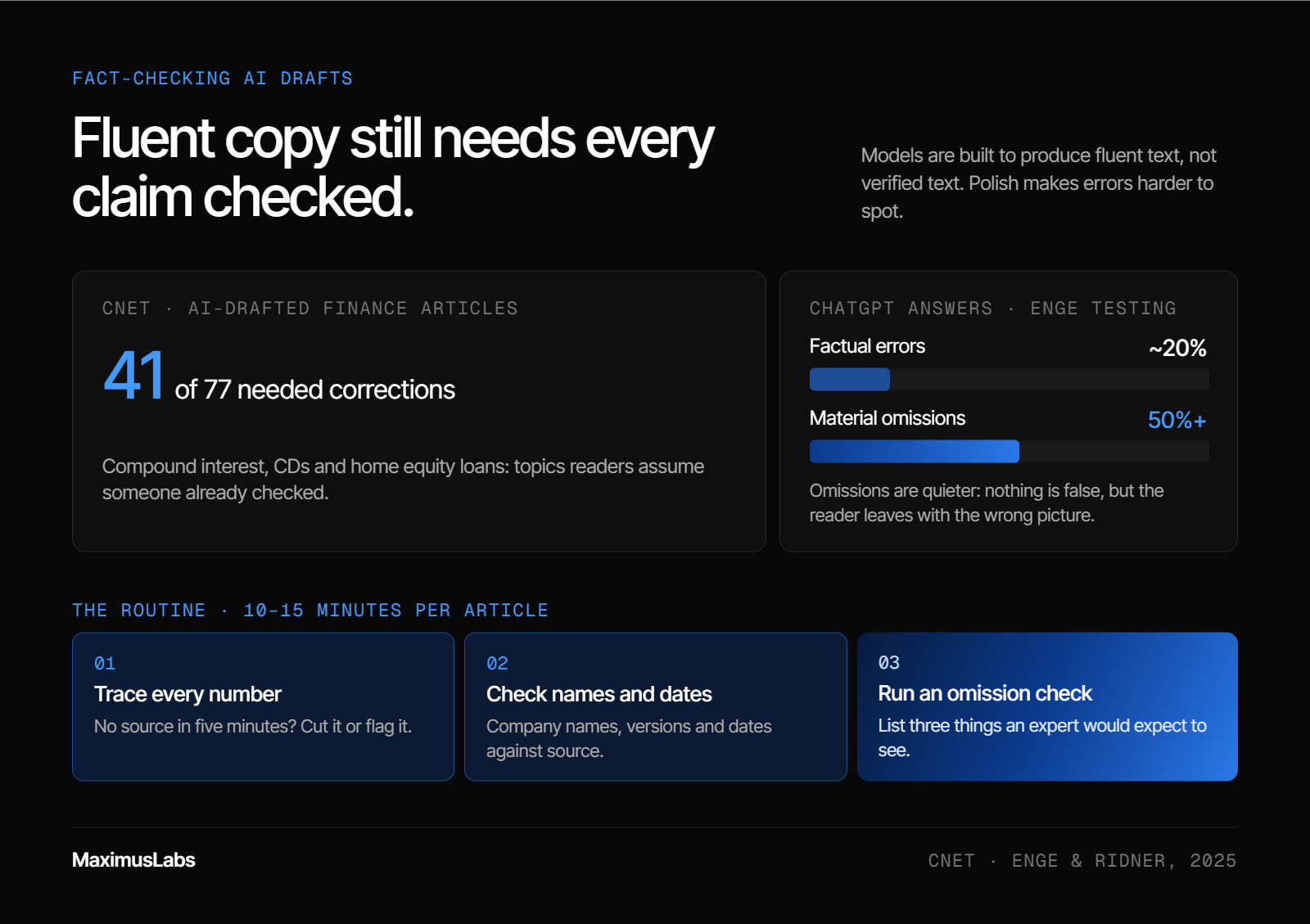
Fluent AI text can still be wrong. CNET reviewed 77 finance articles drafted with an AI tool and issued corrections on 41 of them. In Eric Enge’s testing, about 20% of ChatGPT answers contained factual errors, and more than half left out material information. Check every statistic, date, and named claim against a primary source. Then ask what an expert would expect to see that is missing.
The Situation: Copy That Reads Perfectly
⚠️ Polish Hides Problems
A VP of Marketing skims a draft on her phone between meetings. The grammar is clean, the headings are tidy, and the tone sounds confident. She approves it, because nothing looks wrong.
That is the trap. Language models are built to produce fluent text, not verified text. Fluency makes errors harder to notice, not less likely to exist.
The Complication: Errors and Gaps at Scale
❌ What Happened at CNET
Between late 2022 and early 2023, CNET published personal-finance explainers drafted with an internal AI tool. After outside reporting flagged mistakes, editor-in-chief Connie Guglielmo ordered a full review. CNET corrected 41 of the 77 stories, from substantial errors to transposed numbers and incomplete company names.
These were not exotic topics. They covered compound interest, certificates of deposit, and home equity loans. That is exactly the kind of content readers assume someone has already checked.
⏰ Omissions Are the Quieter Problem
Eric Enge and Adrián Ridner report that roughly 20% of ChatGPT answers in their testing contained factual errors. More than half had material omissions, meaning key information was simply missing.
Omissions are harder to catch than errors. A wrong number can be checked against a source. A missing caveat only shows up if you know the topic well enough to expect it.
Picture an AI draft on certificates of deposit that explains rates well but never mentions early-withdrawal penalties. Nothing in it is false. The reader still walks away with the wrong picture.
The Resolution: A Three-Step Fact-Check Routine
✅ Run This Before Anything Publishes
- Trace every number. Find the original study, filing, or official page. If you cannot find it in five minutes, cut the number or flag it.
- Check names, dates, and versions. Confirm each company name, product version, and date against its source. CNET’s corrections included exactly these slips.
- Run an omission check. List three things an expert would expect in the section. If any are missing, the draft is not finished.
The routine takes 10 to 15 minutes per article. It costs far less than a public correction note.
⭐ Why Answer Engines Punish Errors
MaximusLabs AI’s read is that answer engines care about accuracy more than a list of blue links ever did. When ChatGPT names a source, its own credibility rides on that source being right. I might be overstating how well engines catch errors today, but I would not bet a brand’s citations on them missing one.
MaximusLabs AI requires a primary-source citation for every factual claim in a draft, and humans approve everything that ships. That rule exists because one wrong number can cost a citation. In B2B SaaS, a lost citation is a lost conversation with a buyer, and eventually lost pipeline.
Q6. How Do You Check a Draft for AI Without Any Tools?
Run five checks in order. First, scan for overused AI vocabulary. Second, read two paragraphs aloud for uniform rhythm. Third, look for points repeated in new words. Fourth, test three facts against primary sources. Fifth, search for first-hand experience. One or two flags mean edit. Three or more mean ask the writer for drafts or notes. No single sign decides the case.
Why One Signal Is Never Enough
⚠️ Weak Signals Add Up
Every tell in this guide has an innocent explanation. Humans use “meticulous,” careful writers keep sentences even, and busy writers repeat themselves. Wikipedia’s AI Cleanup guide makes the same point: look for a combination of signs before deciding.
The 2025 Russell study points the same way. Expert readers who weighed several cues beat most detectors, and their group vote was more reliable than any single reader. A checklist does that job for one editor working alone.
The Five-Step Manual Review
✅ Run the Checks in Order
| Step | Check | What counts as a flag | Time |
|---|---|---|---|
| 1 | Vocabulary scan with Ctrl+F | Two or more tell words in one paragraph | 2 min |
| 2 | Read two paragraphs aloud | Most sentences share the same length and pace | 2 min |
| 3 | Write each section’s point in one line | Following paragraphs add no new fact | 3 min |
| 4 | Test three claims against primary sources | Any claim you cannot trace | 5 min |
| 5 | Look for observed results or original material | No first-hand detail anywhere | 2 min |
The order matters. The first two checks are fast and catch raw drafts. The last three take longer, but they catch edited drafts that slip past a word scan.
How to Score the Result
⏰ What Each Score Means
- No flags: publish after normal editing.
- One or two flags: send the draft back with notes on the flagged areas.
- Three or more flags: ask the writer for outlines, notes, or version history before deciding anything.
The score describes the draft, not the person. A draft with four flags needs work, whoever wrote it. Questions of authorship come later, and the section on false accusations covers them.
❌ Mistakes That Weaken the Review
- Checking only the introduction, where writers polish the most
- Skipping the fact test because the draft “sounds right”
- Treating three flags as proof instead of a reason to ask questions
Each mistake turns a careful process back into a hunch. The checklist only works when every step runs on every draft.
💰 Why the Ten Minutes Pay Off
The whole review takes about 14 minutes. That is cheaper than a correction note, a lost freelancer, or a lost citation. Teams that run it on every draft also train their editors’ palate, which is how the expert readers in the Russell study got good.
⭐ One Scorecard Beats Five Hunches
MaximusLabs AI’s habit is to turn scattered tells into a single scorecard. I trust a framework more than my mood on a Friday afternoon. A score also makes feedback to writers specific, which keeps good freelancers instead of insulting them.
MaximusLabs AI uses a similar gate before publishing. Every draft must carry first-hand evidence and primary-source citations, because answer engines cite trusted sources, not polished ones.
Q7. How Accurate Are AI Detectors, Really?
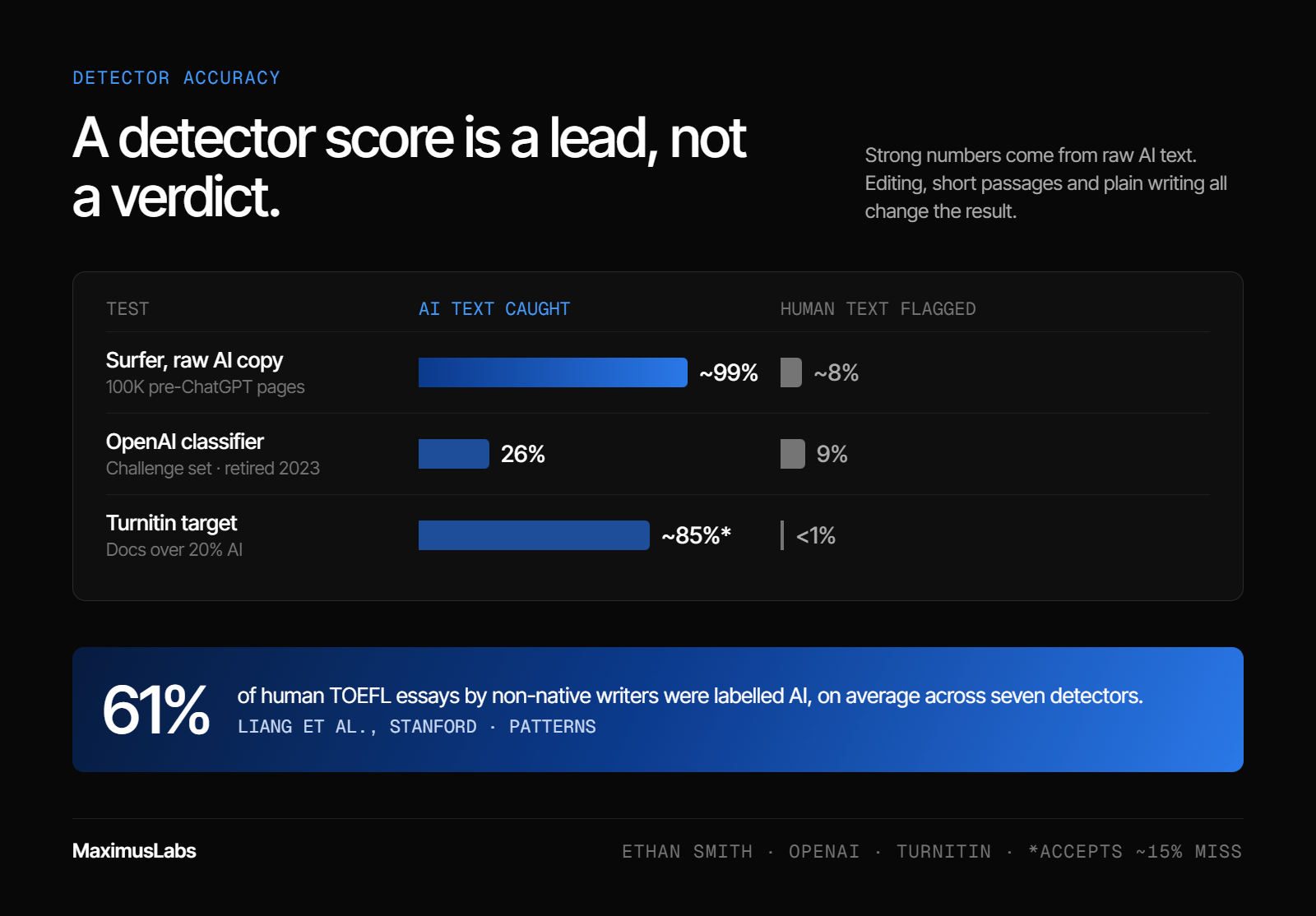
It depends on the text. Graphite CEO Ethan Smith tested Surfer’s detector on a sample of 100,000 pre-ChatGPT web pages. He reported about 8% false positives and roughly 99% accuracy on raw AI copy. OpenAI, however, retired its own classifier after it caught only 26% of AI text. Rewriting cuts accuracy further. Treat a detector score as directional evidence, never as proof.
The Situation: Two Camps, Both Half Right
❌ “Detectors Are Useless”
Ask in any teachers’ or SEO forum, and someone will call AI detectors snake oil. The favorite proof is the US Constitution. Eric Enge and Adrián Ridner note that AI checkers have labelled it AI-written, and they advise treating detector output as “directionally correct.”
The skeptics have a point. Formal, predictable writing scores low on perplexity, so historical documents and careful technical prose can trip a detector. That is a real limit, not a myth.
✅ “Detectors Are Accurate”
The other camp has data too. Ethan Smith’s team sampled 100,000 pages from Common Crawl, a public archive of the web, published before ChatGPT existed. Surfer’s detector flagged about 8% of that human text as AI and was right about 99% of the time on AI text.
Turnitin publishes a similar trade-off for education. It aims for a document false-positive rate under 1% when more than 20% of the text is AI. To hold that line, it accepts missing about 15% of AI text.
The Complication: Edited Text Changes Everything
⚠️ Where Accuracy Falls Apart
Those strong numbers describe raw, unedited AI output. On a harder challenge set, OpenAI’s classifier caught only 26% of AI text and wrongly flagged 9% of human text. OpenAI withdrew it in July 2023, citing its low rate of accuracy.
Light editing makes detection harder still. Liang and colleagues showed that simple prompting strategies could bypass the detectors they tested. By contrast, the expert human readers in the Russell study stayed accurate on paraphrased and humanized text.
The reason is simple. Detectors measure statistical patterns, and editing changes those patterns without changing where the ideas came from. A polished AI draft and a careful human draft can end up with similar scores.
The Resolution: Directional, Not a Verdict
⏰ How to Read a Score
- High score on a raw draft: a strong reason to run the manual checklist.
- Low score on a polished draft: proves little, because editing hides AI patterns.
- Different scores from two tools: read the draft closely before acting.
- Any score on very short text: ignore it, since accuracy drops sharply on short passages.
⭐ Judge the Detector by Its Error Rate
MaximusLabs AI treats detectors the way it treats any model, as a data-science problem. I ask two questions of every tool. What is its false-positive rate, and on what kind of text was that measured? A vendor that cannot answer both is selling confidence, not accuracy.
MaximusLabs AI applies the same rule to AI-search visibility. It tracks citations across every major engine daily and re-runs the checks, because one reading from one tool is a guess. Clients judge the work on pipeline, not on any single score.
Q8. Which AI Detectors and Watermarking Tools Fit Which Job?
Match the tool to the job. Originality.ai, Surfer, and Copyleaks are commonly used to screen web content and freelance drafts. GPTZero and Turnitin focus on education, and Grammarly suits writers checking their own work. Watermarking works differently: Google’s SynthID-Text marks Gemini output when it is generated, but it only covers Google’s models and weakens under heavy rewriting. Run two detectors and treat disagreement as a reason to read closely.
How to Choose a Detector
✅ Start With the Job, Not the Brand
Each detector was trained on certain text for certain users. An education tool expects student essays. An SEO tool expects blog posts and landing pages.
Ask three questions before you pick. What text will you check, how long is it, and what happens when the tool flags something? Short text is a known weak spot, and OpenAI warned its classifier was unreliable under 1,000 characters.
Also check how the tool reports results. A single percentage hides which sentences triggered it. Sentence-level highlights let an editor test the flagged lines against the manual checklist.
Detectors Side by Side
| Tool | Common use | How it works | Known limit |
|---|---|---|---|
| Originality.ai | Publishers and agencies screening drafts | Statistical classifier score | Weaker on heavily edited text |
| Surfer AI detector | SEO teams checking web content | Statistical classifier score | Benchmark measured on raw AI text |
| Copyleaks | Publishers and schools | Classifier plus plagiarism check | Same weakness on edited text |
| GPTZero | Educators | Classifier with sentence highlights | A score, not proof of authorship |
| Turnitin | Universities | Sentence-level scoring | Accepts missing about 15% of AI text |
| Grammarly | Writers self-checking | Classifier inside the editor | Built for self-review, not judging others |
| SynthID-Text | Gemini output | Watermark added at generation | Detects Google-model text only |
⚠️ What the Table Cannot Tell You
Vendor accuracy claims are usually measured on raw AI text. Real drafts are edited, mixed, and rewritten. Expect lower accuracy in practice than the product page suggests. Treat any accuracy figure without a named test set as marketing, not evidence.
Watermarks Versus Statistical Detection
💰 Two Different Questions
A statistical detector asks, “Does this text look like AI?” A watermark asks, “Did this specific model write it?” Google DeepMind’s SynthID-Text adjusts how Gemini picks words, leaving a pattern a detector can check later.
The catch is coverage. A watermark only helps if the model that wrote the text added one. Heavy rewriting or translation can also weaken it, so it complements detectors instead of replacing them.
⏰ The Two-Detector Rule
Run every suspicious draft through two detectors from different vendors. If both flag a raw draft, take it seriously and run the manual checklist. If they disagree, the disagreement is the finding, so read the draft yourself.
⭐ Know What the Tool Was Trained On
MaximusLabs AI’s view is simple: know what a detector was trained on before trusting it. I would not use an essay detector to judge a SaaS comparison page. That would be like judging AI-search visibility with a Google-only ranking report.
MaximusLabs AI does not sell a detection tool, so it has no stake in which one you choose. Its content process sits upstream: human-approved, source-cited drafts that need no detector to defend them.
Q9. How Do You Avoid Falsely Accusing a Human Writer?
Never act on a detector score alone. A Stanford study in Patterns tested seven popular detectors on 91 TOEFL essays written by non-native English speakers. On average, the detectors labelled 61% of those human essays as AI-written. Before any accusation, ask for version history, outlines, or notes, and run the manual checklist. For ongoing teams, drafting inside a tracked editor shows real composition versus a bulk paste.
The Situation: A Flag Lands on a Good Writer
⚠️ One Score, One Email
Picture a Head of Content running a new freelancer’s draft through a detector. It comes back mostly “AI.” She starts an email ending the contract, then pauses, because this writer’s last three pieces were excellent.
That pause matters. A false flag can cost a good writer, a working relationship, and the team’s reputation with other freelancers. Turnitin’s product lead put it plainly: “behind each false positive instance is a real student.”
The Complication: Detectors Misread Some Writers More Than Others
❌ What the Stanford Team Found
Weixin Liang and colleagues tested seven widely used detectors on two sets of human essays. On essays by US eighth graders, the detectors were nearly perfect. On 91 TOEFL essays, they flagged 61% as AI on average, and 89 of the 91 were flagged by at least one tool.
The cause is perplexity, the predictability score covered earlier in this guide. Writers working in a second language often choose simpler, safer words. Detectors read that predictability as machine writing.
💸 Who Else Gets Caught
The authors warn that the risk may reach other groups whose language varies from the detector’s norm. Think of technical writers, compliance teams in financial services, or clinical writers in healthcare. Their style is predictable on purpose, and a detector can punish exactly that.
Wikipedia’s AI Cleanup guide reaches the same conclusion from the editing side. It tells editors not to rely solely on detection tools, because those tools have high error rates.
The Resolution: A Fair Process Before Any Decision
✅ Collect Process Evidence First
- Ask for the trail. Request outlines, research notes, or the document’s version history in Google Docs or Word.
- Run the manual checklist. Use the five-step review from earlier, not a second detector on its own.
- Talk to the writer. Ask them to walk through how they built one section.
- Judge the draft, not the person. If the draft needs work, say so, whoever wrote it.
⏰ Prevent Disputes With Tracked Writing
For ongoing teams, prevention beats investigation. Eric Enge and Adrián Ridner recommend a CMS that fingerprints each writer’s speed and keystroke dynamics to confirm original work. Keystroke dynamics means the timing and rhythm of typing, which looks very different from one large paste.
A lighter version needs no new tools. Ask writers to draft in a shared document that keeps version history. A draft that appears in one paste is worth a calm conversation.
⭐ “I Might Be Wrong” Belongs in the Process
MaximusLabs AI’s read is that every review process needs a step that says, “I might be wrong here.” I have misjudged people before, and a short conversation fixed it faster than any tool could. Certainty should come from evidence, not from a percentage.
MaximusLabs AI works with B2B SaaS, healthcare services, and financial services teams, where formal and template-driven writing is common. Its review process judges drafts on evidence and citations, so a disagreement becomes an editing conversation instead of an accusation.
Q10. Do Google and AI Answer Engines Care Whether Content Is AI-Written?
Not directly. Google rewards high-quality content however it is produced. It treats pages made mainly to manipulate rankings as spam, whether AI or people wrote them. AI answer engines then choose which trusted sources to cite. For Oliv AI, MaximusLabs AI’s work produced a 64% AI citation rate in 6 months, vs ~30% for billion-dollar incumbents. The useful question is not “was this AI?” but “will an engine cite it?”
The Situation: The Monthly Report Looks Fine
💰 Rankings Up, Pipeline Unclear
A Head of Growth at a B2B SaaS company opens the monthly SEO report. Rankings are up, impressions are up, and the agency shipped 40 new blog posts. Then the board asks how much pipeline came from search, and nobody has a clear answer.
That report reflects how SEO was sold for years. Agencies delivered rankings, impressions, and clicks on fixed retainers, with content written for Google’s blue links. Whether a human or a model wrote those posts mattered less than whether anyone checked their effect on revenue.
The Complication: The Answer Changed Shape
⚠️ What Google Actually Penalizes
Google’s position on AI is consistent. Its February 2023 guidance says it rewards high-quality content, however it is produced. In March 2024, it introduced a “scaled content abuse” policy aimed at unoriginal pages made to manipulate rankings, no matter how they are created.
So the risk was never AI on its own. The risk is publishing pages that add nothing, at scale, whoever writes them.
❌ One Answer, a Handful of Brands
Buyers now ask ChatGPT, Perplexity, Gemini, Claude, and Google AI Overviews for recommendations. They get one answer that names a handful of brands. A brand is either inside that answer or invisible to that buyer.
Those engines also face a flood of machine-written pages. Graphite’s Common Crawl analysis found that more AI-generated content is now published than human-written content. When most pages sound alike, engines lean on trust signals such as original data, first-hand experience, and mentions in reviews, forums, and press.
The Resolution: Build for Citations That Turn Into Pipeline
✅ What MaximusLabs AI Does About It
MaximusLabs AI runs Answer Engine Optimization (AEO), with SEO underneath, as strategy and execution in one team. Every engagement is measured on pipeline, not on mentions. The work rests on four systems:
- Per-client intelligence graphs: AI agents that research the market and reason over each client’s own context.
- Daily AI-visibility tracking: citation checks across every major engine, re-run and regression-tested.
- Citation intelligence: a map of which sources each engine trusts, so the client can earn a place in them.
- Two pillars: Owned AEO makes the client’s content the answer. Earned AEO builds trust through reviews, Reddit, press, and listicles.
Humans approve everything that ships. That is why authorship rarely becomes a question for MaximusLabs AI clients: every page carries proof a model could not invent.
⭐ Brand Beats Detection
MaximusLabs AI’s view, and mine, is that brand matters more than any detector. If you build a real brand in your space, AI engines have to recommend you. That is my current thinking, and I expect to keep testing it as the engines change.
MaximusLabs AI’s work for Oliv AI, a B2B SaaS company, shows this in numbers. The result was a 64% AI citation rate in 6 months, vs ~30% for billion-dollar incumbents. The same engagement produced 27 qualified leads, $47K+ pipeline, 26% close rate in 4 months. Those are MaximusLabs AI’s own reported results.
Frequently asked questions
Can ChatGPT or OpenAI tell you if text was written by AI?
Not reliably. OpenAI launched its own AI Classifier in January 2023 to flag AI-written text. On its challenge set, it correctly identified only 26% of AI-written text and wrongly labelled human writing as AI 9% of the time. OpenAI withdrew the tool in July 2023, citing its low rate of accuracy. Asking ChatGPT directly, such as "did you write this?", is even weaker. The model has no record of past outputs and no access to a watermark check, so its answer is a guess dressed up as a verdict. • What works better: a trained human reader plus a manual checklist. • What helps at the edges: two commercial detectors from different vendors, read as directional evidence. • What to avoid: treating any single yes or no as proof. At MaximusLabs AI, we see this mistake often when teams first build an AI review process. The tool that wrote the text is rarely the right tool to judge it. If ChatGPT visibility is your real goal, our ChatGPT search optimization guide covers what actually earns citations there.
What are the most common signs of AI-generated text?
AI-generated text tends to show the same handful of patterns. No single sign proves anything, but several together are worth a closer look. • Tell words: clusters of words like "intricate," "meticulous," "commendable," and "delve," which research on millions of academic papers found spiked after ChatGPT launched. • Flat rhythm: sentences of similar length and structure, with little of the short-then-long variation human writers use. • Repetition: the same point restated across several paragraphs with fresh words but no new fact. • Neat summaries: paragraphs that close by telling you what you just read. • Generic details: "many businesses" and "significant results" instead of names, dates, and numbers. • Missing experience: no observed result, original screenshot, or insider detail. The last sign matters most. A model can describe a process, but it cannot honestly report what happened when someone ran it. At MaximusLabs AI, we treat that gap as both a detection signal and a quality problem, because content without first-hand proof rarely earns a place in AI answers. Our guide to citation-worthy content for AI engines explains why.
Are free AI detectors accurate enough to trust?
They are accurate on raw AI text and much weaker on edited text. That distinction decides how much weight a score deserves. On the strong side, Graphite CEO Ethan Smith tested Surfer's detector on 100,000 web pages published before ChatGPT existed. It flagged about 8% of that human text as AI and was right roughly 99% of the time on raw AI copy. Turnitin publishes a similar trade-off, aiming for under 1% false positives while accepting that it misses about 15% of AI text. On the weak side, editing changes the statistical patterns detectors measure. Stanford researchers showed simple prompting could bypass the detectors they tested. • High score on a raw draft: run the manual checklist. • Low score on a polished draft: proves little. • Two tools disagree: read the draft yourself. • Very short text: ignore the score. MaximusLabs AI judges every detector the way it judges any model: by its error rate and the kind of text it was tested on. We apply the same discipline to AI-search measurement, which our breakdown of AEO tools covers in more detail.
Can AI text be made undetectable with humanizer tools?
Often, yes, against software. Humanizer tools rewrite AI text to change word choice and sentence rhythm, which are exactly the signals statistical detectors measure. Stanford researchers led by Weixin Liang showed that simple prompting strategies were enough to bypass the detectors they tested. Trained human readers are a different story. In a 2025 ACL study, five annotators who use ChatGPT heavily for writing, voting together, misclassified just 1 of 300 articles. They stayed accurate even on paraphrased and humanized text, because they judged originality, clarity, and formality, not just word patterns. There is a bigger point for marketing teams. Humanizing changes how text sounds, not what it contains. • It does not add original data. • It does not add first-hand experience. • It does not fix factual errors or omissions. That is why MaximusLabs AI does not chase "undetectable." We build drafts that carry proof a model could not invent, because that is what both editors and answer engines reward. Our trust-first content playbook lays out that approach.
Will Google penalize my website for publishing AI-generated content?
Not for using AI itself. Google's February 2023 guidance says it rewards high-quality content, however it is produced. What Google targets is intent and value. • Spam: using automation, including AI, mainly to manipulate rankings. • Scaled content abuse: a policy introduced in March 2024 against large volumes of unoriginal pages made to game rankings, no matter how they are created. • Quality signals: E-E-A-T, which stands for experience, expertise, authoritativeness, and trustworthiness. So the real risk is publishing thin, generic pages at scale, whoever writes them. A carefully edited, well-sourced article that used AI for research or a first draft is not the problem. At MaximusLabs AI, we would add one caution. Ranking on Google is no longer the whole game. ChatGPT, Perplexity, and Google AI Overviews choose a handful of sources to cite, and unedited AI copy gives them little reason to pick yours. We track how these policies evolve and what they mean for content teams in our Google algorithm updates hub.
How should a content team set an AI policy for freelance writers?
Start with process, not suspicion. A fair policy protects quality without turning editors into detectives. • Disclosure: ask writers to state which parts, if any, used AI and for what. • Drafting trail: require drafts in a shared document that keeps version history, or a CMS that records typing patterns. • Manual review: run a five-step check on every draft covering vocabulary, rhythm, repetition, facts, and first-hand experience. • Fact standard: every statistic and named claim must trace to a primary source. • Fair escalation: three or more flags trigger a conversation and a request for notes, never an automatic penalty. Be careful with detector scores. A Stanford study found popular detectors flagged 61% of essays by non-native English writers as AI-written on average. Formal, template-driven writing in finance and healthcare carries similar risk. MaximusLabs AI runs a hybrid workflow of its own: AI handles research and first drafts, while humans add voice, perspective, and proof, then approve everything that ships. Our founder voice methodology guide shows how that keeps content original at scale.
Does AI-written content get cited by ChatGPT, Perplexity, and Google AI Overviews?
It can, but authorship is not what decides it. Answer engines choose a small set of trusted sources for each answer, and they lean on trust signals. • Original data and research • First-hand experience and specific detail • Accurate, primary-source citations • Mentions across reviews, forums, and press Unedited AI copy usually lacks all four. It tends to summarize what already ranks, so an engine has no new reason to cite it. A well-edited draft that started with AI but carries real proof is a different case. That is how MaximusLabs AI approaches Answer Engine Optimization (AEO). We pair owned content that becomes the answer with earned trust from reviews, Reddit, press, and listicles, and every engagement is measured on pipeline. For Oliv AI, a B2B SaaS company, that work produced a 64% AI citation rate in 6 months, vs ~30% for billion-dollar incumbents. You can see the details in our Oliv AI case study or explore our AEO services.