 Krishna Kaanth M
- AI content marketing now has two jobs: produce content efficiently with AI, and become the source ChatGPT, Perplexity, Gemini, and Google AI Overviews cite when buyers ask.
- CMI's 2027 research shows 88% of B2B marketers use AI content tools, but only 14% credit AI for effectiveness, because teams optimized speed and volume over quality.
- Google allows AI-assisted content that helps people, but mass-produced derivative pages tend to spike, then decay; expert review and original proof are the line.
- AI engines cite trusted, quotable sources, often beyond Google's top 20; brand mentions, statistics, quotes, named sources, and crawlable HTML raise citation odds.
- Run a human-in-the-loop workflow, target bottom- and middle-of-funnel buyer questions first, and pick tools by stage on integration, governance, and measurement.
- Measure share of voice, citation rate, AI referral conversions, and pipeline; Oliv AI reached a 64% AI citation rate in six months with MaximusLabs AI.
A VP Marketing opens the quarterly content report. Output tripled after the team started drafting with AI. Forty posts a month now ship on schedule, and the rankings chart points up.
Then the CEO types one question into ChatGPT during the board meeting: "Best tool for mid-market revenue teams?" Five brands come back. Theirs is not one of them. The pipeline line from organic has not moved in two quarters.
I have watched this exact moment play out more than once. The team did nothing lazy. They did the 2023 version of AI content marketing, which means using AI to write faster. The 2026 version is different. AI now writes your content, and AI also decides whether a buyer ever sees it.
This guide covers both sides. You will see how to run AI-assisted content without losing quality. You will also see how AI engines choose what to cite, and how to tie it all to pipeline.
Q1. What is AI content marketing, and what changed when AI engines became the gatekeeper?
AI content marketing is the use of artificial intelligence to research, plan, draft, optimize, distribute, and measure content, with humans owning strategy, expertise, and accuracy. What changed by 2026 is the audience. ChatGPT, Perplexity, Gemini, and Google AI Overviews now answer buyer questions directly. Content has to help people and be structured so AI engines can retrieve, trust, and cite it.
The definition most guides stop at
🧭 AI as the writer
Most definitions treat AI as a production tool. It suggests topics, writes outlines, drafts posts, rewrites for SEO, and repurposes one article into ten social posts. That definition is correct. It is also incomplete.
If AI is only your writer, the goal is speed. You measure output, hours saved, and cost per post. Those are inputs, not outcomes, and they say nothing about who reads the work.
🚪 AI as the gatekeeper
The bigger change sits on the other side of the screen. A large language model (LLM) is the AI system behind tools like ChatGPT. Buyers now ask LLMs their questions and get one synthesized answer instead of ten blue links.
That answer reduces clicks. Ahrefs found the click-through rate for the top-ranking page fell 58% on keywords that show an AI Overview, comparing December 2023 to December 2025 [1]. Pew Research Center found users clicked a traditional result on 8% of visits with an AI summary, versus 15% without one [2].
Why this changes the job
🎯 From ranking to becoming the answer
Ranking first used to be the finish line. Now, a buyer may never see the ranked page at all. They see whichever sources the AI engine chose to cite and name.
My working phrase for this is simple. Don't try to be in the answer. Become the answer. That means becoming the source an AI engine trusts enough to quote when your buyer asks.
⚠️ The sample set is small
When a buyer asks an AI engine for the best tools in a category, the answer usually names a handful of brands. If you are outside that set, you are outside the evaluation. There is no page two in an AI answer.
"Generative Engine Optimization is like getting into the brain of AI. Making AI think what we want it to think."
That is how I describe Generative Engine Optimization (GEO), the practice of earning visibility and citations inside AI-generated answers. Answer Engine Optimization (AEO) is the same work aimed at answer engines specifically. Both sit on top of classic SEO, which remains the foundation.
What the rest of this guide covers
| Old view of AI content marketing | 2026 view |
| AI writes faster | AI writes and AI selects |
| Goal: more posts | Goal: cited, trusted answers |
| Metric: traffic and rank | Metric: citations and pipeline |
| Audience: Google | Audience: people and AI engines |
MaximusLabs AI builds content for both readers at once: the human buyer and the AI engine that answers them. Krishna Kaanth started MaximusLabs after watching SEO drive 98% of revenue at WiseMonk, then seeing ChatGPT, Google, and Perplexity each trust different sources. That gap between AI writing and AI selecting is where every engagement starts, and pipeline is what it is measured on.
Q2. Why do most AI content programs fail to move pipeline?
Most AI content programs fail because teams use AI to make more content, not better content. The Content Marketing Institute's 2027 research found 88% of B2B marketers use AI content tools, yet only 14% credit AI for marketing effectiveness. Just 17% name quality as a benefit. Automating an average workflow produces cheaper average content that neither ranks durably nor earns AI citations.
Situation: adoption is solved
📊 Everyone has the tools
The Content Marketing Institute (CMI) and MarketingProfs surveyed 861 B2B marketers in mid-2026. Their findings show AI is now standard [3]:
- 88% of organizations use AI content creation tools.
- 60% of those users expanded their use in the past year.
- AI agent use rose from 28% to 59% in one year.
So access is not the problem. Every competitor in your category has the same models you do. The edge has to come from somewhere else.
Complication: speed won, quality lost
🏃 What teams actually optimized
The same CMI report shows what teams got from AI. Speed was named by 78%, efficiency by 59%, and volume by 44% [3]. Quality came in at 17%. Only 14% said AI-powered tools contributed to marketing effectiveness.
Accuracy and quality control tied as the top challenges, at 54% each [3]. And 75% worry AI is making audiences more skeptical of online content. Those numbers describe a factory running faster on the wrong product.
❌ The CNET lesson
In 2023, CNET published 77 AI-written finance explainers. After outside criticism, editors reviewed them and corrected 41, according to reporting by The Verge [4]. Most errors were small. The trust damage was not.
Growth advisor Ethan Smith (Graphite) put the pattern bluntly:
"They take a B-minus workflow and then they automate it by chaining ChatGPT queries, and then they make it from a B-minus into a C-plus, but 80% off."
Cheaper C-plus content is still C-plus. Buyers skim past it, and AI engines have no reason to cite it.
Resolution: expertise is the scarce input
💡 What AI cannot supply
Everyone can now summarize five articles and write a sixth. That is exactly why the sixth article is worthless. The scarce inputs are original data, real customer stories, and a point of view the category has not heard.
I might be wrong about the timeline, but I think this gap widens. As AI output grows, average content gets cheaper and genuine expertise gets more valuable.
✅ The practical shift
| Volume program | Pipeline program |
| Measures posts shipped | Measures pipeline influenced |
| AI drafts and publishes | AI drafts, experts add proof |
| Targets broad TOFU topics | Targets buyer-stage questions |
| No accuracy check | Every claim sourced and verified |
MaximusLabs AI runs every article through a three-stage pipeline: deep research, writing in the founder's voice, and a QA pass against a 10-dimension quality scorecard. AI handles research aggregation and first drafts. Humans own originality, accuracy, and strategy. The goal is fewer, better pieces aimed at ICP questions, measured on pipeline rather than post count.
Q3. Does AI-generated content hurt SEO and AI search visibility?
No, not by itself. Google says AI-generated content is acceptable when it helps people, but using automation mainly to manipulate rankings violates its spam policies. The real risk is unassisted mass production. Derivative pages often spike for a few weeks, then fall when quality systems re-evaluate them. Expert-reviewed, original content holds rankings and earns AI citations.
Situation: the fear in every content team
😟 The question I hear most
Founders ask me some version of this every week: "Will Google punish us for using AI?" The fear is reasonable. Nobody wants to flood their domain and watch organic traffic collapse.
The honest answer is that Google does not care how a page was written. It cares why it was written and whether it helps.
📜 What Google actually says
Google's February 2023 guidance is direct. Using automation, including AI, "with the primary purpose of manipulating ranking in search results" violates its spam policies [5]. The same post says AI can help create helpful, original content.
Google frames the test as "Who, How, and Why." Who made it, how it was made, and why it exists. A page made mainly to rank fails the "why" test, whatever tool wrote it.
Complication: the spike and the drop
📉 Why AI-only sites look fine at first
Here is the trap. Mass-produced AI pages often work for a while. Traffic climbs for a few weeks, and the team celebrates.
Ethan Smith described the pattern: "it's common for something to work for a few weeks and then the algorithm reruns and says... these articles are not good." Then traffic falls back, sometimes below where it started.
🔁 We have seen this movie before
Smith compares it to 2007, when he built scraped e-commerce pages:
"I created spam in 2007... scraped all each other's content reviews chopped it up... and it worked really well and then it stopped working and then all those companies disappeared."
The parallel holds. Search engines eventually filter out pages that only remix other pages. AI engines face the same problem, and they have even less reason to cite a source that adds nothing new.
Resolution: assisted, not unassisted
✅ Where the line sits
The line is not "AI or human." It is whether a qualified person added something real and checked it. Use this test before you publish:
| Question | Unassisted AI page | AI-assisted expert page |
| Does it add new facts or experience? | ❌ No | ✅ Yes |
| Was every claim checked? | ❌ Rarely | ✅ Yes |
| Would you publish it without search engines? | ❌ No | ✅ Yes |
| Does it name its sources? | ❌ Seldom | ✅ Always |
🛡️ Why trust matters more now
AI-generated text now floods the web. That makes trust signals rarer and more valuable. My read is that this shift helps teams that publish real expertise, because the gap between them and the noise keeps growing.
MaximusLabs AI uses AI for research and drafts, and never publishes unreviewed output. Every factual claim gets a named primary source, and experience comes from real client work. That approach follows Google's own "Who, How, and Why" test. It also gives AI engines a reason to trust the page instead of filtering it out.
Q4. How do AI search engines decide which content to cite?
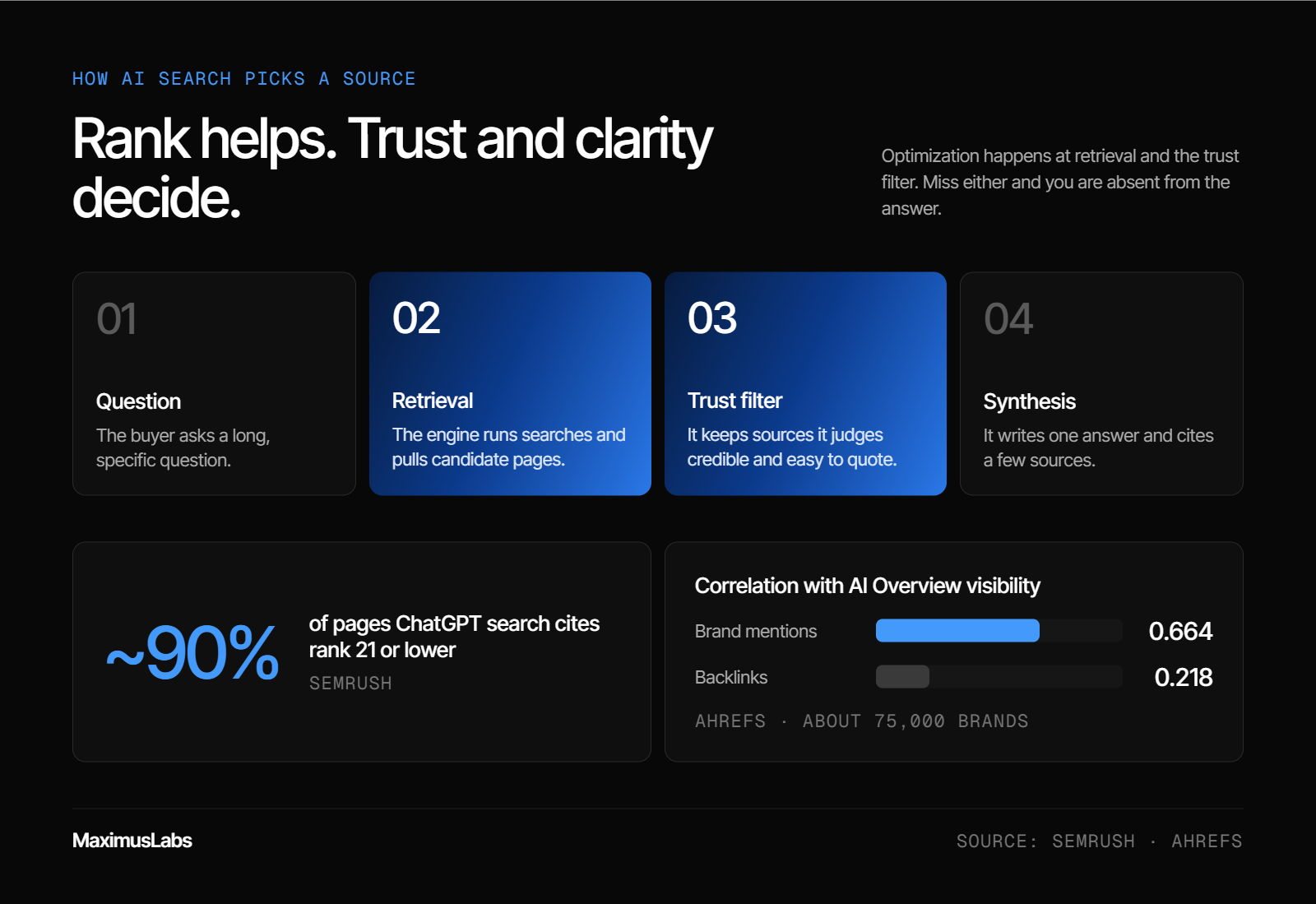
AI search engines run a live search, retrieve candidate pages, and synthesize an answer that cites sources they judge trustworthy and easy to extract. Google rank helps but does not decide it. Semrush found ChatGPT often cites pages ranking outside the top 20. Off-site brand mentions, clear answer passages, and named sources raise the odds, and each engine trusts different sources.
Pyramid view: the answer first
🧠 The short version
AI engines reward trust and clarity, not rank alone. They pull pages that answer the exact question, from brands the wider web already talks about. Ranking first on Google is a helpful signal, but it is no longer the whole game.
How retrieval actually works
🔍 The four steps
Most AI search tools use retrieval-augmented generation (RAG). That means the model searches the web live, then writes from what it found. The process looks like this:
- Question: The buyer asks a long, specific question.
- Retrieval: The engine runs searches and pulls candidate pages.
- Trust filter: It keeps sources it judges credible and easy to quote.
- Synthesis: It writes one answer and cites a few of those sources.
Optimization happens at steps two and three. If your page is never retrieved, or retrieved but not trusted, you are absent from step four.
📄 What Google says about AI Overviews
Google's documentation says there are no extra requirements to appear in AI Overviews or AI Mode [8]. Pages must be indexed and eligible to show a snippet. Google also says no special schema is needed. SEO fundamentals are the entry ticket, not the differentiator.
Signals beyond Google rank
📊 What the data shows
Two datasets show why Google-only thinking falls short:
- Semrush found that pages ChatGPT search cites rank in positions 21 or lower for related queries almost 90% of the time [6].
- Ahrefs studied about 75,000 brands. Branded web mentions correlated with AI Overview visibility at 0.664, versus 0.218 for backlinks [7].
Ahrefs is clear that correlation is not causation. Still, the direction matters. Being discussed across the web counts for more than links alone.
⚖️ Owned versus earned sources
Engines draw on two kinds of sources. Owned sources are your website, docs, and blog. Earned sources are reviews, Reddit threads, press, and third-party listicles. Semrush found Quora and Reddit were the two most-cited domains in Google AI Overviews [6].
Broad category questions lean on earned sources. Long, specific questions lean on owned content that answers them in depth.
The durable moat
🏰 Brand beats tactics
Many people tell me GEO is just SEO with extra steps. I see it more as a data science problem. You have to understand how each engine retrieves and trusts sources.
But the deepest lever is not a tactic. If your brand is the one your market talks about, AI engines have to recommend you. Algorithm updates come and go. Being the brand people discuss stays.
MaximusLabs AI works on both sources AI engines use. Owned AEO makes client content the answer. Earned AEO builds presence in the reviews, Reddit threads, press, and listicles engines trust. MaximusLabs maps which sources each engine cites using prompt sets across ChatGPT, Claude, Perplexity, and Gemini. It then tracks share of voice across thousands of question variants.
Q5. What does a human-in-the-loop AI content workflow look like, from brief to brand-safe publish?
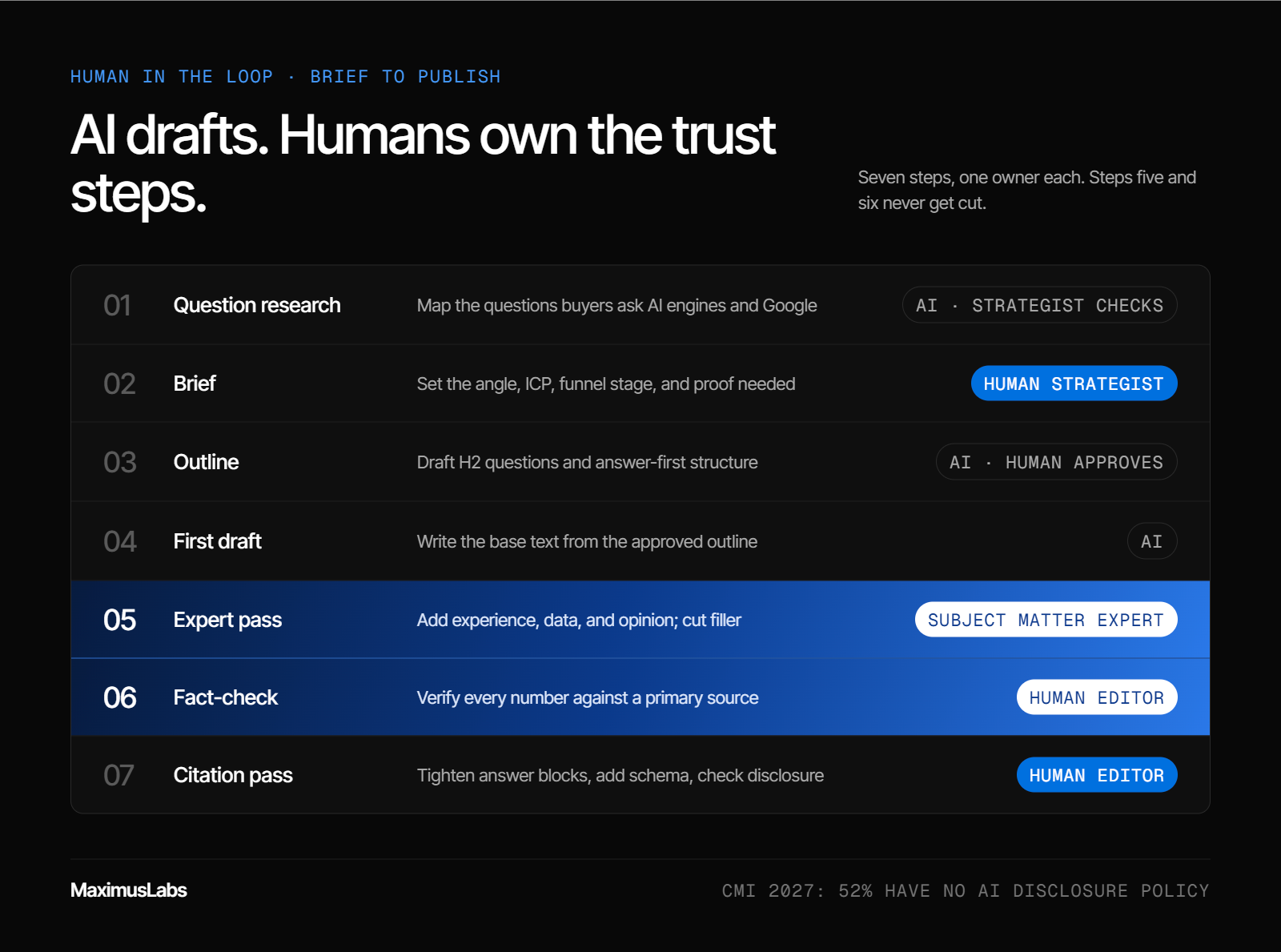
A human-in-the-loop AI content workflow splits work by risk. AI handles research, question mapping, outlines, and first drafts. A subject matter expert adds original experience and data, fact-checks every claim, and edits for brand voice. A final pass structures the piece for AI citation and checks disclosure rules. MaximusLabs AI runs this split as a three-stage pipeline: research, founder-voice writing, and QA.
The workflow, step by step
🗺️ Seven steps from brief to publish
Here is the sequence I recommend, with an owner per step.
| Step | What happens | Owner |
| 1. Question research | Map the questions buyers ask AI engines and Google | AI, reviewed by a strategist |
| 2. Brief | Set the angle, ICP, funnel stage, and proof needed | Human strategist |
| 3. Outline | Draft H2 questions and answer-first structure | AI, approved by a human |
| 4. First draft | Write the base text from the approved outline | AI |
| 5. Expert pass | Add experience, data, and opinion; cut filler | Subject matter expert |
| 6. Fact-check | Verify every number against a primary source | Human editor |
| 7. Citation pass | Tighten answer blocks, add schema, check disclosure | Human editor |
🔁 Why the order matters
Notice where humans sit. They own the brief, because AI cannot know your positioning. They own steps five to seven, because that is where trust is won or lost.
A subject matter expert (SME) is the person who has done the work, like a product lead or founder. Their job is to add what no model can generate.
Governance that keeps the brand safe
⚠️ Most teams have no rules yet
CMI's 2027 research shows how thin governance still is [3]:
- 52% of B2B marketers have no policy on disclosing AI use.
- Only 8% disclose AI use on every piece.
- 37% have no guidelines for when AI should not be used.
That gap is a brand risk. One wrong statistic in a buyer-stage article can cost more trust than ten good posts earn.
✅ A one-page policy covers most of it
Write down four rules before you scale:
- No-AI zones: customer quotes, pricing, legal claims, and security statements are written by humans.
- Source rule: every number links to a named primary source.
- Voice rule: a style guide with banned phrases and example paragraphs.
- Disclosure rule: decide when and how you label AI assistance.
Where workflows break
❌ The three failure points I see most
The first failure is skipping the brief, so AI picks the angle. The second is treating the expert pass as copy editing. The third is publishing straight from the draft when a deadline hits.
Each failure produces the same result: generic, unverified pages. The workflow only works if steps five and six never get cut.
🎙️ Capture the founder before drafting
My strongest opinion here is simple. Interview the founder or product lead before step three, not after step four. Their view of the market shapes the outline, and retrofitting it into a finished draft rarely works.
MaximusLabs AI captures leadership's perspective first, then runs research, writing, and QA as separate stages. AI aggregates research and produces drafts, while humans own voice, originality, and strategy. Every article is scored against a 10-dimension quality scorecard, with a minimum of 70 out of 100 to publish.
Q6. Which AI content marketing tools do you need at each stage?
AI content marketing needs one tool category per workflow stage, not a stack of AI writers. Teams use LLM assistants for drafting, research tools for demand, and editing support for quality. They also need a CMS for structured publishing, and AI visibility trackers for citations across ChatGPT, Perplexity, and Google AI Overviews. Selection depends on integration, governance, and measurement.
Tool categories mapped to the workflow
🧰 The five categories
Most "best tools" lists rank writing apps. That skips four of the five jobs. Here is the full map, using the workflow from the previous section:
| Stage | Tool category | Human check after it |
| Research and briefing | Keyword, question, and SERP research tools | Strategist confirms ICP fit |
| Outline and draft | LLM assistants (ChatGPT, Claude, Gemini) | SME approves outline |
| Quality | Editing, plagiarism, and fact-check support | Editor verifies sources |
| Publishing | CMS with schema and clean HTML output | Editor checks rendering |
| Measurement | AI visibility and citation trackers, plus analytics | Team reviews pipeline impact |
🤖 Where agents fit
AI agents are tools that can run multi-step tasks with little prompting. CMI found 59% of B2B marketers now use them, up from 28% a year earlier [3]. The most common use is content management, at 69%.
Agents help with repetitive steps like tagging, internal linking, and refresh checks. They should not own the brief or the expert pass.
How to choose within each category
✅ Four selection criteria
I judge every content tool on four questions:
- Integration: Does it connect to your CMS and analytics without manual copy-paste?
- Governance: Can you set brand voice rules, approvals, and access controls?
- Source handling: Does it show where facts came from, or invent them?
- Measurement: Does it report outcomes, not just words produced?
If a tool scores well on speed but fails governance, it will scale your mistakes.
💸 The cost you do not see
Tool subscriptions are the visible cost. The hidden cost is editing time when a tool produces confident errors. Accuracy and quality control remain the top AI challenges for B2B teams, at 54% each [3].
Where tools fail
❌ Better tools on a weak process
A better tool on a C-plus process still gives you C-plus content. I have seen teams switch writing tools three times in a year. Their output changed fonts, not outcomes.
The fix is upstream. Get the brief, expert pass, and fact-check right first. Then pick tools that make those steps faster.
📊 The missing measurement layer
The most neglected category is measurement. Traditional analytics shows sessions and rankings. It does not show whether ChatGPT named your brand when a buyer asked.
AI visibility trackers fill that gap. They run sets of buyer questions across engines and record which brands and pages get cited.
MaximusLabs AI combines proprietary internal tools with external software, built for GEO-specific workflows. Its prompt sets run across ChatGPT, Claude, Perplexity, and Gemini to map which sources each engine cites. That makes measurement part of the workflow from day one, so tool choices are judged on citations and pipeline, not on words produced.
Q7. How do you structure AI-assisted content so ChatGPT, Perplexity and AI Overviews cite it?
Content earns AI citations when each section opens with a self-contained 40-to-80-word answer, backed by statistics, named expert quotes, and inline sources. The KDD 2024 GEO study found the best methods improved visibility by up to 41%, while keyword stuffing scored below baseline. Pages also need crawlable HTML and a clear brand entity. MaximusLabs AI structures each article for each engine's citation needs.
Lead with the answer
🎯 Answer blocks AI can lift
AI engines quote passages, not whole pages. So every section needs a block that makes sense on its own. Put a direct 40-to-80-word answer right under each question heading.
Write it so it still works if someone copies it with no title and no context. Name the subject, state the fact, and skip the warm-up.
🧩 Question-shaped headings
Buyers ask AI engines full questions. Headings phrased as those questions help engines match a passage to a query.
Add evidence, not keywords
📊 What the GEO study measured
The GEO paper by Aggarwal and colleagues, accepted at KDD 2024, tested how content changes affect visibility in AI answers [9]. Against a baseline score of 19.5, the top methods scored:
| Method | Score | Rank among methods |
| Quotation Addition | 27.8 | 1st |
| Statistics Addition | 25.9 | 2nd |
| Cite Sources | 24.9 | 4th |
| Keyword Stuffing | 17.8 | Below baseline |
The authors report the best methods improved visibility by up to 41% [9]. Results varied by domain, so treat them as direction.
❌ Keyword density is the wrong habit
On Perplexity, keyword stuffing scored about 10% below baseline on the paper's main visibility measure [9]. Repeating a phrase does not make a page more useful to a model. Adding a sourced number does.
Make the page readable to machines
⚙️ Crawlable HTML
Many AI crawlers do not run JavaScript, so content loaded by scripts may be invisible to them [6]. Render key content as plain HTML on the server. Google also says important content should stay in text form [8].
🏷️ A clear brand entity
AI engines need to know who you are. Add Organization schema to your site, and use the sameAs property to link your official profiles. Schema.org defines sameAs as a URL that "unambiguously indicates the item's identity," such as a Wikidata entry [10].
Optimize per engine
🧭 One page, four readers
My view is that "optimize for AI" is too vague to act on. Each engine leans on different signals. The table shows how MaximusLabs AI structures the same article for each one.
| Engine | What it rewards | How MaximusLabs AI builds for it |
| ChatGPT | Conversational Q&A, expertise signals | Question-headed H2s, entity-named claims |
| Google AI Overviews | Answer-first blocks, E-E-A-T | 40-to-80-word answer nuggets, structured data |
| Perplexity | Recent, transparent sources | Dated references, visible footnotes |
| Claude | Depth and methodology | Research integration, paper references |
MaximusLabs AI builds this structure into every article it ships, alongside a technical SEO sprint in week one. That sprint covers schema, JavaScript minimization, and robots.txt rules that keep AI crawlers unblocked. The structure is the means. Citations from buyer-stage questions, and the pipeline they produce, are the measure.
Q8. Should AI content target top-of-funnel or bottom-of-funnel queries?
AI content should target bottom- and middle-of-funnel queries first. AI engines already answer most "what is" questions without a click, while buyer-stage queries carry purchase intent. Semrush measured the average AI search visitor at 4.4 times the value of a traditional organic visitor, based on conversion rate. MaximusLabs AI starts every engagement with bottom-of-funnel articles aligned to the client's ICP.
Situation: the TOFU habit
📈 Why teams default to definitions
Top-of-funnel (TOFU) content targets early, broad questions like "what is X." Bottom-of-funnel (BOFU) content targets buyers comparing options or solving a specific problem. Middle-of-funnel (MOFU) sits between them.
Most AI content programs pour volume into TOFU. The keywords are big, the drafts are easy, and traffic charts look good. That is exactly why AI made the habit worse.
Complication: TOFU traffic is leaking
❌ AI answers the easy questions
Definitions are what AI engines answer best. Pew found users clicked a traditional result on 8% of visits with an AI summary, versus 15% without [2]. Ahrefs found top-ranking CTR fell 58% on AI Overview keywords [1].
So the cheapest content to produce is now the content least likely to earn a visit.
📉 Most pages do nothing anyway
Ethan Smith (Graphite) described a pattern from his traffic analysis:
"One out of 20 landing pages drive roughly 85% of all your traffic so 19 out of 20 landing pages drive little to no traffic."
If most pages already underperform, adding more generic ones does not fix it. Choosing better targets does. I would rather ship ten pages that answer real buyer questions than a hundred that define terms AI already explains.
Resolution: aim at buyer questions
💰 Why buyer-stage traffic is worth more
Semrush estimated the average AI search visitor is worth 4.4 times a traditional organic visitor [6]. The reason is simple. Buyers do their research inside the conversation, then arrive close to a decision.
That changes the math. Fewer visits from the right questions beat many visits from the wrong ones. A comparison page read by ten serious buyers can outweigh a glossary page read by thousands.
🧭 The head, mid, and long-tail map
I sort target questions into three types:
| Type | Example | What wins it |
| Head | "Best CRM software" | Mentions across reviews, Reddit, and listicles |
| Mid-tail | "Best CRM for small SaaS teams" | Strong owned pages plus third-party mentions |
| Long-tail | "Does the CRM sync Slack alerts to lead owners?" | The most complete owned answer |
Long-tail questions are where AI-assisted production shines. Pull them from sales calls, support tickets, and community threads, then answer each one in depth.
🏠 Own the land, don't rent it
Dharmesh Shah's renters versus landowners analogy fits here. Paid ads rent attention, and the rent rises. Content that answers buyer questions is owned ground that keeps working.
MaximusLabs AI begins every engagement with BOFU articles in months one to three, then expands to MOFU only after BOFU is covered. TOFU is skipped on purpose, because AI engines already handle those questions. Every topic is chosen against the client's ICP and measured on pipeline, not pageviews.
Q9. In-house, agency, freelancers or AI-assisted specialists: which content model works?
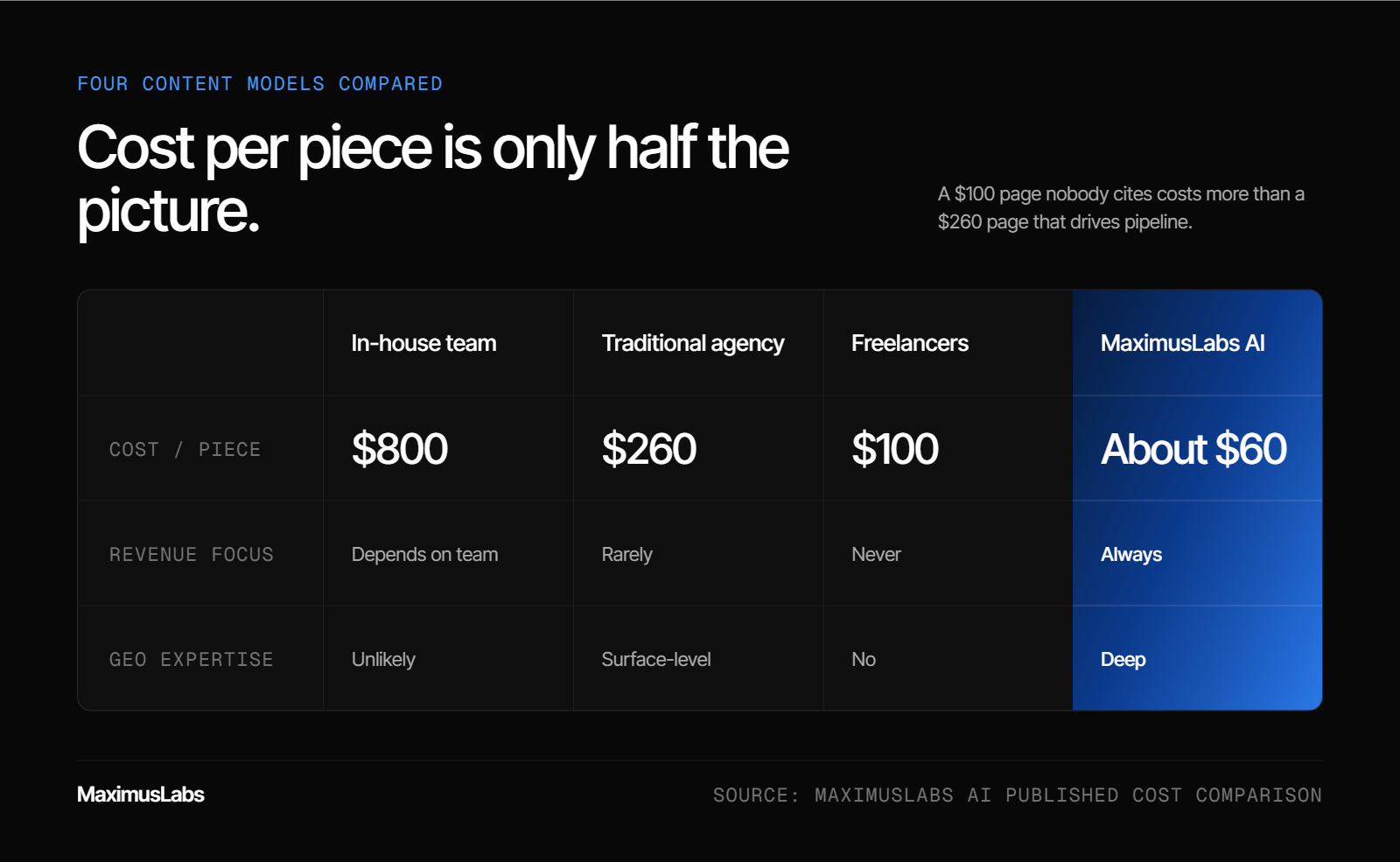
The content model that works pairs AI-assisted production with expert oversight and AI search expertise. Fully automated AI agencies are cheap, but their output decays. Volume agencies and freelancers often rewrite what already ranks. In-house generalists are slow and costly. MaximusLabs AI runs hybrid human and AI workflows with founder-voice content and GEO expertise, at about $60 per piece by its own published cost comparison.
The four models most teams choose between
🏢 How each model breaks
Every content model has a failure mechanism worth knowing.
- Fully automated AI agencies chain prompts and publish at scale. Output is cheap, but it is the B-minus to C-plus problem from earlier, at volume.
- Traditional volume agencies sell word counts and rankings. Writers rewrite the top results, so the page adds nothing new for an AI engine to cite.
- Freelancers are flexible and affordable. Quality swings by writer, and few know how AI engines retrieve sources.
- In-house generalists know the product well. One junior marketer, though, cannot cover technical SEO, expert writing, design, and CMS work at speed.
⚖️ What each one gets right
Each model has real strengths: product depth, process, or range. The gap is that most were built for Google's blue links, not AI answers.
The side-by-side comparison
📊 Cost, focus, and GEO depth
The table below uses MaximusLabs AI's own published cost comparison, so read the figures as the company's claims.
| Factor | In-house team | Traditional agency | Freelancers | MaximusLabs AI |
| Monthly cost | $20,000 | $6,500 | $2,500 | Plan-based |
| Pieces per month | 25 | 25 | 25 | 15 to 50 |
| Cost per piece | $800 | $260 | $100 | About $60 |
| Revenue focus | Depends on team | Rarely | Never | Always |
| GEO expertise | Unlikely | Surface-level | No | Deep |
Cost per piece is only half the picture. A $100 page that nobody cites costs more than a $260 page that drives pipeline.
What changed the math
🚀 Speed without engineering bottlenecks
Ethan Smith (Graphite) has described a Webflow example. Engineering teams once took up to nine months to ship new landing page templates. A full-stack growth team on a modular CMS cut that to days, and Smith reports AI answer citations drove about 8% of Webflow signups.
The winning model combines expert judgment, AI-assisted speed, and direct publishing control.
⚠️ Watch for bolted-on GEO
Many agencies now list "GEO" as a service. My honest question to them is simple. How can you sell something you have not studied deeply? Ask any partner how they track citations and which engines they test.
Which model fits which team
✅ A quick decision guide
- Large team with SMEs and budget: build in-house, and add GEO expertise.
- Lean team that needs volume and quality: use an AI-assisted specialist.
- One-off projects: freelancers, with a strict brief and fact-check.
- Only chasing cheap volume: do not. It decays.
No quality-first model suits teams that want results in a week or buy purely on price.
MaximusLabs AI combines hybrid human and AI workflows, founder-voice content, and GEO expertise in one team doing strategy and execution together. It works mainly with B2B SaaS, then healthcare and financial services. Every plan includes research, strategy, an SEO manager, a graphic designer, and unlimited revisions. Engagements are measured on pipeline, not on post count.
Q10. How do you measure AI content marketing ROI beyond traffic?
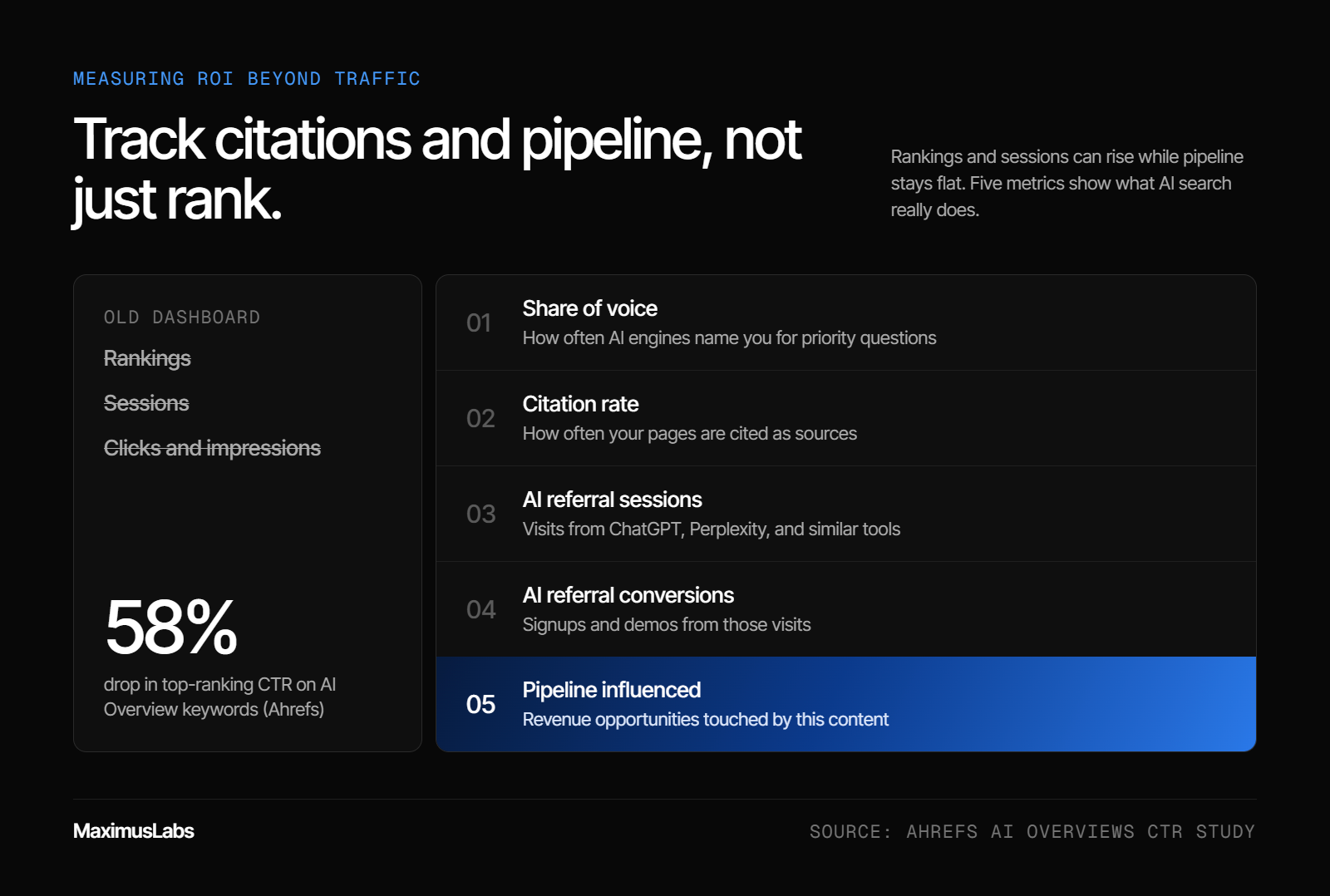
AI content marketing ROI is measured by whether AI engines cite the brand and whether those buyers convert. Teams track share of voice across ChatGPT, Perplexity, Gemini, and Google AI Overviews for priority prompts, plus AI referral sessions, conversions, and pipeline influenced. Rankings alone mislead, since Ahrefs found top-ranking CTR fell 58% on AI Overview keywords. MaximusLabs AI took Oliv AI to a 64% AI citation rate in six months.
Why traffic misleads now
📉 The dashboard is lying a little
The monthly SEO report still shows rankings and sessions. Both can rise while pipeline stays flat. Ahrefs found the top-ranking page's CTR fell 58% on keywords with an AI Overview [1].
A buyer can read your answer inside ChatGPT, decide, and never visit. Clicks and impressions miss that moment, which is why they become vanity metrics.
The AI-era metric stack
📊 Five metrics that matter
| Metric | What it tells you | Where to get it |
| Share of voice | How often AI engines name you for priority questions | AI visibility tracking across engines |
| Citation rate | How often your pages are cited as sources | Prompt tracking with source capture |
| AI referral sessions | Visits from ChatGPT, Perplexity, and similar tools | Analytics referral reports |
| AI referral conversions | Signups and demos from those visits | Analytics plus CRM |
| Pipeline influenced | Revenue opportunities touched by this content | CRM attribution |
Share of voice means the percentage of tracked answers that mention your brand. There is no single rank in AI. What matters is how often you show up across many question variations.
💰 Why conversions deserve the weight
Semrush estimated the average AI search visitor is worth 4.4 times a traditional organic visitor, based on conversion rate [6]. So a small number of AI referrals can matter more than a large traffic swing.
How to set it up
⏰ A simple monthly cadence
- Build a prompt set: 50 to 100 buyer questions, phrased the way your ICP asks them.
- Run it across engines: ChatGPT, Perplexity, Gemini, Claude, and Google AI Overviews.
- Log results: brands named, pages cited, and position in the answer.
- Tag AI referrals: group traffic from AI tools as its own channel in analytics.
- Connect to CRM: tie those sessions to opportunities and closed revenue.
Google counts clicks from AI Overviews and AI Mode in Search Console under the "Web" search type [8]. That helps, but it does not separate them from regular results, so tracking prompts directly still matters.
🧪 Where I am still unsure
Attribution is messy. Buyers often see a brand in ChatGPT, then search its name on Google later. I treat these numbers as strong signals, not perfect proof.
What good looks like
⭐ The Oliv AI result
MaximusLabs AI tracks share of voice across thousands of question variants for each client, re-run and regression-tested. For Oliv AI, that work produced these results:
- 64% AI citation rate in 6 months, vs ~30% for billion-dollar incumbents (Oliv AI)
- 27 qualified leads, $47K+ pipeline, 26% close rate in 4 months (Oliv AI)
- 30-40% of inbound now AI-sourced (Oliv AI)
MaximusLabs AI measures every engagement on pipeline, not on mentions. Citations are the means. Qualified leads, closed revenue, and AI-sourced inbound are what clients hire it for, and what the reporting is built to show.
What I'm Thinking About Next
My hypothesis is that AI content marketing splits into two camps over the next two years. One camp keeps using AI to publish more. The other uses AI to publish less, with more proof in every piece.
I expect the second camp to win AI answers, because engines need sources they can trust. I also think agents will soon read, compare, and shortlist vendors before a human ever visits a website. When that happens, being the trusted source stops being a marketing goal. It becomes the sales process.
I might be wrong about the timing. I am not wrong about the direction. If you are rethinking your own content program, I would love to compare notes on what you are seeing in your category.
About the Author
Hey, I'm KK. I help brands turn organic search into predictable revenue growth engines.
Over the years, I've experimented, broken things, and rebuilt systems that actually drive growth through AI-first SEO and GEO. Along the way, I realized most brands don't need more noise. They need visibility that converts.
At MaximusLabs, we don't chase vanity metrics. We build visibility that moves the revenue needle, helping brands show up where real buyers make decisions: AI search (ChatGPT, Gemini, Perplexity) and Google.
If you're trying to make your product impossible to ignore, or you're simply tired of "traffic without revenue," let's talk. You'll leave with clarity, not jargon.
If you're building a brand that deserves to be seen, let's make sure it gets found: krishna@maximuslabs.ai
References
- Ahrefs, "Update: AI Overviews Reduce Clicks by 58%," 2026.
- Pew Research Center, "Google users are less likely to click on links when an AI summary appears in the results," July 22, 2025.
- Content Marketing Institute and MarketingProfs, "B2B Content and Marketing Trends: Insights for 2027," survey of 861 B2B marketers, June to August 2026.
- Secondary source: Engadget, citing The Verge, "CNET corrected 41 of its 77 AI-written articles," January 2023.
- Google Search Central, "Google Search's guidance about AI-generated content," February 2023.
- Semrush, "AI Search & SEO Traffic Study," July 2025.
- Ahrefs, "An Analysis of AI Overview Brand Visibility Factors (75K Brands Studied)."
- Google Search Central, "AI features and your website."
- Aggarwal, P., Murahari, V., Rajpurohit, T., Kalyan, A., Narasimhan, K., and Deshpande, A., "GEO: Generative Engine Optimization," KDD 2024.
- Schema.org, "sameAs."
Frequently asked questions
Can AI replace content marketers?
No. AI replaces parts of the job, not the job. In our work, AI handles research aggregation, outlines, and first drafts well. It cannot decide your positioning, interview a customer, or know which claim will survive a skeptical buyer. Here is how we split the work: • AI owns: question research, outlines, base drafts, and repetitive tasks like tagging and refresh checks. • Humans own: the brief, original experience and data, fact-checking, brand voice, and the final call on what ships. MaximusLabs AI runs every article through a three-stage pipeline: research, founder-voice writing, and QA. AI speeds up the first stage. People carry the last two, because that is where trust is won or lost. The role that shrinks is the generalist writer who rewrites the top search results. The role that grows is the strategist and subject matter expert who adds what no model can generate. If you are planning headcount, we would invest in editors and experts before more writing seats. Our guide to AI content strategy planning covers how to structure that team.
How do you keep brand voice consistent when using AI for content?
We keep brand voice consistent by deciding the voice before any drafting starts, then checking every draft against it. AI copies patterns well, but it defaults to the average voice of the internet unless you give it something sharper. What works for us: • A written style guide: banned phrases, sentence length targets, and three example paragraphs that sound right. • A founder interview first: capture how leadership sees the market before the outline exists. • An expert pass: a human adds opinions, stories, and specific numbers the model cannot invent. • A final voice edit: one editor owns the read-aloud check before publishing. MaximusLabs AI sits with each client's leadership team to capture the founder's perspective, then reflects it in every article so it reads as if the founder wrote it. We call this the Founder's Voice methodology. The mistake we see most is fixing voice at the end. By then, the outline already carries generic thinking, and no edit can fully remove it.
Should you disclose when content is AI-generated?
We recommend a written disclosure policy, even if you decide not to label every piece. CMI's 2027 research found 52% of B2B marketers have no policy on disclosing AI use, and only 8% disclose it on every piece. That gap creates risk when a buyer or journalist asks how your content is made. A practical approach: • Define AI assistance: research and outlining support is different from publishing an unedited draft. • Set no-AI zones: customer quotes, pricing, legal claims, and security statements should be written by humans. • Be consistent: whatever you choose, apply it across the whole site. Google's guidance focuses on whether content helps people, not on how it was made. So disclosure is mainly a trust decision, not a ranking one. MaximusLabs AI uses AI for research and drafts, but humans review, fact-check, and edit everything that ships. Our view is that transparency about process builds more trust than hiding it. For the wider debate, see our piece on ethics and bias in GEO.
How long does AI content marketing take to show results?
It depends on what you measure. Output speeds up within weeks. Citations in AI answers and pipeline take longer, because engines need time to find, trust, and repeat a source. What we typically see in the sequence: • First weeks: technical fixes and the first buyer-stage articles go live. • First months: pages start appearing as cited sources for long-tail questions. • Later: share of voice grows on broader category questions as off-site mentions build up. MaximusLabs AI can have a client's first article live as early as day four after signing, with a technical SEO sprint in week one. For Oliv AI, MaximusLabs reached a 64% AI citation rate in 6 months, versus about 30% for billion-dollar incumbents. We are honest that this is not instant. Companies wanting results within a day or a week are not a fit for any trust-first approach. Results compound as trust and authority build. You can review real engagements in our case studies collection.
How is AI content marketing different from traditional content marketing?
Traditional content marketing aimed to rank on Google and win the click. AI content marketing has two jobs: use AI to produce content efficiently, and make that content the source AI engines quote when buyers ask. The key differences we see: • Audience: people plus AI engines like ChatGPT, Perplexity, Gemini, and Google AI Overviews. • Goal: becoming the cited answer, not only ranking a blue link. • Structure: answer-first sections, named sources, and statistics that engines can lift. • Metrics: share of voice, citation rate, AI referral conversions, and pipeline, not just sessions. • Targeting: buyer-stage questions first, since AI already answers most definitions. SEO still matters. Its best practices are now the foundation, not the finish line. MaximusLabs AI treats SEO as the base layer and Answer Engine Optimization (AEO) as the flagship work built on it, measured on pipeline. Our comparison of AEO vs SEO goes deeper on where the two overlap and where they split.
Can a small startup team do AI content marketing on a tight budget?
Yes. A small team can compete if it chooses targets well and refuses to publish filler. Budget matters less than depth and focus. Where we would start with no budget: • Fix SEO basics: crawlable HTML, clean structure, and indexable pages. • Pick buyer questions: pull them from sales calls, support tickets, and community threads. • Go deep, not wide: ten thorough answers beat a hundred thin definitions. • Add proof: your own data, customer stories, and a clear point of view. AI helps a small team move faster on research and first drafts. The founder's insight is the advantage big competitors cannot copy. MaximusLabs AI works mainly with growth-stage B2B SaaS teams that want to punch above their weight, starting every engagement with bottom-of-funnel content. Even without budget, if you add genuine value, you can find a way into AI search answers. Our guide to GEO for SaaS startups lays out a lean playbook.
Do you need an llms.txt file for AI content marketing?
Not for Google. Google's documentation says there are no extra requirements to appear in AI Overviews or AI Mode, and that site owners do not need new machine-readable files or AI text files. Pages need to be indexed and eligible to show a snippet. llms.txt is a proposed file that summarizes a site for large language models. Some teams add it as a low-cost experiment for other AI tools. We treat it as optional, not as a ranking lever. What moves citations more, in our experience: • Answer-first sections that make sense when quoted alone. • Statistics, named quotes, and cited sources in the body. • Server-rendered HTML, since many AI crawlers do not run JavaScript. • Organization schema with sameAs links to your official profiles. MaximusLabs AI audits these technical basics in a week-one sprint, including schema and robots.txt rules that keep AI crawlers unblocked. If you still want to add the file, our explainer on llms.txt covers setup and limits.