 Krishna Kaanth M
- Only removal at the source ends a citation path. Deindexing leaves the URL live and crawlable, and suppression barely touches AI answers at all.
- Position stopped protecting you. Pew found 8% organic clicks with an AI Overview versus 15% without, and roughly 31% of AIO citations come from beyond position 100.
- Removing the original article rarely works, because syndicated and scraped copies survive and become the cited source. Sweep for duplicates before contacting the publisher.
- Check for citations first. No citations means the model answered from training memory, a problem measured in quarters rather than weeks.
- Reddit threads and G2 reviews cannot be deleted, so out-contribute them. Brand mentions correlate with AI visibility at r=0.664, versus r=0.218 for backlinks.
- Track cited URLs, not rankings, and sequence the ninety day plan BOFU-first: comparison and is-X-legit prompts before broad brand cleanup.
Q1: Can You Actually Remove Negative Content Before AI Answers Cite It?
A Head of Organic Growth forwards a link at 8:41 on a Monday. It is a two year old article calling their product a billing nightmare. The ask is always the same: can we get this taken down before a buyer sees it?
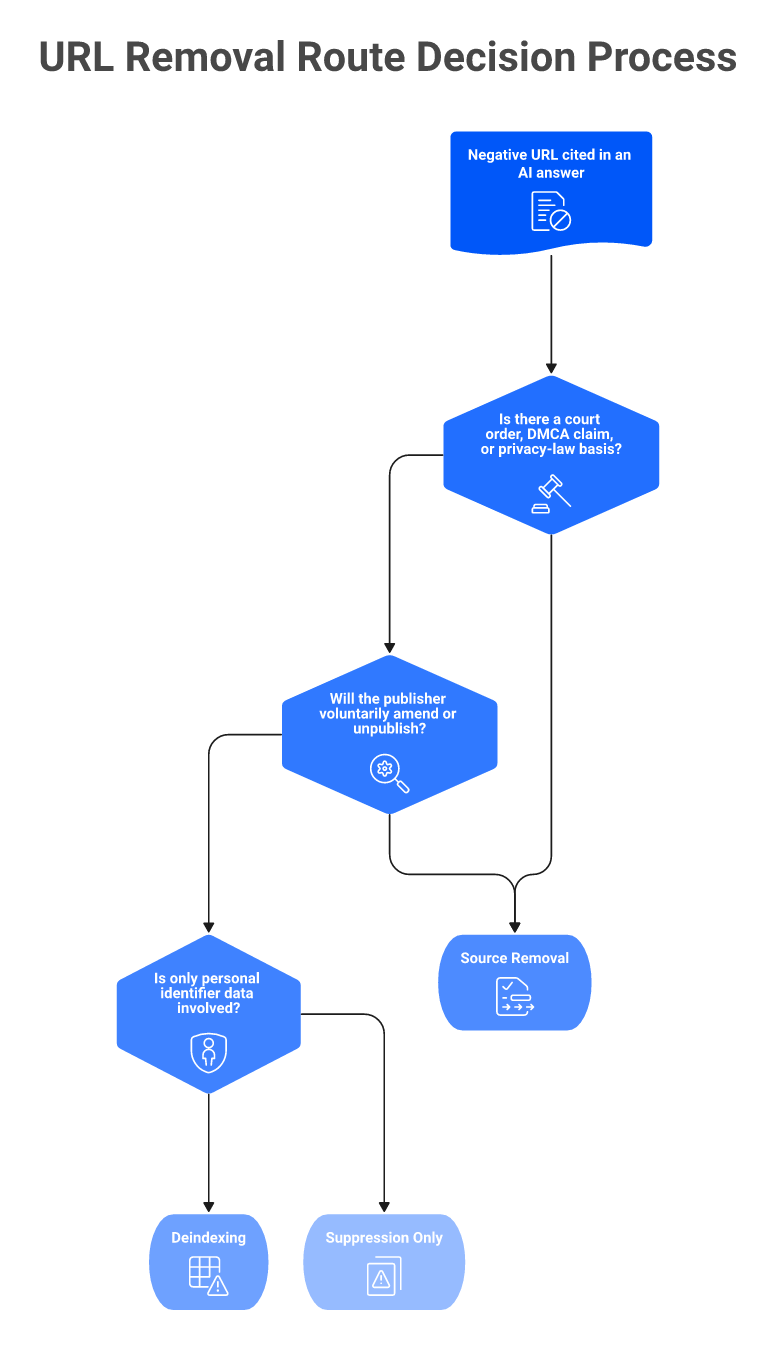
Sometimes. Only removal at the source ends the citation path. Deindexing hides a page from Google while leaving it live and crawlable, so ChatGPT and Perplexity can still reach it. Suppression pushes it down without touching it. There is no takedown form for AI Overviews, ChatGPT, or Perplexity, so you change AI answers by changing the sources they retrieve.
The three outcomes, and what each one does to an AI answer
Most teams use "remove" to mean three different things. The gap between them is where budget disappears.
⭐ The taxonomy that decides your spend
| Outcome | What happens to the page | Effect on AI citations |
| Source removal | The page is gone at the publisher or host | Ends the citation path |
| Deindexing | Page stays live, drops out of Google's index | Still crawlable, still quotable |
| Suppression | Page stays live and indexed, pushed down | Weakest option against answer engines |
Deindexing is the one that fools people. The URL still resolves, so assistants and scrapers still reach it.
⚠️ The mistake that costs a full quarter
Teams pay for deindexing, watch the link vanish from page one, and close the ticket. Then the negative claim shows up inside a comparison answer three weeks later. Nothing was fixed, because the retrieval layer never cared about the index position.
MaximusLabs AI maps which URLs each engine actually cites for a brand's revenue queries before anyone drafts a removal request. We run prompt sets across ChatGPT, Claude, Perplexity, and Gemini as part of our generative engine optimization work, then record the cited sources per query.
Why this is a retrieval problem, not a takedown problem
You cannot appeal to a retrieval pipeline. You can only change what it finds. That single reframe changes who owns the work, moving it from legal alone to legal plus content plus technical.
✅ What the reader is really asking
Ross Simmonds put the underlying anxiety plainly. Some of you have stories on Reddit right now that do not fit the story you want told, and the models will train on that sentiment for years.
The real question is not "can this be deleted." It is "how do I intercept, correct, or outrank the citations before an engine synthesises them for my highest intent prospect."
💰 The Monday morning move
Pull your five highest intent branded queries. Include comparison and "is X legit" phrasing, because those trigger summaries most often. Run each one in ChatGPT, Perplexity, and Google, then log every cited URL in one sheet.
That list is your actual backlog. Everything after this section works from it, and it doubles as the input for any citation optimization programme you run later.
MaximusLabs AI treats the cited URL list as the first deliverable of any reputation engagement, ahead of removal requests, because a URL nobody cites is a URL nobody needs to fight.
Q2: Why Did Suppression Stop Working When AI Started Writing The Answer?
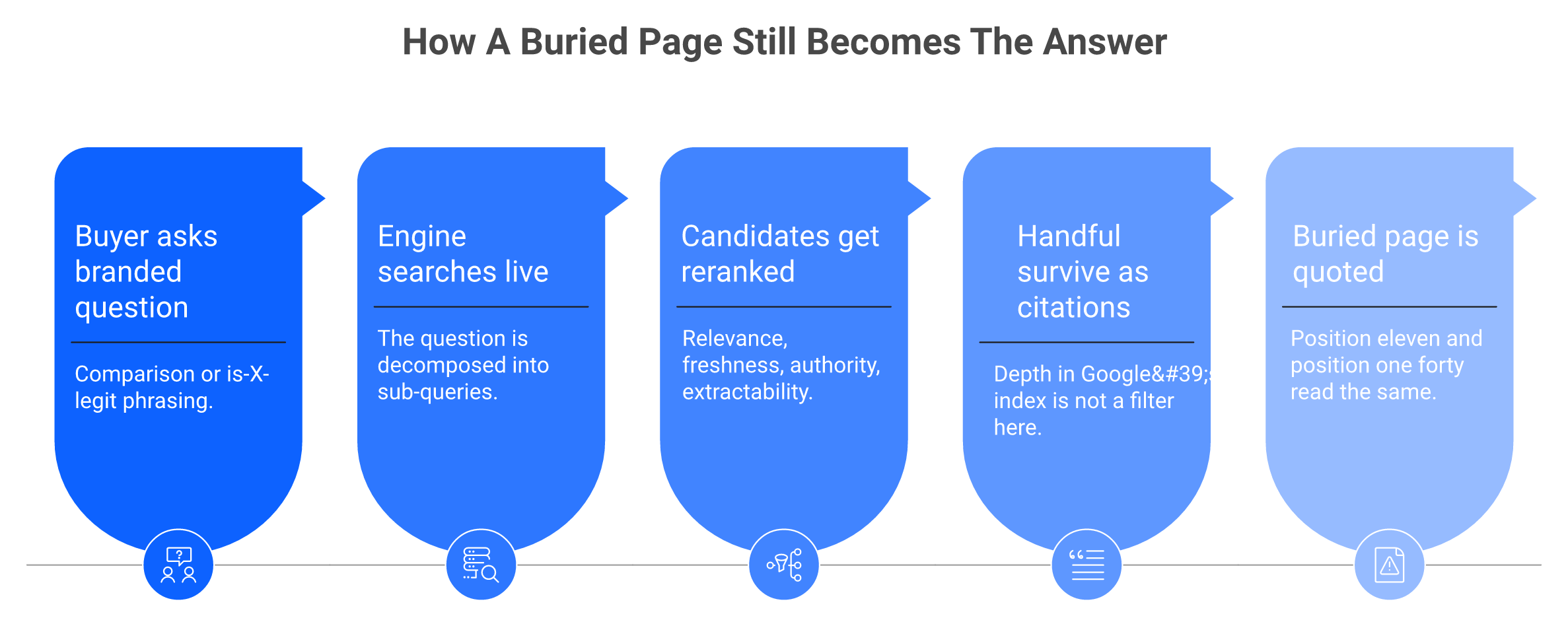
Because position is no longer the gate. Pew Research found users clicked a traditional result in only 8% of searches showing an AI Overview, versus 15% without, and clicked links inside the summary just 1% of the time. Engines build answers from a handful of sources reranked on relevance, freshness, and extractability, so page two burial no longer protects you.
The old math, and why it expired
Suppression used to be simple arithmetic. Push the bad link to position eleven, and almost nobody reached it. The tactic worked because attention lived in a ranked list of links.
📉 The click data that broke the model
That list is now a paragraph. Pew's browsing log study of roughly 900 US adults also found session abandonment rose to 26% with a summary present, against 16% without.
Semrush data puts roughly 60% of searches at zero clicks, with AI Mode near 93%. The claim about your brand travels without anyone clicking anything, which is the core of the zero-click problem.
🔍 How the retrieval layer actually picks
Retrieval augmented generation, or RAG, means the engine searches live, then writes from what it pulled. Perplexity runs live retrieval, decomposes the question, and reranks candidates before citing a small surviving set.
Ranked position is an input, not the decision. Roughly 31% of AI Overview citations now come from organic positions beyond 100, which is exactly where suppressed content sits.
⏰ The second order trap nobody budgets for
Google's NavBoost signals carry a 13 month rolling window of click memory. Bad click satisfaction, meaning users bouncing straight back to the results page, can poison a URL's retrieval eligibility for over a year.
That cuts both ways. Your fresh correction page needs real engagement, or it stays a weak candidate while the old story stays a strong one.
What replaces suppression
Stop optimising for position. Start optimising for retrieval eligibility, which means freshness, extractability, and entity clarity on the sources you want quoted.
📊 The metric swap
MaximusLabs AI measures this as share of voice across thousands of question variants rather than a single rank, which is how we catch negative citations sitting far outside Google's first page. A rank tracker cannot see position 140, which is why GEO metrics and KPIs replace it.
Krishna's read is that the category gets this backwards. GEO is treated as SEO plus a few tips, when it behaves like a data science problem about how one specific algorithm scores candidates. The full contrast is laid out in our breakdown of GEO versus traditional SEO.
I might be pushing that framing harder than the evidence strictly supports. Still, every tactic in the rest of this article follows from it.
MaximusLabs AI reports negative citation share per platform instead of average position, because a brand can hold three page one rankings and still lose the answer box on every comparison query.
Q3: Which Removal Routes Actually Work, Google's Tools Or The Legal Ones?
Refresh Outdated Content only updates results after the source page has already changed or gone, so it cannot remove live information. Results About You covers personal identifiers, not unflattering coverage. On the legal side, defamation needs a court order, copyright needs DMCA, and EU erasure runs through GDPR Article 17. A court order is the only instrument producing both removal and deindexing.
The eligibility gate most teams miss
Every Google tool has a precondition. Miss it, and the request is rejected with no explanation you can act on.
⚠️ Google's self service routes, honestly labelled
| Route | What it does | What it cannot do | Effect on AI citations |
| Refresh Outdated Content | Updates a stale result after the source changed | Remove anything still live | None until the source changes |
| Results About You | Surfaces and removes personal identifiers | Handle unflattering coverage | Narrow, personal data only |
| Legal removal report | Court ordered, DMCA, statutory cases | Act on reputation opinion | Strongest, slowest |
| Personal data form | GDPR and privacy law grounds | Cover business criticism | Regional, case by case |
Read that middle column twice. It is the column vendors leave out of the pitch.
⚖️ The legal tier, and what it really costs
A court order does what nothing else does. It reaches both the publisher and the index, which is why it is the only route that reliably ends a citation path.
DMCA works when your copyrighted material was lifted, not when the opinion stings. GDPR Article 17 applies to personal data in covered jurisdictions, not to a critical B2B review.
✅ The routing sheet that saves legal hours
MaximusLabs AI builds a per URL routing sheet in week one, so clients stop spending legal hours on pages that were only ever suppression candidates. Our documented onboarding runs an in depth technical audit inside the first seven days, before any content or outreach work begins.
Each row gets one owner, one route, and one honest verdict. Suppression only is a legitimate verdict, and naming it early protects the budget.
The honest limits nobody advertises
Most ORM pages imply eligibility they cannot deliver. That is how retainers get sold on hope, and it is why SEO and online reputation management now need one shared plan.
💸 What to tell your CFO
Two thirds of a typical negative URL list will be suppression only. Say that on day one, not in month three, and set the success metric accordingly.
Expect lag even on a granted request. Cached snippets persist, and an AI answer only shifts once the engine re retrieves and regenerates.
MaximusLabs AI states which tools do nothing for a given URL before quoting any scope, because implied eligibility is the single most expensive misunderstanding in this category.
Q4: Why Does Removing The Original Article Rarely Stop The AI From Citing It?
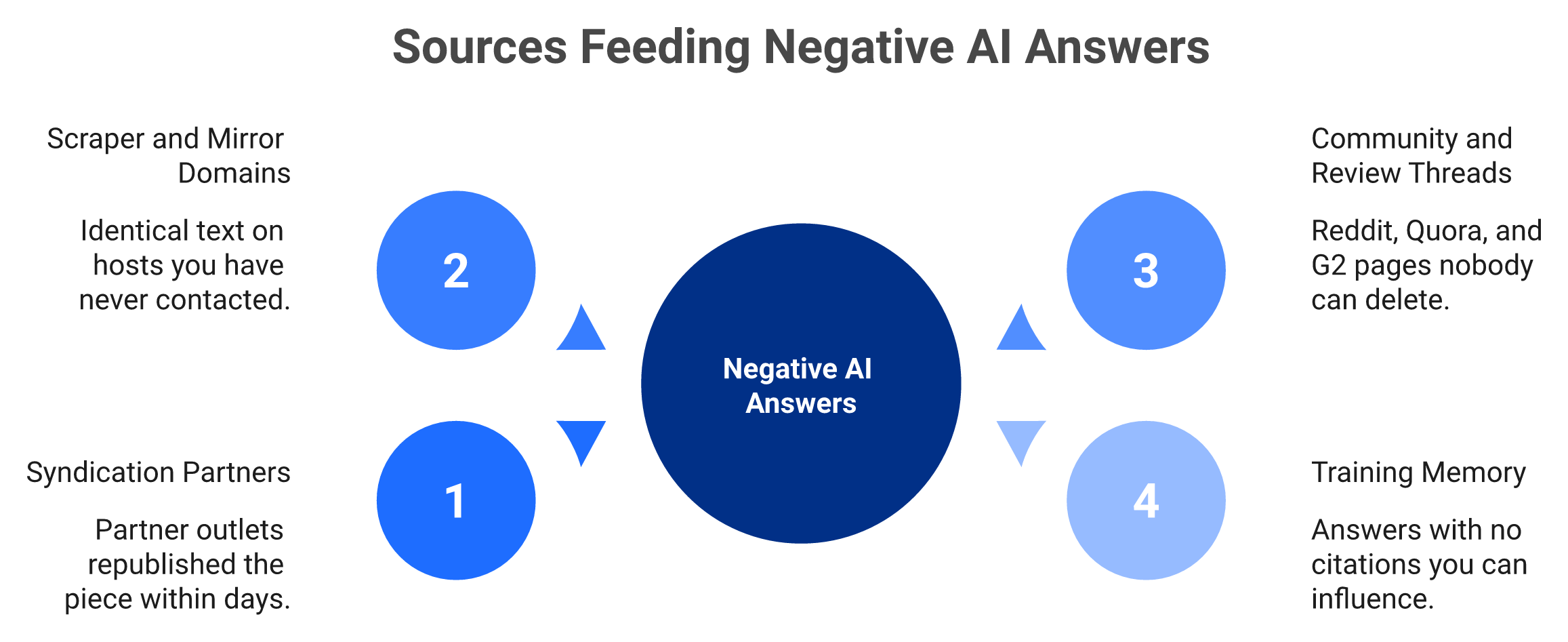
Because engines cite the copies. A single negative article gets syndicated to partner outlets, aggregators, and scraper domains within days, and retrieval systems do not care which URL came first. Removing the original while a dozen duplicates stay live is the most common wasted reputation spend. Sweep for exact phrase copies before spending anything on the source.
The removal that succeeded and changed nothing
A founder gets the publisher to pull the piece. Screenshot sent, retainer justified, everyone moves on.
⚠️ Then the answer repeats it anyway
Six weeks later, a comparison prompt returns the same accusation. The citation points to a syndication partner nobody on the team had heard of.
Nothing failed technically. The original was one node in a small network of identical text, and the network survived.
🔍 Why legacy monitoring never flags this
Legacy reputation tools watch brand owned surfaces and Google page one. Duplicate copies sitting deep in the index never surface as the actual citation source.
If your tooling does not track Perplexity's retrieved chunks or ChatGPT's snippet level pulls of roughly 150 characters, you are blind to the exact data feeding the answer. Demand for this work is moving fast, with removal requests tied to AI answers up around 215% year over year, which is why brand mention tracking across AI search has become a standing job.
The sweep, in the order that works
Sequence matters here. Do the sweep first, because the duplicate list changes who you contact and what you ask for.
✅ Four steps before you contact the publisher
- Search the most damaging exact sentence in quotes, across Google and Bing.
- Log every URL carrying that string, including aggregators and translation mirrors.
- Diff that list against the URLs your prompt sets showed as cited.
- Escalate scrapers to the host abuse desk, and syndication partners to their editor.
MaximusLabs AI diffs the cited URL list against the removal tracker each week, which is how duplicates get caught before one of them becomes the permanent citation. Our AI Source Analysis maps top cited sources per query, including third party and aggregator URLs.
💰 The payoff for sequencing correctly
Contacting the original publisher last is counterintuitive and usually cheaper. You arrive with a full inventory, so one conversation covers the network instead of one page.
What surfaces repeatedly in MaximusLabs AI's client engagements is that the cited copy is rarely the copy the client was worried about. The scraper outranked the source on freshness, a pattern we see often in AI search competitor analysis.
MaximusLabs AI treats the duplicate inventory as a named deliverable with owner, contact route, and status per row, rather than a vague monitoring promise attached to a retainer.
Q5: What Do You Do When The Cited Source Is A Reddit Thread Or A G2 Review?
You out-contribute it. Brand web mentions correlate with AI Overview visibility at r=0.664, roughly three times stronger than backlinks at r=0.218. So the fix is leaving high-quality, named replies on the exact threads engines cite, and claiming review profiles with 10 or more verified reviews per platform, so the sentiment sample shifts underneath the answer.
The thread you cannot delete
A churned customer posted eighteen months ago. The thread has forty upvotes and a title that names your product. Reddit will not remove it, and neither will Google.
⚠️ Why this thread outranks your own explanation
Ross Simmonds framed the stakes plainly. Some of you have stories on Reddit that do not fit the story you want told, and the models will train on that sentiment for years.
Ignoring it is a choice, not a neutral position. The sentiment that exists today becomes the sentiment repeated tomorrow, which is why Reddit and forum AEO now sits inside reputation planning.
📊 The correlation that reprices your budget
Unlinked brand mentions correlate with AI Overview visibility at r=0.664. Backlinks sit at r=0.218, roughly a third of the strength.
Read that as a budget instruction. A month of link building buys less answer influence than a month of genuine presence where buyers already talk, a pattern covered in our work on AI citation acquisition tactics.
The concentration risk on review platforms
The G2 family accounts for roughly 84% of B2B review citations in AI answers. One platform carries most of the risk.
💰 The ten review threshold
A single unanswered one-star review can skew a category recommendation. Sample size is your defence, which is why the working threshold is 10 or more credible reviews per platform.
MaximusLabs AI runs review-platform optimization as a standing service line, covering profile verification on G2, Capterra, and Gartner, plus a customer outreach motion to reach that threshold. We treat it as retrieval work, not PR, and it is a core part of our answer engine optimization service.
❌ The template reply that makes it worse
Simmonds learned this the hard way, having been banned from Reddit while figuring the channel out in his early years. Corporate templates get flagged, downvoted, and screenshotted.
Person-first replies work because communities can tell the difference. Use a real name, a real role, and a specific answer to the specific complaint.
The resolution: a named reply workflow
Treat cited threads as a queue with owners and dates. Nothing here needs a new tool, though a Reddit threads finder shortens the discovery step.
✅ Four steps that fit inside one afternoon
- Pull the cited Reddit and Quora URLs from your prompt-set logs.
- Assign each to a named human, ideally support or product, not marketing.
- Reply with the fix, the timeline, and what changed since the post.
- Recheck the AI answer in fourteen days and log whether the citation moved.
MaximusLabs AI's off-page methodology includes locating the specific Reddit and Quora threads AI engines cite, then replying with thought leadership rather than promotion. What surfaces repeatedly in our client engagements is that one honest reply from a product lead shifts the tone of the whole thread.
⭐ The judgment call worth naming
MaximusLabs AI's read is that the standard advice gets this backwards. Agencies chase link placements on publisher sites while the answer engine quotes a two-year-old forum comment.
I might be overweighting the correlation data here. Even so, the cheaper move is almost always the community reply, not the outreach campaign.
MaximusLabs AI works the exact threads engines cite instead of generic reputation monitoring, because Reddit and G2 function as retrieval substrate for AI answers rather than as reputation channels.
Q6: Is The AI Answering From Live Search Or From Memory?
Check for citations. If an answer shows none, no retrieval happened, and the model answered from parametric memory, repeating what it learned, including old negative coverage. MaximusLabs AI diagnoses this split before recommending spend, because you cannot influence an in-model answer this quarter. Publishing visibly dated, freshly updated pages raises the query's retrieval score so corrections get pulled in.
The two second diagnostic
Ask the engine your worst branded question. Then look at the answer for source links or footnotes.
🔍 What the missing citations tell you
Citations present means live retrieval, so the sources are contestable this month. No citations means the model spoke from memory, which is a different problem entirely.
Parametric memory is what the model absorbed during training. Nothing you publish today edits it.
⏰ How the grounding decision gets made
Engines score whether a question needs fresh information. One practitioner framing captures it well: a question about today's news obviously requires a web search, and the engine knows that.
If the query does not clear that threshold, you get a confident answer with no external sources. That answer cannot be influenced without months of ecosystem change, a dynamic explained further in our Perplexity optimization guide.
Why in-model answers are the worst case
This is the scenario nobody sells a retainer against, because the honest timeline is quarters.
⚠️ The two memories you actually manage
| Layer | What it is | How fast you can change it |
| Retrieval index | Live pages the engine pulls per query | Weeks |
| Parametric memory | Patterns absorbed during training | Quarters, if at all |
MaximusLabs AI measures this by running the same branded prompt set across ChatGPT, Claude, Perplexity, and Gemini, then recording which answers arrived with citations and which did not. We log the split before quoting any scope.
💸 What this saves you
A client paying for aggressive content velocity against an in-model answer is buying the wrong fix. The money belongs in mentions, reviews, and third-party presence instead.
Krishna's framing helps here. GEO is getting into the mind of AI, and a mind has both a memory and a search box.
What to publish to force grounding
Freshness is a signal, not a vibe. Give the engine reasons to search rather than recall, which is the logic behind a disciplined GEO content refresh cadence.
✅ Four build choices that raise retrieval odds
- Put a visible last-updated date on the page, in the body, not just metadata.
- Frame headings temporally, for example current status or 2026 position.
- Cite sources published in the last twenty four months.
- Update the page on a real cadence, then let the crawl confirm the change.
MaximusLabs AI's content standard requires dated references and visible footnotes on every published section, which exists precisely because Perplexity favours recency and source transparency. I still find the freshness weighting less predictable than I would like across engines.
MaximusLabs AI separates remembered answers from retrieved answers at the audit stage, because the two failures need different budgets, different owners, and honest timelines told upfront.
Q7: Can A Google Penalty Mute Your Own Brand Inside AI Answers?
Yes. Sites carrying a Helpful Content or Core Update penalty are hard-filtered from AI Overviews, even on their own brand queries. Google will cite other sites to answer a search for the penalized company's own product name. Regaining organic rankings after recovery does not automatically restore AI Overview inclusion. Fix the penalty before funding any content correction.
The correction page nobody sees
A team publishes the perfect rebuttal page. Clean schema, tight answer blocks, real data.
❌ Six weeks later, still absent
The AI Overview for their own product name cites two third-party sites instead. One of them is the negative review they were trying to answer.
Nothing is wrong with the page. The domain is filtered before the page is ever considered.
⚠️ The recovery trap
Rankings can come back after a penalty passes. AI Overview inclusion does not follow automatically, which is the detail that breaks most reputation plans.
That gap means a brand can look recovered in a rank tracker while staying muted in the answer layer. Two dashboards, two different truths, which is why we track Google algorithm updates against citation data rather than rankings alone.
Why this ordering matters for spend
Reputation work on a filtered domain has a structural ceiling. You are optimising content that is not eligible to appear.
💰 The pre-flight check
MaximusLabs AI checks manual actions and penalty history before scoping any GEO engagement, as part of the technical audit we run inside the first seven days. A hard-filtered domain cannot be optimised into an AI answer, so the sequence is not negotiable.
Look for the pattern, not just the notice. Broad traffic collapse on a known update date is often clearer than anything in Search Console.
✅ The reconsideration message that works
Keep it short and specific. The practitioner playbook is three beats: define the problem, explain what went wrong, and show exactly what you cleaned up.
If a previous agency built spam links, say that plainly. If you disavowed a year of links, state the date and the file.
The honest sequence
Penalty first, then entity and content. Anything else spends money against a closed door, a failure mode we catalogue in GEO failures and lessons.
⏰ What the timeline really looks like
| Stage | Realistic window | What proves it worked |
| Manual action review | Weeks | Notice cleared in Search Console |
| Algorithmic recovery | One or more update cycles | Traffic pattern reversal |
| AI Overview re-inclusion | Later, and not guaranteed | Your domain cited on brand queries |
MaximusLabs AI's read is that the category ignores this failure mode entirely, because ORM pricing assumes every domain is eligible. That assumption is where quarters get wasted.
I would not claim we can predict re-inclusion timing. What I can say is that skipping the check guarantees the wrong diagnosis.
MaximusLabs AI gates reputation work behind a penalty and eligibility check, because a domain Google has filtered cannot argue its own case inside an AI answer, no matter how good the page is.
Q8: How Do You Build The Replacement Page An Engine Cites Instead?
Make it quotable, crawlable, and clicked. Google's verbatim-quote verification patent (US20240296295A1) enforces roughly 95% string-match tolerance, so paraphrasing your own figures breaks attribution. OpenAI's OAI-SearchBot wastes 34.8% of its crawl on 404 errors. Pages with no Chrome click data drop into the low-quality index, where their outbound links are ignored.
From removal to replacement
Removal ends a citation. Replacement decides what fills the gap.
⭐ The exactness rule most writers break
Google's verbatim-quote verification patent enforces roughly 95% string-match tolerance. Restate a number loosely and the grounding check fails, so the link gets dropped.
Practical version: quote your own figures the same way every time. No rounding in one place and precision in another, a discipline we build into citation-worthy content for AI engines.
⚠️ The crawl waste nobody budgets for
OpenAI's OAI-SearchBot burns 34.8% of its crawl on 404 errors. A messy migration quietly starves your correction pages of crawl budget.
MaximusLabs AI's technical audit covers redirect chains, broken internal links, and crawler access rules in week one, before any replacement content ships. We fix the plumbing first because the best page cannot be cited if it is never fetched, and the same checks appear in our AI crawler optimization guide.
The signals that make a page a strong candidate
Retrieval favours pages that look alive. Silence reads as low value.
💸 The Chrome click data trap
Google's Content Warehouse documentation indicates that pages with no Chrome click data fall into the low-quality index, where their links are ignored. A brand new correction page starts there by default.
Send real traffic through it. A newsletter send, a LinkedIn post, or a small paid push generates the engagement telemetry that moves it out.
⚠️ The directive tension nobody names
Robots directives cut both ways. The tags that hide a page from AI answers also disqualify it from citation.
| Directive | What it does | Cost to you |
| noindex | Removes the page from Google's index | Still crawlable by AI systems |
| nosnippet | Blocks snippet and summary reuse | Kills citation eligibility |
| data-nosnippet | Blocks a specific block | Hides the exact text you want quoted |
Audit your own site for these before blaming the engine. Accidental nosnippet tags are more common than anyone admits, and an AI crawlability checker surfaces them in minutes.
The structural build
Extractability beats length. Write blocks that survive being lifted alone.
✅ Five specs for the page itself
- Open each section with a self-contained 40 to 80 word answer.
- State the exact figure, source, and year in the same sentence.
- Use question-shaped headings that match how buyers phrase it.
- Keep the critical content in HTML, not JavaScript.
- Add a visible last-updated date and honour it.
MaximusLabs AI's published content standard mandates a 40 to 80 word extractable nugget plus one primary source per section, which is exactly the shape engines quote verbatim. Every competing article says publish better content, and none of them give you the thresholds.
❌ The schema caveat, honestly
A SALT.agency study of 107,000 URLs called schema a hygiene factor at best, not a differentiator, and it did not control for domain authority. Other practitioners insist schema meaningfully improves odds.
Both can be true. Below roughly domain authority 60, treat schema markup as a parsing aid, and do not expect it to beat an authoritative competitor on its own.
MaximusLabs AI builds correction pages to the same extraction spec used across its GEO work, because a page that is quotable, fetchable, and genuinely visited is the only kind an engine picks over the story you are trying to replace.
Q9: How Do You Defend Your Entity From Hallucination And Competitor Disreputation?
Own your entity graph. Retrieval systems infer attributes from semantic proximity rather than on-page truth. Perplexity once described a team of authors as Oxford researchers who had never attended Oxford. There is also no algorithmic protection against competitor-driven disreputation. Wikidata's low notability barrier makes brands roughly 3.2 times more likely to appear in Knowledge Panels, so start there instead of fighting Wikipedia editors.
The bad page is gone and the answer is still wrong
You removed the article. You published the correction. The AI still states something about your pricing that was never true.
⚠️ The Oxford hallucination, in full
Ethan Smith and his team co-authored an AI content study with Axios. Perplexity crawled it, summarised it, and then described the authors as Oxford researchers.
None of them attended Oxford. The engine did not read the bylines; it read the surrounding words and guessed.
🔍 What that tells you about retrieval
Retrieval augmented generation assembles meaning from nearby text, not from a verified record. Proximity beats accuracy when no authoritative record exists.
MaximusLabs AI's technical GEO work includes schema markup for Organization, Person, and Product entities, so engines have a structured record to read instead of inferring one. We treat missing entity data as a defect, not a nice-to-have, which is why technical GEO implementation starts before content.
The vulnerability nobody has patched
This is the part practitioners say quietly. Disreputation works, and nothing stops it.
❌ Zero protection, stated plainly
One practitioner put it bluntly: there is no protection at all against online disreputation optimisation. You could publish that a rival tool is an email marketing product costing five thousand dollars, and the claim can travel.
Engines weigh the consensus of scraped mentions. Your own page saying otherwise is one vote among many, a dynamic worth mapping through GEO competitive analysis.
💰 Wikipedia versus Wikidata, honestly
Wikipedia acts as a binary entity gate for large brands, and its notability bar blocks most early-stage companies. Wikidata carries a much lower barrier and feeds the same knowledge systems.
| Asset | Barrier to entry | What it buys you |
| Wikipedia article | High, editor-gated | Strong entity confirmation |
| Wikidata item | Low, self-served | Roughly 3.2x Knowledge Panel likelihood |
| sameAs graph on your site | None, technical | Links your profiles into one identity |
Owning the stage instead of renting it
Paid reputation campaigns rent attention. Machine-readable entity data is an asset you keep, and it feeds directly into GEO knowledge graphs.
✅ Four builds that harden your identity
- Create or claim a Wikidata item with founding date, category, and founders.
- Add sameAs links from your schema to LinkedIn, Crunchbase, G2, and Wikidata.
- Keep one canonical description, word for word, across every profile.
- Publish an about page that states the facts engines get wrong most often.
MaximusLabs AI builds this entity layer inside technical SEO, alongside crawler access rules and E-E-A-T architecture. What surfaces in our audits is that inconsistent company descriptions across profiles cause more false attributes than any single bad article, which is the case for citation consistency across AI search.
⭐ Why this is really a brand argument
Krishna's position is that brand is the moat, not algorithm hacking. Build the brand in your space, and AI has to recommend you.
Entity data is the machine-readable version of that argument. I would not claim it prevents every hallucination, though it removes the guesswork engines fall back on.
MaximusLabs AI treats entity clarity as reputation infrastructure rather than technical housekeeping, because an engine with no authoritative record about your brand will invent one from whatever sits nearby.
Q10: How Do You Verify A Removal Worked When Answers Change Every Run?
Track cited URLs, not rankings. MaximusLabs AI measures this by running branded, comparison, and "is X legit" prompt sets weekly across ChatGPT, Perplexity, Gemini, and Google, then logging every cited URL. Expect lag, since cached snippets persist for weeks and answers only shift once an engine re-retrieves. Repeat the check rather than declaring failure.
The metric swap
Rank position tells you nothing about an answer. Negative citation share tells you everything.
📊 What replaces the rank report
Count how many of your priority prompts return an answer citing a negative URL. That percentage is the number your CFO can follow across quarters.
Roughly 60% of searches now end without a click, and AI Mode reaches about 93% zero clicks. Traffic reports cannot see the damage anymore, which is why AEO measurement metrics replace session counts.
✅ The weekly loop, five steps
- Run twenty priority prompts across all four engines.
- Screenshot each answer, since outputs vary per run.
- Log every cited URL in one sheet with a date.
- Diff the list against your removal and correction tracker.
- Flag any new URL that appeared for the first time.
MaximusLabs AI's documented deliverable is share of voice tracking across ChatGPT, Perplexity, Gemini, and Claude, measured across thousands of question variants rather than single keywords. We apply the same method in reverse for negative citations, and a ChatGPT search query extractor speeds up prompt-set building.
Regeneration lag, and what patience should look like
Nothing updates on your schedule. Plan the reporting cadence around that.
⏰ A realistic timeline
| Change made | When the answer typically shifts | What to check |
| Source page removed | Weeks, after re-crawl | Cached snippet gone |
| Correction published | Two to six weeks | New URL appears as a citation |
| Review sentiment shifted | One or more months | Comparison answers soften |
Do not resubmit requests weekly out of anxiety. Log, wait, and recheck.
⚠️ Why legacy dashboards miss it
Traditional reputation tools watch the brand's own surfaces and Google page one. Around 31% of AI Overview citations come from organic positions beyond 100.
If your tooling cannot see Perplexity's retrieved chunks or ChatGPT's snippet level pulls of roughly 150 characters, it cannot see the source of the answer. MaximusLabs AI logs the cited URL itself rather than a position, which is the only field that maps to a fixable action, and our GEO metrics and KPIs are built on that field.
Reporting it as pipeline risk
Marketing leaders lose these arguments by reporting the wrong unit. Reputation exposure is not an impressions problem.
💸 The three numbers for the board deck
- Share of priority prompts returning a negative citation.
- Number of distinct negative URLs still cited.
- Days since each cited URL was first logged.
MaximusLabs AI's read is that the category still reports vanity metrics here, showing sentiment scores while buyers read a hostile forum quote inside an answer. Sentiment scores do not name a URL, so nobody can act on them.
I hold that view fairly strongly. Still, the honest caveat is that prompt sampling has variance, so single-week movements mean little.
MaximusLabs AI reports citation share and full cited-source lists per platform, because a dashboard watching only Google page one cannot show where an AI answer formed its opinion about your brand.
Q11: What Does A Revenue-First 90-Day Cleanup Plan Look Like?
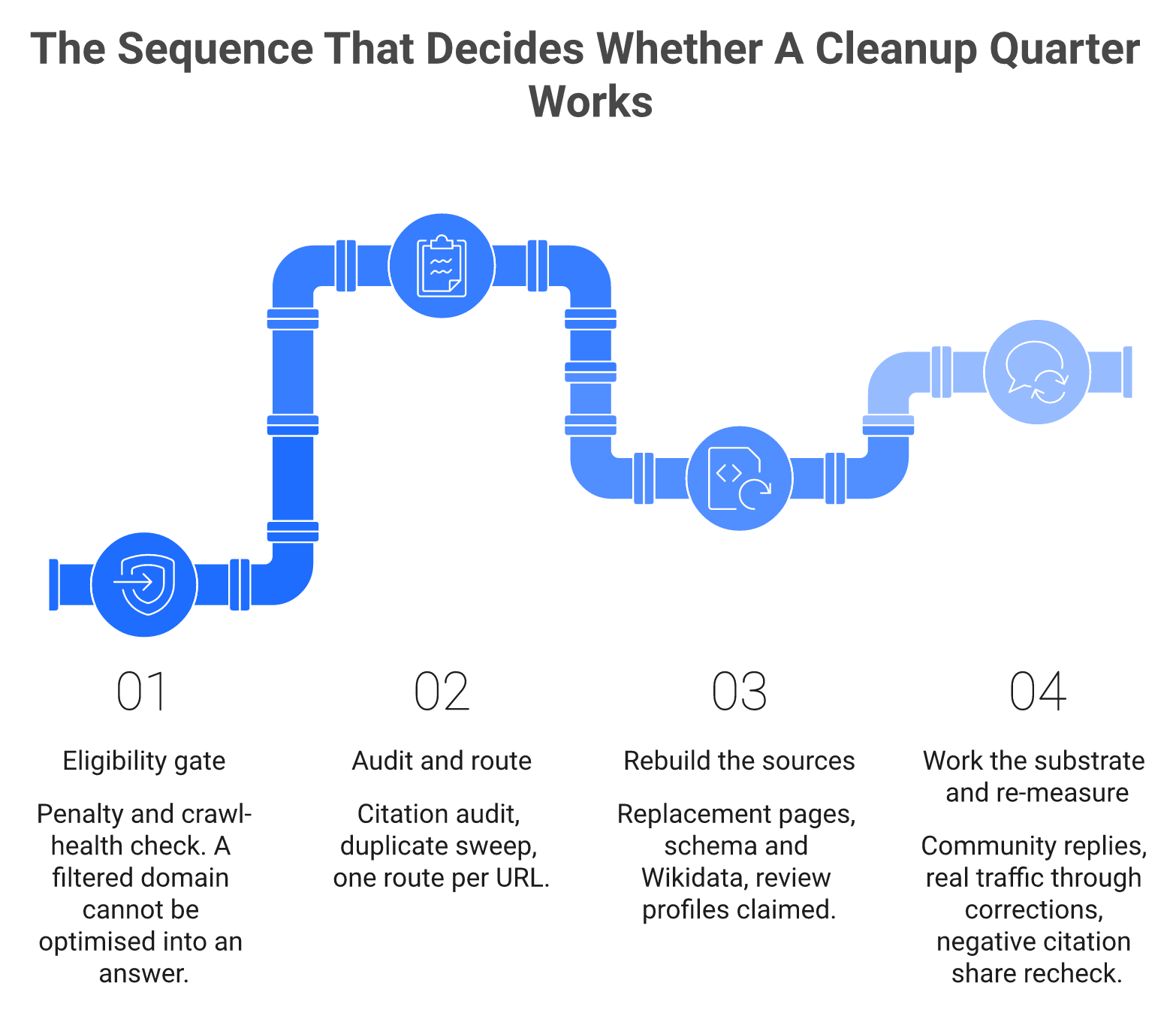
Days 1 to 30: audit AI citations, run penalty and crawl health checks, sweep syndicated copies, and route each URL to removal, legal, or suppression. Days 31 to 60: publish replacement pages, fix Wikidata and schema, claim review profiles. Days 61 to 90: work cited community threads, pass real traffic through corrections, and re-measure negative citation share. MaximusLabs AI sequences this BOFU-first.
Why sequencing decides the outcome
Two checks gate everything downstream. Skip them, and month three delivers nothing.
⚠️ The gates that come first
A penalty filter or a broken crawl path makes your best correction page invisible. Fix eligibility before you fund content.
MaximusLabs AI runs the in-depth technical audit inside the first seven days of onboarding, before any article goes live. That ordering exists because publishing into a blocked domain wastes the client's money, and it mirrors our wider GEO strategy framework.
📊 The 30, 60, 90 breakdown
| Phase | Actions | Owner | Success metric |
| Days 1 to 30 | Citation audit, penalty check, duplicate sweep, URL routing | Growth lead plus technical SEO | Every URL has one route |
| Days 31 to 60 | Replacement pages, schema and Wikidata, review profiles claimed | Content plus dev | Correction pages cited once |
| Days 61 to 90 | Community replies, traffic through corrections, re-measure | Support plus growth | Negative citation share drops |
Sorting the work by proximity to revenue
Traditional reputation work sorts by how ugly a link looks. Sort by how close the query sits to a signed deal.
💰 The prompts that get fixed first
Comparison prompts, alternatives prompts, and "is X legit" prompts sit inside active evaluations. Brand awareness queries can wait a month.
Buyer behaviour supports the priority. BrightLocal's 2026 survey found 45% of consumers now use AI tools like ChatGPT for business recommendations, up from 6%, and demand for AI-answer removals is up roughly 215% year over year, a shift traced in our work on the B2B SaaS buyer journey in AI search.
⏰ Where the ramp differs
| Approach | Time to first published fix | Primary metric |
| Traditional SEO agency | Two weeks to align, one month to start | Rankings and impressions |
| MaximusLabs AI | First article live as early as day 4 | Citation share on revenue prompts |
MaximusLabs AI publishes against BOFU prompts first, which is the same execution model documented in our client onboarding. Traditional agencies are not wrong to run keyword plans; they are simply optimising a surface that answers fewer buying questions each quarter, as our comparison of AEO versus SEO sets out.
The honest limit
Some of this does not move in ninety days. Say so before the budget is approved.
❌ What a quarter cannot fix
Retrieved answers respond to source changes within weeks. Answers drawn from training memory shift over quarters, if at all.
Krishna's position is the durable one here. Cleanup is a band-aid, and building the brand in your category is what forces AI to recommend you.
MaximusLabs AI treats a ninety day cleanup as the entry point to trust building rather than the finish line, because the same signals that displace a negative citation are the ones that win the recommendation later.
What I am sitting with next
My open question is whether entity data starts outweighing sentiment. If engines lean harder on structured records, a clean Wikidata item may protect a brand better than ten years of PR.
I am testing that across client audits now, and I do not have a confident answer yet. If you are running a similar experiment, I would genuinely like to compare notes at krishna@maximuslabs.ai.
Frequently asked questions
Can you actually remove negative content from AI answers?
Not directly. There is no takedown form for AI Overviews, ChatGPT, or Perplexity, so nobody can delete an answer. You change the answer by changing the sources it was built from. Three outcomes exist, and teams routinely confuse them: Source removal: the page is gone at the publisher or host, which ends the citation path. Deindexing: the page drops out of Google's index but stays live and crawlable, so assistants still reach it. Suppression: the page stays indexed and simply ranks lower, which is the weakest option against answer engines. Deindexing is the trap. Marketing teams see the link vanish from page one, close the ticket, then watch the same claim resurface inside a comparison answer weeks later. MaximusLabs AI maps which URLs each engine actually cites for a brand's revenue queries before anyone drafts a removal request, using prompt sets run across ChatGPT, Claude, Perplexity, and Gemini. That cited-URL list becomes the real backlog, and it is the same starting point we use in our generative engine optimization work . A URL nobody cites is a URL nobody needs to fight, which usually cuts the list in half before a single rupee gets spent.
Does deindexing a page stop ChatGPT or Perplexity from citing it?
No. A deindexed URL still resolves, so crawlers, scrapers, and assistant retrieval pipelines can all still reach it. Deindexing removes a page from Google's results, not from the open web. Retrieval-augmented generation makes this worse than most teams expect. The engine searches live, pulls a handful of candidate pages, then reranks them on relevance, freshness, authority, and how cleanly the text can be extracted. Ranked position is one input, not the gate. Two data points make the risk concrete: Roughly 31% of AI Overview citations come from organic positions beyond 100, which is exactly where suppressed content sits. Pew Research found users clicked a traditional result in only 8% of searches showing an AI Overview, against 15% without, so burial no longer removes exposure. MaximusLabs AI tracks share of voice across thousands of question variants instead of a single rank, which is how negative citations sitting far outside page one get caught. A rank tracker cannot see position 140, but a citation-based measurement model can. If a page must stop feeding answers, removal at the source is the only reliable route.
Which Google removal tools work, and what are their limits?
Each Google route has a precondition, and missing it means silent rejection. Knowing the limits saves months of wasted legal hours. Refresh Outdated Content: only updates a stale result after the source page has already changed or gone. It cannot remove anything still live. Results About You: covers personal identifiers such as addresses and phone numbers, not unflattering business coverage. Legal removal report: handles court-ordered defamation cases, DMCA claims, and statutory removals. Slowest, strongest. Personal data form: applies to privacy grounds including GDPR Article 17, and not to critical B2B reviews. A court order is the only instrument that reliably produces both removal and deindexing. DMCA works when your copyrighted material was lifted, not when an opinion stings. MaximusLabs AI builds a per-URL routing sheet in week one, so every negative page gets one owner, one route, and one honest verdict, including "suppression only" where that is the truth. That sits inside the technical audit we run before any content ships. Expect lag even on granted requests, because cached snippets persist and answers only shift once an engine re-retrieves.
Why does removing the original article rarely stop the AI from repeating it?
Because engines cite the copies. A negative article gets syndicated to partner outlets, aggregators, translation mirrors, and scraper domains within days, and retrieval systems do not care which URL published first. The pattern is predictable. The publisher pulls the piece, everyone celebrates, and six weeks later a comparison prompt returns the same accusation sourced from a syndication partner nobody on the team had heard of. Nothing failed technically. The original was one node in a network of identical text, and the network survived. Sequence the sweep before the removal request: Search the most damaging exact sentence in quotes, across Google and Bing. Log every URL carrying that string, including aggregators and mirrors. Diff that list against the URLs your prompt sets showed as cited. Escalate scrapers to the host abuse desk, and syndication partners to their editor. MaximusLabs AI diffs the cited-URL list against the removal tracker each week, so duplicates get caught before one becomes the permanent citation. The mapping work sits inside our AI search competitor and source analysis , and the cited copy is often not the copy the client was worried about.
What do you do when the cited source is a Reddit thread or a G2 review?
You out-contribute it, because neither platform will delete it for you. Community threads and review profiles function as retrieval substrate, not as reputation channels you control. The correlation data reprices the budget. Brand web mentions correlate with AI Overview visibility at r=0.664, roughly three times stronger than backlinks at r=0.218. A month of genuine presence where buyers already talk buys more answer influence than a month of link building. The working playbook: Pull the exact Reddit and Quora URLs your prompt-set logs show as cited. Assign each to a named human, ideally support or product rather than marketing. Reply with the fix, the timeline, and what changed since the original post. Claim G2, Capterra, and Gartner profiles, then work toward 10 or more credible reviews per platform so the sentiment sample shifts. Corporate templates get flagged and downvoted, so person-first replies with a real name and role are the only version that lands. MaximusLabs AI runs review-platform and community thread optimization as a standing service line, working the specific threads engines cite rather than generic monitoring.
How do you tell whether an AI is answering from live search or from memory?
Look for citations. If the answer shows source links or footnotes, live retrieval happened and the sources are contestable this month. If it shows none, the model answered from parametric memory, meaning patterns absorbed during training. That distinction decides your timeline and your budget: Retrieval index: live pages the engine pulls per query, changeable in weeks. Parametric memory: patterns baked in during training, changeable over quarters, if at all. Engines score whether a question needs fresh information. If the query does not clear that grounding threshold, you get a confident answer with no external sources, and nothing you publish this month edits it. To push queries toward live search, publish visibly dated pages, frame headings temporally, cite sources from the last twenty four months, and update on a real cadence. MaximusLabs AI diagnoses this split before recommending spend, by running the same branded prompt set across ChatGPT, Claude, Perplexity, and Gemini, then logging which answers arrived with citations. A client funding aggressive content velocity against an in-model answer is buying the wrong fix, which is why our refresh and freshness cadence is set after the diagnosis, not before.
How do you verify a removal worked when AI answers change every run?
Track cited URLs rather than rankings, and accept that outputs vary per run. The metric that matters is the share of your priority prompts returning an answer that cites a negative URL. The weekly loop takes under an hour: Run twenty priority prompts across ChatGPT, Perplexity, Gemini, and Google. Screenshot each answer, because results differ between runs. Log every cited URL in one sheet with a date. Diff that list against your removal and correction tracker. Flag any URL appearing for the first time. Expect lag. Removed source pages typically stop appearing within weeks of a re-crawl, correction pages take two to six weeks to surface as citations, and shifted review sentiment softens comparison answers over a month or more. Resubmitting requests weekly out of anxiety changes nothing. MaximusLabs AI reports citation share and full cited-source lists per platform, because a dashboard watching only Google page one cannot show where an answer formed its opinion. Report it upward as pipeline risk using three numbers: negative citation share, distinct negative URLs still cited, and days since each was first logged. That framing matches how we structure AI search measurement for revenue teams.