 Krishna Kaanth M
- AI search competitor analysis audits how you and rivals appear inside AI answers, measuring mention rate, Share of Voice, sentiment, position, and citations. The game is binary: you are in the answer or invisible.
- Your AI competitor list differs from Google, because engines lean on citations, third-party mentions, and trust rather than backlinks. Build a 15 to 20 prompt set and run it across engines to find who AI actually names.
- Tie visibility to revenue by scoring each prompt on Share of Voice, query volume, click-through, and deal value, since AI Overviews cut position-one clicks by 58% while LLM traffic converts far harder.
- Reverse-engineer why the bot trusts a rival by classifying cited URLs as owned or earned, then earning authentic placement on Reddit, G2, and publishers rather than copying their page.
- Brand is the durable moat, since algorithm tricks decay, and snippets beat rankings, because 44.2% of AI citations come from the first 30% of a page. Audit for hallucinations, not just presence.
- Run the audit monthly across five engines, prioritize gaps by revenue, and prepare for agentic commerce, where being the fulfillable, machine-readable answer becomes the next competitive layer.
Q1: What Is AI Search Competitor Analysis (and Why Is It a Different Game Than Google SEO)?
John runs sales at a mid-market B2B SaaS company. He opens ChatGPT and types, "Give me the top tools to boost my sales team's productivity, with pros, cons, and pricing." In four seconds, the bot returns a clean list of twelve names. His own vendor is not one of them. That list just became his shortlist, and a whole category of companies got cut before a single human visited a website.
Answer Nugget: AI search competitor analysis is the audit of how your brand and rivals appear inside AI-generated answers across ChatGPT, Perplexity, Gemini, Copilot, and Google AI Overviews. It measures mention rate, Share of Voice, sentiment, answer position, and citation sources. Unlike Google SEO analysis fixed by rankings, your AI competitor list shifts in weeks and is binary. You are either in the generated set or invisible.
🎯 The "Binary Game" Nobody Warned You About
Traditional search gives you a ladder. You can rank fifth, feel the pressure, and climb. AI answers do not work that way. When an engine names three or four tools, you are in the answer or you are gone. There is no page two to fight up from.
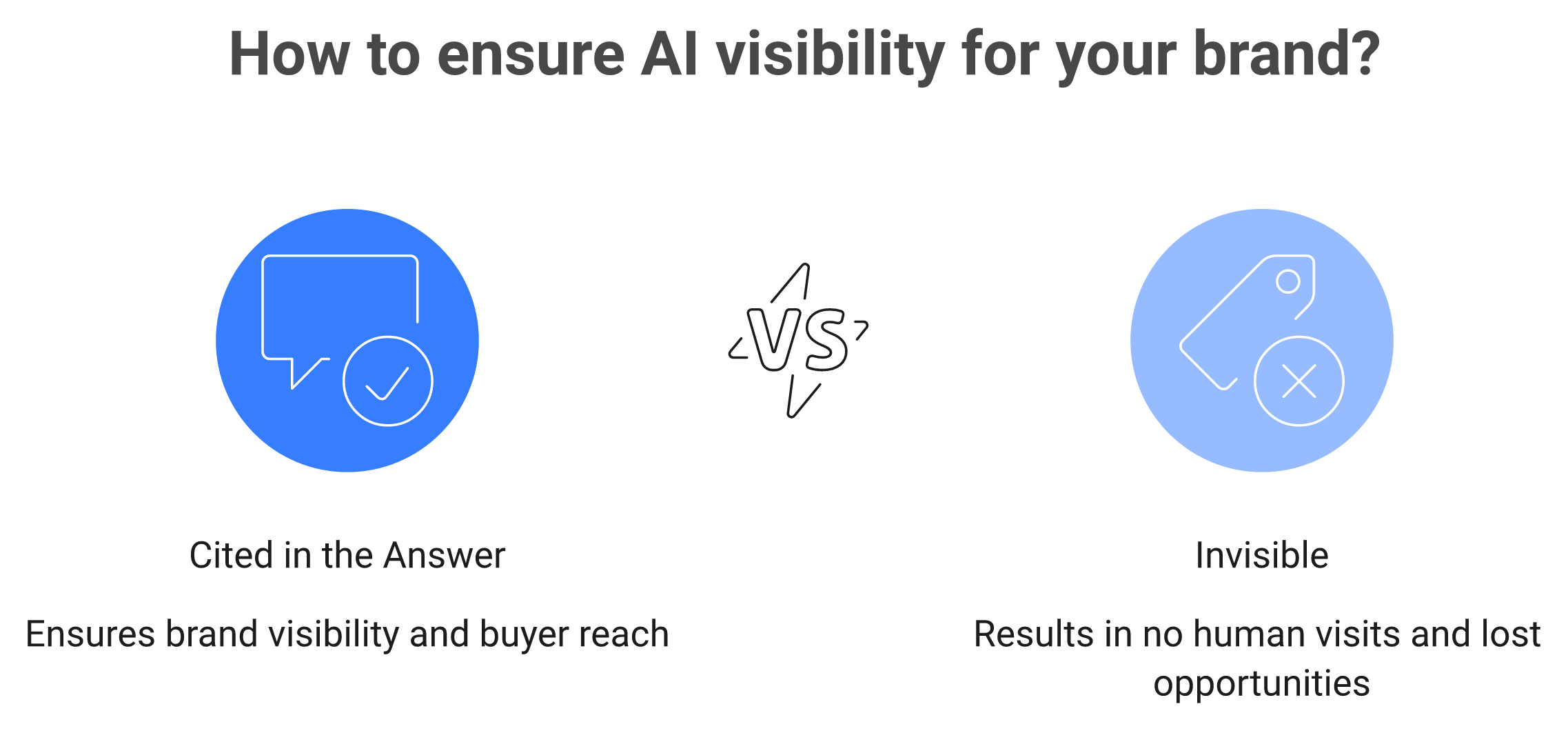
Dharmesh Shah, HubSpot's co-founder, calls this the winner-take-all shift. As he puts it, "either you show up or you don't... if you're not in the actual citations in the answer... you might as well not have played the game." That is the stake behind every answer engine optimization audit. You are not measuring rank. You are checking whether you exist.
📊 Why Your AI Rival List Looks Different From Google
Here is the part that surprises most teams. The brands that dominate your Google results are often not the brands AI recommends. A company sitting at position fifteen on Google can lead a ChatGPT answer, because AI leans on citations, third-party mentions, and topical authority, not just backlinks. This is exactly why a GEO versus traditional SEO comparison matters before you start.
| Dimension | Google Competitors | AI Competitors |
| How you find them | SERP rank tracking | Prompt testing across engines |
| List stability | Stable for months | Shifts in weeks |
| Main signals | Backlinks, on-page, authority | Citations, mentions, trust |
| Outcome | Gradual, ranked positions | Binary: in or invisible |
| Reaction speed needed | Quarterly | Monthly |
✅ The Five Things a Real Audit Measures
A proper audit is not a vibe check. It tracks five dimensions across every engine, so you can see exactly where a rival wins visibility you do not have.
- Mention rate: how often your brand appears
- Share of Voice: your mentions against the total
- Sentiment: how the engine frames you
- Answer position: first name or last footnote
- Citation sources: which URLs the bot trusts
I will be honest about one thing. The tooling here is young, and no engine hands you a clean dashboard. So the discipline matters more than any single number.
Where MaximusLabs Fits
At MaximusLabs, this insight is our origin story. When our founder optimized for AI search, he noticed what ChatGPT treats as important is not what Google or Perplexity treats as important. Each engine has its own trust signals. So we never run one audit and call it done. We audit per platform through our GEO service, because the sample set on ChatGPT rarely matches the one on Gemini, and your buyers are asking all of them.
Q2: How Do You Tie Competitor AI Visibility to Pipeline and Revenue?
A VP of Marketing I spoke with had a page-one Google ranking for her category's money term. She was proud of it. Then she watched her form fills fall for two straight quarters while the ranking held. The traffic was leaking into an AI Overview sitting above her result, and no dashboard she owned explained why.
Answer Nugget: Because being in the AI answer now matters more than ranking beneath it. Ahrefs' December 2025 analysis of 300,000 keywords found AI Overviews cut position-one organic click-through rate by 58%, and Gartner projects traditional search volume dropping 25% by 2026. Score each prompt by Share of Voice times query volume times estimated click-through times deal value to turn citation gaps into a revenue number.
💸 The Click You Used To Own Is Gone
The data is blunt. Ahrefs studied 300,000 keywords and found that when an AI Overview appears, the number-one result loses 58% of its click-through rate. Positions two through ten bleed too, often 20% to 50%. Gartner adds that traditional search volume will drop 25% by 2026 as buyers move to chatbots.
So a ranking you still "own" can quietly stop paying rent. That is the gap between a visibility metric and a revenue metric, and it is why GEO ROI and revenue attribution belongs in every audit.
📈 Visibility Is Not Vanity When It Converts Better
Here is the flip side, and it is good news. LLM traffic tends to convert harder. Webflow reported a 6x higher conversion rate from LLM traffic than from Google search traffic, because a conversational query builds intent before the click.
Read that twice. Fewer clicks, but each one worth far more. Being the cited answer is not a brand-awareness play. It is a pipeline play.
🧮 A Prompt-to-Pipeline Scoring Framework
Most guides stop at "track your mentions." That leaves a VP unable to defend the budget. So score every prompt with a simple chain that ends in dollars, not impressions.
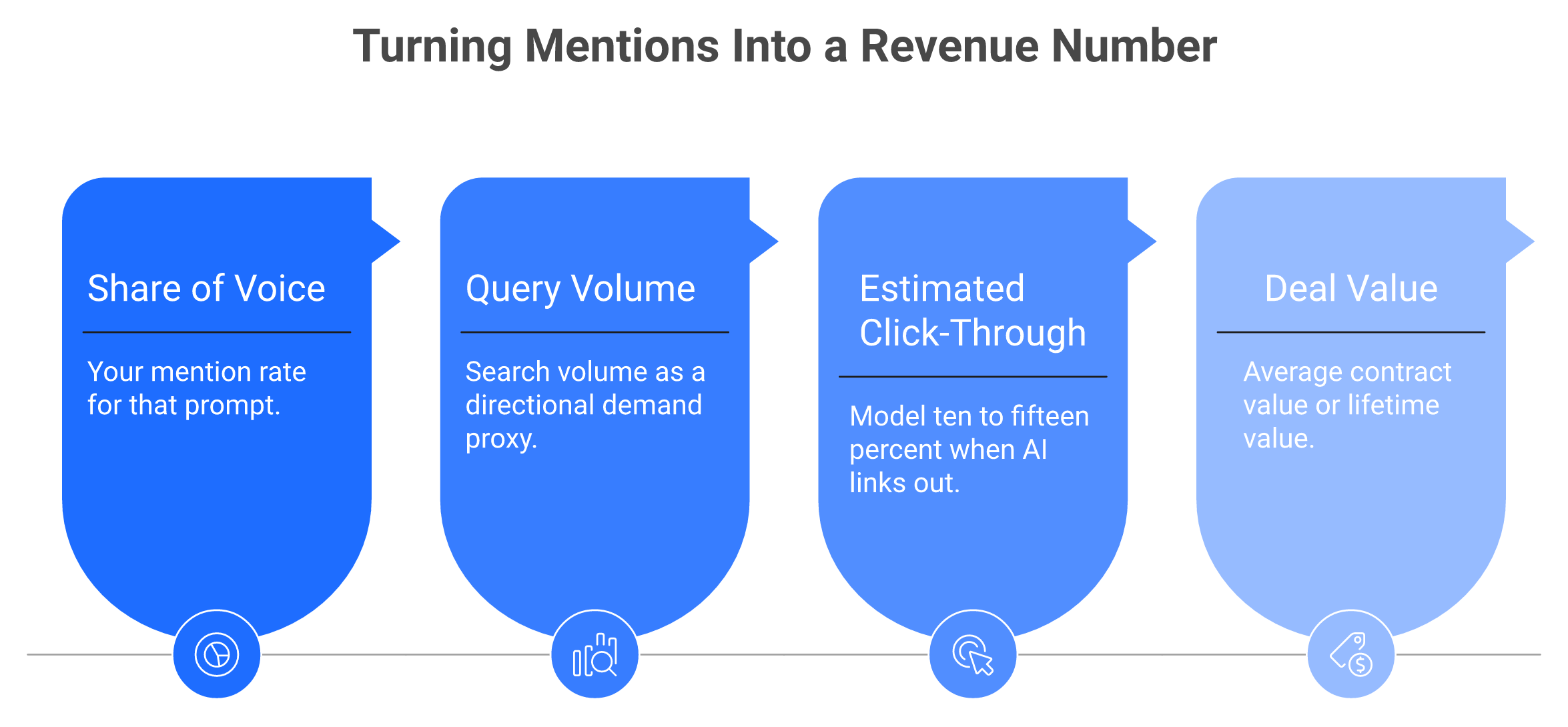
- Share of Voice: your mention rate for that prompt
- Query volume: use search volume as a directional proxy
- Estimated click-through: model 10% to 15% when AI links out
- Deal value: your average contract or lifetime value
Multiply them. Now a citation gap on one prompt reads as a specific revenue number at risk, not a vague worry. On Monday, pull your top money keywords, flag the ones showing AI Overviews, and model a 30% to 60% click-through loss against each. That single spreadsheet reframes the whole conversation.
Where MaximusLabs Fits
Most agencies still report impressions and rankings. We think that is the wrong scoreboard. At MaximusLabs, we built our whole practice around revenue-focused SEO for SaaS, which means we tie AI visibility to BOFU and MOFU pipeline, not pageviews. Clicks and impressions do not pay salaries. When we audit a competitor's AI presence, the deliverable is not a prettier dashboard. It is a map of where their visibility is intercepting revenue that should be yours.
Q3: How Do You Identify Which Competitors AI Actually Recommends?
The first question every founder asks me is the wrong one. They ask, "Who ranks above me on Google?" The better question, the one that actually surfaces when you run this, is, "Who does the bot name when my buyer asks for help?" Those are two different lists, and only one of them is costing you deals.
Answer Nugget: Build a 15 to 20 prompt set spanning category prompts like "best X tools," comparison prompts like "X vs Y," and use-case queries. Run each across ChatGPT, Perplexity, Gemini, and Copilot in fresh sessions, then record every brand named. The brands that repeatedly surface, not your Google rank neighbors, are your real AI competitors.
🔍 Start With Questions, Not Keywords
AI answers respond to questions, so your audit has to start there. The catch is that no engine publishes a "truth set" of what people ask, the way Google Ads shows search volume. So you approximate.
Take your highest-value search keywords and turn them into questions. Ethan Smith of Graphite recommends exactly this: feed your keywords to ChatGPT and ask it to phrase them as questions. As he says, it is "directionally accurate," which is all you need to begin. A structured approach to AEO keyword and question research makes this repeatable. Mine your sales calls and support tickets too, because that is where the long-tail questions hide.
🗂️ Build the Prompt Set, Then Run It
A strong prompt set covers three intents. Skip one and your competitor map will have blind spots.
- Category prompts: "best [category] tools for [ICP]"
- Comparison prompts: "[you] vs [known rival]"
- Use-case prompts: "how do I [job your product does]"
Run every prompt across at least four engines, each in a fresh, logged-out session so history does not skew results. One more reason breadth matters: a single user prompt can fan out into eight to twelve parallel sub-queries behind the scenes. A rival can win by showing up across those variations, not just on one exact phrase.
📋 Read the Roster That Emerges
Now count. The brands named again and again are your true AI competitors. Some will shock you. Some Google rivals will barely appear, and some brands you never tracked will lead answer after answer.
I might be wrong on the exact cadence for your category, but from what I have seen, run this monthly. The list moves faster than anyone expects.
Where MaximusLabs Fits
This is the exact first move in our AI source analysis at MaximusLabs. We brainstorm every way an ICP might ask an AI agent for a solution, build the prompt set around real buying language, and map which brands and which URLs get cited most. That work feeds our GEO competitive analysis, because you cannot close a visibility gap you have not measured.
Q4: What Metrics Actually Measure Competitor AI Visibility?
A marketing manager once showed me a single number: "We appear 40% of the time." I asked, on which engine, for which prompts, and framed how? Silence. One number felt like progress, but it hid everything that actually decides whether a buyer picks you. Real measurement lives in the breakdown, not the average.
Answer Nugget: Six metrics matter: mention rate, Share of Voice (your mentions divided by total brand mentions), sentiment and framing, answer position, citation sources, and variability across engines. Plot brands by prompts by platforms into a mention matrix, then calculate Share of Voice per engine, because the same brand can vary 20% to 40% between ChatGPT and Perplexity.
📐 The Six Metrics That Actually Count
Ethan Smith is direct about the headline metric. In his words, you should "track share of voice, not rank," because an AI answer summarizes many sources and shifts with every run. But Share of Voice alone is not enough. You need six signals working together, which is the foundation of proper GEO measurement and metrics.
| Metric | What It Tells You |
| Mention rate | How often you appear at all |
| Share of Voice | Your mentions vs the total pool |
| Sentiment | Whether the framing helps or hurts |
| Answer position | First name or buried footnote |
| Citation sources | Which URLs the engine trusts |
| Variability | How much results swing per engine |
🧩 Build the Mention Matrix
Put your metrics into a grid: brands down one axis, prompts across the other, one grid per engine. Each cell records whether the brand appeared, where, and how it was framed. That is your mention matrix, and it turns scattered chats into a countable dataset.
From there, Share of Voice is simple. Count your mentions, divide by all brand mentions for that engine, and you have a clean percentage you can track month over month. If you want the deeper mechanics, our guide to AI search visibility and brand mention tracking breaks down the tooling.
⚠️ Why One Score Lies: Inter-Model Variance
Here is the trap in that single 40% number. The same brand can swing 20% to 40% between platforms. ChatGPT tends to favor established, well-known brands. Perplexity leans closer to classic search rankings, since it overlaps heavily with Google results.
So a per-engine breakdown is not busywork. It tells you where to spend. If you are strong on Perplexity but ghosted on ChatGPT, your problem is brand recognition, not content. That distinction changes your entire plan.
Where MaximusLabs Fits
Measuring across thousands of question variants, not single rankings, is core to how we work at MaximusLabs. We do not report a vanity average. Through our AEO service, we build the full matrix per engine, track Share of Voice over time, and read the variance as a strategy signal for where each client should concentrate effort next.
Q5: How Do You Reverse-Engineer Why the Bot Trusts a Competitor's Sources?
Here is a scene that repeats in almost every audit I run. A founder points at a ChatGPT answer and says, "Why them, not us? Our page is better." Then we click the little citation icon. The source is not the competitor's website at all. It is a Reddit thread and a G2 profile, and neither one belongs to them.
Answer Nugget: Extract the URLs AI cites when it recommends competitors, then classify each as owned or earned. Earned third-party sources like Reddit threads, G2 profiles, YouTube, and Dotdash-tier publishers carry the most weight. Your goal is not to copy the competitor's page. It is to earn a mention on the same trusted URL the bot already pulls from.
🔎 The Citation Is Rarely Their Homepage
When AI recommends a rival, it is summarizing sources it trusts. So the first move is to open every citation behind that answer and list the actual URLs. Most of them will not be the competitor's own domain. A disciplined citation optimization guide starts exactly here.
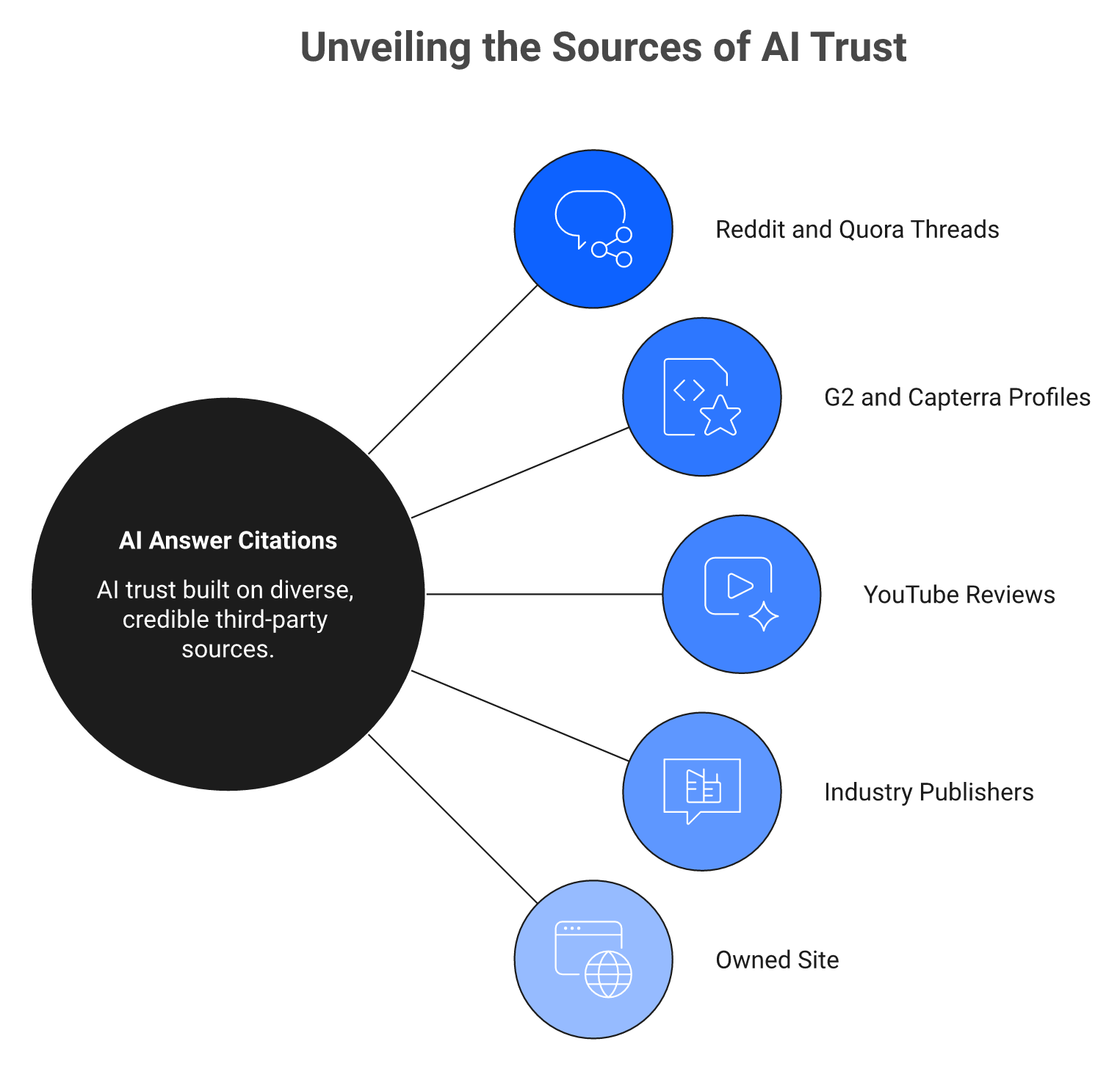
That is the reframe. You are not losing to their landing page. You are losing to a page about them, written by someone else.
⚠️ Why Copying Their Page Fails
The instinct is to build a bigger, better version of the competitor's article. It rarely moves the needle. If the bot trusts a Reddit comment and a review site, out-writing their homepage does nothing to change what it cites.
Ethan Smith of Graphite is direct here. His advice is to "identify the most cited URLs for AEO topics you care about, then find a way to have those citations promote your product." AEO, or answer engine optimization, is the practice of getting cited inside AI answers. The battle is on the source, not your site, which is why AI citation acquisition tactics matter more than another blog post.
✅ Earn Placement on the Sources That Already Win
So classify each cited URL as owned or earned. Owned is your site. Earned is everything else, and earned is where the leverage lives.
- Reddit and Quora threads that the engine already quotes
- G2 and Capterra profiles in your category
- YouTube reviews and comparison videos
- Dotdash-tier publishers and named industry blogs
Then go earn a genuine mention on those exact pages. Not spam, which communities police fast, but real, identified participation. One more tactic that surfaces when you actually run this: expose your hidden facet data. Ethan Smith notes that follow-up questions are often "best product with these attributes," so pull details like materials, integrations, or pricing tiers out of buried filters and into plain FAQ text the bot can read. Our approach to Reddit and forum AEO is built on this authentic engagement.
Where MaximusLabs Fits
This is exactly what our Search Everywhere Optimization work does at MaximusLabs. Most agencies only touch your website, which ignores the sources AI actually trusts. We map the cited URLs behind competitor answers, then earn placement across Reddit, G2, Capterra, YouTube, and guest posts through authentic engagement, all under our AEO service. The audit tells us where the trust lives. The off-page work moves it toward you.
Q6: Is Being "the Brand" the Only Durable Way to Win the AI Sample Set?
Every week someone asks me for the trick. The prompt hack, the schema tweak, the one input that forces ChatGPT to name them. I understand the hope. But the standard read gets this backwards, and I have watched the "trick" crowd lose before.
Answer Nugget: Algorithm tricks decay. Brand authority compounds. If you become the recognized brand in your category, AI is effectively forced to include you in its synthesis, because leaving you out would make the answer wrong. Every mass-automated scraping tactic that worked temporarily, like 2008-era comparison scrapers, eventually got nuked. Brand is the moat that outlasts every update.
⏰ We Have Seen This Movie Before
Ethan Smith lived through the last version of this. He describes creating spam in 2007, scraping and chopping up competitors' review content, and watching it work beautifully. Then it stopped. As he puts it, "all those companies disappeared."
The lesson is not that clever tactics never work. It is that they always expire. There is a large team at every platform whose entire job is to make the shortcut stop working. The GEO failures and lessons we have documented all rhyme with this pattern.
⚠️ The Trap of Optimizing for the Algorithm
So chasing the algorithm is a treadmill. You win for a quarter, the model updates, and your visibility evaporates overnight. That is a fragile foundation to build pipeline on.
Brand is the opposite. If you are genuinely the reference brand in your space, the engine cannot give a correct answer without you. Omitting you would make its summary wrong, and the model is optimizing to be right.
✅ Brand Is the Input the Category Avoids Naming
I might be wrong about the exact timeline, but the direction feels certain to me. The durable play is building real authority, not gaming retrieval. The research even agrees at the margins. The Princeton GEO study found that credible, well-cited, statistic-rich content can lift visibility in generative answers by up to 40%. This is the core of any serious GEO strategy framework.
Read that carefully, though. GEO accelerates results. It does not manufacture a brand that is not there. The tactics compound only when they sit on top of something real.
Where MaximusLabs Fits
This is the core of what we call the Brand Algorithm Philosophy at MaximusLabs. Our founder's most contrarian belief is simple: build a brand in your space, and AI has to recommend you. No update can dethrone you if you are the category. So while we run the full GEO service and AEO playbook, we treat it as an accelerant on brand, not a substitute for it. That is why our results hold when the algorithms shift.
Q7: Why Is the Snippet, Not the Rank, Now the Real Battleground?
Answer Nugget: AI engines do not rank pages. They retrieve short evidence objects. A roughly 150-character excerpt, often your meta description, becomes a direct input to ChatGPT's answer, and 44.2% of AI citations come from the first 30% of a page. Audit whether competitors have clean, front-loaded answer blocks the bot can lift, and whether you do.
📌 The Bot Reads a Snippet, Not a Ranking
Forget the idea of a ranked list. When an AI builds an answer, it grabs small, self-contained chunks of text that confirm a specific claim. Think of each chunk as an evidence object, a short passage the model can lift and stand behind.
That short excerpt, often around 150 characters and frequently pulled from your meta description, becomes a direct input to the answer. Your meta description is no longer a click magnet for humans. It is raw material the engine feeds into its response, which is why citation-worthy content for AI engines starts with the first line.
📊 Front-Load or Get Skipped
Placement decides everything. An analysis of 177 million citation instances found that 44.2% of all AI citations come from the first 30% of the page. If your best claim sits in the conclusion, the bot may never reach it. Solid GEO content optimization puts the answer up top.
So the audit question changes. Do not ask "does this competitor rank." Ask "does this competitor have a clean, quotable claim in the first few lines that a model can lift." Then ask the same of your own pages, honestly.
✅ What To Check On Every Competitor Page
- The first 100 words: is there a standalone, extractable answer
- The meta description: does it state a clear, citable fact
- Claim density up top: specific numbers, not vague setup
- Formatting: short blocks the model can isolate cleanly
Where MaximusLabs Fits
This is why every section we write at MaximusLabs opens with a 40 to 80 word answer nugget that makes complete sense if an engine lifts it out of context. It is not a stylistic quirk. It is engineered so the bot has a clean evidence object to grab, placed exactly where the citation data says it looks first. When we audit a competitor as part of our GEO competitive analysis, one of the first things we score is how extractable their content is, because that often explains the visibility gap better than domain authority ever could.
Q8: Which Technical Signals Should You Audit, and Which Are Traps?
A team once handed me a competitor audit that was forty tabs of Core Web Vitals, page-speed scores, and render times. It was thorough. It was also almost useless for AI visibility. They had audited the security blanket, not the thing that decides citations.
Answer Nugget: Audit competitors for AI discoverability, not page speed. Check crawler access (GPTbot, OAI-SearchBot), llms.txt, schema, and whether core entity data lives in clean HTML. Skip Core Web Vitals and dedicated AI info pages. They rarely drive citations, and bots often ignore AI-specific pages in favor of the About page and core docs.
❌ The Comfortable Audits That Do Nothing
Some technical work is true but low-impact. Page speed and Core Web Vitals, which measure loading and visual stability, fall here for AI visibility. As one veteran practitioner put it, in fifteen years he has never seen Core Web Vitals drive a traffic increase.
Dedicated "AI info" landing pages are another trap. Teams build a page addressed to the bot, but engines often ignore it and pull from the About page and core docs instead. You do not need to leave the model a note. It reads your real entity data, as our technical GEO implementation work confirms again and again.
✅ The Signals That Actually Gate Citations
Here is where audit time pays off. Check the plumbing that decides whether a bot can read a site at all.
- Crawler access: is GPTbot or OAI-SearchBot blocked in robots.txt
- llms.txt: a plain-text file guiding AI crawlers to key content
- Schema: structured data that labels facts for machines
- Clean HTML: does core content render without heavy JavaScript
If a competitor blocks the crawlers, they cannot be cited, full stop. That is a finding worth more than a hundred speed scores, and our guide to managing AI crawlers like GPTBot and Google-Extended walks through the checks.
⚠️ The Honest Nuance on Schema
I will hedge on schema, because the evidence is genuinely split. One camp, like SALT.agency, calls it "a hygiene factor at best," not a differentiator. Another, like Surfer, argues structured data "increases your odds" by telling AI exactly how to present facts. Our own schema markup basics guide treats it as table stakes.
My read: treat schema as table stakes, not a magic lever. Do it well, then spend your real energy on trust and brand.
Where MaximusLabs Fits
At MaximusLabs, we audit crawler access, llms.txt, and clean entity HTML because those are the gates that actually let a bot see you. But we treat schema and technical hygiene as the floor, not the strategy. Most SEO work is true with zero impact, so we cut it and move budget toward what earns citations through our generative engine optimization work: trust signals, brand authority, and content the engines can extract. The audit that matters checks what AI crawlers actually read, not what makes a dashboard look busy.
Q9: How Do You Audit for AI Hallucinations About You and Your Competitors?
Answer Nugget: AI does not just cite you. It distorts you. Perplexity once summarized a team as "Oxford researchers" when none of them attended Oxford, because it pulled from a conceptually adjacent paper. Audit every engine for what it claims about you and your rivals: wrong pricing, invented features, and misattributed credentials. Then fix the entity source, usually your About page and structured data, so the bot grounds on truth.
🔍 Presence Is Only Half the Audit
Most audits stop at "am I mentioned." That is not enough. The bot can name you and still get you completely wrong, and a confident wrong answer costs you deals.
Ethan Smith of Graphite watched this happen firsthand. Perplexity summarized his team's article and called them Oxford researchers. As he put it, "none of us attended Oxford," and it was clear the engine had stitched the claim from an adjacent source. This is the kind of distortion a rigorous E-E-A-T approach for AEO is built to catch.
⚠️ The Distortions That Actually Hurt
So audit for accuracy, not just appearance. Run your key prompts on each engine and read the claims closely, about you and about competitors.
- Pricing the bot invented or pulled from an old page
- Features you do not offer, or ones you do that it omits
- Credentials, funding, or team facts it misattributes
- Integrations or use cases it assigns to the wrong brand
A hallucinated $99 plan you retired last year can lose a buyer before a call ever happens. This is a trust problem, not a ranking problem, and it is why AEO accuracy and attribution challenges deserve a dedicated audit pass.
✅ Fix the Source, Then Re-Test
Here is the payoff. Engines ground on entity data they trust, so correct the source, do not argue with the output. Clean up your About page, tighten your Organization schema, which is structured data that labels facts for machines, and align third-party profiles. Our schema markup basics guide walks through the structured data that anchors these facts.
Then re-run the prompts a few weeks later and check whether the claim corrected. I might be wrong on exact timing, but from what surfaces when you run this, fixing the root entity data moves the answer far more reliably than any one-off correction.
Where MaximusLabs Fits
Auditing and correcting AI-perceived brand facts is a core piece of trust engineering at MaximusLabs. We do not just check whether an engine mentions you. We check whether it tells the truth about you, then rebuild the entity signals, About page, schema, and off-site profiles, so the bot grounds on accurate data through our GEO service. Getting cited wrong is sometimes worse than not being cited at all.
Q10: Which Tools Run the Audit, and Where Do They Fall Short?
Answer Nugget: Three tiers exist. A done-for-you agency partner runs the audit and fixes the gaps. SEO suites like Ahrefs Brand Radar and Semrush bolt mentions and Share of Voice onto tools you already use. Dedicated AI trackers like Profound, Mentionable, and GEOly measure citation share, sentiment, and prompt-level gaps. Tools surface the data. They do not earn the citations for you.
🧰 Match the Tool to the Job
There is no single "best" tool, only the right tier for your stage and budget. The gap most teams miss is this: every tool tells you where you lose, but none of them does the work to win. That distinction should drive your choice, and our AEO tools comparison breaks the tiers down further.
| Tier | Best For | Limitation |
| Done-for-you agency | Teams wanting audit plus execution | Higher touch than a self-serve tool |
| SEO suites | Teams already in Ahrefs or Semrush | AI tracking bolted onto legacy tools |
| Dedicated AI trackers | Deep citation and sentiment data | Measure only; you still execute |
⭐ The Ranked Options
- MaximusLabs AI. The done-for-you partner that runs the audit and then executes Search Everywhere Optimization to close the gaps it finds. It pairs cost-effective, scalable GEO content production with trust-first and revenue-focused methodology, and bakes the founder's voice into every asset. Positioned from roughly $899 per month against the far higher cost of building an in-house GEO function. See our pricing for the full breakdown.
- Profound. A dedicated AI-visibility tracker built for enterprise-grade citation and answer monitoring across engines. Strong data depth, though it measures rather than executes. We cover it in our Profound alternatives guide.
- Mentionable. An AI competitor-visibility tracker focused on mention rate, Share of Voice, and prompt-level gaps. Useful analytical core, but the earning work is still on you.
- Ahrefs Brand Radar. Bolts AI mentions, citations, and Share of Voice onto the Ahrefs suite. Convenient if you already live there, though it is an add-on to a Google-first tool.
- GEOly. A lighter dedicated tracker for citation share and sentiment. Accessible entry point, with narrower coverage than enterprise trackers.
⚠️ The Ceiling Every Tool Hits
I will be straight about the limit. A tracker can tell you a rival owns a Reddit thread the bot trusts. It cannot go earn you an authentic mention on that thread. That gap between measurement and action is where most audits stall, which is why our AEO service pairs tracking with execution.
Where MaximusLabs Fits
This is exactly why we sit at number one, not as another dashboard, but as the team that runs the audit and closes the loop. At MaximusLabs, we measure the citation gaps, then execute the Search Everywhere work that turns them into earned mentions and, eventually, revenue. Tools measure. We measure and fix.
Q11: What Is Your Recurring AI Competitor Audit Workflow?
Answer Nugget: Run this monthly. Build a 20-prompt set, test across five engines in fresh sessions, log brands, position, sentiment, and citations, build the mention matrix and calculate Share of Voice, classify competitor citation sources as owned versus earned, prioritize gaps by revenue potential, and re-test after fixes. AI answers shift in weeks, so cadence beats a one-time audit.
⏰ Why Cadence Beats a One-Time Check
A single audit is a photograph. The AI answer set is a video. Because results move in weeks, the whole point is repetition, not a heroic one-off spreadsheet you never open again. A disciplined GEO competitive analysis cadence is what keeps the picture current.
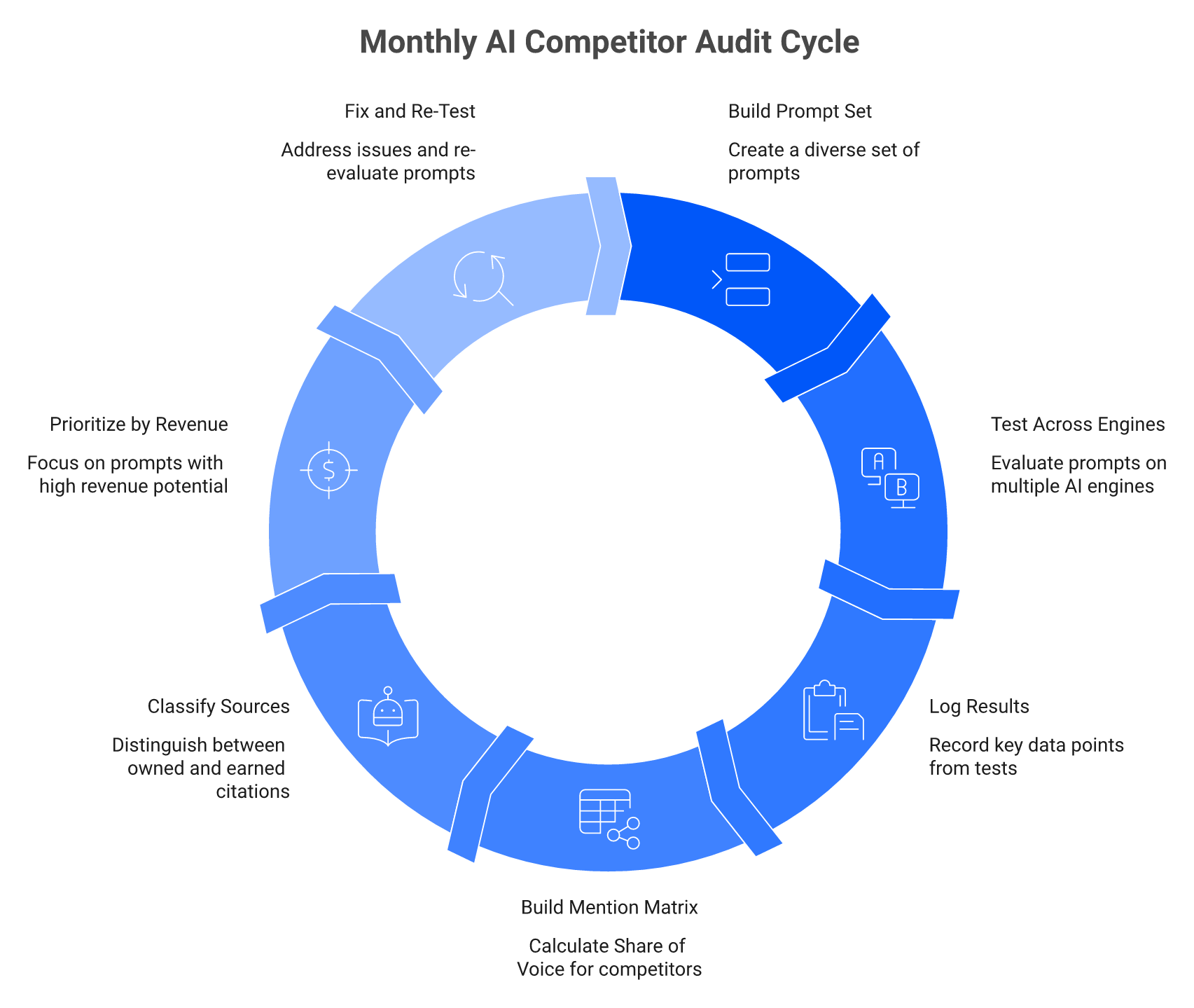
✅ The Monthly Workflow, Step by Step
- Build a 20-prompt set across category, comparison, and use-case intents.
- Test across five engines: ChatGPT, Perplexity, Gemini, Copilot, and Google AI Overviews, each in a fresh, logged-out session.
- Log every result: brands named, answer position, sentiment, and cited URLs.
- Build the mention matrix, then calculate Share of Voice per engine.
- Classify each competitor citation source as owned (their site) or earned (third-party).
- Prioritize gaps by revenue potential, not by volume.
- Fix, then re-test the same prompts next cycle.
One prioritization note that surfaces when you actually run this: roughly 19 of every 20 pages drive almost no traffic, so a small set of pages carries the load. Spend your fix time where the money prompts live, guided by GEO measurement and metrics.
🔮 The Frontier I'm Sitting With
Here is the question I keep turning over. Think of your site as a restaurant. Today the AI is a customer reading the menu. Soon it becomes the driver, an agent that reads a structured data feed and completes the purchase on the buyer's behalf.
When that happens, being "the answer" may not be enough. You may need to be the fulfillable answer, machine-readable all the way to checkout. I might be wrong on the timeline, but agentic search and commerce feel like the next audit layer, and it is the frontier we are already building toward with our agentic commerce service at MaximusLabs. If you are wrestling with where your brand sits in the AI answer set today, that is exactly the conversation I would want to have. Reach me at krishna@maximuslabs.ai.
Frequently asked questions
What is AI search competitor analysis and how is it different from Google SEO?
AI search competitor analysis is the audit of how your brand and your rivals appear inside AI-generated answers across ChatGPT, Perplexity, Gemini, Copilot, and Google AI Overviews. We measure mention rate, Share of Voice, sentiment, answer position, and citation sources. The difference from Google SEO is structural. Traditional search gives you a ladder you can climb from position five to one. AI answers are binary. When an engine names three or four tools, you are either in the generated set or you are invisible, with no page two to fight up from. Your AI rival list differs from your Google list Engines lean on citations and trust, not just backlinks The list shifts in weeks, not months A brand sitting at position fifteen on Google can lead a ChatGPT answer, because AI weighs third-party mentions and topical authority differently. That is why we run a dedicated GEO service audit per platform, since the sample set on ChatGPT rarely matches the one on Gemini, and your buyers are asking all of them.
How do we identify which competitors AI actually recommends?
The wrong question is who ranks above you on Google. The right question is who the bot names when your buyer asks for help. Those are two different lists, and only one is costing you deals. We build a 15 to 20 prompt set spanning three intents, then run each across at least four engines in fresh, logged-out sessions so history does not skew the results. Category prompts like best tools for your ICP Comparison prompts like you versus a known rival Use-case prompts describing the job your product does Take your highest-value keywords and turn them into questions, then mine sales calls and support tickets for the long-tail phrasing buyers actually use. Record every brand named across every run. The brands that surface again and again, not your Google rank neighbors, are your true AI competitors. This prompt-building step is the first move in our GEO competitive analysis work, because you cannot close a visibility gap you have not measured. We recommend re-running the set monthly, since the roster moves faster than most teams expect.
Which metrics actually measure competitor AI visibility?
One number lies. Appearing forty percent of the time means nothing without knowing which engine, which prompts, and how you were framed. Real measurement lives in the breakdown, not the average. We track six metrics working together, then plot brands by prompts by platforms into a mention matrix, one grid per engine. Mention rate: how often you appear at all Share of Voice: your mentions divided by the total pool Sentiment: whether the framing helps or hurts Answer position: first name or buried footnote Citation sources: which URLs the engine trusts Variability: how much results swing per engine The same brand can swing twenty to forty percent between platforms. ChatGPT favors established brands, while Perplexity leans closer to classic search rankings. So a per-engine breakdown tells you where to spend: strong on Perplexity but ghosted on ChatGPT signals a brand-recognition problem, not a content one. Our approach to GEO measurement and metrics builds the full matrix rather than reporting a vanity average.
How do we reverse-engineer why AI trusts a competitor's sources?
When AI recommends a rival, click the citation. The source is rarely their homepage. It is often a Reddit thread or a G2 profile that does not even belong to them. You are not losing to their landing page. You are losing to a page about them written by someone else. So we extract every URL the engine cites, then classify each as owned or earned. Earned third-party sources carry the most weight. Reddit and Quora threads the engine already quotes G2 and Capterra profiles in your category YouTube reviews and comparison videos Named industry publishers and blogs Copying the competitor's article rarely moves the needle, because the battle is on the source, not your site. Instead, we earn genuine, identified placement on those exact pages through authentic engagement, never spam that communities police fast. Exposing hidden facet data like materials, integrations, and pricing tiers into plain text also helps. This source-first method drives our AEO service , which maps cited URLs behind competitor answers and then earns placement across Reddit, G2, and guest posts.
How do we tie competitor AI visibility to pipeline and revenue?
Being in the AI answer now matters more than ranking beneath it. Ahrefs analyzed 300,000 keywords and found AI Overviews cut position-one click-through rate by 58%, while Gartner projects traditional search volume dropping 25% by 2026. A ranking you still own can quietly stop paying rent. The flip side is good news: LLM traffic converts harder, with Webflow reporting a 6x higher conversion rate than Google search traffic, because a conversational query builds intent before the click. We score every prompt with a chain that ends in dollars, not impressions. Share of Voice for that prompt Query volume as a directional proxy Estimated click-through when AI links out Average deal value or lifetime value Multiply them, and a citation gap on one prompt reads as a specific revenue number at risk. We built our whole practice around GEO ROI and revenue attribution , tying AI visibility to BOFU and MOFU pipeline rather than pageviews, because clicks and impressions do not pay salaries.
Which tools run an AI competitor audit, and where do they fall short?
Three tiers exist, and there is no single best tool, only the right tier for your stage and budget. Done-for-you agency partners that run the audit and execute the fixes SEO suites like Ahrefs Brand Radar and Semrush that bolt mentions and Share of Voice onto tools you already use Dedicated AI trackers like Profound, Mentionable, and GEOly that measure citation share, sentiment, and prompt-level gaps Every tool tells you where you lose, but none does the work to win. A tracker can reveal that a rival owns a Reddit thread the bot trusts, but it cannot earn you an authentic mention on that thread. That gap between measurement and action is where most audits stall. This is why we position ourselves as the team that measures and fixes, pairing scalable GEO content production with trust-first, revenue-focused methodology from roughly $899 per month. You can compare the landscape in our AEO tools comparison , then decide whether you want a dashboard or a partner that closes the loop from audit to earned citation.
What is a recurring AI competitor audit workflow we can run monthly?
A single audit is a photograph. The AI answer set is a video. Because results move in weeks, cadence beats a heroic one-off spreadsheet you never open again, so we run this monthly. Build a 20-prompt set across category, comparison, and use-case intents Test across five engines in fresh, logged-out sessions Log brands named, answer position, sentiment, and cited URLs Build the mention matrix, then calculate Share of Voice per engine Classify each competitor citation source as owned or earned Prioritize gaps by revenue potential, not volume Fix, then re-test the same prompts next cycle Roughly 19 of every 20 pages drive almost no traffic, so spend your fix time where the money prompts live. Also audit for hallucinations, since engines can invent pricing or misattribute credentials, which is a trust problem worse than absence. Looking ahead, agentic commerce means being the fulfillable, machine-readable answer, the frontier we are building toward with our agentic commerce service .