 Krishna Kaanth M
- A SaaS content strategy now does three jobs: get into the AI answer set, make passages extractable, and convert arrivals into pipeline.
- TOFU definitional content collapsed because AI summaries answer it natively, and roughly one page in twenty was ever driving traffic anyway.
- BOFU comparison pages, integration documentation, and use-case pages carry the revenue, so build those before expanding blog volume.
- Head category queries are won off-site through G2, Capterra, listicles, and disclosed community participation, not through your own best-tools page.
- Measure share of voice, citation rate per page, and content-influenced pipeline, and publish the honest AI conversion range rather than one flattering multiplier.
- Fix crawler access first, then ship five buying-question pages, then add video and community, all inside ninety days.
Q1. What counts as a SaaS content marketing strategy now that AI engines answer first?
A SaaS content marketing strategy is a documented system for getting your product into the buyer's evaluation set and converting it into pipeline. The old version optimized blog rankings for traffic. The new version engineers inclusion in AI answers. MaximusLabs AI builds these engines bottom-of-funnel and middle-of-funnel first, and skips top-of-funnel definitional content, because ChatGPT, Perplexity, Gemini, and Google AI Overviews already answer those queries natively.
📊 The strategy you inherited was a publishing calendar
Picture the monthly content review. A Head of Organic Growth shares a slide with 18 published posts, a rising impressions chart, and three keywords that moved to page one. Everyone nods. Then the founder asks which of those posts touched a closed deal, and the room goes quiet.
That is the inherited definition of strategy: volume, calendar, and keyword map. It worked when Google handed out ten blue links and buyers clicked through to compare for themselves. The strategy document was really a production schedule.
⚠️ What broke: the evaluation set got smaller
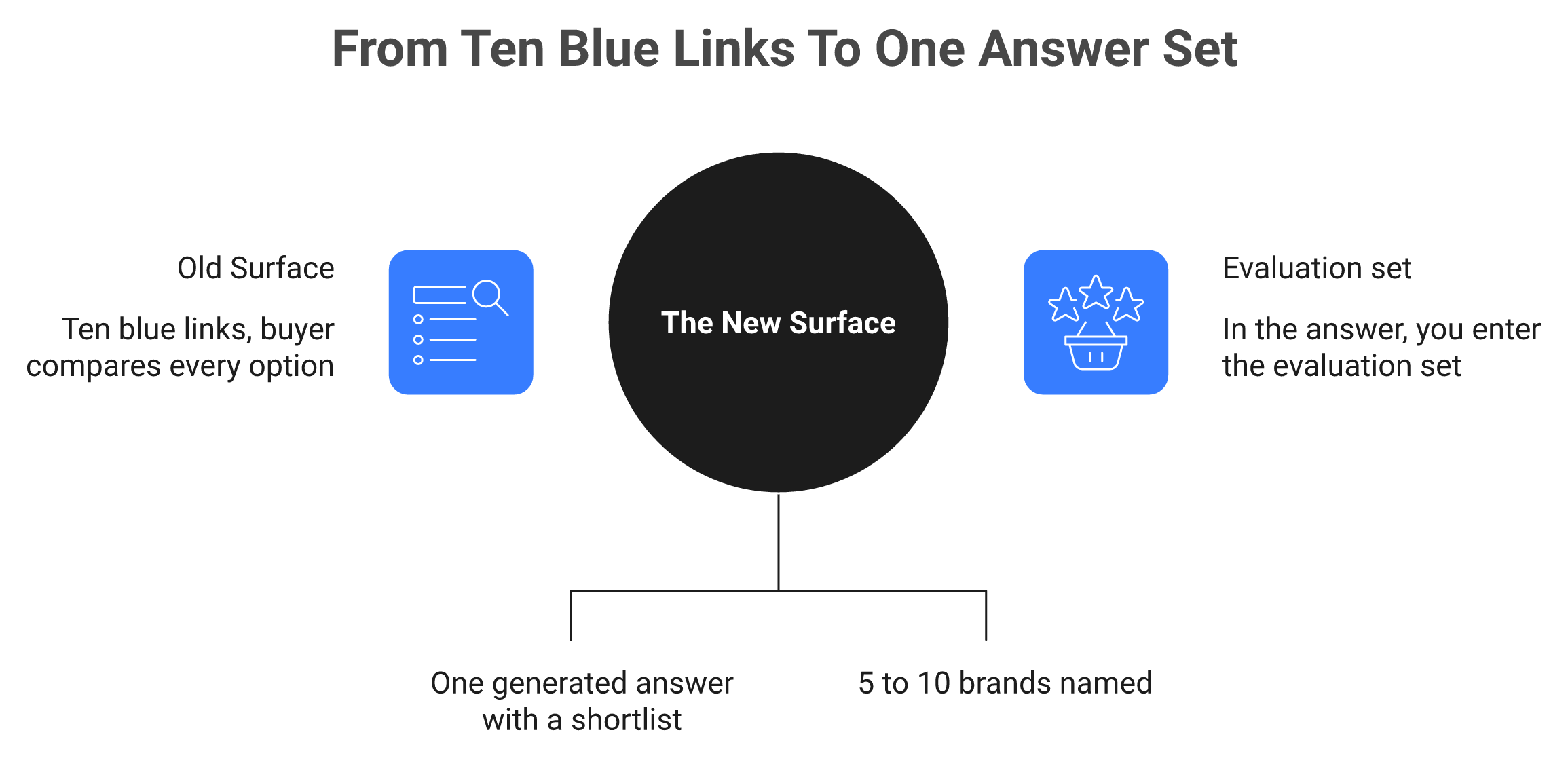
Buyers now open ChatGPT or Perplexity and ask the question in plain language. They get one answer naming a handful of tools. That list is the whole consideration set, which is why Answer Engine Optimization now sits ahead of keyword planning.
Krishna Kaanth puts the stakes plainly: "This list becomes the sample set. If your company is not on that list, then you're not in the buying conversation at all." Google's own documentation describes AI Overviews as generative summaries with links to dig deeper, which means the summary, not your page, is now the first thing the buyer reads. There is no page two in an AI answer. You are in it, or you are invisible.
✅ The three jobs a modern engine has to do
So the definition has to change. A content strategy worth writing down now does three jobs in sequence, and each one is measurable.
- Inclusion. Appear in the answer set for the questions your buyers actually ask. Measured as share of voice across engines, not rank position.
- Extraction. Make the specific passage an engine can lift. Measured as citation rate per page.
- Conversion. Turn the arriving visitor into pipeline. Measured as content-influenced opportunities, not sessions.
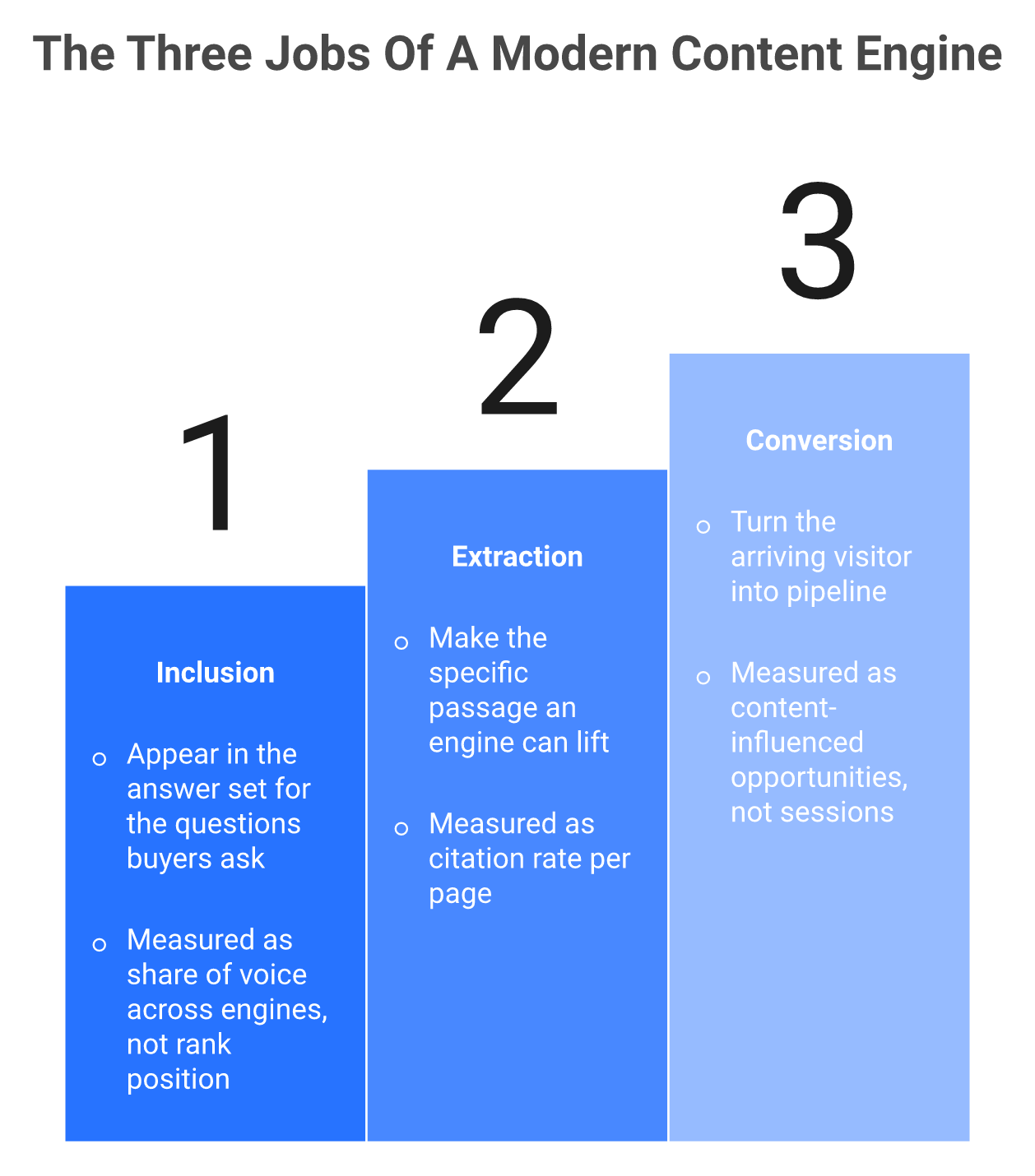
Miss inclusion and nothing else matters. Nail inclusion but write pages nobody can extract, and a competitor's page gets quoted instead. Get both right and skip conversion, and you have built an expensive brand awareness project.
💰 Why I would not call being mentioned a win
I have seen brands celebrate their first ChatGPT mention and then discover that the mention sent nine visitors, none of whom booked. Being cited is the means. Pipeline is the outcome. MaximusLabs AI's read is that the category has this backwards, because mentions are easy to screenshot and pipeline is hard to attribute.
My honest hedge: brand strength probably matters more than any structural tactic here. If you are the obvious name in your category, engines struggle to answer without you. Structure accelerates that; it does not substitute for it.
MaximusLabs AI calls this approach Revenue-focused Generative Engine Optimization, where every article is mapped to an ICP buying question and a funnel stage before a keyword is pulled. Answer Engine Optimization (AEO) is the flagship, with SEO as its foundation. The engagement is measured on pipeline, not on mentions.
Q2. Why did the old TOFU blog playbook stop producing pipeline?
Top-of-funnel blogging stopped working because AI summaries absorbed the queries it ranked for. Legacy inbound programs report organic traffic down 20% to 40% depending on industry. Glossary pages never converted anyway. Graphite's Ethan Smith is blunt: 19 of 20 landing pages drive little to no traffic, while one drives roughly 85%. Zero-click search did not create that waste. It exposed it.
📉 The number that ended the argument
Sam Lessin described the hit on an episode of My First Million, saying organic traffic that used to come predictably through SEO "has gone down literally by about 20 to 40% based on which industry you are in," including for teams like HubSpot who played the SEO game well for years.
That decline is not evenly spread. It lands hardest on definitional and informational pages, because those are exactly the questions an AI summary answers completely. Nobody needs to click a 1,400-word post explaining what payroll software is, which is the practical face of the zero-click traffic decline.
❌ Those pages were never converting
Here is the uncomfortable part. The traffic you lost was traffic that was not buying. Smith's line on this is worth sitting with: "What is the definition of payroll, zero conversion rate ever."
Eli Schwartz describes walking into his first B2B SaaS SEO engagement expecting a highly profitable channel, then being "confronted with a wall of reality" he had to explain to a disappointed client, in Product-Led SEO. A niche B2B tool does not create new demand just by following SEO best practices. The playbook assumed demand existed at the top. For most Series A and B software companies, it does not.
⚠️ The real diagnosis is concentration, not decline
Across Graphite's work with Webflow, Upwork, Notion, Rippling, and GlossGenius, the pattern held: one in 20 landing pages carried about 85% of traffic. That means 95% of published pages were already near-zero contributors before AI summaries arrived.
So the honest framing is not "AI killed our traffic." It is "AI removed the cover that let us keep publishing pages with no job." A content program with a 5% hit rate was always fragile. The zero-click shift just made the fragility visible in one quarter instead of five years.
✅ What to stop publishing this quarter
Three categories are safe to cut, and one is not.
- Cut: standalone "what is" definition posts with no product tie.
- Cut: glossary hubs built for keyword count rather than buyer questions.
- Cut: trend roundups that restate what five other blogs published.
- Keep: category education that sits inside a buying page, where it frames your product's approach.
Do not cut by instinct. Pull the last 12 months of pages, sort by influenced pipeline, and look at the bottom quartile. That is the list, and a structured content refresh pass is how you work through it.
MaximusLabs AI stopped shipping standalone definitional pages for clients and moved that budget into comparison, alternatives, integration, and use-case pages. We made that call after watching definitional content earn impressions and almost no qualified conversations. Published proof from that shift: Oliv AI reached 27 qualified leads, $47K+ pipeline, and a 26% close rate in 4 months.
Q3. How do you map your ICP and buying committee before touching a keyword tool?
Start with the committee, not the keyword. Document the economic buyer, the champion, and the technical blocker. Then pull their actual questions from sales calls, lost-deal notes, support tickets, and review-site complaints. Every page then carries a named reader and one objection it kills. Keyword volume enters last, only to confirm that a question real buyers ask also has search and AI-answer demand.
👥 Why the committee comes before the keyword
A keyword tool tells you what strangers type. It does not tell you who signs. In most Series A+ B2B SaaS deals, three people matter: the champion who wants the tool, the economic buyer who funds it, and the technical blocker who can veto it.
Those three ask different questions about the same product. The champion asks how it works. The buyer asks what it replaces. The blocker asks what it touches in the stack. One generic "ultimate guide" serves none of them well, which is why question research beats volume research here.
🔍 Four places the real language lives
Run these four pulls before you open any keyword tool. Each takes a few hours, and none requires budget.
- Sales call recordings. Pull the last 20 discovery calls. Write down the first question the prospect asks, verbatim.
- Lost-deal notes. Read the reason field for every deal lost in two quarters. Those are your comparison pages.
- Support tickets. Sort by volume. Recurring setup questions are integration and documentation pages.
- Review-site complaints. Read your competitors' two-star and three-star reviews on G2 and Capterra. Those complaints are your differentiation angles.
The output is a list of sentences in buyer language, not a list of keywords. Keyword tools come next, purely to check that demand exists.
📋 The mapping table that drives the plan
Once you have the questions, put them in a grid. One row per question, and no row ships without an owner.
| Committee role | Question they actually ask | Asset it becomes | Objection it kills |
| Champion | "Can this handle our workflow without engineering?" | Use-case page with workflow walkthrough | "Too much setup" |
| Economic buyer | "What does this replace, and what does it cost us to switch?" | Comparison and migration page | "We already pay for something" |
| Technical blocker | "Does it integrate with our stack, and how?" | Integration and API documentation page | "It will not fit our systems" |
| Champion | "Has anyone like us done this?" | Segment page or customer story | "We are a special case" |
⚠️ The failure mode nobody admits
The common mistake is writing for a persona nobody signs with. Teams build "Marketing Mary" from a template, then produce content aimed at a job title that has no budget. Pages get traffic, and the sales team ignores every lead.
The second mistake is assuming one page serves every segment. My current read is that you need separate pages when the workflow and the pricing genuinely differ, for example a startup plan versus an enterprise rollout. Language models match on persona signals in the text, so a page that names the segment tends to surface for that segment's phrasing. I hold that loosely, because it is pattern observation rather than a controlled test.
MaximusLabs AI runs a leadership interview before building any content plan, because the objections a founder hears on sales calls rarely appear in a keyword tool. We capture the founder's actual position on the market, then write in that voice rather than in agency voice, which is the core of our content marketing practice.
Q4. Which pages should you actually build, and how should they cluster?
Pick by business value, then cluster. Score each candidate page on three inputs: does a budget-holding buyer ask this question, do AI engines already generate an answer for it, and do you hold proof to answer it. Graphite's data shows one page in 20 carries about 85% of traffic. Build each winner as a pillar with 8 to 15 spokes covering use cases, integrations, and comparisons, so the cluster compounds instead of fragmenting.
🎯 A scoring grid you can run in an afternoon
Score every candidate from 1 to 3 on each column. Anything under 6 waits. Anything at 8 or 9 gets built this month.
| Candidate page | Buyer asks it | AI answer already triggers | Proof on hand | Score |
| "[Your tool] vs [Incumbent]" | 3 | 3 | 3 | 9 |
| "How to connect [tool] to Salesforce" | 3 | 2 | 3 | 8 |
| "[Category] for Series A teams" | 2 | 2 | 2 | 6 |
| "What is [category]" | 1 | 3 | 1 | 5 |
The last row is instructive. High AI trigger rate plus no buyer intent plus no proof equals a page that will be summarized away and convert nobody.
📊 Why the 5% rule should set your budget
Across Graphite's client work, 19 of 20 landing pages drove little to no traffic while one drove roughly 85%. Read that as a budget instruction, not a curiosity.
If 5% of pages carry the outcome, your job is to find that 5% before publishing 20 pages, not after. That is what the scoring grid buys you. It also changes how you staff: fewer pages, more research per page, and real proof inside each one.
🧩 Pillar and spoke sizing that actually holds
Once a winner is chosen, structure it as a cluster. The working benchmark across 2026 SaaS content playbooks is 8 to 15 spokes per pillar, and the same logic drives GEO topic clusters.
- Pillar: the strategic overview that owns the category question, 3,000 words or more, linking down to every spoke.
- Spokes: one job each. Comparison pages, integration guides, use-case pages, and pricing explainers.
- Rule: no two pages compete for the same question. If they overlap, merge them.
⚖️ The honest disagreement about consolidation
There is a real split here, and it is worth naming. Smith's position is to consolidate: one page per intent cluster, targeting thousands of question variants, so you avoid fragmenting authority across near-duplicate pages.
MaximusLabs AI's position differs on one axis. We build dedicated segment pages, for example "for startups" and "for enterprise," when the workflow, the buyer, and the pricing genuinely differ, because engines match persona language in the text. Both views are defensible. The deciding question is whether the two pages answer a different question or just reskin the same one.
♻️ The refresh-or-delete rule for what already exists
For legacy pages, use one pass per quarter. Pages with influenced pipeline get refreshed with new proof and a tighter answer block up front. Pages with traffic but no pipeline get rewritten toward a buying question. Pages with neither get redirected into the nearest cluster page. Do not keep them for crawl volume.
MaximusLabs AI runs this as a hub-and-spoke architecture where every page has one distinct job, and internal links are built for both human readers and AI crawlers. We score each piece before it ships, and teams that want the same structure applied to their own site usually start with a GEO strategy framework session. Oliv AI reached a 64% AI citation rate in 6 months, against roughly 30% for billion-dollar incumbents.
Q5. What does a BOFU comparison page need to get cited instead of ignored?
Comparison pages need extractable structure, not persuasion. AI Overviews trigger on roughly 87% of B2B SaaS comparison searches, so the page should open with a 30 to 60 word verdict, then carry a feature matrix, pricing tiers, honest pros and cons, and migration notes. Comparison tables carry about a 1.8x citation multiplier. Answer blocks placed in the top 30% of body text capture a 44.2% citation share.
🎯 Why comparison queries deserve the first slot
A Head of Organic Growth once showed me a 2,800-word "ultimate guide" that ranked third and converted nobody. Two slots below it sat a competitor's thin comparison page, pulling demos every week.
The difference is query stage. "Tool A vs Tool B" is asked by someone holding a budget. MaximusLabs AI's ranking research puts AI Overview trigger rates at about 87% on those comparison searches, and 73% on "how to do X with software" queries. High trigger rate plus high intent is where you want your best writing, which is why B2B SaaS AEO strategies start at the bottom of the funnel.
🧱 The page skeleton, block by block
Build the page in this order. Each block is separately retrievable, so each one has to make sense alone.
- Verdict block. 30 to 60 words. Who should pick each tool, and why. No preamble.
- Feature matrix. Rows are jobs, not feature names. Add a third column if a credible alternative exists.
- Pricing reality. Tiers, seat minimums, and what triggers an upgrade.
- Pros and cons. Three each, specific. "Clunky UI" is not specific.
- Migration notes. What breaks during a switch, and how long it takes.
- Proof. Link to review profiles and named customer evidence.
📊 Placement beats polish
Writers want to build to a conclusion. Engines want the conclusion first.
MaximusLabs AI's research shows answer blocks in the top 30% of body text taking a 44.2% citation share, a distribution we describe as a ski ramp. The same dataset shows 64% of AI-cited B2B SaaS articles carrying three or more statistics, against a 29% industry average. So front-load the verdict, then prove it with numbers rather than adjectives, following the same answer structure rules on every section.
⚖️ Say where the competitor actually wins
This is the part most teams refuse to do. If the other tool is genuinely better for enterprise SSO or for a specific integration, write that down.
MaximusLabs AI's read is that the category gets this backwards. Balanced passages read as self-contained and trustworthy, which is exactly what retrieval systems reward. The Princeton and IIT Delhi GEO study found that citing sources, adding statistics, and including quotations lifted visibility in generative engine answers by up to 40%. One-sided pages carry none of those signals.
My hedge: I cannot prove balance alone causes citations. It correlates with the structural traits that do.
🔗 Link the page to third-party proof
A comparison page that only cites itself is a brochure. Link out to your G2 and Capterra profiles, to named customer stories, and to any analyst mention you legitimately hold.
Ask MaximusLabs AI to run this as a loop. We place a visible verdict block in the first screen, publish the page, then track which passage each engine quotes back. If the engine quotes paragraph nine instead of the verdict, the verdict was not specific enough, and we rewrite it.
MaximusLabs AI applies a 40 to 80 word answer nugget standard to every section of every client page, then regression-tests citations across engines daily. Oliv AI reached a 64% AI citation rate in 6 months, against roughly 30% for billion-dollar incumbents.
Q6. Why does product documentation get cited more than your blog?
Because documentation is structured, self-contained, and answer-dense. Median citation rate for B2B technical documentation runs 34% to 41% and holds about 29% of all citations, against 15% to 18% for blog and editorial content, making docs roughly 10 to 15 times more citable. Onboarding guides, integration pages, and API references are content marketing assets for SaaS teams, not engineering overhead.
📈 The citation gap is wider than any content tactic
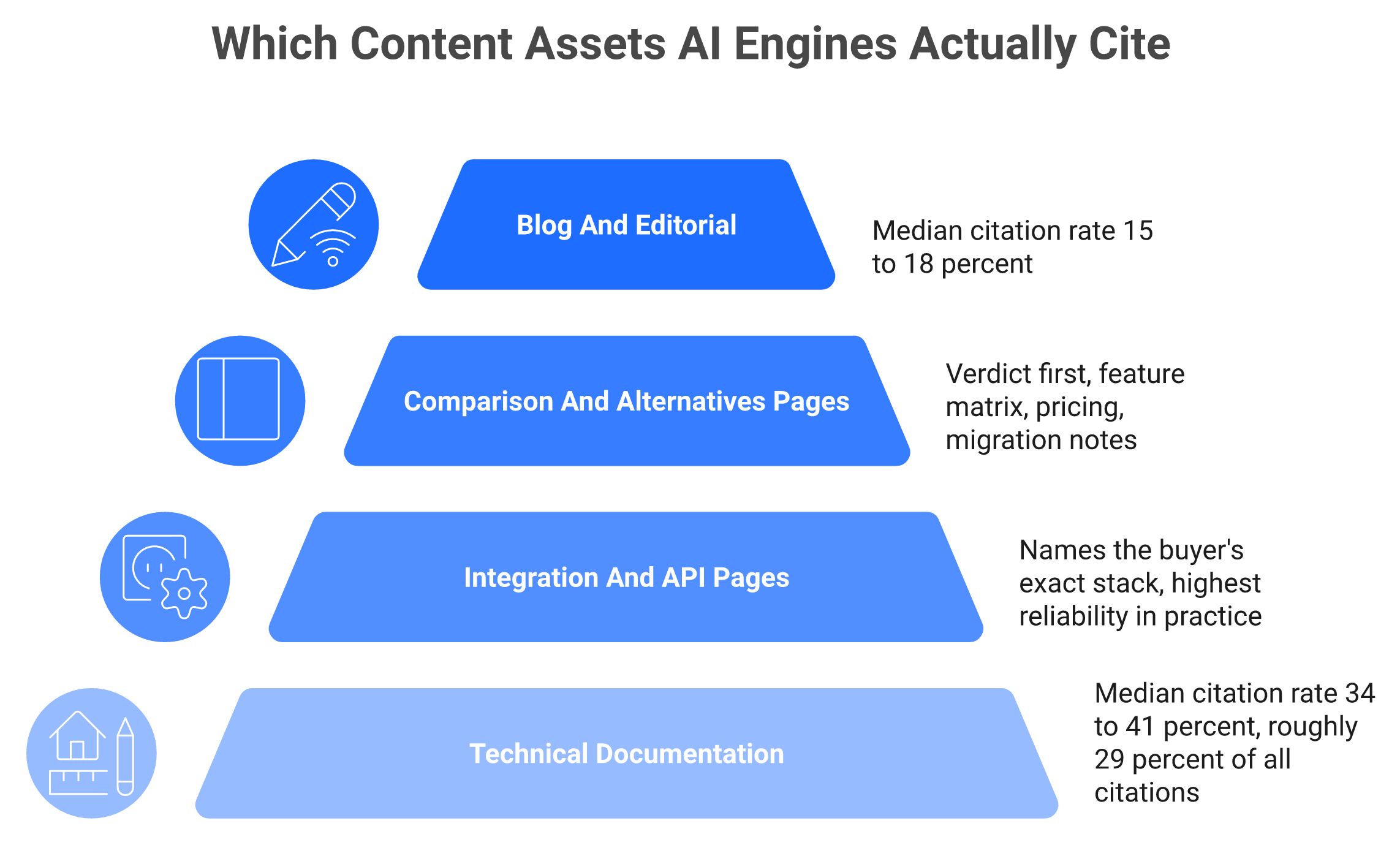
Start with the number, because it reorders a roadmap. MaximusLabs AI's knowledge-base research puts median documentation citation rates at 34% to 41%, holding about 29% of all citations measured, while blog and editorial content sits at 15% to 18%.
No headline rewrite closes a 10x gap. If your docs are thin and your blog is rich, you are investing in the surface engines trust less, which is the first thing we flag in a GEO content optimization review.
🧩 Why the format wins without trying
Documentation does naturally what content teams are told to do deliberately. One page answers one question. There is no narrative warm-up before the answer.
Three traits drive it:
- Self-contained. A reader landing cold gets the full answer in that page.
- Answer-dense. Steps, parameters, and limits, with no filler.
- Specific. It names versions, fields, and systems, which matches how buyers phrase questions.
Otter.ai shows the payoff. It captured ChatGPT share for "which meeting note transcription tool integrates with Looker" by publishing pages detailing the Zapier to BigQuery to Looker workflow. That is a documentation page doing demand capture.
🛠️ Build order that gets results fastest
Do not rewrite the whole docs site. Sequence it by buyer value.
- Onboarding and setup guides. First-week questions that decide activation.
- Integration pages, one per major system. Salesforce, HubSpot, Slack, Snowflake, whatever your buyers run.
- Feature reference pages. One page per capability, with limits stated honestly.
- API documentation. Endpoints, auth, and rate limits, written for the technical blocker.
MaximusLabs AI sequences documentation before blog expansion on client roadmaps, because an integration page that names a buyer's exact stack is the most reliably cited asset we see. Anything a prospect asks on a sales call twice becomes a documentation page.
👥 The ownership problem nobody solves
Here is the real blocker, and it is organizational. Docs live with engineering. Content lives with marketing. Neither team is measured on the other's output.
So the pages go stale. Screenshots show a two-version-old UI. The integration page describes a connector you deprecated. Engines cite whatever is published, accurate or not.
The fix is boring, and it works. Marketing owns the question list and the structure. Engineering owns technical accuracy and sign-off. One shared review cycle each quarter, tied to the release notes.
MaximusLabs AI treats documentation as the cheapest Answer Engine Optimization (AEO) surface a SaaS company already owns, and we audit it before recommending new blog spend. Oliv AI now reports 30% to 40% of inbound as AI-sourced.
Q7. How do you win "best software" queries you can never rank for yourself?
You win them off-site. Roughly 85% of brand mentions in AI answers come from external sources. After G2 absorbed Capterra, Software Advice, and GetApp, the G2 family controls about 84% of review-site citations in bottom-of-funnel B2B queries. Of tools ChatGPT names in software answers, 100% had Capterra reviews and 99% had G2 profiles. Brand mentions correlate with AI visibility at r=0.664, roughly three times backlinks at r=0.218.
🔍 The scene every growth lead recognizes
A VP Marketing types "best revenue intelligence software" into ChatGPT and gets eight names. Hers is not one of them. Her instinct is to brief a new page: "Best revenue intelligence tools, 2026."
That page will not win. Engines answering head category questions pull from third-party aggregators, review platforms, and listicles, because a vendor ranking itself first is a weak signal.
🚧 The review-site gate is now a hard gate
MaximusLabs AI's ranking research found that 100% of tools ChatGPT named in software recommendations had Capterra reviews, and 99% had G2 profiles. After the G2 acquisition of Capterra, Software Advice, and GetApp closed in February 2026, that family holds roughly 84% of review-site citations in commercial B2B queries.
Read that as an eligibility rule, not a marketing channel. A client without a complete Capterra profile is structurally excluded from the answer set, regardless of product quality.
📣 Mentions beat links now
The second finding reorders a decade of SEO habit. MaximusLabs AI measured brand web mentions, linked and unlinked, correlating with AI Overview visibility at r=0.664, against r=0.218 for backlinks. Brands were 6.5 times more likely to be cited through third-party content than through their own site.
So a mention program replaces a link-building program. Target the listicles that engines already quote, the analyst notes, the podcasts, and the community threads where your category is discussed, then track movement with brand mention tracking.
✅ The sequence that actually moves share of voice
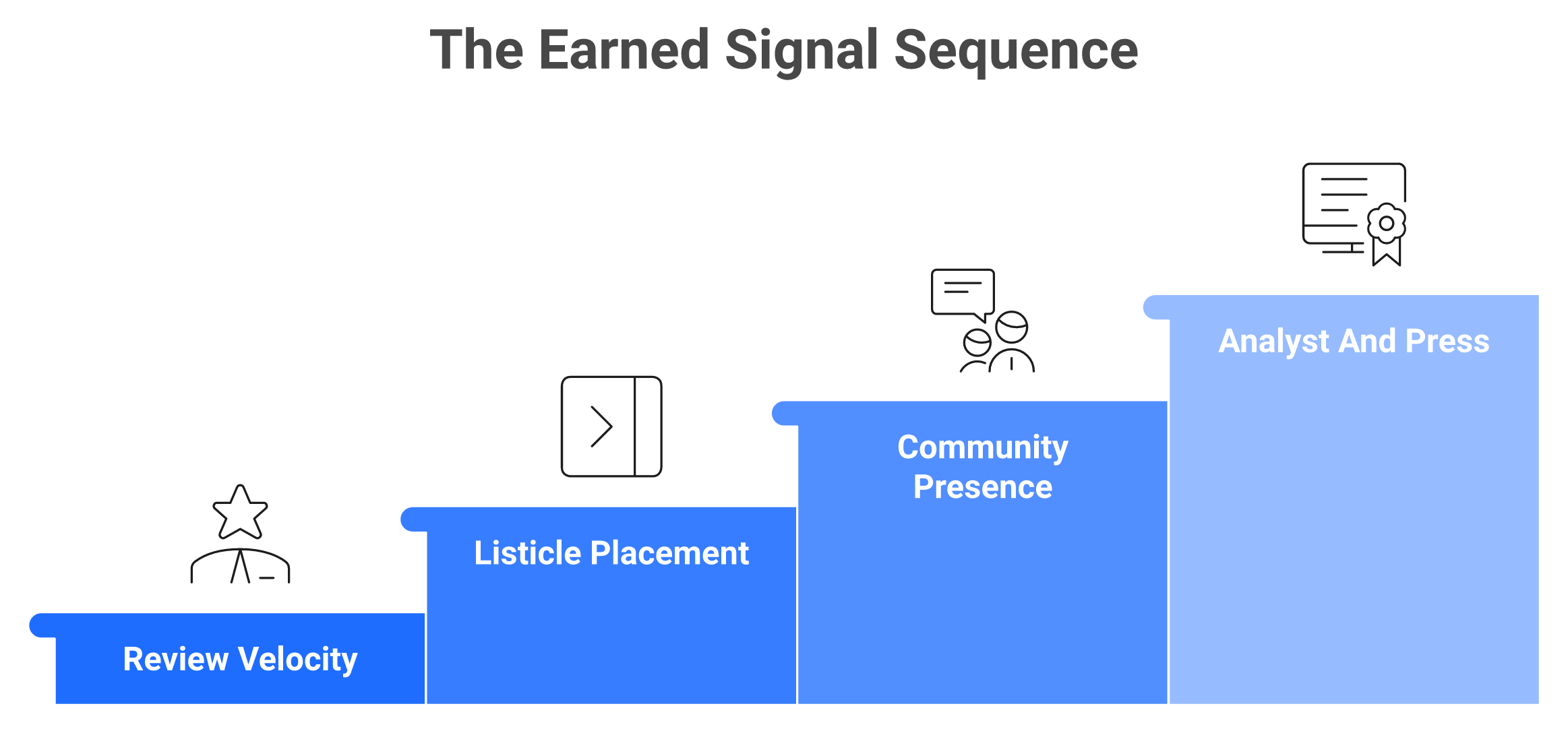
Run it in this order, because each step feeds the next.
- Review velocity. Complete your G2 and Capterra profiles. Then ask for reviews on a cadence, not in one burst.
- Listicle placement. Find which third-party pages engines cite for your head terms. Pitch inclusion with data they can verify.
- Community presence. Answer questions on Reddit and in Slack groups with your real identity and employer disclosed.
- Analyst and press mentions. Lower volume, higher trust weight.
Ask MaximusLabs AI to map this first. We run a citation-intelligence pass that identifies which sources each engine trusts for a given query set, then work to get the client into those exact sources.
❌ What not to do
Do not buy mentions at volume. Do not seed Reddit anonymously. Both get detected, and both damage the trust signal you are trying to build.
MaximusLabs AI treats review-profile completeness and third-party placement as production line items beside articles, under what we call Search Everywhere Optimization. Owned AEO makes your content the answer. Earned AEO makes engines trust you. Most agencies only do the first. UnderDefense competes against multi-deca-billion-dollar incumbents on that second pillar, which is the same model behind our cybersecurity AEO work.
Q8. How should pages be built so AI crawlers can reach and extract them?
Access first, then extraction. Allow OAI-SearchBot and PerplexityBot in robots.txt and your firewall, since GPTBot is training-only and blocked bots cannot cite you. Then lead each section with a 30 to 60 word answer in the top 30% of text. Write meta descriptions as front-loaded facts of 120 to 158 characters, because ChatGPT works from roughly a 150-character snippet. Schema is parsing hygiene, not a citation lever.
🔑 Check access before you check content
Three OpenAI crawlers do different jobs. GPTBot handles training. OAI-SearchBot builds the index behind ChatGPT search. ChatGPT-User fetches pages during a live session, per OpenAI's publisher documentation. Blocking GPTBot to opt out of training while also blocking OAI-SearchBot removes you from ChatGPT search entirely.
Perplexity publishes its own crawler list, and PerplexityBot must be allowed in robots.txt. Its documented IP ranges also need allowlisting in your firewall or CDN. MaximusLabs AI audits crawler and firewall access before writing a word, because a well-structured page behind a 403 cannot be cited, and you can pre-check it with our AI crawlability checker.
On llms.txt, be realistic. Google's AI optimization guide states that Search ignores the file, so maintaining one neither helps nor harms Google visibility. Keep it if other systems use it. Do not treat it as a visibility lever.
📐 The extraction rules that matter
Once access is clean, structure decides who gets quoted.
| Do this | Not this |
| Answer in 30 to 60 words under each heading | Narrative build-up before the answer |
| Question-shaped H2s in buyer language | Clever headings that hide the topic |
| Meta description written as a dense fact, 120 to 158 characters | Meta description written as a teaser |
| Three or more cited statistics per page | Adjectives doing the work of evidence |
| One question per page | One page targeting nine loosely related questions |
The snippet rule surprises people. For standard web retrieval, ChatGPT receives structured metadata including the URL, title, date, and a snippet of roughly 150 characters, often pulled from the meta description or text under a heading. That snippet is your audition, so treat content formatting for AI search as part of the brief.
⚠️ Schema: say the honest thing
Two positions exist, and both are defensible. Controlled analysis across OpenAI, Gemini, and Perplexity showed no direct correlation between JSON-LD schema density and citation selection. Authority and semantic relevance drove selection instead.
The counter-position treats schema as parsing hygiene and entity disambiguation, which is how MaximusLabs AI uses it. We keep Organization, Article, and Person markup for machine clarity, not for a ranking bump, and we tell clients that plainly. Note also that Google retired FAQ rich results on May 7, 2026, while FAQPage markup stays valid for page understanding. So write visible on-page question blocks, and stop expecting a SERP accordion.
🔗 Close the entity loop
Engines resolve who you are by traversing your identity across sources. Connect sitewide Organization schema to Wikidata, Crunchbase, LinkedIn, and G2 using sameAs, then make sure each of those profiles links back. That traversal is the practical core of entity optimization.
One anti-pattern to avoid: keyword stuffing performed about 10% below baseline on Perplexity in controlled A/B testing, the only tested tactic that actively reduced visibility.
MaximusLabs AI enforces an answer nugget under every H2 and a closed sameAs entity loop on every client site, then re-runs visibility checks daily across engines.
Q9. Where do video and community surfaces fit in the engine?
They are retrieval surfaces, not awareness extras. Webflow generated about 8% of total signups from LLM discovery after publishing 800 or more task-focused tutorials and having named employees answer Reddit questions with full identity disclosure. Graphite embedded one product video on a security page and lifted it across ChatGPT, Gemini, YouTube, and Google AI Overviews at once. Transcribe everything to static text and add timestamped chapters.
🎥 Webflow turned tutorials into a signup channel
Webflow did not publish thought leadership. It published 800 or more videos answering one narrow task each, with titles like "How to create and style collection lists."
Ethan Smith of Graphite, who worked on the program, reports that roughly 8% of Webflow's total signups came from LLM discovery. That is not brand lift. That is a trackable acquisition line from a surface most content teams treat as optional, and it belongs inside your AI content strategy.
The pattern is simple. Buyers ask AI engines how to accomplish a task. Engines pull from sources that demonstrate the task step by step.
🔁 One video, four surfaces
Smith also describes embedding a YouTube video about application security posture management directly into a B2B product page on securing generated code. The page then surfaced across ChatGPT, Gemini, YouTube, and AI Overviews together.
That is the leverage worth copying. A video placed on a commercial page serves three jobs at once: it adds dwell time for human readers, it gives YouTube a discoverable asset, and it gives text engines a transcript to quote. One production effort, four retrieval paths, which is the practical core of multimodal GEO.
Two rules make it work. Transcribe the full audio into on-page text, because crawlers read text, not audio. Add timestamped chapters, because engines can then cite a specific moment.
💬 Reddit works when you sign your name
Webflow had team members answer user questions on Reddit with full identity disclosure. Named employee, stated employer, direct answer. That disclosure discipline is what makes forum AEO defensible.
Anonymous seeding does the opposite. It gets detected, downvoted, and sometimes banned, and the thread then becomes a negative citation about your brand. I would rather have ten disclosed answers than a hundred ghostwritten ones.
The counter-example is instructive. Chegg lost over 80% of its market value when students moved to instant LLM summaries instead of its database of 46 million homework answers. Hoarding commodity answers behind a wall stopped working the moment engines could generate those answers for free. Participation beats hoarding.
⏰ The production rule I would hold to
Do not build a content studio. Build a list.
- List the ten tasks your highest-value customers perform in the first 30 days.
- Record one screen-share video per task, five to eight minutes, no intro music.
- Publish the transcript as on-page text beside the embed.
- Place each video on the commercial page it supports, not only on the blog.
- Add chapters, then check monthly whether engines quote the transcript.
Otter.ai proves the adjacent play. It captured ChatGPT share for "which meeting note transcription tool integrates with Looker" by publishing workflow pages covering Zapier to BigQuery to Looker. Specific workflow, specific stack, specific answer.
MaximusLabs AI briefs video and community work into the same content calendar as articles, under Earned Answer Engine Optimization (AEO). A transcribed task tutorial often gets cited where a polished post does not. UnderDefense competes on that pillar against far larger security incumbents, and the same approach drives our B2B SaaS AEO and GEO work.
Q10. How do you measure the engine when the clicks disappear?
Measure inclusion and pipeline, not sessions. Webflow measured roughly a 6x conversion-rate gap between LLM-referred and Google organic visitors. Semrush reports AI visitors at 4.4x the value of traditional organic. One 95-site benchmark found B2B product sites converting AI traffic at 0.62x organic. Track share of voice across engines, tag AI referrals in GA4 because many land as direct, and report content-influenced pipeline.
📊 The four numbers worth reporting
Swap the traffic slide for four metrics. Each one answers a question a board actually asks.
| Metric | What it answers | How to get it |
| Share of voice | Are we in the answer set | Run a fixed prompt set across engines, weekly, and count inclusions |
| Citation rate per page | Which pages get quoted | Log which URLs engines cite for those prompts |
| Content-influenced pipeline | Did it create opportunities | CRM attribution on accounts that touched the page |
| CAC per winning page | Was it worth building | Production cost divided by sourced pipeline |
MaximusLabs AI runs daily AI-visibility tracking across every major engine, re-run and regression-tested, because single-day snapshots swing wildly on the same prompt. The full metric set sits in our GEO measurement framework.
⚠️ Publish the honest conversion range
Here is where most agencies pick the flattering number. I would show all three.
Smith reports Webflow seeing about a 6x conversion-rate difference between LLM traffic and Google search traffic. Semrush's study puts AI-search visitors at 4.4x the value of traditional organic visits. A separate 95-site, 12-month benchmark found organic delivering far more volume, with B2B product sites converting AI referrals at about 0.62x organic.
All three can be true. The multiplier depends on your business model and on how buyers arrive. MaximusLabs AI's read is that quoting 4.4x as a universal law is how credibility gets burned in the next board meeting, which is why we tie every number back to revenue attribution.
🔎 Know what your tools cannot tell you
Two measurement gaps catch teams off guard.
- GA4. Many AI-referred visits arrive without a referrer and land in direct traffic. Build a custom channel group for AI sources before you compare anything.
- Search Console. The generative reporting exposes impressions, pages, countries, and devices, but not clicks or click-through rate. Treating impressions as sessions inflates every number in the deck.
💸 The tracking-tool trap
Smith's team catalogued over 60 AEO tracking tools and found they do the same job: send a prompt, record whether you appeared, chart it. His conclusion is blunt. Ahrefs and Semrush will ship that feature at commodity pricing, so a premium tracker churns within two years. Graphite built its own at a few cents per question. If you are still comparing vendors, start with our AEO tools comparison.
There is a deeper issue. About 95% of third-party trackers query vendor API endpoints rather than the live logged-in interface, and APIs return a different citation mix than real users see.
MaximusLabs AI built its own prompt tracking rather than renting one, because knowing what you rank does not cause an outcome. We report share of voice and pipeline influence. Oliv AI reached a 64% AI citation rate in 6 months, against roughly 30% for billion-dollar incumbents, and now reports 30% to 40% of inbound as AI-sourced.
Q11. What does the first 90 days cost, and who does the work?
Budget 20% to 30% of marketing spend to content, then sequence the work. Days 1 to 30: fix crawler access, complete G2 and Capterra profiles, and baseline share of voice on 50 buying questions. Days 31 to 60: ship five bottom-of-funnel pages with answer-first blocks and start the integration documentation hub. Days 61 to 90: add video and community presence, close the entity loop, and move reporting to pipeline influence.
🧱 Sequence matters more than spend
Think of it as a floor and a building. Traditional technical SEO, meaning indexability, crawlability, and clean markup, is the floor. Answer engine work sits on top of it, so a technical audit comes before any publishing push.
So the order is access, then assets, then amplification. Teams that skip to amplification publish strong pages that crawlers cannot reach, or earn mentions that point at a weak page. Both waste a quarter.
📋 The 90-day phase table
| Phase | Work | Owner | Success metric |
| Days 1 to 30 | Allowlist OAI-SearchBot and PerplexityBot, complete G2 and Capterra profiles, baseline 50 prompts | Growth lead with engineering support | Baseline share of voice recorded |
| Days 31 to 60 | Five comparison and use-case pages, plus integration docs | Content lead with product marketing | Pages cited for target prompts |
| Days 61 to 90 | Transcribed task videos, disclosed community answers, sameAs entity loop | Content lead with founder participation | Third-party citations appearing |
| Ongoing | Weekly prompt re-runs, quarterly refresh-or-delete pass | Growth lead | Content-influenced pipeline reported |
MaximusLabs AI runs this sequence as a three-stage pipeline of deep research, founder-voice writing, and quality scoring across ten dimensions, which is how a 15-article month holds hub-page quality.
👥 Resourcing, honestly
Two people can run this. One owns research, prompts, and measurement. One owns writing and docs coordination. The founder gives two hours a month for voice and point of view, which is non-negotiable.
A full function adds a technical SEO resource and a designer. It does not add more writers. Volume is not the constraint here. Picking the right pages is.
❌ The five ways teams burn the quarter
- Mass-producing definitional posts that AI summaries answer natively.
- Shipping fully automated AI content, which invites algorithmic demotion.
- Ignoring G2 and Capterra while chasing owned-page rankings.
- Paying premium prices for prompt trackers that incumbents will commoditize.
- Expecting FAQ markup to produce a search accordion, which Google removed in May 2026.
⏰ If the budget is zero
You can still move. Get the technical fundamentals right. Write three pages far deeper than anyone else in your category. Answer real customer problems in the words customers use. Claim and complete your review profiles. This is the same starting point we recommend in GEO for SaaS startups.
That path is slower, and it works. Trust compounds, which is the one advantage a small team can build before a funded competitor notices.
What I am watching next is agentic search, where an assistant evaluates and transacts on the buyer's behalf. My hypothesis is that documentation and structured pricing data become the deciding assets there, not blog volume. I hold that loosely.
MaximusLabs AI runs Answer Engine Optimization with SEO underneath, as strategy and execution in one team, and measures every engagement on pipeline rather than mentions. Oliv AI produced 27 qualified leads, $47K+ pipeline, and a 26% close rate in 4 months. Teams that want that sequence run for them can talk to us.
Frequently asked questions
What is a SaaS content marketing strategy in the AI search era?
A SaaS content marketing strategy is a documented system for getting your product into the buyer's evaluation set and converting that visibility into pipeline. The old version optimised blog rankings for traffic volume. The current version engineers inclusion in AI answers. We think of it as three sequential jobs, each separately measurable: • Inclusion. Appear in the answer set for the questions real buyers ask, measured as share of voice across engines rather than a single rank position. • Extraction. Write passages an engine can lift cleanly, measured as citation rate per page. • Conversion. Turn arrivals into opportunities, measured as content-influenced pipeline. MaximusLabs AI builds these engines bottom-of-funnel and middle-of-funnel first, and deliberately skips top-of-funnel definitional content, because ChatGPT, Perplexity, Gemini, and Google AI Overviews already answer those queries without sending a click. We call that revenue-focused Generative Engine Optimization, and every article is mapped to an ICP buying question and a funnel stage before a keyword tool opens. The practical test is simple. If a page cannot name the buyer who reads it and the objection it kills, it is production, not strategy.
Why has our SaaS blog traffic dropped, and is TOFU content still worth publishing?
Traffic dropped because AI summaries absorbed the queries top-of-funnel content ranked for. Legacy inbound programs report organic declines of roughly 20% to 40% depending on industry, and the loss concentrates on definitional and informational pages. The harder truth is that most of that traffic was never buying. Glossary and "what is" pages convert at close to zero for B2B software, because the reader is researching a concept rather than evaluating a purchase. There is also a concentration problem that predates AI. Across published agency datasets covering companies like Webflow, Upwork, Notion, and Rippling, roughly one landing page in twenty drove about 85% of traffic. Zero-click search did not create that waste, it exposed it. So we would cut three categories this quarter: • Standalone definition posts with no product tie • Glossary hubs built for keyword count • Trend roundups restating other blogs Keep category education only when it sits inside a buying page and frames your product's approach. MaximusLabs AI stopped shipping standalone definitional pages for clients and moved that budget into comparison, alternatives, and integration pages, a reallocation we document in our content refresh methodology.
Which pages should a SaaS company build first for pipeline?
Build bottom-of-funnel and middle-of-funnel assets first, in this order: 1. Comparison pages. "Your tool vs incumbent" queries are asked by budget holders, and AI Overviews trigger on roughly 87% of B2B SaaS comparison searches. 2. Alternatives pages. These capture buyers already dissatisfied with a competitor. 3. Integration documentation. Technical documentation shows median citation rates of 34% to 41% against 15% to 18% for blog content, making docs roughly 10 to 15 times more citable. 4. Use-case and segment pages. One per workflow where pricing and process genuinely differ. Score candidates on three inputs before building: does a budget-holding buyer ask this question, do AI engines already generate an answer for it, and do you hold proof to answer it credibly. Anything scoring low on buyer intent waits, regardless of search volume. MaximusLabs AI sequences documentation before blog expansion on client roadmaps, because an integration page naming a buyer's exact stack is the most reliably cited asset we see. Teams building this architecture usually start from our B2B SaaS AEO strategies and work outward to supporting spokes once the revenue pages are live.
How do we get ChatGPT, Perplexity, and Gemini to recommend our SaaS product?
Start with access, then structure, then third-party presence. Blocked crawlers cannot cite you, so allow OAI-SearchBot and PerplexityBot in robots.txt and in your firewall or CDN. Note that GPTBot handles training rather than search, so blocking it does not remove you from ChatGPT search, while blocking OAI-SearchBot does. Then make passages extractable: • Lead each section with a 30 to 60 word direct answer placed in the top 30% of body text • Use question-shaped headings in buyer language • Write meta descriptions as front-loaded facts of 120 to 158 characters • Carry three or more cited statistics per page Finally, work the earned side. Roughly 85% of brand mentions in AI answers come from external sources, and of tools ChatGPT names in software recommendations, 100% had Capterra reviews and 99% had G2 profiles. Complete profiles are an eligibility requirement, not a nice-to-have. MaximusLabs AI runs a citation-intelligence pass that maps which sources each engine trusts for a given query set, then works to place the client inside those exact sources. Our citation optimization guide details the full sequence.
How do you measure SaaS content marketing ROI when clicks are disappearing?
Replace the traffic slide with four metrics: • Share of voice. Run a fixed prompt set across engines weekly and count inclusions. • Citation rate per page. Log which URLs engines quote for those prompts. • Content-influenced pipeline. CRM attribution on accounts that touched the page. • CAC per winning page. Production cost divided by sourced pipeline. Two measurement gaps catch teams out. Many AI-referred visits arrive without a referrer and land in GA4 as direct traffic, so build a custom channel group before comparing anything. Search Console's generative reporting exposes impressions, pages, countries, and devices, but not clicks or click-through rate, so treating impressions as sessions inflates every number in the deck. Be careful with conversion multipliers. Published figures range widely: one vendor study places AI visitors at 4.4x the value of organic, a practitioner dataset reports roughly 6x on signups, and a 95-site benchmark found B2B product sites converting AI referrals at about 0.62x organic. MaximusLabs AI reports share of voice and pipeline influence rather than a single flattering multiplier, using the approach in our GEO revenue attribution framework.
How much should a SaaS company budget for content, and who runs the work?
A common working benchmark is 20% to 30% of marketing spend allocated to content. The sequencing matters more than the number. A ninety-day build looks like this: • Days 1 to 30. Fix crawler access, complete G2 and Capterra profiles, and baseline share of voice on 50 buying questions. • Days 31 to 60. Ship five bottom-of-funnel pages with answer-first blocks, and start the integration documentation hub. • Days 61 to 90. Add transcribed task videos and disclosed community answers, close the sameAs entity loop, and move reporting to pipeline influence. Two people can run it. One owns research, prompts, and measurement. One owns writing and documentation coordination. The founder contributes about two hours a month for voice and point of view, which we treat as non-negotiable. A fuller function adds a technical SEO resource and a designer, not more writers, because picking the right pages is the constraint. With zero budget, the path still works: get fundamentals right, write three pages deeper than anyone in your category, and claim your review profiles. MaximusLabs AI runs this sequence as strategy and execution in one team, measured on pipeline, and outlines the starting point in GEO for SaaS startups.
Do schema markup and llms.txt actually improve AI search visibility?
The evidence is mixed, and we would rather say so than oversell either. On schema, controlled analysis across OpenAI, Gemini, and Perplexity showed no direct correlation between JSON-LD density and citation selection. Authority and semantic relevance drove selection instead. The defensible position is that schema works as parsing hygiene and entity disambiguation, not as a ranking multiplier. Keep Organization, Article, and Person markup for machine clarity. Note also that Google retired FAQ rich results on May 7, 2026, while FAQPage markup remains valid for page understanding. So write visible on-page question blocks and stop expecting a search accordion. On llms.txt, Google's own AI optimization guidance states that Search does not use the file, so maintaining one neither helps nor harms Google visibility. Keep it if other systems consume it, but do not treat it as a visibility lever. What does move the needle is entity consistency. Connect sitewide Organization schema to Wikidata, Crunchbase, LinkedIn, and G2 using sameAs, and ensure those profiles link back. MaximusLabs AI enforces that closed entity loop on every client site, following the method in our entity optimization guide.