 Krishna Kaanth M
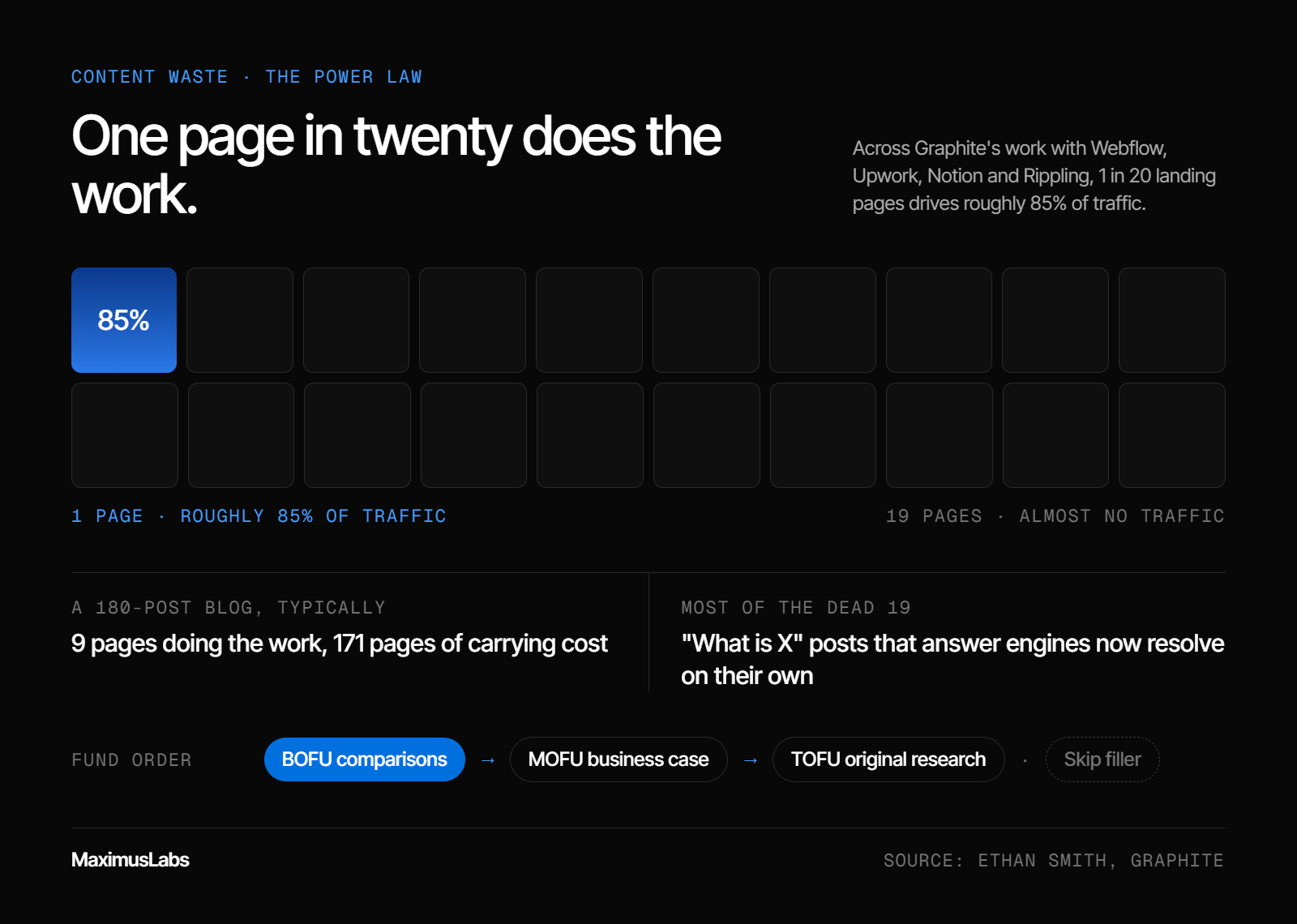
- B2B content output follows a power law. Roughly 19 of 20 pages drive almost no traffic while 1 in 20 drives about 85% of it, so allocation beats volume.
- Definitional TOFU content is the worst-performing asset class now, because answer engines resolve those queries natively and only 1% of users click a cited source.
- Technical documentation carries a 34% to 41% median citation rate against 15% to 18% for blogs, so a docs hub should ship before the blog calendar.
- Most AI citations come from off-site surfaces. Brand mentions correlate with AI Overview visibility far more strongly than backlinks, and G2 plus Capterra gate review citations.
- Measurement moves from sessions and rank to citation share of voice per engine, content-influenced pipeline, and revenue per published asset.
- Run a 90-day sequence: technical and schema sprint, docs hub and comparison pages, review profiles and video, then a measurement re-baseline and a quarterly refresh loop.
Q1. What is B2B content marketing in 2026, and how is it different from B2C?
B2B content marketing is the practice of publishing content that educates a multi-person buying committee, builds trust across long cycles, and converts existing demand into pipeline. Unlike B2C, the buyer is a committee, the cycle runs months, and purchases get justified to other people. What changed in 2026: Pew found link clicks drop from 15% to 8% when an AI Overview appears, and 94% of buying groups shortlist vendors before contacting sales.
📋 The job has always been committee education, not persuasion
A B2C buyer decides alone, often in minutes. A B2B buyer decides with a finance lead, a security reviewer, and a skeptical end user in the room. Every asset you publish gets forwarded, screenshotted, and argued over internally.
That is why formats differ so sharply. B2C content drives impulse. B2B content arms an internal champion with evidence she can defend in a procurement meeting.
📉 What broke: predictable organic traffic stopped being predictable
The old model assumed research traffic landed on your site first. It no longer does. Sam Lessin put the damage plainly on My First Million: "organic traffic that used to come through SEO very predictably including to folks like HubSpot we are very good at the SEO game have played it for a long time has gone down literally by about 20 to 40% based on which industry you are in."
Pew's 2025 study measured the mechanism behind that drop. Across 68,879 searches from 900 US adults, clicks fell from 15% to 8% when an AI summary appeared, and only 1% of users clicked a source cited inside the summary, per Pew Research Center. That is the mechanism behind the decline in search referral traffic every B2B team is now reporting.
🧾 Where the research actually happens now
6sense surveyed 4,510 B2B buyers on purchases above $25,000. Ninety-four percent of buying groups had already ranked their preferred vendor before they spoke to a seller, and 94% used large language models to synthesize their research, according to the 6sense 2025 B2B Buyer Experience Report. G2's March 2026 survey of 1,076 software buyers found 51% start research inside an AI chatbot.
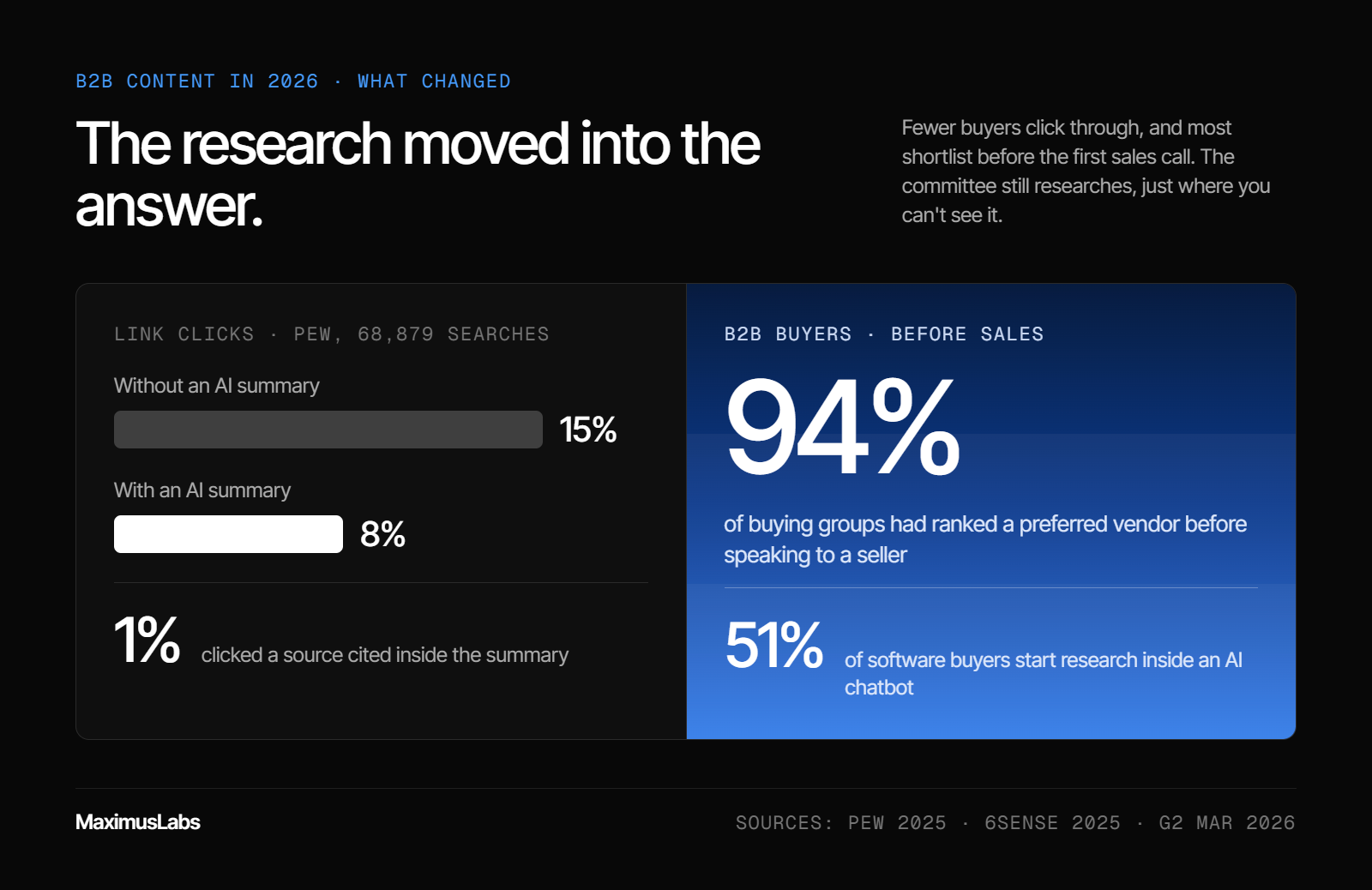
So the committee still does the homework. It just does it somewhere you cannot see, inside a chat window, before any form fill exists to attribute. We mapped that path in our research on the B2B SaaS buyer journey in AI search.
🎯 The reframe: citation share plus pipeline, not rank
This is where I think most 2026 content plans go wrong. They optimize for a position on a page that fewer buyers scroll. The useful question is narrower: when a CFO asks Gemini for the three best options in your category, are you one of them?
"Instead of trying to be in the answer, we're trying to become the answer, by becoming the most trusted source for AI."
That distinction matters because an AI recommendation is a trust transfer. When ChatGPT names you, it stakes its own credibility on you being right. Google's ten blue links never did that, which is the core of GEO versus traditional SEO.
MaximusLabs AI runs two scoreboards instead of one. Traditional agencies report rank and sessions, which now move independently of revenue. We track share of voice across ChatGPT, Perplexity, Gemini, and AI Overviews alongside pipeline influence, because Semrush found pages cited by ChatGPT rank 21st or lower on Google roughly 90% of the time.
Q2. Why do 19 out of 20 B2B content pages fail, and where should the budget go instead?
B2B content output follows a power law. Across Graphite's work with Webflow, Upwork, Notion, and Rippling, 19 of 20 landing pages drive almost no traffic while 1 in 20 drives roughly 85% of it. Most of the dead 19 are top-of-funnel "what is" posts that answer engines now resolve natively, and Pew recorded only 1% of users clicking a cited source inside an AI summary. Fund bottom-of-funnel and middle-of-funnel first. MaximusLabs AI skips top-of-funnel production as stated policy and starts every engagement on bottom-of-funnel assets.
📊 The power law, stated by the operator who measured it
Ethan Smith of Graphite has run this across category champions, not one lucky account. His summary is blunt: "one out of 20 landing pages drive roughly 85% of all your traffic."
Averages hide this completely. A 180-post blog with "decent average traffic" is usually nine good pages and 171 pages of carrying cost.
⚠️ Volume briefs manufacture the dead 19
Here is the mechanism. A retainer promises eight posts a month. The calendar needs filling. Keyword tools surface high-volume definitional terms, so the team writes them.
Smith's verdict on those pages is the one I quote most in strategy calls: "what is the definition of payroll zero conversion rate ever." The post ranks. Nobody buys. Nobody even clicks, because the engine already answered it.
❌ The TOFU verdict, with one honest exception
I do not think top-of-funnel content is universally dead. I think it is mispriced by roughly an order of magnitude.
The exception is category-defining content. If you are naming a new category, that content makes you the entity engines reference when the term comes up. Definitional filler does the opposite. It feeds the summary that replaces you. Chegg is the cautionary case, losing over 80% of its market value once students swapped its 46 million stored answers for instant model summaries.
💰 Where the budget actually goes
| Funnel stage | Buyer goal | Formats that earn citations | Conversion action |
| ✅ BOFU | Choose between two shortlisted vendors | Comparison and alternatives pages, pricing explainers, integration docs | Demo, trial, sales call |
| ✅ MOFU | Build the internal business case | Implementation guides, ROI models, customer case studies | Content download, email capture |
| ⚠️ TOFU | Understand a problem | Original research, category-defining thought leadership | Brand recall only |
| ❌ TOFU filler | Define a term | "What is X" posts | None measurable |
🧱 The wall of reality nobody warns you about
Eli Schwartz documented this honestly in Product-Led SEO: "When I embarked on my first effort to help an SaaS B2B company with its SEO, I was also under the illusion that this was going to be a supremely profitable channel. I was eventually confronted with a wall of reality." Best practices did not create demand for a niche product.
That is the uncomfortable part. Volume and technical hygiene cannot manufacture buyers who do not exist. Allocation can only concentrate you where buyers already are, which is why our revenue-focused GEO framework starts at the bottom of the funnel.
MaximusLabs AI fixes the allocation rule before the calendar: bottom-of-funnel master articles, comparison and alternatives pages, then ideal-customer-profile service pages, with middle-of-funnel considered only after that set is exhausted. Our published cost comparison puts content near $60 a piece against $800 in-house, and paying $60 for the dead 19 is still paying for nothing.
Q3. How do you research what your buying committee actually searches before they are ready to buy?
Research problems, not products. A Director of Finance is not changing banks weekly, but she is searching how to set up payroll when expanding to Argentina. 6sense found 94% of buying groups rank preferred vendors before first contact, and 94% used large language models to synthesize research, while G2 found 51% start inside an AI chatbot. MaximusLabs AI builds topic maps from buyer prompts rather than keyword volume, then records which sources each engine cites for those prompts.
🔍 Demand capture, not demand creation
Outbound advertising creates demand. Content captures it when a buyer enters a research moment. Ethan Smith frames the B2B version precisely: "Your ideal customer generally is not searching for your B2B product. Director of Finance is not changing their bank every week, but they are searching online for problems like how to set up payroll when expanding to Argentina."
So the research job is not finding product keywords. It is finding the operational problem that forces the search. That is the premise behind question research for AI search.
🧰 Why keyword tools point you at the wrong terms
Keyword tools rank by volume, and volume concentrates on definitional and category terms. Those sit furthest from a purchase decision. Smith's blunt summary of the result: "The biggest problem in B2B is waste."
The better source is already in your stack. Pull objection language and integration questions from Gong or Chorus call transcripts, then interview three recently won deals about what they searched before they ever filled a form.
👤 One worked example, three query layers
Take an ICP of a 300-person fintech expanding into Brazil, buying an employer-of-record product. One problem splits into three different jobs.
| Query layer | How the buyer phrases it | Who wins it |
| Head | "best employer of record" | Third-party listicles and review platforms |
| Mid-tail | "best EOR for fintech expanding to Brazil" | Mixed, citations plus strong owned pages |
| Long-tail | "does [tool] handle Brazilian 13th-month salary and FGTS filings" | Owned documentation and feature pages |
Average chat queries run around 25 words, which is why short-keyword planning misses the third row entirely. Our AEO keyword and question research method starts from that length, not from a seed list.
📞 The Monday-morning version of this research
Run it in four passes, in this order.
Export 20 recent sales calls and tag every objection, integration question, and competitor mention.
Write each tagged question the way a buyer would type it into ChatGPT, in 10 to 15 words.
Run those prompts across ChatGPT, Perplexity, and Gemini, and log every source cited.
Sort the results into two buckets: pages you need to write, and third-party surfaces you need to get mentioned on.
Otter.ai shows the payoff of step three. It captured ChatGPT recommendations for meeting-transcription tools that integrate with Looker by publishing pages detailing the Zapier to BigQuery to Looker workflow, a question no keyword tool would have surfaced.
🧭 Where I hold this loosely
MaximusLabs AI's prompt testing points one way here, though I might be reading it too strongly. Citation sets move week to week, and a single prompt run is a snapshot, not a trend. We re-run the same prompt sets on a schedule for that reason, and I would not rebuild a content plan off one afternoon of testing.
MaximusLabs AI writes the topic map from prompts, not keywords, then maps which sources each engine trusts per query cluster. That map decides two things: what gets written, and where a third-party mention matters more than another blog post. We are measured on pipeline, not on mentions.
Q4. How should you structure topic clusters and filter keywords by commercial intent?
Filter every candidate topic by commercial intent before volume, then choose architecture by query type. One dense pillar covering a thousand question variants prevents dilution on consolidated topics. Distinct deep URLs win when sub-queries are genuinely different jobs, which Google's thematic search patent rewards with aggregate prominence. Long-tail integration and how-to queries almost always deserve their own page.
🧮 The intent filter runs before the volume column
Sort candidates by modifier first, not search volume. Commercial and transactional modifiers (versus, alternatives, pricing, for [segment], integrates with) sit closest to a decision.
Only after that filter should volume break ties. Search Engine Land's B2B guidance makes the same point, and it remains the strongest single tactic on the ranking pages for this topic.
⚖️ Two credible architectures, pulling in opposite directions
Now the genuinely contested part. The consolidation view, argued by Ethan Smith, says one dense page targeting a cluster of a thousand question variants prevents dilution across thin near-duplicates. Fewer, deeper URLs, each unmistakably the best answer.
The multi-page view leans on Google's thematic search patent, where distinct deep URLs for specific sub-queries build aggregate domain prominence across a theme. Both camps have shipped results. Anyone claiming this is settled has not tested both, and our notes on GEO topic clusters keep both options open.
📐 The decision rule that resolves it
I resolve it by retrieval behavior rather than by preference. Run the sub-queries through the engines and watch what comes back.
✅ One consolidated answer citing the same source repeatedly, build one exhaustive master article.
✅ Different sources cited per sub-question, build separate pages and interlink them.
⚠️ Integration, pricing, and how-to queries, almost always their own URL, because the answers are not substitutable.
❌ Two pages that would answer the same question, merge them and redirect.
🔗 Wiring the cluster to revenue
Architecture without internal linking is just filing. Every cluster needs a defined path into a bottom-of-funnel page, or it becomes a reading experience with no next step.
Three rules keep it honest. Each supporting page links up to its pillar with descriptive anchor text. Each pillar links down to the three highest-intent pages in the cluster. Every comparison and alternatives page links to a service or pricing page, not to another blog post.
🧠 Why this makes you legible as an entity
There is a second reason to care about structure, and it has little to do with rankings. Engines need to resolve what your brand is, not just which page answers a query.
Semantic interlinking and genuine topic depth are what make a company legible as an entity rather than a scattered set of URLs, which is the point of entity optimization and knowledge graphs. A cluster that covers one domain thoroughly reads as expertise. Forty unconnected posts across nine topics read as noise, and the Princeton and IIT Delhi GEO study found keyword-stuffed content actively lost visibility while statistics and cited sources gained it.
MaximusLabs AI decides architecture per query cluster rather than by template. Where an engine returns one consolidated answer, we build one exhaustive master article. Where it returns different sources per sub-question, we build separate pages and interlink them into the B2B SEO bottom-of-funnel set. The architecture follows observed retrieval behavior, not a blog category tree.
Q5. Which content formats do AI engines actually cite for B2B queries?
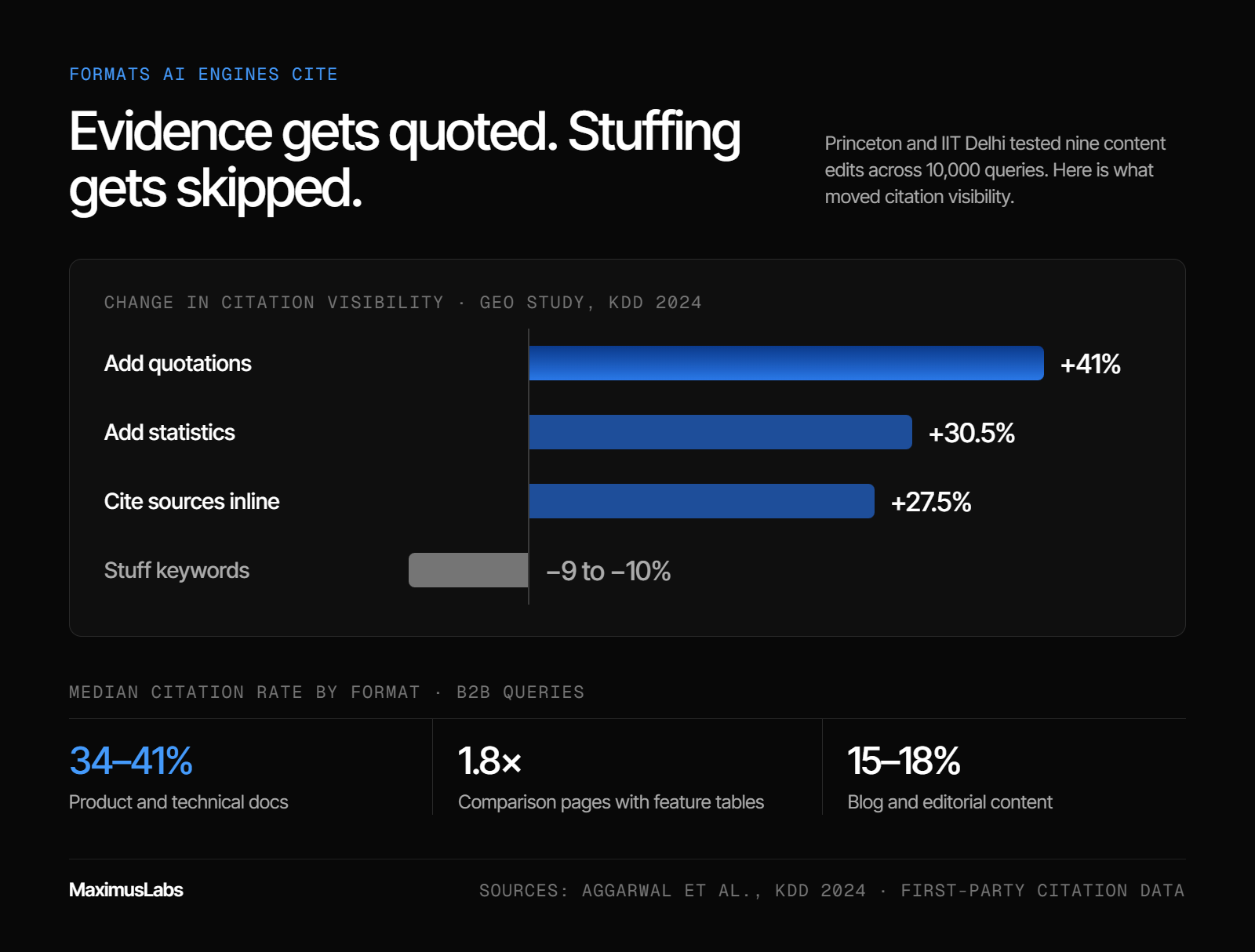
Technical documentation wins. Product and technical docs show a 34% to 41% median citation rate against 15% to 18% for blog and editorial content, roughly 10 to 15 times a blog post, because docs are structured, self-contained, and answer-dense. Comparison pages with feature tables carry a 1.8 times multiplier, and 64% of AI-cited B2B SaaS articles contain three or more statistics against a 29% baseline.
📄 Why docs beat blogs at the passage level
Retrieval does not grade pages. It grades passages. An engine pulls a block, checks whether it answers the question on its own, and cites it or drops it.
Documentation is built that way by accident. Each section covers one capability, defines its terms, and finishes the thought. A blog post buries the same answer under 300 words of setup, so the useful block never stands alone. Our notes on citation-worthy content for AI engines break that failure down block by block.
📊 Observed citation rates by format
| Format | Median citation rate | Why it performs |
| ✅ Product and technical docs | 34% to 41% | Self-contained, answer-dense, factual |
| ✅ Comparison and alternatives pages | 1.8x multiplier with feature tables | Structured rows map to structured questions |
| ⚠️ Blog and editorial | 15% to 18% | Answers buried mid-article |
| ⚠️ Video with full transcript | Varies by surface | Text gives crawlers something to read |
| ❌ Thin definitional posts | Near zero | Engines answer these natively |
Docs hold roughly 29% of all citations in this dataset while making up a small share of most content libraries. That gap is the cheapest arbitrage in B2B content right now, and we quantified it further in the ChatGPT, Perplexity, and Gemini citation patterns report.
🔬 What the GEO study proved about formatting
The Princeton and IIT Delhi team behind the KDD 2024 GEO paper tested nine content edits across 10,000 queries. Adding quotations lifted citation visibility by 41%, statistics by 30.5%, and inline source citations by 27.5%, per Aggarwal et al., "GEO: Generative Engine Optimization," ACM SIGKDD KDD 2024.
Keyword stuffing moved visibility down by roughly 9% to 10%. So the old density playbook is not neutral in AI search. It actively costs you citations, which is one of the most common GEO mistakes to avoid.
⌨️ The extraction standard I write to
Answer Engine Optimization (AEO) works on the retrieval step, not the ranking step. That changes the craft. Every block has to survive being lifted out with no title, no byline, and no surrounding context.
Three rules carry most of the gain. Put a 30 to 60 word direct answer inside the first 30% of the page, which correlates with a 44.2% citation share in this dataset. Include one verifiable statistic and one attributed quote per 300 words. Use real HTML tables, not screenshots of tables, as our guidance on AEO answer structure and writing sets out.
🧱 The build order that follows from this
Sequence production by citation rate, not by content calendar habit.
Documentation hub first: onboarding guides, feature reference pages, integration guides, and API docs.
Bottom-of-funnel comparison and alternatives pages next, each with a real feature matrix.
Task-focused video with full transcripts and timestamped chapters.
Blog content last, and only where it carries original data or a named point of view.
I hold one caveat here. This citation dataset is first-party and category-specific, so the exact percentages will move by vertical. The ranking order has held up every time I have tested it, but I would not treat 34% as a forecast for your docs.
MaximusLabs AI sequences production by citation rate, which is why a documentation hub ships before the blog calendar. We also write for extraction: answer-first blocks, question-form subheads, real HTML feature matrices, and one named statistic per section. That is the difference between content an engine quotes and content it summarizes away.
Q6. How do you build a BOFU-first content engine that produces pipeline?
Start at the bottom. Build comparison and alternatives pages for every competitor, then master articles for high-intent methodology queries, then ideal-customer-profile service pages. Semrush measured AI-search visitors converting at roughly 4.4 times traditional organic, Webflow saw a 6 times gap between large-language-model traffic and Google traffic, and AI Overviews trigger on 87% of B2B comparison searches. MaximusLabs AI runs this sequence as a documented plan and is measured on pipeline, not on mentions.
⏰ Why balanced calendars starve the bottom of the funnel
A balanced funnel plan sounds responsible. In practice, the top of the funnel eats the capacity, because definitional topics are easier to brief and faster to write.
Six months later, the team has 40 awareness posts and no page that helps a buyer choose between you and the incumbent. The comparison page, the one your sales team actually sends, is still on the backlog.
💰 The conversion math that justifies the order
Ethan Smith of Graphite put a number on this from first-party client data: "Web Flow we saw a 6x conversion rate difference between LLM traffic and Google search traffic." Semrush's June 2025 study found a similar direction at 4.4 times across its sample.
Trigger rates reinforce it. AI Overviews appear on 87% of B2B SaaS comparison searches and 73% of how-to queries, so these are exactly the queries where being cited decides the shortlist. That is the whole premise of Google AI Overviews optimization.
🔢 The build sequence, in order
One comparison page per named competitor, plus one alternatives page per category you compete in.
Master articles for each methodology or problem your product solves, written to be the most complete page on that topic.
ICP-specific service or solution pages, written for conversion rather than keyword coverage.
Integration and how-to pages for the long-tail questions buyers ask at evaluation.
Middle-of-funnel assets (ROI models, implementation guides, and case studies) once steps one to four exist.
📐 What a comparison page needs to contain
Thin "us versus them" pages lose on both surfaces. A page that gets cited carries structure an engine can read.
✅ A real HTML comparison table, not an image.
✅ An explicit feature matrix with honest gaps marked.
✅ Pros and cons for both products, including where you lose.
✅ Pricing tier breakdown in plain text.
❌ No vague superlatives, which engines cannot verify and buyers discount.
Those specs are the backbone of our B2B SaaS AEO strategies.
⚠️ Hacks do not scale past a certain revenue line
Neil Patel described the reaction from larger buyers directly: "when we talk to enterprise companies they don't care about any of those hacks. You tell them about a hack no one gives a crap. How do we go from 10 million to driving additional 90 million a year."
That reframes the engine. A tactic that lifts one page is not a system. A system is a defined asset order, an owner per asset type, and a reporting line that ends at pipeline, which is how we scope a GEO strategy framework.
MaximusLabs AI runs AEO with SEO as its foundation, strategy and execution in one team. Our published proof point for the sequence is Oliv AI: 27 qualified leads, $47K+ pipeline, 26% close rate in 4 months. Humans approve everything that ships.
Q7. Where does B2B content need to show up besides your own blog?
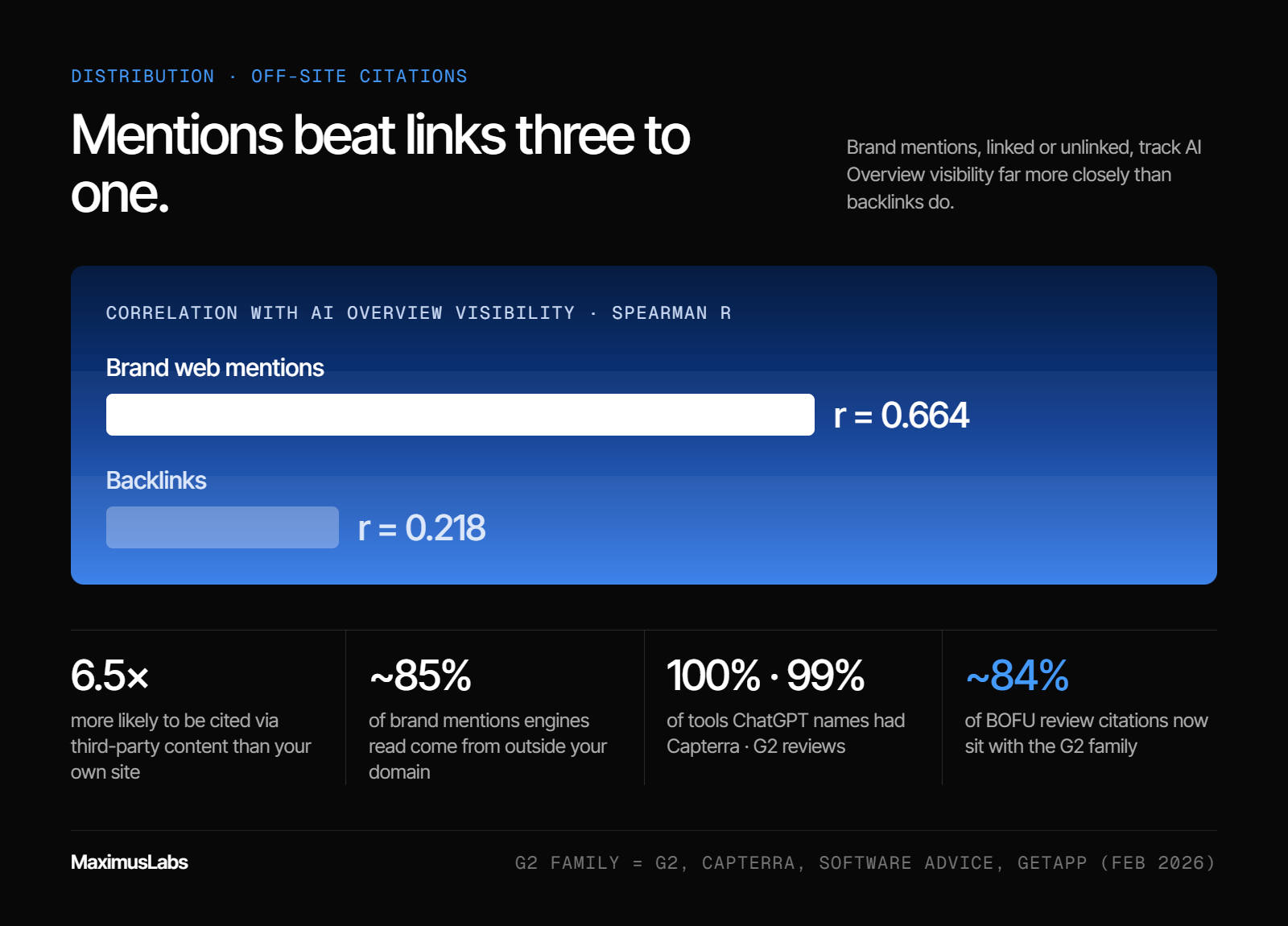
Everywhere your buyers and the engines look. Brand web mentions correlate with AI Overview visibility at Spearman r=0.664, roughly three times stronger than backlinks at r=0.218, and brands are 6.5 times more likely to be cited through third-party content than their own site. After G2's February 2026 acquisition of Capterra, Software Advice, and GetApp, the G2 family controls roughly 84% of bottom-of-funnel review citations. MaximusLabs AI runs off-site placement as a managed workstream alongside owned content.
📣 The owned stack, done properly
Most teams plan distribution after production. That order is backwards, and it shows in the numbers.
Done properly, the owned stack has four jobs. The founder publishes on LinkedIn weekly in their own voice. A newsletter carries the original data. Sales gets a one-page version of every bottom-of-funnel asset. Partners co-publish into audiences you do not own.
⚠️ Where the complication starts
Here is the part that breaks the owned-media model. Roughly 85% of brand mentions that engines read originate outside your domain. For head terms like "best CRM software," aggregators and review platforms dominate the citation set almost entirely.
So your best page can be excellent and still lose the query. The engine is not reading your site for that question. It is reading G2, Capterra, Reddit, and a listicle you have never audited, which is why Reddit and forum AEO belongs in the content plan.
🔎 What the correlation data actually says
The mention-versus-link gap is the finding I would put in front of a board. Brand mentions, linked and unlinked, correlate with AI Overview visibility at r=0.664 against 0.218 for backlinks.
Review coverage behaves almost like a gate. Of the tools ChatGPT names in software answers, 100% had Capterra reviews and 99% had G2. Similarweb data shows ChatGPT is already a top-ten traffic source for Forrester, Gartner, and G2, and we track that shift in our 2026 GEO and AEO benchmark report.
🎥 One worked example worth copying
Webflow generated 8% of total signups directly from large-language-model discovery. The mechanism was unglamorous. It published more than 800 task-focused YouTube videos, with titles like how to create and style collection lists, and participated transparently on Reddit.
Legit Security shows the compounding version. Embedding one YouTube video on an application security product page lifted that exact page across ChatGPT, Gemini, YouTube, and Google AI Overviews at once. That multi-surface effect is what multimodal search optimization is built to produce.
✅ The off-site checklist, with owners
| Surface | Action | Owner | Cadence |
| G2, Capterra, Gartner Peer Insights | Claim, verify, reach 10+ verified reviews each | Customer marketing | Monthly |
| Reddit and Quora | Find threads engines already cite, contribute real expertise | Product marketing | Weekly |
| YouTube | Task-focused videos, full transcripts, chapters | Content lead | Biweekly |
| Listicles and roundups | Audit which ones get cited, pitch inclusion | Founder or head of growth | Quarterly |
MaximusLabs AI splits this into two pillars: Owned AEO, where your content becomes the answer, and Earned AEO, where reviews, Reddit, press, and listicles make engines trust you. Our citation-intelligence engine maps which sources each engine trusts per query, then we work to get clients into those sources through AI citation acquisition. Most agencies only run the first pillar.
Q8. What technical setup makes B2B content discoverable to AI engines?
Four requirements: server-rendered HTML with minimal JavaScript dependence, passage-level structure (question subheads with answer-first blocks), complete schema covering Article, FAQPage, HowTo, Organization, Person with credentials, and ItemList, plus a closed entity loop linking your site to Wikidata, Crunchbase, LinkedIn, and G2 through sameAs. Schema is no longer a rich-snippet play. It is how engines resolve which entity you are. MaximusLabs AI ships this sprint in week one, before any article publishes.
🧩 Why rendering decides whether you exist
Not every crawler executes JavaScript. If your key content loads client-side, some retrieval systems see an empty shell where your answer should be.
The fix is unexciting and permanent. Render critical content and metadata in HTML, keep markup semantic, and stop hiding answers inside tabs and accordions that require a click. Start with an AI crawlability check before you touch anything else.
🔗 The closed entity loop
Schema has a second job most teams skip. It tells engines which real-world entity a site belongs to.
Build the loop so every node points at the others. Sitewide Organization schema uses sameAs to reference your Wikidata item, Crunchbase profile, LinkedIn page, and G2 listing. Wikidata carries the G2 Product ID property P12136 back to your listing. The traversal becomes website, Wikidata, LinkedIn, Crunchbase, G2, and back, which is the practical core of GEO knowledge graph work.
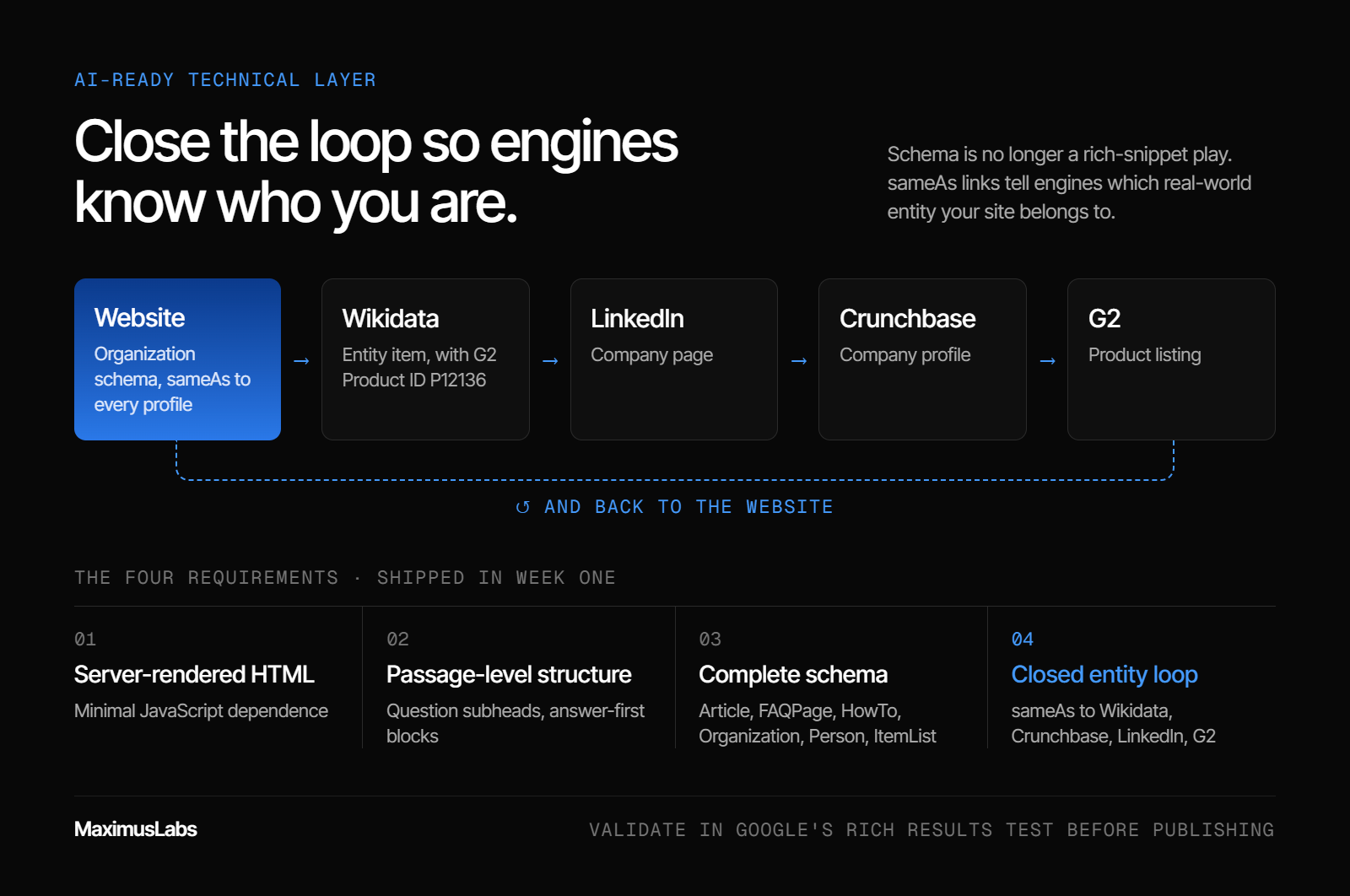
✅ The week-one implementation checklist
Audit rendering: confirm body copy, headings, and schema appear in raw HTML.
Ship an updated article template with an automatic table of contents and a real table module.
Add Article, FAQPage, HowTo, Organization, ItemList, and Person schema with author credentials.
Fill sameAs on Organization with Wikidata, Crunchbase, LinkedIn, and G2 URLs.
Create or correct the Wikidata item, including P12136 where a G2 listing exists.
Validate everything in Google's Rich Results Test and fix errors before publishing.
Restructure the top 20 revenue pages into question subheads with answer-first blocks.
If any of those steps are new, our schema markup basics and technical GEO implementation guides cover the markup line by line.
📏 Why structure is part of the technical layer
The KDD 2024 GEO study makes this a technical question, not an editorial one. Structural and source-level edits moved citation visibility by 27.5% to 41%, while keyword density moved it down, and Google Search Central's structured data guidelines set the markup rules you have to stay inside.
So the template is doing SEO work. A blog theme with no table module, no author schema, and no answer-block styling quietly caps every article you publish into it.
⚠️ The honest limits of this work
MaximusLabs AI's audits point one way here, though I might be reading it too strongly. Schema correlates with citation outcomes in the engagements we see, but no platform documents it as a ranking or citation input.
My read is simpler. Clean structure and resolved entities remove reasons for an engine to skip you. That is worth doing even if nobody publishes a coefficient for it.
MaximusLabs AI runs the technical sprint before a single article publishes: updated template, automatic table of contents, table modules, and full Article, Author, and FAQ schema. We deconstruct the site rather than audit it, because publishing strong content onto a template engines cannot parse is the most expensive mistake in this discipline.
Q9. How do you measure B2B content ROI when the clicks disappear?
Measure three layers: citation share of voice across ChatGPT, Perplexity, Gemini, and Google AI Overviews, content-sourced and content-influenced pipeline with qualified-lead conversion and deal velocity, and revenue per published asset. Traffic alone now misleads. Pew recorded clicks falling from 15% to 8% under AI Overviews, and Semrush found ChatGPT-cited pages rank 21st or lower on Google about 90% of the time. MaximusLabs AI measures engagements on pipeline, not on mentions.
📉 Why the traffic line now lies to your board
Picture the quarterly review. Sessions are down 18%. The board reads that as a content problem and asks whether the retainer is working.
The sessions did not move because your content got worse. They moved because the answer now appears above the links. Across B2B categories, organic traffic fell roughly 20% to 40% as zero-click summaries absorbed the research step, a pattern we documented in the zero-click search and brand economy report.
⚠️ The old dashboard, retired honestly
| Old metric | Why it broke | Replacement | Where to pull it |
| ❌ Sessions and pageviews | Answers resolve above the link | Citation share of voice per engine | Scheduled prompt-set runs |
| ❌ Average keyword position | No single rank exists inside an answer | Appearance rate across question variants | Prompt logs, engine by engine |
| ⚠️ MQL volume | Buyers arrive late and pre-sold | Content-influenced pipeline and close rate | CRM touch attribution |
| ⚠️ Time on page | Fewer, better-qualified visits | Revenue per published asset | CRM plus content inventory |
| ✅ Referral source detail | Still works, needs new segments | AI-source referral segment | GA4 session source and referral reports |
🔢 How to build each layer
Start with citation share. Take the 50 prompts your ideal customer would actually type, run them weekly across ChatGPT, Perplexity, and Gemini, and log whether your brand appears and which source got cited. Our notes on AEO measurement metrics set out the exact fields to log.
Then wire pipeline. Tag every content touch in the CRM, then report content-sourced and content-influenced deals separately. GA4 documentation covers the referral segmentation you need to isolate AI referrers in reporting, and our guide to calculating ROI for GEO initiatives covers the revenue-attribution side.
🧮 The measurement shift in one line
There is no single rank inside an AI answer. So position tracking stops being the unit of measure, and appearance frequency across thousands of question variants takes its place.
My read is that this is healthier than what it replaces. Share of voice is harder to game than a rank check. It also maps cleanly onto the only number a founder actually asks about, which is pipeline. That is the logic behind our measurement and metrics in GEO framework.
⏰ Re-baseline in one week
Build the 50-prompt set from sales-call language, not keyword tools.
Run it once, by hand if needed, and record the baseline.
Add an AI-referral segment in GA4 and separate it from generic organic.
Turn on content-touch tracking in the CRM for every bottom-of-funnel page.
Replace the traffic headline in your deck with citation share plus influenced pipeline.
📊 Where I stay uncertain
MaximusLabs AI's tracking shows citation sets shifting week to week, and I might be reading short-run noise as signal more often than I admit. One weekly run is a snapshot, so we regression-test the same prompts before calling a change real. Attribution for an answer with no click remains genuinely unsolved, and anyone claiming otherwise is selling something. We wrote up those limits in AEO challenges around accuracy and attribution.
MaximusLabs AI reports outcomes, not dashboards, with daily AI-visibility tracking across every major engine. We tie that to pipeline rather than impressions, because a page can be invisible on Google and still be the source ChatGPT names. Flat traffic with rising AI-sourced demo requests is a win, and the reporting has to show it.
Q10. Do you need an AEO tracking tool, or are you being sold a commodity?
Mostly a commodity. More than 60 AEO tracking tools charge hundreds to thousands monthly for near-identical prompt-ping tracking, and roughly 95% query vendor API endpoints instead of scraping the live logged-in interface, which returns a different citation mix than real users see. Buy the cheapest tool that does the job. MaximusLabs AI runs its own daily visibility tracking and spends client budget on the inputs that change citations.
💸 The land grab, and the pitch that comes with it
Every VP Marketing I speak with has three AEO tracking demos in the calendar. The pitch is always urgency. Your competitors are being cited right now and you cannot see it.
The demo looks impressive. A prompt list, a share-of-voice chart, and a competitor column. Then the annual invoice arrives and the chart has not changed a single citation. Our AEO tools comparison lays the feature sets side by side.
⚠️ Where the category falls apart
Two problems sit underneath the dashboards. The first is feature parity. Ethan Smith of Graphite audited the field and put it plainly: "We have a page with 60+ AEO tools and they all do the same thing: They all do tracking. Pick the tool that does what you want and has the lowest cost. And two years from now, you'll probably be using Ahrefs anyway."
The second is methodology. Roughly 95% of third-party platforms call vendor API endpoints rather than scraping the live, logged-in interface. API responses and real user sessions return different citation mixes, so the number on your dashboard may not match what your buyer sees. The same gap shows up across the top GEO tools and platforms.
❌ The sentence worth printing out
Knowing what you rank does not cause an outcome. Tracking is a thermometer. It tells you the room is cold and changes nothing about the heating.
That distinction is where I think most 2026 budgets leak. A team buys visibility into a problem, then has no capacity left to fix it. Our 2026 GEO budget benchmark shows where that money produces results instead.
✅ A fair buyer's comparison
| Option | What it actually delivers | Honest drawback |
| ✅ Low-cost AEO tracker | Prompt-level visibility reporting | Commodity feature set, likely bundled by Ahrefs or Semrush |
| ✅ Enterprise AEO suite | Broader prompt volume, team seats | Same core tracking at higher cost |
| ❌ Agency that only reports | Monthly dashboard reviews | No change to the citation set |
| ✅ MaximusLabs AI | AEO and SEO strategy plus execution, with its own daily tracking across engines | Scoped to B2B SaaS first, then healthcare and financial services, not general marketing |
🔍 Three questions to ask any AEO vendor
Do you scrape the live logged-in interface, or call an API? Ask for the methodology document.
How often do you re-run the same prompt set, and do you regression-test for noise?
What do you change after the report, and who does that work?
If the answer to question three is "that is on you," you bought a thermometer. Our AEO agency evaluation criteria use the same three questions.
💰 Where that budget belongs instead
Move it to the inputs. Review profiles on G2 and Capterra with ten or more verified reviews each. A documentation hub. Task-focused video with transcripts. Those three change what engines cite.
MaximusLabs AI sells execution, not dashboards, which is the honest dividing line in this category. Tracking tells you where you stand. Getting cited takes documentation, review presence, community credibility, and content engines can quote. Our published proof point is Oliv AI: 64% AI citation rate in 6 months, vs ~30% for billion-dollar incumbents.
Q11. What does the first 90 days of a 2026 B2B content program look like?
Weeks 1 to 2: technical sprint plus a prompt-set citation audit. Weeks 3 to 6: documentation hub and the first five comparison or alternatives pages. Weeks 7 to 10: review-platform profiles with ten or more verified reviews each, plus task-focused video. Weeks 11 to 13: measurement re-baseline on citation share and content-influenced pipeline. MaximusLabs AI runs a documented bottom-of-funnel-first quick-win plan across the first three months.
⏰ The 90-day sequence
| Phase | Focus | Deliverables | Owner |
| Weeks 1 to 2 | Foundations | Template, schema, sameAs loop, 50-prompt baseline | Dev plus growth lead |
| Weeks 3 to 6 | Owned assets | Docs hub, five comparison or alternatives pages | Content lead |
| Weeks 7 to 10 | Earned surfaces | G2, Capterra, Gartner Peer Insights profiles, 10+ reviews each, first videos | Customer and product marketing |
| Weeks 11 to 13 | Measurement | AI-referral segment, CRM content-touch tracking, citation-share report | Marketing ops |
❌ What not to do in quarter one
Skip the awareness calendar. Skip the brand refresh. Skip the 10,000-word pillar on a topic nobody evaluates you for.
Also skip tool shopping. Baseline by hand for one quarter, then decide whether a tracker earns its line item. For early-stage teams, our GEO guidance for SaaS startups sequences the same work on a smaller budget.
🔁 The quarterly loop that follows
After day 90, the work becomes a loop rather than a launch. Run it every quarter, on a calendar, not when someone remembers.
✅ Refresh what gets cited: update statistics, add new quotes, and keep dates current.
✅ Expand what converts: more pages in the clusters that touched closed deals.
⚠️ Rewrite what ranks but never converts: re-angle toward evaluation intent.
❌ Prune what has had no citations, no pipeline touches, and no links in two quarters.
The Content Marketing Institute's 2026 survey of more than 1,000 B2B marketers found teams struggling most with consistency rather than ideas, per its annual B2B research. A dated loop fixes consistency better than any new tool, which is why we run a scheduled GEO content refresh.
💰 Staffing reality, stated plainly
A two-person team can run this, but not at volume. Expect one strong writer with product fluency, plus a half-day of developer time in week one.
The honest alternative is a partner who does strategy and execution together. Splitting strategy from execution across two vendors is what makes quarter one slip to quarter three, which is the pattern we screen for in our directory of B2B SaaS AEO and GEO agencies.
⭐ What good looks like at day 90
Not revenue. Leading indicators. Your brand appears in a measurably higher share of the 50 prompts. Your docs pages start showing up as cited sources. Two comparison pages carry CRM touches on live deals.
I also say the unpopular part out loud. On a low-authority domain, Google rankings take time even when AI citations arrive early. Trust compounds, so the advantage goes to whoever starts the loop first, not whoever publishes most in month one.
MaximusLabs AI starts clients in two days rather than the two weeks of alignment plus a month of ramp common elsewhere, because quarter one goes entirely to bottom-of-funnel work with the technical sprint front-loaded. If you want that sequence mapped to your own category, talk to our team. Oliv AI's published outcome after this sequence: 30 to 40% of inbound now AI-sourced.
Frequently asked questions
What is B2B content marketing, and how is it different from B2C content marketing?
B2B content marketing is the practice of publishing content that educates a multi-person buying committee, builds trust across long sales cycles, and converts existing demand into pipeline. B2C content often targets one person making a fast, emotional decision. • Buyer: a committee of finance, security, and end-user stakeholders, not an individual. • Cycle: months rather than minutes, with multiple internal justifications. • Job of the asset: arming an internal champion with evidence she can defend in a procurement meeting. • Surface: traditional search plus AI answer engines that now resolve research before anyone visits your site. The 2026 difference sits in that last point. Buying committees now run most of their research inside ChatGPT, Perplexity, Gemini, and Google AI Overviews, then arrive carrying a shortlist. MaximusLabs AI treats that as two scoreboards: citation share across engines, and pipeline influence in the CRM. We built our view of that shift in the B2B SaaS buyer journey in AI search report, and the practical implication is simple. Write for a committee, and write so an engine can quote you accurately.
Is top-of-funnel what is content still worth producing for B2B in 2026?
For most B2B companies, no. Definitional top-of-funnel content is now the worst-converting asset you can fund, because answer engines resolve those queries directly inside the response. Pew measured link clicks falling from 15% to 8% when an AI Overview appears, with only 1% of users clicking a cited source. There is one honest exception. Category-defining content still earns its budget when you are naming or owning an emerging category, because it makes your brand the entity engines reference when the term comes up. • Skip: what is X posts, glossary filler, and generic how-it-works explainers. • Fund: comparison and alternatives pages, integration and how-to pages, documentation, and original research. • Keep: one or two category-defining thought leadership pieces per year. MaximusLabs AI skips top-of-funnel production as a stated policy rather than as a resource excuse, and we sequence middle-of-funnel work only after the bottom-of-funnel set is exhausted. If you want the reasoning behind that allocation, our revenue-focused GEO framework walks through how we score every planned page against an ideal-customer-profile decision stage before anyone writes it.
Which content formats do AI engines actually cite for B2B queries?
Technical documentation leads by a wide margin. Product and technical docs show a 34% to 41% median citation rate against 15% to 18% for blog and editorial content, roughly 10 to 15 times a blog post, because docs are structured, self-contained, and answer-dense. • Docs and reference pages: highest citation rate, holding roughly 29% of all citations. • Comparison and alternatives pages: about a 1.8 times lift when they contain real feature tables. • Video with full transcripts: works because crawlers get text to read. • Thin definitional posts: near zero, since engines answer those natively. Formatting matters as much as format. The KDD 2024 GEO study found quotations lifted citation visibility by 41%, statistics by 30.5%, and inline source citations by 27.5%, while keyword stuffing reduced it. MaximusLabs AI sequences production by citation rate, which is why a documentation hub ships before a blog calendar in our engagements. We also write for extraction: answer-first blocks, question-form subheads, and one named statistic per section. Our guidance on citation-worthy content for AI engines breaks that standard down block by block.
How do you measure B2B content marketing ROI when organic clicks are falling?
Measure three layers instead of one traffic line. • Citation share of voice: run a fixed set of roughly 50 buyer prompts weekly across ChatGPT, Perplexity, and Gemini, then log whether your brand appears and which source got cited. • Content-influenced pipeline: tag every content touch in the CRM and report content-sourced and content-influenced deals separately, with qualified-lead conversion and deal velocity. • Revenue per published asset: divide influenced revenue by the number of live pages to expose carrying cost. Traffic now misleads. Semrush found ChatGPT-cited pages rank 21st or lower on Google roughly 90% of the time, so a page can be invisible on Google and still be the source an engine names. Across B2B categories, organic traffic fell about 20% to 40% as zero-click summaries absorbed the research step. MaximusLabs AI measures every engagement on pipeline rather than mentions, with daily visibility tracking across major engines. We also say plainly that attribution for a click-free answer remains unsolved. Our guide to calculating ROI for GEO initiatives covers the attribution models that hold up in a board review.
Why do most B2B content pages fail to drive traffic or pipeline?
Because B2B content output is distributed by power law, not by average. Across Graphite's work with companies including Webflow, Upwork, Notion, and Rippling, 19 of 20 landing pages drove almost no traffic while 1 in 20 drove roughly 85% of it. Three mechanisms create the dead 19: • Volume briefs: a retainer promising eight posts a month forces the calendar to absorb high-volume definitional terms nobody buys from. • Keyword-first planning: search volume concentrates furthest from the purchase decision, so the plan optimizes the wrong queries. • No funnel discipline: awareness topics are easier to brief, so they consume the capacity that comparison pages needed. Eli Schwartz described the honest version in Product-Led SEO, recalling that best-practice SEO did not create demand for a niche B2B product. Volume and technical hygiene cannot manufacture buyers who do not exist. MaximusLabs AI plans against the power law rather than against word count, starting with bottom-of-funnel master articles, comparison and alternatives pages, and then ideal-customer-profile service pages. Our AI content strategy planning guide shows how we score candidates before production starts.
Do third-party sites like G2, Capterra, and Reddit affect B2B AI search citations?
Heavily. Most citations an engine surfaces for commercial B2B queries originate outside your own domain, so off-site presence functions as part of your content strategy rather than as public relations. • Mentions beat links: brand web mentions correlate with AI Overview visibility at Spearman r=0.664, roughly three times stronger than backlinks at r=0.218. • Third-party advantage: brands are about 6.5 times more likely to be cited through third-party content than through their own site. • Review coverage as a gate: of the tools ChatGPT names in software answers, 100% had Capterra reviews and 99% had G2. • Consolidation: after G2's February 2026 acquisition of Capterra, Software Advice, and GetApp, the G2 family controls roughly 84% of bottom-of-funnel review citations. The practical floor is ten or more verified reviews on each major platform, plus genuine participation in the community threads engines already cite. MaximusLabs AI runs this as a managed workstream we call Earned AEO, alongside owned content, including profile claims, review programs, and contributions to cited threads. Our notes on Reddit and forum AEO cover how to do that without spamming.
What should the first 90 days of a B2B content program cover?
Front-load the foundations, then build the assets that influence a purchase decision. • Weeks 1 to 2: technical sprint covering template, schema, and the sameAs entity loop, plus a baseline prompt-set citation audit. • Weeks 3 to 6: documentation hub and the first five comparison or alternatives pages. • Weeks 7 to 10: review-platform profiles with ten or more verified reviews each, plus task-focused video with transcripts. • Weeks 11 to 13: measurement re-baseline on citation share and content-influenced pipeline. Deliberately skip the awareness calendar, the brand refresh, and tool shopping in quarter one. Baseline by hand first, then decide whether a tracker earns a line item. At day 90 the honest expectation is leading indicators, not revenue: higher appearance share across your prompt set, documentation pages showing up as cited sources, and two comparison pages carrying CRM touches on live deals. MaximusLabs AI runs a documented bottom-of-funnel-first quick-win plan across the first three months, with humans approving everything that ships. Our GEO strategy framework maps the same sequence to different domain-authority starting points, since rankings compound slower than citations.