 Krishna Kaanth M
- The three-stage funnel still holds, but the click that used to start it does not. Roughly 68% of US Google searches now end without any website visit.
- TOFU-heavy programmes stall because answer engines satisfy awareness queries natively. Graphite found 19 of 20 landing pages drive almost no traffic while one drives about 85%.
- Label keywords by buyer awareness, problem, solution, or product aware, then mine real phrasing from Gong or Chorus transcripts instead of keyword tools.
- Technical documentation earns a 34% to 41% median citation rate against 15% to 18% for editorial blogs, so build the docs hub before the blog.
- Review presence is an eligibility gate. Of tools ChatGPT names, 100% had Capterra reviews and 99% had G2 profiles, and brand mentions beat backlinks for AI visibility.
- Expect 9 to 18 months before pipeline is clearly attributable. Report AI impressions, share of voice, and content-influenced pipeline instead of sessions.
Q1. What is a B2B content marketing funnel, and what has actually changed in 2026?
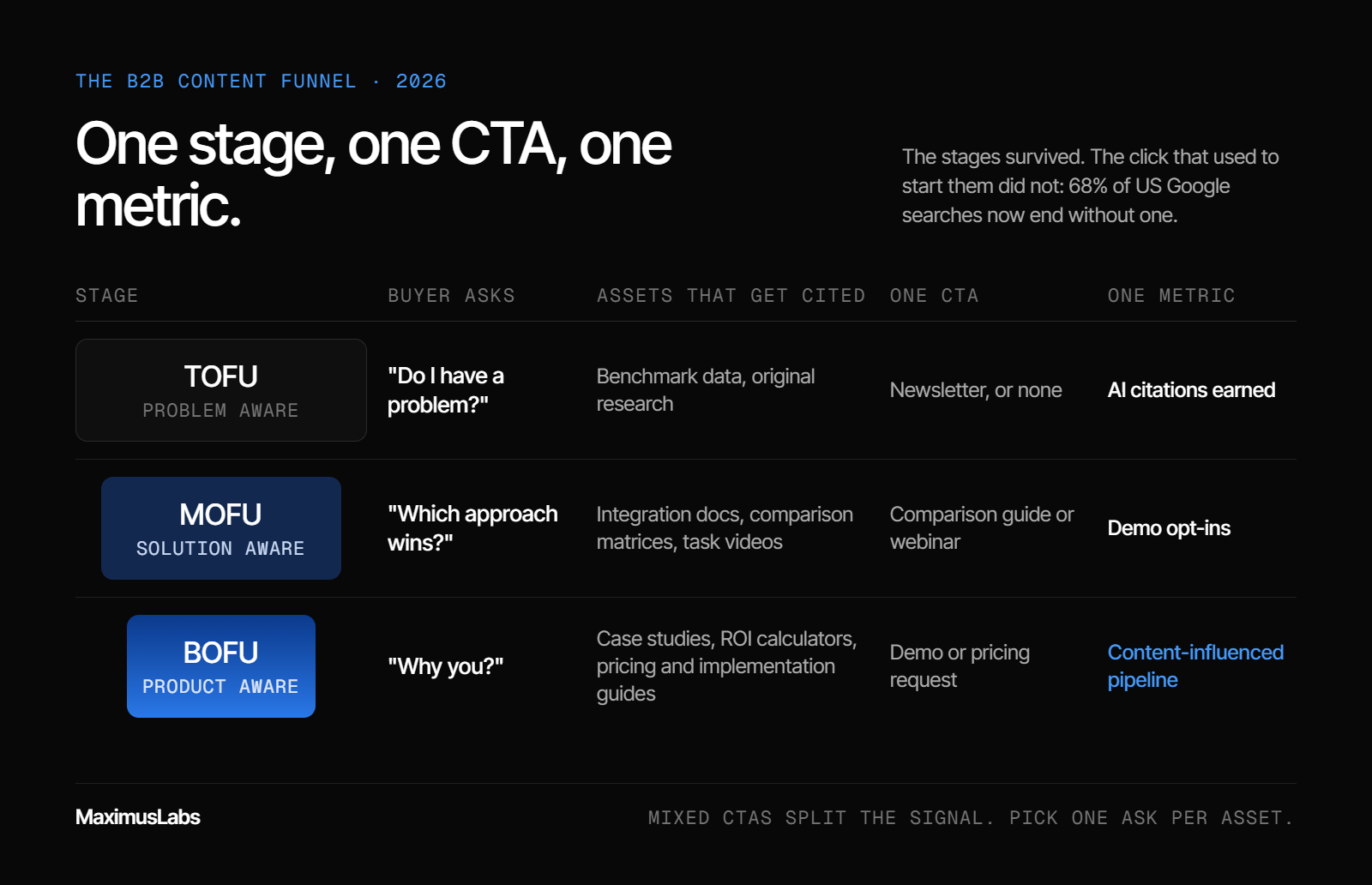
A B2B content marketing funnel maps buyer stages to specific content, keywords, and metrics. Top of funnel (TOFU) builds problem awareness. Middle of funnel (MOFU) supports vendor evaluation. Bottom of funnel (BOFU) de-risks the decision. Each stage carries one call to action and one revenue metric. What changed is the entry point. AI engines now answer awareness questions directly, so 68% of US Google searches end without a click. The funnel survived. The click that used to start it did not.
🧭 The three stages, stated plainly
The model itself is not broken. Buyers still move from "I have a problem" to "which approach wins" to "why you." Each stage still needs its own asset, its own ask, and its own number. A webinar signup is not a demo request, and treating them as one metric is how teams lose the thread.
What breaks is the assumption underneath the diagram. Every funnel chart ever drawn assumes a click at the top. That click delivered the session, the cookie, the email, and the first touch in your attribution model. Remove it and the diagram still looks right while the measurement collapses.
📉 The click stopped being the entry event
Pew Research Center tracked 900 US adults across 68,879 searches. Click-through fell to 8% when an AI summary appeared, against 15% without one. Links inside the summary were clicked in 1% of visits. Your awareness content is still being read. It is being read inside someone else's interface.
This is not a top-of-funnel-only problem. Semrush analysed over 600,000 keywords from November 2025 to April 2026 and found AI Overviews grew 71% on commercial-intent SERPs. Commercial intent is MOFU. The evaluation stage, where buyers compare approaches, is now being summarised before anyone reaches your page. The same compression is now visible in AI search click-through rate data.
⚠️ Why this hits B2B harder than B2C
CEB's research put 57% of the B2B purchase decision ahead of any contact with a supplier. That share of the journey has always happened in the dark. Now a large slice of it happens inside ChatGPT, Perplexity, Gemini, and Google AI Mode, where you get no referrer and no session. Our own research on the B2B SaaS buyer journey in AI search maps where those dark touches now sit.
Gartner forecast in February 2024 that traditional search engine volume would fall 25% by 2026 as chatbots and virtual agents absorbed queries. Forecasts age badly, and I would not bet a budget on the exact number. The direction has held up well enough to plan around.
🔁 The funnel is now a retrieval problem
Here is the reframe I keep coming back to. Best-practice SEO has become the basics of generative engine optimization, not the whole of it. SEO is the foundation floor. AI retrieval is the building above it.
So the question for each stage changes. Not "does this page rank," but "will an engine retrieve this block, trust it, and name us inside the answer." Rankings are a proxy. Being the answer is the job. The rest of this playbook maps content, keywords, and metrics against that version of the funnel.
Q2. Why do TOFU-heavy funnels produce traffic but no pipeline, and which stage should get budget first?
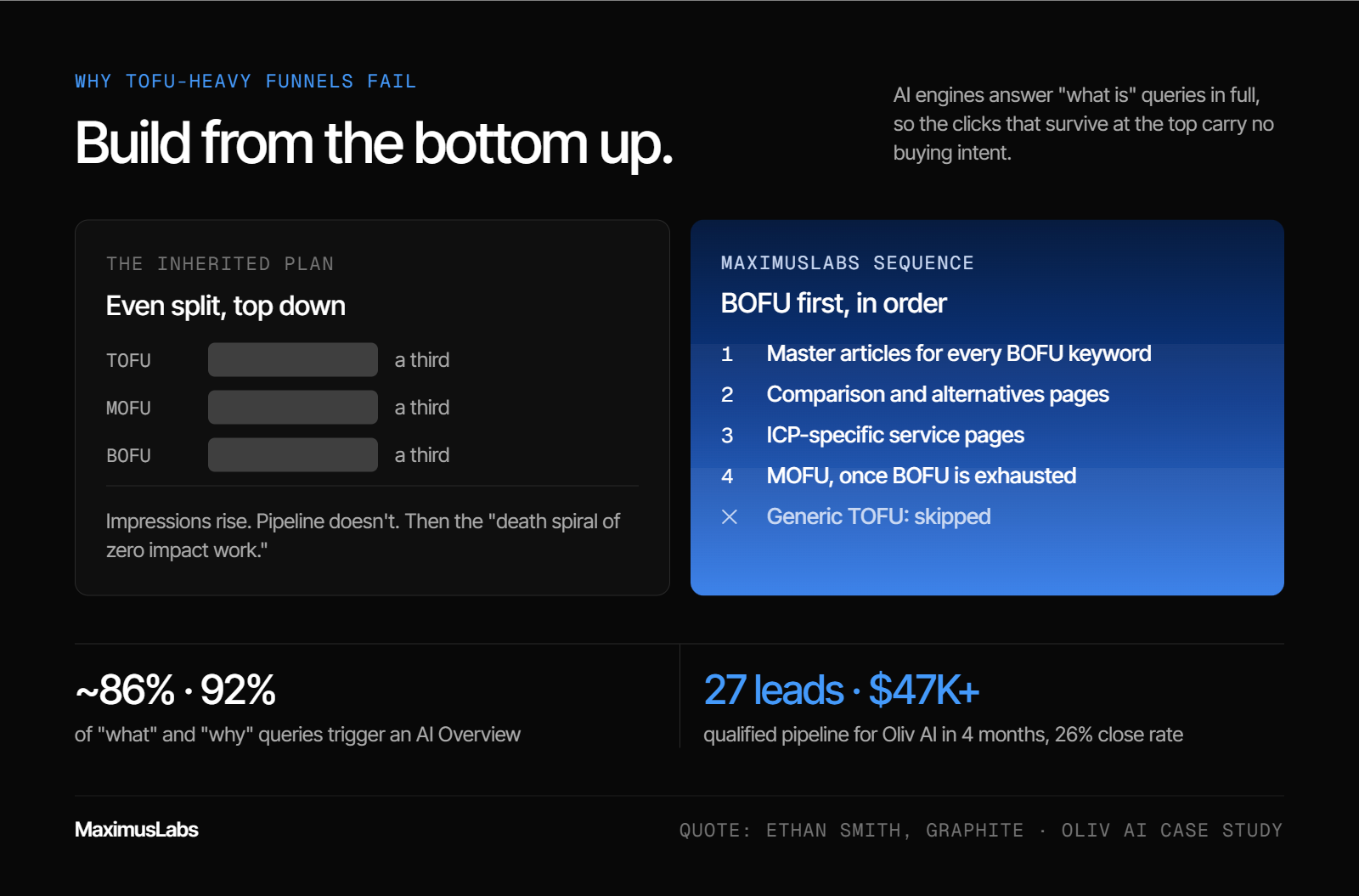
Because AI engines satisfy awareness queries natively, and the clicks that survive carry no buying intent. Graphite's work across Webflow, Upwork, Notion, and Rippling found 19 of 20 landing pages drive little to no traffic, while one drives roughly 85%. MaximusLabs AI inverts the standard build: BOFU master articles, comparison matrices, and alternatives pages first, MOFU once BOFU is exhausted, and generic TOFU skipped because answer engines already cover "what is" queries well.
🗓️ Situation: the playbook everyone inherited
The inherited plan splits budget evenly across three stages. Write the glossary posts, build the awareness volume, then nurture downward. It made sense when a click was cheap and a session meant something.
So teams publish 40 posts a quarter. Impressions rise. The board asks about pipeline, and the answer involves the word "compounding."
⏰ Complication: the death spiral nobody names
Ethan Smith of Graphite described the pattern exactly: you ask the SEO person why results have not arrived, they say it takes a year, you wait a year, nothing happens, you decide SEO is a bad channel, and you hire the next person. His phrase for it is "this death spiral of zero impact work".
Eli Schwartz puts the structural reason in one line: "SEO is an optimization channel, not a demand-creation channel". A niche B2B tool does not generate new demand because you published a definition page. The demand either exists or it does not.
❌ Proof: the glossary page is now the worst asset you own
Smith is blunt about the specific asset class. "What is the definition of payroll" has, in his words, a zero conversion rate. That was true before AI search. AI search made it worse, because definitional queries are exactly what the engines answer in full.
The trigger rates tell the story. AI Overviews appear on roughly 86% of "what" queries and 92% of "why" queries, and Semrush recorded 71% growth on commercial-intent SERPs. Your definition page is competing with a summary that never needs your click. This is the pattern behind the wider decline in search referral traffic.
✅ What the inverted sequence looks like
MaximusLabs AI publishes its sequence rather than improvising it, and the order is deliberate:
Master articles for every known BOFU keyword.
Competitor comparison and alternatives pages, to catch switchers mid-evaluation.
ICP-specific service pages built from what the BOFU research surfaced.
MOFU only after BOFU is exhausted. Generic TOFU marked skipped.
I will hedge one part honestly. MaximusLabs AI's own plan notes that on a low-activity domain, Google rankings lag even when the content is strong, while AI visibility arrives earlier. My read is that this gap is the real reason BOFU-first works, though I may be weighting the AI side too heavily this early.
💰 Resolution: capture demand, then widen
Demand capture beats demand creation when budget is tight. MaximusLabs AI runs Answer Engine Optimization (AEO) with SEO underneath it, as strategy and execution in one team, and is measured on pipeline rather than mentions. The public proof line from Oliv AI is specific: 27 qualified leads, $47K+ pipeline, 26% close rate in 4 months.
That is the trade. Fewer assets, aimed at the end of the journey, reporting a number the CRO recognises.
Q3. How do you map keywords to funnel stages without guessing?
Label by buyer awareness, not search volume. Problem-aware queries name a symptom, such as "set up payroll in Argentina." Solution-aware queries compare approaches, such as "EOR vs local entity." Product-aware queries name vendors, such as "Deel vs Remote." Assign each query one stage, one call to action, and one metric. Mine the real phrasing from Gong or Chorus call transcripts rather than keyword tools, because buyers ask AI engines in roughly 25-word sentences, not two-word head terms.
🏷️ The awareness taxonomy, mapped to intent labels
Ethan Smith's framing is the cleanest I have used. "Problem aware: I know I have a problem like I need to set up payroll in Argentina. Solution aware: I know there are options. Product aware: I know there are five companies that have specific products".
That maps directly onto the intent labels most teams already use. The value is that awareness is observable in the query string, while "intent" often becomes an argument in a spreadsheet. Our AEO keyword and question research process starts from exactly this labelling step.
| Awareness state | Intent label | Funnel stage | One CTA, one metric |
| Problem aware | Informational | TOFU | Newsletter or no CTA. Metric: AI citations earned |
| Solution aware | Investigational | MOFU | Comparison guide or webinar. Metric: demo opt-ins |
| Product aware | Transactional | BOFU | Demo or pricing request. Metric: content-influenced pipeline |
🎤 Mining transcripts instead of keyword tools
Keyword tools return what has already been indexed. Sales calls return what buyers actually say. Run this in an afternoon:
Pull the last 30 closed-won and closed-lost call recordings from Gong or Chorus.
Export transcripts and search for question marks, plus the words "integrate," "migrate," "compliance," and "versus."
Copy each question verbatim into a sheet. Keep the buyer's wording, including the clumsy parts.
Tag each one problem, solution, or product aware.
Only then check volume, and treat a zero-volume question with three sales mentions as real.
Google's patent work on query intent classification splits intent into far more granular categories than most keyword tools expose. The transcript is a shortcut to that granularity, and it feeds directly into question research for AI search strategy.
🎯 Why head, mid-tail, and long-tail need different plays
MaximusLabs AI works from a three-question-type framework, and it changes where the effort goes:
Head queries ("best CRM software") are won through citations. Third-party sources dominate these answers, so owned content alone rarely moves them.
Mid-tail queries ("best CRM for small SaaS teams") need both citations and strong owned pages.
Long-tail queries ("does HubSpot integrate with Slack for automated lead routing") belong to owned content. Be the most complete answer and you win it outright.
The average AI chat query runs near 25 words, which is why long-tail is no longer a scraps strategy. It is where owned content still has a clear edge, and where the query types answer engines prioritize matter most.
📋 What the writer should receive
The output of all this is one sheet, and nothing more. Columns: verbatim query, awareness state, funnel stage, assigned CTA, assigned metric, and the sales-call timestamp it came from.
A writer can build from that without asking a single follow-up question. That is the test. If the brief still needs a meeting, the mapping is not finished.
Q4. Which content assets actually get cited at each funnel stage?
Technical documentation wins. Vendor docs hold a 34% to 41% median citation rate and roughly 29% of all B2B citations in AI search, against 15% to 18% for editorial blogs. The hierarchy inverts accordingly: onboarding guides, feature references, integration pages, and API docs first; comparison matrices second; case studies, ROI calculators, and pricing pages at BOFU; editorial blogs last. Build the documentation hub before the blog.
📊 The citation gap nobody plans around
Most funnel guides give you a format list per stage. Ebook at the top, webinar in the middle, case study at the bottom. None of them weight the list by what engines actually quote.
A 10x to 15x citation gap between docs and blogs should reorder your roadmap. If one asset class gets quoted twice as often per unit of effort, it stops being a developer concern and becomes a marketing asset. Our analysis of ChatGPT, Perplexity, and Gemini citation patterns tracks that gap by asset type.
🔍 Why documentation outperforms editorial
Three reasons, in order of how much they matter:
Specificity. Docs answer one narrow question completely. That matches how buyers prompt.
Stability. A feature reference page does not get rewritten for seasonality, so it accumulates trust.
Structure. Clear headings, tables, and short answer blocks are easy to parse and easy to lift. The mechanics sit in our guide to content formatting for AI search.
| Stage | Buyer question | Highest-citation assets | Primary metric |
| TOFU | "Do I have a problem?" | Benchmark data, original research | AI citations earned |
| MOFU | "Which approach wins?" | Integration docs, comparison matrices, task videos | Demo opt-ins |
| BOFU | "Why you?" | Case studies, ROI calculators, pricing and implementation guides | Content-influenced pipeline |
🎥 Two worked examples worth copying
Rippling captured LLM share for "which payroll software integrates HR, IT, and finance" by building dedicated landing pages on cross-department features, including spend management and IT provisioning. Not generic payroll blogs. Pages that answered the exact composite question.
Webflow published over 800 task-focused YouTube videos, with titles like "how to create and style collection lists," and attributes 8% of total signups to LLM discovery. Legit Security embedded a video on application security posture management directly into a product page, and that single page lifted across ChatGPT, Gemini, YouTube, and Google AI Overviews at once.
⭐ Writing to the role, not the category
MaximusLabs AI builds assets for a specific role in a specific industry rather than a category. The working example from its own standards: instead of "Best Sales Tools for 2025," write "Top Sales Automation Tools for SaaS Marketing Managers in B2B Startups". ChatGPT and Perplexity carry the user's stated role into retrieval, so the narrower title matches more prompts, not fewer.
Length follows the same logic. MaximusLabs AI sets article length by what the SERP and the AI answer require, not by a word quota, which is why a documentation hub and a comparison matrix get built to different specs inside the same engagement.
✅ One CTA, one metric, no exceptions
The most common failure I see is not a missing asset. It is a MOFU comparison page carrying a "book a demo" button and a newsletter form and a content download.
Pick one ask per asset and one number that proves it worked. Mixed CTAs split the signal, and a page that measures three things measures nothing. If you want that mapping built against your own pipeline, talk to our team.
Q5. How do you structure a page so AI engines quote it instead of summarising past it?
Lead with a 30 to 60 word direct answer inside the first 30% of body text. That placement yields roughly a 44.2% citation share, in what practitioners call a ski-ramp distribution. Then carry evidence. The KDD 2024 generative engine optimization benchmark found that statistics, quotations, and cited sources lifted AI visibility by up to roughly 40%, while keyword stuffing scored about 10% below an unoptimised baseline.
⭐ Put the answer where the crawler looks first
Bottom line up front, or BLUF, is a military briefing habit that happens to match how retrieval works. State the answer, then explain it. Do not build to a conclusion.
The distribution of citations across a page is heavily front-loaded. Roughly 44.2% of citations come from blocks sitting in the top third of body text. Anything you bury below a 400-word preamble is competing for the remaining share. The mechanics sit in our guide to AEO answer structure and writing.
🧪 What the Princeton benchmark actually tested
The GEO paper from Princeton, IIT Delhi, and Georgia Tech ran about 10,000 queries across nine content methods. It is the closest thing this field has to a controlled experiment.
Three methods won: adding statistics, adding quotations, and citing sources. One method lost outright. Keyword density, the habit most Google-era playbooks still teach, performed below doing nothing at all. Position-5 pages gained 115.1% visibility from citations alone, which is the single most useful number in the paper for anyone stuck on page one but absent from answers.
So the funnel asset that gets quoted is not the one with the best keyword coverage. It is the one that carries verifiable claims a model can safely repeat. That is the whole premise behind citation-worthy content for AI engines.
⚙️ The render path and markup checklist
An engine cannot quote what it cannot parse. Run this before you publish anything new:
Render critical content in HTML. Many AI crawlers do not execute JavaScript, so a client-side rendered answer block is invisible to them.
Keep the markup clean and semantic. Real headings, real tables, real lists. Not styled divs.
Ship the schema types that match the asset. Article for editorial, HowTo for process pages, Dataset for original data, VideoObject for embeds, ImageObject for diagrams. The Schema.org vocabulary defines each type.
Add Organization and Person schema with real credentials. Author identity is a trust input, not decoration.
Close the sameAs entity loop. Link Organization schema out to Wikidata, Crunchbase, LinkedIn, and your G2 profile, then back again.
Schema stopped being a rich-snippet tactic. It is now how an engine confirms that the entity making a claim actually exists. MaximusLabs AI runs this as a Week 1 dev sprint, shipping Article, Author, and FAQ schema, table modules, and automatic tables of contents before any content drops, because retrofitting markup across 40 published pages costs more than building it once. The underlying method is documented in our work on schema markup basics and entity optimization for the knowledge graph.
📊 Make the funnel diagram a citable asset
One original labelled funnel diagram does more work than five stock images. Draw the three stages, then annotate each with the buyer question, the content format, the single CTA, and the single metric.
Name the file descriptively, write alt text that states the stage, format, and metric, and wrap it in ImageObject schema. That gives you an image-carousel candidate and a parseable summary of the whole article in one asset.
My honest uncertainty here: I cannot prove how much weight diagrams carry inside AI answers, and anyone claiming a clean number is guessing. What I can say is that pages carrying an original visual tend to get linked and quoted more often, which feeds the mention signal that does matter.
Q6. How do you earn your way into the 10 to 15 vendor sample set AI engines generate?
Get reviewed, then get mentioned. Of software tools ChatGPT names in recommendations, 100% had Capterra reviews and 99% had G2 profiles, which makes review presence an eligibility gate rather than a nice-to-have. After G2 acquired Capterra, Software Advice, and GetApp for roughly $110M on February 5, 2026, that family controls about 84% of bottom-of-funnel review citations. Brand web mentions correlate with AI visibility at r=0.664, against 0.218 for backlinks.
🙋 Situation: one prompt, one list
John runs sales at a mid-market SaaS company. He needs sales productivity tooling. He does not open Google and work through G2 category pages.
He opens ChatGPT and types a full sentence with his role, his company type, and his constraint. Fifteen seconds later he has a list of 10 to 15 tools with pros, cons, and rough pricing.
❌ Complication: that list is the whole evaluation
Here is the part most funnel plans miss. That list becomes the sample set. If your company is not on it, you are not in the buying conversation at all.
There is no page two in an AI answer. On Google, a result at position 14 still existed and still got occasional clicks. Inside a generated answer, absence is total. Product quality does not rescue you, because the engine never surfaced you to be judged. This is the visibility gap we quantified in the 2026 GEO and AEO benchmark report.
📈 Why third-party surfaces decide inclusion
Ahrefs studied 75,000 brands and found brand web mentions, both linked and unlinked, correlating with AI Overview appearance at r=0.664, roughly three times stronger than backlinks at 0.218. Brands are around 6.5 times more likely to be cited through third-party content than through their own site.
Correlation is not causation, and I would not build a whole budget on a single Spearman coefficient. But it matches what shows up in audits. Pages that rank well and still never appear in answers almost always share one trait: almost nobody else on the web mentions the brand. Closing that gap is the job of AI citation acquisition.
🎬 What Webflow did that most teams will not
Webflow attributes 8% of total signups to LLM discovery. Two things produced it. Over 800 task-focused YouTube videos answering narrow how-to questions. And team members answering user questions on Reddit under their real identity, with full disclosure of where they worked.
The second one is where most teams flinch. Anonymous promotion gets detected and punished by communities. Named expertise gets quoted. The rules of engagement are covered in our breakdown of Reddit and forum AEO.
✅ The claim-and-populate sequence
Run this in order, not in parallel:
Build prompt sets that mirror how your ICP actually asks, then run them across ChatGPT, Claude, Perplexity, and Google AI Mode.
Log every source each engine cites. Expect review sites, listicles, and Reddit threads to dominate the head queries.
Claim and verify G2, Capterra, and Gartner Peer Insights profiles. Complete every field.
Drive a minimum of 10 credible reviews per platform through email and LinkedIn outreach to existing customers.
Find the specific Reddit and Quora threads your engines already cite, then contribute real expertise inside them with your identity disclosed.
MaximusLabs AI calls this Search Everywhere Optimization and runs it as a mapped workstream rather than an afterthought. Its citation-intelligence work maps which sources each engine trusts for a category, then gets the client into those sources. That is the Earned pillar of Answer Engine Optimization (AEO), and it sits beside the Owned pillar most agencies stop at.
💰 Resolution: inclusion is the gate, pipeline is the outcome
Being in the sample set is not the finish line. Turning inclusion into pipeline is. MaximusLabs measures every engagement on pipeline, not on mentions, and the public proof from Oliv AI is a 64% AI citation rate in 6 months, vs ~30% for billion-dollar incumbents.
Q7. How do you attribute content to pipeline when the clicks have disappeared?
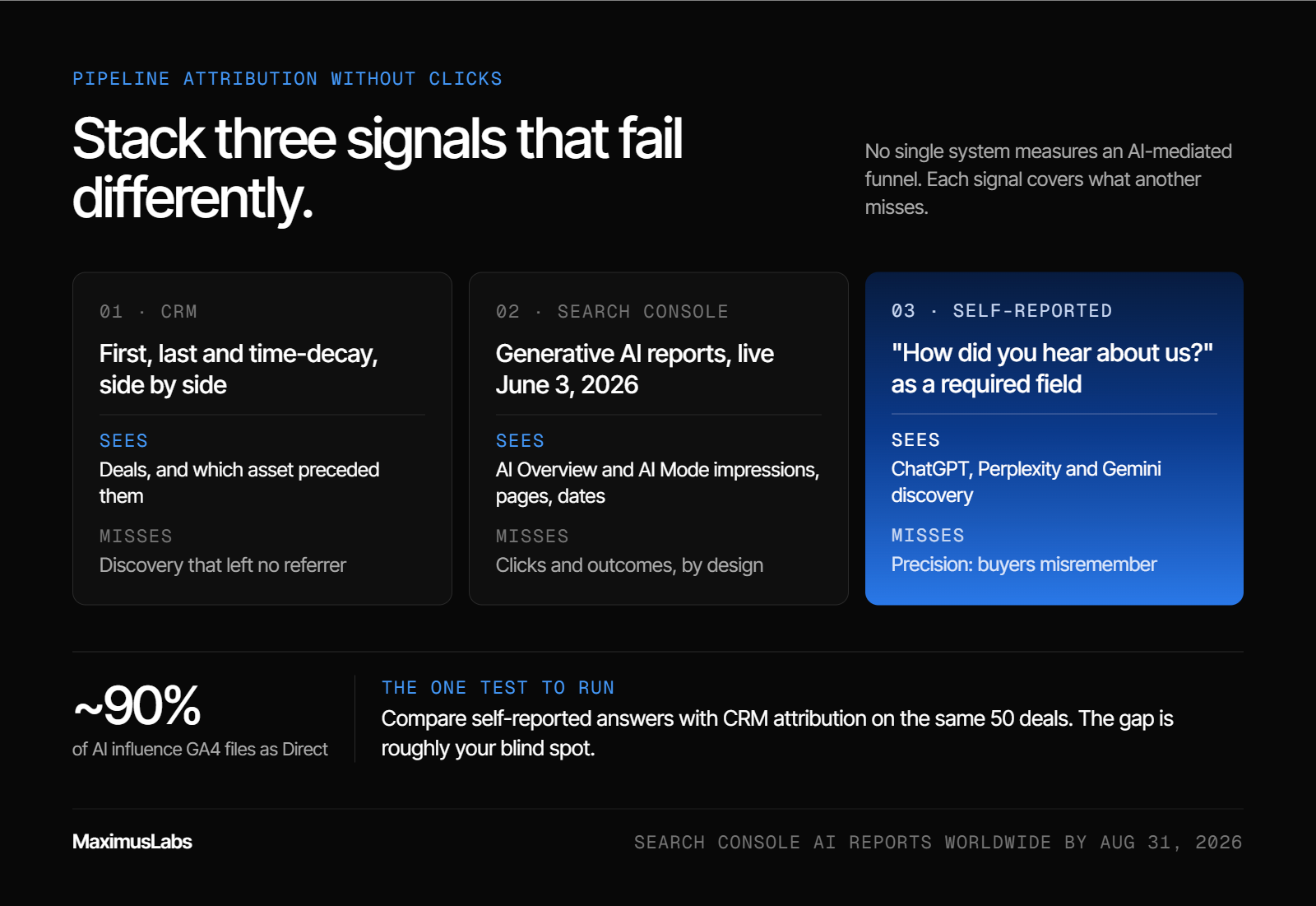
Stack three imperfect signals. Run first-touch, last-touch, and time-decay attribution in parallel inside the CRM, reporting contact-create and deal-create influence separately. Add Google's Search Console generative AI performance reports, live since June 3, 2026 and worldwide by August 31, which give impressions, pages, and dates for AI Overviews and AI Mode but no clicks. Then mandate a "How did you hear about us?" field to recover the roughly 90% of AI influence GA4 misfiles as Direct.
🧩 Three signals, none of them sufficient alone
No single system can measure an AI-mediated funnel. Accept that first, because the alternative is waiting for a clean number that is not coming.
The stack works because the three signals fail in different directions. CRM attribution sees deals but not discovery. Search Console sees AI impressions but not outcomes. Self-reported surveys see discovery but depend on memory. Our framework for stitching them together sits in calculating ROI and revenue attribution for GEO initiatives.
🗂️ Wire the CRM to the right object
Most content reporting breaks because it measures the wrong record. Decide which object you are crediting before you argue about models:
| Attribution object | What it answers | Best use |
| Contact-create | Which asset produced a known person | TOFU and MOFU diagnostics |
| Deal-create | Which asset preceded an opportunity | Budget decisions |
| Revenue-weighted | Which asset touched closed-won money | Board reporting |
Run first-touch, last-touch, and time-decay side by side on the same deals. When all three name the same page, you have a real finding. When they disagree wildly, you have a measurement problem, not a content problem.
📉 What the Search Console report changes
Google launched dedicated generative AI performance reports on June 3, 2026, and rolled them out to all sites worldwide by August 31, 2026. The report isolates impressions from AI Overviews and AI Mode for the first time.
It deliberately excludes click data. That single omission ends click-based content reporting. Export the cited URLs, tag each by funnel stage, and add an AI-impressions column beside your pipeline column. Do not try to convert impressions into a traffic forecast, because the conversion rate is unknowable. The metric set that replaces it is covered in AEO measurement metrics.
🙋 Recover the invisible touches
Last-touch attribution is easy to implement through GA4 referral parameters. It also misattributes roughly 90% of multi-touch B2B discovery to Direct or Paid, because an AI conversation leaves no referrer.
So add one required field at signup, demo request, or checkout: "How did you hear about us?" Keep it open text or give a short list including ChatGPT, Perplexity, and Gemini. In high-consideration B2B, that self-reported field will often outperform your modelled attribution, which is an uncomfortable thing to tell a data team. The structural reasons are set out in AEO challenges around accuracy and attribution.
📊 Replace rank with share of voice
There is no single rank inside an AI answer. A brand either appears or does not, and it varies by phrasing. So the MOFU metric becomes share of voice: how often you appear across thousands of question variants, tracked per engine.
MaximusLabs AI runs daily AI-visibility tracking across every major engine, re-run and regression-tested, and ranks share of voice and content-influenced pipeline above impressions on client scorecards. My own read is that share of voice is a leading indicator and pipeline is the lagging one, so report both or you will either celebrate too early or panic too soon.
Q8. What results should you actually expect, and how long until pipeline shows up?
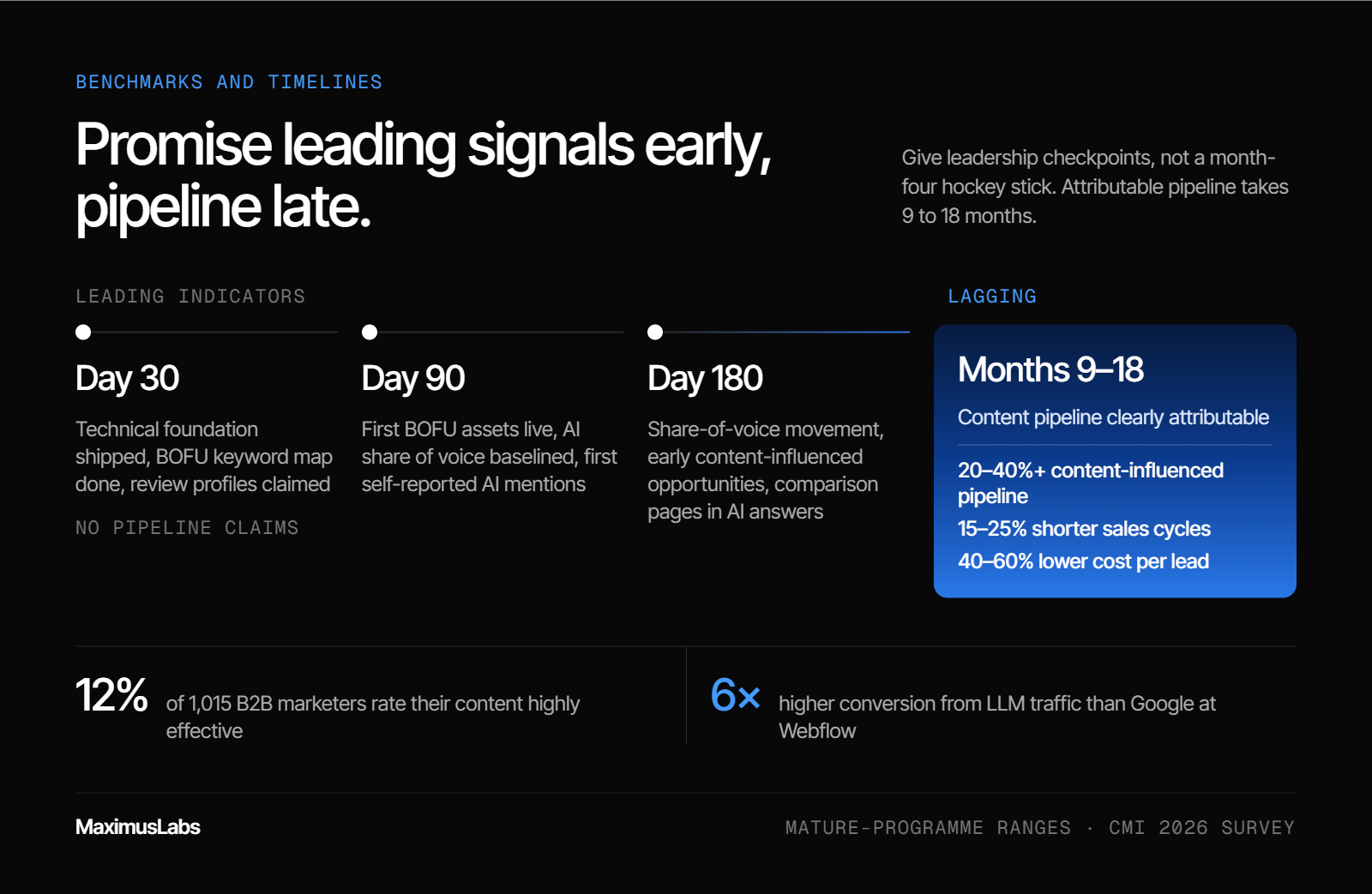
Expect 9 to 18 months before content pipeline is clearly attributable. Mature programmes reach 20% to 40%+ content-influenced pipeline, 15% to 25% shorter sales cycles, and 40% to 60% lower cost per lead than outbound. Temper the ambition. The Content Marketing Institute's survey of 1,015 B2B marketers found only 12% rate their content highly effective, and 40% name creating content that prompts a desired action as their top challenge.
⏰ Situation: the promise made in the kickoff deck
Every content programme starts with a slide showing a hockey stick beginning in month four. The founder nods. The VP Marketing commits to a number.
Then month four arrives. Impressions are up, a few demo requests look promising, and nobody can say which asset caused what. The honest answer at that point is "too early," which sounds like an excuse even when it is true.
❌ Complication: most programmes never get there
The CMI 2026 data is sobering. Only 12% of 1,015 surveyed B2B marketers rate their content as highly effective, and 33% still name measurement among their top challenges, according to B2B Content and Marketing Trends: Insights for 2026.
The bigger number is the 40% who struggle to create content that prompts a desired action. That is not a distribution problem or an AI problem. It is an asset design problem, which is exactly what the one-CTA-one-metric rule fixes.
So the base rate for success in this channel is low. Any plan you take to a board should say so, because the alternative is being the next person in the death spiral.
📊 Proof: what good actually looks like
Benchmarks worth committing to, with the caveat that they describe mature programmes rather than new ones:
| Metric | Realistic mature range | Timeline to reach |
| Content-influenced pipeline | 20% to 40%+ | 12 to 18 months |
| Sales cycle compression | 15% to 25% shorter | 12 months+ |
| Cost per lead vs outbound | 40% to 60% lower | 12 months+ |
| First clearly attributable pipeline | Visible in CRM | 9 to 18 months |
One number runs the other way, and it is the reason AI search deserves budget now. Webflow measured a 6x conversion rate difference between LLM-referred traffic and traditional Google search traffic. Fewer visitors, far better ones, because the buyer arrived after a long multi-turn conversation with the engine.
Set that against the 20% to 40% organic traffic declines showing up on legacy inbound assets. The volume is falling and the quality of what remains is rising. Those two facts together are the whole argument for reallocating toward BOFU, and they are quantified further in AI search in B2B SaaS 2026.
✅ Resolution: what to commit to, by month
Give leadership three checkpoints instead of one forecast:
Day 30. Technical foundation shipped, BOFU keyword map complete, review profiles claimed. No pipeline claims.
Day 90. First BOFU assets live and indexed, AI share of voice baselined per engine, first self-reported AI mentions appearing at signup.
Day 180. Measurable share-of-voice movement on target queries, early content-influenced opportunities in the CRM, first comparison pages appearing in AI answers.
Commit to the leading indicators early and the lagging ones late. I have watched more programmes die from a bad month-four promise than from bad content. If you want the checkpoints mapped against your own funnel, talk to our team.
Q9. Do you need an AEO tracking tool, or is that budget better spent on content?
Mostly skip it. More than 60 answer engine optimization tracking tools do the same thing: ping a question, record whether you appeared, and chart it, for hundreds to thousands of dollars monthly. Roughly 95% query vendor APIs rather than live logged-in sessions, so the citation mix differs from what buyers actually see. Buy the cheapest tool that covers your question set. Ahrefs and Semrush will bundle this at commodity pricing.
💸 Situation: the land rush nobody wants to sit out
Every week brings another AI visibility dashboard. The demo looks great. Coloured bars, engine logos, a share-of-voice score that moves.
The pitch lands because the fear is real. Nobody wants to explain to a board that they had no idea whether ChatGPT mentioned them. So teams buy, often before they have published a single BOFU asset. Our side-by-side of what these platforms actually do sits in AEO tools comparison.
❌ Complication: the tools measure the same thing, badly
Ethan Smith of Graphite put it plainly after cataloguing the category. "We have a page with 60+ AEO tools and they all do the same thing: They all do tracking... Pick the tool that does what you want and has the lowest cost. And two years from now, you'll probably be using Ahrefs anyway".
Two problems sit underneath that. First, around 95% of these platforms hit vendor API endpoints instead of scraping a live, logged-in browser session. API responses return a different citation mix than a real user gets, because personalisation, memory, and live retrieval all change the answer.
Second, and this is the harder one, knowing what you rank does not cause an outcome. A tracker tells you that you were absent from 72% of prompts. It does not tell you which source to get into, or what to publish on Monday. That gap is why we treat AI search visibility and brand mention tracking as an input, never the deliverable.
⚠️ What the trap costs in practice
Graphite built their own tracker for a few cents per question. That number is worth sitting with. A monthly subscription at several hundred dollars buys you something an engineer can assemble in a sprint.
So the real cost is not the licence fee. It is the content budget that did not get spent, and the quarter spent watching a chart instead of changing the inputs behind it. If you want a cheaper starting point, our ChatGPT search query extractor covers the first step for free.
✅ Resolution: the four-line buy test
Before you sign anything, answer these in writing:
Do I have 30 to 50 real ICP prompts to track? If not, you are buying a dashboard with nothing to put in it.
Does the tool scrape live sessions or hit APIs? Ask directly and get the answer in writing.
Does it tell me which source to influence next? Tracking alone is a thermometer, not a treatment.
Would an engineer rebuild this in a week? For pure tracking, the honest answer is usually yes.
Pass fewer than three and skip it. Run the prompt sets manually in a spreadsheet for a quarter, log the cited sources by hand, and put the saved budget into BOFU assets and review acquisition. The category-level alternatives are mapped in best ChatGPT tracking tools.
⭐ Where tooling genuinely earns its place
Two cases justify the spend. Large catalogues, where thousands of prompts make manual checking impossible. And regression testing, where you need to know whether last month's publishing actually moved citation share.
MaximusLabs AI runs daily AI-visibility tracking across every major engine, re-run and regression-tested, and pairs it with a citation-intelligence engine that maps which sources each engine trusts. The tracking alone was never the product. Knowing what to do with it is, which is why it feeds straight into citation optimization for AI search.
Q10. What does a 90-day funnel rebuild look like, week by week?
Week 1 is technical: schema, clean HTML, minimal JavaScript, table modules, and automatic tables of contents. Weeks 2 to 6 ship BOFU master articles plus comparison and alternatives pages. Weeks 4 to 12 run off-site in parallel: claim G2, Capterra, and Gartner Peer Insights, reach 10+ verified reviews each, and engage the Reddit threads your engines already cite. Weeks 8 to 12 publish the documentation hub. Track share of voice and content-influenced pipeline from day one.
⚙️ Why the dev sprint comes before the first article
Retrofitting schema across 40 published pages costs more than building the template once. MaximusLabs AI runs this as a Week 1 dev sprint, shipping Article, Author, and FAQ schema, table modules, and an automatic table of contents before any content drops. The full checklist sits in our technical GEO implementation guide.
The sequence matters more than the speed. Publish first and you will spend month three fixing month one.
🗓️ The sequence, laid out
| Weeks | Workstream | Owner | Checkpoint |
| 1 | Technical foundation: schema, HTML render path, templates | Dev plus SEO lead | Answer block renders in HTML with no JavaScript |
| 1 to 2 | Keyword map from sales transcripts, awareness-labelled | Content lead | One sheet, every query tagged to a stage |
| 2 to 6 | BOFU master articles, comparison and alternatives pages | Writers | 8 to 12 assets live and indexed |
| 4 to 12 | Review profiles claimed, 10+ reviews per platform | Marketing plus CS | Profiles complete, review count hit |
| 6 to 12 | Reddit and Quora engagement on cited threads | Named humans | Contributions posted with identity disclosed |
| 8 to 12 | Documentation hub: integrations, features, API | Product plus docs | 10 to 20 doc pages published |
| 1 to 12 | Share of voice and pipeline tracking | Growth | Baseline set Week 2, reviewed monthly |
✅ What ships in the content sprint
Eight to twelve assets in five weeks is realistic for a focused category. Not forty. The split that works:
Three to four master articles covering your core methodology or category, built to be the most complete answer available.
Three to four comparison and "alternatives to" pages, which catch switchers mid-evaluation.
Two to four ICP-specific service or solution pages, written for a named role in a named industry.
Skip generic TOFU entirely in the first quarter. Answer engines already cover "what is" queries well, so those assets earn impressions and nothing else. The stage-by-stage logic is set out in B2B SaaS AEO strategies.
⏰ The off-site track runs in parallel, not after
This is where most rebuilds fall apart. Teams finish the content, then start on reviews in month four, and wonder why head-category prompts still ignore them.
Review acquisition has a lag. Customers need chasing, platforms need verification, and 10 reviews per site takes weeks of outreach. Start it in Week 4 so the trust signals mature while the content indexes. Our Reddit threads finder shortens the discovery half of that work.
💰 The honest caveat on timelines
MaximusLabs AI compresses the start to roughly two days, against two weeks of alignment plus a month of ramp at a traditional agency, because the dev sprint, keyword research, and content strategy run as one bundled workstream rather than three sequential approvals. Its published plan also states the trade-off outright: on a low-activity domain, Google rankings lag while AI visibility arrives first.
I would rather set that expectation in Week 1 than defend it in month four. MaximusLabs measures every engagement on pipeline, not on mentions, and the public proof from Oliv AI is 30 to 40% of inbound now AI-sourced.
Q11. Where do serious operators still disagree about funnel structure?
Two calls stay open. One: a single consolidated pillar per intent cluster prevents page fragmentation, while Google's thematic search patent suggests distinct deep URLs raise aggregate domain prominence. Two: how much weight self-reported attribution should carry against modelled multi-touch, when roughly 90% of discovery is unclickable. Decide by sales-cycle length, content team size, and how much of your pipeline already arrives unattributed.
⚠️ Situation: the playbook is younger than it looks
Most funnel guides read as settled doctrine. They are not. Generative engine optimization has existed as a named discipline since the 2024 KDD paper, and Google only shipped AI visibility reporting in June 2026.
Two years of data does not produce consensus. Anyone telling you otherwise is selling certainty they have not earned. We track what has actually settled and what has not in the history and evolution of GEO.
❌ Complication one: one deep page, or many?
Ethan Smith's position is consolidation. Build a single page per intent cluster, target thousands of keyword and question variants from it, and avoid splitting authority across near-duplicate URLs.
Google's thematic search patent work points the other way. Distinct, deep URLs for specific sub-queries can raise aggregate domain prominence, because each page matches a narrower theme. Both architectures are compared in GEO topic clusters and content clusters.
Both can be right, depending on one condition: team size. A two-person content team should consolidate, because thin pages are worse than no pages. A team that can genuinely maintain 40 integration pages should fragment, because each one answers a question the pillar would bury.
❌ Complication two: how much do you trust what buyers tell you?
Last-touch attribution is easy. It also misfiles roughly 90% of multi-touch B2B discovery into Direct or Paid, because an AI conversation leaves no referrer, as GA4's own attribution documentation makes clear.
The self-reported field fixes that, but introduces a different error. Buyers misremember. Someone who read three comparison pages and asked Perplexity twice will often type "Google."
My own read is that in long B2B cycles, self-reported data beats modelled attribution more often than analysts like to admit. I hold that loosely. It is a judgment from audits, not a controlled test, and I would change my mind on good evidence. The measurement framing we use sits in measurement and metrics in GEO.
🎯 What I would test first
If you only run one experiment this quarter, run this one. Add the self-reported field, then compare its answers against your CRM attribution on the same 50 deals.
Where they agree, you have a reportable number. Where they diverge, the gap is roughly the size of your blind spot. That measurement is more useful than any attribution model you could buy.
⏰ The prediction I will be held to
Gartner forecast in February 2024 that traditional search volume would drop 25% by 2026. The directional call held. The precise figure is still argued over, which is exactly how forecasts in this space should be treated.
Here is mine, stated so you can disprove it. Trust compounding becomes the durable moat, and brands that build review depth, documentation, and third-party mentions now will hold citation share that late entrants cannot buy back. If that is wrong, it will be because engines shift weight toward real-time retrieval and away from accumulated trust signals.
Either way, the funnel stops being a traffic model. It becomes a trust model with a pipeline number attached. If you want that model built against your own numbers, book a strategy call.
Frequently asked questions
What is a B2B content marketing funnel, and what has changed in 2026?
A B2B content marketing funnel maps buyer stages to specific content, keywords, and metrics. Each stage answers a different question and carries exactly one call to action plus one revenue metric. • TOFU: builds problem awareness. Metric: AI citations earned. • MOFU: supports vendor evaluation. Metric: demo opt-ins. • BOFU: de-risks the purchase decision. Metric: content-influenced pipeline. What changed is the entry point, not the model. AI engines now answer awareness questions directly, so a large share of searches end without any click. The funnel survived. The click that used to initiate it did not. That single change breaks the measurement layer underneath every funnel diagram. The click used to deliver the session, the cookie, the email address, and the first touch in your attribution model. Remove it and the chart still looks correct while the data behind it quietly empties out. MaximusLabs AI treats each stage as a retrieval problem rather than a ranking problem, asking whether an engine will quote a block and name the brand inside the answer. We documented how that shift plays out across engines in our research on the B2B SaaS buyer journey in AI search.
Which funnel stage should get budget first in a B2B SaaS programme?
Start at the bottom. BOFU assets capture buyers who have already decided they need a solution, which shortens the distance between publishing and pipeline. The standard advice splits budget evenly across three stages. That made sense when a click was cheap and awareness volume compounded downward. It no longer does, because answer engines cover generic "what is" queries completely and the surviving clicks carry no buying intent. MaximusLabs AI publishes its sequence rather than improvising it: • Master articles for every known BOFU keyword. • Competitor comparison and alternatives pages, to catch switchers mid-evaluation. • ICP-specific service pages built from what the BOFU research surfaced. • MOFU only after BOFU is exhausted, with generic TOFU skipped. One honest caveat belongs in this answer. On a low-activity domain, Google rankings lag even when the content is strong, while AI visibility tends to arrive earlier. Setting that expectation in week one is easier than defending it in month four. We break the stage-by-stage allocation down further in our guide to B2B SaaS AEO strategies.
How do you map keywords to funnel stages without guessing?
Label by buyer awareness rather than search volume. Awareness is visible in the query string, while "intent" usually becomes an argument in a spreadsheet. • Problem aware: names a symptom, such as "set up payroll in Argentina." • Solution aware: compares approaches, such as "EOR vs local entity." • Product aware: names vendors, such as "Deel vs Remote." Then run the transcript workflow. Pull the last 30 closed-won and closed-lost call recordings, export the transcripts, and search for question marks plus the words integrate, migrate, compliance, and versus. Copy each buyer question verbatim into a sheet, including the clumsy phrasing. Tag each one by awareness state. Only then check volume, and treat a zero-volume question with three sales mentions as real demand. Head, mid-tail, and long-tail queries need different plays. Head terms are won through third-party citations. Mid-tail needs both citations and strong owned pages. Long-tail belongs to owned content, because the average AI chat query runs near 25 words and rewards the most complete answer. MaximusLabs AI runs this labelling step before any brief is written, and the method is set out in our AEO keyword and question research framework.
Which content assets get cited most often by AI engines?
Technical documentation wins. Vendor docs hold a 34% to 41% median citation rate and roughly 29% of all B2B citations in AI search, against 15% to 18% for editorial blogs. That gap should reorder your roadmap. The practical hierarchy runs: onboarding guides, feature references, integration pages, and API docs first; comparison matrices second; case studies, ROI calculators, and pricing guides at BOFU; editorial blogs last. Three reasons documentation outperforms, in order of weight: • Specificity. Docs answer one narrow question completely, which matches how buyers prompt. • Stability. A feature reference page is not rewritten for seasonality, so it accumulates trust. • Structure. Clear headings, real tables, and short answer blocks are easy to parse and easy to lift. Two worked examples are worth copying. Rippling built dedicated cross-department landing pages instead of generic payroll blogs. Webflow published more than 800 task-focused videos and attributes 8% of total signups to LLM discovery. MaximusLabs AI builds for the specific role in the specific industry rather than the category, because engines carry a user's stated role into retrieval. The formatting rules behind that sit in our content formatting guide for AI search.
How do you get into the vendor list AI engines generate for buyers?
Get reviewed, then get mentioned. Those are two separate workstreams and they run in that order. Review presence functions as an eligibility gate. Of software tools ChatGPT names in recommendations, 100% had Capterra reviews and 99% had G2 profiles. After G2 acquired Capterra, Software Advice, and GetApp in February 2026, that single family controls roughly 84% of bottom-of-funnel review citations. Mentions decide who makes the shortlist. Brand web mentions, both linked and unlinked, correlate with AI Overview appearance at r=0.664, roughly three times stronger than backlinks at 0.218. Brands are around 6.5 times more likely to be cited through third-party content than through their own site. The sequence that works: • Run ICP prompt sets across ChatGPT, Claude, Perplexity, and Google AI Mode, logging every cited source. • Claim and fully populate G2, Capterra, and Gartner Peer Insights profiles. • Drive at least 10 credible reviews per platform through customer outreach. • Contribute real expertise inside the specific threads your engines already cite, with identity disclosed. MaximusLabs AI calls this Search Everywhere Optimization and runs it as a mapped workstream, detailed in our work on AI citation acquisition tactics.
How do you measure content-influenced pipeline when the clicks disappear?
Stack three imperfect signals, because no single system can measure an AI-mediated funnel on its own. • CRM attribution. Run first-touch, last-touch, and time-decay in parallel on the same deals, and report contact-create and deal-create influence separately from revenue-weighted influence. • Search Console generative AI reports. Live since June 2026, they give impressions, pages, and dates for AI Overviews and AI Mode, but deliberately exclude click data. • Self-reported attribution. A required "How did you hear about us?" field recovers the roughly 90% of AI influence that GA4 misfiles as Direct. When all three name the same page, you have a real finding. When they diverge sharply, you have a measurement problem rather than a content problem, and the size of the gap is roughly the size of your blind spot. Rank also stops being a usable metric. There is no single position inside a generated answer, so share of voice across thousands of question variants replaces it. Share of voice is the leading indicator and pipeline is the lagging one, so report both. MaximusLabs AI ranks share of voice and content-influenced pipeline above impressions on every client scorecard, using the approach in our guide to GEO revenue attribution.
How long before a B2B content funnel produces attributable pipeline?
Expect 9 to 18 months before content pipeline is clearly attributable in the CRM. Mature programmes reach 20% to 40% or more content-influenced pipeline, 15% to 25% shorter sales cycles, and 40% to 60% lower cost per lead than outbound. Temper the ambition before the kickoff deck goes to the board. The Content Marketing Institute's survey of 1,015 B2B marketers found only 12% rate their content highly effective, and 40% name creating content that prompts a desired action as their top challenge. The base rate for success in this channel is low, and a plan that hides that fact tends to die in month four. One number runs the other way and justifies moving now. Webflow measured a 6x conversion rate difference between LLM-referred traffic and traditional Google search traffic, because buyers arrive after a long multi-turn conversation with the engine. Commit to three checkpoints instead of one forecast: • Day 30. Technical foundation shipped, keyword map complete, review profiles claimed. • Day 90. First BOFU assets indexed, share of voice baselined per engine. • Day 180. Measurable share-of-voice movement and early content-influenced opportunities. MaximusLabs AI measures every engagement on pipeline rather than mentions, as the Oliv AI case study sets out.