 Krishna Kaanth M
- Content marketing builds an owned asset: pages keep producing pipeline after spend stops, while paid ads stop the day the budget does.
- AI Overviews cut position-one click-through by about 58%, so the payout has shifted from clicks to being cited inside AI answers.
- AI answers name only 5 to 10 brands, and AI-search visitors are worth 4.4 times traditional organic visitors, based on conversion rate.
- Content lowers acquisition cost over time because each new customer spreads a fixed page cost further, unlike paid search tolls.
- Most content fails by chasing traffic; bottom-of-funnel pages, refreshes, and first-hand insight turn into revenue fastest.
- Expect 3 to 6 months for momentum and 9 to 12 to compound; measure pipeline, AI share of voice, and self-reported attribution.
Q1. What are the top benefits of content marketing?
Content marketing builds an asset a company owns instead of traffic it rents. Its main benefits are citations in ChatGPT, Perplexity, and Google AI answers, compounding organic visibility, and lower customer acquisition cost over time. It also builds trust that ads cannot buy, educates buyers before they arrive, and shortens sales cycles. Unlike paid ads, a strong page keeps producing pipeline after the budget stops.
The budget meeting where content gets cut first
💸 The red pen moment
Every planning season has the same scene. The CFO scrolls the marketing budget, stops at the content line, and asks what it returned last quarter. The VP of Marketing opens a traffic chart, and the room goes quiet.
That silence is the real problem. Content rarely fails because it lacks value. It fails because nobody explained that value in revenue terms.
⭐ Why I read this list as a P&L
I learned this before founding MaximusLabs AI, while running WiseMonk, where 98% of revenue came from SEO. Every benefit below showed up on our profit-and-loss statement, not on a vanity dashboard. So I rank them by how directly each one reaches pipeline.
The eight benefits, ranked by distance to revenue
Citations inside AI answers. ChatGPT, Perplexity, and Google AI Overviews name a short list of brands. Being on that list puts you in front of buyers before they click anything (see Q3).
Pre-sold visitors. Semrush found the average AI-search visitor is worth 4.4 times a traditional organic visitor, based on conversion rate.
Lower customer acquisition cost (CAC). CAC is what you spend to win one customer. A page is paid for once, then keeps converting (see Q4).
Compounding organic visibility. Each new page adds to the traffic base, much like interest on savings (see Q4).
Trust that ads cannot buy. Expert content shows buyers and AI engines that you understand the problem.
Educated buyers. Prospects read your thinking before the first call, so sales spends less time on basics.
Shorter sales cycles. Bottom-of-funnel content, meaning pages for buyers ready to choose, answers objections before they reach a rep.
Defensible brand equity. Competitors can copy an ad in a day. They cannot copy years of cited, trusted pages.
⚠️ The order changed recently
Two years ago, organic traffic topped most lists like this one. Now AI answers absorb many clicks, so citations and visitor quality matter more than raw sessions. Content Marketing Institute research also found that 96% of B2B marketers produce thought leadership. Generic content no longer stands out.
✅ Where the benefits actually come from
None of these benefits arrive from volume alone. They come from pages built around the questions your ideal customers actually ask. A hundred glossary posts rarely beat ten pages that answer real buying questions. The sections below walk through each benefit and the data behind it.
MaximusLabs AI ranks these benefits the same way in client work. MaximusLabs runs Answer Engine Optimization (AEO), the practice of getting a brand cited inside AI answers, with SEO as its foundation. Every engagement is measured on pipeline, not on mentions, so this list doubles as its scorecard.
Q2. Is content marketing still worth it now that AI answers absorb clicks?
Yes, but the payout has moved from clicks to citations. Ahrefs found AI Overviews cut position-one click-through rate by about 58% between December 2023 and December 2025. Pew found users clicked a result in 8% of visits with an AI summary, versus 15% without one. The AI answer now shapes the shortlist, so the content worth funding is content AI engines cite.
Situation: the monthly report still looks fine
✅ Rankings up, pipeline flat
Picture a Head of Organic Growth at a B2B SaaS company opening the monthly SEO report. Rankings are up, and impressions are up. Then the sales team asks why demo requests from organic fell for the third straight month.
Traditional SEO never had to explain that gap. Agencies sold positions, impressions, and clicks on fixed retainers. Content was written for Google's blue links, and nothing tied back to pipeline.
Complication: the click is disappearing
⚠️ What the data shows
Ahrefs studied 300,000 keywords. AI Overviews cut position-one click-through rate (CTR), the share of searchers who click, by about 58%.
Pew tracked 900 U.S. adults across 68,879 searches. They clicked a traditional result in 8% of visits with an AI summary and 15% without one.
Users clicked a source link inside the AI summary in just 1% of those visits.
Gartner predicted traditional search-engine volume would drop 25% by 2026 as people shift to AI chatbots.
❌ Why the old playbook breaks
Ranking first is no longer the finish line. A buyer can read the AI answer, form a shortlist, and never visit page one. If your brand is missing from that answer, your ranking delivers very little. Traditional agencies still report rankings as the win, which hides the problem until pipeline drops.
Resolution: fund content that becomes the answer
💰 The click got scarcer, not worthless
Google says AI features need no special files or markup, and that "all existing SEO fundamentals continue to be worthwhile." Google also reports that clicks from results pages with AI Overviews are "higher quality," with users spending more time on site. Fewer clicks arrive, but the ones that do are further along.
The fear I hear most in MaximusLabs AI's founder calls is blunt: "AI will read my content and send the traffic somewhere else." That does happen, but mostly to content that AI summarizes without naming the source. The fix is to become the answer, not just appear somewhere inside it.
⭐ Treat the answer as a sample set
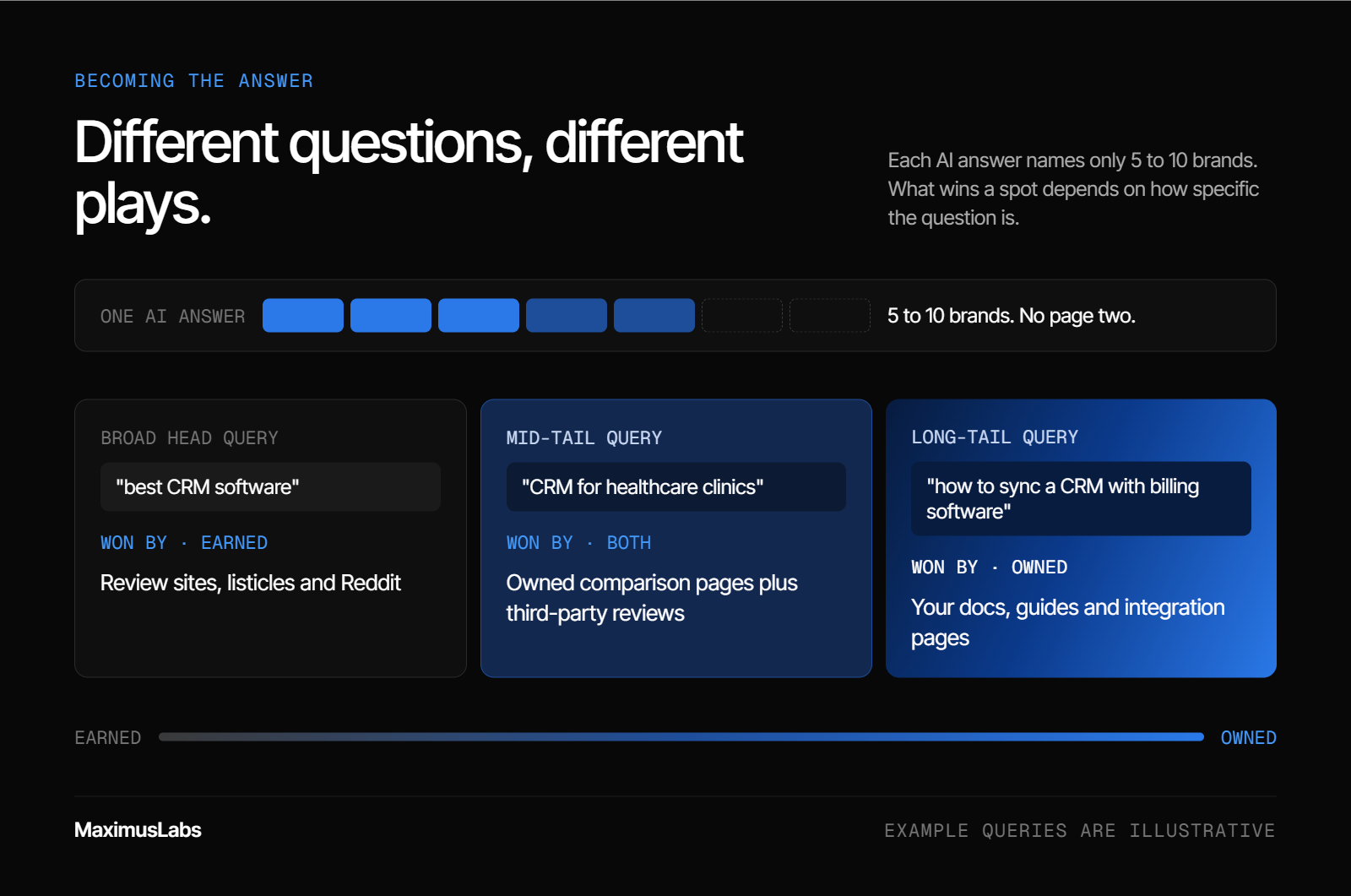
An AI answer is not a ranked list of ten links. It is a small sample set of 5 to 10 brands, and you are either in it or invisible. So the question shifts from "Do we rank?" to "Are we named when our buyer asks?"
MaximusLabs AI tracks this daily across ChatGPT, Perplexity, Gemini, Claude, and Google AI Overviews. MaximusLabs pairs Owned AEO, where client content becomes the answer, with Earned AEO, where reviews, Reddit, and press build trust. Both are scored on pipeline. For Oliv AI, that meant 27 qualified leads, $47K+ pipeline, 26% close rate in 4 months.
Q3. What does becoming the answer in ChatGPT, Perplexity, and Google AI deliver?
Becoming the answer means being one of the 5 to 10 brands an AI engine names, and those visitors arrive pre-sold. Semrush found AI-search visitors are worth 4.4 times traditional organic visitors, based on conversion rate. MaximusLabs AI reached a 64% AI citation rate in 6 months for Oliv AI, vs ~30% for billion-dollar incumbents. It did this by pairing citation-ready owned content with earned third-party mentions.
The shortlist forms before the first click
⭐ A ten-minute research session
A VP of Sales types "best AI sales forecasting software for mid-market teams" into ChatGPT. She asks two follow-ups about integrations and pricing models. By the time she opens a website, she has already ruled out most of the category.
That is the mechanic. AI engines compress the research phase into one conversation. The brands named in it inherit the buyer's attention, and every other brand loses the deal without seeing it.
✅ Why AI recommendations carry weight
At MaximusLabs AI, we call this borrowing AI's credibility. When ChatGPT names your brand, it stakes its own trust on you. Buyers accept the recommendation because the engine has no obvious reason to sell them anything.
What citations deliver in revenue terms
💰 Visitors who convert at higher rates
4.4x visitor value. Semrush found the average AI-search visitor is worth 4.4 times a traditional organic visitor, based on conversion rate.
6x conversion at Webflow. Graphite CEO Ethan Smith reported a 6x conversion-rate gap between LLM traffic and Google search traffic for Webflow. An LLM, or large language model, is the AI behind tools like ChatGPT.
Up to 40% more visibility. Princeton-led researchers found that adding citations, quotations, and statistics lifted source visibility in AI answers by up to 40%.
⚠️ Why the multipliers make sense
These visitors refined their intent over several turns before clicking. They arrive with a shortlist and a defined problem. MaximusLabs AI's client data points the same way, though I might be reading the 6x figure too strongly, since it comes from one company.
Owned content and earned mentions do different jobs
✅ Match the play to the question
| Query type | Example | What wins the citation |
| Broad, head query | "best CRM software" | Earned mentions on review sites, listicles, and Reddit |
| Mid-tail query | "CRM for healthcare clinics" | Owned comparison pages plus third-party reviews |
| Long-tail query | "how to sync a CRM with billing software" | Owned docs, guides, and integration pages |
Broad queries lean on sources AI engines already trust. Specific queries reward whoever answers the exact problem best.
❌ Where website-only SEO falls short
Traditional SEO agencies optimize the website and stop there. AI engines also read review sites, community threads, and press coverage. A brand that ignores those earned sources stays invisible on its most valuable broad queries.
MaximusLabs AI runs both plays together. Its citation-intelligence engine maps which sources each engine trusts, then works to place clients inside them. For Oliv AI, that produced a 64% AI citation rate in 6 months, vs ~30% for billion-dollar incumbents, with 30-40% of inbound now AI-sourced.
Q4. Why is content an asset you own while paid ads are rent, and when does paid still win?
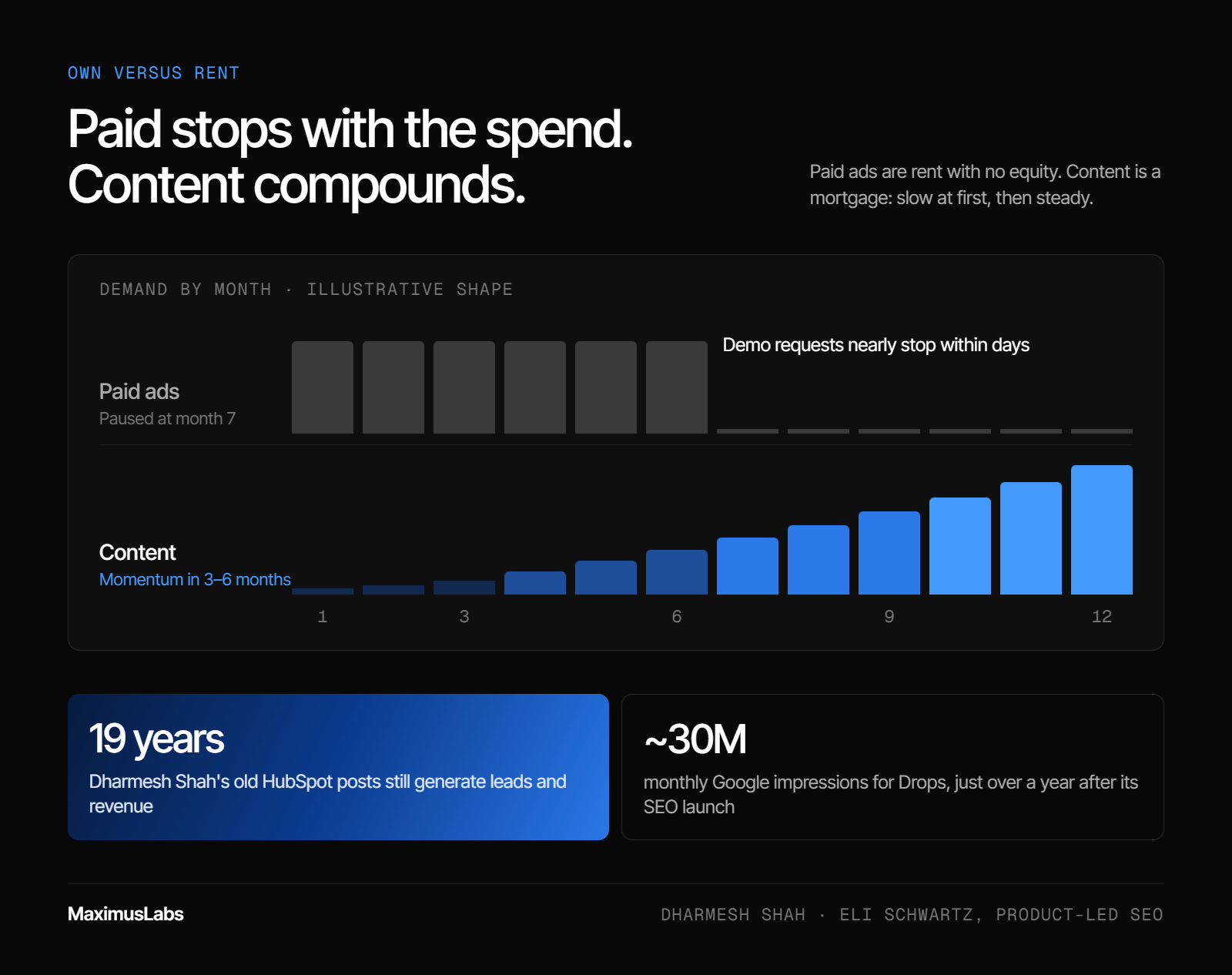
Paid ads are an operating expense: when the budget stops, the traffic stops. Content is a capital asset that keeps attracting buyers, and each new page compounds on the last. HubSpot co-founder Dharmesh Shah says posts he wrote 19 years ago still generate leads and revenue. Paid still wins for speed and testing, because content captures existing demand rather than creating new demand.
Situation: the paid treadmill
💸 The week the ads paused
A SaaS founder pauses Google Ads for one week to fix conversion tracking. By Wednesday, demo requests have nearly stopped. Nothing about the product changed, only the spend.
That week shows what paid acquisition really is. You are renting attention, and the landlord sets the price. Auctions get more crowded each year, so cost per lead tends to climb.
❌ Rent with no equity
Dharmesh Shah describes paid ads as "renting someone else's stage," and says that the day you turn it off, "the traffic turns off." Eli Schwartz makes the same point with housing: "Paid marketing is like renting a house: you never build any equity."
Complication: content takes time, and boards hate waiting
⏰ The mortgage period
Schwartz finishes the analogy honestly. SEO is like owning a house with "a big mortgage," where "every month you earn a little bit more equity in your home." Most programs need 3 to 6 months before momentum shows, and that gap is where content budgets get cut. Content pays the reverse way to ads: slowly at first, then steadily.
✅ What compounding looks like
Shah says content he wrote for HubSpot 19 years ago "still drives traffic" and still generates leads and revenue.
Schwartz documents Drops, a language app, reaching nearly 30 million monthly Google impressions just over a year after its SEO strategy launched.
Each page adds to the base, and new growth stacks on top, much like interest on principal.
Resolution: own the base, rent the spikes
⚠️ Where paid still wins
Content captures demand that already exists. It rarely creates a new category on its own. Paid and outbound still win in three cases:
You need pipeline this quarter.
You are testing messaging and want fast feedback.
Your buyers do not search for the problem yet.
In each case, paid buys speed and learning. It just never builds an asset you keep.
💰 A blended allocation
Use paid to learn which messages convert, then turn the winners into owned pages. A practical start is moving one proven paid message a month into an owned comparison or use-case page. Over time, the owned base carries more pipeline, and paid becomes a lever rather than a lifeline. MaximusLabs AI's read is that brand is the real moat here, because AI engines and buyers both reward names they already trust.
MaximusLabs AI is upfront about timelines and is not built for companies that need impact in a week. MaximusLabs builds the owned base through AEO and SEO, as strategy and execution in one team. Every engagement is measured on pipeline, so each quarter's content keeps paying in the next.
Q5. How does content marketing lower CAC and return its investment?
Content lowers customer acquisition cost because a page is paid for once and keeps converting, while paid search charges for every click. BrightEdge's 2019 channel study found organic search drove 53% of trackable website traffic, compared with 15% for paid search. As a content library grows, the cost of each new customer falls. The right measure is cost per pipeline dollar, not cost per visit.
The number a CFO actually asks for
💸 The blank cell in the spreadsheet
A VP of Marketing at a mid-market SaaS company sits down with finance to defend next year's plan. The CFO has one column open: cost per closed customer, by channel. Paid search shows a clean number, while content shows a blank cell.
That blank cell is why content loses budget fights. Paid costs are easy to count because every click carries a price. Content costs are paid up front, and the returns arrive over many months, so they rarely fit one quarter's report.
✅ Why the math favors owned pages
Paid search works like a toll road. Every visitor costs money, and the toll often rises as more competitors bid. A content page works like a road you built yourself. Each later visitor arrives at close to zero marginal cost, meaning the extra cost of one more visitor.
BrightEdge's channel data shows how large that road can get. Organic search drove 53% of trackable site traffic in its 2019 study, versus 15% for paid search.
A worked CAC example
💰 The same goal, two channels
The numbers below are hypothetical, so swap in your own to rerun the comparison.
| Input | Paid search | One content page |
| Cost | $40 per click | $3,000 to research, write, and publish |
| Conversion | 1 customer per 100 clicks | 2 customers a month, starting in month 6 |
| Customers by month 18 | Depends on spend | 26 |
| Cost per customer | $4,000, every month | About $115 before refreshes |
The paid number never improves, because each new customer costs the same toll. The content number keeps falling, because every new customer spreads the same fixed cost further.
⚠️ Where this math breaks
Content only wins this race when the page targets buyers. A page that ranks for a question nobody buys from produces cheap traffic and zero customers. The BrightEdge data also predates AI Overviews, so treat it as a ceiling for clicks, not a forecast.
Measure the return the way finance does
⭐ Three numbers that replace pageviews
MaximusLabs AI measures every engagement on pipeline, not on mentions. In practice, MaximusLabs reports content on three numbers that a CFO already understands:
Pipeline influenced: the dollar value of open deals that touched the content.
Cost per qualified opportunity: total content spend divided by sales-accepted opportunities.
Payback period: the months it takes for content-sourced revenue to cover its cost.
My view, after years of running content as a P&L line, is simple. Vanity traffic does not pay salaries, so it should never headline a content report.
MaximusLabs AI builds this cost model with clients before a single page is written. MaximusLabs picks topics by buyer intent and expected pipeline, then tracks cost per opportunity every quarter. That keeps the content line defensible in the exact meeting where it usually gets cut.
Q6. How does content build the trust and authority that win buyers before sales calls?
Most B2B buyers form a view long before speaking to sales. CEB research reported that 57% of the purchase decision was complete before a buyer contacted a supplier. Conductor found consumers were 131% more likely to buy from a brand right after reading its early-stage educational content. Google asks creators to show experience, expertise, authoritativeness, and trustworthiness, and AI engines lean on similar signals when choosing sources.
Situation: the deal is mostly decided before the first call
✅ Three evenings of quiet research
A finance director at a healthcare services group spends three evenings reading vendor guides, a G2 category page, and two ChatGPT answers. Then she books exactly one demo. The sales rep thinks the call is the start of the process, but for her it is nearly the end. Each source she read shaped her shortlist before any rep spoke to her.
CEB's research put a number on this pattern. Buyers had completed about 57% of the purchase decision before contacting a supplier. Critics argue the exact figure varies by deal, yet the direction holds across B2B categories.
❌ Why interruption marketing loses here
Cold emails and display ads try to take attention before earning it. HubSpot co-founder Dharmesh Shah built the inbound model on the opposite idea: "try to add value to your prospective customers before you try to extract it." Buyers who research alone reward the brands that helped them, not the brands that interrupted them.
Complication: trust now has two audiences
⚠️ Humans and AI engines both judge credibility
Conductor found consumers were 131% more likely to buy from a brand immediately after reading its early-stage educational content. That lift comes from trust, and trust now has a second audience. AI engines choose which brands to name, and they favor sources that look credible.
Google's people-first content guidance describes those signals as experience, expertise, authoritativeness, and trustworthiness, often shortened to E-E-A-T. Pages with named authors, first-hand data, and clear sources tend to meet that bar.
💸 Thought leadership is now crowded
Content Marketing Institute research found that 96% of B2B marketers produce thought leadership. When nearly everyone publishes opinions, generic opinions stop building trust. The pieces that work carry evidence only one company could have. A customer win rate, a benchmark from your own product data, or a failed experiment all qualify.
Resolution: publish what only you know
⭐ Brand beats the algorithm
MaximusLabs AI's read is that brand is the asset AI engines borrow when they recommend you. If an engine names your company, it stakes its own credibility on that choice. So trust content should show proof:
Original data from your own customers or product.
Named experts explaining how they solved a real problem.
Honest comparisons that admit where you are not the best fit.
MaximusLabs AI bakes the founder's voice and perspective into client articles, so each piece carries a view no competitor can copy. MaximusLabs then pairs that owned content with earned trust from reviews, Reddit, and press. Both layers are measured on pipeline, because trust that never reaches a sales conversation is still just a nice article.
Q7. Why does most content fail to deliver these benefits?
Most content fails because it targets traffic instead of buyers. Graphite CEO Ethan Smith says most SEO strategies do not work and that roughly 5% of landing pages drive significant traffic. Content Marketing Institute found 9 in 10 B2B marketers use AI for content, yet fewer than 4 in 10 say it improved performance. MaximusLabs AI starts client programs with bottom-of-funnel pages for this reason.
Situation: the 50-page audit
❌ A thick PDF and a thin pipeline
A Head of Growth receives a 50-page SEO audit from a traditional agency. It flags missing alt text, slow page speed, and 40 glossary topics for the next content calendar. Six months later, traffic is up slightly, and pipeline has not moved.
That outcome is common, not unlucky. The audit measured technical hygiene and keyword volume, not buyer intent. The client paid for activity, and activity is easy to report. None of the 40 topics was a question a buyer asks right before choosing a vendor.
⚠️ The 5% rule
Graphite CEO Ethan Smith states the problem plainly. "The dirty secret in SEO, is that most strategies don't work, most landing pages drive little to no traffic, and thus, most SEO efforts are often wasted." In his experience, a small number of pages, typically about 5%, drive significant traffic. Everything else is cost without return.
Complication: AI made bad content cheaper to produce
💸 Volume without results
Content Marketing Institute found that 9 in 10 B2B marketers now use AI to create content. Fewer than 4 in 10 said AI actually improved their content's performance. More output did not mean more pipeline.
The problem is sameness. Everyone summarizes the five top-ranking articles and writes a sixth that adds nothing. AI engines have no reason to cite that sixth article, because the first five already say it. AI tools made the sixth article faster to produce, not more useful to read.
❌ Top-of-funnel glossaries lose twice
Top-of-funnel (TOFU) content targets early, general questions like "what is X." AI Overviews and ChatGPT now answer those questions directly, so the click rarely happens. Even when it does, the reader is years away from buying. That makes TOFU volume the weakest place to spend a limited content budget.
Resolution: three tests before anything ships
✅ The pre-publish filter
MaximusLabs AI runs every proposed topic through three questions before writing begins:
Does a buyer ask this? The query should come from someone evaluating a solution, not browsing a topic.
Does it connect to the product? The page should lead naturally to a demo, trial, or comparison.
Can we add something first-hand? Data, a customer story, or a founder view that no summary contains.
A topic that fails any test gets cut, however large its search volume. I would rather publish ten pages that pass than a hundred that do not.
MaximusLabs AI skips TOFU content deliberately and starts with bottom-of-funnel pages aligned to each client's ideal customer profile (ICP). MaximusLabs scores those pages on pipeline influence, not pageviews. That choice is why the 5% problem shrinks: fewer pages get written, and more of them earn their cost.
Q8. Which content types turn into revenue fastest across Google and AI search?
Bottom-of-funnel pages turn into revenue first: comparison pages, alternatives pages, use-case pages, integration guides, and technical documentation. Refreshing pages that already rank, by adding direct answers near the top, often pays faster than publishing new ones. MaximusLabs AI used a bottom-of-funnel-first mix to rank Nidra Goods #1 for "best sleep mask" on Google, ChatGPT, and Perplexity at the same time.
Start where the buyer is closest to choosing
⭐ The Monday-morning question
A Marketing Manager at a B2B SaaS company has budget for eight pages this quarter. The backlog holds 60 ideas, from glossary posts to competitor comparisons. Picking wrong means another quarter of traffic that never becomes pipeline.
Bottom-of-funnel (BOFU) content, meaning pages for buyers who are ready to choose, should go first. These buyers already know their problem. They are deciding who solves it best.
✅ Content types ranked by speed to revenue
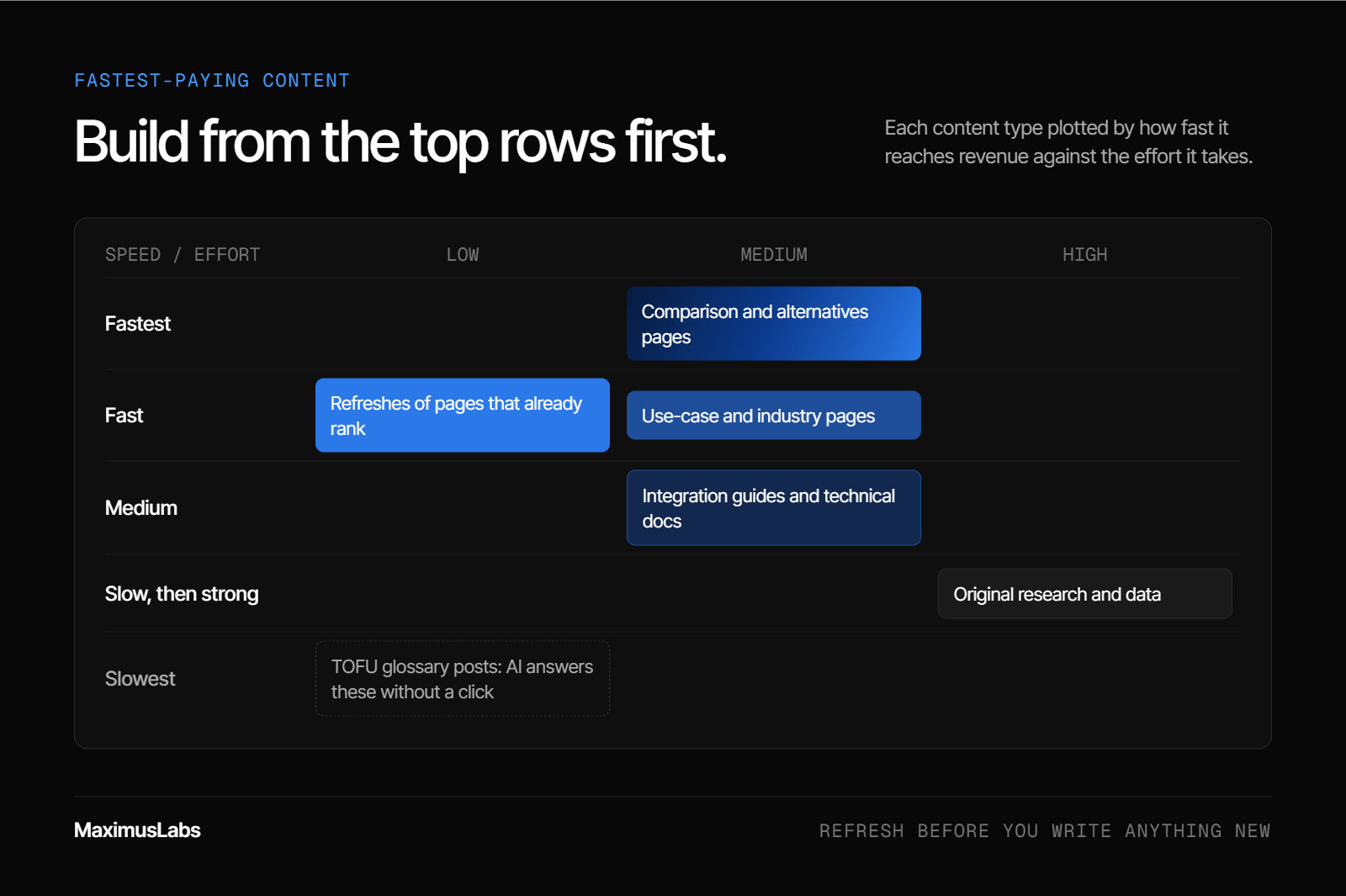
| Content type | Speed to revenue | Effort | Why it pays |
| Comparison and alternatives pages | Fastest | Medium | Buyers search these right before choosing |
| Refreshes of pages that already rank | Fast | Low | The page already has authority |
| Use-case and industry pages | Fast | Medium | They match how buyers describe their problem |
| Integration guides and technical docs | Medium | Medium | AI engines cite specific how-to answers |
| Original research and data | Slow, then strong | High | Earns citations and links for years |
| TOFU glossary posts | Slowest | Low | AI answers these without a click |
Refresh before you write anything new
💰 Upgrade the pages with authority
Pages that already rank have done the hardest work. Adding a short direct answer near the top, plus missing question variants, often lifts them faster than a new page can rank. Direct answers also match how AI engines extract text for summaries.
MaximusLabs AI audits a client's existing pages before planning new ones. MaximusLabs looks for pages close to page one or close to being cited, because small upgrades there pay soonest.
⚠️ Clarity beats length
Donald Miller tells the story of Kyle Shultz, who sold $25,000 of online courses on his first launch. After rewriting his sales page in fewer than 300 clear words, he sold another $103,000. Buyers did not need more content, just content that showed them what was in it for them.
Add moments only your product can show
✅ The a-ha moment and the founder's view
Mid- and bottom-of-funnel pages convert better when they show the product working. Screenshots, short demos, and real use cases let buyers picture the result. A founder's view of the market adds the one thing AI cannot copy: a perspective built from years inside the problem.
MaximusLabs AI applied this BOFU-first mix for Nidra Goods, which reached #1 for "best sleep mask" on Google, ChatGPT, and Perplexity at the same time. MaximusLabs pairs these pages with earned mentions so engines see proof from outside the brand. Every page is then judged on the revenue it moves.
Q9. How long does content take to pay off, and how should you measure it?
Content usually needs 3 to 6 months to gain momentum and 9 to 12 months to compound. Measure it on pipeline and revenue influenced, not pageviews. Track ChatGPT and Perplexity referrals as their own channel in Google Analytics 4 (GA4). Also monitor share of voice inside AI answers, and add a "How did you hear about us?" field. Many AI referrals show up as Direct or Branded traffic.
Set the clock before you start
⏰ The month-four board meeting
A founder reaches month four of a content program. The board deck shows 30 new pages, a small traffic bump, and no closed deals tied to content. Someone asks whether it is time to cut it.
That question is fair, but it comes at the wrong time. Most of the value has not arrived.
✅ Four phases and the metric for each
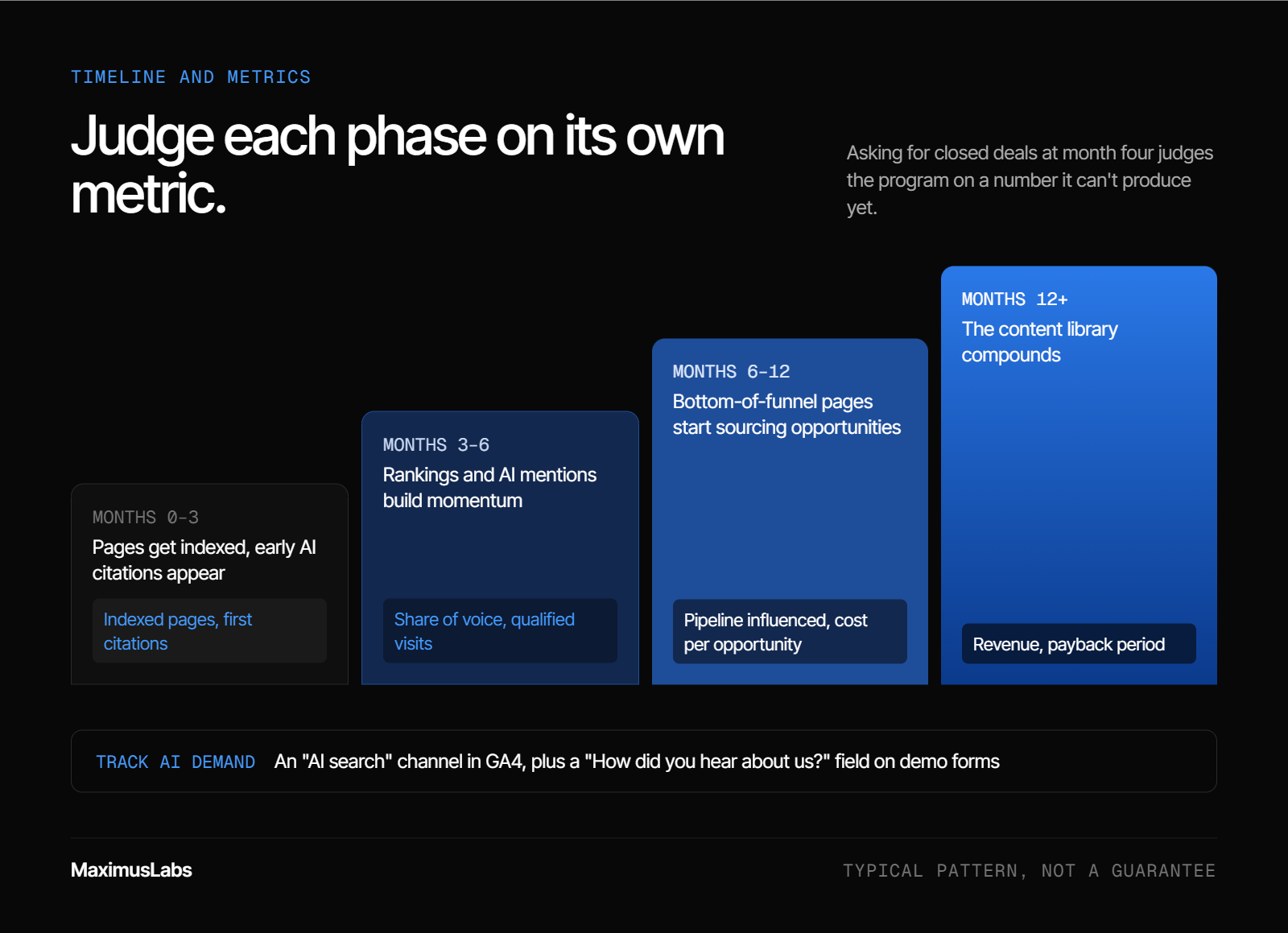
| Phase | What usually happens | Metric to watch |
| Months 0 to 3 | Pages get indexed, and early AI citations appear | Indexed pages and first citations |
| Months 3 to 6 | Rankings and AI mentions build momentum | Share of voice and qualified visits |
| Months 6 to 12 | Bottom-of-funnel pages start sourcing opportunities | Pipeline influenced and cost per opportunity |
| Months 12 and beyond | The content library compounds | Revenue and payback period |
MaximusLabs AI plans every engagement around these phases, so each review checks the right metric for that stage.
Why rank and traffic mislead now
⚠️ The old scoreboard broke
Rankings once worked as a decent proxy for revenue, but AI answers broke that link. Pew found users clicked a source inside an AI summary in just 1% of visits. A brand can now shape a buying decision without earning a single click.
Traffic also undercounts AI influence. Some AI referrals arrive without referrer data and land in the Direct bucket. Others return later as branded searches after a buyer saw your name in ChatGPT.
💸 Vanity metrics hide the real result
Clicks and impressions are vanity metrics when they stand alone, because they measure activity rather than buyers. MaximusLabs AI's read is that share of voice is the GEO equivalent of rank. Share of voice means how often your brand appears across a fixed set of buyer questions.
The scorecard that ties content to pipeline
💰 Three layers to track
Pipeline and revenue. Track opportunities and closed revenue that touched content in your CRM (customer relationship management system).
AI share of voice. Run a fixed set of buyer prompts in ChatGPT, Perplexity, Gemini, and Google AI Overviews. Record how often your brand is named.
Self-reported attribution. Add a required "How did you hear about us?" field to demo forms. Buyers often write "ChatGPT" when analytics says "Direct."
✅ Separate AI traffic in GA4
OpenAI says ChatGPT automatically adds utm_source=chatgpt.com to referral links from its search results. In GA4, a custom channel group can pull ChatGPT, Perplexity, Gemini, and Copilot referrals into one "AI search" channel. Semrush's finding that AI visitors are worth 4.4 times organic visitors makes this split worth doing.
MaximusLabs AI tracks AI visibility daily across every major engine and ties it to each client's pipeline in the CRM. For Oliv AI, that tracking showed 30-40% of inbound now AI-sourced. MaximusLabs reports that number next to pipeline, because citations only matter when they turn into deals.
Frequently asked questions
What are the main benefits of content marketing for B2B companies?
The main benefits of content marketing for B2B companies come down to owning demand instead of renting it. A strong page keeps working after the budget stops, which paid ads never do. MaximusLabs AI ranks the benefits by how directly each one reaches pipeline: • Citations in AI answers: ChatGPT, Perplexity, and Google AI Overviews name a short list of brands, and being on it puts you in front of buyers early. • Pre-sold visitors: Semrush found AI-search visitors are worth 4.4 times traditional organic visitors, based on conversion rate. • Lower customer acquisition cost: a page is paid for once, then keeps converting. • Trust and authority: expert content shows buyers and AI engines that you understand the problem. • Shorter sales cycles: bottom-of-funnel pages answer objections before a rep ever joins the call. We have found that these benefits only show up when content targets real buying questions. A hundred glossary posts rarely beat ten pages built for buyers who are ready to choose. That is why our content marketing work starts at the bottom of the funnel and is measured on pipeline, not pageviews.
Is content marketing still worth it for early-stage SaaS startups?
Yes, but only if the startup can wait three to six months for momentum. Content is a capital asset, not a quick lead source. Founders who need pipeline this quarter should pair it with paid or outbound. MaximusLabs AI tells early-stage founders to think about content as owned land and paid ads as rent. Paid buys speed and fast feedback. Content builds an asset that keeps paying after spend stops. For a small budget, we suggest a narrow start: • Write eight to ten bottom-of-funnel pages, such as comparison, alternatives, and use-case pages. • Use paid search to test which messages convert, then turn the winners into owned pages. • Skip broad glossary posts, because AI engines already answer those without a click. • Add a founder's point of view to each page, because it is the one thing competitors and AI tools cannot copy. This approach keeps cost per page low and ties every page to a buyer question. Our guide to GEO for SaaS startups covers how to pick those first pages so they get cited by AI engines as well as ranked on Google.
How long does it take to see ROI from content marketing?
Most content programs need three to six months to gain momentum and nine to twelve months to compound. Judging a two-month-old program on closed revenue sets it up to fail. MaximusLabs AI plans every engagement around four phases, each with its own metric: • Months 0 to 3: pages get indexed and early AI citations appear. Watch indexed pages and first citations. • Months 3 to 6: rankings and AI mentions build momentum. Watch share of voice and qualified visits. • Months 6 to 12: bottom-of-funnel pages start sourcing opportunities. Watch pipeline influenced and cost per opportunity. • Months 12 and beyond: the library compounds. Watch revenue and payback period. We have seen budgets cut at month four more than at any other point, usually because nobody set these expectations on day one. Agreeing on the phase metrics up front keeps the board conversation honest. Our breakdown of ROI and revenue attribution shows how to connect each phase to a number finance already trusts.
Does AI search make content marketing less effective?
AI search changes what content pays out in, not whether it pays. Clicks are shrinking, but the AI answer itself now shapes the buyer's shortlist. The data on clicks is clear. Ahrefs found AI Overviews cut position-one click-through rate by about 58% between December 2023 and December 2025. Pew found users clicked a result in 8% of visits with an AI summary, versus 15% without one, and clicked a cited source in just 1%. MaximusLabs AI treats this as a shift from ranking to becoming the answer. An AI answer is a small sample set of 5 to 10 brands, and you are either in it or invisible. So we focus on two things: • Owned content that answers specific buyer questions clearly enough for AI engines to quote. • Earned mentions on review sites, Reddit, and listicles that AI engines already trust. The visitors who do click arrive further along. Semrush found AI-search visitors are worth 4.4 times traditional organic visitors. Our guide to AI search click-through rates explains how to plan content when fewer, better clicks are the new normal.
How does content marketing help a brand get cited by ChatGPT and Perplexity?
AI engines cite sources they trust and can extract clean answers from. Content marketing builds both conditions: clear answers on your own pages and credibility signals across the wider web. MaximusLabs AI reached a 64% AI citation rate in 6 months for Oliv AI, vs ~30% for billion-dollar incumbents, by pairing two kinds of work: • Owned content: pages that open with a direct answer, carry named experts and original data, and cover specific long-tail questions. • Earned content: mentions on review sites, listicles, Reddit threads, and press, which AI engines lean on for broad queries like "best CRM software." Research supports the owned side. Princeton-led researchers found that adding citations, quotations, and statistics lifted source visibility in AI answers by up to 40%. We match the play to the query. Broad questions reward earned mentions, while specific questions reward whoever answers the exact problem best. Our citation optimization guide walks through how to audit which sources each engine trusts in your category.
How should we measure content marketing ROI in the AI search era?
Measure content on pipeline and revenue influenced, not pageviews. Rankings and traffic both undercount AI influence, because buyers can decide without clicking and AI referrals often land as Direct traffic. MaximusLabs AI uses a three-layer scorecard: • Pipeline and revenue: track opportunities and closed revenue that touched content in your CRM. • AI share of voice: run a fixed set of buyer prompts in ChatGPT, Perplexity, Gemini, and Google AI Overviews, and record how often your brand is named. • Self-reported attribution: add a required "How did you hear about us?" field to demo forms, since buyers often write "ChatGPT" when analytics says "Direct." We also separate AI traffic in Google Analytics 4. OpenAI says ChatGPT adds utm_source=chatgpt.com to referral links from its search results, so a custom channel group can collect AI referrals in one place. For Oliv AI, this tracking showed 30-40% of inbound now AI-sourced. Our guide to AEO measurement metrics lists the exact KPIs we report to finance teams each quarter.
Should we use AI to scale content marketing production?
AI can speed up research and drafting, but volume alone does not deliver the benefits of content marketing. Content Marketing Institute found that 9 in 10 B2B marketers use AI to create content, yet fewer than 4 in 10 say it improved performance. The problem is sameness. Most AI-assisted articles summarize the top five results and add nothing new. AI engines have no reason to cite a sixth version of the same answer. MaximusLabs AI uses AI for research and structure, then runs every topic through three tests before writing: • Does a buyer ask this? The query should come from someone evaluating a solution. • Does it connect to the product? The page should lead to a demo, trial, or comparison. • Can we add something first-hand? Data, a customer story, or a founder view that no summary contains. Humans approve everything that ships. We would rather publish ten pages that pass these tests than a hundred that do not. Our founder voice methodology guide shows how to keep AI-assisted content distinct enough to earn citations.