 Krishna Kaanth M
- A content audit is a review of every URL against revenue goals, ending in one decision per page: protect, enhance, consolidate, noindex, or delete.
- In AI search, the goal shifts from ranking to becoming the answer engines cite, so clicks alone no longer show what a page is worth.
- Scope by closeness to revenue: audit commercial and comparison pages first, mid-funnel next, and skip most top-of-funnel content that AI already answers.
- Find the roughly 5% of pages driving most pipeline, protect them, and improve them before writing anything new.
- Diagnose before pruning: steady impressions with falling clicks usually means an AI Overview took the click, not that the page failed.
- Audit off-site citations too, and measure Google, AI share of voice, and pipeline together, re-auditing quarterly.
Q1: What is a content audit in the AI search era, and why isn't ranking the goal anymore?
A content audit is a structured review of every published URL against revenue goals. It ends with one decision per page: protect, enhance, consolidate, noindex, or delete. In AI search, the goal shifts from ranking to becoming the answer that engines cite. Pew Research Center found Google users clicked a result on 8% of visits when an AI summary appeared, against 15% without one. Traffic alone no longer shows what a page is worth.
What the audit actually produces
An audit is not a report. It is a list of decisions, one per URL, with an owner and a date. "Noindex" means adding a tag that tells search engines to keep a page out of results while users can still reach it.
The output should fit on one sheet. If your audit ends in a 90-page PDF, it has described the site without deciding anything.
⭐ Most pages lose the bet
I think of every published page as a bet in a portfolio. Most bets lose, and that is normal. HubSpot's own blog audit of its oldest 4,000 posts found 951 with organic potential and 2,888 recommended for pruning, roughly 72%.
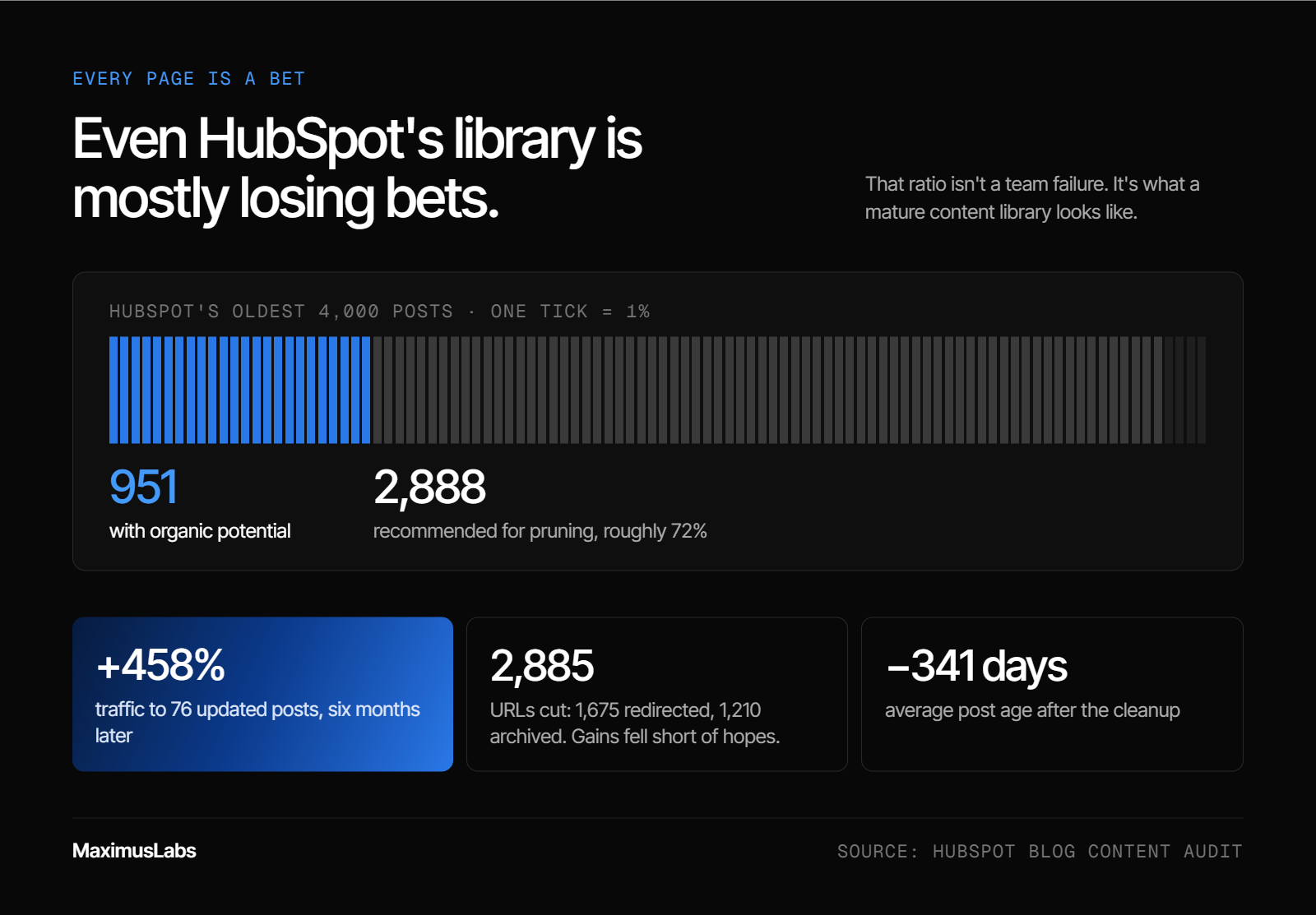
That ratio is not a failure of the HubSpot team. It is what a mature content library looks like. The audit's job is to find the winners and stop paying upkeep on the rest.
Why the old scorecard broke
❌ Traffic used to be the whole story
The classic audit sorted URLs by sessions and cut from the bottom. That logic held when a page-one ranking reliably earned the click. A visit was the proof that a page did its job.
⚠️ AI answers took the click, not the influence
An AI Overview is the generated summary Google shows above the blue links. Ahrefs measured a 58% lower click-through rate for the top-ranking page when one appears. Pew found only 1% of visits included a click on a link inside the summary.
So a page can lose clicks and still shape the answer a buyer reads. Google says its AI features run several related searches to build each response, a process it calls "query fan-out." Being one of the pages pulled into that answer is the new win.
⏰ Freshness now carries more weight
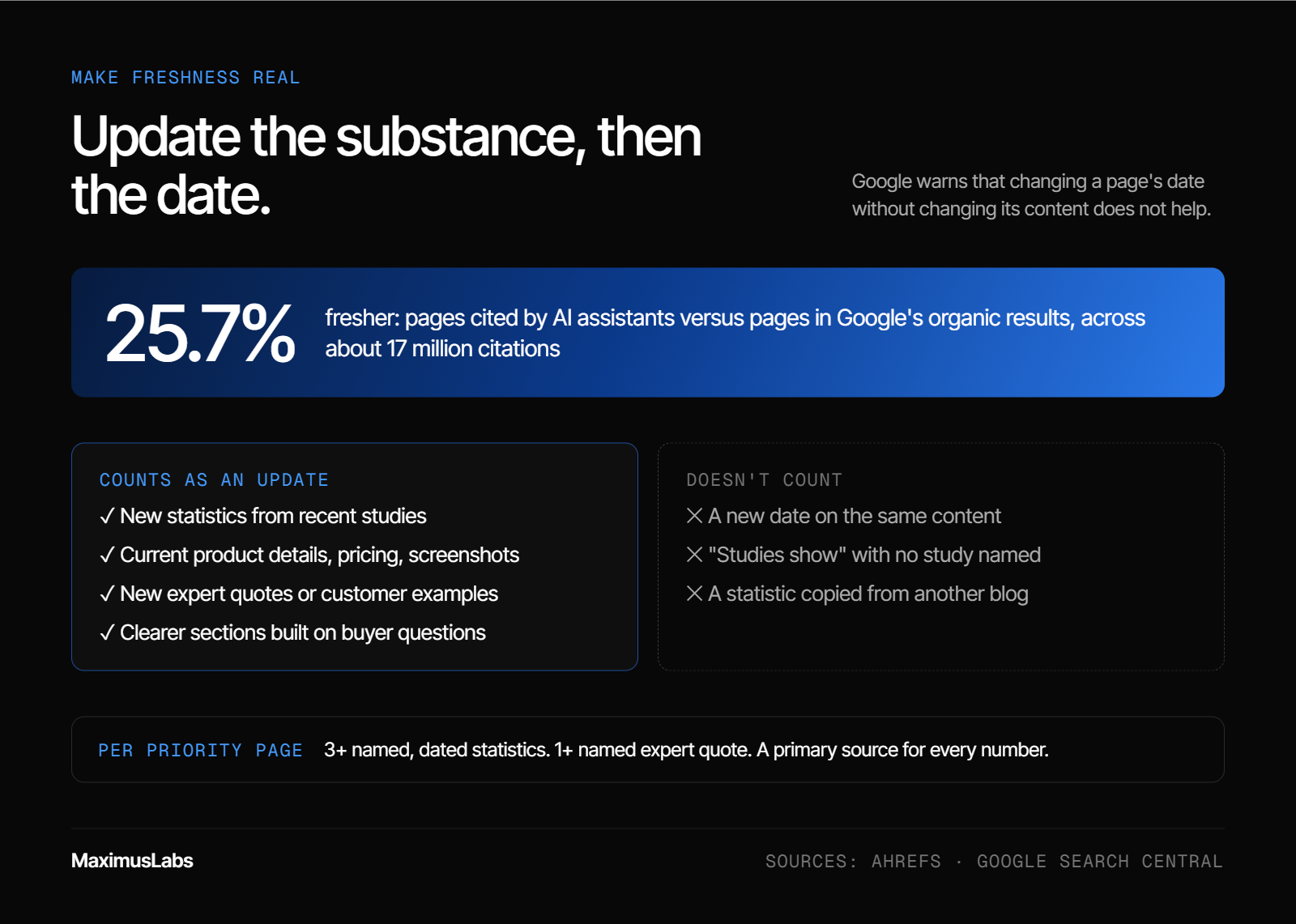
Ahrefs analyzed about 17 million citations and found pages cited by AI assistants were 25.7% fresher than pages in Google's organic results. Google is equally clear that changing a date without changing the content does not help. An audit has to separate real updates from cosmetic ones.
What this guide walks you through
Set a revenue goal and scope.
Build an inventory tagged by buyer intent.
Find the small set of pages driving pipeline.
Diagnose traffic loss before cutting anything.
Decide an action for every page.
Rework kept pages so AI engines cite them.
Check links, rendering, and off-site citations.
Measure across Google, AI engines, and revenue.
MaximusLabs AI opens every engagement with this kind of audit: an in-depth technical review, then a plan the client approves before any content ships. MaximusLabs measures that plan on pipeline, not on mentions. Answer Engine Optimization (AEO), the work of getting cited in AI answers, is the means. Revenue is the outcome the audit is built to protect.
Q2: Why do most content audits fail to move revenue?
Most content audits fail because they list every technical fact instead of ranking the few changes that move pipeline. Traditional SEO agencies often deliver a 50- to 100-page PDF of alt tags, header fixes, and speed tweaks. The team ships the fixes, results stay flat, and the channel gets blamed. MaximusLabs AI starts every audit with bottom-of-funnel and mid-funnel revenue pages and skips "what is" content that AI engines already answer.
The PDF arrives, and nothing moves
📋 How the traditional audit runs
The monthly SEO report looks healthy. Rankings tick up, impressions climb, and the agency attaches a fresh audit with hundreds of flagged items.
Every item is true. Almost none of it changes whether a buyer books a demo. The board still asks where the pipeline is.
❌ The death spiral
Graphite CEO Ethan Smith describes the pattern bluntly:
"you hire an SEO person or an SEO agency and they will recommend a... 50 page PDF and a bunch of charts and tables... most of it's zero impact work... then you decide SEO is not a good Channel... then you go on to the next SEO person"
Ethan Smith, CEO of Graphite
Eli Schwartz puts it more simply:
"Creating a useless book doesn't do the creator or the recipient any good."
Eli Schwartz, Product-Led SEO
What changed with AI search
⚠️ The answer now has five to ten names in it
Buyers now ask ChatGPT, Perplexity, Gemini, Claude, and Google AI Overviews for a shortlist, and they get one answer. A brand is either in that answer or invisible to that buyer.
AI engines recommend brands they trust, because their own credibility rides on the answer. That makes a checklist of alt tags the wrong unit of work. The right unit is the commercial page a buyer and an engine both read.
💸 The cost of auditing the wrong pages
An hour spent fixing headers on a 2019 glossary post is an hour not spent on the comparison page buyers use. In my experience, that tradeoff hides in a PDF and shows up in a pipeline report.
How an impact-ranked audit works instead
| Audit approach | Starts with | Measured on | Typical output |
| Traditional checklist audit | Every crawl error on the site | Rankings, impressions, clicks | 50- to 100-page PDF |
| Generic GEO tool audit | AI mention counts | Share of mentions | Dashboard of yes/no citations |
| MaximusLabs AI audit | Bottom-funnel and mid-funnel revenue pages | Pipeline | Ranked action list per URL |
Crawl errors that block indexing still matter, and Q9 covers them. The difference is order: revenue pages first.
✅ What "ranked by impact" means in practice
Tag each URL by how close it sits to a purchase.
Score only the commercial and mid-funnel pages first.
Fix what blocks a buyer or an AI engine from using those pages.
Leave cosmetic issues on low-value pages for later, or never.
MaximusLabs AI runs strategy and execution in one team, so the audit and the fixes come from the same people. MaximusLabs pairs Owned AEO, where your pages become the answer, with Earned AEO, where reviews, Reddit, and listicles build trust. For Oliv AI, that approach produced a "64% AI citation rate in 6 months, vs ~30% for billion-dollar incumbents (Oliv AI)."
Q3: How should you set goals and scope before opening a spreadsheet?
Set one primary goal per audit and write down the success number before pulling any data. The goal can be organic pipeline, share of AI citations, or recovery from a core update. Then scope by closeness to revenue: commercial and comparison pages first, mid-funnel use cases next, and top-of-funnel pages last or not at all. AI engines already answer most "what is" questions directly.
Pick one goal, and give it a number
🎯 Three goals that hold up in a budget review
An audit with five goals ends up serving none of them. Pick the one your leadership team will judge you on this quarter.
| Goal | Example success number | Best for |
| Organic pipeline | Demo requests from organic pages up 20% in two quarters | Teams with steady traffic and weak conversion |
| AI citation share | Cited in 4 of 10 target buyer prompts, up from 1 | Brands missing from ChatGPT and Perplexity shortlists |
| Core update recovery | Commercial pages back to pre-update clicks | Sites hit by a Google quality update |
These numbers are illustrations, not benchmarks. Set yours from your own baseline.
⚠️ Why the number comes first
Without a written target, the audit drifts toward whatever the data makes easy to count. That is usually traffic. A pipeline goal forces you to pull conversion data you might otherwise skip.
Search Engine Land's audit guide makes the same call, putting goal-setting ahead of any data pull. I'd go further: if the goal does not mention revenue or buyers, rewrite it.
Scope by closeness to revenue
🪜 The scope ladder
Audit in this order, and stop when time runs out:
Commercial pages: product, pricing, comparison, and alternative pages a buyer reads before a demo.
Mid-funnel pages: use cases, templates, and integration guides for buyers still evaluating.
Technical docs and help content: pages that answer specific feature questions AI engines love to cite.
Top-of-funnel posts: broad "what is" explainers, audited last.
A mid-sized SaaS blog can hold thousands of URLs. Most teams never reach rung four, and that is fine.
❌ What to leave out
Do not use the audit as a reason to publish more glossary posts. AI engines already answer most definitional questions without sending a click, so new "What is [topic]?" pages rarely earn their upkeep.
Leave out pages with no plausible buyer, too. Old event recaps, hiring posts, and press releases rarely need a scored row. Batch them into one decision.
Owned pages now, earned pages later
Google says AI Overviews and AI Mode pull from many related searches to build an answer, not just the top result. That means third-party pages about your brand also shape what buyers read.
Keep this first pass focused on pages you own. Q10 covers the separate off-site audit, because mixing the two in one sheet muddies every decision.
MaximusLabs AI sets the audit goal with the client in week one, then scopes from commercial pages downward. MaximusLabs skips top-of-funnel content by design, because that is where AI answers already absorb the click. The goal sheet becomes the scorecard every later step reports against.
Q4: How do you build a content inventory segmented by buyer intent?
Export every URL from Google Search Console and crawl the site with Screaming Frog or Sitebulb. Merge the two lists so orphaned and unindexed pages show up. Tag each URL by intent: commercial, mid-funnel, docs, or top-of-funnel. Add columns for clicks, conversions, AI referral sessions, AI citations for target prompts, backlinks, internal links, and the date of the last real update.
Pull from two sources, not one
🔍 Search Console plus a crawl
Google Search Console (GSC) shows pages Google knows about and how they perform. A crawler like Screaming Frog shows every page your site links to. Neither list is complete alone.
Export the GSC performance report at the page level for the last 12 months. Then run a full crawl with the same domain settings. Save both as CSV files.
✅ Merge and look at the gaps
Match the two lists on URL. Pages in the crawl but missing from GSC are often orphans, meaning no internal links point to them. Others are pages Google chose not to index.
Do not treat every unindexed page as an error. Google's John Mueller has said the ratio of indexed to non-indexed pages is not a quality signal:
"There's no such thing as a ratio between index and non-indexed pages... I've seen so many websites that have a million non-indexed pages and half a million that are in the index and they're doing perfectly fine."
John Mueller, Google Search Central
Tag intent before you look at metrics
🏷️ Four buckets
Tag every URL before you sort by any number. Otherwise, traffic quietly biases every later decision.
Commercial: product, pricing, comparison, and alternative pages.
Mid-funnel: use cases, templates, and integration pages.
Docs: help center and technical documentation.
Top-of-funnel: broad explainers and news posts.
A quick rule: if a buyer could read the page the week they sign, it is commercial. If they would read it months earlier, it is probably top-of-funnel.
⚠️ Where tagging goes wrong
Blog posts that compare tools are commercial, even if they live under /blog/. Tag by what the page does, not where the CMS stores it.
The columns that matter
| Column | Source | Why it matters |
| Intent bucket | Manual tag | Sets the priority order |
| Clicks, impressions, position | GSC | Shows search demand and visibility |
| Conversions | GA4 or CRM | Ties the page to pipeline |
| AI referral sessions | GA4 referrals (chatgpt.com, perplexity.ai, gemini.google.com) | Shows visits from AI assistants |
| AI citations | Prompt checks in each engine | Shows whether engines cite the page |
| Backlinks | Ahrefs or Semrush | Flags pages worth keeping for link value |
| Internal links in | Crawler | Finds orphans and weak pages |
| Last substantive update | CMS history | Separates real refreshes from date changes |
Semrush's 2026 audit guide shows how to filter GA4 referrals for those AI domains. The AI citation column needs manual prompt checks or a tracking tool. Record it now, because Q11 measures results against this starting point.
MaximusLabs AI builds this inventory with daily AI-visibility tracking already running across the major engines, so the citation column starts filled. MaximusLabs then maps which third-party sources each engine trusts for the client's buyer prompts. That gives the decision steps that follow a real baseline instead of a guess.
Q5: How do you find the 5% of pages that drive your pipeline?
Sort the inventory by assisted pipeline and conversions first, and by clicks second. Mark the URLs that together produce 85 to 95% of results. Graphite CEO Ethan Smith calls this "The 5%," because roughly 1 in 20 landing pages drives nearly all the impact. Label these pages protected core assets. Improve them first, and never change their URL or canonical tag without testing.
The distribution almost every site shares
⭐ Why 1 in 20 pages carries the load
Most content libraries follow the same lopsided curve. Ethan Smith puts it plainly:
"5% of the landing pages Drive 95% of the impact often times so 95% of your landing pages get little to no traffic and 5% get almost all of the traffic."
Ethan Smith, CEO of Graphite
Smith also argues the weak tail can drag down the winners by lowering perceived site quality.
💡 Why I treat this as a budget question
I treat content like any market: effort goes where the return is. If one page in twenty earns the pipeline, that page deserves most of your next quarter. The other nineteen need a decision, not more polish.
How to calculate your own 5%
✅ Cumulative share in five steps
Use the inventory sheet from Q4. "Assisted pipeline" means deals where the page appeared somewhere in the buyer's path before they converted.
Sort rows by assisted pipeline or conversions, highest first.
Use organic clicks as the tiebreaker, not the main sort.
Add a running-total column for your chosen metric.
Divide each running total by the grand total to get a cumulative percentage.
Mark every row until the cumulative share reaches 85 to 95%.
The marked rows are your core.
⚠️ When pipeline data is thin
If attribution is thin, use form fills or demo requests, and keep the commercial intent bucket as a filter. Do not let raw clicks decide on their own, because top-of-funnel posts will crowd out the pages buyers use.
Rules for protected core assets
💰 What "protected" means in practice
A canonical tag tells search engines which URL is the main version of a page. Changing it, or the URL itself, can reset hard-won signals.
Keep the URL and canonical tag unchanged unless a test proves the change helps.
Never merge other pages into a core page without a plan and a baseline.
Refresh facts, data, and examples on a fixed schedule.
Watch clicks, conversions, and AI citations for these pages every week.
Why improving these pages pays off first
⏰ Enhancement beats net-new content
Smith's team found the fastest wins came from upgrading pages that already ranked:
"if you already have content I would start by enhancing the content that you already have before doing net new content... we doubled traffic by doing content enhancements"
Ethan Smith, CEO of Graphite
His team added "templates" to top articles that ranked for the term without using it, and saw a lift he calls "25% Plus 20%." HubSpot saw a similar pattern, with traffic to 76 updated posts up 458% six months later.
MaximusLabs AI starts every content plan by protecting the pages that already earn pipeline. MaximusLabs runs daily AI-visibility tracking on those pages, so a drop in citations shows up before it shows up in revenue. New content comes second, once the core is secure.
Q6: Is a page underperforming, or did AI Overviews take its clicks?
Check impressions and position before blaming the page. If rankings and impressions held steady but clicks fell, an AI Overview probably absorbed the click. Ahrefs measured a 58% lower click-through rate for position-one pages when an AI Overview appears. That page may still be cited and still influencing buyers. Cut a page only when impressions, rankings, and conversions are all falling together.
Situation: the clicks chart drops
📉 The reflex to cut
A Head of Organic Growth opens Search Console on Monday. A comparison guide that used to send steady clicks is down by a third. The page still ranks first, but the instinct is to mark it "underperforming" and move on.
That instinct made sense when a top ranking meant a visit. Now it can delete a page that still works.
Complication: the page may still be working
⚠️ What the click data shows
An AI Overview is the summary Google writes above the regular results. Ahrefs compared 300,000 keywords and found a 58% lower click-through rate for the top result when one appears.
Pew Research Center tracked 900 U.S. adults in March 2025. Users clicked a result on 8% of visits with an AI summary and 15% without one. Only 1% clicked a link inside the summary, and 26% ended their browsing session there.
❌ Why clicks mislead here
My biggest worry with AI search is simple: the engine reads your page, answers the buyer, and the visit never comes. That hurts your traffic chart. It does not mean the page lost its influence.
If your page is one of the sources behind that answer, it is still shaping the shortlist. Cutting it removes you from the answer, too. A commercial page ranking on pages two or three deserves an upgrade, not a deletion.
Resolution: a four-signal diagnosis
✅ Read the signals together
Google counts traffic from AI features inside the normal Search Console performance data. So you cannot isolate AI Overview clicks there. Compare four signals side by side instead.
| Impressions | Position | Clicks | Conversions or citations | Likely cause | Action |
| Steady | Steady | Down | Steady, or page is cited | AI Overview absorbing clicks | Keep and rework for citation (Q8) |
| Steady | Dropped to 6 to 20 | Down | Down | Lost ranking to a competitor | Enhance the page |
| Down | Steady | Down | Steady | Less search demand overall | Monitor, do not cut |
| Down | Down | Down | Down | Real decay | Enhance, merge, or remove (Q7) |
Only the last row is a true decline. The first row is the one most audits get wrong.
🔍 How to confirm an AI Overview is present
Take the page's top five queries from Search Console.
Search each one in a logged-out browser window.
Note whether an AI Overview appears, and whether it cites your page.
Run the same queries in ChatGPT and Perplexity, and record any citations.
Add the results to the AI citation column from Q4.
Do this only for pages with commercial value.
MaximusLabs AI checks this automatically through daily AI-visibility tracking across the major engines. MaximusLabs can see when a page loses clicks but keeps its citations. That distinction decides whether the page gets reworked or cut, and it protects pages that still influence pipeline.
Q7: Should you enhance, consolidate, noindex, or delete each page?
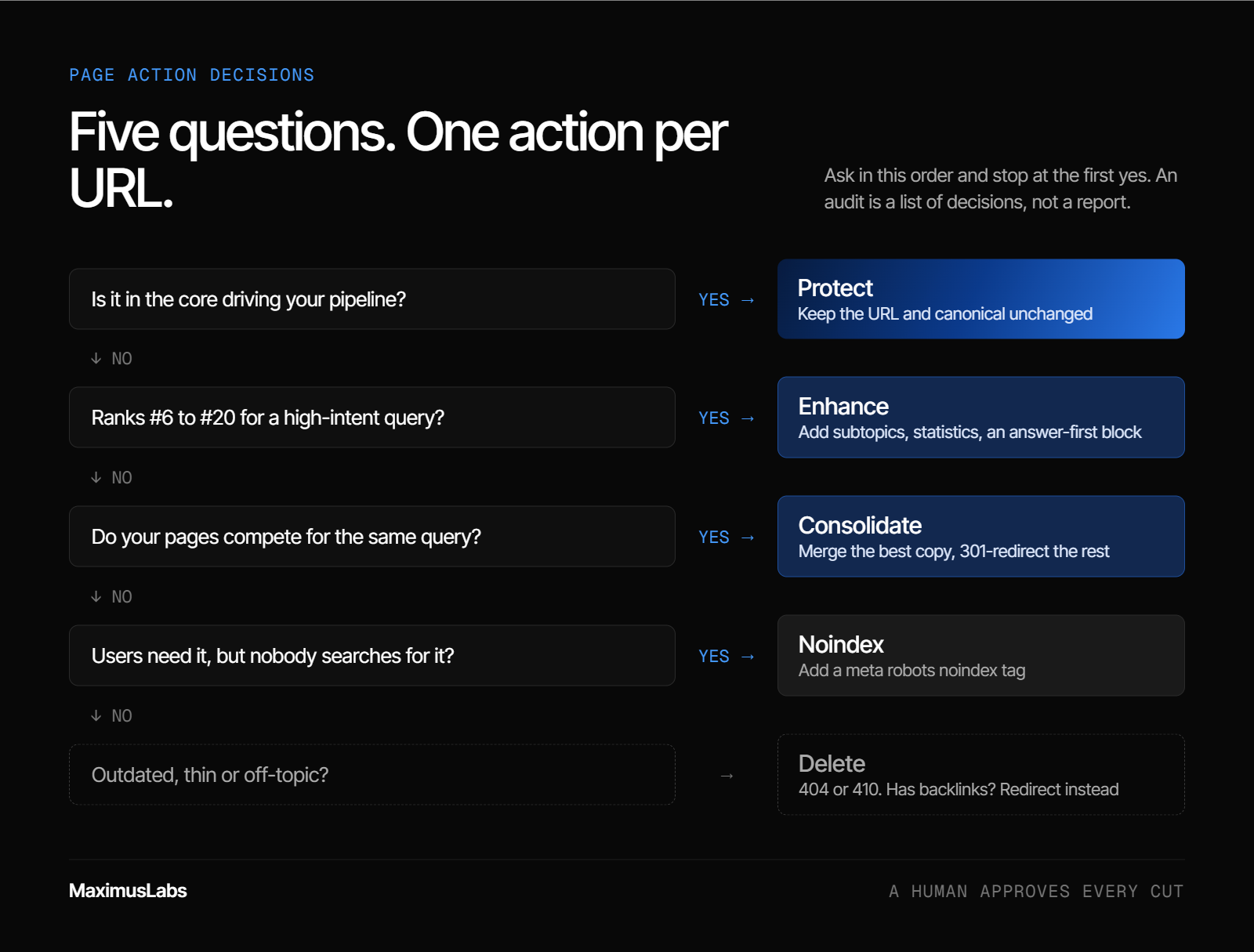
Give every page outside the protected core one action. Enhance pages ranking #6 to #20 for high-intent terms. Merge pages competing for the same query and 301-redirect the weaker ones. Noindex pages that help users but have no search intent. Delete outdated or out-of-scope pages with a 404 or 410 status. Eli Schwartz recovered from Google's Panda update by cutting more than 100 sites down to 12.
The decision table
✅ One page, one action
| Action | Use it when | How |
| Enhance | The page ranks #6 to #20 for a high-intent query | Add missing subtopics, statistics, and an answer-first block |
| Consolidate | Two or more pages target the same query | Merge the best copy into one URL, then 301-redirect the rest |
| Noindex | Users need the page, but nobody searches for it | Add a meta robots noindex tag |
| Delete | The page is outdated, thin, or off-topic | Return a 404, or a 410 for permanent removal |
A 301 redirect permanently sends visitors and search engines from an old URL to a new one. A 410 status tells crawlers the page is gone for good.
How to spot each case
🔍 Finding cannibalization
Cannibalization happens when several of your pages compete for one query. In Search Console, open the Queries report, filter one query, and switch to the Pages tab. If two URLs trade places week to week, they are splitting the signal.
A common example is near-identical pages, such as "resume writing service" and "resume writing services." Keep the stronger page, fold in the best sections from the other, and redirect.
⚠️ Noindex versus delete
Noindex suits pages with real user value and no search demand. Think HTML sitemaps, internal search results, and region-specific terms pages.
Delete suits pages nobody needs anymore. If a page has backlinks, redirect it to the closest relevant page instead.
Cut with care
❌ Pruning does not always pay
HubSpot redirected 1,675 old blog URLs and archived 1,210 more. The traffic gains fell short of expectations during a volatile 2024. The content library did get younger, though, with average post age dropping by 341 days.
Eli Schwartz describes a recovery that did work:
"Through the use of canonical tags, directives not to index content, redirects, and outright website removals, we reduced our footprint of one hundred plus websites down to twelve."
Eli Schwartz, Product-Led SEO
💸 AI-written pages need a human pass
Eric Enge reports a financial site with mostly AI-generated content lost 99.3% of its rankings after a 2023 core update. Do not rely on AI detectors to find those pages. Ethan Smith's team tested detectors on content published before ChatGPT existed and found a false positive rate around 8%.
Have a subject-matter expert review flagged pages for accuracy and depth. I find this step the hardest emotionally. Deleting pages feels like admitting a mistake, and I've learned to acknowledge that loss, then make the cut.
MaximusLabs AI assigns one action per URL and ties each to the audit goal set in Q3. Humans at MaximusLabs approve every change that ships, including redirects and deletions. That keeps cuts deliberate and reversible where it matters.
Q8: How do you rework the pages you keep so AI engines cite them?
Put a direct answer in the first third of each section. Add attributed statistics and expert quotes, and update the facts, not just the date. The Princeton-led GEO study found that citing sources and adding statistics raised visibility in AI-generated answers by up to 40%. MaximusLabs AI applies this structure to client pages, and Oliv AI reached a 64% AI citation rate in 6 months, vs ~30% for billion-dollar incumbents.
Put the answer where engines look first
✅ Answer-first blocks
Phrase each H2 or H3 as the question a buyer would ask. Keep it close to how buyers type the question into ChatGPT. Then answer it in 40 to 80 words, directly under the heading.
Write that answer so it makes sense if lifted alone. Avoid "as mentioned above" or pronouns with no clear subject. AI engines often quote one block, not the whole page.
💡 Why this matters to me
My goal for any page is to become the answer, not just appear near it. When an AI engine names your brand, it lends you its own credibility. A clear, self-contained answer makes that easy for the engine to do.
Add data and named sources
📊 What the GEO research found
Aggarwal and colleagues tested ways to change how often content appears in generative answers. Adding citations, quotations, and statistics produced the largest gains, with visibility improving by up to 40%.
A practical rule for each priority page:
At least three statistics, each named and dated.
At least one quote from a named expert.
A link to the primary source for every number.
❌ What does not count as evidence
"Studies show" with no study named adds nothing. Neither does a statistic copied from a blog that copied it from another blog. Trace each number back to the original report.
Make freshness real
⏰ Update the substance, then the date
Ahrefs found pages cited by AI assistants were 25.7% fresher than pages ranking in Google's organic results. Google warns that changing a page's date without changing its content does not help.
Real updates include:
New statistics from more recent studies.
Updated product details, pricing pages, or screenshots.
New expert quotes or customer examples.
A clearer section structure based on current buyer questions.
Format for extraction
📋 Tables, lists, and matching markup
Use tables for comparisons and numbered lists for steps. Define every term the first time it appears. Google also asks that any structured data match the visible text on the page.
Keep each section focused on one question, so an engine can lift it without pulling in unrelated material. These formats help human readers skim. They also give AI engines clean blocks to quote.
MaximusLabs AI rebuilds audited pages with answer-first sections, cited data, and real updates, with humans approving every page. For Oliv AI, that work produced "27 qualified leads, $47K+ pipeline, 26% close rate in 4 months (Oliv AI)." The citations were the means. The pipeline was the result.
Q9: Which technical and internal-link checks belong in a content audit?
Check only what blocks discovery or citation. Give each priority page 5 to 10 contextual internal links, and fix orphaned pages. Serve key pages as server-rendered HTML, because many AI crawlers do not run JavaScript, and allow those crawlers in robots.txt. Do not chase a fully green indexing report in Search Console. Google's John Mueller says the ratio of indexed to non-indexed pages does not matter.
Send internal links to the pages that earn
✅ The 5 to 10 link rule
A contextual internal link sits inside body text and points to a related page on your site. Use the "internal links in" column from Q4 to find gaps.
Give every protected core page 5 to 10 contextual links from relevant posts.
Flag any priority page with zero or one internal link.
Link from pages that already get traffic, so value actually flows.
💸 Fix the "billionaires with no money"
Some pages link out to dozens of subpages but receive almost no links themselves. They hand out value they never collect. Category hubs and old resource libraries often fall into this trap.
I like the airline comparison for this. A hub airline routes every trip through one airport. A point-to-point airline connects cities directly. Your best pages should get direct links from related posts, not only from the homepage.
Clean up link depth
⭐ What a link cleanup can do
Kevin Indig describes an audit of the Atlassian Marketplace, where every app version had its own thin page:
"once we cleaned our internal link structure up and the more fluff we removed in terms of pages the more often Google will actually come around"
Kevin Indig
My read is simple: every platform has a goal, and crawlers have budgets. If you waste their visits on thin pages, they reach your important pages less often.
Check rendering and crawler access
⚠️ Many AI crawlers do not run JavaScript
Vercel and MERJ analyzed AI crawler traffic in December 2024. GPTBot, ClaudeBot, and PerplexityBot did not render JavaScript. Gemini did, because it uses Googlebot's infrastructure.
Content that loads only through client-side JavaScript may be invisible to most AI engines. To test, open a priority page and choose "view page source." If your main text is missing from that raw HTML, ask your developers to server-render it.
🔍 Robots.txt and broken URLs
Google asks site owners to allow crawling in robots.txt and in any CDN settings. Check that rules do not block OAI-SearchBot, PerplexityBot, or Claude-SearchBot by accident.
Vercel also found over 34% of AI crawler fetches hit 404 pages. Redirect old URLs that still earn links, and keep your sitemap current.
What to ignore
❌ Checklist items that rarely matter
Skip the push for a perfect indexing report. As Q4 covered, Mueller says many healthy sites have more unindexed pages than indexed ones.
Also deprioritize missing alt text, minor speed scores, and header tweaks on low-value pages. They are real issues, but they rarely change whether a buyer or an engine uses your commercial pages.
MaximusLabs AI runs this technical review in the first week of an engagement, before any new content ships. MaximusLabs checks that critical content renders in plain HTML and that AI crawlers are unblocked. That keeps the content work from Q7 and Q8 visible to the engines that matter.
Q10: How do you audit the off-site pages AI engines cite about you?
Run your target buyer prompts through ChatGPT, Perplexity, Gemini, and Google AI Overviews. List every third-party URL cited, such as listicles, Reddit threads, G2 profiles, and YouTube videos. Flag pages where competitors appear and you do not, or where facts about you are outdated. For broad "best X" questions, these earned pages often shape the answer more than your own site does.
Situation: the audit stops at your domain
📋 Every row is a URL you own
A marketing manager finishes the inventory from Q4. Every row is a page on the company's domain, scored and tagged. It feels complete.
Then a buyer asks ChatGPT for the best tools in the category. The answer cites a listicle, two Reddit threads, and a G2 category page. None of those appear in the audit.
Complication: AI answers lean on third-party pages
⚠️ What the engines actually pull from
Google says AI Overviews and AI Mode run several related searches to build one response. Each extra search pulls in more pages, and many of them are not yours.
Pew Research Center found Wikipedia, YouTube, and Reddit together made up 15% of sources cited in Google's AI summaries. Add review sites and listicles, and much of the answer comes from pages you do not control.
⭐ Which questions depend on earned pages
I sort buyer questions into three types. Broad head questions, like "best CRM software," are won mostly through third-party citations. Long-tail questions, like "does this CRM sync with Slack," are won by your own detailed pages.
Ethan Smith makes a similar split between earned and owned media. That is why an owned-only audit covers the long tail well and misses the head almost entirely.
Resolution: the prompt-to-citation audit
✅ Five steps
Write 20 to 30 prompts buyers actually use, drawn from sales calls and your Q3 goal.
Run each prompt in ChatGPT, Perplexity, Gemini, and Google AI Overviews.
Log every third-party URL cited.
Tag each one by type: listicle, Reddit, review site, video, or publisher.
Mark whether you appear, whether competitors appear, and whether facts about you are correct.
Answers change between runs, so repeat each prompt a few times before drawing conclusions.
🛠️ The fix list by source type
| Source type | What to check | Fix |
| Listicles | Are you included, and is the information current? | Send the author updated facts and a clear reason to include you |
| Reddit threads | Is your brand mentioned, and accurately? | Reply openly, and say who you work for |
| Review sites (G2, Capterra) | Is the profile complete, with recent reviews? | Ask current customers for honest reviews |
| YouTube | Does any video cover your use case? | Publish a short, plain demo video |
❌ What not to do
Do not create fake accounts or post planted praise. Smith advises identifying yourself on Reddit and adding real value. Communities spot astroturfing quickly, and the backlash can outlast any citation gain.
MaximusLabs AI runs this off-site audit through a citation-intelligence engine that maps which sources each engine trusts for a client's buyer prompts. MaximusLabs then works to earn placement in those sources, which it calls Earned AEO. Owned pages answer the long tail, and earned pages win the shortlist.
Q11: How do you measure audit results across Google and AI engines, and when should you re-audit?
Measure three layers against the starting figures from your inventory. Google: clicks, impressions, and position. AI engines: share of voice across a fixed prompt set, plus AI referral sessions in GA4. Revenue: assisted pipeline. MaximusLabs AI tracks all three layers, and Nidra Goods ranked #1 for "best sleep mask" on Google, ChatGPT, and Perplexity at once. Re-audit quarterly, and judge new changes only after 90 to 120 days.
The three-layer scorecard
✅ What to track and where
Share of voice means the percentage of prompt runs in which your brand appears. It replaces a single rank in AI search.
| Layer | Metric | Source | What a win looks like |
| Clicks, impressions, position | Search Console | Commercial pages hold or gain position | |
| AI engines | Share of voice, cited URLs | Prompt tracking | Appearing in more prompts than at baseline |
| AI engines | AI referral sessions | GA4 referrals | Sessions from chatgpt.com and perplexity.ai rise |
| Revenue | Assisted pipeline, demos | CRM or GA4 conversions | More pipeline touched by audited pages |
Semrush's 2026 guide shows how to isolate AI referrals in GA4. I treat that number as a floor, because some AI visits likely arrive without referral data.
⭐ Why there is no single rank
There is no position one in an AI answer. What matters is how often you show up across many versions of the same question. That is why the prompt set stays fixed, so each month compares like with like.
Track without a big tool budget
💰 The tracking itself is simple
Ethan Smith is blunt about the tool market:
"We have a page with 60+ AEO tools and they all do the same thing: They all do tracking... It's not that hard to build... We actually built our own I think it costs us a few cents per question"
Ethan Smith, CEO of Graphite
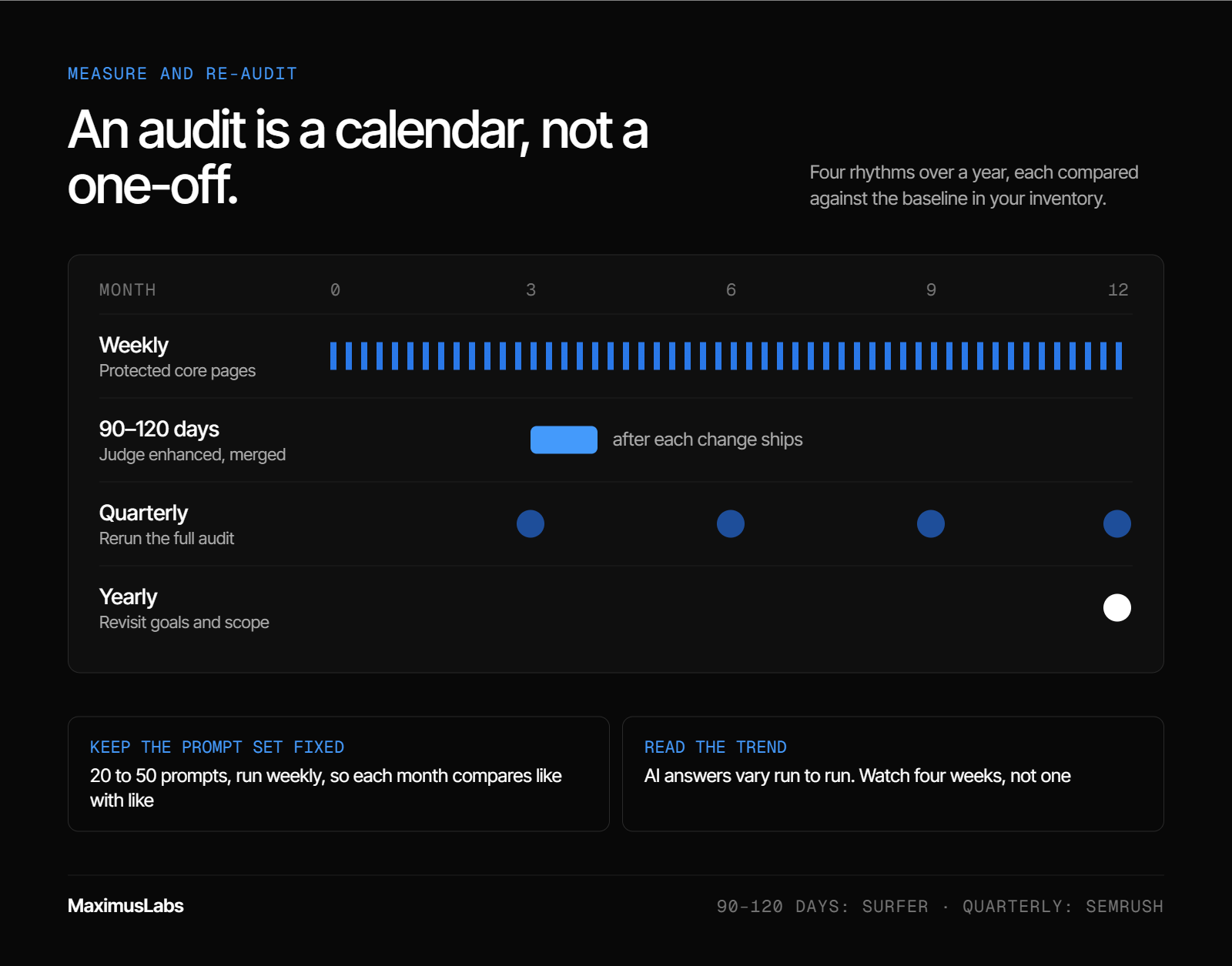
A spreadsheet works to start. List 20 to 50 prompts, run them weekly in each engine, and record whether you appear and which URL was cited.
⚠️ Where the numbers can mislead
AI answers vary from run to run. A single week's drop may be noise, so watch the four-week trend instead.
Know when to re-audit
⏰ A cadence that fits most teams
Weekly: check protected core pages from Q5.
After 90 to 120 days: judge pages you enhanced or merged, as Surfer's guide recommends.
Quarterly: rerun the full audit, which Semrush also suggests.
Yearly: revisit goals and scope from Q3.
What I'm thinking about next
My current hypothesis is that AI agents will soon act on pages, not just read them. Audits may need to check whether an agent can compare plans or book a demo. I might be early on this, and I'd like to hear what you're seeing.
MaximusLabs AI measures share of voice across the major engines every day, instead of reporting a single rank. MaximusLabs ties that tracking to pipeline, because citations are the means and revenue is the result. Nidra Goods holding #1 for "best sleep mask" on Google, ChatGPT, and Perplexity shows what consistent, cross-engine visibility looks like.
Frequently asked questions
How long does a content audit take?
A content audit takes anywhere from a few days to several weeks. The biggest factor is scope, not site size. MaximusLabs AI scopes every audit by closeness to revenue, so commercial and comparison pages get reviewed first and low-value posts get batch decisions. Here is a realistic timeline we use for a mid-sized B2B SaaS site: • Days 1 to 2: set one goal, export Search Console data, and crawl the site. • Days 3 to 5: tag every URL by buyer intent and flag the small set of pages driving pipeline. • Week 2: diagnose traffic drops, assign one action per page, and check rendering and internal links. • Week 3 onward: rework priority pages and run the off-site citation audit. Most delays come from trying to score every URL with equal care. A site with thousands of pages rarely needs that. Old event recaps, hiring posts, and press releases can share one decision. We also separate the audit from the results window. Judge enhanced or merged pages only after 90 to 120 days, because rankings and AI citations take time to settle. If you want the technical layer handled in the first week, our technical SEO website audit covers crawl access, rendering, and indexing before any content work starts.
What tools do you need to run a content audit?
You need fewer tools than most guides suggest. A solid content audit runs on five data sources and one spreadsheet. MaximusLabs AI adds daily AI-visibility tracking on top, because traditional tools do not show whether ChatGPT or Perplexity cite a page. • Google Search Console: clicks, impressions, position, and indexing status for every URL. • A crawler (Screaming Frog or Sitebulb): every page your site links to, plus internal link counts and orphaned pages. • GA4 or your CRM: conversions, assisted pipeline, and referral sessions from chatgpt.com and perplexity.ai. • A backlink tool (Ahrefs or Semrush): pages worth keeping or redirecting for link value. • Prompt tracking: a fixed list of buyer prompts run in each AI engine, recording whether you appear and which URL gets cited. We have found that prompt tracking does not need an expensive platform to start. A spreadsheet with 20 to 50 prompts, run weekly, gives a usable baseline. Before buying anything, decide what each tool will change in your decisions. If a column will not change a keep, merge, or delete call, skip it. Our roundup of GEO tools and platforms compares options if you want to automate the AI-visibility layer later.
How often should you do a content audit?
Run a full content audit every quarter, and check your most important pages every week. That cadence works for most B2B SaaS teams because AI answers and rankings shift faster than they did a few years ago. MaximusLabs AI tracks share of voice across the major engines daily, so problems on core pages surface before a quarterly review. Here is the rhythm we recommend: • Weekly: review the protected core pages that drive most of your pipeline. • After 90 to 120 days: judge pages you enhanced, merged, or redirected. • Quarterly: rerun the full audit against your starting figures. • Yearly: revisit the audit goal and scope with leadership. Freshness matters more in AI search. Ahrefs found pages cited by AI assistants were 25.7% fresher than pages in Google's organic results. That does not mean changing dates. Google has said that updating a date without changing the content does not help. Real updates mean new statistics, current product details, new expert quotes, or a clearer structure. Our guide to GEO content refresh explains how to schedule those updates without rewriting pages that already perform.
Does deleting old content help or hurt SEO?
Deleting old content can help, but only when the page is truly dead weight. Pruning works best on thin, duplicate, or off-topic pages that earn no traffic, links, citations, or conversions. It can hurt when you cut a page that still shapes AI answers or carries backlinks. The evidence is mixed, which is why we diagnose before cutting: • HubSpot redirected or archived about 2,900 old posts. Traffic gains fell short of expectations, though the library got much younger. • Eli Schwartz recovered from Google's Panda update by cutting more than 100 sites down to 12. Before deleting, check four signals together: impressions, position, clicks, and conversions or citations. If impressions and position held steady while clicks fell, an AI Overview probably absorbed the click. That page may still be cited, so rework it instead. MaximusLabs AI assigns one action per URL: enhance, consolidate, noindex, or delete. Humans approve every redirect and deletion. If a page has backlinks, redirect it to the closest relevant page rather than returning a 404. Our GEO failures and lessons piece covers what goes wrong when teams prune too aggressively.
What is the difference between a content audit and a content inventory?
A content inventory is a list of what you have. A content audit is a set of decisions about what to do with it. The inventory comes first and feeds the audit. An inventory records facts for every URL, such as: • URL, title, and content type • Buyer intent bucket (commercial, mid-funnel, docs, or top-of-funnel) • Clicks, impressions, conversions, and backlinks • AI referral sessions and AI citations • Date of the last substantive update The audit then scores those rows against a goal and assigns one action per page. That action might be protect, enhance, consolidate, noindex, or delete. Without the audit, an inventory is just a spreadsheet. Without the inventory, an audit is guesswork. We see teams stop at the inventory more often than you would expect. They export everything, build a beautiful sheet, and never make the hard calls. MaximusLabs AI treats the inventory as a means, not a deliverable. The output that matters is a ranked action list tied to pipeline. If you are building your first inventory, our GEO metrics and KPIs guide lists the columns worth tracking for AI search alongside Google.
Can AI tools run a content audit for you?
AI tools can speed up a content audit, but they cannot run one on their own. They are good at pulling data, spotting duplicate topics, and flagging pages with weak structure. They are poor at judging accuracy, business value, and competitive positioning. Here is how we split the work: • Let AI handle: merging exports, grouping similar pages, finding cannibalization, and drafting first-pass labels. • Keep humans on: final keep or cut decisions, fact-checking, tone, and whether a page supports pipeline. Be careful with AI detectors. Ethan Smith's team at Graphite tested detectors on content published before ChatGPT existed and found a false positive rate around 8%. A detector score alone should never decide whether a page gets deleted. MaximusLabs AI runs hybrid human and AI workflows for this reason. AI agents research the market and handle aggregation, while humans approve everything that ships. That keeps the audit fast without letting a model make calls it cannot judge. If you are reviewing AI-assisted pages, our AI content optimizer can help tighten structure before a subject-matter expert does the final pass.
How is a content audit for AI search different from a traditional SEO audit?
A traditional SEO audit asks whether a page ranks and gets clicks. A content audit for AI search asks whether engines cite the page and whether that citation influences pipeline. The goal shifts from ranking to becoming the answer. Four things change in practice: • New metrics: share of voice across a fixed prompt set, AI citations, and AI referral sessions sit beside clicks and position. • Diagnosis before pruning: falling clicks may mean an AI Overview absorbed the visit, not that the page failed. • Off-site scope: listicles, Reddit threads, and review sites shape AI answers, so the audit covers pages you do not own. • Rendering checks: many AI crawlers do not run JavaScript, so key content must sit in plain HTML. Traditional audits still matter. Crawl errors, indexing issues, and internal links remain the foundation. They are just no longer the whole job. MaximusLabs AI pairs Owned AEO, where your pages become the answer, with Earned AEO, where third-party sources build trust. Our breakdown of AEO vs SEO explains where the two disciplines overlap and where they split.