 Krishna Kaanth M
- Evergreen content answers questions that stay stable for years, but evergreen does not mean maintenance-free.
- Seasonal, trending, and news content spike and fade; only evergreen pages get better with scheduled refreshes.
- AI Overviews cut top-result clicks by about 58%, yet AI engines still cite pages averaging nearly three years old.
- Pick topics with steady demand, a stable answer, and a clear link to buying decisions, not just traffic.
- Refresh priority pages quarterly, prune dead weight yearly, and never change dates without real updates.
- Measure citation share, CTR, and pipeline influenced per page instead of pageviews alone.
It's the quarterly content review. The Head of Content pulls up Search Console and finds the same "ultimate guide" from 2023 at the top of the list. It still ranks, and impressions are steady. Clicks, though, have quietly fallen by almost half, and the sales team can't name a single deal it touched.
Someone in the room calls it "evergreen." Nobody asks whether it is still alive.
I've sat in that meeting more times than I can count. Here's the thing: evergreen content is still the most durable asset a content team can own. But the rules for keeping it alive changed the moment ChatGPT, Perplexity, Gemini, and Google AI Overviews started answering questions directly.
This guide covers what evergreen content is, what it looks like, and how to make it earn citations and pipeline, not just traffic.
Q1. What is evergreen content, and why is it called evergreen?
Evergreen content is content on topics that stay relevant to readers for years, such as how-to guides, explainers, and frameworks. The name comes from evergreen trees, which keep their leaves all year. Evergreen does not mean maintenance-free. The pages that keep earning traffic and AI citations are the ones refreshed with current data, examples, and answers as the topic matures.
The working definition
🌲 What makes a page evergreen
A page is evergreen when two things stay stable. The question people ask doesn't change, and the core answer doesn't change. Ahrefs uses "how to take a screenshot on a Mac" as its example, because people will ask it for years.
The term comes from journalism. Newsrooms kept "evergreen" stories on file to run on slow news days, because they didn't depend on any date. Marketing borrowed the word for the same reason.
✅ Evergreen vs simply "old"
Evergreen is not the same as old. A 2019 post about a retired product is old. A 2019 post explaining how to calculate customer acquisition cost (CAC, what you spend to win one customer) can still be evergreen.
The test is simple. If a reader in three years would ask the same question and accept the same core answer, the topic is evergreen.
A quick checklist helps when you brief a new piece:
✅ The search question has existed for years and still gets asked.
✅ The core answer won't flip with next quarter's news.
✅ Only details like stats, tools, or screenshots need periodic updates.
❌ The topic depends on a date, a launch, or a single event.
Why the label misleads teams
⚠️ The set-and-forget trap
Most teams hear "evergreen" and think "write once, rank forever." That is the most expensive misreading in content marketing.
Even Ahrefs notes that the core of an evergreen page stays the same, yet keeping it current is still good SEO practice. The topic is timeless. The page about it is not. Statistics age, screenshots break, and competitors publish better versions.
💰 What it looks like when it works
When it works, the payoff is huge. Dharmesh Shah is HubSpot's co-founder. He has said content he wrote 19 years ago "still drives traffic to hubspot.com that still generates leads." That is compounding, not luck.
But notice what sits behind that result. It is a strong topic, a strong domain, and a company that kept investing in the page's ecosystem for nearly two decades.
How I think about it
💡 Run it like a product
My working model is this: an evergreen page is a product, not a post. It has a launch date, a maintenance cycle, and a retirement date if it stops serving buyers.
That framing changes who owns it. A post belongs to whoever wrote it. A product belongs to someone accountable for how it performs next quarter.
MaximusLabs AI treats every evergreen page that way. Each page has an owner, a review date, and a buyer question it must keep answering. If the page stops earning citations or pipeline, it gets rebuilt or retired, not left to drift.
Q2. How is evergreen content different from seasonal, trending, and news content?
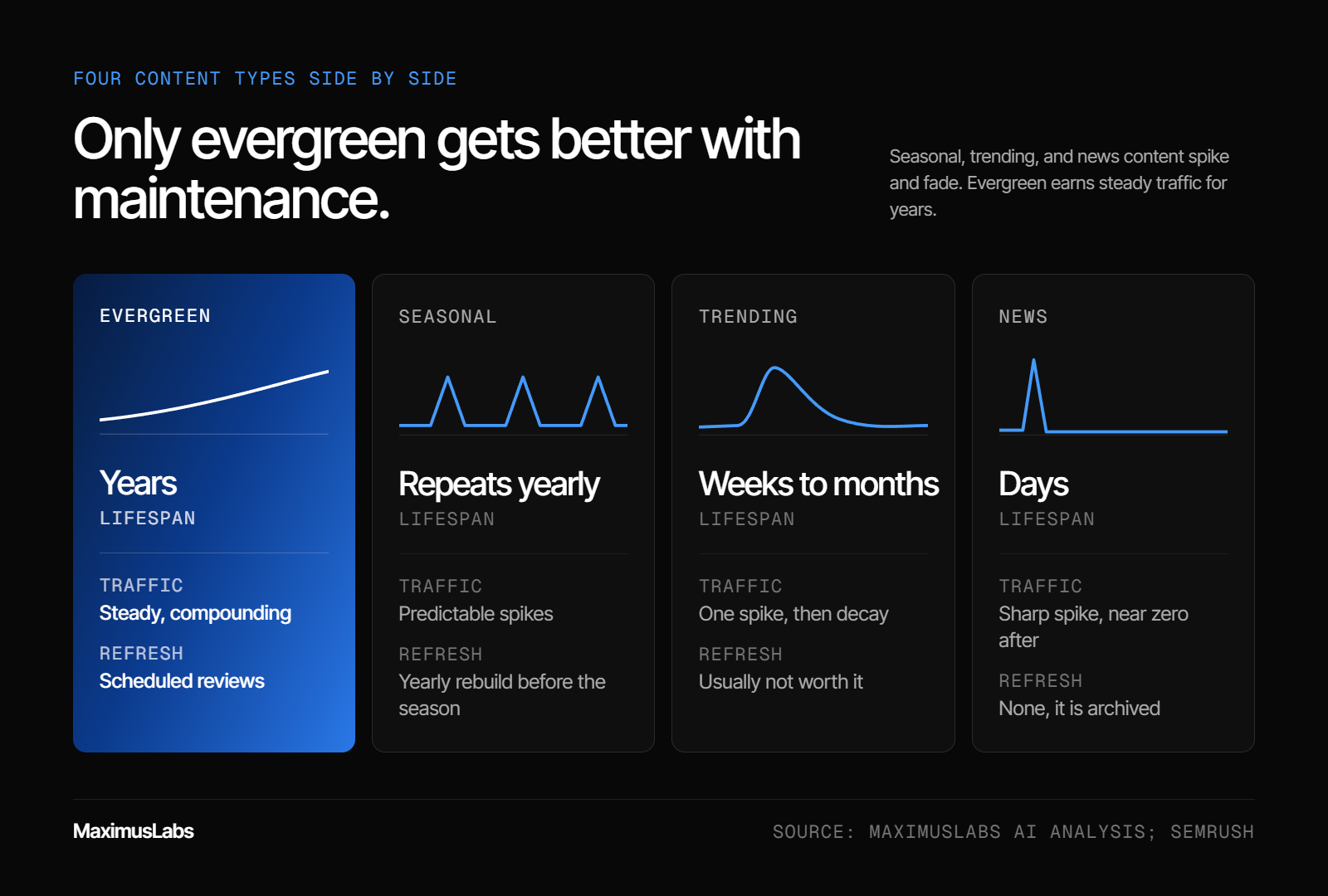
Evergreen content answers questions whose intent stays stable, so it earns steady traffic for years. Seasonal content spikes on a calendar cycle, trending content spikes once and fades, and news content loses relevance within days. Most strong content programs run evergreen as the base layer and use timely pieces for reach. Evergreen still needs scheduled refreshes, which timely content never gets.
The four content types side by side
📊 How each one behaves
Semrush shows the difference with Google Trends curves. "SEO" shows flat, steady interest. "Black Friday marketing" spikes every November. A one-off event spikes once and collapses.
| Content type | Typical lifespan | Traffic pattern | Refresh need | B2B SaaS example |
|---|---|---|---|---|
| ✅ Evergreen | Years | Steady, compounding | Scheduled reviews | "How to calculate CAC payback" |
| ⏰ Seasonal | Repeats yearly | Predictable spikes | Yearly rebuild before the season | "Year-end budget planning checklist" |
| ⚠️ Trending | Weeks to months | One spike, then decay | Usually not worth it | "What the latest model launch means for sales teams" |
| ❌ News | Days | Sharp spike, near zero after | None, it is archived | "Company X raises Series B" |
💡 The pattern that matters
The table shows something most guides skip. Only evergreen content gets better with maintenance. A refreshed news story is still old news. A refreshed evergreen guide can climb again.
Where teams get confused
⚠️ The "trends" trap
The trickiest pages sit on the border. "SEO trends for 2024" looks like an evergreen topic because people search it every year. It isn't. Each year needs a new answer, so it behaves like seasonal content.
Shopify draws a similar line. It lists topical articles, pop culture pieces, and opinion essays as content that does not stay evergreen.
✅ A simple sorting question
Ask one question before you brief a piece. "Will the answer still be right in two years?" If yes, it's evergreen. If it changes on a calendar, it's seasonal. If nobody will ask in six months, it's trending or news.
How to mix them
💸 Attention vs equity
My view is blunt. Timely content buys attention. Evergreen content buys equity.
Eli Schwartz frames it as renting versus owning. Paid marketing is like renting a house, because you never build equity. SEO is like owning one, because every month you build a little more.
Timely pieces still matter. They earn links, social reach, and press, and they can point readers to your evergreen hubs. But a program built only on timely content resets to zero every month.
🎯 A workable ratio
There is no universal ratio. As a starting point, I'd weight the calendar toward evergreen pages tied to buyer decisions. Then I'd use timely posts to feed links and attention into them.
MaximusLabs AI plans content calendars this way. Evergreen pages tied to buyer decisions form the base, and timely pieces are scheduled only when they can send authority back to that base.
Q3. What are the best examples and formats of evergreen content?
The strongest evergreen formats are how-to guides, frameworks, comparison pages, buyer's guides, glossaries backed by original data, templates, and free tools. For a B2B SaaS company, "how to choose a CRM for a 20-person sales team" outlasts and outsells "what is a CRM." News recaps, yearly trend posts, and statistics roundups are not evergreen unless you rebuild them on a schedule.
Formats that hold up
✅ The core evergreen formats
Shopify lists how-to guides, listicles, product reviews, tips, and explainers as typical evergreen types. That list is fine for a store. For B2B SaaS, I'd sharpen it around buying decisions.
| Format | Why it lasts | B2B SaaS example |
|---|---|---|
| How-to guide | The task stays the same | "How to set up lead scoring in your CRM" |
| Framework | The thinking stays useful | "A 3-step model for pricing a usage-based product" |
| Comparison page | Buyers always compare | "Product-led vs sales-led onboarding" |
| Buyer's guide | Every new buyer asks it | "How to choose a data warehouse for a Series A team" |
| Template or checklist | People reuse it | "Security questionnaire template for vendors" |
| Free tool or calculator | People return to it | "SaaS churn calculator" |
| Glossary with original data | Only if it adds something new | "Net revenue retention benchmarks by ARR band" |
💡 Small additions, big lift
Format choice is not the end of the job. Ethan Smith has described a resource library that stalled for months. Then his team noticed searchers wanted "templates" and "examples." Adding those words and sections lifted organic traffic by 20% to 25% or more, with no new URLs.
Why decision content outlasts definitions
⚠️ The TOFU problem
Here is my contrarian take. Plain "What is X?" pages are the weakest evergreen bet left. AI engines already answer those questions in the results page, so the reader rarely clicks.
TOFU (top-of-funnel) content targets people just learning a topic. BOFU (bottom-of-funnel) and MOFU (middle-of-funnel) content target people comparing and choosing. Those decision questions are longer, more specific, and harder for an AI summary to settle without citing a source.
💰 What this means for pipeline
A definition page might win traffic and never touch a deal. A buyer's guide answers the exact question a prospect asks the week before a demo. That is the page your sales team will share.
What is not evergreen
❌ Formats to treat as timely
News recaps and funding announcements
Yearly trend and prediction posts
Statistics roundups that age within 12 months
Product release notes and feature launches
Event recaps and webinar summaries
Each of these can still be useful. Just plan them as timely work, with a short shelf life, or schedule a full rebuild.
🎯 Applying it on Monday
MaximusLabs AI builds evergreen libraries BOFU-first and skips TOFU definitions that AI engines already answer. Each page targets a decision your ideal customer profile (ICP) actually makes. That way, the evergreen library compounds toward pipeline, not just pageviews.
Q4. Does evergreen content still matter when AI engines answer most questions directly?
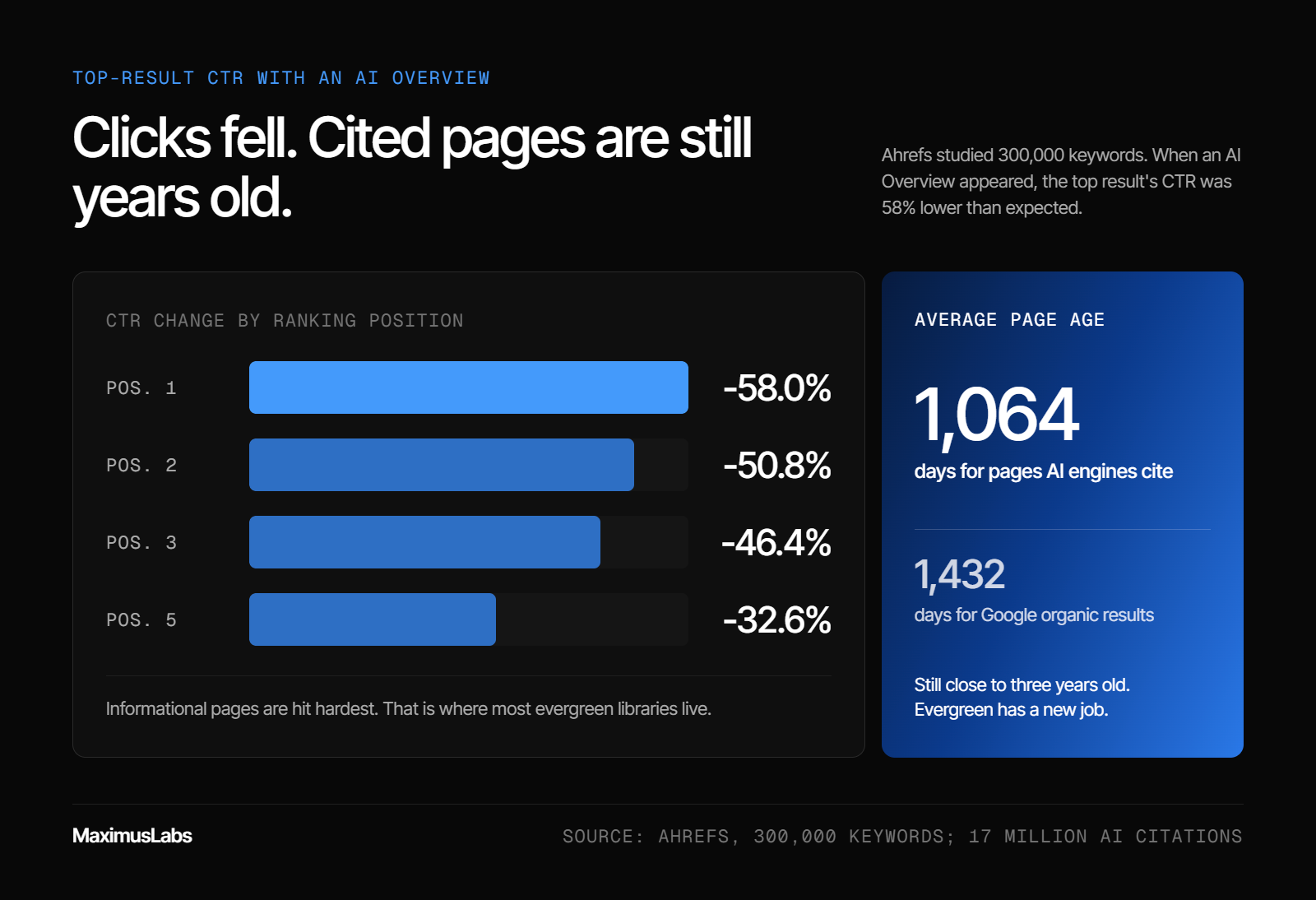
Yes, but the payoff has moved from clicks to citations. Ahrefs found AI Overviews correlate with a 58% lower click-through rate for the top-ranking page. A separate Ahrefs study of 17 million AI citations found that cited pages still averaged about 2.9 years old. Evergreen pages remain the raw material AI engines cite. The ones that win are maintained and carry information competitors lack.
How it used to work
📈 The old compounding model
For a decade, evergreen content followed a simple loop. You ranked on page one, people clicked, and some of them converted. Each month added more traffic on top of the last.
Most content reports still assume that loop. They show rankings rising and expect pipeline to follow.
What changed
⚠️ The click gap
Ahrefs studied 300,000 keywords using Search Console data from December 2023 to December 2025. When an AI Overview appeared, the top result's click-through rate (CTR, the share of searchers who click) was 58% lower than expected.
| Position | CTR change with an AI Overview |
|---|---|
| 1 | -58.0% |
| 2 | -50.8% |
| 3 | -46.4% |
| 5 | -32.6% |
The pages hit hardest are informational ones. That is exactly where most evergreen libraries live.
💡 But AI still cites older pages
Here is the twist. A separate Ahrefs study looked at about 17 million citations across ChatGPT, Perplexity, Gemini, Copilot, and AI Overviews. Cited pages averaged 1,064 days since publication, versus 1,432 days for organic results.
So AI engines do prefer fresher pages. Yet the average cited page was still close to three years old. Evergreen content isn't dead. It has a new job.
What to do about it
✅ Become the answer
The new job is to become the answer AI engines cite, not just a blue link. When ChatGPT names your page, it puts its own credibility behind you. That trust transfer is worth more than a click from a cold reader.
Google says there are no special requirements to appear in AI Overviews or AI Mode beyond normal search eligibility. So the work is the same craft, done better. That means clear answers, real data, and pages kept current.
💸 Don't cut the budget
Some teams see falling clicks and pause content entirely. Eli Schwartz answers that with a Henry Ford line. "Pausing advertising to save money is like stopping a clock to save time." The better move is to shift where you invest, from new TOFU posts to maintaining pages buyers and AI engines rely on.
In practice, that shift looks like three changes:
Report citations and assisted deals next to rankings, so falling clicks don't trigger panic.
Move budget from new definition posts into refreshing your highest-value evergreen pages.
Add original data or examples that competing pages don't have, so AI engines have a reason to cite you.
MaximusLabs AI measures evergreen pages by citation share and pipeline, not clicks alone. For Oliv AI, that approach produced a "64% AI citation rate in 6 months, vs ~30% for billion-dollar incumbents (Oliv AI)."
Q5. How do you find evergreen topics that drive pipeline, not just traffic?
Pick topics that pass three tests. Demand should stay flat or grow over several years. The core answer should not change yearly. The question should sit close to a buying decision your ideal customer profile (ICP) makes. Then check your own analytics. A small share of pages usually drives most of the traffic and pipeline, so double down on topics that already behave like evergreen.
The three-test filter
✅ Test 1: Steady demand
Start with demand that holds up over time. Ahrefs suggests looking for keywords with a steady trend, not a spike, and for pages that already pull a steady flow of traffic.
Pull five years of search interest for the topic. A flat or rising line passes. A line with one big hump fails, because that topic was a moment, not a need.
✅ Test 2: A stable answer
Next, ask whether the answer will hold. "How to structure a sales commission plan" has a stable core. "Best AI note-taker this quarter" does not.
A stable answer doesn't mean frozen details. Examples, tools, and numbers can change. The logic of the answer should not.
✅ Test 3: Close to a buying decision
This is the test most teams skip. Ask what decision the reader is trying to make. If the honest answer is "none, they're curious," the page may earn traffic and never touch a deal.
| Topic | Steady demand | Stable answer | Near a decision | Verdict |
|---|---|---|---|---|
| "What is a sales pipeline" | ✅ | ✅ | ❌ | Low priority |
| "How to choose a CRM for a 20-person team" | ✅ | ✅ | ✅ | Build it |
| "Sales tech trends this year" | ⚠️ | ❌ | ❌ | Treat as timely |
| "CRM migration checklist" | ✅ | ✅ | ✅ | Build it |
Mine what already works
📊 The 1-in-20 pattern
Before you brief anything new, look at what you already own. Ethan Smith describes a power law in content libraries. About 1 in 20 pages drives 85% to 95% of traffic and pipeline.
I'd treat that ratio as a pattern, not a law. Still, a handful of pages usually carry the library.
🔍 How to find your winners
Run this simple pass each quarter:
Export page-level organic sessions and conversions for the last 12 months.
Sort by assisted conversions, not traffic.
Flag pages with steady month-over-month traffic and at least one deal touch.
List the questions those pages answer, then brief adjacent questions.
Where long-tail wins
💡 The head, mid, and long-tail lens
I sort every topic into three types. Head questions like "best CRM software" are dominated by third-party listicles and reviews. Mid-tail questions mix citations with owned content.
Long-tail questions are where owned evergreen content wins. "Does this CRM sync with Slack for lead routing?" is specific, stable, and decision-ready. Fewer competitors write it, so a strong page can own it for years.
💰 Apply it on Monday
Take your top 20 pages by assisted pipeline. For each one, list three long-tail questions a buyer asks next.
MaximusLabs AI starts every topic plan with question research from sales calls, support tickets, and Reddit threads, then scores each question against these three tests. Topics that fail the decision test get dropped, however big their search volume looks.
Q6. How do you write evergreen content that Google and AI engines cite?
Lead each section with a direct answer under a question-style heading. Keep sections self-contained so a single passage can be cited. Add verifiable statistics, named sources, and expert quotes. The Princeton-led GEO study found these methods lift visibility in generative engine responses by up to 40%. Google says AI Overviews need no special markup, only crawlable text and structured data that matches the page.
Write for retrieval, not for keywords
💡 How AI engines read your page
Most AI answers follow a pattern called retrieval-augmented generation (RAG). The engine searches the web, pulls a few passages, and writes an answer from them with citations.
That changes the unit of competition. You aren't competing page against page anymore. You're competing passage against passage.
✅ Answer first, every time
Put a direct answer right under each heading. Make it 40 to 80 words, and make it make sense on its own.
Then expand with context, steps, and evidence. If an engine lifts only your first paragraph, the reader still gets the right answer.
Make every section stand alone
🧩 Self-contained passages
Google says AI Overviews and AI Mode may run multiple related searches across subtopics to build a response. Each of those searches can pull a different passage from your page.
So each section needs its own clear subject. Don't write "as mentioned above" or lean on a pronoun from three paragraphs back. Name the thing again.
⚠️ Technical basics still matter
Google says there are no extra technical requirements for AI features. It asks that crawling is allowed, that key content exists in text form, and that structured data matches the visible text.
Some AI crawlers may not run JavaScript. If your core answer only renders after scripts load, render it in the HTML instead.
Add evidence engines can trust
📊 What the research says
The GEO paper by Aggarwal and colleagues tested ways to change a page and measured visibility in AI answers. Adding citations, quotations, and statistics improved visibility by 30% to 40% on its main metric.
Keyword stuffing did the opposite. It gave little to no improvement, and on Perplexity it performed about 10% worse than the unchanged page.
| Change to the page | Effect on AI visibility (GEO paper) |
|---|---|
| ✅ Cite sources | Among the top methods, 30% to 40% lift |
| ✅ Add quotations | Among the top methods, 30% to 40% lift |
| ✅ Add statistics | Among the top methods, 30% to 40% lift |
| ❌ Keyword stuffing | Little to no lift, about 10% worse on Perplexity |
⭐ Show who wrote it and how
Google's guidance asks three questions about content: who made it, how, and why. Readers should see a byline and know the author's experience.
For evergreen pages, add a visible "last updated" note that explains what changed. That one line builds trust with readers and engines alike.
My take
💡 It's a data problem
I see GEO as closer to a data science problem than a copywriting one. The question is what a retrieval system can extract, verify, and trust.
MaximusLabs AI writes every section with a 40 to 80 word answer nugget and footnoted primary sources. Each page is shaped for how ChatGPT, Perplexity, and Google AI Overviews extract answers.
Q7. How often should you update evergreen content, and what counts as a real refresh?
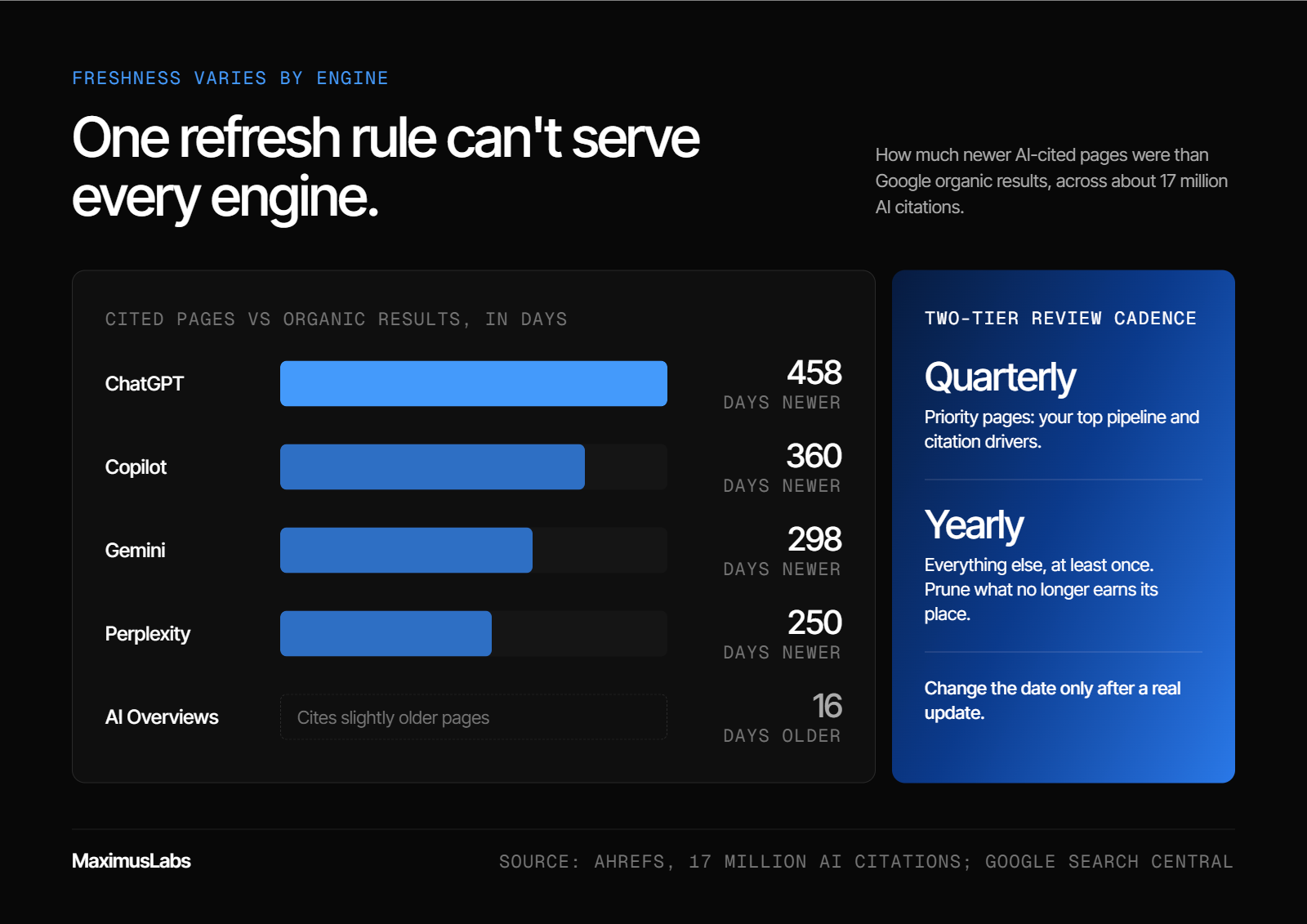
Review priority evergreen pages every quarter and the rest at least once a year. A real refresh adds new data, examples, or missing subtopics, not just a new date. Google's guidance warns against changing dates without substantial changes. Freshness matters more on some platforms than others. Ahrefs found ChatGPT cites pages about 458 days newer than Google's organic results, while AI Overviews cite slightly older ones.
Set the cadence by priority
⏰ A two-tier schedule
You don't need to refresh everything. Split the library into two tiers.
Priority pages: your top pipeline and citation drivers. Review them every quarter.
Everything else: review at least once a year, and prune what no longer earns its place.
Quarterly doesn't mean a rewrite every 90 days. It means a check, then a change only if something is out of date.
A 30-minute review usually covers it. Check the stats, the links, the screenshots, and whether the page still answers the question buyers ask today.
Why platforms disagree
📊 Freshness varies by engine
Ahrefs analyzed about 17 million AI citations and compared their age to Google's organic results. The gap varied a lot by platform.
| Platform | How much newer cited pages were than organic results |
|---|---|
| ChatGPT (citations) | 458 days newer |
| Copilot | 360 days newer |
| Gemini | 298 days newer |
| Perplexity | 250 days newer |
| Google AI Overviews | 16 days older |
Ahrefs also found that cited pages were last updated more recently than organic results on average.
💡 What that means
This is what I noticed early on. ChatGPT, Google, and Perplexity don't weigh signals the same way.
If ChatGPT and Perplexity matter most to your buyers, freshness carries more weight. If Google AI Overviews matter most, depth and authority carry more. One refresh rule can't serve every engine equally.
What a real refresh includes
✅ The refresh checklist
Replace statistics older than about 12 months, or label their dates clearly.
Swap outdated screenshots, tools, and examples.
Add subtopics searchers now ask about.
Update the title and headings to match how people search today.
Recheck every link and footnote.
Add one thing competitors lack, such as original data or a worked example.
💰 Small edits, real lifts
Ethan Smith calls refreshing your top performers one of the best long-term growth moves in SEO. His team updated titles and added missing "templates" and "examples" sections. Traffic rose 20% to 25% or more, with no new URLs.
Don't fake freshness
❌ The date-bump trap
Google lists one warning sign in its own words. "Are you changing the date of pages to make them seem fresh when the content has not substantially changed?"
So change the date only after a real update. Keep a short changelog so anyone can see what moved.
MaximusLabs AI tracks citation share for each priority page across AI engines. That data sets which pages get refreshed first, instead of a blanket calendar.
Q8. When should you prune or consolidate evergreen content instead of refreshing it?
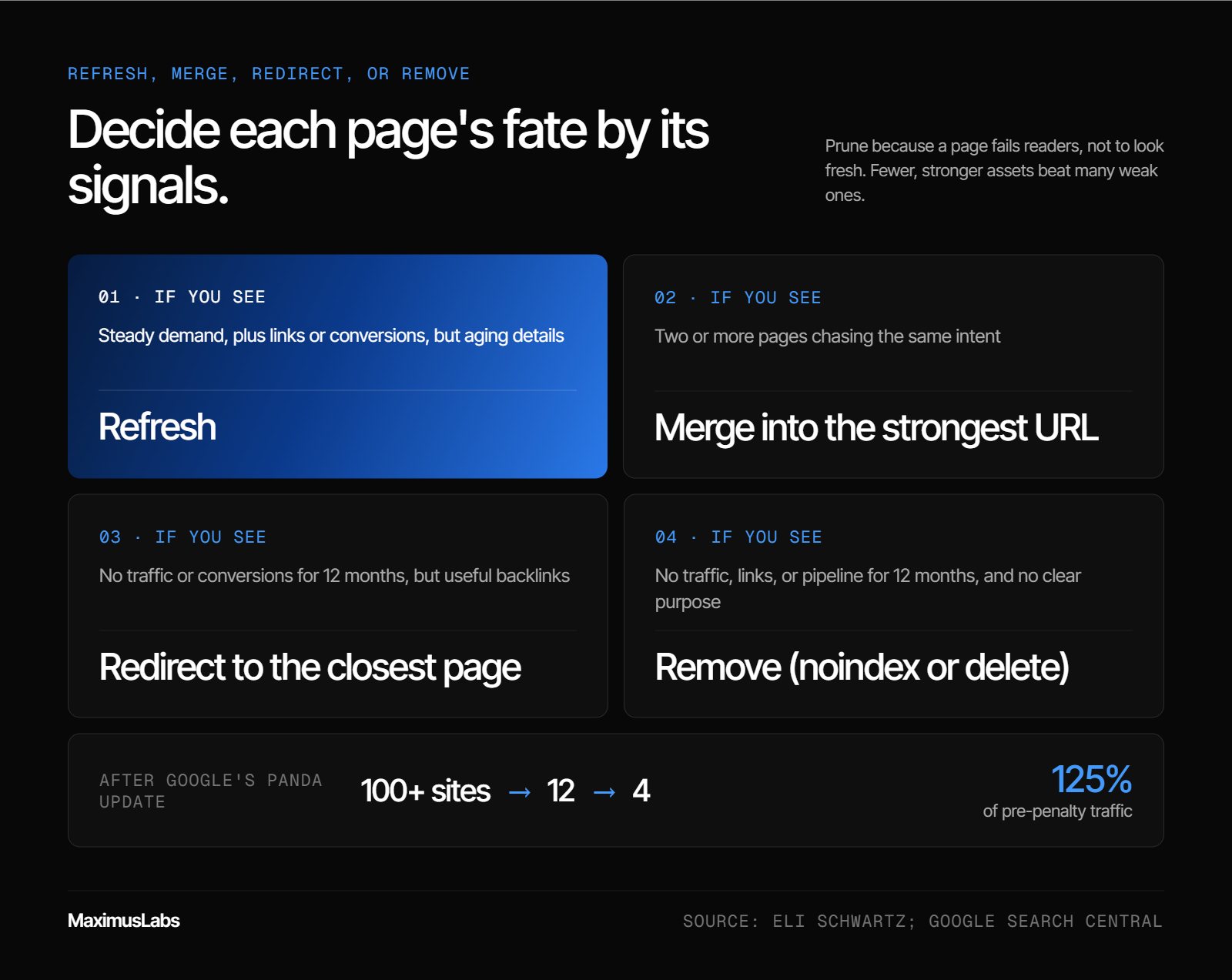
Refresh pages that still match demand and have links or conversions. Merge pages that compete for the same intent. Redirect or remove thin pages that have had no traffic, links, or pipeline for a year. Pruning is about quality, not looking fresh. Eli Schwartz cut a network of 100+ sites down to 4 after Google's Panda update, and traffic recovered to 125% of its pre-penalty level.
The situation: libraries only grow
📚 Why hoarding happens
Content teams are rewarded for publishing, not deleting. After a few years, the blog holds hundreds of posts, and most of them get almost no visits.
Nobody owns those pages. Nobody wants to be the person who deletes "content we paid for."
⚠️ Why it hurts
A bloated library spreads attention thin. Several weak pages may target the same query and split links and signals.
Eric Enge, a long-time SEO practitioner, puts the risk bluntly. He has warned that a section judged unhelpful "will apply a negative ranking factor to your entire site."
The complication: a real crash
📉 The Panda story
Eli Schwartz has shared a story from his time running a large network of sites. When Google's Panda update rolled out, the network lost 40% of its organic traffic in a single day.
His team used canonical tags, noindex directives, redirects, and full removals. They cut more than 100 sites down to 12, and finally to 4.
✅ The outcome
When Google reran the update months later, aggregate traffic reached 125% of its pre-penalty level. Fewer, stronger assets beat many weak ones.
The resolution: a four-way rule
🎯 Decide each page's fate
| Signal you see | Action |
|---|---|
| Steady demand, plus links or conversions, but aging details | ✅ Refresh |
| Two or more pages chasing the same intent | 🔀 Merge into the strongest URL |
| No traffic or conversions for 12 months, but useful backlinks | ↪️ Redirect to the closest relevant page |
| No traffic, links, or pipeline for 12 months, and no clear purpose | ❌ Remove (noindex or delete) |
⚠️ Prune for readers, not for freshness
Google's guidance warns against removing lots of older content just to seem fresh, and says plainly that it won't help. Prune because a page fails readers, not to game a signal.
Run a yearly decay audit
⏰ The annual pass
Once a year, export every URL with 12 months of traffic, links, and conversions. Tag each one with the four-way rule.
Then review the "remove" list with sales and support before acting. Sometimes a low-traffic page is the exact link reps send to late-stage buyers. Keep those, even if search ignores them.
💡 My take
I believe brand is the moat, and a lean, trusted library builds a stronger brand than a bloated one.
MaximusLabs AI runs this audit during onboarding and folds the results into the refresh plan. Pages that fail every test get merged or retired, so authority flows to pages buyers use.
Q9. What evergreen content mistakes kill rankings and AI citations?
The three costliest evergreen mistakes are publishing a page and never revisiting it, mass-producing AI text that repeats what already ranks, and writing generic definitions with no original data. Each one removes the information gain that makes a page worth ranking or citing. Practitioners report AI-padded sites that spiked for a few weeks, then lost their rankings entirely when Google reassessed them.
Information gain means what your page adds that other pages on the topic don't. It's the single idea that ties these three mistakes together.
Mistake 1: Publish and forget
⚠️ The symptom
The page went live two years ago and hasn't been touched since. Its stats point to a year nobody remembers, and two screenshots show a tool's old interface.
Rankings slip slowly, so nobody notices. Meanwhile, competitors publish fuller, newer versions.
✅ The fix
Give every evergreen page an owner and a next review date. Put both in the content tracker, not in someone's memory.
The two-tier review schedule from earlier is enough. What matters is that the review happens and someone is accountable for it.
Mistake 2: Mass-produced AI text
❌ The symptom
A team uses AI to publish 200 articles in a month. Traffic jumps, the dashboard looks great, and everyone celebrates.
Ethan Smith has described this exact pattern. Traffic from AI-made articles rose, then "went back down" once the algorithm reassessed the pages. Eric Enge shared a similar case on a lawn care site. Pages filled with recycled AI text "eventually lost 100% of their ranking."
✅ The fix
Google's guidance asks a pointed question. "Are you mainly summarizing what others have to say without adding much value?" It also says attribution "doesn't replace the need for original effort".
AI can speed up research, outlines, and formatting. But a human with real experience must add the parts no model can invent. Those are your data, your examples, and your judgment.
Mistake 3: Definitions with nothing new
❌ The symptom
The blog has 40 glossary pages, each restating the same definition found on 100 other sites. None of them has a single original number.
These pages are the easiest for AI engines to replace. The answer box already gives the definition, so nobody clicks, and no engine needs to cite you.
✅ The fix
Keep a definition page only if you can add something others can't. That might be a benchmark from your customer data, a worked example, or a decision framework.
If you can't add anything, merge the page into a deeper guide or retire it.
Why these keep happening
💡 The sixth-article problem
Here's the thing. Most content today summarizes five articles to write a sixth, and AI made that cheaper.
When everything looks the same, engines need a reason to pick you. Original data and lived experience are that reason. I'd argue they're the only durable defense left.
🎯 A quick self-check
Before publishing any evergreen page, ask three questions:
What does this page say that the current top five don't?
Who on our team has actually done this, and is their experience visible?
When will we review it next, and who owns that?
If any answer is blank, the page isn't ready.
MaximusLabs AI runs these checks on every draft before it ships. Its Founder's Voice process captures the client team's own experience, so each page carries information that other sites can't copy.
Q10. How do you measure evergreen content success in the AI search era?
Track four signals for each evergreen page: rankings and click-through rate (CTR) per impression in Search Console, citation share across ChatGPT, Perplexity, Gemini, and AI Overviews, assisted conversions, and the date of the last substantive update. Pageviews alone now understate value, because AI answers absorb clicks. A page that is cited often but rarely clicked can still be shaping the buyer's shortlist.
Why pageviews mislead now
📉 The click gap, revisited
Earlier, we saw that AI Overviews correlate with a 58% lower CTR for the top result. That means a page can hold its ranking and still lose half its clicks.
If you judge that page on pageviews, it looks like it's failing. Yet it may still be the source an AI engine quotes to your buyer.
⚠️ The wrong conclusion
The risky move is cutting pages that look weak on traffic but strong on influence. You can't see that influence unless you measure it.
The four signals to track
📊 The evergreen scorecard
| Signal | What it tells you | Where to get it |
|---|---|---|
| Rankings and CTR per impression | Whether search still sends clicks | Google Search Console |
| AI citation share | How often engines cite or name you for target questions | Manual prompt checks or an AI visibility tracker |
| Assisted conversions | Whether the page touches pipeline | Your analytics and CRM attribution |
| Last substantive update | Whether the page is due for review | Your content tracker or changelog |
💡 Share of voice, not rank
Rank is a single number on Google. In AI search, there's no single rank. What matters is how often you show up across many versions of a buyer's question.
That's called share of voice. Track it across a fixed set of 20 to 50 buyer questions per topic, checked on the same schedule each month.
Tie it to pipeline
💰 What the board cares about
Clicks and impressions on their own are vanity metrics. The board wants to know which pages touched deals.
Connect each evergreen URL to your CRM through first-touch and assisted attribution. Then report pipeline influenced per page, not just sessions.
⏰ The quarterly review
Run one review each quarter with content, demand gen, and sales in the room. Look at the scorecard, pick the pages to refresh, and assign owners.
Then make sure the plan actually ships. Ethan Smith admits his early consulting plans rarely shipped in full. In his words, "maybe 20% of that was launched; 20% launched is not going to cause the outcome." Measurement without execution changes nothing.
Making the math work
✅ Cost per maintained page
Maintenance is ongoing work, so cost per piece matters. MaximusLabs AI's own published comparison puts its cost at about $60 per piece. That compares with roughly $800 in-house, $260 for a traditional agency, and $100 for freelancers.
MaximusLabs AI reports share of voice and pipeline, not impressions. That lower cost per piece is what makes a maintained evergreen library realistic to run quarter after quarter.
What I'm Thinking About Next
My hypothesis is that "evergreen" will soon mean something new. It won't describe a page that ranks for years. It will describe a source AI engines keep trusting for years.
That shift rewards teams that treat pages as products. They'll own fewer pages, refresh them more often, and pack them with data nobody else has.
I'm still testing how refresh cadence affects citations on each platform. My current read is that ChatGPT rewards recency much more than Google AI Overviews does. I might be wrong, and I'll share what the data shows.
If you're rethinking your evergreen library for AI search, I'd love to compare notes at krishna@maximuslabs.ai.
Frequently asked questions
Why is it called evergreen content?
The name comes from evergreen trees, which keep their leaves all year. Newsrooms first used the word for stories that didn't depend on a date. Editors kept them on file and ran them on slow news days, because they stayed relevant whenever they were published. Marketing borrowed the term for the same reason. An evergreen page answers a question people keep asking, with an answer that holds for years. Typical examples include: • How-to guides for tasks that rarely change • Frameworks and decision guides • Templates, checklists, and calculators • Glossary pages, but only when they add original data The label is a little misleading, though. Trees stay green because they keep renewing their needles. Evergreen pages work the same way. The topic stays stable, but stats, screenshots, and examples still age. At MaximusLabs AI, we treat the word as a promise to maintain, not a license to forget. If you're new to the vocabulary around AI search, our AEO and GEO terms glossary explains the related concepts in plain language.
What is the difference between evergreen content and timely content?
Evergreen content answers questions that stay stable, so it earns steady traffic and citations for years. Timely content is tied to a moment, so its value peaks fast and then fades. Timely content comes in three main types: • Seasonal: spikes on a calendar cycle, like year-end budget planning. • Trending: spikes once around a launch or event, then decays. • News: stays relevant for days, then gets archived. The biggest practical difference is maintenance. A refreshed evergreen guide can climb again. A refreshed news story is still old news. We don't think the choice is either-or. Timely pieces earn links, social reach, and press attention. The smart move is to point that attention back to evergreen hubs that answer buyer questions. MaximusLabs AI plans content so evergreen pages form the base, and timely pieces feed authority into them. Our guide to building topic clusters shows how to connect the two so each page strengthens the others.
How often should evergreen content be updated?
We recommend a two-tier schedule. Review your priority pages every quarter, and review everything else at least once a year. Priority pages are the ones that drive pipeline or AI citations. A quarterly review doesn't mean a rewrite. It means a short check, followed by changes only where something is out of date. A real refresh usually includes: • Replacing statistics older than about 12 months • Swapping outdated screenshots, tools, and examples • Adding subtopics searchers now ask about • Rechecking every link and source • Adding something competitors lack, such as original data Freshness also matters more on some platforms. An Ahrefs study found ChatGPT cites pages much newer than Google's organic results, while Google AI Overviews cite slightly older ones. One warning: never change the date without real changes. Google's own guidance flags that as a sign of low-quality content. MaximusLabs AI uses citation data to decide which pages to refresh first. Our content refresh guide covers the full process.
Can evergreen content improve search engine rankings?
Yes, evergreen content can improve rankings, but only when it's useful and kept current. Its strength is that it keeps earning links, engagement, and relevance over years instead of weeks. Evergreen pages help rankings in a few ways: • Links compound: useful guides attract backlinks long after launch. • Topical authority grows: a cluster of strong pages signals expertise on a subject. • Internal linking improves: evergreen hubs give newer pages a strong place to link from. There's a catch in 2026, though. Ahrefs found that AI Overviews correlate with a 58% lower click-through rate for the top-ranking page. So a page can rank well and still lose clicks. That's why we look beyond rankings alone. MaximusLabs AI tracks whether evergreen pages earn citations in ChatGPT, Perplexity, and Google AI Overviews, and whether they touch pipeline. If you want the fundamentals first, our guide to how SEO works covers the basics that still apply. In short, evergreen content is still one of the strongest ranking assets you can own. The scoreboard has simply expanded.
Can you use AI to create evergreen content?
Yes, but AI alone rarely produces evergreen content that lasts. AI is great for speeding up research, outlines, and formatting. It struggles to add what makes a page worth citing: original data, real examples, and lived experience. Practitioners have shared cautionary cases. Sites that published large batches of AI-written articles saw traffic rise for a few weeks, then fall once the algorithm reassessed them. Google's guidance also asks whether content mainly summarizes what others say without adding much value. That's exactly what unedited AI drafts tend to do. Here's the workflow we recommend: • Use AI to gather sources and draft structure. • Have a subject expert add data, examples, and judgment. • Show who wrote it and how it was made. • Fact-check every number against its primary source. MaximusLabs AI uses hybrid human and AI workflows, where humans approve everything that ships. Our guide to E-E-A-T for answer engines explains how to show experience and trust signals on every page.
How much of a content calendar should be evergreen?
There's no universal ratio, and we'd be wary of anyone who claims one. The right mix depends on your market, your sales cycle, and how much content you already own. As a starting point, we weight the calendar toward evergreen pages tied to buyer decisions. Then we add timely pieces only when they can send links and attention back to those pages. A few signals help you set your own balance: • Lean more evergreen if your library is thin or your best pages are aging. • Lean more timely if you need links, press, or a quick boost in awareness. • Refresh before you create if a few pages already drive most of your pipeline. One pattern holds across most libraries. A small share of pages tends to carry most of the traffic and pipeline. That makes maintaining winners at least as valuable as publishing new posts. MaximusLabs AI starts B2B SaaS calendars with bottom-of-funnel evergreen pages, then expands outward. Our B2B SaaS AEO strategies guide shows how that plan looks in practice.
Do ChatGPT and Perplexity cite older evergreen pages?
Yes, they do, but they lean toward fresher ones. Ahrefs analyzed about 17 million AI citations and found cited pages averaged 1,064 days since publication. Google's organic results averaged 1,432 days. So AI engines prefer newer content on average. Yet the typical cited page was still nearly three years old. Evergreen content clearly still gets cited. The preference varies by platform: • ChatGPT: cited pages about 458 days newer than organic results. • Perplexity: about 250 days newer. • Google AI Overviews: about 16 days older, so close to organic results. For your evergreen library, that means two things. Keep pages substantively updated if ChatGPT and Perplexity matter to your buyers. Invest in depth and authority if Google AI Overviews matter most. MaximusLabs AI tracks citations across these engines for each priority page, because each one weighs signals differently. Our report on ChatGPT, Perplexity, and Gemini citation patterns goes deeper into how each engine chooses its sources.