 Krishna Kaanth M
- A content calendar turns strategy into dated, owned rows; plan each row for AI answers as well as Google, not rankings alone.
- Most calendars stall on full queues, missing owners, and TOFU glut; give every row one owner and a publish path that skips engineering.
- Set one pipeline goal and weight the mix toward BOFU and MOFU, since a few pages drive most results and AI Overviews cut clicks on definitions.
- Audit first and reserve about 30% of slots for refreshing pages that already work before adding new topics.
- Use nine core fields, including a target AI prompt and next refresh date, plus a sources and stats checkbox before review.
- Plan topics a quarter ahead, briefs a month ahead, keep two ready drafts, and measure rows on pipeline and AI share of voice.
It is Monday, and a Head of Content shares a spreadsheet with 48 rows. Each row has a title, a date, and a writer. Half the titles start with "What is." The VP of Marketing scrolls for a minute, then asks one question: "Which of these rows will put a deal in the pipeline?" Nobody answers.
I have sat in that meeting more times than I can count. The spreadsheet was never the problem. The problem was what went into it, who owned it, and whether anything shipped.
This guide gives you the 7 steps and the template fields I use. It also covers what most calendar guides skip. Buyers now ask ChatGPT, Perplexity, Gemini, and Google AI Overviews before they ever click a blue link. So your calendar has to plan for being the answer, not just ranking.
Q1. What is a content calendar, and why plan it for AI answers as well as Google?
A content calendar is a shared schedule of what a team will publish or refresh, where, when, and who owns it. Each item carries a status, a target topic or AI prompt, and a funnel stage. Content strategy decides what to win and why. The calendar turns that strategy into dated, owned work, so the team can ship it, track it, and measure it against pipeline.
The calendar is the execution layer
📅 What sits inside a working calendar
Think of strategy as the map and the calendar as the trip plan. The map says where you want to end up. The trip plan says which road you take on Tuesday, and who is driving.
A working calendar answers five questions for every piece of content:
What is it (title, topic cluster, format)?
Who owns it (one name, not a team)?
When does it ship (a real date)?
Why does it exist (funnel stage and business goal)?
What happens next (refresh date and how it gets measured)?
✅ Strategy vs calendar, side by side
| - | Content strategy | Content calendar |
| Question it answers | What should we win, and why? | What ships this week, and who owns it? |
| Time horizon | 6 to 12 months | Next 4 to 12 weeks |
| Main output | Priorities, audiences, and positioning | Dated rows with owners and status |
| Changes | Quarterly | Weekly |
A strategy without a calendar stays a slide deck. A calendar without a strategy becomes a list of busy work.
Why a Google-only calendar now falls short
⚠️ The answer box changed the job
Most calendar templates still assume one goal: rank on page one of Google. That goal is now incomplete. Google confirms that AI Overviews and AI Mode pull from pages that are already indexed and eligible to show a snippet, with no extra technical requirements. So the content you schedule feeds both the blue links and the AI answer above them.
That changes what a row on your calendar is for. In traditional SEO, the job was to rank a page. In Answer Engine Optimization (AEO), which means shaping content so AI engines quote and cite it, the job is to become the answer. A calendar row should say which buyer question the piece answers, not only which keyword it targets.
💡 SEO is the floor, not the ceiling
MaximusLabs AI treats SEO best practices as the foundation, and AI visibility as the building on top. I still care about indexing, internal links, and clean structure. I just do not stop there.
There is a useful parallel from real estate. Paid channels are like renting a stage, and the rent keeps rising. Organic content is owned land that compounds in value over years. A calendar is how you build on that land one plot at a time.
MaximusLabs AI builds editorial calendars from the questions buyers ask ChatGPT, Perplexity, Gemini, Claude, and Google. Each question then becomes a dated, owned row. Every row carries a funnel stage and a target prompt, so the calendar plans for citations and pipeline, not just rankings. SEO stays underneath as the foundation that makes those pages eligible in the first place.
Q2. Why do most content calendars stall before anything ships?
Most content calendars stall because they depend on people and queues that are already full. Ethan Smith, CEO of Graphite, has said only about 20% of a typical SEO strategy he delivered ever launched. Engineering teams often quoted nine months, or said it would be a few months. A calendar works only when every row has one owner, a real date, and a path to publish that skips those queues.
How it used to work
📉 The strategy deck that never shipped
You know this scene. An agency presents a 50-page strategy with a color-coded calendar of 60 topics. Everyone nods. Three months later, the dashboard shows rankings for a handful of pages, and the board asks where the pipeline went.
The traditional model split the work in two. One firm wrote the strategy. Another team, often internal engineering or a separate writer pool, was supposed to execute it. Agencies reported rankings, impressions, and clicks, which are vanity metrics on their own. Nothing in the calendar tied a row to revenue.
❌ Where the calendar actually breaks
Ethan Smith described this pattern bluntly: when only 20% of a plan launches, that 20% is not going to cause the outcome. He also described clients being told a project would take nine months of engineering time, for work that could be built in days.
From my own audits, the same four mistakes show up again and again:
TOFU glut. Most rows are "What is X" posts with no buyer intent.
No single owner. A row assigned to "marketing" is assigned to nobody.
Dev dependency. Pages wait on engineering sprints that never come.
No refresh plan. Old posts decay while the team chases new titles.
What changed with AI search
🔄 Fewer slots, higher stakes
Buyers now ask ChatGPT, Perplexity, Gemini, Claude, and Google AI Overviews, and they get one answer with a short list of brands in it. A brand is either in that answer or invisible. AI engines recommend sources they trust, because their own credibility rides on the answer.
That makes a stalled calendar more expensive than before. If your BOFU comparison page sits in a queue for a quarter, a competitor fills the slot in the answer first. Being mentioned is not the finish line either. Turning that mention into pipeline is.
How MaximusLabs AI keeps the calendar moving
🚀 Strategy and execution in one team
MaximusLabs AI runs AEO, with SEO underneath, as strategy and execution in one team, measured on pipeline. The calendar does not get handed off to a separate executor and forgotten. A few systems keep it honest:
Per-client intelligence graphs: AI agents research the market and reason over each client's own context.
Daily AI-visibility tracking: visibility across every major engine is re-run and regression-tested.
Citation intelligence: maps which sources each engine trusts, then gets the client into those sources.
Two Pillars: Owned AEO, where your content becomes the answer, and Earned AEO, where reviews, Reddit, press, and listicles build trust.
Humans approve everything that ships.
I think of it like a toy dash car. It runs full speed, hits a wall, turns, and keeps going. A calendar should ship, learn, and adjust, never wait nine months.
MaximusLabs AI's first article for a new client can go live by day 4 after signing. The plan, writing, and publishing sit with one team. The 7 steps below show how to build that same momentum into your own calendar.
Q3. Step 1: How do you set calendar goals tied to pipeline, not pageviews?
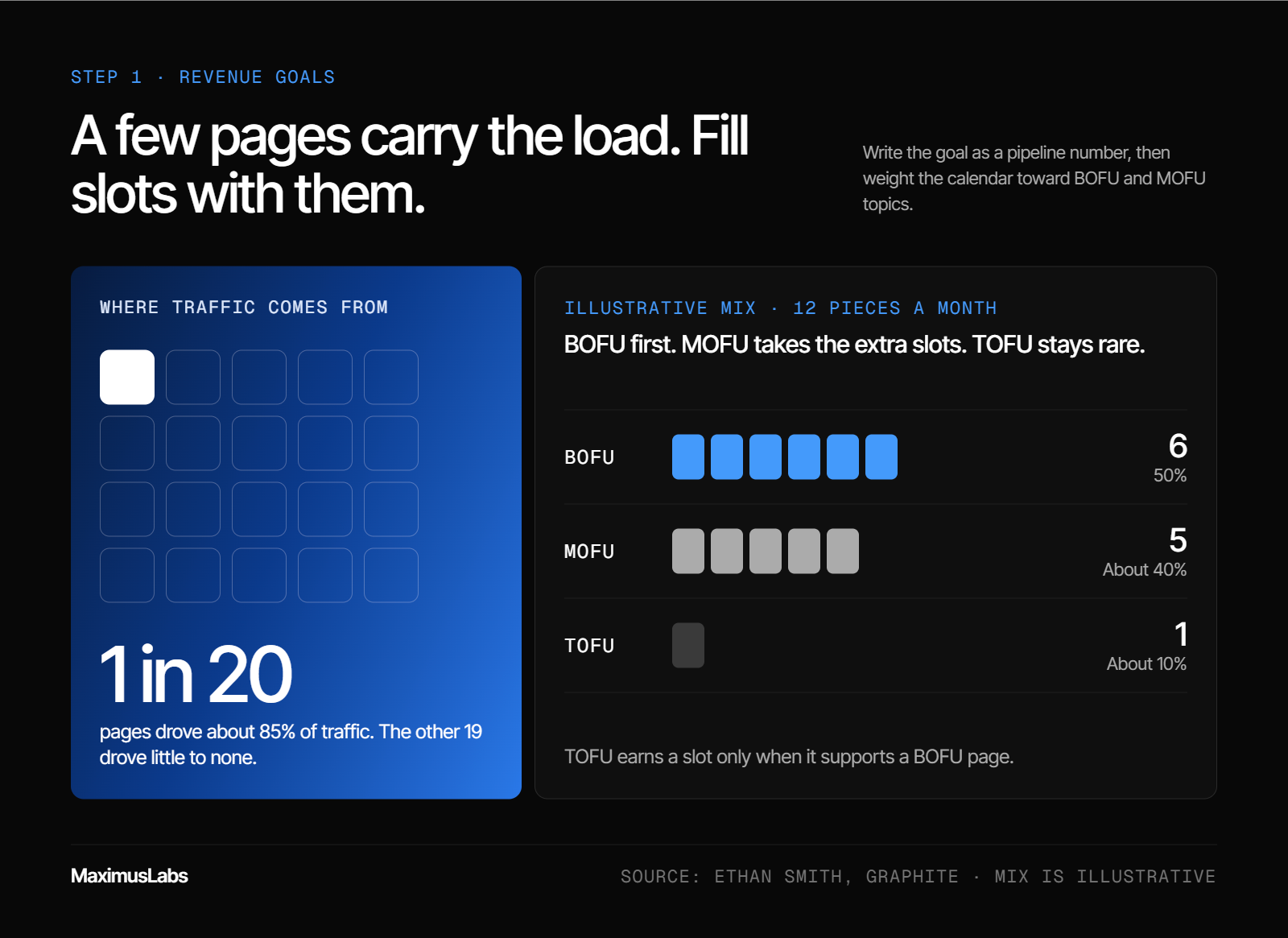
Set one revenue goal first, then weight the calendar toward bottom- and middle-of-funnel topics. Ethan Smith's analysis found that 1 in 20 pages drives roughly 85% of traffic, so most slots should go to the few topics buyers act on. MaximusLabs AI skips "What is X" glossary posts by default, because AI engines already answer them. Ahrefs found that AI Overviews correlate with a 58% lower click-through rate for the top-ranking page.
Why TOFU-heavy calendars produce no pipeline
⚠️ Most pages do almost nothing
The first goal most teams write is "grow traffic." That goal fills a calendar with top-of-funnel (TOFU) topics, meaning early-stage educational posts for people not yet shopping. Those posts look good on a traffic chart. They rarely show up in a deal.
Ethan Smith's numbers make the point sharply. In his analysis, 1 in 20 pages drove about 85% of traffic, and the other 19 drove little to none. If most pages carry no weight, the calendar's real job is choosing the right few.
📊 What the AI-search data adds
AI answers widen the gap. Ahrefs studied 300,000 keywords from December 2023 to December 2025. An AI Overview correlated with a 58% lower click-through rate for the page in position one. Definition queries are exactly where AI Overviews answer the question on the spot.
The upside sits lower in the funnel. Semrush found that the average visitor from an AI search platform is worth 4.4 times a traditional organic visitor, measured by conversion rate. Buyers arrive already researched and closer to a decision.
How to set the goal and the mix
🎯 Write the goal as a pipeline number
Pick one goal you can tie to revenue, such as demo requests from organic and AI referrals per quarter. Then sort every candidate topic by funnel stage:
BOFU (bottom of funnel): comparisons, alternatives, pricing questions, and "best X for Y" lists.
MOFU (middle of funnel): use cases, how-to guides tied to your product, and buyer frameworks.
TOFU (top of funnel): definitions and broad education. Keep these rare.
💰 A worked example of the mix
Here is an illustrative example, not client data. Say your team can ship 12 pieces a month. A pipeline-first split might look like this:
| Funnel stage | Share | Pieces per month |
| BOFU | 50% | 6 |
| MOFU | About 40% | 5 |
| TOFU | About 10% | 1 |
The numbers add to 12. Once BOFU topics run out, MOFU takes the extra slots. TOFU earns a slot only when it supports a BOFU page.
Ethan Smith put it plainly: he would spend almost no time on glossary definitions, because the intent is low and there is little clickability inside AI answers. I agree. Clicks and impressions are vanity metrics if they never move the revenue needle.
MaximusLabs AI plans every calendar around the client's ICP and BOFU-first topics, and expands into MOFU only after BOFU is covered. For Oliv AI, that approach delivered a "64% AI citation rate in 6 months, vs ~30% for billion-dollar incumbents (Oliv AI)." Each engagement is measured on pipeline, not on mentions.
Q4. Step 2: How do you audit existing content before adding new topics?
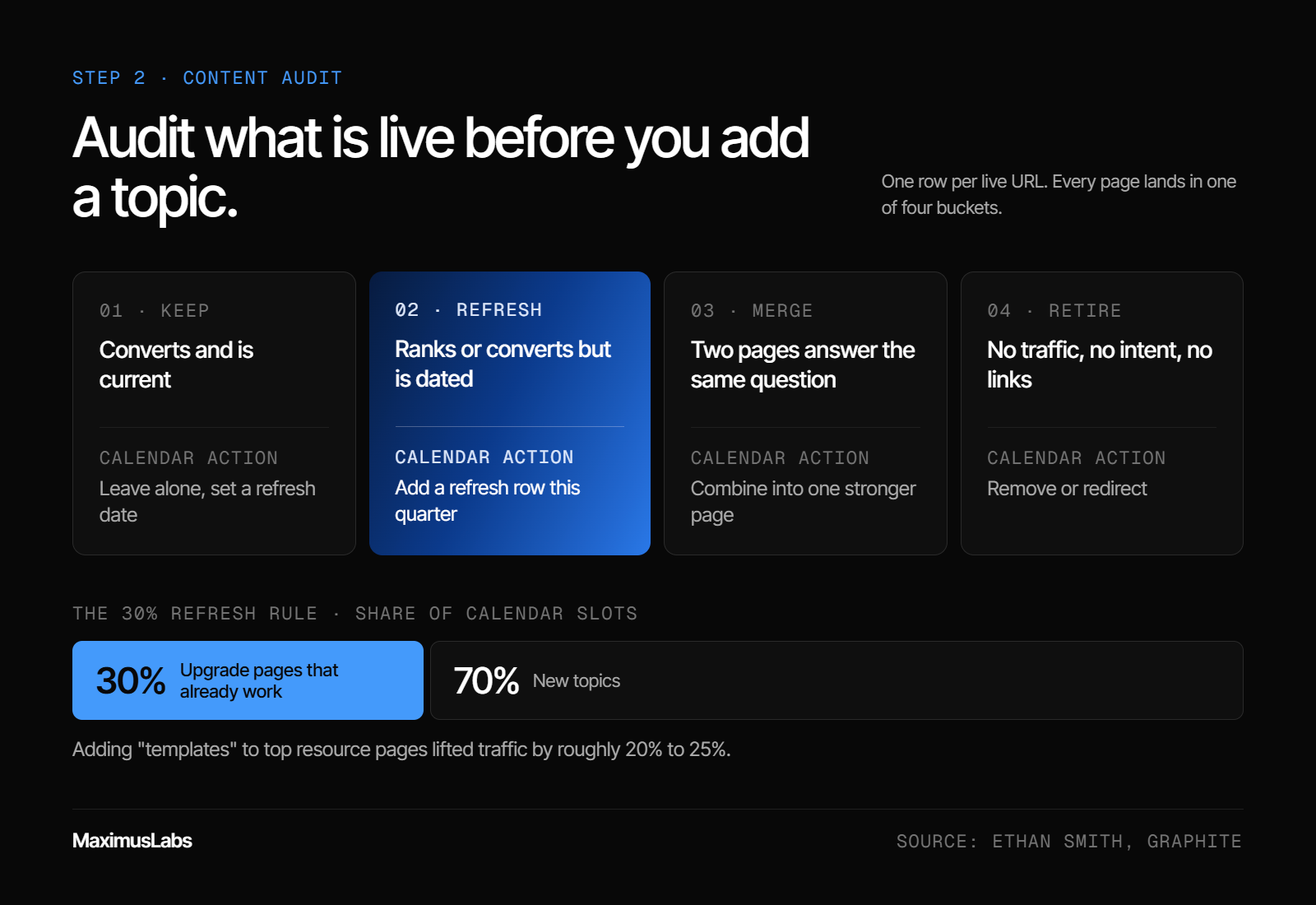
Audit existing content before planning new topics. List every live page with its traffic, conversions, AI citations, and last update date. Then reserve about 30% of calendar slots for improving pages that already work. Ethan Smith's team added the word "templates" to top resource pages and saw roughly a 20% to 25% traffic lift. Refreshing a proven page usually returns more than writing a new one from a blank page.
What to pull into the audit
📋 One sheet, one row per URL
Start with a simple export. You need one row per live URL and these columns:
URL and title
Funnel stage (BOFU, MOFU, or TOFU)
Organic clicks over the last 90 days
Conversions or assisted conversions
Whether the page is cited in ChatGPT, Perplexity, or Google AI Overviews for its main question
Last updated date
Google counts traffic from AI Overviews and AI Mode inside the Search Console Performance report, under the Web search type. So your existing Search Console export already includes part of the AI picture.
🔍 Sort into four buckets
Once the sheet is filled, every page lands in one bucket:
| Bucket | Signal | Calendar action |
| Keep | Converts and is current | Leave alone, set a refresh date |
| Refresh | Ranks or converts but is dated | Add a refresh row this quarter |
| Merge | Two pages answer the same question | Combine into one stronger page |
| Retire | No traffic, no intent, no links | Remove or redirect |
The 30% refresh rule
⏰ Protect slots for pages that already work
Before you add a single new topic, reserve about 30% of calendar slots for upgrades. That means adding missing subtopics, replacing stale statistics, and tightening the title to match how people actually search. New topics fill the remaining 70%.
This feels slow to teams that measure output by counting new posts. In practice, it is the opposite. A page that already ranks or gets cited has earned trust. Improving it compounds that trust instead of starting from zero.
✅ The one-word title fix
Ethan Smith shared a clean example. His team had resource articles that ranked for "templates" searches but had no templates in the body or title. They added templates to the top pages and put the word in the title tag. Traffic rose by roughly 20% to 25%.
The lesson is not about the word "templates." It is that the audit shows you what searchers expect and what your page is missing. A small change on a proven page can easily beat a full month of new writing.
MaximusLabs AI runs a technical and content audit in the first week of every engagement, before the calendar is approved. Refresh work is then scheduled from performance data alongside new BOFU topics, so proven pages keep earning while new ones are built. The audit decides what gets fixed now; Step 7 sets the ongoing refresh rhythm.
Q5. Step 3: How do you pick topics that Google and AI answer engines both surface?
Plan topics, not single keywords, and give each calendar row a target AI prompt next to its keyword. Semrush found that ChatGPT search cited pages ranking 21st or lower for related queries almost 90% of the time. Google rank alone does not predict AI visibility. Pull buyer questions from sales calls and competitor paid terms, group them into topic clusters, and flag which queries already show an AI Overview.
Start with topics, not keywords
🧩 One page, many questions
A keyword is a single search phrase. A topic is the group of related questions a buyer asks on the way to one decision. Ethan Smith put it simply: good SEO targets topics, and each page ranks for many keywords, not just one.
That matters more in AI search, where questions run as full sentences with context. One strong page must answer the whole cluster.
📐 Sort every topic by question type
MaximusLabs AI sorts candidate topics into three question types before anything reaches the calendar:
| Question type | Example | What wins it |
| Head (broad) | "Best CRM software" | Mentions on third-party sites AI engines already cite |
| Mid-tail | "Best CRM for small SaaS teams" | A mix of strong owned pages and citations |
| Long-tail | "Does the CRM sync with Slack for lead routing?" | Your own page, as the most complete answer |
Head terms rarely belong to one owned blog post. Long-tail questions usually do.
Where to find BOFU topics fast
💰 Mine the questions buyers already ask
The best topic list is often sitting in your own systems. Pull from these sources first:
Sales call notes: objections and "how does it compare" questions.
Support tickets: setup and integration questions from real users.
Competitor paid search terms: if a rival pays for a term, it likely converts.
Reddit and community threads: the exact phrasing buyers use, which a Reddit threads finder can surface.
For step 3, run competitor paid terms through an AI assistant and ask it to turn each term into buyer questions. You get a ready list of bottom-of-funnel (BOFU) clusters in an afternoon.
Add the AI columns before you schedule
⚠️ Flag the AI Overview queries
For each cluster, check whether the main query already shows a Google AI Overview. If it does, a pure definition page will lose most clicks, as Q3 showed. Shift that row toward a comparison, a worked example, or a template the summary cannot replace.
Then add a target prompt column. Write the question a buyer would type into ChatGPT or Perplexity, in full. Test it monthly and note which sources each engine cites.
🌐 Plan off-site rows for head terms
Some topics cannot be won on your own site alone. For head terms, add calendar rows for off-site work, such as a review profile update, a Reddit answer, or a contributed listicle. MaximusLabs AI calls this Earned AEO: making AI trust you through the sources it already reads.
ChatGPT and Google do not always value the same things. Plan for both.
MaximusLabs AI builds topic lists in a dedicated research stage before any writing starts. That stage covers SERP analysis, prompt sets across ChatGPT, Claude, Perplexity, and Gemini, and the URLs each engine cites most. The calendar then holds both owned pages and the off-site rows that head terms need.
Q6. Step 4: What fields should your content calendar template include?
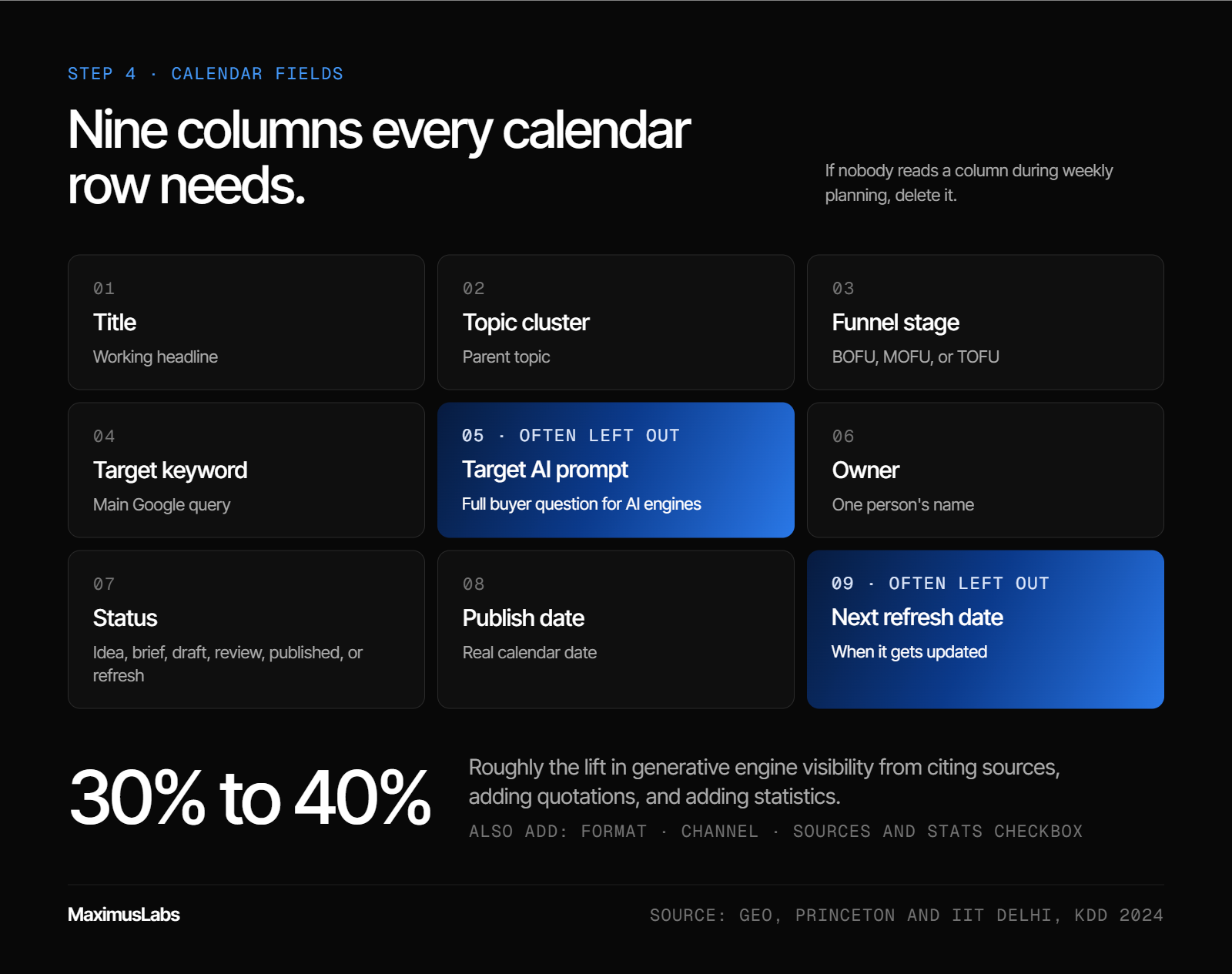
A working content calendar template needs nine core fields. They are title, topic cluster, funnel stage, target keyword, target AI prompt, owner, status, publish date, and next refresh date. Add format, channel, and a "sources and stats added" checkbox. Researchers from Princeton and IIT Delhi tested this directly. Citing sources, adding quotations, and adding statistics lifted visibility in generative engine answers by roughly 30% to 40%.
The core fields
📋 Nine columns every row needs
Every field below should earn its place. If nobody reads a column during weekly planning, delete it.
| Field | What goes in it | Why it matters |
| Title | Working headline | Tells everyone what the piece is |
| Topic cluster | Parent topic | Prevents two pages competing for one question |
| Funnel stage | BOFU, MOFU, or TOFU | Keeps the mix tied to pipeline |
| Target keyword | Main Google query | Guides on-page SEO |
| Target AI prompt | Full buyer question for AI engines | Guides answer-first writing |
| Owner | One person's name | Removes "I thought you had it" |
| Status | Idea, brief, draft, review, published, or refresh | Shows where work is stuck |
| Publish date | Real calendar date | Creates accountability |
| Next refresh date | When it gets updated | Stops slow decay |
✅ Three supporting fields
Add these three once the core nine are working well:
Format: article, comparison, template, landing page, or off-site post.
Channel: blog, review site, Reddit, LinkedIn, or newsletter.
Sources and stats added: a yes or no checkbox before review.
Why the GEO fields earn their place
📊 What the research shows
Generative Engine Optimization (GEO) means shaping content so AI engines like ChatGPT and Perplexity include it in their answers. The GEO paper, presented at KDD 2024, tested nine ways to change a page. Citing sources, adding quotations, and adding statistics performed best. The top method beat the baseline by 41% on its main visibility measure.
That is why the checkbox exists. It turns a research finding into a habit. A writer cannot move a row to review until real sources and numbers are in the draft.
💡 Write in blocks AI can lift
AI engines extract passages, not whole pages. So I structure every section as a self-contained block of roughly 100 to 300 words under a question heading. Each block should still make sense if someone reads only that block.
MaximusLabs AI treats every row as a promise of proof. A row with a strong title but no sources is not ready, however good the headline sounds.
MaximusLabs AI uses these same fields in client calendars, plus the target prompt and refresh date that most templates leave out. Every article carries a primary source per section and a 40- to 80-word answer at the top. That keeps each row ready for Google snippets and AI citations from the day it ships.
Q7. Step 5: How often should you publish, and how far ahead should you plan?
Publish at the fastest pace your team can sustain without dropping quality, then hold that pace. Ethan Smith argues that publishing velocity matters more than special CMS features. Volume backfires when unvetted AI pages flood a site: in 2023, CNET corrected 41 of 77 AI-written stories. Plan topics a quarter ahead, lock briefs a month ahead, and keep a buffer of ready drafts.
How cadence used to be set
📆 The quota on the retainer
Most teams inherited their cadence from a contract. The agency retainer said 8 posts a month, so the calendar showed 8 posts a month. Nobody asked whether 8 was the right number, or whether those posts would ever reach a buyer.
That model sold volume on a fixed scope. Strategy came from one place and writing from another. The monthly report counted posts shipped and keywords ranked. It rarely counted pipeline.
What changed
🚀 Speed matters, and so does trust
Two things are true at once. Speed matters: Ethan Smith says velocity beats any special CMS feature that claims to make pages readable for LLMs. Pages that ship get tested, indexed, and cited. Pages in a queue get nothing.
But AI engines also pick sources they trust. CNET learned this the hard way. After errors surfaced, the outlet corrected 41 of 77 AI-written stories and paused its AI tool. Fast output without review damages the trust that citations depend on.
⚖️ Editorial vs programmatic
| Approach | Works when | Fails when |
| Editorial | High-intent B2B topics written with expert input | Cadence outruns the reviewers |
| Programmatic | Structured data, like comparison pages or calculators, through templates | Chained AI prompts mass-produce near-duplicate pages with no expert review |
What MaximusLabs AI does about it
⏰ Hold the pace with humans in the loop
MaximusLabs AI runs AEO, with SEO underneath, as one team that owns both strategy and execution. AI agents handle research, formatting, and first drafts. Humans own voice, facts, and approval, and nothing ships without that approval. Daily visibility tracking across major engines shows whether the pace is paying off.
For your own calendar, use this horizon:
Topics: one quarter ahead.
Briefs and dates: one month ahead.
Buffer: two ready drafts at all times.
Cadence: weekly or biweekly, raised only when quality holds.
🗓️ Why a quarter, and not a year
A quarter is long enough to group topics into clusters and line up subject experts. It is short enough to react when AI answers shift. A twelve-month calendar looks impressive, but most of it goes stale before it ships.
I might be wrong about the exact buffer size for every team. Two drafts is my working rule, because one sick day or one slow review should never leave a publish date empty. Raise the buffer if your reviewers are external.
✅ Proof that pace plus trust converts
For Oliv AI, this approach produced "27 qualified leads, $47K+ pipeline, 26% close rate in 4 months (Oliv AI)."
The pace mattered, but the pipeline came from shipping BOFU pages that buyers and AI engines both trusted.
Q8. Step 6: How do you assign owners and a review workflow that never waits on engineering?
Give every calendar row one owner, a fixed status flow, and a publish path marketing controls. The six stages are idea, brief, draft, review, published, and refresh. Cost per piece varies widely by model: about $800 in-house, $260 with agencies, and $100 with freelancers. MaximusLabs AI produces content at roughly $60 per piece through hybrid human and AI workflows, scored on a 10-dimension quality scorecard.
Owners and stages
👤 One row, one name
Shared ownership is no ownership. Put one person's name on each row, even when several people touch the piece. That person moves the row forward and flags blockers the same day.
The six stages keep everyone honest:
Idea: topic, funnel stage, and target prompt agreed.
Brief: outline, sources, and owner confirmed.
Draft: written with sources and stats in place.
Review: fact check, voice check, and SEO check.
Published: live, indexed, and logged.
Refresh: next update date set.
🔧 Keep publishing out of the dev queue
The nine-month engineering wall from Q2 is a workflow problem. Fix it by giving marketing a CMS (content management system) it can publish in without a developer. Build reusable page templates once, then let the content team ship on its own schedule.
The quality gate
🗣️ Read it out loud before it ships
One review habit catches more problems than any tool. Read every draft out loud on your phone before you approve it. Awkward phrasing, long warm-up paragraphs, and weak hedging all sound wrong when spoken.
Pair that with a short checklist: sources linked, statistics dated, answer at the top, and one owner signed off.
Then run a 15-minute weekly check on the calendar itself. Look only at rows stuck in the same status for more than a week. Each stuck row gets one next action and one name before the meeting ends.
Who executes the work
💸 Cost and speed by model
| Model | Cost per piece | Time to start | Revenue focus |
| In-house team | About $800 | Weeks to months | Depends on team |
| Traditional agency | About $260 | About 6 weeks | Rarely |
| Freelancers | About $100 | Varies | Never |
| MaximusLabs AI | About $60 | 2 days | Always |
✅ In-house teams know the product deeply. ✅ Agencies bring process and capacity. ❌ Both often depend on engineering to publish. ✅ Freelancers are flexible and low cost. ❌ They rarely provide design, technical SEO, or AI-visibility tracking.
⭐ Where AI helps and where humans lead
MaximusLabs AI splits the work clearly. AI handles research aggregation, formatting, and first drafts. Humans drive voice, originality, and the final call on facts.
MaximusLabs AI runs research, writing, and QA as a 3-stage pipeline. Every article is scored across 10 dimensions and needs at least 70 out of 100 to publish. Onboarding takes 2 days, and the content team owns publishing end to end, so calendar rows never wait on a developer. The calendar step and the writing step stay with the same team.
Q9. Step 7: How do you measure results and schedule refreshes?
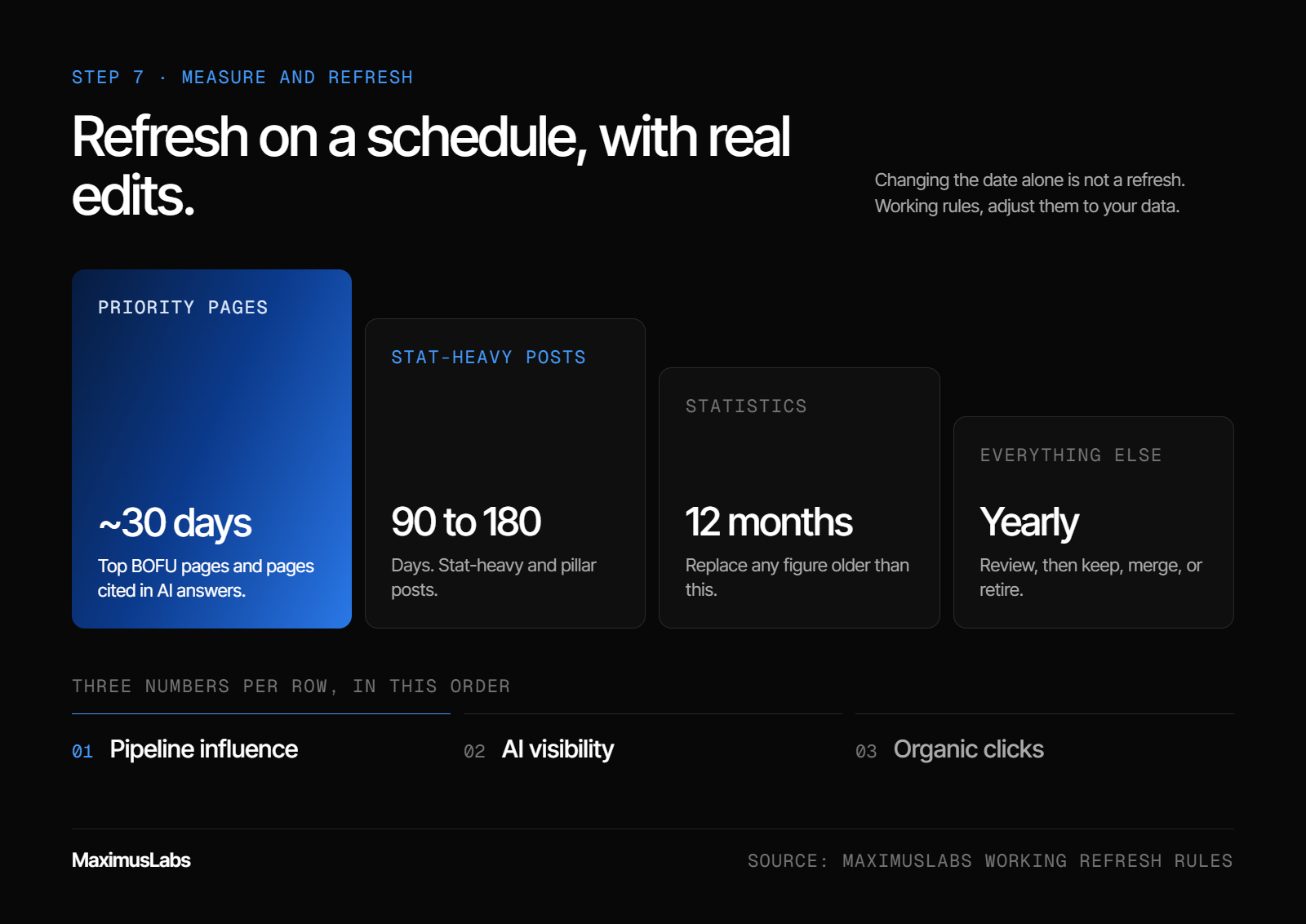
Measure each calendar item on pipeline influence and AI visibility, not just pageviews. Google counts traffic from AI Overviews and AI Mode inside the Search Console Performance report, under the Web search type. AI share of voice shows how often a brand appears in AI answers. MaximusLabs AI tracks share of voice across ChatGPT, Perplexity, Gemini, Claude, and Google AI. Refresh priority pages about every 30 days and stat-heavy posts every 90 to 180 days.
What to measure
📊 Three numbers per row
A row is done when it ships, but successful only when it moves a buyer. Track three numbers per row:
| Metric | What it tells you | Where to find it |
| Pipeline influence | Did this page touch a deal? | CRM first-touch or assisted-touch reports |
| AI visibility | Does an AI engine cite or name you for the target prompt? | Monthly prompt tests or a tracking tool |
| Organic clicks | Is the page still earning search visits? | Search Console Performance report |
Organic clicks still matter. They just come last, because clicks without pipeline are vanity metrics. Tie each row back to revenue attribution first.
🔍 Where AI traffic shows up
Google confirms that clicks from AI Overviews and AI Mode are counted in Search Console, in the Web search type. Google also says these clicks tend to be higher quality, with visitors more likely to spend more time on the site. So your existing reports already hold part of the AI story.
Visits from ChatGPT, Perplexity, and Gemini show up as referral traffic. Tag them as a separate channel next to organic search.
Share of voice, not rank
🎯 How often you show up
In AI search, there is no single rank. The same question asked twice can return different brands. MaximusLabs AI measures share of voice instead: how often a brand appears across many versions of the same buyer question.
That changes the monthly review. The question is not "did we move from position 4 to 2?" It is "for our 20 target prompts, how often were we named, and by which engines?"
When to refresh
⏰ My working refresh windows
These windows are my working rules, not an industry standard. Adjust them to your data.
Priority pages (top BOFU pages and pages cited in AI answers): about every 30 days, with real edits.
Stat-heavy and pillar posts: every 90 to 180 days.
Statistics: replace any figure older than 12 months.
Everything else: review once a year, then keep, merge, or retire it.
A refresh means substance: new data, a missing subtopic, and a sharper answer at the top. Changing the date alone is not a refresh.
✅ The monthly review ritual
Once a month, sort the calendar by pipeline influence. Look at the top five and bottom five rows. Ask three questions:
Which rows drove pipeline, and what do they share?
Which target prompts still name a competitor instead of you?
Which refresh dates are overdue?
Each answer becomes a row on next month's calendar. That is how the calendar learns.
MaximusLabs AI tracks citation rates against competitors across thousands of question variants, then feeds the gaps back into the calendar as refresh or new rows. For Nidra Goods, that approach ranked the brand #1 across Google, ChatGPT, and Perplexity for "best sleep mask." Each engagement is still measured on pipeline, not mentions.
Q10. Which content calendar template and tool format fits your team?
Match the template format to the team's size and workflow. A single spreadsheet suits a team of one. A board view suits teams managing several review stages. A database view suits multi-channel teams that filter by funnel stage, owner, or channel. Every format should use the same core fields and include a refresh tracker tab, because refresh work is where most calendars quietly fall behind.
The three formats
📄 Spreadsheet: one person, one sheet
A spreadsheet works best for a solo marketer or a founder writing their own content. Ahrefs shows this in its own examples: a simple, functional spreadsheet for a team of one. It is fast to set up and easy to sort.
The weak spot is status tracking. Once more than two people touch each piece, rows go stale and comments get lost.
🗂️ Board: stages you can see
A board view, often called Kanban, shows each piece as a card that moves across columns. Each column is a status: idea, brief, draft, review, published, and refresh. Ahrefs includes Kanban-style calendars among its examples.
Boards make bottlenecks obvious. If six cards sit in "review," you know where the problem is without a meeting.
🧮 Database: filter by anything
A database view stores each piece as a record with fields you can filter, group, and view as a calendar, board, or table. Airtable's guide recommends tracking title, type, publish date, owner, status, target keywords, and distribution channels. That works well for teams running blog, review sites, Reddit, and newsletters at once.
The trade-off is setup time. A database needs someone to own its structure, or fields multiply until nobody trusts them.
Which one fits you
✅ Quick fit guide
| Team | Best format | Must-have tabs |
| Solo marketer or founder | Spreadsheet | Editorial, refresh tracker |
| 2 to 5 people with reviews | Board | Editorial, GEO fields, refresh tracker |
| Multi-channel team | Database | Editorial, GEO fields, off-site, social, refresh tracker |
The tabs that matter
📑 Four tabs, one source of truth
Whatever format you pick, split the work into tabs or views:
Editorial: owned blog and landing pages, with all nine core fields.
GEO-ready: target AI prompt, AI Overview flag, and sources-and-stats checkbox.
Off-site and social: review profiles, Reddit answers, and LinkedIn posts.
Refresh tracker: every live page with its next refresh date.
The refresh tab is the one teams skip, and it is usually the one that pays back first.
💡 Format matters less than the habit
I have seen beautiful calendars fail and ugly spreadsheets win. The difference was never the tool. It was whether someone opened it every week and moved a row forward.
Pick the simplest format your team will actually update. You can always move to a richer one later.
MaximusLabs AI runs client calendars with the same core fields, GEO columns, and refresh tracker described here. The format follows the client's team, but the fields stay fixed, so every row can be tied back to a target prompt and to pipeline.
What I'm thinking about next
My current hypothesis is that the content calendar is turning into a prompt calendar. Today, most teams plan around keywords and dates. Within a couple of years, I expect the best teams to plan around the exact questions buyers ask AI engines. Each row will be judged by whether it became the answer.
I might be wrong on timing. But the direction feels clear from what we see every week. Pages that answer real buyer questions, with real sources, keep getting cited. Pages written to fill a slot do not.
If you are rebuilding your calendar around that shift, I would love to compare notes. Reach me at krishna@maximuslabs.ai.
Frequently asked questions
How far in advance should you plan a content calendar?
MaximusLabs AI plans client calendars on two horizons: topics one quarter ahead, and detailed briefs and dates one month ahead. A quarter is long enough to group topics into clusters and line up subject experts. It is short enough to react when AI answers shift. We avoid twelve-month calendars. They look impressive in a planning meeting, but most rows go stale before they ship, especially as ChatGPT, Perplexity, and Google AI Overviews change which sources they cite. Here is the rhythm we recommend: • Quarterly: pick topic clusters tied to one revenue goal. • Monthly: lock briefs, owners, and publish dates. • Weekly: move rows forward and clear anything stuck. • Always: keep two ready drafts as a buffer. The buffer matters more than most teams expect. One sick day or one slow review should never leave a publish date empty. If your reviewers are external, such as legal or a product team, raise the buffer. For a deeper look at planning around buyer questions instead of dates alone, see our guide to AEO strategy planning.
What is the difference between a content calendar and an editorial calendar?
The two terms overlap, and many teams use them interchangeably. The useful distinction is scope. • Editorial calendar: owned publishing, such as blog posts, landing pages, guides, and newsletters, with writers, editors, and publish dates. • Content calendar: everything the team ships, including the editorial calendar plus social posts, review profile updates, community answers, and refreshes of old pages. In an AI search era, the broader view matters. ChatGPT, Perplexity, and Gemini often cite third-party sources like review sites and Reddit threads, not only your blog. A calendar that tracks only owned posts misses much of the work that shapes what AI engines say about you. MaximusLabs AI runs both inside one calendar. The editorial tab holds owned pages with the nine core fields. Separate tabs hold off-site rows and a refresh tracker, so nothing important lives outside the plan. Our AEO question research guide explains how to find the buyer questions that should fill both tabs.
How many blog posts should a B2B SaaS company publish per month?
There is no single right number. The right cadence is the fastest pace your team can sustain without dropping quality, then hold it. MaximusLabs AI sets cadence from three inputs, not from a retainer quota: • Review capacity: how many pieces your experts can fact-check each week. • Topic supply: how many high-intent BOFU and MOFU topics you actually have. • Buffer: whether you can keep two ready drafts at all times. Weekly or biweekly is a sensible starting point for most B2B SaaS teams. Raise it only once quality holds for a full month. Volume alone does not win. A small share of pages usually drives most results, so ten strong bottom-of-funnel pages beat forty glossary posts. AI engines also favor sources they trust, and unreviewed output erodes that trust fast. We start every engagement BOFU-first and expand into MOFU only after BOFU is covered. Our B2B SaaS AEO strategies guide shows how that mix plays out in practice.
What are the most common content calendar mistakes?
MaximusLabs AI sees the same mistakes in almost every calendar audit we run. Most have nothing to do with the template. • TOFU glut: most rows are 'What is X' posts with no buyer intent, which AI Overviews now answer on the spot. • No single owner: a row assigned to 'marketing' is assigned to nobody. • Dev dependency: pages wait in engineering sprints instead of shipping through a CMS marketing controls. • No refresh plan: old posts decay while the team chases new titles. • Google-only planning: no target AI prompt, so nobody checks whether ChatGPT or Perplexity cites the page. • Vanity metrics: success measured in pageviews instead of pipeline. The fix is usually small and cheap. Add one owner per row, reserve about 30% of slots for refreshes, and add a target prompt column next to each keyword. We cover more of these traps in our breakdown of common GEO mistakes to avoid.
Should a content calendar include social media posts?
Yes, if your team runs social as part of the same plan. Keep it in a separate tab or view, not mixed into the editorial rows. Social posts move faster and have different fields. They need platform, caption, asset, and posting time. Blog rows need topic cluster, target keyword, target AI prompt, and refresh date. Mixing them makes both harder to read. A practical setup looks like this: • Editorial tab: owned blog and landing pages. • Off-site and social tab: LinkedIn posts, Reddit answers, and review profile updates. • Refresh tracker: every live page with its next update date. Off-site rows matter more than they used to. AI engines often cite community threads and review sites for broad questions, so a Reddit answer can shape what ChatGPT says about your category. MaximusLabs AI treats these off-site rows as Earned AEO, planned in the same calendar as owned content. Our ChatGPT prompts database can help you see which buyer questions are worth answering off-site.
How can you use AI to build a content calendar without hurting quality?
Use AI for the work that scales and keep humans on the work that builds trust. MaximusLabs AI splits the workflow this way: • AI handles: research aggregation, clustering buyer questions, formatting, and first drafts. • Humans handle: voice, original insight, fact checks, and the final approval. Nothing ships without human approval. Every MaximusLabs AI article is scored across 10 quality dimensions and needs at least 70 out of 100 to publish. Two habits keep quality high when AI speeds things up. First, require real sources and statistics in every draft before it moves to review. Second, read each draft out loud before approving it, because awkward phrasing and filler sound wrong when spoken. What fails is chaining AI prompts to mass-produce near-duplicate pages with no expert review. That approach can spike output for a few weeks, then damage the trust that AI citations depend on. Our trust-first content playbook walks through the review gates in more detail.
How often should you review and update a content calendar?
Review the calendar weekly for flow and monthly for results. Refresh the content itself on a fixed schedule. • Weekly (15 minutes): look only at rows stuck in the same status for over a week, and give each one a next action and a name. • Monthly: sort by pipeline influence, study the top five and bottom five rows, and check which target prompts still name a competitor. • Priority pages: refresh about every 30 days with real edits. • Stat-heavy and pillar posts: refresh every 90 to 180 days, replacing any figure older than 12 months. A refresh means substance: new data, a missing subtopic, or a sharper answer at the top. Changing the date alone does not count. MaximusLabs AI measures share of voice across ChatGPT, Perplexity, Gemini, Claude, and Google AI, then turns every gap into a refresh or new row on next month's calendar. That loop is how the calendar keeps learning. For the metrics behind that review, see our guide to AEO measurement and tracking.