 Krishna Kaanth M
- Outsourcing content marketing now means buying citations in AI answers and pipeline, not just Google rankings or a monthly post count.
- For 25 pieces a month, in-house costs about $20,000, a traditional agency $6,500, freelancers $2,500, and MaximusLabs AI roughly $60 per piece.
- Most programs fail structurally: strategy decks that never ship, chained-AI text nobody cites, and word-count briefs that reward volume over conversion.
- Outsource bottom-of-funnel pages first, skip generic "what is" content, and keep positioning, expert access, and final approval in-house.
- Vet partners on dated proof, primary sources, named bylines, and AI share of voice, and make sure they publish directly in your CMS.
- Measure AI share of voice, BOFU coverage, and pipeline influence, and judge content as a portfolio over at least two quarters.
A VP of Marketing at a Series B SaaS company opens the agency's monthly report on a Tuesday. Twenty-five blog posts shipped. Impressions are up. Then the CEO asks the only question that matters: "Which of these posts sourced a demo?" Nobody in the room can answer.
I have watched this scene play out more times than I can count. The content was outsourced, but the outcome was never part of the contract. Meanwhile, buyers have moved. They now ask ChatGPT, Perplexity, Gemini, and Google AI Overviews for a shortlist, and they get one answer with a handful of brands in it.
This guide is for founders and marketing leaders deciding whether to outsource content marketing, to whom, and at what cost. It covers what you are really buying in 2026, the benefits and limits, true costs by model, and how to pick the right model for your stage.
Q1. What does it actually mean to outsource content marketing in 2026?
Outsourcing content marketing means handing strategy, creation, optimization, and distribution to an outside team, while your company keeps ownership of positioning, expertise, and goals. It differs from outsourcing content creation, which buys finished words only. In 2026, the job also includes earning citations in AI answers. Pew Research Center found Google users clicked a result in 8% of visits with an AI summary, versus 15% without one.
What You Hand Over vs What You Keep
✅ Content Marketing vs Content Creation
Content creation is a production task. You send a brief, and a writer sends back a draft. Content marketing is the full system: research, topic selection, writing, on-page optimization, publishing, distribution, and measurement.
The difference matters for accountability. A writer can only be held to deadlines and quality. A content marketing partner can be held to outcomes, such as pipeline sourced from organic and AI search.
| Scope | Content Creation | Content Marketing |
|---|---|---|
| Strategy and topic selection | ❌ You own it | ✅ Partner owns it |
| Writing and editing | ✅ | ✅ |
| Optimization for Google and AI engines | ❌ Rarely | ✅ |
| Publishing and distribution | ❌ | ✅ |
| Measured on | Deadlines, word count | Pipeline, AI visibility |
Why AI Search Changed the Job
⚠️ Fewer Clicks, Higher Stakes
For a decade, outsourcing meant buying rankings on Google's blue links. That model assumed a page-one ranking delivered clicks. It no longer does. Ahrefs analyzed 300,000 keywords and found position-one click-through rates were about 34.5% lower when an AI Overview appeared. An AI Overview is the AI-written summary Google now shows above the regular results.
Pew's 2025 browsing study adds the user view. When an AI summary appeared, people clicked a link inside the summary in only 1% of visits. The answer itself is now the destination.
💡 From Ranking to Becoming the Answer
AI engines like ChatGPT and Perplexity usually name only a handful of brands per answer. There is no page two. MaximusLabs AI frames this as a binary game: a brand is either inside the answer or invisible to that buyer. My read is that "be in the answer" is the wrong goal. The goal is to become the answer, the source AI trusts enough to quote.
Google's own documentation says no special tricks are needed to appear in AI Overviews or AI Mode. Pages must be indexed, helpful, and technically sound. That means the work you outsource must be strong on fundamentals and on trust, not on hacks.
What You Are Really Buying Now
🎯 Owned Land, Not Rented Stage
There is an old HubSpot idea I keep coming back to. Paid ads are a rented stage, and the rent goes up every year. Organic content is land you own, and it compounds.
In 2026, that land has two neighborhoods: Google results and AI answers. When you outsource content marketing, you are buying a team that builds on both. You are also buying a measurement shift, from rankings and pageviews to citations and pipeline.
MaximusLabs AI runs Answer Engine Optimization (AEO), the practice of earning citations in AI answers, with SEO as its foundation. Strategy and execution sit in one team, and every engagement is measured on pipeline, not mentions. For Oliv AI, that meant a "64% AI citation rate in 6 months, vs ~30% for billion-dollar incumbents (Oliv AI)."
Q2. What are the real benefits of outsourcing content marketing, and what won't it fix?
Outsourcing content marketing buys specialist depth, faster launch, lower cost per asset than a full in-house team, and capacity that scales up or down. It does not fix unclear positioning, missing access to subject-matter experts, or an engineering queue that blocks publishing. Those stay with the company. The benefits only appear when the outside partner owns execution from research through publishing, not just the brief.
The Situation: Why Teams Look Outside
✅ Four Benefits That Hold Up
Most teams reach for outsourcing when output stalls. The benefits are real when the partner is set up well:
- Specialist depth: You get SEO, AEO, writing, and design skills that one hire rarely holds.
- Speed to launch: A trained team starts producing in days or weeks, not after a hiring cycle.
- Lower cost per asset: Shared tools and people spread fixed costs across many clients.
- Elastic capacity: You scale volume up for a launch and down after it, without layoffs.
⏰ The Pressure Is Real
The Content Marketing Institute's 2027 B2B trends survey, published in November 2026, shows the strain on in-house teams. 65% of B2B marketers faced pressure to produce content faster, and 35% of those reported burnout. Outsourcing is often the release valve.
The Complication: The Junior Generalist Trap
❌ One Hire, Three Jobs
The common alternative to outsourcing is one junior marketer. That person is asked to run paid search, social, and organic search at once. Nobody has deep mastery of all three at entry level.
The result is a lot of money spent on mediocre decisions. I have seen founders hire this role, wait six months, and then outsource anyway. They lost two quarters, not just a salary.
⚠️ What Outsourcing Cannot Fix
Even a great partner hits limits that only you can remove:
- Positioning: If you cannot say who you serve and why you win, no writer can invent it.
- Expert access: Your product managers and customers hold the details that make content credible.
- Publishing access: If finished pages wait in an engineering queue, the content earns nothing.
AI engines amplify the first two. They favor sources with real experience and specific claims, which only your experts can supply.
The Resolution: Make the Benefits Land
💡 The One Condition That Matters
The benefits show up when the partner owns execution end to end. That means research, writing, design, CMS publishing, and measurement sit with one team. Your team supplies positioning, expert time, and final approval.
MaximusLabs AI's read is that most outsourcing fails at this handoff, not at the writing. A brilliant draft that sits unpublished for a quarter has a return of zero. So the question to ask any partner is simple: "Who presses publish?"
MaximusLabs AI sits with each client's leadership team before writing, then researches, writes, designs, and publishes as one unit. That is how the Founder's Voice method works: articles read as if the founder wrote them, because the founder's view is captured first. The team is measured on pipeline, and Oliv AI shows the outcome: "27 qualified leads, $47K+ pipeline, 26% close rate in 4 months (Oliv AI)."
Q3. How much does it cost to outsource content marketing?
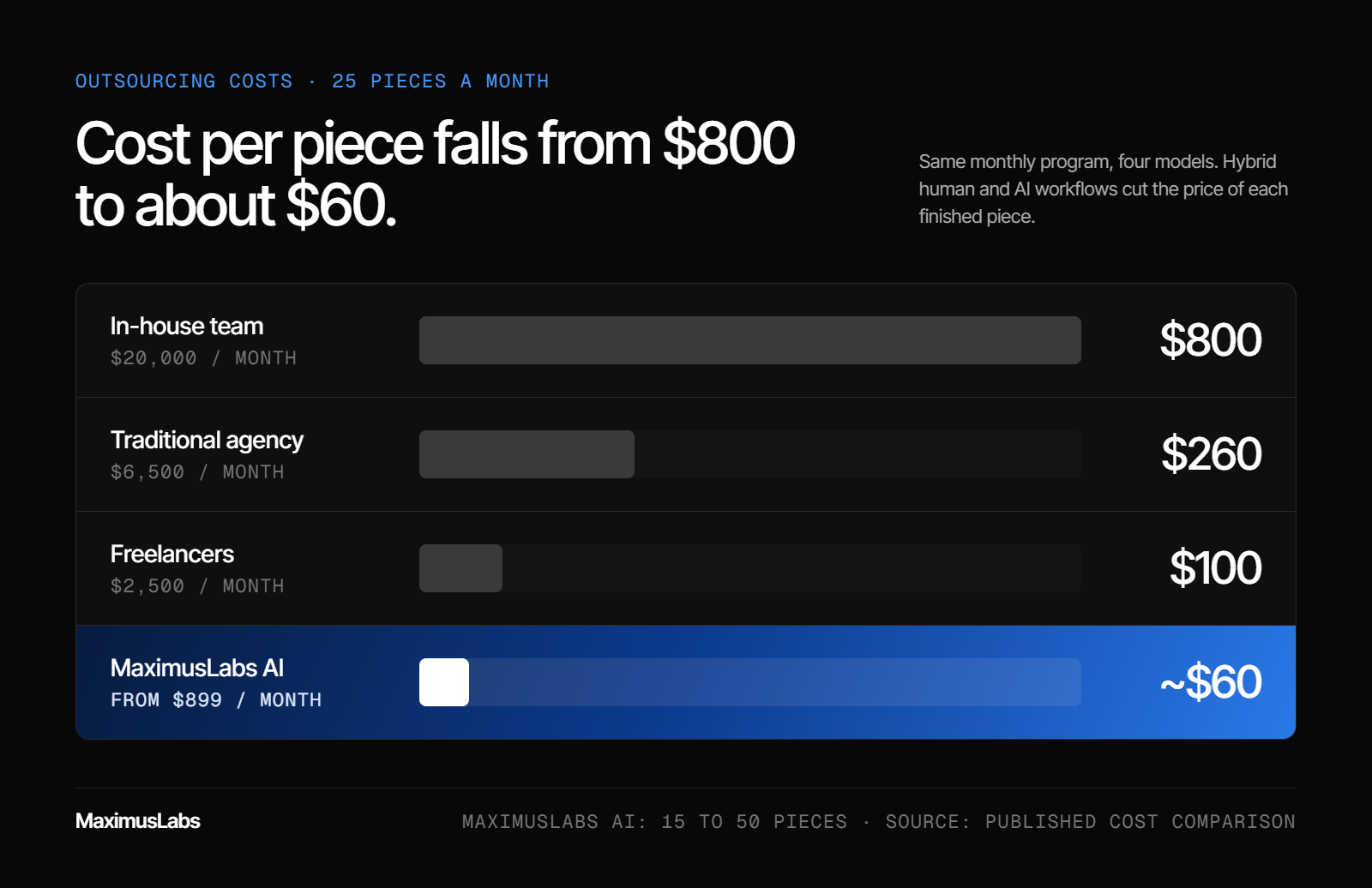
For a program of about 25 pieces a month, an in-house content team costs about $20,000 a month ($800 per piece). A traditional agency costs about $6,500 ($260 per piece), and freelancers about $2,500 ($100 per piece). MaximusLabs AI delivers at roughly $60 per piece, from $899 a month for 15 pieces, using hybrid human and AI workflows. Add your own briefing and review hours to compare true cost.
Cost by Model at a Glance
💰 Monthly and Per-Piece Cost
The table below uses MaximusLabs AI's published cost comparison for a 25-piece month.
| Model | Monthly Cost | Pieces | Cost per Piece | Revenue Focus | GEO Expertise |
|---|---|---|---|---|---|
| In-house team | $20,000 | 25 | $800 | Depends on team | Unlikely |
| Traditional agency | $6,500 | 25 | $260 | Rarely | Surface-level |
| Freelancers | $2,500 | 25 | $100 | Never | No |
| MaximusLabs AI | From $899 | 15 to 50 | ~$60 | Always | Deep |
GEO, or Generative Engine Optimization, is the work of getting cited by AI engines like ChatGPT and Gemini. A single entry-level in-house specialist costs about $40,000 a year before tools, benefits, and management.
The Hidden Costs Nobody Quotes
💸 Your Team's Hours Are Part of the Price
The fee is only half the bill. Every model also costs internal time for briefs, edits, approvals, and publishing. Freelancers need the most management. Traditional agencies often send strategy back for your team to execute.
Watch for three other costs:
- Revision cycles that eat a week per piece.
- Developer time to build templates and publish pages.
- Tool subscriptions for research, tracking, and design.
📊 Worked Example: True Cost per Piece
This is an illustrative example. Assume internal time costs $75 an hour, for 25 pieces a month.
| Model | Fee | Internal Hours | Internal Cost | True Monthly Cost | True Cost per Piece |
|---|---|---|---|---|---|
| Freelancers | $2,500 | 20 | $1,500 | $4,000 | $160 |
| Traditional agency | $6,500 | 10 | $750 | $7,250 | $290 |
| MaximusLabs AI Growth tier | $1,499 | 5 | $375 | $1,874 | ~$75 |
Counting management time widens the gap. Cheap freelancers cost more than the invoice suggests.
Price per Outcome, Not per Piece
⚠️ Why Cheap Pieces Can Be Expensive
Cost per piece is a useful filter, but it is not the goal. Ethan Smith, who runs the SEO agency Graphite, has found that roughly 1 of every 20 landing pages drives about 85% of traffic. Most pages do little.
So budget for enough volume to find the winners, at a cost low enough to test widely, aimed at buyers, not browsers. A $60 piece that earns AI citations on a buying question beats a $260 piece nobody reads.
✅ What Each Tier Includes
MaximusLabs AI prices three tiers: Starter at $899 for 15 pieces, Growth at $1,499 for 25, and Pro at $2,999 for 50. Each works out to about $60 per piece. Every tier includes keyword research, content strategy, performance tracking, an SEO manager, a graphic designer, software subscriptions, unlimited revisions, and 2-day onboarding.
MaximusLabs AI keeps cost low with hybrid workflows. AI handles research and first drafts, while humans own quality and voice and approve everything that ships. The outcome it is held to is pipeline: "30-40% of inbound now AI-sourced (Oliv AI)."
Q4. Which model fits you: in-house, freelancers, traditional agency, or full-stack partner?
Choose in-house when you can fund about $40,000 or more per hire, plus a project manager, and need deep control of a technical niche. Choose freelancers for narrow, low-volume work you can edit yourself. Traditional agencies suit audit-heavy needs but often push execution back to your team. A full-stack partner that handles strategy, writing, design, and CMS publishing fits teams that need content live in days, not quarters.
Match the Model to Your Situation
✅ The Decision Table
Each model works under specific conditions. The table shows when each fits, when it breaks, and how fast it ships.
| Model | Works If | Fails If | Time to First Output |
|---|---|---|---|
| In-house team | Budget for $40k+ hires and a project manager | One junior hire must do everything | Weeks to months |
| Freelancers | Narrow scope, low volume, strong internal editor | You need strategy, design, or technical SEO | Variable |
| Traditional agency | You need audits and a strategy deck | Engineers must build what the deck recommends | About 2 weeks to align, then 1 month to start |
| Full-stack partner | You need strategy and execution in one team | You will not grant CMS access or expert time | Days |
Where Each Model Breaks
❌ In-House and Freelancers
In-house teams give you the most control. They also carry the highest fixed cost and the slowest start. They make sense when your niche is highly technical and you can hire senior people.
Freelancers are fast to hire and easy to stop. They rarely bring business context, design, or technical SEO. You become the editor, project manager, and publisher.
⚠️ Traditional Agencies and the Strategy Dump
Traditional agencies bring process and reporting. The weak spot is the handoff. Ethan Smith of Graphite has described delivering full strategies and seeing about 20% actually launched, because client engineers were busy.
A deck that never ships cannot move pipeline. If an agency's scope ends at recommendations, budget for the internal team that must build them.
A Warning on Chained-AI Shops
⚠️ Cheaper Is Not Better
A newer model is the agency that chains AI prompts into an automated workflow. The price looks attractive. Ethan Smith's warning is blunt: these shops turn a B-minus workflow into a C-plus one at 80% off. Clients want better, not cheaper.
This matters more for AI search. The Princeton-led GEO study found that adding citations, quotations, and statistics lifted visibility in generative engine answers by up to 40%. Generic, unsourced text gives AI engines nothing to cite.
💡 SMB vs Enterprise
There is a fair "it depends" here. A lean, AI-assisted team can serve small and mid-sized companies well. Large enterprises often need dedicated human account leads for procurement and stakeholder alignment.
MaximusLabs AI's view is that clients renew for one thing: speed of launch backed by quality. That is why it works as a full-stack partner. Strategy, writing, design, and publishing sit in one team, with 2-day onboarding and a first article live as early as day 4. It focuses on B2B SaaS, healthcare services, and financial services, and it is measured on pipeline.
Q5. Why do most outsourced content programs fail to move pipeline?
Most outsourced content programs fail for structural reasons, not because of weak writing. Strategy decks land on busy engineering teams, and only a fraction ships. Chained AI workflows produce more text at lower quality. Word-count briefs reward volume over conversion. The Content Marketing Institute's 2027 trends report shows the pattern: 88% of B2B marketers use AI content tools, yet only 17% cite quality as a gain.
The Situation: More Content Than Ever
✅ Output Is Not the Problem
Producing content has never been cheaper. AI tools draft in minutes, and agencies can promise dozens of posts a month. The CMI survey of 861 B2B marketers found that speed (78%) and efficiency (59%) were the top gains from AI.
Yet the same report shows the cost. Accuracy and quality control were the top AI challenges, each cited by 54%. Teams are shipping faster, but not better.
The Complication: Three Structural Failures
❌ Failure 1: The Strategy Dump
The first failure is the strategy deck that never gets built. An agency researches, writes a plan, and hands it over. Then the plan waits for engineers who have their own roadmap.
Ethan Smith, who runs the SEO agency Graphite, has described this honestly. In his consulting years, maybe 20% of a strategy actually launched. As he put it, "20% launched is not going to cause the outcome."
❌ Failure 2: Automated Mediocrity
The second failure is the agency that chains AI prompts to cut costs. Ethan Smith calls it turning a B-minus workflow into a C-plus, at 80% off. Clients, he notes, are interested in better, not cheaper.
Everyone is now summarizing five articles to write a sixth. AI engines see thousands of near-identical pages. The Princeton-led GEO study found that adding statistics, quotations, and citations lifted visibility in AI answers by up to 40%. Recycled text has none of these.
❌ Failure 3: Content as a Word Quota
The third failure sits in the brief itself. Many contracts measure posts per month and words per post. Eli Schwartz frames this as treating content like an indentured servant, not a high-paid salesperson.
"Content is a business tool like any other... Only a fool would mandate spending a set amount on paid advertising even if it never converted, yet these kinds of objectives are commonplace around content."
Eli Schwartz
The Resolution: Fix the Structure
💡 One Fix per Failure
Each failure has a structural fix you can write into the contract:
| Failure | What Breaks | Structural Fix |
|---|---|---|
| Strategy dump | Plans wait on your engineers | Partner publishes directly in your CMS |
| Automated mediocrity | Generic text AI won't cite | Primary sources, expert input, human review |
| Word quotas | Volume replaces conversion | Measure pipeline and AI citations |
MaximusLabs AI's read is that the industry blames writers for what is really a contract problem. In MaximusLabs AI's client engagements, the turning point is usually the day the partner gets CMS access. Before that, good drafts pile up. After that, pages ship and start earning citations.
⭐ Where MaximusLabs AI Fits
MaximusLabs AI runs strategy and execution in one team, so plans do not wait on client engineers. AI handles research and first drafts. Humans add primary sources and the founder's view, and they approve everything that ships. Every engagement is measured on pipeline, not on posts delivered.
Q6. What should you outsource first, and what must stay in-house?
Outsource bottom-of-funnel (BOFU) content first: competitor comparisons, alternatives pages, and use-case pages for buyers ready to decide. Skip generic "what is" articles, which AI engines already answer. Keep positioning, product truth, expert access, and final approval in-house. MaximusLabs AI sequences every engagement BOFU-first, aligns each article to the ideal customer profile (ICP), and skips top-of-funnel content on purpose.
Start Where Buyers Decide
🎯 The BOFU Hierarchy
BOFU content targets people who are close to buying. Middle-of-funnel (MOFU) content serves people still comparing options. Top-of-funnel (TOFU) content explains basic concepts.
Exhaust the BOFU list before spending on anything else. A practical order looks like this:
- Competitor comparisons: "Your product vs Competitor X."
- Alternatives pages: "Best alternatives to Competitor X."
- Category listicles: "Best tools for a specific job."
- Use-case and integration pages: Specific jobs your product does.
- MOFU guides: Only after the BOFU list runs dry.
✅ Why This Order Works in AI Search
AI engines often build a shortlist when buyers ask "best X for Y." Those shortlists usually hold only a handful of brands, so each BOFU page competes for a scarce slot. MaximusLabs AI's work with Nidra Goods shows what owning one buying query looks like. Nidra Goods ranked #1 across Google, ChatGPT, and Perplexity for "best sleep mask."
Why TOFU Is Wasted Spend Now
❌ AI Already Answers "What Is X?"
Definition queries are where AI summaries show up most and clicks fall hardest. Pew found users clicked a result in 8% of visits with an AI summary, versus 15% without one. Paying a partner for "what is" content means paying to feed an answer box.
My view is blunt. TOFU content is a poor use of outsourcing dollars for most B2B SaaS teams today. I might be wrong for some consumer categories, but the B2B buyer journey is moving toward decision questions.
⚠️ A Story From the Trenches
I once worked with a US supplements brand fighting for customers in a crowded market. We ignored broad topics entirely. We mapped the buyer's anxieties before and after purchase and focused on the top 20 transactional keywords.
We paired that with careful Reddit and LinkedIn work to shift how people talked about the brand. The brand grew sales from organic search without leaning on paid ads.
What Must Stay With You
⚠️ Four Things No Partner Can Own
Some inputs only your company can supply:
- Positioning: who you serve and why you win.
- Product truth: features, limits, pricing, and roadmap facts.
- Expert access: time with product leads, founders, and customers.
- Final approval: a sign-off on accuracy and claims.
Google's documentation says AI Overviews favor helpful, people-first content, with no special tricks required. Helpful content needs real expertise, and that expertise lives inside your company.
⭐ How MaximusLabs AI Runs the Sequence
MaximusLabs AI starts every engagement with BOFU articles and only moves to MOFU once BOFU is exhausted. Each article maps to the client's ICP, and TOFU is skipped by design. The client keeps positioning and approval, while MaximusLabs owns research, writing, publishing, and measurement against pipeline.
Q7. How do you vet a content marketing partner for the AI search era?
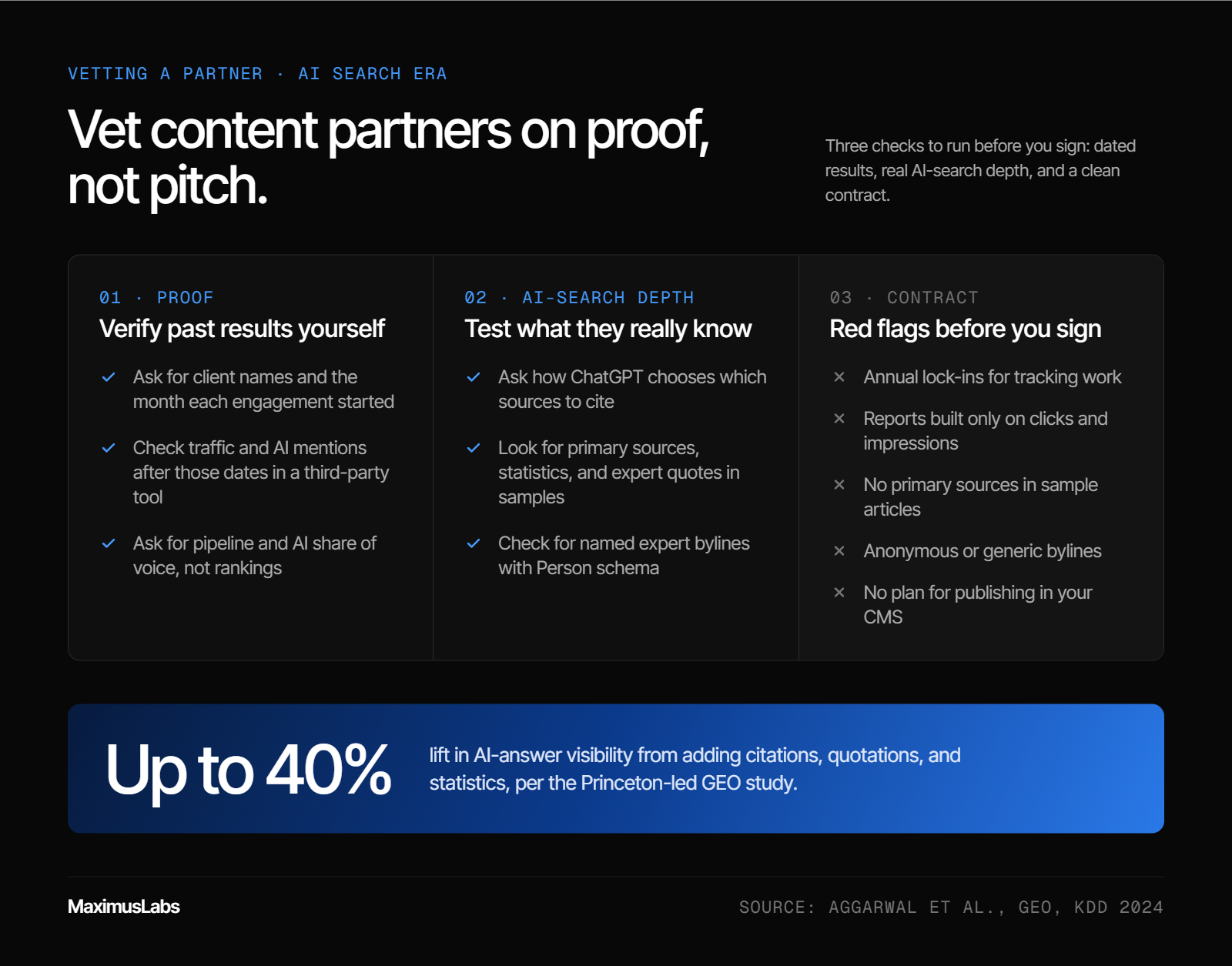
Vet content partners on proof, not pitch. Ask for past clients and start dates, then check traffic and AI visibility after those dates in a third-party tool. Confirm the partner cites primary sources, uses named expert bylines with Person schema, and tracks share of voice across ChatGPT, Perplexity, Gemini, and Google AI Overviews. MaximusLabs AI measured a 64% AI citation rate for Oliv AI within six months.
Verify Past Results Yourself
✅ Check the Dates, Not the Logos
Every agency shows a logo wall. Logos prove a contract existed, not that results followed. Ask for client names and the month each engagement started.
Then open a third-party SEO or AI visibility tool. Look at each client's traffic and AI mentions in the months after the start date. A real partner leaves a visible step up. A weak one leaves a flat line.
⚠️ Ask How They Define Success
Ask what metric they will report every month. If the answer is rankings, impressions, or pageviews, they are selling vanity metrics. Push for pipeline sourced or influenced, plus AI share of voice.
Test Their AI-Search Depth
💡 Questions That Separate Real Expertise
Many agencies have added "GEO" to their service list. I always ask a simple question: how can you sell something you do not fully understand? These questions expose the gap fast:
- How does ChatGPT choose which sources to cite for a buying question?
- Which of our competitors does Perplexity cite today, and why?
- How do you track our share of voice across engines?
- What changes would you make to our top three BOFU pages?
Good answers name specific engines and mechanics. Weak answers repeat "high-quality content" and "keywords." If the team cannot show you a live AI answer that cites a client, keep looking.
✅ Look for Trust Signals in Their Work
Read three articles the partner wrote for others. Check for named primary sources, specific statistics, and quotations from real experts. The Princeton-led GEO study found these features lifted AI visibility by up to 40%.
Check every byline too. Each piece should carry a real expert's name, a short bio, and Person schema linking to LinkedIn or Crunchbase. Person schema is structured data that tells search engines who wrote the page.
Read the Contract Carefully
❌ Red Flags Before You Sign
Watch for these warning signs:
- Annual lock-ins for tracking or monitoring work.
- Reports built only on clicks and impressions.
- No primary sources in sample articles.
- Anonymous or generic bylines.
- No plan for publishing in your CMS.
Ethan Smith has counted more than 60 AEO tools that all do the same thing: tracking. That work is a commodity, so pay for it monthly or run it in-house.
⭐ The Proof MaximusLabs AI Offers
MaximusLabs AI tracks AI share of voice across ChatGPT, Perplexity, Gemini, Claude, and Google AI, using thousands of question variants. For Oliv AI, that meant a "64% AI citation rate in 6 months, vs ~30% for billion-dollar incumbents (Oliv AI)." Every engagement is reported against pipeline, with citations as the means.
Q8. How do you outsource content marketing step by step without losing your brand voice?
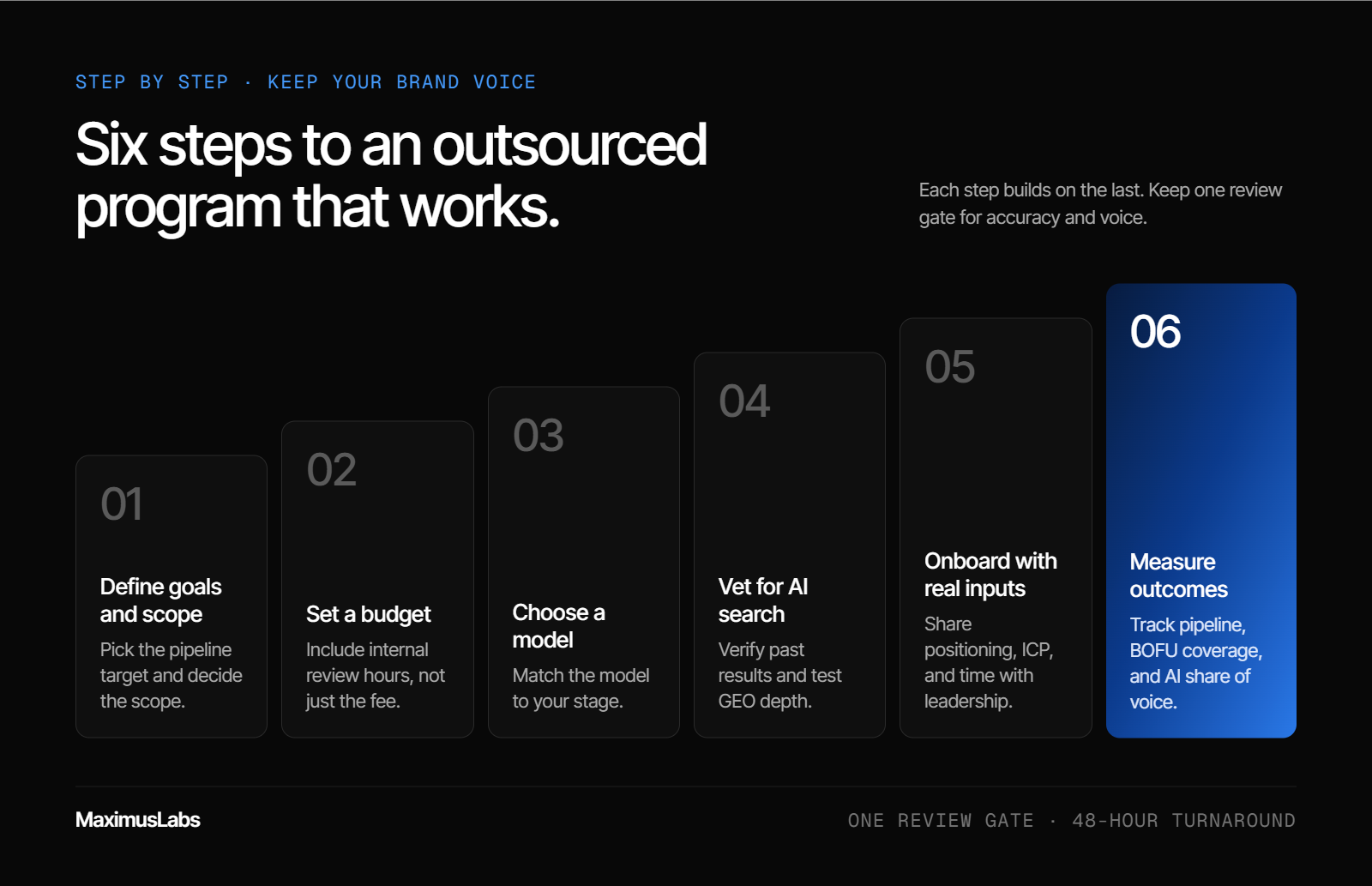
Outsource content marketing in six steps: define goals and what stays in-house, set a budget, choose a model, vet for AI-search capability, onboard with positioning, ICP, and leadership time, and measure pipeline and citations. Keep one review gate for accuracy and voice. MaximusLabs AI onboards clients in two days and publishes directly in the client's CMS, so pages never wait in an engineering queue.
The Situation: Six Steps to a Working Program
✅ The Process at a Glance
Use this sequence to set up an outsourced program:
- Define goals and scope. Pick the pipeline target and decide what stays in-house.
- Set a budget. Include internal review hours, not just the partner's fee.
- Choose a model. Match in-house, freelancers, agency, or full-stack partner to your stage.
- Vet for AI-search capability. Verify past results and test GEO depth.
- Onboard with real inputs. Share positioning, ICP, and time with leadership.
- Measure outcomes. Track pipeline, BOFU coverage, and AI share of voice.
The Complication: Voice Gets Lost in the Handoff
⚠️ Why Outsourced Content Sounds Generic
Brand voice is the most common casualty. The CMI 2027 trends report found that 52% of B2B marketers named maintaining brand voice as a top AI challenge. An outside team copying your old blog posts will only copy their blandness.
Voice is not a style guide. It is your founder's point of view on the market: what they believe, what they reject, and why. A partner cannot guess it.
❌ The Engineering Bottleneck
The second loss happens after the draft. I have seen CMS template requests wait in engineering backlogs for up to nine months. A full-stack team can build the same pages in days.
If finished content needs a developer to go live, it will wait. Waiting content earns no citations and sources no pipeline.
The Resolution: Onboard for Voice and Speed
💡 Week One Inputs
Give the partner these inputs in the first week:
- Positioning statement and ICP definition.
- Two or three customer call recordings.
- A 60-minute session with the founder or product lead.
- A list of claims the company can and cannot make.
- CMS access with a clear approval workflow.
✅ One Review Gate, Not Ten
Set a single review gate for accuracy, claims, and voice. Avoid line edits from five stakeholders, which flatten every draft into committee prose. Review against the founder's stated views, not personal taste. Agree on a 48-hour turnaround so reviews never become the new bottleneck.
MaximusLabs AI's Founder's Voice method starts with sitting down with the leadership team. MaximusLabs captures their view of the market, the vision, and the right to win, then reflects it in each article. The aim is simple: the article should read as if the founder wrote it.
⭐ How MaximusLabs AI Runs Onboarding
MaximusLabs AI completes onboarding in two days and runs a technical audit in the first week. The first article can go live as early as day 4, published directly in the client's CMS. Humans approve everything that ships, and every engagement is measured on pipeline.
Q9. How should you measure outsourced content when clicks are shrinking?
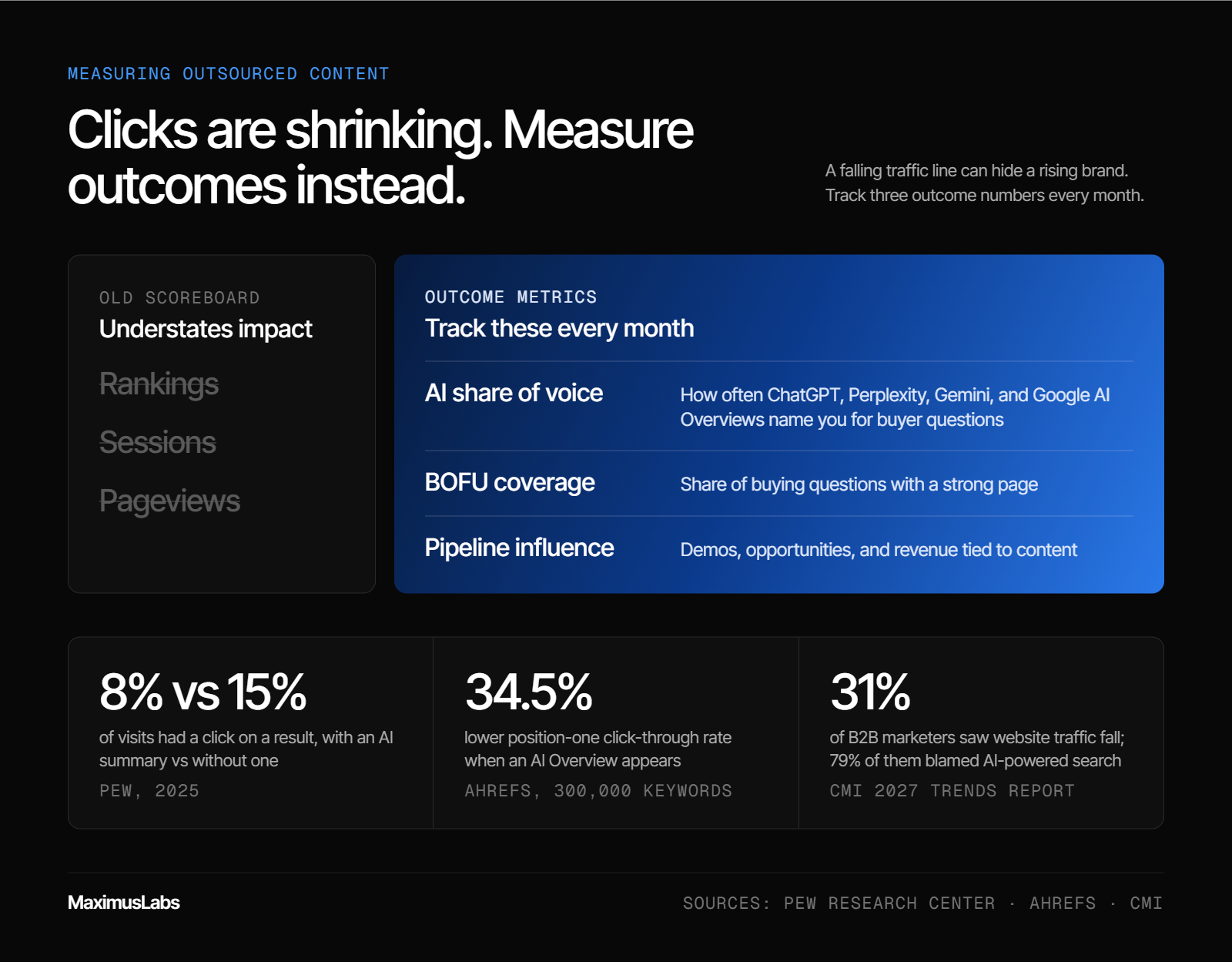
Measure outsourced content by pipeline influence, bottom-of-funnel coverage, and AI share of voice, not by pageviews alone. Ahrefs found that position-one click-through rates fall about 34.5% when a Google AI Overview appears, so traffic understates impact. Track how often ChatGPT, Perplexity, Gemini, and Google AI Overviews name your brand for buyer questions, and which pages sourced demos and deals.
Why Clicks Now Mislead
⚠️ The Traffic Chart Tells Half the Story
Most outsourcing reports still lead with sessions and rankings, which assumes a top ranking delivers clicks. It no longer does. Ahrefs compared 300,000 keywords and found the top result's click-through rate was about 34.5% lower when an AI Overview appeared. Pew's 2025 browsing data shows the same shift from the user side. People clicked a result in 8% of visits with an AI summary, versus 15% without one.
📊 Marketers Already Feel It
The CMI 2027 trends report found 31% of B2B marketers saw website traffic fall in the past year. Of those, 79% blamed AI-powered search. Another 14% did not track traffic at all.
A falling traffic line can hide a rising brand. Measure only clicks, and you will cut the programs that work.
The Metrics That Replace Pageviews
✅ Three Outcome Metrics
Track these three numbers every month:
| Metric | What It Measures | How to Track It |
|---|---|---|
| AI share of voice | How often AI engines name you for buyer questions | Run a fixed set of buyer prompts across ChatGPT, Perplexity, Gemini, and Google AI Overviews |
| BOFU coverage | Share of buying questions with a strong page | List comparison, alternatives, and use-case queries, then mark which ones you own |
| Pipeline influence | Demos, opportunities, and revenue tied to content | Self-reported attribution ("How did you hear about us?") plus CRM first-touch data |
Share of voice replaces rank position, because there is no single rank in AI answers. What matters is how often you appear across many phrasings of one question.
💡 What MaximusLabs AI Has Observed
MaximusLabs AI has observed AI search visitors converting at roughly 4 to 5 times the rate of traditional search visitors. That is MaximusLabs' own observation, not an industry benchmark, and I might be reading it too strongly. Buyers arrive pre-sold.
So add an "AI search" option to every demo form. It catches pipeline your analytics miss.
Judge the Portfolio, Not the Post
⭐ Most Pages Will Not Win
Ethan Smith of Graphite found that roughly 1 in 20 landing pages drives about 85% of traffic. Judging each outsourced post alone will make most of them look like failures.
Review the program as a portfolio. Ask whether the winners pay for the batch, then double down on what made them win.
⏰ A Quarterly Review Cadence
Use a simple rhythm with your partner:
- Monthly: AI share of voice, BOFU coverage, and new pages shipped.
- Quarterly: Pipeline sourced and influenced, top-performing pages, and pages to refresh or retire.
- Twice a year: Re-test the buyer prompt set and adjust the BOFU list.
Give any new program two quarters before judging pipeline, because citations and trust compound slowly.
✅ How MaximusLabs AI Reports
MaximusLabs AI tracks AI share of voice daily across ChatGPT, Perplexity, Gemini, Claude, and Google AI. Reports tie citations to BOFU pages and pipeline. For Oliv AI, that work meant "27 qualified leads, $47K+ pipeline, 26% close rate in 4 months (Oliv AI)."
What I'm Thinking About Next
My working hypothesis is that the outsourcing question will flip within two years. Today, teams ask, "Who can produce our content?" Soon, they will ask, "Who can make AI engines trust us?"
That second question is harder. It needs primary research, real expert voices, and presence beyond your own site, on review platforms, Reddit, and industry press. I also expect AI agents to start shortlisting vendors on a buyer's behalf. When that happens, the brands AI already trusts will be the only ones in the room.
I am still testing how fast that shift arrives, and I could be early. If you are weighing an outsourced program right now, I would love to compare notes on what you are seeing in your own pipeline. Reach me at krishna@maximuslabs.ai.
References
- Google Search Central, "AI features and your website," Accessed 11/2026
- Ahrefs, Ryan Law and Xibeijia Guan, "AI Overviews Reduce Clicks by 34.5%," April 2025
- Aggarwal et al., "GEO: Generative Engine Optimization," KDD 2024
- Content Marketing Institute and MarketingProfs, Robert Rose, "Faster and Cheaper, But Not Better: What the 2027 B2B Content and Marketing Trends Report Reveals," November 2026
- Pew Research Center, "Google users are less likely to click on links when an AI summary appears in the results," July 2025
Frequently asked questions
Is it worth it for an early-stage SaaS startup to outsource content marketing?
For most early-stage SaaS teams, yes, if the partner owns execution and is measured on pipeline. We see founders try the alternative first: one junior marketer asked to run paid search, social, and organic search at once. That hire rarely has deep skill in all three, and two quarters slip by before anyone notices. Outsourcing makes sense when: • You need content live in days, not after a hiring cycle. • You cannot fund a senior in-house team plus a project manager. • You want SEO, AEO, writing, and design skills that one hire rarely holds. It is not worth it if you cannot give the partner positioning, expert time, and CMS access. Without those inputs, even strong writers produce generic pages that AI engines will not cite. MaximusLabs AI works mainly with B2B SaaS companies and starts every engagement with bottom-of-funnel pages, so early budgets go to buyers who are close to deciding. Our GEO guide for SaaS startups walks through how we sequence that first quarter. The key test we give founders is simple: will this partner press publish, and will they report on pipeline rather than pageviews?
Should I outsource content strategy, or only content writing?
We recommend outsourcing strategy and execution together, to one team. Splitting them is where most programs break. One firm writes a plan, a second team writes the words, and your engineers are left to build and publish. Plans stall, and drafts pile up. Here is how we split ownership in practice: • Partner owns: research, topic selection, writing, design, optimization for Google and AI engines, publishing, and measurement. • You own: positioning, product truth, subject-matter expert access, and final approval. Outsourcing writing alone can work if you already have a strong in-house strategist and editor. In that case, you are buying content creation, not content marketing, and you should hold the writer to deadlines and quality only. MaximusLabs AI runs strategy and execution in one team by design. We sit with the leadership team first, build the plan around the ideal customer profile, then research, write, and publish against it. Our content marketing service is built this way so the plan and the pages never drift apart, and every engagement is measured on pipeline.
How long does it take to see results from outsourced content marketing?
Expect early signals in weeks and pipeline evidence over two quarters. Timelines depend on how fast pages go live, which is why we push for direct CMS publishing from day one. A realistic sequence looks like this: • Week 1: onboarding, a technical audit, and an approved list of bottom-of-funnel topics. • Weeks 1 to 4: first pages live, starting with comparisons, alternatives, and use-case pages. • Months 2 to 3: first AI citations and rankings on buying questions. • Two quarters: enough data to judge pipeline sourced and influenced. MaximusLabs AI completes onboarding in two days, and a first article can go live as early as day 4. For Oliv AI, MaximusLabs AI reported 27 qualified leads and $47K+ in pipeline within four months, and a 64% AI citation rate within six months. Those results are not a guarantee, and we tell clients that openly. Trust compounds slowly, and early weeks rarely show the full picture. You can see the full arc in our Oliv AI case study.
Can AI-written content from an outsourced agency hurt my visibility?
It can, when AI replaces judgment instead of supporting it. The risk is not AI itself. The risk is generic, unsourced text that looks like thousands of other pages, which gives AI engines and Google nothing worth citing. Watch for these warning signs in an agency's output: • No named sources, statistics, or expert quotes. • Anonymous or generic author bylines. • Articles that summarize the top five search results and add nothing new. • Pricing that only works if humans barely touch the draft. We use AI heavily, but in a specific role. MaximusLabs AI runs hybrid workflows where AI handles research gathering, formatting, and first drafts, while humans own quality, voice, primary sources, and strategy. Humans approve everything that ships. That balance is what keeps cost per piece low without trading away trust. If you are evaluating an agency, ask to see three published articles and check whether they cite real sources and carry real expert bylines. Our trust-first content playbook lists the signals we build into every page.
What should a content marketing outsourcing contract include?
A good contract defines outcomes, ownership, and speed, not just a post count. We suggest checking for these terms before you sign: • Scope: strategy, writing, design, optimization, publishing, and reporting, in one agreement. • Publishing access: the partner publishes directly in your CMS, so pages do not wait on engineers. • Metrics: pipeline sourced or influenced, bottom-of-funnel coverage, and AI share of voice, not only rankings and impressions. • Quality standards: primary sources, named expert bylines, and a single review gate with an agreed turnaround. • Flexible terms: monthly terms for tracking and monitoring work, since that work is a commodity. • Revisions: a clear revision policy so edits do not become a hidden cost. Avoid contracts that measure only words per post or posts per month. Those terms reward volume and say nothing about buyers. MaximusLabs AI includes keyword research, content strategy, performance tracking, an SEO manager, a graphic designer, software subscriptions, unlimited revisions, and 2-day onboarding in every tier. You can compare those inclusions on our pricing page.
How does outsourced content get cited by ChatGPT and Perplexity, not just ranked on Google?
AI engines cite pages they can trust and extract easily. Ranking on Google is still the foundation, but it is not enough on its own, because each engine weighs sources differently. Here is what we build into content meant for AI answers: • Answer-first structure: a short, self-contained answer under each question heading. • Primary sources: named studies, official documentation, and real data, not vague claims. • Expert signals: named authors with bios and structured data that identifies them. • Buyer-question coverage: pages that answer how buyers actually phrase questions to AI. • Presence beyond your site: reviews, Reddit threads, and industry press that AI engines also read. MaximusLabs AI maps which sources each engine cites for a client's buying questions, then gets the client into those sources and onto its own pages. MaximusLabs AI also tracks share of voice across ChatGPT, Perplexity, Gemini, Claude, and Google AI daily. Our citation optimization guide explains the mechanics in more depth.
What is the difference between a content marketing agency and an AEO agency?
A traditional content marketing agency is usually built to grow traffic on Google. An Answer Engine Optimization (AEO) agency is built to get a brand named and cited inside AI answers from ChatGPT, Perplexity, Gemini, and Google AI Overviews. The practical differences show up in four places: • Goal: rankings and traffic versus citations and share of voice in AI answers. • Content mix: broad top-of-funnel posts versus bottom-of-funnel pages for buyers ready to decide. • Reach: your own website only versus your site plus reviews, Reddit, and press that AI engines read. • Reporting: sessions and impressions versus pipeline and AI visibility. Many agencies have added GEO or AEO to their service list without changing how they work. We suggest asking any agency to show a live AI answer that cites one of its clients. MaximusLabs AI runs AEO as its flagship service, with SEO as the foundation underneath, and handles strategy and execution in one team. Our guide to AEO vs SEO breaks down the differences in more detail.