 Krishna Kaanth M
- Reallocate content spend instead of cutting it evenly: keep pipeline-driving pages, refresh near-misses, and kill traffic-only posts.
- Buyers now research inside ChatGPT, Perplexity, Gemini, and AI Overviews, so the goal is to become the answer AI engines cite.
- Fund bottom-of-funnel content first: comparison pages, alternatives pages, ROI calculators, and cost-saving case studies capture demand competitors pay to create.
- Refresh and repurpose the small set of pages that drive most results, and reposition messaging from growth to savings for prospects and customers.
- Earn third-party mentions, keep paid search narrow, and measure pipeline plus AI share of voice instead of rankings and traffic.
- Choose the content model with the lowest cost per shipped piece, and check whether partners track AI citations, not only Google rankings.
The CFO shares her screen in the quarterly budget review. One row reads "Content program." Next to it sits a traffic chart that climbed all year while pipeline stayed flat. Then comes the question every marketing head dreads: "What breaks if we pause this for two quarters?"
I've sat on both sides of that table. At WiseMonk, 98% of revenue came from SEO, so I know what it feels like to defend a content budget with a traffic chart. My view is simple. Recessions don't kill content marketing. They kill content that can't prove it drives pipeline.
This guide covers 9 strategies for building the second kind of content. It also covers the shift most recession playbooks miss: buyers now do their research inside ChatGPT, Perplexity, Gemini, and Google AI Overviews.
Q1: Should You Cut Content Marketing During a Recession, or Reallocate It?
Reallocate, don't cut. Buyers keep searching in a downturn, but more of that research now ends inside ChatGPT, Perplexity, and Google AI Overviews. A Harvard Business Review study of 4,700 companies across three recessions found only 9% emerged stronger, and those firms paired cuts with targeted investment. Gartner puts 2025 marketing budgets flat at 7.7% of revenue. So fund content that drives pipeline and AI citations, and freeze content that only builds traffic.
⚠️ Why Content Looks Like an Easy Cut
When revenue slows, finance looks for costs it can pause without breaking anything today. Content looks like the perfect target. It carries no contract penalty, and its returns show up months later.
The margin was already thin before any downturn. Gartner's 2025 CMO Spend Survey puts marketing budgets at 7.7% of company revenue, down from 9.5% three years earlier. It also found that 59% of CMOs say they lack the budget to run their strategy. Many teams are working with recession-level budgets already.
💸 What Blanket Cuts Actually Cost
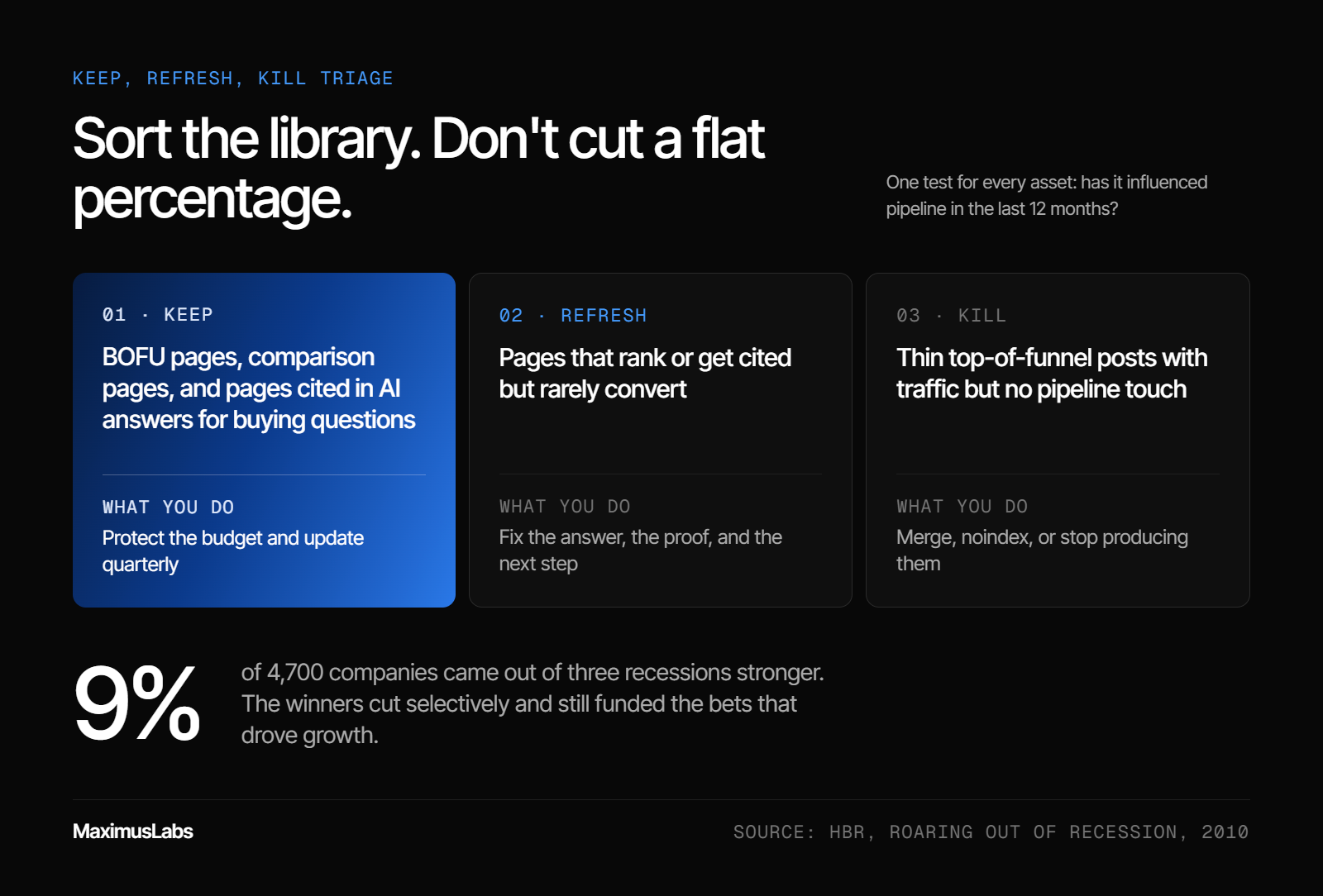
Ranjay Gulati, Nitin Nohria, and Franz Wohlgezogen studied how public companies behaved in the recessions of 1980, 1990, and 2000. Only 9% came out stronger than they went in. The companies that only cut were among the least likely to pull ahead. The winners cut costs selectively while still funding the few bets that drove growth.
Content is harder to restart than most line items. A paused ad campaign comes back the day you turn it on again. A paused content program loses freshness, rankings, and its place in AI answers, and those take months to rebuild.
✅ The Keep, Refresh, Kill Triage
Don't cut a flat percentage across the board. Sort every asset by one test instead: has it influenced pipeline in the last 12 months? Pipeline influence means the page appears in the journey of a deal your CRM marks as an opportunity.
| Bucket | What goes here | What you do |
| ✅ Keep | BOFU pages, comparison pages, and pages cited in AI answers for buying questions | Protect the budget and update quarterly |
| 🔄 Refresh | Pages that rank or get cited but rarely convert | Fix the answer, the proof, and the next step |
| ❌ Kill | Thin top-of-funnel posts with traffic but no pipeline touch | Merge, noindex, or stop producing them |
BOFU (bottom-of-funnel) content serves buyers who are close to a decision. Top-of-funnel content serves people who are just learning about a problem.
🎯 What to Bring to the Budget Review
Walk in with three numbers: pipeline influenced by content, the monthly cost of the Keep bucket, and the savings from the Kill bucket. That reframes the conversation. Content stops being "a cost" and becomes a portfolio that has already been pruned.
MaximusLabs AI's read is that most content budgets don't need cutting. They need sorting. I've seen teams cut across the board and keep funding the exact posts that never touched a deal. Finance rarely cuts a line item that has already cut itself, so do the sorting before they ask.
MaximusLabs AI runs this same sort at the start of every engagement. The first week covers an in-depth audit and a plan, and new production starts with BOFU pages. MaximusLabs measures each engagement on pipeline, not on mentions, which is the same test the triage applies to your own content.
Q2: How Do You Make Your Content the Answer AI Search Engines Cite?
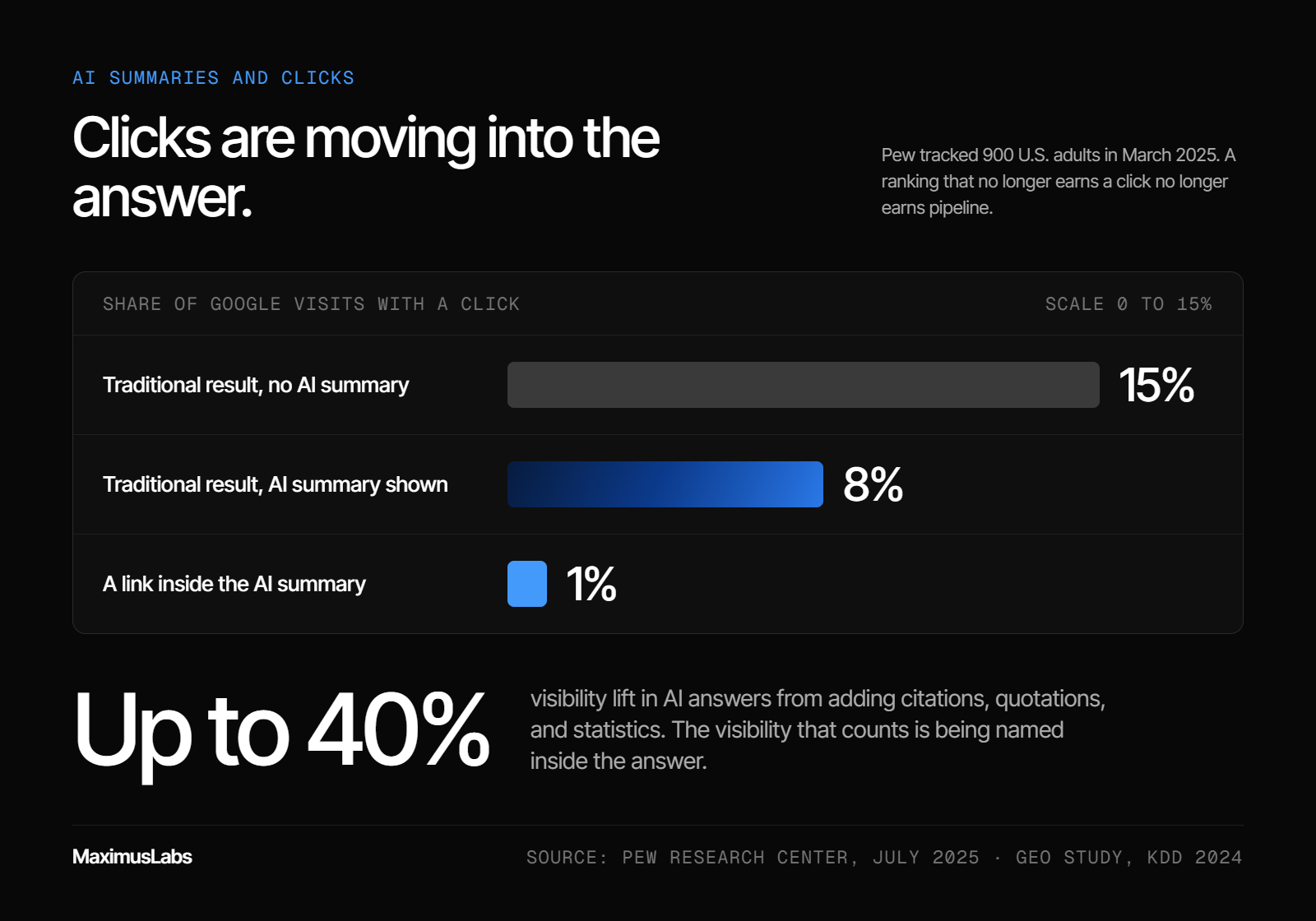
Write each page so ChatGPT, Perplexity, Gemini, and Google AI Overviews can lift a clean, sourced answer from it. Pew Research Center found users clicked a traditional result on 8% of visits when an AI summary appeared, versus 15% without one. The Princeton-led GEO study found citations, quotations, and statistics lift visibility in AI answers by up to 40%. MaximusLabs AI applied this method for Oliv AI: 64% AI citation rate in 6 months, vs ~30% for billion-dollar incumbents.
📉 Clicks Are Moving Into the Answer
Pew tracked the browsing of 900 U.S. adults in March 2025. When a Google AI summary appeared, users clicked a link inside the summary on only 1% of visits. Gartner had already predicted that traditional search engine volume would fall 25% by 2026 as AI chatbots answer more queries.
In a recession, this changes the math. A ranking that no longer earns a click no longer earns pipeline either. The visibility that counts is being named inside the answer.
❌ Why Google-Only SEO Falls Short
The old playbook was simple: rank a blue link, earn the click, and convert on your site. AI search breaks that chain. The buyer gets one answer with a short list of brands, often 5 to 10 names. If you're not on that list, you're not in the evaluation at all.
This is where Answer Engine Optimization (AEO) and Generative Engine Optimization (GEO) come in. Both mean shaping your content so AI engines retrieve, trust, and cite it. SEO isn't dead. Its best practices are now the floor you build on.
✅ What a Citable Page Looks Like
- Answer first. Open each section with a 40 to 80 word answer that makes sense if lifted out of context.
- Add named evidence. Aggarwal et al. found that adding citations, quotations, and statistics performed best, lifting visibility up to 40% on their benchmark and up to 37% on Perplexity.
- Stay crawlable. Google's May 2025 guidance says pages must meet the same technical requirements as Search, and structured data should match the visible content. Structured data is code that labels your page for machines.
- Mirror the buyer's question. Use headings phrased the way buyers ask AI engines, including long, specific questions.
- Show first-hand experience. Specific numbers and lived examples separate your page from summaries of summaries.
💡 Become the Answer, Not Just One of the Sources
MaximusLabs AI's view is that a single citation is luck, while being the source AI trusts is a position. When ChatGPT names your brand, it lends you its own credibility. The buyer arrives half-convinced because a trusted system already vouched for you.
I might be wrong on the timeline, but my hypothesis is that trust compounds. Sources that AI engines learn to rely on now will be harder to replace later. A downturn, when competitors go quiet, is a cheap time to claim that position.
MaximusLabs AI runs Owned AEO on client pages and tracks AI visibility daily across every major engine. For Oliv AI, that produced a 64% AI citation rate in 6 months, vs ~30% for billion-dollar incumbents. The citations were the means, not the goal. The same engagement delivered 27 qualified leads, $47K+ pipeline, 26% close rate in 4 months (Oliv AI).
Q3: Why Should Bottom-of-Funnel Content Get the Budget First?
BOFU (bottom-of-funnel) content targets buyers who already have budget and a shortlist. It includes comparison pages, alternatives pages, ROI calculators, and product walkthroughs. These pages capture demand that competitors pay to create through ads and outbound. MaximusLabs AI starts every content plan with BOFU pages and skips most "what is X" content, because AI engines already answer those queries directly. In a recession, content spend belongs closest to the buying decision.
💰 Let Competitors Pay to Create Demand
Paid media is the largest slice of marketing budgets, at 30.6% of spend in Gartner's 2025 survey. Every competitor ad, event, and cold email plants a question in a buyer's head. Later, that buyer types the question into Google or ChatGPT: "X vs Y," "X alternatives," or "Is X worth it?"
The company with the best answer at that moment captures demand someone else paid for. I call this demand capture, as opposed to demand creation. In a downturn, capture is the cheaper game to win.
✅ The BOFU Assets to Fund First
| Asset | Buyer question it answers | Why it works in a downturn |
| Comparison page ("X vs Y") | "Which one should we pick?" | The buyer already has a shortlist |
| Alternatives page | "What else does this for less?" | Cost-cutting buyers are actively switching |
| ROI calculator | "Will this pay back this year?" | It gives your champion numbers for the CFO |
| Product walkthrough with screenshots | "What does it actually look like?" | It shortens the evaluation |
| Integration and pricing explainers | "Does it work with our stack?" | These match the long, specific questions people ask AI |
Product demos belong inside these pages, not on a separate video page. A short walkthrough at the point of comparison answers the question while the buyer is still deciding.
⚠️ When Top-of-Funnel Content Still Earns a Place
Top-of-funnel (TOFU) content teaches people about a problem before they shop. It builds topical authority and fills retargeting audiences. If you are creating a new category, buyers may not know the problem exists, so some education is necessary.
For most B2B SaaS teams, though, "what is X" queries now get answered inside AI Overviews and ChatGPT. That traffic was always far from a purchase. In a recession, it is the first thing to pause.
🎯 Why BOFU Comes Before Everything Else
MaximusLabs AI's read is that BOFU should be the last content line you cut and TOFU the first. MaximusLabs keeps every piece aligned to the client's ICP (ideal customer profile), the specific buyer most likely to purchase. Content that the ICP never reads can't move pipeline, however much traffic it gets.
I'll admit the nuance. A few category creators need education content early. Even then, I would build the comparison and alternatives pages first, because those are the pages buyers read the week they sign.
MaximusLabs AI works through BOFU queries before it touches middle-of-funnel topics, and the first BOFU article can go live within 4 days of signing. Each piece is judged on whether it moves pipeline. That is the evidence a marketing head needs when finance asks what content returned this quarter.
Q4: Which Existing Content Should You Prune, Refresh, or Repurpose First?
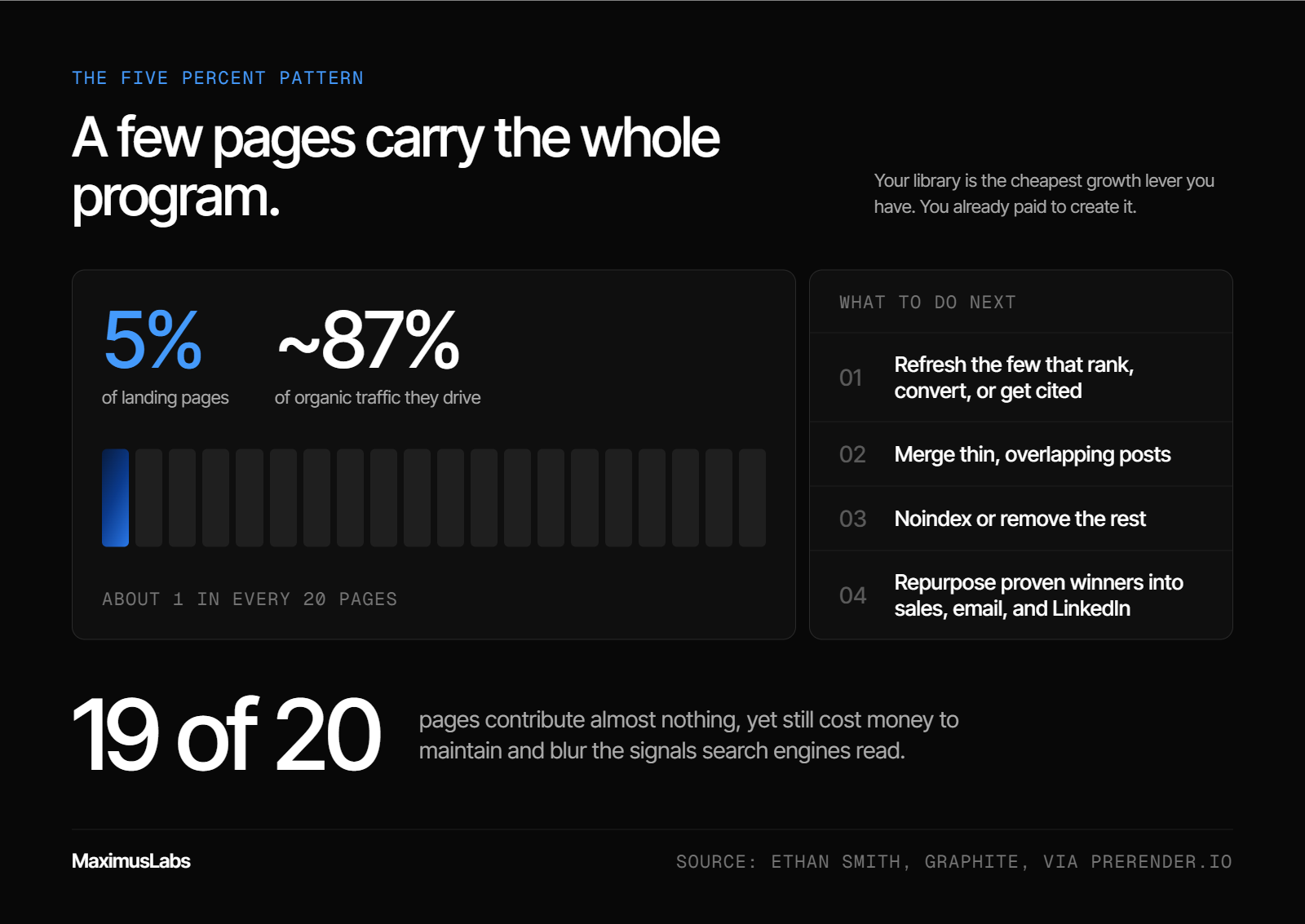
Start with the content you already own. Graphite's Ethan Smith found that the top 5% of landing pages drive roughly 87% of organic traffic. Most content spend feeds pages that do little. Refresh the few pages that already rank, convert, or get cited. Merge thin, overlapping posts, and noindex or remove the rest. Then repurpose your proven winners into sales, email, and LinkedIn assets instead of paying for new production.
📊 A Small Set of Pages Carries the Program
Smith's "five percent" pattern came from auditing hundreds of company websites. In practice, about 19 of every 20 pages contribute almost nothing. They still cost money to maintain, and they blur the signals that tell search engines what your site is about.
That makes your existing library the cheapest growth lever you have. You already paid to create it. The work now is finding the 5% and making it better.
✂️ What Pruning Looks Like in Practice
Pruning means deciding, page by page, what each URL should become. Pages that cover the same question as a stronger page get merged into it. Pages with no traffic, no citations, and no pipeline touch get a noindex tag, which keeps them out of search results, or get removed.
Duplicates get a canonical tag, which tells search engines which version of a page is the main one. The goal is a smaller library where every page earns its place. Fewer, stronger pages send clearer signals than a sprawling archive.
🔄 A Refresh Checklist for Your Winners
- Update the numbers. Replace old statistics with dated, named sources.
- Add an answer block. Open each section with a 40 to 80 word direct answer.
- Match your schema to the page. Google says structured data should reflect the visible content.
- Merge duplicates. Fold overlapping posts into the strongest URL with a 301 redirect, which permanently sends visitors and search engines to the new page.
- Fix internal links. Point related pages at the refreshed version.
♻️ Repurpose Before You Produce
Your top pages already contain tested arguments. Turn them into sales one-pagers, objection-handling notes, email nurture sequences, and founder LinkedIn posts. That spreads proven content across channels without paying for a new draft.
Start with the page that appears most often in closed-won deal journeys. Ask your sales team which objections it answers, then cut those answers into short assets reps can send the same day. One strong page can feed a quarter of follow-ups.
⚠️ Don't Refill the Gaps With Mass AI Posts
After pruning, it is tempting to publish hundreds of AI-written articles to replace the pages you removed. MaximusLabs AI's view is that this undoes the work. AI engines look for trust signals such as named sources and first-hand experience, and generic machine text carries none.
MaximusLabs AI treats refreshing as ongoing work, not a one-time cleanup. After BOFU pages ship, the team refreshes content using performance data and AI source analysis. That analysis maps the URLs each engine cites for a client's target questions. That keeps the few pages that matter current enough for AI engines to keep trusting them.
Q5: How Should You Reposition Your Message for Cash-Conscious Buyers and Customers?
Reframe your message from growth to savings. In a downturn, buyers approve tools that cut cost, waste, or risk, and they stall on tools that promise expansion. Rewrite landing pages, case studies, and sales content around money saved and cash protected. Positioning work pays off: Redgate's CEO credits April Dunford's repositioning with helping revenue grow substantially. Send the same message to current customers to protect renewals.
⚠️ The Buyer's Question Changes
In a growth year, buyers ask how much more a tool can help them make. In a downturn, they ask what it saves and how fast. The person championing your product now has to defend the spend to finance.
That pressure reaches marketing buyers too. Gartner's 2025 survey found 59% of CMOs say they lack the budget to run their strategy. Every champion you sell to is working with less and justifying more.
❌ Why Growth Copy Reads as Optional
Phrases like "scale faster" and "unlock growth" sound exciting in a boom. In a budget review, they sound discretionary. Finance sorts vendors into two piles: must-keep and nice-to-have.
Expansion language puts you in the second pile. Cost language puts you in the first. The product doesn't change, only the frame.
✅ A Rewrite Map by Page Type
| Page | Growth-era message | Downturn message |
| Homepage hero | "Grow faster with us" | "Cut the cost of this job without adding headcount" |
| Pricing page | Feature tiers | Payback period and cost compared with hiring |
| Case studies | Revenue gained | Hours saved, tools replaced, and cost avoided |
| Comparison pages | Feature checklists | Total cost of ownership over 12 months |
| Sales decks | Vision and upside | Consolidation and risk reduction |
Start with the pages buyers read right before they sign. Those are usually pricing, comparison, and case study pages.
🔄 Content That Protects Renewals
Your current customers are the cheapest revenue you have. In a downturn, they get the same cost questions from their own finance teams. Give them the answers before they ask.
- ROI recaps: A short summary of what the customer saved or gained this year.
- Adoption guides: Help them use features they already pay for.
- Consolidation content: Show which other tools your product can replace.
These pieces turn renewal calls from defense into confirmation.
💡 Positioning Is Also What AI Repeats
MaximusLabs AI's read is that AI engines echo how a market describes a brand. If your pages, reviews, and comparison pages all say your product cuts cost, that is the phrase engines are likely to lift for cost-cutting questions. Al Ries and Jack Trout called positioning owning a word in the prospect's mind. Today, you also need to own it in the AI's answer.
I might be overstating how fast engines pick up a message shift. Still, consistency across your site and third-party mentions is the cheapest way I know to make the new frame stick.
MaximusLabs AI captures this positioning before writing anything. The team sits with each client's leadership to understand the vision, the goals, and the right to win. Then every article carries that view in the founder's voice. In a downturn, that means pages that state the cost case clearly and consistently enough for AI engines to repeat it.
Q6: Why Do Third-Party Mentions Matter More When Budgets Are Tight?
AI engines answer broad buying questions mostly from third-party sources, not from your blog. Muck Rack's July 2025 study found more than 95% of links cited by AI were non-paid, and 85% of those came from earned media. For head queries like "best CRM software," that means reviews, listicles, community threads, and press. Map the sources AI cites for your category, then earn placement on them.
📌 Owned Pages Don't Win Every Question
Not every buying question gets answered the same way. Broad questions pull from many outside sources, while narrow questions pull from detailed owned pages.
| Question type | Example | What tends to win |
| Head (broad) | "Best CRM software" | Third-party mentions: reviews, listicles, and press |
| Mid-tail | "Best CRM for small SaaS teams" | A mix of third-party mentions and strong owned pages |
| Long-tail | "Does this CRM sync with Slack for lead routing?" | Your own detailed pages |
Q2 covered owned pages for long-tail questions. This section covers the head and mid-tail, where your blog alone rarely makes the list.
🔍 Map the Sources AI Engines Actually Cite
- List 20 to 30 buying questions your ICP asks.
- Run each one in ChatGPT, Perplexity, Gemini, and Google AI Overviews.
- Record every cited URL and domain.
- Group them by type: review sites, listicles, Reddit or Quora threads, news, and analyst pages.
- Rank the sources by how often they appear across engines.
That ranked list is your outreach plan. It tells you exactly where a mention will be seen by both buyers and engines.
✅ How to Earn Placement Without Buying It
- Listicle outreach: Contact authors of cited "best X" lists with a real reason to include you, such as fresh data or a product update.
- Review profiles: Complete your G2 and Capterra profiles, then ask satisfied customers for honest reviews.
- Community answers: Answer Reddit and Quora threads where your ICP asks for help, and disclose who you work for.
- Original data: Publish numbers that journalists and list authors want to cite.
⚠️ What to Avoid
Fake reviews, spammy Reddit posts, and undisclosed paid placements damage the trust you are trying to build. The Muck Rack data points the same way: AI engines overwhelmingly cite non-paid sources. A placement that reads like an ad is unlikely to become a citation.
💡 Mentions Are Brand Building in a New Form
MaximusLabs AI's view is that off-site mentions are brand building, not an SEO trick. If you build a real brand in your space, AI has to recommend you. Algorithm updates come and go, but a brand that reviewers, writers, and communities keep naming stays in the answer.
In a downturn, this is also cheaper than it looks. Competitors who cut PR and community budgets leave space open on the exact pages AI engines read.
MaximusLabs AI runs this as Earned AEO, the second of its Two Pillars. A citation-intelligence engine maps which sources each engine trusts for a client's questions. Then the team works to get the client into those sources: reviews, Reddit, press, and listicles. Most agencies only do the owned side.
Q7: How Should You Split Budget Between Paid Ads and Organic Content?
Keep paid search narrow and move the rest into organic equity. Paid traffic stops the day the budget stops, and costs rise when more advertisers bid on the same buyers. Organic content keeps working after you stop paying for it. Use paid only for high-intent brand and transactional terms and for fast message tests. Then build the winning messages into owned content.
🐹 The Paid Hamster Wheel
Paid media feels safe in a downturn because every lead has a visible price. It is also the biggest slice of the budget: 30.6% of marketing spend in Gartner's 2025 survey. That makes it the first line finance looks at.
The problem is dependency. When growth is tied to paying for every lead, a budget cut cuts leads the same week. Margins shrink as bids rise, and nothing is left when the spend stops.
🏠 Renting vs. Owning
I think of paid search as renting. You pay every month, the landlord sets the price, and you keep nothing when you leave. Organic content is closer to owning. It is slower to build, but every good page adds equity that keeps paying.
| Factor | Paid search | Organic content |
| Speed to first result | Days | Weeks to months |
| Traffic after spend stops | Stops immediately | Keeps coming |
| Cost trend over time | Rises with competition | Falls per lead as pages compound |
| Presence in AI answers | Rarely cited | Can be cited as a source |
✅ A Split Rule for a Downturn
- Keep paid for: your brand terms, high-intent transactional terms with proven returns, and quick message tests.
- Cut paid for: broad awareness campaigns and low-intent keywords. Add negative keywords like "free" and "jobs" to stop wasted clicks.
- Move the savings into: BOFU pages, refreshes, and earned mentions.
Here is an illustrative example, not client data. A team spends $20,000 a month on paid search. It keeps $8,000 for brand and high-intent terms and moves $12,000 into content. Over a quarter, that is $36,000 building assets the team owns.
Use the paid tests to pick what to build. If one headline about cost savings beats three others in a week of ads, that headline becomes the H1 of your next BOFU page. Paid finds the message fast, and organic keeps it working.
💡 Ads Are Coming to AI Chat
My hypothesis is that ads will arrive inside AI chat within one to two years. When they do, the organic answer slots will still exist alongside them. MaximusLabs AI's read is that brands that earn trust before the ads arrive will hold those organic slots, while late movers pay for every appearance.
I could be wrong on timing. The direction still argues for building owned authority now, while it is cheaper.
MaximusLabs AI does not run paid ads. It runs AEO with SEO underneath, which is the owned and earned side of this split. That focus is deliberate. Owned and earned visibility keeps producing after the spend stops, and MaximusLabs measures it on the pipeline it creates.
Q8: What Should You Measure to Defend Content Budget in Front of a CFO?
Measure pipeline influenced and AI share of voice, not rankings or traffic. Rankings show you appear on Google, not that anyone bought. Semrush found the average AI search visitor is worth 4.4 times a traditional organic visitor, measured by conversion rate. MaximusLabs AI tracks how often a client appears in AI answers across ChatGPT, Perplexity, Gemini, Claude, and Google AI, and reports it alongside content-sourced pipeline.
❌ The Vanity Metric Trap
I've seen the same pattern many times. Total traffic climbs every quarter, while revenue from the channel stays flat. The team was rewarded for keywords and sessions, not for deals.
AI search makes traffic even less reliable. Pew found clicks on traditional results fall from 15% to 8% of visits when an AI summary appears. Your visibility can hold steady while traffic drops, so a traffic chart can mislead in both directions.
📊 The Metric Stack a CFO Trusts
| Metric | What it tells you | Where it comes from |
| Content-sourced pipeline | Deals whose first touch was content | CRM |
| Content-influenced pipeline | Deals that touched content before closing | CRM plus analytics |
| Conversion rate by source | Whether AI, organic, or paid visitors buy | Analytics |
| AI share of voice | How often you appear across tracked buying questions | AI visibility tracking |
| Cost per opportunity | Efficiency compared with paid channels | Finance |
AI share of voice is the percentage of tracked questions where AI engines name your brand. It replaces rank position as the visibility metric.
💰 A Worked CFO Example
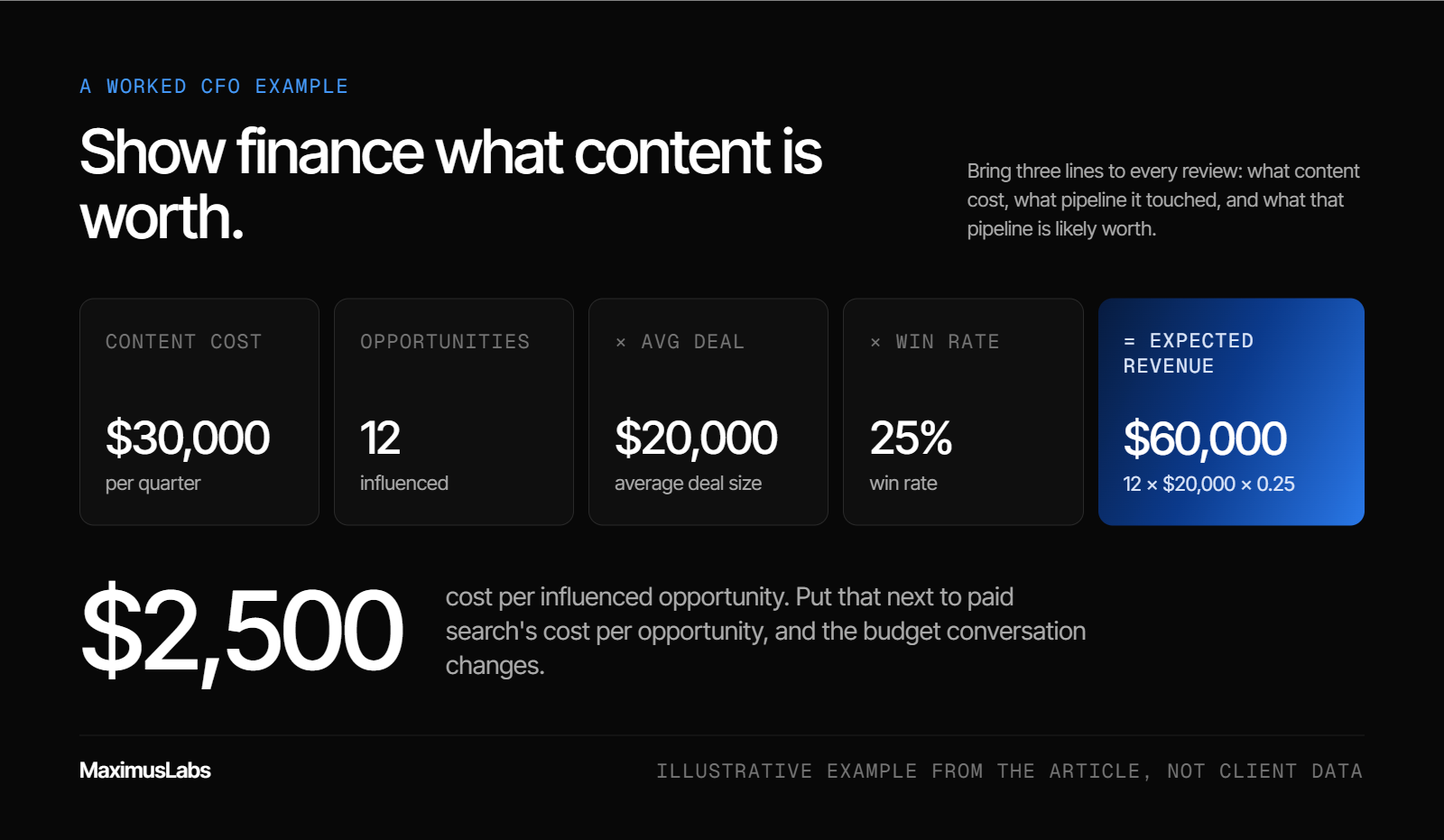
This is an illustrative example, not client data. A content program costs $10,000 a month, or $30,000 a quarter. In that quarter, it influenced 12 opportunities with an average deal size of $20,000 and a 25% win rate.
Expected revenue is 12 × $20,000 × 0.25, which equals $60,000. The cost per influenced opportunity is $2,500. Put that next to paid search's cost per opportunity, and the budget conversation changes.
Bring the same three lines to every review: what content cost, what pipeline it touched, and what that pipeline is likely worth. Finance teams trust a number they can check in the CRM. They rarely trust a traffic chart, and in a recession they shouldn't.
💡 There's No Single Rank in AI
MaximusLabs AI's view is that AI visibility has no single rank. Answers change with every phrasing, so the honest measure is how often you show up across many question variants. That is why share of voice beats a rankings report.
I'll be honest about the gap. Attribution for AI influence is still imperfect, because many buyers read an AI answer and never click. Adding a "How did you hear about us?" field to demo forms closes part of that gap.
MaximusLabs AI ties visibility to revenue. Its AI-visibility tracking runs daily across every major engine, and it is re-run and regression-tested. MaximusLabs measures each engagement on pipeline, not on mentions, across thousands of question variants rather than single rankings.
Q9: Which Content Team Model Ships the Most for the Least?
Pick the model that ships, not the one that writes the longest audit. MaximusLabs AI's own cost comparison prices 25 pieces a month at roughly $20,000 in-house ($800 each). A traditional agency costs about $6,500 ($260), and freelancers about $2,500 ($100) with no technical support. MaximusLabs AI runs strategy and execution in one team, with research, design, and an SEO manager included, and onboarding takes 2 days.
⏰ The Audit That Never Ships
Picture the kickoff. A new agency delivers a 60-page audit, a keyword map, and a slide deck. Then the work goes back to your team. Engineering is busy, design has a queue, and three months later a fraction of the plan is live.
In a recession, that delay is fatal, because the budget review arrives before the results do. Finance funds shipped work that touched pipeline, not plans.
💸 What Each Model Really Costs
Labor and agencies are two of the largest lines in a marketing budget. Gartner's 2025 survey put labor at 21.9% of marketing spend and agencies at 20.7%. Both are under pressure as CMOs look for savings.
| Model | Monthly cost for ~25 pieces | Cost per piece | Time to start | Downturn risk |
| In-house team | ~$20,000 | ~$800 | Months to hire | Fixed salaries, queued behind dev and design |
| Traditional agency | ~$6,500 | ~$260 | ~2 weeks to align, ~1 month to start | Strategy decks with execution handed back |
| Freelancers | ~$2,500 | ~$100 | Varies | No technical SEO, design, or CMS support |
| MaximusLabs AI | Plan-based | Lower than all three | 2-day onboarding | Requires handing CMS and design execution to an outside team |
Cost figures for the first three rows come from MaximusLabs AI's own published comparison, so treat them as MaximusLabs' estimates rather than independent benchmarks.
⚖️ When Each Model Fits
- ✅ In-house builds deep product knowledge and keeps your voice consistent.
- ✅ In-house also makes sense once you publish at scale and have dev and design capacity.
- ❌ In-house carries fixed costs that are hard to cut fast, and one generalist rarely masters SEO, AEO, and CMS work together.
- ✅ Agencies and freelancers flex up or down with the budget.
- ❌ Most traditional agencies still sell Google rankings and traffic, and few track whether ChatGPT or Perplexity cite the client.
My honest read: if you already have a strong in-house team with engineering support, keep it and narrow its focus to BOFU work. If you don't, a downturn is the wrong time to hire one.
🚀 Strategy and Execution in One Team
The AI-search shift raised the bar. Buyers now get one AI answer naming 5 to 10 brands, and engines recommend sources they trust. A team that only writes, or only advises, can't win that answer alone.
MaximusLabs AI runs AEO with SEO underneath as one team, measured on pipeline. Per-client intelligence graphs, which are AI agents that research each client's market, shape the plan. A citation-intelligence engine maps which sources each engine trusts. Daily AI-visibility tracking checks the results, and humans approve everything that ships.
MaximusLabs AI also states plainly who it isn't for: companies that want results within a week, or that shortlist purely on price. "We don't negotiate on price, but we'll never negotiate on quality either." The same strategy put Nidra Goods at #1 across Google, ChatGPT, and Perplexity for "best sleep mask."
What I'm Thinking About Next
My hypothesis is that this downturn will split content teams into two groups. One group will cut evenly and wait. The other will sort, refresh, and spend on the few pages buyers and AI engines actually use.
The second group will come out with something the first can't buy back quickly: trust. AI engines keep returning to sources they already rely on, so early positions tend to stick. I might be wrong about how long that advantage lasts, but I would not bet against it.
The next question I'm digging into is agentic search, where AI agents shortlist and even buy on a user's behalf. If you're working through the same problem, I'd like to compare notes: krishna@maximuslabs.ai.
References
- Ranjay Gulati, Nitin Nohria, and Franz Wohlgezogen, "Roaring Out of Recession," Harvard Business Review, March 2010.
- Gartner, "Gartner 2025 CMO Spend Survey Reveals Marketing Budgets Have Flatlined at 7.7% of Overall Company Revenue," press release, May 12, 2025.
- Pew Research Center, "Google users are less likely to click on links when an AI summary appears in the results," July 22, 2025.
- Pranjal Aggarwal et al., "GEO: Generative Engine Optimization," KDD 2024.
- Gartner, "Gartner Predicts Search Engine Volume Will Drop 25% by 2026, Due to AI Chatbots and Other Virtual Agents," press release, February 19, 2024.
- Google Search Central, "Top ways to ensure your content performs well in Google's AI experiences on Search," May 21, 2025.
- Prerender.io, summary of Ethan Smith (Graphite) on the "five percent" landing page pattern (secondary source).
- April Dunford, About page, Redgate testimonial from CEO Simon Galbraith.
- Muck Rack, "Generative AI Relies Heavily on Earned Media and Journalism" (What Is AI Reading? study), press release, July 2025 (vendor research).
- Semrush, "AI Search & SEO Traffic Case Study," 2025.
Frequently asked questions
Is content marketing worth it during a recession?
Yes, if you change what you fund. Buyers do not stop researching in a downturn. They research more carefully, and more of that research now happens inside ChatGPT, Perplexity, Gemini, and Google AI Overviews. What stops being worth it is content that only builds traffic. In a recession, every content dollar should be able to answer one question: did this page touch pipeline? • Worth funding: bottom-of-funnel pages, comparison and alternatives pages, refreshes of pages that already convert, and pages AI engines cite for buying questions. • Worth pausing: broad top-of-funnel posts that AI Overviews already answer and that never show up in a deal. • Worth protecting: consistency. A paused program loses freshness and its place in AI answers, and that takes months to rebuild. Harvard Business Review research on three past recessions found that only 9% of companies came out stronger, and they paired cuts with targeted investment. That is the model we recommend for content too: sort first, then cut. MaximusLabs AI applies this as a pipeline-first content strategy. We start every engagement with BOFU pages and measure them on pipeline, using a content strategy built for AI search.
How much should a SaaS company spend on content marketing during a downturn?
There is no safe universal number, so we start from the budget you have and sort it rather than picking a percentage. Gartner's 2025 CMO Spend Survey put marketing budgets at 7.7% of company revenue, and 59% of CMOs said that was not enough to run their strategy. Most teams are already working with less. The better question is where the content money goes. We use a simple three-bucket test based on pipeline influence over the last 12 months: • Keep: pages that show up in deal journeys or get cited in AI answers for buying questions. • Refresh: pages that rank or get cited but rarely convert. • Kill: thin posts with traffic but no pipeline touch. Then fund the Keep bucket first, refresh second, and move the savings from the Kill bucket into new bottom-of-funnel pages. That usually frees budget without cutting the output that matters. MaximusLabs AI runs this same sort in the first week of an engagement, alongside a technical audit, before any new content ships. If you want a benchmark for how teams split GEO and content spend, our GEO budget benchmark is a useful starting point.
What type of content performs best during a recession?
Content that sits close to a buying decision performs best. When budgets tighten, buyers spend less time learning and more time comparing, justifying, and switching. • Comparison pages: "X vs Y" pages for buyers who already have a shortlist. • Alternatives pages: for cost-cutting buyers looking for cheaper options. • ROI calculators: numbers your champion can take to the CFO. • Cost-saving case studies: hours saved, tools replaced, and cost avoided. • Retention content: ROI recaps and adoption guides that protect renewals. Messaging matters as much as format. Copy that says "scale faster" reads as optional in a budget review. Copy that says "cut this cost without adding headcount" reads as essential. Broad "what is X" content performs worst, because AI Overviews and ChatGPT now answer those questions directly. Some education still helps if you are creating a new category, but it should come after the comparison pages. MaximusLabs AI builds BOFU content first for this reason, and only moves to middle-of-funnel topics once the high-intent questions are covered. Our guide to finding the questions buyers actually ask shows how we pick those topics.
How does AI search change content marketing in a recession?
AI search changes what visibility means. Buyers increasingly get one answer from ChatGPT, Perplexity, Gemini, or Google AI Overviews, with a short list of 5 to 10 brands. If you are not named in that answer, you are not in the evaluation. It also changes the traffic math. Pew Research Center found users clicked a traditional search result on 8% of visits when an AI summary appeared, versus 15% when it did not. A ranking that no longer earns a click no longer earns pipeline. • On your own pages: open sections with short, direct answers, and back claims with named sources and statistics. • Off your site: earn mentions on the review sites, listicles, and community threads AI engines cite for broad questions. • In reporting: track how often you appear in AI answers, not only rankings. In a recession, this is an opening. Competitors who go quiet leave citation space on the exact pages AI engines read. MaximusLabs AI runs Owned AEO and Earned AEO together for this reason, and tracks AI visibility daily across the major engines. For Oliv AI, that work reached a 64% AI citation rate in 6 months. You can see how the approach differs from classic SEO in our GEO vs. traditional SEO comparison.
How do you prove content marketing ROI to a CFO during budget cuts?
Show pipeline, not traffic. Rankings and sessions prove you are visible, not that anyone bought. A CFO trusts numbers they can check in the CRM. We recommend bringing a short metric stack to every budget review: • Content-sourced pipeline: deals whose first touch was content. • Content-influenced pipeline: deals that touched content before closing. • Conversion rate by source: AI referrals, organic, and paid compared side by side. • AI share of voice: how often AI engines name you across tracked buying questions. • Cost per opportunity: content compared with paid channels. Here is an illustrative example, not client data. A $10,000 monthly program costs $30,000 a quarter. If it influences 12 opportunities averaging $20,000 at a 25% win rate, expected revenue is $60,000, and cost per influenced opportunity is $2,500. Attribution for AI influence is still imperfect, because many buyers read an AI answer and never click. A "How did you hear about us?" field on demo forms closes part of that gap. MaximusLabs AI measures every engagement on pipeline, not on mentions, and reports AI visibility next to it. Our breakdown of AEO measurement metrics covers how we track it.
Should you stop publishing new content during a recession?
Usually no, but you should publish less and update more. Most content libraries are heavily concentrated: Graphite's Ethan Smith has described the top 5% of landing pages driving roughly 87% of organic traffic. That means your fastest gains often sit in pages you already own. A practical order of work looks like this: • Refresh winners first: update statistics, add a direct answer at the top of each section, and fix internal links. • Merge and prune: fold overlapping posts into the strongest URL, and noindex or remove pages with no traffic, citations, or pipeline touch. • Repurpose: turn top pages into sales one-pagers, email sequences, and founder LinkedIn posts. • Then publish new BOFU pages: comparison, alternatives, and ROI content. The one thing we would avoid is refilling the gaps with mass-produced AI articles. AI engines look for trust signals such as named sources and first-hand experience, and generic machine text carries none. MaximusLabs AI treats refreshing as ongoing work, guided by performance data and AI source analysis. Our trust-first content playbook explains what makes a refreshed page worth citing.
Is an agency or an in-house team cheaper for content during a recession?
It depends on what you already have, but cost per shipped piece is the right comparison. A plan that never ships costs the most of all. MaximusLabs AI's own cost comparison, which should be read as our estimate rather than an independent benchmark, puts roughly 25 pieces a month at: • In-house team: about $20,000 a month, around $800 a piece, with months to hire. • Traditional agency: about $6,500 a month, around $260 a piece, often with execution handed back to your team. • Freelancers: about $2,500 a month, around $100 a piece, with no technical SEO, design, or CMS support. If you already have a strong in-house team with engineering support, keep it and narrow its focus to BOFU work. If you do not, a downturn is the wrong time to build one from scratch, because fixed salaries are hard to cut quickly. The other test is AI readiness. Ask any partner whether they track if ChatGPT or Perplexity cite their clients, not only Google rankings. MaximusLabs AI runs strategy and execution in one team, with research, design, and an SEO manager included and a 2-day onboarding. You can see how we compare in our guide to evaluating AEO agencies.