 Krishna Kaanth M
- The real question is no longer who types the words, but who owns the expertise that gets content cited by AI engines.
- At 25 pieces a month, in-house costs about $800 per piece, agencies $260, freelancers $100, and MaximusLabs AI roughly $60.
- In-house wins on product depth and voice but suffers from single points of failure and engineering queues that stall publishing.
- Judge content by cost per winning piece, pipeline, and AI citations, because a few pieces drive most results and AI answers cut clicks.
- A hybrid model usually wins: keep strategy, expert access, and approvals in-house, and outsource research, drafting, design, and publishing.
- Vet partners with named teams, monthly terms, expert bylines with Person schema, verified client growth, and renewal rate.
Picture a Head of Marketing with two browser tabs open. One holds a job req for a senior content writer. The other holds an agency proposal for 25 articles a month. The CFO wants a single answer by Friday: which one is cheaper?
Here's the thing. That question made sense when every article fought for a blue link on Google. Today, buyers ask ChatGPT, Perplexity, and Google AI Overviews, and they get one answer with a handful of brands in it. Cost per word tells you nothing about whether your content becomes that answer.
I've seen this decision from both sides. At WiseMonk, I headed GTM, and 98% of revenue came from SEO. Now, at MaximusLabs AI, I run content for other companies. This guide covers the real costs, the honest pros and cons, and the model that earns pipeline.
Q1. Should you outsource content writing or hire in-house writers in the AI search era?
Outsource content writing when you publish fewer than about 10 pieces a month, need specialist range, or need output within weeks. Hire in-house when content is a core channel, with 20 or more pieces a month and budget for a full team, not one writer. Because AI answers now absorb many clicks, the deciding question is which model ships expert content that AI engines cite. For most growth-stage B2B teams, the answer is a hybrid.
⭐ The verdict in one table
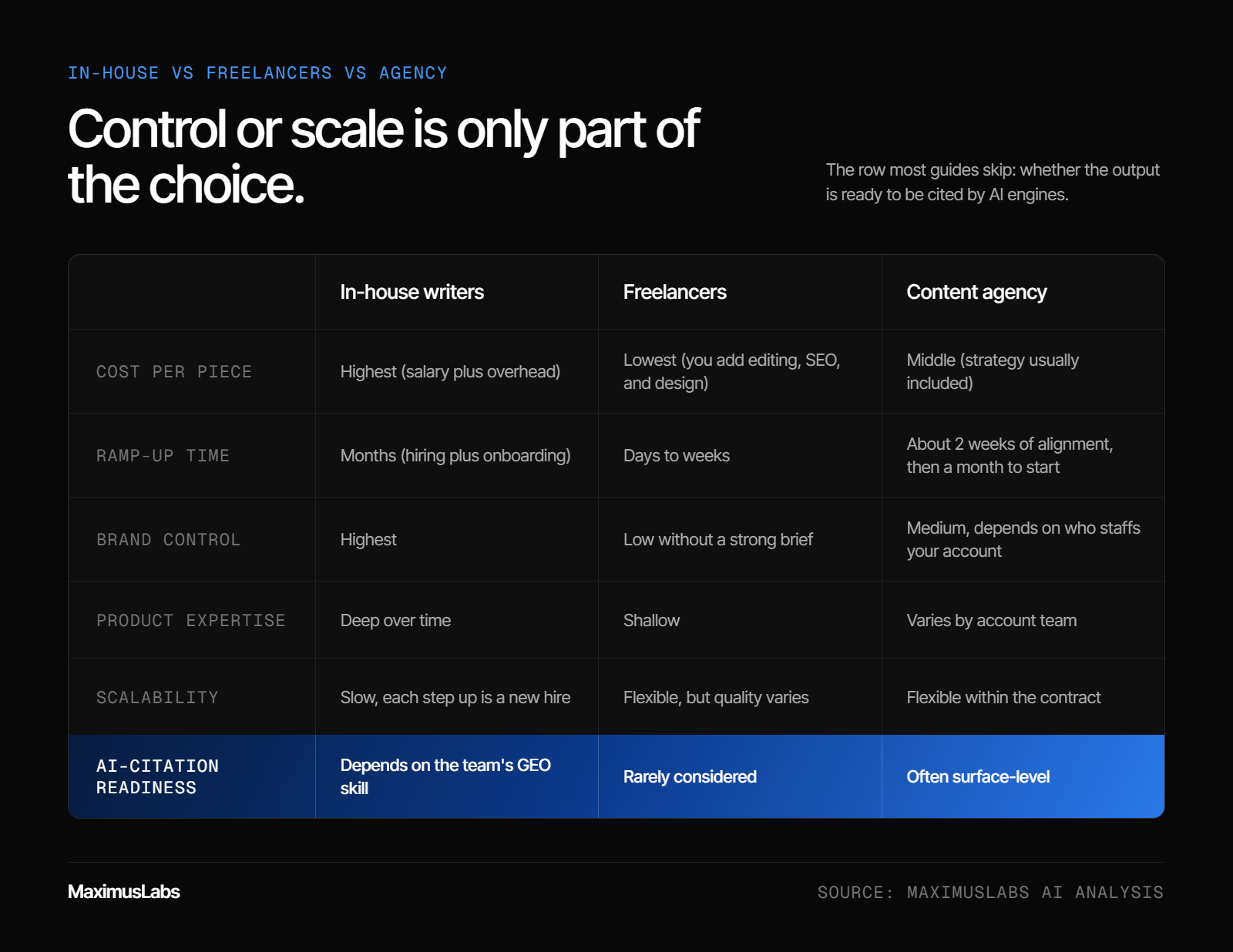
Most comparisons stop at "in-house gives control, outsourcing gives scale." That is true, but incomplete. The table below adds the row most guides skip: whether the output is ready to be cited by ChatGPT, Perplexity, and Google AI Overviews.
| Criteria | In-house writers | Freelancers | Content agency |
|---|---|---|---|
| Cost per piece | Highest (salary plus overhead) | Lowest (you add editing, SEO, and design) | Middle (strategy usually included) |
| Ramp-up time | Months (hiring plus onboarding) | Days to weeks | About 2 weeks of alignment, then a month to start |
| Brand control | Highest | Low without a strong brief | Medium, depends on who staffs your account |
| Product expertise | Deep over time | Shallow | Varies by account team |
| Scalability | Slow, each step up is a new hire | Flexible, but quality varies | Flexible within the contract |
| AI-citation readiness | Depends on the team's GEO skill | Rarely considered | Often surface-level |
⚠️ Why AI search changes the question
Pew Research Center tracked the browsing of 900 US adults in March 2025. When a Google AI summary appeared, users clicked a traditional result on 8% of visits, versus 15% without one. Clicks on sources cited inside the summary happened on only about 1% of visits.
That changes what you are buying. You used to pay writers to rank a page. Now you pay them to produce the source an AI engine trusts enough to quote. Generative Engine Optimization (GEO), the practice of earning citations inside AI answers, rewards expertise and evidence over volume.
💡 Who owns the expertise?
MaximusLabs AI's read is that most teams ask the wrong question. "Who types the words?" matters far less than "Who owns the expertise?"
I've watched both payroll writers and contract writers fail for the same reason: nobody fed them real buyer insight.
The Content Marketing Institute's 2026 research shows why this matters. 88% of B2B marketers use AI content tools, and 52% name brand voice and authenticity as a top challenge. When drafting is cheap, expertise becomes the scarce input.
✅ A stage-based rule of thumb
Seed to early stage: Outsource most production. Keep one founder or marketer as the expert voice.
Series A to B: Hire an in-house content strategist first. Then outsource execution.
Scale stage: At 20+ pieces a month and $20,000+ in monthly content budget, a full in-house unit can pay off. That holds only if engineering does not block publishing.
MaximusLabs AI runs this hybrid as one team. MaximusLabs sits with the client's leadership to capture the founder's perspective, then handles research, writing, design, and publishing. The client keeps the expertise and approves what ships, and MaximusLabs measures every engagement on pipeline, not on mentions.
Q2. What does an in-house content writer really cost once fully loaded?
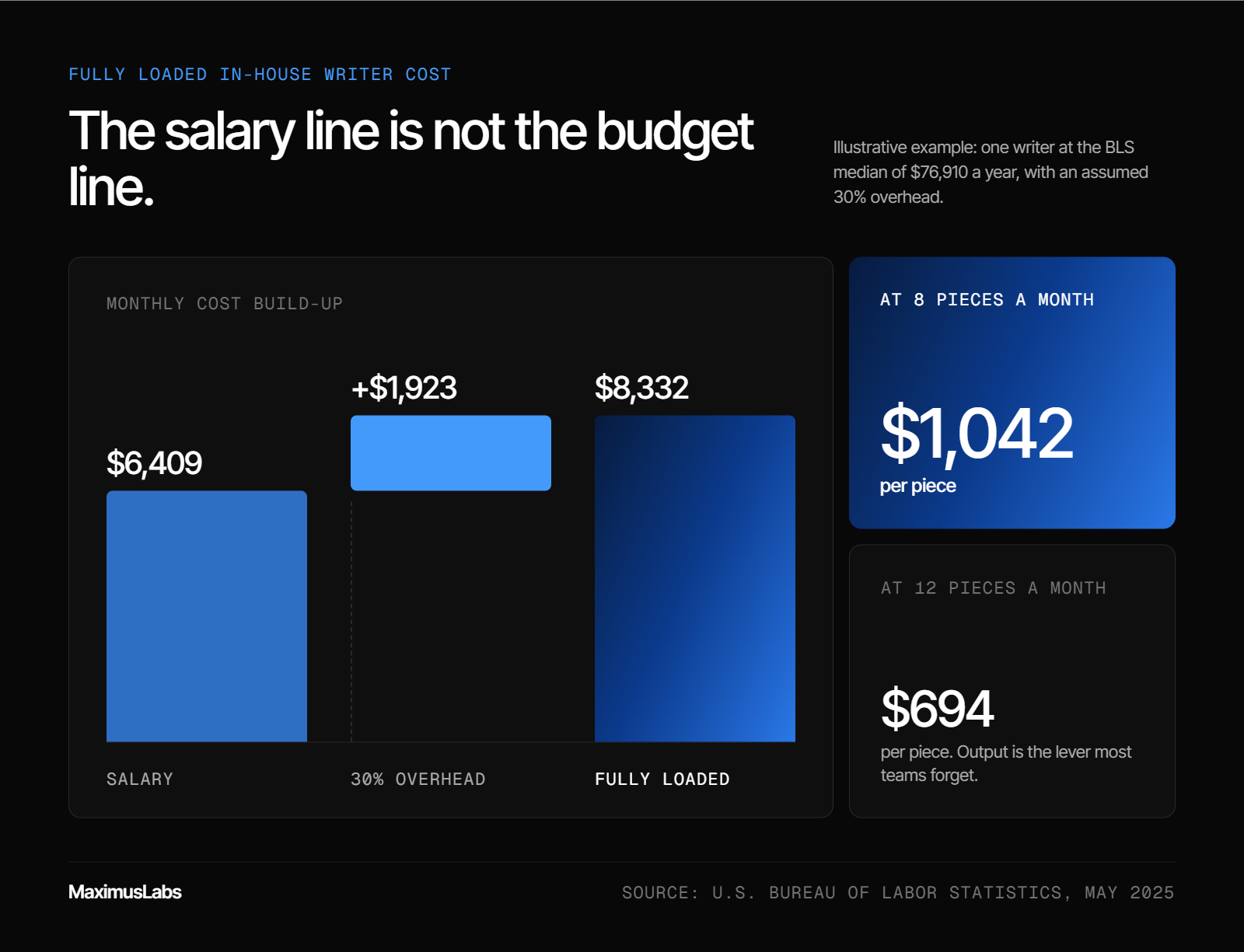
An in-house content writer costs far more than the salary line. The US Bureau of Labor Statistics puts median pay for writers and authors at $76,910 a year. That is about $6,400 a month, before benefits, tools, editing, and management time. At eight long-form pieces a month, salary alone works out to roughly $800 per piece. A full in-house team with an SEO manager and a designer can run near $20,000 a month.
💰 Start with the salary baseline
BLS reports the May 2025 median for writers and authors at $76,910, or $36.98 an hour. That is a median across all writers, so someone with deep product or technical knowledge can cost more. BLS also projects 0% employment growth for the role from 2025 to 2035.
Salary is the visible number. It is rarely the number that lands in your budget review.
💸 The hidden costs that never show up in the job req
Benefits and payroll taxes
Software for SEO research, AI drafting, and design
Editing and review time from senior staff
Recruiting time, plus the months before a new hire ships at full speed
Management time from whoever owns the content calendar
Each item looks small on its own. Together, they turn a $6,400 monthly salary into a much larger line.
Ramp-up deserves its own mention. A new writer spends the first months learning your product, your buyers, and your review process. You pay full salary during that time, but output stays low until the writer can work without heavy edits.
📊 A worked example: cost per published piece
This is an illustrative example, not a benchmark. Assume one writer at the BLS median, and assume benefits, tools, and management add 30%.
| Line item | Monthly cost |
|---|---|
| Salary ($76,910 ÷ 12) | $6,409 |
| Assumed 30% overhead | $1,923 |
| Fully loaded cost | $8,332 |
| Cost per piece at 8 pieces a month | $1,042 |
| Cost per piece at 12 pieces a month | $694 |
Output is the lever most teams forget. A writer who also handles keyword research, briefs, and graphics finishes fewer pieces, so the cost per piece climbs.
⚠️ The junior generalist trap
Many startups try to save money with one junior hire at around $40,000 a year. That person is then asked to write, design graphics, and fix technical SEO. In MaximusLabs AI's client audits, this setup usually produces mediocre work across all three jobs, plus constant management time.
MaximusLabs AI's own cost model prices a full in-house team at about $20,000 a month for 25 pieces. That team covers a writer, an SEO manager, a designer, and tools. That is roughly $800 per piece, close to the worked example above.
MaximusLabs AI built its model around this gap. Every engagement includes a dedicated SEO manager, a graphic designer, and the software stack, so the client never needs a junior generalist. Strategy and execution sit in one team, which removes the hand-off delays that slow most in-house programs.
Q3. How much does outsourced content cost: freelancers vs agencies?
At 25 pieces a month, freelancers average about $100 a piece, but the client supplies keyword research, graphics, and editing. Traditional agencies average about $260 a piece, with strategy included and a slower start. In-house teams land near $800 a piece. MaximusLabs AI produces content at roughly $60 a piece, with an SEO manager, graphic designer, and unlimited revisions included, using hybrid human and AI workflows.
📊 Cost per piece across four models
These figures come from MaximusLabs AI's own cost comparison at 25 pieces a month. Read them as one operator's model, not an industry census.
| Model | Monthly cost (25 pieces) | Cost per piece | What is included |
|---|---|---|---|
| In-house team | $20,000 | $800 | Full control, but you manage everything |
| Traditional agency | $6,500 | $260 | Strategy, with a slower setup |
| Freelancers | $2,500 | $100 | Writing only, usually up to 3 revisions |
| MaximusLabs AI | Varies by volume | ~$60 | Strategy, SEO manager, designer, software, unlimited revisions |
The gap is not only price. Each row includes a different amount of work, and the missing work lands on your team.
❌ What the freelancer price leaves out
A freelancer's rate usually covers the draft and little else. Keyword research, briefs, graphics, CMS upload, and strategy stay with you. Revisions are often capped at three.
Your editor's time becomes the hidden cost. A $100 article that needs four hours of internal editing is not a $100 article.
❌ What the agency price leaves out
Agency pricing often stacks a management fee on top of writing fees. Zerys, a content platform, lists low-end agency fees at $500 to $1,000 a month. Mid-range fees run $3,000 to $5,000, and high-end fees start at $10,000+. That source is a vendor white paper, so treat it as a rough guide.
The bigger risk is staffing. Senior people often run the sales pitch; then junior staff run the account. Ask who will actually write and edit your content before you sign.
Agencies also differ in what "strategy" means. Some deliver a keyword list and a calendar. Others own the research, the briefs, the publishing, and the reporting. Ask for a sample month of deliverables so you can compare like with like.
⏰ Setup speed is a cost too
Traditional agencies often need about two weeks of alignment, then a month before the first piece starts. Freelancers start fast, but only after you write the briefs. Every month without published content is a month of pipeline you did not build.
💡 Price per piece only means something with the exclusions listed
MaximusLabs AI's rule when reviewing any content quote is simple: list what is missing before you compare numbers. I've seen cheap quotes become the most expensive line in the budget once internal editing hours were added back.
MaximusLabs AI onboards new clients in two days, and the first article can go live as early as day four. That speed comes from hybrid workflows: AI handles research aggregation and formatting, while humans own voice, accuracy, and strategy. Humans approve everything that ships.
Q4. Why is cost per word the wrong way to compare content models?
Cost per word ignores that most content produces almost nothing. SEO consultant Ethan Smith has observed that a small share of landing pages drives most of the traffic. AI answers also shrink clicks. Ahrefs found AI Overviews correlate with a 58% lower click-through rate for the top result. Pew found clicks fall from 15% to 8% of visits. The useful metric is cost per piece that earns pipeline or an AI citation.
🧾 How content got budgeted for a decade
For years, teams bought content like a commodity: per word, per article, per month. Quotas followed. X pieces a day, Y words each, Z keywords inside. Eli Schwartz, author of Product-Led SEO, compares this setup to a warehouse worker packing boxes.
The model made sense when every page was a lottery ticket for a Google ranking. More tickets meant more chances, so cheaper words looked like better value.
⚠️ Two forces broke the math
First, the power law. Ethan Smith has observed that a small share of landing pages drives most of the traffic. That means most pages drive little or nothing.
Second, zero-click search, where the user gets the answer without visiting a site. Ahrefs studied 300,000 keywords and found that, by December 2025, AI Overviews correlated with a 58% lower click-through rate (CTR) for position one. Pew saw the same pattern from the user side.
Put those two forces together, and the old math falls apart. Most pieces never win, and the winners now earn fewer clicks than before. Buying more cheap words only adds more losing tickets.
📐 Measure cost per winning piece
Here is an illustrative example. A team publishes 40 pieces a quarter at $260 each, spending $10,400. If, say, one in 20 pieces carries the results, two pieces did the work. The real cost is $5,200 per winning piece.
Now the question changes. Which model raises the share of pieces that win? That depends on expertise, evidence, and fit with buyer intent, not on a lower word rate.
This is also why I skip most top-of-funnel content. AI engines already answer simple "What is X?" questions on their own. Pieces aimed at buyers comparing options are far more likely to land among the winners, because they match how real deals start.
"Clicks and impressions are vanity metrics. They are of no use if they don't move the revenue needle."
Krishna Kaanth, MaximusLabs AI
✅ What to track starting Monday
Pipeline influenced: Tag each content piece in your CRM and report the deals it touched.
AI citations: Check target prompts monthly in ChatGPT, Perplexity, Gemini, and Google AI Overviews.
Funnel mix: Track the share of bottom-of-funnel (BOFU) and middle-of-funnel (MOFU) pieces against top-of-funnel (TOFU) ones.
Cost per winning piece: Divide quarterly content spend by the pieces that drove pipeline.
MaximusLabs AI measures every engagement on pipeline, not on mentions, and starts with BOFU content because it converts. For one B2B SaaS client, that approach produced "27 qualified leads, $47K+ pipeline, 26% close rate in 4 months (Oliv AI)". The citation work underneath it followed the same logic: earn trust first, then turn it into revenue.
Q5. What are the real pros and cons of in-house writers?
In-house writers win on product depth, brand voice, and fast access to subject experts. They lose on range, resilience, and speed. One hire rarely covers writing, design, and technical SEO. One resignation can stop the whole program. Pages can also sit for months in engineering queues. In-house works best when a company can fund a full team and give it direct publishing access.
✅ Where in-house writers genuinely win
An in-house writer sits in the same Slack channels as sales, product, and support. That proximity is hard to buy. The writer hears objections on calls, sees feature launches early, and learns the words buyers actually use.
Over time, that knowledge compounds. The writer's tenth article on your product is far better than the first, because nothing needs explaining twice. Brand voice also stays consistent, since one person or one small team shapes every draft.
🧠 The advantage most teams waste
MaximusLabs AI's read is that in-house teams often sit on their biggest asset and never use it. That asset is access to subject matter experts (SMEs), the engineers, founders, and customer leads who know the product best. I've seen in-house writers produce generic posts while the CTO sat ten desks away.
Proximity only pays off when the process forces it. A 20-minute SME interview per article turns a generic draft into something only your company could publish.
❌ The single point of failure
An in-house program built around one writer has no backup. If that writer takes a new job, gives two weeks' notice, or goes on leave, publishing stops. Rebuilding means another hiring cycle and another ramp-up period.
You also keep paying for the role in slow months. The BLS median of $76,910 a year applies whether you publish eight pieces or two. Fixed cost suits steady demand. It hurts when content needs swing with launches and campaigns.
⏰ The developer wall
The quieter problem is shipping. SEO consultant Ethan Smith has described his early consulting work this way: he would build an entire, detailed strategy, and more often than not, only a small part of it was ever launched.
The rest waited on engineering. In his account, custom CMS page templates could take up to nine months to deploy through internal developer queues. An in-house writer can finish a draft in a week. If the page needs a new template, the draft waits.
⚖️ When in-house clearly wins
Content is a core channel: It drives a large share of pipeline, so expertise justifies fixed cost.
Volume is steady: You need 20 or more pieces a month, every month.
Publishing is unblocked: Writers can ship pages without waiting on engineering.
The team is complete: A strategist, writer, editor, and designer, not one person doing all four.
If two or more of these are missing, a pure in-house model will likely underdeliver. Strategy that never ships is worth zero, however good it is.
MaximusLabs AI works alongside in-house teams in exactly this gap. The client's people keep product knowledge and approvals, while MaximusLabs handles research, writing, design, and CMS publishing. That split keeps expertise inside the company and removes the engineering queue from the critical path.
Q6. What are the real pros and cons of outsourcing to freelancers vs agencies?
Outsourcing buys speed, specialist range, and flexible volume without salary risk. Freelancers are cheap and fast to start, but bring little business context and rarely cover design or SEO. Agencies bring process and strategy, but staffing can shift to junior writers after the sale. Unvetted writers using raw AI text have triggered steep ranking losses. Outsourcing works when strategy and expertise stay with the company.
✅ What both outsourced models do well
Freelancers and agencies share three real strengths. You can scale volume up or down each month. You can hire specialists for one topic without a full-time role. You also avoid the fixed salary cost that hurts in slow quarters.
Speed matters too. A good freelancer can start this week. An agency brings a ready process for briefs, editing, and publishing. Both let you test a new topic or format before committing to a hire.
👤 Freelancers: fast, cheap, and thin on context
A freelancer is usually one person working across many clients. That brings range but little depth in your product. Keyword research, graphics, and technical SEO typically stay with you.
Continuity is the hidden risk. A strong freelancer can take a full-time job, raise rates, or drop clients with little notice. Your content program then depends on how fast you can find and train the next one.
🏢 Agencies: process, with staffing to watch
Agencies solve the continuity problem with a team. They also bring strategy, editing layers, and reporting. The trade-off is distance: your account is one of many.
Staffing is where agencies most often disappoint. Senior strategists win the pitch; then junior writers produce the work. Quotas make it worse. Eli Schwartz, author of Product-Led SEO, put it sharply. He wrote that this "prescription-type of content is not a king; it is an indentured servant."
⚠️ The unvetted AI risk
The newest risk sits with any writer you cannot see working. Some freelancers paste raw AI output and bill per word. Practitioner accounts describe sites losing nearly all organic visibility after quality updates, with one case citing a 99.3% ranking crash.
Google's position is clear. Its Search Central guidance says it rewards helpful, people-first content however it is produced. The same guidance says using automation mainly to manipulate rankings violates its spam policies. The tool is not the problem. Unreviewed, expertise-free output is.
🎯 How to outsource without losing quality
Keep strategy, topic selection, and SME access in-house.
Contract for outcomes, such as pipeline and citations, not word counts.
Require a named subject matter expert to review every piece.
Ask every writer how they use AI, in writing.
Content should act like your best salesperson, not a box packer. Outsourcing can deliver that, but only when the expertise flows in from your side.
MaximusLabs AI is built to close the context gap that sinks most outsourced programs. MaximusLabs starts each engagement by sitting with the leadership team to capture their perspective, so drafts carry the founder's view rather than a generic summary. A dedicated SEO manager and designer cover the work freelancers leave behind.
Q7. How has AI changed the in-house vs outsource decision?
AI made drafting cheap for both models, so volume no longer separates them. The Content Marketing Institute found 65% of B2B marketers faced pressure to produce content faster. Many reported more generic output as a result. Google rewards helpful content however it is produced. The deciding factor is now who supplies expertise, accuracy, and voice. MaximusLabs AI pairs AI drafting with human research, founder interviews, and quality review in a three-stage pipeline.
📉 Speed went up, originality went down
For a decade, the in-house versus outsource debate was mostly about capacity. Who could produce more pieces per month, at what price? AI tools changed that almost overnight.
CMI's 2026 research shows the side effect. Among marketers under pressure to produce faster, 35% reported burnout or creative fatigue. Another 32% reported less original thinking, and 29% reported more generic content. More output did not mean better output.
⚠️ The automation trap
Many content shops responded by automating everything. Ethan Smith put the problem bluntly. In his view, many shops take a B-minus workflow, automate it by chaining ChatGPT queries, and turn it into a C-plus product sold at a steep discount.
His point was that buyers do not want cheaper. They want better. A C-plus article at a lower price still loses to a competitor's A-grade piece, in Google and in AI answers alike.
🧠 What humans must still own
MaximusLabs AI's view is that AI now handles the parts of writing that used to separate expensive teams from cheap ones. Research aggregation, outlines, formatting, and first drafts are fast for everyone. I believe that leaves four jobs where humans decide the result:
| Job | Why AI cannot own it |
|---|---|
| Original perspective | AI summarizes existing pages; it has no lived opinion about your market |
| Accuracy | Facts, numbers, and product claims need a person who checks the source |
| Brand voice | Voice comes from the founder's real views, not from a style prompt |
| Strategy | Choosing which buyer question to answer next is a business decision |
Everyone can now summarize five articles and write the sixth. Perspective is the scarce asset.
🔀 What this means for your choice
The question is no longer "in-house or outsourced?" It is "who owns the four human jobs above, and who runs the AI-assisted rest?" An in-house writer using AI without SME input fails the same way a cheap freelancer does.
A practical split for most B2B teams looks like this:
Inside the company: perspective, product truth, and final approval.
With a partner: research, drafting, design, publishing, and measurement.
Google's guidance supports this split. It focuses on whether content is helpful and shows expertise, not on whether a human typed every word.
🛠️ How the pipeline works in practice
MaximusLabs AI runs every article through three stages. Stage one is primary-source research and search intent analysis. Stage two is writing in the founder's voice, built from leadership interviews. Stage three is quality review, where each article is scored on 10 dimensions and must reach 70 out of 100 to publish.
MaximusLabs AI uses AI for speed in each stage, and humans own the judgment. Humans approve everything that ships, which keeps the cost of AI-assisted production without the C-plus quality.
Q8. Which model produces content AI engines actually cite?
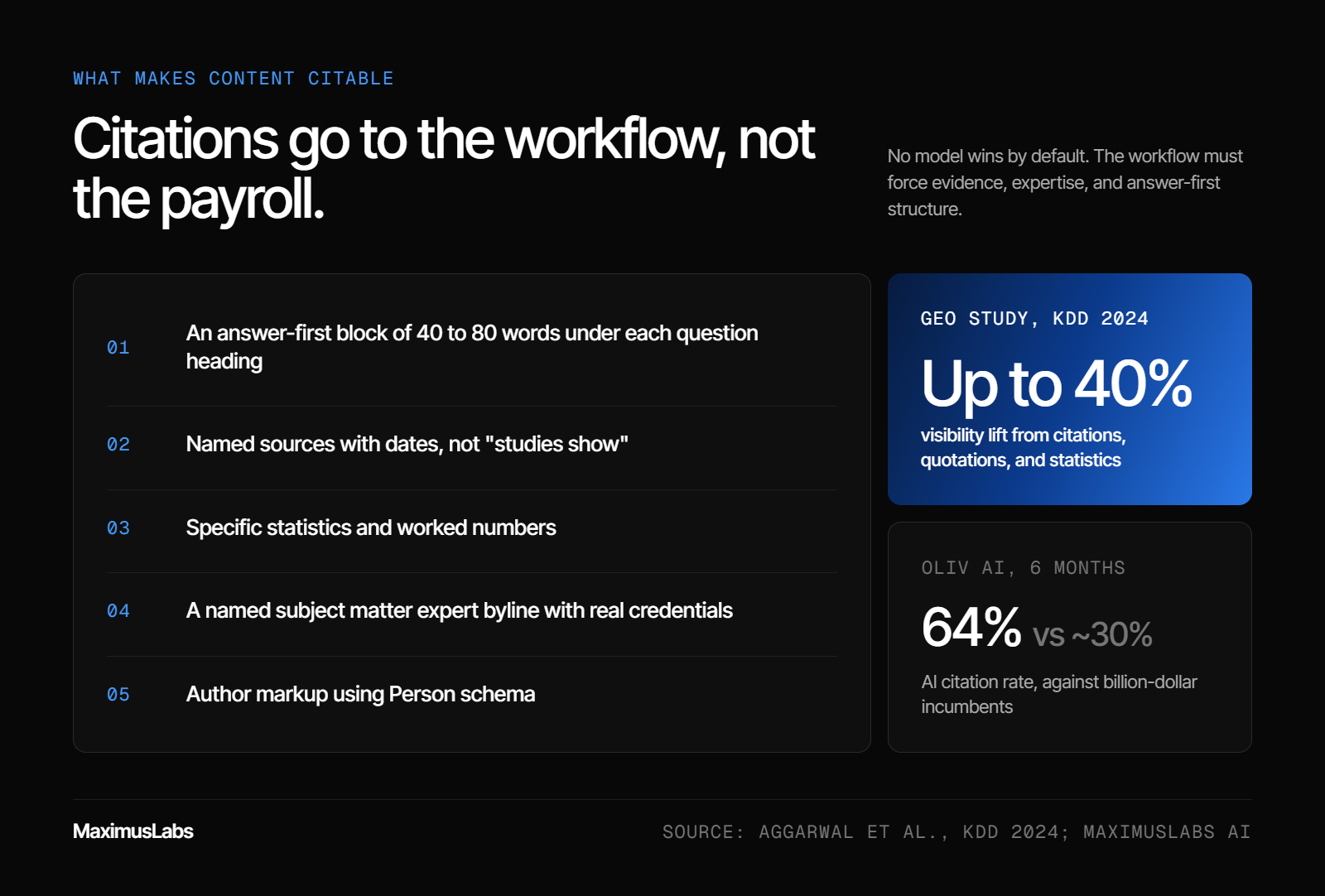
The model that ships expert, sourced, answer-first content wins AI citations, whoever employs the writer. The Princeton-led GEO study, published at KDD 2024, found that optimization tactics can lift visibility in generative engine answers by up to 40%. MaximusLabs AI applied these principles for Oliv AI, reaching a 64% AI citation rate in six months, against about 30% for billion-dollar incumbents.
🎯 Citations are the new rankings
In Google's classic results, ten blue links shared the clicks. In ChatGPT, Perplexity, and Google AI Overviews, the buyer sees one answer with a handful of named sources. A brand is either in that answer or invisible for that question.
Krishna Kaanth, founder of MaximusLabs AI, frames it as a trust transfer. When ChatGPT recommends a brand, it puts its own credibility behind that brand. The goal is to become the answer, not just appear somewhere in the results.
🔬 What makes content citable
The clearest evidence comes from "GEO: Generative Engine Optimization" by Aggarwal and colleagues, presented at KDD 2024. The researchers tested ways to change content and measured how often generative engines surfaced it. Adding citations to credible sources, quotations, and statistics performed among the best, with visibility gains of up to 40%.
That maps to a practical checklist. Citable content has:
An answer-first block of 40 to 80 words under each question heading
Named sources with dates, not "studies show"
Specific statistics and worked numbers
A named subject matter expert byline with real credentials
Author markup using Person schema, the structured data that tells engines who wrote the page
⚖️ How each model fares on citation readiness
| Model | Typical strength | Typical gap |
|---|---|---|
| In-house writer | Product truth and SME access | Often lacks GEO and structured data skills |
| Freelancer | Fast drafts | Rarely adds sources, statistics, or SME bylines |
| Traditional agency | Process and volume | Often optimizes for keywords, not AI answers |
| GEO-native partner | Citation-first structure | Needs the client's experts to supply perspective |
No model wins by default. The deciding factor is whether the workflow forces evidence, expertise, and answer-first structure into every piece.
📈 What it looks like when it works
MaximusLabs AI's work with Oliv AI shows the outcome. The result was a "64% AI citation rate in 6 months, vs ~30% for billion-dollar incumbents (Oliv AI)". Those incumbents had been in market for over ten years. Budget and age did not decide the answer. Trust signals did.
MaximusLabs AI measured this through share of voice, meaning how often a brand appears across many question variants on each AI platform. I like that metric because it rewards being useful across a whole topic, not ranking one keyword.
✅ A citation-readiness test for any writer
Before you hire or renew any writer or partner, check three recent pieces:
Does each section open with a direct answer that stands alone?
Is every number tied to a named, dated source?
Is there a real expert byline with Person schema?
Would a buyer learn something not found in the top five results?
If the answer is no to two or more, the model will struggle in AI search, whatever it costs.
MaximusLabs AI builds these checks into every article and tracks citations across ChatGPT, Perplexity, Gemini, Claude, and Google AI Overviews. The aim is citations that lead to pipeline, not mentions for their own sake.
Q9. When does a hybrid content model beat both?
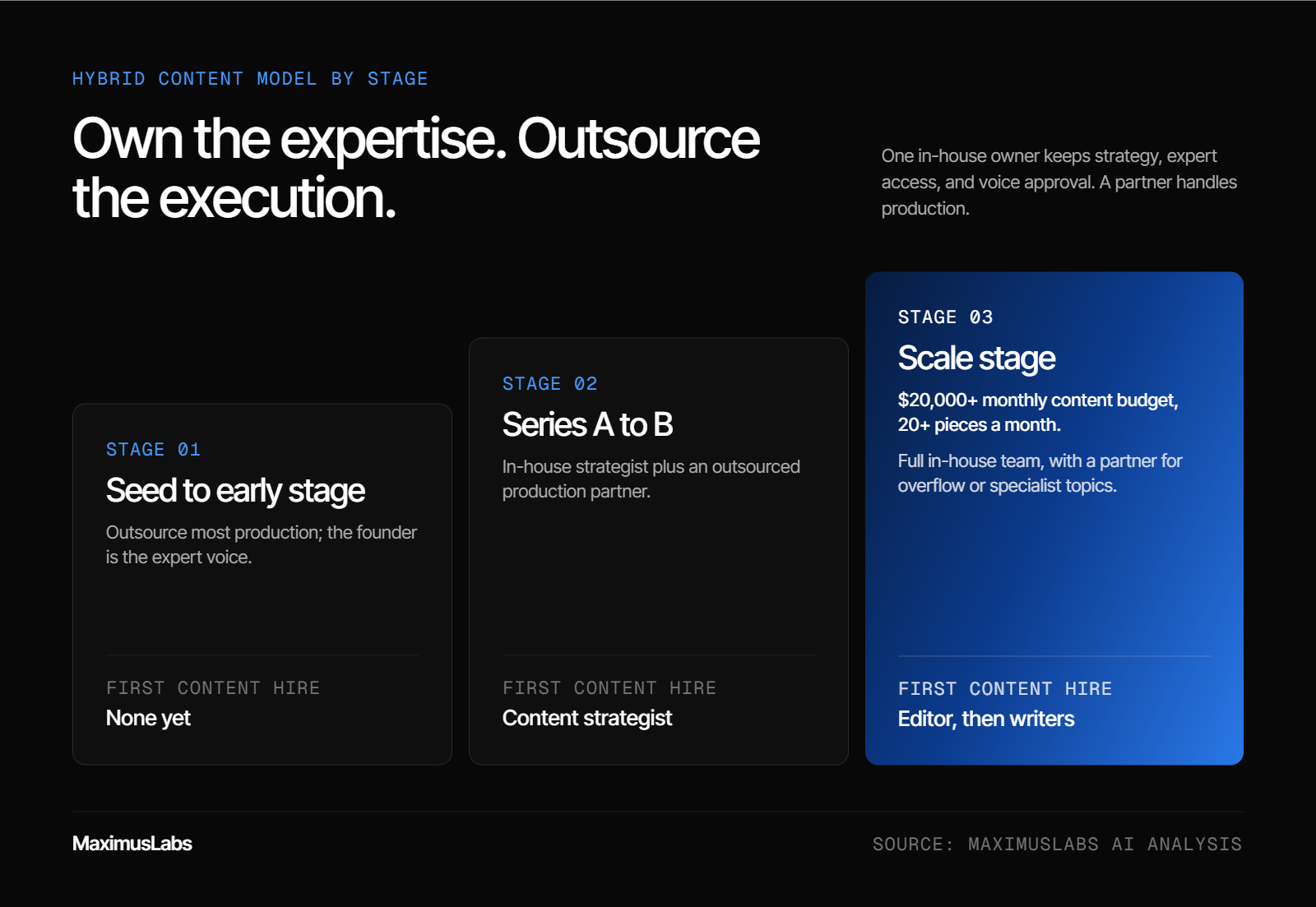
A hybrid content model wins when a company needs speed and depth at the same time. One in-house owner keeps strategy, subject expert access, and voice approval. A partner handles research, drafting, design, and publishing. Seed-stage teams can outsource almost everything. Series A to B teams should hire a strategist first. Teams spending $20,000+ a month can justify a full in-house unit. MaximusLabs AI runs the outsourced half of this model and captures the founder's perspective through leadership interviews.
🧩 The role split that works
The cleanest split follows one rule: own the expertise, outsource the execution.
| Job | Who owns it | Why |
|---|---|---|
| Content strategy and topic choice | In-house owner | Ties content to pipeline and product priorities |
| Subject expert access | In-house owner | Only insiders can book the CTO's time |
| Voice and final approval | In-house owner | The brand's point of view stays in the company |
| Research and briefs | Partner | Needs time and method more than product access |
| Drafting, design, and publishing | Partner | Scales up or down with demand |
| Measurement and AI citation tracking | Partner, reviewed in-house | Needs tools and a repeatable method |
🛡️ Protect the in-house owner from production work
The in-house owner should not become the bottleneck writer. CMI's 2026 research shows why. 72% of individual contributors reported rising pressure to produce faster, against 59% of leaders. Burnout or creative fatigue hit 48% of individual contributors, against 27% of leaders.
A hybrid model moves production off that person, so their week goes to strategy, expert interviews, and approvals.
📍 Matching the model to your stage
| Stage | Recommended setup | First content hire |
|---|---|---|
| Seed to early stage | Outsource most production; the founder is the expert voice | None yet |
| Series A to B | In-house strategist plus an outsourced production partner | Content strategist |
| Scale stage ($20,000+ monthly content budget, 20+ pieces) | Full in-house team, with a partner for overflow or specialist topics | Editor, then writers |
⚙️ Programmatic pages vs expert articles
Programmatic pages are generated from structured data, such as location pages, category pages, or calculators. They scale well with templates and light review.
B2B thought leadership and YMYL ("Your Money or Your Life") topics, meaning pages that affect health or money decisions, are different. They fail at scale without an expert checking every claim.
🎙️ Capturing the founder's voice from outside
The founder's perspective cannot be outsourced, but it can be captured. MaximusLabs AI does this with a fixed workflow:
Sit with the leadership team.
Understand the vision, the goals, and the company's right to win.
Capture the founder's view of the market in their own words.
Reflect that view in every article, so it reads as if the founder wrote it.
MaximusLabs AI has found this step separates a working hybrid from polished but generic copy. The partner writes, but the opinions stay the founder's.
MaximusLabs AI runs the execution side of this hybrid model as one team. Strategy and execution stay connected, a dedicated SEO manager and designer handle production, and the client's leaders approve everything that ships. MaximusLabs measures each engagement on pipeline, which keeps both halves of the model pointed at the same goal.
Q10. How do you vet an outsourced content partner without getting burned?
Write the protections into the contract. Name the senior people who will work on your account. Keep monthly cancellation with 30 days' notice instead of annual lock-ins. Require subject expert bylines with Person schema on every piece. Before signing, ask for past clients and their start dates, then check third-party traffic data to confirm growth followed the engagement.
📝 Contract terms that prevent the common failures
Most outsourcing failures are predictable, so most can be written out of the contract. Four clauses do the heavy lifting:
Named team: The contract lists the strategist, editor, and writers by name. Changes need your written approval.
Monthly terms: Cancellation on 30 days' notice. Avoid annual contracts for commodity writing work.
Outcome reporting: Monthly reports on pipeline influenced and AI citations, not just pieces delivered.
Revision rights: A clear revision policy, so quality fixes do not become extra invoices.
A partner confident in its work rarely objects to these terms. Push back on any partner that insists on a 12-month lock-in before proving results.
✍️ Authorship and AI disclosure rules
Google's own guidance gives you the standard to hold partners to. It asks whether it is "self-evident to your visitors who authored your content." Google also says it strongly encourages "adding accurate authorship information, such as bylines."
The same page asks whether the use of automation, including AI, is clear to visitors where they would reasonably expect it. So put two rules in writing: every piece carries a real expert byline, and the partner discloses how AI is used in production.
Back the byline with structured data. Schema.org's Person type lets a page state who the author is, their job title, and where they work. Its sameAs property links the author to profiles such as LinkedIn, which helps engines confirm the person is real.
🔍 The proof audit before you sign
Case studies on a partner's website are marketing. Verify them yourself:
Ask for three past clients and the month each engagement started.
Check each client's organic traffic trend in a third-party SEO tool.
Confirm growth started after the engagement began, not before.
Ask each referenced client one question: would you renew?
Renewal rate is the honest scorecard of any agency. Ethan Smith put it plainly: for an agency that wants to grow large, renewal rate is the only thing that matters. Ask every partner for theirs.
⏰ Review gates in the first 30 days
The first month tells you most of what you need to know. Set three checkpoints:
Week 1: Does the partner's plan reflect your ICP, meaning your ideal customer profile, and your product's real use cases?
Week 2: Do the first drafts include named sources, expert input, and answer-first sections?
Week 4: Is content live, correctly marked up, and tracked for AI citations?
If two of the three gates fail, use the 30-day exit clause. That clause is why you negotiated it.
MaximusLabs AI accepts these same standards in its own engagements. MaximusLabs onboards clients in two days, includes unlimited revisions, and reports on pipeline rather than word counts. Clients approve the keyword plan before content goes live, and humans approve everything that ships.
Frequently asked questions
Is it cheaper to outsource content writing than to hire an in-house writer?
In most cases, yes, once you count the full cost of an in-house hire. The US Bureau of Labor Statistics puts median pay for writers and authors at $76,910 a year. That salary is only the start. Benefits, software, editing time, recruiting, and management time push the real monthly cost well past the salary line. At 25 pieces a month, the cost per piece looks roughly like this: • In-house team: about $800 per piece, with full control but full management load. • Traditional agency: about $260 per piece, with strategy included and a slower start. • Freelancers: about $100 per piece, but research, graphics, and editing fall back on your team. MaximusLabs AI produces content at roughly $60 a piece, with an SEO manager, a graphic designer, and unlimited revisions included. We get there with hybrid workflows: AI handles research aggregation and formatting, while humans own voice, accuracy, and strategy. Price per piece only means something when you list what each quote leaves out. A cheap article that needs four hours of internal editing is not cheap. You can see how we structure engagements on our pricing page.
How many articles a month justify hiring a full-time in-house content writer?
We use a simple threshold. A full in-house content unit starts to pay off at around 20 or more pieces a month and $20,000 or more in monthly content budget. Below about 10 pieces a month, outsourcing is usually the better fit. Volume alone is not enough, though. In-house works best when four conditions hold: • Content is a core channel that drives a large share of pipeline. • Volume is steady, month after month, not tied to launches. • Publishing is unblocked, so writers can ship pages without engineering queues. • The team is complete: a strategist, writer, editor, and designer, not one person doing all four. If two or more of these are missing, a pure in-house model will likely underdeliver. One writer also creates a single point of failure. A resignation or leave can stop publishing entirely, and rebuilding means another hiring and ramp-up cycle. MaximusLabs AI often works alongside in-house teams that sit between these stages. The client keeps product knowledge and approvals, while we handle research, writing, design, and publishing as part of our content marketing service.
Can an outsourced writer capture our founder's voice and expertise?
Yes, but only if the process is built to capture it. Most outsourced content sounds generic because nobody feeds the writer real buyer insight or the founder's point of view. The writer is rarely the problem. The missing input is. The founder's perspective cannot be outsourced, but it can be captured. MaximusLabs AI does this with a fixed workflow: • Sit with the leadership team. • Understand the vision, the goals, and the company's right to win. • Capture the founder's view of the market in their own words. • Reflect that view in every article, so it reads as if the founder wrote it. We have found this step separates a working hybrid model from polished but generic copy. The partner writes, but the opinions stay the founder's. On your side, keep three things in-house: strategy, access to subject matter experts, and final approval. A 20-minute expert interview per article is often enough to turn a generic draft into something only your company could publish. Our founder voice methodology guide explains the approach in more detail.
Should a startup's first content hire be a writer or a strategist?
For most growth-stage B2B startups, the first content hire should be a strategist, not a writer. Writing can be outsourced. Choosing which buyer question to answer next is a business decision that needs someone close to the product and pipeline. Here is how we map the choice by stage: • Seed to early stage: outsource most production and keep the founder as the expert voice. No content hire yet. • Series A to B: hire an in-house content strategist first, then outsource execution. • Scale stage: at 20+ pieces a month and $20,000+ in monthly budget, add an editor, then writers. Many startups try to save money with one junior generalist at around $40,000 a year. That person is then asked to write, design graphics, and fix technical SEO. In MaximusLabs AI's client audits, this setup usually produces mediocre work across all three jobs, plus constant management time. A strategist paired with an outside production partner avoids that trap. You can read more about stage-specific planning in our guide to GEO for SaaS startups.
Is AI-generated content from outsourced writers risky for SEO?
The risk is not AI itself. The risk is unreviewed output with no real expertise behind it. Google's Search Central guidance says it rewards helpful, people-first content however it is produced. The same guidance says using automation mainly to manipulate rankings violates its spam policies. Problems start when a writer pastes raw AI text and bills per word. Practitioner accounts describe sites losing nearly all organic visibility after quality updates. Chained AI workflows also tend to turn average content into worse content at a lower price. To protect your site, put these rules in writing with any writer or partner: • Every piece carries a real expert byline with Person schema. • A named subject matter expert reviews every piece for accuracy. • The writer discloses how AI is used in production. • Facts and numbers link to a named, dated primary source. Google's helpful content guidance also asks whether authorship and automation are clear to readers. Writers who follow these rules can use AI for speed without the quality loss. You can track how Google algorithm updates treat low-quality content over time.
How do we measure whether outsourced content is actually working?
Stop measuring word counts and pieces delivered. Clicks also tell a weaker story now, because AI answers absorb many of them. Pew Research Center found users clicked a traditional result on 8% of visits when a Google AI summary appeared, versus 15% without one. We track four numbers instead: • Pipeline influenced: tag each piece in your CRM and report the deals it touched. • AI citations: check target prompts monthly in ChatGPT, Perplexity, Gemini, and Google AI Overviews. • Funnel mix: the share of bottom-of-funnel and middle-of-funnel pieces against top-of-funnel ones. • Cost per winning piece: quarterly content spend divided by the pieces that drove pipeline. The last metric changes how you compare models. If a team spends $10,400 on 40 pieces and two pieces carry the results, the real cost is $5,200 per winning piece. The better model is the one that raises the share of pieces that win. MaximusLabs AI measures every engagement on pipeline, not on mentions, and starts with bottom-of-funnel content because it converts. Our guide to calculating content ROI and revenue attribution shows how to set this up.
How long does it take to see results after outsourcing content writing?
Timelines depend on the model you choose. Setup speed is a cost too, because every month without published content is a month of pipeline you did not build. • Traditional agencies often need about two weeks of alignment, then a month before the first piece starts. • Freelancers can start fast, but only after your team writes the briefs. • In-house hires take months, between recruiting and the ramp-up before a new writer ships at full speed. MaximusLabs AI onboards new clients in two days, and the first article can go live as early as day four. Clients approve the keyword plan before content goes live, and humans approve everything that ships. Business results take longer than the first article. For one B2B SaaS client, our approach produced 27 qualified leads, $47K+ pipeline, and a 26% close rate in 4 months. You can read the full Oliv AI case study for the details. We recommend setting review gates in the first 30 days. By week four, content should be live, correctly marked up, and tracked for AI citations. If it is not, use the exit clause.