 Krishna Kaanth M
- A SaaS marketing funnel runs awareness, consideration, conversion, retention, and expansion, with first purchase sitting mid-funnel because subscription revenue is earned monthly, not captured once.
- The 2026 shift is structural: buyers form intent inside ChatGPT, Perplexity, Gemini, and AI Overviews, and legacy inbound playbooks report 20% to 40% organic traffic declines.
- Benchmarks disagree sharply. Visitor-to-lead sits at 2.3% to 2.4%, MQL-to-SQL is reported at both 13% and 41%, and median NRR of 106% against GRR of 90% means expansion masks churn.
- Trial model is the highest-leverage structural choice. Opt-out converts near 49%, opt-in near 18%, and freemium 2.6% to 6%, but customers per 10,000 visitors is the metric that survives comparison.
- Most funnel leaks are measurement problems. Over 70% of AI-assisted journeys land as Direct, so install self-reported attribution before rebuilding any landing page.
- Third-party surfaces decide BOFU outcomes. Web mentions correlate with AI Overview visibility at r=0.664 against 0.218 for backlinks, and the G2 family now holds roughly 84% of review-site citations.
Q1. What is a SaaS marketing funnel in 2026, and what actually changed?
A SaaS marketing funnel is the staged path a buyer takes from problem awareness to becoming a retained, expanding subscriber. The 2026 change is structural. Buyers now form intent inside ChatGPT, Perplexity, Gemini, and Google AI Overviews before they visit any website. Legacy inbound playbooks report 20% to 40% organic traffic declines, so the funnel now starts with whether AI engines cite you, not with where you rank.
📉 The funnel every SaaS team drew on a whiteboard
Most SaaS teams still draw the same shape. Traffic enters at the top, leads form in the middle, trials convert at the bottom, and retention sits somewhere off to the side. The top-ranking guides keep that model intact, adding retention as a fifth stage.
That model worked when Google sent the first click. A visitor landed on a blog post, downloaded something, entered a nurture sequence, and eventually booked a demo. Every stage had a URL you owned.
⚠️ What broke: intent now forms before the first click
The first click is no longer the first touch. Semrush analysed over one billion lines of US clickstream data and found that ChatGPT runs a live web search on only 34.5% of prompts, while 65% to 85% of prompts map to no traditional search keyword at all. Buyers are asking questions your keyword tool cannot see, which is why question research for AI search replaces keyword exports.
Google's own documentation confirms the mechanics. AI Overviews run on a customised Gemini model tied to ranking systems and the Knowledge Graph, and they surface claims corroborated by top web results. The answer gets assembled before anyone chooses a link.
HubSpot's Dharmesh Shah described the downstream effect plainly: organic traffic that used to arrive predictably through SEO "has gone down by 20 to 40%." That is the same shape of search referral traffic decline I see in audits of blog-led SaaS sites.
🎯 The sample set problem
Here is the part that changes funnel design, not just funnel reporting. When a buyer asks an AI engine for the best tools in a category, it names five to ten. My read is that this list is the real top of your funnel now.
"This list becomes the sample set. If your company is not on that list, then you're not in the buying conversation at all. It doesn't matter how good your product is. If you're not surfaced by AI, you're invisible."
Krishna Kaanth, Founder, MaximusLabs AI
On the traditional web, hundreds of tools sat across Google results and G2 listings, and the buyer narrowed them down. Now a model narrows them first. There is no page two in an AI answer.
🔁 Redraw your funnel map this week
MaximusLabs AI builds funnels backward from the AI answer rather than forward from a blog calendar. Traditional SEO agencies open with a keyword list and a publishing cadence. We open with the prompt set your buyers actually type, then engineer which pages, review profiles, and third-party mentions must exist for your product to appear in that generated shortlist. MaximusLabs measures every Answer Engine Optimization engagement on pipeline, not on mentions.
Practically, add one layer above awareness on your funnel diagram and label it citation. Then answer three questions. Which prompts in your category produce a shortlist? Are you on it? And which sources did the engine quote to build that list?
Being in the answer is the means. Pipeline is the outcome. Oliv AI reached a 64% AI citation rate in six months against roughly 30% for billion-dollar incumbents, and 30% to 40% of their inbound is now AI-sourced. That is the layer legacy funnel models leave out.
Q2. What are the funnel stages, and which KPI owns each one?
Five stages run the SaaS funnel: awareness, consideration, conversion, retention, and expansion. Each has one governing metric. Unlike retail, the first purchase sits mid-funnel, because subscription revenue is earned every month rather than captured once. A sharper planning overlay is problem-aware, solution-aware, and product-aware, because a buyer who needs payroll in Argentina behaves nothing like a buyer choosing among five named vendors.
📊 One stage, one metric
Assign a single owner metric per stage. Multiple metrics per stage is how funnel reviews turn into debates.
| Stage | Governing metric | What it answers |
| Awareness | Citation share, qualified sessions | Are we in the answer at all? |
| Consideration | MQL and PQL creation | Did interest become a named buyer? |
| Conversion | Trial-to-paid rate | Did the product earn the card? |
| Retention | Gross revenue retention, churn | Does revenue survive month 13? |
| Expansion | Net revenue retention | Does the account grow itself? |
MQL means marketing qualified lead. PQL means product qualified lead, a user whose in-product behaviour signals readiness to buy.
🔄 Why retention anchors the bottom
In a retail funnel, purchase is the end. In SaaS, purchase is the start of the revenue. Contentsquare's SaaS funnel guide makes this explicit: conversion sits in the middle, and retention forms the bottom. Mouseflow's B2B version reaches the same conclusion through four stages plus retention.
So a funnel with a strong trial-to-paid rate and weak gross retention is not a good funnel. It is an expensive one.
🧠 Plan by awareness state, not by funnel label
Funnel labels describe your org chart. Awareness states describe the buyer. Ethan Smith of Graphite frames the three states like this:
"Problem aware: I know I have a problem like I need to set up payroll in Argentina. Solution aware: I know there are options for how to set up payroll. Product aware: I know there are five companies that have specific products to help me solve this."
Ethan Smith, CEO, Graphite
Each state produces a different prompt, which means a different page type, a different schema, and a different kind of proof. MaximusLabs AI plans content against awareness states rather than TOFU, MOFU, and BOFU quotas, because a quota tells a writer how many pieces to ship and nothing about who reads them.
Some teams prefer John Jantsch's Marketing Hourglass here: Know, Like, Trust, Try, Buy, Repeat, Refer. I think it maps better to SaaS than the funnel does, because it keeps advocacy inside the model rather than treating it as a bonus.
⏰ The timing problem nobody prices in
B2B buying is infrequent, and that breaks the assumption that demand exists on demand. Ethan Smith puts the reality bluntly:
"The Director of Finance is not changing their bank every week. They might be buying clothes every week, but they're not making substantial decisions about a B2B product on a weekly basis. They're also not searching for your B2B product. But they are searching online. They're not just not looking for your product today, but eventually they will make a decision."
Ethan Smith, CEO, Graphite
Eli Schwartz reaches a similar conclusion in Product-Led SEO: search captures demand that already exists rather than manufacturing new demand. So your awareness stage is not a demand machine. It is a presence requirement for the moment the decision finally arrives.
MaximusLabs AI treats citation share as the awareness metric for exactly that reason, which is why our GEO measurement framework starts there. We cannot predict the month your buyer starts looking. We can make sure the answer names you when they do.
Q3. What conversion rates should each stage hit in 2026?
Published 2026 figures put visitor-to-lead at 2.3% to 2.4%, lead-to-MQL near 31%, and MQL-to-SQL at 13% in one dataset and 41% in another. Median net revenue retention sits at 106%, gross revenue retention at 90%, and annual churn at 3.5%. The spread matters more than the median. Segment by trial model and go-to-market motion before setting a target, because a blended median hides the only comparison that is actionable.
📋 The benchmark table, with its disagreements intact
| Funnel stage | Published range | Source and year |
| Visitor to lead | 2.3% to 2.4% | Prospeo, n=86 SaaS companies, 2026 |
| Lead to MQL | about 31% | Prospeo, 2026 |
| MQL to SQL | 13% vs 41% | Oliver Munro compilation, 2026; CUFinder, 2026 |
| Trial to paid (opt-out) | about 49% | Prospeo, 2026 |
| Trial to paid (freemium) | 2.6% to 6% | Prospeo, 2026 |
| Net revenue retention | 106% median | Spike GTM benchmarks, 2026 |
| Gross revenue retention | 90% median | Spike GTM benchmarks, 2026 |
| Annual churn | 3.5% | CUFinder, 2026 |
🤔 Why two credible sources disagree by 28 points
MQL-to-SQL at 13% and MQL-to-SQL at 41% are not a data error. They are two different definitions of MQL. A company that marks every ebook download as an MQL will report a low handoff rate. A company that requires a demo request will report a high one.
The same problem hits trial-to-paid, which is reported as both 18% and 55% for opt-in trials depending on who is counting. Nothing is wrong with either number. Both are wrong for you until you match the definition.
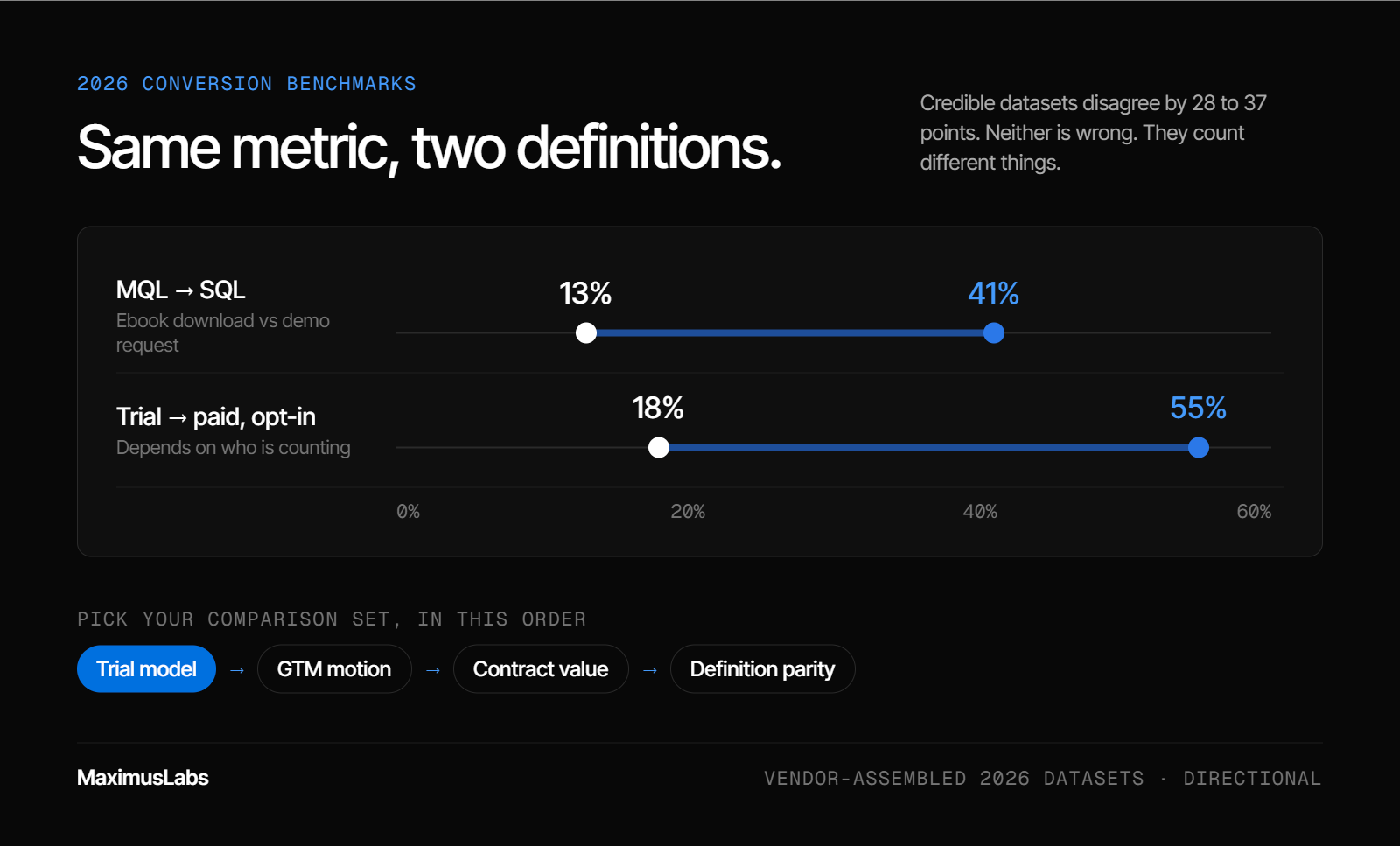
✅ How to pick your comparison set
Four filters, in this order:
Trial model. Opt-out, opt-in, or freemium. This single variable moves trial-to-paid by more than 40 points.
Go-to-market motion. Product-led, sales-led, or hybrid. Spike's 2026 data segments efficiency metrics by motion for this reason.
Average contract value. A $500 ACV funnel and a $50,000 ACV funnel share no benchmarks.
Definition parity. Confirm the source defines MQL and SQL the way your CRM does.
If a source does not publish its sample size, drop it. Prospeo's n=86 disclosure is the minimum bar I apply.
💰 The uncomfortable number belongs in the deck
MaximusLabs AI publishes conflicting benchmark ranges in client funnel audits rather than handing over a single tidy figure. When two credible datasets report MQL-to-SQL at 13% and 41%, quoting the flattering one manufactures false comfort, and the correction arrives later at a worse moment. Our trust-first content methodology means the range goes in the deck with both citations attached.
I will hedge one thing here. These medians come from vendor-assembled datasets, not audited financials, so I treat them as directional rather than precise. The ranking matters more than the decimal. A funnel two points under median on visitor-to-lead is fine. A funnel at 4% trial-to-paid while running opt-out trials has a real problem, and no median will tell you that. Only the segmented comparison will.
Q4. Which trial model converts best: opt-out, opt-in, or freemium?
Opt-out trials that require a card convert near 49%, opt-in trials near 18%, and freemium between 2.6% and 6%, based on data from 86 SaaS companies. Higher conversion does not mean higher revenue. Opt-out buys a conversion rate by shrinking top-of-funnel volume, and freemium buys volume by deferring revenue. Choose based on average contract value and sales motion, then hold every benchmark comparison inside that model.
⚖️ The three models, side by side
| Model | Trial-to-paid | What you trade away |
| Opt-out (card required) | about 49% | Signup volume, because the card is a gate |
| Opt-in (no card) | about 18% | Conversion rate, because intent is unproven |
| Freemium | 2.6% to 6% | Time to revenue, plus real support cost on non-payers |
All three ranges come from the same Prospeo 2026 dataset of 86 SaaS companies.
🧮 The arithmetic that settles most arguments
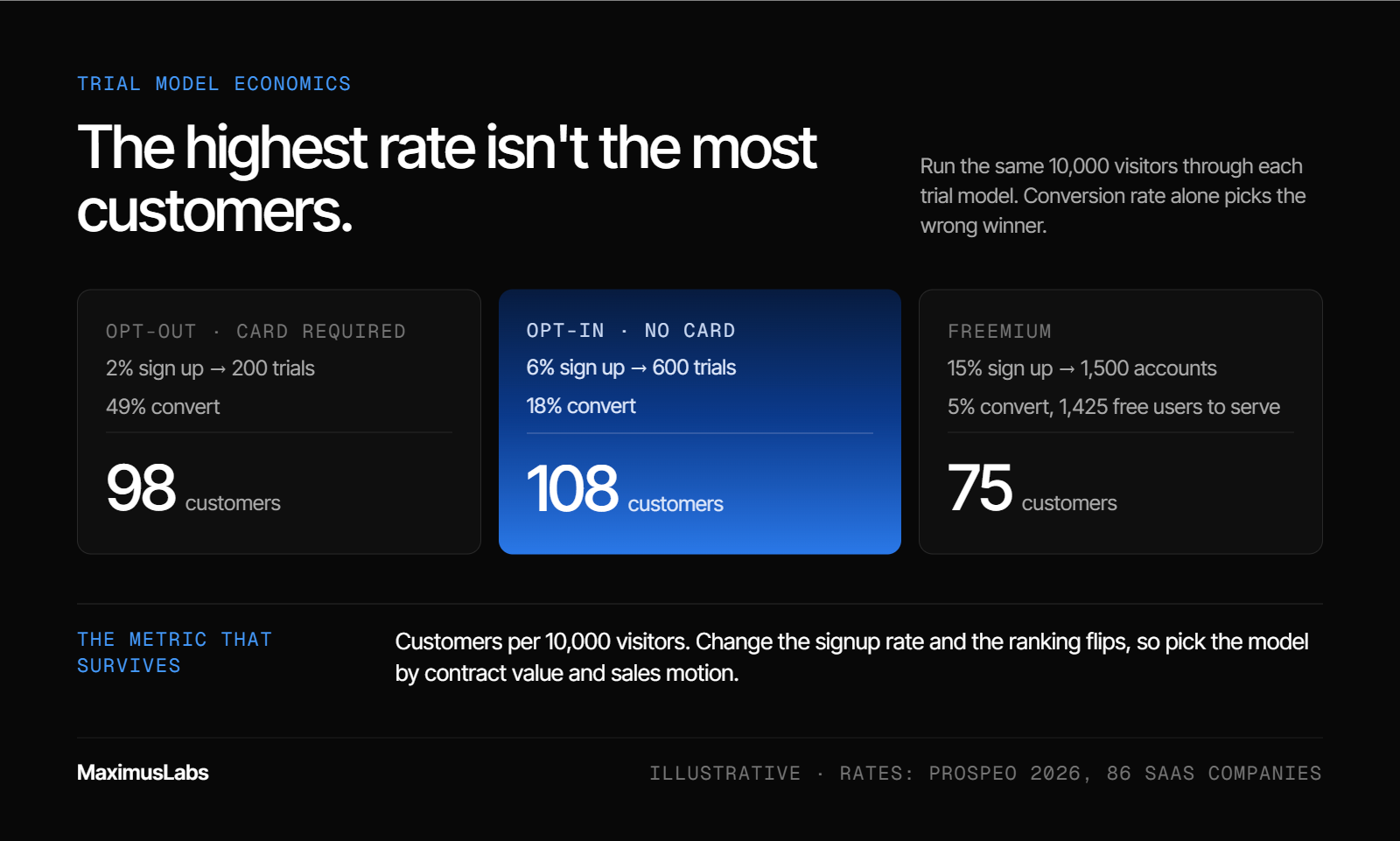
Run the same 10,000 visitors through each model and the rate stops looking decisive.
Opt-out at a 2% signup rate gives 200 trials. At 49%, that is 98 customers.
Opt-in at a 6% signup rate gives 600 trials. At 18%, that is 108 customers.
Freemium at a 15% signup rate gives 1,500 accounts. At 5%, that is 75 customers, plus the cost of serving 1,425 free users.
The ranking flips depending on the signup rate, which is why reporting trial-to-paid in isolation is misleading. The metric that survives this comparison is customers per 10,000 visitors, not conversion percentage.
🎯 The decision rule
Three questions decide it:
What is your ACV? Below roughly $2,000, self-serve economics favour opt-in or freemium, because nobody can afford a sales conversation. Above $25,000, the trial is a sales tool, and opt-out friction costs you qualified pipeline.
Does the product deliver value alone? Freemium needs a product that reaches value without onboarding help. If activation requires a human, free users churn before they convert.
Is your network effect real? Freemium pays for itself when free users attract paying ones. If they do not, you have bought a support queue.
❌ The mistake that shows up in almost every audit
Teams change the trial model and keep the old benchmark. A company moves from opt-out to freemium, watches trial-to-paid fall from 40% to 5%, and declares the funnel broken. It is not broken. It is a different funnel, and the comparison set changed with it.
MaximusLabs AI sets the benchmark baseline after the trial model is fixed, not before, and our revenue-focused GEO engagements start from that baseline. Agencies that report trial-to-paid against an industry median while a client runs freemium are comparing two different businesses and billing for the confusion.
I will admit the limits of my own view here. The 86-company dataset is a useful spread, but it does not segment by ACV, so the opt-out advantage may be partly a selection effect from higher-priced products choosing that model. If you have first-party data from your own pricing tests, trust it over any published median, including this one. When founders want a second read on which model their funnel economics support, they talk it through with our team before rebuilding the funnel.
Q5. Is TOFU "what is" content still worth funding?
For most SaaS companies, no. Definition-style posts now compete directly with AI answers that resolve the query without a click, and they convert at close to zero. Across a portfolio of SaaS sites, 19 of 20 landing pages drive little or no traffic while 1 in 20 drives roughly 85%. MaximusLabs AI skips TOFU "what is" content in client content plans and funds Bottom-of-Funnel and Middle-of-Funnel assets first.
📝 The content calendar everyone inherited
Open any SaaS content calendar and you will find the same pattern. Twenty definitional posts a quarter. "What is payroll compliance." "What is a sales qualified lead." The logic was sound once, because those posts ranked, and ranking brought the top of the funnel.
That logic assumed the definition page would get a click. Now the engine answers the question in the result itself, and the reader never arrives, which is the zero-click dynamic reshaping organic entry points.
⚠️ The 5% rule is a budgeting instrument
Here is the number that reframes the spend. Ethan Smith of Graphite, working across Webflow, Upwork, Notion, Rippling, and GlossGenius, found that 19 out of 20 landing pages drive little to no traffic, while one in 20 drives roughly 85% of all traffic.
His verdict on definitional content is sharper still:
"What is the definition of payroll, zero conversion rate ever. I would spend no time at all really on glossary definitions and low intent stuff. I would focus on the end of the journey and probably the middle of the journey."
Ethan Smith, CEO, Graphite
Treat that as a budget rule, not a statistic. If 5% of pages carry 85% of the result, the other 95% of your spend is available for reallocation right now.
✅ The honest counter-case
I will not pretend this is universal. Three situations justify TOFU spend.
New categories. If buyers do not know the problem has a name, someone has to name it. Category creation is education, and education is TOFU.
Brand plays with distribution. A definitional post that earns citations and mentions can feed the trust layer, even with weak direct conversion.
Technical definitions inside documentation. These behave like docs, not blogs, and engines cite them far more often.
Outside those three, MaximusLabs AI treats definitional pages as a cost line rather than a growth line. What surfaces in our client content audits is that most glossary libraries were built for a search behaviour that stopped existing.
💸 What to do on Monday
Run a four-step sunset pass on the blog.
Pull every URL with its 12-month conversions, not sessions.
Flag the pages with zero assisted conversions and a definitional title.
Check whether an AI Overview or chat answer now resolves that query directly.
Consolidate, redirect, or delete. Then move the freed budget to comparison pages and alternatives pages.
Eli Schwartz reached the same structural conclusion in Product-Led SEO: search optimisation improves visibility where demand already exists, and it does not manufacture demand that was never there. TOFU volume was always the weakest bet against that reality. AI answers simply removed the cover it had.
MaximusLabs AI prioritises BOFU and MOFU content and skips TOFU "what is" pages outright, because AI engines already answer definitional queries natively. Traditional agencies sell TOFU volume because it is cheap to produce and makes a traffic chart rise. MaximusLabs is measured on pipeline, not on pageviews, and Oliv AI's engagement produced 27 qualified leads, $47K+ pipeline, 26% close rate in 4 months.
Q6. How did AI answer engines become the new top of the funnel?
AI engines now perform the discovery step the TOFU blog used to own. AI Overviews trigger on 87% of B2B SaaS comparison searches and 73% of software how-to queries, while 65% to 85% of ChatGPT prompts map to no traditional keyword. The traffic is small but premium, and Webflow measured a 6x conversion difference between LLM-referred visitors and Google search traffic. MaximusLabs AI tracks prompt-level citation share across ChatGPT, Perplexity, Gemini, and AI Overviews as the funnel-entry metric.
📊 Where the discovery step moved
The evidence stacks in one direction. AI Overviews fire on 87% of "Tool A vs Tool B" searches in B2B SaaS, and on 73% of "how to do X with software" queries. On those how-to queries, vendor documentation holds a 34% to 41% citation share against 15% to 18% for blogs.
Semrush, analysing over one billion lines of US clickstream data, found ChatGPT runs a live web search on only 34.5% of prompts, and that most prompts have no keyword equivalent. Your keyword tool cannot show you the questions that now start the funnel, which is why AEO question research replaces it.
⭐ Why the traffic converts so much better
Small volume, high quality. Adobe data cited in the Semrush AI Visibility Index 2026 shows AI-referred visitors convert 60% better and generate 53% more revenue per visit. Ethan Smith reports the same effect at a larger multiple:
"Web Flow we saw a 6x conversion rate difference between LLM traffic and Google search traffic."
Ethan Smith, CEO, Graphite
The mechanism is multi-turn intent. A buyer asks four or five follow-up questions inside the chat, compares options, and arrives already convinced. Webflow generated 8% of total signups from LLM discovery on the back of task-focused video content and disclosed Reddit participation.
⚠️ Citation share is noisy, so measure it as a range
One check tells you nothing. Rand Fishkin of SparkToro and Patrick O'Donnell of Gumshoe.ai ran 2,961 prompts and found the same brand list repeated in under one case in 100. Kevin Indig's analysis of 815,000 prompt-page pairs found roughly 2.2% citation stability across three identical runs.
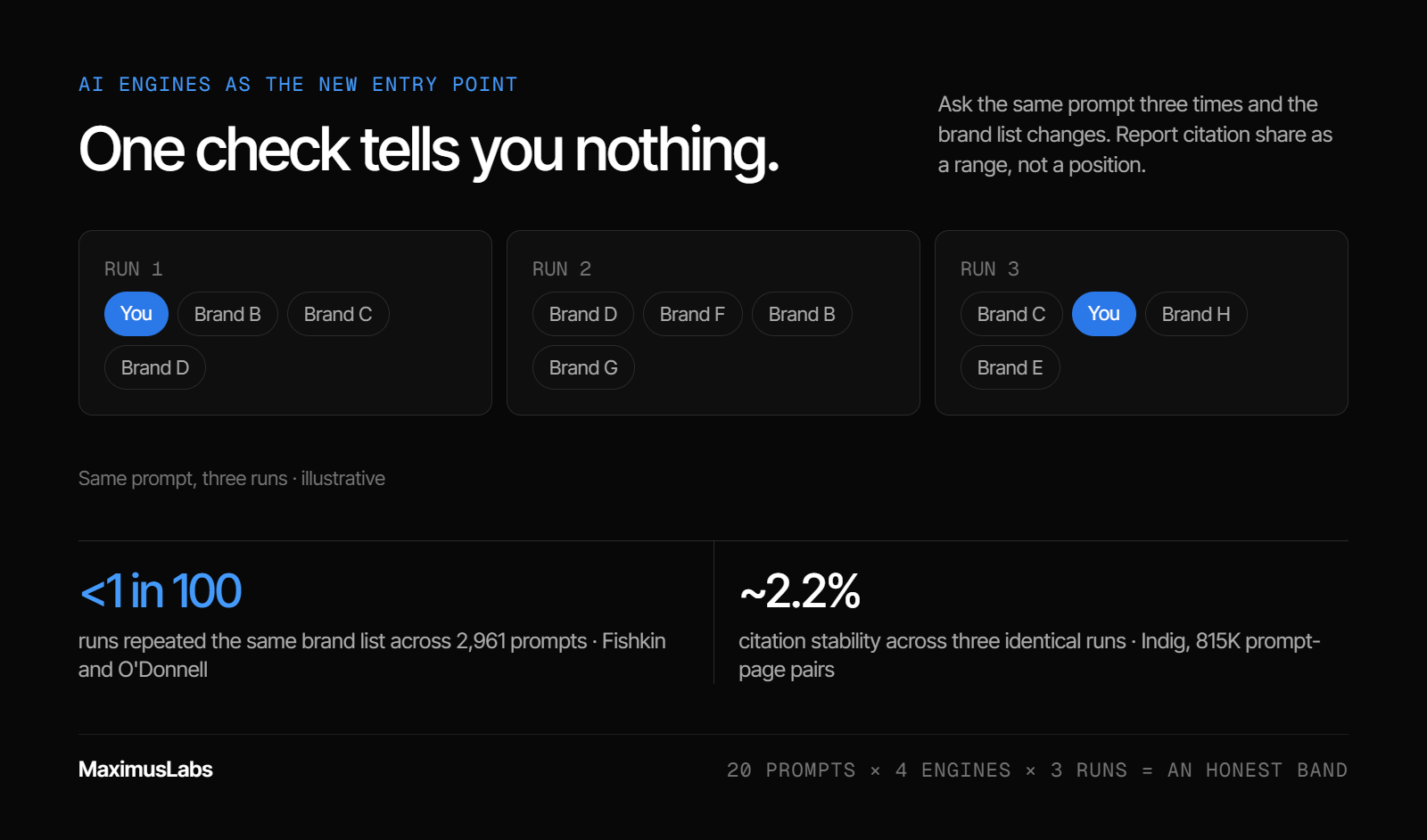
MaximusLabs AI runs daily AI-visibility tracking across every major engine, re-run and regression-tested, and reports citation share as a range rather than a single position. Our AEO measurement approach exists for that reason. I would rather hand a VP Marketing an honest band than a precise number that changes by Thursday.
⏰ Build your prompt inventory this week
Three steps, no tooling budget required to start.
Write down the 20 questions your buyers ask before a demo. Pull them from sales calls, not keyword tools.
Run each one in ChatGPT, Perplexity, Gemini, and Google AI Mode. Record whether you appear and which sources the engine quoted.
Repeat the whole set three times. Report a range.
Then ask the real question. Of the sources the engine quoted, how many do you control? Usually very few, which is why the next section matters more than your blog does.
MaximusLabs AI starts every engagement with a prompt inventory instead of a keyword list, because most AI prompts have no keyword equivalent to export. Our citation-intelligence work maps which sources each engine actually trusts, then works to get the client into those sources. Oliv AI reached a 64% AI citation rate in 6 months, vs ~30% for billion-dollar incumbents.
Q7. What MOFU and BOFU content actually captures demand?
Build Bottom-of-Funnel first: master articles, competitor comparison matrices, alternatives listicles, and conversion-ready product pages. Then add Middle-of-Funnel problem-solution content. Content captures existing demand rather than creating it, because search is an optimisation channel and not a demand-creation channel. MaximusLabs AI sources topics from recorded sales calls instead of keyword tools, because logged buyer objections outperform inferred search volume.
🎯 The build order, in priority sequence
Ship in this order. Each step feeds the next.
Master article for your core category. The definitive answer on the problem your product solves, written for a buyer with budget.
Comparison matrices. "You vs named competitor," with a real table. AI Overviews trigger on 87% of these queries, so the page has an engine waiting for it.
Alternatives listicles. "Alternatives to [incumbent]." Buyers search these when they are already unhappy.
Conversion-ready product and use-case pages. One page per job your product does, not one page per feature.
MOFU problem-solution content. How to solve the problem, with your product as one honest path.
That sequence is the backbone of our B2B SaaS AEO strategy work.
📞 Mine the sales calls, not the keyword tool
The best MOFU topics are already recorded. Pull transcripts from Gong or Chorus, which are conversation-intelligence tools that record and index sales calls, and extract three things: the objections that repeat, the integration questions, and the exact phrasing buyers use for the problem.
That phrasing matters more than it used to. Since most AI prompts have no keyword equivalent, the transcript is often the only place the real question exists in writing. MaximusLabs AI builds per-client intelligence graphs, where AI agents research the market and reason over each client's own context, and the call transcripts feed that layer directly.
✅ What makes a BOFU page citable
The Princeton, IIT Delhi, and Georgia Tech GEO paper tested nine optimisation tactics across 10,000 queries. Adding statistics, citing credible sources, and including quotations produced the largest visibility gains, while keyword stuffing hurt.
One honest caveat, because the headline number gets repeated carelessly. The paper's own deployed-engine test showed statistics addition gaining about 8.7%, not the 30% to 40% figure quoted from the benchmark environment. The direction holds. The magnitude is smaller in the wild, and our citation-worthy content standards are built on the deflated figure.
❌ The reality check nobody sells
BOFU content captures demand. It does not invent it. Eli Schwartz described the moment this landed for him:
"When I embarked on my first effort to help a SaaS B2B company with its SEO, I was also under the illusion that this was going to be a supremely profitable channel. I was eventually confronted with a wall of reality."
Eli Schwartz, Author, Product-Led SEO
His conclusion: a product sold to a very specific niche B2B audience will not create new demand through SEO best practices. So if your category has 400 buyers in the world, no funnel fixes that. Account-based motion does.
MaximusLabs AI writes BOFU assets with the client's positioning intact and the founder's perspective inside them, which is the part commodity content shops cannot replicate. Our founder-voice methodology exists for that reason. A comparison page written by someone who never heard the founder explain why the product exists reads like a feature table, and engines have no reason to cite a feature table.
Q8. Why do G2, Capterra, and Reddit decide your BOFU funnel?
Because AI engines cite other people's pages about you more than your own. Brand web mentions correlate with AI Overview visibility at r=0.664 against 0.218 for backlinks, and brands are 6.5x more likely to be cited through third-party content. After G2 acquired Capterra, Software Advice, and GetApp for roughly $110M on February 5, 2026, the G2 family controls about 84% of review-site citations in BOFU B2B queries. MaximusLabs AI runs Earned AEO on those third-party surfaces alongside owned content.
🏗️ The site you built is not the site being quoted
Most SaaS teams spend years on their own pages. That is the surface they control, so that is the surface they optimise. Then they check which sources an AI engine quoted for "best tool in category" and find G2, Capterra, Reddit, and a listicle from a publication they have never pitched.
Ahrefs studied 75,000 brands and found web mentions, linked and unlinked, correlate with AI Overview presence at r=0.664, roughly three times stronger than backlinks at 0.218. Top-quartile brands averaged 169 AI Overview mentions against 14 for the rest.
⚠️ The review gate got narrower in February
The consolidation matters. G2 bought Capterra, Software Advice, and GetApp from Gartner for roughly $110M, closing February 5, 2026. One entity now sits behind about 84% of review citations in commercial B2B answers.
The gate is close to absolute at the entry level. Of the tools ChatGPT names in software recommendations, 100% had Capterra reviews and 99% had a G2 profile. A missing profile is not a weak signal. It is an absence from the sample set.
⚖️ Owned versus earned, split by query type
| Query type | Example | What wins |
| Long-tail integration | "How to connect X with Y" | Owned docs and feature pages |
| Mid-tail use case | "Best CRM for small SaaS teams" | Mixed, owned content plus citations |
| Head category | "Best CRM software" | Earned, G2, Capterra, and roundups |
Roughly 85% of brand mentions come from external sources, so head queries are an earned game. MaximusLabs AI runs both pillars for this reason: Owned AEO, where your content becomes the answer, and Earned AEO, where reviews, Reddit, press, and listicles make engines trust you. Most agencies only do the first.
💬 Reddit stopped being optional
AI-referred visits to Reddit grew 76x according to Semrush clickstream data. Practitioner threads now sit inside the retrieval set for commercial queries, which makes community sentiment a funnel input rather than a brand-safety concern, and forum AEO becomes part of the plan.
Krishna Kaanth has run this work directly, mapping the buyer journey for a California nutrition brand while conducting targeted sentiment work on Reddit and LinkedIn with full identity disclosure. BOFU pages reached the top 20 while recommendation consensus shifted across AI answers. My read is that disclosure is the whole trick. Undisclosed brand participation gets detected, downvoted, and cached.
✅ The Monday plan
Four moves, in order. Claim and complete your G2 and Capterra profiles. Set a monthly review-request cadence tied to a product milestone. Identify the three subreddits your buyers actually read. Then list the roundups engines quote for your head query and work out who writes them.
MaximusLabs AI treats third-party surfaces as funnel infrastructure, not public relations. Review velocity, disclosed community participation, and placement in the roundups engines quote make up Search Everywhere Optimization. Oliv AI now reports 30-40% of inbound as AI-sourced.
Q9. What technical setup makes a funnel AI-discoverable?
Three moves make a funnel AI-discoverable. Publish a technical documentation hub, because onboarding guides, feature references, integration docs, and API docs are cited at 10 to 15 times the rate of editorial blogs, with a 34% to 41% median citation rate against 15% to 18% for blogs. Lead every page with a 30 to 60 word answer block inside the top 30% of body text, which earns a 44.2% citation share. Then close the sameAs entity loop across Wikidata, LinkedIn, Crunchbase, and G2. MaximusLabs AI implements that entity loop as standard client setup.
📚 Why docs beat blogs for citation
Documentation wins because of its shape, not its subject. Each page is structured, self-contained, and answer-dense, so a retrieval system can lift one block without needing the rest.
Blog posts do the opposite. They build narrative context before the answer arrives, which makes any single chunk weaker on its own. On "how to do X with software" queries, vendor documentation holds 34% to 41% of citations while blogs hold 15% to 18%, which is why our content formatting standards for AI search treat docs as the priority surface.
⭐ Put the answer in the first 30% of the page
Answer placement is measurable. Direct answer blocks positioned in the top 30% of body text earn a 44.2% citation share, following what practitioners call a ski-ramp distribution. Citation probability drops steeply as the answer moves down the page, a pattern our answer structure guidance is built around.
The research supports the underlying move. The Princeton, IIT Delhi, and Georgia Tech GEO paper tested nine tactics across 10,000 queries and found that adding statistics, citing credible sources, and including quotations drove the biggest visibility gains.
One honest correction, since the headline gets quoted loosely. The same paper's deployed-engine test showed statistics addition gaining roughly 8.7%, not the 30% to 40% range from the benchmark setup. MaximusLabs AI publishes the deflated figure in client decks rather than the marketable one, because the smaller number is the one that survives contact with a real engine.
🔗 Close the entity loop
Engines need to resolve your brand to a single set of facts. Schema.org's Organization type supports a sameAs property for exactly this, linking your site to authoritative profiles elsewhere. Google's structured data guidelines treat these as entity reconciliation signals.
MaximusLabs AI closes this loop as standard setup. Organization schema links sitewide to Wikidata, Crunchbase, LinkedIn, and the G2 profile, including the Wikidata G2 Product ID property P12136. It takes an afternoon. Most SaaS sites we audit have never done it, which is why engines sometimes describe a product in a competitor's language. Our entity optimization work starts there.
✅ The implementation checklist
Work through these in order. Each one is a half-day job at most.
Docs hub first. Onboarding, feature reference, integrations, API. One answer per page, stated in the first paragraph.
BLUF everywhere. A 30 to 60 word answer under every heading, before the context.
Organization schema. Sitewide, with sameAs pointing to Wikidata, LinkedIn, Crunchbase, and G2.
Wikidata item. Create or correct it, and add the G2 Product ID.
Supporting schema. Article, Product, Dataset for benchmark tables, and ImageObject for diagrams. Our schema markup basics cover the full set.
llms.txt. A plain-text map of your highest-value pages at the site root, which the llms.txt generator builds in a minute.
Docs are a marketing asset here, not a support artifact. I would move documentation ownership into the content roadmap outright, and MaximusLabs AI treats it that way in client plans. Oliv AI reached a 64% AI citation rate in 6 months, vs ~30% for billion-dollar incumbents.
Q10. How do you tell a real funnel leak from broken attribution?
Run stage-to-stage drop-off against segmented benchmarks, then test whether the drop is real. Roughly 90% of multi-touch SaaS discovery gets misattributed to Direct or branded search under last-touch analytics, and more than 70% of AI-assisted journeys land as Direct. If a stage looks broken but pipeline quality held, the problem is an attribution gap and not a conversion gap. MaximusLabs AI installs self-reported attribution before changing any landing page.
📉 The leak that was never a leak
A VP Marketing opens the funnel dashboard and sees organic-sourced MQLs down 35% quarter over quarter. Direct traffic is up. Demo requests held steady, and close rates actually improved slightly.
That is not a leaking funnel. That is a funnel whose top moved somewhere the tracking cannot see. Kevin Indig's analysis of 815,000 prompt-page pairs found more than 70% of AI-assisted journeys recorded as direct traffic. The visit is real. The origin is missing.
⚠️ The two-column diagnostic
Before any CRO work, sort the evidence into two columns.
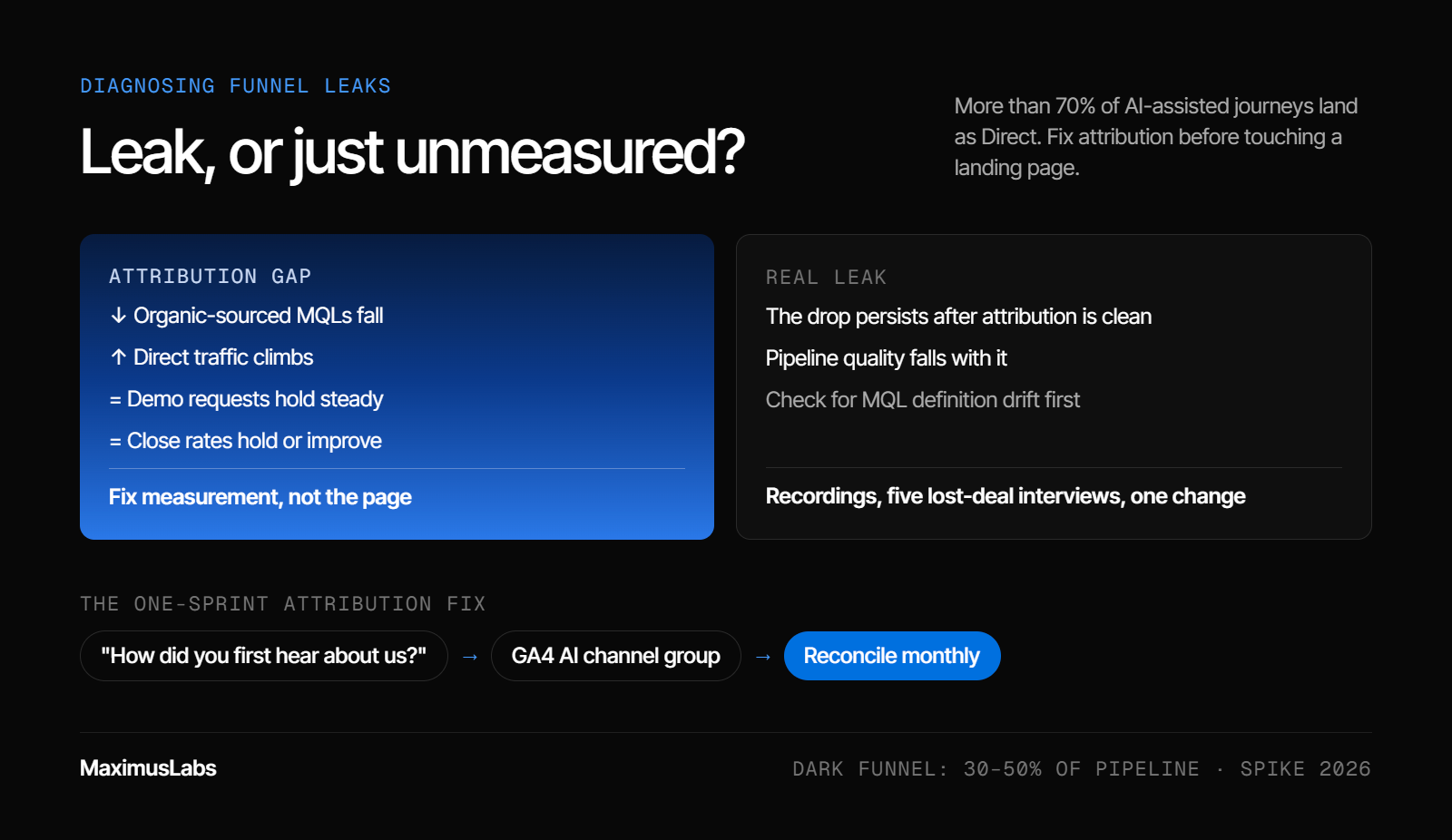
| Points to a conversion leak | Points to an attribution gap |
| Drop-off worsened at one specific step | Drop appeared across several stages at once |
| Lead quality fell with volume | Lead quality held or improved |
| A page, form, or pricing change shipped nearby | No page changes, but Direct rose |
| Session recordings show friction | Self-reported sources name channels you do not track |
Spike's 2026 benchmarks put dark-funnel influence at 30% to 50% of pipeline, which is invisible to last-touch models by definition. So a quarter where Direct climbs while quality holds is the most common false alarm I see, and it is exactly the attribution obstacle AI search introduced.
⏰ The fix takes one sprint
Three steps, all cheap.
Add a self-reported field. One question at signup or demo request: "How did you first hear about us?" Free text beats a dropdown, because buyers name tools your dropdown does not list.
Create a GA4 custom channel group for AI referrals. Google's attribution documentation supports custom groupings, and the default channel set does not isolate AI engines.
Reconcile monthly. Compare self-reported sources against GA4's last-click view. The gap is your dark funnel, quantified.
MaximusLabs AI runs this before touching a landing page. It is one form field and one channel group, and it routinely shows that a "broken" mid-funnel stage was simply unmeasured. Our GEO revenue attribution approach depends on it.
✅ When the leak is real
Once attribution is clean and the drop persists, run a tight loop on the confirmed stage.
Pull session recordings for the exact step, not the whole funnel.
Check definition drift. A changed MQL rule can move the handoff rate 20 points with no behaviour change.
Interview five lost deals from that stage. Five is enough to find the pattern.
Ship one change, measure for a full sales cycle, and resist stacking tests.
MaximusLabs AI's read is that the standard advice gets this backwards. The category rushes to CRO because CRO is billable, while attribution cleanup is unglamorous and takes a sprint. I might be overweighting this, since our sample skews toward B2B SaaS with long buying cycles, where the measurement gap is widest. Oliv AI now reports 30-40% of inbound as AI-sourced, a share no last-touch model would have surfaced.
Q11. How do you tie funnel targets to ARR and retention economics?
Start at the ARR target, divide by average contract value to get required closed-won deals, then work upward through win rate, SQL-to-opportunity, MQL-to-SQL, and visitor-to-lead. That produces a pipeline-coverage requirement of 3x to 5x, not a traffic target. Then test whether the funnel compounds, because median net revenue retention of 106% against gross retention of 90% means expansion is covering for churn. MaximusLabs AI reports client performance on influenced pipeline and prompt-level citation share rather than impressions.
🧮 The backward model, step by step
Six steps. Run them in this order, top-down from revenue.
New ARR target divided by average contract value equals deals needed.
Deals divided by win rate equals opportunities needed.
Opportunities divided by SQL-to-opportunity rate equals SQLs needed.
SQLs divided by MQL-to-SQL rate equals MQLs needed.
MQLs divided by lead-to-MQL rate equals leads needed.
Leads divided by visitor-to-lead rate equals the visibility requirement.
💰 Worked example at $2M new ARR
Take a $20,000 average contract value and a 25% win rate.
$2M divided by $20K gives 100 deals. At 25% win rate, that is 400 opportunities. At a 50% SQL-to-opportunity rate, 800 SQLs. Using the conservative 13% MQL-to-SQL figure, roughly 6,150 MQLs. At a 31% lead-to-MQL rate, about 19,800 leads. At 2.4% visitor-to-lead, roughly 825,000 qualified sessions, using the Oliver Munro and Prospeo 2026 inputs.
That last number is where most plans break. If 825,000 sessions is not reachable, the fix is not more content. It is a higher-intent entry point, which is the whole argument for AI citation work and BOFU pages over blog volume.
⚠️ Pipeline coverage, not traffic
Boards do not fund sessions. They fund coverage, which is the ratio of open pipeline to quota, typically 3x to 5x.
So convert step 2 into coverage. 400 opportunities at $20K is $8M of pipeline against a $2M target, which is 4x. That sentence survives a board meeting. A traffic chart does not.
🔁 The compounding layer nobody models
Now check whether the funnel holds what it wins. Median net revenue retention sits at 106% and gross revenue retention at 90%, per Spike's 2026 GTM benchmarks. The 16-point gap is expansion revenue masking churn.
Run the same math on CAC payback. If payback exceeds 18 months while gross retention sits at 90%, the funnel is renting revenue, not building it. MaximusLabs AI flags this in audits because the fix is usually product or onboarding, not acquisition, and no amount of funnel work corrects it.
✅ What the dashboard should show
Four lines, in this order: influenced pipeline, pipeline coverage, CAC payback, and net revenue retention. Citation share sits above them as the leading indicator, which is how our revenue-focused GEO framework is sequenced.
Traffic spikes without qualified leads or recurring revenue contribution are noise. MaximusLabs AI opens every monthly review with pipeline contribution and closes with which prompts we gained or lost, because a traffic chart has never answered a board question about CAC payback. Oliv AI's engagement produced 27 qualified leads, $47K+ pipeline, 26% close rate in 4 months.
Q12. Should you buy an AEO tracking tool or build your own?
Buy the cheapest tool that answers your questions, or build it. Over 60 Answer Engine Optimization (AEO) trackers charge hundreds to thousands per month for one function, which is pinging a prompt, recording whether you appeared, and charting it, while in-house versions cost a few cents per question. Roughly 95% of these platforms query vendor API endpoints rather than live logged-in UI sessions, which return different citation mixes than real users see. MaximusLabs AI runs its own daily visibility tracking rather than reselling a dashboard.
💸 The commodity trap
A Head of Organic Growth signs a $1,200 per month tracker, builds a dashboard, and shows the board a citation chart. The chart moves. Pipeline does not. Ethan Smith of Graphite put the market plainly:
"We have a page with 60+ AEO tools and they all do the same thing: They all do tracking. You just put a question in and you say, 'Did you show up? Yes/no,' and then you put it somewhere and you chart it. It's not that hard to build. We actually built our own, I think it costs us a few cents per question."
Ethan Smith, CEO, Graphite
His closing call is the one I would act on:
"Pick the tool that does what you want and has the lowest cost. And two years from now, you'll probably be using Ahrefs anyway."
Ethan Smith, CEO, Graphite
That prediction is already visible. Semrush and Ahrefs both ship AI visibility features inside existing subscriptions. Standalone trackers are being bundled into tools you already pay for, as our AEO tools comparison lays out.
⚠️ API responses are not what your buyer sees
The accuracy problem matters more than the price. Most platforms hit vendor API endpoints, which are not the same surface as a logged-in browser session. Personalisation, memory, and live retrieval all change the citation mix.
Volatility compounds the issue. Rand Fishkin and Patrick O'Donnell ran 2,961 prompts and saw the same brand list repeat in under one case in 100. Kevin Indig measured roughly 2.2% citation stability across three identical runs. A single-run dashboard reports noise as signal, which is the core limitation of most AI visibility tracking tools.
⚖️ The honest comparison
| Option | What it gives you | What it costs |
| Standalone AEO tracker | Fast setup, prompt dashboards | Monthly fee, API-based data, likely bundled away |
| Build in-house | Live UI scraping, full control | Engineering time, maintenance |
| Bundled suite feature | Already paid for, familiar reporting | Shallower prompt coverage today |
| MaximusLabs AI | Daily tracking plus execution on the gaps | Tracking is not sold separately |
✅ The decision rule
Three questions settle it. Do you have an engineer with a spare week? Build it. Do you already pay for Semrush or Ahrefs? Use what is bundled and wait. Neither? Buy the cheapest tool that covers your prompt list, and cap the spend at a small fraction of your content budget.
MaximusLabs AI does not resell a tracking dashboard, because knowing where you stand does not cause an outcome. We put the measurement budget into execution, meaning BOFU assets, documentation hubs, review velocity, and entity cleanup, and we report citation share from repeated live runs. The difference shows up in pipeline, not in a chart, and founders who want that read can start a conversation with our team.
Frequently asked questions
What is a SaaS marketing funnel, and what changed in 2026?
A SaaS marketing funnel is the staged path a buyer takes from problem awareness to becoming a retained, expanding subscriber. The classic model has five stages: awareness, consideration, conversion, retention, and expansion. What changed in 2026 is where the funnel actually starts. Buyers now form their shortlist inside ChatGPT, Perplexity, Gemini, and Google AI Overviews before they visit any vendor site. Legacy blog-led playbooks report 20% to 40% organic traffic declines as a result. That makes funnel entry a citation problem, not a ranking problem: • When a buyer asks an AI engine for the best tools in a category, it names five to ten. That list is the evaluation set. • Roughly 65% to 85% of AI prompts have no traditional keyword equivalent, so keyword tools cannot see them. • Absence from the generated shortlist means absence from the buying conversation, regardless of product quality. MaximusLabs AI builds funnels backward from the AI answer rather than forward from a publishing calendar, starting with the prompt set buyers actually type. Our research on the B2B SaaS buyer journey in AI search maps how that discovery step moved. Practically, add one layer above awareness on your funnel diagram and label it citation.
What conversion rates should each SaaS funnel stage hit in 2026?
Published 2026 figures give you a starting range, not a verdict. Visitor-to-lead sits at 2.3% to 2.4%, lead-to-MQL near 31%, median net revenue retention at 106%, gross revenue retention at 90%, and annual churn around 3.5%. The disagreements matter more than the medians: • MQL-to-SQL is reported at 13% in one dataset and 41% in another, because companies define MQL differently. • Trial-to-paid for opt-in trials appears as both 18% and 55% depending on who is counting. • Sample sizes are often undisclosed, which makes the number unusable for comparison. Before you set a target, filter your comparison set by trial model, go-to-market motion, average contract value, and definition parity with your own CRM. A $500 ACV funnel and a $50,000 ACV funnel share no benchmarks. MaximusLabs AI publishes conflicting benchmark ranges in client funnel audits rather than handing over a single tidy figure, because quoting the flattering number manufactures false comfort that corrects itself later at a worse moment. That principle sits at the centre of our trust-first content playbook. Treat these medians as directional, since they come from vendor-assembled datasets rather than audited financials.
Which trial model converts best: opt-out, opt-in, or freemium?
Opt-out trials that require a card convert near 49%, opt-in trials near 18%, and freemium between 2.6% and 6%, based on data from 86 SaaS companies. Higher conversion does not mean higher revenue. Run 10,000 visitors through each model and the ranking flips: • Opt-out at a 2% signup rate gives 200 trials and 98 customers. • Opt-in at a 6% signup rate gives 600 trials and 108 customers. • Freemium at a 15% signup rate gives 1,500 accounts and 75 customers, plus the cost of serving 1,425 free users. So the metric that survives comparison is customers per 10,000 visitors, not conversion percentage. Three questions decide the model: what is your ACV, does the product reach value without human onboarding, and is the network effect real enough that free users attract paying ones? The common mistake is changing the model and keeping the old benchmark. A move from opt-out to freemium drops trial-to-paid from 40% to 5%, and teams declare the funnel broken when it is simply a different funnel. MaximusLabs AI sets the benchmark baseline after the trial model is fixed, which is how our revenue-focused GEO framework ties content targets to real funnel geometry.
How do I tell a real funnel leak from broken attribution?
Test the measurement before you touch the landing page. Roughly 90% of multi-touch SaaS discovery is misattributed to Direct or branded search under last-touch analytics, and more than 70% of AI-assisted journeys land in analytics as Direct. Sort the evidence into two columns: • Conversion leak signals. Drop-off worsened at one specific step, lead quality fell with volume, a page or pricing change shipped nearby, and session recordings show friction. • Attribution gap signals. The drop appeared across several stages at once, lead quality held or improved, no page changes shipped, yet Direct traffic rose. Dark-funnel influence is estimated at 30% to 50% of pipeline, which is invisible to last-touch models by definition. A quarter where Direct climbs while quality holds is the most common false alarm. The fix takes one sprint. Add a free-text "How did you first hear about us?" field at signup, create a GA4 custom channel group for AI referrals, and reconcile self-reported sources against last-click monthly. MaximusLabs AI installs self-reported attribution before changing any page, because it routinely reveals that a "broken" mid-funnel stage was simply unmeasured. Our work on GEO revenue attribution depends on closing that gap first.
Is TOFU what-is blog content still worth funding for SaaS?
For most SaaS companies, no. Definition-style posts now compete directly with AI answers that resolve the query without a click, and they convert close to zero. The distribution data is blunt. Across a portfolio of SaaS sites, 19 of 20 landing pages drive little or no traffic while one in 20 drives roughly 85% of the total. Treat that as a budgeting rule: if 5% of pages carry the result, the other 95% of your spend is available for reallocation. Three situations still justify TOFU spend: • New categories where buyers do not know the problem has a name yet. • Brand plays with distribution where a definitional page earns mentions that feed the trust layer. • Technical definitions inside documentation, which behave like docs and get cited far more often than blogs. Outside those three, run a sunset pass. Pull every URL with 12-month conversions rather than sessions, flag definitional titles with zero assisted conversions, check whether an AI answer now resolves the query, then consolidate or redirect and move the budget to comparison and alternatives pages. MaximusLabs AI prioritises BOFU and MOFU assets and skips TOFU what-is pages outright, a stance set out in our AI content strategy planning guidance.
Why do G2, Capterra, and Reddit decide which tools AI engines recommend?
Because AI engines cite other people's pages about you more often than your own. Brand web mentions, linked and unlinked, correlate with AI Overview visibility at r=0.664 against 0.218 for backlinks, and brands are roughly 6.5 times more likely to be cited through third-party content. The review layer is close to a hard gate. Of the tools ChatGPT names in software recommendations, 100% had Capterra reviews and 99% had a G2 profile. After G2 acquired Capterra, Software Advice, and GetApp for roughly $110M in February 2026, one family controls about 84% of review-site citations in commercial B2B answers. Where you win depends on the query type: • Long-tail integration queries favour your owned documentation and feature pages. • Head category queries like "best CRM software" are an earned game, dominated by review sites and roundups. Reddit also stopped being optional, since AI-referred visits to the platform grew sharply and practitioner threads now sit inside the retrieval set. MaximusLabs AI treats these third-party surfaces as funnel infrastructure rather than public relations, combining review velocity with disclosed community participation. Our approach to AI citation acquisition starts with the sources each engine already trusts.
How do I reverse engineer SaaS funnel targets from an ARR goal?
Work top-down from revenue, not bottom-up from traffic. Six steps produce the model: • New ARR target divided by average contract value equals deals needed. • Deals divided by win rate equals opportunities needed. • Opportunities divided by SQL-to-opportunity rate equals SQLs needed. • SQLs divided by MQL-to-SQL rate equals MQLs needed. • MQLs divided by lead-to-MQL rate equals leads needed. • Leads divided by visitor-to-lead rate equals the visibility requirement. Take a $2M new ARR target at $20,000 ACV and a 25% win rate. That is 100 deals, 400 opportunities, 800 SQLs at a 50% opportunity rate, roughly 6,150 MQLs using the conservative 13% handoff figure, about 19,800 leads, and around 825,000 qualified sessions at 2.4% visitor-to-lead. That final number is where most plans break. If 825,000 sessions is unreachable, the answer is a higher-intent entry point rather than more content. Then convert step two into pipeline coverage, which boards actually fund at 3x to 5x. Finally, check CAC payback against 90% gross retention, because a funnel that pays back past 18 months is renting revenue. MaximusLabs AI reports client performance on influenced pipeline and citation share, which our GEO measurement and metrics framework sequences in that order.